Why the Disciples Truly Honor the Buddha
The fifth reason unfolds into a remarkably broad curriculum: the 37 bodhipakkhiyā dhammas, eight vimokkhā, eight abhibhāyatanāni, ten kasiṇāyatanāni, four jhānas, higher knowledges and finally āsavakkhaya.
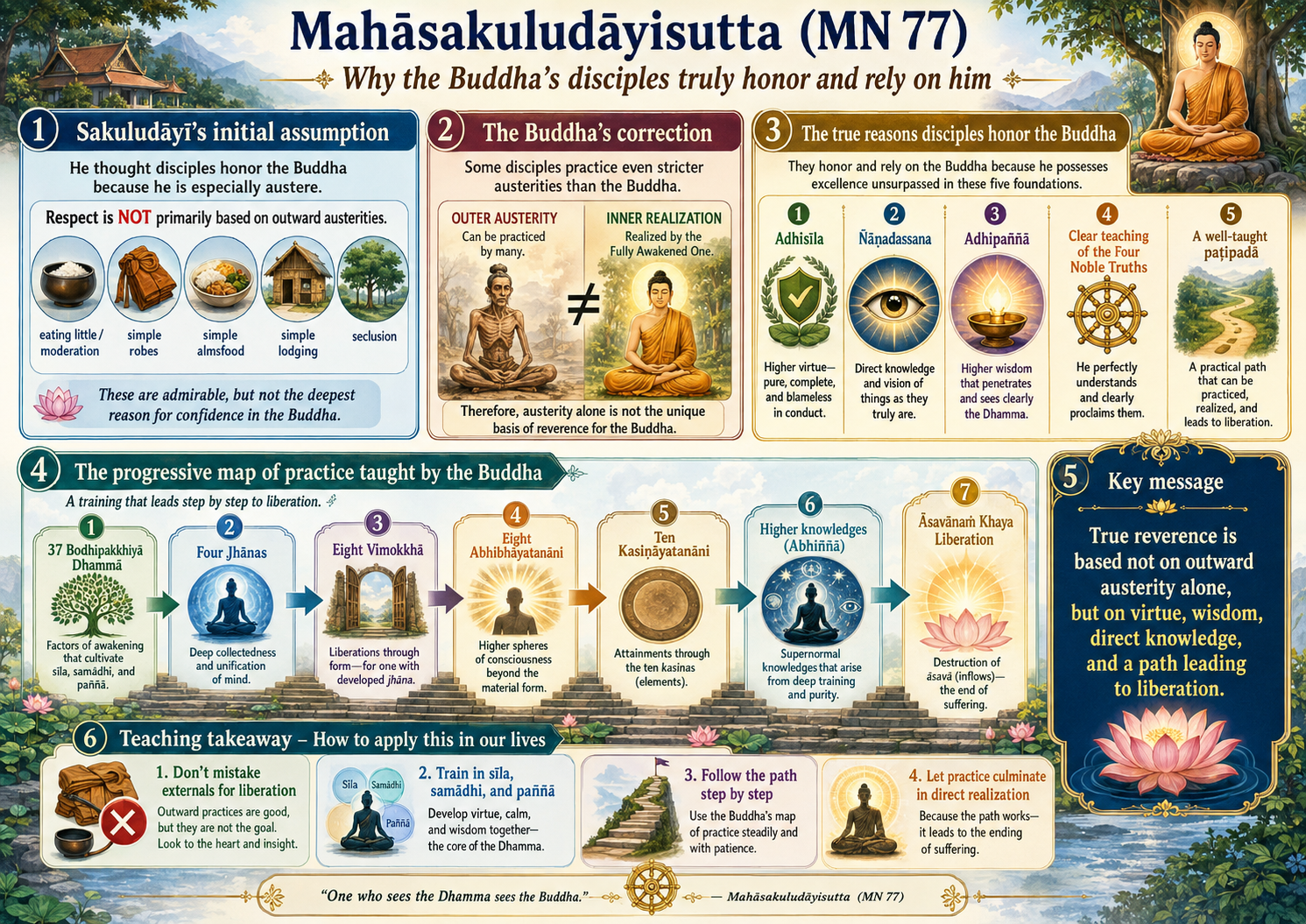 VISUAL SUMMARYSee this sutta in a pictureOpen the complete infographic for a visual overview before or after reading the full study.View infographic →
From receptivity and adhisīla to āsavakkhaya
Why this sutta is so important. The discourse begins as a discussion about why a spiritual community genuinely respects its teacher. Udāyī assumes the answer is austerity. The Buddha corrects him and grounds authentic reliance in higher virtue, direct knowledge-and-vision, higher wisdom, mastery of the Four Noble Truths, and—above all—a paṭipadā that disciples can themselves develop to consummation. That fifth reason unfolds into one of the widest practice maps in the Majjhima Nikāya.
What is rejected as sufficient — and what the Buddha actually emphasizes
Udāyī’s five outward reasons — rejected as sufficient
| Pāli | Meaning | Why insufficient |
|---|---|---|
| Appāhāra | Eating little | Some disciples eat much less. |
| Cīvara-santuṭṭhi | Contentment with robes | Some disciples are stricter rag-robe wearers. |
| Piṇḍapāta-santuṭṭhi | Contentment with food | Some disciples accept only austere almsround food. |
| Senāsana-santuṭṭhi | Contentment with lodging | Some remain under trees/open air for months. |
| Paviveka | Seclusion | Some live deeper in wilderness than the Buddha generally does. |
The Buddha’s actual five reasons
| Pāli | Meaning | Training implication |
|---|---|---|
| Adhisīla | Higher virtue | Supreme aggregate of ethical integrity. |
| Abhikkanta ñāṇadassana | Excellent knowledge & vision | Teaches from knowing, with causal basis and demonstrability. |
| Adhipaññā | Higher wisdom | Can meet arguments in accordance with Dhamma. |
| Cattāri ariyasaccāni | Four Noble Truths | Can diagnose and answer the actual problem of dukkha. |
| Akkhātā paṭipadā | Clearly taught path | Disciples develop it and reach consummation. |
The 37 dhammas on the side of awakening
| Count | Group | Content |
|---|---|---|
| 4 | Satipaṭṭhānā | Body, feeling, mind, dhammas |
| 4 | Sammappadhānā | Prevent, abandon, arouse, maintain |
| 4 | Iddhipādā | Chanda, viriya, citta, vīmaṁsā + samādhi/striving |
| 5 | Indriyāni | Saddhā, viriya, sati, samādhi, paññā |
| 5 | Balāni | The same five matured as powers |
| 7 | Bojjhaṅgā | Sati, dhamma-vicaya, viriya, pīti, passaddhi, samādhi, upekkhā |
| 8 | Ariyo aṭṭhaṅgiko maggo | Right view through right samādhi |
| 37 | All are presented as dhammas to be bhāveti — developed and cultivated. | |
From genuine reliance to the ending of the āsavas
01Setting, the wanderers, and the question of genuine respect
Evaṁ me sutaṁ— ekaṁ samayaṁ bhagavā rājagahe viharati veḷuvane kalandakanivāpe.
Thus have I heard. On one occasion the Blessed One was staying at Rājagaha in the Bamboo Grove, the Squirrel Sanctuary.
Tena kho pana samayena sambahulā abhiññātā abhiññātā paribbājakā moranivāpe paribbājakārāme paṭivasanti, seyyathidaṁ— annabhāro varadharo sakuludāyī ca paribbājako aññe ca abhiññātā abhiññātā paribbājakā.
At that time several well-known wanderers were residing in the wanderers’ park at Moranivāpa, including Annabhāra, Varadhara, the wanderer Sakuludāyī, and other well-known wanderers.
Atha kho bhagavā pubbaṇhasamayaṁ nivāsetvā pattacīvaramādāya rājagahaṁ piṇḍāya pāvisi. Atha kho bhagavato etadahosi: “atippago kho tāva rājagahe piṇḍāya carituṁ. Yannūnāhaṁ yena moranivāpo paribbājakārāmo yena sakuludāyī paribbājako tenupasaṅkameyyan”ti.
Then, in the morning, the Blessed One dressed, took his bowl and outer robe, and entered Rājagaha for alms. He thought: “It is still too early to wander for alms in Rājagaha. What if I were to go to the wanderers’ park at Moranivāpa, to the wanderer Sakuludāyī?”
Atha kho bhagavā yena moranivāpo paribbājakārāmo tenupasaṅkami.
Then the Blessed One went to the wanderers’ park at Moranivāpa.
Tena kho pana samayena sakuludāyī paribbājako mahatiyā paribbājakaparisāya saddhiṁ nisinno hoti unnādiniyā uccāsaddamahāsaddāya anekavihitaṁ tiracchānakathaṁ kathentiyā, seyyathidaṁ— rājakathaṁ corakathaṁ mahāmattakathaṁ senākathaṁ bhayakathaṁ yuddhakathaṁ annakathaṁ pānakathaṁ vatthakathaṁ sayanakathaṁ mālākathaṁ gandhakathaṁ ñātikathaṁ yānakathaṁ gāmakathaṁ nigamakathaṁ nagarakathaṁ janapadakathaṁ itthikathaṁ sūrakathaṁ visikhākathaṁ kumbhaṭṭhānakathaṁ pubbapetakathaṁ nānattakathaṁ lokakkhāyikaṁ samuddakkhāyikaṁ itibhavābhavakathaṁ iti vā.
At that time Sakuludāyī was sitting with a large company of wanderers who were noisy, loud, and engaged in many kinds of worldly talk: talk about kings, thieves, ministers, armies, dangers, wars, food and drink, clothing and beds, garlands and perfumes, relatives and vehicles, villages, towns, cities and countries, women and heroes, streets and gathering places, those who had died, miscellaneous topics, stories about the world and the sea, and talk about becoming and non-becoming.
Addasā kho sakuludāyī paribbājako bhagavantaṁ dūratova āgacchantaṁ. Disvāna sakaṁ parisaṁ saṇṭhāpeti: “appasaddā bhonto hontu; mā bhonto saddamakattha. Ayaṁ samaṇo gotamo āgacchati; appasaddakāmo kho pana so āyasmā appasaddassa vaṇṇavādī. Appeva nāma appasaddaṁ parisaṁ viditvā upasaṅkamitabbaṁ maññeyyā”ti. Atha kho te paribbājakā tuṇhī ahesuṁ.
Sakuludāyī saw the Blessed One approaching in the distance and quietened his own assembly: “Gentlemen, be quiet; do not make noise. The ascetic Gotama is coming. He likes quiet and praises quietness. Perhaps, seeing a quiet assembly, he will think it suitable to approach.” Then the wanderers fell silent.
Atha kho bhagavā yena sakuludāyī paribbājako tenupasaṅkami. Atha kho sakuludāyī paribbājako bhagavantaṁ etadavoca: “etu kho, bhante, bhagavā. Svāgataṁ, bhante, bhagavato. Cirassaṁ kho, bhante, bhagavā imaṁ pariyāyamakāsi yadidaṁ idhāgamanāya. Nisīdatu, bhante, bhagavā; idamāsanaṁ paññattan”ti. Nisīdi bhagavā paññatte āsane. Sakuludāyīpi kho paribbājako aññataraṁ nīcaṁ āsanaṁ gahetvā ekamantaṁ nisīdi.
The Blessed One approached Sakuludāyī. Udāyī welcomed him warmly, invited him to sit on the prepared seat, and then himself took a lower seat and sat to one side.
Ekamantaṁ nisinnaṁ kho sakuludāyiṁ paribbājakaṁ bhagavā etadavoca: “Kāya nuttha, udāyi, etarahi kathāya sannisinnā, kā ca pana vo antarākathā vippakatā”ti?
The Blessed One asked: “Udāyī, what discussion are you sitting together for now? What conversation was left unfinished?”
“Tiṭṭhatesā, bhante, kathā yāya mayaṁ etarahi kathāya sannisinnā. Nesā, bhante, kathā bhagavato dullabhā bhavissati pacchāpi savanāya.
Udāyī replied: “Venerable sir, leave aside the conversation we were having just now. It will not be difficult for the Blessed One to hear it later.”
Purimāni, bhante, divasāni purimatarāni nānātitthiyānaṁ samaṇabrāhmaṇānaṁ kutūhalasālāyaṁ sannisinnānaṁ sannipatitānaṁ ayamantarākathā udapādi: ‘lābhā vata, bho, aṅgamagadhānaṁ, suladdhalābhā vata, bho, aṅgamagadhānaṁ. Tatrime samaṇabrāhmaṇā saṅghino gaṇino gaṇācariyā ñātā yasassino titthakarā sādhusammatā bahujanassa rājagahaṁ vassāvāsaṁ osaṭā.
Textual variant: Tatrime → yatthime (bj, pts1ed); yatrīme (cck); yatrime (sya1ed, sya2ed)
Ayampi kho pūraṇo kassapo saṅghī ceva gaṇī ca gaṇācariyo ca ñāto yasassī titthakaro sādhusammato bahujanassa; sopi rājagahaṁ vassāvāsaṁ osaṭo. Ayampi kho makkhali gosālo …pe… ajito kesakambalo … pakudho kaccāyano … sañjayo belaṭṭhaputto … nigaṇṭho nāṭaputto saṅghī ceva gaṇī ca gaṇācariyo ca ñāto yasassī titthakaro sādhusammato bahujanassa; sopi rājagahaṁ vassāvāsaṁ osaṭo. Ayampi kho samaṇo gotamo saṅghī ceva gaṇī ca gaṇācariyo ca ñāto yasassī titthakaro sādhusammato bahujanassa; sopi rājagahaṁ vassāvāsaṁ osaṭo. Ko nu kho imesaṁ bhavataṁ samaṇabrāhmaṇānaṁ saṅghīnaṁ gaṇīnaṁ gaṇācariyānaṁ ñātānaṁ yasassinaṁ titthakarānaṁ sādhusammatānaṁ bahujanassa sāvakānaṁ sakkato garukato mānito pūjito, kañca pana sāvakā sakkatvā garuṁ katvā upanissāya viharantī’ti?
Textual variant: garuṁ katvā → garukatvā (bj, sya-all, km, pts1ed)
“On previous days, when ascetics and brahmins of various sects were assembled in the debating hall, this discussion arose: ‘The people of Aṅga and Magadha are fortunate indeed. Many famous teachers and leaders of communities are spending the rains at Rājagaha—Pūraṇa Kassapa, Makkhali Gosāla, Ajita Kesakambala, Pakudha Kaccāyana, Sañjaya Belaṭṭhaputta, Nigaṇṭha Nāṭaputta, and the ascetic Gotama. Which of these well-known leaders is respected, esteemed, honored and venerated by his disciples, and upon whom do the disciples live in dependence with respect?’” The supplied Pāli abbreviates the repeated descriptions of several teachers with peyyāla; the sense is the same honorific description for each.
Tatrekacce evamāhaṁsu: ‘ayaṁ kho pūraṇo kassapo saṅghī ceva gaṇī ca gaṇācariyo ca ñāto yasassī titthakaro sādhusammato bahujanassa; so ca kho sāvakānaṁ na sakkato na garukato na mānito na pūjito, na ca pana pūraṇaṁ kassapaṁ sāvakā sakkatvā garuṁ katvā upanissāya viharanti. Bhūtapubbaṁ pūraṇo kassapo anekasatāya parisāya dhammaṁ deseti. Tatraññataro pūraṇassa kassapassa sāvako saddamakāsi: “mā bhonto pūraṇaṁ kassapaṁ etamatthaṁ pucchittha; neso etaṁ jānāti; mayametaṁ jānāma, amhe etamatthaṁ pucchatha; mayametaṁ bhavantānaṁ byākarissāmā”ti. Bhūtapubbaṁ pūraṇo kassapo bāhā paggayha kandanto na labhati: “appasaddā bhonto hontu, mā bhonto saddamakattha. Nete, bhavante, pucchanti, amhe ete pucchanti; mayametesaṁ byākarissāmā”ti. Bahū kho pana pūraṇassa kassapassa sāvakā vādaṁ āropetvā apakkantā: “na tvaṁ imaṁ dhammavinayaṁ ājānāsi, ahaṁ imaṁ dhammavinayaṁ ājānāmi, kiṁ tvaṁ imaṁ dhammavinayaṁ ājānissasi? Micchāpaṭipanno tvamasi, ahamasmi sammāpaṭipanno, sahitaṁ me, asahitaṁ te, purevacanīyaṁ pacchā avaca, pacchāvacanīyaṁ pure avaca, adhiciṇṇaṁ te viparāvattaṁ, āropito te vādo, niggahitosi, cara vādappamokkhāya, nibbeṭhehi vā sace pahosī”ti. Iti pūraṇo kassapo sāvakānaṁ na sakkato na garukato na mānito na pūjito, na ca pana pūraṇaṁ kassapaṁ sāvakā sakkatvā garuṁ katvā upanissāya viharanti. Akkuṭṭho ca pana pūraṇo kassapo dhammakkosenā’ti.
“Some said of Pūraṇa Kassapa that, although he was famous and led a community, his disciples did not respect, honor, esteem, or venerate him. On one occasion, while he was teaching hundreds, a disciple interrupted and told people not to ask Pūraṇa because he did not know the answer and that they should ask the disciple instead. Pūraṇa raised his arms and cried out asking for quiet, but could not obtain it. Many disciples challenged him with contentious claims—‘You do not understand this Dhamma and discipline; I do…’—and departed after attacking his doctrine. Thus he was not respected by his disciples and was even abused on Dhamma grounds.”
Ekacce evamāhaṁsu: ‘ayampi kho makkhali gosālo …pe… ajito kesakambalo … pakudho kaccāyano … sañjayo belaṭṭhaputto … nigaṇṭho nāṭaputto saṅghī ceva gaṇī ca gaṇācariyo ca ñāto yasassī titthakaro sādhusammato bahujanassa; so ca kho sāvakānaṁ na sakkato na garukato na mānito na pūjito, na ca pana nigaṇṭhaṁ nāṭaputtaṁ sāvakā sakkatvā garuṁ katvā upanissāya viharanti. Bhūtapubbaṁ nigaṇṭho nāṭaputto anekasatāya parisāya dhammaṁ deseti. Tatraññataro nigaṇṭhassa nāṭaputtassa sāvako saddamakāsi: “mā bhonto nigaṇṭhaṁ nāṭaputtaṁ etamatthaṁ pucchittha; neso etaṁ jānāti; mayametaṁ jānāma, amhe etamatthaṁ pucchatha; mayametaṁ bhavantānaṁ byākarissāmā”ti. Bhūtapubbaṁ nigaṇṭho nāṭaputto bāhā paggayha kandanto na labhati: “appasaddā bhonto hontu, mā bhonto saddamakattha. Nete bhavante pucchanti, amhe ete pucchanti; mayametesaṁ byākarissāmā”ti. Bahū kho pana nigaṇṭhassa nāṭaputtassa sāvakā vādaṁ āropetvā apakkantā: “na tvaṁ imaṁ dhammavinayaṁ ājānāsi, ahaṁ imaṁ dhammavinayaṁ ājānāmi. Kiṁ tvaṁ imaṁ dhammavinayaṁ ājānissasi? Micchāpaṭipanno tvamasi. Ahamasmi sammāpaṭipanno. Sahitaṁ me asahitaṁ te, purevacanīyaṁ pacchā avaca, pacchāvacanīyaṁ pure avaca, adhiciṇṇaṁ te viparāvattaṁ, āropito te vādo, niggahitosi, cara vādappamokkhāya, nibbeṭhehi vā sace pahosī”ti. Iti nigaṇṭho nāṭaputto sāvakānaṁ na sakkato na garukato na mānito na pūjito, na ca pana nigaṇṭhaṁ nāṭaputtaṁ sāvakā sakkatvā garuṁ katvā upanissāya viharanti. Akkuṭṭho ca pana nigaṇṭho nāṭaputto dhammakkosenā’ti.
Peyyāla note: The supplied canonical text retains a peyyāla abbreviation here. Its repeated sense is translated explicitly below; no separate source paragraph has been omitted.
“Others made the same criticism successively regarding the other famous sectarian teachers represented by the peyyāla—Makkhali Gosāla, Ajita Kesakambala, Pakudha Kaccāyana, Sañjaya Belaṭṭhaputta—and, explicitly here, Nigaṇṭha Nāṭaputta: their assemblies were disorderly, disciples interrupted and contradicted the teacher, and many departed after contentious doctrinal attacks. Thus the point of the repeated passage is the lack of stable respect and reliance within those communities.”
Ekacce evamāhaṁsu: ‘ayampi kho samaṇo gotamo saṅghī ceva gaṇī ca gaṇācariyo ca ñāto yasassī titthakaro sādhusammato bahujanassa; so ca kho sāvakānaṁ sakkato garukato mānito pūjito, samaṇañca pana gotamaṁ sāvakā sakkatvā garuṁ katvā upanissāya viharanti. Bhūtapubbaṁ samaṇo gotamo anekasatāya parisāya dhammaṁ desesi. Tatraññataro samaṇassa gotamassa sāvako ukkāsi. Tamenāññataro sabrahmacārī jaṇṇukena ghaṭṭesi:
Textual variant: jaṇṇukena → jaṇṇuke (bj); jannukena (sya-all, pts1ed)
“appasaddo āyasmā hotu, māyasmā saddamakāsi, satthā no bhagavā dhammaṁ desesī”ti. Yasmiṁ samaye samaṇo gotamo anekasatāya parisāya dhammaṁ deseti, neva tasmiṁ samaye samaṇassa gotamassa sāvakānaṁ khipitasaddo vā hoti ukkāsitasaddo vā. Tamenaṁ mahājanakāyo paccāsīsamānarūpo paccupaṭṭhito hoti: “yaṁ no bhagavā dhammaṁ bhāsissati taṁ no sossāmā”ti. Seyyathāpi nāma puriso cātummahāpathe khuddamadhuṁ anelakaṁ pīḷeyya.
Textual variant: khuddamadhuṁ→ khuddaṁ madhuṁ (bj, sya-all, km, pts1ed) | pīḷeyya → papīḷeyya (bj); uppiḷeyya (si)
Tamenaṁ mahājanakāyo paccāsīsamānarūpo paccupaṭṭhito assa. Evameva yasmiṁ samaye samaṇo gotamo anekasatāya parisāya dhammaṁ deseti, neva tasmiṁ samaye samaṇassa gotamassa sāvakānaṁ khipitasaddo vā hoti ukkāsitasaddo vā. Tamenaṁ mahājanakāyo paccāsīsamānarūpo paccupaṭṭhito hoti: “yaṁ no bhagavā dhammaṁ bhāsissati taṁ no sossāmā”ti. Yepi samaṇassa gotamassa sāvakā sabrahmacārīhi sampayojetvā sikkhaṁ paccakkhāya hīnāyāvattanti tepi satthu ceva vaṇṇavādino honti, dhammassa ca vaṇṇavādino honti, saṅghassa ca vaṇṇavādino honti, attagarahinoyeva honti anaññagarahino, “mayamevamhā alakkhikā mayaṁ appapuññā te mayaṁ evaṁ svākkhāte dhammavinaye pabbajitvā nāsakkhimhā yāvajīvaṁ paripuṇṇaṁ parisuddhaṁ brahmacariyaṁ caritun”ti. Te ārāmikabhūtā vā upāsakabhūtā vā pañcasikkhāpade samādāya vattanti. Iti samaṇo gotamo sāvakānaṁ sakkato garukato mānito pūjito, samaṇañca pana gotamaṁ sāvakā sakkatvā garuṁ katvā upanissāya viharantī’”ti.
“But some said of the ascetic Gotama: he is a famous leader whose disciples respect, honor, esteem, and venerate him, and live in dependence on him with respect. Once, while he was teaching hundreds, a disciple coughed; another companion nudged him with the knee and said, ‘Be quiet; our Teacher, the Blessed One, is teaching Dhamma.’ When Gotama teaches hundreds, there is not even the sound of sneezing or coughing among the disciples; the great crowd waits expectantly, thinking, ‘We will listen to whatever the Blessed One teaches.’ Udāyī compares the expectation to a crowd waiting while pure honey is being pressed at a crossroads. Even those disciples who, after conflict with companions, disrobe and return to lay life still praise the Teacher, Dhamma and Saṅgha, blame themselves rather than others, and often continue as temple attendants or lay followers observing the five training rules. Thus Gotama is genuinely respected and relied upon by his disciples.”
02Udāyī’s five proposed reasons
“Kati pana tvaṁ, udāyi, mayi dhamme samanupassasi, yehi mamaṁ sāvakā sakkaronti garuṁ karonti mānenti pūjenti, sakkatvā garuṁ katvā upanissāya viharantī”ti?
Textual variant: mamaṁ → mama (sabbattha) | garuṁ karonti → garukaronti (bj, sya-all, km); garūkaronti (pts1ed)
The Blessed One asked: “Udāyī, how many qualities do you see in me because of which my disciples respect, honor, esteem and venerate me and live in dependence on me?”
“Pañca kho ahaṁ, bhante, bhagavati dhamme samanupassāmi yehi bhagavantaṁ sāvakā sakkaronti garuṁ karonti mānenti pūjenti, sakkatvā garuṁ katvā upanissāya viharanti. Katame pañca?
Udāyī replied: “Venerable sir, I see five qualities in the Blessed One for which the disciples respect, honor, esteem and venerate him. What five?”
Bhagavā hi, bhante, appāhāro, appāhāratāya ca vaṇṇavādī. Yampi, bhante, bhagavā appāhāro, appāhāratāya ca vaṇṇavādī imaṁ kho ahaṁ, bhante, bhagavati paṭhamaṁ dhammaṁ samanupassāmi yena bhagavantaṁ sāvakā sakkaronti garuṁ karonti mānenti pūjenti, sakkatvā garuṁ katvā upanissāya viharanti.
“The Blessed One eats little and praises eating little. I regard this as the first quality for which the disciples honor and rely upon the Blessed One.”
Puna caparaṁ, bhante, bhagavā santuṭṭho itarītarena cīvarena, itarītaracīvarasantuṭṭhiyā ca vaṇṇavādī. Yampi, bhante, bhagavā santuṭṭho itarītarena cīvarena, itarītaracīvarasantuṭṭhiyā ca vaṇṇavādī, imaṁ kho ahaṁ, bhante, bhagavati dutiyaṁ dhammaṁ samanupassāmi yena bhagavantaṁ sāvakā sakkaronti garuṁ karonti mānenti pūjenti, sakkatvā garuṁ katvā upanissāya viharanti.
“The Blessed One is content with whatever robe is available and praises contentment with robes. This is the second quality.”
Puna caparaṁ, bhante, bhagavā santuṭṭho itarītarena piṇḍapātena, itarītarapiṇḍapātasantuṭṭhiyā ca vaṇṇavādī. Yampi, bhante, bhagavā santuṭṭho itarītarena piṇḍapātena, itarītarapiṇḍapātasantuṭṭhiyā ca vaṇṇavādī, imaṁ kho ahaṁ, bhante, bhagavati tatiyaṁ dhammaṁ samanupassāmi yena bhagavantaṁ sāvakā sakkaronti garuṁ karonti mānenti pūjenti, sakkatvā garuṁ katvā upanissāya viharanti.
“The Blessed One is content with whatever almsfood is available and praises contentment with almsfood. This is the third quality.”
Puna caparaṁ, bhante, bhagavā santuṭṭho itarītarena senāsanena, itarītarasenāsanasantuṭṭhiyā ca vaṇṇavādī. Yampi, bhante, bhagavā santuṭṭho itarītarena senāsanena, itarītarasenāsanasantuṭṭhiyā ca vaṇṇavādī, imaṁ kho ahaṁ, bhante, bhagavati catutthaṁ dhammaṁ samanupassāmi yena bhagavantaṁ sāvakā sakkaronti garuṁ karonti mānenti pūjenti, sakkatvā garuṁ katvā upanissāya viharanti.
“The Blessed One is content with whatever lodging is available and praises contentment with lodging. This is the fourth quality.”
Puna caparaṁ, bhante, bhagavā pavivitto, pavivekassa ca vaṇṇavādī. Yampi, bhante, bhagavā pavivitto, pavivekassa ca vaṇṇavādī, imaṁ kho ahaṁ, bhante, bhagavati pañcamaṁ dhammaṁ samanupassāmi yena bhagavantaṁ sāvakā sakkaronti garuṁ karonti mānenti pūjenti, sakkatvā garuṁ katvā upanissāya viharanti.
“The Blessed One is secluded and praises seclusion. This is the fifth quality.”
Ime kho ahaṁ, bhante, bhagavati pañca dhamme samanupassāmi yehi bhagavantaṁ sāvakā sakkaronti garuṁ karonti mānenti pūjenti, sakkatvā garuṁ katvā upanissāya viharantī”ti.
Udāyī concluded: “These are the five qualities I see in the Blessed One because of which the disciples honor, venerate, and rely upon him.”
03Why austerity alone is not the reason
“‘Appāhāro samaṇo gotamo, appāhāratāya ca vaṇṇavādī’ti, iti ce maṁ, udāyi, sāvakā sakkareyyuṁ garuṁ kareyyuṁ māneyyuṁ pūjeyyuṁ, sakkatvā garuṁ katvā upanissāya vihareyyuṁ, santi kho pana me, udāyi, sāvakā kosakāhārāpi aḍḍhakosakāhārāpi beluvāhārāpi aḍḍhabeluvāhārāpi. Ahaṁ kho pana, udāyi, appekadā iminā pattena samatittikampi bhuñjāmi bhiyyopi bhuñjāmi. ‘Appāhāro samaṇo gotamo, appāhāratāya ca vaṇṇavādī’ti, iti ce maṁ, udāyi, sāvakā sakkareyyuṁ garuṁ kareyyuṁ māneyyuṁ pūjeyyuṁ, sakkatvā garuṁ katvā upanissāya vihareyyuṁ, ye te, udāyi, mama sāvakā kosakāhārāpi aḍḍhakosakāhārāpi beluvāhārāpi aḍḍhabeluvāhārāpi na maṁ te iminā dhammena sakkareyyuṁ garuṁ kareyyuṁ māneyyuṁ pūjeyyuṁ, sakkatvā garuṁ katvā upanissāya vihareyyuṁ.
The Buddha replied: “If my disciples honored me merely because I eat little and praise little eating, then there are disciples of mine who eat only a small cupful, half a cupful, a small fruit-sized amount, or half that amount. Yet I sometimes eat a bowl filled to the brim and even more. Therefore those more austere disciples would not honor me merely on account of eating little.”
‘Santuṭṭho samaṇo gotamo itarītarena cīvarena, itarītaracīvarasantuṭṭhiyā ca vaṇṇavādī’ti, iti ce maṁ, udāyi, sāvakā sakkareyyuṁ garuṁ kareyyuṁ māneyyuṁ pūjeyyuṁ, sakkatvā garuṁ katvā upanissāya vihareyyuṁ, santi kho pana me, udāyi, sāvakā paṁsukūlikā lūkhacīvaradharā te susānā vā saṅkārakūṭā vā pāpaṇikā vā nantakāni uccinitvā saṅghāṭiṁ karitvā dhārenti.
Textual variant: uccinitvā → ucciṇitvā (si); ucchinditvā (mr) | saṅkārakūṭā vā pāpaṇikā vā nantakāni → pāpaṇikāni vā nantakāni vā (si)
Ahaṁ kho panudāyi, appekadā gahapaticīvarāni dhāremi daḷhāni satthalūkhāni alābulomasāni. ‘Santuṭṭho samaṇo gotamo itarītarena cīvarena, itarītaracīvarasantuṭṭhiyā ca vaṇṇavādī’ti, iti ce maṁ, udāyi, sāvakā sakkareyyuṁ garuṁ kareyyuṁ māneyyuṁ pūjeyyuṁ, sakkatvā garuṁ katvā upanissāya vihareyyuṁ, ye te, udāyi, mama sāvakā paṁsukūlikā lūkhacīvaradharā te susānā vā saṅkārakūṭā vā pāpaṇikā vā nantakāni uccinitvā saṅghāṭiṁ karitvā dhārenti, na maṁ te iminā dhammena sakkareyyuṁ garuṁ kareyyuṁ māneyyuṁ pūjeyyuṁ, sakkatvā garuṁ katvā upanissāya vihareyyuṁ.
“If they honored me merely because I am content with any robe and praise such contentment, there are disciples who wear rag-robes and coarse robes, collecting discarded cloth from charnel grounds, rubbish heaps, or shops and sewing it into an outer robe. I sometimes wear robust householder-donated robes. Those stricter rag-robe practitioners therefore would not honor me merely for robe-contentment.”
‘Santuṭṭho samaṇo gotamo itarītarena piṇḍapātena, itarītarapiṇḍapātasantuṭṭhiyā ca vaṇṇavādī’ti, iti ce maṁ, udāyi, sāvakā sakkareyyuṁ garuṁ kareyyuṁ māneyyuṁ pūjeyyuṁ, sakkatvā garuṁ katvā upanissāya vihareyyuṁ, santi kho pana me, udāyi, sāvakā piṇḍapātikā sapadānacārino uñchāsake vate ratā, te antaragharaṁ paviṭṭhā samānā āsanenapi nimantiyamānā na sādiyanti. Ahaṁ kho panudāyi, appekadā nimantanepi bhuñjāmi sālīnaṁ odanaṁ vicitakāḷakaṁ anekasūpaṁ anekabyañjanaṁ.
Textual variant: nimantanepi → nimantanassāpi (mr)
‘Santuṭṭho samaṇo gotamo itarītarena piṇḍapātena, itarītarapiṇḍapātasantuṭṭhiyā ca vaṇṇavādī’ti, iti ce maṁ, udāyi, sāvakā sakkareyyuṁ garuṁ kareyyuṁ māneyyuṁ pūjeyyuṁ, sakkatvā garuṁ katvā upanissāya vihareyyuṁ, ye te, udāyi, mama sāvakā piṇḍapātikā sapadānacārino uñchāsake vate ratā te antaragharaṁ paviṭṭhā samānā āsanenapi nimantiyamānā na sādiyanti, na maṁ te iminā dhammena sakkareyyuṁ garuṁ kareyyuṁ māneyyuṁ pūjeyyuṁ, sakkatvā garuṁ katvā upanissāya vihareyyuṁ.
“If they honored me merely because I am content with any almsfood, there are disciples who live only on alms, go house-to-house without skipping, delight in the austere almsround, and will not accept even an invitation to sit once they enter among houses. Yet I sometimes accept an invitation and eat fine rice with many soups and curries. Those stricter almsfood practitioners would not honor me merely for almsfood-contentment.”
‘Santuṭṭho samaṇo gotamo itarītarena senāsanena, itarītarasenāsanasantuṭṭhiyā ca vaṇṇavādī’ti, iti ce maṁ, udāyi, sāvakā sakkareyyuṁ garuṁ kareyyuṁ māneyyuṁ pūjeyyuṁ, sakkatvā garuṁ katvā upanissāya vihareyyuṁ, santi kho pana me, udāyi, sāvakā rukkhamūlikā abbhokāsikā, te aṭṭhamāse channaṁ na upenti. Ahaṁ kho panudāyi, appekadā kūṭāgāresupi viharāmi ullittāvalittesu nivātesu phusitaggaḷesu pihitavātapānesu.
Textual variant: phusitaggaḷesu → phussitaggalesu (bj); phussitaggaḷesu (cck, pts1ed)
‘Santuṭṭho samaṇo gotamo itarītarena senāsanena, itarītarasenāsanasantuṭṭhiyā ca vaṇṇavādī’ti, iti ce maṁ, udāyi, sāvakā sakkareyyuṁ garuṁ kareyyuṁ māneyyuṁ pūjeyyuṁ, sakkatvā garuṁ katvā upanissāya vihareyyuṁ, ye te, udāyi, mama sāvakā rukkhamūlikā abbhokāsikā te aṭṭhamāse channaṁ na upenti, na maṁ te iminā dhammena sakkareyyuṁ garuṁ kareyyuṁ māneyyuṁ pūjeyyuṁ, sakkatvā garuṁ katvā upanissāya vihareyyuṁ.
“If they honored me merely because I am content with any lodging, there are disciples who live at the foot of trees or in the open and do not go under a roof for eight months. Yet I sometimes live in roofed dwellings that are plastered, sheltered from wind, with doors and closed windows. Those stricter lodging practitioners would not honor me merely for lodging-contentment.”
‘Pavivitto samaṇo gotamo, pavivekassa ca vaṇṇavādī’ti, iti ce maṁ, udāyi, sāvakā sakkareyyuṁ garuṁ kareyyuṁ māneyyuṁ pūjeyyuṁ, sakkatvā garuṁ katvā upanissāya vihareyyuṁ, santi kho pana me, udāyi, sāvakā āraññikā pantasenāsanā araññavanapatthāni pantāni senāsanāni ajjhogāhetvā viharanti, te anvaddhamāsaṁ saṅghamajjhe osaranti pātimokkhuddesāya. Ahaṁ kho panudāyi, appekadā ākiṇṇo viharāmi bhikkhūhi bhikkhunīhi upāsakehi upāsikāhi raññā rājamahāmattehi titthiyehi titthiyasāvakehi. ‘Pavivitto samaṇo gotamo, pavivekassa ca vaṇṇavādī’ti, iti ce maṁ, udāyi, sāvakā sakkareyyuṁ garuṁ kareyyuṁ māneyyuṁ pūjeyyuṁ, sakkatvā garuṁ katvā upanissāya vihareyyuṁ. Ye te, udāyi, mama sāvakā āraññakā pantasenāsanā araññavanapatthāni pantāni senāsanāni ajjhogāhetvā viharanti te anvaddhamāsaṁ saṅghamajjhe osaranti pātimokkhuddesāya, na maṁ te iminā dhammena sakkareyyuṁ garuṁ kareyyuṁ māneyyuṁ pūjeyyuṁ, sakkatvā garuṁ katvā upanissāya vihareyyuṁ.
“If they honored me merely because I am secluded and praise seclusion, there are disciples who live deep in remote forests and wilderness lodgings and come into the Saṅgha only every half-month for the recitation of the Pātimokkha. Yet I sometimes live surrounded by bhikkhus, bhikkhunīs, male and female lay followers, kings, royal ministers, other sectarians and their disciples. Those forest practitioners would not honor me merely for seclusion.”
Iti kho, udāyi, na mamaṁ sāvakā imehi pañcahi dhammehi sakkaronti garuṁ karonti mānenti pūjenti, sakkatvā garuṁ katvā upanissāya viharanti.
“Thus, Udāyī, my disciples do not respect, honor, esteem, venerate and rely upon me because of those five qualities.”
Atthi kho, udāyi, aññe ca pañca dhammā yehi pañcahi dhammehi mamaṁ sāvakā sakkaronti garuṁ karonti mānenti pūjenti, sakkatvā garuṁ katvā upanissāya viharanti. Katame pañca?
“There are five other qualities because of which my disciples truly respect, honor, esteem, venerate and rely upon me. What five?”
04The Buddha’s actual five reasons
Idhudāyi, mamaṁ sāvakā adhisīle sambhāventi: ‘sīlavā samaṇo gotamo paramena sīlakkhandhena samannāgato’ti. Yampudāyi, mamaṁ sāvakā adhisīle sambhāventi:
Textual variant: Yampudāyi → yamudāyi (sya-all, mr); yaṁ panudāyi (pts1ed)
‘sīlavā samaṇo gotamo paramena sīlakkhandhena samannāgato’ti, ayaṁ kho, udāyi, paṭhamo dhammo yena mamaṁ sāvakā sakkaronti garuṁ karonti mānenti pūjenti, sakkatvā garuṁ katvā upanissāya viharanti.
“First, my disciples esteem me regarding higher virtue: ‘The ascetic Gotama is virtuous, endowed with the supreme aggregate of virtue.’ This esteem regarding higher virtue is the first quality because of which they honor and rely upon me.”
Puna caparaṁ, udāyi, mamaṁ sāvakā abhikkante ñāṇadassane sambhāventi: ‘jānaṁyevāha samaṇo gotamo—jānāmīti, passaṁyevāha samaṇo gotamo—passāmīti; abhiññāya samaṇo gotamo dhammaṁ deseti no anabhiññāya; sanidānaṁ samaṇo gotamo dhammaṁ deseti no anidānaṁ; sappāṭihāriyaṁ samaṇo gotamo dhammaṁ deseti no appāṭihāriyan’ti. Yampudāyi, mamaṁ sāvakā abhikkante ñāṇadassane sambhāventi: ‘jānaṁyevāha samaṇo gotamo—jānāmīti, passaṁyevāha samaṇo gotamo—passāmīti; abhiññāya samaṇo gotamo dhammaṁ deseti no anabhiññāya; sanidānaṁ samaṇo gotamo dhammaṁ deseti no anidānaṁ; sappāṭihāriyaṁ samaṇo gotamo dhammaṁ deseti no appāṭihāriyan’ti, ayaṁ kho, udāyi, dutiyo dhammo yena mamaṁ sāvakā sakkaronti garuṁ karonti mānenti pūjenti, sakkatvā garuṁ katvā upanissāya viharanti.
“Second, my disciples esteem me for excellent knowledge-and-vision: ‘The ascetic Gotama says “I know” only when he knows and “I see” only when he sees. He teaches Dhamma from direct knowledge, not without direct knowledge; he teaches it with a basis and causal grounding, not without grounds; he teaches in a way that is demonstrable and effective, not empty of verification.’ This excellent knowledge-and-vision is the second quality.”
Puna caparaṁ, udāyi, mamaṁ sāvakā adhipaññāya sambhāventi: ‘paññavā samaṇo gotamo paramena paññākkhandhena samannāgato; taṁ vata anāgataṁ vādapathaṁ na dakkhati, uppannaṁ vā parappavādaṁ na sahadhammena suniggahitaṁ niggaṇhissatīti—netaṁ ṭhānaṁ vijjati’. Taṁ kiṁ maññasi, udāyi, api nu me sāvakā evaṁ jānantā evaṁ passantā antarantarā kathaṁ opāteyyun”ti?
“Third, my disciples esteem me for higher wisdom: ‘The ascetic Gotama is wise, endowed with the supreme aggregate of wisdom. It is impossible that he would fail to foresee an avenue of argument, or fail to refute, in accordance with Dhamma, a counter-argument that has arisen.’ What do you think, Udāyī? Knowing and seeing me in this way, would my disciples keep interrupting my discourse?”
“No hetaṁ, bhante”.
Udāyī replied: “No, venerable sir.”
“Na kho panāhaṁ, udāyi, sāvakesu anusāsaniṁ paccāsīsāmi;
Textual variant: paccāsīsāmi → paccāsiṁsāmi (bj, sya-all, km, pts1ed)
aññadatthu mamayeva sāvakā anusāsaniṁ paccāsīsanti.
The Buddha said: “I do not look to my disciples for instruction. On the contrary, it is my disciples who look to me for instruction.”
Yampudāyi, mamaṁ sāvakā adhipaññāya sambhāventi: ‘paññavā samaṇo gotamo paramena paññākkhandhena samannāgato; taṁ vata anāgataṁ vādapathaṁ na dakkhati, uppannaṁ vā parappavādaṁ na sahadhammena niggahitaṁ niggaṇhissatīti— netaṁ ṭhānaṁ vijjati’. Ayaṁ kho, udāyi, tatiyo dhammo yena mamaṁ sāvakā sakkaronti garuṁ karonti mānenti pūjenti, sakkatvā garuṁ katvā upanissāya viharanti.
“This esteem of my higher wisdom—knowing that I can see an argument coming and answer opposing claims in accordance with Dhamma—is the third quality because of which they honor and rely upon me.”
Puna caparaṁ, udāyi, mama sāvakā yena dukkhena dukkhotiṇṇā dukkhaparetā te maṁ upasaṅkamitvā dukkhaṁ ariyasaccaṁ pucchanti, tesāhaṁ dukkhaṁ ariyasaccaṁ puṭṭho byākaromi, tesāhaṁ cittaṁ ārādhemi pañhassa veyyākaraṇena; te maṁ dukkhasamudayaṁ … dukkhanirodhaṁ … dukkhanirodhagāminiṁ paṭipadaṁ ariyasaccaṁ pucchanti, tesāhaṁ dukkhanirodhagāminiṁ paṭipadaṁ ariyasaccaṁ puṭṭho byākaromi, tesāhaṁ cittaṁ ārādhemi pañhassa veyyākaraṇena. Yampudāyi, mama sāvakā yena dukkhena dukkhotiṇṇā dukkhaparetā te maṁ upasaṅkamitvā dukkhaṁ ariyasaccaṁ pucchanti, tesāhaṁ dukkhaṁ ariyasaccaṁ puṭṭho byākaromi, tesāhaṁ cittaṁ ārādhemi pañhassa veyyākaraṇena. Te maṁ dukkhasamudayaṁ ariyasaccaṁ pucchanti. Tesāhaṁ dukkhasamudayaṁ ariyasaccaṁ puṭṭho byākaromi. Tesāhaṁ cittaṁ ārādhemi pañhassa veyyākaraṇena. Te maṁ dukkhanirodhaṁ ariyasaccaṁ pucchanti. Tesāhaṁ dukkhanirodhaṁ ariyasaccaṁ puṭṭho byākaromi. Tesāhaṁ cittaṁ ārādhemi pañhassa veyyākaraṇena. Te maṁ dukkhanirodhagāminiṁ paṭipadaṁ ariyasaccaṁ pucchanti. Tesāhaṁ dukkhanirodhagāminiṁ paṭipadaṁ ariyasaccaṁ puṭṭho byākaromi. Tesāhaṁ cittaṁ ārādhemi pañhassa veyyākaraṇena. Ayaṁ kho, udāyi, catuttho dhammo yena mamaṁ sāvakā sakkaronti garuṁ karonti mānenti pūjenti, sakkatvā garuṁ katvā upanissāya viharanti.
Peyyāla note: The supplied canonical text retains a peyyāla abbreviation here. Its repeated sense is translated explicitly below; no separate source paragraph has been omitted.
“Fourth, disciples oppressed and overwhelmed by suffering approach me and ask about the noble truth of suffering; when asked, I explain it and satisfy their minds with the answer. They ask about the noble truth of the origin of suffering; I explain it and satisfy them. They ask about the noble truth of the cessation of suffering; I explain it and satisfy them. They ask about the noble truth of the path leading to the cessation of suffering; I explain it and satisfy them. This is the fourth quality because of which they honor and rely upon me.”
05The paṭipadā: 37 dhammas on the side of awakening
Puna caparaṁ, udāyi, akkhātā mayā sāvakānaṁ paṭipadā, yathāpaṭipannā me sāvakā cattāro satipaṭṭhāne bhāventi. Idhudāyi, bhikkhu kāye kāyānupassī viharati ātāpī sampajāno satimā vineyya loke abhijjhādomanassaṁ; vedanāsu vedanānupassī viharati ātāpī sampajāno satimā vineyya loke abhijjhādomanassaṁ; citte cittānupassī viharati ātāpī sampajāno satimā vineyya loke abhijjhādomanassaṁ; dhammesu dhammānupassī viharati ātāpī sampajāno satimā vineyya loke abhijjhādomanassaṁ. Tatra ca pana me sāvakā bahū abhiññāvosānapāramippattā viharanti.
“Fifth, I have taught my disciples a path of practice by following which they develop the four establishments of mindfulness. A bhikkhu dwells contemplating body as body, feelings as feelings, mind as mind, and dhammas as dhammas—ardent, clearly comprehending and mindful, having removed covetousness and sadness regarding the world. In this training many of my disciples dwell having reached consummation and perfection in direct knowledge.”
Puna caparaṁ, udāyi, akkhātā mayā sāvakānaṁ paṭipadā, yathāpaṭipannā me sāvakā cattāro sammappadhāne bhāventi. Idhudāyi, bhikkhu anuppannānaṁ pāpakānaṁ akusalānaṁ dhammānaṁ anuppādāya chandaṁ janeti, vāyamati, vīriyaṁ ārabhati, cittaṁ paggaṇhāti, padahati; uppannānaṁ pāpakānaṁ akusalānaṁ dhammānaṁ pahānāya chandaṁ janeti, vāyamati, vīriyaṁ ārabhati, cittaṁ paggaṇhāti, padahati; anuppannānaṁ kusalānaṁ dhammānaṁ uppādāya chandaṁ janeti, vāyamati, vīriyaṁ ārabhati, cittaṁ paggaṇhāti, padahati; uppannānaṁ kusalānaṁ dhammānaṁ ṭhitiyā asammosāya bhiyyobhāvāya vepullāya bhāvanāya pāripūriyā chandaṁ janeti, vāyamati, vīriyaṁ ārabhati, cittaṁ paggaṇhāti, padahati. Tatra ca pana me sāvakā bahū abhiññāvosānapāramippattā viharanti.
“I have also taught the path by which my disciples develop the four right efforts: they generate desire, strive, arouse energy, apply the mind and exert themselves to prevent unarisen bad unwholesome states from arising; to abandon arisen bad unwholesome states; to arouse unarisen wholesome states; and to maintain arisen wholesome states, prevent their loss, increase them, expand them, develop them, and bring them to fulfillment. Many disciples reach consummation in direct knowledge through this training.”
Puna caparaṁ, udāyi, akkhātā mayā sāvakānaṁ paṭipadā, yathāpaṭipannā me sāvakā cattāro iddhipāde bhāventi. Idhudāyi, bhikkhu chandasamādhipadhānasaṅkhārasamannāgataṁ iddhipādaṁ bhāveti, vīriyasamādhipadhānasaṅkhārasamannāgataṁ iddhipādaṁ bhāveti, cittasamādhipadhānasaṅkhārasamannāgataṁ iddhipādaṁ bhāveti, vīmaṁsāsamādhipadhānasaṅkhārasamannāgataṁ iddhipādaṁ bhāveti. Tatra ca pana me sāvakā bahū abhiññāvosānapāramippattā viharanti.
“I have taught the path by which my disciples develop the four bases of spiritual power: the basis endowed with concentration founded on desire and formations of striving; the basis founded on energy; the basis founded on mind; and the basis founded on investigation. Many disciples reach consummation in direct knowledge through this training.”
Puna caparaṁ, udāyi, akkhātā mayā sāvakānaṁ paṭipadā, yathāpaṭipannā me sāvakā pañcindriyāni bhāventi. Idhudāyi, bhikkhu saddhindriyaṁ bhāveti upasamagāmiṁ sambodhagāmiṁ; vīriyindriyaṁ bhāveti upasamagāmiṁ sambodhagāmiṁ; satindriyaṁ bhāveti upasamagāmiṁ sambodhagāmiṁ; samādhindriyaṁ bhāveti upasamagāmiṁ sambodhagāmiṁ; paññindriyaṁ bhāveti upasamagāmiṁ sambodhagāmiṁ. Tatra ca pana me sāvakā bahū abhiññāvosānapāramippattā viharanti.
“I have taught the path by which my disciples develop the five faculties—faith, energy, mindfulness, concentration and wisdom—each leading to peace and awakening. Many disciples reach consummation in direct knowledge through this training.”
Puna caparaṁ, udāyi, akkhātā mayā sāvakānaṁ paṭipadā, yathāpaṭipannā me sāvakā pañca balāni bhāventi. Idhudāyi, bhikkhu saddhābalaṁ bhāveti upasamagāmiṁ sambodhagāmiṁ; vīriyabalaṁ bhāveti upasamagāmiṁ sambodhagāmiṁ; satibalaṁ bhāveti upasamagāmiṁ sambodhagāmiṁ; samādhibalaṁ bhāveti upasamagāmiṁ sambodhagāmiṁ; paññābalaṁ bhāveti upasamagāmiṁ sambodhagāmiṁ. Tatra ca pana me sāvakā bahū abhiññāvosānapāramippattā viharanti.
“I have taught the path by which my disciples develop the five powers—faith, energy, mindfulness, concentration and wisdom—each leading to peace and awakening. Many disciples reach consummation in direct knowledge through this training.”
Puna caparaṁ, udāyi, akkhātā mayā sāvakānaṁ paṭipadā, yathāpaṭipannā me sāvakā sattabojjhaṅge bhāventi. Idhudāyi, bhikkhu satisambojjhaṅgaṁ bhāveti vivekanissitaṁ virāganissitaṁ nirodhanissitaṁ vossaggapariṇāmiṁ; dhammavicayasambojjhaṅgaṁ bhāveti vivekanissitaṁ virāganissitaṁ nirodhanissitaṁ vossaggapariṇāmiṁ; vīriyasambojjhaṅgaṁ bhāveti vivekanissitaṁ virāganissitaṁ nirodhanissitaṁ vossaggapariṇāmiṁ; pītisambojjhaṅgaṁ bhāveti vivekanissitaṁ virāganissitaṁ nirodhanissitaṁ vossaggapariṇāmiṁ; passaddhisambojjhaṅgaṁ bhāveti vivekanissitaṁ virāganissitaṁ nirodhanissitaṁ vossaggapariṇāmiṁ; samādhisambojjhaṅgaṁ bhāveti vivekanissitaṁ virāganissitaṁ nirodhanissitaṁ vossaggapariṇāmiṁ; upekkhāsambojjhaṅgaṁ bhāveti vivekanissitaṁ virāganissitaṁ nirodhanissitaṁ vossaggapariṇāmiṁ. Tatra ca pana me sāvakā bahū abhiññāvosānapāramippattā viharanti.
“I have taught the path by which my disciples develop the seven factors of awakening: mindfulness, investigation of dhammas, energy, rapture, tranquility, concentration and equanimity—each dependent on seclusion, dispassion and cessation, maturing in relinquishment. Many disciples reach consummation in direct knowledge through this training.”
Puna caparaṁ, udāyi, akkhātā mayā sāvakānaṁ paṭipadā, yathāpaṭipannā me sāvakā ariyaṁ aṭṭhaṅgikaṁ maggaṁ bhāventi. Idhudāyi, bhikkhu sammādiṭṭhiṁ bhāveti, sammāsaṅkappaṁ bhāveti, sammāvācaṁ bhāveti, sammākammantaṁ bhāveti, sammāājīvaṁ bhāveti, sammāvāyāmaṁ bhāveti, sammāsatiṁ bhāveti, sammāsamādhiṁ bhāveti. Tatra ca pana me sāvakā bahū abhiññāvosānapāramippattā viharanti.
“I have taught the path by which my disciples develop the Noble Eightfold Path: right view, right intention, right speech, right action, right livelihood, right effort, right mindfulness and right samādhi. Many disciples reach consummation in direct knowledge through this training.”
06Eight vimokkhā
Puna caparaṁ, udāyi, akkhātā mayā sāvakānaṁ paṭipadā, yathāpaṭipannā me sāvakā aṭṭha vimokkhe bhāventi.
“I have taught the path by which my disciples develop the eight liberations (aṭṭha vimokkhā).”
Rūpī rūpāni passati, ayaṁ paṭhamo vimokkho;
“Having form, one sees forms. This is the first liberation.”
ajjhattaṁ arūpasaññī bahiddhā rūpāni passati, ayaṁ dutiyo vimokkho;
“Not perceiving form internally, one sees forms externally. This is the second liberation.”
subhanteva adhimutto hoti, ayaṁ tatiyo vimokkho;
“One is resolved exclusively on the beautiful. This is the third liberation.”
sabbaso rūpasaññānaṁ samatikkamā paṭighasaññānaṁ atthaṅgamā nānattasaññānaṁ amanasikārā ‘ananto ākāso’ti ākāsānañcāyatanaṁ upasampajja viharati, ayaṁ catuttho vimokkho;
“By completely transcending perceptions of form, with perceptions of impingement fading and by not attending to perceptions of diversity, one enters and dwells in the base of infinite space, aware: ‘Space is infinite.’ This is the fourth liberation.”
sabbaso ākāsānañcāyatanaṁ samatikkamma ‘anantaṁ viññāṇan’ti viññāṇañcāyatanaṁ upasampajja viharati, ayaṁ pañcamo vimokkho;
“By completely transcending the base of infinite space, one enters and dwells in the base of infinite consciousness, aware: ‘Consciousness is infinite.’ This is the fifth liberation.”
sabbaso viññāṇañcāyatanaṁ samatikkamma ‘natthi kiñcī’ti ākiñcaññāyatanaṁ upasampajja viharati, ayaṁ chaṭṭho vimokkho;
“By completely transcending the base of infinite consciousness, one enters and dwells in the base of nothingness, aware: ‘There is nothing.’ This is the sixth liberation.”
sabbaso ākiñcaññāyatanaṁ samatikkamma nevasaññānāsaññāyatanaṁ upasampajja viharati, ayaṁ sattamo vimokkho;
“By completely transcending the base of nothingness, one enters and dwells in the base of neither-perception-nor-non-perception. This is the seventh liberation.”
sabbaso nevasaññānāsaññāyatanaṁ samatikkamma saññāvedayitanirodhaṁ upasampajja viharati, ayaṁ aṭṭhamo vimokkho.
“By completely transcending the base of neither-perception-nor-non-perception, one enters and dwells in the cessation of perception and feeling. This is the eighth liberation.”
Tatra ca pana me sāvakā bahū abhiññāvosānapāramippattā viharanti.
“In this training too, many of my disciples dwell having reached consummation and perfection in direct knowledge.”
07Eight abhibhāyatanāni
Puna caparaṁ, udāyi, akkhātā mayā sāvakānaṁ paṭipadā, yathāpaṭipannā me sāvakā aṭṭha abhibhāyatanāni bhāventi.
“I have taught the path by which my disciples develop the eight bases of mastery (abhibhāyatanāni).”
Ajjhattaṁ rūpasaññī eko bahiddhā rūpāni passati parittāni suvaṇṇadubbaṇṇāni. ‘Tāni abhibhuyya jānāmi, passāmī’ti evaṁ saññī hoti. Idaṁ paṭhamaṁ abhibhāyatanaṁ.
“Internally perceiving form, one sees external forms that are limited, beautiful or unattractive. One is percipient thus: ‘Having mastered them, I know and see them.’ This is the first base of mastery.”
Ajjhattaṁ rūpasaññī eko bahiddhā rūpāni passati appamāṇāni suvaṇṇadubbaṇṇāni. ‘Tāni abhibhuyya jānāmi, passāmī’ti evaṁ saññī hoti. Idaṁ dutiyaṁ abhibhāyatanaṁ.
“Internally perceiving form, one sees external forms that are measureless, beautiful or unattractive, and knows and sees them with mastery. This is the second base.”
Ajjhattaṁ arūpasaññī eko bahiddhā rūpāni passati parittāni suvaṇṇadubbaṇṇāni. ‘Tāni abhibhuyya jānāmi, passāmī’ti evaṁ saññī hoti. Idaṁ tatiyaṁ abhibhāyatanaṁ.
“Not perceiving form internally, one sees external forms that are limited, beautiful or unattractive, and knows and sees them with mastery. This is the third base.”
Ajjhattaṁ arūpasaññī eko bahiddhā rūpāni passati appamāṇāni suvaṇṇadubbaṇṇāni. ‘Tāni abhibhuyya jānāmi, passāmī’ti evaṁ saññī hoti. Idaṁ catutthaṁ abhibhāyatanaṁ.
“Not perceiving form internally, one sees external forms that are measureless, beautiful or unattractive, and knows and sees them with mastery. This is the fourth base.”
Ajjhattaṁ arūpasaññī eko bahiddhā rūpāni passati nīlāni nīlavaṇṇāni nīlanidassanāni nīlanibhāsāni. Seyyathāpi nāma umāpupphaṁ nīlaṁ nīlavaṇṇaṁ nīlanidassanaṁ nīlanibhāsaṁ, seyyathā vā pana taṁ vatthaṁ bārāṇaseyyakaṁ ubhatobhāgavimaṭṭhaṁ nīlaṁ nīlavaṇṇaṁ nīlanidassanaṁ nīlanibhāsaṁ; evameva ajjhattaṁ arūpasaññī eko bahiddhā rūpāni passati nīlāni nīlavaṇṇāni nīlanidassanāni nīlanibhāsāni. ‘Tāni abhibhuyya jānāmi, passāmī’ti evaṁ saññī hoti. Idaṁ pañcamaṁ abhibhāyatanaṁ.
“Not perceiving form internally, one sees external forms that are blue—blue in color, appearance and radiance—like a blue flax flower or fine Benares cloth polished on both sides. One knows and sees those forms with mastery. This is the fifth base.”
Ajjhattaṁ arūpasaññī eko bahiddhā rūpāni passati pītāni pītavaṇṇāni pītanidassanāni pītanibhāsāni. Seyyathāpi nāma kaṇikārapupphaṁ pītaṁ pītavaṇṇaṁ pītanidassanaṁ pītanibhāsaṁ, seyyathā vā pana taṁ vatthaṁ bārāṇaseyyakaṁ ubhatobhāgavimaṭṭhaṁ pītaṁ pītavaṇṇaṁ pītanidassanaṁ pītanibhāsaṁ; evameva ajjhattaṁ arūpasaññī eko bahiddhā rūpāni passati pītāni pītavaṇṇāni pītanidassanāni pītanibhāsāni. ‘Tāni abhibhuyya jānāmi, passāmī’ti evaṁ saññī hoti. Idaṁ chaṭṭhaṁ abhibhāyatanaṁ.
“Not perceiving form internally, one sees external forms that are yellow—yellow in color, appearance and radiance—like a kaṇikāra flower or fine Benares cloth polished on both sides. One knows and sees those forms with mastery. This is the sixth base.”
Ajjhattaṁ arūpasaññī eko bahiddhā rūpāni passati lohitakāni lohitakavaṇṇāni lohitakanidassanāni lohitakanibhāsāni. Seyyathāpi nāma bandhujīvakapupphaṁ lohitakaṁ lohitakavaṇṇaṁ lohitakanidassanaṁ lohitakanibhāsaṁ, seyyathā vā pana taṁ vatthaṁ bārāṇaseyyakaṁ ubhatobhāgavimaṭṭhaṁ lohitakaṁ lohitakavaṇṇaṁ lohitakanidassanaṁ lohitakanibhāsaṁ; evameva ajjhattaṁ arūpasaññī eko bahiddhā rūpāni passati lohitakāni lohitakavaṇṇāni lohitakanidassanāni lohitakanibhāsāni. ‘Tāni abhibhuyya jānāmi, passāmī’ti evaṁ saññī hoti. Idaṁ sattamaṁ abhibhāyatanaṁ.
“Not perceiving form internally, one sees external forms that are red—red in color, appearance and radiance—like a bandhujīvaka flower or fine Benares cloth polished on both sides. One knows and sees those forms with mastery. This is the seventh base.”
Ajjhattaṁ arūpasaññī eko bahiddhā rūpāni passati odātāni odātavaṇṇāni odātanidassanāni odātanibhāsāni. Seyyathāpi nāma osadhitārakā odātā odātavaṇṇā odātanidassanā odātanibhāsā, seyyathā vā pana taṁ vatthaṁ bārāṇaseyyakaṁ ubhatobhāgavimaṭṭhaṁ odātaṁ odātavaṇṇaṁ odātanidassanaṁ odātanibhāsaṁ; evameva ajjhattaṁ arūpasaññī eko bahiddhā rūpāni passati odātāni odātavaṇṇāni odātanidassanāni odātanibhāsāni. ‘Tāni abhibhuyya jānāmi, passāmī’ti evaṁsaññī hoti. Idaṁ aṭṭhamaṁ abhibhāyatanaṁ.
“Not perceiving form internally, one sees external forms that are white—white in color, appearance and radiance—like the morning star or fine Benares cloth polished on both sides. One knows and sees those forms with mastery. This is the eighth base.”
Tatra ca pana me sāvakā bahū abhiññāvosānapāramippattā viharanti.
“In this training too, many disciples dwell having reached consummation and perfection in direct knowledge.”
08Ten kasiṇāyatanāni
Puna caparaṁ, udāyi, akkhātā mayā sāvakānaṁ paṭipadā, yathāpaṭipannā me sāvakā dasa kasiṇāyatanāni bhāventi.
“I have taught the path by which my disciples develop the ten kasiṇa fields.”
Pathavīkasiṇameko sañjānāti uddhamadho tiriyaṁ advayaṁ appamāṇaṁ;
“One perceives the earth kasiṇa above, below and across, undivided and measureless.”
āpokasiṇameko sañjānāti uddhamadho tiriyaṁ advayaṁ appamāṇaṁ; tejokasiṇameko sañjānāti uddhamadho tiriyaṁ advayaṁ appamāṇaṁ; vāyokasiṇameko sañjānāti uddhamadho tiriyaṁ advayaṁ appamāṇaṁ; nīlakasiṇameko sañjānāti uddhamadho tiriyaṁ advayaṁ appamāṇaṁ; pītakasiṇameko sañjānāti uddhamadho tiriyaṁ advayaṁ appamāṇaṁ; lohitakasiṇameko sañjānāti uddhamadho tiriyaṁ advayaṁ appamāṇaṁ; odātakasiṇameko sañjānāti uddhamadho tiriyaṁ advayaṁ appamāṇaṁ; ākāsakasiṇameko sañjānāti uddhamadho tiriyaṁ advayaṁ appamāṇaṁ; viññāṇakasiṇameko sañjānāti uddhamadho tiriyaṁ advayaṁ appamāṇaṁ.
“One perceives in the same way—above, below and across, undivided and measureless—the water kasiṇa, fire kasiṇa, air kasiṇa, blue kasiṇa, yellow kasiṇa, red kasiṇa, white kasiṇa, space kasiṇa and consciousness kasiṇa.”
Tatra ca pana me sāvakā bahū abhiññāvosānapāramippattā viharanti.
“In this training too, many disciples dwell having reached consummation and perfection in direct knowledge.”
09Four jhānas and their similes
Puna caparaṁ, udāyi, akkhātā mayā sāvakānaṁ paṭipadā, yathāpaṭipannā me sāvakā cattāri jhānāni bhāventi.
“I have taught the path by which my disciples develop the four jhānas.”
Idhudāyi, bhikkhu vivicceva kāmehi vivicca akusalehi dhammehi savitakkaṁ savicāraṁ vivekajaṁ pītisukhaṁ paṭhamaṁ jhānaṁ upasampajja viharati. So imameva kāyaṁ vivekajena pītisukhena abhisandeti parisandeti paripūreti parippharati, nāssa kiñci sabbāvato kāyassa vivekajena pītisukhena apphuṭaṁ hoti. Seyyathāpi, udāyi, dakkho nhāpako vā nhāpakantevāsī vā kaṁsathāle nhānīyacuṇṇāni ākiritvā udakena paripphosakaṁ paripphosakaṁ sanneyya, sāyaṁ nhānīyapiṇḍi snehānugatā snehaparetā santarabāhirā phuṭā snehena na ca pagghariṇī;
Textual variant: sāyaṁ nhānīyapiṇḍi → sāssa nahānīyapiṇḍī (bj, km); sāssa ṇhāniyapiṇḍi (sya-all); sāssa nahāniyapiṇḍī (pts1ed) | nhānīyacuṇṇāni → nahānīyacuṇṇāni (bj, cck); nhāniyacuṇṇāni (sya1ed, sya2ed); nahāniyacuṇṇāni (pts1ed) | nhāpako → nahāpako (bj, cck, pts1ed)
evameva kho, udāyi, bhikkhu imameva kāyaṁ vivekajena pītisukhena abhisandeti parisandeti paripūreti parippharati, nāssa kiñci sabbāvato kāyassa vivekajena pītisukhena apphuṭaṁ hoti.
“Secluded from sensual pleasures and unwholesome states, a bhikkhu enters and dwells in the first jhāna, with thought and examination, and with rapture and pleasure born of seclusion. He drenches, saturates, fills and pervades this very body with the rapture and pleasure born of seclusion so that no part remains untouched. It is like a skilled bath attendant kneading bathing powder in a metal basin while sprinkling water little by little, until the whole ball of bathing powder is saturated with moisture inside and out but does not drip. In the same way the whole body is pervaded with rapture and pleasure born of seclusion.”
Puna caparaṁ, udāyi, bhikkhu vitakkavicārānaṁ vūpasamā ajjhattaṁ sampasādanaṁ cetaso ekodibhāvaṁ avitakkaṁ avicāraṁ samādhijaṁ pītisukhaṁ dutiyaṁ jhānaṁ upasampajja viharati. So imameva kāyaṁ samādhijena pītisukhena abhisandeti parisandeti paripūreti parippharati, nāssa kiñci sabbāvato kāyassa samādhijena pītisukhena apphuṭaṁ hoti. Seyyathāpi, udāyi, udakarahado gambhīro ubbhidodako. Tassa nevassa puratthimāya disāya udakassa āyamukhaṁ, na pacchimāya disāya udakassa āyamukhaṁ, na uttarāya disāya udakassa āyamukhaṁ, na dakkhiṇāya disāya udakassa āyamukhaṁ, devo ca na kālena kālaṁ sammā dhāraṁ anuppaveccheyya;
Textual variant: ubbhidodako → ubbhitodako (sya-all, km, mr)
atha kho tamhāva udakarahadā sītā vāridhārā ubbhijjitvā tameva udakarahadaṁ sītena vārinā abhisandeyya parisandeyya paripūreyya paripphareyya, nāssa kiñci sabbāvato udakarahadassa sītena vārinā apphuṭaṁ assa. Evameva kho, udāyi, bhikkhu imameva kāyaṁ samādhijena pītisukhena abhisandeti parisandeti paripūreti parippharati, nāssa kiñci sabbāvato kāyassa samādhijena pītisukhena apphuṭaṁ hoti.
“With the subsiding of thought and examination, a bhikkhu enters and dwells in the second jhāna, with inner confidence and unification of mind, without thought and examination, with rapture and pleasure born of samādhi. He fills and pervades the whole body with this samādhi-born rapture and pleasure. It is like a deep lake fed by an underground spring, with no inflow from east, west, north or south and no periodic rain; cool water wells up from within and fills the entire lake. So the whole body is pervaded by rapture and pleasure born of samādhi.”
Puna caparaṁ, udāyi, bhikkhu pītiyā ca virāgā upekkhako ca viharati sato ca sampajāno, sukhañca kāyena paṭisaṁvedeti, yaṁ taṁ ariyā ācikkhanti ‘upekkhako satimā sukhavihārī’ti tatiyaṁ jhānaṁ upasampajja viharati. So imameva kāyaṁ nippītikena sukhena abhisandeti parisandeti paripūreti parippharati, nāssa kiñci sabbāvato kāyassa nippītikena sukhena apphuṭaṁ hoti.
Textual variant: nāssa → na nesaṁ (bj)
Seyyathāpi, udāyi, uppaliniyaṁ vā paduminiyaṁ vā puṇḍarīkiniyaṁ vā appekaccāni uppalāni vā padumāni vā puṇḍarīkāni vā udake jātāni udake saṁvaḍḍhāni udakānuggatāni anto nimuggaposīni, tāni yāva caggā yāva ca mūlā sītena vārinā abhisannāni parisannāni paripūrāni paripphuṭāni, nāssa kiñci sabbāvataṁ, uppalānaṁ vā padumānaṁ vā puṇḍarīkānaṁ vā sītena vārinā apphuṭaṁ assa; evameva kho, udāyi, bhikkhu imameva kāyaṁ nippītikena sukhena abhisandeti parisandeti paripūreti parippharati, nāssa kiñci sabbāvato kāyassa nippītikena sukhena apphuṭaṁ hoti.
“With the fading of rapture, he dwells equanimous, mindful and clearly comprehending, experiencing pleasure with the body; he enters and dwells in the third jhāna, of which the noble ones say, ‘Equanimous and mindful, one dwells happily.’ He pervades the body with pleasure free from rapture. It is like lotuses born, grown and nourished in water, remaining submerged, saturated from root to tip with cool water. So the whole body is pervaded with pleasure free from rapture.”
Puna caparaṁ, udāyi, bhikkhu sukhassa ca pahānā dukkhassa ca pahānā pubbeva somanassadomanassānaṁ atthaṅgamā adukkhamasukhaṁ upekkhāsatipārisuddhiṁ catutthaṁ jhānaṁ upasampajja viharati. So imameva kāyaṁ parisuddhena cetasā pariyodātena pharitvā nisinno hoti, nāssa kiñci sabbāvato kāyassa parisuddhena cetasā pariyodātena apphuṭaṁ hoti. Seyyathāpi, udāyi, puriso odātena vatthena sasīsaṁ pārupitvā nisinno assa, nāssa kiñci sabbāvato kāyassa odātena vatthena apphuṭaṁ assa; evameva kho, udāyi, bhikkhu imameva kāyaṁ parisuddhena cetasā pariyodātena pharitvā nisinno hoti, nāssa kiñci sabbāvato kāyassa parisuddhena cetasā pariyodātena apphuṭaṁ hoti. Tatra ca pana me sāvakā bahū abhiññāvosānapāramippattā viharanti.
“With the abandoning of pleasure and pain, and with the previous disappearance of gladness and sadness, he enters and dwells in the fourth jhāna, neither painful nor pleasant, with purification of mindfulness by equanimity. He sits pervading this very body with a purified and bright mind, so that no part remains untouched—like a person sitting wrapped from head to foot in a white cloth with no part of the body uncovered. Many disciples reach consummation in direct knowledge through this training.”
10Body-consciousness discernment and mind-made body
Puna caparaṁ, udāyi, akkhātā mayā sāvakānaṁ paṭipadā, yathāpaṭipannā me sāvakā evaṁ pajānanti: ‘ayaṁ kho me kāyo rūpī cātumahābhūtiko mātāpettikasambhavo odanakummāsūpacayo aniccucchādanaparimaddanabhedanaviddhaṁsanadhammo; idañca pana me viññāṇaṁ ettha sitaṁ ettha paṭibaddhaṁ’. Seyyathāpi, udāyi, maṇi veḷuriyo subho jātimā aṭṭhaṁso suparikammakato accho vippasanno sabbākārasampanno; tatridaṁ suttaṁ āvutaṁ nīlaṁ vā pītaṁ vā lohitaṁ vā odātaṁ vā paṇḍusuttaṁ vā. Tamenaṁ cakkhumā puriso hatthe karitvā paccavekkheyya: ‘ayaṁ kho maṇi veḷuriyo subho jātimā aṭṭhaṁso suparikammakato accho vippasanno sabbākārasampanno; tatridaṁ suttaṁ āvutaṁ nīlaṁ vā pītaṁ vā lohitaṁ vā odātaṁ vā paṇḍusuttaṁ vā’ti.
“I have taught a path by which disciples understand: ‘This body of mine is material, composed of the four great elements, born of mother and father, built up from rice and porridge, subject to impermanence, rubbing, massaging, breaking up and destruction; and this consciousness of mine is supported here and bound up here.’ It is like a beautiful, well-cut, transparent beryl gem threaded with a blue, yellow, red, white or pale thread; a person with good sight holding it could clearly distinguish the gem and the thread passing through it.”
Evameva kho, udāyi, akkhātā mayā sāvakānaṁ paṭipadā, yathāpaṭipannā me sāvakā evaṁ pajānanti: ‘ayaṁ kho me kāyo rūpī cātumahābhūtiko mātāpettikasambhavo odanakummāsūpacayo aniccucchādanaparimaddanabhedanaviddhaṁsanadhammo; idañca pana me viññāṇaṁ ettha sitaṁ ettha paṭibaddhan’ti.
“In the same way, the disciples know this body as material, four-elemental, parent-born, food-sustained and subject to destruction, and know consciousness as dependent here and bound up here.”
Tatra ca pana me sāvakā bahū abhiññāvosānapāramippattā viharanti.
“In this training too, many disciples dwell having reached consummation and perfection in direct knowledge.”
Puna caparaṁ, udāyi, akkhātā mayā sāvakānaṁ paṭipadā, yathāpaṭipannā me sāvakā imamhā kāyā aññaṁ kāyaṁ abhinimminanti rūpiṁ manomayaṁ sabbaṅgapaccaṅgiṁ ahīnindriyaṁ. Seyyathāpi, udāyi, puriso muñjamhā īsikaṁ pabbāheyya; tassa evamassa: ‘ayaṁ muñjo, ayaṁ īsikā; añño muñjo, aññā īsikā; muñjamhā tveva īsikā pabbāḷhā’ti. Seyyathā vā panudāyi, puriso asiṁ kosiyā pabbāheyya; tassa evamassa: ‘ayaṁ asi, ayaṁ kosi; añño asi aññā kosi; kosiyā tveva asi pabbāḷho’ti. Seyyathā vā, panudāyi, puriso ahiṁ karaṇḍā uddhareyya; tassa evamassa: ‘ayaṁ ahi, ayaṁ karaṇḍo; añño ahi, añño karaṇḍo; karaṇḍā tveva ahi ubbhato’ti. Evameva kho, udāyi, akkhātā mayā sāvakānaṁ paṭipadā, yathāpaṭipannā me sāvakā imamhā kāyā aññaṁ kāyaṁ abhinimminanti rūpiṁ manomayaṁ sabbaṅgapaccaṅgiṁ ahīnindriyaṁ.
“I have taught a path by which disciples produce from this body another body, material, mind-made, complete in all limbs and faculties. It is like drawing a reed-shaft from its sheath, a sword from its scabbard, or a snake from its slough/container: one understands that the two are distinct, although the one has been drawn out from the other.”
Tatra ca pana me sāvakā bahū abhiññāvosānapāramippattā viharanti.
“In this training too, many disciples dwell having reached consummation and perfection in direct knowledge.”
11Higher knowledges (abhiññā)
Puna caparaṁ, udāyi, akkhātā mayā sāvakānaṁ paṭipadā, yathāpaṭipannā me sāvakā anekavihitaṁ iddhividhaṁ paccanubhonti—ekopi hutvā bahudhā honti, bahudhāpi hutvā eko hoti; āvibhāvaṁ, tirobhāvaṁ; tirokuṭṭaṁ tiropākāraṁ tiropabbataṁ asajjamānā gacchanti, seyyathāpi ākāse; pathaviyāpi ummujjanimujjaṁ karonti, seyyathāpi udake; udakepi abhijjamāne gacchanti, seyyathāpi pathaviyaṁ; ākāsepi pallaṅkena kamanti, seyyathāpi pakkhī sakuṇo; imepi candimasūriye evaṁmahiddhike evaṁmahānubhāve pāṇinā parimasanti parimajjanti, yāva brahmalokāpi kāyena vasaṁ vattenti.
Textual variant: abhijjamāne → abhijjamānā (mr)
Seyyathāpi, udāyi, dakkho kumbhakāro vā kumbhakārantevāsī vā suparikammakatāya mattikāya yaṁ yadeva bhājanavikatiṁ ākaṅkheyya taṁ tadeva kareyya abhinipphādeyya; seyyathā vā panudāyi, dakkho dantakāro vā dantakārantevāsī vā suparikammakatasmiṁ dantasmiṁ yaṁ yadeva dantavikatiṁ ākaṅkheyya taṁ tadeva kareyya abhinipphādeyya; seyyathā vā panudāyi, dakkho suvaṇṇakāro vā suvaṇṇakārantevāsī vā suparikammakatasmiṁ suvaṇṇasmiṁ yaṁ yadeva suvaṇṇavikatiṁ ākaṅkheyya taṁ tadeva kareyya abhinipphādeyya. Evameva kho, udāyi, akkhātā mayā sāvakānaṁ paṭipadā, yathāpaṭipannā me sāvakā anekavihitaṁ iddhividhaṁ paccanubhonti—ekopi hutvā bahudhā honti, bahudhāpi hutvā eko hoti; āvibhāvaṁ, tirobhāvaṁ; tirokuṭṭaṁ tiropākāraṁ tiropabbataṁ asajjamānā gacchanti, seyyathāpi ākāse; pathaviyāpi ummujjanimujjaṁ karonti, seyyathāpi udake; udakepi abhijjamāne gacchanti, seyyathāpi pathaviyaṁ; ākāsepi pallaṅkena kamanti, seyyathāpi pakkhī sakuṇo; imepi candimasūriye evaṁmahiddhike evaṁmahānubhāve pāṇinā parimasanti parimajjanti, yāva brahmalokāpi kāyena vasaṁ vattenti.
“I have taught a path by which disciples experience many kinds of supernormal power: being one they become many, being many they become one; they appear and disappear; pass unhindered through walls, ramparts and mountains as though through space; dive in and out of the earth as though it were water; walk on water without sinking as though on land; travel cross-legged through the sky like a bird; touch and stroke the sun and moon, mighty and powerful as they are; and exercise bodily mastery as far as the Brahmā world. It is like a skilled potter shaping well-prepared clay into whatever vessel is desired, or a skilled ivory-worker or goldsmith producing whatever form is intended from well-prepared material.”
Tatra ca pana me sāvakā bahū abhiññāvosānapāramippattā viharanti.
“In this training too, many disciples dwell having reached consummation and perfection in direct knowledge.”
Puna caparaṁ, udāyi, akkhātā mayā sāvakānaṁ paṭipadā, yathāpaṭipannā me sāvakā dibbāya sotadhātuyā visuddhāya atikkantamānusikāya ubho sadde suṇanti—dibbe ca mānuse ca, ye dūre santike ca. Seyyathāpi, udāyi, balavā saṅkhadhamo appakasireneva cātuddisā viññāpeyya; evameva kho, udāyi, akkhātā mayā sāvakānaṁ paṭipadā, yathāpaṭipannā me sāvakā dibbāya sotadhātuyā visuddhāya atikkantamānusikāya ubho sadde suṇanti—dibbe ca mānuse ca, ye dūre santike ca.
“I have taught a path by which disciples, with the purified divine ear surpassing the human, hear both divine and human sounds, far and near. It is like a powerful conch-blower who can make the four directions aware of the sound with little difficulty.”
Tatra ca pana me sāvakā bahū abhiññāvosānapāramippattā viharanti.
“In this training too, many disciples dwell having reached consummation and perfection in direct knowledge.”
Puna caparaṁ, udāyi, akkhātā mayā sāvakānaṁ paṭipadā, yathāpaṭipannā me sāvakā parasattānaṁ parapuggalānaṁ cetasā ceto paricca pajānanti— sarāgaṁ vā cittaṁ ‘sarāgaṁ cittan’ti pajānanti, vītarāgaṁ vā cittaṁ ‘vītarāgaṁ cittan’ti pajānanti; sadosaṁ vā cittaṁ ‘sadosaṁ cittan’ti pajānanti, vītadosaṁ vā cittaṁ ‘vītadosaṁ cittan’ti pajānanti; samohaṁ vā cittaṁ ‘samohaṁ cittan’ti pajānanti, vītamohaṁ vā cittaṁ ‘vītamohaṁ cittan’ti pajānanti; saṅkhittaṁ vā cittaṁ ‘saṅkhittaṁ cittan’ti pajānanti, vikkhittaṁ vā cittaṁ ‘vikkhittaṁ cittan’ti pajānanti; mahaggataṁ vā cittaṁ ‘mahaggataṁ cittan’ti pajānanti, amahaggataṁ vā cittaṁ ‘amahaggataṁ cittan’ti pajānanti; sauttaraṁ vā cittaṁ ‘sauttaraṁ cittan’ti pajānanti, anuttaraṁ vā cittaṁ ‘anuttaraṁ cittan’ti pajānanti; samāhitaṁ vā cittaṁ ‘samāhitaṁ cittan’ti pajānanti, asamāhitaṁ vā cittaṁ ‘asamāhitaṁ cittan’ti pajānanti; vimuttaṁ vā cittaṁ ‘vimuttaṁ cittan’ti pajānanti, avimuttaṁ vā cittaṁ ‘avimuttaṁ cittan’ti pajānanti. Seyyathāpi, udāyi, itthī vā puriso vā daharo yuvā maṇḍanakajātiko ādāse vā parisuddhe pariyodāte acche vā udakapatte sakaṁ mukhanimittaṁ paccavekkhamāno sakaṇikaṁ vā ‘sakaṇikan’ti jāneyya, akaṇikaṁ vā ‘akaṇikan’ti jāneyya;
Textual variant: sakaṇikaṁ vā ‘sakaṇikan’ti → sakaṇikaṅgaṁ vā sakaṇikaṅganti (si) | akaṇikaṁ vā ‘akaṇikan’ti → akaṇikaṅgaṁ vā akaṇikaṅganti (si)
evameva kho, udāyi, akkhātā mayā sāvakānaṁ paṭipadā, yathāpaṭipannā me sāvakā parasattānaṁ parapuggalānaṁ cetasā ceto paricca pajānanti— sarāgaṁ vā cittaṁ ‘sarāgaṁ cittan’ti pajānanti, vītarāgaṁ vā cittaṁ ‘vītarāgaṁ cittan’ti pajānanti, sadosaṁ vā cittaṁ ‘sadosaṁ cittan’ti pajānanti, vītadosaṁ vā cittaṁ ‘vītadosaṁ cittan’ti pajānanti, samohaṁ vā cittaṁ ‘samohaṁ cittan’ti pajānanti, vītamohaṁ vā cittaṁ ‘vītamohaṁ cittan’ti pajānanti, saṅkhittaṁ vā cittaṁ ‘saṅkhittaṁ cittan’ti pajānanti, vikkhittaṁ vā cittaṁ ‘vikkhittaṁ cittan’ti pajānanti, mahaggataṁ vā cittaṁ ‘mahaggataṁ cittan’ti pajānanti, amahaggataṁ vā cittaṁ ‘amahaggataṁ cittan’ti pajānanti, sauttaraṁ vā cittaṁ ‘sauttaraṁ cittan’ti pajānanti, anuttaraṁ vā cittaṁ ‘anuttaraṁ cittan’ti pajānanti, samāhitaṁ vā cittaṁ ‘samāhitaṁ cittan’ti pajānanti, asamāhitaṁ vā cittaṁ ‘asamāhitaṁ cittan’ti pajānanti, vimuttaṁ vā cittaṁ ‘vimuttaṁ cittan’ti pajānanti, avimuttaṁ vā cittaṁ ‘avimuttaṁ cittan’ti pajānanti.
“I have taught a path by which disciples encompass with their own mind the minds of other beings and persons and understand them: a mind with lust as with lust, without lust as without lust; with hate or without hate; with delusion or without delusion; contracted or distracted; exalted or unexalted; surpassable or unsurpassable; concentrated or unconcentrated; liberated or unliberated. It is like a young person fond of adornment looking at the reflection of their own face in a clean mirror or clear bowl of water and knowing whether it has a blemish or not. In the same way they understand another’s mind according to its actual state.”
Tatra ca pana me sāvakā bahū abhiññāvosānapāramippattā viharanti.
“In this training too, many disciples dwell having reached consummation and perfection in direct knowledge.”
Puna caparaṁ, udāyi, akkhātā mayā sāvakānaṁ paṭipadā, yathāpaṭipannā me sāvakā anekavihitaṁ pubbenivāsaṁ anussaranti, seyyathidaṁ—ekampi jātiṁ dvepi jātiyo tissopi jātiyo catassopi jātiyo pañcapi jātiyo dasapi jātiyo vīsampi jātiyo tiṁsampi jātiyo cattālīsampi jātiyo paññāsampi jātiyo jātisatampi jātisahassampi jātisatasahassampi, anekepi saṁvaṭṭakappe anekepi vivaṭṭakappe anekepi saṁvaṭṭavivaṭṭakappe: ‘amutrāsiṁ evaṁnāmo evaṅgotto evaṁvaṇṇo evamāhāro evaṁsukhadukkhappaṭisaṁvedī evamāyupariyanto, so tato cuto amutra udapādiṁ; tatrāpāsiṁ evaṁnāmo evaṅgotto evaṁvaṇṇo evamāhāro evaṁsukhadukkhappaṭisaṁvedī evamāyupariyanto, so tato cuto idhūpapanno’ti. Iti sākāraṁ sauddesaṁ anekavihitaṁ pubbenivāsaṁ anussarati. Seyyathāpi, udāyi, puriso sakamhā gāmā aññaṁ gāmaṁ gaccheyya, tamhāpi gāmā aññaṁ gāmaṁ gaccheyya; so tamhā gāmā sakaṁyeva gāmaṁ paccāgaccheyya; tassa evamassa: ‘ahaṁ kho sakamhā gāmā aññaṁ gāmaṁ agacchiṁ, tatra evaṁ aṭṭhāsiṁ evaṁ nisīdiṁ evaṁ abhāsiṁ evaṁ tuṇhī ahosiṁ; tamhāpi gāmā amuṁ gāmaṁ agacchiṁ, tatrāpi evaṁ aṭṭhāsiṁ evaṁ nisīdiṁ evaṁ abhāsiṁ evaṁ tuṇhī ahosiṁ, somhi tamhā gāmā sakaṁyeva gāmaṁ paccāgato’ti. Evameva kho, udāyi, akkhātā mayā sāvakānaṁ paṭipadā, yathāpaṭipannā me sāvakā anekavihitaṁ pubbenivāsaṁ anussaranti, seyyathidaṁ—ekampi jātiṁ dvepi jātiyo tissopi jātiyo catassopi jātiyo pañcapi jātiyo dasapi jātiyo vīsampi jātiyo tiṁsampi jātiyo cattālīsampi jātiyo paññāsampi jātiyo jātisatampi jātisahassampi jātisatasahassampi, anekepi saṁvaṭṭakappe anekepi vivaṭṭakappe anekepi saṁvaṭṭavivaṭṭakappe: ‘amutrāsiṁ evaṁnāmo evaṅgotto evaṁvaṇṇo evamāhāro evaṁsukhadukkhappaṭisaṁvedī evamāyupariyanto, so tato cuto amutra udapādiṁ; tatrāpāsiṁ evaṁnāmo evaṅgotto evaṁvaṇṇo evamāhāro evaṁsukhadukkhappaṭisaṁvedī evamāyupariyanto, so tato cuto idhūpapanno’ti. Iti sākāraṁ sauddesaṁ anekavihitaṁ pubbenivāsaṁ anussaranti.
“I have taught a path by which disciples recollect many former lives: one birth, two, three, four, five, ten, twenty, thirty, forty, fifty, a hundred, a thousand, a hundred thousand births; many aeons of contraction, expansion, and contraction-and-expansion. They remember name, clan, appearance, food, pleasure and pain, lifespan, death and rebirth in each place, with details and characteristics. It is like a person who travels from their own village to another, then another, and later returns home, remembering where they stood, sat, spoke and remained silent in each village.”
Tatra ca pana me sāvakā bahū abhiññāvosānapāramippattā viharanti.
“In this training too, many disciples dwell having reached consummation and perfection in direct knowledge.”
Puna caparaṁ, udāyi, akkhātā mayā sāvakānaṁ paṭipadā, yathāpaṭipannā me sāvakā dibbena cakkhunā visuddhena atikkantamānusakena satte passanti cavamāne upapajjamāne hīne paṇīte suvaṇṇe dubbaṇṇe sugate duggate yathākammūpage satte pajānanti: ‘ime vata bhonto sattā kāyaduccaritena samannāgatā vacīduccaritena samannāgatā manoduccaritena samannāgatā ariyānaṁ upavādakā micchādiṭṭhikā micchādiṭṭhikammasamādānā, te kāyassa bhedā paraṁ maraṇā apāyaṁ duggatiṁ vinipātaṁ nirayaṁ upapannā; ime vā pana bhonto sattā kāyasucaritena samannāgatā vacīsucaritena samannāgatā manosucaritena samannāgatā ariyānaṁ anupavādakā sammādiṭṭhikā sammādiṭṭhikammasamādānā, te kāyassa bhedā paraṁ maraṇā sugatiṁ saggaṁ lokaṁ upapannā’ti. Iti dibbena cakkhunā visuddhena atikkantamānusakena satte passanti cavamāne upapajjamāne hīne paṇīte suvaṇṇe dubbaṇṇe sugate duggate yathākammūpage satte pajānanti. Seyyathāpi, udāyi, dve agārā sadvārā. Tatra cakkhumā puriso majjhe ṭhito passeyya manusse gehaṁ pavisantepi nikkhamantepi anucaṅkamantepi anuvicarantepi;
Textual variant: agārā sadvārā → sannadvārā (mr)
evameva kho, udāyi, akkhātā mayā sāvakānaṁ paṭipadā, yathāpaṭipannā me sāvakā dibbena cakkhunā visuddhena atikkantamānusakena satte passanti cavamāne upapajjamāne hīne paṇīte suvaṇṇe dubbaṇṇe sugate duggate yathākammūpage satte pajānanti: ‘ime vata bhonto sattā kāyaduccaritena samannāgatā vacīduccaritena samannāgatā manoduccaritena samannāgatā ariyānaṁ upavādakā micchādiṭṭhikā micchādiṭṭhikammasamādānā, te kāyassa bhedā paraṁ maraṇā apāyaṁ duggatiṁ vinipātaṁ nirayaṁ upapannā; ime vā pana bhonto sattā kāyasucaritena samannāgatā vacīsucaritena samannāgatā manosucaritena samannāgatā ariyānaṁ anupavādakā sammādiṭṭhikā sammādiṭṭhikammasamādānā, te kāyassa bhedā paraṁ maraṇā sugatiṁ saggaṁ lokaṁ upapannā’ti. Iti dibbena cakkhunā visuddhena atikkantamānusakena satte passanti cavamāne upapajjamāne hīne paṇīte suvaṇṇe dubbaṇṇe sugate duggate yathākammūpage satte pajānanti.
“I have taught a path by which disciples, with the purified divine eye surpassing the human, see beings passing away and being reborn, inferior and superior, beautiful and ugly, fortunate and unfortunate, and understand how beings fare according to kamma. They understand that beings engaged in misconduct of body, speech and mind, who revile noble ones, hold wrong view and act on wrong view, may arise after death in deprivation, a bad destination or hell; while beings endowed with good bodily, verbal and mental conduct, who do not revile noble ones and who hold and act on right view, may arise in a good destination, a heavenly world. It is like a person with good sight standing between two houses with doors, seeing people enter, leave, move about and walk around.”
tatra ca pana me sāvakā bahū abhiññāvosānapāramippattā viharanti.
“In this training too, many disciples dwell having reached consummation and perfection in direct knowledge.”
12Āsavakkhaya and final liberation
Puna caparaṁ, udāyi, akkhātā mayā sāvakānaṁ paṭipadā, yathāpaṭipannā me sāvakā āsavānaṁ khayā anāsavaṁ cetovimuttiṁ paññāvimuttiṁ diṭṭheva dhamme sayaṁ abhiññā sacchikatvā upasampajja viharanti. Seyyathāpi, udāyi, pabbatasaṅkhepe udakarahado accho vippasanno anāvilo, tattha cakkhumā puriso tīre ṭhito passeyya sippisambukampi sakkharakaṭhalampi macchagumbampi carantampi tiṭṭhantampi. Tassa evamassa: ‘ayaṁ kho udakarahado accho vippasanno anāvilo, tatrime sippisambukāpi sakkharakaṭhalāpi macchagumbāpi carantipi tiṭṭhantipī’ti.
“I have taught a path by which disciples, through the destruction of the āsavas, personally realize by direct knowledge here and now the influx-free liberation of mind and liberation by wisdom, and dwell having entered them. It is like a clear, bright, unclouded mountain lake in which a person with good sight standing on the bank can see shells, gravel and pebbles, and schools of fish moving and standing still.”
Evameva kho, udāyi, akkhātā mayā sāvakānaṁ paṭipadā, yathāpaṭipannā me sāvakā āsavānaṁ khayā anāsavaṁ cetovimuttiṁ paññāvimuttiṁ diṭṭheva dhamme sayaṁ abhiññā sacchikatvā upasampajja viharanti.
“In the same way, following the path I have taught, disciples through the destruction of the āsavas directly realize and dwell in the influx-free liberation of mind and liberation by wisdom here and now.”
Tatra ca pana me sāvakā bahū abhiññāvosānapāramippattā viharanti.
“In this training too, many disciples dwell having reached consummation and perfection in direct knowledge.”
Ayaṁ kho, udāyi, pañcamo dhammo yena mama sāvakā sakkaronti garuṁ karonti mānenti pūjenti, sakkatvā garuṁ katvā upanissāya viharanti.
“This, Udāyī, is the fifth quality because of which my disciples respect, honor, esteem and venerate me and live in dependence on me.”
Ime kho, udāyi, pañca dhammā yehi mamaṁ sāvakā sakkaronti garuṁ karonti mānenti pūjenti, sakkatvā garuṁ katvā upanissāya viharantī”ti.
“These, Udāyī, are the five qualities because of which my disciples respect, honor, esteem and venerate me and live in dependence on me.”
Idamavoca bhagavā. Attamano sakuludāyī paribbājako bhagavato bhāsitaṁ abhinandīti.
That is what the Blessed One said. The wanderer Sakuludāyī was satisfied and delighted in the Blessed One’s words.
Mahāsakuludāyisuttaṁ niṭṭhitaṁ sattamaṁ.
The Mahāsakuludāyisutta, the seventh discourse, is finished.
A complete practice curriculum extracted from MN 77
01The Opening Contrast: Noise, Tiracchānakathā and a Mind Fit to Learn
The discourse opens with a deliberate contrast. Sakuludāyī’s assembly is noisy and absorbed in tiracchānakathā—talk that runs horizontally across worldly preoccupations rather than toward liberation. When the Buddha approaches, Udāyī immediately knows that quiet is required.
The point is not that kings, food, cities or everyday matters are intrinsically sinful. The issue is what repeated conversation does to the mind. A mind habitually dispersed among social news, conflict, consumption, status and speculation becomes poorly prepared for subtle Dhamma.
Appasaddakāmo—one who likes quiet—and appasaddassa vaṇṇavādī—one who praises quiet—therefore have a practical role. Silence is not ceremony. It reduces incoming stimulation so attention can become collected enough to hear, examine and practice.
The sutta later unfolds extraordinary ranges of samādhi and knowledge. The very first practical preparation is therefore strikingly simple: stop feeding noise.
Practical Examples
- Example 1
A retreatant spends every break discussing politics, travel and other people. Formal meditation then begins with the same conversations replaying internally.
- Example 2
A Dhamma group may appear serious yet remain mentally noisy when every teaching becomes comparison, gossip or debate.
- Example 3
Before a deep session, ten minutes of device-free silence can change the quality of attention more than another ten minutes of information.
Training Aid
- Establish periods of noble silence before and after formal practice.
- Audit which conversations leave citta scattered and which support dispassion.
- Do not confuse social stimulation with Dhamma learning.
02Why the Disciples’ Silence Matters
The comparison with other communities is not primarily about institutional obedience. The disciples’ silence while the Buddha teaches is evidence of confidence that something worth hearing is being taught.
The contrast is sharp: in the other assemblies disciples interrupt, compete with the teacher, assert superior knowledge and leave after contentious attacks. In the Buddha’s assembly even a cough is gently checked by a fellow practitioner because the group does not want to lose the teaching.
This is not an argument for suppressing intelligent questions. Later in the same sutta the Buddha explicitly praises questions about the Four Noble Truths and answers them so that the questioner’s mind is satisfied. The distinction is between receptive inquiry and egoic interruption.
The honey simile shows the quality of expectancy: people wait because they expect nourishment.
Practical Examples
- Example 1
In a class, a person asks a question to understand; another asks mainly to display knowledge. The words may sound similar, but the mental function is different.
- Example 2
A practitioner constantly compares each sentence with another teacher instead of first hearing the teaching completely.
- Example 3
Group discipline can protect the learning environment without requiring blind agreement.
Training Aid
- During teaching, hear the whole argument before preparing a rebuttal.
- Write questions down and ask them after accurately restating what was taught.
- Use silence to increase receptivity, not to create personality worship.
03Five Outward Qualities Udāyī Mistakes for the Real Cause
Udāyī identifies five visible qualities: little eating, contentment with robes, food and lodging, and seclusion.
All five are wholesome and the Buddha praises them. Yet he rejects them as the fundamental reason disciples rely upon him. Why? Because some disciples practice each austerity more strictly than he does.
This is a profound correction to spiritual culture. Greater austerity does not automatically mean greater wisdom or greater authority.
One disciple may eat less than the Buddha. Another may live under trees while the Buddha sometimes stays in a substantial dwelling. Another may wear discarded rag robes while the Buddha accepts donated cloth. Another may remain remote while the Buddha meets kings, laypeople and other sectarians.
Therefore the authority of the Teacher cannot be reduced to an ascetic performance.
Practical Examples
- Example 1
A teacher fasts more strictly than others, so students assume the teacher must have deeper paññā. The sutta rejects that inference.
- Example 2
A practitioner sleeps on the floor and eats once daily but remains dominated by anger and views.
- Example 3
Someone living in a forest may have more external seclusion than someone living in a monastery, yet external seclusion alone does not establish liberation.
Training Aid
- Keep austerities functional: ask what defilement they reduce.
- Do not rank practitioners by food quantity, clothing roughness or lodging hardship.
- Assess practice by sīla, knowledge, wisdom, understanding of dukkha and actual path-development.
04The Actual Five Reasons the Buddha Is Worthy of Reliance
The Buddha replaces Udāyī’s five outward reasons with five deeper reasons:
1. Adhisīla — supreme higher virtue. 2. Abhikkanta ñāṇadassana — excellent knowledge-and-vision. 3. Adhipaññā — higher wisdom. 4. The ability to answer the Four Noble Truths in a way that satisfies those oppressed by dukkha. 5. A clearly taught paṭipadā which disciples can actually develop and bring to culmination.
This redefines spiritual authority. A teacher is not worthy of reliance because of charisma, severity, exotic behavior or lifestyle minimalism. The criterion is whether conduct is pure, knowledge is direct and grounded, wisdom withstands examination, dukkha is correctly diagnosed, and a reproducible path produces realization in disciples.
The fifth reason is especially important. The Buddha is not merely personally accomplished; he can teach a path others can walk.
Practical Examples
- Example 1
A brilliant speaker with no stable ethical conduct fails the first test.
- Example 2
A teacher makes extraordinary claims but cannot explain their causal basis: the second test is weak.
- Example 3
A teacher answers abstract metaphysics but cannot help students understand dukkha, its origin, cessation and path: the fourth test is weak.
- Example 4
A system depends entirely on the teacher’s presence and produces no independently trained practitioners: the fifth test is weak.
Training Aid
- Use these five as a teacher-evaluation checklist.
- Use the same five as a self-evaluation framework when teaching others.
- Give greatest weight to whether the taught paṭipadā actually matures wholesome qualities and release.
05`Abhiññāya … sanidānaṁ … sappāṭihāriyaṁ` — What Makes Teaching Trustworthy
The Buddha describes his teaching as coming from abhiññā—direct knowing—not from not-knowing. It is sanidānaṁ: taught with grounds, causes and explanatory basis. It is sappāṭihāriyaṁ: not merely asserted, but possessing a compelling, verifiable or demonstrative quality.
The practical principle is that Dhamma explanation should reveal why a state arises, what feeds it, what happens when its conditions cease, and how the claim can be tested in practice.
This protects practice from two extremes: unsupported authority—“believe me because I am the teacher”—and endless conceptual skepticism that never practices anything.
The Buddha’s model is: know, explain causally, demonstrate through a path.
Practical Examples
- Example 1
‘Guard the senses because scripture says so’ is weaker than showing how unguarded contact feeds signs, craving, hindrances and agitation.
- Example 2
‘This meditation works’ becomes stronger when its conditions, observable markers and limitations can be explained.
- Example 3
A student should be able to verify at least progressive results such as reduced hindrances and clearer sati rather than relying only on reputation.
Training Aid
- For each teaching ask: What is directly known? What are its conditions? How is it tested?
- Separate canonical statement from personal inference.
- Prefer explanations that increase the student’s capacity to verify Dhamma.
06The Four Noble Truths: The Buddha Answers the Problem That Brought the Disciple
The fourth reason is relational and practical. People come dukkhotiṇṇā dukkhaparetā—immersed in and overwhelmed by suffering.
The Buddha does not answer suffering with generic reassurance. He works through the four noble truths: dukkha → samudaya → nirodha → nirodhagāminī paṭipadā.
This provides a complete diagnostic logic: – What exactly is the problem? – What is producing or sustaining it? – What would cessation mean? – What path leads to that cessation?
A training system becomes liberative when it repeatedly moves experience through this structure rather than merely helping one feel better temporarily.
Practical Examples
- Example 1
Workplace humiliation: identify the dukkha, then craving/appropriation sustaining it, what non-clinging would look like, and the training needed at speech, attention and sense contact.
- Example 2
Grief: do not deny painful vedanā; distinguish the unavoidable pain from craving that reality be otherwise and identity built around loss.
- Example 3
Meditation frustration: define the actual obstacle before changing technique.
Training Aid
- Use the Four Truths as a worksheet for one concrete difficulty.
- Do not jump directly to ‘path’ before correctly identifying dukkha and samudaya.
- Check whether the proposed solution reduces the cause or merely distracts from the symptom.
07The 37 Bodhipakkhiyā Dhammas Are Presented as `Bhāveti`
The fifth reason opens with the classic groups later known collectively as the thirty-seven dhammas on the side of awakening:
4 satipaṭṭhāna + 4 sammappadhāna + 4 iddhipāda + 5 indriya + 5 bala + 7 bojjhaṅga + 8 ariya-magga = 37.
The repeated verb is bhāveti — develops, cultivates, brings into being and strengthens.
This is important. These are not primarily a list to believe, memorize or define. They are capacities to develop until they become reliable.
The groups overlap functionally rather than forming seven unrelated techniques. Mindfulness appears as satipaṭṭhāna, an indriya, a bala, a bojjhaṅga and sammāsati. Energy appears across right efforts, iddhipāda, indriya, bala, bojjhaṅga and sammāvāyāma. Samādhi and paññā recur similarly.
The architecture therefore shows integration and maturation, not compartmentalization.
Practical Examples
- Example 1
A student says ‘I know the four satipaṭṭhānas’ but cannot recognize a lustful citta in real time. Conceptual knowledge has not yet become bhāvanā.
- Example 2
Energy used without mindfulness becomes agitation; mindfulness without energy can become passive observation.
- Example 3
Faith matures from a faculty into a power when it becomes difficult for contrary states to shake it.
Training Aid
- Track each group by observable function, not just name.
- Ask which awakening quality is underdeveloped when practice stalls.
- Use repeated cultivation until the quality operates under pressure.
08Satipaṭṭhāna → Sammappadhāna: Observation Must Be Joined to Training
The sutta places the four satipaṭṭhānas next to the four right efforts. This prevents a passive interpretation of mindfulness.
Satipaṭṭhāna knows body, vedanā, citta and dhammas with ātāpī sampajāno satimā, having removed covetousness and distress regarding the world.
Sammappadhāna then states four deliberate tasks: prevent unarisen akusala, abandon arisen akusala, arouse unarisen kusala, maintain and bring arisen kusala to fullness.
Thus mindfulness is not merely neutral registration. It gives the information needed for intelligent effort.
Practical Examples
- Example 1
Mindfulness recognizes irritation. Right effort prevents it becoming harsh speech and develops patience.
- Example 2
Mindfulness recognizes sloth. Right effort may brighten posture, perception and energy.
- Example 3
Mindfulness recognizes stable mettā. Right effort sustains and enlarges it rather than moving on restlessly.
Training Aid
- For every state recognized, ask which of the four efforts applies.
- Do not call indulgent observation ‘non-reactivity’.
- Train prevention before waiting for a defilement to become strong.
09Iddhipāda, Indriya and Bala: From Motivation to Unshakeable Capacity
The four iddhipādas combine concentration with four different bases: chanda, viriya, citta and vīmaṁsā, together with formations of striving.
They show that strong practice can be organized around wholesome desire, energy, committed mind, or investigation.
The five faculties then present saddhā, viriya, sati, samādhi and paññā as governing capacities leading to peace and awakening. The same five appear as powers when mature.
A practical reading is that a faculty is a capacity under cultivation; a power is that capacity made strong enough not to be easily overturned by its opposite.
Practical Examples
- Example 1
Faith as faculty: one trusts the practice when conditions are favorable. Faith as power: disappointment does not make one abandon Dhamma.
- Example 2
Mindfulness as faculty: sati often returns after distraction. As power: distraction is recognized quickly and cannot dominate for long.
- Example 3
Samādhi as faculty: collectedness occurs in quiet. As power: collectedness remains stable under subtler disturbance.
Training Aid
- Identify which of the five is weakest.
- Use the iddhipāda best suited to strengthen it—interest, energy, committed mind, or investigation.
- Measure maturation by resilience, not peak experience.
10Bojjhaṅga: Every Factor Must Lean Toward Viveka, Virāga, Nirodha and Vossagga
The seven awakening factors are not defined merely by their names. The sutta gives the same orientation for each:
vivekanissitaṁ — dependent on seclusion,
virāganissitaṁ — dependent on fading of passion,
nirodhanissitaṁ — dependent on cessation,
vossaggapariṇāmiṁ — maturing in relinquishment.
This is a powerful safeguard. Pīti is not automatically a bojjhaṅga simply because pleasant excitement is present. Samādhi is not automatically awakening samādhi merely because the mind is absorbed. The factor must be moving in the direction of dispassion and letting go.
The orientation determines whether a quality belongs to awakening.
Practical Examples
- Example 1
Rapture from praise can be strong but does not thereby become pīti-sambojjhaṅga.
- Example 2
Concentration used to intensify attachment to an image may be samādhi but not necessarily samādhi-sambojjhaṅga.
- Example 3
Equanimity that is actually indifference lacks the clarity and relinquishment orientation of upekkhā-sambojjhaṅga.
Training Aid
- After identifying a bojjhaṅga, ask: Does this reduce rāga? Does it mature in letting go?
- Use the four orientation terms as a quality-control test.
- Do not rank factors by intensity; assess direction.
11Eight Vimokkhā, Eight Abhibhāyatanāni and Ten Kasiṇāyatanāni
The sutta places three advanced perceptual/samādhi domains together:
Eight vimokkhā — progressive liberations in relation to form, beauty, the arūpa bases and cessation of perception and feeling.
Eight abhibhāyatanāni — mastery bases in which forms are known and seen without overpowering the trained mind.
Ten kasiṇāyatanāni — fields of perception made measureless above, below and across: earth, water, fire, air, blue, yellow, red, white, space and consciousness.
The Pāli repeatedly says disciples develop (bhāventi) these. The text gives formulas and results, not a modern procedural manual for fabricating each state. Practice instructions beyond the formulas therefore need to be identified as reconstruction rather than quoted as Buddha-vacana.
A major doctrinal point is that refined perception itself is trainable. The mind is not merely a passive receiver; with samādhi it can master, expand, relinquish and transcend perceptual fields.
Aṭṭha Vimokkha — A Detailed Walkthrough of the Eight Liberations
MN 77 lists the eight vimokkhā as advanced domains to be developed. The dedicated Aṭṭha Vimokkha study page takes these eight formulas one by one and provides a progressive practice walkthrough—showing how each liberation relates to the preceding development and what is being relinquished or transcended.
How to use this link: MN 77 supplies the canonical formulas and the fact that these vimokkhā are developed. The linked page is best used as a structured practice guide and interpretive walkthrough—not as though every procedural detail were stated verbatim in this MN 77 passage.
Walk Through the Eight Vimokkhā →AN 8.65 Abhibhāyatanasutta — A Walkthrough of the Eight Bases of Mastery
MN 77 includes the eight abhibhāyatanāni as part of the wider field of advanced meditative mastery. The dedicated AN 8.65 study page examines the eight bases individually and helps the reader see how mastery is expressed through perception, scope and overcoming rather than treating the eight items as a mere memorized list.
How to use this link: MN 77 gives the eight abhibhāyatanāni within its broad curriculum. AN 8.65 is especially useful for studying the eight formulas in their own right and for understanding the repeated emphasis on overcoming and mastery. It should not be read as a simple linear attainment ladder.
Study the Eight Abhibhāyatanāni →Ten Kasiṇas — Expanded Sutta-Based Practice Manual
MN 77 names the ten kasiṇa fields and gives the compact training formula. The dedicated Ten Kasiṇas study page expands this into a carefully guarded, sutta-based practice walkthrough for each of the ten fields, while clearly distinguishing the canonical formula from later meditation-manual systems.
How to use this link: MN 77 supplies the ten kasiṇa names and the formula describing perception above, below and across, undivided and immeasurable. The linked page develops a practical reconstruction around that formula and explicitly avoids presenting later disk–nimitta–upacāra/appanā procedures as though they were stated in MN 77.
Walk Through the Ten Kasiṇas →Practical Examples
- Example 1
An ordinary attractive form dominates attention; abhibhāyatana points toward a mind no longer dominated by the form.
- Example 2
The progression to infinite space is not imagining a large room; the formula says perceptions of form are completely transcended.
- Example 3
Experiencing infinite consciousness does not authorize the conclusion ‘infinite consciousness is my eternal self.’
Training Aid
- Establish sīla, sense restraint, hindrance-abandonment and stable jhāna before interpreting advanced formulas as personal attainments.
- For every refined state, distinguish the experience from metaphysical conclusions.
- Use mastery and relinquishment—not fascination—as the criterion.
12Four Jhānas: The Similes Explain Full-Body Saturation
The four jhāna passages are unusually valuable because each includes a physical simile.
First jhāna — bath powder: moisture is deliberately kneaded through the whole mass. Likewise seclusion-born pīti-sukha pervades the whole body.
Second jhāna — spring-fed lake: the cool water arises from within rather than entering from external channels. Likewise pīti-sukha is now samādhija, born of samādhi after vitakka-vicāra subside.
Third jhāna — submerged lotuses: cool water saturates root to tip. Pīti has faded, but sukha without pīti pervades thoroughly.
Fourth jhāna — white cloth: a purified, bright mind pervades the whole body; neither pleasure nor pain dominates, and mindfulness is purified by equanimity.
These similes argue against treating jhāna as mere narrow concentration at a point. The texts repeatedly emphasize abhisandeti, parisandeti, paripūreti, parippharati—drenching, saturating, filling and pervading.
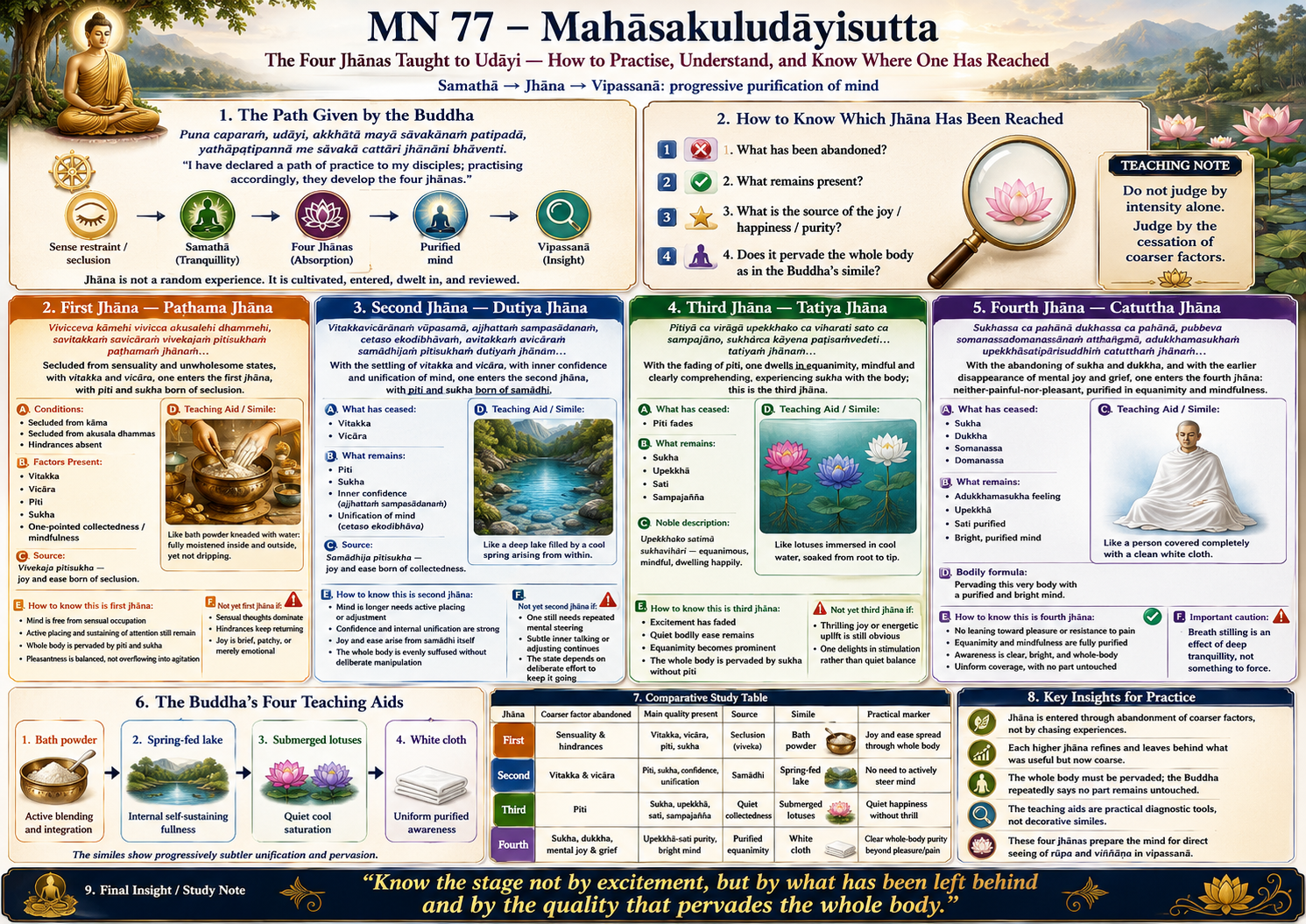
Practical Examples
- Example 1
If attention is tightly compressed around one point while the rest of embodied experience is tense and excluded, the bath-powder and lake similes should make us question whether the canonical description is being matched.
- Example 2
Second jhāna’s spring simile highlights an internally self-sustaining collectedness rather than continued discursive management.
- Example 3
Fourth jhāna is not emotional numbness; its simile emphasizes pervasive clarity and purity.
Training Aid
- Study each jhāna by both formula and simile.
- Do not reduce samādhi to forceful concentration.
- After emergence, distinguish which factors were present and which had actually ceased.
13Body and Consciousness: Clear Distinction Without an Eternal Witness
After the jhānas the sutta presents a contemplative knowledge: the body is material, four-elemental, born of parents, sustained by food and subject to destruction; consciousness is ettha sitaṁ ettha paṭibaddhaṁ—supported here, bound up here.
The beryl-and-thread simile gives clarity of relationship: one can discern the gem and the thread without confusing them.
The passage should not be used to infer an eternal consciousness that survives independently. The formula emphasizes relationship and dependence within this embodied condition.
For practice, it trains precise discernment: material process is known as material; consciousness is known as consciousness; neither needs to be collapsed into the other nor appropriated as self.
Teaching Infographics
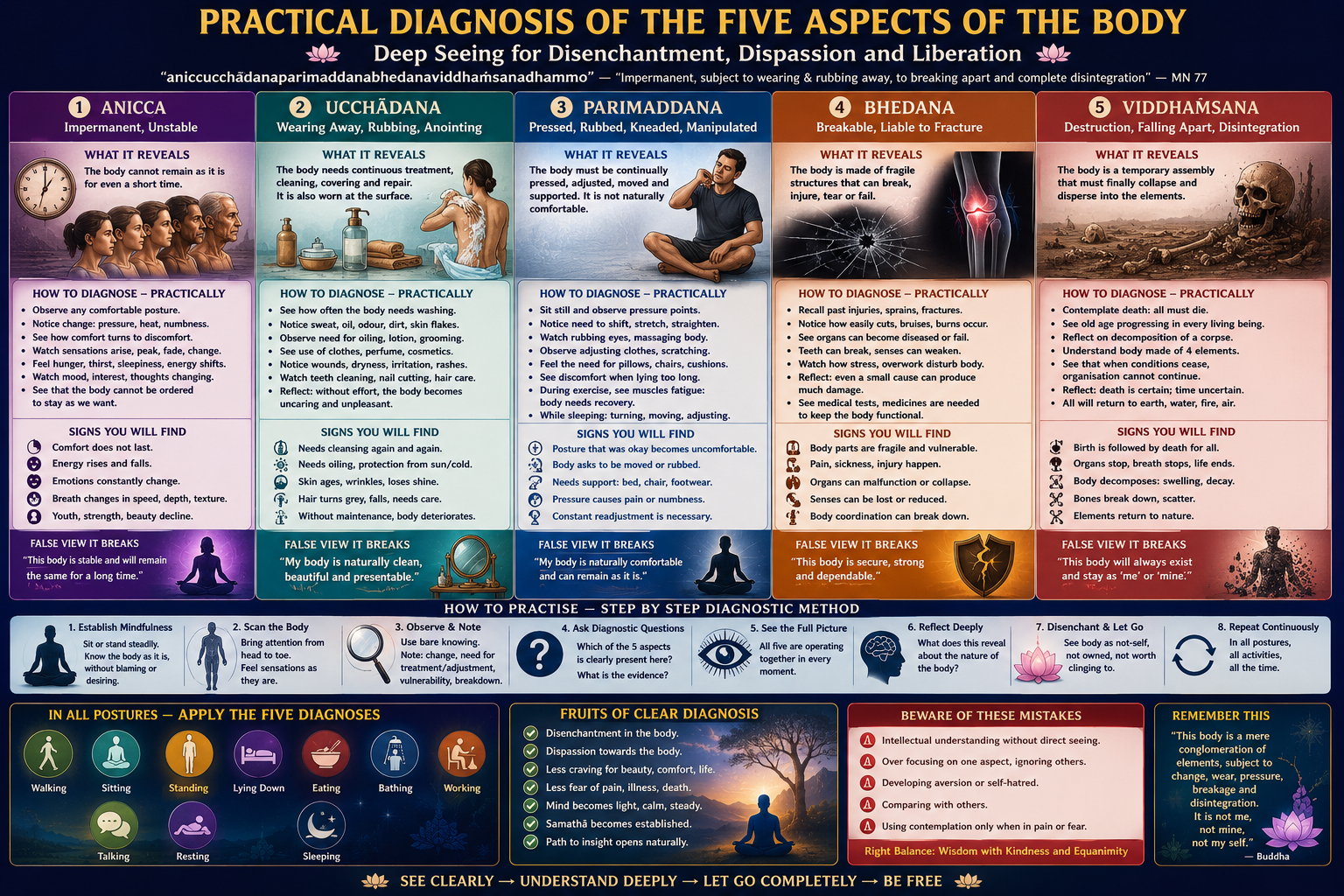
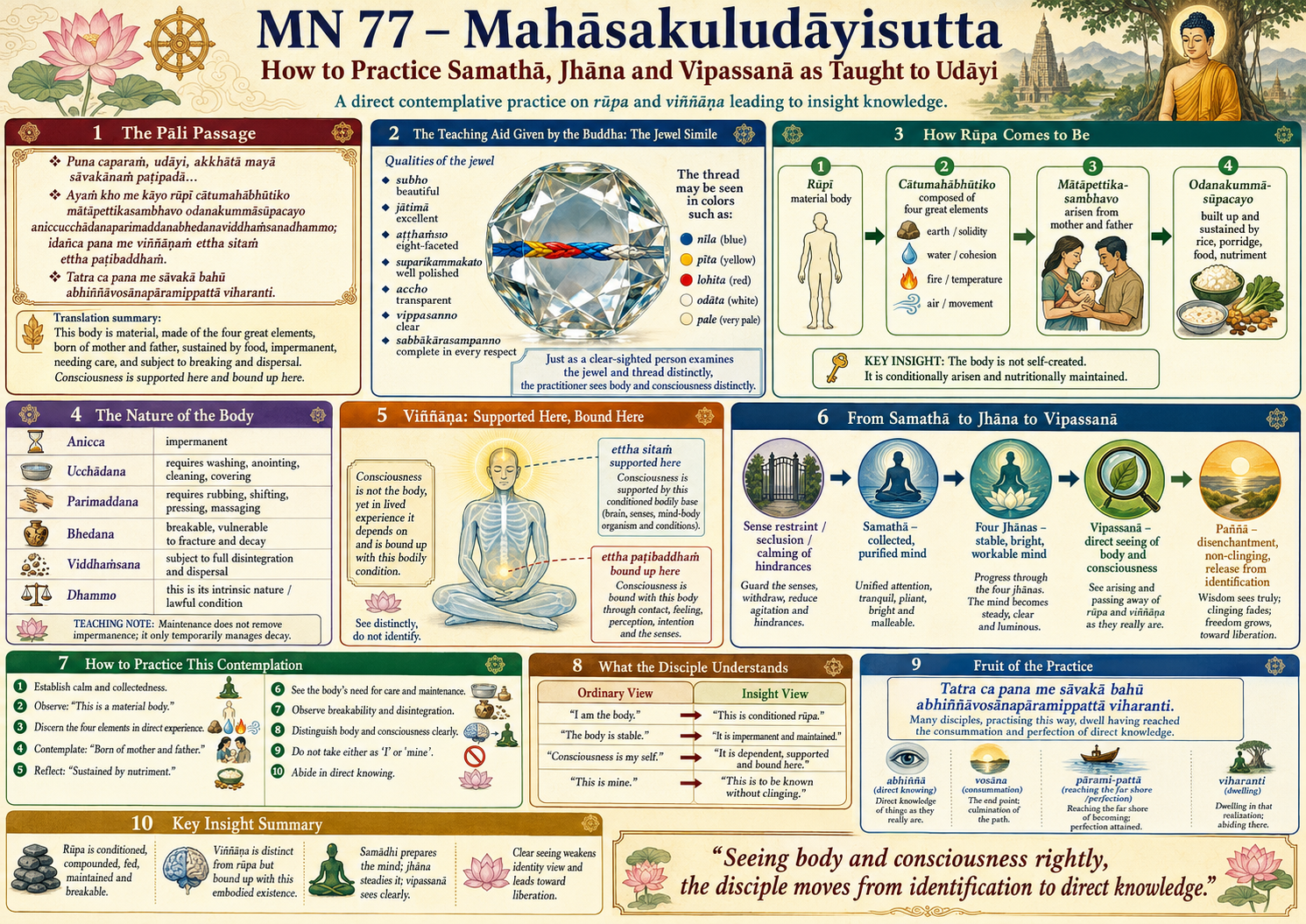

Practical Examples
- Example 1
Pain in the knee is a bodily event known by consciousness; ‘I am ruined’ is an additional identity construction.
- Example 2
A clear knowing of the body does not prove a permanent knower behind it.
- Example 3
Food dependence and bodily decay are included explicitly to counter idealized body-identification.
Training Aid
- Contemplate the body’s four-element, parent-born, food-supported nature.
- Notice knowing without immediately concluding ‘this knowing is my eternal essence’.
- Separate direct observation from metaphysical inference.
14Abhiññā: Extraordinary Capacities Are Included, But They Are Not the Final Goal
The sutta then gives a broad range of direct knowledges and capacities: mind-made body, iddhi, divine ear, knowing others’ minds, recollection of past lives, and divine eye.
The repeated refrain says many disciples reach abhiññāvosānapārami—a consummation or perfection in direct knowledge.
This is significant: the Buddha’s training is not presented as intellectually minimal. It includes extraordinary capacities of samādhi.
But the structure is equally significant: none of these ends the sutta. The culmination comes only with āsavānaṁ khayā.
Therefore extraordinary experience is neither to be casually dismissed nor made into the definition of liberation.
Practical Examples
- Example 1
A striking meditation perception may indicate unusual samādhi while greed and conceit remain.
- Example 2
Recollection of past lives, even if accepted as genuine within the sutta’s framework, is still not āsavakkhaya.
- Example 3
Ability to read another’s mental state would not by itself remove one’s own appropriation.
Training Aid
- Do not use unusual experiences as identity labels.
- After any attainment, examine rāga, dosa, moha, māna and upādāna.
- Keep the final criterion in view: destruction of āsavas.
15Ceto-Paricca Ñāṇa: The Same Citta Categories Used in Practice Become Objects of Direct Knowing
The mind-reading passage lists a familiar diagnostic matrix:
sarāga / vītarāga, sadosa / vītadosa, samoha / vītamoha, saṅkhitta / vikkhitta, mahaggata / amahaggata, sauttara / anuttara, samāhita / asamāhita, vimutta / avimutta.
These categories are valuable even before any claim to knowing another person’s mind. They are a precise vocabulary for knowing citta states.
The mirror simile is especially instructive: the state is known as plainly as a face in a clean mirror. There is no story-making—only accurate recognition.
Practical Examples
- Example 1
Instead of ‘my meditation is bad,’ identify: vikkhitta citta is present.
- Example 2
Instead of ‘I am spiritual,’ identify whether the mind is actually sarāga, sadosa or samoha.
- Example 3
A collected mind can still be sauttara—surpassable; samādhi is not automatically the highest state.
Training Aid
- Use the citta pairs as a daily diagnostic vocabulary.
- Name the state without making it self.
- Track transitions: what condition moved citta from sadosa to vītadosa, or asamāhita to samāhita?
16Pubbenivāsa and Dibbacakkhu: Experience Must Still Be Read Through Kamma and Conditionality
Recollection of former lives is described with detail—identity, circumstances, pleasure and pain, lifespan, death and rebirth.
The divine eye passage adds another dimension: beings are seen passing away and reappearing according to kamma, with bodily, verbal and mental conduct and view explicitly included.
Together, these passages present a causal moral universe rather than random migration.
Yet earlier suttas such as Brahmajāla warn against overinterpreting even profound recollection into eternalist or annihilationist metaphysics. The appropriate use of abhiññā is therefore knowledge that supports paññā, not a new self-theory.
Practical Examples
- Example 1
Remembering continuity does not prove an unchanging entity that owns the continuity.
- Example 2
Observing results attributed to kamma should strengthen responsibility for body, speech and mind, not fatalism.
- Example 3
Extraordinary memory is still conditioned knowing.
Training Aid
- Keep kamma connected to present intentional conduct.
- Do not convert memory into a permanent-self theory.
- Use knowledge to reduce heedlessness.
17The Culmination: `Āsavānaṁ Khayā`
The final practice result is explicit:
āsavānaṁ khayā anāsavaṁ cetovimuttiṁ paññāvimuttiṁ diṭṭheva dhamme sayaṁ abhiññā sacchikatvā upasampajja viharanti
Through the destruction of the āsavas, disciples directly realize for themselves here and now the influx-free liberation of mind and liberation by wisdom.
The mountain-lake simile is about transparency. In clear, unclouded water the person sees shells, stones and fish exactly as they are. Liberation is associated with unobscured knowing, not mystical vagueness.
This final passage governs how all previous attainments should be interpreted. The 37 awakening factors, vimokkhā, mastery bases, kasiṇas, jhānas and abhiññās are impressive, but the sutta’s culminating criterion is āsavakkhaya.
That is why this discourse is a complete training aid: it distinguishes supporting disciplines, meditative mastery, extraordinary knowledge, and final release.
Practical Examples
- Example 1
One may master fourth jhāna but still have conceit; the path is not complete.
- Example 2
One may have unusual perceptions but still become defensive when challenged; upādāna remains.
- Example 3
Clear insight that directly weakens sensuality, becoming and ignorance is closer to the sutta’s final criterion than spectacular experience alone.
Training Aid
- After every stage ask: what has happened to the āsavas?
- Do not stop at an attainment because it is rare.
- Keep cetovimutti and paññāvimutti together with direct knowing and non-influx as the culmination.
18A Practical Curriculum Extracted from the Sutta
The discourse should not be forced into a single rigid sequence where every practitioner must complete every advanced attainment in the exact order listed. The Buddha repeatedly says, “I have taught a paṭipadā by following which my disciples develop…” and then names multiple domains.
Still, the architecture provides a powerful curriculum:
Foundation: quiet, receptive learning, adhisīla, confidence in a teacher grounded in direct knowledge and wisdom.
Core liberation framework: Four Noble Truths.
Developmental engine: 37 bodhipakkhiyā dhammas.
Samādhi and perceptual mastery: vimokkhā, abhibhāyatanāni, kasiṇā, four jhānas.
Discriminative knowledge: body/consciousness discernment.
Higher knowledges: mind-made body, iddhi, divine ear, mind-reading, former lives, divine eye.
Culmination: āsavakkhaya, cetovimutti, paññāvimutti.
For training purposes, the safest emphasis is: do not chase the later capacities while the earlier foundations are unstable.
Practical Examples
- Example 1
A student asking for arūpa practice while sense restraint and the five hindrances are uncontrolled is trying to start downstream.
- Example 2
A retreat curriculum can repeatedly return to Four Noble Truths and 37 awakening factors while samādhi matures.
- Example 3
A teacher can assess demonstrated capacity rather than assuming that attendance duration equals readiness for advanced practices.
Training Aid
- Stabilize sīla and daily sense restraint.
- Use Four Noble Truths to diagnose actual dukkha.
- Develop the 37 dhammas as integrated capacities.
- Establish jhāna according to the full canonical formulas and similes.
- Approach advanced perceptual/abhiññā domains without making them identity.
- Never lose sight of āsavakkhaya as the endpoint.