Aṭṭha Vimokkhā — The Eight Liberations
The safest reading is progressive relinquishment: each subtler liberation is entered by transcending the previous field, while the entire sequence remains subordinate to wisdom and non-clinging.
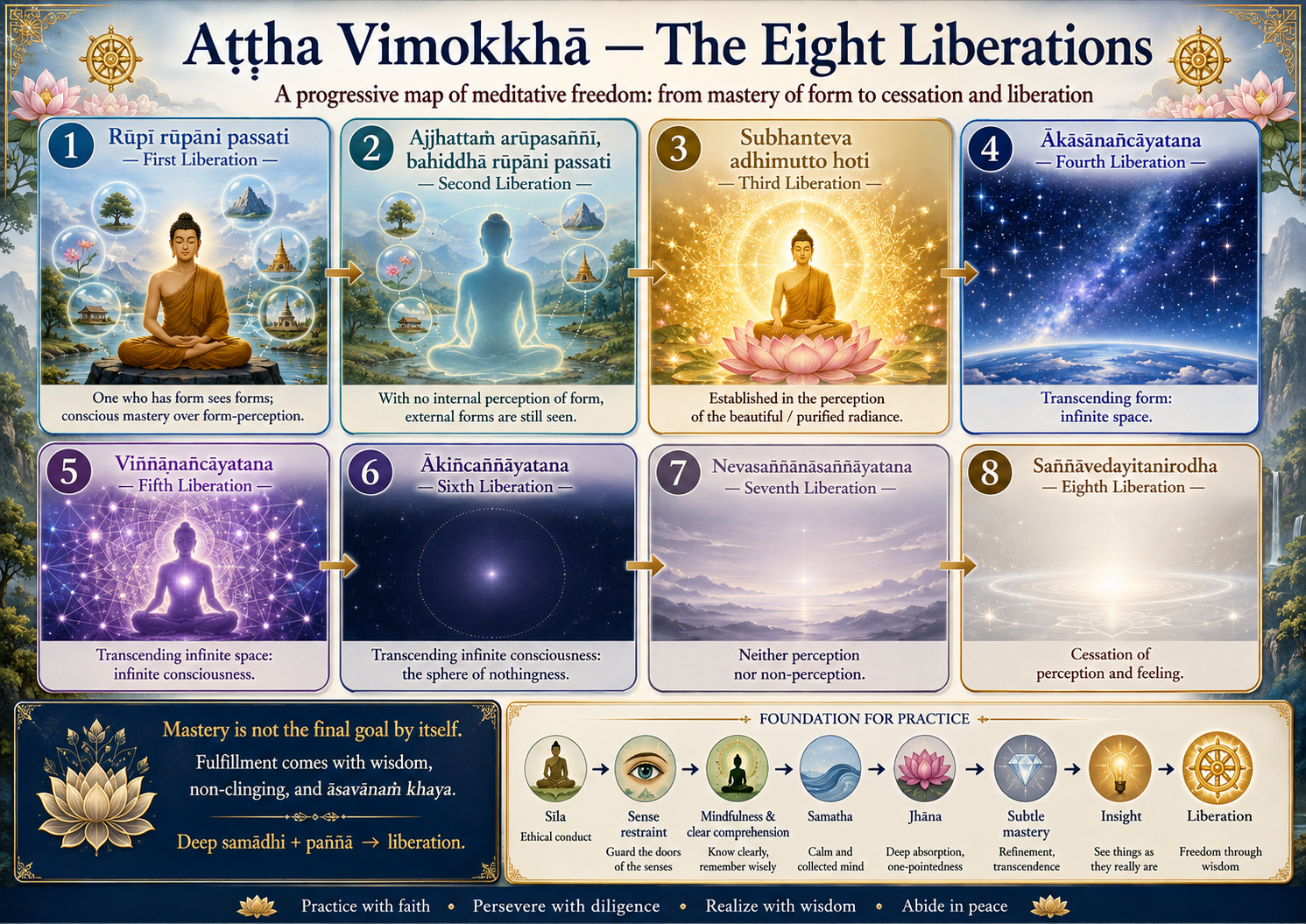 VISUAL SUMMARYSee this study in a pictureOpen the complete infographic for a visual overview before or after reading the full study.View infographic →
Deep samādhi is not separated from paññā
These eight should therefore not be understood merely as eight unusual meditation experiences. They represent a progressive relinquishment of increasingly subtle objects of perception and attachment—from form, to boundless space, boundless consciousness, nothingness, neither-perception-nor-non-perception, and finally cessation. Yet even mastery of these profound states is not presented as the final goal by itself. The decisive criterion remains wisdom, non-clinging, and āsavānaṁ khaya — the ending of the influxes. Thus the study of the Eight Vimokkhā is ultimately a study of how deep samādhi and paññā work together toward complete liberation.
Explicit sutta wording and sutta-based reconstruction must remain distinct
The word vimokkha here names eight meditative liberations or releases. DN 15 concludes with a much stricter criterion: the practitioner masters them forward, backward and in both directions; enters and emerges as wished; and, through āsavānaṁ khaya, directly realizes the influx-free liberation of mind and liberation by wisdom. Therefore an unusual meditative state, by itself, should never be equated with arahantship.
The training platform supporting the eight vimokkhā
| Training foundation | Why it matters before specialization |
|---|---|
| Sīla | Stable ethical conduct; the mind is not repeatedly disturbed by remorse. |
| Indriya-saṁvara | Forms, sounds, smells, tastes, touches and mental objects are known without uncontrolled grasping. |
| Bhojane mattaññutā | Moderation supports wakefulness and bodily balance. |
| Jāgariyānuyoga | The practitioner trains against sloth and negligence. |
| Sati-sampajañña | Posture, activity, intention and mental movement become knowable. |
| Five hindrances abandoned | Kāmacchanda, byāpāda, thīnamiddha, uddhaccakukkucca and vicikicchā no longer dominate. |
| Four jhānas | The essential samādhi platform before the arūpa transition. |
| Paññā review | Every attainment is known in terms of arising, ending, gratification, danger and escape; no state is made into self. |
From form mastery to cessation — then paññā and āsavakkhaya
One sequence of progressively subtler relinquishment
01 Vimokkha 1 — Rūpī rūpāni passati
Rūpī rūpāni passati. Ayaṁ paṭhamo vimokkho.
Having form, one sees forms. This is the first liberation.
What this liberation means
DN 15 and AN 8.66 give this compact formula without a detailed procedural explanation. Therefore one should be careful not to pretend that the sutta itself specifies a later technical meditation method.
The important contrast is with the second vimokkha. In the first, the practitioner is still rūpī in relation to the meditation and sees rūpāni—forms. In the closely related abhibhāyatana scheme (AN 8.65), the first two mastery bases say: ajjhattaṁ rūpasaññī ... bahiddhā rūpāni passati—internally perceiving form, one sees external forms, limited or measureless, beautiful or unattractive, and knows them with mastery.
That makes AN 8.65 the closest explicit sutta companion for understanding how form-perception is trained rather than merely passively experienced.
This vimokkha should therefore be understood as freedom and mastery within the field of form, not yet freedom from all perception of form.
Practice that can support its accomplishment
Sutta-based practice reconstruction
- First establish the gradual-training foundation: sīla, restraint of the sense doors, moderation in eating, wakefulness, sati-sampajañña, abandonment of the five hindrances, and stable jhāna. MN 107 places jhāna after this preparation; it is not presented as an isolated visualization exercise.
- Develop clear internal form-perception without identifying it as “I” or “mine.” Kāyānupassanā, awareness of bodily posture, and body contemplation provide a sutta-consistent basis for accurately knowing embodied form.
- With the mind stable and collected, allow external form to be known without losing internal collectedness.
- Use AN 8.65 as the nearest canonical mastery-map: external forms may be limited or measureless, attractive or unattractive; the training point is that perception does not overpower the mind.
- The criterion is not vivid imagery alone. The mind should remain steady, free from the five hindrances, and able to know form without being pulled into kāmarāga or paṭigha.
Useful practice markers
- Internal form-perception remains operative.
- External forms are known without losing samādhi.
- Attractive/unattractive form does not dominate the mind.
- The practitioner can remain composed rather than becoming fascinated by visual phenomena.
Common misreadings / mistakes
- Treating any bright image or visual phenomenon as proof of the first vimokkha.
- Turning bodily form into a permanent self.
- Skipping sīla, hindrance-abandonment and jhāna foundation.
- Using forceful visualization while the mind is still restless.
02 Vimokkha 2 — Ajjhattaṁ arūpasaññī bahiddhā rūpāni passati
Ajjhattaṁ arūpasaññī bahiddhā rūpāni passati. Ayaṁ dutiyo vimokkho.
Not perceiving form internally, one sees forms externally. This is the second liberation.
What this liberation means
The phrase ajjhattaṁ arūpasaññī must be read carefully. Here it does not automatically mean that the practitioner has entered an arūpa attainment. The formula still says bahiddhā rūpāni passati—external forms are seen.
The contrast is with the first vimokkha: internal form-perception is no longer foregrounded, while external form remains the field of perception.
AN 8.65 again supplies a close parallel. Its third and fourth mastery bases say: ajjhattaṁ arūpasaññī ... bahiddhā rūpāni passati—not perceiving form internally, one sees external forms, limited or measureless, beautiful or unattractive, and knows them with mastery. The later mastery bases apply the same internal non-form perception to blue, yellow, red, and white external forms.
Thus the second vimokkha is best approached as a greater independence from the internal form-sign while form outside is still known.
Practice that can support its accomplishment
Sutta-based practice reconstruction
- Do not try to “erase the body.” Begin from stable bodily composure and jhāna.
- Learn to let the internal body-sign cease to dominate attention. The body can remain physically present without being the object around which perception is organized.
- Maintain collectedness while external form is known.
- Work with the AN 8.65 distinction between limited/measureless and attractive/unattractive external forms. The aim is perceptual mastery, not aesthetic excitement.
- Observe whether perception can remain stable when the internal form-reference is not foregrounded.
- Continue guarding against the thought: “I have become formless.” The sutta formula concerns perception; it does not license a metaphysical conclusion about self.
Useful practice markers
- Internal bodily form is no longer the dominant meditation-sign.
- External forms remain clearly knowable.
- Samādhi does not collapse when the internal form-sign is relinquished.
- Form is known without constructing ‘this is my true formless self.’
Common misreadings / mistakes
- Equating
arūpasaññīhere with the fourth-to-seventh vimokkhā. - Trying to dissociate from the body through suppression or aversion.
- Confusing numbness with freedom from internal form-perception.
- Using the state to construct an immaterial attā.
03 Vimokkha 3 — Subhanteva adhimutto hoti
Subhanteva adhimutto hoti. Ayaṁ tatiyo vimokkho.
One is resolved exclusively on the beautiful. This is the third liberation.
What this liberation means
This short phrase is among the easiest to misread.
Subha means beautiful, lovely, or purified/pleasant in appearance; adhimutta conveys being resolved, intent, or fully inclined. The text does not say, “indulge sensual attraction.” The context is a vimokkha following two stages of mastery regarding form.
The closest sutta context again lies near the abhibhāyatanāni, where the practitioner knows attractive and unattractive forms without being overpowered by them and can work with pure color-fields such as blue, yellow, red, and white.
The third vimokkha should therefore not be used as an excuse to strengthen kāmarāga. It represents a controlled, non-sensual orientation of perception toward the beautiful after the mind has gained stability with respect to form.
Because DN 15 gives no direct step-by-step technique, any specific procedural method beyond this must be labeled reconstruction rather than Buddha-vacana.
Practice that can support its accomplishment
Sutta-based practice reconstruction
- Do not begin here while attractive form still produces obvious sensual excitement. First develop indriya-saṁvara and the ability to know attractive/unattractive form without being driven by it.
- Stabilize the first two form-related vimokkhā or their corresponding mastery skills.
- Deliberately incline perception toward what is subha while preserving seclusion from kāma and akusala dhammas.
- Use the related AN 8.65 color/mastery passages as a canonical reference point for stable perception of refined form, rather than importing a later visualization system automatically.
- Check the mind continuously: is there serenity and mastery, or is sensual desire being fed?
- After emergence, apply DN 15’s own wisdom standard: know the state’s arising, ending, gratification, danger, and escape; do not abhinandati —do not delight in it as a final refuge.
Useful practice markers
- Beautiful perception can be sustained without sensual excitement.
- The mind is inclined, steady and non-reactive.
- The state increases mastery rather than attachment.
- After emergence, there is no need to possess or identify with the experience.
Common misreadings / mistakes
- Equating
subhawith ordinary sensual beauty. - Using pleasant imagery to stimulate kāmacchanda.
- Calling aesthetic pleasure a vimokkha without jhānic stability.
- Failing to examine the state afterward through assāda, ādīnava and nissaraṇa.
04 Vimokkha 4 — Sabbaso rūpasaññānaṁ samatikkamā paṭighasaññānaṁ atthaṅgamā nānattasaññānaṁ amanasikārā ‘ananto ākāso’ti ākāsānañcāyatanaṁ upasampajja viharati
Sabbaso rūpasaññānaṁ samatikkamā paṭighasaññānaṁ atthaṅgamā nānattasaññānaṁ amanasikārā ‘ananto ākāso’ti ākāsānañcāyatanaṁ upasampajja viharati. Ayaṁ catuttho vimokkho.
Completely transcending perceptions of form, with perceptions of impingement fading away, and by not attending to perceptions of diversity, one enters and dwells in the base of infinite space, aware: ‘Space is infinite.’ This is the fourth liberation.
What this liberation means
Here the sutta itself gives the transition conditions.
Three movements are named before ananto ākāso:
rūpasaññānaṁ samatikkamā — complete transcendence of perceptions of form; paṭighasaññānaṁ atthaṅgamā — fading/ending of perceptions connected with sensory impingement; nānattasaññānaṁ amanasikārā — non-attention to perceptions of diversity.
Only then is the perception ananto ākāso established.
AN 9.31 confirms the progressive cessation: on attaining infinite space, perception of forms has ceased. MN 121 provides a useful sutta model of progressively ceasing to attend to a coarser perception and attending to a subtler, more unified one.
Practice that can support its accomplishment
Practice progression
- Make fourth jhāna genuinely stable. Do not attempt the arūpa transition from a mind still struggling with the hindrances.
- On emerging from or working from the stability of fourth jhāna, discern the limitation of form-perception: wherever form is marked out, there is boundary, location, diversity and impingement.
- Cease attending to the plurality of forms. Do not fight them; simply stop giving them the role of meditation-object.
- Attend to the absence of bounded form and the open spatial field. The sutta’s perception is simple: ananto ākāso —space is infinite.
- Let the perception of boundlessness become unified; do not repeatedly conceptualize “infinite, infinite.”
- If form-perception repeatedly returns and dominates, the transition is not yet mature; return to strengthening fourth jhāna and the relinquishment of form-signs.
- After emergence, examine the attainment as conditioned—not-self, impermanent, and not a final refuge.
Useful practice markers
- Form-perception no longer structures the field.
- Multiplicity and sensory impingement have receded.
- Boundlessness, not a large visual object, is the dominant perception.
- The mind remains unified rather than conceptually measuring space.
Common misreadings / mistakes
- Trying to imagine a very large room or universe.
- Calling ordinary spaciousness
ākāsānañcāyatana. - Forcing sensory shutdown.
- Constructing the view: ‘Infinite space is my true self.’
05 Vimokkha 5 — Sabbaso ākāsānañcāyatanaṁ samatikkamma ‘anantaṁ viññāṇan’ti viññāṇañcāyatanaṁ upasampajja viharati
Sabbaso ākāsānañcāyatanaṁ samatikkamma ‘anantaṁ viññāṇan’ti viññāṇañcāyatanaṁ upasampajja viharati. Ayaṁ pañcamo vimokkho.
Completely transcending the base of infinite space, one enters and dwells in the base of infinite consciousness, aware: ‘Consciousness is infinite.’ This is the fifth liberation.
What this liberation means
The fifth vimokkha does not return to ordinary sensory consciousness. It arises by transcending the previous attainment itself.
AN 9.31 says that with the attainment of infinite consciousness, the perception belonging to infinite space has ceased. The logic is successive refinement.
A sutta-consistent way of understanding the transition is: infinite space was known; attention now ceases to privilege “space” and takes up the boundlessness of the consciousness by which that boundless field is known.
This must not be turned into a doctrine of an eternal, universal consciousness. DN 15 has just listed “immaterial and infinite self” as a self-designation to be understood and not clung to. The same discourse later says the station of infinite consciousness has arising, ending, gratification, danger and escape.
Practice that can support its accomplishment
Practice progression
- Establish real mastery of infinite space—entry, stability, emergence.
- Discern that even the perception “infinite space” is a conditioned perception.
- Let the spatial aspect cease to be foregrounded.
- Attend instead to the boundlessness of the knowing of that field: anantaṁ viññāṇaṁ .
- Do not analyze philosophically while entering. The perception should become simple and unified.
- If the mind keeps returning to spatial extension, the fifth attainment has not replaced the fourth.
- After emergence, explicitly contemplate: “This was known; it arose dependently; it ended.” That review protects against making infinite consciousness into attā.
Useful practice markers
- The perception of infinite space has been left behind.
- Boundless consciousness is the dominant unified perception.
- There is no need for discursive metaphysics about consciousness.
- Emergence is followed by clear recognition that the state was conditioned.
Common misreadings / mistakes
- Equating this attainment with Nibbāna.
- Concluding that consciousness is eternal because it appeared boundless.
- Retaining ‘space’ as the dominant perception while merely changing the label.
- Using philosophical imagination instead of meditative transcendence.
06 Vimokkha 6 — Sabbaso viññāṇañcāyatanaṁ samatikkamma ‘natthi kiñcī’ti ākiñcaññāyatanaṁ upasampajja viharati
Sabbaso viññāṇañcāyatanaṁ samatikkamma ‘natthi kiñcī’ti ākiñcaññāyatanaṁ upasampajja viharati. Ayaṁ chaṭṭho vimokkho.
Completely transcending the base of infinite consciousness, one enters and dwells in the base of nothingness, aware: ‘There is nothing.’ This is the sixth liberation.
What this liberation means
The movement is again transcendence of the previous perception, not intellectual nihilism.
AN 9.31 says the perception of infinite consciousness ceases with the attainment of nothingness. MN 121 is especially useful here: the practitioner stops attending to the earlier perception and attends to the single perception of the base of nothingness, recognizing what disturbance is absent and what subtle perception remains.
Natthi kiñci therefore should not be interpreted as the philosophical doctrine “nothing exists.” It is the perception defining this meditative base after the previous object has been relinquished.
Practice that can support its accomplishment
Practice progression
- Become skilled in infinite consciousness before attempting this transition.
- See the previous field as still containing something that is being attended to—“infinite consciousness.”
- Withdraw attention from that “something.”
- Attend to the absence left when that object is no longer taken up: natthi kiñci —there is nothing.
- Let the perception of absence become steady rather than repeatedly verbalizing a thought about nothingness.
- Use MN 121’s principle: clearly know what disturbances are absent and what subtle perception remains.
- On emergence, review the attainment as conditioned and liable to cessation.
Useful practice markers
- Infinite-consciousness perception has ceased to dominate.
- The mind rests on absence/nothingness rather than a conceptual theory.
- The state is peaceful but still recognizable as an attainment.
- There is no nihilistic conclusion about reality.
Common misreadings / mistakes
- Thinking ‘nothing exists’ and calling that meditation.
- Using blankness, sleepiness or dullness as nothingness.
- Suppressing consciousness rather than transcending the prior perception.
- Delighting in nothingness as final liberation.
07 Vimokkha 7 — Sabbaso ākiñcaññāyatanaṁ samatikkamma nevasaññānāsaññāyatanaṁ upasampajja viharati
Sabbaso ākiñcaññāyatanaṁ samatikkamma nevasaññānāsaññāyatanaṁ upasampajja viharati. Ayaṁ sattamo vimokkho.
Completely transcending the base of nothingness, one enters and dwells in the base of neither-perception-nor-non-perception. This is the seventh liberation.
What this liberation means
This is an extremely subtle attainment. The formula does not say that perception is totally absent; nor is ordinary perception functioning in the usual way. Hence neva saññā nāsaññā—neither perception nor non-perception.
AN 9.31 says that with this attainment the perception of nothingness has ceased. AN 9.36 gives an important caution: the final two attainments are properly explained by meditators who are skilled in attaining and emerging from them.
That canonical caution should shape practice guidance. This is not a state to manufacture through vagueness, sleepiness, oxygen deprivation, trance, or suppression.
Practice that can support its accomplishment
Practice progression
- Do not approach this without stable mastery of nothingness.
- Recognize that even the subtle perception natthi kiñci is still a perception.
- See the disturbance/limitation in continuing to attend to that perception.
- Relinquish the perception of nothingness without replacing it with another coarse object.
- Allow perception to become so subtle that it cannot appropriately be characterized as ordinary perception, while it has not yet completely ceased.
- Do not repeatedly check, “Am I perceiving?”—that very monitoring coarsens the state.
- Cultivate skill in entry and emergence; review only after emergence.
Useful practice markers
- Nothingness is no longer the dominant perception.
- Perception has become extraordinarily subtle rather than dull.
- Entry and emergence are distinct and reviewable afterward.
- The mind is not confused, intoxicated, or physiologically forced.
Common misreadings / mistakes
- Confusing sleep, fainting or blankness with the seventh vimokkha.
- Trying to stop perception by force.
- Breath-holding or physiological manipulation.
- Claiming mastery without reliable emergence and retrospective clarity.
08 Vimokkha 8 — Sabbaso nevasaññānāsaññāyatanaṁ samatikkamma saññāvedayitanirodhaṁ upasampajja viharati
Sabbaso nevasaññānāsaññāyatanaṁ samatikkamma saññāvedayitanirodhaṁ upasampajja viharati. Ayaṁ aṭṭhamo vimokkho.
Completely transcending the base of neither-perception-nor-non-perception, one enters and dwells in the cessation of perception and feeling. This is the eighth liberation.
What this liberation means
The formula is unambiguous: this is saññāvedayitanirodha—cessation of perception and feeling.
AN 9.31 describes it as the final step in a series of progressive cessations: with cessation of perception and feeling, perception and feeling cease.
AN 9.41 describes the Buddha’s own progression in terms of seeing the drawback of the previous attainment, understanding the benefit of the next, becoming confident and steady toward it, and then completely transcending the previous base. After cessation, “having seen with wisdom,” the āsavas were ended.
This is therefore not an instruction to forcibly stop mental or bodily processes. It is the culmination of an already extraordinarily refined sequence of relinquishment.
Practice that can support its accomplishment
Practice progression
- Establish mastery of the preceding attainments; the eighth is presented as sabbaso … samatikkamma —complete transcendence of the seventh.
- Do not seek cessation through suppression, breath-holding, sensory deprivation, exhaustion, or attempting to make oneself unconscious.
- Following the pattern in AN 9.41, clearly discern the limitation of the preceding state and the peace of cessation.
- Let the mind incline to cessation through relinquishment rather than force.
- The sutta model is progressive stopping: each coarser perception has already been abandoned before the next refinement.
- On emergence, paññā is decisive. DN 15 does not end with the mere fact of reaching cessation; it culminates in mastery plus āsavānaṁ khaya .
- Therefore the practitioner must examine what has actually happened to greed, hatred, delusion, bhavarāga, conceit, and the āsavas rather than using the attainment as an identity badge.
Useful practice markers
- The transition depends on complete transcendence of the seventh attainment.
- Perception and feeling cease; this is not mere quiet or low sensory input.
- The attainment is entered and emerged from within a developed path of mastery.
- After emergence, wisdom—not self-congratulation—is the critical factor.
Common misreadings / mistakes
- Calling deep calm or blankness cessation.
- Trying to produce it by reducing breathing deliberately.
- Equating unconsciousness, fainting or sleep with nirodha.
- Assuming experience of cessation automatically proves arahantship without examining the sutta’s explicit
āsavānaṁ khayacriterion.
Anuloma • Paṭiloma • Yatthicchakaṁ • Āsavānaṁ khaya
| Pāli / criterion | Meaning for practice |
|---|---|
| Anuloma | Enter the sequence in forward order. |
| Paṭiloma | Enter the sequence in reverse order. |
| Anulomapaṭiloma | Move through it forward and reverse. |
| Yatthicchakaṁ | Wherever / whichever is wished. |
| Yadicchakaṁ | In whatever way is wished. |
| Yāvaticchakaṁ | For as long as wished. |
| Samāpajjati / vuṭṭhāti | Enter and emerge skillfully. |
| Āsavānaṁ khaya | The final liberating criterion is destruction of the āsavas, not meditative virtuosity alone. |
Final distinction: skill in entering, emerging and moving through the eight vimokkhā is meditative mastery; the liberating criterion remains āsavānaṁ khaya.
Essential study: Sati-Sampajañña
Please go through this without fail, so you understand what “clear comprehension” means as presented in the suttas.