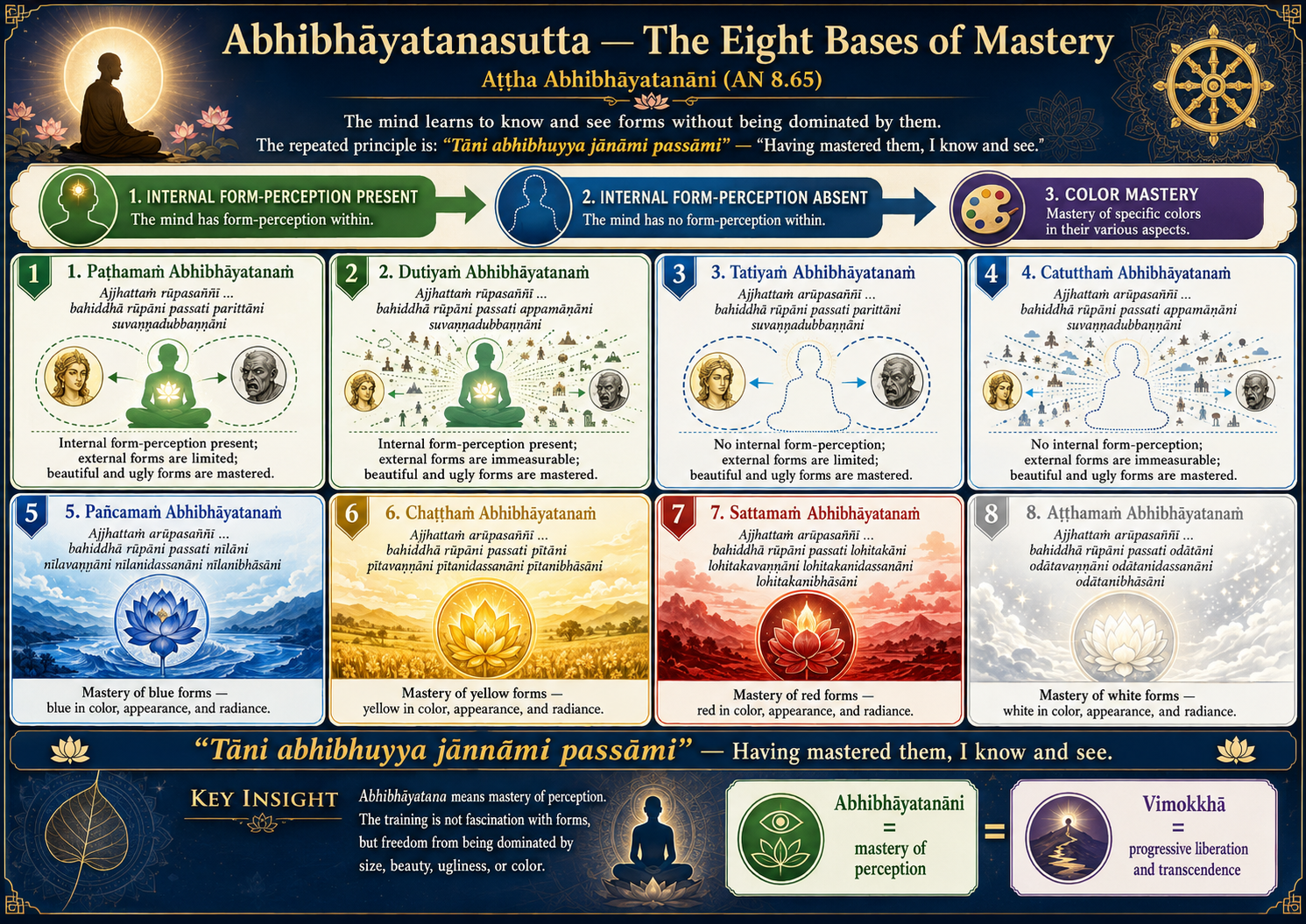
 VISUAL SUMMARYSee this sutta in a pictureOpen the complete infographic for a visual overview before or after reading the full study.View infographic →
“Aṭṭhimāni, bhikkhave, abhibhāyatanāni. Katamāni aṭṭha?”
“Bhikkhus, there are these eight bases of mastery. What eight?”
Abhibhāyatana is built around the idea of abhibhava—mastery, overcoming, or not being overpowered—and āyatana, a sphere, base, or dimension.
The point is not conquest in an aggressive sense. It is perceptual mastery: forms are known clearly while the mind remains collected and does not become dominated by their size, attractiveness, unattractiveness, or color.
Each formula therefore ends with the same declaration: “Having mastered them, I know and see.” The practitioner is no longer merely a passive recipient of visual appearance.
1 Paṭhamaṁ AbhibhāyatanaṁInternal form-perception + limited external forms
“Ajjhattaṁ rūpasaññī eko bahiddhā rūpāni passati parittāni suvaṇṇadubbaṇṇāni. ‘Tāni abhibhuyya jānāmi passāmī’ti, evaṁsaññī hoti. Idaṁ paṭhamaṁ abhibhāyatanaṁ.”
“Perceiving form internally, one sees external forms that are limited, beautiful or ugly. Having mastered them, one is percipient thus: ‘I know; I see.’ This is the first base of mastery.”
Ajjhattaṁ rūpasaññī means that perception of form is present internally. Bahiddhā rūpāni passati means external forms are also seen.
The external forms are parittāni—limited, small, restricted, or of limited extent.
Suvaṇṇadubbaṇṇāni literally contrasts good/beautiful appearance and bad/unattractive appearance. The field therefore includes both what ordinarily attracts and what ordinarily repels.
The mastery is not demonstrated by making only pleasant forms appear. It is demonstrated by remaining master of perception across both sides—suvaṇṇa and dubbaṇṇa.
The repeated declaration, “tāni abhibhuyya jānāmi passāmi,” means the forms have been overcome as dominating perceptual influences. One knows and sees them without being mentally overrun by them.
Practice implication: begin with a bounded perceptual field. Let form be clearly known, including both attractive and unattractive qualities, while maintaining collectedness. The training is not “make the ugly beautiful” or “reject the beautiful,” but prevent appearance from dictating the state of the mind.

2 Dutiyaṁ AbhibhāyatanaṁInternal form-perception + immeasurable external forms
“Ajjhattaṁ rūpasaññī eko bahiddhā rūpāni passati appamāṇāni suvaṇṇadubbaṇṇāni. ‘Tāni abhibhuyya jānāmi passāmī’ti, evaṁsaññī hoti. Idaṁ dutiyaṁ abhibhāyatanaṁ.”
“Perceiving form internally, one sees external forms that are immeasurable, beautiful or ugly. Having mastered them, one is percipient thus: ‘I know; I see.’ This is the second base of mastery.”
The only major change from the first base is paritta → appamāṇa.
Appamāṇāni means immeasurable, unlimited, or not confined to a small bounded field. The mastery that worked with limited form must now remain stable when the perceptual field becomes vast.
This is an important progression. A mind may remain steady with a small, controlled field yet lose stability when the object becomes extensive. The second abhibhāyatana trains mastery that is not dependent on smallness or tight boundaries.
Beautiful and ugly forms remain included. Thus size and valence are both brought under mastery: the mind is neither overwhelmed by vastness nor captivated or repelled by appearance.
Practice implication: once steadiness is reliable with a limited field, the perceptual extent is allowed to become vast without losing clarity. The mind remains collected whether the external appearance is pleasant or unpleasant.

3 Tatiyaṁ AbhibhāyatanaṁNo internal form-perception + limited external forms
“Ajjhattaṁ arūpasaññī eko bahiddhā rūpāni passati parittāni suvaṇṇadubbaṇṇāni. ‘Tāni abhibhuyya jānāmi passāmī’ti, evaṁsaññī hoti. Idaṁ tatiyaṁ abhibhāyatanaṁ.”
“Not perceiving form internally, one sees external forms that are limited, beautiful or ugly. Having mastered them, one is percipient thus: ‘I know; I see.’ This is the third base of mastery.”
The crucial change is ajjhattaṁ arūpasaññī—internally, one is not perceiving form.
This phrase should not automatically be equated with dwelling in one of the four arūpa attainments, because the very next phrase says external forms are still seen. The statement describes the configuration of perception: internal form-perception is absent or not operating, while external forms remain the field of mastery.
The forms are again paritta—limited—and again include both suvaṇṇa and dubbaṇṇa.
This makes the third base subtler than the first: the mind masters a limited external form-field without relying on an internally held form-perception.
Practice implication: allow internal form-perception to become non-dominant while maintaining clear external perception. The test of mastery remains the same: beautiful and ugly forms are known without becoming masters of the mind.

4 Catutthaṁ AbhibhāyatanaṁNo internal form-perception + immeasurable external forms
“Ajjhattaṁ arūpasaññī eko bahiddhā rūpāni passati appamāṇāni suvaṇṇadubbaṇṇāni. ‘Tāni abhibhuyya jānāmi passāmī’ti, evaṁsaññī hoti. Idaṁ catutthaṁ abhibhāyatanaṁ.”
“Not perceiving form internally, one sees external forms that are immeasurable, beautiful or ugly. Having mastered them, one is percipient thus: ‘I know; I see.’ This is the fourth base of mastery.”
The fourth base combines the refinements of the second and third.
There is no internal perception of form, while the external forms are appamāṇa—immeasurable or unlimited.
The mind therefore remains master in a vast external field without depending on internal form-perception.
Again, beautiful and ugly forms are explicitly included. The repeated structure across the first four bases shows that mastery is being tested across two variables:
1. internal form-perception present or absent; 2. external field limited or immeasurable.
In every case the practitioner remains capable of the same declaration: “Having mastered them, I know and see.”
Practice implication: the field expands beyond limit while internal form-perception remains absent. Stability should not collapse merely because the object is vast.

5 Pañcamaṁ AbhibhāyatanaṁMastery of blue
“Ajjhattaṁ arūpasaññī eko bahiddhā rūpāni passati nīlāni nīlavaṇṇāni nīlanidassanāni nīlanibhāsāni. ‘Tāni abhibhuyya jānāmi passāmī’ti, evaṁsaññī hoti. Idaṁ pañcamaṁ abhibhāyatanaṁ.”
“Not perceiving form internally, one sees external forms that are blue—blue in color, blue in appearance, blue in radiance. Having mastered them, one is percipient thus: ‘I know; I see.’ This is the fifth base of mastery.”
From the fifth base onward, the text shifts away from the variables limited/immeasurable and beautiful/ugly and moves into precise color-perception.
Nīlāni — blue forms. Nīlavaṇṇāni — blue in color. Nīlanidassanāni — displaying or appearing blue. Nīlanibhāsāni — shining, radiating, or presenting a blue appearance.
The repetition intensifies the purity and completeness of the color-perception. The object is not vaguely bluish; blue dominates the perceptual field with clarity.
DN 16 and DN 33 expand this formula with examples such as a blue flax flower or fine blue Vārāṇasī cloth. These parallels help show the intended vividness of the color without changing AN 8.65’s shorter wording.
The key remains abhibhuyya: even a brilliant, compelling color-field does not overpower the mind.
Practice implication: allow the chosen blue appearance to become clear, uniform, and stable. The point is not aesthetic fascination but perceptual command—clarity without captivation.

6 Chaṭṭhaṁ AbhibhāyatanaṁMastery of yellow
“Ajjhattaṁ arūpasaññī eko bahiddhā rūpāni passati pītāni pītavaṇṇāni pītanidassanāni pītanibhāsāni. ‘Tāni abhibhuyya jānāmi passāmī’ti, evaṁsaññī hoti. Idaṁ chaṭṭhaṁ abhibhāyatanaṁ.”
“Not perceiving form internally, one sees external forms that are yellow—yellow in color, yellow in appearance, yellow in radiance. Having mastered them, one is percipient thus: ‘I know; I see.’ This is the sixth base of mastery.”
The structure is identical to the fifth base, but the mastered color is pīta—yellow.
Pītavaṇṇa, pītanidassana, and pītanibhāsa again show completeness: color, visible appearance, and radiance all share the same yellow quality.
DN 16 and DN 33 use a yellow champak flower and fine Vārāṇasī cloth as illustrative comparisons.
The repetition across colors is pedagogically significant. Mastery is not tied to one preferred hue. The practitioner develops reliable command across distinct perceptual qualities.
Practice implication: stabilize a clear yellow perceptual field while remaining free from excitement, preference, and self-conscious achievement. The clarity of color is strong; grasping should be weak.

7 Sattamaṁ AbhibhāyatanaṁMastery of red
“Ajjhattaṁ arūpasaññī eko bahiddhā rūpāni passati lohitakāni lohitakavaṇṇāni lohitakanidassanāni lohitakanibhāsāni. ‘Tāni abhibhuyya jānāmi passāmī’ti, evaṁsaññī hoti. Idaṁ sattamaṁ abhibhāyatanaṁ.”
“Not perceiving form internally, one sees external forms that are red—red in color, red in appearance, red in radiance. Having mastered them, one is percipient thus: ‘I know; I see.’ This is the seventh base of mastery.”
Lohitaka is red or reddish.
As before, the fourfold wording gives saturation and consistency to the perception: red forms, red color, red appearance, red radiance.
DN 33 compares this with the vivid red bandhujīvaka flower and fine red Vārāṇasī cloth.
What matters doctrinally is not the symbolism of red. AN 8.65 does not assign emotional or mystical meanings to the color. The training concerns perceptual mastery itself.
This is an important safeguard: the practitioner should not replace the sutta’s simple color mastery with speculative symbolism that the text does not provide.
Practice implication: let the red field be vivid and steady without adding symbolic stories, emotional associations, or fascination. Know the perception simply as mastered perception.

8 Aṭṭhamaṁ AbhibhāyatanaṁMastery of white
“Ajjhattaṁ arūpasaññī eko bahiddhā rūpāni passati odātāni odātavaṇṇāni odātanidassanāni odātanibhāsāni. ‘Tāni abhibhuyya jānāmi passāmī’ti, evaṁsaññī hoti. Idaṁ aṭṭhamaṁ abhibhāyatanaṁ.”
“Not perceiving form internally, one sees external forms that are white—white in color, white in appearance, white in radiance. Having mastered them, one is percipient thus: ‘I know; I see.’ This is the eighth base of mastery.”
Odāta means white, bright, pure-looking, or luminous.
Odātavaṇṇa, odātanidassana, and odātanibhāsa emphasize a thoroughly white and radiant appearance.
DN 16 and DN 33 expand the image with the morning star and fine white Vārāṇasī cloth.
The eighth is treated elsewhere in the Nikāyas as the highest of these eight bases of mastery, but even such a refined perception remains conditioned and subject to change. AN 10.29 explicitly uses this fact to redirect the practitioner from mastery toward disenchantment and dispassion.
Thus the end of the eight abhibhāyatanāni is not an invitation to identify with perceptual power. Mastery itself must remain subordinate to liberation.
Practice implication: stabilize the bright white perceptual field without turning luminosity into a metaphysical claim or a new identity. Even the most refined mastery is still something to be known without clinging.

“Imāni kho, bhikkhave, aṭṭha abhibhāyatanānī”ti.
“These, bhikkhus, are the eight bases of mastery.”
The progression can be seen as training along three dimensions.
First: internal form-perception is either present or absent.
Second: external forms are either limited or immeasurable.
Third: perception becomes highly refined through vivid, uniform color-fields—blue, yellow, red, and white.
Across all eight, one refrain never changes: “tāni abhibhuyya jānāmi passāmi”—having mastered them, I know and see.
That refrain gives the sutta its real center. The training is not about collecting unusual visual experiences. It is about the mind ceasing to be subordinate to appearances.
And the broader Nikāya context gives an important final safeguard: mastery is still conditioned. AN 10.29 states that even the highest of the eight abhibhāyatanāni is subject to change; seeing this, the instructed noble disciple grows disenchanted and dispassionate. Mastery is therefore a powerful meditative capacity, but not the final goal.