From Mere Fasting to Purification of Mind and Imitation of the Arahants
The decisive question is not merely “Did I fast?” but “What happened to the mind during the observance?”
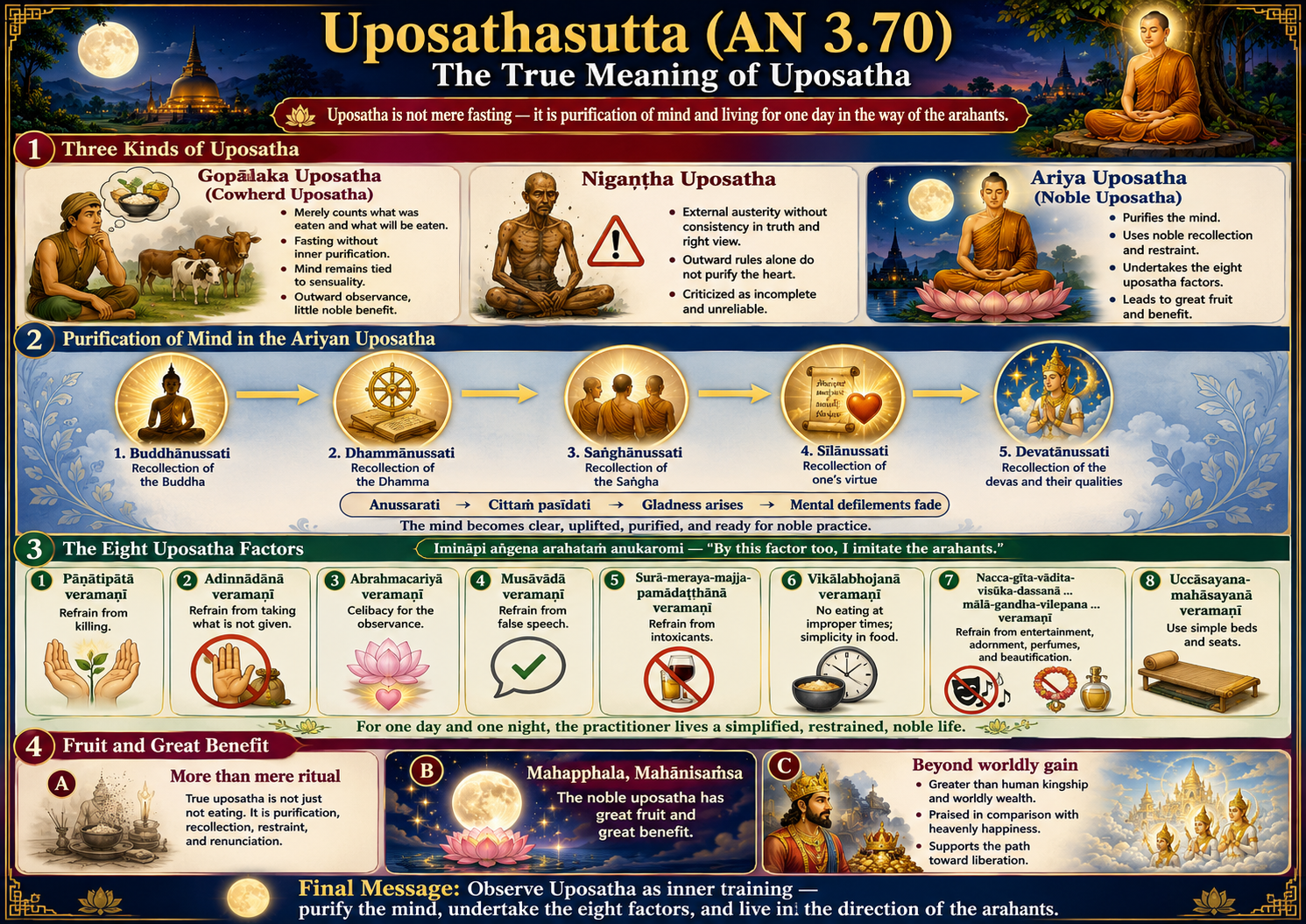 VISUAL SUMMARYSee this sutta in a pictureOpen the complete infographic for a visual overview before or after reading the full study.View infographic →
Three observances → purification → imitation of arahants
All 13 sections with full Pāḷi, translation and explanation
01 Visākhā Comes on the Uposatha Day
Evaṁ me sutaṁ— ekaṁ samayaṁ bhagavā sāvatthiyaṁ viharati pubbārāme migāramātupāsāde.
Atha kho visākhā migāramātā tadahuposathe yena bhagavā tenupasaṅkami; upasaṅkamitvā bhagavantaṁ abhivādetvā ekamantaṁ nisīdi. Ekamantaṁ nisinnaṁ kho visākhaṁ migāramātaraṁ bhagavā etadavoca: “handa kuto nu tvaṁ, visākhe, āgacchasi divā divassā”ti?
“Uposathāhaṁ, bhante, ajja upavasāmī”ti.
Thus have I heard. On one occasion the Blessed One was dwelling at Sāvatthī in the Eastern Monastery, in the mansion of Migāra’s mother.
On that uposatha day, Visākhā, Migāra’s mother, approached the Blessed One, paid homage, and sat to one side. The Blessed One said to her:
“Visākhā, where are you coming from in the middle of the day?”
“Venerable sir, today I am observing the uposatha.”
Deep Dive
The discourse begins with a lay practitioner, Visākhā, not with a monastic audience. This makes the teaching directly relevant to lay observance.
Upavasāmi here means “I am observing” or “I am keeping” the uposatha. The Buddha’s response shows that the external fact of observing a special day is not sufficient; the quality and mental orientation of the observance determine its value.
02 Three Kinds of Uposatha
“Tayo khome, visākhe, uposathā. Katame tayo? Gopālakuposatho, nigaṇṭhuposatho, ariyuposatho.”
“Visākhā, there are these three kinds of uposatha. What three?
The cowherd uposatha, the Nigaṇṭha uposatha, and the Ariyan uposatha.”
Deep Dive
The rest of the sutta contrasts three approaches.
The first is formally restrained but mentally preoccupied with sensual consumption.
The second is criticized for inconsistency between professed renunciation and actual truthfulness or ownership.
The third purifies the mind and uses the day to imitate the life-pattern of arahants.
The teaching therefore moves from outward form → inner contradiction → integrated purification and practice.
03 1. Gopālakuposatha — The Cowherd Uposatha
Kathañca, visākhe, gopālakuposatho hoti? Seyyathāpi, visākhe, gopālako sāyanhasamaye sāmikānaṁ gāvo niyyātetvā iti paṭisañcikkhati: ‘ajja kho gāvo amukasmiñca amukasmiñca padese cariṁsu, amukasmiñca amukasmiñca padese pānīyāni piviṁsu; sve dāni gāvo amukasmiñca amukasmiñca padese carissanti, amukasmiñca amukasmiñca padese pānīyāni pivissantī’ti;
evamevaṁ kho, visākhe, idhekacco uposathiko iti paṭisañcikkhati: ‘ahaṁ khvajja idañcidañca khādanīyaṁ khādiṁ, idañcidañca bhojanīyaṁ bhuñjiṁ; sve dānāhaṁ idañcidañca khādanīyaṁ khādissāmi, idañcidañca bhojanīyaṁ bhuñjissāmī’ti.
So tena abhijjhāsahagatena cetasā divasaṁ atināmeti.
Evaṁ kho, visākhe, gopālakuposatho hoti.
Evaṁ upavuttho kho, visākhe, gopālakuposatho na mahapphalo hoti na mahānisaṁso na mahājutiko na mahāvipphāro.
“And what is the cowherd uposatha?
Just as, in the evening, a cowherd returns the cattle to their owners and reflects: ‘Today the cattle grazed here and there and drank water here and there; tomorrow they will graze here and there and drink here and there’;
in the same way, some person observing the uposatha reflects: ‘Today I ate this and that kind of food; tomorrow I will eat this and that kind of food.’
That person spends the day with a mind accompanied by covetousness.
This is the cowherd uposatha.
Observed in this way, it is not of great fruit, great benefit, great brilliance, or great radiance.”
Deep Dive
The problem is not fasting itself. The problem is that the body is restrained while the mind remains occupied with consumption.
Abhijjhāsahagata citta means a mind accompanied by covetousness. The person has stopped eating, but mentally continues feeding sensual anticipation.
This is a sharp criterion for modern observance: renunciation should reduce mental feeding, not merely postpone physical consumption.
Practice Application
Modern example: someone keeps an uposatha fast but spends hours planning the special breakfast, restaurant meal, sweets, or shopping that will follow the next day. Outwardly the fast is maintained; inwardly the mind remains in kāma.
04 2. Nigaṇṭhuposatha — The Nigaṇṭha Uposatha
Kathañca, visākhe, nigaṇṭhuposatho hoti? Atthi, visākhe, nigaṇṭhā nāma samaṇajātikā. Te sāvakaṁ evaṁ samādapenti: ‘ehi tvaṁ, ambho purisa, ye puratthimāya disāya pāṇā paraṁ yojanasataṁ tesu daṇḍaṁ nikkhipāhi; ye pacchimāya disāya pāṇā paraṁ yojanasataṁ tesu daṇḍaṁ nikkhipāhi; ye uttarāya disāya pāṇā paraṁ yojanasataṁ tesu daṇḍaṁ nikkhipāhi; ye dakkhiṇāya disāya pāṇā paraṁ yojanasataṁ tesu daṇḍaṁ nikkhipāhī’ti.
Iti ekaccānaṁ pāṇānaṁ anuddayāya anukampāya samādapenti, ekaccānaṁ pāṇānaṁ nānuddayāya nānukampāya samādapenti.
Te tadahuposathe sāvakaṁ evaṁ samādapenti: ‘ehi tvaṁ, ambho purisa, sabbacelāni nikkhipitvā evaṁ vadehi—
Textual variant: sabbacelāni → sabbaverāni (mr)
“nāhaṁ kvacani kassaci kiñcanatasmiṁ, na ca mama kvacani katthaci kiñcanatatthī”ti.
Textual variant: kiñcanatasmiṁ → kiñcanattasmiṁ (bj); kiñcanaṁ tasmiṁ (si, sya-all, pts1ed); kiñcanatasmi (?) | katthaci → kismiñci (sya-all); kassaci (pts1ed) | kiñcanatatthī’ti → kiñcana nātthīti (bj); kiñcanatthīti (sya-all); kiñcanaṁ natthīti (pts1ed)
Jānanti kho panassa mātāpitaro: ‘ayaṁ amhākaṁ putto’ti; sopi jānāti: ‘ime mayhaṁ mātāpitaro’ti.
Jānāti kho panassa puttadāro: ‘ayaṁ mayhaṁ bhattā’ti; sopi jānāti: ‘ayaṁ mayhaṁ puttadāro’ti.
Jānanti kho panassa dāsakammakaraporisā: ‘ayaṁ amhākaṁ ayyo’ti; sopi jānāti: ‘ime mayhaṁ dāsakammakaraporisā’ti.
Iti yasmiṁ samaye sacce samādapetabbā musāvāde tasmiṁ samaye samādapenti. Idaṁ tassa musāvādasmiṁ vadāmi.
So tassā rattiyā accayena bhoge adinnaṁyeva paribhuñjati. Idaṁ tassa adinnādānasmiṁ vadāmi.
Evaṁ kho, visākhe, nigaṇṭhuposatho hoti.
Evaṁ upavuttho kho, visākhe, nigaṇṭhuposatho na mahapphalo hoti na mahānisaṁso na mahājutiko na mahāvipphāro.
“And what is the Nigaṇṭha uposatha?
There are ascetics called Nigaṇṭhas. They instruct a disciple to lay down violence toward beings beyond a certain distance in the four directions. In this way they encourage compassion toward some beings, but not toward others.
On the uposatha day they instruct a disciple to put aside clothing and declare: ‘I am nothing belonging to anyone anywhere, and nowhere is there anything that belongs to me.’
Yet the person’s parents know, ‘This is our son,’ and he knows, ‘These are my parents.’ His wife and children know their relationship to him, and he knows theirs. His servants and workers know him as their master, and he knows them as his workers.
Thus, at a time when he should be encouraged in truthfulness, he is encouraged in false speech. This, I say, counts as false speech.
When the night is over, he again makes use of possessions that have not been newly given to him. This, I say, counts as taking what is not given.
This is the Nigaṇṭha uposatha.
Observed in this way, it is not of great fruit, great benefit, great brilliance, or great radiance.”
Deep Dive
The criticism is about inconsistency between ritual declaration and actual lived reality.
The Buddha points out two faults: selective compassion and speech that conflicts with what the practitioner and others actually know to be true.
The deeper principle is that religious observance cannot be separated from sacca and ethical coherence. A renunciant formula does not purify the mind merely because it sounds radical.
This passage should be read in its historical polemical setting: it is the Buddha’s critique of a rival ascetic observance as represented in this discourse.
Practice Application
Practice application: an observance can become performative when one adopts external simplicity for a day but still cultivates possessiveness, status, deception, or selective compassion. The test is not how severe the ritual looks, but whether greed, falsehood, and harm actually diminish.
05 3. Ariyuposatha — Purifying a Defiled Mind
Kathañca, visākhe, ariyuposatho hoti?
Upakkiliṭṭhassa, visākhe, cittassa upakkamena pariyodapanā hoti.
Textual variant: pariyodapanā → pariyodāpanā (?)
Kathañca, visākhe, upakkiliṭṭhassa cittassa upakkamena pariyodapanā hoti?
“And what is the Ariyan uposatha?
Visākhā, a defiled mind is cleansed by applying an appropriate method.
And how is a defiled mind cleansed by applying an appropriate method?”
Deep Dive
This sentence gives the governing principle for the entire noble observance:
upakkiliṭṭha citta — a mind affected by defilement; upakkamena — by an applied method or deliberate procedure; pariyodapanā — cleansing, purification, clarification.
The uposatha is therefore active mental training. One does not simply wait for the mind to become pure. A specific object of recollection is deliberately applied so that pasāda and pāmojja arise and the defilements lose their hold.
06 Buddhānussati — Recollection of the Tathāgata
Idha, visākhe, ariyasāvako tathāgataṁ anussarati:
‘itipi so bhagavā arahaṁ sammāsambuddho vijjācaraṇasampanno sugato lokavidū anuttaro purisadammasārathi satthā devamanussānaṁ buddho bhagavā’ti.
Tassa tathāgataṁ anussarato cittaṁ pasīdati, pāmojjaṁ uppajjati, ye cittassa upakkilesā te pahīyanti, seyyathāpi, visākhe, upakkiliṭṭhassa sīsassa upakkamena pariyodapanā hoti.
Kathañca, visākhe, upakkiliṭṭhassa sīsassa upakkamena pariyodapanā hoti? Kakkañca paṭicca mattikañca paṭicca udakañca paṭicca purisassa ca tajjaṁ vāyāmaṁ paṭicca, evaṁ kho, visākhe, upakkiliṭṭhassa sīsassa upakkamena pariyodapanā hoti.
Evamevaṁ kho, visākhe, upakkiliṭṭhassa cittassa upakkamena pariyodapanā hoti.
Idha, visākhe, ariyasāvako tathāgataṁ anussarati:
‘itipi so bhagavā arahaṁ sammāsambuddho vijjācaraṇasampanno sugato lokavidū anuttaro purisadammasārathi satthā devamanussānaṁ buddho bhagavā’ti.
Tassa tathāgataṁ anussarato cittaṁ pasīdati, pāmojjaṁ uppajjati, ye cittassa upakkilesā te pahīyanti.
Ayaṁ vuccati, visākhe: ‘ariyasāvako brahmuposathaṁ upavasati, brahmunā saddhiṁ saṁvasati, brahmañcassa ārabbha cittaṁ pasīdati, pāmojjaṁ uppajjati, ye cittassa upakkilesā te pahīyanti’.
Textual variant: brahmañcassa → brahmañca (mr)
Evaṁ kho, visākhe, upakkiliṭṭhassa cittassa upakkamena pariyodapanā hoti.
The noble disciple recollects the Tathāgata:
“Indeed, the Blessed One is an arahant, perfectly awakened, accomplished in true knowledge and conduct, well-gone, knower of the world, unsurpassed trainer of persons to be trained, teacher of devas and humans, awakened, blessed.”
As the disciple recollects the Tathāgata, the mind becomes clear and confident, gladness arises, and the mind’s defilements are abandoned—just as a dirty head is cleansed by the proper cleansing agents, water, and appropriate effort.
This is called observing the Brahmā-uposatha: recollection of the Buddha becomes the basis for clarity, gladness, and abandonment of mental defilements.
Deep Dive
The result sequence is consistent throughout these recollections:
anussarati → cittaṁ pasīdati → pāmojjaṁ uppajjati → upakkilesā pahīyanti.
Recollection is not merely reciting a formula. The qualities recollected should shift the actual state of the mind.
The cleansing simile also emphasizes effort and appropriate means. Mental purification has conditions, just as washing a dirty head does.
07 Dhammānussati — Recollection of the Dhamma
Upakkiliṭṭhassa, visākhe, cittassa upakkamena pariyodapanā hoti.
Kathañca, visākhe, upakkiliṭṭhassa cittassa upakkamena pariyodapanā hoti?
Idha, visākhe, ariyasāvako dhammaṁ anussarati:
‘svākkhāto bhagavatā dhammo sandiṭṭhiko akāliko ehipassiko opaneyyiko paccattaṁ veditabbo viññūhī’ti.
Tassa dhammaṁ anussarato cittaṁ pasīdati, pāmojjaṁ uppajjati, ye cittassa upakkilesā te pahīyanti, seyyathāpi, visākhe, upakkiliṭṭhassa kāyassa upakkamena pariyodapanā hoti.
Kathañca, visākhe, upakkiliṭṭhassa kāyassa upakkamena pariyodapanā hoti? Sottiñca paṭicca, cuṇṇañca paṭicca, udakañca paṭicca, purisassa ca tajjaṁ vāyāmaṁ paṭicca. Evaṁ kho, visākhe, upakkiliṭṭhassa kāyassa upakkamena pariyodapanā hoti.
Evamevaṁ kho, visākhe, upakkiliṭṭhassa cittassa upakkamena pariyodapanā hoti.
Idha, visākhe, ariyasāvako dhammaṁ anussarati:
‘svākkhāto bhagavatā dhammo sandiṭṭhiko akāliko ehipassiko opaneyyiko paccattaṁ veditabbo viññūhī’ti.
Tassa dhammaṁ anussarato cittaṁ pasīdati, pāmojjaṁ uppajjati, ye cittassa upakkilesā te pahīyanti.
Ayaṁ vuccati, visākhe, ‘ariyasāvako dhammuposathaṁ upavasati, dhammena saddhiṁ saṁvasati, dhammañcassa ārabbha cittaṁ pasīdati, pāmojjaṁ uppajjati, ye cittassa upakkilesā te pahīyanti’.
Evaṁ kho, visākhe, upakkiliṭṭhassa cittassa upakkamena pariyodapanā hoti.
The noble disciple recollects the Dhamma:
“The Dhamma is well proclaimed by the Blessed One, visible here and now, timeless, inviting inspection, onward-leading, to be known individually by the wise.”
As the disciple recollects the Dhamma, the mind becomes clear and confident, gladness arises, and mental defilements are abandoned—just as the body is cleansed through proper cleansing materials, water, and effort.
This is called observing the Dhamma-uposatha: one dwells with the Dhamma, and recollection of it becomes the basis for clarity, gladness, and purification.
Deep Dive
Dhammānussati turns the mind away from fascination with worldly objects and toward the qualities of a teaching that can be directly known and lived.
The phrase paccattaṁ veditabbo viññūhi is important: the Dhamma is not merely believed; it is to be personally known by the wise.
08 Saṅghānussati — Recollection of the Saṅgha
Upakkiliṭṭhassa, visākhe, cittassa upakkamena pariyodapanā hoti.
Kathañca, visākhe, upakkiliṭṭhassa cittassa upakkamena pariyodapanā hoti?
Idha, visākhe, ariyasāvako saṅghaṁ anussarati:
‘suppaṭipanno bhagavato sāvakasaṅgho, ujuppaṭipanno bhagavato sāvakasaṅgho, ñāyappaṭipanno bhagavato sāvakasaṅgho, sāmīcippaṭipanno bhagavato sāvakasaṅgho, yadidaṁ cattāri purisayugāni aṭṭha purisapuggalā, esa bhagavato sāvakasaṅgho āhuneyyo pāhuneyyo dakkhiṇeyyo añjalikaraṇīyo anuttaraṁ puññakkhettaṁ lokassā’ti.
Tassa saṅghaṁ anussarato cittaṁ pasīdati, pāmojjaṁ uppajjati, ye cittassa upakkilesā te pahīyanti, seyyathāpi, visākhe, upakkiliṭṭhassa vatthassa upakkamena pariyodapanā hoti.
Kathañca, visākhe, upakkiliṭṭhassa vatthassa upakkamena pariyodapanā hoti? Usmañca paṭicca, khārañca paṭicca, gomayañca paṭicca, udakañca paṭicca, purisassa ca tajjaṁ vāyāmaṁ paṭicca. Evaṁ kho, visākhe, upakkiliṭṭhassa vatthassa upakkamena pariyodapanā hoti.
Evamevaṁ kho, visākhe, upakkiliṭṭhassa cittassa upakkamena pariyodapanā hoti.
Idha, visākhe, ariyasāvako saṅghaṁ anussarati:
‘suppaṭipanno bhagavato sāvakasaṅgho, ujuppaṭipanno bhagavato sāvakasaṅgho, ñāyappaṭipanno bhagavato sāvakasaṅgho, sāmīcippaṭipanno bhagavato sāvakasaṅgho, yadidaṁ cattāri purisayugāni aṭṭha purisapuggalā, esa bhagavato sāvakasaṅgho āhuneyyo pāhuneyyo dakkhiṇeyyo añjalikaraṇīyo anuttaraṁ puññakkhettaṁ lokassā’ti.
Tassa saṅghaṁ anussarato cittaṁ pasīdati, pāmojjaṁ uppajjati, ye cittassa upakkilesā te pahīyanti.
Ayaṁ vuccati, visākhe, ‘ariyasāvako saṅghuposathaṁ upavasati, saṅghena saddhiṁ saṁvasati, saṅghañcassa ārabbha cittaṁ pasīdati, pāmojjaṁ uppajjati, ye cittassa upakkilesā te pahīyanti’.
Evaṁ kho, visākhe, upakkiliṭṭhassa cittassa upakkamena pariyodapanā hoti.
The noble disciple recollects the Saṅgha of the Blessed One’s disciples as practicing well, directly, methodically, and properly; comprising the four pairs and eight kinds of noble persons; worthy of gifts, hospitality, offerings, reverential salutation, and an unsurpassed field of merit for the world.
As the disciple recollects the Saṅgha, the mind becomes clear and confident, gladness arises, and mental defilements are abandoned—just as soiled cloth is properly cleansed.
This is called observing the Saṅgha-uposatha: one dwells with the Saṅgha in recollection, and the mind is purified through that recollection.
Deep Dive
The abbreviated `…pe…` in your source has been expanded here in full.
The object of recollection is not merely an institution. It is the sāvakasaṅgha defined through noble practice and realization: the four pairs and eight persons.
09 Sīlānussati — Recollection of One’s Sīla
Upakkiliṭṭhassa, visākhe, cittassa upakkamena pariyodapanā hoti.
Kathañca, visākhe, upakkiliṭṭhassa cittassa upakkamena pariyodapanā hoti?
Idha, visākhe, ariyasāvako attano sīlāni anussarati:
‘akhaṇḍāni acchiddāni asabalāni akammāsāni bhujissāni viññuppasatthāni aparāmaṭṭhāni samādhisaṁvattanikāni’.
Tassa sīlaṁ anussarato cittaṁ pasīdati, pāmojjaṁ uppajjati, ye cittassa upakkilesā te pahīyanti, seyyathāpi, visākhe, upakkiliṭṭhassa ādāsassa upakkamena pariyodapanā hoti.
Kathañca, visākhe, upakkiliṭṭhassa ādāsassa upakkamena pariyodapanā hoti? Telañca paṭicca, chārikañca paṭicca, vālaṇḍupakañca paṭicca, purisassa ca tajjaṁ vāyāmaṁ paṭicca. Evaṁ kho, visākhe, upakkiliṭṭhassa ādāsassa upakkamena pariyodapanā hoti.
Evamevaṁ kho, visākhe, upakkiliṭṭhassa cittassa upakkamena pariyodapanā hoti.
Idha, visākhe, ariyasāvako attano sīlāni anussarati:
‘akhaṇḍāni acchiddāni asabalāni akammāsāni bhujissāni viññuppasatthāni aparāmaṭṭhāni samādhisaṁvattanikāni’.
Tassa sīlaṁ anussarato cittaṁ pasīdati, pāmojjaṁ uppajjati, ye cittassa upakkilesā te pahīyanti.
Ayaṁ vuccati, visākhe, ‘ariyasāvako sīluposathaṁ upavasati, sīlena saddhiṁ saṁvasati, sīlañcassa ārabbha cittaṁ pasīdati, pāmojjaṁ uppajjati, ye cittassa upakkilesā te pahīyanti’.
Evaṁ kho, visākhe, upakkiliṭṭhassa cittassa upakkamena pariyodapanā hoti.
The noble disciple recollects their own virtues as unbroken, untorn, unblotched, unmottled, liberating, praised by the wise, not grasped at, and conducive to samādhi.
As the disciple recollects sīla, the mind becomes clear and confident, gladness arises, and mental defilements are abandoned—just as a stained mirror is polished through the proper method.
This is called observing the sīla-uposatha: one dwells with sīla, and recollection of one’s ethical integrity purifies the mind.
Deep Dive
The `…pe…` formula has been restored in full.
The final quality, samādhisaṁvattanikāni, is especially important: sīla is not merely social morality. It conduces to samādhi.
Recollection works because ethical integrity removes remorse and gives the mind legitimate grounds for confidence and gladness.
10 Devatānussati — Recollection of the Devas and One’s Own Qualities
Upakkiliṭṭhassa, visākhe, cittassa upakkamena pariyodapanā hoti.
Kathañca, visākhe, upakkiliṭṭhassa cittassa upakkamena pariyodapanā hoti?
Idha, visākhe, ariyasāvako devatā anussarati:
‘santi devā cātumahārājikā, santi devā tāvatiṁsā, santi devā yāmā, santi devā tusitā, santi devā nimmānaratino, santi devā paranimmitavasavattino, santi devā brahmakāyikā, santi devā tatuttari.
Textual variant: cātumahārājikā → cātummahārājikā (bj, sya-all, km, pts1ed) | tatuttari → tatuttariṁ (bj, pts1ed); taduttari (sya-all)
Yathārūpāya saddhāya samannāgatā tā devatā ito cutā tatthupapannā, mayhampi tathārūpā saddhā saṁvijjati.
Yathārūpena sīlena samannāgatā tā devatā ito cutā tatthupapannā, mayhampi tathārūpaṁ sīlaṁ saṁvijjati.
Yathārūpena sutena samannāgatā tā devatā ito cutā tatthupapannā, mayhampi tathārūpaṁ sutaṁ saṁvijjati.
Yathārūpena cāgena samannāgatā tā devatā ito cutā tatthupapannā, mayhampi tathārūpo cāgo saṁvijjati.
Yathārūpāya paññāya samannāgatā tā devatā ito cutā tatthupapannā, mayhampi tathārūpā paññā saṁvijjatī’ti.
Tassa attano ca tāsañca devatānaṁ saddhañca sīlañca sutañca cāgañca paññañca anussarato cittaṁ pasīdati, pāmojjaṁ uppajjati, ye cittassa upakkilesā te pahīyanti, seyyathāpi, visākhe, upakkiliṭṭhassa jātarūpassa upakkamena pariyodapanā hoti.
Kathañca, visākhe, upakkiliṭṭhassa jātarūpassa upakkamena pariyodapanā hoti? Ukkañca paṭicca, loṇañca paṭicca, gerukañca paṭicca, nāḷikasaṇḍāsañca paṭicca, purisassa ca tajjaṁ vāyāmaṁ paṭicca.
Textual variant: gerukañca paṭicca, nāḷikasaṇḍāsañca → nāḷikañca paṭicca saṇḍāsañca (pts1ed, mr)
Evaṁ kho, visākhe, upakkiliṭṭhassa jātarūpassa upakkamena pariyodapanā hoti.
Evamevaṁ kho, visākhe, upakkiliṭṭhassa cittassa upakkamena pariyodapanā hoti.
Idha, visākhe, ariyasāvako devatā anussarati:
‘santi devā cātumahārājikā, santi devā tāvatiṁsā, santi devā yāmā, santi devā tusitā, santi devā nimmānaratino, santi devā paranimmitavasavattino, santi devā brahmakāyikā, santi devā tatuttari.
Yathārūpāya saddhāya samannāgatā tā devatā ito cutā tatthupapannā, mayhampi tathārūpā saddhā saṁvijjati.
Yathārūpena sīlena samannāgatā tā devatā ito cutā tatthupapannā, mayhampi tathārūpaṁ sīlaṁ saṁvijjati.
Yathārūpena sutena samannāgatā tā devatā ito cutā tatthupapannā, mayhampi tathārūpaṁ sutaṁ saṁvijjati.
Yathārūpena cāgena samannāgatā tā devatā ito cutā tatthupapannā, mayhampi tathārūpo cāgo saṁvijjati.
Yathārūpāya paññāya samannāgatā tā devatā ito cutā tatthupapannā, mayhampi tathārūpā paññā saṁvijjatī’ti.
Tassa attano ca tāsañca devatānaṁ saddhañca sīlañca sutañca cāgañca paññañca anussarato cittaṁ pasīdati, pāmojjaṁ uppajjati, ye cittassa upakkilesā te pahīyanti.
Ayaṁ vuccati, visākhe, ‘ariyasāvako devatuposathaṁ upavasati, devatāhi saddhiṁ saṁvasati, devatā ārabbha cittaṁ pasīdati, pāmojjaṁ uppajjati, ye cittassa upakkilesā te pahīyanti’.
Evaṁ kho, visākhe, upakkiliṭṭhassa cittassa upakkamena pariyodapanā hoti.
The noble disciple recollects the devas of various heavenly realms and reflects that those beings were reborn there endowed with qualities such as faith, sīla, learning, generosity, and wisdom—and that those same kinds of qualities are present in oneself.
Recollecting both the devas and these shared qualities, the mind becomes clear and confident, gladness arises, and mental defilements are abandoned—just as raw gold is purified by the proper refining process.
This is called observing the deva-uposatha: one dwells in recollection of the devas and of the qualities that made such fortunate rebirth possible.
Deep Dive
The abbreviated `…pe…` in the source has been fully restored.
The practice is not passive admiration of devas. The practitioner recognizes in oneself the same five qualities: saddhā, sīla, suta, cāga, and paññā.
The recollection therefore becomes both inspiration and self-verification: “These wholesome qualities exist in me and can be further developed.”
11 The Eight Factors — Imitating the Arahants for One Day and Night
Sa kho so, visākhe, ariyasāvako iti paṭisañcikkhati:
‘yāvajīvaṁ arahanto pāṇātipātaṁ pahāya pāṇātipātā paṭiviratā nihitadaṇḍā nihitasatthā lajjī dayāpannā sabbapāṇabhūtahitānukampī viharanti; ahampajja imañca rattiṁ imañca divasaṁ pāṇātipātaṁ pahāya pāṇātipātā paṭivirato nihitadaṇḍo nihitasattho lajjī dayāpanno sabbapāṇabhūtahitānukampī viharāmi. Imināpi aṅgena arahataṁ anukaromi, uposatho ca me upavuttho bhavissati.
Yāvajīvaṁ arahanto adinnādānaṁ pahāya adinnādānā paṭiviratā dinnādāyī dinnapāṭikaṅkhī, athenena sucibhūtena attanā viharanti; ahampajja imañca rattiṁ imañca divasaṁ adinnādānaṁ pahāya adinnādānā paṭivirato dinnādāyī dinnapāṭikaṅkhī, athenena sucibhūtena attanā viharāmi. Imināpi aṅgena arahataṁ anukaromi, uposatho ca me upavuttho bhavissati.
Yāvajīvaṁ arahanto abrahmacariyaṁ pahāya brahmacārī ārācārī viratā methunā gāmadhammā;
Textual variant: ārācārī → anācārī (mr)
ahampajja imañca rattiṁ imañca divasaṁ abrahmacariyaṁ pahāya brahmacārī ārācārī virato methunā gāmadhammā. Imināpi aṅgena arahataṁ anukaromi, uposatho ca me upavuttho bhavissati.
Yāvajīvaṁ arahanto musāvādaṁ pahāya musāvādā paṭiviratā saccavādī saccasandhā thetā paccayikā avisaṁvādakā lokassa; ahampajja imañca rattiṁ imañca divasaṁ musāvādaṁ pahāya musāvādā paṭivirato saccavādī saccasandho theto paccayiko avisaṁvādako lokassa. Imināpi aṅgena arahataṁ anukaromi, uposatho ca me upavuttho bhavissati.
Yāvajīvaṁ arahanto surāmerayamajjapamādaṭṭhānaṁ pahāya surāmerayamajjapamādaṭṭhānā paṭiviratā; ahampajja imañca rattiṁ imañca divasaṁ surāmerayamajjapamādaṭṭhānaṁ pahāya surāmerayamajjapamādaṭṭhānā paṭivirato. Imināpi aṅgena arahataṁ anukaromi, uposatho ca me upavuttho bhavissati.
Yāvajīvaṁ arahanto ekabhattikā rattūparatā viratā vikālabhojanā; ahampajja imañca rattiṁ imañca divasaṁ ekabhattiko rattūparato virato vikālabhojanā. Imināpi aṅgena arahataṁ anukaromi, uposatho ca me upavuttho bhavissati.
Yāvajīvaṁ arahanto naccagītavāditavisūkadassanamālāgandhavilepanadhāraṇamaṇḍanavibhūsanaṭṭhānā paṭiviratā; ahampajja imañca rattiṁ imañca divasaṁ naccagītavāditavisūkadassanamālāgandhavilepanadhāraṇamaṇḍanavibhūsanaṭṭhānā paṭivirato. Imināpi aṅgena arahataṁ anukaromi, uposatho ca me upavuttho bhavissati.
Yāvajīvaṁ arahanto uccāsayanamahāsayanaṁ pahāya uccāsayanamahāsayanā paṭiviratā nīcaseyyaṁ kappenti mañcake vā tiṇasanthārake vā; ahampajja imañca rattiṁ imañca divasaṁ uccāsayanamahāsayanaṁ pahāya uccāsayanamahāsayanā paṭivirato nīcaseyyaṁ kappemi mañcake vā tiṇasanthārake vā. Imināpi aṅgena arahataṁ anukaromi, uposatho ca me upavuttho bhavissatī’ti.
Evaṁ kho, visākhe, ariyuposatho hoti. Evaṁ upavuttho kho, visākhe, ariyuposatho mahapphalo hoti mahānisaṁso mahājutiko mahāvipphāro.
The noble disciple reflects that arahants live for life abstaining from killing, taking what is not given, sexual activity, false speech, intoxicants, untimely eating, entertainment and adornment, and high or luxurious beds.
The practitioner then resolves: “For this day and this night, I too will live in this way. By this factor I imitate the arahants, and my uposatha will be well observed.”
The Buddha concludes that the Ariyan uposatha observed in this way is of great fruit, great benefit, great brilliance, and great radiance.
Deep Dive
The recurring phrase is crucial:
imināpi aṅgena arahataṁ anukaromi — “by this factor too, I imitate the arahants.”
The eight precepts are therefore not arbitrary prohibitions. For one day and night, the lay practitioner deliberately approximates the arahant’s mode of life.
This changes the psychology of observance. Instead of “I am being deprived of food, entertainment, sex, comfort, or decoration,” the framing becomes: “For this period I am training in the direction of those who are fully liberated.”
12 Great Fruit — Human Sovereignty Compared with Heavenly Happiness
Kīvamahapphalo hoti kīvamahānisaṁso kīvamahājutiko kīvamahāvipphāro?
Seyyathāpi, visākhe, yo imesaṁ soḷasannaṁ mahājanapadānaṁ pahūtarattaratanānaṁ issariyādhipaccaṁ rajjaṁ kāreyya, seyyathidaṁ—
Textual variant: pahūtarattaratanānaṁ → pahūtasattaratanānaṁ (bj, sya-all, km); pahūtamahāsattaratanānaṁ (pts1ed) | issariyādhipaccaṁ → issarādhipaccaṁ (pts1ed)
aṅgānaṁ, magadhānaṁ, kāsīnaṁ, kosalānaṁ, vajjīnaṁ, mallānaṁ, cetīnaṁ, vaṅgānaṁ, kurūnaṁ, pañcālānaṁ, macchānaṁ, sūrasenānaṁ, assakānaṁ, avantīnaṁ, gandhārānaṁ, kambojānaṁ, aṭṭhaṅgasamannāgatassa uposathassa etaṁ kalaṁ nāgghati soḷasiṁ.
Textual variant: macchānaṁ → maccānaṁ (mr) | etaṁ → etassa (bj); ekaṁ (mr)
Taṁ kissa hetu? Kapaṇaṁ, visākhe, mānusakaṁ rajjaṁ dibbaṁ sukhaṁ upanidhāya.
Yāni, visākhe, mānusakāni paññāsa vassāni, cātumahārājikānaṁ devānaṁ eso eko rattindivo. Tāya rattiyā tiṁsarattiyo māso. Tena māsena dvādasamāsiyo saṁvaccharo. Tena saṁvaccharena dibbāni pañca vassasatāni cātumahārājikānaṁ devānaṁ āyuppamāṇaṁ. Ṭhānaṁ kho panetaṁ, visākhe, vijjati yaṁ idhekacco itthī vā puriso vā aṭṭhaṅgasamannāgataṁ uposathaṁ upavasitvā kāyassa bhedā paraṁ maraṇā cātumahārājikānaṁ devānaṁ sahabyataṁ upapajjeyya.
Yaṁ, visākhe, mānusakaṁ vassasataṁ, tāvatiṁsānaṁ devānaṁ eso eko rattindivo. Tāya rattiyā tiṁsarattiyo māso. Tena māsena dvādasamāsiyo saṁvaccharo. Tena saṁvaccharena dibbaṁ vassasahassaṁ tāvatiṁsānaṁ devānaṁ āyuppamāṇaṁ. Ṭhānaṁ kho panetaṁ, visākhe, vijjati yaṁ idhekacco itthī vā puriso vā aṭṭhaṅgasamannāgataṁ uposathaṁ upavasitvā kāyassa bhedā paraṁ maraṇā tāvatiṁsānaṁ devānaṁ sahabyataṁ upapajjeyya.
Yāni, visākhe, mānusakāni dve vassasatāni, yāmānaṁ devānaṁ eso eko rattindivo. Tāya rattiyā tiṁsarattiyo māso. Tena māsena dvādasamāsiyo saṁvaccharo. Tena saṁvaccharena dibbāni dve vassasahassāni yāmānaṁ devānaṁ āyuppamāṇaṁ. Ṭhānaṁ kho panetaṁ, visākhe, vijjati yaṁ idhekacco itthī vā puriso vā aṭṭhaṅgasamannāgataṁ uposathaṁ upavasitvā kāyassa bhedā paraṁ maraṇā yāmānaṁ devānaṁ sahabyataṁ upapajjeyya.
Yāni, visākhe, mānusakāni cattāri vassasatāni, tusitānaṁ devānaṁ eso eko rattindivo. Tāya rattiyā tiṁsarattiyo māso. Tena māsena dvādasamāsiyo saṁvaccharo. Tena saṁvaccharena dibbāni cattāri vassasahassāni tusitānaṁ devānaṁ āyuppamāṇaṁ. Ṭhānaṁ kho panetaṁ, visākhe, vijjati yaṁ idhekacco itthī vā puriso vā aṭṭhaṅgasamannāgataṁ uposathaṁ upavasitvā kāyassa bhedā paraṁ maraṇā tusitānaṁ devānaṁ sahabyataṁ upapajjeyya.
Yāni, visākhe, mānusakāni aṭṭha vassasatāni, nimmānaratīnaṁ devānaṁ eso eko rattindivo. Tāya rattiyā tiṁsarattiyo māso. Tena māsena dvādasamāsiyo saṁvaccharo. Tena saṁvaccharena dibbāni aṭṭha vassasahassāni nimmānaratīnaṁ devānaṁ āyuppamāṇaṁ. Ṭhānaṁ kho panetaṁ, visākhe, vijjati yaṁ idhekacco itthī vā puriso vā aṭṭhaṅgasamannāgataṁ uposathaṁ upavasitvā kāyassa bhedā paraṁ maraṇā nimmānaratīnaṁ devānaṁ sahabyataṁ upapajjeyya.
Yāni, visākhe, mānusakāni soḷasa vassasatāni, paranimmitavasavattīnaṁ devānaṁ eso eko rattindivo. Tāya rattiyā tiṁsarattiyo māso. Tena māsena dvādasamāsiyo saṁvaccharo. Tena saṁvaccharena dibbāni soḷasa vassasahassāni paranimmitavasavattīnaṁ devānaṁ āyuppamāṇaṁ. Ṭhānaṁ kho panetaṁ, visākhe, vijjati yaṁ idhekacco itthī vā puriso vā aṭṭhaṅgasamannāgataṁ uposathaṁ upavasitvā kāyassa bhedā paraṁ maraṇā paranimmitavasavattīnaṁ devānaṁ sahabyataṁ upapajjeyya.
The Buddha says that even sovereignty over the sixteen great states of ancient India would not amount to one-sixteenth of the value of the eight-factored uposatha.
He then compares human time with the lifespans of six deva realms: the Four Great Kings, Tāvatiṁsa, Yāma, Tusita, Nimmānarati, and Paranimmitavasavatti.
In the narrative framework of the sutta, observing the eight-factored uposatha can become a condition for rebirth in these fortunate realms.
The repeated point is: human kingship is meager when compared with heavenly happiness.
Deep Dive
These cosmological numbers should be presented as part of the sutta’s own cosmological framework.
The deeper ethical contrast is clear even without focusing on arithmetic: power, territory, and wealth are placed below a day and night of disciplined renunciation and wholesome training.
The sutta revalues “success”: sovereignty over vast land is portrayed as spiritually small compared with a mind deliberately trained in sīla, recollection, gladness, and restraint.
13 Closing Verses — The Eight-Factored Uposatha
Pāṇaṁ na haññe na cadinnamādiye,
Textual variant: na haññe → na hāne (bj, pts1ed)
; na hane (mr) Musā na bhāse na ca majjapo siyā; Abrahmacariyā virameyya methunā, Rattiṁ na bhuñjeyya vikālabhojanaṁ.
Mālaṁ na dhāre na ca gandhamācare, Mañce chamāyaṁ va sayetha santhate; Etañhi aṭṭhaṅgikamāhuposathaṁ, Buddhena dukkhantagunā pakāsitaṁ.
Cando ca suriyo ca ubho sudassanā, Obhāsayaṁ anupariyanti yāvatā; Tamonudā te pana antalikkhagā, Nabhe pabhāsanti disāvirocanā.
Etasmiṁ yaṁ vijjati antare dhanaṁ, Muttā maṇi veḷuriyañca bhaddakaṁ; Siṅgī suvaṇṇaṁ atha vāpi kañcanaṁ, Yaṁ jātarūpaṁ haṭakanti vuccati.
Aṭṭhaṅgupetassa uposathassa, Kalampi te nānubhavanti soḷasiṁ; Candappabhā tāragaṇā ca sabbe.
Tasmā hi nārī ca naro ca sīlavā, Aṭṭhaṅgupetaṁ upavassuposathaṁ; Puññāni katvāna sukhudrayāni, Aninditā saggamupenti ṭhānan”ti.
The verses summarize the observance:
Do not kill or take what is not given. Do not speak falsely or drink intoxicants. Abstain from sexual activity. Do not eat at night or at the wrong time. Do not wear garlands or use perfumes for adornment. Sleep on a simple low bed or mat.
This is called the eight-factored uposatha proclaimed by the Buddha, who has reached the end of suffering.
The wealth and brilliance associated with the sun, moon, stars, gems, gold, and precious materials do not equal even a sixteenth part of the value of the eight-factored uposatha.
Therefore, women and men endowed with sīla who observe this uposatha and perform meritorious deeds leading to happiness are praised and may reach fortunate heavenly destinations.
Deep Dive
The closing verses compress the entire practical observance into a memorable form.
But the prose section before it shows that the eight precepts are only one part of the Ariyan uposatha. The day also includes deliberate recollection and purification of mind.
Thus the complete structure is:
purify citta through recollection → generate pasāda and pāmojja → abandon upakkilesa → imitate arahants through eight factors → dwell for one day and night in a simplified, restrained mode of life.
Where do the deva realms mentioned in this sutta fit?
A one-day imitation of the arahants
| Factor | Training for one day and night |
|---|---|
| 1. Pāṇātipātā veramaṇī | Abstaining from killing; dwelling compassionate toward all living beings. |
| 2. Adinnādānā veramaṇī | Abstaining from taking what is not given; living honestly and purely. |
| 3. Abrahmacariyā veramaṇī | Observing celibacy for the day and night. |
| 4. Musāvādā veramaṇī | Abstaining from false speech; being truthful and trustworthy. |
| 5. Surāmerayamajjapamādaṭṭhānā veramaṇī | Abstaining from intoxicants that are a basis for heedlessness. |
| 6. Vikālabhojanā veramaṇī | One meal / abstaining from eating at the wrong time, especially at night. |
| 7. Nacca-gīta-vādita… mālā-gandha-vilepana… | Abstaining from entertainment, adornment, cosmetics, perfumes, and beautification. |
| 8. Uccāsayana-mahāsayanā veramaṇī | Abstaining from high/luxurious beds and seats; using a simple low sleeping place. |