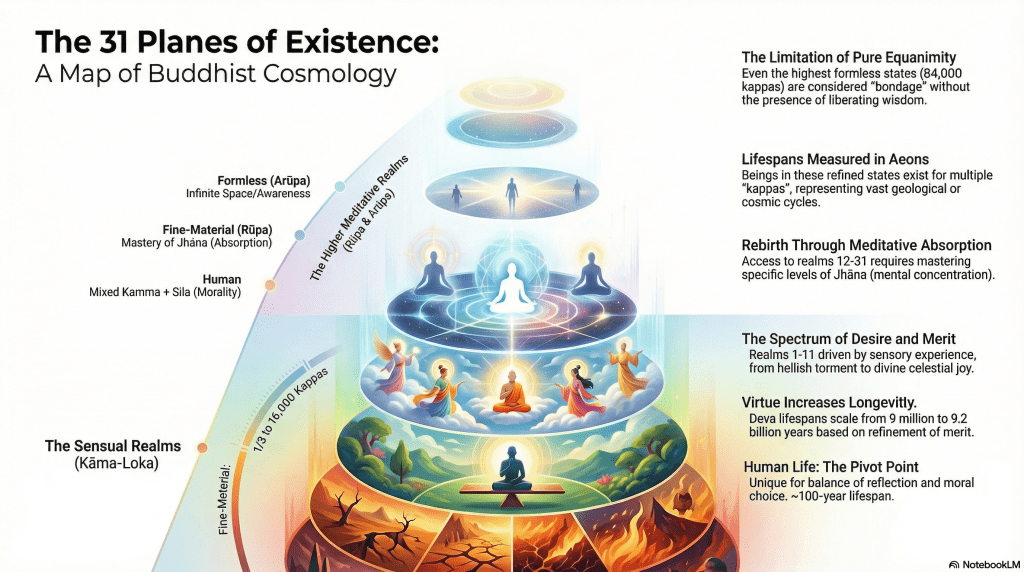
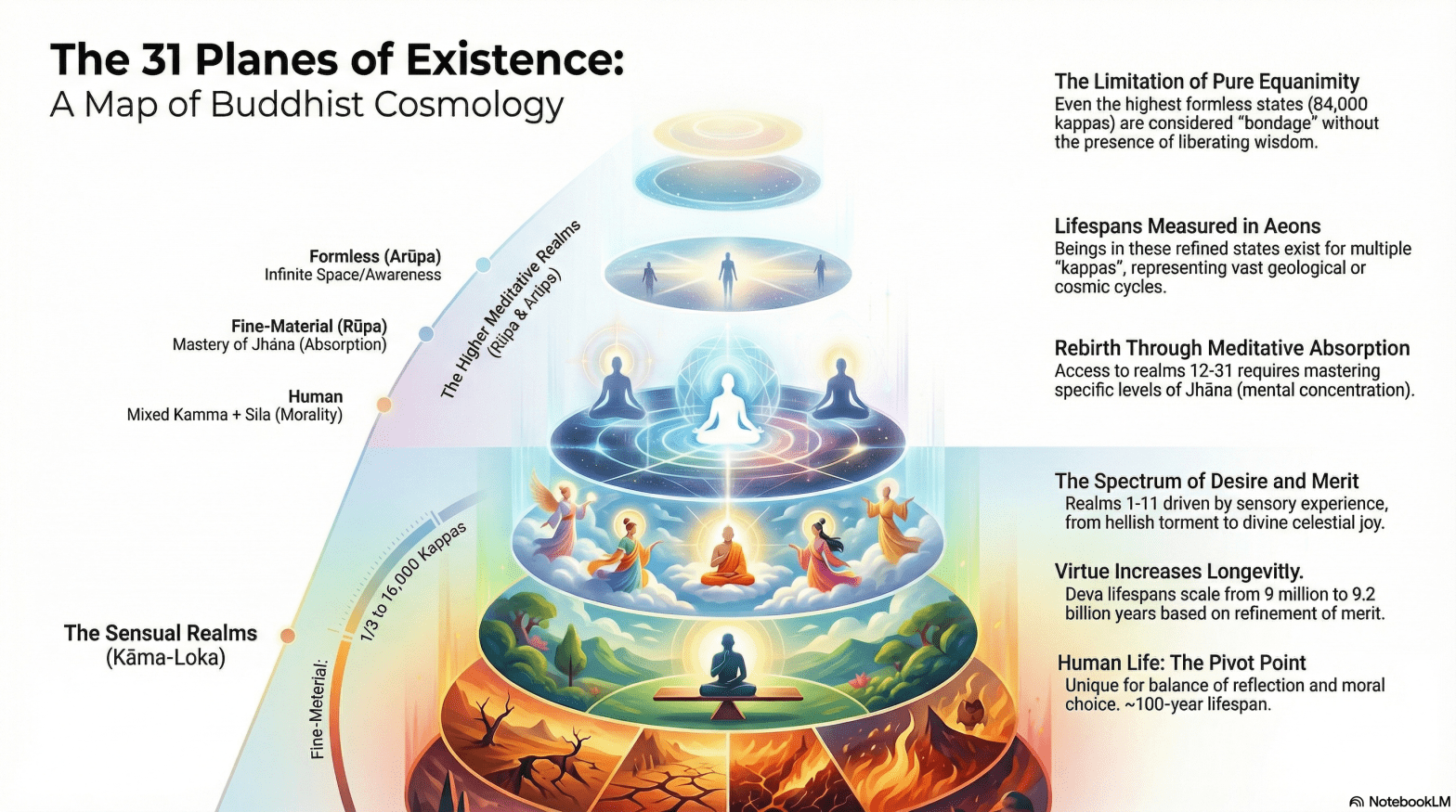
Let us go over the 31 planes of existence which can be experienced by everyone during a day if someone is keen and sharp to see that indeed the mind keeps on oscillating among these existence.
It’s time to go into every detail of it and understand what needs to be done in order not to be in apayas
| Plane | Realm (Pāli) | Category | Lifespan (Approx.) | Requirement / Cause | Inner Experience | Limitation / Risk |
|---|---|---|---|---|---|---|
| 1 | Niraya | Hell | Thousands → many kappas | Severe hatred, cruelty | Burning rage, torment | Extreme suffering |
| 2 | Tiracchāna | Animal | Many lives | Strong delusion | Instinct life, dullness | No wisdom |
| 3 | Peta | Hungry Ghost | 100–10,000+ yrs | Greed, miserliness | Endless hunger | Never satisfied |
| 4 | Asura | Titan | Millions yrs | Jealousy, pride | Conflict, rivalry | Restlessness |
| 5 | Manussa | Human | ~100 yrs | Mixed kamma + sīla | Reflection, moral choice | Short life |
| 6 | Cātummahārājika | Deva | ~9 million yrs | Dāna + sīla | Moral joy | Sensual craving |
| 7 | Tāvatimsa | Deva | ~36 million yrs | Strong merit | Faith, gratitude | Pride |
| 8 | Yāma | Deva | ~144 million yrs | Joyful virtue | Stable happiness | Subtle craving |
| 9 | Tusita | Deva | ~576 million yrs | High morality | Dhamma-joy | Attachment |
| 10 | Nimmānarati | Deva | ~2.3 billion yrs | Refined merit | Creative joy | Ego |
| 11 | Paranimmita | Deva | ~9.2 billion yrs | Strong merit | Dependent joy | Dependency |
| No. | Realm (Pāli) | Category | Lifespan | Basis / Requirement | Inner Experience | Limitation |
|---|---|---|---|---|---|---|
| 12 | Brahma-pārisajja | Rūpa (1st Jhāna) | 1/3 kappa | 1st Jhāna | Early absorption, joy | Thinking remains |
| 13 | Brahma-purohita | Rūpa (1st Jhāna) | 1/2 kappa | Strong 1st Jhāna | Stable bliss | Subtle effort |
| 14 | Mahābrahmā | Rūpa (1st Jhāna) | 1 kappa | Mastered 1st Jhāna | Full absorption | Pride risk |
| 15 | Parittābha | Rūpa (2nd Jhāna) | 2 kappas | 2nd Jhāna | Inner light, joy | Bliss attachment |
| 16 | Appamāṇābha | Rūpa (2nd Jhāna) | 4 kappas | Strong 2nd Jhāna | Vast radiance | No insight |
| 17 | Ābhassara | Rūpa (2nd Jhāna) | 8 kappas | Mastered 2nd Jhāna | Luminous mind | Still conditioned |
| 18 | Parittasubha | Rūpa (3rd Jhāna) | 16 kappas | 3rd Jhāna | Gentle peace | Sukha-clinging |
| 19 | Appamāṇasubha | Rūpa (3rd Jhāna) | 32 kappas | Strong 3rd Jhāna | Boundless calm | Stagnation |
| 20 | Subhakiṇha | Rūpa (3rd Jhāna) | 64 kappas | Mastered 3rd Jhāna | Pure tranquility | No paññā |
| 21 | Vehapphala | Rūpa (4th Jhāna) | 500 kappas | 4th Jhāna | Perfect equanimity | Subtle attachment |
| 22 | Asaññasatta | Rūpa (Special) | 500 kappas | Special samādhi | Non-perception | No liberation |
| 23 | Aviha | Pure Abode | 1000 kappas | Anāgāmi + 4th Jhāna | Stable renunciation | Still rebirth |
| 24 | Atappa | Pure Abode | 2000 kappas | Same | Untroubled peace | Subtle becoming |
| 25 | Sudassa | Pure Abode | 4000 kappas | Same | Refined clarity | Not final |
| 26 | Sudassi | Pure Abode | 8000 kappas | Same | Clear seeing | Last purification |
| 27 | Akanittha | Pure Abode | 16000 kappas | Same | Supreme purity | Ends in Nibbāna |
| 28 | Ākāsānañcāyatana | Arūpa (1st) | 20,000 kappas | Arūpa Jhāna 1 | Infinite space | No wisdom |
| 29 | Viññāṇañcāyatana | Arūpa (2nd) | 40,000 kappas | Arūpa Jhāna 2 | Infinite awareness | Subtle self-view |
| 30 | Ākiñcaññāyatana | Arūpa (3rd) | 60,000 kappas | Arūpa Jhāna 3 | Nothingness | Nihilism risk |
| 31 | Nevasaññānāsaññāyatana | Arūpa (4th) | 84,000 kappas | Arūpa Jhāna 4 | Ultra-subtle perception | Highest bondage |
📊 Six roots analysis during planes of existence from 6–22 in a day of meditator
Legend:
🔴 = Strongly present
🟠 = Moderate
🟡 = Weak
🟢 = Very weak
⚪ = Absent (during that state)
🌟 KĀMA-DEVA REALMS (6–11)
a. Sensual lobha still present in 6–11
b. Dosa gradually weakens
c. Moha still substantial
| No | Realm | Lobha | Dosa | Moha | Alobha | Adosa | Amoha | Mental Mode |
|---|---|---|---|---|---|---|---|---|
| 6 | Cātummahārājika | 🟠 | 🟡 | 🔴 | 🟠 | 🟢 | 🟡 | Moral restraint |
| 7 | Tāvatimsa | 🟡 | 🟡 | 🔴 | 🟢 | 🟢 | 🟡 | Joy in merit |
| 8 | Yāma | 🟡 | 🟢 | 🟠 | 🟢 | 🟢 | 🟠 | Calm happiness |
| 9 | Tusita | 🟡 | 🟢 | 🟠 | 🟢 | 🟢 | 🟢 | Dhamma joy |
| 10 | Nimmānarati | 🟡 | 🟢 | 🟠 | 🟢 | 🟢 | 🟢 | Creative merit |
| 11 | Paranimmita | 🟠 (refined) | 🟢 | 🟠 | 🟡 | 🟢 | 🟡 | Refined pleasure |
🌼 RŪPA- LOKA (12–22) In Jhāna, sensual lobha and dosa are suppressed or temporarily absent
| No | Realm | Sensual Lobha | Dosa | Moha | Alobha | Adosa | Amoha | Mental Mode |
|---|---|---|---|---|---|---|---|---|
| 12 | Brahma-pārisajja | ⚪ (suppressed) | ⚪ | 🟠 | 🟢 | ⚪ | 🟢 | Initial absorption |
| 13 | Brahma-purohita | ⚪ | ⚪ | 🟠 | 🟢 | ⚪ | 🟢 | Stable absorption |
| 14 | Mahābrahmā | ⚪ | ⚪ | 🟡 | 🟢 | ⚪ | 🟢 | Full 1st Jhāna |
| 15 | Parittābha | ⚪ | ⚪ | 🟡 | 🟢 | ⚪ | 🟢 | Luminous joy |
| 16 | Appamāṇābha | ⚪ | ⚪ | 🟡 | 🟢 | ⚪ | 🟢 | Vast radiance |
| 17 | Ābhassara | ⚪ | ⚪ | 🟡 | 🟢 | ⚪ | 🟢 | Pure light |
| 18 | Parittasubha | ⚪ | ⚪ | 🟡 | 🟢 | ⚪ | 🟢 | Gentle peace |
| 19 | Appamāṇasubha | ⚪ | ⚪ | 🟡 | 🟢 | ⚪ | 🟢 | Vast serenity |
| 20 | Subhakiṇha | ⚪ | ⚪ | 🟢 | 🟢 | ⚪ | 🟢 | Pure tranquility |
| 21 | Vehapphala | ⚪ | ⚪ | 🟢 (very subtle) | 🟢 | ⚪ | 🟢 | Pure equanimity |
| 22 | Asaññasatta | ⚪ | ⚪ | 🔴 (not removed, only suppressed) | 🟢 | ⚪ | 🟡 | Non-perception state |
🌿 SUDDHĀVĀSA (PURE ABODES)
| No | Realm | Sensual Lobha | Dosa | Moha | Alobha | Adosa | Amoha | Mental Mode |
|---|---|---|---|---|---|---|---|---|
| 23 | Aviha | ⚪ | ⚪ | 🟡 | 🟢 | ⚪ | 🟢 | Stable renunciation |
| 24 | Atappa | ⚪ | ⚪ | 🟡 | 🟢 | ⚪ | 🟢 | Unshakable calm |
| 25 | Sudassa | ⚪ | ⚪ | 🟢 | 🟢 | ⚪ | 🟢 | Clear serene wisdom |
| 26 | Sudassi | ⚪ | ⚪ | 🟢 (very subtle) | 🟢 | ⚪ | 🟢 | Near-penetrative insight |
| 27 | Akanittha | ⚪ | ⚪ | 🟢 (extremely subtle) | 🟢 | ⚪ | 🟢 | Final becoming |
🌌 ARŪPA-LOKA (FORMLESS REALMS)
| No | Realm | Sensual Lobha | Dosa | Moha | Alobha | Adosa | Amoha | Mental Mode |
|---|---|---|---|---|---|---|---|---|
| 28 | Ākāsānañcāyatana | ⚪ | ⚪ | 🟡 | 🟢 | ⚪ | 🟢 | Infinite space |
| 29 | Viññāṇañcāyatana | ⚪ | ⚪ | 🟡 | 🟢 | ⚪ | 🟢 | Infinite awareness |
| 30 | Ākiñcaññāyatana | ⚪ | ⚪ | 🟢 | 🟢 | ⚪ | 🟢 | Nothingness |
| 31 | Nevasaññānāsaññāyatana | ⚪ | ⚪ | 🟢 (ultra-subtle) | 🟢 | ⚪ | 🟢 | Almost unconscious |
Buddhist Metaphors for the Length of a Kappa
Mountain and Silk Cloth:
Imagine a mountain 16 miles (or 7 yojanas) high, wide, and deep. A person brushes it once every 100 years with a silk cloth. The time it would take for the mountain to erode completely is shorter than one kappa.
Mustard Seed Metaphor: Suppose a giant cube is filled with mustard seeds, with each side measuring one yojana (approximately 7 miles). Removing one seed every 100 years, the time it takes to empty the cube is still shorter than one kappa.
Types of Kappas and Their Lengths – The teachings divides time into various types of kappas:
Each phase is immeasurably long, and collectively, a Mahākappa is interpreted as billions or trillions of years.
Antarakappa (Intermediate Kappa):
Refers to shorter periods within the larger cycle, such as the rise and fall of human lifespans, estimated at millions of years.
Mahākappa (Great Kappa): Comprises four distinct phases:
Vivatta-kappa (Period of Expansion): Universe forms and expands.
Vivatta-saññi-kappa (Steady-State Period): Universe exists in stability.
Samvatta-kappa (Period of Contraction): Universe begins to dissolve.
Samvattaṭṭhāyi-kappa (State of Emptiness): The universe remains in a dormant state before the next cycle begins.
A kappa is so vast that it defies precise quantification, with traditional descriptions serving to highlight its immeasurable nature. It emphasizes the impermanence of even the longest-lasting phenomena, urging practitioners to focus on liberation rather than on cosmic timescales.
A being experiences each of these planes everyday in situations and this is how one can visualize
Morning calm → Human
Traffic anger → Hell
Phone addiction → Animal
Shopping desire → Peta
Office politics → Asura
Helping → Deva
Meditation → Brahma
Insight moment → Nibbāna-touch
Let us look at each of these below.
🔴 1. NIRAYA — HELL REALM (Hatred-Dominant Mind)
This is when dosa (hatred) fully possesses the mind. The result is burning, explosive, narrow mindset, violent attacks, suffocating and mind feeling like trapped. thus, dhamma shows itself in this way when dosa or hatred increases. Niraya is experienced when an insult or rage or something that hurt is replayed again and again and mind wants to take revenge against the same.
this robs sleep due to anger, always feeling ‘boiled’ and there is consistent fantasizing of harming someone whom the person hates
Example:
Someone cheated you → whole day ruined → heart burning which is hell experience while being human
Root of this plane is: dosa
🟠 2. TIRACCHĀNA — ANIMAL REALM (Instinct Mind)
Moha when become very evident and strong, take mind to animal realm wherein life starts to become mechanical – eating, sleeping, breeding (sex) and fear, creating a repetitive process. The being just stops reflection and starts only automation and addiction for comfort which includes games, eating, gambling, porn and sex and when get tired, sleep and start all over again.
Example: 3 hours Instagram → no memory → tired → repeat.
Root of this plane is: moha
🟡 3. PETA — HUNGRY GHOST REALM (Craving Mind)
When taṇhā (craving) is developed beyond proportions, one always feel “more” the better and becomes unsatisfied with whatever one has. On another side, when he/she gets it, feels empty, restless and relies on status anxiety and comparing it with others who possess or do not possess. As this is developed one has landed in peta existence being in a human body always seeking or rather hungry for everything be it food, information, entertainment, knowledge etc., and never satisfied. Thus, it seems like a big belly with small throat as an illustration.
Example:
New phone → 2 days happy → dissatisfaction.
Root of this is Lobha or greed
🔵 4. ASURA — TITAN REALM (Ego & Competition)
When pride with delusion starts to pump up, anger kicks in when something as expected does not happen. The fuel for asura or a + sura is conceit “I”m” and nothing else. Everything is related to that self which comes in these forms: I’m best, I’m worse, I’m equal, I’ve everything etc., and when one compares with others, he sees other better placed and that pierces his pride and gets jealous.
This mentality of people are generally argumentative, wants to win over others, can manipulate to any extent in order to take charge of things which drive their constant urge to compete for everything around. Be it office politics, country, sports, spiritual etc., they want to be the elite in that and pride their knowledge or expertise and advertise them again and again. Key feature is “argument addition” that makes them ignite their “I-ness” for everything they want to achieve or accomplish.
Root of this plane is Māna + dosa
✅ Six Deva Planes
| Plane | Deva Realm (Pāli) | Dominant Root (Mūla) in daily experience | What it feels like (inner sign) | Typical triggers/examples |
|---|---|---|---|---|
| 6 | Cātummahārājika | Adosa + Alobha (goodwill + basic virtue) | Decent, disciplined, protected, “I should do what’s right” | Keeping precepts, honesty, respecting parents/teachers, helping without show, guarding senses |
| 7 | Tāvatimsa | Alobha + Saddhā (generosity + faith/devotion) | Uplift, gratitude, rejoicing in merit, inspired joy | Dāna, supporting Saṅgha/teachers, rejoicing in others’ goodness (anumodanā), devotional confidence |
| 8 | Yāma | Adosa + Passaddhi (non-ill-will + tranquility) | Stable happiness, no agitation, calm contentment | Forgiving quickly, absence of conflict, steady kindness, quiet satisfied mind (less excitement, more peace) |
| 9 | Tusita | Amoha + Saddhā + Alobha (Dhamma clarity + faith + renunciation) | Noble joy, inner uplift linked to meaning/purpose, “Dhamma gladness” | Deep Dhamma reflection, sincere teaching/service, strong resolve for practice, delight in renunciation rather than pleasure |
| 10 | Nimmānarati | Amoha + Alobha (skillful wisdom + creative non-greed) | Joy in wholesome creation, constructive energy without craving | Creating Dhamma content, organizing retreat/service, solving problems compassionately, building something beneficial without ego hunger |
| 11 | Paranimmita-vasavatti | Lobha (refined) mixed with puñña (worldly deva joy still kāma-based) | Pleasure dependent on external supports; “enjoying what others create” | Enjoying luxury, entertainment, praise/likes, status; happiness rises/falls with external validation (still not dosa-based, but craving-tinted) |
🟡 FIRST JHĀNA BRAHMA REALMS (12–14) Root Pattern: Viveka + Pīti + Sukha + Vitakka-Vicāra + Ekaggatā
(Sensua seclusion + joy + happiness + gentle thinking + oneness)
| No | Realm | Dominant Roots | Inner Signature | Daily-Life / Meditation Example | Main Limitation |
|---|---|---|---|---|---|
| 12 | Brahma-pārisajja | Viveka + Pīti + Initial Samādhi | Joyful focus with effort | First deep absorption on breath; still “adjusting” attention | Thinking remains |
| 13 | Brahma-purohita | Stronger Samādhi + Pīti | Stable joyful absorption | Long sitting with continuous bliss | Subtle effort |
| 14 | Mahābrahmā | Full Ekaggatā + Pīti-Sukha | Complete unification | Total immersion, body forgotten | Pride / attachment |
🟠 SECOND JHĀNA BRAHMA REALMS (15–17) Root Pattern: Samādhi + Pīti + Sukha + Ekaggatā (No thinking)
| No | Realm | Dominant Roots | Inner Signature | Example | Limitation |
|---|---|---|---|---|---|
| 15 | Parittābha | Samādhi + Light Pīti | Soft luminosity | Inner light appears in meditation | Bliss clinging |
| 16 | Appamāṇābha | Strong Ekaggatā + Light | Vast radiance | Awareness feels “bright everywhere” | No insight |
| 17 | Ābhassara | Perfect Samādhi | Mind-as-light | Effortless luminous absorption | Still saṅkhata |
🟢 THIRD JHĀNA BRAHMA REALMS (18–20) Root Pattern: Upekkhā + Sukha + Sati + Ekaggatā
(Joy becomes calm peace)
| No | Realm | Dominant Roots | Inner Signature | Example | Limitation |
|---|---|---|---|---|---|
| 18 | Parittasubha | Calm Sukha + Upekkhā | Gentle happiness | Very peaceful sitting | Subtle attachment |
| 19 | Appamāṇasubha | Vast Upekkhā-Sukha | Boundless serenity | Wide tranquil awareness | Stagnation |
| 20 | Subhakiṇha | Perfect Balance | Pure tranquility | No excitement, no dullness | No paññā |
🔵 FOURTH JHĀNA BRAHMA REALMS (21–22) Root Pattern: Upekkhā + Sati-pārisuddhi + Ekaggatā
(Pure equanimity, no feeling tone)
| No | Realm | Dominant Roots | Inner Signature | Example | Limitation |
|---|---|---|---|---|---|
| 21 | Vehapphala | Perfect Upekkhā + Sati | Absolute stillness | Mind like clear sky | Subtle attachment |
| 22 | Asaññasatta | Perception Suppressed | Blank cessation | Non-perceptive trance | No wisdom |
🌿 PURE ABODES (SUDDHĀVĀSA) — ANĀGĀMI REALMS (23–27) Root Pattern: Anāgāmi + Upekkhā + Paññā + Virāga (No sensual desire + wisdom + fading away)
| No | Realm | Dominant Roots | Inner Signature | Example | Limitation |
|---|---|---|---|---|---|
| 23 | Aviha | Virāga + Samādhi | Stable renunciation | No pull toward pleasure | Still becoming |
| 24 | Atappa | Strong Upekkhā | Untroubled mind | Nothing disturbs | Subtle bhava |
| 25 | Sudassa | Paññā + Passaddhi | Beautiful clarity | Insight + calm | Not final |
| 26 | Sudassi | Deep Paññā | Clear seeing | Near arahant | Last conditioning |
| 27 | Akanittha | Perfect Virāga | Final purity | No further craving | Ends in Nibbāna |
| Aspect | 6–11 | 12–14 | 15–17 | 18–20 | 21 | 22 |
|---|---|---|---|---|---|---|
| Sensual Lobha | Present | Suppressed | Suppressed | Suppressed | Suppressed | Suppressed |
| Dosa | Weakening | Suppressed | Suppressed | Suppressed | Suppressed | Suppressed |
| Moha | Strong | Moderate | Moderate | Weak | Very subtle | Dormant but not destroyed |
Pure abodes for anāgami
The five Pure Abodes (Suddhāvāsa) are specific realms within the Rūpadhātu (Form Realm) and are only accessible to Anāgāmis (non-returners)—those who have reached the third stage of enlightenment. These beings have completely eradicated sensual desire (kāma-taṇhā) and will attain full enlightenment (Arahantship) within these realms without being reborn elsewhere.
Here is a detailed explanation of each Pure Abode:
Aviha (Non-Declining Realm) Meaning: “Non-declining” refers to the unwavering stability of beings’ spiritual progress in this realm.
Characteristics: Beings here are steadfast in their journey to enlightenment. and the environment is serene and conducive to meditation and the refinement of insight.
Lifespan: Approximately 1,000 aeons (kalpas).
Significance: This is the lowest of the Pure Abodes, but beings here have transcended all sensual desires and are firmly established in their spiritual attainments.
Atappa (Without Affliction Realm) Meaning: “Without affliction” signifies a realm free from mental and physical suffering.
Characteristics: A realm of pure bliss and complete detachment from worldly concerns. Beings exist in a state of profound inner peace and mental clarity.
Lifespan: Approximately 2,000 aeons (kalpas).
Significance: Beings here refine their equanimity and insight, progressing further toward enlightenment.
Sudassa (Beautiful Realm) Meaning: “Beautiful realm” emphasizes its sublime and radiant nature, reflecting the inner purity of its inhabitants.
Characteristics: This realm is described as aesthetically perfect, symbolizing the refined mental states of its inhabitants. The beings here radiate contentment and serenity.
Lifespan: Approximately 4,000 aeons (kalpas).
Significance: Beings here cultivate the beauty of their meditative absorption and profound insight, steadily approaching the end of the cycle of birth and death.
Sudassi (Clear-Sighted Realm) Meaning: “Clear-sighted” indicates the clarity of vision and insight possessed by the beings here.
Characteristics: The clarity of mind and understanding in this realm surpasses the previous levels. Beings here have near-complete understanding of the Dhamma and their own spiritual path.
Lifespan: Approximately 8,000 aeons (kalpas).
Significance: This realm is very close to the final liberation of Nibbāna. Beings here are profoundly wise and equanimous.
Akanittha (Highest Realm) Meaning: “Peerless” or “supreme” realm, indicating its position as the highest of the Pure Abodes.
Characteristics: This is the pinnacle of existence within the Form Realm, where beings are in their final birth before achieving enlightenment. The environment is perfectly suited for meditation, free from any distractions or hindrances.
Lifespan: Approximately 16,000 aeons (kalpas).
Significance: Beings in this realm are on the verge of attaining Arahantship and full liberation.
This realm represents the culmination of spiritual practice in samsara, as no further rebirth occurs after enlightenment is achieved here.
Key Features of the Pure Abodes
Exclusivity: Only Anāgāmis—those who have eradicated sensual desire—can be reborn in these realms.
Spiritual Refinement: These realms provide ideal conditions for perfecting insight and mindfulness, leading directly to enlightenment.
No Decline: Beings in these realms progress steadily toward Nibbāna without the risk of regression.
Purpose of the Pure Abodes
The Pure Abodes highlight the refinement and transcendence of mental states. They illustrate the Buddhist concept that spiritual progress is gradual and supported by ideal conditions, leading ultimately to the cessation of samsara (Nibbāna).
These realms emphasize the gradual perfection of equanimity, mindfulness, and wisdom until the final attainment of enlightenment.