Which Ocean Are You Filling?
What is repeatedly associated with, heard, trusted, attended to, remembered, guarded, enacted and developed comes to fullness.
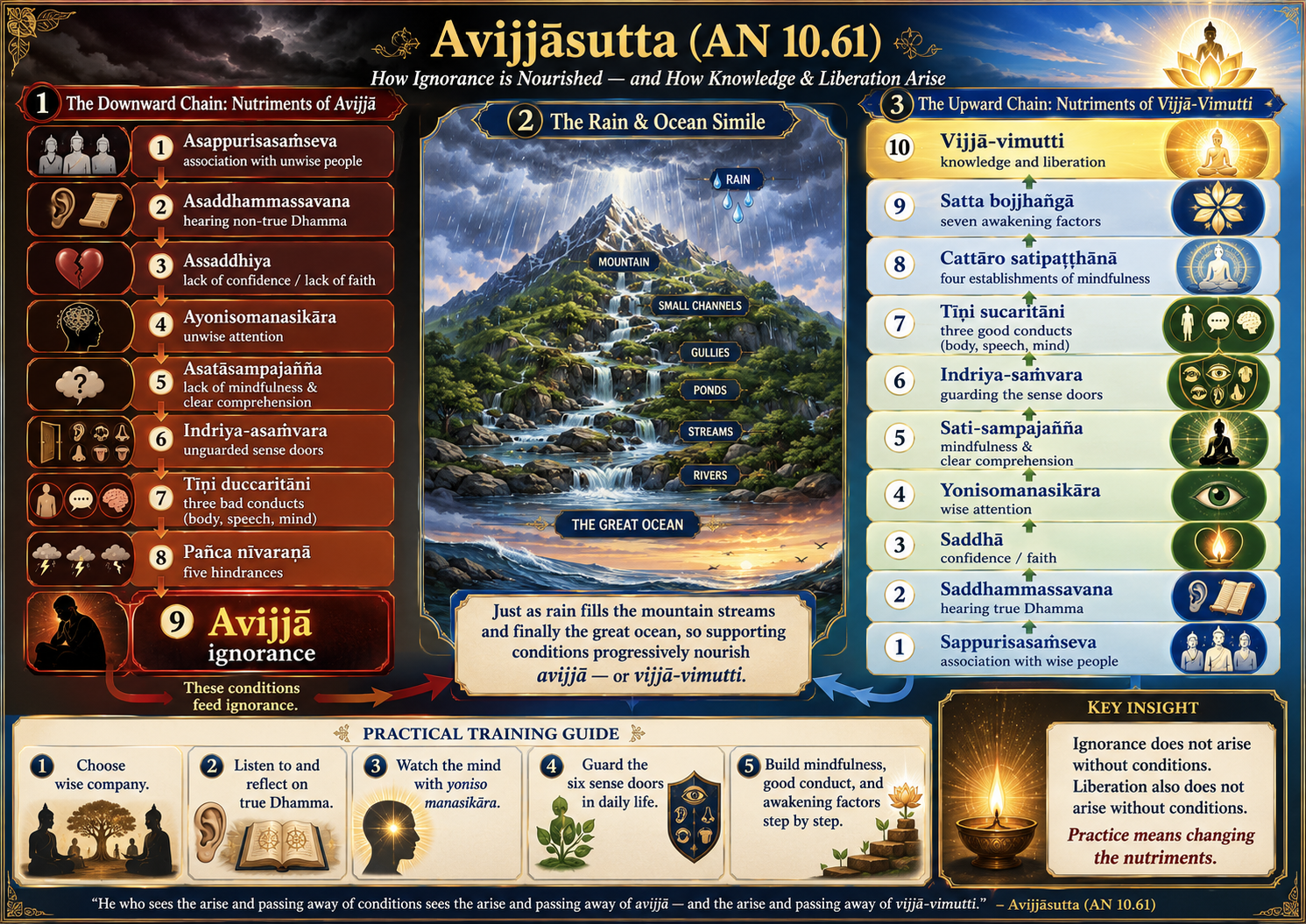 VISUAL SUMMARYSee this sutta in a pictureOpen the complete infographic for a visual overview before or after reading the full study.View infographic →
Ignorance and liberation are progressively nourished
The Buddha then reveals two contrasting chains. Unwise association → hearing what is not true Dhamma → lack of confidence → unwise attention → absence of mindfulness and clear comprehension → lack of sense restraint → misconduct → the five hindrances → avijjā. In the opposite direction, wise association → hearing true Dhamma → saddhā → yoniso manasikāra → sati-sampajañña → indriya-saṁvara → good conduct → satipaṭṭhāna → bojjhaṅga → vijjā-vimutti.
Using the powerful simile of rain falling on the mountains and gradually filling streams, rivers, and finally the great ocean, the Buddha shows that neither ignorance nor liberation appears suddenly. Both are progressively nourished by what we repeatedly associate with, hear, attend to, remember, practice, and cultivate.
The Avijjāsutta therefore becomes a complete diagnostic and training map for practice: instead of merely struggling with ignorance or hindrances after they have become strong, the practitioner learns to identify their upstream nutriment and deliberately cultivate the conditions that ultimately lead to vijjā and vimutti — true knowledge and liberation.
Avijjā has nutriment — and so does vijjā-vimutti
Central insight. The Buddha does not ask us to discover the first historical beginning of ignorance. He asks us to see its āhāra —its nutriment. Ignorance is progressively fed through a chain beginning with unwise association; knowledge and liberation are progressively fed through a mirrored chain beginning with wise association. The discourse is therefore both diagnosis and prescription.
Chain that fills avijjā
Chain that fills vijjā-vimutti
Every unwholesome feeder has a wholesome training counterpart
Chain that fills avijjā
| Pāli | Meaning | Function |
|---|---|---|
| Asappurisasaṁseva | Unwise association | Choose a poor environment |
| Asaddhammassavana | Not hearing true Dhamma | Wrong/confusing inputs |
| Assaddhiya | Lack of confidence | Training is not trusted |
| Ayoniso manasikāra | Unwise attention | Attend to signs that feed grasping |
| Asati-asampajañña | No mindfulness / clear comprehension | Training is forgotten in action |
| Indriya-asaṁvara | Sense doors unguarded | Signs & features are followed |
| Tīṇi duccaritāni | Misconduct of body, speech, mind | Reaction becomes behavior |
| Pañca nīvaraṇā | Five hindrances | Mind becomes obstructed |
| Avijjā | Ignorance | Things are not known as they are |
Chain that fills vijjā-vimutti
| Pāli | Meaning | Function |
|---|---|---|
| Sappurisasaṁseva | Wise association | Choose a liberative environment |
| Saddhammassavana | Hearing true Dhamma | Right teaching enters |
| Saddhā | Confidence | Training is trusted and applied |
| Yoniso manasikāra | Wise attention | Attend to origin, condition, cessation |
| Sati-sampajañña | Mindfulness / clear comprehension | Remember and clearly know |
| Indriya-saṁvara | Sense restraint | Guard all six doors |
| Tīṇi sucaritāni | Good bodily, verbal, mental conduct | Wholesome response |
| Cattāro satipaṭṭhānā | Four establishments of mindfulness | Sustained bhāvanā |
| Satta bojjhaṅgā | Seven awakening factors | Awakening qualities mature |
| Vijjā-vimutti | Knowledge & liberation | The path reaches its fruit |
From the nutriment of ignorance to the nutriment of knowledge and liberation
01Ignorance Has No Discernible First Beginning
“Purimā, bhikkhave, koṭi na paññāyati avijjāya: ‘ito pubbe avijjā nāhosi, atha pacchā samabhavī’ti. Evañcetaṁ, bhikkhave, vuccati, atha ca pana paññāyati: ‘idappaccayā avijjā’ti.”
“Bhikkhus, a first beginning of ignorance is not discerned, such that one could say: ‘Before this, ignorance did not exist; then afterwards it came into being.’ Although this is said, nevertheless it can be discerned: ‘Ignorance exists dependent on this condition.’”
02The Nutriment of Avijjā
Avijjampāhaṁ, bhikkhave, sāhāraṁ vadāmi, no anāhāraṁ. Ko cāhāro avijjāya? ‘Pañca nīvaraṇā’tissa vacanīyaṁ. Pañcapāhaṁ, bhikkhave, nīvaraṇe sāhāre vadāmi, no anāhāre. Ko cāhāro pañcannaṁ nīvaraṇānaṁ? ‘Tīṇi duccaritānī’tissa vacanīyaṁ. Tīṇipāhaṁ, bhikkhave, duccaritāni sāhārāni vadāmi, no anāhārāni. Ko cāhāro tiṇṇaṁ duccaritānaṁ? ‘Indriyaasaṁvaro’tissa vacanīyaṁ. Indriyaasaṁvarampāhaṁ, bhikkhave, sāhāraṁ vadāmi, no anāhāraṁ. Ko cāhāro indriyaasaṁvarassa? ‘Asatāsampajaññan’tissa vacanīyaṁ. Asatāsampajaññampāhaṁ, bhikkhave, sāhāraṁ vadāmi, no anāhāraṁ. Ko cāhāro asatāsampajaññassa? ‘Ayonisomanasikāro’tissa vacanīyaṁ. Ayonisomanasikārampāhaṁ, bhikkhave, sāhāraṁ vadāmi, no anāhāraṁ. Ko cāhāro ayonisomanasikārassa? ‘Assaddhiyan’tissa vacanīyaṁ. Assaddhiyampāhaṁ, bhikkhave, sāhāraṁ vadāmi, no anāhāraṁ. Ko cāhāro assaddhiyassa? ‘Asaddhammassavanan’tissa vacanīyaṁ. Asaddhammassavanampāhaṁ, bhikkhave, sāhāraṁ vadāmi, no anāhāraṁ. Ko cāhāro asaddhammassavanassa? ‘Asappurisasaṁsevo’tissa vacanīyaṁ.
“Bhikkhus, I say that ignorance has nutriment; it is not without nutriment. And what is the nutriment for ignorance? ‘The five hindrances,’ it should be said. I say that the five hindrances have nutriment; they are not without nutriment. And what is their nutriment? ‘The three kinds of misconduct.’ I say that the three kinds of misconduct have nutriment; they are not without nutriment. And what is their nutriment? ‘Lack of restraint of the sense faculties.’ I say that lack of restraint of the sense faculties has nutriment; it is not without nutriment. And what is its nutriment? ‘Lack of mindfulness and clear comprehension.’ I say that lack of mindfulness and clear comprehension has nutriment; it is not without nutriment. And what is its nutriment? ‘Unwise attention.’ I say that unwise attention has nutriment; it is not without nutriment. And what is its nutriment? ‘Lack of faith/confidence.’ I say that lack of faith has nutriment; it is not without nutriment. And what is its nutriment? ‘Not hearing the true Dhamma.’ I say that not hearing the true Dhamma has nutriment; it is not without nutriment. And what is its nutriment? ‘Association with unwise or unvirtuous persons.’”
03How the Downward Chain Comes to Fullness
Iti kho, bhikkhave, asappurisasaṁsevo paripūro asaddhammassavanaṁ paripūreti, asaddhammassavanaṁ paripūraṁ assaddhiyaṁ paripūreti, assaddhiyaṁ paripūraṁ ayonisomanasikāraṁ paripūreti, ayonisomanasikāro paripūro asatāsampajaññaṁ paripūreti, asatāsampajaññaṁ paripūraṁ indriyaasaṁvaraṁ paripūreti, indriyaasaṁvaro paripūro tīṇi duccaritāni paripūreti, tīṇi duccaritāni paripūrāni pañca nīvaraṇe paripūrenti, pañca nīvaraṇā paripūrā avijjaṁ paripūrenti; evametissā avijjāya āhāro hoti, evañca pāripūri.
“Thus, bhikkhus, when association with unwise persons is brought to fullness, it fills up not hearing the true Dhamma. When not hearing the true Dhamma is full, it fills up lack of faith. When lack of faith is full, it fills up unwise attention. When unwise attention is full, it fills up lack of mindfulness and clear comprehension. When lack of mindfulness and clear comprehension is full, it fills up lack of sense restraint. When lack of sense restraint is full, it fills up the three kinds of misconduct. When the three kinds of misconduct are full, they fill up the five hindrances. When the five hindrances are full, they fill up ignorance. Such is the nutriment of this ignorance, and in this way it comes to fullness.”
04The Mountain-to-Ocean Simile
Seyyathāpi, bhikkhave, uparipabbate thullaphusitake deve vassante (…) taṁ udakaṁ yathāninnaṁ pavattamānaṁ pabbatakandarapadarasākhā paripūreti, pabbatakandarapadarasākhā paripūrā kusobbhe paripūrenti. Kusobbhā paripūrā mahāsobbhe paripūrenti, mahāsobbhā paripūrā kunnadiyo paripūrenti, kunnadiyo paripūrā mahānadiyo paripūrenti, mahānadiyo paripūrā mahāsamuddaṁ sāgaraṁ paripūrenti; evametassa mahāsamuddassa sāgarassa āhāro hoti, evañca pāripūri.
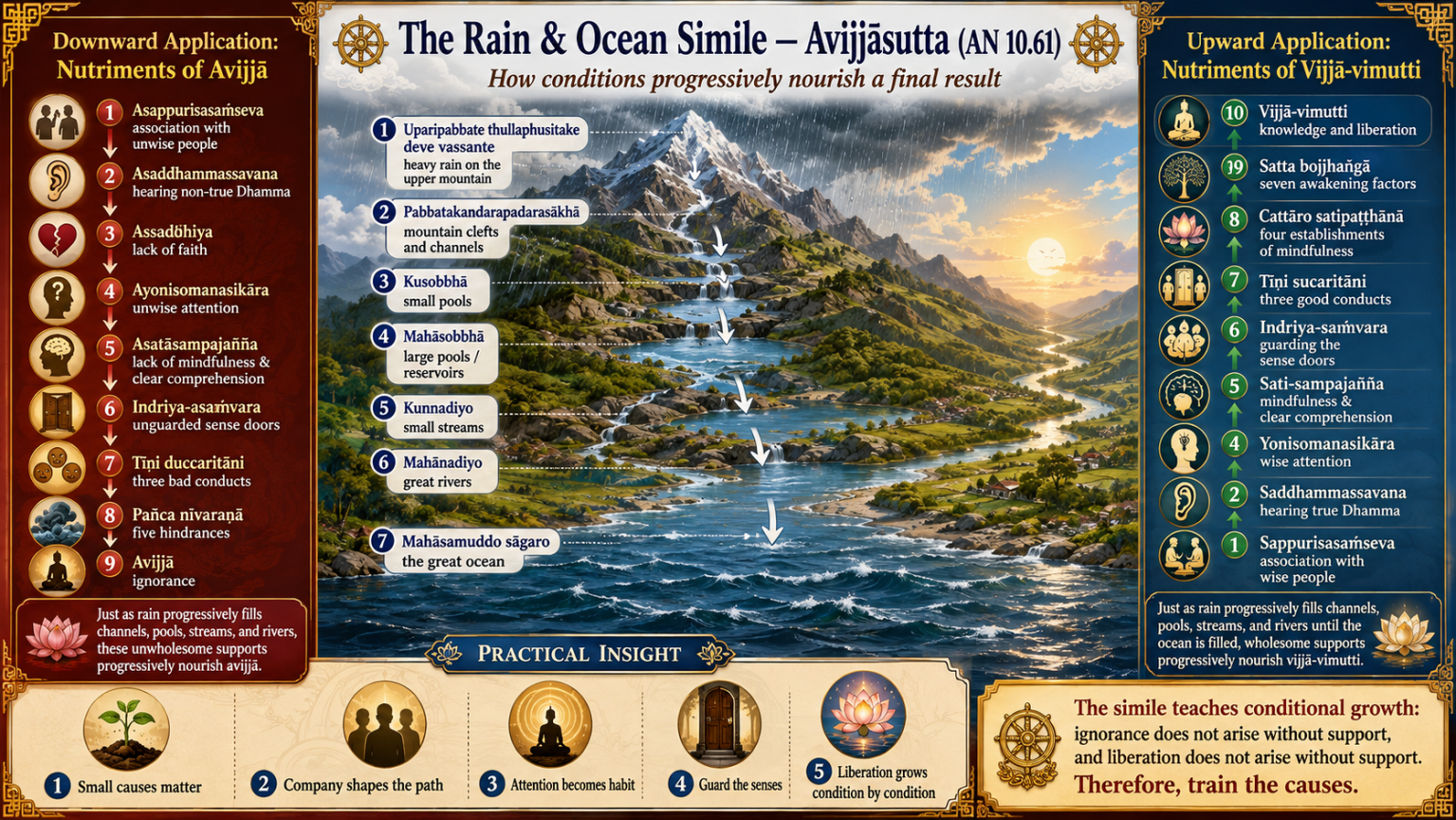
“Suppose, bhikkhus, heavy rain were falling on the upper mountains. As the water flows downhill, it fills the mountain clefts, ravines, and channels. When those clefts, ravines, and channels are full, they fill the small pools. When the small pools are full, they fill the large pools. When the large pools are full, they fill the small rivers. When the small rivers are full, they fill the great rivers. When the great rivers are full, they fill the great ocean. Such is the nutriment of the great ocean, and in this way it is filled.”
05The Simile Applied to Avijjā
Evamevaṁ kho, bhikkhave, asappurisasaṁsevo paripūro asaddhammassavanaṁ paripūreti, asaddhammassavanaṁ paripūraṁ assaddhiyaṁ paripūreti, assaddhiyaṁ paripūraṁ ayonisomanasikāraṁ paripūreti, ayonisomanasikāro paripūro asatāsampajaññaṁ paripūreti, asatāsampajaññaṁ paripūraṁ indriyaasaṁvaraṁ paripūreti, indriyaasaṁvaro paripūro tīṇi duccaritāni paripūreti, tīṇi duccaritāni paripūrāni pañca nīvaraṇe paripūrenti, pañca nīvaraṇā paripūrā avijjaṁ paripūrenti; evametissā avijjāya āhāro hoti, evañca pāripūri.
“In the same way, bhikkhus, when association with unwise persons is full, it fills up not hearing the true Dhamma; not hearing the true Dhamma fills lack of faith; lack of faith fills unwise attention; unwise attention fills lack of mindfulness and clear comprehension; lack of mindfulness and clear comprehension fills lack of sense restraint; lack of sense restraint fills the three kinds of misconduct; the three kinds of misconduct fill the five hindrances; and the five hindrances fill ignorance. Such is the nutriment of ignorance, and in this way it comes to fullness.”
06The Nutriment of Vijjā-Vimutti
Vijjāvimuttimpāhaṁ, bhikkhave, sāhāraṁ vadāmi, no anāhāraṁ. Ko cāhāro vijjāvimuttiyā? ‘Satta bojjhaṅgā’tissa vacanīyaṁ. Sattapāhaṁ, bhikkhave, bojjhaṅge sāhāre vadāmi, no anāhāre. Ko cāhāro sattannaṁ bojjhaṅgānaṁ? ‘Cattāro satipaṭṭhānā’tissa vacanīyaṁ. Cattāropāhaṁ, bhikkhave, satipaṭṭhāne sāhāre vadāmi, no anāhāre. Ko cāhāro catunnaṁ satipaṭṭhānānaṁ? ‘Tīṇi sucaritānī’tissa vacanīyaṁ. Tīṇipāhaṁ, bhikkhave, sucaritāni sāhārāni vadāmi, no anāhārāni. Ko cāhāro tiṇṇaṁ sucaritānaṁ? ‘Indriyasaṁvaro’tissa vacanīyaṁ. Indriyasaṁvarampāhaṁ, bhikkhave, sāhāraṁ vadāmi, no anāhāraṁ. Ko cāhāro indriyasaṁvarassa? ‘Satisampajaññan’tissa vacanīyaṁ. Satisampajaññampāhaṁ, bhikkhave, sāhāraṁ vadāmi, no anāhāraṁ. Ko cāhāro satisampajaññassa? ‘Yonisomanasikāro’tissa vacanīyaṁ. Yonisomanasikārampāhaṁ, bhikkhave, sāhāraṁ vadāmi, no anāhāraṁ. Ko cāhāro yonisomanasikārassa? ‘Saddhā’tissa vacanīyaṁ. Saddhampāhaṁ, bhikkhave, sāhāraṁ vadāmi, no anāhāraṁ. Ko cāhāro saddhāya? ‘Saddhammassavanan’tissa vacanīyaṁ. Saddhammassavanampāhaṁ, bhikkhave, sāhāraṁ vadāmi, no anāhāraṁ. Ko cāhāro saddhammassavanassa? ‘Sappurisasaṁsevo’tissa vacanīyaṁ.
“Bhikkhus, I say that true knowledge and liberation have nutriment; they are not without nutriment. And what is their nutriment? ‘The seven factors of awakening.’ I say that the seven factors of awakening have nutriment. What is their nutriment? ‘The four establishments of mindfulness.’ I say that the four establishments of mindfulness have nutriment. What is their nutriment? ‘The three kinds of good conduct.’ I say that the three kinds of good conduct have nutriment. What is their nutriment? ‘Restraint of the sense faculties.’ I say that sense restraint has nutriment. What is its nutriment? ‘Mindfulness and clear comprehension.’ I say that mindfulness and clear comprehension have nutriment. What is their nutriment? ‘Wise attention.’ I say that wise attention has nutriment. What is its nutriment? ‘Faith/confidence.’ I say that faith has nutriment. What is its nutriment? ‘Hearing the true Dhamma.’ I say that hearing the true Dhamma has nutriment. What is its nutriment? ‘Association with wise and virtuous persons.’”
07How the Upward Chain Comes to Fullness
Iti kho, bhikkhave, sappurisasaṁsevo paripūro saddhammassavanaṁ paripūreti, saddhammassavanaṁ paripūraṁ saddhaṁ paripūreti, saddhā paripūrā yonisomanasikāraṁ paripūreti, yonisomanasikāro paripūro satisampajaññaṁ paripūreti, satisampajaññaṁ paripūraṁ indriyasaṁvaraṁ paripūreti, indriyasaṁvaro paripūro tīṇi sucaritāni paripūreti, tīṇi sucaritāni paripūrāni cattāro satipaṭṭhāne paripūrenti, cattāro satipaṭṭhānā paripūrā satta bojjhaṅge paripūrenti, satta bojjhaṅgā paripūrā vijjāvimuttiṁ paripūrenti; evametissā vijjāvimuttiyā āhāro hoti, evañca pāripūri.
“Thus, bhikkhus, when association with wise persons is brought to fullness, it fills up hearing the true Dhamma. When hearing the true Dhamma is full, it fills up faith. When faith is full, it fills up wise attention. When wise attention is full, it fills up mindfulness and clear comprehension. When mindfulness and clear comprehension are full, they fill up sense restraint. When sense restraint is full, it fills up the three kinds of good conduct. When the three kinds of good conduct are full, they fill up the four establishments of mindfulness. When the four establishments of mindfulness are full, they fill up the seven factors of awakening. When the seven factors of awakening are full, they fill up knowledge and liberation. Such is the nutriment of knowledge and liberation, and in this way they come to fullness.”
08The Mountain-to-Ocean Simile Repeated
Seyyathāpi, bhikkhave, uparipabbate thullaphusitake deve vassante taṁ udakaṁ yathāninnaṁ pavattamānaṁ pabbatakandarapadarasākhā paripūreti, pabbatakandarapadarasākhā paripūrā kusobbhe paripūrenti, kusobbhā paripūrā mahāsobbhe paripūrenti, mahāsobbhā paripūrā kunnadiyo paripūrenti, kunnadiyo paripūrā mahānadiyo paripūrenti, mahānadiyo paripūrā mahāsamuddaṁ sāgaraṁ paripūrenti; evametassa mahāsamuddassa sāgarassa āhāro hoti, evañca pāripūri.
“Suppose, bhikkhus, heavy rain were falling on the upper mountains. The water flowing downhill fills the mountain clefts, ravines, and channels. When those are full, they fill the small pools; the small pools fill the large pools; the large pools fill the small rivers; the small rivers fill the great rivers; and the great rivers fill the great ocean. Such is the nutriment of the great ocean, and in this way it is filled.”
09The Simile Applied to Vijjā-Vimutti
Evamevaṁ kho, bhikkhave, sappurisasaṁsevo paripūro saddhammassavanaṁ paripūreti, saddhammassavanaṁ paripūraṁ saddhaṁ paripūreti, saddhā paripūrā yonisomanasikāraṁ paripūreti, yonisomanasikāro paripūro satisampajaññaṁ paripūreti, satisampajaññaṁ paripūraṁ indriyasaṁvaraṁ paripūreti, indriyasaṁvaro paripūro tīṇi sucaritāni paripūreti, tīṇi sucaritāni paripūrāni cattāro satipaṭṭhāne paripūrenti, cattāro satipaṭṭhānā paripūrā satta bojjhaṅge paripūrenti, satta bojjhaṅgā paripūrā vijjāvimuttiṁ paripūrenti; evametissā vijjāvimuttiyā āhāro hoti, evañca pāripūrī”ti.
“In the same way, bhikkhus, when association with wise persons is full, it fills hearing the true Dhamma; hearing the true Dhamma fills faith; faith fills wise attention; wise attention fills mindfulness and clear comprehension; mindfulness and clear comprehension fill sense restraint; sense restraint fills the three kinds of good conduct; the three kinds of good conduct fill the four establishments of mindfulness; the four establishments of mindfulness fill the seven factors of awakening; and the seven factors of awakening fill knowledge and liberation. Such is the nutriment of knowledge and liberation, and in this way they come to fullness.”
A diagnostic map from association to liberation
01Ignorance Has No Discernible First Beginning
The Buddha redirects the investigation. The useful question is not, “At what point in the immeasurable past did avijjā first begin?” but, “What is feeding avijjā now?”
Purimā koṭi na paññāyati means that a first point is not discernible. Yet this does not make ignorance causeless. The second sentence immediately prevents that misunderstanding: idappaccayā avijjā—ignorance is dependent on conditions.
This changes practice completely. If ignorance had to be solved by discovering its first historical beginning, liberation would depend on recovering an inaccessible past. Instead, the Buddha directs attention to present nourishment. What is being repeatedly supplied can also cease being supplied.
The sutta will therefore analyze avijjā not as an isolated substance inside the mind but as a condition that is fed, accumulated, and brought to fullness.
Real-Life Examples
- Example 1
Someone repeatedly becomes angry when criticized. Instead of asking, ‘Why have I always been like this?’, the useful question becomes, ‘What conditions are feeding this reaction today?’
- Example 2
A practitioner struggles with sensual desire. Rather than searching for the first time desire ever arose, they examine the present sequence: what was seen, how attention was directed, whether mindfulness was present, and whether the sense door was guarded.
- Example 3
A person says, ‘I am simply an anxious person.’ AN 10.61 shifts the emphasis from identity to conditions: what associations, inputs, attention patterns, and behaviors keep anxiety-producing patterns nourished?
Training Aid
- Whenever a recurring unwholesome state appears, replace ‘Why am I like this?’ with ‘What is feeding this now?’
- Look for conditions that are repeatable and therefore trainable.
- Do not make avijjā into an identity: study its nutriment.
02The Nutriment of Avijjā
This is the downward nourishment chain.
The movement is:
asappurisasaṁseva → asaddhammassavana → assaddhiya → ayoniso manasikāra → asati-asampajañña → indriya-asaṁvara → tīṇi duccaritāni → pañca nīvaraṇā → avijjā
The order matters.
1. Asappurisasaṁseva The process begins socially. Whom we associate with shapes what we repeatedly hear, admire, normalize, imitate, and consider important. Association is not limited to physical company. In modern life, repeated digital exposure can function similarly: channels, groups, teachers, influencers, news feeds, and conversations become a mental environment.
2. Asaddhammassavana Poor association fills the mind with teachings, values, explanations, and narratives that do not lead toward dispassion, relinquishment, ethical clarity, and liberation.
3. Assaddhiya
When true Dhamma is not heard or understood, confidence in the Buddha’s training cannot mature. Saddhā is not blind belief; here its absence means the practitioner does not trust the training enough to apply it consistently.
4. Ayoniso manasikāra
Attention then operates unwisely. Yoniso points toward attending in terms of origin, condition, and what leads toward cessation; ayoniso attends in a way that feeds proliferation, attraction, aversion, identity, or confusion.
5. Asati-asampajañña Once attention is repeatedly misdirected, mindfulness and clear comprehension weaken. One no longer remembers the training at the moment it is needed, nor clearly understands what one is doing and why.
6. Indriya-asaṁvara Without sati-sampajañña, the six doors are not guarded. Seeing, hearing, smelling, tasting, touching, and thinking are allowed to develop through signs and features into grasping, aversion, fantasy, and proliferation.
7. Tīṇi duccaritāni Unrestrained contact begins to express itself through misconduct of body, speech, and mind.
8. Pañca nīvaraṇā Repeated misconduct and unguarded living strengthen sensual desire, ill will, sloth-and-torpor, restlessness-remorse, and doubt. The mind becomes progressively less fit for seeing things as they are.
9. Avijjā Ignorance is now not merely present; it has been fed to fullness.
Real-Life Examples
- Example 1
Social media: unwise accounts → repeated sensual/status content → weaker confidence in restraint → attention goes to attractive features → mindfulness disappears → uncontrolled scrolling → craving/comparison/harsh comments → sensual desire/restlessness → greater confusion.
- Example 2
Workplace anger: company gossip → distorted narratives → distrust → attention focuses only on insult → mindfulness is lost → ear/mind door unguarded → harsh speech → ill will and remorse → inability to see the event clearly.
- Example 3
Meditation: listening constantly to contradictory techniques → uncertainty about training → little confidence → attention searches for dramatic experiences → present activity is not clearly known → mind chases signs at the six doors → practice becomes inconsistent → doubt and restlessness dominate.
Training Aid
- Audit the people, media, and teachings entering your mind each day.
- At a strong reaction ask: ‘What did I attend to?’ rather than only ‘What happened?’
- Before body or speech acts, check whether sati-sampajañña is actually present.
- Treat the hindrance as the end of a chain; trace backward to find an earlier intervention point.
03How the Downward Chain Comes to Fullness
The repeated verb is paripūreti — fills, completes, brings to maturity.
This is not saying that one brief conversation with an unwise person mechanically causes avijjā. The emphasis is cumulative. Repeated nourishment makes the downstream condition increasingly likely, strong, and habitual.
A useful analogy is a groove in a path. One step does not create a deep track; repeated walking does. The sutta is describing habitual conditionality.
This also means the chain can be interrupted before the final stages. It is easier to correct association or attention than to fight five fully developed hindrances in meditation.
Real-Life Examples
- Example 1
A person watches angry political commentary every evening. After weeks, irritation is already present before meditation begins. The hindrance was being nourished long before the meditation cushion.
- Example 2
A practitioner repeatedly indulges fantasies after seeing attractive forms. Eventually kāmacchanda appears ‘spontaneously’ during meditation, but the sutta asks us to see the earlier nourishment.
- Example 3
Frequent careless speech makes remorse common; remorse contributes to restlessness; restlessness makes samādhi difficult; lack of samādhi allows ignorance to remain strong.
Training Aid
- When a hindrance appears repeatedly, review the previous 24 hours rather than only the meditation period.
- Identify the earliest recurring feeder in the chain.
- Reduce nourishment instead of merely suppressing the final symptom.
04The Mountain-to-Ocean Simile
This simile is essential. The ocean does not become full because one drop falls directly into it. Countless upstream conditions collect, join, and flow downstream.
Likewise, avijjā is often blamed only when it is already ‘ocean-sized’: confusion, entrenched views, repeated hindrances, or a life organized around craving. The Buddha trains us to look upstream.
The mountain rain also shows directionality. Once water has accumulated, gravity carries it onward. In the same way, once a mental condition has been repeatedly strengthened, the next link may arise with very little conscious effort.
Practice therefore means building upstream dams and diversions: association, hearing, wise attention, mindfulness, clear comprehension, and sense restraint.
Teaching Infographic
Real-Life Examples
- Example 1
A burst of anger seems sudden, but upstream were poor sleep, repeated resentment, mental rehearsal, unguarded listening, and absence of mindfulness.
- Example 2
Compulsive buying appears at the checkout, but upstream were advertisements, comparison videos, attention to attractive details, fantasies, and repeated browsing.
- Example 3
Sexual misconduct does not begin at the final act; upstream are contact, attention, unguarded signs, repeated imagination, and weakening of clear comprehension.
Training Aid
- Draw your own ‘mountain to ocean’ diagram for one recurring problem.
- Label each upstream feeder.
- Choose the earliest link you realistically can change today.
05The Simile Applied to Avijjā
The Buddha repeats the complete chain after the simile so the simile is not left as poetry. We are expected to map the water-system directly onto practice.
The practical message is: do not wait for avijjā to become obvious before training.
If the wrong inputs are being repeatedly consumed, if attention is repeatedly unwise, and if the senses are repeatedly unguarded, then the downstream results should not surprise us.
Real-Life Examples
- Example 1
Repeated exposure to envy-producing content eventually makes comparison feel natural and gratitude difficult.
- Example 2
Repeated harsh speech eventually makes ill will easier to access and mettā harder to access.
- Example 3
Repeated multitasking makes sustained mindfulness difficult even when one genuinely wants to meditate.
Training Aid
- Review the chain every evening from avijjā backward to association.
- Ask at each link: ‘Was this fed today?’
- Do not judge yourself; change the feeder.
06The Nutriment of Vijjā-Vimutti
Now the Buddha gives the upward nourishment chain:
sappurisasaṁseva → saddhammassavana → saddhā → yoniso manasikāra → sati-sampajañña → indriya-saṁvara → tīṇi sucaritāni → cattāro satipaṭṭhānā → satta bojjhaṅgā → vijjā-vimutti
This is not merely the negative chain reversed. Notice the additional development after good conduct:
sucarita → satipaṭṭhāna → bojjhaṅga → vijjā-vimutti.
Ethical conduct and sense restraint prepare the field, but liberation requires bhāvanā.
Sappurisasaṁseva Association with persons who embody Dhamma gives living examples of what should be developed and abandoned.
Saddhammassavana One hears teachings directed toward actual liberation rather than entertainment, speculation, identity, or ritualism.
Saddhā Confidence matures because the teaching is heard, reflected upon, and increasingly verified in practice.
Yoniso manasikāra Attention becomes causal and liberative: What is this? What conditions it? What feeds it? What happens if it is not fed? Does this lead to dispassion or to more appropriation?
Sati-sampajañña The practitioner remembers the training and clearly knows the purpose, suitability, domain, and non-deluded character of current activity.
Indriya-saṁvara The six doors are guarded—not by blindness or suppression, but by preventing signs and features from developing into greed and aversion.
Tīṇi sucaritāni Body, speech, and mind increasingly express wholesome conduct.
Cattāro satipaṭṭhānā Now sustained bhāvanā becomes possible: kāya, vedanā, citta, and dhamma are contemplated with appropriate ardency, clear comprehension, and mindfulness.
Satta bojjhaṅgā Mindfulness, investigation of dhammas, energy, rapture, tranquility, samādhi, and equanimity mature as awakening factors.
Vijjā-vimutti Knowledge and liberation are the mature fruit of a long nourishment process.
Real-Life Examples
- Example 1
Criticism: wise association teaches restraint → true Dhamma is remembered → confidence in non-reaction → wise attention asks ‘what is arising?’ → painful feeling is known → ear/mind door is guarded → no harsh speech → citta becomes observable → investigation and equanimity strengthen.
- Example 2
Attractive object: seeing occurs → sati remembers the training → sampajañña knows the danger of grasping signs → sense door is guarded → no bodily or verbal misconduct → vedanā is contemplated → kāmacchanda is not fed → bojjhaṅgas can develop.
- Example 3
Meditation difficulty: instead of changing techniques impulsively, the practitioner hears sound Dhamma, develops confidence, uses wise attention to identify the hindrance, maintains clear comprehension, and works systematically.
Training Aid
- Choose your Dhamma environment intentionally.
- Before every formal meditation, recollect one correct Dhamma principle to establish saddhā and yoniso manasikāra.
- Practice sense restraint throughout the day so satipaṭṭhāna is not forced to clean up an already agitated mind at night.
- Develop the bojjhaṅgas as a culmination of the earlier conditions, not as isolated techniques.
07How the Upward Chain Comes to Fullness
This paragraph is a complete curriculum of development.
A common mistake is trying to begin at the far end. One wants bojjhaṅgas, deep samādhi, insight, or liberation while daily association, sense restraint, speech, and attention remain untrained.
AN 10.61 says development is cumulative. If satipaṭṭhāna is weak, inspect sucarita and sense restraint. If sense restraint is weak, inspect sati-sampajañña. If mindfulness is weak, inspect yoniso manasikāra. If wise attention is weak, inspect what Dhamma is being heard and whom one associates with.
The chain becomes a troubleshooting chart for practice.
Real-Life Examples
- Example 1
Problem: meditation is full of sensual thoughts. Diagnosis: do not begin only at samādhi; inspect daytime sense restraint.
- Example 2
Problem: sense restraint collapses repeatedly. Diagnosis: inspect whether sati-sampajañña is present before and during contact.
- Example 3
Problem: mindfulness is rarely present. Diagnosis: inspect how attention is normally directed and whether the mind sees purpose in the training.
- Example 4
Problem: confidence is weak. Diagnosis: inspect whether one is hearing coherent saddhamma from trustworthy sources.
Training Aid
- When practice is weak, move backward one link at a time until you find the feeder that is missing.
- Strengthen the earliest weak link for one week.
- Do not demand the fruit from a chain whose nutriments are not yet being supplied.
08The Mountain-to-Ocean Simile Repeated
The same simile is now used positively.
Liberation is not filled by one heroic meditation session any more than the ocean is filled by one bucket of water. It is the downstream result of many aligned conditions.
This protects the practitioner from impatience. Daily association, listening, attention, mindfulness, restraint, conduct, and satipaṭṭhāna may sometimes appear ordinary. But the Buddha compares them to the streams that ultimately fill the ocean.
It also changes how progress is measured. Instead of asking only, “Did I have a special state today?”, ask whether the upstream watershed of liberation is becoming stronger.
This paragraph reuses the same mountain-to-ocean simile positively for the wholesome chain.
Real-Life Examples
- Example 1
One day of careful speech may feel small, but repeated good speech reduces remorse and supports a more settled mind.
- Example 2
One guarded visual contact may seem insignificant, but thousands of such moments change the baseline of kāmacchanda.
- Example 3
Regular association with a wise teacher may slowly reshape what the mind notices, values, and practices.
Training Aid
- Track continuity rather than dramatic experiences.
- Count upstream wins: guarded contact, wise attention, truthful speech, remembered Dhamma.
- Let repetition fill the river.
09The Simile Applied to Vijjā-Vimutti
The discourse ends by repeating the full wholesome chain. This is the training aid to memorize—not as a slogan, but as an operating sequence.
The starting point is not an extraordinary mystical event. It is sappurisasaṁseva: entering a good Dhamma environment.
The endpoint is not merely calm or good conduct. It is vijjā-vimutti.
Between them lies a progressive training that connects community, learning, confidence, attention, moment-to-moment awareness, restraint, ethical conduct, satipaṭṭhāna, awakening factors, knowledge, and release.
This makes AN 10.61 an unusually complete map from environment to liberation.
Real-Life Examples
- Example 1
A retreat participant can use this chain as a daily checklist: whom did I associate with, what did I hear, how did I attend, were the senses guarded, how was conduct, was satipaṭṭhāna developed, which bojjhaṅgas were present?
- Example 2
A teacher can diagnose a student’s difficulty without immediately changing meditation technique; often the weak condition is earlier in the chain.
- Example 3
A household practitioner can treat daily life itself as preparation for satipaṭṭhāna rather than separating ‘life’ from ‘meditation’.
Training Aid
- Memorize both chains.
- At the end of each day score each wholesome link 0–2: absent / partial / strong.
- Choose the earliest weak link as tomorrow’s training priority.
- Do not skip links merely because later practices sound more advanced.
Move backward through the chain to find the earliest trainable feeder
| Question | What to observe today |
|---|---|
| 1. Saṁseva | Whom / what did I repeatedly associate with? |
| 2. Savana | What teachings, media, conversations, or ideas entered the mind? |
| 3. Saddhā | Did confidence in the training strengthen or weaken? |
| 4. Manasikāra | What did attention select—cause and cessation, or attractive/irritating signs? |
| 5. Sati-sampajañña | Did I remember the training and clearly know what I was doing? |
| 6. Indriya-saṁvara | Which of the six doors was most difficult to guard? |
| 7. Carita | What bodily, verbal, or mental conduct followed? |
| 8. Hindrance / Satipaṭṭhāna | Which hindrance was fed? Which satipaṭṭhāna was developed? |
| 9. Bojjhaṅga | Which awakening factor became stronger? |
| 10. Tomorrow | What is the earliest link I can improve tomorrow? |
Practice rule: Do not fight avijjā only at the end of the chain; change what is feeding it upstream—and deliberately feed the conditions that culminate in vijjā-vimutti.
Essential study: Sati-Sampajañña
Please go through this without fail, so you understand what “clear comprehension” means as presented in the suttas.