 VISUAL SUMMARYSee this study in a pictureOpen the complete infographic for a visual overview before or after reading the full study.View infographic →
This essay explores how modern science can help us observe the conditioned processes that Buddha Dhamma asks us to understand directly. Neuroscience, chemistry, physiology, brain waves and related fields can describe measurable changes in the body and brain, while Dhamma shows how those changing conditions become craving, clinging and suffering—and how they can be trained toward calm, wisdom and release.
The purpose is not to use science to prove the Dhamma. Scientific measurements can reveal correlations in breathing, neural activity, autonomic regulation, hormones, neurotransmitters and brain-wave patterns. Dhamma asks a further question: how are these conditioned processes taken as “I,” “me” and “mine,” how are unwholesome conditions fed, and how can the causes of suffering be brought to cessation?
The meeting point is therefore conditionality. Science can illuminate parts of the mechanism; Dhamma shows what must be understood, trained, relinquished and ultimately brought to an end.
01 Neuroscience — habit, brain, breath and training
A Dhamma bridge before the science
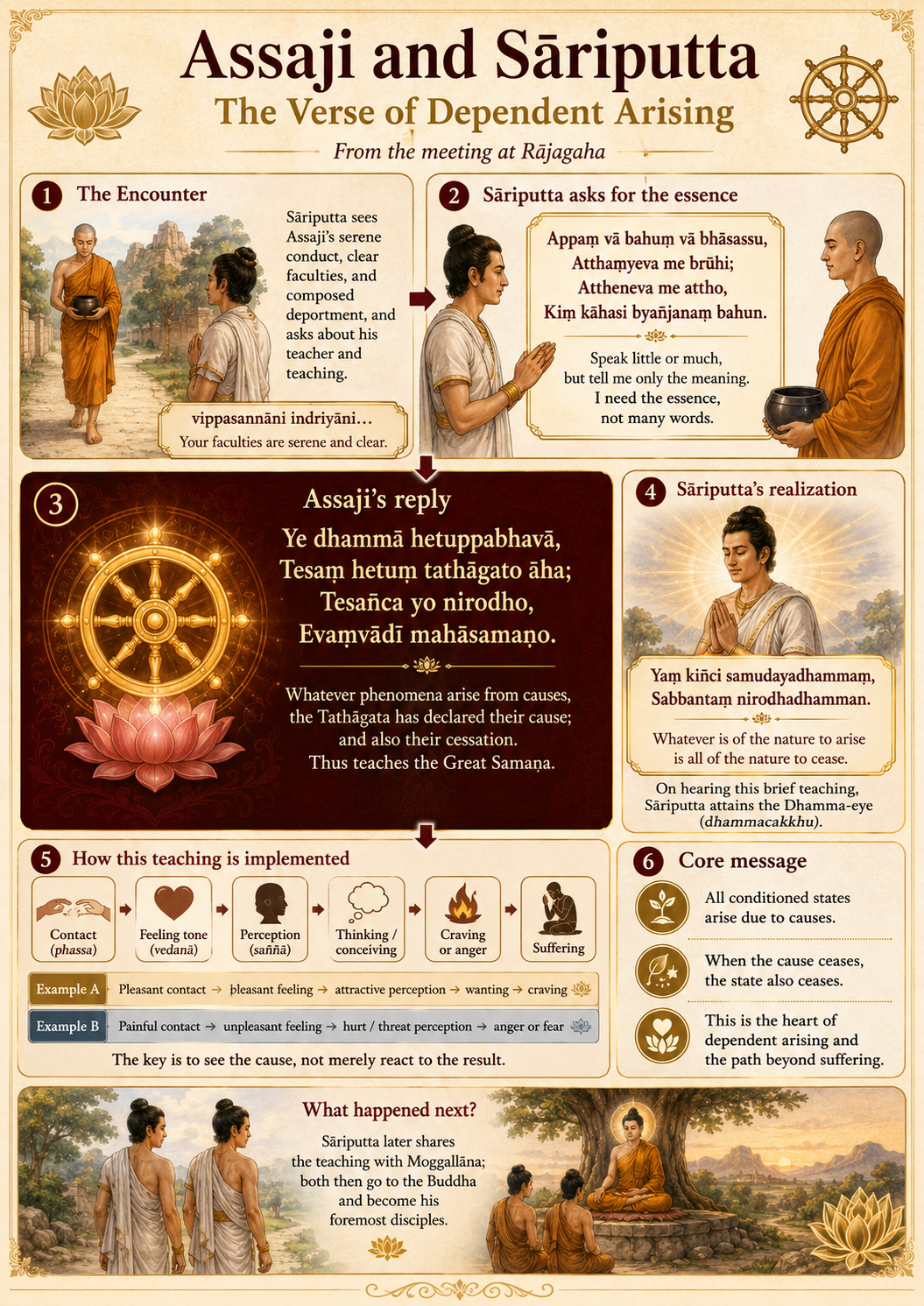
Before moving into neuroscience, it helps to keep one central Dhamma lens clearly in view. The scientific material that follows becomes useful only when it remains connected to the Buddha’s way of seeing experience: phenomena arise due to conditions, they continue when fed, and they cease when the supporting conditions cease. This is why the well-known meeting between Assaji and Sāriputta still belongs here. It keeps the essay grounded in Dhamma rather than allowing the scientific discussion to become merely technical or speculative.
Teaching infographics — click any preview to enlarge.
A Dhamma bridge before the science
Supporting infographic 1
Open the visual for the complete illustrated explanation.
Click infographic to enlarge ↗
The verse taught by Assaji to Sāriputta is short, but it provides the bridge for the whole essay: ye dhammā hetuppabhavā — phenomena arise from causes; tesaṁ hetuṁ tathāgato āha — the Tathāgata has explained their causes; tesañca yo nirodho — and also their cessation. Neuroscience, chemistry and physiology can help us examine some of the conditioned machinery through which experience unfolds. Dhamma shows how to understand those conditions without identifying with them, how to stop feeding unwholesome ones, and how to cultivate the path toward release.
Neuroscience through habit-patterns
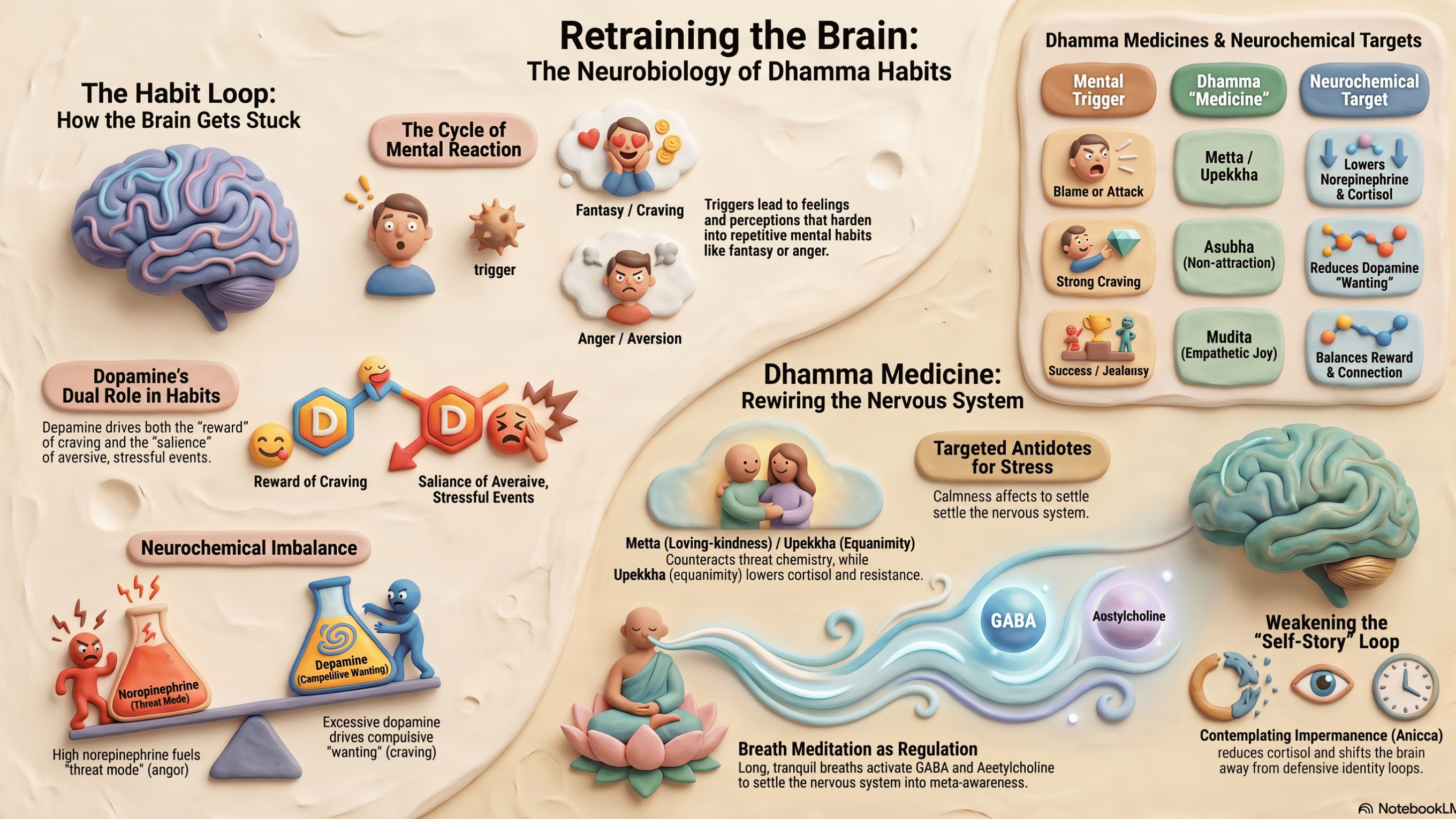
Human life can be understood as repeated patterns. A sound is heard, a form is seen, a memory appears, a word is spoken, and immediately an old pattern begins. One person hears criticism and anger arises. Another sees an attractive object and craving begins. Another sits quietly and worry starts. Another remembers the past and becomes sad. These are not random events. They are learned body-mind patterns.
In Dhamma language, the sequence begins with: phassa → vedanā → saññā → saṅkhāra → viññāṇa-pattern → upādāna
Contact arises, feeling tone arises and perception labels the experience. Saṅkhāra begins to construct a response which then mind repeats an old way of becoming.
In neuroscience language, the same thing can be seen as: cue → body response → feeling → interpretation → action → reward/relief → repetition → neural wiring
What is repeated becomes easier to repeat. A pathway that is used again and again becomes a habit. This is why anger becomes quick, craving becomes quick, worry becomes quick, and self-story becomes quick.
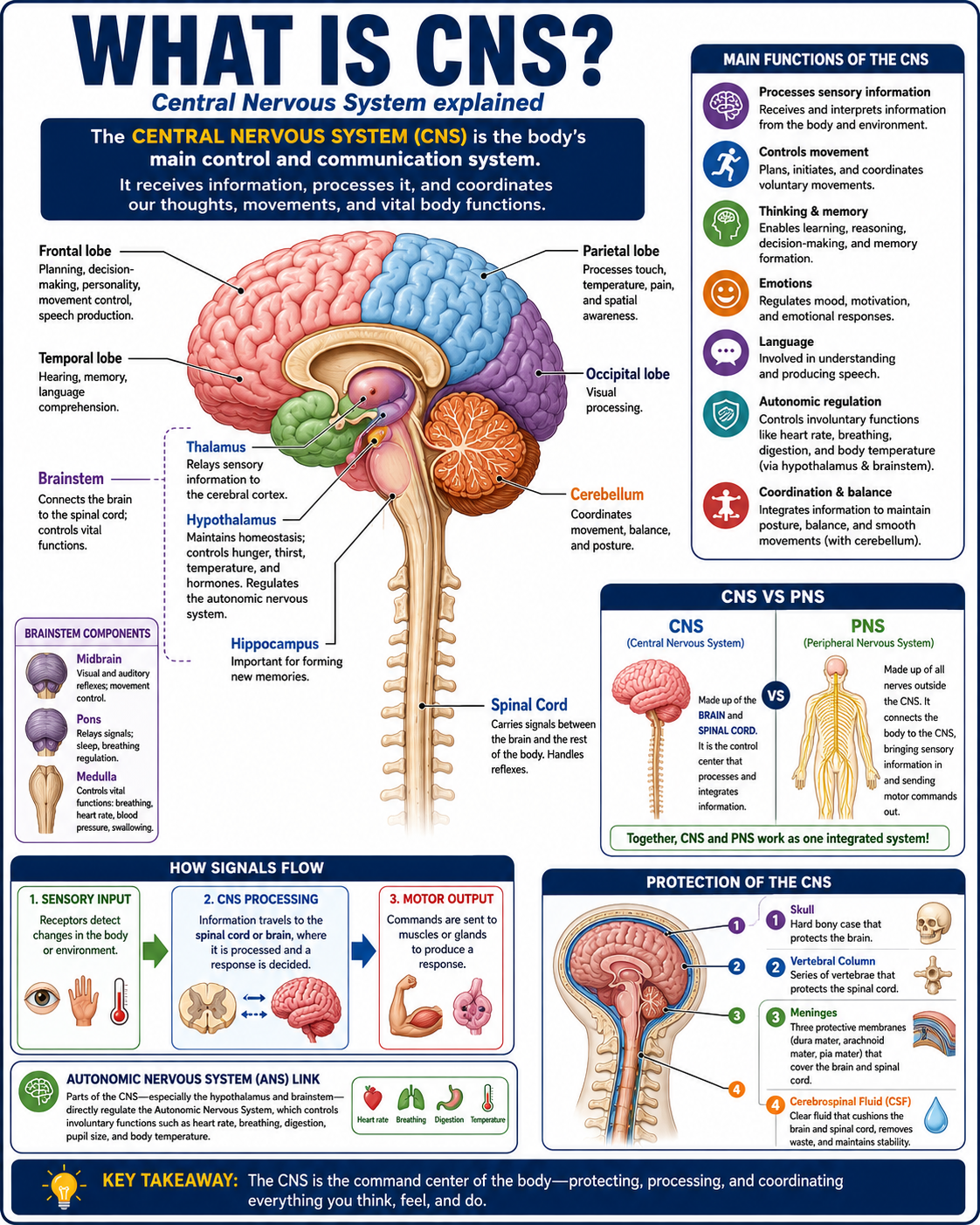
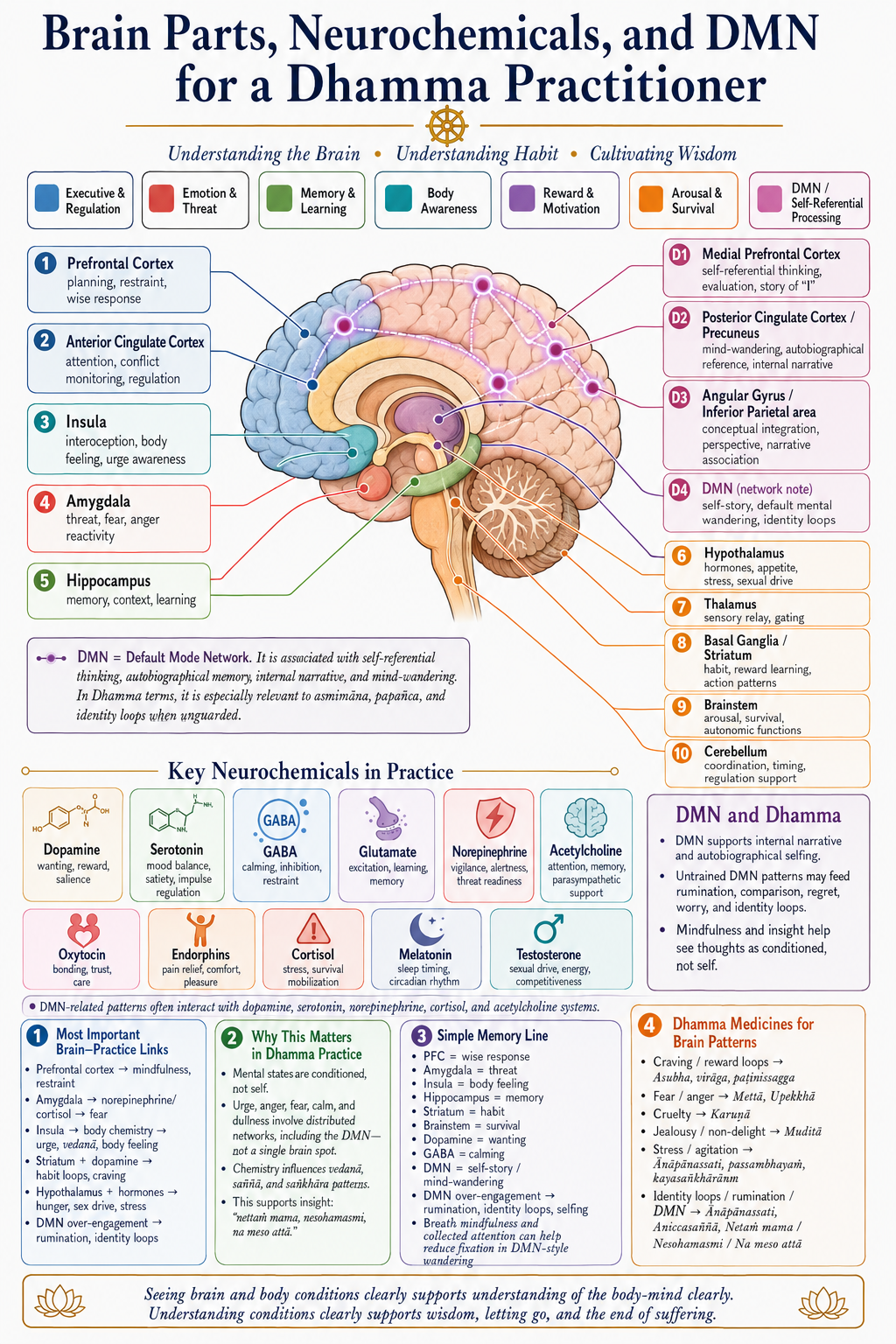
Where DMN enters – The DMN — Default Mode Network becomes very important when the mind is not simply reacting, but narrating: This happened to me, why did he say that to me, I am like this, my life is not going well, I was insulted, I am spiritual, I am progressing, I failed etc.,
This is where habit becomes identity. A simple urge is one thing. But when the DMN adds story, the urge becomes:
This is my desire.
I need this.”
I cannot live without this.
I am weak.
I am this kind of person.
That is why the DMN is especially important for understanding asmimāna, mamaṅkāra, papañca, and self-referential thinking. The DMN has been studied for its role in self-reference, autobiographical memory, language/meaning, and mind-wandering; meditation research also reports reduced DMN activity during meditation compared with control conditions in several studies.
In short – Habit is repeated saṅkhāra; DMN is the self-story around that saṅkhāra; Dhamma practice is the wisdom that sees both as conditioned and lets them go.
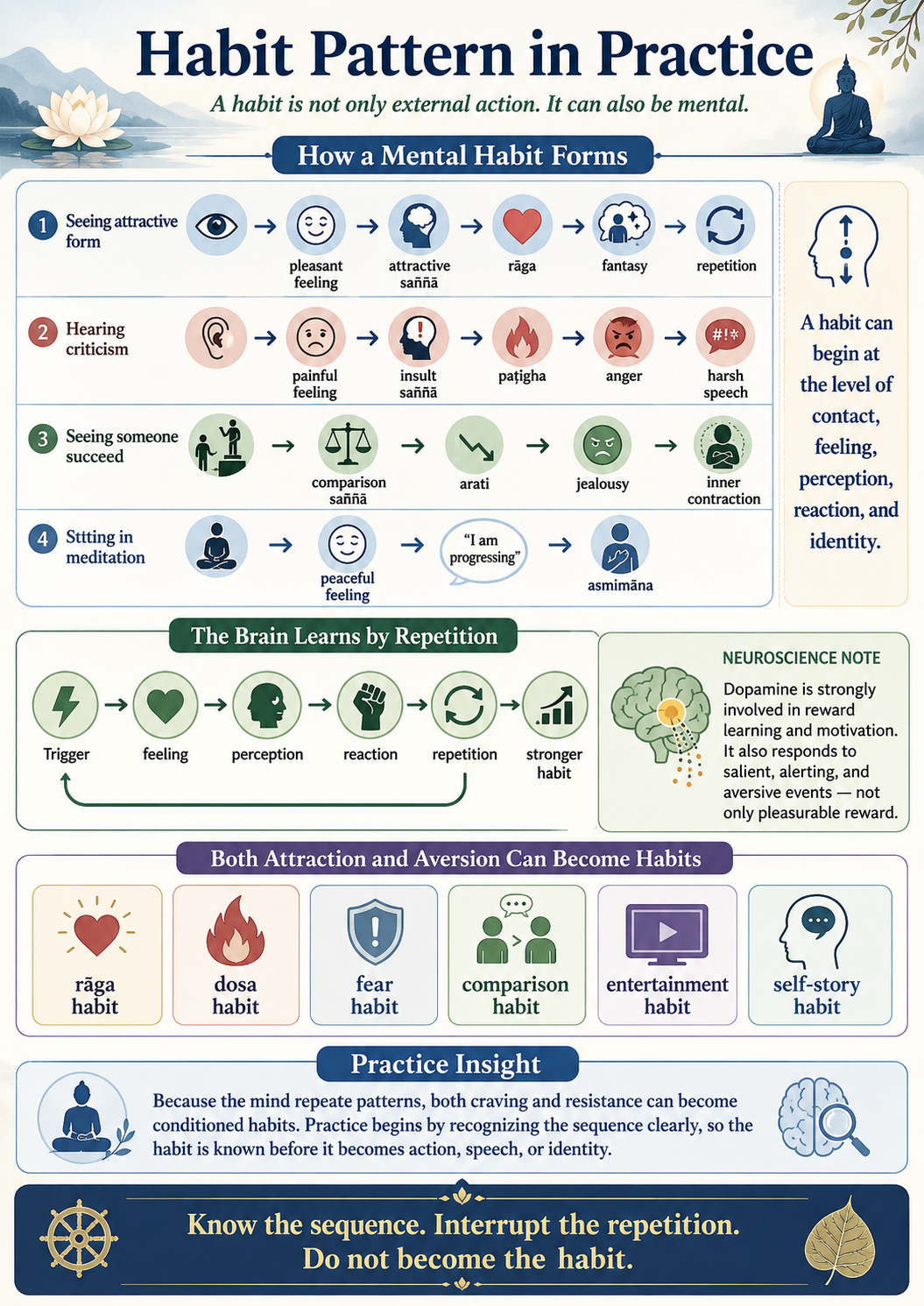
What is “habit pattern” in this practice? A habit is not only external action but mental as well.
For example:
seeing attractive form → pleasant feeling → attractive saññā → rāga → fantasy → repetition
hearing criticism → painful feeling → insult saññā → paṭigha → anger → harsh speech
seeing someone succeed → comparison saññā → arati → jealousy → inner contraction
sitting in meditation → peaceful feeling → “I am progressing” → asmimāna
The brain learns by repetition. Dopamine is strongly involved in reward learning and motivation, but dopamine also responds to salient, alerting, and aversive events, not only pleasurable reward.
So both attraction and aversion can become habits:
rāga habit,
dosa habit,
fear habit,
comparison habit,
entertainment habit,
self-story habit.
Teaching infographics — click any preview to enlarge.
Neuroscience through habit-patterns
Supporting infographic 2
Open the visual for the complete illustrated explanation.
Click infographic to enlarge ↗
Neuroscience through habit-patterns
Supporting infographic 3
Open the visual for the complete illustrated explanation.

Click infographic to enlarge ↗
Neuroscience through habit-patterns
Supporting infographic 4
Open the visual for the complete illustrated explanation.
Click infographic to enlarge ↗
Neuroscience through habit-patterns
Supporting infographic 5
Open the visual for the complete illustrated explanation.
Click infographic to enlarge ↗
Dhamma training gives precise responses to recurring triggers
| Trigger | Old brain habit | Dhamma Diagnosis | Dhamma training |
|---|---|---|---|
| Praise | “I am important” | asmimāna | aniccasaññā |
| Blame | “I am attacked” | paṭigha / byāpāda | upekkhā / mettā |
| Attractive form | “I want” | rāga | asubha |
| Pain | “Why me?” | paṭigha | pathavīsamaṁ / upekkhā |
| Someone suffering | “Not my problem” | lack of karuṇā | karuṇā |
| Someone succeeds | “Why not me?” | arati / issā | muditā |
| Harsh word | “I must reply” | saṅkhāra reaction | vāyosamaṁ |
| Shame memory | “I am bad” | asmimāna | āposamaṁ + anicca |
| Strong craving | “Just once” | rāga-saṅkhāra | asubha + fire-like wisdom |
| Meditation calm | “I attained” | asmimāna | aniccasaññā |
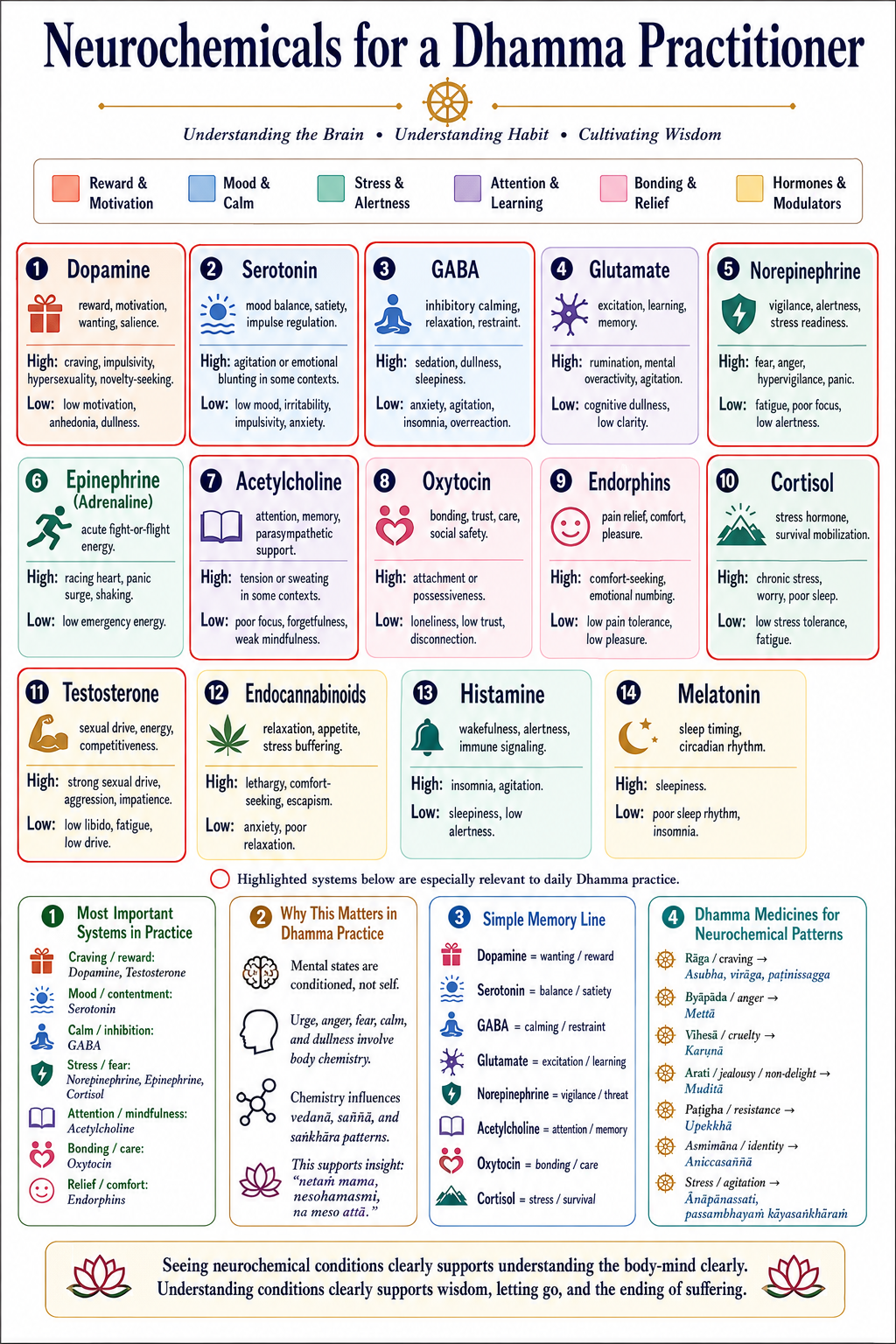
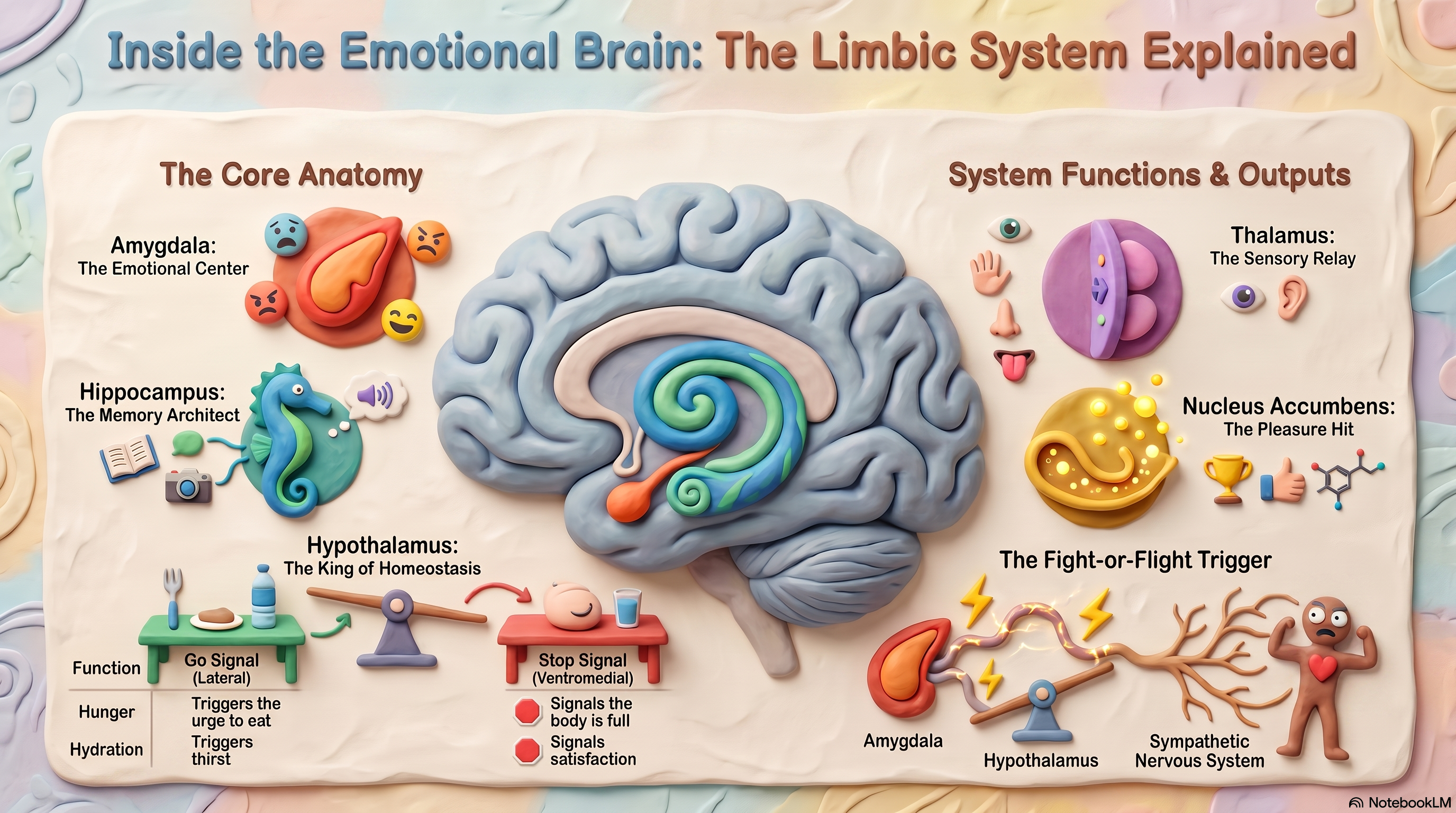
Main neurotransmitters and hormones involved
| Neurochemical system | Basic function | Dhamma relevance |
|---|---|---|
| GABA | Main inhibitory/calming neurotransmitter | Helps reduce over-arousal, anxiety, impulsive reaction |
| Glutamate | Main excitatory neurotransmitter | Involved in alertness, learning, memory, habit encoding |
| Serotonin | Mood, patience, satiety, emotional balance | Supports contentment, less compulsive chasing |
| Dopamine | Motivation, reward learning, wanting, salience | Can drive craving, but can also be retrained toward wholesome joy |
| Oxytocin | Bonding, trust, social connection, care | Related to mettā, karuṇā, muditā, relational safety |
| Norepinephrine (naw·reh·pi·neh·fruhn) / adrenaline | Alertness, threat, stress arousal | Rises with fear, anger, urgency, defense |
| Cortisol | Major stress hormone | Chronic stress keeps body in defensive mode |
| Endorphins | Pain relief, stress relief, well-being | Supports resilience, especially under pain/stress |
| Acetylcholine (uh·see·tuhl·koh·leen) | Attention, learning, parasympathetic/vagal function | Helps attention, bodily calming, digestion/rest regulation |
| Neurochemical | Main function | When relatively excessive / overactive | When relatively low / underactive | Mental states seen | Dhamma diagnosis | How to practise Dhamma |
|---|---|---|---|---|---|---|
| Dopamine | Motivation, reward, wanting, salience, learning | Craving, novelty-seeking, pornography pull, hypersexuality, gambling, risk-taking, obsession | Low motivation, dullness, anhedonia, lack of interest | “I want,” “just once,” stimulation chasing | rāga, taṇhā, upādāna | Practise asubhaṁ bhāvanaṁ bhāvehi. See pleasant vedanā, subha-saññā, and rāga-saṅkhāra as conditioned. Add virāgānupassanā and paṭinissagga. |
| Serotonin | Mood balance, patience, satiety, impulse regulation, sleep rhythm | Agitation, restlessness, emotional blunting in some contexts; extreme excess can be medically dangerous | Low mood, irritability, anxiety, impulsivity, compulsive repetition | Dissatisfaction, poor emotional balance | arati, uddhacca, domanassa | Practise muditā for arati, upekkhā for imbalance, and ānāpānassati to steady vedanā. |
| GABA | Main inhibitory/calming neurotransmitter | Sedation, dullness, sleepiness, low alertness | Anxiety, insomnia, agitation, impulsive reaction, inability to pause | Restlessness, panic, overreaction | uddhacca, paṭigha, bhaya | Practise passambhayaṁ kāyasaṅkhāraṁ: soften breath, relax body, lengthen exhale naturally. Then practise upekkhā. |
| Glutamate | Main excitatory neurotransmitter; learning, memory, alertness | Overthinking, rumination, obsessive loops, agitation | Cognitive dullness, poor learning, low clarity | Papañca, fast thoughts, repeated story | papañca, saṅkhāra proliferation | Return to pajānāti: long breath known, short breath known. Name thinking as saṅkhāra. Practise nirodhānupassanā: see each thought ending. |
| Norepinephrine (naw·reh·pi·neh·fruhn) | Alertness, vigilance, stress response, fight-or-flight readiness | Hypervigilance, anger, fear, panic, urgency, insomnia | Fatigue, poor focus, low alertness | Defensive reaction, threat mode | byāpāda, paṭigha, bhaya | Practise pathavīsamaṁ bhāvanaṁ. Let praise/blame fall like clean/unclean things on earth. Add mettā for ill will and upekkhā for resistance. |
| Epinephrine / Adrenaline | Acute emergency energy: heart rate, blood pressure, rapid fight-or-flight | Sudden panic, shaking, sweating, heart racing, aggressive surge | Low emergency energy, fatigue under challenge | Emotional hijack, panic surge | paṭigha, bhaya, dosa-vega | Stop speech/action first. Feel feet, abdomen, breath. Practise vāyosamaṁ: let sound/thought pass like air. Then calm the body. |
| Acetylcholine (uh·see·tuhl·koh·leen) | Attention, memory, learning, parasympathetic/vagal pathways, muscle activation | Too much peripheral activation may cause sweating, cramps, tension; attention may feel tight | Poor attention, weak memory, dullness, weak sati | Forgetfulness, poor mindfulness | muṭṭhassati, thīna-middha | Practise sati-sampajañña. Use simple knowing: “walking,” “seeing,” “hearing,” “breathing.” Return to assasāmi / passasāmi pajānāti. |
| Oxytocin | Bonding, trust, social safety, caregiving, attachment | Possessiveness, emotional dependence, in-group bias, clinging to one person | Loneliness, low trust, social disconnection | Attachment, longing, possessiveness | pema mixed with upādāna, mamaṅkāra | Practise mettā with paññā. “May this being be well, but this being is not mine.” Add netaṁ mama, nesohamasmi, na meso attā. |
| Endorphins / endogenous opioids | Pain relief, pleasure, comfort, stress-soothing | Relief-seeking, comfort addiction, emotional numbing, pleasure dependency | Low pain tolerance, stress sensitivity, low pleasure | Seeking relief through sex, food, sleep, entertainment | taṇhā for sukha-vedanā, upādāna | Replace unwholesome relief with wholesome pīti and sukha from breath, sīla, mettā, Dhamma. See relief as temporary: aniccānupassī. |
| Cortisol | Stress hormone; survival mobilization, glucose regulation | Chronic stress, worry, irritability, poor sleep, fear loops | Too low in medical disorders can cause fatigue and poor stress tolerance | Survival mode, anxiety, defensive identity | bhaya, upāyāsa, asmimāna under threat | Practise upekkhā and pathavīsamaṁ. “This is conditioned stress, not self.” Use ānāpānassati step 4 to calm the body. |
| Testosterone | Sexual drive, energy, dominance, competitiveness, muscle-building support | Increased sexual drive, aggression tendency, risk-taking, impatience | Low libido, fatigue, low confidence, low drive | Sexual urge, competitiveness, pride | rāga, māna, asmimāna | For sexual drive, practise asubha and indriyasaṁvara. For dominance/pride, practise aniccasaññā: body, status, strength, and identity are changing. |
| Endocannabinoids | Relaxation, appetite, pleasure, pain modulation, stress buffering | Lethargy, comfort-seeking, overeating, escapism | Anxiety, poor relaxation, stress sensitivity | Escaping into comfort, laziness | thīna-middha, kāmasukha attachment | Practise balanced viriya. Stand, walk, breathe clearly. Use tejosamaṁ bhāvanaṁ: burn dullness with energy and wisdom. |
| Histamine | Wakefulness, alertness, immune/allergy signaling | Insomnia, agitation, allergy-related irritability | Sleepiness, dullness, low alertness | Drowsiness or agitation | thīna-middha or uddhacca | If dull, practise walking meditation and bright attention. If agitated, practise soft breathing and upekkhā. |
Teaching infographics — click any preview to enlarge.
Main neurotransmitters and hormones involved
Supporting infographic 6
Open the visual for the complete illustrated explanation.
Click infographic to enlarge ↗
Main neurotransmitters and hormones involved
Supporting infographic 7
Open the visual for the complete illustrated explanation.
Click infographic to enlarge ↗
Main neurotransmitters and hormones involved
Supporting infographic 8
Open the visual for the complete illustrated explanation.
Click infographic to enlarge ↗
Main neurotransmitters and hormones involved
Supporting infographic 9
Open the visual for the complete illustrated explanation.
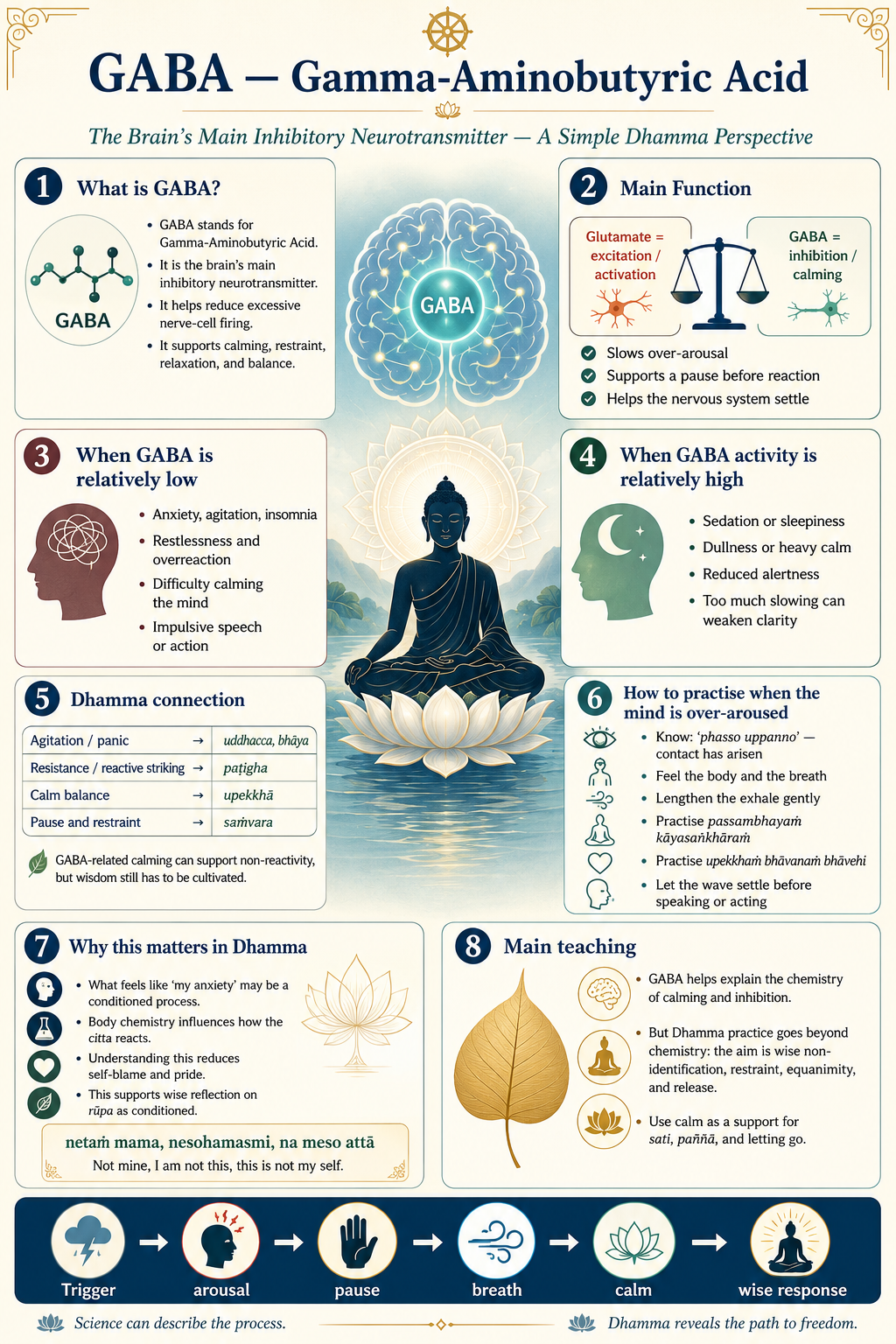
Click infographic to enlarge ↗
Main neurotransmitters and hormones involved
Supporting infographic 10
Open the visual for the complete illustrated explanation.
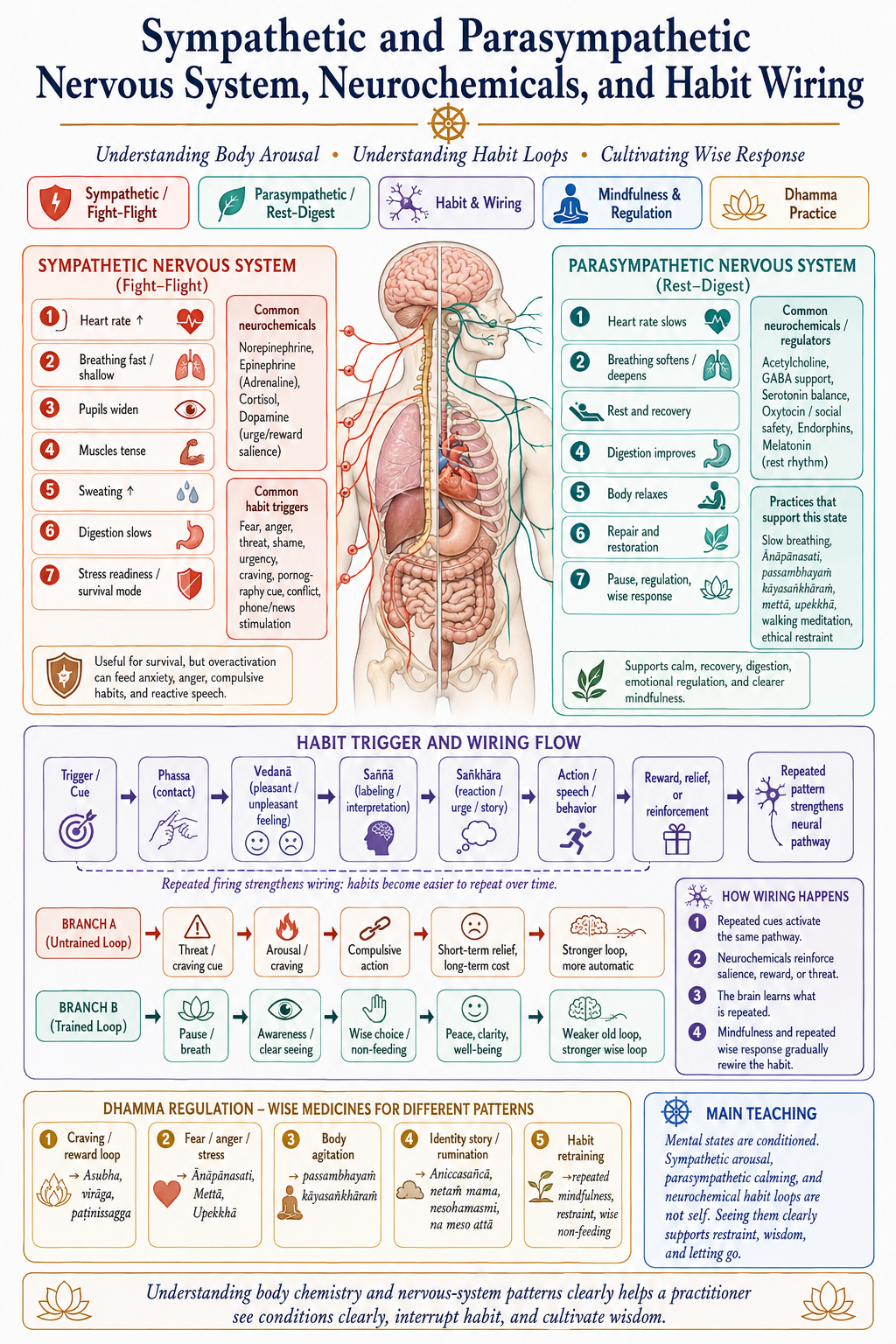
Click infographic to enlarge ↗
The Vagus Nerve: A Neuroscience and Buddha Dhamma Perspective
The vagus nerve is one of the most important nerves for understanding the connection between body, breath, emotion, digestion, heart regulation, and mental calm. It is known as the tenth cranial nerve, or cranial nerve X. The word “vagus” means “wandering,” because this nerve travels widely from the brainstem into the throat, heart, lungs, and digestive system.
In simple terms, the vagus nerve is a major communication pathway between the brain and the body. It does not only send instructions from the brain to the organs. It also carries information from the organs back to the brain. This is very important for meditation practice because the mind is not separate from the body. The state of breathing, heartbeat, digestion, muscle tension, and inner bodily feeling all influence the condition of the mind.
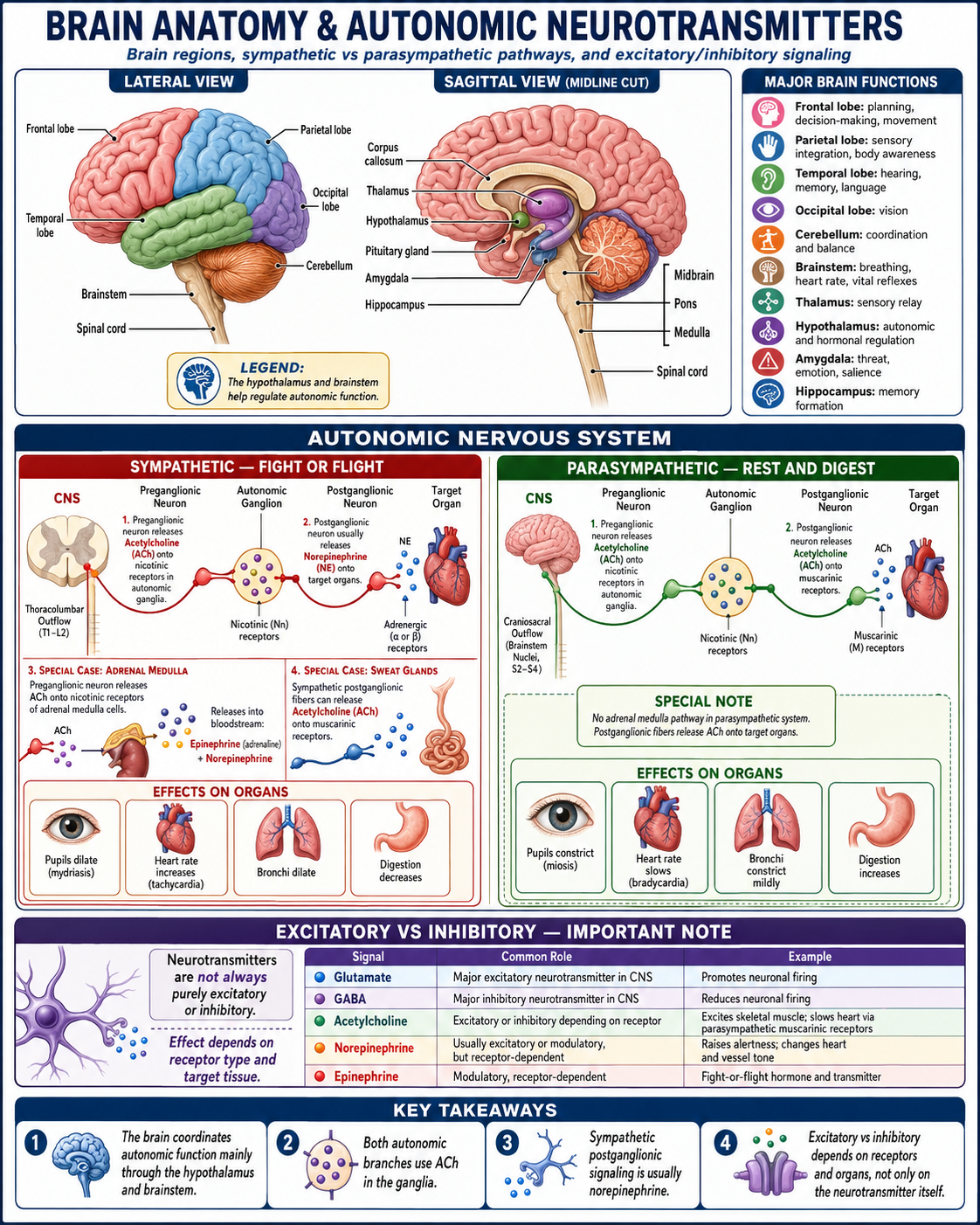
The vagus nerve is a major part of the parasympathetic system. When vagal regulation is strong, the body can shift more easily from stress into calm. The heart rate can settle, breathing can become smoother, digestion can function better, and the nervous system can return toward balance.
This does not mean the vagus nerve alone creates peace or wisdom. It is a bodily condition that supports calm. In Dhamma language, it is a condition, a paccaya. It is not self.
Breath and the vagus nerve
Breathing has a close relationship with autonomic regulation. When breathing is fast, shallow, and irregular, the body may remain in a state of alertness or threat. When breathing becomes slower, softer, and more regular, the body can move toward parasympathetic regulation. This is why ānāpānasati is so practical.
Buddha says:
Dīghaṁ vā assasanto dīghaṁ assasāmīti pajānāti.
Breathing in long, one understands: “I breathe in long.”
Passambhayaṁ kāyasaṅkhāraṁ assasissāmīti sikkhati.
One trains: “I shall breathe in calming the bodily formation.”
Here, the practitioner is not controlling the breath with force. He is learning to know the breath, feel the body, and allow the bodily formation to calm. As the body calms, the nervous system also settles. As the nervous system settles, the mind becomes less reactive. This is where neuroscience and Dhamma meet beautifully.
Neuroscience says: breath influences body regulation.
Dhamma says: know the breath, calm the kāyasaṅkhāra, and observe the arising and passing of experience.
Vagus nerve and emotional reactivity
When a person is angry, afraid, anxious, or overwhelmed, the body becomes activated. The heart may beat faster. Breathing may become short. The stomach may tighten. The throat may close. Heat may rise. Muscles may contract. These are not merely “mental” events. They are body-mind events.
In Dhamma terms: phassa → vedanā → saññā → saṅkhāra → reaction
In neuroscience terms: trigger → body activation → emotional interpretation → habitual response
The vagus nerve is involved in helping the body return from activation to regulation. When the vagal system supports settling, the practitioner has more space between stimulus and reaction. This space is very important in Dhamma practice.
Without regulation: contact quickly becomes reaction.
With regulation: contact can be known as contact, feeling can be known as feeling, and reaction need not be blindly followed.
Vagus nerve, gut, and mind
The gut and brain are deeply connected. Many people feel anxiety in the stomach, grief in the chest, fear in the belly, or tension in the throat. These are not imaginary. The nervous system continuously receives information from the internal organs. The vagus nerve is one of the main pathways in this gut-brain communication. This is why digestion, food, stress, breath, sleep, and emotional life are connected.
From a Dhamma perspective, this helps us understand rūpa more deeply.
Vagal tone and meditation
People sometimes use the phrase “vagal tone” to describe the functional strength or flexibility of vagal regulation, often discussed through heart rate variability. A more flexible nervous system can shift more smoothly between activation and recovery. Meditation, slow breathing, relaxation, kindness practice, and body awareness may support better regulation. But this should not be turned into a new attachment: I have high vagal tone, I am spiritually advanced, My nervous system is pure. That becomes another identity.
In Buddha Dhamma, calm is useful, but calm alone is not liberation. Calm must be used for wisdom.The correct reflection is:
This calm is conditioned.
This breath is conditioned.
This body is conditioned.
This nervous system is conditioned.
This is not mine, I am not this, this is not my self.
Vagus nerve and the five hindrances The vagus nerve can be connected to practice through the five hindrances.
| Hindrance | Body-nervous system expression | Dhamma practice |
| Kāmacchanda | excitement, wanting, pleasant stimulation seeking | asubha, sense restraint, anicca |
| Byāpāda | heat, contraction, threat activation | mettā, softening, patience |
| Thīna-middha | heaviness, dullness, low alertness | viriya, open posture, walking meditation |
| Uddhacca-kukkucca | restlessness, agitation, unsettled breath | ānāpānasati, grounding, calming |
| Vicikicchā | uncertainty, tension, hesitation | yoniso manasikāra, clear investigation |
The vagus nerve does not remove hindrances by itself. But bodily regulation supports the practitioner in seeing the hindrances clearly. When the body is calmer, the mind can observe more accurately.
Teaching infographics — click any preview to enlarge.
Main neurotransmitters and hormones involved
Supporting infographic 11
Open the visual for the complete illustrated explanation.
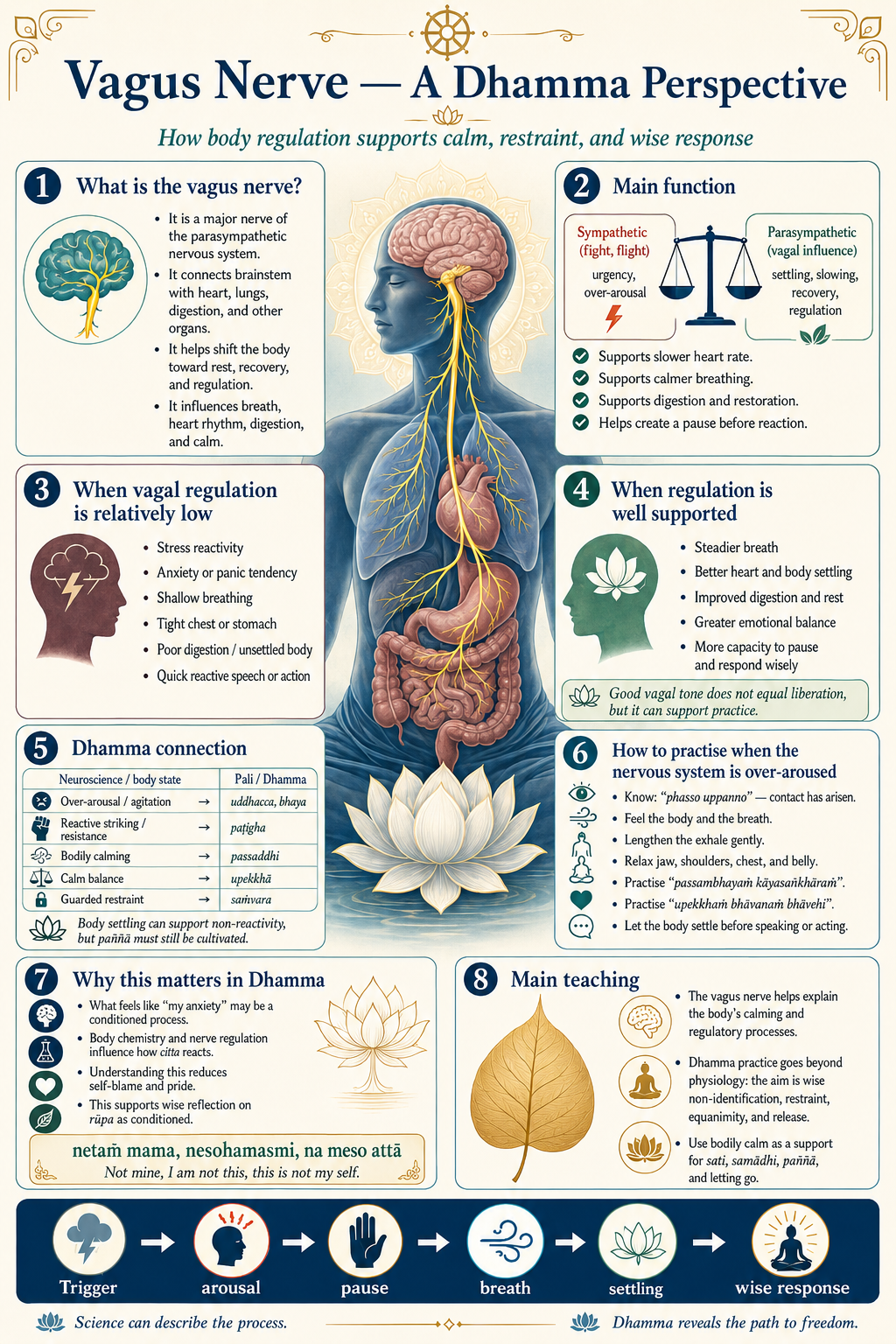
Click infographic to enlarge ↗
Creating motivation for anāpanasati – Moving from Kāmacchanda to Chanda or interest
Teaching infographics — click any preview to enlarge.
Creating motivation for anāpanasati – Moving from Kāmacchanda to Chanda or interest
Supporting infographic 12
Open the visual for the complete illustrated explanation.
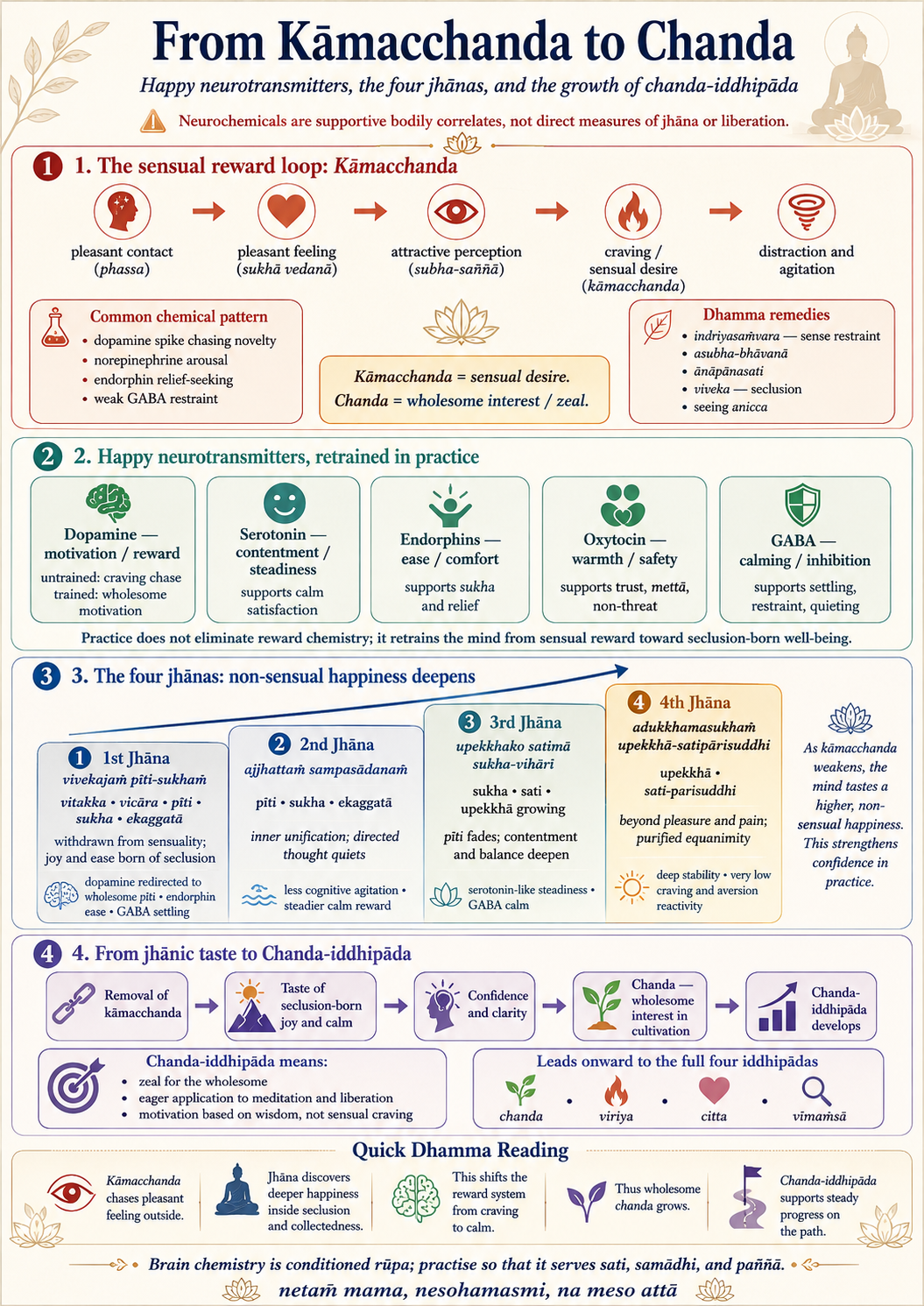
Click infographic to enlarge ↗
Creating motivation for anāpanasati – Moving from Kāmacchanda to Chanda or interest
Supporting infographic 13
Open the visual for the complete illustrated explanation.

Click infographic to enlarge ↗
MN118 ānāpānassati with neuroscience and neurotransmitters
| # | Pāli | Practice meaning | Neuroscience perspective | Likely neurochemical systems |
|---|---|---|---|---|
| 1 | Dīghaṁ vā assasanto “dīghaṁ assasāmī”ti pajānāti; dīghaṁ vā passasanto “dīghaṁ passasāmī”ti pajānāti. | Breathing in long, he knows “I breathe in long”; breathing out long, he knows “I breathe out long.” | The first training is simple accurate knowing. Attention returns from story to bodily rhythm. This strengthens present-moment sensory monitoring. | Acetylcholine (uh·see·tuhl·koh·leen) for attention; reduced norepinephrine (naw·reh·pi·neh·fruhn) over-arousal; GABA-related settling. |
| 2 | Rassaṁ vā assasanto “rassaṁ assasāmī”ti pajānāti; rassaṁ vā passasanto “rassaṁ passasāmī”ti pajānāti. | Breathing in short, he knows “I breathe in short”; breathing out short, he knows “I breathe out short.” | The mind becomes sensitive to change. It knows long as long, short as short, without forcing. This trains discrimination and reduces automatic wandering. | Acetylcholine for precision; glutamate for learning; GABA for inhibitory control. |
| 3 | Sabbakāyapaṭisaṁvedī assasissāmī’ti sikkhati; sabbakāyapaṭisaṁvedī passasissāmī’ti sikkhati. | He trains: “Experiencing the whole body, I will breathe in/out.” | Awareness expands from nostril or breath-point to the whole bodily field. This strengthens interoception: sensing the body from within. | Acetylcholine for body attention; glutamate for body-map learning; GABA for calming; reduced stress chemistry. |
| 4 | Passambhayaṁ kāyasaṅkhāraṁ assasissāmī’ti sikkhati; passambhayaṁ kāyasaṅkhāraṁ passasissāmī’ti sikkhati. | He trains: “Tranquilizing the bodily formation, I will breathe in/out.” | Breath, body tension, and autonomic arousal soften. Slow breathing and longer exhalation are linked with vagal/parasympathetic regulation. (PMC) | Acetylcholine/vagal pathways, GABA-related inhibition, reduced norepinephrine (naw·reh·pi·neh·fruhn) and cortisol stress reactivity. |
| 5 | Pītipaṭisaṁvedī assasissāmī’ti sikkhati; pītipaṭisaṁvedī passasissāmī’ti sikkhati. | He trains: “Experiencing pīti, I will breathe in/out.” | Pīti is energizing joy. The reward system begins to taste wholesome joy instead of sensual stimulation, news, entertainment, or craving. | Dopamine redirected toward wholesome reward; endorphins; serotonin balance. |
| 6 | Sukhapaṭisaṁvedī assasissāmī’ti sikkhati; sukhapaṭisaṁvedī passasissāmī’ti sikkhati. | He trains: “Experiencing sukha, I will breathe in/out.” | Sukha is ease, comfort, and inner well-being. The nervous system learns safety without grasping. | Serotonin contentment; endorphins; GABA calming; possible oxytocin-related safety tone. |
| 7 | Cittasaṅkhārapaṭisaṁvedī assasissāmī’ti sikkhati; cittasaṅkhārapaṭisaṁvedī passasissāmī’ti sikkhati. | He trains: “Experiencing the mental formation, I will breathe in/out.” | In the Pāli explanation, cittasaṅkhāra is closely linked with vedanā and saññā. This is where one sees how feeling and perception shape mood, reaction, and habit. | Acetylcholine for monitoring; glutamate for learning; reduced automatic dopamine and norepinephrine loops. |
| 8 | Passambhayaṁ cittasaṅkhāraṁ assasissāmī’ti sikkhati; passambhayaṁ cittasaṅkhāraṁ passasissāmī’ti sikkhati. | He trains: “Tranquilizing the mental formation, I will breathe in/out.” | Feeling and perception are calmed before they harden into craving, aversion, fear, fantasy, or self-story. | GABA-related inhibition; serotonin mood steadiness; reduced norepinephrine/cortisol stress arousal. |
| 9 | Cittapaṭisaṁvedī assasissāmī’ti sikkhati; cittapaṭisaṁvedī passasissāmī’ti sikkhati. | He trains: “Experiencing the mind, I will breathe in/out.” | The practitioner knows the mind-state directly: dull, bright, restless, contracted, joyful, angry, craving, peaceful. Mindfulness research links practice with emotional regulation and brain changes related to sensory and emotional processing. (PMC) | Acetylcholine meta-awareness; prefrontal regulation; less default-mode self-story capture. |
| 10 | Abhippamodayaṁ cittaṁ assasissāmī’ti sikkhati; abhippamodayaṁ cittaṁ passasissāmī’ti sikkhati. | He trains: “Gladdening the mind, I will breathe in/out.” | The mind is intentionally uplifted. This is not entertainment; it is wise joy, confidence, and wholesome motivation. | Dopamine wholesome motivation; serotonin well-being; endorphins; reduced stress chemistry. |
| 11 | Samādahaṁ cittaṁ assasissāmī’ti sikkhati; samādahaṁ cittaṁ passasissāmī’ti sikkhati. | He trains: “Composing/unifying the mind, I will breathe in/out.” | Scattered attention becomes gathered. Competing impulses quieten. This is attentional stability, not mere forced concentration. | Acetylcholine sustained attention; GABA stabilization; balanced glutamate excitation. |
| 12 | Vimocayaṁ cittaṁ assasissāmī’ti sikkhati; vimocayaṁ cittaṁ passasissāmī’ti sikkhati. | He trains: “Freeing the mind, I will breathe in/out.” | The mind is released from rāga, dosa, moha, worry, dullness, agitation, and identity loops. The ancient explanation explicitly connects this step with freeing the mind from passion, hate, delusion, conceit, views, doubt, sloth, agitation, shamelessness, and lack of conscience. | Reduced dopamine craving, reduced norepinephrine threat, increased GABA regulation, serotonin balance. |
| 13 | Aniccānupassī assasissāmī’ti sikkhati; aniccānupassī passasissāmī’ti sikkhati. | He trains: “Contemplating impermanence, I will breathe in/out.” | Every breath, sensation, feeling, mood, perception, and consciousness-event changes. This weakens fixed identity and self-threat. | Reduced cortisol self-threat; less default-mode fixation; acetylcholine clarity. |
| 14 | Virāgānupassī assasissāmī’ti sikkhati; virāgānupassī passasissāmī’ti sikkhati. | He trains: “Contemplating fading/dispassion, I will breathe in/out.” | Rāga as coloring fades. The object loses the mind-made glow of “this will satisfy me.” | Reduced dopamine craving salience; serotonin contentment; GABA restraint. |
| 15 | Nirodhānupassī assasissāmī’ti sikkhati; nirodhānupassī passasissāmī’ti sikkhati. | He trains: “Contemplating cessation, I will breathe in/out.” | The practitioner sees endings: breath ends, feeling ends, urge ends, thought ends, identity-construction ends. This weakens habit reinforcement. | Reduced habit-loop reinforcement; GABA quieting; reduced norepinephrine/cortisol arousal. |
| 16 | Paṭinissaggānupassī assasissāmī’ti sikkhati; paṭinissaggānupassī passasissāmī’ti sikkhati. | He trains: “Contemplating relinquishment, I will breathe in/out.” | Letting go becomes the new habit. Instead of grasping, resisting, or becoming, the mind releases. The Pāli explanation describes two kinds of letting go: abandoning and entering/releasing toward cessation. (Ancient Buddhist Texts) | Reward revaluation; serotonin ease; reduced stress chemistry; less compulsive dopamine seeking. |
Teaching infographics — click any preview to enlarge.
MN118 ānāpānassati with neuroscience and neurotransmitters
Supporting infographic 14
Open the visual for the complete illustrated explanation.
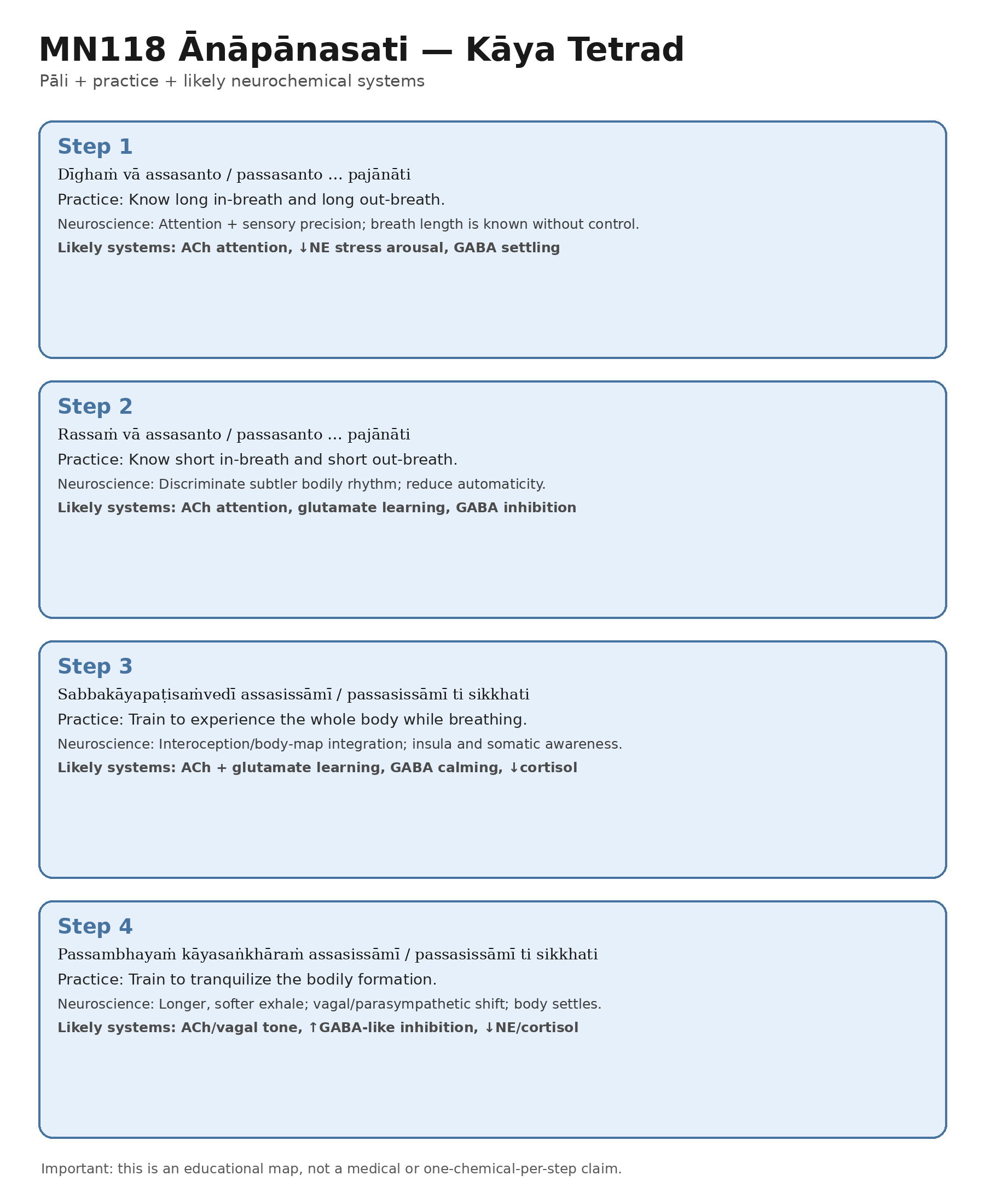
Click infographic to enlarge ↗
MN118 ānāpānassati with neuroscience and neurotransmitters
Supporting infographic 15
Open the visual for the complete illustrated explanation.
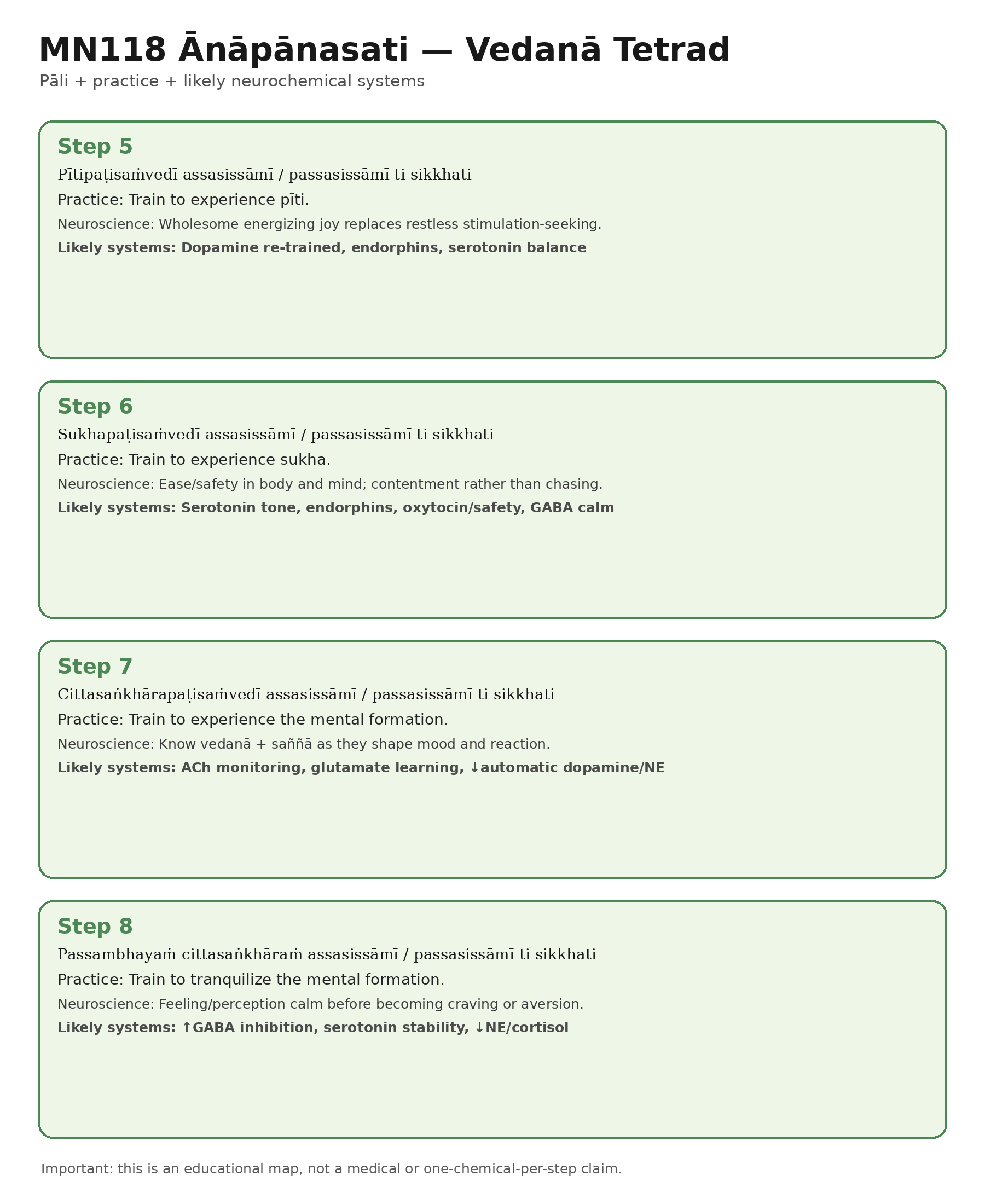
Click infographic to enlarge ↗
MN118 ānāpānassati with neuroscience and neurotransmitters
Supporting infographic 16
Open the visual for the complete illustrated explanation.

Click infographic to enlarge ↗
MN118 ānāpānassati with neuroscience and neurotransmitters
Supporting infographic 17
Open the visual for the complete illustrated explanation.
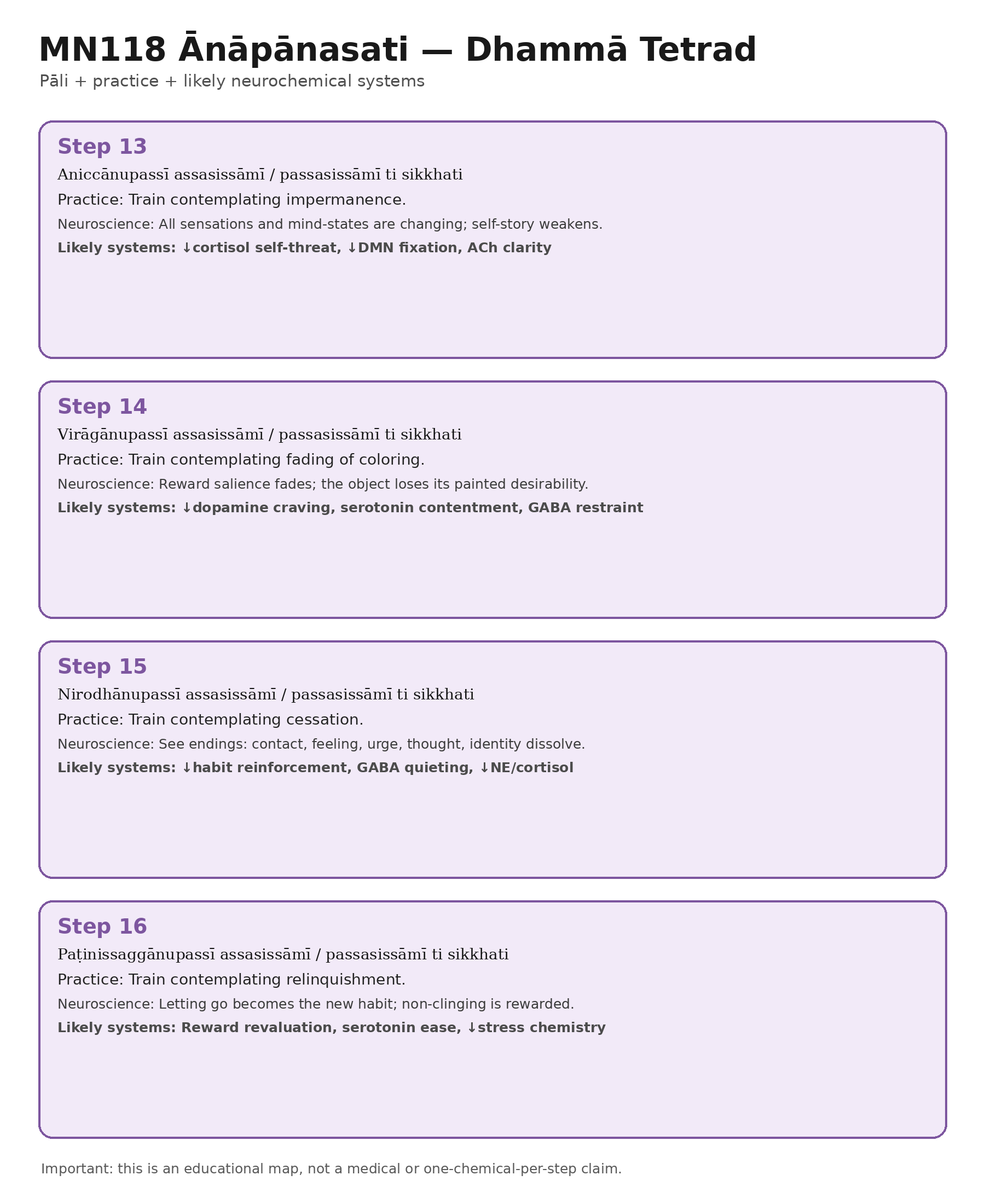
Click infographic to enlarge ↗
Applying this to six targeted Dhamma developments
| Dhamma development | Removes | Neurochemical habit being retrained |
|---|---|---|
| Mettaṁ bhāvanaṁ bhāvehi | byāpāda | Threat chemistry, anger arousal, norepinephrine/cortisol dominance |
| Karuṇaṁ bhāvanaṁ bhāvehi | vihesā | Revenge reward, aggression, domination impulse |
| Muditaṁ bhāvanaṁ bhāvehi | arati | Jealousy, boredom, reward distortion, comparison |
| Upekkhaṁ bhāvanaṁ bhāvehi | paṭigha | Resistance, fight-flight, stress chemistry |
| Asubhaṁ bhāvanaṁ bhāvehi | rāga | Dopamine craving, sexual coloring, novelty reward |
| Aniccasaññaṁ bhāvanaṁ bhāvehi | asmimāna | Self-story, pride/shame loops, defensive identity |
Dhamma-neuroscience bridge table
| Dhamma process | Neuroscience language | Daily example | Practice point |
|---|---|---|---|
| Phassa | cue / sensory contact | seeing phone, hearing criticism, remembering someone | know: “contact has arisen” |
| Vedanā | body-feeling / affective tone | pleasant, unpleasant, neutral | know feeling before reaction |
| Saññā | labeling / interpretation | “good,” “bad,” “mine,” “insult,” “opportunity” | see perception as painting |
| Saṅkhāra | learned response pattern | anger, craving, worry, fantasy, planning | interrupt before action |
| Habit loop | cue-routine-reward wiring | YouTube, food, lust, irritation, worry | replace unwise routine |
| DMN self-story | self-reference / narrative identity | “Why me?” “I am like this” | see papañca and asmimāna |
| Upādāna | reinforced attachment | clinging to view, person, pleasure, role | practise paṭinissagga |
| Anattā insight | de-identification | “this is conditioned, not self” | netaṁ mama, nesohamasmi, na meso attā |
Teaching infographics — click any preview to enlarge.
MN118 ānāpānassati with neuroscience and neurotransmitters
Supporting infographic 18
Open the visual for the complete illustrated explanation.
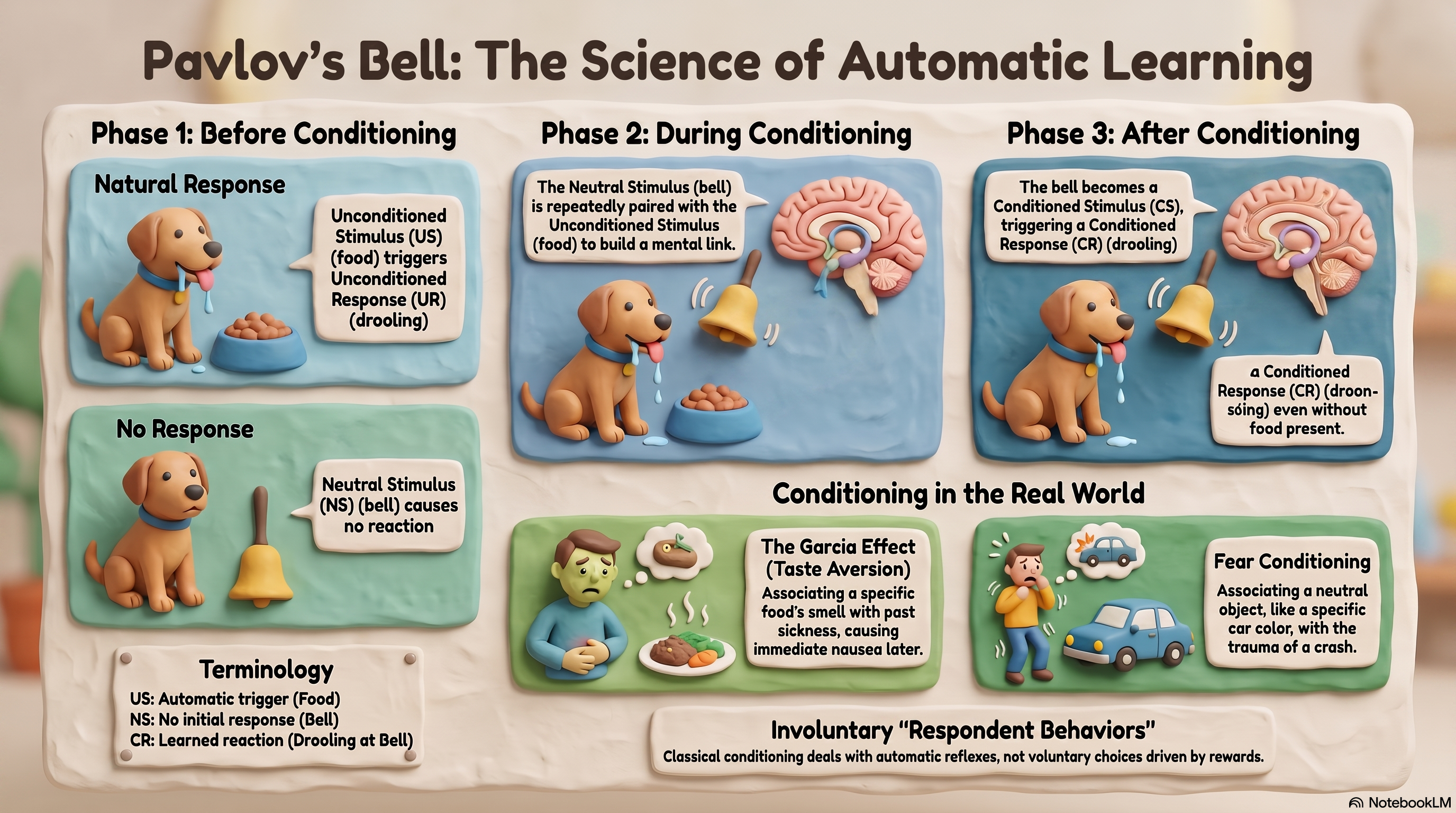
Click infographic to enlarge ↗
02 Chemistry — elements, molecules and conditioned rūpa
Teaching infographics — click any preview to enlarge.
Chemistry — elements, molecules and conditioned rūpa
Supporting infographic 1
Open the visual for the complete illustrated explanation.

Click infographic to enlarge ↗
What is the periodic table?
The periodic table is an organized map of chemical elements. Elements are arranged by atomic number, and the table is organized into rows called periods and columns called groups. Standard periodic tables use 7 periods and 18 groups.
IUPAC, the international chemistry authority, maintains information on the periodic table. The currently named elements include up to element 118, with elements 113, 115, 117, and 118 receiving approved names in 2016.
Basic terms
| Term | Meaning | Example | Dhamma reflection |
|---|---|---|---|
| Element | Pure type of atom | Oxygen, carbon, iron | Body is made of elements, not self |
| Atom | Small unit of an element | One oxygen atom | rūpa is composite and conditioned |
| Atomic number | Number of protons | Carbon = 6 | each element has specific conditions |
| Symbol | Short name | O, C, H, N, Na, K, Fe | useful for reading body chemistry |
| Period | Horizontal row | Period 2 contains C, N, O | properties change across a row |
| Group | Vertical column | Group 1: Li, Na, K | similar chemical behavior |
| Valence electrons | Outer electrons involved in bonding | Na loses one electron easily | explains why atoms form molecules/ions |
Elements in the same group often have similar chemical properties because they have the same number of valence electrons.
How to read one box in the periodic table? Example: carbon.
| Part | Carbon example | Meaning |
|---|---|---|
| Atomic number | 6 | Carbon has 6 protons |
| Symbol | C | Chemical symbol |
| Name | Carbon | Element name |
| Atomic mass | about 12 | average mass of carbon atoms |
Dhamma reflection:
The body’s proteins, fats, sugars, DNA, neurotransmitters, and cells all contain carbon and still, no carbon atom says: “I am Vilas.” The person is a conceptual designation over conditioned processes.
The most important elements for body and mind. A Dhamma practitioner does not need to memorize all 118 elements. First understand the elements that form the body and influence mind-state.
| Element | Symbol | Why important in body | Dhamma relevance |
|---|---|---|---|
| Oxygen | O | breathing, water, energy production | breath is chemical support for life |
| Carbon | C | backbone of organic molecules | body is organic chemistry |
| Hydrogen | H | water, acids, organic molecules | everywhere in body chemistry |
| Nitrogen | N | proteins, DNA, neurotransmitters | mind-states depend on conditioned molecules |
| Calcium | Ca | bones, muscle contraction, neurotransmitter release | nerve/body activity is conditioned |
| Phosphorus | P | ATP, DNA, cell membranes | energy and life processes |
| Sulfur | S | proteins, enzymes | body maintenance |
| Sodium | Na | nerve impulses, fluid balance | affects excitability |
| Potassium | K | nerve impulses, heart rhythm | body stability |
| Chlorine / Chloride | Cl | fluid balance, stomach acid, nerve signaling | digestion and nerve function |
| Magnesium | Mg | enzyme function, muscle/nerve regulation | calm and metabolic support |
| Iron | Fe | hemoglobin, oxygen transport | energy, fatigue, vitality |
| Zinc | Zn | enzymes, immunity, hormones | body regulation |
| Copper | Cu | enzymes, iron metabolism | trace but important |
| Iodine | I | thyroid hormones | metabolism, energy, mood |
Teaching infographics — click any preview to enlarge.
Chemistry — elements, molecules and conditioned rūpa
Supporting infographic 2
Open the visual for the complete illustrated explanation.
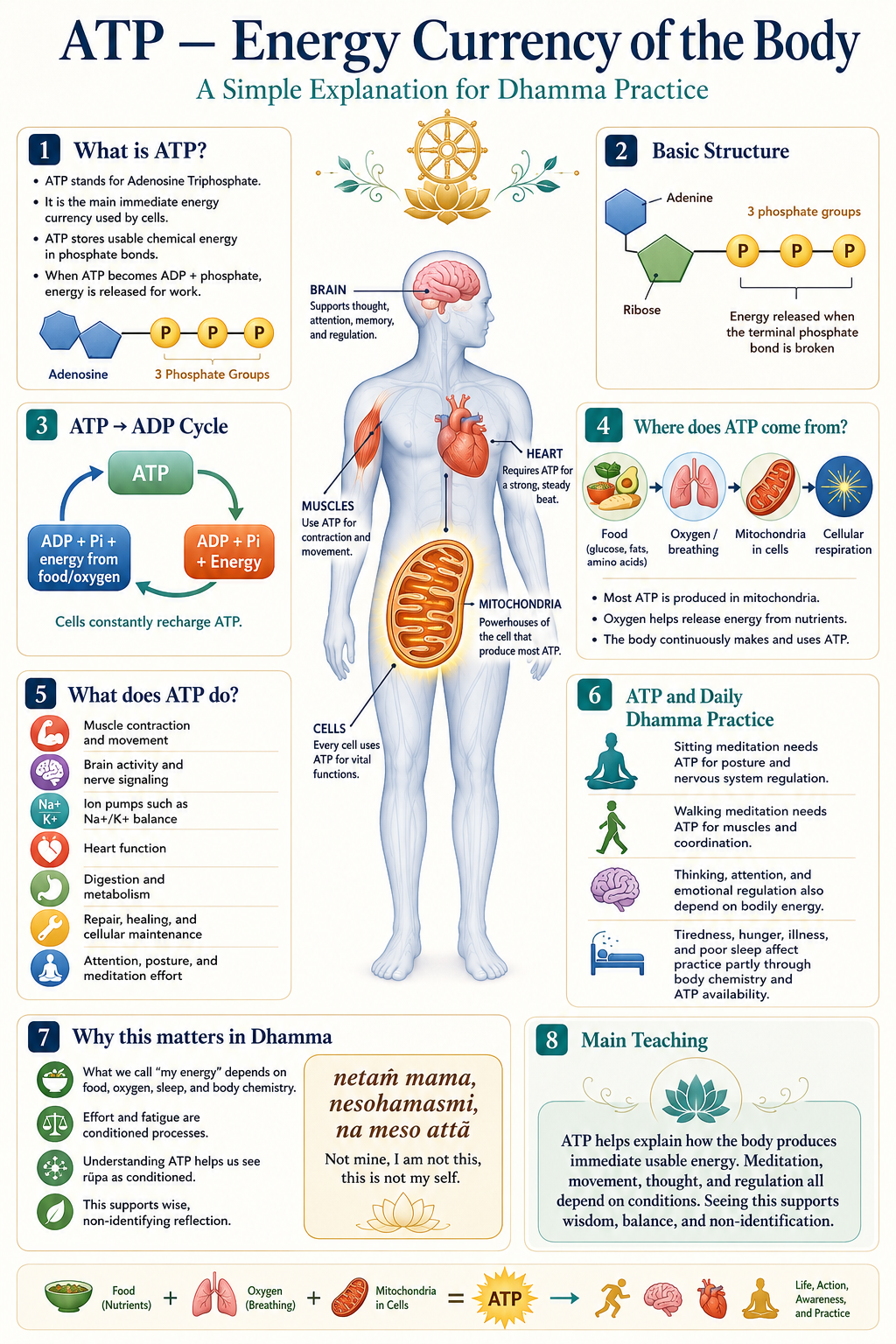
Click infographic to enlarge ↗
This table helps the practitioner see: rūpa is not a single solid thing.
It is countless elements functioning together temporarily.
Let us now look at important groups in the periodic table
Group 1: alkali metals – Examples: Lithium, sodium, potassium
For body practice, sodium and potassium are very important because nerve impulses depend on ion movement.
| Element | Symbol | Body role |
|---|---|---|
| Sodium | Na | fluid balance, nerve signals |
| Potassium | K | nerve signals, heart rhythm |
Dhamma point: Even a thought, emotion, or impulse depends on ion movement.
Therefore “I am angry” is less precise than “anger has arisen due to conditions.”
Group 2: alkaline earth metals Examples: Magnesium, calcium
| Element | Symbol | Body role |
|---|---|---|
| Magnesium | Mg | enzyme support, muscle/nerve regulation |
| Calcium | Ca | bones, muscles, neurotransmitter release |
Dhamma point: Body strength, weakness, calmness, tension, and nerve activity are conditioned and hence Not self.
Nonmetals: the body-building elements – Most living-body chemistry depends heavily on nonmetals.
What is being organic?
| Element | Symbol | Body role |
|---|---|---|
| Carbon | C | backbone of life molecules |
| Hydrogen | H | water and organic molecules |
| Oxygen | O | breathing, water, energy |
| Nitrogen | N | proteins, DNA, neurotransmitters |
| Phosphorus | P | ATP, DNA, cell membranes |
| Sulfur | S | proteins and enzymes |
These are central to organic chemistry.
Dhamma point: This body is not “beautiful” in an ultimate sense. It is carbon, hydrogen, oxygen, nitrogen, phosphorus, sulfur, water, salts, heat, motion, and decay which supports asubha and aniccasaññā contemplation.
Halogens – Examples: Fluorine, chlorine, iodine
| Element | Symbol | Body relevance |
|---|---|---|
| Fluorine | F | teeth and bones in trace use |
| Chlorine | Cl | chloride ion, stomach acid, fluid balance |
| Iodine | I | thyroid hormone production |
Dhamma point: Hunger, digestion, energy, mood, and metabolism are not “my self” and they depend on chemistry.
Transition metals- Examples: Iron, zinc, copper, manganese
| Element | Symbol | Body relevance |
|---|---|---|
| Iron | Fe | oxygen transport in blood |
| Zinc | Zn | enzymes, immunity, hormones |
| Copper | Cu | enzymes, iron handling |
| Manganese | Mn | enzyme support |
Dhamma point: Even energy and alertness depend on tiny trace elements. Pride about “my strength” or despair about “my weakness” should be seen with wisdom.
Why columns matter: valence electrons?
The periodic table is powerful because elements in the same column behave similarly. This is because the outer electrons, called valence electrons, are similar in that group. OpenStax explains that similar chemical properties among elements in the same group occur because they have the same number of valence electrons. Simple example:
| Element | Group | Common behavior |
|---|---|---|
| Sodium | Group 1 | easily becomes Na⁺ |
| Potassium | Group 1 | easily becomes K⁺ |
| Chlorine | Group 17 | commonly becomes Cl⁻ |
| Calcium | Group 2 | commonly becomes Ca²⁺ |
This is very important for the nervous system: Na⁺, K⁺, Ca²⁺, and Cl⁻ are charged particles.
Nerve activity depends on charged particles moving across cell membranes.
Dhamma reflection: Mental events depend on material conditions.
Therefore citta should not build “I am this” around a chemically conditioned event.
The body through periodic-table eyes – Let us look at some daily experiences.
| Experience | Chemistry involved | Dhamma way of seeing |
|---|---|---|
| Breathing | O₂ enters, CO₂ leaves | breath is rūpa-process |
| Hunger | glucose, hormones, stomach acid | vedanā + body chemistry |
| Sexual urge | dopamine, testosterone, oxygen, nerve ions | rāga due to conditions |
| Anger | adrenaline, norepinephrine (naw·reh·pi·neh·fruhn), cortisol, ions | paṭigha due to conditions |
| Calm meditation | breath, GABA, acetylcholine, parasympathetic tone | passaddhi due to conditions |
| Fatigue | ATP, iron, glucose, sleep chemistry | not “I am weak,” but conditions |
| Anxiety | CO₂, adrenaline, cortisol, norepinephrine | bhaya/uddhacca due to conditions |
| Attention | acetylcholine, glucose, oxygen, neural firing | sati depends on conditions too |
This does not reduce Dhamma to chemistry. It helps remove conceit:
I am angry” becomes “anger-condition has arisen.
I am lustful” becomes “rāga-condition has arisen.
I am dull” becomes “dullness-condition has arisen.
I am calm” becomes “calm-condition has arisen.
Then one can practise without self-hatred and without pride.
Periodic table and the four great elements
| Dhamma term | Experiential meaning | Chemistry connection |
|---|---|---|
| Pathavī-dhātu | solidity, hardness, resistance | minerals, bones, tissues, proteins, calcium, phosphorus |
| Āpo-dhātu | cohesion, fluidity | water, blood, lymph, intracellular fluid |
| Tejo-dhātu | heat, temperature, metabolism | ATP, oxidation, body heat, enzyme activity |
| Vāyo-dhātu | motion, pressure, expansion | breathing, gas exchange, nerve impulses, circulation |
Periodic table and neurotransmitters – Neurotransmitters are also molecules made from periodic-table elements.
| Neurotransmitter / hormone | Main atoms involved | Dhamma relevance |
|---|---|---|
| Dopamine | C, H, N, O | rāga, reward, wanting |
| Serotonin | C, H, N, O | mood, impulse balance |
| GABA | C, H, N, O | calming, inhibition |
| Glutamate | C, H, N, O | excitation, learning |
| Norepinephrine | C, H, N, O | alertness, stress |
| Acetylcholine | C, H, N, O | attention, memory |
| Testosterone | C, H, O | sexual drive, energy |
| Cortisol | C, H, O | stress response |
| Oxytocin | C, H, N, O, S | bonding, attachment/care |
This is powerful for contemplation:
A sexual urge depends partly on atoms arranged into molecules.
Anger depends partly on atoms arranged into molecules.
Fear depends partly on atoms arranged into molecules.
Therefore none of these are “I,” “mine,” or “my self.”
What to learn first from the periodic table? For practice, learn these first:
| Priority | Elements |
|---|---|
| Body-building elements | C, H, O, N, P, S |
| Electrolytes / nerve elements | Na, K, Ca, Mg, Cl |
| Blood and energy | Fe, O, C, H |
| Hormone and enzyme trace elements | I, Zn, Cu, Se |
| Bone/body structure | Ca, P, Mg |
| Breath chemistry | O, C, H |
A simple memory line:
CHONPS builds the body.
Na-K-Ca-Mg-Cl moves the nerves.
Fe carries oxygen.
I-Zn-Cu-Se regulate subtle functions.
How to practise Dhamma using periodic-table understanding?
When a strong mental state arises, reflect like this: Sexual urge
This is not “my true need.”
This is body chemistry, dopamine, testosterone, memory, image, vedanā, saññā, and rāga-saṅkhāra.
Netaṁ mama, nesohamasmi, na meso attā.
Practice:
Asubhaṁ bhāvanaṁ bhāvehi. Aniccasaññaṁ bhāvanaṁ bhāvehi.
Anger – This heat, pressure, fast breath, and urge to speak are chemical and bodily conditions.
Norepinephrine/adrenaline/cortisol may be active and hence not self.
Practice:
Upekkhaṁ bhāvanaṁ bhāvehi. Mettaṁ bhāvanaṁ bhāvehi.
Anxiety
Body is in threat chemistry while breath is disturbed. Mind is predicting danger.
Practice:
Pathavīsamaṁ bhāvanaṁ bhāvehi. Passambhayaṁ kāyasaṅkhāraṁ.
Pride
This body, intelligence, energy, voice, memory, status — all depend on elements, molecules, food, oxygen, sleep, and conditions.
Practice: Aniccasaññaṁ bhāvanaṁ bhāvehi.
The Dhamma practitioner’s periodic-table summary
| Periodic-table understanding | Dhamma insight |
|---|---|
| Body is made of elements | rūpaṁ anattā |
| Elements combine into molecules | saṅkhataṁ — conditioned |
| Molecules form cells, hormones, neurotransmitters | paccayā uppajjati — arises by conditions |
| Chemical levels rise and fall | anicca |
| Mental states depend partly on chemistry | vedanā, saññā, saṅkhārā are conditioned |
| Repeated chemical reward builds habit | upādāna / bhava |
| Breath changes body chemistry | kāyasaṅkhāra can be tranquilized |
| Letting go changes habit patterns | paṭinissagga |
How does an atom become an ion?
A normal atom is usually neutral because: number of protons = number of electrons
For example, neutral sodium has: 11 protons and 11 electrons and so total charge = 0
But when an atom loses or gains electrons, it becomes an ion.
Positive ion: If an atom loses electrons, it becomes positively charged and if gains, become negatively charged.
Example: Na → Na⁺ + electron. Sodium loses one electron. Now it has more positive charge than negative charge.
| Ion | Movement | Effect |
|---|---|---|
| Na⁺ | moves into the nerve cell | helps start nerve signal |
| K⁺ | moves out | helps reset nerve signal |
| Ca²⁺ | enters nerve ending | helps release neurotransmitters |
| Cl⁻ | often moves in | can support calming/inhibition |
Teaching infographics — click any preview to enlarge.
Chemistry — elements, molecules and conditioned rūpa
Supporting infographic 3
Open the visual for the complete illustrated explanation.
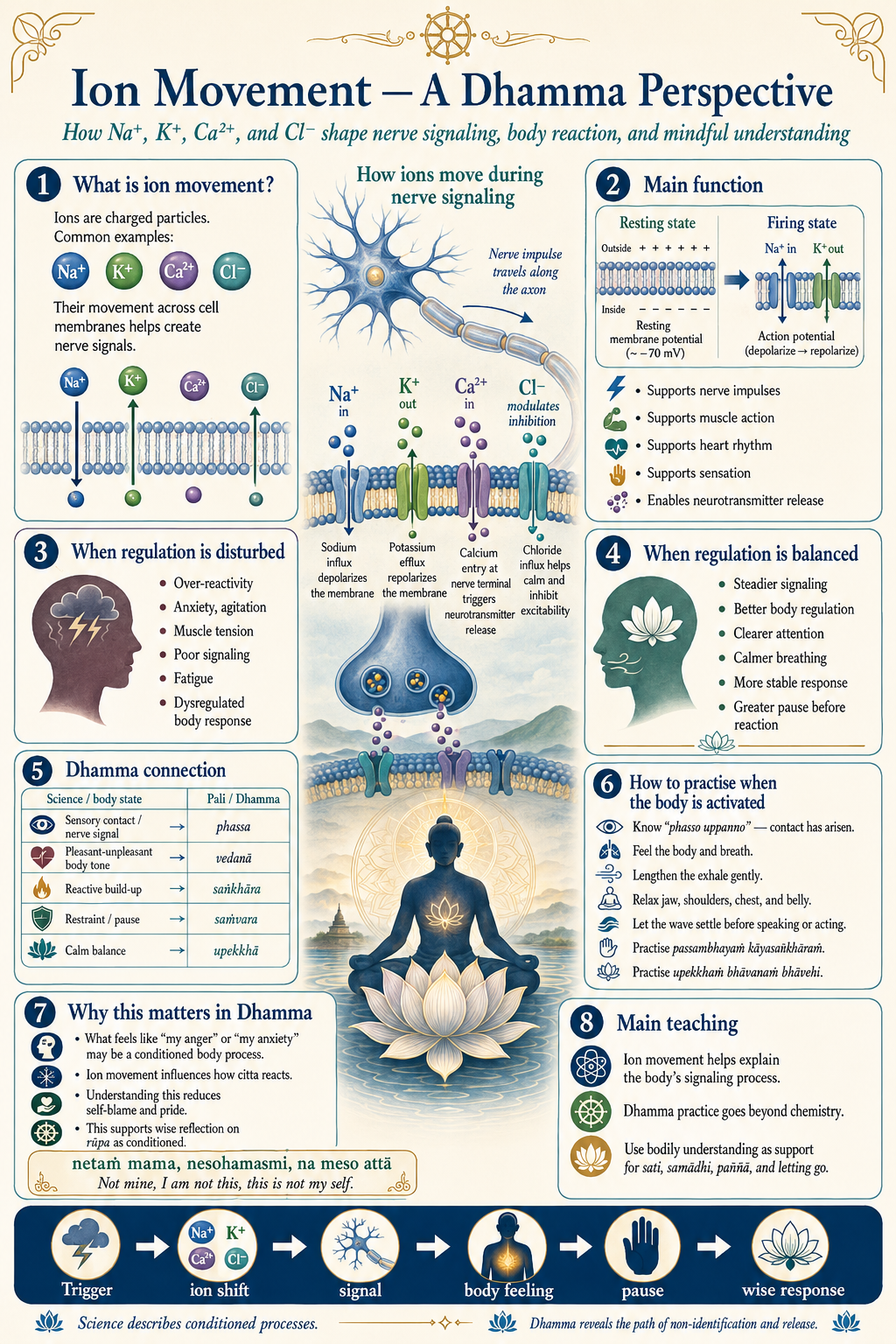
Click infographic to enlarge ↗
Summary of understanding on Organic and Inorganic Chemistry
| Lens | What it explains | Limitation | Dhamma use |
|---|---|---|---|
| Organic chemistry | Carbon-based life molecules: glucose, fats, proteins, hormones, neurotransmitters | It explains body-mind support, but not liberation | Helps see mental states as conditioned, not self |
| Inorganic chemistry | Water, salts, minerals, gases, pH, electrolytes | It explains physical support, but not wisdom | Helps see body as elements and processes |
| Buddha’s teaching | Rūpa, vedanā, saññā, saṅkhārā, viññāṇa; anicca, dukkha, anattā | Not a chemistry textbook | Shows how to stop clinging, craving, and self-view |
One compact Dhamma reflection
This body depends on organic chemistry as in glucose, proteins, lipids, hormones, neurotransmitters.
This body depends on inorganic chemistry as in water, salts, oxygen, minerals, ions, pH balance.
Therefore this body is saṅkhata rūpa — conditioned form.
Whatever is conditioned is changing.
Whatever is changing cannot be held as “I,” “me,” or “mine.”
Yaṁ kiñci rūpaṁ — sabbaṁ rūpaṁ
netaṁ mama, nesohamasmi, na meso attā.
Whatever form there is — all form is not mine, I am not this, this is not my self.
Teaching infographics — click any preview to enlarge.
Chemistry — elements, molecules and conditioned rūpa
Supporting infographic 4
Open the visual for the complete illustrated explanation.
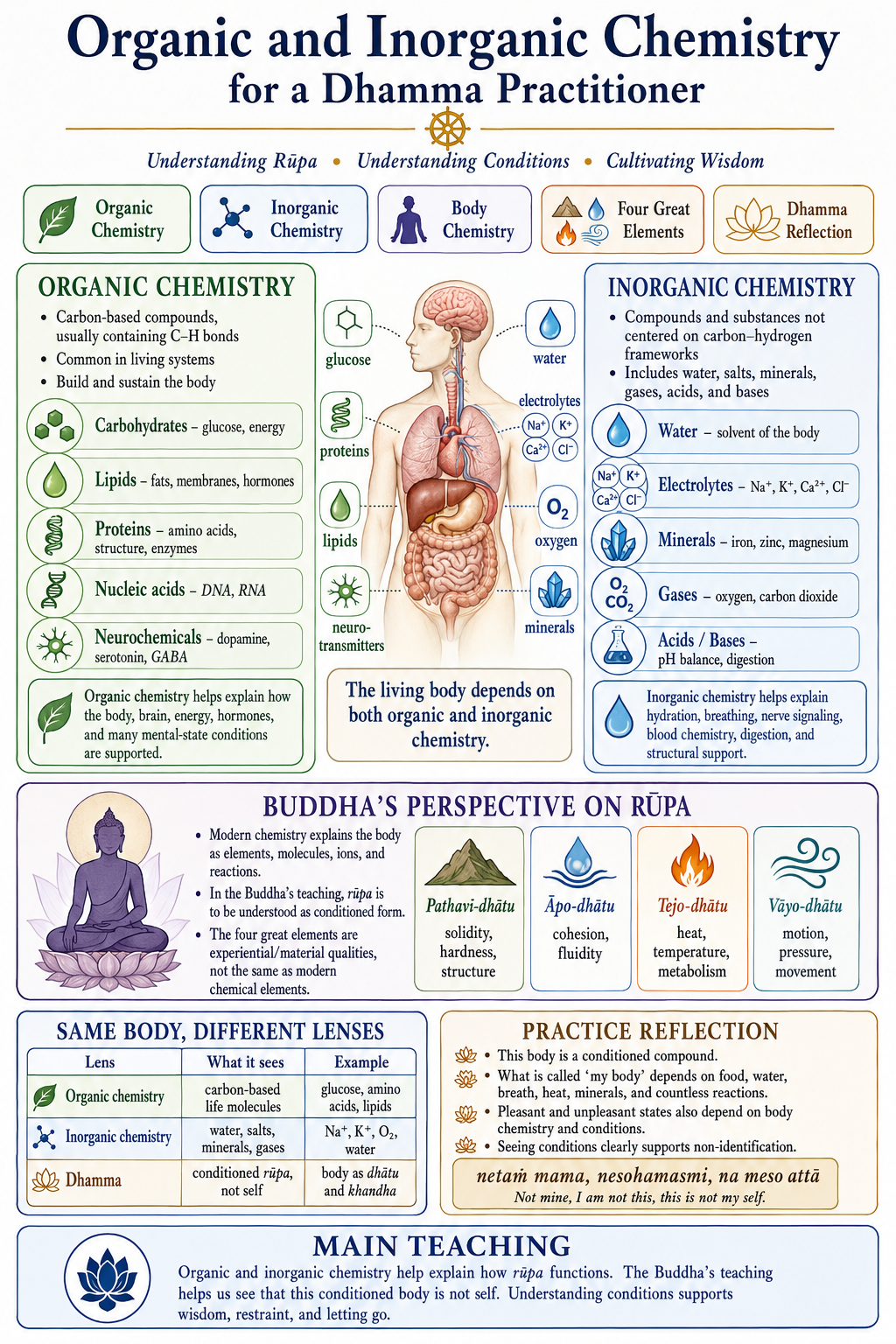
Click infographic to enlarge ↗
| Buddha’s teaching | Pāli / Dhamma term | Meaning in Buddha’s teaching | Organic chemistry connection | Inorganic chemistry connection | Practical Dhamma reflection |
|---|---|---|---|---|---|
| Body is form, not self | rūpaṁ anattā | Body is material form, not “I” or “mine” | Proteins, fats, carbohydrates, DNA, hormones, neurotransmitters | Water, salts, minerals, gases, ions | “This body is chemistry and conditions, not my permanent self.” |
| Whatever form exists should be seen as not mine | yaṁ kiñci rūpaṁ… netaṁ mama, nesohamasmi, na meso attā | All form, internal or external, gross or subtle, should be seen as not mine, not me, not self | Body tissues, brain molecules, sexual hormones, dopamine, serotonin, GABA | Bones, calcium, sodium, potassium, oxygen, carbon dioxide, water | When attachment to body, beauty, strength, health, or sexual urge arises, reflect: “not mine, not me, not self.” |
| Body is made of elements | catasso dhātuyo — four great elements | Body is understood through qualities: solidity, cohesion, heat, motion | Organic compounds form tissues, membranes, enzymes, hormones | Minerals, water, ions, gases support structure and function | “Body is not one solid person; it is elements functioning together.” |
| Solidity / structure | pathavī-dhātu | Hardness, resistance, structure | Proteins, collagen, fats, cell structures | Calcium, phosphorus, magnesium in bones; minerals | Teeth, bones, nails, flesh: not “me,” only structure. |
| Fluidity / cohesion | āpo-dhātu | Binding, cohesion, liquidity | Blood proteins, plasma molecules, cell fluids | Water, electrolytes, blood salts | Saliva, blood, urine, sweat: not disgusting-self or beautiful-self; only fluid condition. |
| Heat / metabolism | tejo-dhātu | Temperature, digestion, aging, metabolism | Glucose metabolism, ATP, enzymes, hormones | Oxygen for energy, minerals as enzyme cofactors | Body heat, digestion, fever, aging are conditioned processes. |
| Motion / pressure | vāyo-dhātu | Movement, expansion, contraction, pressure | Muscle proteins, nerve signaling molecules | Oxygen/CO₂ exchange, ion movement, blood pressure | Breath, heartbeat, gas movement, body pressure: not self. |
| Body depends on food | āhāra-paccaya | Body is sustained by nutriment | Carbohydrates, proteins, fats, vitamins | Water, minerals, salts, oxygen | “Without food, water, and breath, this body cannot stand. How can it be independent self?” |
| Experience arises due to conditions | paccayā uppajjati | Nothing arises by itself; all depends on causes | Neurotransmitters, hormones, enzymes, metabolic pathways | Ions, pH, oxygen, electrolytes, hydration | Anger, lust, calm, fatigue, fear are conditioned; do not identify with them. |
| Contact conditions feeling | phassa-paccayā vedanā | Sense contact gives rise to pleasant, painful, or neutral feeling | Dopamine, serotonin, endorphins influence pleasant feeling and reward | Nerve ions, sensory signaling, oxygen, body chemistry support contact | “Pleasant feeling has arisen due to contact; it is not mine.” |
| Feeling can condition craving | vedanā-paccayā taṇhā | Pleasant feeling can lead to craving if not seen wisely | Dopamine reward loop, sexual hormones, endorphin relief | Body arousal, electrolytes, stress chemistry | When pleasure arises, know it before it becomes rāga. |
| Mental formations are conditioned | saṅkhārā paccayā | Reactions, urges, habits, intentions are conditioned | Habit learning through dopamine, glutamate, cortisol, serotonin systems | Nerve firing depends on sodium, potassium, calcium, chloride | “This urge is a saṅkhāra, not ‘my true self.’” |
| Sexual urge is conditioned | rāga | The mind colors an object as attractive and desirable | Testosterone, dopamine, oxytocin, endorphins, sexual hormones | Body heat, blood flow, nerve ions, hydration | Practise asubha, virāga, anicca, and indriyasaṁvara. |
| Anger is conditioned | byāpāda / paṭigha | Ill will and resistance arise due to conditions | Stress chemistry, cortisol, norepinephrine, adrenaline | Fast breathing, CO₂ changes, muscle tension, ion signaling | Practise mettā, upekkhā, and calming the breath. |
| Fear is conditioned | bhaya / uddhacca | Fear and restlessness arise dependent on perception and body state | Cortisol, norepinephrine, adrenaline | Oxygen/CO₂ balance, heart rate, sweating, body pressure | Practise ānāpānassati, pathavīsamaṁ, and grounding in body. |
| Calm is conditioned too | passaddhi / samādhi | Calm and collectedness arise due to proper conditions | GABA, serotonin balance, acetylcholine attention, endorphin ease | Slow breathing, parasympathetic tone, oxygen balance | Do not cling to calm: “This too is conditioned.” |
| Perception labels the world | saññā | The mind marks: beautiful, ugly, mine, enemy, success, failure | Memory molecules, neural learning, dopamine salience | Sense organs, nerve impulses, sensory chemistry | “The label is not ultimate truth; saññā is conditioned.” |
| Identity is constructed | asmimāna | “I am” conceit forms around body, feeling, perception, thought, consciousness | Self-story involves brain chemistry, hormones, memory, reward | Body states influence identity: fatigue, pain, arousal, stress | Practise aniccasaññā: this body-mind process is changing. |
| All conditioned things are impermanent | sabbe saṅkhārā aniccā | Whatever is constructed changes | Organic molecules are built, used, broken down | Water balance, ions, gases, minerals constantly change | “This urge, anger, pleasure, body, and thought are changing.” |
| What is impermanent is unsatisfactory | yadaniccaṁ taṁ dukkhaṁ | What changes cannot give permanent satisfaction | Pleasure chemicals rise and fall | Body comfort depends on unstable conditions | Chasing chemical pleasure cannot end dukkha. |
| What is impermanent and unsatisfactory is not self | yaṁ dukkhaṁ tadanattā | The changing body-mind cannot be owned as self | Cells, hormones, neurotransmitters, DNA expression change | Breath, water, minerals, temperature, pressure change | “Since it changes and depends on conditions, it is not me.” |
| The body should be contemplated as unattractive | asubhaṁ bhāvanaṁ bhāvehi | To remove rāga by seeing the body realistically | Flesh, fat, blood proteins, mucus, hormones, tissues | Saliva, urine, sweat, minerals, gases, excretions | Body is not to be hated, but de-glamorized. |
| Breath calms bodily formation | passambhayaṁ kāyasaṅkhāraṁ | Breathing practice tranquilizes body activity | Calms stress chemistry and arousal patterns | CO₂/O₂ balance, heart rate, parasympathetic regulation | Use breath when anger, fear, lust, or anxiety rises. |
| Letting go is the final medicine | paṭinissagga | Relinquishment, non-holding, non-feeding | Weakens dopamine-based craving and habit reinforcement | Reduces stress arousal and body agitation | “I do not need to feed this pattern.” |
Teaching infographics — click any preview to enlarge.
Chemistry — elements, molecules and conditioned rūpa
Supporting infographic 5
Open the visual for the complete illustrated explanation.
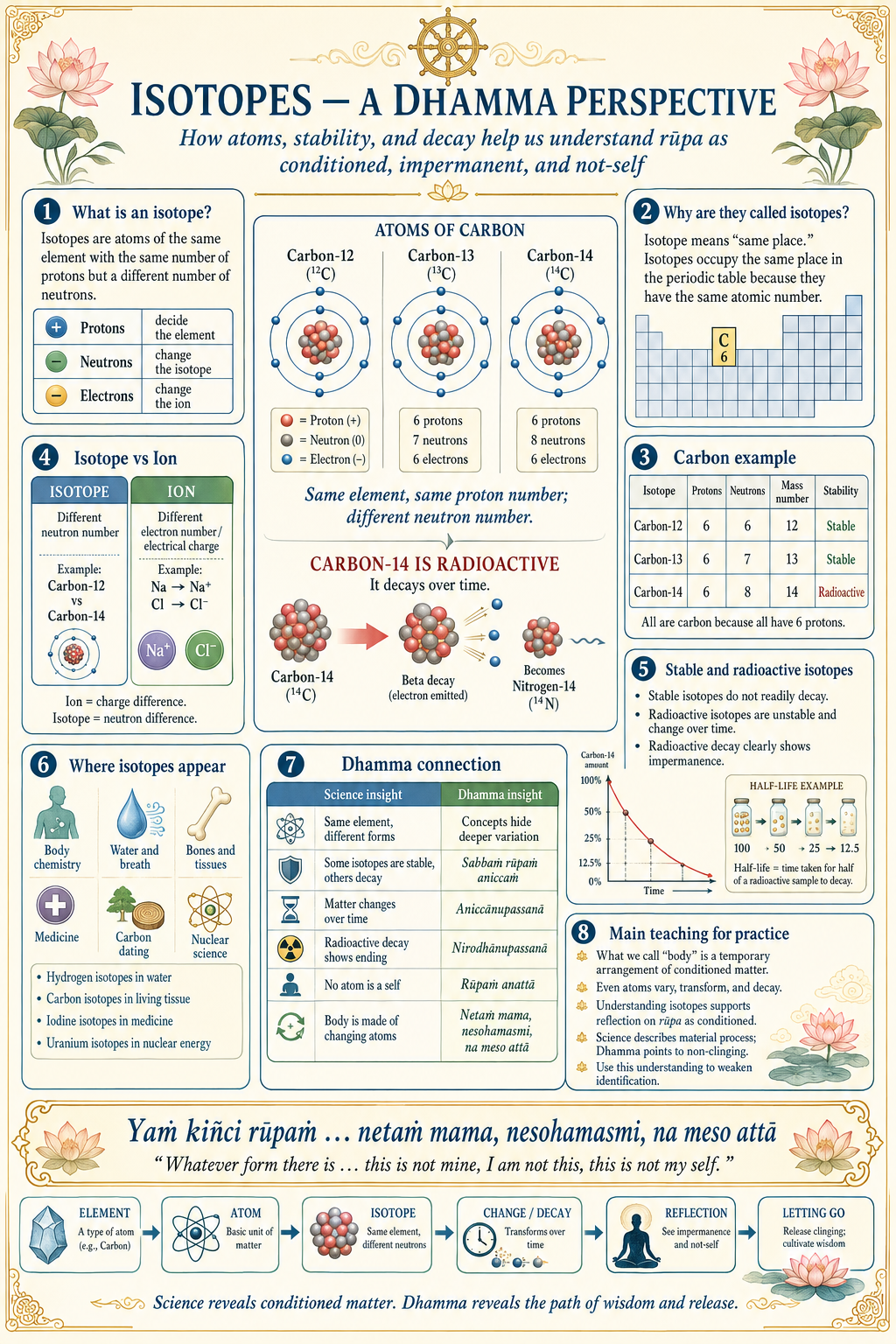
Click infographic to enlarge ↗
What is isotope?
Isotope means, atoms of the same element having the same number of protons but a different number of neutrons. The number of protons decides the element.
| Element | Protons | Element identity |
|---|---|---|
| Hydrogen | 1 | always hydrogen |
| Carbon | 6 | always carbon |
| Oxygen | 8 | always oxygen |
| Uranium | 92 | always uranium |
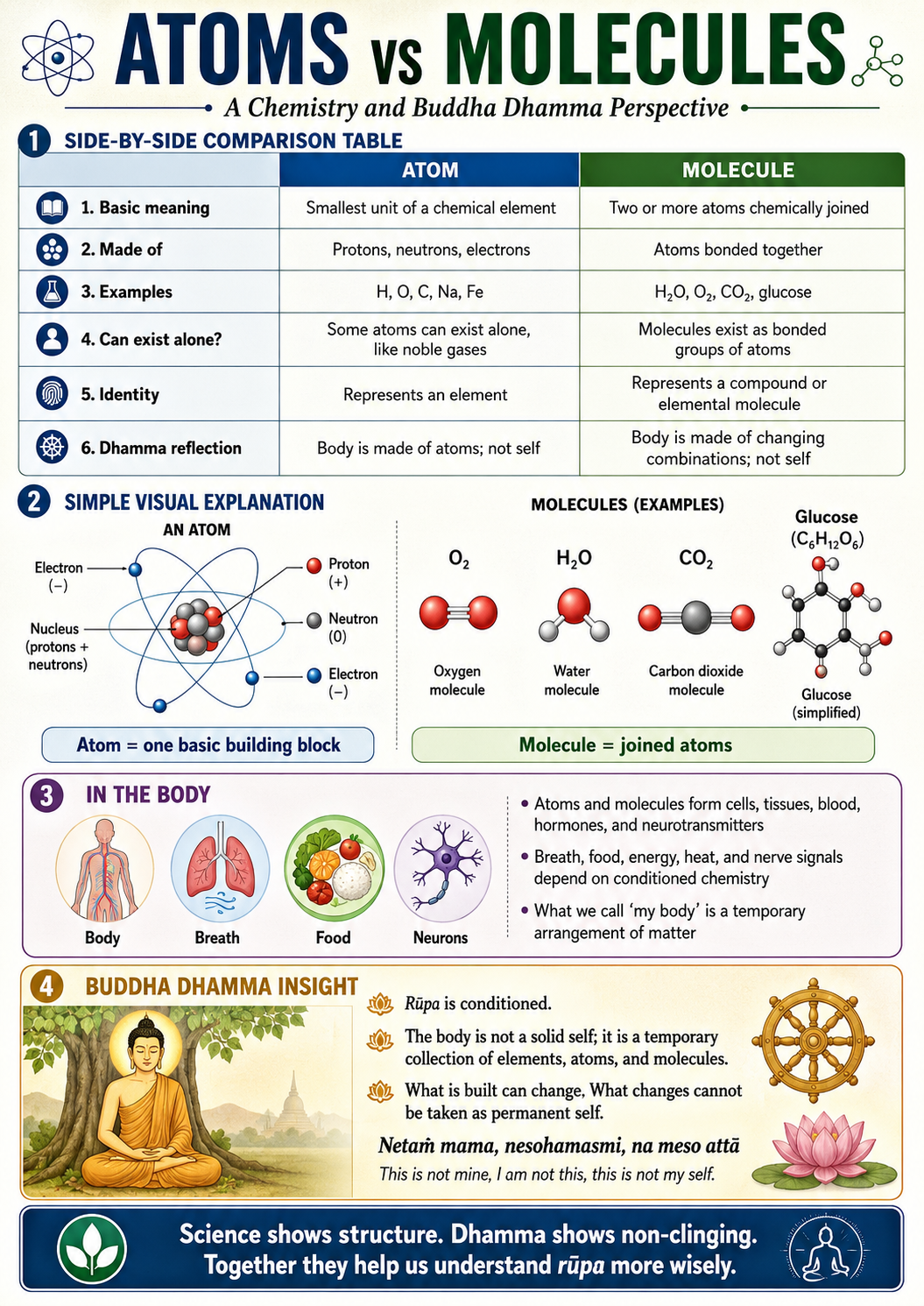
Difference between atoms and molecules
Teaching infographics — click any preview to enlarge.
Chemistry — elements, molecules and conditioned rūpa
Supporting infographic 6
Open the visual for the complete illustrated explanation.
Click infographic to enlarge ↗
| Aspect | Atom | Molecule |
|---|---|---|
| Basic meaning | Smallest unit of a chemical element | Two or more atoms chemically joined |
| Made of | Protons, neutrons, electrons | Atoms bonded together |
| Example | H, O, C, Na, Fe | H₂O, O₂, CO₂, glucose |
| Can exist alone? | Some atoms can exist alone, like noble gases | Molecules exist as bonded groups of atoms |
| Identity | Represents an element | Represents a compound or elemental molecule |
| Dhamma reflection | Body is made of atoms; not self | Body is also made of changing combinations; not self |
Very simple analogy – Think of atoms like letters and molecules are like words.
| Analogy | Chemistry |
|---|---|
| Letter | Atom |
| Word | Molecule |
| Sentence | Larger biological structure |
03 Physics & Maths — conditionality, change and structure
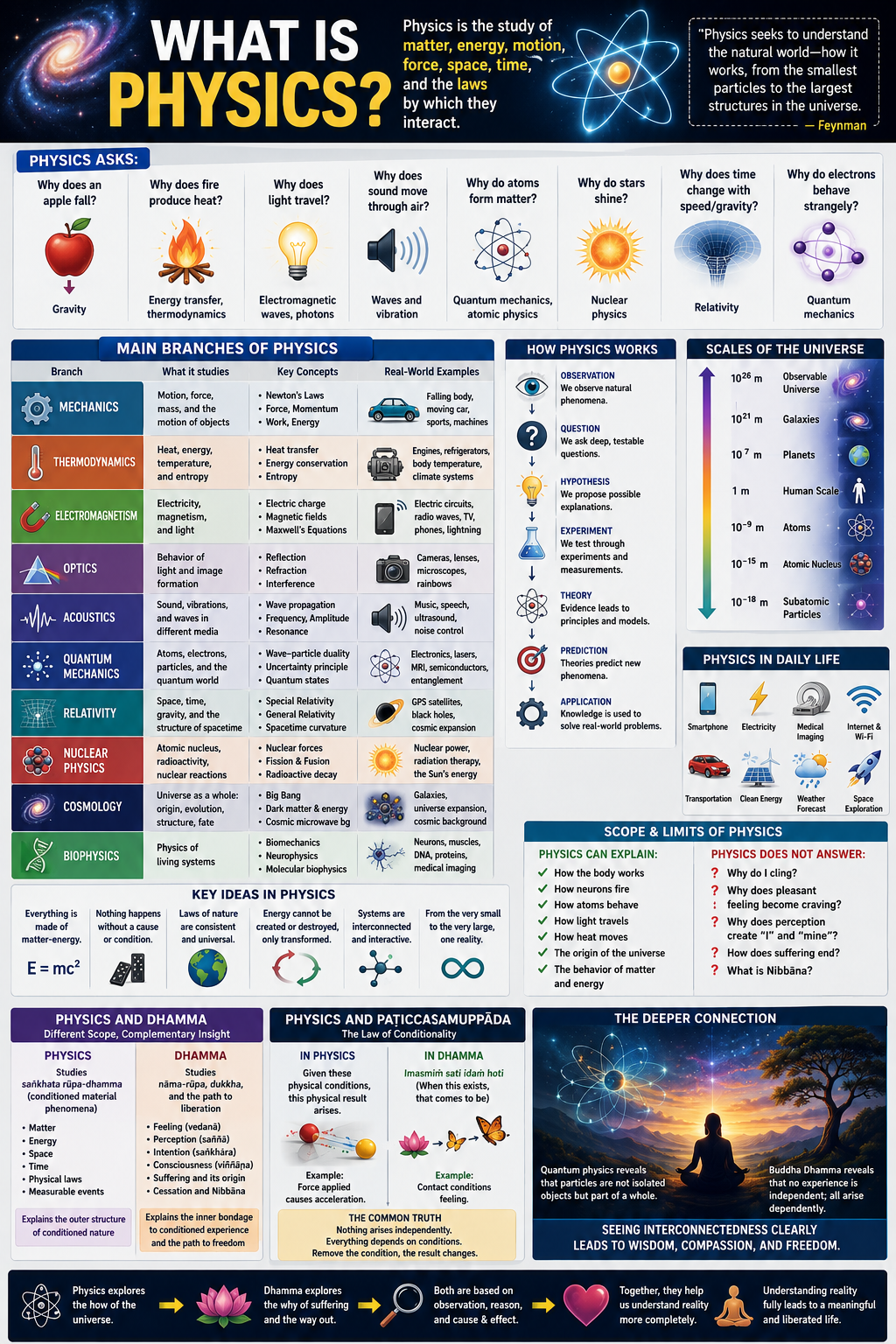
Definition of Physics: Physics is the study of how the material universe behaves. The word comes from Greek physis, meaning nature. So physics originally means the study of nature and natural processes.
In simple terms, Physics studies matter, energy, motion, force, space, time, fields, waves, particles, and the laws by which they interact.
What physics investigates?
| Question | Physics studies |
|---|---|
| Why does an apple fall? | Gravity |
| Why does fire produce heat? | Energy transfer, thermodynamics |
| Why does light travel? | Electromagnetic waves, photons |
| Why does sound move through air? | Waves and vibration |
| Why do atoms form matter? | Quantum mechanics, atomic physics |
| Why do stars shine? | Nuclear physics |
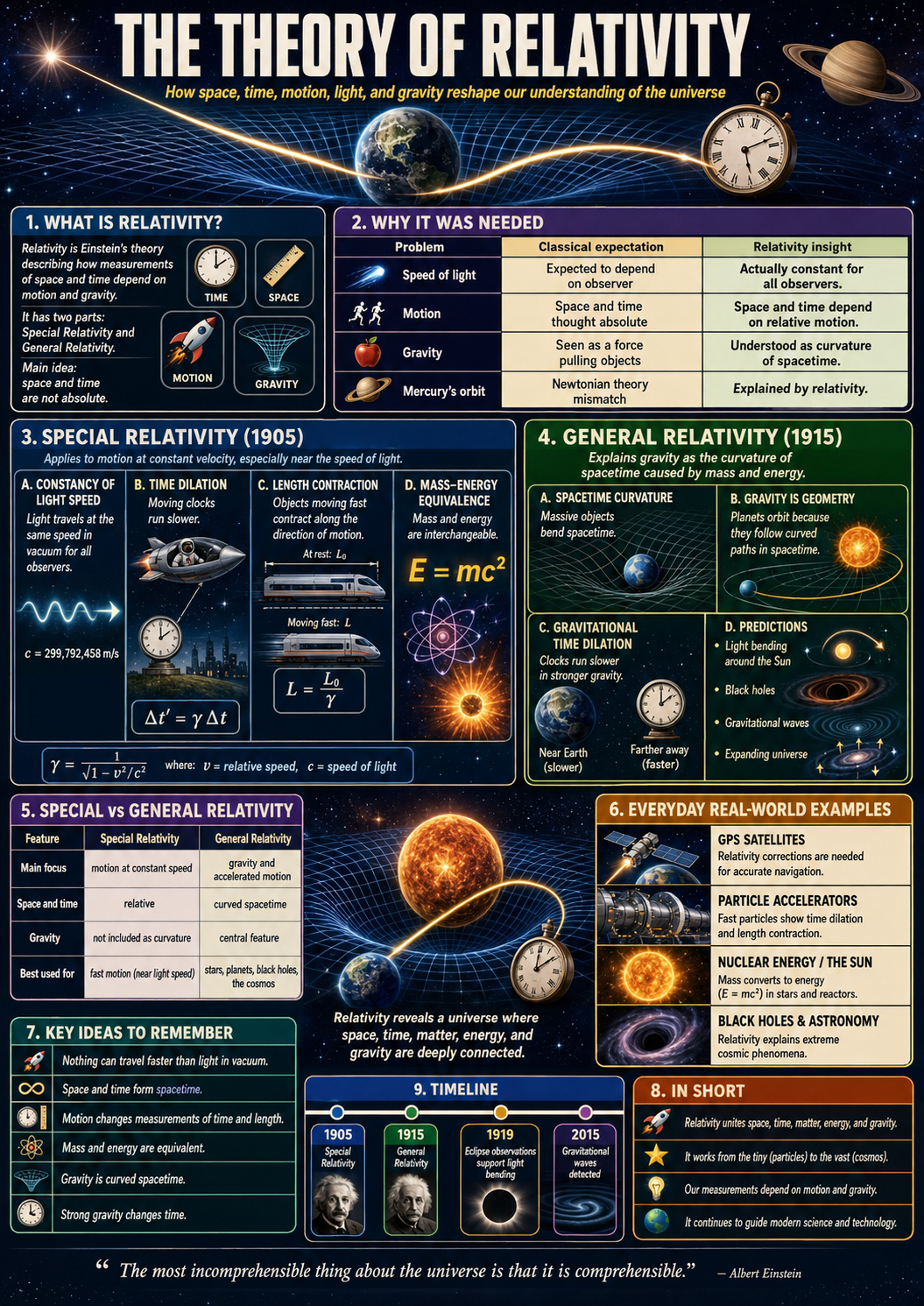
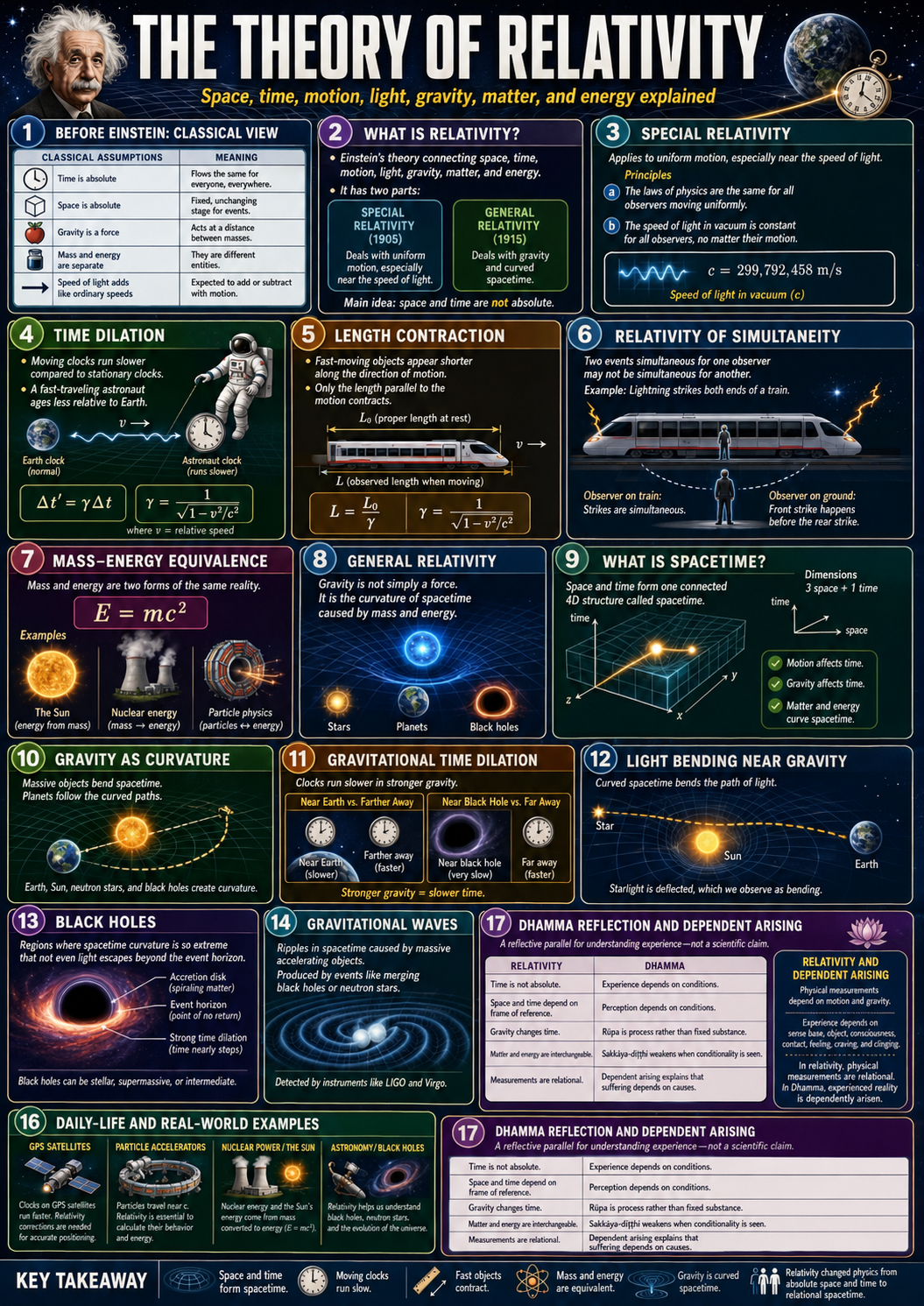
| Why does time change with speed/gravity? | Relativity |
| Why do electrons behave strangely? | Quantum mechanics |
Main areas of physics
| Branch | What it studies | Example |
|---|---|---|
| Mechanics | Motion, force, mass | Falling body, moving car |
| Thermodynamics | Heat, energy, entropy | Fire, body temperature, engine |
| Electromagnetism | Electricity, magnetism, light | Lightning, phone signal, vision |
| Optics | Light and image formation | Eye, lens, mirror |
| Acoustics | Sound and vibration | Voice, music, hearing |
| Quantum mechanics | Atoms, electrons, particles | Electron orbitals, entanglement |
| Relativity | Space, time, gravity | Black holes, time dilation |
| Nuclear physics | Atomic nucleus | Sunlight, radiation |
| Cosmology | Universe as a whole | Galaxies, cosmic expansion |
| Biophysics | Physics of living systems | Neurons, muscles, DNA folding |
Physics and Dhamma
| Physics | Dhamma |
|---|---|
| Studies matter-energy | Studies nāma-rūpa and dukkha |
| Looks for laws of nature | Looks at paṭiccasamuppāda |
| Explains physical events | Explains experience and suffering |
| Deals with conditioned reality | Shows conditioned and unconditioned |
| Uses measurement and mathematics | Uses direct observation, sīla, samādhi, paññā |
| Can explain the body and universe | Can explain bondage and liberation |
Physics and paṭiccasamuppāda
Physics: Given these physical conditions, this physical result arises.
Dhamma:
Imasmiṁ sati idaṁ hoti
When this exists, this comes to be.
Imassuppādā idaṁ uppajjati
With the arising of this, this arises.
So both reject randomness without condition. Both reject independent arising.
But their scope is different.
| Level | Physics example | Dhamma example |
|---|---|---|
| Physical condition | Heat causes expansion | Contact conditions feeling |
| Physical dependency | Gravity affects motion | Ignorance conditions saṅkhāra |
| Physical change | Energy transforms | Vedanā can condition taṇhā |
| Physical cessation | Remove fuel, fire stops | Remove craving, suffering stops |
Teaching infographics — click any preview to enlarge.
Physics & Maths — conditionality, change and structure
Supporting infographic 1
Open the visual for the complete illustrated explanation.
Click infographic to enlarge ↗
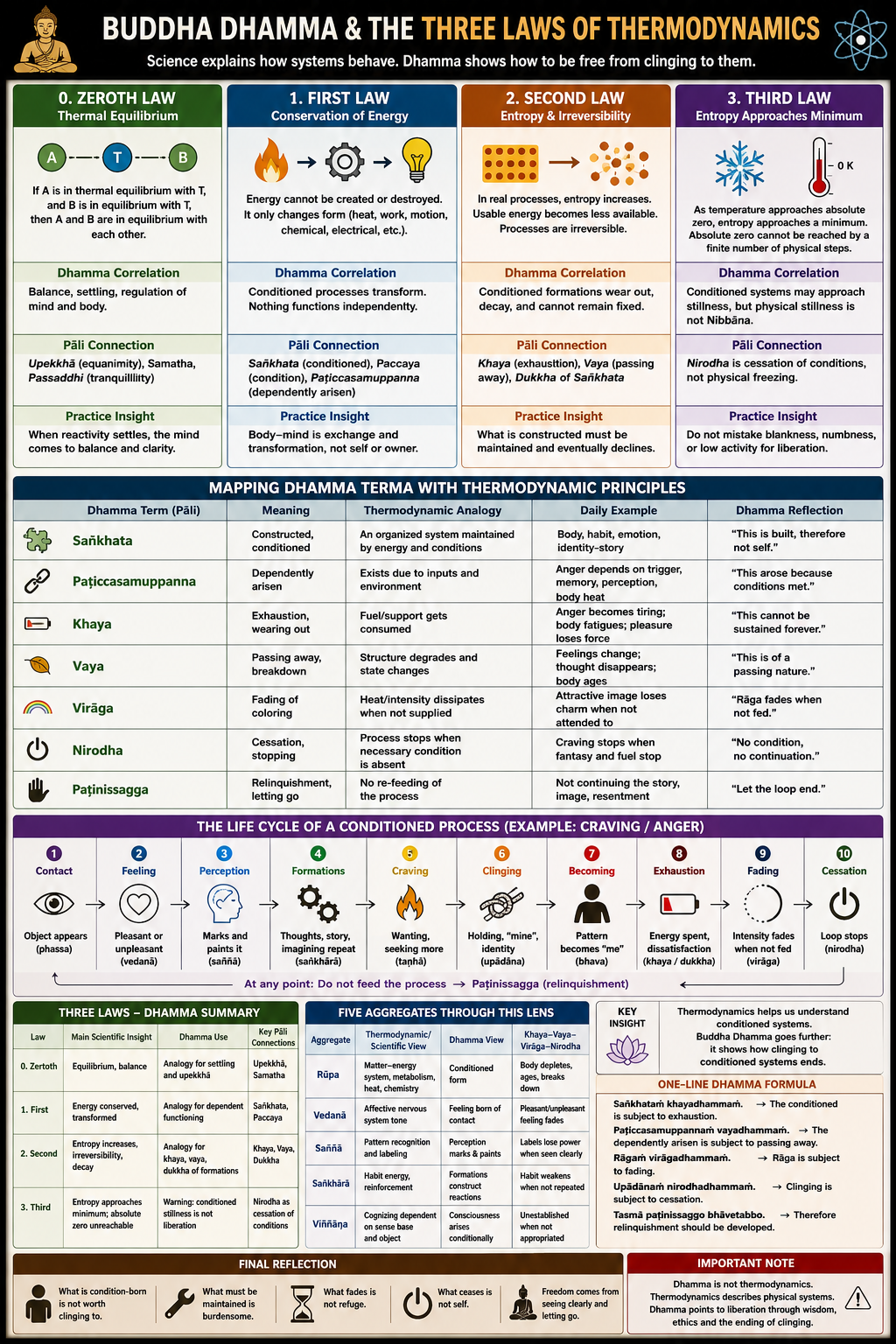
Let us look at Law at Thermodynamics along with what Buddha says about paticcasamutpanna as there is lot of correlation between the two.
| Dhamma term | Thermodynamic analogy | Correct practice meaning |
|---|---|---|
| Saṅkhata | system organized by conditions | what is built is not self |
| Paṭiccasamuppanna | state depends on inputs and environment | with conditions, this arises |
| Khaya | fuel/support is exhausted | anger, craving, body, and pleasure wear out |
| Vaya | structure/state passes away | what arises cannot remain |
| Virāga | heat/intensity/coloring dissipates when not fed | rāga fades when fuel is removed |
| Nirodha | process stops when necessary conditions are absent | craving/clinging cease when causes cease |
| Asaṅkhata | no exact thermodynamic equivalent | Nibbāna is not a physical state or entropy condition |
Thermodynamic law and paticcasamutpanna
| Law of thermodynamics | Scientific meaning | Dhamma correlation | Pāli | Practice insight |
|---|---|---|---|---|
| Zeroth Law | If systems are in thermal equilibrium with a third system, they are in equilibrium with each other | Balance, settling, regulation | upekkhā, samatha, passaddhi | The mind learns balance when reactivity settles |
| First Law | Energy is conserved; it changes form through heat, work, metabolism, movement | Conditioned processes transform; nothing functions independently | saṅkhata, paccaya, paṭiccasamuppanna | Body-mind is exchange and transformation, not self |
| Second Law | Entropy increases in real irreversible processes; usable energy becomes less available | Conditioned formations wear out, decay, and cannot remain fixed | khaya, vaya, dukkha of saṅkhata | What is constructed must be maintained and eventually declines |
| Third Law | As absolute zero is approached, entropy approaches a minimum; absolute zero is physically unattainable by finite steps | Conditioned systems may approach stillness, but physical stillness is not Nibbāna | nirodha as cessation of conditions, not physical freezing | Do not mistake extreme calm, blankness, or low activity for liberation |
Teaching infographics — click any preview to enlarge.
Physics & Maths — conditionality, change and structure
Supporting infographic 2
Open the visual for the complete illustrated explanation.

Click infographic to enlarge ↗
Final synthesis
| Law | Main insight | Dhamma use |
|---|---|---|
| Zeroth | equilibrium / balance | analogy for settling and upekkhā |
| First | transformation / conservation | analogy for dependent functioning |
| Second | irreversibility / entropy / decay | analogy for khaya, vaya, dukkha of formations |
| Third | absolute-zero limit / minimal entropy | warning: conditioned stillness is not liberation |
Practice table
| Meditative observation | Thermodynamic reflection | Dhamma reflection | Practical instruction |
|---|---|---|---|
| Breath arises and ceases | air exchange and body regulation | kāyasaṅkhāra is conditioned | know breath, calm body |
| Body heat changes | metabolism and heat transfer | tejo-dhātu changes | do not identify with heat/cold |
| Pleasant calm appears | temporary ordered state | pleasant vedanā is conditioned | enjoy without clinging |
| Pleasant calm fades | state cannot be frozen | vaya-dhamma | see passing away |
| Craving weakens when unfed | reward loop loses fuel | virāga | withdraw attention from fantasy |
| Thought ends | neural activation decays | nirodha of thought | notice endings clearly |
| Identity story weakens | self-loop loses reinforcement | asmimāna fades | practise “not mine” |
| Letting go happens | loop not maintained | paṭinissagga | do not restart the process |
Teaching infographics — click any preview to enlarge.
Physics & Maths — conditionality, change and structure
Supporting infographic 3
Open the visual for the complete illustrated explanation.
Click infographic to enlarge ↗
Physics & Maths — conditionality, change and structure
Supporting infographic 4
Open the visual for the complete illustrated explanation.

Click infographic to enlarge ↗
Physics & Maths — conditionality, change and structure
Supporting infographic 5
Open the visual for the complete illustrated explanation.
Click infographic to enlarge ↗
Physics & Maths — conditionality, change and structure
Supporting infographic 6
Open the visual for the complete illustrated explanation.
Click infographic to enlarge ↗
Quantum Mechanics
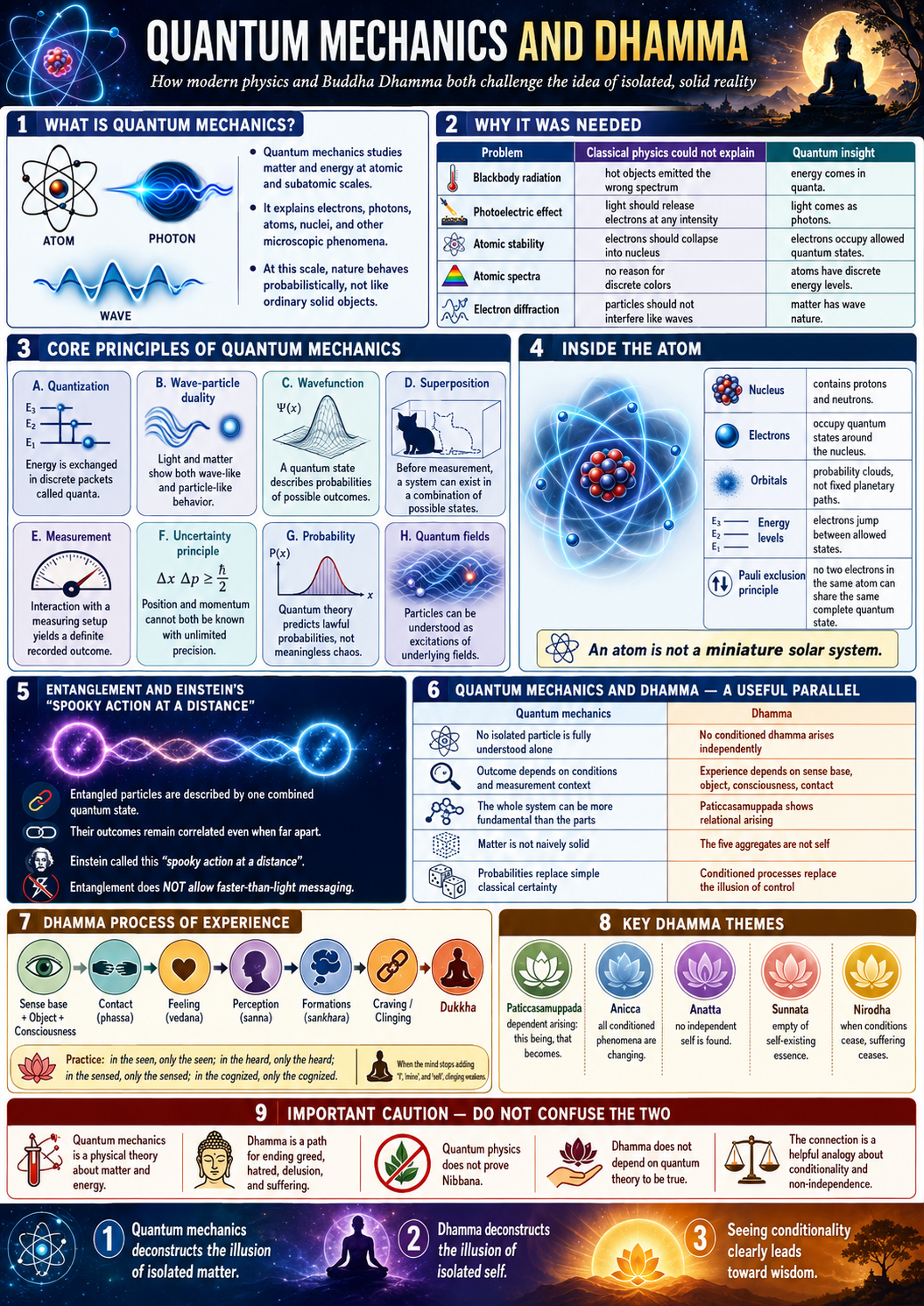
Quantum mechanics is the branch of physics that studies how matter and energy behave at very small scales: atoms, electrons, photons, nuclei, and subatomic particles.
Classical physics works well for ordinary objects: stones, cars, planets, water, heat, sound. But when scientists studied light, atoms, electrons, and radiation, classical physics could not explain what was happening. Quantum mechanics arose because nature at the smallest scale behaves in a way that is not like ordinary common-sense objects.
The word quantum means a discrete packet or measured amount. So quantum mechanics studies the behavior of energy and matter when they appear in tiny packets and probabilistic states rather than as smooth, solid, predictable objects.
Quantum mechanics shows that physical phenomena are not fully understandable as isolated, self-existing units.
Buddha Dhamma says that all conditioned phenomena arise dependently, not independently.
Classical view vs quantum view
| Classical physics | Quantum mechanics |
|---|---|
| Objects have definite position and speed | Particles are described by probabilities |
| Matter is like tiny solid balls | Matter behaves sometimes like particles, sometimes like waves |
| Energy can vary continuously | Energy is often exchanged in discrete packets |
| Observation simply reveals what is already there | Measurement participates in defining the observed result |
| The whole can be understood by separating parts | Some systems must be understood as one combined state |
| Reality is deterministic in principle | Reality is probabilistic at the quantum level |
Why quantum mechanics was needed? Scientists discovered several problems that classical physics could not explain.
| Problem | What classical physics could not explain | Quantum solution |
|---|---|---|
| Blackbody radiation | Why hot objects emit light in a specific spectrum | Energy is emitted/absorbed in packets: quanta |
| Photoelectric effect | Why light knocks electrons out of metal only above a certain frequency | Light comes as photons with energy depending on frequency |
| Atomic stability | Why electrons do not simply spiral into the nucleus | Electrons occupy allowed quantum states |
| Atomic spectra | Why atoms emit specific colors | Electrons jump between discrete energy levels |
| Electron diffraction | Why electrons form wave-like interference patterns | Particles have wave-like nature |
| Entanglement | Why separated particles show deep correlations | Combined quantum state can be more fundamental than separate parts |
The first key idea: energy comes in quanta – In ordinary life, we think energy can be increased smoothly: a little more heat, a little more light, a little more sound. But at atomic scale, energy is often exchanged in specific packets. Example:
| Situation | Quantum meaning |
|---|---|
| Atom absorbs light | It absorbs a photon of a specific energy |
| Electron moves to higher energy level | It does not take any random energy; it takes the required amount |
| Atom emits light | Electron drops to lower level and releases a photon |
| Color of light | Depends on the photon’s energy |
So an atom is not like a staircase ramp. It is more like steps.
You can stand on step 1, step 2, step 3 and cannot stand halfway between steps as a stable energy state. This is why atoms emit specific colors and each color corresponds to a particular energy difference.
The photon: light as particle and wave Light behaves like a wave in some experiments and like particles in others.
| Experiment | Light behaves like |
|---|---|
| Interference | Wave |
| Diffraction | Wave |
| Reflection/refraction | Wave description useful |
| Photoelectric effect | Particle-like photons |
| Detection on a screen | Individual photon events |
A photon is a quantum of light. It has no rest mass, travels at the speed of light in vacuum, and carries energy and momentum. But we should not imagine a photon as a tiny glowing marble. It is better to say: A photon is a quantum excitation of the electromagnetic field. For practical understanding: Light spreads like a wave, but when detected, it appears as individual energy packets.
Matter also has wave nature Quantum mechanics does not say only light has wave nature. Electrons also behave like waves. This is very strange because we usually imagine electrons as tiny particles orbiting the nucleus like planets around the sun. That is not correct. An electron in an atom is better understood as a quantum state or probability distribution around the nucleus.
The wavefunction The wavefunction is the mathematical description of a quantum system. It does not directly show a physical wave like water. Instead, it gives the probability structure of possible measurement outcomes. When we square the wavefunction’s amplitude, we get probabilities.
So for an electron: The wavefunction tells us where the electron is likely to be found if we measure its position.
Before measurement, quantum mechanics does not describe the electron as having one ordinary definite position in the classical sense.
Superposition – Superposition means a quantum system can be described as a combination of possible states before measurement.
For example, an electron’s spin may be in a superposition of “up” and “down” relative to a measuring direction. This does not mean the electron is confused. It means the quantum state is not one fixed classical alternative before measurement.
Example: A coin spinning in the air is not a perfect analogy, because a classical coin has a definite physical state even if we do not know it. Quantum superposition is deeper. It is not merely “we do not know.” It is that the system itself is not described as having a single classical property before measurement.
Measurement – Measurement is one of the most subtle parts of quantum mechanics. In daily life, measurement seems passive. If I measure a table, I discover its length. The table already had that length. But in quantum mechanics, measurement is an interaction between the system and the measuring apparatus. The result depends on what is measured and how it is measured.
Uncertainty principle – The uncertainty principle says there are limits to how precisely certain pairs of properties can be known together. The most famous pair is:
| Pair | Meaning |
|---|---|
| Position | Where the particle is |
| Momentum | How much motion it has |
Probability, not chaos – Quantum mechanics is probabilistic, but not random in a meaningless way. It gives very precise probabilities.
| Not quantum mechanics | Quantum mechanics |
|---|---|
| Anything can happen without cause | Outcomes follow lawful probability rules |
| Pure chaos | Structured uncertainty |
| No order | Deep mathematical order |
| No cause and effect | Conditional probability and lawful evolution |
So quantum mechanics does not destroy causality completely. Rather, it changes our understanding of causality at the smallest scale. The evolution of the wavefunction is orderly, but individual measurement outcomes may be probabilistic.
The atom in quantum mechanics An atom has:
| Component | Role |
|---|---|
| Nucleus | Contains protons and neutrons |
| Protons | Positive charge |
| Neutrons | Neutral particles in nucleus |
| Electrons | Negative charge, described by quantum states |
| Orbitals | Probability distributions for electrons |
| Energy levels | Allowed electron states |
Electrons do not simply move around like planets. They occupy quantum states. Each electron state has quantum numbers.
| Quantum number | Meaning |
|---|---|
| Principal quantum number | Energy level / shell |
| Angular momentum quantum number | Shape of orbital |
| Magnetic quantum number | Orientation of orbital |
| Spin quantum number | Intrinsic spin state |
No two electrons in the same atom can have the exact same complete quantum state. This is the Pauli exclusion principle. That principle is why matter has structure. Without it, atoms and chemistry would not exist in the way we know them.
Entanglement – Entanglement means two or more particles are described by one combined quantum state, such that the state of each part cannot be fully described independently.
Example: Two particles are prepared so that their total spin is fixed. Later, they move far apart. When one is measured, the result is correlated with the other.
| Ordinary view | Entangled view |
|---|---|
| Each particle has its own separate complete state | The pair has one combined state |
| Distance should make them independent | Correlations remain |
| One particle “knows” the other | Better: the system was never fully separable |
| This allows faster-than-light messaging | No, it does not allow controllable faster-than-light communication |
This is where Einstein objected and called it “spooky action at a distance.” He did not like the idea that quantum mechanics seemed to challenge local realism. But experiments have repeatedly supported quantum predictions.
Important correction:
Entanglement is not telepathy.
It is not consciousness.
It is not ordinary communication.
It is non-classical correlation in a shared quantum state.
Quantum fields Modern physics goes deeper than “particles.” According to quantum field theory, what we call particles are excitations of underlying fields.
| Particle | Field excitation |
|---|---|
| Photon | Electromagnetic field |
| Electron | Electron field |
| Quark | Quark field |
| Gluon | Gluon field |
So a particle is not like a tiny permanent object. It is more like a localized excitation of a field.which again weakens the idea of solid independent things.
What quantum mechanics teaches philosophically? Quantum mechanics challenges several assumptions.
| Assumption | Quantum challenge |
|---|---|
| Matter is solid | Matter is mostly structured fields and probabilities |
| Objects have fixed properties independent of context | Some properties depend on measurement context |
| Whole is just sum of parts | Entangled whole can be more fundamental |
| Nature is fully predictable in classical terms | Only probabilities may be predicted |
| Observation is always passive | Measurement is an interaction |
| Separation means independence | Entanglement challenges simple separability |
This is why quantum mechanics feels close to Dhamma. It breaks the naive view of reality.
But we must be careful. Quantum mechanics is about rūpa, material phenomena. Dhamma is about dukkha, its arising, its cessation, and the path.
Quantum Mechanics and Dhamma can be conneted carefully.
Quantum mechanics and paṭiccasamuppāda
The Buddha’s classical formula:
Imasmiṁ sati idaṁ hoti
When this exists, that comes to be.
Imassuppādā idaṁ uppajjati
With the arising of this, that arises.
Imasmiṁ asati idaṁ na hoti
When this does not exist, that does not come to be.
Imassa nirodhā idaṁ nirujjhati
With the cessation of this, that ceases.
Quantum mechanics also shows that events are condition-dependent.
| Quantum mechanics | Dhamma |
|---|---|
| Outcome depends on state, apparatus, interaction | Experience depends on sense base, object, consciousness, contact |
| System cannot always be described independently | Dhammas do not arise independently |
| Whole quantum state matters | Whole conditional structure matters |
| Measurement context matters | Manasikāra and saññā matter |
| No isolated essence is found | No self-essence is found |
Quantum measurement and Dhamma contact
| Quantum process | Dhamma process |
|---|---|
| Quantum system is present | Sense base is present |
| Measuring apparatus is present | Sense object is present |
| Interaction occurs | Phassa occurs |
| Outcome becomes definite | Vedanā and saññā arise |
| Result is recorded | Memory and saṅkhāra form |
| Future probabilities are affected | Habit-patterns are strengthened |
The five aggregates through a quantum-style reflection
| Aggregate | Ordinary view | Deeper reflection |
|---|---|---|
| Rūpa | Solid body, solid world | Conditioned matter-energy process |
| Vedanā | “My pleasure, my pain” | Feeling arises due to contact |
| Saññā | “This is exactly what it is” | Perception marks and interprets |
| Saṅkhāra | “My intention, my personality” | Conditioned formations, habits, reactions |
| Viññāṇa | “My consciousness” | Consciousness arises dependent on object and base |
Quantum mechanics helps loosen the grip on solid rūpa.
Dhamma loosens the grip on all five aggregates. That is why Dhamma is broader than quantum physics.
Teaching infographics — click any preview to enlarge.
Quantum Mechanics
Supporting infographic 7
Open the visual for the complete illustrated explanation.
Click infographic to enlarge ↗
In conclusion, Quantum mechanics is the science of how matter and energy behave at atomic and subatomic scales, where energy is quantized, particles show wave-like behavior, outcomes are probabilistic, measurement matters, and systems can be deeply interconnected.
In Dhamma language:
Quantum mechanics helps us see that rūpa is not a solid, independent substance.
Buddha Dhamma helps us see that nāma-rūpa, the five aggregates, and the six sense-world are dependently arisen, impermanent, unsatisfactory, and not-self.
The contemplative summary:
There is no isolated electron. and there is no isolated experience.
There is no independent “I” standing apart from conditions.
When conditions are seen clearly, clinging weakens.
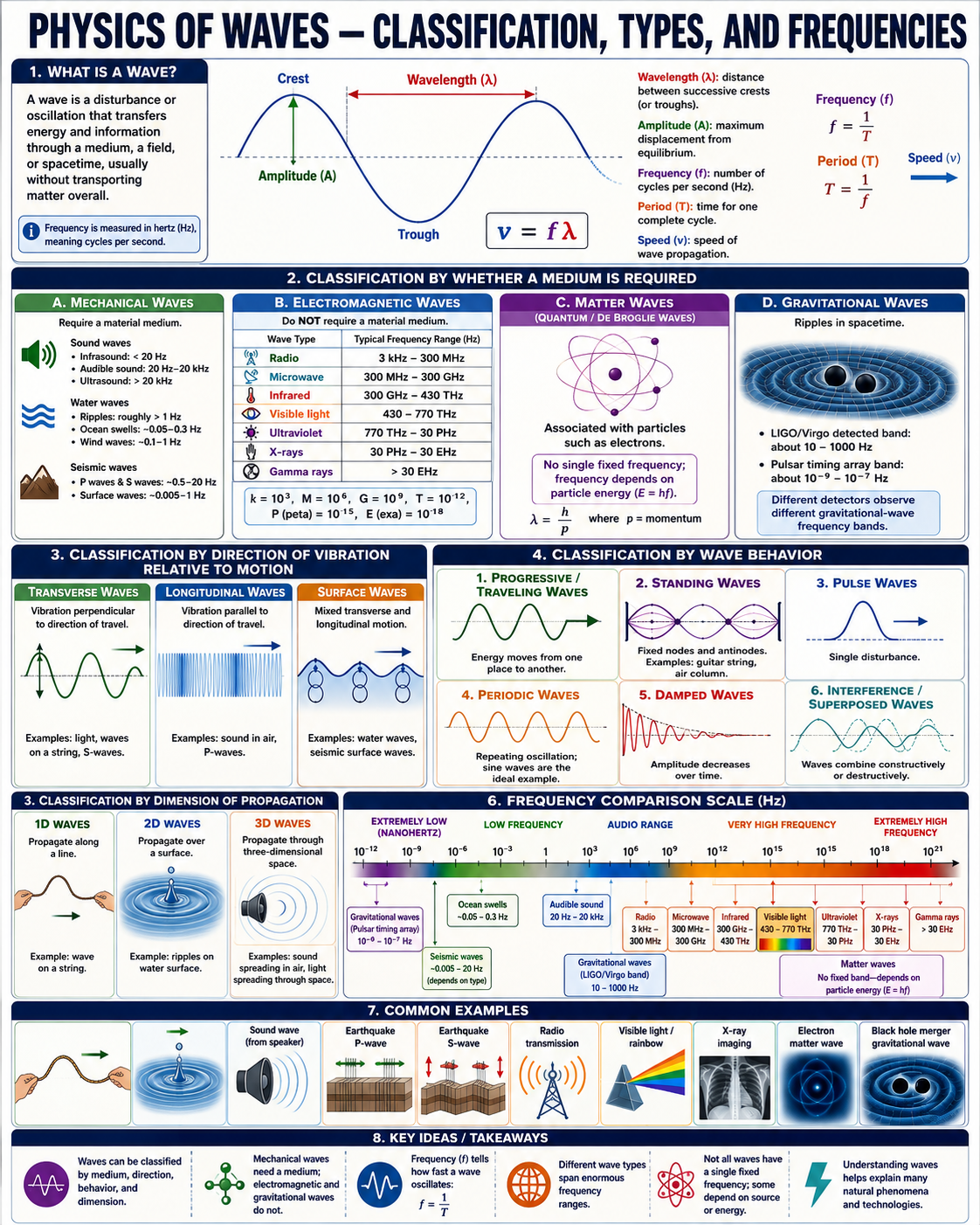
Waves
Waves are disturbances that transfer energy or information through a medium, field, or spacetime.
Main types:
Mechanical waves – Electromagnetic waves, Matter / quantum waves, Gravitational waves
And by motion: Transverse Longitudinal and Surface
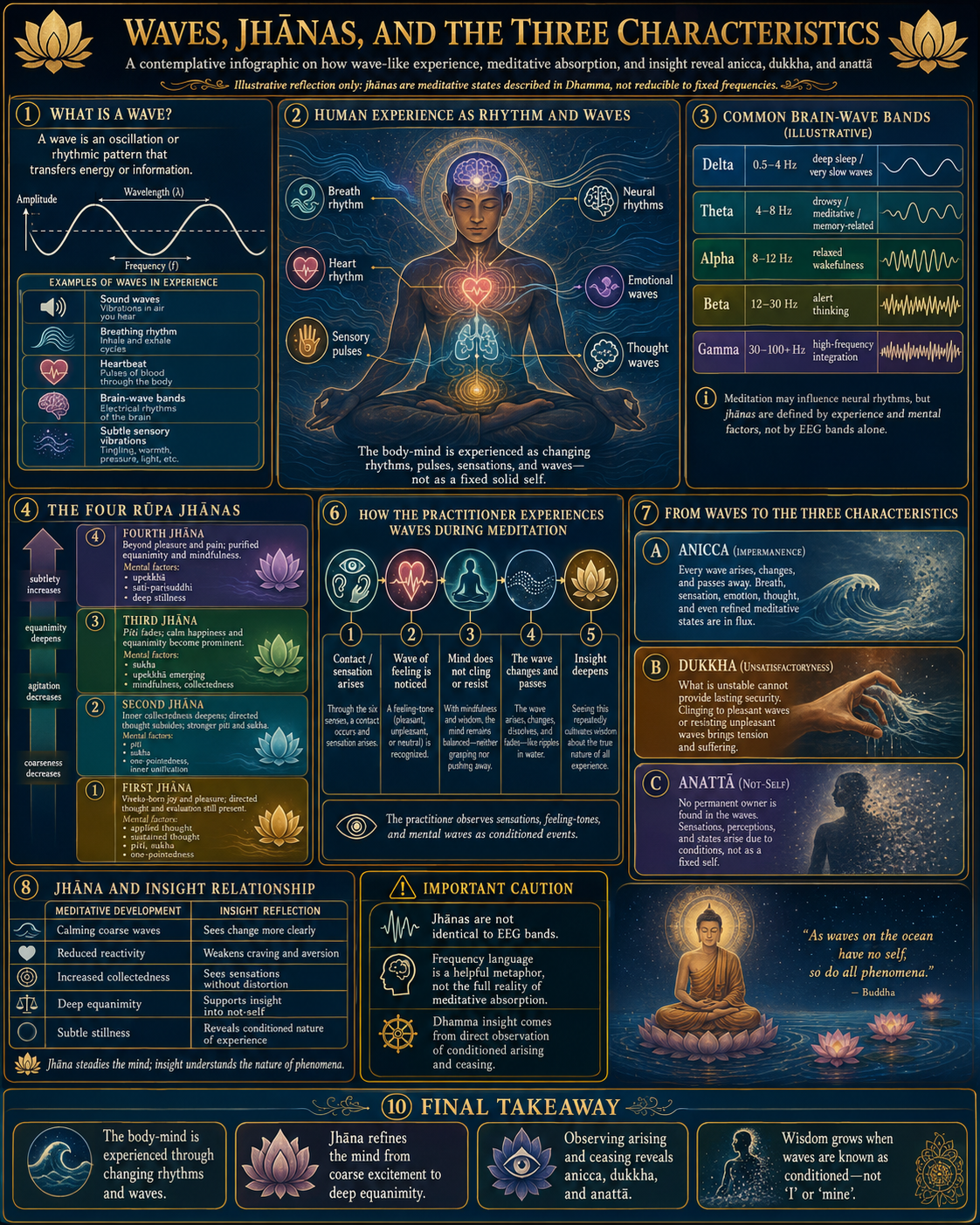
Dhamma reflection: a wave is not a separate solid thing. It is a process arising due to conditions. In the same way, feeling, perception, anger, craving, calm, and thought are also wave-like: they arise, move, change, and cease.
Teaching infographics — click any preview to enlarge.
Waves
Supporting infographic 8
Open the visual for the complete illustrated explanation.
Click infographic to enlarge ↗
Waves
Supporting infographic 9
Open the visual for the complete illustrated explanation.

Click infographic to enlarge ↗
Waves
Supporting infographic 10
Open the visual for the complete illustrated explanation.
Click infographic to enlarge ↗
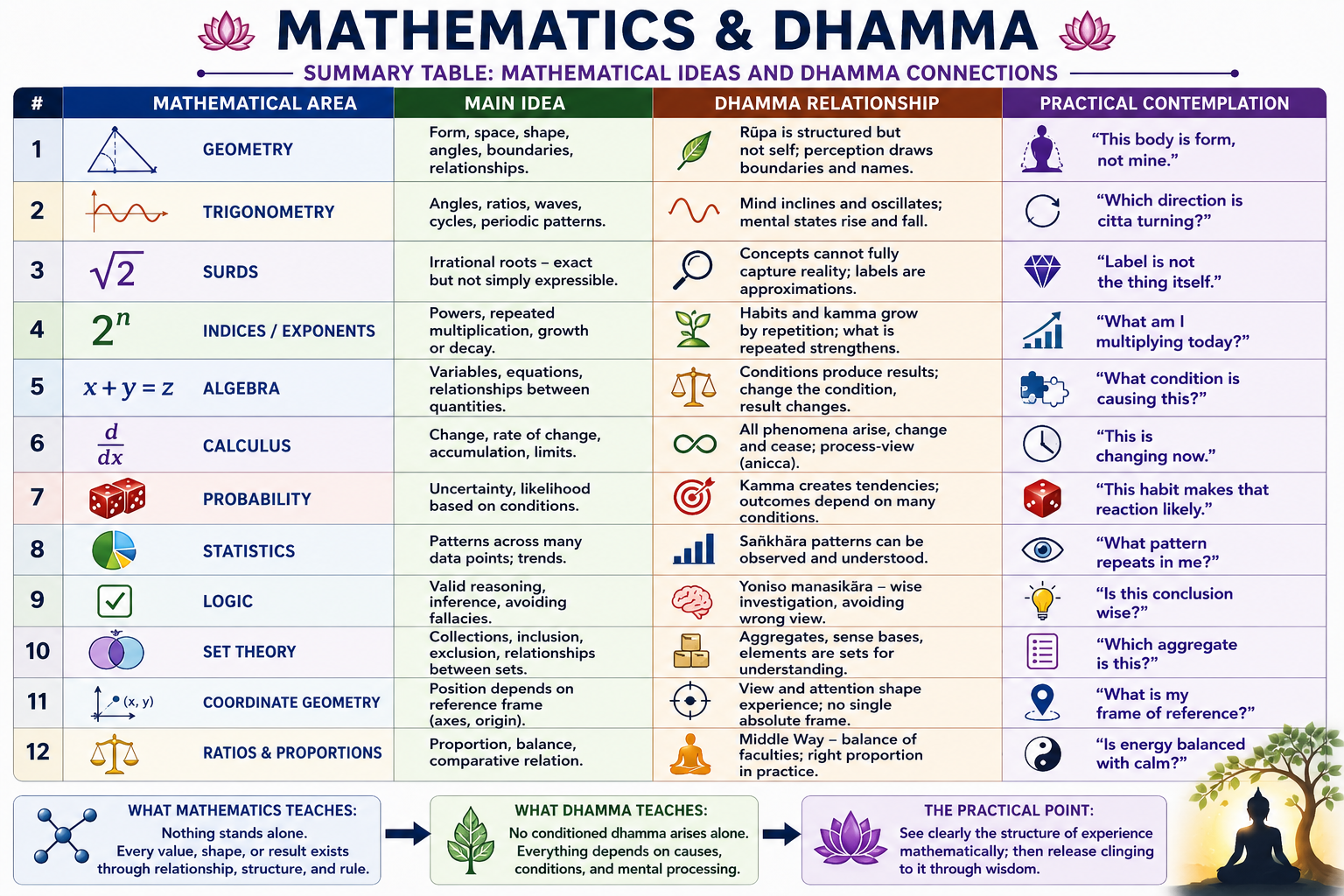
Mathematics
Teaching infographics — click any preview to enlarge.
Mathematics
Supporting infographic 11
Open the visual for the complete illustrated explanation.
Click infographic to enlarge ↗
Mathematics and Dhamma – Bridge
| Mathematics | What it studies | Dhamma connection |
|---|---|---|
| Arithmetic | Number, quantity, increase, decrease | Kamma accumulates through repeated intention |
| Algebra | Unknowns, variables, relationships | Conditions produce results; change the condition, result changes |
| Geometry | Shape, space, form, relation | Rūpa, structure, boundary, perspective |
| Trigonometry | Angles, cycles, waves, ratios | Inclination of mind, oscillation, proportion, balance |
| Surds | Irrational quantities, exactness beyond simple numbers | Reality cannot always be reduced to simple concepts |
| Indices / exponents | Powers, growth, repeated multiplication | Habit-patterns strengthen through repetition |
| Calculus | Change, rate, accumulation | Anicca, arising-ceasing, process-view |
| Probability | Uncertainty, likelihood | Conditions create tendencies, not fixed self |
| Statistics | Patterns across data | Repeated saṅkhāra patterns reveal tendencies |
| Logic | Valid reasoning | Yoniso manasikāra, right view, avoiding wrong inference |
| Set theory | Groups, inclusion, exclusion | Khandha, āyatana, dhātu classifications |
| Coordinate geometry | Position relative to axes | Experience depends on frame/reference/context |
| Topology | Continuity, deformation, connectedness | Conditional continuity without permanent self |
| Fractals | Repeating patterns at many scales | Saṅkhāra patterns repeating in thought, speech, action |
Geometry studies form, space, boundary, proportion, angle, direction, and relationship. Dhamma studies how the mind turns form into “mine,” “I,” “person,” “beautiful,” “ugly,” “enemy,” “desirable,” or “dangerous.”
| Geometry concept | Mathematical meaning | Dhamma reflection |
|---|---|---|
| Point | No length, width, or height; only position | A moment of contact appears and vanishes |
| Line | Extension between points | Continuity appears from many moments |
| Plane | Two-dimensional field | Sense field where appearances arise |
| Shape | Boundary-defined form | Saññā marks boundaries and names things |
| Angle | Directional relation | Mind inclines toward rāga, dosa, moha, or kusala |
| Symmetry | Balanced structure | Equanimity, balance, non-bias |
| Circle | No beginning or end in the curve | Saṁsāric repetition when ignorance continues |
| Triangle | Stable three-point structure | Sīla, samādhi, paññā as a stable training structure |
| Center | Reference point | “I” is often falsely placed as the center of experience |
| Perimeter | Boundary | Upādāna creates “inside” and “outside”: mine/not-mine |
Trigonometry and Dhamma – Trigonometry studies angles, ratios, waves, cycles, and periodic motion. It is especially useful for understanding how small changes in angle can greatly change direction.
| Trigonometry concept | Meaning | Dhamma connection |
|---|---|---|
| Angle | Direction of movement | Citta inclines toward kusala or akusala |
| Sine/cosine | Cyclic wave pattern | Mental states rise and fall |
| Tangent | Steepness / rate of change | Intensity of reaction |
| Ratio | Relationship between sides | Experience depends on proportion of conditions |
| Phase | Position in a cycle | Mood, energy, and attention shift over time |
| Amplitude | Height of wave | Strength of emotion or excitement |
| Frequency | How often wave repeats | Repetition of habit-pattern |
| Period | Time for one cycle | Duration of mental cycle |
Example: anger as a wave
| Wave stage | Mental process |
|---|---|
| Trigger | Contact occurs |
| Rising wave | Perception labels: “insult” |
| Peak | Anger becomes strong |
| Falling wave | Energy decreases |
| After-effect | Regret, justification, memory |
| Repetition | Habit becomes easier next time |
Surds and Dhamma A surd is an irrational root. It cannot be expressed as a simple fraction.
| Surd concept | Mathematical meaning | Dhamma reflection |
|---|---|---|
| Exact but not simple | 2 is exact, but its decimal never ends | Reality can be precise but not reducible to simple words |
| Irrational number | Not expressible as ratio of two integers | Concepts cannot fully capture direct experience |
| Approximation | 1.414 is useful but incomplete | Language is useful but not ultimate |
| Root | Hidden basis of a value | Hidden conditions under visible experience |
| Simplification | | Analysis separates complex experience into conditions |
Dhamma connection:
A label is like an approximation while direct seeing is deeper than the label.
For example:
| Label | Deeper Dhamma analysis |
|---|---|
| “I am angry” | Contact + painful feeling + perception + memory + conceit + intention |
| “She is beautiful” | Form + perception + pleasant feeling + rāga-coloring |
| “This is mine” | Perception + craving + ownership-view |
| “I failed” | Event + memory + self-view + comparison + unpleasant feeling |
Just as cannot be fully captured by a short decimal, living experience cannot be fully captured by conceptual labels.
Indices / exponents and Dhamma – Indices show repeated multiplication:
| Mathematical idea | Meaning | Dhamma connection |
|---|---|---|
| (x^1) | One occurrence | One thought arises |
| (x^2) | Repetition begins | Thought is repeated |
| (x^3) | Growth accelerates | Habit becomes stronger |
| (x^n) | Power of repetition | Saṅkhāra pattern becomes deep |
| Negative index | Inverse relation | Removing condition reverses effect |
| Zero power | Base loses expressed power | When condition is absent, result does not arise |
| Exponential growth | Rapid increase | Craving, anger, fear can grow quickly |
| Exponential decay | Rapid decrease | Akusala weakens when not fed |
Algebra and paṭiccasamuppāda Algebra shows relationship between variables. For example:Meaning: when changes, changes too
| Algebra | Dhamma |
|---|---|
| Change the input, output changes | Change the condition, result changes |
| Unknown variable must be investigated | Hidden condition must be seen |
| Equation shows relation | Paṭiccasamuppāda shows dependency |
| Remove a term, equation changes | Remove craving, suffering changes |
| Simplify expression | Analyze experience into aggregates and conditions |
Calculus and anicca – Calculus studies change.
| Calculus idea | Meaning | Dhamma connection |
|---|---|---|
| Derivative | Rate of change | How quickly a state is shifting |
| Integral | Accumulation | Repeated kamma and habit accumulation |
| Limit | Approaching a boundary | Mind approaching subtle states |
| Continuity | Smooth transition | Apparent continuity of experience |
| Discontinuity | Break or jump | Sudden change in mood or perception |
| Curve | Process over time | Life as process, not fixed identity |
Probability and kamma
Probability studies likelihood, not fixed certainty and his is useful for understanding kamma carefully.
Kamma is not fatalism and is not “everything is already fixed.” It means intentional action creates tendencies, results, and conditions which will arise when proper conditions appear.
| Probability | Dhamma |
|---|---|
| Repeated causes increase likelihood | Repeated intention strengthens tendency |
| Outcome is condition-dependent | Kamma ripens when supporting conditions are present |
| Many variables affect result | Many conditions shape experience |
| Pattern can be seen over time | Character can be observed through repeated action |
| One event does not define the whole system | One thought does not define a person |
Set theory and Dhamma classifications – Set theory studies collections and Dhamma often classifies experience into sets.
| Mathematical set | Dhamma set |
|---|---|
| Collection of objects | Five aggregates |
| Subset | One aggregate within the five |
| Union | Combined experience |
| Intersection | Shared conditions |
| Complement | What is excluded |
| Empty set | Absence of expected essence |
Examples:
| Dhamma classification | Set-like structure |
|---|---|
| Five aggregates | rūpa, vedanā, saññā, saṅkhāra, viññāṇa |
| Six sense bases | eye, ear, nose, tongue, body, mind |
| Six external objects | form, sound, smell, taste, touch, dhamma |
| Eighteen elements | six bases + six objects + six consciousnesses |
| Four noble truths | dukkha, origin, cessation, path |
| Five hindrances | kāmacchanda, vyāpāda, thīna-middha, uddhacca-kukkucca, vicikicchā |
| Seven awakening factors | sati, dhamma-vicaya, viriya, pīti, passaddhi, samādhi, upekkhā |
Coordinate geometry and point of reference – Coordinate geometry shows that position depends on a reference frame. A point is meaningful only relative to axes.
| Coordinate idea | Dhamma reflection |
|---|---|
| Position depends on axes | Experience depends on view and attention |
| Change origin, coordinates change | Change self-view, experience changes |
| Same point, different frame | Same event, different perception |
| Distance depends on relation | Emotional distance depends on clinging |
| Direction depends on orientation | Mental direction depends on intention |
Ratios and the Middle Way – Ratios show proportion and Dhamma also emphasizes balance.
| Ratio/proportion | Dhamma balance |
|---|---|
| Too much effort | Restlessness |
| Too little effort | Sloth |
| Too much analysis | Dry intellectualization |
| Too little investigation | Blind faith |
| Too much calm | Dull absorption |
| Too little calm | Scattered mind |
| Too much speech | Restless mind |
| Too much silence without wisdom | Suppression |
| Faculty | If excessive | If weak | Balanced form |
|---|---|---|---|
| Saddhā | Blind belief | Cynicism | Confidence with investigation |
| Viriya | Agitation | Laziness | Steady energy |
| Sati | Mechanical noting | Forgetfulness | Clear remembering |
| Samādhi | Dull stillness | Scattered mind | Stable collectedness |
| Paññā | Argumentation | Confusion | Direct seeing |
Summary Table
| Mathematical area | Main idea | Dhamma relationship | Practical contemplation |
|---|---|---|---|
| Geometry | Form and relation | Rūpa is structured but not self | “This body is form, not mine” |
| Trigonometry | Angles and cycles | Mind inclines and oscillates | “Which direction is citta turning?” |
| Surds | Exact but not simply expressible | Concepts cannot fully capture reality | “Label is not the thing itself” |
| Indices | Repeated multiplication | Habits grow by repetition | “What am I multiplying today?” |
| Algebra | Relation between variables | Conditions produce results | “What condition is causing this?” |
| Calculus | Change and accumulation | Anicca and saṅkhāra-flow | “This is changing now” |
| Probability | Conditional likelihood | Kamma creates tendencies | “This habit makes that reaction likely” |
| Statistics | Repeated patterns | Saṅkhāra can be observed | “What pattern repeats in me?” |
| Logic | Valid reasoning | Yoniso manasikāra | “Is this conclusion wise?” |
| Set theory | Classification | Khandha, āyatana, dhātu | “Which aggregate is this?” |
| Coordinates | Reference frame | View and attention shape experience | “What is my frame of reference?” |
| Ratios | Proportion | Middle Way and balanced faculties | “Is energy balanced with calm?” |
How to analyze Mathematics with Dhamma
| Mathematics | Dhamma |
|---|---|
| Relation | Paccaya |
| Function | Paṭiccasamuppāda |
| Pattern | Saṅkhāra |
| Change | Anicca |
| Non-isolated structure | Anattā |
| Empty abstraction | Suññatā |
| Balance | Majjhimā paṭipadā |
| Repetition | Bhāvanā or habit formation |
| Simplification | Analysis into conditions |
| Proof | Direct verification through practice |
Sureshot formula for success When a mental event arises, examine it mathematically:
| Question | Dhamma investigation |
|---|---|
| What is the input? | Contact, memory, feeling, thought |
| What is the function? | Ignorance or wisdom? |
| What is the output? | Craving, anger, calm, insight? |
| What is being repeated? | Akusala or kusala? |
| What is the rate of change? | Is it increasing or fading? |
| What is the reference frame? | Self-view or Dhamma-view? |
| What is the hidden variable? | Fear, conceit, craving, expectation? |
| What condition can be removed? | Attention, fuel, contact, story, ownership |
| What condition can be added? | Sati, mettā, restraint, investigation, calm |
Teaching infographics — click any preview to enlarge.
Summary Table
Supporting infographic 12
Open the visual for the complete illustrated explanation.
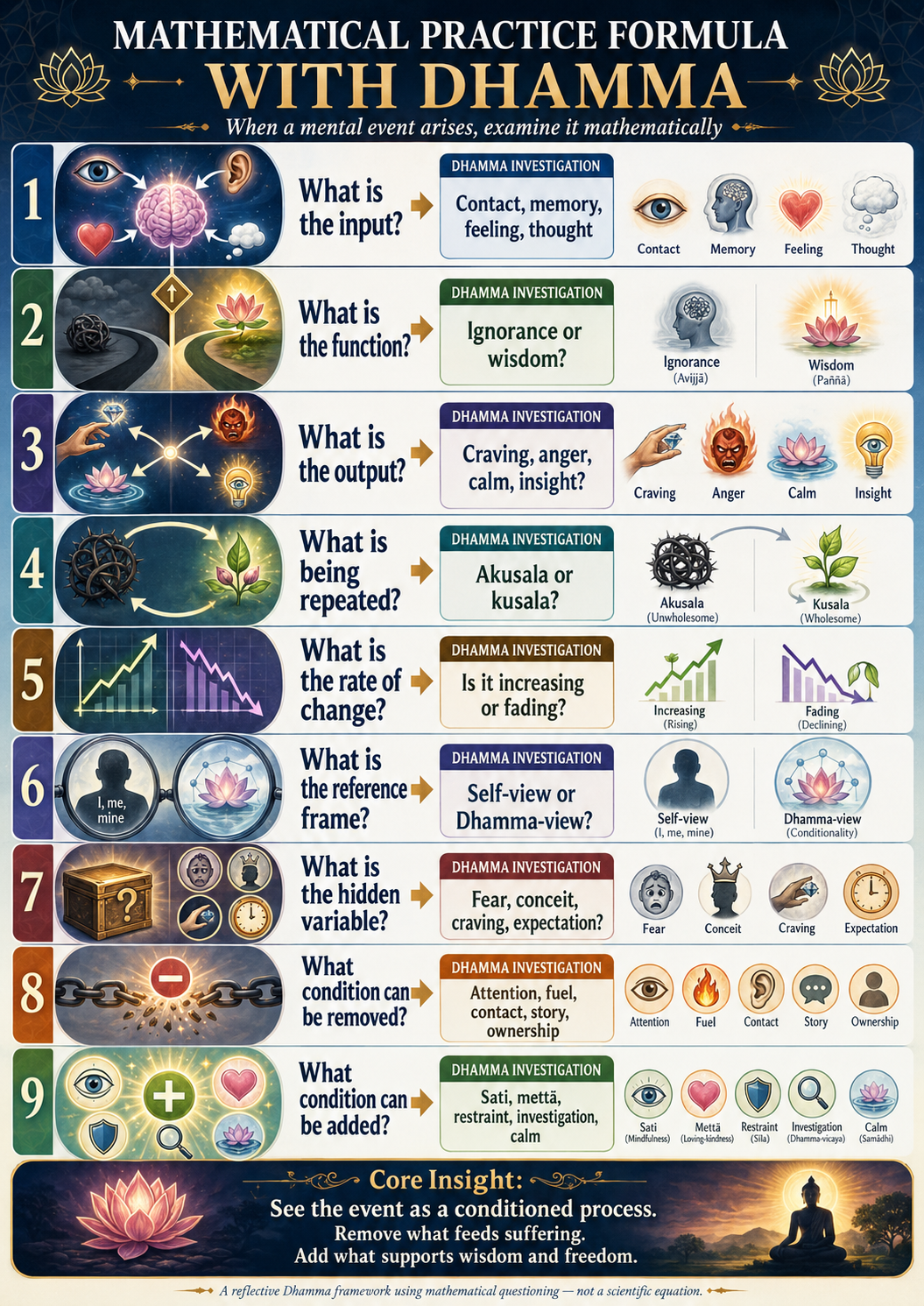
Click infographic to enlarge ↗
04 Brain Waves — EEG, meditation and careful interpretation
Introduction: EEG brainwaves can show changing brain activity during breath meditation, but they do not directly measure liberation, sotāpatti, sakadāgāmī, jhāna, paññā, or purity of citta.
They measure electrical oscillations of brain activity. Dhamma practice uses calm and attention, but the real aim is:
sati, sampajañña, samādhi, paññā, virāga, nirodha, paṭinissagga.
Scientific reviews note that meditation research using EEG has methodological challenges, because different meditation styles, experience levels, and signal-processing methods produce different results. So we should avoid saying “ānāpānasati always produces exactly this wave.”
Teaching infographics — click any preview to enlarge.
Brain Waves — EEG, meditation and careful interpretation
Supporting infographic 1
Open the visual for the complete illustrated explanation.
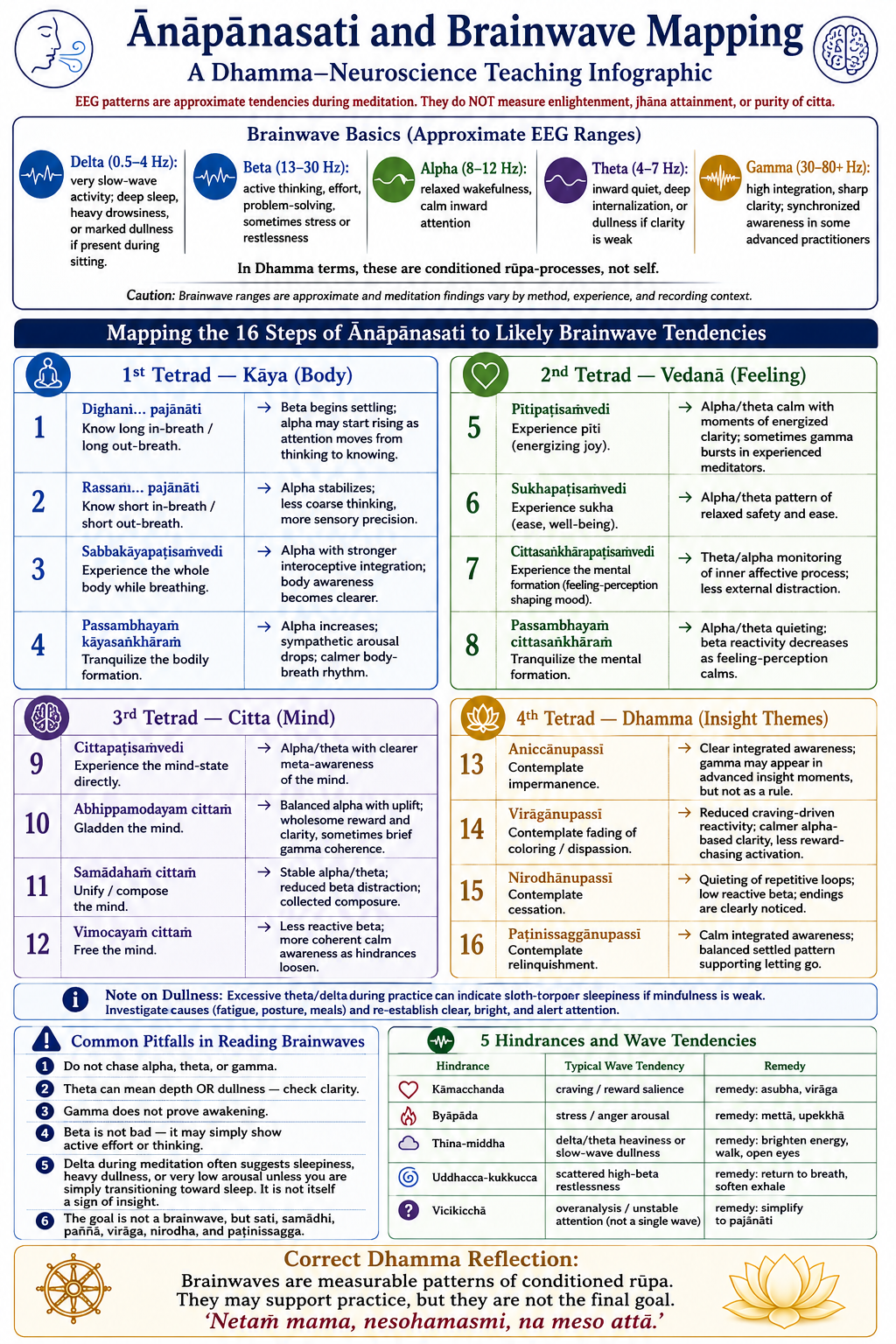
Click infographic to enlarge ↗
Summary Table
| Wave | Too much / wrong use | Helpful form | Dhamma practice |
|---|---|---|---|
| Delta | sleepiness, heaviness, mental fog, loss of clarity | deep bodily rest when appropriate, but not during dull meditation | if Delta-like dullness appears in sitting, check for thīna-middha; straighten posture, open eyes slightly, increase viriya, or do walking meditation |
| Theta | dull drifting, dreamlike wandering, unclear mindfulness | deep inward quiet, subtle internalization | check clarity carefully; if mindfulness is bright, continue; if not, guard against thīna-middha |
| Alpha | attachment to pleasant calm, comfort-seeking | relaxed alertness, settled body-mind, inward stability | use calm for sati, passaddhi, and paññā; do not cling to the calm state |
| Beta | overthinking, efforting, worry, self-monitoring, restlessness | clear initial attention, functional alertness | soften into breath knowing; reduce papañca and return to simple pajānāti |
| Gamma | spiritual pride, fascination with “advanced states,” misinterpretation | clarity, integration, vivid awareness in advanced practice | see even clarity as anicca; do not take it as “I” or “mine” |
Tabulation
| Brainwave | Frequency range | Common neuroscience meaning | During ānāpānasati | Possible hindrance if unbalanced | Dhamma correction |
|---|---|---|---|---|---|
| Delta | 0.5–4 Hz | Very slow-wave activity; deep sleep, heavy drowsiness, very low arousal | If it appears strongly during sitting, it may indicate sleepiness, sinking, or loss of bright mindfulness | Thīna-middha — sloth, torpor, dullness | Open eyes slightly, straighten posture, increase viriya, practise walking meditation, brighten attention |
| Theta | 4–7 Hz | Inward quiet, memory, internalization; can also appear with drowsiness | May appear when attention becomes inward and subtle, especially in deeper calm | Can be useful inwardness, or can become thīna-middha if clarity weakens | Check: “Is sati bright?” If clear, continue; if dull, energize body and mind |
| Alpha | 8–12 Hz | Relaxed wakefulness, calm inward attention, reduced external engagement | Often supports settled breath awareness, body calming, and relaxed alertness | Attachment to pleasant calm; subtle rāga for peaceful state | Use calm as support for sati, samādhi, and paññā; reflect anicca |
| Beta | 13–30 Hz | Active thinking, effort, problem-solving, alertness; sometimes stress or restlessness | Present when planning, judging, correcting, analyzing, or trying too hard | Uddhacca, kukkucca, papañca, self-monitoring | Return to simple pajānāti: “long breath known, short breath known”; soften effort |
| Gamma | 30–80+ Hz | High integration, synchrony, sharp clarity; reported in some advanced meditators | May appear in moments of strong clarity, integration, and advanced meditative awareness | Conceit if misunderstood: māna, asmimāna, “I have high gamma” | See even clarity as conditioned: netaṁ mama, nesohamasmi, na meso attā |
16 steps of Anāpanasati
| Step | Pāli | Practice meaning | Likely EEG tendency | Dhamma caution / correction |
|---|---|---|---|---|
| 1 | Dīghaṁ… pajānāti | Know long in-breath / long out-breath | Beta begins settling; alpha may start rising | Do not overthink the breath; just know |
| 2 | Rassaṁ… pajānāti | Know short in-breath / short out-breath | Alpha stabilizes; sensory precision improves | If delta-like heaviness appears, check sleepiness |
| 3 | Sabbakāyapaṭisaṁvedī | Experience the whole body while breathing | Alpha with stronger body-awareness; theta may appear | Whole-body awareness should be bright, not foggy |
| 4 | Passambhayaṁ kāyasaṅkhāraṁ | Tranquilize bodily formation | Alpha increases; sympathetic arousal drops | Calm body is not enough; keep sati clear |
| 5 | Pītipaṭisaṁvedī | Experience pīti, energizing joy | Alpha/theta calm with energized clarity; possible gamma bursts in experienced meditators | Pīti should not become excitement or ownership |
| 6 | Sukhapaṭisaṁvedī | Experience sukha, ease and well-being | Alpha/theta relaxed safety | Watch for sukha becoming sleepy comfort |
| 7 | Cittasaṅkhārapaṭisaṁvedī | Experience mental formation, feeling-perception shaping mood | Theta/alpha inner monitoring | If unclear, it may be dull affective sinking |
| 8 | Passambhayaṁ cittasaṅkhāraṁ | Tranquilize mental formation | Alpha/theta quieting; beta reactivity decreases | Do not slide into delta-heavy dullness |
| 9 | Cittapaṭisaṁvedī | Experience mind-state directly | Alpha/theta with meta-awareness | Know clearly: dull, bright, restless, calm |
| 10 | Abhippamodayaṁ cittaṁ | Gladden the mind | Balanced alpha with uplift; wholesome reward and clarity | Useful medicine when dullness or heaviness appears |
| 11 | Samādahaṁ cittaṁ | Compose/unify the mind | Stable alpha/theta; reduced beta distraction | True collectedness is clear, not blankness |
| 12 | Vimocayaṁ cittaṁ | Free the mind | Less reactive beta; coherent calm | Free from hindrance, including thīna-middha |
| 13 | Aniccānupassī | Contemplate impermanence | Clear integrated awareness; gamma may appear but not as a rule | Do not measure insight by EEG |
| 14 | Virāgānupassī | Contemplate fading of rāga/coloring | Less craving-driven reactivity; calmer alpha-based clarity | Do not cling to dispassion as “my state” |
| 15 | Nirodhānupassī | Contemplate cessation | Quieting of repetitive loops; low reactive beta | Endings must be known clearly, not slept through |
| 16 | Paṭinissaggānupassī | Contemplate relinquishment | Calm integrated awareness; settled pattern supporting letting go | Let go even of meditation signs and brainwave ideas |
Teaching infographics — click any preview to enlarge.
Brain Waves — EEG, meditation and careful interpretation
Supporting infographic 2
Open the visual for the complete illustrated explanation.
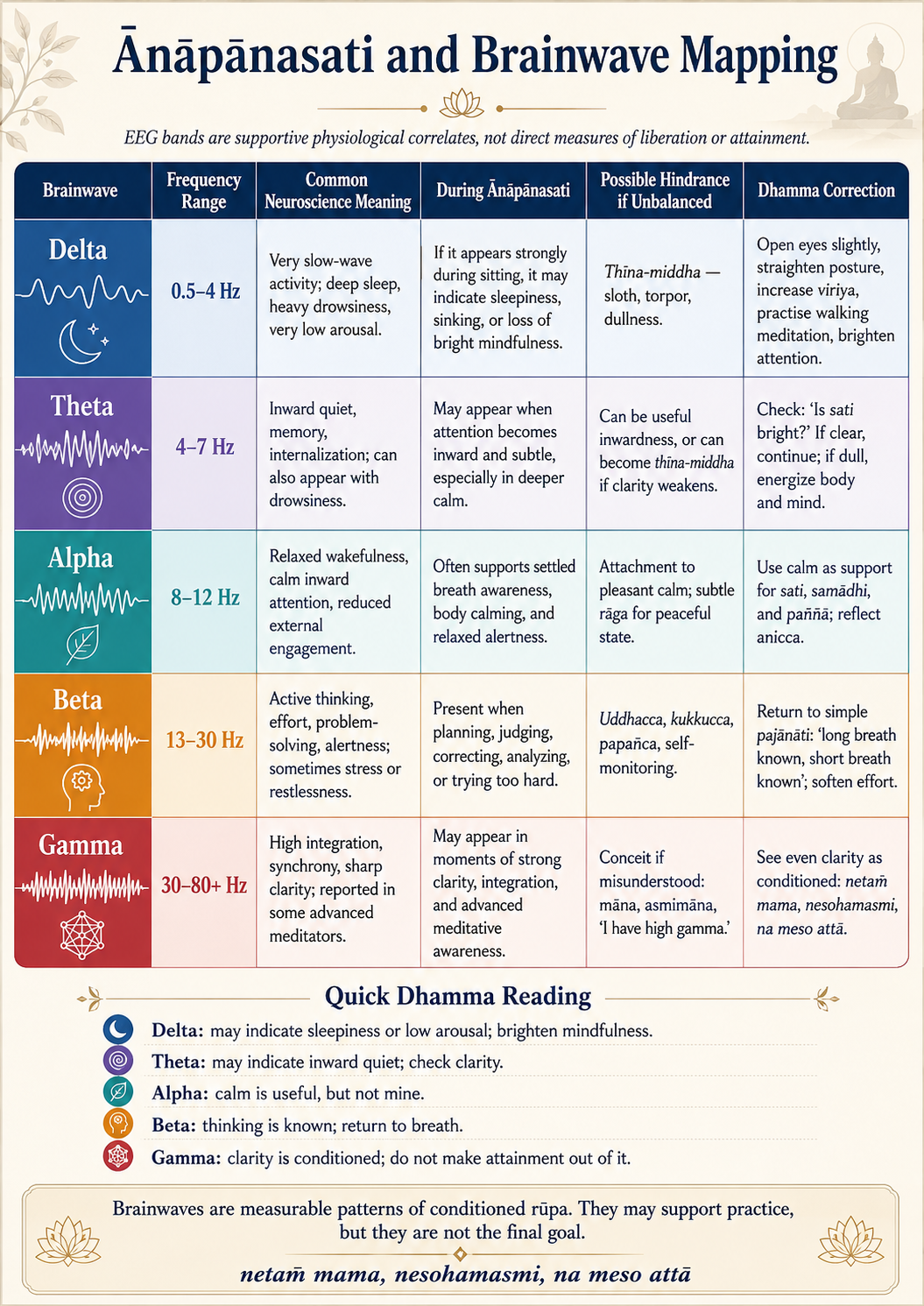
Click infographic to enlarge ↗
05 Psychic Powers — sutta claims and scientific limits
Teaching infographics — click any preview to enlarge.
Psychic Powers — sutta claims and scientific limits
Supporting infographic 1
Open the visual for the complete illustrated explanation.
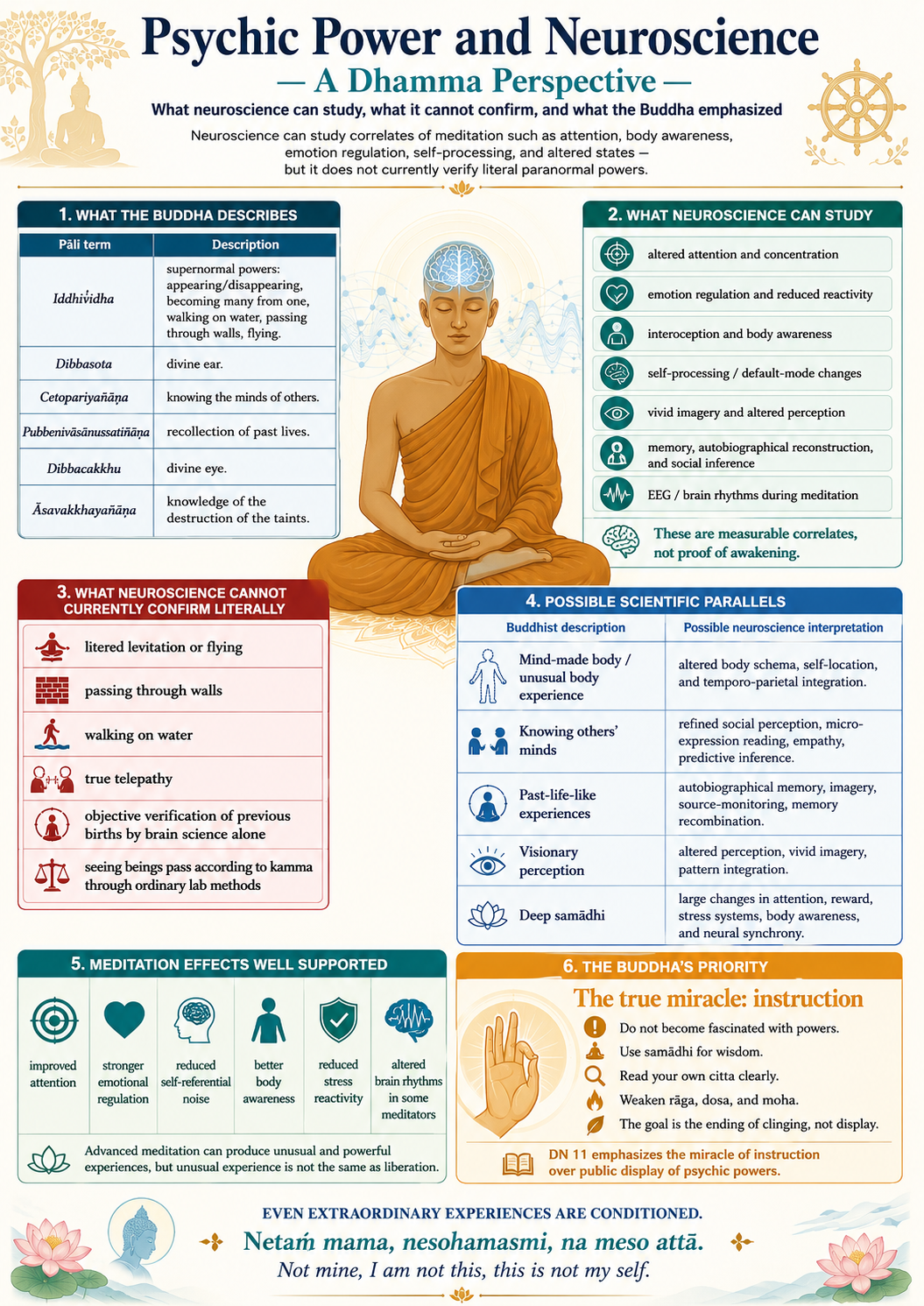
Click infographic to enlarge ↗
In the suttas, the Buddha describes powers such as becoming many from one, appearing and vanishing, passing through walls, walking on water, flying through the air, divine ear, knowing others’ minds, recollecting past lives, divine eye, and the destruction of āsavā. But in DN 11 Kevaddha Sutta, the Buddha clearly refuses to encourage public displays of psychic power and says the true miracle is the miracle of instruction: “Attend this way, not that way; let go of this; enter and remain in that.
What neuroscience can say?
| Buddha’s description | Pāli text | What neuroscience can study | What neuroscience cannot confirm |
|---|---|---|---|
| Supernormal powers | iddhividha | altered body schema, body-image plasticity, trance, absorption, vivid imagery | literal flying, walking on water, passing through walls |
| Divine ear | dibbasota | heightened auditory attention, auditory imagery, sensory sensitivity | hearing distant physical sounds beyond normal sensory pathways |
| Knowing others’ minds | cetopariyañāṇa | social perception, micro-expression reading, empathy, predictive inference | literal telepathy |
| Past-life recollection | pubbenivāsānussatiñāṇa | autobiographical memory, imagery, source monitoring, dreamlike memory recombination | objective verification of previous births through brain science alone |
| Divine eye | dibbacakkhu | visual imagery, altered perception, pattern recognition, visionary states | literal seeing beings passing according to kamma |
| Ending of taints | āsavakkhayañāṇa | reduced reactivity, attention regulation, self-processing changes | final liberation itself as an EEG/fMRI signature |
The strongest scientific position as on date:
Modern neuroscience has strong evidence that meditation can alter attention, emotion regulation, interoception, self-processing, and brain networks. Meta-analyses and reviews report meditation-related changes in areas such as the insula, anterior cingulate cortex, prefrontal areas, and networks related to self-regulation and body awareness.
Advanced meditation can also produce unusual measurable states. For example, long-term Buddhist practitioners have shown high-amplitude gamma synchrony during meditation, and recent neurophenomenology work on advanced concentration/jhāna states has found reliable changes in conscious experience associated with neural activity.
But this does not prove levitation, telepathy, or supernatural travel. It proves that deep training can strongly change perception, attention, body experience, emotional regulation, and brain dynamics.
Out-of-body and “mind-made body” experiences In DN 11/DN 2-type descriptions, after strong samādhi the monk may direct the mind toward a mind-made body and then toward supernormal powers. The sutta repeatedly describes the mind as concentrated, purified, bright, pliant, malleable, steady, and imperturbable before such attainments are mentioned.
Neuroscience has studied out-of-body experiences and altered body ownership. Research links such experiences to the temporo-parietal junction, a region involved in integrating visual, vestibular, tactile, and body-position information. When that integration is disturbed, the sense of “I am located here in this body” can shift or become unusual.
So from neuroscience:
“Mind-made body” may correspond, at least partly, to highly altered body schema, vivid imagery, dissociation from ordinary body-reference, and unusual self-location experience.
From Dhamma: Even this is still saṅkhata, conditioned and not liberation.
“Mind reading” and neuroscience
The Buddha’s description of cetopariyañāṇa includes knowing a mind with rāga as with rāga, without rāga as without rāga, with dosa as with dosa, concentrated as concentrated, released as released, and so on. This is not merely guessing ordinary thoughts; it is described as a refined direct knowledge after deep samādhi.
Neuroscience can explain part of this in ordinary terms:
| Capacity | Brain/psychology explanation |
|---|---|
| sensing anger or calm in others | facial expression, tone, posture, micro-movement |
| knowing emotional state | empathy, interoception, mirror-like social processing |
| predicting intention | theory of mind, pattern recognition |
| deep sensitivity | attention training, reduced self-noise, subtle perception |
But neuroscience does not currently validate literal telepathy. The National Research Council’s review of paranormal claims concluded that there was no scientific justification from the research record for phenomena such as ESP, mental telepathy, or mind-over-matter claims.
Why deep samādhi may feel “supernormal”? When the five hindrances are suppressed and samādhi becomes strong, the ordinary noisy self-process weakens.
| Hindrance weakened | Possible brain/body effect | Experience |
|---|---|---|
| kāmacchanda | less reward chasing | mind feels free from sensual pull |
| byāpāda | less threat arousal | friendliness, non-reactivity |
| thīna-middha | clearer alertness | brightness, wakefulness |
| uddhacca-kukkucca | less scattered beta/restlessness | collectedness |
| vicikicchā | less uncertainty/conflict | confidence and stability |
Then perception can become unusually vivid, quiet, unified, and spacious. This may produce experiences that feel beyond ordinary body-mind limits.
But the Dhamma warning is:
refined experience is still experience.
refined perception is still perception.
refined samādhi is still conditioned.
06 Alpha Testing — personal measurements and observations
Alpha test of Vilas Kadival
Teaching infographics — click any preview to enlarge.
Alpha Testing — personal measurements and observations
Supporting infographic 1
Open the visual for the complete illustrated explanation.
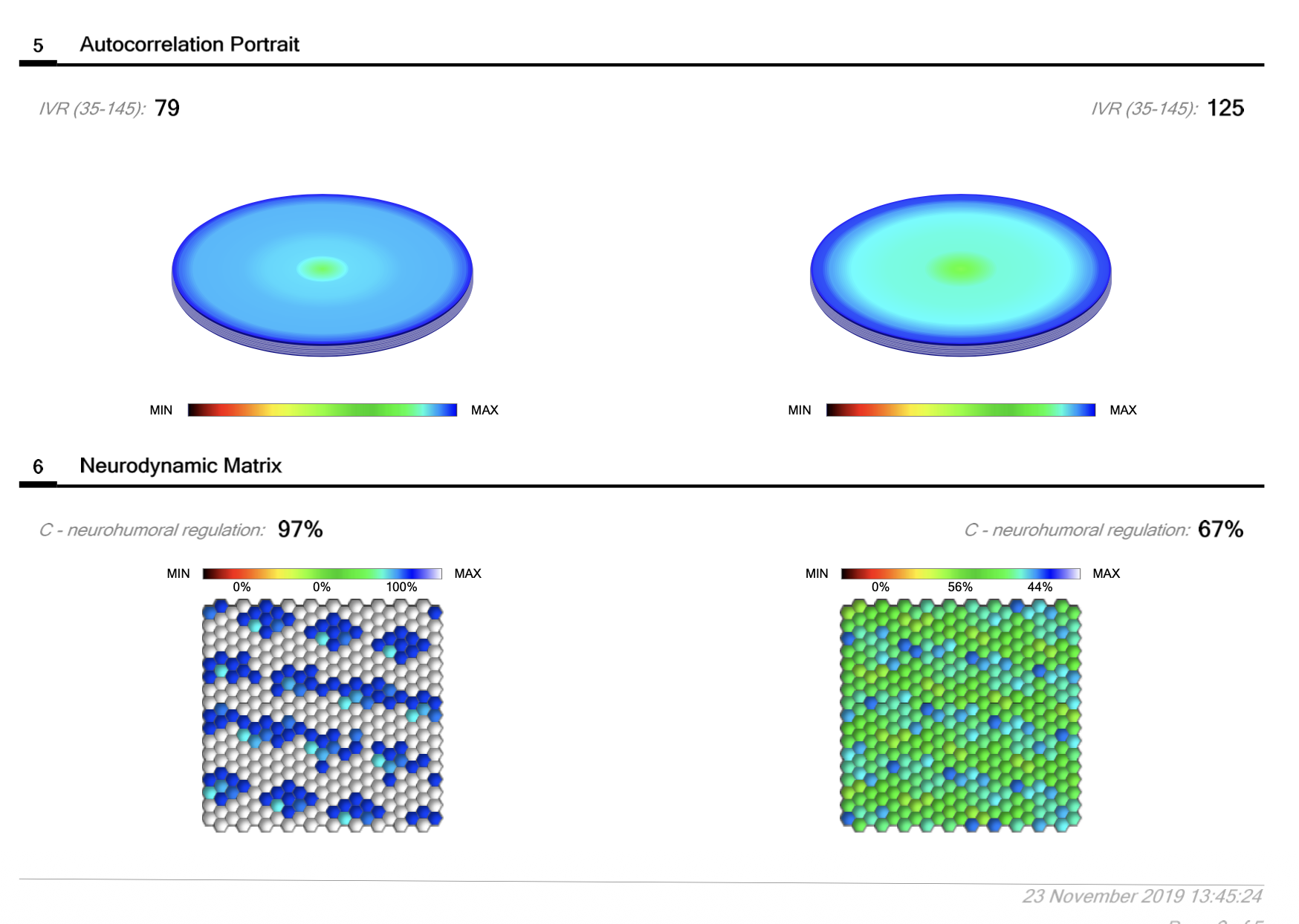
Click infographic to enlarge ↗
Alpha Testing — personal measurements and observations
Supporting infographic 2
Open the visual for the complete illustrated explanation.
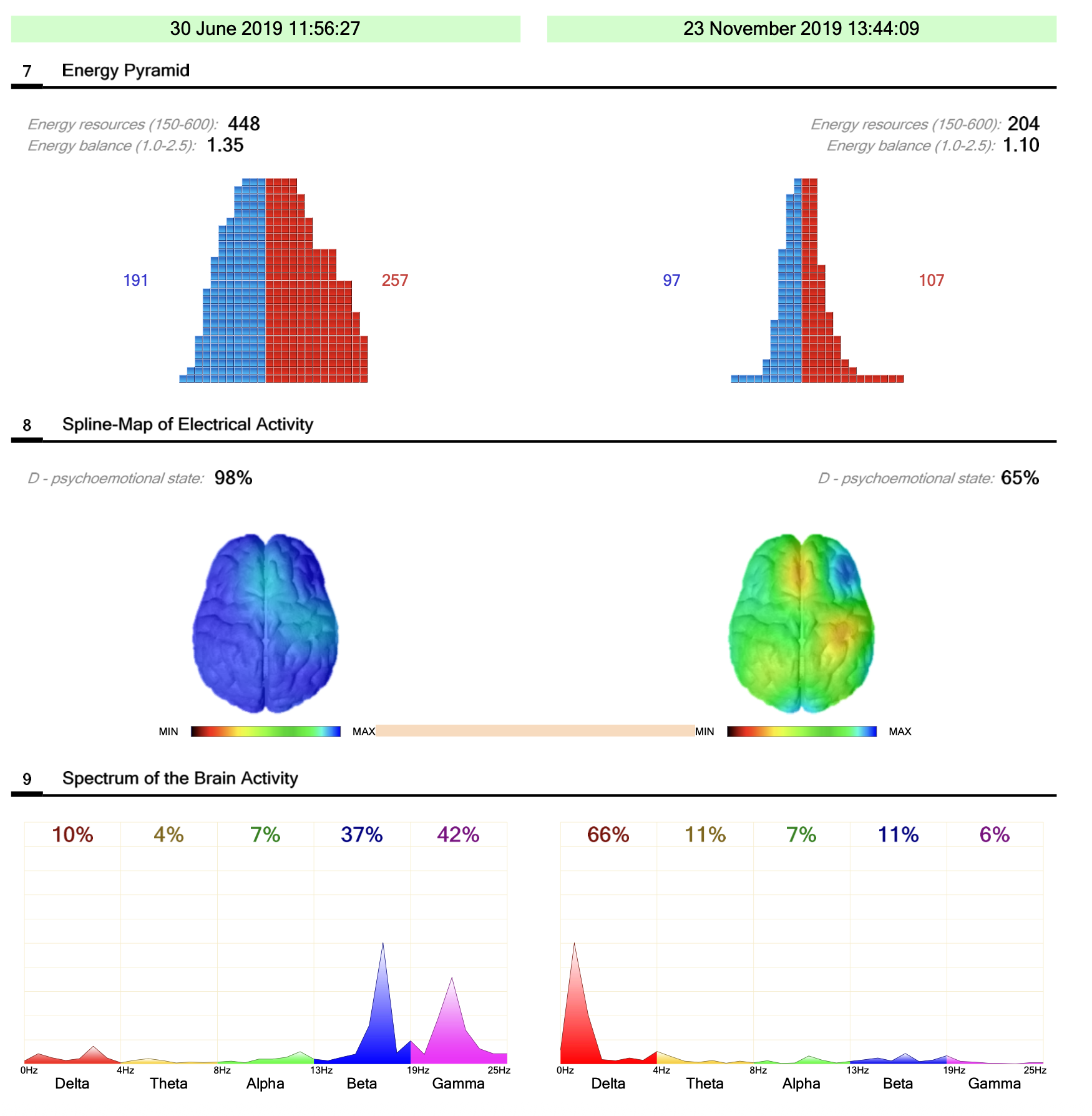
Click infographic to enlarge ↗
Alpha Testing — personal measurements and observations
Supporting infographic 3
Open the visual for the complete illustrated explanation.
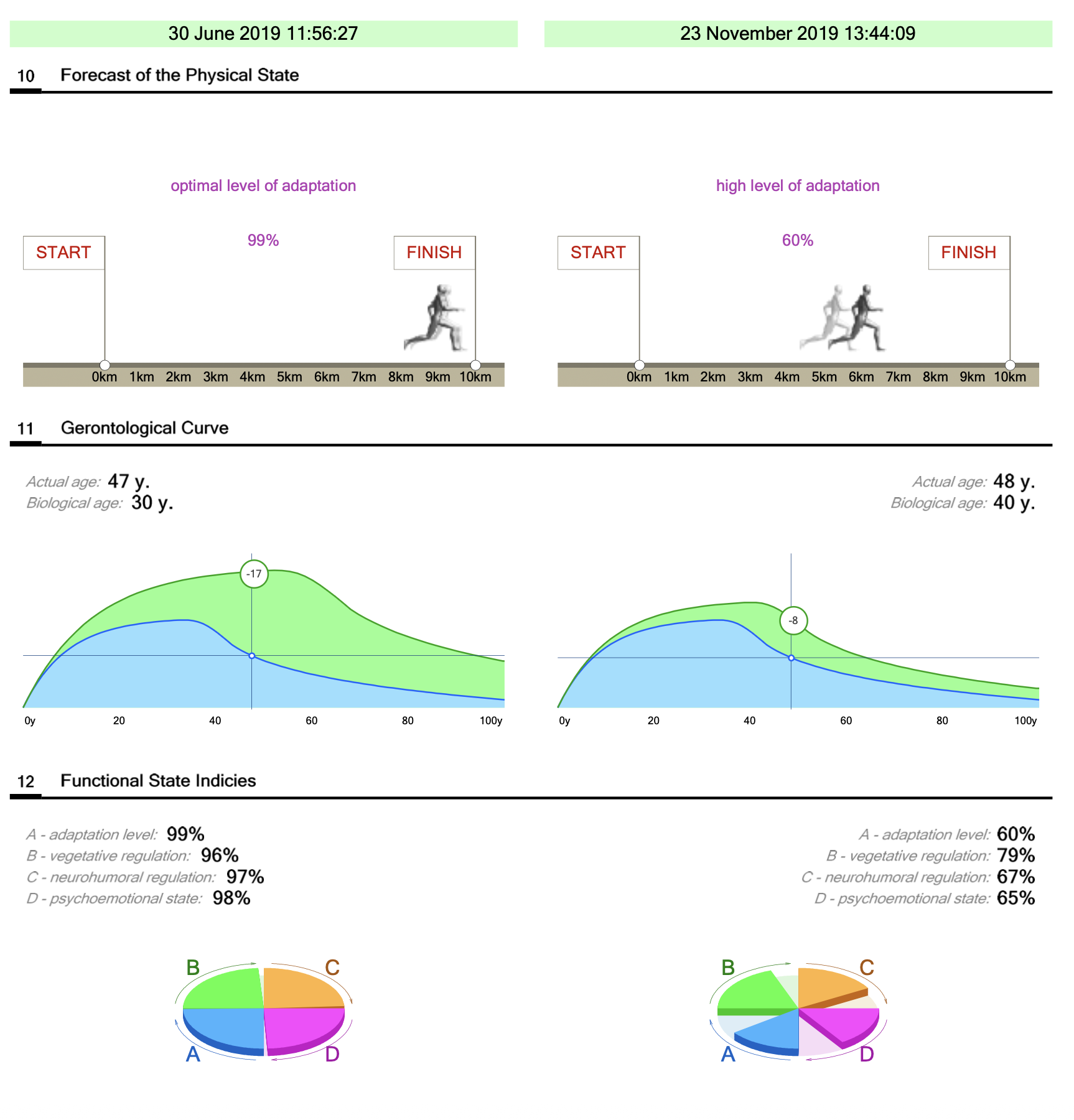
Click infographic to enlarge ↗
07 Cranial — anatomy and supporting visual material
Teaching infographics — click any preview to enlarge.
Cranial — anatomy and supporting visual material
Supporting infographic 1
Open the visual for the complete illustrated explanation.
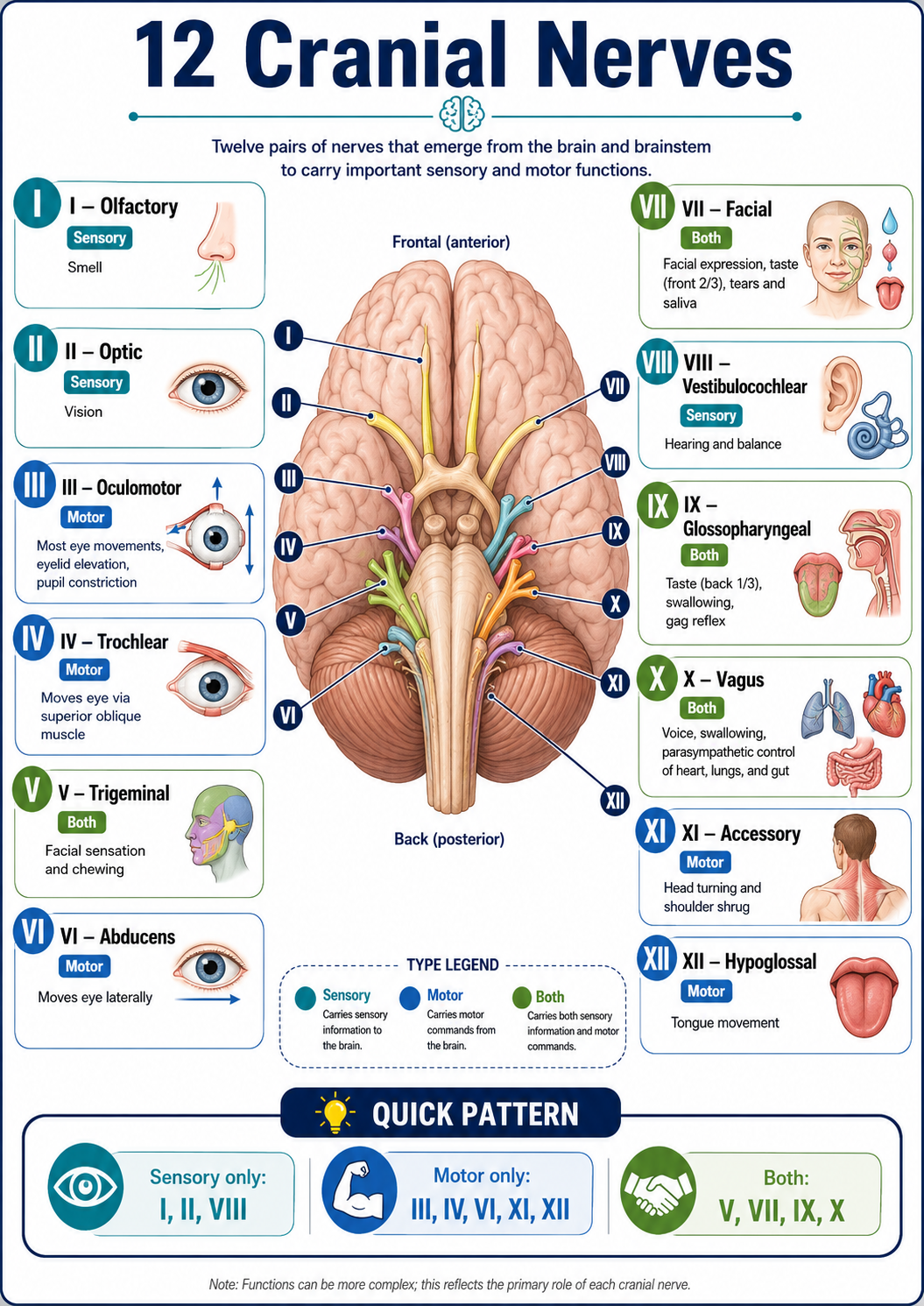
Click infographic to enlarge ↗
Cranial — anatomy and supporting visual material
Supporting infographic 2
Open the visual for the complete illustrated explanation.

Click infographic to enlarge ↗
Modern science can be extremely useful when it helps us see that body, breath, emotion, attention, perception and habit are dependent on changing conditions. What appears to be a fixed “person” is supported moment by moment by physiology, chemistry, neural activity, sensory contact, memory, learning and countless other causes.
But Dhamma does not stop at explaining those mechanisms. It asks whether the conditioned process is being grasped, resisted, identified with or fed. The training develops conditions that support sīla, sense restraint, wakefulness, sati-sampajañña, samatha, jhāna and vipassanā so that craving, conceiving and appropriation can weaken rather than merely become more sophisticated.
EEG, HRV, neurotransmitters, brain networks and physiological calm may provide useful observations, but none of them defines paññā, noble attainment or Nibbāna. Nibbāna is not a brain state, chemical balance, EEG signature or autonomic condition. Science remains a supporting lens; the Dhamma remains the training for understanding dukkha, its arising, its cessation and the path leading to cessation.