Preparing the Mind and Removing Hindrances Through the Breath
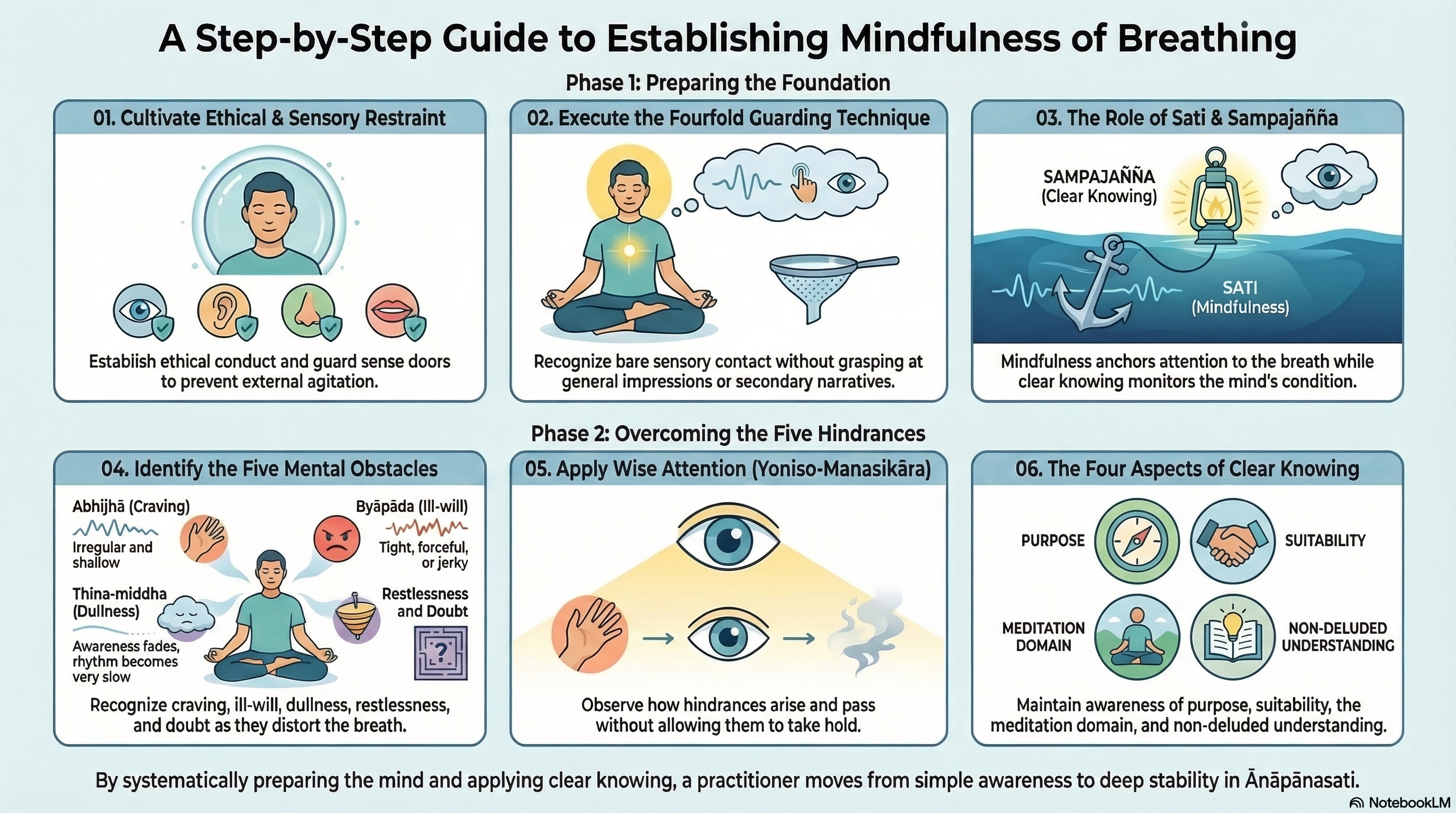 VISUAL SUMMARYSee this study in a pictureOpen the complete infographic for a visual overview before or after reading the full study.View infographic →
The Foundation Before Breath Watching
Mindfulness of breathing does not become stable immediately because the mind is usually covered by the five hindrances. Establishing the breath therefore requires gradual preparation rather than mechanical observation.
Craving pulls the mind toward pleasant objects, ill will pushes it away from unpleasant ones, dullness sinks it into heaviness, restlessness scatters attention, and doubt disrupts confidence. As these disturbances are understood and weakened, the breath becomes smooth and subtle and the mind gathers into samādhi.
So iminā ca ariyena sīlakkhandhena samannāgato, iminā ca ariyena indriyasaṁvarena samannāgato, iminā ca ariyena satisampajaññena samannāgato, imāya ca ariyāya santuṭṭhiyā samannāgato. (DN 2)
| Foundation | How it prepares the mind |
|---|---|
| Sīla | Ethical conduct quiets gross agitation, remorse, guilt, and fear, making the mind lighter and more trustworthy. |
| Indriya-saṁvara | Guarding the faculties prevents the mind from constantly chasing pleasant objects or resisting unpleasant ones. |
| Sati-sampajañña | Mindfulness and clear knowing maintain awareness of bodily and mental activities throughout the day. |
| Santuṭṭhi | Contentment reduces outward hunger, comparison, restlessness, and dependence upon ideal conditions. |
Without this foundation, sights, sounds, thoughts, memories, attraction, irritation, and remorse repeatedly scatter attention away from the breath.
With this foundation, the mind becomes lighter, less reactive, and naturally inclined toward steadiness.
Guarding the Sense Doors
Before mindfulness of breathing can become stable, the Buddha repeatedly emphasizes guarding the six faculties.
When a form is seen, a sound heard, an odour smelled, a flavour tasted, a touch felt, or a mental object cognized, the practitioner does not grasp its sign or secondary characteristics in ways that strengthen attraction or aversion.
| Step | Practice |
|---|---|
| 1. Recognize bare contact | Know seeing, hearing, smelling, tasting, touching, or thinking without immediately building a story. |
| 2. Do not grasp the nimitta | Do not fix upon the general sign or impression that captures the mind and begins attraction or aversion. |
| 3. Do not pursue anubyañjana | Do not elaborate secondary features, comparisons, memories, details, and narratives. |
| 4. Return to present awareness | Prevent the mind from being carried away by excessive desire, irritation, or imagination. |
The practice is not suppression of seeing, hearing, or thinking. It is refusing to let the mind elaborate the object through liking, disliking, comparison, memory, imagination, and narrative.
Guarding the senses prevents unwholesome states from gaining strength before formal breath practice begins.
Sati and Sampajañña with the Breath
| Quality | Function | Breath application |
|---|---|---|
| Sati | Keeps the breath and the training present | Knows inhalation and exhalation without forgetting the object. |
| Sampajañña | Clearly understands the condition and direction of practice | Knows whether the mind is attentive or distracted, calm or agitated, dull or bright. |
Sati maintains steady awareness of inhalation and exhalation, knowing when the breath begins, continues, and ends. Sampajañña observes whether the mind is attentive or distracted, calm or agitated, dull or bright.
When desire, irritation, dullness, restlessness, or doubt arises, sampajañña recognizes the condition and sati re-establishes the breath.
Breath meditation is not mechanical breath watching.
It is continuous knowing of breathing together with wise understanding of the mind that is observing it.
The Four Aspects of Sampajañña
| Aspect | Meaning | Application to breath |
|---|---|---|
| Sātthaka-sampajañña | Clear knowing of purpose | The breath is observed to calm the mind, weaken the hindrances, and support liberation. |
| Sappāya-sampajañña | Clear knowing of suitability | Posture, environment, effort, and method are adjusted according to what supports alert awareness. |
| Gocara-sampajañña | Clear knowing of the proper domain | The breathing body remains the home base instead of external objects or mental stories. |
| Asammoha-sampajañña | Clear knowing without delusion | Breath, body, feelings, and mind-states are seen as conditioned processes, not as “I,” “me,” or “mine.” |
01 Sātthaka-Sampajañña in the Four Postures
| Posture | Practice |
|---|---|
| Walking | Know: “Walking with awareness of breathing to maintain mindfulness.” |
| Standing | Maintain breath awareness instead of drifting into thoughts. |
| Sitting | Observe inhalation and exhalation for calming and collecting the mind. |
| Lying down | Remain aware of breathing instead of falling immediately into unconscious sleep. |
02 Sappāya-Sampajañña
The practitioner asks: Is this posture supporting alert breath awareness? Is the mind becoming dull or restless?
| Situation | Adjustment |
|---|---|
| Breath becomes dull | Straighten posture and renew brightness. |
| Sleepiness while sitting | Walk while observing the breath. |
| Restlessness | Return to calm, natural breathing and reduce unnecessary mental movement. |
03 Gocara-Sampajañña
The breathing body—assāsa-passāsa—remains the proper field or home base of awareness.
| Posture | Breath-domain practice |
|---|---|
| Walking | Feel breathing while walking and know the bodily movement. |
| Standing | Continue breath awareness while knowing weight and pressure. |
| Lying down | Know the body touching the bed and the breath continuing. |
| Sitting | Know bodily contact with the cushion, floor, or mat and the breath entering and leaving. |
04 Asammoha-Sampajañña
- Inhalation arises and passes.
- Exhalation arises and passes.
- Bodily movements arise and pass.
- Sensations change from moment to moment.
- Feelings change according to conditions.
- Mental states arise and pass.
- These are processes, not “I,” “mine,” or “my self.”
Recognizing the Five Hindrances
| Hindrance | Meaning | How it obstructs the breath |
|---|---|---|
| Abhijjhā | Covetousness and grasping desire | Pulls attention toward pleasant objects and imagined satisfaction. |
| Byāpāda | Ill will and aversion | Pushes against discomfort, sounds, memories, pain, people, or the practice itself. |
| Thīna-middha | Sloth and torpor | Dims awareness, collapses posture, and makes the breath vague. |
| Uddhacca-kukkucca | Restlessness and remorse | Scatters attention into future planning and past regret. |
| Vicikicchā | Doubt | Divides confidence through uncertainty about teacher, teaching, method, capacity, and conditions. |
Each hindrance distorts breathing, attention, posture, perception, and confidence differently. The practitioner therefore learns to identify the specific obstruction instead of merely saying, “The breath is not stable.”
Working with hindrances directly through the breath makes them observable.
The changing breath reveals whether the mind is craving, resisting, sinking, scattering, or doubting.
Abhijjhā and Byāpāda
01 Abhijjhā: The Mind Leaning Toward an Object
Abhi carries the sense of toward or intensely, while ijjhati means to desire, long for, or strive for. Abhijjhā is therefore not merely liking, but appropriating desire—the mind leaning strongly toward an object and wanting to possess or continue it.
- Remembering pleasant food
- Thinking about money or success
- Imagining future pleasure
- Desire for praise or recognition
- Sensual imagery
- Craving for pleasant meditation experiences
- Craving for jhāna or peaceful states
How Abhijjhā Changes the Breath
| Breath quality | What happens |
|---|---|
| Rhythm | Becomes irregular |
| Depth | Becomes shallow |
| Speed | Often becomes faster |
| Attention | Moves away from the breath |
| Body | Subtle tension appears |
Wise-Attention Questions
- Is the mind leaning toward something pleasant?
- Has the breath become secondary to imagination?
- Is the mind projecting a future experience?
- Does this direction lead toward bondage or liberation?
| Stage | What to do |
|---|---|
| Desire appears | Recognize it |
| Mind leaves the breath | Notice the movement |
| Pleasant image arises | Observe without feeding it |
| Return | Feel the breath again |
| Repeat | Craving gradually weakens |
02 Byāpāda: The Movement to Strike, Reject, or Push Away
Byāpāda is the hostile movement that wants to reject, attack, harm, or remove what is unpleasant. During breath meditation it may appear as anger, resentment, irritation at sounds, dislike of pain, resistance to the practice, or rejection of unpleasant thoughts.
How Byāpāda Changes the Breath
| Breath aspect | Change |
|---|---|
| Rhythm | Jerky |
| Depth | Forceful or tight |
| Chest | Contracted |
| Exhalation | May become stronger than inhalation |
| Body | Heat and pressure appear |
Early Signs
- The breath becomes forceful.
- Facial muscles tighten.
- Jaw or throat contracts.
- The mind begins arguing internally.
- Past conversations and conflicts are replayed.
- The mind is pushing something away.
Step-by-Step Approach
- Acknowledge the hostility.
- Know the kind of breath presently occurring.
- Allow the exhalation to lengthen naturally rather than forcing it.
- Observe the fading of heat, pressure, and resistance.
- Understand that ill will first burns the mind that holds it.
Thīna-Middha and Uddhacca-Kukkucca
01 Thīna-Middha: Dullness, Inertia, and Sinking
Thīna is mental inertia, stiffness, or sluggishness. Middha is heaviness, sleepiness, sinking, or drooping. Together they cause attention to fade, breathing to become vague, posture to collapse, and awareness to become dream-like.
| Breath aspect | Change |
|---|---|
| Rhythm | Very slow |
| Clarity | Difficult to detect |
| Awareness | Fades |
| Posture | Chest collapses |
A subtle breath is not automatically a sign of progress.
If mindfulness has faded, the breath may seem to disappear because the mind is dull rather than deeply collected.
Practical Work Based on the Sutta Framework
- Keep the spine upright.
- Do not insist on keeping the eyes closed when dullness is strong.
- Stay with one clear breath location rather than changing repeatedly.
- Brighten perception when the mind becomes dark or foggy.
- Include awareness of sounds and air touching the body.
- Walk while observing the breath when sitting strengthens sleepiness.
02 Uddhacca-Kukkucca: Future Agitation and Past Remorse
Uddhacca is the mind jumping outward and upward into future planning and agitation. Kukkucca is repeated regret, worry, guilt, and self-reproach concerning the past.
Early Signs of Uddhacca
- The mind jumps to new topics repeatedly.
- Attention leaves the breath every few seconds.
- The body feels restless.
- There is an urge to move or change posture.
- Future responsibilities and plans repeatedly appear.
Early Signs of Kukkucca
- Remembering mistakes
- Guilt about past actions
- Regret about speech or conduct
- Mental self-criticism
- Repeated thoughts such as “I should not have done that.”
Working with Both Through Wise Attention
- Know the agitation, worry, and fear.
- Narrow attention to the breath or recollect qualities of Buddha, Dhamma, and Saṅgha.
- Slow the observation rather than chasing the mind.
- Recognize and release bodily and mental tension.
- Maintain sīla with hiri and ottappa so that fresh remorse is not created.
| Hindrance | Breath pattern |
|---|---|
| Abhijjhā | Restless and craving-driven breathing |
| Byāpāda | Tight and heated breathing |
| Thīna-middha | Fading and dull breathing |
| Uddhacca-kukkucca | Irregular and unstable breathing |
Vicikicchā and the Complete Framework
01 Vicikicchā: A Mind Divided by Uncertainty
The source explains vicikicchā through vi, divided or scattered, and cikicchā, examining or investigating. It is uncertainty that divides the mind and prevents wholehearted application.
| Area of doubt | How it appears |
|---|---|
| Path | How should it be practised? |
| Tradition | Which approach is right for me? |
| Method | Is meditation only closed-eye sitting on a cushion, or is there another method? |
| Body sensations | What role do bodily sensations play? |
| Conditions | Which supporting conditions must be established? |
The essay places these doubts within three broad areas: Buddha, Dhamma, and Saṅgha—the teacher, the teaching and method, and the people associated with the training.
Topic on ayonisa-manasikara.
The essay concludes that yoniso means from the matrix or origin, while manasikāra concerns making up or directing the mind together with sati-sampajañña, and refers the detailed treatment to another essay.
Related Detailed Study: To understand yoniso-manasikāra, ayoniso-manasikāra, and the complete sequence leading toward liberation, read:
02 Complete Practice Sequence
Establish sīla so that remorse and gross agitation reduce.
Guard the six faculties so that fresh craving and aversion are not continually fed.
Use sati to maintain the breath and sampajañña to know the state and direction of the mind.
Keep the breath as the proper gocara while adjusting posture and effort according to suitability.
Recognize which hindrance is present through changes in breath, body, attention, and perception.
Apply wise attention and the appropriate response without hostility toward the hindrance.
Return repeatedly to the natural breath.
Allow mindfulness to become continuous and the mind to gather into samādhi.
Final Understanding
Ānāpānasati succeeds when the entire training supports it. Ethical conduct quiets remorse, sense restraint prevents continual disturbance, sati-sampajañña governs practice, contentment reduces outward hunger, and wise attention identifies the precise obstruction.
As the five hindrances weaken, the breath becomes calm and subtle, mindfulness becomes continuous, and the mind naturally gathers into collectedness.