The Robe Is Not the Samaṇa
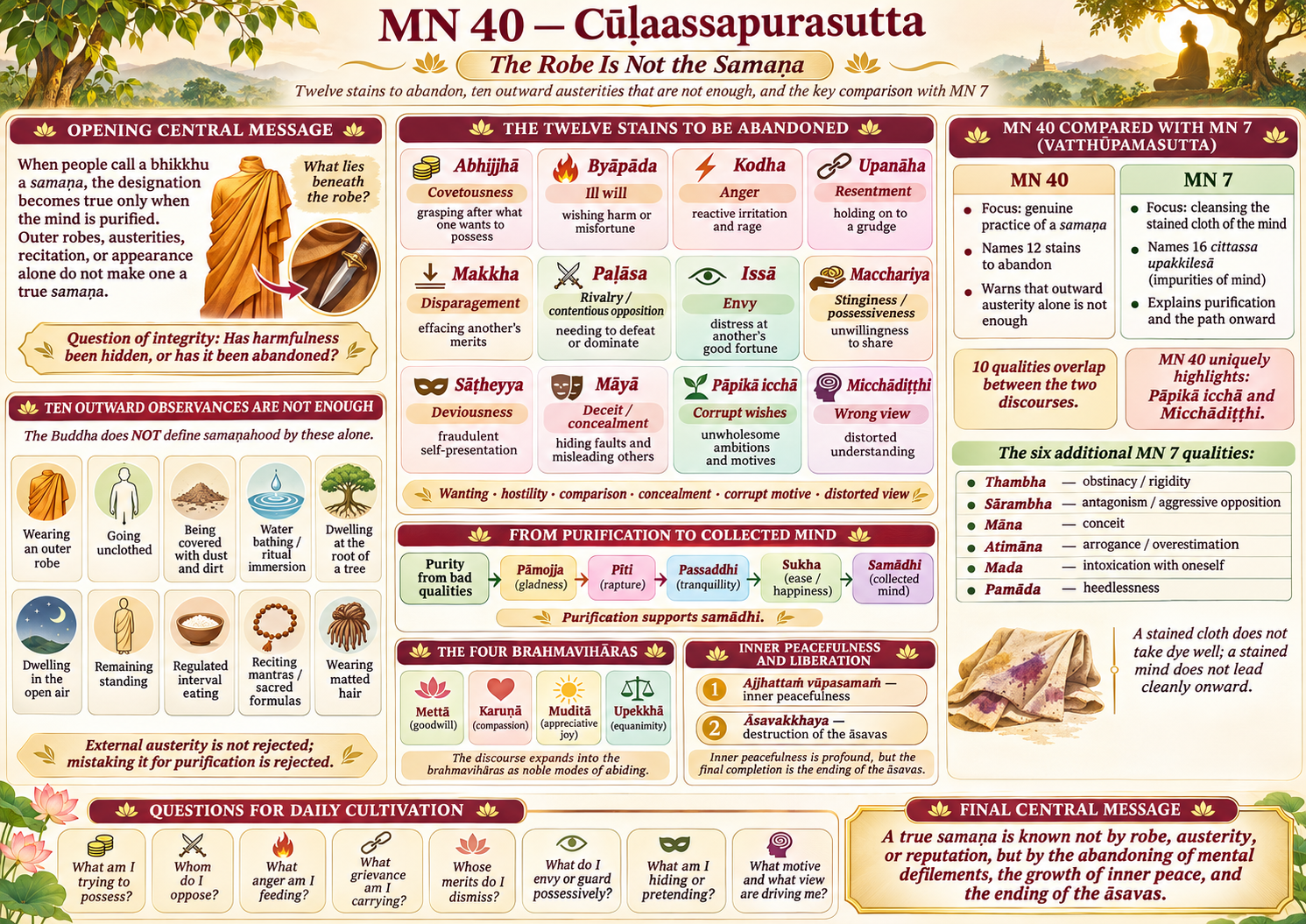 VISUAL SUMMARYSee this sutta in a pictureOpen the complete infographic for a visual overview before or after reading the full study.View infographic →
What truly qualifies someone to be a samaṇa?
The Shorter Discourse at Assapura begins with a question of integrity: when people call a bhikkhu a samaṇa, and the bhikkhu accepts that designation, what must actually be true? The Buddha does not begin by asking which garment is worn, how many austerities are performed, or whether the practitioner has attracted respect. He asks whether qualities that corrupt the renunciant life have been abandoned. A robe can signify renunciation, but it cannot itself remove covetousness, ill will, anger, retained resentment, disparagement, rivalry, envy, stinginess, deviousness, deceit, corrupt wishes, or wrong view.
This is not a rejection of sīla, discipline, simplicity, or seclusion. It is a rejection of mistaking their outward form for the fulfilment of their purpose. The offerings of supporters, the responsibility of going forth, and the honesty of one’s declaration must converge in the life actually cultivated. The Buddha’s vivid image of a weapon wrapped beneath a robe asks us to assess what lies beneath appearances: has harmfulness merely been hidden, or has it been abandoned?
MN 40 does not stop with a negative list. The bhikkhu who observes purification experiences gladness, pīti, tranquillity, sukha, and samādhi. All four brahmavihārā are cultivated expansively. The discourse then distinguishes internal peacefulness, open to a person from any family background, from the complete destruction of the āsavā. An examination of one heated reaction can thus be placed within the full purpose of the Buddha’s training, without confusing a temporary calm state with final liberation.
We compare this with MN 7, the Vatthasutta or Vatthūpamasutta, where sixteen cittassa upakkilesā are named. The two discourses share ten corresponding qualities; MN 7 develops the process of recognizing and abandoning a mental stain and then explicitly describes confidence in the Buddha, Dhamma, and Saṅgha. Its ending further challenges the claim that sacred bathing can cleanse misconduct. Reading the two together produces a useful verification standard: recognize the actual stain, abandon it, observe the resulting transformation, and do not substitute religious appearance for purification.
Textual policy. The complete MN 40 reader below retains the Pāli followed directly by a fresh English translation. The main Pāli reference is the Mahāsaṅgīti edition, compared with the Buddha Jayanti edition. Where an edition contracts its repeated formulas (pe), the reader supplies the full recurring formula for use in study; these passages are editorial expansions and are labelled as such, not claimed to be a verbatim diplomatic transcription. Variant readings, notably udakorohakamattena/udakorohaṇamattena, abyāpajjhena/abyābajjhena, and the occasional adjective ending, are not doctrinal differences. English prose is original, not reproduced from a modern translator.
MN 40 — Cūḷaassapurasutta, complete reading
011. The setting
Evaṁ me sutaṁ—ekaṁ samayaṁ bhagavā aṅgesu viharati assapuraṁ nāma aṅgānaṁ nigamo. Tatra kho bhagavā bhikkhū āmantesi: “Bhikkhavo”ti. “Bhadante”ti te bhikkhū bhagavato paccassosuṁ. Bhagavā etadavoca:
Thus have I heard. On one occasion the Blessed One was staying among the Aṅgas at Assapura, a town of the Aṅgas. There the Blessed One addressed the bhikkhus, “Bhikkhus!” “Venerable sir,” they replied. The Blessed One said this.
022. Let the name samaṇa be truthful
“Samaṇā samaṇāti vo, bhikkhave, jano sañjānāti. Tumhe ca pana ‘ke tumhe’ti puṭṭhā samānā ‘samaṇāmhā’ti paṭijānātha. Tesaṁ vo, bhikkhave, evaṁsamaññānaṁ sataṁ evaṁpaṭiññānaṁ sataṁ: ‘yā samaṇasāmīcippaṭipadā taṁ paṭipajjissāma; evaṁ no ayaṁ amhākaṁ samaññā ca saccā bhavissati paṭiññā ca bhūtā; yesañca mayaṁ cīvarapiṇḍapātasenāsanagilānappaccayabhesajjaparikkhāraṁ paribhuñjāma, tesaṁ te kārā amhesu mahapphalā bhavissanti mahānisaṁsā, amhākañcevāyaṁ pabbajjā avañjhā bhavissati saphalā saudrayā’ti. Evañhi vo, bhikkhave, sikkhitabbaṁ.
“Bhikkhus, people recognize you as samaṇas, and when asked who you are, you declare that you are samaṇas. Since this is your designation and your declaration, you should train: ‘We shall follow the way of practice fitting for a samaṇa, so that the name given to us will be true and our declaration genuine. Those who provide the robes, almsfood, lodgings, medicines and requisites for the sick that we use will gain great fruit and benefit from their support. And our going forth will not be barren, but fruitful and productive.’ This is how you should train.”
Textual note: Samaṇasāmīcippaṭipadā means the way of conduct or practice proper to a samaṇa; it is not merely an outward identity.
033. The twelve stains remaining unabandoned
Kathañca, bhikkhave, bhikkhu na samaṇasāmīcippaṭipadaṁ paṭipanno hoti? Yassa kassaci, bhikkhave, bhikkhuno abhijjhālussa abhijjhā appahīnā hoti, byāpannacittassa byāpādo appahīno hoti, kodhanassa kodho appahīno hoti, upanāhissa upanāho appahīno hoti, makkhissa makkho appahīno hoti, paḷāsissa paḷāso appahīno hoti, issukissa issā appahīnā hoti, maccharissa macchariyaṁ appahīnaṁ hoti, saṭhassa sāṭheyyaṁ appahīnaṁ hoti, māyāvissa māyā appahīnā hoti, pāpicchassa pāpikā icchā appahīnā hoti, micchādiṭṭhikassa micchādiṭṭhi appahīnā hoti—imesaṁ kho ahaṁ, bhikkhave, samaṇamalānaṁ samaṇadosānaṁ samaṇakasaṭānaṁ āpāyikānaṁ ṭhānānaṁ duggativedaniyānaṁ appahānā ‘na samaṇasāmīcippaṭipadaṁ paṭipanno’ti vadāmi.
“How does a bhikkhu fail to follow the way proper to a samaṇa? When covetousness in a covetous bhikkhu has not been abandoned; ill will in one whose mind is hostile has not been abandoned; anger in an angry person has not been abandoned; resentment in a resentful person has not been abandoned; disparagement in one who disparages has not been abandoned; contentious rivalry in a rivalrous person has not been abandoned; envy in an envious person has not been abandoned; stinginess in a stingy person has not been abandoned; deviousness in a devious person has not been abandoned; deceit in a deceitful person has not been abandoned; unwholesome wishes in a person with unwholesome wishes have not been abandoned; and wrong view in a person holding wrong view has not been abandoned—I say that, because these stains, defects, and dregs of a samaṇa, which lead to deprivation and painful results, have not been abandoned, such a bhikkhu has not undertaken the way proper to a samaṇa.”
044. A weapon concealed beneath the robe
Seyyathāpi, bhikkhave, matajaṁ nāma āvudhajātaṁ ubhatodhāraṁ pītanisitaṁ. Tadassa saṅghāṭiyā sampārutaṁ sampaliveṭhitaṁ. Tathūpamāhaṁ, bhikkhave, imassa bhikkhuno pabbajjaṁ vadāmi.
“Suppose there were a weapon called mataja, with two cutting edges, sharpened and whetted, yet concealed and completely wrapped in an outer robe. I say that such a bhikkhu’s going forth is like that.”
Textual note: The simile warns against dangerous mental qualities hidden beneath an outwardly renunciant appearance. Readings include mataja/maṭaja, and the exact identification of the named weapon is not certain; the concealed double-edged weapon is the point of the simile.
055. Ten outward observances are not themselves samaṇahood
Nāhaṁ, bhikkhave, saṅghāṭikassa saṅghāṭidhāraṇamattena sāmaññaṁ vadāmi. Nāhaṁ, bhikkhave, acelakassa acelakamattena sāmaññaṁ vadāmi. Nāhaṁ, bhikkhave, rajojallikassa rajojallikamattena sāmaññaṁ vadāmi. Nāhaṁ, bhikkhave, udakorohakassa udakorohakamattena sāmaññaṁ vadāmi. Nāhaṁ, bhikkhave, rukkhamūlikassa rukkhamūlikamattena sāmaññaṁ vadāmi. Nāhaṁ, bhikkhave, abbhokāsikassa abbhokāsikamattena sāmaññaṁ vadāmi. Nāhaṁ, bhikkhave, ubbhaṭṭhakassa ubbhaṭṭhakamattena sāmaññaṁ vadāmi. Nāhaṁ, bhikkhave, pariyāyabhattikassa pariyāyabhattikamattena sāmaññaṁ vadāmi. Nāhaṁ, bhikkhave, mantajjhāyakassa mantajjhāyakamattena sāmaññaṁ vadāmi. Nāhaṁ, bhikkhave, jaṭilakassa jaṭādhāraṇamattena sāmaññaṁ vadāmi.
I do not say that genuine samaṇahood consists merely in wearing an outer robe. I do not say that genuine samaṇahood consists merely in going without clothing. I do not say that genuine samaṇahood consists merely in being covered with dust and dirt. I do not say that genuine samaṇahood consists merely in immersing oneself in water. I do not say that genuine samaṇahood consists merely in dwelling at the root of a tree. I do not say that genuine samaṇahood consists merely in dwelling in the open air. I do not say that genuine samaṇahood consists merely in remaining standing. I do not say that genuine samaṇahood consists merely in eating at prescribed intervals. I do not say that genuine samaṇahood consists merely in reciting sacred formulas. I do not say that genuine samaṇahood consists merely in wearing matted hair.
Textual note: In the water-immersion phrase the BJT witness reads udakorohakamattena, while Mahāsaṅgīti has udakorohaṇamattena. The two point to the same external observance. Mattena indicates “merely” or “by that alone.” This passage does not deny that a practice can be useful; it denies that outward observance alone guarantees liberation.
066.1. Could wearing an outer robe remove all twelve stains?
Saṅghāṭikassa ce, bhikkhave, saṅghāṭidhāraṇamattena abhijjhālussa abhijjhā pahīyetha, byāpannacittassa byāpādo pahīyetha, kodhanassa kodho pahīyetha, upanāhissa upanāho pahīyetha, makkhissa makkho pahīyetha, paḷāsissa paḷāso pahīyetha, issukissa issā pahīyetha, maccharissa macchariyaṁ pahīyetha, saṭhassa sāṭheyyaṁ pahīyetha, māyāvissa māyā pahīyetha, pāpicchassa pāpikā icchā pahīyetha, micchādiṭṭhikassa micchādiṭṭhi pahīyetha, tamenaṁ mittāmaccā ñātisālohitā jātameva naṁ saṅghāṭikaṁ kareyyuṁ, saṅghāṭikattameva samādapeyyuṁ: “Ehi tvaṁ, bhadramukha, saṅghāṭiko hohi, saṅghāṭikassa te sato saṅghāṭidhāraṇamattena abhijjhālussa abhijjhā pahīyissati, byāpannacittassa byāpādo pahīyissati, kodhanassa kodho pahīyissati, upanāhissa upanāho pahīyissati, makkhissa makkho pahīyissati, paḷāsissa paḷāso pahīyissati, issukissa issā pahīyissati, maccharissa macchariyaṁ pahīyissati, saṭhassa sāṭheyyaṁ pahīyissati, māyāvissa māyā pahīyissati, pāpicchassa pāpikā icchā pahīyissati, micchādiṭṭhikassa micchādiṭṭhi pahīyissati”ti. Yasmā ca kho ahaṁ, bhikkhave, saṅghāṭikampi idhekaccaṁ passāmi abhijjhāluṁ byāpannacittaṁ kodhanaṁ upanāhiṁ makkhiṁ paḷāsiṁ issukiṁ macchariṁ saṭhaṁ māyāviṁ pāpicchaṁ micchādiṭṭhikaṁ, tasmā na saṅghāṭikassa saṅghāṭidhāraṇamattena sāmaññaṁ vadāmi.
“Bhikkhus, if covetousness, ill will, anger, resentment, disparagement, rivalry, envy, stinginess, deviousness, deceit, unwholesome wishes, and wrong view could all be abandoned simply by wearing an outer robe, then friends, companions, relatives and kin would make a person a wearer of an outer robe from birth and urge that person: ‘Come, good person, become a wearer of an outer robe! By adopting this observance, covetousness, ill will, anger, resentment, disparagement, rivalry, envy, stinginess, deviousness, deceit, unwholesome wishes and wrong view will be abandoned.’ But I see some who follow this observance and still remain covetous, hostile, angry, resentful, disparaging, contentious, envious, stingy, devious, deceitful, driven by unwholesome wishes and holding wrong view. Therefore I do not say that simply wearing an outer robe constitutes genuine samaṇahood.”
Textual note: Editorial expansion of the repeated formula, based on the formula attested in the Buddha Jayanti full-recitation text; supplied in expanded form for study, not asserted to be a diplomatic facsimile of the Mahāsaṅgīti edition.
076.2. Could going without clothing remove all twelve stains?
Acelakassa ce, bhikkhave, acelakamattena abhijjhālussa abhijjhā pahīyetha, byāpannacittassa byāpādo pahīyetha, kodhanassa kodho pahīyetha, upanāhissa upanāho pahīyetha, makkhissa makkho pahīyetha, paḷāsissa paḷāso pahīyetha, issukissa issā pahīyetha, maccharissa macchariyaṁ pahīyetha, saṭhassa sāṭheyyaṁ pahīyetha, māyāvissa māyā pahīyetha, pāpicchassa pāpikā icchā pahīyetha, micchādiṭṭhikassa micchādiṭṭhi pahīyetha, tamenaṁ mittāmaccā ñātisālohitā jātameva naṁ acelakaṁ kareyyuṁ, acelakamattameva samādapeyyuṁ: “Ehi tvaṁ, bhadramukha, acelako hohi, acelakassa te sato acelakamattena abhijjhālussa abhijjhā pahīyissati, byāpannacittassa byāpādo pahīyissati, kodhanassa kodho pahīyissati, upanāhissa upanāho pahīyissati, makkhissa makkho pahīyissati, paḷāsissa paḷāso pahīyissati, issukissa issā pahīyissati, maccharissa macchariyaṁ pahīyissati, saṭhassa sāṭheyyaṁ pahīyissati, māyāvissa māyā pahīyissati, pāpicchassa pāpikā icchā pahīyissati, micchādiṭṭhikassa micchādiṭṭhi pahīyissati”ti. Yasmā ca kho ahaṁ, bhikkhave, acelakampi idhekaccaṁ passāmi abhijjhāluṁ byāpannacittaṁ kodhanaṁ upanāhiṁ makkhiṁ paḷāsiṁ issukiṁ macchariṁ saṭhaṁ māyāviṁ pāpicchaṁ micchādiṭṭhikaṁ, tasmā na acelakassa acelakamattena sāmaññaṁ vadāmi.
“Bhikkhus, if covetousness, ill will, anger, resentment, disparagement, rivalry, envy, stinginess, deviousness, deceit, unwholesome wishes, and wrong view could all be abandoned simply by going without clothing, then friends, companions, relatives and kin would make a person a unclothed ascetic from birth and urge that person: ‘Come, good person, become a unclothed ascetic! By adopting this observance, covetousness, ill will, anger, resentment, disparagement, rivalry, envy, stinginess, deviousness, deceit, unwholesome wishes and wrong view will be abandoned.’ But I see some who follow this observance and still remain covetous, hostile, angry, resentful, disparaging, contentious, envious, stingy, devious, deceitful, driven by unwholesome wishes and holding wrong view. Therefore I do not say that simply going without clothing constitutes genuine samaṇahood.”
086.3. Could being covered with dust and dirt remove all twelve stains?
Rajojallikassa ce, bhikkhave, rajojallikamattena abhijjhālussa abhijjhā pahīyetha, byāpannacittassa byāpādo pahīyetha, kodhanassa kodho pahīyetha, upanāhissa upanāho pahīyetha, makkhissa makkho pahīyetha, paḷāsissa paḷāso pahīyetha, issukissa issā pahīyetha, maccharissa macchariyaṁ pahīyetha, saṭhassa sāṭheyyaṁ pahīyetha, māyāvissa māyā pahīyetha, pāpicchassa pāpikā icchā pahīyetha, micchādiṭṭhikassa micchādiṭṭhi pahīyetha, tamenaṁ mittāmaccā ñātisālohitā jātameva naṁ rajojallikaṁ kareyyuṁ, rajojallikattameva samādapeyyuṁ: “Ehi tvaṁ, bhadramukha, rajojalliko hohi, rajojallikassa te sato rajojallikamattena abhijjhālussa abhijjhā pahīyissati, byāpannacittassa byāpādo pahīyissati, kodhanassa kodho pahīyissati, upanāhissa upanāho pahīyissati, makkhissa makkho pahīyissati, paḷāsissa paḷāso pahīyissati, issukissa issā pahīyissati, maccharissa macchariyaṁ pahīyissati, saṭhassa sāṭheyyaṁ pahīyissati, māyāvissa māyā pahīyissati, pāpicchassa pāpikā icchā pahīyissati, micchādiṭṭhikassa micchādiṭṭhi pahīyissati”ti. Yasmā ca kho ahaṁ, bhikkhave, rajojallikampi idhekaccaṁ passāmi abhijjhāluṁ byāpannacittaṁ kodhanaṁ upanāhiṁ makkhiṁ paḷāsiṁ issukiṁ macchariṁ saṭhaṁ māyāviṁ pāpicchaṁ micchādiṭṭhikaṁ, tasmā na rajojallikassa rajojallikamattena sāmaññaṁ vadāmi.
“Bhikkhus, if covetousness, ill will, anger, resentment, disparagement, rivalry, envy, stinginess, deviousness, deceit, unwholesome wishes, and wrong view could all be abandoned simply by being covered with dust and dirt, then friends, companions, relatives and kin would make a person a dust-covered ascetic from birth and urge that person: ‘Come, good person, become a dust-covered ascetic! By adopting this observance, covetousness, ill will, anger, resentment, disparagement, rivalry, envy, stinginess, deviousness, deceit, unwholesome wishes and wrong view will be abandoned.’ But I see some who follow this observance and still remain covetous, hostile, angry, resentful, disparaging, contentious, envious, stingy, devious, deceitful, driven by unwholesome wishes and holding wrong view. Therefore I do not say that simply being covered with dust and dirt constitutes genuine samaṇahood.”
096.4. Could immersing oneself in water remove all twelve stains?
Udakorohakassa ce, bhikkhave, udakorohakamattena abhijjhālussa abhijjhā pahīyetha, byāpannacittassa byāpādo pahīyetha, kodhanassa kodho pahīyetha, upanāhissa upanāho pahīyetha, makkhissa makkho pahīyetha, paḷāsissa paḷāso pahīyetha, issukissa issā pahīyetha, maccharissa macchariyaṁ pahīyetha, saṭhassa sāṭheyyaṁ pahīyetha, māyāvissa māyā pahīyetha, pāpicchassa pāpikā icchā pahīyetha, micchādiṭṭhikassa micchādiṭṭhi pahīyetha, tamenaṁ mittāmaccā ñātisālohitā jātameva naṁ udakorohakaṁ kareyyuṁ, udakorohakamattameva samādapeyyuṁ: “Ehi tvaṁ, bhadramukha, udakorohako hohi, udakorohakassa te sato udakorohakamattena abhijjhālussa abhijjhā pahīyissati, byāpannacittassa byāpādo pahīyissati, kodhanassa kodho pahīyissati, upanāhissa upanāho pahīyissati, makkhissa makkho pahīyissati, paḷāsissa paḷāso pahīyissati, issukissa issā pahīyissati, maccharissa macchariyaṁ pahīyissati, saṭhassa sāṭheyyaṁ pahīyissati, māyāvissa māyā pahīyissati, pāpicchassa pāpikā icchā pahīyissati, micchādiṭṭhikassa micchādiṭṭhi pahīyissati”ti. Yasmā ca kho ahaṁ, bhikkhave, udakorohakampi idhekaccaṁ passāmi abhijjhāluṁ byāpannacittaṁ kodhanaṁ upanāhiṁ makkhiṁ paḷāsiṁ issukiṁ macchariṁ saṭhaṁ māyāviṁ pāpicchaṁ micchādiṭṭhikaṁ, tasmā na udakorohakassa udakorohakamattena sāmaññaṁ vadāmi.
“Bhikkhus, if covetousness, ill will, anger, resentment, disparagement, rivalry, envy, stinginess, deviousness, deceit, unwholesome wishes, and wrong view could all be abandoned simply by immersing oneself in water, then friends, companions, relatives and kin would make a person a ritual bather from birth and urge that person: ‘Come, good person, become a ritual bather! By adopting this observance, covetousness, ill will, anger, resentment, disparagement, rivalry, envy, stinginess, deviousness, deceit, unwholesome wishes and wrong view will be abandoned.’ But I see some who follow this observance and still remain covetous, hostile, angry, resentful, disparaging, contentious, envious, stingy, devious, deceitful, driven by unwholesome wishes and holding wrong view. Therefore I do not say that simply immersing oneself in water constitutes genuine samaṇahood.”
106.5. Could dwelling at the root of a tree remove all twelve stains?
Rukkhamūlikassa ce, bhikkhave, rukkhamūlikamattena abhijjhālussa abhijjhā pahīyetha, byāpannacittassa byāpādo pahīyetha, kodhanassa kodho pahīyetha, upanāhissa upanāho pahīyetha, makkhissa makkho pahīyetha, paḷāsissa paḷāso pahīyetha, issukissa issā pahīyetha, maccharissa macchariyaṁ pahīyetha, saṭhassa sāṭheyyaṁ pahīyetha, māyāvissa māyā pahīyetha, pāpicchassa pāpikā icchā pahīyetha, micchādiṭṭhikassa micchādiṭṭhi pahīyetha, tamenaṁ mittāmaccā ñātisālohitā jātameva naṁ rukkhamūlikaṁ kareyyuṁ, rukkhamūlikattameva samādapeyyuṁ: “Ehi tvaṁ, bhadramukha, rukkhamūliko hohi, rukkhamūlikassa te sato rukkhamūlikamattena abhijjhālussa abhijjhā pahīyissati, byāpannacittassa byāpādo pahīyissati, kodhanassa kodho pahīyissati, upanāhissa upanāho pahīyissati, makkhissa makkho pahīyissati, paḷāsissa paḷāso pahīyissati, issukissa issā pahīyissati, maccharissa macchariyaṁ pahīyissati, saṭhassa sāṭheyyaṁ pahīyissati, māyāvissa māyā pahīyissati, pāpicchassa pāpikā icchā pahīyissati, micchādiṭṭhikassa micchādiṭṭhi pahīyissati”ti. Yasmā ca kho ahaṁ, bhikkhave, rukkhamūlikampi idhekaccaṁ passāmi abhijjhāluṁ byāpannacittaṁ kodhanaṁ upanāhiṁ makkhiṁ paḷāsiṁ issukiṁ macchariṁ saṭhaṁ māyāviṁ pāpicchaṁ micchādiṭṭhikaṁ, tasmā na rukkhamūlikassa rukkhamūlikamattena sāmaññaṁ vadāmi.
“Bhikkhus, if covetousness, ill will, anger, resentment, disparagement, rivalry, envy, stinginess, deviousness, deceit, unwholesome wishes, and wrong view could all be abandoned simply by dwelling at the root of a tree, then friends, companions, relatives and kin would make a person a tree-root dweller from birth and urge that person: ‘Come, good person, become a tree-root dweller! By adopting this observance, covetousness, ill will, anger, resentment, disparagement, rivalry, envy, stinginess, deviousness, deceit, unwholesome wishes and wrong view will be abandoned.’ But I see some who follow this observance and still remain covetous, hostile, angry, resentful, disparaging, contentious, envious, stingy, devious, deceitful, driven by unwholesome wishes and holding wrong view. Therefore I do not say that simply dwelling at the root of a tree constitutes genuine samaṇahood.”
116.6. Could dwelling in the open air remove all twelve stains?
Abbhokāsikassa ce, bhikkhave, abbhokāsikamattena abhijjhālussa abhijjhā pahīyetha, byāpannacittassa byāpādo pahīyetha, kodhanassa kodho pahīyetha, upanāhissa upanāho pahīyetha, makkhissa makkho pahīyetha, paḷāsissa paḷāso pahīyetha, issukissa issā pahīyetha, maccharissa macchariyaṁ pahīyetha, saṭhassa sāṭheyyaṁ pahīyetha, māyāvissa māyā pahīyetha, pāpicchassa pāpikā icchā pahīyetha, micchādiṭṭhikassa micchādiṭṭhi pahīyetha, tamenaṁ mittāmaccā ñātisālohitā jātameva naṁ abbhokāsikaṁ kareyyuṁ, abbhokāsikattameva samādapeyyuṁ: “Ehi tvaṁ, bhadramukha, abbhokāsiko hohi, abbhokāsikassa te sato abbhokāsikamattena abhijjhālussa abhijjhā pahīyissati, byāpannacittassa byāpādo pahīyissati, kodhanassa kodho pahīyissati, upanāhissa upanāho pahīyissati, makkhissa makkho pahīyissati, paḷāsissa paḷāso pahīyissati, issukissa issā pahīyissati, maccharissa macchariyaṁ pahīyissati, saṭhassa sāṭheyyaṁ pahīyissati, māyāvissa māyā pahīyissati, pāpicchassa pāpikā icchā pahīyissati, micchādiṭṭhikassa micchādiṭṭhi pahīyissati”ti. Yasmā ca kho ahaṁ, bhikkhave, abbhokāsikampi idhekaccaṁ passāmi abhijjhāluṁ byāpannacittaṁ kodhanaṁ upanāhiṁ makkhiṁ paḷāsiṁ issukiṁ macchariṁ saṭhaṁ māyāviṁ pāpicchaṁ micchādiṭṭhikaṁ, tasmā na abbhokāsikassa abbhokāsikamattena sāmaññaṁ vadāmi.
“Bhikkhus, if covetousness, ill will, anger, resentment, disparagement, rivalry, envy, stinginess, deviousness, deceit, unwholesome wishes, and wrong view could all be abandoned simply by dwelling in the open air, then friends, companions, relatives and kin would make a person an open-air dweller from birth and urge that person: ‘Come, good person, become an open-air dweller! By adopting this observance, covetousness, ill will, anger, resentment, disparagement, rivalry, envy, stinginess, deviousness, deceit, unwholesome wishes and wrong view will be abandoned.’ But I see some who follow this observance and still remain covetous, hostile, angry, resentful, disparaging, contentious, envious, stingy, devious, deceitful, driven by unwholesome wishes and holding wrong view. Therefore I do not say that simply dwelling in the open air constitutes genuine samaṇahood.”
126.7. Could remaining standing remove all twelve stains?
Ubbhaṭṭhakassa ce, bhikkhave, ubbhaṭṭhakamattena abhijjhālussa abhijjhā pahīyetha, byāpannacittassa byāpādo pahīyetha, kodhanassa kodho pahīyetha, upanāhissa upanāho pahīyetha, makkhissa makkho pahīyetha, paḷāsissa paḷāso pahīyetha, issukissa issā pahīyetha, maccharissa macchariyaṁ pahīyetha, saṭhassa sāṭheyyaṁ pahīyetha, māyāvissa māyā pahīyetha, pāpicchassa pāpikā icchā pahīyetha, micchādiṭṭhikassa micchādiṭṭhi pahīyetha, tamenaṁ mittāmaccā ñātisālohitā jātameva naṁ ubbhaṭṭhakaṁ kareyyuṁ, ubbhaṭṭhakattameva samādapeyyuṁ: “Ehi tvaṁ, bhadramukha, ubbhaṭṭhako hohi, ubbhaṭṭhakassa te sato ubbhaṭṭhakamattena abhijjhālussa abhijjhā pahīyissati, byāpannacittassa byāpādo pahīyissati, kodhanassa kodho pahīyissati, upanāhissa upanāho pahīyissati, makkhissa makkho pahīyissati, paḷāsissa paḷāso pahīyissati, issukissa issā pahīyissati, maccharissa macchariyaṁ pahīyissati, saṭhassa sāṭheyyaṁ pahīyissati, māyāvissa māyā pahīyissati, pāpicchassa pāpikā icchā pahīyissati, micchādiṭṭhikassa micchādiṭṭhi pahīyissati”ti. Yasmā ca kho ahaṁ, bhikkhave, ubbhaṭṭhakampi idhekaccaṁ passāmi abhijjhāluṁ byāpannacittaṁ kodhanaṁ upanāhiṁ makkhiṁ paḷāsiṁ issukiṁ macchariṁ saṭhaṁ māyāviṁ pāpicchaṁ micchādiṭṭhikaṁ, tasmā na ubbhaṭṭhakassa ubbhaṭṭhakamattena sāmaññaṁ vadāmi.
“Bhikkhus, if covetousness, ill will, anger, resentment, disparagement, rivalry, envy, stinginess, deviousness, deceit, unwholesome wishes, and wrong view could all be abandoned simply by remaining standing, then friends, companions, relatives and kin would make a person a standing ascetic from birth and urge that person: ‘Come, good person, become a standing ascetic! By adopting this observance, covetousness, ill will, anger, resentment, disparagement, rivalry, envy, stinginess, deviousness, deceit, unwholesome wishes and wrong view will be abandoned.’ But I see some who follow this observance and still remain covetous, hostile, angry, resentful, disparaging, contentious, envious, stingy, devious, deceitful, driven by unwholesome wishes and holding wrong view. Therefore I do not say that simply remaining standing constitutes genuine samaṇahood.”
136.8. Could eating at prescribed intervals remove all twelve stains?
Pariyāyabhattikassa ce, bhikkhave, pariyāyabhattikamattena abhijjhālussa abhijjhā pahīyetha, byāpannacittassa byāpādo pahīyetha, kodhanassa kodho pahīyetha, upanāhissa upanāho pahīyetha, makkhissa makkho pahīyetha, paḷāsissa paḷāso pahīyetha, issukissa issā pahīyetha, maccharissa macchariyaṁ pahīyetha, saṭhassa sāṭheyyaṁ pahīyetha, māyāvissa māyā pahīyetha, pāpicchassa pāpikā icchā pahīyetha, micchādiṭṭhikassa micchādiṭṭhi pahīyetha, tamenaṁ mittāmaccā ñātisālohitā jātameva naṁ pariyāyabhattikaṁ kareyyuṁ, pariyāyabhattakattameva samādapeyyuṁ: “Ehi tvaṁ, bhadramukha, pariyāyabhattiko hohi, pariyāyabhattikassa te sato pariyāyabhattikamattena abhijjhālussa abhijjhā pahīyissati, byāpannacittassa byāpādo pahīyissati, kodhanassa kodho pahīyissati, upanāhissa upanāho pahīyissati, makkhissa makkho pahīyissati, paḷāsissa paḷāso pahīyissati, issukissa issā pahīyissati, maccharissa macchariyaṁ pahīyissati, saṭhassa sāṭheyyaṁ pahīyissati, māyāvissa māyā pahīyissati, pāpicchassa pāpikā icchā pahīyissati, micchādiṭṭhikassa micchādiṭṭhi pahīyissati”ti. Yasmā ca kho ahaṁ, bhikkhave, pariyāyabhattikampi idhekaccaṁ passāmi abhijjhāluṁ byāpannacittaṁ kodhanaṁ upanāhiṁ makkhiṁ paḷāsiṁ issukiṁ macchariṁ saṭhaṁ māyāviṁ pāpicchaṁ micchādiṭṭhikaṁ, tasmā na pariyāyabhattikassa pariyāyabhattikamattena sāmaññaṁ vadāmi.
“Bhikkhus, if covetousness, ill will, anger, resentment, disparagement, rivalry, envy, stinginess, deviousness, deceit, unwholesome wishes, and wrong view could all be abandoned simply by eating at prescribed intervals, then friends, companions, relatives and kin would make a person a regulated eater from birth and urge that person: ‘Come, good person, become a regulated eater! By adopting this observance, covetousness, ill will, anger, resentment, disparagement, rivalry, envy, stinginess, deviousness, deceit, unwholesome wishes and wrong view will be abandoned.’ But I see some who follow this observance and still remain covetous, hostile, angry, resentful, disparaging, contentious, envious, stingy, devious, deceitful, driven by unwholesome wishes and holding wrong view. Therefore I do not say that simply eating at prescribed intervals constitutes genuine samaṇahood.”
146.9. Could reciting sacred formulas remove all twelve stains?
Mantajjhāyakassa ce, bhikkhave, mantajjhāyakamattena abhijjhālussa abhijjhā pahīyetha, byāpannacittassa byāpādo pahīyetha, kodhanassa kodho pahīyetha, upanāhissa upanāho pahīyetha, makkhissa makkho pahīyetha, paḷāsissa paḷāso pahīyetha, issukissa issā pahīyetha, maccharissa macchariyaṁ pahīyetha, saṭhassa sāṭheyyaṁ pahīyetha, māyāvissa māyā pahīyetha, pāpicchassa pāpikā icchā pahīyetha, micchādiṭṭhikassa micchādiṭṭhi pahīyetha, tamenaṁ mittāmaccā ñātisālohitā jātameva naṁ mantajjhāyakaṁ kareyyuṁ, mantajjhāyakattameva samādapeyyuṁ: “Ehi tvaṁ, bhadramukha, mantajjhāyako hohi, mantajjhāyakassa te sato mantajjhāyakamattena abhijjhālussa abhijjhā pahīyissati, byāpannacittassa byāpādo pahīyissati, kodhanassa kodho pahīyissati, upanāhissa upanāho pahīyissati, makkhissa makkho pahīyissati, paḷāsissa paḷāso pahīyissati, issukissa issā pahīyissati, maccharissa macchariyaṁ pahīyissati, saṭhassa sāṭheyyaṁ pahīyissati, māyāvissa māyā pahīyissati, pāpicchassa pāpikā icchā pahīyissati, micchādiṭṭhikassa micchādiṭṭhi pahīyissati”ti. Yasmā ca kho ahaṁ, bhikkhave, mantajjhāyakampi idhekaccaṁ passāmi abhijjhāluṁ byāpannacittaṁ kodhanaṁ upanāhiṁ makkhiṁ paḷāsiṁ issukiṁ macchariṁ saṭhaṁ māyāviṁ pāpicchaṁ micchādiṭṭhikaṁ, tasmā na mantajjhāyakassa mantajjhāyakamattena sāmaññaṁ vadāmi.
“Bhikkhus, if covetousness, ill will, anger, resentment, disparagement, rivalry, envy, stinginess, deviousness, deceit, unwholesome wishes, and wrong view could all be abandoned simply by reciting sacred formulas, then friends, companions, relatives and kin would make a person a reciter from birth and urge that person: ‘Come, good person, become a reciter! By adopting this observance, covetousness, ill will, anger, resentment, disparagement, rivalry, envy, stinginess, deviousness, deceit, unwholesome wishes and wrong view will be abandoned.’ But I see some who follow this observance and still remain covetous, hostile, angry, resentful, disparaging, contentious, envious, stingy, devious, deceitful, driven by unwholesome wishes and holding wrong view. Therefore I do not say that simply reciting sacred formulas constitutes genuine samaṇahood.”
156.10. Could wearing matted hair remove all twelve stains?
Jaṭilakassa ce, bhikkhave, jaṭādhāraṇamattena abhijjhālussa abhijjhā pahīyetha, byāpannacittassa byāpādo pahīyetha, kodhanassa kodho pahīyetha, upanāhissa upanāho pahīyetha, makkhissa makkho pahīyetha, paḷāsissa paḷāso pahīyetha, issukissa issā pahīyetha, maccharissa macchariyaṁ pahīyetha, saṭhassa sāṭheyyaṁ pahīyetha, māyāvissa māyā pahīyetha, pāpicchassa pāpikā icchā pahīyetha, micchādiṭṭhikassa micchādiṭṭhi pahīyetha, tamenaṁ mittāmaccā ñātisālohitā jātameva naṁ jaṭilakaṁ kareyyuṁ, jaṭilakattameva samādapeyyuṁ: “Ehi tvaṁ, bhadramukha, jaṭilako hohi, jaṭilakassa te sato jaṭādhāraṇamattena abhijjhālussa abhijjhā pahīyissati, byāpannacittassa byāpādo pahīyissati, kodhanassa kodho pahīyissati, upanāhissa upanāho pahīyissati, makkhissa makkho pahīyissati, paḷāsissa paḷāso pahīyissati, issukissa issā pahīyissati, maccharissa macchariyaṁ pahīyissati, saṭhassa sāṭheyyaṁ pahīyissati, māyāvissa māyā pahīyissati, pāpicchassa pāpikā icchā pahīyissati, micchādiṭṭhikassa micchādiṭṭhi pahīyissati”ti. Yasmā ca kho ahaṁ, bhikkhave, jaṭilakampi idhekaccaṁ passāmi abhijjhāluṁ byāpannacittaṁ kodhanaṁ upanāhiṁ makkhiṁ paḷāsiṁ issukiṁ macchariṁ saṭhaṁ māyāviṁ pāpicchaṁ micchādiṭṭhikaṁ, tasmā na jaṭilakassa jaṭādhāraṇamattena sāmaññaṁ vadāmi.
“Bhikkhus, if covetousness, ill will, anger, resentment, disparagement, rivalry, envy, stinginess, deviousness, deceit, unwholesome wishes, and wrong view could all be abandoned simply by wearing matted hair, then friends, companions, relatives and kin would make a person a matted-hair ascetic from birth and urge that person: ‘Come, good person, become a matted-hair ascetic! By adopting this observance, covetousness, ill will, anger, resentment, disparagement, rivalry, envy, stinginess, deviousness, deceit, unwholesome wishes and wrong view will be abandoned.’ But I see some who follow this observance and still remain covetous, hostile, angry, resentful, disparaging, contentious, envious, stingy, devious, deceitful, driven by unwholesome wishes and holding wrong view. Therefore I do not say that simply wearing matted hair constitutes genuine samaṇahood.”
167. The twelve stains abandoned
Kathañca, bhikkhave, bhikkhu samaṇasāmīcippaṭipadaṁ paṭipanno hoti? Yassa kassaci, bhikkhave, bhikkhuno abhijjhālussa abhijjhā pahīnā hoti, byāpannacittassa byāpādo pahīno hoti, kodhanassa kodho pahīno hoti, upanāhissa upanāho pahīno hoti, makkhissa makkho pahīno hoti, paḷāsissa paḷāso pahīno hoti, issukissa issā pahīnā hoti, maccharissa macchariyaṁ pahīnaṁ hoti, saṭhassa sāṭheyyaṁ pahīnaṁ hoti, māyāvissa māyā pahīnā hoti, pāpicchassa pāpikā icchā pahīnā hoti, micchādiṭṭhikassa micchādiṭṭhi pahīnā hoti—imesaṁ kho ahaṁ, bhikkhave, samaṇamalānaṁ samaṇadosānaṁ samaṇakasaṭānaṁ āpāyikānaṁ ṭhānānaṁ duggativedaniyānaṁ pahānā ‘samaṇasāmīcippaṭipadaṁ paṭipanno’ti vadāmi.
“And how does a bhikkhu follow the way proper to a samaṇa? When a covetous person’s covetousness has been abandoned; when ill will, anger, resentment, disparagement, rivalry, envy, stinginess, deviousness, deceit, unwholesome wishes and wrong view have each been abandoned in those formerly affected by them—because these stains, defects and dregs of a samaṇa, which lead to deprivation and painful results, have been abandoned, I say that this bhikkhu follows the way proper to a samaṇa.”
178. Purity, gladness, pīti, tranquillity, sukha and samādhi
So sabbehi imehi pāpakehi akusalehi dhammehi visuddhamattānaṁ samanupassati. Tassa sabbehi imehi pāpakehi akusalehi dhammehi visuddhamattānaṁ samanupassato pāmojjaṁ jāyati, pamuditassa pīti jāyati, pītimanassa kāyo passambhati, passaddhakāyo sukhaṁ vedeti, sukhino cittaṁ samādhiyati.
He observes himself purified of all these bad and unwholesome qualities. In one who sees himself purified of them, gladness arises. In one who is glad, rapture (pīti) arises; in one whose mind is rapturous, the body becomes tranquil; one whose body has become tranquil experiences ease (sukha); and in one experiencing ease, the mind becomes composed in samādhi.
Textual note: The BJT edition spells the full passage without an editorial contraction; the Mahāsaṅgīti edition places a contraction marker in this location.
189.1. The immeasurable cultivation of mettā
So mettāsahagatena cetasā ekaṁ disaṁ pharitvā viharati, tathā dutiyaṁ, tathā tatiyaṁ, tathā catutthiṁ. Iti uddhamadho tiriyaṁ sabbadhi sabbattatāya sabbāvantaṁ lokaṁ mettāsahagatena cetasā vipulena mahaggatena appamāṇena averena abyāpajjhena pharitvā viharati.
He dwells pervading one direction with a mind accompanied by goodwill or loving-kindness; likewise the second, third and fourth directions. Above, below, across, everywhere and in every respect, he dwells pervading the entire world with a mind accompanied by goodwill or loving-kindness—vast, exalted, immeasurable, without enmity and without harmful intent.
Textual note: BJT has catutthiṁ and abyāpajjhena in this passage; some editions have catutthaṁ and abyābajjhena. This manuscript follows BJT here.
199.2. The immeasurable cultivation of karuṇā
So karuṇāsahagatena cetasā ekaṁ disaṁ pharitvā viharati, tathā dutiyaṁ, tathā tatiyaṁ, tathā catutthiṁ. Iti uddhamadho tiriyaṁ sabbadhi sabbattatāya sabbāvantaṁ lokaṁ karuṇāsahagatena cetasā vipulena mahaggatena appamāṇena averena abyāpajjhena pharitvā viharati.
He dwells pervading one direction with a mind accompanied by compassion; likewise the second, third and fourth directions. Above, below, across, everywhere and in every respect, he dwells pervading the entire world with a mind accompanied by compassion—vast, exalted, immeasurable, without enmity and without harmful intent.
209.3. The immeasurable cultivation of muditā
So muditāsahagatena cetasā ekaṁ disaṁ pharitvā viharati, tathā dutiyaṁ, tathā tatiyaṁ, tathā catutthiṁ. Iti uddhamadho tiriyaṁ sabbadhi sabbattatāya sabbāvantaṁ lokaṁ muditāsahagatena cetasā vipulena mahaggatena appamāṇena averena abyāpajjhena pharitvā viharati.
He dwells pervading one direction with a mind accompanied by appreciative joy; likewise the second, third and fourth directions. Above, below, across, everywhere and in every respect, he dwells pervading the entire world with a mind accompanied by appreciative joy—vast, exalted, immeasurable, without enmity and without harmful intent.
219.4. The immeasurable cultivation of upekkhā
So upekkhāsahagatena cetasā ekaṁ disaṁ pharitvā viharati, tathā dutiyaṁ, tathā tatiyaṁ, tathā catutthiṁ. Iti uddhamadho tiriyaṁ sabbadhi sabbattatāya sabbāvantaṁ lokaṁ upekkhāsahagatena cetasā vipulena mahaggatena appamāṇena averena abyāpajjhena pharitvā viharati.
He dwells pervading one direction with a mind accompanied by equanimity; likewise the second, third and fourth directions. Above, below, across, everywhere and in every respect, he dwells pervading the entire world with a mind accompanied by equanimity—vast, exalted, immeasurable, without enmity and without harmful intent.
2210. The pond: the simile and all five directions
Seyyathāpi, bhikkhave, pokkharaṇī acchodikā sātodikā sītodikā setakā supatitthā ramaṇīyā.
“Suppose there were a pleasant lotus pond, with clear, agreeable, cool and pure water, and easy access.”
Textual note: The water adjectives differ slightly across editions; acchodikā/sātodikā/sītodikā are the BJT readings.
2310. East
Puratthimāya cepi disāya puriso āgaccheyya ghammābhitatto ghammapareto kilanto tasito pipāsito. So taṁ pokkharaṇiṁ āgamma vineyya udakapipāsaṁ, vineyya ghammapariḷāhaṁ.
“If a person came from the east, oppressed and overwhelmed by heat, exhausted, parched and thirsty, upon reaching the pond that person could relieve thirst and the distress caused by heat.”
2410. West
Pacchimāya cepi disāya puriso āgaccheyya ghammābhitatto ghammapareto kilanto tasito pipāsito. So taṁ pokkharaṇiṁ āgamma vineyya udakapipāsaṁ, vineyya ghammapariḷāhaṁ.
“If a person came from the west, oppressed and overwhelmed by heat, exhausted, parched and thirsty, upon reaching the pond that person could relieve thirst and the distress caused by heat.”
2510. North
Uttarāya cepi disāya puriso āgaccheyya ghammābhitatto ghammapareto kilanto tasito pipāsito. So taṁ pokkharaṇiṁ āgamma vineyya udakapipāsaṁ, vineyya ghammapariḷāhaṁ.
“If a person came from the north, oppressed and overwhelmed by heat, exhausted, parched and thirsty, upon reaching the pond that person could relieve thirst and the distress caused by heat.”
2610. South
Dakkhiṇāya cepi disāya puriso āgaccheyya ghammābhitatto ghammapareto kilanto tasito pipāsito. So taṁ pokkharaṇiṁ āgamma vineyya udakapipāsaṁ, vineyya ghammapariḷāhaṁ.
“If a person came from the south, oppressed and overwhelmed by heat, exhausted, parched and thirsty, upon reaching the pond that person could relieve thirst and the distress caused by heat.”
2710. Any direction whatsoever
Yato kuto cepi naṁ puriso āgaccheyya ghammābhitatto ghammapareto kilanto tasito pipāsito. So taṁ pokkharaṇiṁ āgamma vineyya udakapipāsaṁ, vineyya ghammapariḷāhaṁ.
“Indeed, from whatever direction anyone approached, afflicted by heat, exhausted and thirsty, the pond would relieve thirst and the distress brought on by heat.”
2811.1. Inner peacefulness: a khattiya family
Khattiyakulā cepi agārasmā anagāriyaṁ pabbajito hoti, so ca tathāgatappaveditaṁ dhammavinayaṁ āgamma, evaṁ mettaṁ karuṇaṁ muditaṁ upekkhaṁ bhāvetvā labhati ajjhattaṁ vūpasamaṁ. Ajjhattaṁ vūpasamā “samaṇasāmīcippaṭipadaṁ paṭipanno”ti vadāmi.
“Similarly, if one born in a khattiya family goes forth from home to homelessness, encounters the Dhamma-Vinaya proclaimed by the Tathāgata, and cultivates mettā, karuṇā, muditā and upekkhā in this way, one obtains internal peacefulness (ajjhattaṁ vūpasamaṁ). Because of this internal peacefulness, I say that such a person has undertaken the way proper to a samaṇa.”
Textual note: These five repetitions are supplied in full in the BJT text.
2911.2. Inner peacefulness: a brahmin family
Brāhmaṇakulā cepi agārasmā anagāriyaṁ pabbajito hoti, so ca tathāgatappaveditaṁ dhammavinayaṁ āgamma, evaṁ mettaṁ karuṇaṁ muditaṁ upekkhaṁ bhāvetvā labhati ajjhattaṁ vūpasamaṁ. Ajjhattaṁ vūpasamā “samaṇasāmīcippaṭipadaṁ paṭipanno”ti vadāmi.
“Similarly, if one born in a brahmin family goes forth from home to homelessness, encounters the Dhamma-Vinaya proclaimed by the Tathāgata, and cultivates mettā, karuṇā, muditā and upekkhā in this way, one obtains internal peacefulness (ajjhattaṁ vūpasamaṁ). Because of this internal peacefulness, I say that such a person has undertaken the way proper to a samaṇa.”
3011.3. Inner peacefulness: a merchant family
Vessakulā cepi agārasmā anagāriyaṁ pabbajito hoti, so ca tathāgatappaveditaṁ dhammavinayaṁ āgamma, evaṁ mettaṁ karuṇaṁ muditaṁ upekkhaṁ bhāvetvā labhati ajjhattaṁ vūpasamaṁ. Ajjhattaṁ vūpasamā “samaṇasāmīcippaṭipadaṁ paṭipanno”ti vadāmi.
“Similarly, if one born in a merchant family goes forth from home to homelessness, encounters the Dhamma-Vinaya proclaimed by the Tathāgata, and cultivates mettā, karuṇā, muditā and upekkhā in this way, one obtains internal peacefulness (ajjhattaṁ vūpasamaṁ). Because of this internal peacefulness, I say that such a person has undertaken the way proper to a samaṇa.”
3111.4. Inner peacefulness: a worker family
Suddakulā cepi agārasmā anagāriyaṁ pabbajito hoti, so ca tathāgatappaveditaṁ dhammavinayaṁ āgamma, evaṁ mettaṁ karuṇaṁ muditaṁ upekkhaṁ bhāvetvā labhati ajjhattaṁ vūpasamaṁ. Ajjhattaṁ vūpasamā “samaṇasāmīcippaṭipadaṁ paṭipanno”ti vadāmi.
“Similarly, if one born in a worker family goes forth from home to homelessness, encounters the Dhamma-Vinaya proclaimed by the Tathāgata, and cultivates mettā, karuṇā, muditā and upekkhā in this way, one obtains internal peacefulness (ajjhattaṁ vūpasamaṁ). Because of this internal peacefulness, I say that such a person has undertaken the way proper to a samaṇa.”
3211.5. Inner peacefulness: any family whatsoever
Yasmā kasmā cepi kulā agārasmā anagāriyaṁ pabbajito hoti, so ca tathāgatappaveditaṁ dhammavinayaṁ āgamma, evaṁ mettaṁ karuṇaṁ muditaṁ upekkhaṁ bhāvetvā labhati ajjhattaṁ vūpasamaṁ. Ajjhattaṁ vūpasamā “samaṇasāmīcippaṭipadaṁ paṭipanno”ti vadāmi.
“Similarly, if one born in any family whatsoever goes forth from home to homelessness, encounters the Dhamma-Vinaya proclaimed by the Tathāgata, and cultivates mettā, karuṇā, muditā and upekkhā in this way, one obtains internal peacefulness (ajjhattaṁ vūpasamaṁ). Because of this internal peacefulness, I say that such a person has undertaken the way proper to a samaṇa.”
3312.1. Complete liberation: a khattiya family
Khattiyakulā cepi agārasmā anagāriyaṁ pabbajito hoti, so ca āsavānaṁ khayā anāsavaṁ cetovimuttiṁ paññāvimuttiṁ diṭṭheva dhamme sayaṁ abhiññā sacchikatvā upasampajja viharati. Āsavānaṁ khayā samaṇo hoti.
“If one born in a khattiya family goes forth from home to homelessness and, with the destruction of the āsavā, personally knows and realizes in this very life the taint-free liberation of mind and liberation through wisdom, entering upon and dwelling in it, then one is a samaṇa through the destruction of the āsavā.”
Textual note: These five repetitions are supplied in full in the BJT text.
3412.2. Complete liberation: a brahmin family
Brāhmaṇakulā cepi agārasmā anagāriyaṁ pabbajito hoti, so ca āsavānaṁ khayā anāsavaṁ cetovimuttiṁ paññāvimuttiṁ diṭṭheva dhamme sayaṁ abhiññā sacchikatvā upasampajja viharati. Āsavānaṁ khayā samaṇo hoti.
“If one born in a brahmin family goes forth from home to homelessness and, with the destruction of the āsavā, personally knows and realizes in this very life the taint-free liberation of mind and liberation through wisdom, entering upon and dwelling in it, then one is a samaṇa through the destruction of the āsavā.”
3512.3. Complete liberation: a merchant family
Vessakulā cepi agārasmā anagāriyaṁ pabbajito hoti, so ca āsavānaṁ khayā anāsavaṁ cetovimuttiṁ paññāvimuttiṁ diṭṭheva dhamme sayaṁ abhiññā sacchikatvā upasampajja viharati. Āsavānaṁ khayā samaṇo hoti.
“If one born in a merchant family goes forth from home to homelessness and, with the destruction of the āsavā, personally knows and realizes in this very life the taint-free liberation of mind and liberation through wisdom, entering upon and dwelling in it, then one is a samaṇa through the destruction of the āsavā.”
3612.4. Complete liberation: a worker family
Suddakulā cepi agārasmā anagāriyaṁ pabbajito hoti, so ca āsavānaṁ khayā anāsavaṁ cetovimuttiṁ paññāvimuttiṁ diṭṭheva dhamme sayaṁ abhiññā sacchikatvā upasampajja viharati. Āsavānaṁ khayā samaṇo hoti.
“If one born in a worker family goes forth from home to homelessness and, with the destruction of the āsavā, personally knows and realizes in this very life the taint-free liberation of mind and liberation through wisdom, entering upon and dwelling in it, then one is a samaṇa through the destruction of the āsavā.”
3712.5. Complete liberation: any family whatsoever
Yasmā kasmā cepi kulā agārasmā anagāriyaṁ pabbajito hoti, so ca āsavānaṁ khayā anāsavaṁ cetovimuttiṁ paññāvimuttiṁ diṭṭheva dhamme sayaṁ abhiññā sacchikatvā upasampajja viharati. Āsavānaṁ khayā samaṇo hoti.
“If one born in any family whatsoever goes forth from home to homelessness and, with the destruction of the āsavā, personally knows and realizes in this very life the taint-free liberation of mind and liberation through wisdom, entering upon and dwelling in it, then one is a samaṇa through the destruction of the āsavā.”
3813. The conclusion
Idamavoca bhagavā. Attamanā te bhikkhū bhagavato bhāsitaṁ abhinandunti. Cūḷaassapurasuttaṁ niṭṭhitaṁ dasamaṁ.
This is what the Blessed One said. The bhikkhus were delighted and rejoiced in what the Blessed One had said. Here ends the Cūḷaassapurasutta, the tenth discourse.
From the stain hidden beneath the robe to genuine purification
The discourse distinguishes internal peacefulness (ajjhattaṁ vūpasamaṁ) attained through the cultivation of the four brahmavihārā from the final liberation described as the destruction of the āsavā (āsavānaṁ khayā). They must not be equated merely because they occur in succession.
The list from abhijjhā to micchādiṭṭhi is easily flattened into “greed, hatred, and delusion.” That summary is directionally useful but conceals distinctions essential to daily bhāvanā. Anger (kodha) is not the same as holding resentment (upanāha); wishing another person harm (byāpāda) is not identical to the heat of an angry reaction. Denigrating someone’s virtue (makkha) differs from disputing for superiority (paḷāsa). Envy (issā) and possessive stinginess (macchariya) similarly turn on different relationships to another person’s well-being. Devious performance of virtue (sāṭheyya) and deliberate concealment (māyā) can occur together without being exactly the same tendency.
Equally important is grammar. In kodhanassa kodho pahīno hoti, the first form denotes the angry person and the second names the mental quality that has been abandoned. The endings pahīnā, pahīno, and pahīnaṁ agree with the gender of the individual noun. It is the quality’s abandonment, not merely the outward suppression of its expression, that MN 40 places at the centre of authentic practice. Yet a present interval without angry thoughts should not be claimed as proof of irreversible eradication; progress and noble attainment require careful differentiation.
The twelve stains: roots, meanings, subtle distinctions and bhāvanā
First retain the Buddha’s criterion. The discourse opens with the declaration “samaṇāmhā” (“we are samaṇas”) and requires the samaṇasāmīcippaṭipadā, the practice appropriate to that declaration. It calls the twelve qualities samaṇamalā (stains of a samaṇa), samaṇadosā (defects), and samaṇakasaṭā (dregs or impurities). This is an ethical and contemplative test, not a test of costume or social rank. The hidden double-edged weapon under a robe makes precisely that point.
Historically, Pāli samaṇa corresponds to Sanskrit śramaṇa, associated with √śram, “to exert oneself, toil.” But Buddhist texts also provide a practice-oriented explanation: Dhammapada 265 says “samitattā hi pāpānaṁ, samaṇoti pavuccati”—one is called a samaṇa because harmful qualities have been brought to peace. The latter is a meaningful canonical interpretation, not the same claim as the historical derivation of śramaṇa. Thus “striving” and “pacification of the unwholesome” should not be conflated as though they were identical word histories. [Sources: MN 40; Dhp 265.]
Grammar of the list. In MN 40 the Buddha often pairs a genitive adjective describing the affected person—such as kodhanassa, “of one prone to anger”—with a nominative noun, kodho, “anger”; the statement kodho pahīno hoti means “anger has been abandoned.” The participle pahīna changes ending (pahīno, pahīnā, pahīnaṁ) according to the gender of the noun. The list is not a random collection of English synonyms: its grammatical repetitions draw attention to the actual abandonment of each quality.
011. Abhijjhā — covetousness
MN 40 Pāli: abhijjhālussa abhijjhā pahīnā hoti. Related MN 7 form: abhijjhāvisamalobho.
Etymology. Abhi- carries a sense of towards, upon, or intensification, while √jhā (Sanskrit √dhyai/√dhyā) concerns thinking or contemplation; abhijjhā is an abstract feminine noun, historically corresponding to Sanskrit abhidhyā. The Digital Pāḷi Dictionary gives the helpful literal gloss “over-thinking.” This lexical formation illuminates how attention may become fixed upon obtaining something, but it does not mean that any sustained thinking, or the wholesome contemplation of Dhamma, is covetousness.
Distinct mental operation. Covetousness is more specific than merely enjoying an agreeable sight, sound, taste, smell, contact, or mental object. The mind shifts from experiencing an object to wanting to acquire, appropriate, or possess it. In daily life a person sees someone else’s success and starts thinking, “That should be mine.” In a Dhamma community one might want the respect, responsibility, or following associated with another teacher. The problem lies in the grasping, not in the appearance of an object or in wholesome chanda for practice.
MN 7 contribution. Abhijjhāvisamalobha adds visama (“uneven, improper, not straight”) and lobha (“greed”) to abhijjhā. MN 7 therefore presents an expanded expression, commonly rendered “covetousness and unrighteous greed”; we should not pretend that its first item is an exact verbal duplicate of MN 40’s abhijjhā.
Bhāvanā inquiry. Is there a movement from knowing “this is pleasant” to insisting “this must be mine”? Cultivation aims at anabhijjhā, non-covetousness, without suppressing wholesome aspirations.
022. Byāpāda — ill will or harmful intention
MN 40 Pāli: byāpannacittassa byāpādo pahīno hoti.
Etymology. Byāpāda corresponds to Sanskrit vyāpāda, associated with injury, misfortune, and malign intent; its historical formation is commonly connected with vi/ā and √pad (“to go, step, come to a condition”). The philology should not be converted into the simplistic assertion that the word literally means “a thought that walks away.” The related adjective byāpannacitta marks a mind turned against another.
Distinct mental operation. Byāpāda is the hostile disposition or wish for another’s loss or suffering. It can be quiet and carefully planned. A person may be outwardly polite but hope that a rival fails, is humiliated, or suffers harm. Conversely, firmly refusing wrongdoing or maintaining a protective boundary need not involve byāpāda. This distinction is especially important when teaching mettā: goodwill does not require approval of misconduct.
MN 7 contribution. MN 7 names byāpāda independently, just as MN 40 does. Both passages refuse to equate purification with a merely restrained outward expression while hostility remains inwardly operative.
Bhāvanā inquiry. When facing a painful encounter, does the intention seek a wholesome resolution, or does it seek another being’s suffering? The contrary cultivation is abyāpāda, non-ill-will.
033. Kodha — anger
MN 40 Pāli: kodhanassa kodho pahīno hoti.
Etymology. Pāli kodha is the counterpart of Sanskrit krodha, connected with √krudh (Pāli √kudh), “to be angry.” Here kodhanassa describes someone inclined to anger, while kodho identifies the quality to abandon. The inherited word is more precise than rendering the entire phenomenon as a passing “irritability.”
Distinct mental operation. Kodha highlights an angry eruption or heated reactive condition, whereas byāpāda emphasizes ill-disposed intention and upanāha the carrying forward of grievance. The three can occur together but need not be collapsed. An interruption during a discussion may trigger kodha immediately; wishing the interrupter ill expresses byāpāda; repeatedly rehearsing the insult later expresses upanāha. These distinctions are analytic illustrations, not a fixed temporal sequence stated in MN 40.
MN 7 contribution. MN 7 separately names kodha and upanāha and therefore reinforces the need not to translate both simply as “anger.”
Bhāvanā inquiry. Which expectation was obstructed? What unpleasant feeling and adverse interpretation were present? Can the situation be addressed without nourishing the angry state?
044. Upanāha — retained resentment
MN 40 Pāli: upanāhissa upanāho pahīno hoti.
Etymology. A relatively secure derivation is upa + √nah (“to bind, fasten”), so the figurative image is binding a grievance onto oneself. Its established sense is harbouring enmity or holding a grudge. The word need not imply that an old event is literally present; what is present is the continuing disposition and renewed mental reaction.
Distinct mental operation. An angry exchange may have ended years ago, yet the person continually recalls it, identifies the other entirely through it, and recreates hostility. Mere memory is not upanāha: a person can remember an injury, avoid danger, and make appropriate decisions without wishing harm or fastening the injury to an enduring grievance.
MN 7 contribution. The cloth of the mind remains soiled when the grudge is retained; removing an outward expression of anger does not, by itself, clean that cloth. Commentarial tradition describes upanāha as anger maintained afterwards, but that technical explanation is later commentary, not an explicit etymological sentence in MN 7 or MN 40.
Bhāvanā inquiry. Can I recall the relevant facts without renewing hostility? What is presently sustaining the grudge?
055. Makkha — disparagement, effacing another’s merits
MN 40 Pāli: makkhissa makkho pahīno hoti.
Etymology. Makkha is related to makkheti/makkhati, with senses of rubbing, smearing, covering, or obliterating. This gives a vivid interpretive image of “rubbing out” another’s genuine good qualities. The established ethical sense is denigration, disparagement or refusing fair recognition, not simply the presence of a critical opinion.
Distinct mental operation. A colleague helps others but receives the dismissive reaction, “Anyone could do that; it means nothing.” The problem is neither disagreement nor evidentially justified criticism: it is the impulse to negate an actual merit because acknowledging it threatens one’s status or comparison. In bhāvanā one can observe this silently, before it becomes speech.
MN 7 contribution. MN 7 treats makkha as a stain of the citta. MN 40 adds the specific ethical force that such an unremoved stain contradicts the professed life of a samaṇa. The word is distinct from macchariya, despite a superficial resemblance in spelling.
Bhāvanā inquiry. Can I name another person’s genuine virtues accurately without first protecting my own image?
066. Paḷāsa — contentious rivalry and domineering opposition
MN 40 Pāli: paḷāsissa paḷāso pahīno hoti. Variant: palāsa.
Etymology. Lexicons distinguish palāsa meaning rivalry or domineering contentiousness from the unrelated homonym palāsa meaning a leaf or tree. The historical derivation of the ethical term is not sufficiently transparent to justify a confident breakdown into a prefix and verbal root. The important datum is its attested sense of rivalry or adversarial self-assertion; botanical meanings must not be used as fanciful mental etymologies.
Distinct mental operation. Makkha rubs out someone’s qualities; paḷāsa enters into opposition, competing for superiority. In a discussion a practitioner may recognize that a sutta passage contradicts a favored claim but continue arguing to “win.” Yet disagreement based on evidence is not automatically paḷāsa. A person can scrutinize doctrine rigorously without becoming adversarial.
MN 7 contribution. MN 7 also names sārambha, sometimes translated “rivalry” or “contentiousness,” as a separate additional stain. Therefore one English label must not make paḷāsa and sārambha indistinguishable. Their semantic ranges overlap, but the Pāli list treats them as distinct items.
Bhāvanā inquiry. Is my attention on what is true, or on defeating another person and securing a superior position?
077. Issā — envy
MN 40 Pāli: issukissa issā pahīnā hoti.
Etymology. Issā corresponds to Sanskrit īrṣyā, envy or jealousy. The Sanskrit cognate is useful; a precise, productive Pāli segmentation into smaller meaningful elements is not sufficiently evident to make one up. Issuka is a person characterized by this tendency.
Distinct mental operation. Envy is distress at another’s fortunate condition. One may not desire the other’s exact possessions yet still dislike their praise, advancement or joy. This distinguishes issā from abhijjhā (wanting to get or possess) and macchariya (not wanting one’s own resources or benefits to be shared). The three may coincide, but the separation helps reveal the mental operation more precisely.
MN 7 contribution. The cloth simile brings out a subtle point: a person can outwardly celebrate another’s success while internally resenting it. The mind is not thereby unstained. DN 21 discusses issāmacchariya as a closely related pair; this is a further canonical cross-reference, not an assertion that the two are synonyms.
Bhāvanā inquiry. Can another person’s well-being become an occasion for genuine muditā, rather than comparison?
088. Macchariya — possessive stinginess
MN 40 Pāli: maccharissa macchariyaṁ pahīnaṁ hoti.
Etymology. Macchariya is an abstract noun connected with macchara (“stingy, envious, possessive”) and the nominal development -iya; Sanskrit mātsarya is a related form. The deeper prehistory of macchara is less secure than the transparent derivation of upanāha. Do not derive macchariya from makkha merely because both begin with macch-/makkh-.
Distinct mental operation. The mind guards gain, position, support, reputation, relationships or Dhamma knowledge as “mine.” A person may be financially generous but reluctant to let others benefit from a teacher’s instruction or a colleague’s recognition. The well-known five types of macchariya cover dwelling, supporters, material gain, praise, and Dhamma; these provide a practical check beyond money alone.
MN 7 contribution. Issā and macchariya stand together in both discourses. When compared with the simile of a soiled cloth, both are modes of inward impurity even when apparently generous conduct persists.
Bhāvanā inquiry. What exactly do I resist sharing? Is the obstacle prudent stewardship, or the pain of losing the claim “mine”?
099. Sāṭheyya — deviousness, fraudulent self-presentation
MN 40 Pāli: saṭhassa sāṭheyyaṁ pahīnaṁ hoti.
Etymology. The adjective saṭha means devious, fraudulent, or insincere; sāṭheyya is its abstract noun (“the quality of being saṭha”), corresponding to Sanskrit śāṭhya. The long vowel in the noun should be respected. It is safer to explain this saṭha → sāṭheyya relationship than to invent a speculative English literal gloss.
Distinct mental operation. This tendency manipulates the presentation of oneself to elicit admiration, status, support, or trust. A person might arrange an appearance of extraordinary simplicity or advanced realization while inwardly seeking gain. Normal courtesy and context-sensitive behaviour are not inherently devious. What matters is the intentional false representation.
MN 7 contribution. The two deceit-related qualities are present in both lists, but MN 7 puts māyā before sāṭheyya. This reversal should be explicitly noted; it does not prove a doctrinal priority or historical sequence between them.
Bhāvanā inquiry. Do I want my behaviour to be wholesome, or do I want other people to believe it is wholesome?
1010. Māyā — deceit, concealment or misleading appearance
MN 40 Pāli: māyāvissa māyā pahīnā hoti.
Etymology. Māyā is an old Indo-Aryan word with meanings including deceptive appearance, trickery and illusion. Its ultimate derivation should be treated cautiously rather than forcing a neat split into two syllables. Māyāvī or māyāvin denotes one characterized by such deception. In MN 40 it is a moral-psychological term, not an assertion that experienced reality is an ontological illusion.
Distinct mental operation. A mistake occurs; instead of acknowledging it, the person conceals evidence, alters the story, or pretends that no fault occurred. That is different from making an innocent mistake. A practical distinction from sāṭheyya is that sāṭheyya can emphasize putting forward a false image of virtue, while māyā can emphasize hiding a real fault. This is a useful interpretive distinction, not an exclusive pair of dictionary definitions stated word-for-word in MN 40.
MN 7 contribution. Both are stains of mind regardless of whether the deception succeeds publicly. The discourse’s concern is purification of the heart, not successful image management.
Bhāvanā inquiry. When error or misconduct is discovered, does the mind move toward disclosure and correction or toward concealment?
1111. Pāpikā icchā — unwholesome wishes and ambitions
MN 40 Pāli: pāpicchassa pāpikā icchā pahīnā hoti.
Etymology. Pāpikā is the feminine qualifying form related to pāpa, harmful or unwholesome; icchā is wish, desire, or wanting (cf. Sanskrit icchā and √iṣ, “seek, wish”). The adjective pāpiccha characterizes a person whose wishes are unwholesome. This is a qualified wish, not a condemnation of every wish. In particular, beneficial interest (chanda) in bhāvanā must not be treated as equivalent to corrupt ambition.
Distinct mental operation. The same outward act of austerity, generosity, study or service may be undertaken for simplicity and release, or for gain, praise and control over others. MN 5, Anaṅgaṇasutta, explores the blemish of evil wishes and the trouble created when others learn of unwholesome motives or misconduct. That is a particularly helpful companion passage for understanding why MN 40 closes its list with the direction of motivation and view.
MN 7 contribution. The expression pāpikā icchā is not separately listed among the sixteen upakkilesā in MN 7. This does not imply that MN 7 treats unwholesome ambition as harmless: its list is not declared to be an exhaustive dictionary of all unwholesome states.
Bhāvanā inquiry. Is my aim release from greed, hostility and confusion, or an increase in reputation, privilege or influence through the appearance of renunciation?
1212. Micchādiṭṭhi — wrong view
MN 40 Pāli: micchādiṭṭhikassa micchādiṭṭhi pahīnā hoti.
Etymology. Micchā means wrongly, falsely, contrary to what is fitting; Sanskrit mithyā is its historical counterpart. Diṭṭhi (“view”) is related to Sanskrit dṛṣṭi and the root √dṛś, “to see.” Thus this compound refers to an erroneous standpoint, not merely a person who holds an unpopular opinion.
Distinct mental operation. Wrong view can provide justification for unwholesome conduct: “intentions do not matter,” “actions bear no result,” or “there is nothing to abandon.” It also underlies misapprehending conditioned experience through permanence, ownership or self. These are related doctrinal issues, but one should not pretend that MN 40 spells out every type of wrong view in the same sentence. MN 117 offers a fuller canonical distinction between wrong view, ordinary right view with āsavā, and noble right view.
MN 7 contribution. Micchādiṭṭhi is not a separately named member of MN 7’s sixteen. MN 40 names it explicitly, connecting genuine renunciation to correct orientation of understanding, and not merely to a code of polite social behaviour.
Bhāvanā inquiry. Am I examining experiences and deeds in terms of causes, conditions and consequences, or imposing unsupported assumptions and then defending them?
MN 7 and MN 40: what corresponds, what differs, and why
MN 7 — The original Pāli list of sixteen cittassa upakkilesā
Pāli (MN 7):
Katame ca, bhikkhave, cittassa upakkilesā? Abhijjhāvisamalobho cittassa upakkileso, byāpādo cittassa upakkileso, kodho cittassa upakkileso, upanāho cittassa upakkileso, makkho cittassa upakkileso, paḷāso cittassa upakkileso, issā cittassa upakkileso, macchariyaṁ cittassa upakkileso, māyā cittassa upakkileso, sāṭheyyaṁ cittassa upakkileso, thambho cittassa upakkileso, sārambho cittassa upakkileso, māno cittassa upakkileso, atimāno cittassa upakkileso, mado cittassa upakkileso, pamādo cittassa upakkileso.
Translation: “And what, bhikkhus, are the impurities of the mind? Covetousness and improper greed are impurities of the mind; ill will, anger, resentment, denigration, contentious rivalry, envy, possessive stinginess, deceit, deviousness, obstinacy, aggressive opposition, conceit, excessive conceit, intoxicated pride, and heedlessness are impurities of the mind.” The Pāli repeats cittassa upakkileso (“an impurity of the mind”) after each term; the English condenses only that recurring predicate here, not the sixteen terms.
MN 7’s method in its next passage: “…cittassa upakkileso’ti—iti viditvā … cittassa upakkilesaṁ pajahati”—having understood that each identified state is an impurity of the mind, one abandons it. MN 40, in contrast, repeatedly uses the result formulation pahīnā/pahīno/pahīnaṁ hoti (“has been abandoned”). One text emphasizes recognition and abandoning, while the other tests whether renunciation is truly consistent with that abandonment.
A precise correspondence table
| MN 40 order and term | Correspondence in MN 7 | What deserves attention |
|---|---|---|
| 1. Abhijjhā | 1. Abhijjhāvisamalobha | Shared covetousness, but MN 7 explicitly adds visamalobha, improper greed. |
| 2. Byāpāda | 2. Byāpāda | The same Pāli noun. |
| 3. Kodha | 3. Kodha | The same Pāli noun; not identical to upanāha. |
| 4. Upanāha | 4. Upanāha | The same Pāli noun; retained enmity. |
| 5. Makkha | 5. Makkha | The same Pāli noun; denigration. |
| 6. Paḷāsa | 6. Paḷāsa | The same Pāli noun; rivalry or domineering contention. |
| 7. Issā | 7. Issā | The same Pāli noun; envy. |
| 8. Macchariya | 8. Macchariya | The same Pāli noun; possessive stinginess. |
| 9. Sāṭheyya | 10. Sāṭheyya | Same quality; order reversed relative to māyā. |
| 10. Māyā | 9. Māyā | Same quality; order reversed relative to sāṭheyya. |
| 11. Pāpikā icchā | Not a separate MN 7 list item | Unwholesome wishes are explicit in MN 40. |
| 12. Micchādiṭṭhi | Not a separate MN 7 list item | Wrong view is explicit in MN 40. |
Six additional impurities in MN 7
The remaining six terms—thambha, sārambha, māna, atimāna, mada and pamāda—are treated in full in the separate six-impurity deep dive below, rather than repeating shorter glossary entries here.
Why the two discourses use different images
MN 7: the cloth and its dye. A dirty cloth takes dye poorly, while a clean cloth takes it well. The point is that cittassa upakkilesā condition the quality of the mind and the outcome of further cultivation. The discourse names sixteen impurities, describes knowing them as impurities and abandoning them, and then describes confidence in Buddha, Dhamma and Saṅgha; gladness, pīti, tranquillity, sukha and samādhi; the four brahmavihārā; further understanding and the ending of the āsavā. The concluding exchange with Sundarika Bhāradvāja explicitly challenges purification through ritual bathing. These are features of MN 7, not passages copied into MN 40.
MN 40: the weapon concealed beneath the robe. Here the concern is the gap between the public claim “I am a samaṇa” and actual purification. Ten external ascetic observances are evaluated and shown to be insufficient by themselves. Abandoning the twelve stains is followed by gladness, pīti, tranquillity, sukha, samādhi and the four brahmavihārā. A pond accessible from all directions then illustrates that internal peacefulness is available irrespective of social birth. The sutta concludes by distinguishing the attainment of internal peacefulness (ajjhattaṁ vūpasamaṁ) from the complete destruction of the āsavā.
The pairing is especially instructive: MN 7 says clean the cloth rather than relying on ritual washing, while MN 40 says remove the concealed weapon rather than relying on the robe. The comparison is conceptual; it does not mean that the two suttas have identical paragraph structures.
Shared liberating progression, distinct emphases
| Dimension | MN 7 — Vatthūpamasutta | MN 40 — Cūḷaassapurasutta |
|---|---|---|
| Opening problem | A stained mind, like a stained cloth | Claiming the samaṇa identity without matching conduct |
| Named mental qualities | Sixteen cittassa upakkilesā | Twelve samaṇamalā/samaṇadosā/samaṇakasaṭā |
| Emphasis on abandoning | Knowing the defilement and abandoning it (iti viditvā … pajahati) | The quality actually abandoned (pahīna hoti) |
| Explicit confidence in the Triple Gem | Yes, as the mind is purified | Not developed as a separate passage here |
| Gladness to samādhi | Yes | Yes |
| Four brahmavihārā | Yes | Yes |
| Criticism of merely external purification | Bathing in sacred waters cannot wash away wrongdoing | Robes, austerities and ritual practices alone cannot establish samaṇahood |
| Final realization | Liberation with destruction of the āsavā | Liberation with destruction of the āsavā |
| Additional concluding feature | Sundarika Bhāradvāja enters the teaching and later attains arahantship | No class of birth excludes internal peacefulness or final liberation |
The practical synthesis: knowing, abandoning and verifying
An integrated reading gives a coherent practice, but we must clearly distinguish the words in the texts from our synthesis. First, MN 7 teaches recognition: “this is an impurity of the mind.” The practitioner observes the tendency as a state to be abandoned rather than defending it. Second, MN 40 tests whether abandonment is genuine rather than merely claimed; the robes, posture, chanting, and other outward acts cannot substitute for it. Third, both suttas connect purification with a positive development: gladness, pīti, tranquillity, ease, samādhi, and the cultivation of all four brahmavihārā. Finally, both place the destruction of the āsavā beyond ordinary calm or impressive external observance.
The distinction between temporary non-arising, restraint, weakening and irreversible eradication is essential. Neither a calm sitting period nor a single generous action proves that a tendency has been uprooted. A careful practitioner can ask whether an unwholesome quality reappears in ordinary seeing, hearing, family life, instruction, disagreement, praise, blame, gain or loss. This inquiry should lead to honest cultivation, not to premature claims of spiritual attainment.
Practical example. Suppose another practitioner receives public appreciation. The mind may move through wanting that appreciation (abhijjhā), resenting the other’s good fortune (issā), denying their merit (makkha), entering a contest (paḷāsa), and later concealing its own unwholesome conduct (māyā). These processes can interact without arising in a fixed order. Seeing them accurately enables restraint, correction, muditā, generosity, and truthful speech. This example is an application of the texts, not an alleged sequence formally prescribed in them.
MN 7: knowing the stain, abandoning it, confidence, samādhi and escape
The stained cloth is a condition, not merely a symbol
Pāli (MN 7): Seyyathāpi, bhikkhave, vatthaṁ saṅkiliṭṭhaṁ malaggahitaṁ … aparisuddhattā, bhikkhave, vatthassa. Evameva kho, bhikkhave, citte saṅkiliṭṭhe, duggati pāṭikaṅkhā.
Translation: “Suppose a cloth were soiled and stained; because the cloth is not clean, it would receive a dye poorly. Likewise, when the mind is soiled, an unfortunate destination is to be expected.” The converse is given for a clean cloth, which receives dye well: when the mind is not soiled, a good destination is to be expected.
The comparison is concerned with a condition that changes what follows. Stains do not simply make the cloth appear unattractive; they impair what can be done with it. The mind’s stains similarly condition conduct, perception, and subsequent development. This is why merely announcing a virtuous intention does not remove a stain. The stain must be understood and abandoned. In MN 40 the corresponding test is whether the practitioner remains a dangerous weapon beneath the cloth of renunciation.
Iti viditvā … pajahati — knowing the stain as a stain
Pāli (MN 7): ‘byāpādo cittassa upakkileso’ti—iti viditvā byāpādaṁ cittassa upakkilesaṁ pajahati.
Translation: “Having understood, ‘Ill will is an impurity of the mind,’ one abandons ill will as an impurity of the mind.” The discourse repeats this pattern with all sixteen qualities.
This is more demanding than the mere ability to define byāpāda. A person may competently lecture on loving-kindness and still cherish an enemy’s misfortune. The phrase iti viditvā, “having known thus,” points to correctly recognizing the unwholesome state, rather than defending it under a respectable name. The subsequent pajahati requires giving it up. Taken together with MN 40’s pahīno hoti, the practical task is to recognize the quality whenever it arises and cultivate its genuine abandoning rather than building an identity around being “one who knows the Dhamma.”
Aveccappasāda — confidence is not a decorative addition
Pāli (MN 7): So buddhe aveccappasādena samannāgato hoti … dhamme aveccappasādena samannāgato hoti … saṅghe aveccappasādena samannāgato hoti.
Translation: “Such a person is endowed with grounded confidence in the Buddha … in the Dhamma … and in the Saṅgha.” The sutta then gives the customary recollections of the qualities of Buddha, Dhamma, and the noble community of disciples.
The term aveccappasāda should not be collapsed into unexamined belief or a passing devotional emotion. The discourse has just described knowing and abandoning the mind’s impurities. Confidence belongs here as a consequence and support of discerned purification. MN 7 does not invite the practitioner to recite qualities while ignoring anger or deception. Rather, an increasingly clean mind can appreciate why awakening and the path are trustworthy. Although aveccappasāda is important in descriptions of noble disciples elsewhere, this passage alone must not be used to assign a particular noble attainment to someone merely because they report strong faith.
Atthaveda, dhammaveda, and dhammūpasaṁhitaṁ pāmojjaṁ
Pāli (MN 7): Yathodhi kho panassa cattaṁ hoti vantaṁ muttaṁ pahīnaṁ paṭinissaṭṭhaṁ … labhati atthavedaṁ, labhati dhammavedaṁ, labhati dhammūpasaṁhitaṁ pāmojjaṁ. Pamuditassa pīti jāyati, pītimanassa kāyo passambhati, passaddhakāyo sukhaṁ vedeti, sukhino cittaṁ samādhiyati.
Translation: “To the extent that the defilements have been relinquished, expelled, released, abandoned, and let go, one obtains inspiration in the meaning, inspiration in the Dhamma, and gladness connected with Dhamma. In one who is glad, rapture arises; the body of one filled with rapture becomes tranquil; one who is tranquil experiences ease; and the mind of one who experiences ease becomes composed in samādhi.”
The words atthaveda and dhammaveda concern a meaningful response to understanding; the word veda here should not be mistaken for a reference to the Vedas as scriptures. The gladness is specifically dhammūpasaṁhita, connected with Dhamma. This is an essential bridge between ethical purification and samādhi. The mind is not made steady by forcing it to imitate calmness while cherishing hostility. As unwholesome conditions are relinquished and the Dhamma is understood, a wholesome gladness can support pīti, passaddhi, sukha, and samādhi. MN 40 gives that sequence more briefly following the abandonment of its twelve stains.
Why MN 7 mentions fine almsfood
Pāli (MN 7): Sa kho so, bhikkhave, bhikkhu evaṁsīlo evaṁdhammo evaṁpañño sālīnañcepi piṇḍapātaṁ bhuñjati vicitakāḷakaṁ anekasūpaṁ anekabyañjanaṁ, nevassa taṁ hoti antarāyāya.
Translation: “A bhikkhu of such conduct, Dhamma, and wisdom, even if eating fine rice with many soups and accompaniments, would not find it an obstruction.”
This does not turn indulgence into an ideal, nor does it abolish wise moderation in eating. It challenges the assumption that visible harshness of austerity is the true measure of purification. As MN 40 says that wearing a robe, living under a tree or eating in a particular pattern does not itself produce samaṇahood, MN 7 says that a clean mind and wise conduct matter more than the impressiveness of an external hardship. The two teachings converge precisely at this point.
Beyond the brahmavihārā — knowing the higher escape
Pāli (MN 7): So ‘atthi idaṁ, atthi hīnaṁ, atthi paṇītaṁ, atthi imassa saññāgatassa uttari nissaraṇan’ti pajānāti. Tassa evaṁ jānato evaṁ passato kāmāsavāpi cittaṁ vimuccati, bhavāsavāpi cittaṁ vimuccati, avijjāsavāpi cittaṁ vimuccati.
Translation: “One understands: ‘There is this; there is what is inferior; there is what is excellent; and beyond this domain of perception there is an escape.’ For one knowing and seeing in this way, the mind is freed from the āsava of sensuality, of becoming, and of ignorance.”
This passage is indispensable. MN 7’s movement does not end with pleasant feelings or even immeasurable meditative pervasion. It continues through discriminating knowledge of what is conditioned, what is higher, and the possibility of escape beyond the presently attained level. Consequently, the earlier sequence leading to samādhi must not be isolated from liberating paññā. The two discourses should be studied as pathways whose culminating measure is freedom from the āsavā, rather than an ability to induce an impressive state on demand.
Sundarika Bhāradvāja — ritual bathing cannot wash away deeds
Near the conclusion of MN 7, Sundarika Bhāradvāja asks about going to the Bāhukā River to bathe. The Buddha challenges the view that water can wash away unwholesome action. Instead, truthful speech, harmlessness, refraining from taking the ungiven, confidence, and the absence of stinginess are brought to the forefront. The brahmin subsequently asks to enter the training and is said to attain arahantship.
This closing encounter should not be omitted from the comparison merely because the principal inquiry concerns twelve or sixteen defilements. It is the direct counterpart to MN 40’s critique of immersion in water and external signs. Both discourses make inner ethical and mental purification primary. One should not infer that bathing, cleanliness, or cultural custom are wrong in themselves; the rejected claim is that such an act can substitute for abandoning unwholesome conduct and mental qualities.
MN 7: obstinacy, antagonism, conceit, intoxication and heedlessness
01Thambha — the mind that will not bend
The word thambha is associated with a pillar or stiffness; as a mental quality it indicates obstinacy or rigidity. This is not the steadiness of adhiṭṭhāna, wholesome resolve. Someone who has evidence against an opinion but refuses to investigate because concession would feel humiliating illustrates thambha. Where makkha belittles another’s merits, thambha can prevent the mind from accepting correction at all. In a Dhamma discussion, its antidote is not mechanical agreement but honest examinability: one listens, compares with the sutta, and is willing to revise an error.
02Sārambha — antagonism that pushes back
The term sārambha is commonly explained as hostile competitiveness, contention, or an eagerness to oppose. The exact etymological parsing is less secure than a simple dictionary gloss might imply, so the analysis should not rest on a fanciful root derivation. A practical contrast with paḷāsa is that paḷāsa often emphasizes presumptuous rivalry, while sārambha emphasizes the combative answering-back of antagonism. Their overlap is real; their separate appearance in MN 7 warns us not to imagine that competition always takes only one form. Clear disagreement without an adversarial mind is not necessarily either quality.
03Māna — self-measurement
Māna is historically connected with a root concerned with thinking or measuring. Its familiar translation “conceit” can mislead readers into thinking only of superiority. The Nikāyas also address the measuring of oneself as equal or inferior; a mind continually evaluating “I am better,” “I am just as good,” or “I am worse” still turns life into self-comparison. One may realistically know that another person is more learned, without building a fixed identity of inferiority. The relevant investigation is the mental act of self-measurement and the appropriation of that comparison as “I” or “mine.”
04Atimāna — conceit pushed beyond measure
Ati- indicates excess or going beyond; atimāna intensifies māna. This may manifest as treating one’s opinions as uncorrectable, assuming that a pleasant state proves a noble attainment, or taking ordinary respect as evidence of exceptional spiritual rank. Unlike grounded confidence, atimāna protects an inflated self-assessment against reality. The practice is to verify experience by conduct, understanding, and the disappearance of defilements rather than by the prestige associated with a claim.
05Mada — intoxication by one’s circumstances
Mada is linked to a root meaning intoxication or exhilaration. It can describe being carried away by youth, health, possessions, success, or personal standing. The problem is not the simple enjoyment of healthy conditions but their appropriation as a ground for complacency or dominance. A person may behave kindly while fortunes are favourable yet become harsh when threatened, revealing how intoxication had dulled heedfulness. Reflection on impermanence can expose the unstable basis of that pride without turning appreciation into pessimism.
06Pamāda — heedlessness that allows the others to return
Pamāda is heedlessness, inattentiveness to what should be cultivated or abandoned; appamāda is its opposite. Someone may know all sixteen terms, agree with the need for purification, and yet repeatedly postpone the practice whenever an unwholesome reaction arises. In that sense pamāda can permit the continued operation of the other stains. The Buddha’s training calls for attention in walking, standing, sitting and lying down, in encounters with the six sense fields, and in duties that demand honest self-observation. Heedfulness should not be confused with obsessive self-surveillance or refusal to rest; it is the timely protection and cultivation of wholesome qualities.
Recognizing and abandoning the twelve in everyday life
An encounter between two practitioners
Suppose a participant in a study group is praised for careful understanding of a discourse. A second participant initially feels a small dissatisfaction. If the mind wishes to obtain that recognition, abhijjhā is operating; if it is distressed at the first participant’s success, issā may be involved. Denying their genuine merits is makkha, and arguing to defeat them rather than to clarify the discourse can reveal paḷāsa. If an irritated response becomes a repeated grievance, upanāha has taken hold; if the participant then presents a false appearance of harmony or hides misconduct, sāṭheyya and māyā come into view. This is not an invariant psychological chain prescribed by MN 40. It is an illustration of how several separate stains can become mutually reinforcing in ordinary life.
The purpose of such examination is not to assign labels to others. One cannot securely infer another person’s mental intention merely from a disagreement or facial expression. The discipline is first-person: what did I want, what did I resent, what did I conceal, and what was my view of the event? From that understanding, one can practise truthful acknowledgement, restraint of speech, reconciliation where appropriate, appreciative joy, and relinquishment of possessiveness. The correction is not the forced assertion “I am not angry.” It is a change in the conditions that sustain the angry or grasping response.
A guide for recognizing without confusing neighbouring qualities
| Pāli quality | Its defining question in practice | What it should not be confused with |
|---|---|---|
| Abhijjhā | Am I coveting what another possesses? | Wholesome interest in learning or service |
| Byāpāda | Do I want someone to suffer? | Firm, harmless correction of misconduct |
| Kodha | Is the mind heated by an adverse reaction? | Clear recognition that something is wrong |
| Upanāha | Am I carrying the hostility forward? | Remembering an injury for protection |
| Makkha | Am I refusing to acknowledge genuine merit? | Evidence-based criticism |
| Paḷāsa | Must I defeat this person or dominate the discussion? | Careful inquiry into a disputed point |
| Issā | Does someone else’s good fortune distress me? | Recognizing different abilities and outcomes |
| Macchariya | What do I guard possessively as “mine”? | Responsible stewardship of shared resources |
| Sāṭheyya | Am I performing virtue to create a misleading impression? | Ordinary courtesy or reserve |
| Māyā | Am I concealing a fault with intent to deceive? | Privacy without misrepresentation |
| Pāpikā icchā | Is my wish directed to gain, prestige, or control by unwholesome means? | Wholesome aspiration to cultivate |
| Micchādiṭṭhi | Does my view deny causal and ethical consequences or distort reality? | An honestly provisional question under investigation |
The five forms of macchariya are a practical diagnostic
AN 5.254 names āvāsamacchariya, kulamacchariya, lābhamacchariya, vaṇṇamacchariya, and dhammamacchariya: stinginess towards dwellings, supporter relationships, gains, praise, and Dhamma. The last is described as particularly blameworthy. These five show why “I am generous with money” cannot settle the question. Possessiveness over students, access to resources, reputational credit, or useful teaching can remain. The corresponding cultivation is genuine cāga, relinquishment of possessive guarding, exercised with care rather than indiscriminate disclosure or negligence. This is an explicit supplement from AN 5.254, not a fivefold classification given in MN 40 itself.
Corrupt wishes must be checked against MN 5
MN 5, the Anaṅgaṇasutta, supplies concrete examples of pāpakā akusalā icchāvacarā—unwholesome wishes—related to concealing an offence, controlling who corrects the practitioner, seeking exclusive attention from the teacher, receiving prominent seats and requisites, and being preferred when teaching Dhamma. When such wishes are frustrated, anger and displeasure arise. A person may therefore speak correctly about the Dhamma while covertly desiring honour rather than liberation. This makes pāpikā icchā one of the most demanding tests in MN 40, because the same public act of teaching or serving can be accompanied by very different intentions.
From restraint to irreversible eradication
At least four levels must be distinguished. A person can restrain harmful speech; experience a period when an unwholesome thought does not arise; progressively weaken an underlying tendency; and ultimately uproot it by liberating understanding. These are not interchangeable. MN 40’s phrase pahīno hoti expresses abandonment, but the discourse does not provide a numerical map assigning each of the twelve items to a particular attainment stage. Such a map must be drawn from other suttas with careful attention to what is actually said about fetters and the destruction of the āsavā. One must not infer arahantship from a calm session or from another person’s claim.
Why the brahmavihārā belong after purification
The four cultivated qualities are distinct and complementary: mettā is goodwill free from hostility; karuṇā is a compassionate response to suffering and vulnerability; muditā rejoices rather than begrudges another’s welfare; and upekkhā sustains an even, non-possessive regard without being carried away by approval and disapproval. In MN 40 each is described with the same expansive pervasion, vipulena mahaggatena appamāṇena averena abyābajjhena. These words describe the scope and character of cultivated citta; they do not reduce the practice to a verbal wish or prescribe one specific visualization technique.
A helpful caution concerns upekkhā: it is not indifference to suffering. Equanimity does not cancel compassion, and compassion does not require possessive control of outcomes. The mature practice can see a painful situation clearly, act responsibly where action is useful, and remain free from the wish to punish or from the demand that events obey one’s preferences. Such cultivation supports the interior peacefulness of the discourse while remaining distinct from the final ending of the āsavā.
The robe, the cloth, and the ending of the āsavā
MN 40 asks whether the renunciant’s designation is true. MN 7 asks whether the mind is clean enough to receive the colour of Dhamma. Both reject the mistake of treating outward signs as substitutes for abandoning the stains. Yet neither makes morality into a narrow exercise of social politeness: the result of purification is gladness, pīti, tranquillity, sukha, and samādhi, followed by the wide cultivation of all four brahmavihārā. Both discourses point beyond these wholesome attainments to liberating discernment and the destruction of the āsavā.
A practitioner can use the list daily, with honest attention to the six sense fields, speech, relationships, possessions, disagreement, gain, loss, praise, and blame. Recognition must become non-nourishment of the defilement, not merely expertise in describing it. When one stops feeding covetousness, hostility, comparison and concealment, the path ceases to be a religious identity and becomes a lived training. The ultimate measure is not how extraordinary the appearance of practice becomes, but whether the causes of suffering are relinquished.
Canonical references and editorial conventions
The Pāli transcription is principally compared with the Mahāsaṅgīti MN 40 text and the Buddha Jayanti MN 40 witness. The exact standard Pāli spelling varies across editions; repetition in the ascetic-observance passages is made explicit here for study. Mahāsaṅgīti MN 7 supplies the sixteen-item comparison and the sequence concerning grounded confidence, Dhamma-related gladness, and the cessation of the āsavā.
Related canonical passages used for interpretation include MN 5, AN 5.254, AN 5.256, and MN 117. Historical word derivations are checked against lexicographical resources such as the Digital Pāḷi Dictionary and Pāli Text Society dictionaries. Possible root-images are explicitly distinguished from attested meanings and from later interpretive comparisons. This article does not attribute its modern examples to the Buddha.
For further interactive study use the Depth of Dhamma archive. Direct individual-sutta URLs are not asserted here where they have not been verified.