Vedānta and the Buddha
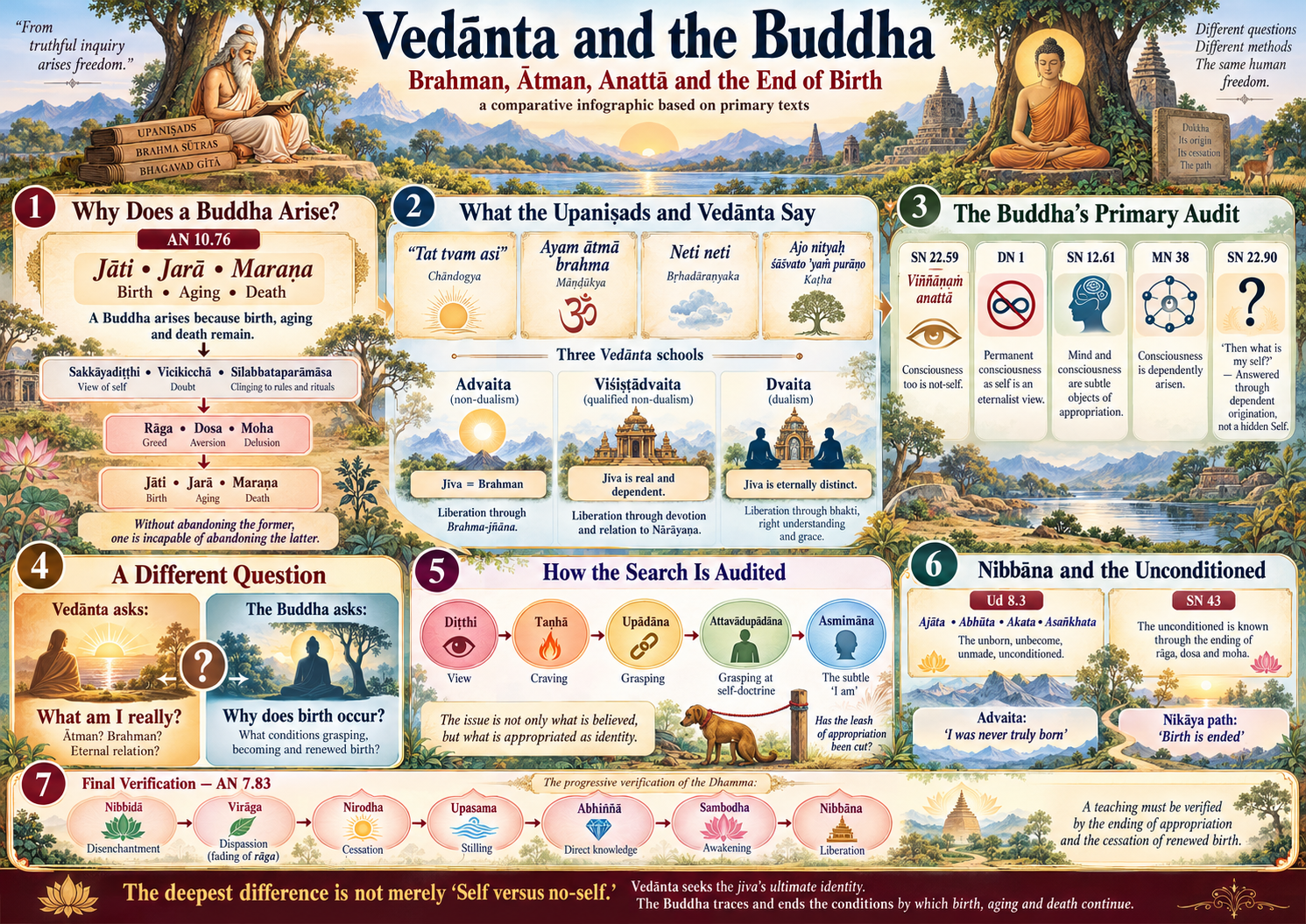 VISUAL SUMMARYSee this study in a pictureOpen the complete infographic for a visual overview before or after reading the full study.View infographic →
Why Does a Buddha Arise?
Discussions comparing Vedānta and the Buddha frequently begin with an attractive proposition: perhaps they ultimately taught the same realization.
The comparison initially seems plausible. The Upaniṣads speak of an unborn and immortal Self. Advaita speaks about nondual consciousness. The Buddha speaks about the unborn and unconditioned.
Advaita says ordinary body-mind identity is mistaken. The Buddha tells us not to regard form, feeling, perception, formations or consciousness as self.
Advaita uses neti neti—“not this, not this.” Buddhism teaches anattā. Advaita speaks of nonduality. Madhyamaka rejects reified extremes. Later Mahāyāna traditions sometimes use language concerning luminous mind or Buddha-nature that can sound surprisingly close to Vedāntic language.
But comparison becomes unreliable if we begin merely by matching attractive words such as “unborn,” “awareness,” “nondual,” “emptiness,” “Self,” or “ultimate reality.”
The Buddha gives us a different starting point.
KEY POINT 1 · WHY A BUDDHA ARISES
AN 10.76 begins with jāti, jarā and maraṇa
Birth, aging and death are the problem identified by the Buddha. The inquiry begins with renewed birth—not with establishing an eternal Absolute.
Birth, Aging and Death Are Why a Buddha Arises
Tayome, bhikkhave, dhammā loke na saṁvijjeyyuṁ, na tathāgato loke uppajjeyya arahaṁ sammāsambuddho…
Katame tayo? Jāti ca jarā ca maraṇañca.
If these three things were not found in the world, a Tathāgata, an Arahant, a Sammāsambuddha would not arise in the world.
What three? Birth, aging and death.
This changes the direction of the entire Vedānta–Buddha comparison.
The Buddha does not say that a Sammāsambuddha appears because beings have forgotten that they are Brahman. Nor does he say that humanity needs a Buddha because it has lost knowledge of an eternal consciousness-substratum.
He identifies the central problem as: jāti, jarā and maraṇa.
The discourse then presents a long prerequisite or abandonment architecture. Without abandoning one obstructive set, one is incapable of abandoning the next.
The repeated logic is: X appahāya abhabbo Y pahātuṁ — without abandoning X, one is incapable of abandoning Y.
This should not be confused with saying that every triplet in AN 10.76 is a formal paccaya link in precisely the same technical sense as the twelve-link dependent-origination formula.
AN 10.76 is better understood as a prerequisite/abandonment architecture of cultivation.
↗ Further Study · Opens in a New Tab
Study AN 10.76 — Tayodhammasutta in Full
AN 10.76 provides the central framework for this article. For the complete Tayodhammasutta study, translation and detailed explanation:
AN 10.76 — Tayodhammasutta | Dhamma Essence ↗
For the primary Pāli text and parallel study resource:
What Does Tathāgata Mean?
AN 10.76 does not merely say that “a Buddha” appears. Its wording is: na tathāgato loke uppajjeyya arahaṁ sammāsambuddho — if birth, aging and death were not found in the world, a Tathāgata, an Arahant, a Sammāsambuddha would not arise in the world.
Because this essay compares the Buddha with the Upaniṣads and Vedānta, the title Tathāgata requires careful explanation. Otherwise a reader can easily import into it an idea the early discourses do not supply: an eternal Self, a cosmic consciousness, Brahman, or a hidden metaphysical essence behind the five aggregates.
The early Nikāyas point in a different direction. The title is connected with awakening, direct understanding, abandonment, realization, truthfulness, consistency of speech and conduct, and freedom from the world through non-attachment.
A Lexical Caution — Tathāgata Is Not Tat Tvam Asi
The words can sound deceptively similar to someone approaching the Dhamma through Vedānta, but they are not the same expression.
In tat tvam asi, tat means “That.” The Chāndogya formula identifies the student with the ultimate reality being discussed: “You are That.”
In Tathāgata, the relevant word is tathā — “thus,” “so,” “in that way,” and in the canonical explanation, what is thus and not otherwise.
The compound has historically been parsed in more than one way, including tathā + gata, “thus-gone,” and by traditional interpretation tathā + āgata, “thus-come.” The early discourses themselves, however, give us a safer guide than forcing one speculative dictionary derivation: AN 4.23 repeatedly explains why he is called Tathāgata.
The important point for this essay is therefore: Tathāgata is not an Upaniṣadic identity formula. It does not mean “one who has discovered that he is That,” nor is tathā another form of the Upaniṣadic tat.
AN 4.23 — The Canonical Explanation Begins with the World and Its Cessation
Loko, bhikkhave, tathāgatena abhisambuddho.
Lokasmā tathāgato visaṁyutto.
Lokasamudayo, bhikkhave, tathāgatena abhisambuddho.
Lokasamudayo tathāgatassa pahīno.
Lokanirodho, bhikkhave, tathāgatena abhisambuddho.
Lokanirodho tathāgatassa sacchikato.
Lokanirodhagāminī paṭipadā, bhikkhave, tathāgatena abhisambuddhā.
Lokanirodhagāminī paṭipadā tathāgatassa bhāvitā.
The world has been fully understood by the Tathāgata, and the Tathāgata is disentangled from the world.
The origin of the world has been fully understood, and its origin has been abandoned.
The cessation of the world has been fully understood, and that cessation has been directly realized.
The path leading to the cessation of the world has been fully understood, and that path has been developed.
These eight lines deserve to be read very slowly. They are not merely four descriptions of what the Tathāgata knows. Each pair has a deliberate structure. First comes abhisambuddho — what has been fully awakened to, penetrated and understood. Then comes a second verb describing what has actually been accomplished with respect to it: visaṁyutto, pahīno, sacchikato, bhāvitā.
This means AN 4.23 is not presenting four metaphysical propositions. It is presenting four completed tasks. The Tathāgata does not merely possess correct information about the world. He has completely understood it, become disentangled from it, abandoned its origin, directly realized its cessation, and cultivated the way leading to that cessation.
This closely parallels the fourfold practical structure familiar from the Four Noble Truths: something is to be fully understood, something abandoned, something directly realized, and something cultivated. The important point is that awakening is expressed through completed transformation, not merely through assent to a doctrine.
1. Loko Tathāgatena Abhisambuddho — “The World Has Been Fully Understood”
Loko, bhikkhave, tathāgatena abhisambuddho.
Abhisambuddho comes from the same awakening vocabulary as sambodhi and sammāsambuddha. It is much stronger than merely “having an opinion about” or “having intellectually concluded.” The sense is of fully awakening to, penetrating and comprehending something.
What, then, has been fully understood? Loka — the world. We should not immediately interpret this as merely the physical universe, planets or cosmology. AN 4.45 gives the important clarification that the Buddha declares the world, its origin, its cessation and the path to its cessation within this fathom-long body endowed with perception and mind. The end of the world cannot be reached simply by travelling through space, yet the ending of suffering cannot occur without reaching the end of this world.
SN 12.44 makes the meaning still more practical. At the eye and forms, eye-consciousness arises; their meeting is contact; with contact there is vedanā, the felt hedonic tone; from vedanā, taṇhā; from taṇhā, upādāna; from upādāna, bhava; from bhava, jāti; and with jāti, jarā-maraṇa and the whole mass of dukkha. The same structure is applied through all six sense doors.
Thus “understanding the world” means understanding the conditioned experiential process through which a world of I, mine, attraction, aversion, appropriation, becoming and renewed birth is constructed and sustained. This is very different from discovering a permanent metaphysical substance standing behind the world.
In Advaita, inquiry often moves from changing appearances toward the question: what is the changeless reality by which these appearances are known? AN 4.23 moves differently. It does not say: “the Tathāgata has discovered that the world is really Brahman.” It says: the world has been fully understood.
2. Lokasmā Tathāgato Visaṁyutto — “The Tathāgata Is Disentangled from the World”
Lokasmā tathāgato visaṁyutto.
Visaṁyutta carries the sense of being disconnected, disentangled, unbound or released from conjunction. The important contrast is not between “the world” and a second eternal substance existing somewhere outside it. The contrast is between being bound into the world-process and being free from that bondage.
This is why “disentangled from the world” should not be read as a spatial statement. The Tathāgata is not said to have travelled beyond the universe, nor to have migrated into another metaphysical realm. AN 4.45 explicitly rejects reaching the end of the world merely by travelling.
Nor does visaṁyutto mean that the awakened person no longer sees forms, hears sounds, experiences vedanā or uses the six sense bases. While alive, the aggregates and sense processes continue. What has ended is the bondage created through ignorance, craving, appropriation and becoming.
This gives us an important contrast with Advaita. Advaita ultimately says that the deepest Self is not other than Brahman. AN 4.23 does not say that the Tathāgata becomes identical with the world, with an underlying Absolute, or with a universal consciousness. It says he is visaṁyutta — disentangled from the world.
3. Lokasamudayo Abhisambuddho — “The Origin of the World Has Been Fully Understood”
Lokasamudayo, bhikkhave, tathāgatena abhisambuddho.
Samudaya is arising, origination, coming into being or the condition through which something is generated. Once again the Buddha’s question is causal rather than substantival: How does this world arise?
SN 12.44 supplies a direct answer. With the sense base and its object, consciousness arises. With the meeting of these comes contact. Contact conditions vedanā; vedanā conditions taṇhā; taṇhā conditions upādāna; upādāna conditions bhava; bhava conditions jāti; and from jāti come aging, death and the mass of suffering.
The “origin of the world” therefore cannot be reduced to a theory about the first creation of the physical cosmos. It is the presently observable process through which the lived world of attachment and becoming is repeatedly generated.
This also protects us from confusing Buddhist samudaya with an Upaniṣadic search for a first ontological source such as Brahman. The Buddha’s concern here is not: “From what ultimate substance did everything emerge?” It is: “Dependent upon what does this field of appropriation, becoming, birth and dukkha arise?”
4. Lokasamudayo Tathāgatassa Pahīno — “The Origin of the World Has Been Abandoned”
Lokasamudayo tathāgatassa pahīno.
This second sentence is indispensable. It prevents us from reducing awakening to correct causal knowledge.
Pahīna means abandoned, given up, removed. The Tathāgata not only knows how the world arises; the origin that sustains the bondage of that world has been abandoned in him.
SN 12.44 places the critical turning point at the complete fading and cessation of taṇhā. With the cessation of taṇhā, upādāna ceases; with the cessation of upādāna, bhava ceases; with the cessation of bhava, jāti ceases; and therefore jarā-maraṇa and the entire mass of dukkha cease.
AN 10.76 complements this by showing the cultivation required for the complete abandonment of rāga, dosa and moha, without which birth, aging and death cannot finally be abandoned.
Thus pahīno is experiential and ethical, not merely theoretical. One may understand dependent origination as a doctrine and still continue to crave, appropriate, become angry, defend identity and generate bhava. In such a case the origin has been described, but it has not yet been pahīna — abandoned.
This also marks a major difference from the Advaita claim that bondage is fundamentally removed by knowledge of one’s identity as Brahman. The Buddha’s test is not simply whether the correct ultimate identity has been known. The test is whether the causes that generate appropriation and renewed becoming have actually been abandoned.
5. Lokanirodho Abhisambuddho — “The Cessation of the World Has Been Fully Understood”
Lokanirodho, bhikkhave, tathāgatena abhisambuddho.
Nirodha is cessation, ending, stopping or the coming to an end of the conditioned process. It does not require the destruction of a cosmic substance, because the “world” under discussion is already being analyzed through conditional arising.
If a process arises because conditions are present, its cessation is understood by seeing what occurs when the relevant conditions no longer operate. This is why SN 12.44 explains the disappearance of the world through the cessation of taṇhā, upādāna, bhava, jāti and finally the mass of dukkha.
Nirodha therefore does not mean that the awakened person discovers a second, more real universe hidden behind the first. Nor does it mean that the changing world is finally recognized as merely Brahman under another name. It means that the causal process producing bondage is capable of ending.
This is also why Nibbāna cannot simply be inferred to be Brahman merely because both are described with language such as unborn, peaceful or unconditioned. Within the Nikāya architecture, cessation is tied to the ending of the conditions that sustain craving, grasping, becoming and renewed birth.
6. Lokanirodho Tathāgatassa Sacchikato — “The Cessation Has Been Directly Realized”
Lokanirodho tathāgatassa sacchikato.
Sacchikata is much stronger than accepting something by reasoning, scripture or confidence. It means directly realized, made manifest or personally verified.
This is a crucial distinction. The Buddha is not saying: “I have concluded that cessation must logically exist.” He is saying that cessation has been sacchikata — directly realized.
The contrast with speculative metaphysics is therefore sharp. A doctrine may assert an eternal reality, defend it logically and interpret scripture in its support. AN 4.23 instead places emphasis upon a cessation that has been directly realized through the ending of the conditions of bondage.
The language also accords with the Buddha’s repeated insistence that liberation is to be known for oneself. The ending of craving, grasping and becoming cannot be borrowed from a teacher’s realization or obtained merely by accepting a philosophical conclusion.
7. Lokanirodhagāminī Paṭipadā Abhisambuddhā — “The Way to Cessation Has Been Fully Understood”
Lokanirodhagāminī paṭipadā, bhikkhave, tathāgatena abhisambuddhā.
Paṭipadā is a way of practice, course of training or mode of proceeding. Lokanirodhagāminī means “going to,” “leading to,” or “conductive to” the cessation of the world.
This again prevents a purely philosophical reading of awakening. There is a way that must actually be walked. The Tathāgata has fully awakened to that way.
Elsewhere this is expressed through the Noble Eightfold Path and through the gradual training: sīla, indriya-saṁvara, sati-sampajañña, abandoning the hindrances, samatha and jhāna, and the development of liberating paññā. AN 10.76 adds another practical architecture by showing what must be abandoned before deeper abandonments become possible.
The point is important in comparison with Vedānta. Advaita itself has serious disciplines such as śravaṇa, manana and nididhyāsana and should not be caricatured as mere intellectual speculation. Nevertheless its liberating culmination is knowledge of Ātman-Brahman identity. The Nikāya path is evaluated by whether cultivation actually brings about the ending of taṇhā, upādāna, bhava, rāga, dosa, moha and renewed jāti.
8. Lokanirodhagāminī Paṭipadā Tathāgatassa Bhāvitā — “The Path Has Been Cultivated”
Lokanirodhagāminī paṭipadā tathāgatassa bhāvitā.
The final word, bhāvitā, is especially important. It comes from the language of bhāvanā — cultivation, development, bringing something into being through repeated practice.
The Buddha does not merely say that the path is known. It has been bhāvitā — cultivated, developed, made much of in lived practice.
This is why the Dhamma cannot be reduced to a correct metaphysical belief. One may know the vocabulary of anicca, dukkha, anattā, dependent origination and Nibbāna while still failing to cultivate the path that transforms conduct, sense restraint, sati, sampajañña, citta and paññā.
In this single word bhāvitā, AN 4.23 protects the entire teaching from becoming merely philosophical. The Tathāgata is one for whom the path to cessation has not only been described or understood: it has been fully cultivated.
Why Is Abhisambuddho Repeated Four Times?
The repetition is meaningful. The Buddha does not merely understand one final “ultimate reality” and then reinterpret everything else through it. He fully understands four distinct dimensions: the world, its arising, its cessation, and the way leading to its cessation.
But understanding each dimension is not enough by itself. The accompanying verbs disclose the completed work:
| AN 4.23 phrase | What is known | What is completed | Practical meaning |
|---|---|---|---|
| loko … abhisambuddho | The world is fully understood | visaṁyutto | The Tathāgata is disentangled from it |
| lokasamudayo … abhisambuddho | Its origin is fully understood | pahīno | The origin has been abandoned |
| lokanirodho … abhisambuddho | Its cessation is fully understood | sacchikato | Cessation has been directly realized |
| lokanirodhagāminī paṭipadā … abhisambuddhā | The way to cessation is fully understood | bhāvitā | The path has been cultivated |
SN 12.20 — The Tathāgata Is Not the Cosmic Principle He Discovers
Uppādā vā tathāgatānaṁ anuppādā vā tathāgatānaṁ, ṭhitāva sā dhātu dhammaṭṭhitatā dhammaniyāmatā idappaccayatā.
SN 12.20 adds a decisive clarification. Whether Tathāgatas arise or do not arise, the principle of conditionality remains: dhammaṭṭhitatā, dhammaniyāmatā, idappaccayatā — the stability of Dhamma, the regularity of Dhamma, specific conditionality.
The Tathāgata awakens to it and penetrates it, and having done so explains, teaches, analyzes and makes it clear.
This is extremely important in comparison with Brahman. The Tathāgata is not being identified with the ontological ground of the universe. The principle of conditionality is said to obtain whether a Tathāgata appears or not. The Tathāgata is the one who awakens to it completely and teaches the path by which bondage to the conditioned process ends.
Thus the relationship is not: Tathāgata = Brahman = ultimate substance.
It is: conditionality remains → a Tathāgata awakens to it → he explains arising and cessation → he develops the path completely → he becomes disentangled from the world generated through craving and grasping.
AN 4.45 — “World” Is Not Something to Escape by Travelling Elsewhere
Rohitassa asks whether the end of the world can be reached by travelling to some place where there is no birth, aging, death, passing away or rebirth. The Buddha says no.
Yet he immediately adds that there is no ending of dukkha without reaching the end of the world. He then says that in this fathom-long body, together with perception and mind, he declares the world, its origin, its cessation and the way leading to its cessation.
This makes the meaning of AN 4.23 much harder to misunderstand. Loka is not being treated merely as an external physical cosmos from which one must escape. The field in which the problem is to be understood is this lived psycho-physical process of sense experience, perception, mind, craving, grasping and becoming.
Therefore lokasmā tathāgato visaṁyutto does not mean that the Tathāgata has moved to the far side of the universe. It means the bondage through which that world becomes appropriated and perpetuated has ended.
AN 4.23 and Advaita — The Difference Is in the Direction of the Inquiry
| AN 4.23 | Early Nikāya direction | Advaita direction |
|---|---|---|
| Loko abhisambuddho | Fully understand the conditioned world-process | Discern the changeless reality underlying changing appearance |
| Lokasmā visaṁyutto | Become disentangled from bondage to the world | Realize that the true Self is Brahman, not the finite world-person |
| Lokasamudayo pahīno | Abandon the causes generating appropriation and becoming | Remove ignorance of Ātman-Brahman identity |
| Lokanirodho sacchikato | Directly realize cessation of the conditioned bondage-process | Realize Brahman as ever-present reality |
| Paṭipadā bhāvitā | Cultivate the path that ends craving, grasping, becoming and birth | Discipline culminates in liberating knowledge of true identity |
This comparison should not be used to caricature Advaita. Advaita has its own disciplined path and does not simply advocate repeating “I am Brahman.” The difference is more fundamental: what is the liberating knowledge finally knowledge of?
Advaita answers: the true Self is Brahman.
AN 4.23 answers through another architecture: the world is understood, its origin abandoned, its cessation directly realized, the way to cessation cultivated, and the Tathāgata is disentangled from the world.
This is why these eight lines belong at the center of the present essay. They show that the title Tathāgata is inseparable from understanding conditionality, abandoning the causes of bondage, realizing cessation and cultivating the path. It should not be converted into another name for the Upaniṣadic Self or Advaitic Brahman.
What Is “the World” in This Early Buddhist Framework?
AN 4.23 speaks of understanding the world, its origin, its cessation and the path to its cessation. SN 12.44 helps clarify how the early Nikāyas analyze the arising of the world without positing a metaphysical substratum behind it.
Cakkhuñca paṭicca rūpe ca uppajjati cakkhuviññāṇaṁ.
Tiṇṇaṁ saṅgati phasso.
Phassapaccayā vedanā;
vedanāpaccayā taṇhā;
taṇhāpaccayā upādānaṁ;
upādānapaccayā bhavo;
bhavapaccayā jāti;
jātipaccayā jarāmaraṇaṁ sokaparidevadukkhadomanassupāyāsā sambhavanti.
Ayaṁ kho, bhikkhave, lokassa samudayo.
Dependent on the eye and forms, eye-consciousness arises. The meeting of the three is contact. With contact as condition there is feeling; with feeling as condition, craving; with craving as condition, grasping; with grasping as condition, becoming; with becoming as condition, birth; and with birth as condition, aging and death, sorrow, lamentation, pain, sadness and distress arise.
This is called the origin of the world.
SN 12.44 repeats the corresponding structure through the six sense doors. The point is not that the world is an illusion projected upon an eternal Brahman-substratum. The Buddha analyzes how the experienced world of appropriation, craving, becoming and birth is conditionally generated.
Its ending is likewise explained through cessation of those conditions. The question becomes: What is feeding the arising of this world, and what happens when that fuel is removed?
Tathāgata Also Carries the Sense of “Thus, Not Otherwise”
Yaṁ, bhikkhave, sadevakassa lokassa samārakassa sabrahmakassa
sassamaṇabrāhmaṇiyā pajāya sadevamanussāya diṭṭhaṁ sutaṁ mutaṁ
viññātaṁ pattaṁ pariyesitaṁ anuvicaritaṁ manasā,
sabbaṁ taṁ tathāgatena abhisambuddhaṁ.
Tasmā “tathāgato”ti vuccati.
Whatever in this world is seen, heard, sensed, cognized, attained, sought or explored by the mind has been fully understood by the Tathāgata. Therefore he is called Tathāgata.
Yañca, bhikkhave, rattiṁ tathāgato anuttaraṁ sammāsambodhiṁ
abhisambujjhati, yañca rattiṁ anupādisesāya nibbānadhātuyā
parinibbāyati, yaṁ etasmiṁ antare bhāsati lapati niddisati,
sabbaṁ taṁ tatheva hoti no aññathā.
Tasmā “tathāgato”ti vuccati.
From the night of unsurpassed perfect awakening until final Nibbāna, what the Tathāgata speaks, says and explains is thus and not otherwise. Therefore he is called Tathāgata.
Here the canonical text itself links the title with tathā — thus, truly, not otherwise. The emphasis is not on discovering an eternal “That” behind experience, but on having penetrated things as they are and teaching in accordance with that realization.
He Acts as He Speaks and Speaks as He Acts
Yathāvādī, bhikkhave, tathāgato tathākārī,
yathākārī tathāvādī.
Iti yathāvādī tathākārī, yathākārī tathāvādī,
tasmā “tathāgato”ti vuccati.
As the Tathāgata speaks, so he acts; as he acts, so he speaks. Because his speech and conduct correspond, he is called Tathāgata.
This is especially important for the present essay. Tathāgata is not merely a metaphysical claim. The title includes complete correspondence between realization, teaching and conduct.
AN 10.76 makes the same practical demand upon the path: one cannot bypass conduct, restraint, receptivity, sati-sampajañña, wise attention and the abandonment of rāga, dosa and moha by adopting a philosophically impressive account of ultimate reality.
SN 22.86 — The Tathāgata Is Not a Hidden Self Behind the Aggregates
SN 22.86 becomes crucial when someone tries to reinterpret Tathāgata as an eternal inner essence comparable to Ātman or the Advaitic witness.
The Buddha asks Anurādha whether he regards form, feeling, perception, formations or consciousness as the Tathāgata. He answers no.
The Buddha then asks whether the Tathāgata should be regarded as existing in an aggregate or apart from an aggregate. Again the answer is no.
He further rejects taking the five aggregates together as the Tathāgata, and also rejects trying to define the Tathāgata as a mysterious entity stripped of the aggregates.
The discourse therefore does not perform the following move: “The aggregates are not the Tathāgata; therefore there must be an eternal witness behind them.”
Instead the Buddha concludes by returning to his central teaching: formerly and now, he makes known dukkha and the cessation of dukkha.
This does not mean that the Buddha is teaching annihilation. It means that the categories by which we attempt to seize a liberated person as a metaphysical entity have already imported the very appropriation the teaching is undoing.
MN 72 — After Death, Tathāgata Is Not Converted into an Eternal Ātman
MN 72 extends the point. Vacchagotta asks whether the Tathāgata after death exists, does not exist, both exists and does not exist, or neither exists nor does not exist.
The Buddha does not choose one of the four. He uses the simile of a fire that burns dependent upon fuel. When the fuel is exhausted, asking in which direction the fire “went” no longer applies.
This is particularly significant in comparison with Advaita. The Buddha does not answer the problem by saying: “The empirical person disappears, but the true Tathāgata remains eternally as Brahman.”
Nor does he say that the liberated one is annihilated. The conceptual framework of tracking an enduring entity through the four alternatives is itself rejected.
Tathāgata and Brahman Move in Different Directions
| Question | Upaniṣadic / Advaita direction | Tathāgata in the early Nikāyas |
|---|---|---|
| Central expression | tat tvam asi, ahaṁ brahmāsmi, ayam ātmā brahma | The world is understood; its origin abandoned; its cessation realized; the path developed |
| Meaning of liberation | Especially in Advaita, recognition of the true Self as Brahman | Ending of appropriation, defilement, grasping, becoming and renewed birth |
| Relation to the world | Brahman is the ultimate reality; the world is dependent appearance or mithyā in Advaita | The world, its arising and its cessation are understood conditionally; the Tathāgata is detached from it |
| Ultimate identity | The deepest identity is Ātman-Brahman | No hidden eternal identity is introduced after the aggregates are not appropriated as self |
| Consciousness | Pure consciousness can function as the unconditioned witness in Advaita | MN 38 analyzes consciousness as dependently arisen; the Tathāgata is not identified with viññāṇa |
| Truth-language | Brahman is ultimate reality or truth | In AN 4.23, what the Tathāgata teaches is tatheva, no aññathā — thus, not otherwise; speech and action correspond |
| After death | The true Self is unborn and therefore not destroyed with the body | MN 72 refuses all four propositions about the Tathāgata after death; no eternal Ātman is inserted as the answer |
| Historical arising | Brahman in Advaita is not something newly produced in history | AN 10.76 says a Tathāgata arises in the world because birth, aging and death are present |
A Particularly Important Difference — Brahman Does Not “Arise,” a Tathāgata Does
AN 10.76 says: tathāgato loke uppajjati — a Tathāgata arises in the world.
This does not mean that an eternal Tathāgata-substance suddenly comes into existence. It means that in a world where birth, aging and death remain, a perfectly awakened Buddha appears, discovers the path and makes the Dhamma-Vinaya shine.
In Advaita, Brahman is precisely not an event that arises in history. Brahman is held to be the ever-present ultimate reality.
The two concepts therefore occupy different logical roles: Brahman is the asserted ultimate reality; Tathāgata is a title of the awakened one who has fully understood the world, abandoned its origin, realized its cessation and developed the path.
The Upaniṣadic and Advaita question tends toward: What is the eternal reality that I truly am?
The canonical explanation of Tathāgata tends toward: What has been fully understood, what has been abandoned, what has been realized, what path has been developed, and has the process producing dukkha and renewed birth actually ended?
Tathāgata therefore should not be translated conceptually into “Brahman-realized Self,” “cosmic consciousness,” or “the eternal witness.” Those are conclusions imported from another philosophical architecture.
↗ Primary Canonical Sources · Open in a New Tab
Read the Tathāgata Passages in Context
AN 4.23 — Lokasutta: canonical explanations of Tathāgata ↗
Iti 112 — parallel Tathāgata explanation ↗
SN 12.20 — conditionality remains whether Tathāgatas arise or not ↗
SN 12.44 — arising and cessation of the world ↗
AN 4.45 — the world, its origin, cessation and path in this fathom-long body ↗
KEY POINT 2 · APPLY THE TEACHING INWARDLY
AN 10.76 must first be applied to our own practice
A Buddhist label does not itself remove rāga, dosa, moha, lack of restraint, difficulty accepting correction, or subtle identity-making.
AN 10.76 Must Audit Buddhists First
A Buddhist may repeatedly say: “there is no self.”
But if criticism produces anger, difficulty accepting correction remains. If one delights in attacking other traditions, a fault-finding mind may remain. If restraint is weak, asaṁvara remains.
If sati and sampajañña are weak, repeating the word anattā does not compensate.
If intellectual knowledge of Buddhism becomes a new basis for superiority, the subtle “I am” orientation may remain strong.
The Buddhist label bypasses nothing.
The central question is not: Which religious team wins?
It is: What has actually been abandoned?
Deep Dive Why Does a Buddha Arise? — AN 10.76 and the Architecture for Ending Birth
When people compare the Buddha with Vedānta, the discussion usually begins too late. It begins with questions such as: Is there a Self? Is the Self Brahman? Did the Buddha deny Ātman? Is Nibbāna another name for Brahman? Is consciousness ultimately nondual? Did the Buddha merely reject the ego while leaving a deeper witnessing Self untouched?
These are legitimate comparative questions. But AN 10.76 gives a much more fundamental starting point: Why is a Buddha needed at all?
The opening of AN 10.76
Tayome, bhikkhave, dhammā loke na saṁvijjeyyuṁ, na tathāgato loke uppajjeyya arahaṁ sammāsambuddho, na tathāgatappavedito dhammavinayo loke dibbeyya.
Katame tayo? Jāti ca, jarā ca, maraṇañca.
Yasmā ca kho, bhikkhave, ime tayo dhammā loke saṁvijjanti tasmā tathāgato loke uppajjati arahaṁ sammāsambuddho, tasmā tathāgatappavedito dhammavinayo loke dibbati.
If birth, aging and death were not found in the world, the Tathāgata, Arahant, Sammāsambuddha would not arise and his Dhamma-Vinaya would not shine in the world. But because birth, aging and death are found, a Buddha arises.
The fundamental Buddhist question therefore is not merely: “What am I ultimately?” It is: “Why does birth continue, and what must be abandoned so that birth, aging and death can finally be abandoned?”
MN 26 confirms the same orientation
MN 26 distinguishes anariyapariyesanā, ignoble search, from ariyapariyesanā, noble search. Being subject to birth, the Bodhisatta sees the danger in what is itself subject to birth and seeks the unborn. Being subject to aging, sickness and death, he seeks freedom from aging, sickness and death.
This immediately corrects the crude claim that all searching is craving. DN 15 can place search downstream from taṇhā, but MN 26 explicitly recognizes noble search. The real question is what is being sought, why it is being sought, and whether the search perpetuates appropriation or leads to its cessation.
AN 10.76 does not jump from philosophy to liberation
After identifying birth, aging and death as the problem, the Buddha does not say: “Understand anattā intellectually and the work is finished.” Instead he gives a prerequisite architecture of abandonment.
Its recurring structure is: X appahāya abhabbo Y pahātuṁ — without abandoning X, one is incapable of abandoning Y.
This is why AN 10.76 should not be confused with the formal twelve-link dependent-origination formula. Its controlling language is abhabbo / bhabbo — incapable / capable — and pahātuṁ — to abandon.
Rāga, dosa and moha → jāti, jarā and maraṇa
Rāgaṁ appahāya, dosaṁ appahāya, mohaṁ appahāya… abhabbo jātiṁ pahātuṁ jaraṁ pahātuṁ maraṇaṁ pahātuṁ.
Immediately upstream of the ending of birth stand rāga, dosa and moha.
Rāga should not be reduced merely to crude greed. It includes passion, colouring, attraction and attachment. Dosa is aversion and ill will. Moha is delusion or not seeing clearly.
The ending of birth is therefore not presented as acquiring a satisfying metaphysical proposition. The transformation must reach the affective and cognitive roots through which experience is appropriated.
The first three fetters → rāga, dosa and moha
Sakkāyadiṭṭhiṁ appahāya, vicikicchaṁ appahāya, sīlabbataparāmāsaṁ appahāya… abhabbo rāgaṁ pahātuṁ dosaṁ pahātuṁ mohaṁ pahātuṁ.
This should not be read as saying that a stream-enterer instantly has no trace of rāga or dosa. The discourse makes a prerequisite claim: without abandoning the first three fetters, complete abandonment of the deeper roots cannot be accomplished.
The importance of sakkāyadiṭṭhi becomes especially clear in MN 44. Self-view is not merely “I am the body.” Self can be placed as owner, container, possessor or deeper reality behind the aggregates.
Unwise attention → identity-view
Ayonisomanasikāraṁ appahāya, kummaggasevanaṁ appahāya, cetaso līnattaṁ appahāya…
AN 10.76 places ayoniso manasikāra upstream of identity-view. This means sakkāyadiṭṭhi is not merely an accidental philosophical mistake. A way of attending nourishes it.
MN 2 shows how attention can repeatedly revolve around: Was I in the past? What was I? Will I exist? What will I become? What am I? How am I?
The Buddha’s alternative repeatedly turns attention toward: what does this depend upon, how does it arise, and what happens when its conditions cease?
Loss of sati and sampajañña → unwise attention
Muṭṭhassaccaṁ appahāya, asampajaññaṁ appahāya, cetaso vikkhepaṁ appahāya…
Before the discourse reaches identity-view, it has already brought us to sati, sampajañña and the condition of the citta. If mindfulness is repeatedly lost, clear comprehension is absent and the mind is scattered, wise attention becomes difficult.
MN 39 and MN 107 reinforce this gradual training. Sati-sampajañña operates while walking, standing, sitting, lying down, waking, speaking and remaining silent. Bhāvanā therefore cannot be confined to a formal sitting period.
Fault-finding and resistance to noble Dhamma
Ariyānaṁ adassanakamyataṁ appahāya, ariyadhammassa asotukamyataṁ appahāya, upārambhacittataṁ appahāya…
Upārambhacittatā, the fault-finding mind, is not the same as careful verification. Verification seeks to understand whether something agrees with Dhamma and Vinaya. Fault-finding listens primarily in order to attack.
Uddhacca, asaṁvara and dussīlya
AN 10.76 places restlessness, lack of restraint and unethical conduct upstream of unwillingness to receive noble guidance.
Indriya-saṁvara protects the mind from being repeatedly seized by features and details that feed attraction and aversion.
Assaddhiya, avadaññutā and kosajja
Lack of confidence, lack of generosity and laziness support restlessness, non-restraint and poor conduct.
Saddhā need not mean blind belief. It is enough confidence to enter the training and test it. Cāga loosens the grip of “mine.”
Anādariya, dovacassatā and pāpamittatā
Disrespect, difficulty accepting admonition and bad friendship lie still further upstream.
Dovacassatā is especially practical. One may know hundreds of suttas and still be almost impossible to correct. Its opposite, suvaco, is being easy to speak to and receptive to instruction.
Ahirika, anottappa and pamāda
At the behavioural foundation are lack of moral conscience, lack of moral caution and heedlessness.
The path to the ending of birth therefore does not begin with an exotic mystical state. It begins with whether one cares about the consequences of what one is doing and what one is becoming.
The entire downward movement
Ahirikoyaṁ, bhikkhave, anottappī pamatto hoti… so pamatto samāno abhabbo anādariyaṁ pahātuṁ dovacassataṁ pahātuṁ pāpamittataṁ pahātuṁ…
…so vikkhittacitto samāno abhabbo ayonisomanasikāraṁ pahātuṁ kummaggasevanaṁ pahātuṁ cetaso līnattaṁ pahātuṁ…
…so vicikiccho samāno abhabbo rāgaṁ pahātuṁ dosaṁ pahātuṁ mohaṁ pahātuṁ; so rāgaṁ appahāya dosaṁ appahāya mohaṁ appahāya abhabbo jātiṁ pahātuṁ jaraṁ pahātuṁ maraṇaṁ pahātuṁ.
The path is not: philosophy → correct conclusion → liberation. It is an ecology of conduct, association, receptivity, energy, restraint, mindfulness, comprehension, attention, view and defilement.
The positive movement
The sutta then reverses the architecture.
Hirimāyaṁ, bhikkhave, ottappī appamatto hoti. So appamatto samāno bhabbo anādariyaṁ pahātuṁ dovacassataṁ pahātuṁ pāpamittataṁ pahātuṁ.
So kalyāṇamitto samāno bhabbo assaddhiyaṁ pahātuṁ avadaññutaṁ pahātuṁ kosajjaṁ pahātuṁ.
So āraddhaviriyo samāno bhabbo uddhaccaṁ pahātuṁ asaṁvaraṁ pahātuṁ dussīlyaṁ pahātuṁ.
So sīlavā samāno bhabbo ariyānaṁ adassanakamyataṁ pahātuṁ ariyadhammassa asotukamyataṁ pahātuṁ upārambhacittataṁ pahātuṁ.
So anupārambhacitto samāno bhabbo muṭṭhassaccaṁ pahātuṁ asampajaññaṁ pahātuṁ cetaso vikkhepaṁ pahātuṁ.
So avikkhittacitto samāno bhabbo ayonisomanasikāraṁ pahātuṁ kummaggasevanaṁ pahātuṁ cetaso līnattaṁ pahātuṁ.
So alīnacitto samāno bhabbo sakkāyadiṭṭhiṁ pahātuṁ vicikicchaṁ pahātuṁ sīlabbataparāmāsaṁ pahātuṁ.
So avicikiccho samāno bhabbo rāgaṁ pahātuṁ dosaṁ pahātuṁ mohaṁ pahātuṁ.
So rāgaṁ pahāya dosaṁ pahāya mohaṁ pahāya bhabbo jātiṁ pahātuṁ jaraṁ pahātuṁ maraṇaṁ pahātunti.
The positive side describes an embodied person: hirimā, ottappī, appamatto, kalyāṇamitto, āraddhaviriyo, sīlavā, anupārambhacitto, avikkhittacitto, alīnacitto, avicikiccho.
This is not merely a theory one possesses. It is what one has become through cultivation.
AN 10.76 and the gradual training
MN 39 and MN 107 reinforce the same practical direction: ethical conduct, sense restraint, moderation, wakefulness, sati-sampajañña, abandoning the hindrances, jhāna and liberating knowledge.
The practical architecture may therefore be summarized: sīla → indriya-saṁvara → sati-sampajañña → abandoning hindrances → samatha/jhāna → paññā/vipassanā → nibbidā → virāga → nirodha → vimutti.
This should not be mistaken for a quotation from one sutta. It is a synthesis of the gradual-training pattern.
Why this matters for the Vedānta comparison
Suppose someone says: “Liberation occurs when I understand that I am Brahman.” The Buddhist response need not ridicule the proposition.
AN 10.76 gives a more rigorous audit: Has heedlessness weakened? Has one become easier to correct? Has generosity increased? Has restraint grown? Is conduct purified? Are sati and sampajañña established? Is attention becoming wise? Is sakkāyadiṭṭhi being abandoned? Are rāga, dosa and moha actually ending? Is the machinery producing renewed birth being exhausted?
The sutta must audit Buddhists first
Someone may affirm sabbe dhammā anattā, quote SN 22.59 flawlessly and hold sophisticated opinions about Śaṅkara and Brahman while still being difficult to correct, angry under criticism, unrestrained, fault-finding and strongly invested in superiority.
In that case doctrinal correctness has not completed the training. The label “Buddhist” removes nothing by itself.
The governing question
AN 10.76 therefore gives us the compass for everything that follows.
Does the teaching culminate in establishing what one really is? Or does it illuminate and finally end the conditions by which “I,” “mine,” “my self,” “I am,” upādāna, bhava and renewed jāti continue?
The Buddha arises because jāti, jarā and maraṇa remain. His path is a cultivated architecture of abandonment that reaches from heedfulness and conduct through restraint, sati-sampajañña and wise attention into the uprooting of identity-view, rāga, dosa and moha, and finally the ending of renewed birth.
What Do the Upaniṣads and the Three Vedāntas Actually Teach?
A fair comparison requires us to hear the Upaniṣadic and Vedāntic side in its own voice rather than reducing it to a modern slogan.
It also requires historical distinction. Neither “Vedānta” nor “Buddhism” is one timeless homogeneous doctrine.
| Historical layer | Representative developments |
|---|---|
| Early Upaniṣadic inquiry | Ātman, Brahman, rebirth, liberation, inner seer/knower |
| Early Nikāya Buddhism | anattā, paṭiccasamuppāda, six consciousnesses, Four Noble Truths |
| Later Buddhist philosophy | Abhidharma, Madhyamaka, Yogācāra, Tathāgatagarbha developments |
| Classical Vedānta | Gauḍapāda, Śaṅkara, Rāmānuja, Madhva |
The Buddha Entered an Existing Indian Spiritual Conversation
Ancient India already contained reflection upon kamma, rebirth, renunciation, ascetic discipline, self, death, cosmic order, contemplation and liberation.
But shared vocabulary does not require shared explanatory architecture.
Earlier Vedic karman has strong ritual and sacrificial associations. Upaniṣadic reflection increasingly connects action with destiny and rebirth.
The Buddha gives a decisive ethical-psychological formulation: cetanāhaṁ, bhikkhave, kammaṁ vadāmi — “Intention is what I call kamma.”
The same pattern occurs with rebirth. The Buddha retains rebirth while rejecting the need for an eternal transmigrating self to explain continuity.
The relationship is best expressed as: inheritance → engagement → critique → transformation.
The Upaniṣadic Self in Its Own Voice
01 Chāndogya Upaniṣad 6.8.7 — Tat Tvam Asi
tat satyaṁ sa ātmā tat tvam asi śvetaketo
“That is the Real; that is the Self; you are That, Śvetaketu.”
The direction is affirmative. Beneath multiplicity lies a subtle reality identified as sat and ātmā.
Śvetaketu is told: tat tvam asi — “You are That.”
02 Bṛhadāraṇyaka — The Unseen Seer and Unknown Knower
Bṛhadāraṇyaka speaks of an ultimate principle that is unseen yet the seer, unheard yet the hearer, and unknown yet the knower.
The central intuition is powerful: whatever is known is an object; the ultimate Knower cannot simply be one more known object.
03 Neti Neti
neti neti — “not this, not this.”
In Advaita interpretation, neti neti removes finite predication while preserving or revealing Ātman-Brahman.
Buddhist anattā contemplation moves differently: conditioned phenomena are not appropriated as mine, I or my self, leading to nibbidā → virāga → vimutti.
04 Kaṭha Upaniṣad 1.2.18 — The Unborn Eternal Self
ajo nityaḥ śāśvato’yaṁ purāṇo
na hanyate hanyamāne śarīre
The body dies; the true Self does not.
05 Māṇḍūkya — This Self Is Brahman
sarvaṁ hy etad brahma
ayam ātmā brahma
“All this is Brahman; this Self is Brahman.”
Māṇḍūkya examines waking, dreaming, deep sleep and the fourth, turīya, described as peaceful, auspicious and nondual.
KEY POINT 3 · TWO DIFFERENT DIRECTIONS
“You are That” and “not mine, not I, not my self”
Chāndogya: tat tvam asi — “You are That.”
SN 22.59: netaṁ mama, nesohamasmi, na meso attā —
“not mine, not I, not my self.”
The similarity of spiritual language should not hide the difference in direction.
Advaita, Viśiṣṭādvaita and Dvaita Do Not Agree About the Jīva
| School | Ultimate status of the jīva | Relation to Brahman/God |
|---|---|---|
| Advaita | Ultimately Brahman | Identity |
| Viśiṣṭādvaita | Eternally real dependent individual | Qualified unity/dependence within Nārāyaṇa |
| Dvaita | Eternally real individual | Permanent difference from Viṣṇu |
| Early Nikāya framework | No eternal jīva established through the aggregates | Liberation explained through cessation of appropriation and becoming |
Brahma Satyaṁ Jaganmithyā, Jīvo Brahmaiva Nāparaḥ
brahma satyaṁ jaganmithyā
jīvo brahmaiva nāparaḥ
The decisive clause is: jīvo brahmaiva nāparaḥ — the jīva is none other than Brahman.
The liberation problem is therefore ultimately one of mistaken identity.
Jaganmithyā Is Not the Same as Anicca
Advaita sees changing appearance and asks: what is the real substratum?
Buddhist anicca analysis does not require this move.
Advaita: appearance → underlying reality.
Nikāya analysis: condition → arising → continuation → cessation.
Deep Dive Ātman and Brahman — From the Upaniṣads to Advaita, Viśiṣṭādvaita and Dvaita
A fair comparison must allow Vedānta to speak in its own voice. It would be inadequate simply to say: “Vedānta teaches Self; Buddhism teaches no-self.” The Upaniṣads are layered texts, classical Vedānta arises much later, and Advaita, Viśiṣṭādvaita and Dvaita disagree profoundly about the jīva, Brahman and liberation.
The Upaniṣads are not one text written at one time
Bṛhadāraṇyaka and Chāndogya belong to the oldest Upaniṣadic prose strata. Kaṭha belongs to a later layer, while Māṇḍūkya is later still. Exact dates remain debated.
It is reasonable to say that the Buddha lived within a wider Indian environment where ideas concerning self, rebirth, kamma, renunciation and liberation circulated. It is much less responsible to assume he personally heard every later Upaniṣadic verse.
Chāndogya — tat tvam asi
tat satyaṁ sa ātmā tat tvam asi śvetaketo
“That is the Real; that is the Self; you are That, Śvetaketu.” The direction is affirmative.
The statement and Śaṅkara’s interpretation are not the same historical layer
Chāndogya is ancient. Śaṅkara’s systematized Advaita is centuries later. Rāmānuja and Madhva also interpret the same textual inheritance differently.
Bṛhadāraṇyaka — ahaṁ brahmāsmi
ahaṁ brahmāsmi
“I am Brahman.” Advaita does not understand this as the ordinary empirical ego becoming a cosmic super-person. It takes the finite ego to be a mistaken superimposition and the true Self to be Brahman.
The unseen seer and unknown knower
Bṛhadāraṇyaka also speaks of the unseen seer, unheard hearer, unthought thinker and unknown knower.
Whatever is known becomes an object. What about that by which objects are known? Can the final knower itself become one more known object?
Neti neti
Neti neti — “not this, not this” — can superficially resemble Buddhist disidentification.
But in Advaita the negation removes finite superimpositions while revealing or preserving Ātman-Brahman. Buddhist anattā contemplation moves toward non-appropriation, nibbidā and virāga without introducing a replacement ultimate Self.
Kaṭha — the unborn eternal Self
na jāyate mriyate vā vipaścin
ajo nityaḥ śāśvato’yaṁ purāṇo
na hanyate hanyamāne śarīre
The body is destroyed but the true Self is unborn and is not slain when the body dies.
Māṇḍūkya — ayam ātmā brahma
sarvaṁ hy etad brahma
ayam ātmā brahma
Māṇḍūkya examines waking, dream and deep sleep and then describes the fourth, turīya, as peaceful, auspicious and nondual.
The three-state argument
Waking changes. Dream changes. Ordinary subject-object cognition disappears in deep sleep. Yet afterwards one says, “I slept.”
Advaita asks what persists across these mutually exclusive states. Its answer is the underlying consciousness in whose presence these states arise and disappear.
Advaita Vedānta
Advaita’s central claim is: Ātman is Brahman. The true Self is not body, changing mind, biography or empirical ego. It is pure nondual consciousness.
Sākṣin — witness consciousness
The witness is not a tiny observer hidden inside the head. It is the unobjectifiable consciousness by which body, sensation, thought, memory, emotion, ego, waking, dream and deep sleep are known.
Mithyā does not mean nonexistent
Jaganmithyā should not be rendered simply as “the world does not exist.” The world functions empirically but does not possess the independent ultimate reality of Brahman.
This is why jaganmithyā ≠ anicca.
Māyā is not Buddhist impermanence
The rope-snake analogy expresses the Advaita structure: appearance is mistaken; substratum is real. Buddhist conditionality does not require a permanent metaphysical ground.
Advaita avidyā and Buddhist avijjā are not identical
Advaita avidyā hides the identity of Ātman and Brahman. Buddhist avijjā operates within another causal architecture involving dukkha, dependent arising and the Four Noble Truths.
Advaita liberation
If Ātman already is Brahman, liberation cannot produce Brahman. Mokṣa removes ignorance. The liberated person does not become Brahman; apparent separation is seen through.
This is why Advaita can coherently say: the true Self was never born.
Jīvanmukti
Advaita allows liberation while still alive. The body and mind continue functioning, but the liberated person no longer regards them as the true Self.
Viśiṣṭādvaita — Rāmānuja
Rāmānuja rejects Śaṅkara’s conclusion that individual persons and the world are finally sublated into featureless nondual Brahman.
Individuals are real. Difference is real. The world is real. Brahman is Nārāyaṇa possessing infinite auspicious qualities.
The body–soul relation
Individual souls and the world exist in complete dependence upon Brahman. Unity and difference are both preserved.
Dvaita — Madhva
Madhva goes further. Viṣṇu alone is fully independent. Jīvas and matter are dependent realities, but their difference from God is real and eternal.
The fivefold difference includes God–jīva, God–matter, jīva–jīva, jīva–matter and matter–matter.
Three Vedāntas, three answers
Advaita: the finite jīva is ultimately Brahman.
Viśiṣṭādvaita: the jīva is eternally real and completely dependent upon Brahman.
Dvaita: the jīva is eternally real and eternally distinct from Viṣṇu.
Brahmā is not Brahman
Buddhist texts often speak of Brahmā beings and Brahmā worlds. These are beings within saṁsāra and should not be automatically equated with philosophical Brahman.
The strongest question carried into Part III
The strongest Advaita challenge is: “You have shown that body, thoughts, feelings and empirical consciousness change. But every changing phenomenon is known. What is the knower of change? The final subject cannot be another object.”
The Buddha’s Primary-Text Audit of Self and Consciousness
The central question is not merely whether ordinary ego is rejected. It is what the Buddha says about consciousness, identity, grasping, the residual “I am,” and the question: “Then what is my self?”
Consciousness Is Included in Anattā
Rūpaṁ, bhikkhave, anattā.
Vedanā anattā.
Saññā anattā.
Saṅkhārā anattā.
Viññāṇaṁ anattā.
netaṁ mama, nesohamasmi, na meso attā
“This is not mine; I am not this; this is not my self.”
The Permanent Consciousness-Self Move Was Already Known
DN 1 describes a thinker who observes that the bodily senses are impermanent but concludes that what is called citta, mano, viññāṇa is the Self—permanent, stable, eternal and unchanging.
The Buddha places this within a form of partial eternalism.
Mind and Consciousness Can Be an Even More Seductive Self
Regarding what is called citta, mano and viññāṇa, disenchantment is difficult because these have long been grasped as: “This is mine, this I am, this is my self.”
The Buddha compares the process to a monkey letting go of one branch and taking hold of another.
The Same Consciousness Does Not Wander Through Saṁsāra
tadevidaṁ viññāṇaṁ sandhāvati saṁsarati, anaññaṁ
paṭiccasamuppannaṁ viññāṇaṁ
aññatra paccayā natthi viññāṇassa sambhavo
Consciousness Is Not an Independent Ground
viññāṇapaccayā nāmarūpaṁ
nāmarūpapaccayā viññāṇaṁ
SN 12.67 makes the relationship visual through two sheaves of reeds leaning against one another. Neither stands independently.
The Buddha Changes “Who?” Into “Dependent Upon What?”
phassapaccayā vedanā
The Buddha redirects questions such as “Who feels?” toward conditionality.
“What Am I?” Can Become a Thicket of Views
Under unwise attention the mind may revolve around: Was I? What was I? Will I exist? What will I become? Am I? Am I not? What am I? How am I?
Sakkāyadiṭṭhi Is More Than “I Am the Body”
Each aggregate may be regarded as self, as possessed by self, as contained in self, or as containing self. The same applies to consciousness.
The Four Forms of Upādāna
kāmupādānaṁ
diṭṭhupādānaṁ
sīlabbatupādānaṁ
attavādupādānaṁ
The Cosmic Eternal Self Is Also Within the Field of Examination
MN 22 includes a cosmic eternal-self view and shows how fear of annihilation can arise when relinquishment is taught.
Beyond “I Am This” to the Residual “I Am”
Explicit identity-view may fall while asmīti māna, the residual conceit “I am,” remains.
“Then What Is My Self?”
atha ko carahi me attā?
Channa has accepted the aggregates as impermanent and not-self, yet anxiety arises: “Then what is my self?” The response is dependent origination—not the introduction of a hidden witness.
KEY POINT 4 · CHANNA’S DECISIVE QUESTION
“Then what is my self?”
In SN 22.90, the response is dependent origination— not the introduction of a hidden witness beyond the five aggregates.
Even Oneness and Nibbāna Can Become Fields of Conceiving
MN 1 analyzes maññanā—conceiving, construing and appropriation. Its field includes Brahmā, oneness, the All and Nibbāna.
The Dog Tied to the Post
The object of identity can become increasingly subtle and expansive. The Buddhist question remains: Has the leash of appropriation actually been cut?
Deep Dive What Does the Buddha Actually Say About Self and Consciousness?
The strongest Advaita position does not require the body, personality, memories or ordinary ego to be eternal. The claim is that whatever changes is known and therefore the final Knower cannot itself be another changing object.
Anattā should not be reduced to “there is no self”
The Buddha repeatedly works with: “not mine, not I, not my self.” He analyzes self-view, self-doctrine grasping, conceiving and residual “I am.”
DN 1 — permanent mind-consciousness as Self
DN 1 describes a thinker who sees bodily faculties changing yet regards citta, mano or viññāṇa as permanent, stable, eternal and not subject to alteration.
DN 1 is not a historical refutation of eighth-century Śaṅkara. But it shows that the move from changing body to permanent inner mind-consciousness Self was already within the Buddhist field of views.
SN 22.59 — consciousness is included
Rūpaṁ anattā. Vedanā anattā. Saññā anattā. Saṅkhārā anattā. Viññāṇaṁ anattā.
netaṁ mama, nesohamasmi, na meso attā
The formula attacks ownership, identity and self-doctrine. The movement is: seeing correctly → nibbidā → virāga → vimutti → khīṇā jāti.
The mastery argument
SN 22.59 asks whether an alleged self possesses ultimate mastery. If consciousness were Self, one should be able to command it: let consciousness be thus and not otherwise.
The Advaita objection remains
A sophisticated Advaitin can still answer: “Aggregate viññāṇa is conditioned cognition. I agree it is not Self. I am referring to the awareness in whose presence all cognition appears.”
SN 12.61 — mind is especially seductive as Self
The Buddha says it would be better for an uninstructed person to take the four-element body as self than to take what is called citta, mano and viññāṇa as self.
The monkey-branch simile captures causal continuity without requiring an invariant substance.
MN 38 — Sāti’s transmigrating consciousness
tadevidaṁ viññāṇaṁ sandhāvati saṁsarati, anaññaṁ
Sāti claims the very same consciousness runs and wanders through saṁsāra.
paṭiccasamuppannaṁ viññāṇaṁ
aññatra paccayā natthi viññāṇassa sambhavo
The six conditioned consciousnesses
Eye and form condition eye-consciousness; ear and sound condition ear-consciousness; and so on through mind-consciousness.
The discourse does not insert one pure consciousness behind six temporary channels.
DN 15 and SN 12.67 — reciprocal conditionality
DN 15 gives: viññāṇapaccayā nāmarūpaṁ and nāmarūpapaccayā viññāṇaṁ.
SN 12.67 expresses this through two sheaves of reeds leaning against each other.
This is not modern materialism
The relevant claim is not that the brain alone produces consciousness. It is that viññāṇa is not presented as an independently existing Brahman-like substrate.
SN 12.12 — change the grammar of the question
Moḷiyaphagguna asks “Who contacts?”, “Who feels?”, “Who craves?” The Buddha asks instead: dependent upon what?
phassapaccayā vedanā
vedanāpaccayā taṇhā
taṇhāpaccayā upādānaṁ
MN 2 — what am I?
MN 2 shows how unwise attention can revolve around speculative identity: Was I? What was I? Will I be? What will I become? What am I? How am I?
It includes both “a self exists for me” and “no self exists for me” among possible views arising through unwise attention.
MN 44 — twenty modes of sakkāyadiṭṭhi
Each aggregate may be viewed as Self, as possessed by Self, as within Self, or as containing Self.
MN 11 — attavādupādāna
The four graspings are sensuality-grasping, view-grasping, rules-and-observances grasping and self-doctrine grasping.
This gives us a more precise vocabulary: diṭṭhi is a view, taṇhā affective thirst, upādāna appropriation, attavādupādāna self-doctrine grasping, and asmimāna residual “I am.”
Therefore “Brahman = bhavataṇhā” would be too crude.
MN 22 — cosmic eternal Self
MN 22 includes a cosmic eternal-self formulation and shows fear arising when relinquishment is taught.
SN 22.89 — residual asmī
Khemaka no longer regards an aggregate as “I am this,” yet the residual asmī remains.
Advaita moves from false finite “I” to limitless true “I.” SN 22.89 moves from “I am this” to residual “I am” and finally toward exhaustion of “I am.”
SN 22.90 — the decisive question
atha ko carahi me attā?
Channa expects the teaching to leave him with a true Self. Ānanda does not reveal a witness beyond the aggregates. He teaches dependent arising and dependent cessation.
MN 1 — maññanā
MN 1 examines conceiving and appropriation around earth, beings, Brahmā, oneness, diversity, the All and even Nibbāna.
Even an experience of oneness can become: “my realization” or “what I truly am.”
SN 22.99 — dog tied to the post
One may say: I am the body; I am the mind; I am consciousness; I am the witness; I am universal consciousness; I am Brahman.
The Buddhist question is not how large the identity becomes. It is whether appropriation has ended.
The cumulative case
The early Nikāyas do not merely reject body-self. They examine consciousness, self-doctrine, cosmic identity, residual “I am,” and the very grammar of “Who?” questions.
The cumulative direction is difficult to reconcile with the claim that the Buddha secretly taught an eternal Ātman identical with pure consciousness.
The Strongest Advaita Arguments
01 Does Knowing Require an Eternal Knower?
Whatever is known is an object. Advaita therefore asks whether the final subject can itself be one more object.
02 Deep Sleep
Waking changes, dream changes and ordinary subject-object cognition disappears in deep sleep. Advaita asks what provides continuity.
03 Memory and Continuity
The dispute is whether causal continuity is sufficient or whether memory requires an immutable subject.
Substratum Metaphysics and Paṭiccasamuppāda
Advaita asks what is finally independent. Early Buddhist conditionality explains the experiential field through relationships without requiring a Brahman-like consciousness substrate.
Search Is Not Automatically Craving
MN 26 distinguishes anariyapariyesanā from ariyapariyesanā. The issue is not whether one searches, but what is sought and where the search leads.
How Should the Search for Brahman Be Examined?
A metaphysical proposition is first a diṭṭhi. Grasping it can involve diṭṭhupādāna or attavādupādāna; craving for an eternal mode of being may involve bhavataṇhā; residual identity belongs to asmimāna.
The Buddha Does Not Choose Between “I Exist Forever” and “I Become Nothing”
Eternalism and annihilationism appear opposite, but both may revolve around: “What finally happens to me?”
The Buddhist path investigates appropriation around the entity itself.
Deep Dive The Strongest Advaita Case — Witness Consciousness, Self-Luminosity, Deep Sleep and Continuity
A philosophically serious Advaitin can reply: “You have analyzed everything that appears. You have not yet explained that to which it appears.”
Advaita does not defend an eternal ego
Śaṅkara does not teach that personality, biography, memory or empirical ego survive eternally unchanged. The essential Self is pure consciousness, ultimately identical with Brahman.
Dṛk and dṛśya — seer and seen
Whatever can be observed is not the ultimate observer. Body is observed. Sensations are observed. Thoughts are observed. Emotions and memories are observed. Even the ego can become observed.
What knows all these changes? Advaita answers: awareness itself.
The witness is not another object
Asking “show me the witness” may contain a category error. Whatever is shown becomes an object.
The self-evidence of consciousness
One can doubt a perception, memory or interpretation. But can consciousness be denied while the act of doubting is itself occurring?
Yet the Buddhist response must distinguish: consciousness is occurring from: consciousness is eternal, unconditioned and Brahman.
Svaprakāśa — self-luminosity
Advaita argues that awareness does not require another awareness to make it known.
Self-revealing and self-existing are different claims.
The crucial inference
Advaita moves from: consciousness is undeniable → consciousness is self-established → consciousness is unobjectifiable → pure consciousness is unconditioned Ātman-Brahman.
The Buddhist challenge asks which argument proves the later metaphysical steps.
Deep sleep
Māṇḍūkya distinguishes waking, dream and deep sleep. Advaita asks what continues when ordinary subject-object cognition disappears in deep sleep yet one later says: “I slept.”
The sophisticated argument says that absence of objects need not mean absence of consciousness.
The Buddhist response must remain modest
The Nikāyas do not develop Śaṅkara’s later theory of deep sleep. A later report of sleep establishes continuity but does not by itself prove one invariant eternal witness.
Memory
If I now remember something experienced years ago, how can the later subject remember an earlier experience unless the same subject persisted?
Anicca is not automatically later kṣaṇikavāda
The Nikāyas teach impermanence. Later Buddhist scholastic systems develop technical theories of momentariness.
Memory itself is a conditioned event
A present memory contains a representation of the past, associations and a sense of ownership. First-person grammar does not itself prove a numerically identical metaphysical Self endured unchanged.
Continuity versus identity
A river can continue while its water changes. A flame can continue while fuel changes.
Continuity does not automatically equal invariance.
Rebirth sharpens the problem
What crosses death? Sāti gives one intuitive answer in MN 38: the same consciousness. The Buddha explicitly rejects that solution.
Non-objectifiability does not equal unconditioned
Something may fail to appear as an external object without thereby being eternal, independent or Brahman.
Pabhassara citta and viññāṇaṁ anidassanaṁ
These passages deserve examination but neither should bear the burden of overturning the wider corpus.
The witness is powerful—but is it necessary?
Advaita elegantly explains immediacy, unity of experience, continuity, deep sleep, first-person subjectivity and regress.
The Buddhist question is whether conditioned processes can account for these phenomena without positing an eternal substratum.
Phenomenology versus ontology
Phenomenologically: awareness is present; experience has first-person character.
Advaita’s ontological conclusion is that this awareness is unconditioned, eternal, nondual and Brahman.
The Nikāya challenge concerns that inference.
The “I am” question returns
Even if awareness cannot be objectified, Advaita culminates in ahaṁ brahmāsmi.
SN 22.89 asks whether asmī itself has ended.
Later Buddhism, Vedānta Polemics and the Modern Nondual Debate
Which “Buddhism” Did Classical Vedānta Refute?
Classical Vedāntic polemics engage several distinct Buddhist positions, including Vaibhāṣika/Sarvāstivāda, Sautrāntika, Yogācāra and Madhyamaka.
A Historical Bridge Between Buddhist Debate and Advaita
Gauḍapāda uses concepts such as ajāti and asparśa-yoga. Buddhist philosophical interaction is significant, but resemblance does not make his final Advaita ontology Buddhist.
Śūnyatā Is Not Simple Nothingness
Madhyamaka critiques independently established svabhāva. Emptiness is not another substance standing behind phenomena.
Early Nikāya Suññatā
SN 35.85 calls the experiential world empty of attā and attaniya—self and what belongs to self. This should not automatically be equated with the complete later Madhyamaka system.
Later Buddhist Consciousness Theory Must Not Be Read Back Into MN 38
Yogācāra develops the three natures, mind-only approaches and ālayavijñāna. These are later Buddhist philosophical developments and should not be silently inserted into MN 38.
Why Later Buddhism Can Sound Much More Vedāntic
Later Buddha-nature traditions use strongly positive language about innate purity and awakening. Interpretations differ.
Swami Sarvapriyananda — A Careful Madhyamaka Comparison, but Is It the Buddha’s Original Framework?
Swami Sarvapriyananda deserves a careful treatment rather than either uncritical agreement or dismissal. He is one of the contemporary Advaita teachers who has taken Buddhist philosophy seriously and has attempted to present important Buddhist arguments before defending the Advaita position.
His 2023 study, “Chandrakirti’s Chariot: Self in Madhyamaka Buddhism and Advaita Vedanta”, tells us exactly which Buddhist framework is central to that comparison: Madhyamaka, particularly the Candrakīrti tradition. The study grew out of an Indo-Tibetan Madhyamaka course undertaken during his period at Harvard Divinity School. His later book Fullness & Emptiness: Vedanta and Buddhism continues the wider comparison between Vedānta and Buddhist philosophy.
↗ Further Study · Swami Sarvapriyananda · Opens in a New Tab
Read Sarvapriyananda’s Own Comparative Sources
Before proceeding to the Nikāya assessment below, readers are encouraged to examine Swami Sarvapriyananda’s own presentation of the Vedānta–Buddhism comparison. These two works make especially clear that his principal Buddhist interlocutor is Madhyamaka, particularly Candrakīrti.
2025 · Fullness & Emptiness: Vedanta and Buddhism
The official Vedanta Society of New York preview allows the reader to examine the book’s presentation directly before considering the comparison made here.
Read the Official Preview — Fullness & Emptiness ↗
2023 · Chandrakirti’s Chariot: Self in Madhyamaka Buddhism and Advaita Vedanta
This open-access paper directly places Candrakīrti’s Madhyamaka analysis of self in dialogue with Advaita Vedānta. It is therefore especially important for understanding exactly which form of Buddhism is being compared.
This is an important strength of his work. He does not merely dismiss Buddhism as nihilism. He takes the Madhyamaka critique of self seriously and asks whether the Advaitic Self can survive that critique.
But this is also exactly where historical precision becomes necessary. Candrakīrti is not Gotama Buddha, and Madhyamaka is not simply another name for the early Nikāya teaching.
Therefore, even if an Advaita argument successfully answers a particular Madhyamaka analysis, it does not follow that Advaita has thereby answered SN 22.59, MN 38, SN 22.89, SN 22.90, dependent origination or AN 10.76.
The Center of Gravity Has Shifted
Sarvapriyananda’s comparison naturally begins from an Advaita concern: What is the real Self? Body is known. Thought is known. Memory is known. The empirical ego can itself become an object of awareness. Advaita therefore asks what the unobjectifiable knower of all these changing objects is.
Candrakīrti becomes a powerful Buddhist interlocutor because his chariot analysis asks whether the person can ultimately be found as identical with the aggregates, different from them, possessing them, contained in them, containing them, merely their collection, or merely their configuration.
The Advaita response can then be: the true Self is not one more object among the aggregates; it is the sākṣin, the witnessing awareness in whose presence they are known.
That is a serious philosophical exchange. But it is already a debate framed by Advaita and later Madhyamaka categories.
The early Nikāya question has a different center of gravity: What is being appropriated as mine? What is being taken as I? What is being regarded as my self? What conditions taṇhā, upādāna and bhava? Why does another jāti occur?
AN 10.76 Provides a Different Starting Point
AN 10.76 does not say that a Sammāsambuddha appears because beings have forgotten their identity with an eternal Absolute. It says that if jāti, jarā and maraṇa were not found in the world, a Tathāgata, Arahant, Sammāsambuddha would not arise.
The problem identified by the Buddha is therefore not primarily: “Which metaphysical Self can withstand analysis?”
It is: “Why does birth continue, and what must be abandoned so that birth, aging and death can finally cease?”
SN 22.59 Is Not Merely a “No-Self Position”
A modern comparison can make Buddhism sound as though it simply advances the proposition “there is no self,” after which Advaita replies that body, thought and empirical consciousness are indeed not the Self, but the unobjectifiable witness remains.
SN 22.59 works differently. Form, feeling, perception, formations and consciousness are contemplated as:
netaṁ mama, nesohamasmi, na meso attā
“This is not mine; I am not this; this is not my self.”
The discourse does not then introduce a sixth entity and identify it as the true Self. It proceeds through nibbidā → virāga → vimutti → khīṇā jāti.
Anattā therefore operates within an abandonment process directed toward the ending of appropriation and renewed birth, not merely within an abstract debate over whether a Self can be philosophically established.
Channa’s Question Is Especially Important
SN 22.90 reaches a point remarkably close to the Advaita inquiry. Channa has understood that the aggregates are impermanent and not-self, but anxiety arises:
atha ko carahi me attā?
“Then what is my self?”
This is precisely where one might expect a hidden or transcendental witness to be revealed if that were the intended teaching.
But Ānanda does not introduce a sākṣin. He teaches dependent arising and dependent cessation.
MN 38 Makes the Consciousness Question Sharper
The sophisticated Advaita reply is that conditioned viññāṇa may indeed be not-self while pure awareness itself remains unconditioned.
But MN 38 explicitly rejects the idea that the same consciousness runs and wanders through saṁsāra and insists:
paṭiccasamuppannaṁ viññāṇaṁ
aññatra paccayā natthi viññāṇassa sambhavo
Consciousness is dependently arisen; apart from conditions there is no arising of consciousness.
The discourse then explains six condition-dependent consciousnesses. It does not add an eternal seventh witness-consciousness behind them.
Advaita may philosophically introduce the distinction between empirical consciousness and pure awareness, but that distinction should be recognized as an Advaitic proposal rather than silently inserted into MN 38.
SN 22.89 Goes Beyond “I Am This”
Khemaka no longer identifies any particular aggregate as “I am this.” Yet the subtle residual asmī — “I am” remains.
This matters because Advaita also rejects crude finite identity. It moves from “I am this body-mind” toward the ultimate affirmation ahaṁ brahmāsmi.
The early Nikāya trajectory continues examining even the residual orientation “I am.” This is a deeper distinction than merely asking whether the empirical ego is real.
“Fullness” and “Emptiness” Are Not the Earliest Buddhist Organizing Categories
The modern comparison between Vedāntic pūrṇam — fullness and Buddhist śūnyam — emptiness can be philosophically illuminating.
But it can also relocate the center of Buddhism into a later metaphysical comparison between fullness and emptiness.
The early Nikāyas are more characteristically organized around: dukkha and its cessation; dependent arising and dependent cessation; taṇhā and its abandonment; upādāna and its exhaustion; rāga, dosa and moha and their ending; bhava and its cessation; and the ending of renewed birth.
Madhyamaka śūnyatā is an important later development, but it should not become the sole lens through which the Buddha’s earlier teaching is retroactively read.
| Issue | Sarvapriyananda’s major comparative frame | Early Nikāya baseline |
|---|---|---|
| Main Buddhist interlocutor | Candrakīrti / Madhyamaka | Gotama Buddha’s early discourses must establish the baseline |
| Central self-question | Can a Self withstand Madhyamaka analysis? | What is appropriated as mine, I and my self, and how does appropriation cease? |
| Advaita response | The true Self is not an object among the aggregates but unobjectifiable awareness | SN 22.90 responds to “Then what is my self?” through dependent arising, not disclosure of a hidden witness |
| Consciousness | Empirical cognition may be distinguished from pure witness-consciousness | MN 38 emphasizes conditionally arisen consciousness and six condition-dependent consciousnesses |
| Anattā | Often approached through later Madhyamaka self-analysis | SN 22.59: not mine, not I, not my self → nibbidā → virāga → liberation → khīṇā jāti |
| Residual identity | Advaita culminates in Ātman-Brahman identity | SN 22.89 continues beyond “I am this” to residual asmī — “I am” |
| Primary problem | Ignorance of true Self in Advaita; self-reification in Madhyamaka | Jāti, jarā, maraṇa and the conditions sustaining renewed becoming |
| Liberating endpoint | Ātman-Brahman realization in Advaita | Exhaustion of rāga, dosa, moha, taṇhā, upādāna and bhava; no renewed birth |
Swami Sarvapriyananda’s work can provide a serious and valuable comparison of Advaita and Madhyamaka. The comparison becomes misplaced only when Madhyamaka is allowed to stand for the totality of what Gotama Buddha originally taught.
A response to Candrakīrti is not automatically a response to SN 22.59, MN 38, SN 22.89, SN 22.90, dependent origination and AN 10.76.
The early Nikāya audit asks not merely whether a Self can be defended philosophically, but whether maññanā, sakkāyadiṭṭhi, attavādupādāna, asmimāna, taṇhā, upādāna, bhava and renewed jāti actually come to an end.
Does the Advaita Self Escape the Chariot Analysis?
Even if the Advaitic witness is argued to escape a particular Madhyamaka analysis, it does not follow that Gotama Buddha taught that witness.
Do Any Buddhist Passages Teach Pure Eternal Consciousness?
Pabhassara citta and viññāṇaṁ anidassanaṁ deserve serious investigation, but neither should be used casually to override the wider Nikāya framework.
Deep Dive Which “Buddhism” Did Vedānta Actually Debate?
By the time Gauḍapāda and Śaṅkara appear, Indian Buddhism has already undergone centuries of philosophical development. “Buddhism” is no longer one single philosophical position.
The chronological problem
The early Nikāyas belong to the period of the Buddha and early transmission. Nāgārjuna appears centuries later. Yogācāra develops later again. Gauḍapāda and Śaṅkara enter an intellectual world already transformed by Buddhist philosophy.
Therefore a Vedāntic refutation of a Buddhist philosophical school cannot automatically be treated as a refutation of MN 38 or SN 22.59.
The familiar four Buddhist schools
Classical doxographies commonly organize Buddhist opponents as Vaibhāṣika/Sarvāstivāda, Sautrāntika, Yogācāra/Vijñānavāda and Madhyamaka.
Vaibhāṣika/Sarvāstivāda
Sarvāstivāda develops elaborate Abhidharma realism in which dharmas receive a stronger ontological role than one obtains simply by reading the early discourses.
Sautrāntika
Sautrāntika criticizes aspects of Vaibhāṣika and develops more radical momentariness and representational theories of perception.
This is why anicca and later kṣaṇikavāda must not be collapsed.
Vaibhāṣika and Sautrāntika are not Mahāyāna
The claim that classical Vedānta simply refuted “Mahāyāna Buddhism” is historically inaccurate.
Yogācāra
Yogācāra develops a far more elaborate consciousness theory than MN 38: mind-only or representation-only approaches, three natures, afflicted mind and ālayavijñāna.
Store consciousness helps later Buddhists explain karmic seeds, memory and continuity without an eternal Ātman.
Ālayavijñāna is not automatically Brahman
It functions in causal and karmic processes and undergoes transformation. It is not simply an unchanging universal Self.
Madhyamaka
Madhyamaka develops a radical critique of svabhāva, independently established intrinsic nature.
Śūnyatā therefore does not mean nothingness. But neither is emptiness an underlying metaphysical substance.
Advaya is not Advaita
Madhyamaka nonduality may concern freedom from reified conceptual extremes. Advaita nonduality means Ātman and Brahman are not two.
Candrakīrti
Candrakīrti’s chariot analysis asks whether the person is identical with, different from, possessing, contained in or containing the aggregates, or is merely their collection or arrangement.
The Advaita reply to Candrakīrti
Advaita can argue that pure awareness is not one item standing in any of Candrakīrti’s listed relations to the aggregates.
Even if that argument succeeds against the particular chariot analysis, it does not follow that the Buddha of the early Nikāyas taught Ātman.
Gauḍapāda
Gauḍapāda’s Māṇḍūkya Kārikā develops ajāti, non-origination, and asparśa-yoga, contactless yoga, within an Advaitic project.
Nāgārjuna’s non-arising and Gauḍapāda’s ajāti
Nāgārjuna uses non-arising to dismantle intrinsic origination. Gauḍapāda uses non-origination while affirming an unborn nondual Self.
Śaṅkara
Śaṅkara systematizes mature Advaita in an intellectual environment where Buddhist philosophy has already developed for centuries.
Target confusion
Refuting Vaibhāṣika does not refute MN 38. Refuting Sautrāntika momentariness does not refute anicca. Refuting Yogācāra does not refute the Buddha’s six consciousnesses. Refuting Madhyamaka does not automatically establish Ātman in the Nikāyas.
Tathāgatagarbha and Buddha-nature
Later Mahāyāna introduces strongly positive language of Buddha-nature, innate purity and awakened potential.
This explains why later Buddhism can sound significantly more Vedāntic than SN 22.59 or MN 38.
Swami Sarvapriyananda — locate the comparison precisely
Sarvapriyananda’s modern comparative work should be represented fairly. His 2023 study is explicitly titled “Chandrakirti’s Chariot: Self in Madhyamaka Buddhism and Advaita Vedanta.” It emerged from his study of Indo-Tibetan Madhyamaka and places Candrakīrti’s analysis of the self in dialogue with Advaita.
This already tells us something essential: the principal Buddhist interlocutor in that comparison is later Madhyamaka, not simply “the Buddha” without historical qualification.
His strength — he does not dismiss Madhyamaka casually
This is one of the strongest aspects of Sarvapriyananda’s treatment. He takes the Buddhist challenge seriously, distinguishes Madhyamaka from crude nihilism, and asks whether the Advaita Self can withstand the sophisticated Buddhist critique of substantial identity.
This makes his work valuable. It prevents Advaita from defeating a caricature of Buddhism and forces the witness-consciousness claim to face a serious philosophical opponent.
But the historical target must remain visible
Candrakīrti belongs to a much later Buddhist philosophical environment. Therefore: Advaita versus Madhyamaka is not automatically Advaita versus Gotama Buddha in the early Nikāyas.
Even if the Advaita sākṣin successfully escapes one formulation of the chariot analysis, the separate question remains: where does the Buddha of the Nikāyas teach that sākṣin?
The chariot problem and the Nikāya problem are not identical
Candrakīrti asks whether the person can be established under a set of possible relations to the aggregates.
The early Nikāyas repeatedly ask how conditioned experience is appropriated as mine, I and my self, how that appropriation conditions craving and becoming, and how the entire process ceases.
This difference is not minor. It changes what would count as a successful answer.
The witness may escape one analysis without being established by the Buddha
Advaita can argue: the witness is not identical with the aggregates, not separate from them as another object, and not one more component of the person. It is the unobjectifiable awareness by which all such relations are known.
But logically escaping a particular set of alternatives is not the same as demonstrating from the Nikāyas that such an eternal witness exists.
The burden then shifts back to the early discourses.
SN 22.90 is a decisive early-text test
Channa has already accepted that the aggregates are impermanent and not-self. He then asks:
atha ko carahi me attā?
“Then what is my self?”
If the intended Buddhist conclusion were: “The aggregates are not you, but there is a pure witnessing Self behind them,” this would be a natural place to say so.
Instead Ānanda teaches dependent arising and dependent cessation.
MN 38 is the second major test
Sāti proposes that the same consciousness runs and wanders through saṁsāra. The Buddha rejects the claim and teaches paṭiccasamuppannaṁ viññāṇaṁ—consciousness as dependently arisen.
The discourse then distinguishes consciousness by condition: eye-consciousness, ear-consciousness, nose-consciousness, tongue-consciousness, body-consciousness and mind-consciousness.
It does not disclose an unconditioned seventh consciousness behind them.
The Advaita distinction is philosophically possible but textually additional
An Advaitin may respond that MN 38 concerns empirical viññāṇa, whereas Advaita concerns pure awareness prior to subject-object cognition.
That is a philosophically intelligible distinction. But it is an Advaita distinction unless the Nikāyas themselves establish it.
Comparative philosophy should therefore not assume the very distinction that the early Buddhist texts are being asked to prove.
SN 22.89 raises an even subtler difficulty for Advaita
Khemaka has gone beyond identifying an aggregate as “I am this.” Yet the residual asmī — “I am” remains.
Advaita likewise rejects finite identification, but its culmination is an ultimate identity: ahaṁ brahmāsmi.
The Nikāya trajectory asks whether the residual “I am” itself has been exhausted.
This is where the two liberation grammars diverge
Advaita says, in effect: false finite identity is removed so that true limitless identity is known.
The Nikāya path increasingly investigates the very processes of identity-making, appropriation and “I am” until their fuel is exhausted.
“What am I?” is therefore not a neutral shared starting point
Sarvapriyananda’s teaching naturally gives great importance to “What am I?” because Advaita liberation depends upon discovering the true Self.
MN 2, however, shows that questions such as “What am I?” and “How am I?” can become part of a thicket of views under ayoniso manasikāra.
The Buddha repeatedly redirects inquiry from “Who is the ultimate subject?” toward “Dependent upon what does this arise, and with the cessation of what does this cease?”
The shift from early Buddhism to “emptiness” also requires caution
Sarvapriyananda’s later Vedānta–Buddhism comparison is naturally framed in terms such as pūrṇam and śūnyam. This can be fruitful when comparing Advaita and Madhyamaka.
But the earliest Nikāya teaching is not principally organized as a metaphysical doctrine of Emptiness opposed to a metaphysical doctrine of Fullness.
Its recurring language is: dukkha and its cessation; taṇhā and its abandonment; upādāna and its cessation; dependent arising and dependent cessation; rāga, dosa and moha and their destruction; and the ending of renewed birth.
AN 10.76 exposes the change of question most clearly
The Buddha says a Tathāgata arises because jāti, jarā and maraṇa remain.
The sutta then traces what must be abandoned until rāga, dosa and moha can be abandoned and birth, aging and death can finally be abandoned.
This is a different organizing problem from: “Can the Advaitic Self survive Madhyamaka analysis?”
Shared soteriological intention does not prove a shared endpoint
Both systems can aim at freedom from suffering and ignorance. Both can produce renunciation, discipline, contemplation and profound experiences.
Yet Advaita culminates in knowledge of Ātman-Brahman identity. The Nikāyas culminate in the exhaustion of rāga, dosa, moha, taṇhā, upādāna and bhava and the declaration: khīṇā jāti.
A shared word such as “liberation” therefore does not establish an identical liberation model.
Where Sarvapriyananda’s work is most useful
His work remains valuable because it forces Buddhist readers to address difficult questions concerning the knower, non-objectifiability, continuity, memory, deep sleep and the immediacy of awareness.
A Buddhist response that merely repeats “everything is impermanent” or “there is no self” would not adequately engage those arguments.
The appropriate response is to return to the Nikāyas and ask whether those phenomena require an eternal witness, or whether conditioned continuity and dependent arising can account for them without introducing one.
The fairest conclusion
Sarvapriyananda offers a serious modern comparison of Advaita and Madhyamaka. The error would be ours if we silently widened that comparison until Madhyamaka became identical with all Buddhism and then treated an Advaita reply to Candrakīrti as an answer to Gotama Buddha.
The early Nikāya audit remains necessary: SN 22.59 on the five aggregates; MN 38 on conditioned consciousness; SN 22.89 on residual “I am”; SN 22.90 on “Then what is my self?”; dependent origination; and AN 10.76 on the abandonment architecture that culminates in the ending of birth.
From that baseline, the decisive question is no longer merely: “Can I defend an ultimate Self?”
It becomes: “Have sakkāyadiṭṭhi, maññanā, attavādupādāna, asmimāna, taṇhā, upādāna, bhava and renewed jāti actually come to an end?”
Early suññatā
SN 35.85 describes the sensory world as empty of attā and attaniya.
This should not simply be identified with the complete later Madhyamaka svabhāva framework.
The governing historical rule
Whenever a later Vedānta text says “the Buddhist says,” ask: Which Buddhist school? Which doctrine? Is that doctrine present in the early Nikāyas? If the refutation succeeds, does it actually touch the early Buddhist argument under study?
Later does not automatically mean false
Saying Madhyamaka or Yogācāra is later does not prove it false. Historical chronology and philosophical truth are different questions.
The Nikāya baseline
The method is: establish the early baseline; identify development; then evaluate the development.
Nibbāna, Brahman and Four Different Models of Liberation
The Unborn and Unconditioned
ajāta
abhūta
akata
asaṅkhata
The text says there is the unborn, unbecome, unmade and unconditioned, because of which escape from what is born and conditioned is possible.
What Is the Asaṅkhata?
rāgakkhayo, dosakkhayo, mohakkhayo
The unconditioned is directly linked to the ending of rāga, dosa and moha.
“I Was Never Born” and “Birth Is Ended” Are Not the Same Claim
Advaita can say the true Self was never born. The arahant’s knowledge is expressed: khīṇā jāti — birth is exhausted.
Four Different Liberation Models
| Question | Advaita | Viśiṣṭādvaita | Dvaita | Early Nikāya |
|---|---|---|---|---|
| Bondage | ignorance of Ātman-Brahman identity | karmic bondage and ignorance of true relation to Brahman | bondage of an eternal dependent jīva | avijjā, taṇhā, upādāna, bhava |
| Jīva | ultimately Brahman | eternally real and dependent | eternally real and distinct | no eternal jīva established through the aggregates |
| Liberation | Brahma-jñāna | perfected devotion/relation to Nārāyaṇa | knowledge, bhakti and divine grace | ending rāga-dosa-moha, grasping and renewed becoming |
| Individuality | ultimately sublated | retained | retained | not presented as an eternal liberated individual |
Similar Externally, Different Internally
Both may represent liberation while alive. The decisive difference is whether liberation means recognition of true identity or exhaustion of the conditions for renewed becoming.
After Death: Neither Eternal Survival Nor Simple Annihilation
The four positions—exists, does not exist, both, neither—are rejected. The fire analogy redirects the question toward dependence upon fuel and the ending of that fuel.
This is also why Tathāgata should not be reinterpreted as the name of an eternal Ātman that remains after the aggregates cease. The Buddha does not replace the four rejected propositions with a fifth claim: “the Tathāgata is really Brahman.” The framework of tracking an enduring entity is itself being questioned.
See the earlier section: What Does Tathāgata Mean?
Deep Dive Is Nibbāna Brahman? — The Unborn, the Unconditioned and the Ending of Birth
This is where the comparison becomes most tempting. The Upaniṣads speak of an unborn, deathless Self. Advaita describes Brahman as unconditioned and nondual. The Buddha speaks of the unborn and unconditioned.
Yet shared adjectives do not establish shared doctrine.
The strongest case for equating Brahman and Nibbāna
Kaṭha speaks of unborn eternal Ātman. Māṇḍūkya calls the Self Brahman and describes turīya as peaceful and nondual. Advaita says Brahman is not produced and cannot perish.
Ud 8.3 says there is the unborn, unbecome, unmade and unconditioned. MN 26 says the Bodhisatta seeks the unborn, unaging and deathless.
Ud 8.3
Atthi, bhikkhave, ajātaṁ abhūtaṁ akataṁ asaṅkhataṁ.
Yasmā ca kho, bhikkhave, atthi ajātaṁ abhūtaṁ akataṁ asaṅkhataṁ, tasmā jātassa bhūtassa katassa saṅkhatassa nissaraṇaṁ paññāyati.
Ud 8.3 cannot responsibly be weakened into simple nothingness. It explicitly contrasts the conditioned with an unconditioned escape.
Unborn does not automatically mean unborn Self
Kaṭha explicitly makes Ātman unborn. Ud 8.3 says there is the unborn. It does not add: “this unborn is your true Self,” “this is eternal consciousness,” or “you are That.”
Nissaraṇa — escape
Ud 8.3 uses the unconditioned as the possibility of escape from the conditioned. It does not present the asaṅkhata as the metaphysical substance beneath conditioned phenomena.
MN 26 — the noble search
Being subject to birth, aging, sickness, death, sorrow and defilement, the Bodhisatta seeks what is unborn, unaging, deathless, sorrowless and undefiled.
But the liberating knowledge is not: “I discovered the real I was never born.” It is: this is the final birth; there is no further renewed existence.
I was never born versus birth is exhausted
Advaita can say: the empirical body-mind was born, but the true Ātman never was.
The Nikāya formula says: khīṇā jāti — birth is exhausted.
Advaita liberation is an epistemic correction
If Ātman already is Brahman, mokṣa cannot produce Brahman. Ignorance ends; what was always real is recognized.
Nikāya liberation describes things actually ending
Taṇhā ceases. Upādāna ceases. Bhava ceases. Rāga, dosa and moha are exhausted. Renewed jāti ceases.
SN 43 — what is the asaṅkhata?
Katamañca, bhikkhave, asaṅkhataṁ?
Yo, bhikkhave, rāgakkhayo dosakkhayo mohakkhayo— idaṁ vuccati, bhikkhave, asaṅkhataṁ.
The Buddha does not answer: “pure consciousness,” “true Self,” or “ground of being.” He identifies the unconditioned through the ending of rāga, dosa and moha.
AN 10.76 and SN 43 interlock
AN 10.76 says without abandoning rāga, dosa and moha one is incapable of abandoning birth, aging and death.
SN 43 identifies the ending of rāga, dosa and moha as the asaṅkhata.
Deathless does not necessarily mean an immortal entity
Death depends upon birth. If renewed birth no longer occurs, renewed death no longer occurs.
Iti 44 — two Nibbāna-elements
Iti 44 distinguishes Nibbāna with residue remaining and without residue.
The living arahant has destroyed the āsavas and the defilements while the sense faculties continue. Pleasant and painful vedanā may still arise.
Nibbāna without residue
When the arahant’s present bodily life ends, no future becoming is generated. The text does not describe an eternal personal consciousness leaving the body or a jīva merging into Brahman.
Arahant and jīvanmukta
Both remain alive after liberation. Both may see, hear, walk, speak and teach.
But the liberating knowledge differs. Advaita: the finite individual was never ultimately separate from Brahman. Nikāya: the defilements, grasping and fuel for renewed becoming are exhausted.
Ground versus escape
Advaita’s Brahman functions as the ultimate ground of appearance. Ud 8.3’s asaṅkhata functions as the escape from conditioned becoming.
Rope-snake versus fuel-fire
Advaita’s rope-snake model says: mistaken appearance → real substratum.
The Buddhist fire model says: fuel → dependent burning → exhaustion of fuel → cessation.
MN 72 — Vacchagotta
Vaccha asks whether the Tathāgata after death exists, does not exist, both, or neither. The Buddha rejects all four.
The fire analogy asks: when a fire no longer has fuel, in which direction did it go? The question does not apply.
Upādāna as grasping and fuel
Upādāna carries the sense of both appropriation and sustenance/fuel. Grasping feeds becoming just as fuel sustains fire.
Does Nibbāna exist?
Ud 8.3 uses atthi, so Nibbāna should not be spoken of as mere nothing.
But asking whether it exists as a substance in the way Brahman exists imports another metaphysical framework.
Is Nibbāna consciousness?
If Nibbāna were explicitly identified as eternal pure consciousness, the Advaita comparison would become much stronger.
But the primary texts examined do not straightforwardly say: Nibbāna is the eternal consciousness that is your true Self.
Nibbāna is not merely negative
The texts use both cessational and positive language: ending, dispassion, peace, security, island, refuge, deathless, unconditioned.
Nibbāna is known but not possessed
MN 1 warns against conceiving even around Nibbāna.
Four liberation models
Advaita: liberation by identity.
Viśiṣṭādvaita: liberated individuality in perfected dependence upon Nārāyaṇa.
Dvaita: liberation with permanent distinction from Viṣṇu.
Early Nikāya: liberation through cessation of appropriation, becoming and renewed birth.
The strongest responsible conclusion
Brahman and Nibbāna share important comparative features. But the Nikāyas do not identify Nibbāna as eternal Ātman, pure universal consciousness or Brahman.
The early Buddhist formulation is: Nibbāna is the unborn, deathless and unconditioned escape realized through the complete ending of rāga, dosa, moha, grasping, becoming and renewed birth.
The arahant’s declaration is: khīṇā jāti — birth is exhausted.
The Final Practical Verification
Advaita
Advaita may genuinely weaken ordinary egoism and worldly attachment. The decisive Buddhist question is whether liberation through “I am Brahman” amounts to the Buddha’s abandonment of self-view, self-doctrine grasping and finally asmimāna.
Viśiṣṭādvaita
Bhakti can cultivate humility, generosity, love, ethical conduct and self-surrender. The Buddhist disagreement concerns the retained eternal jīva.
Dvaita
Dvaita rejects “I am Brahman” because it maintains an eternally distinct jīva. The Buddha’s path does not simply select that identity model instead.
The Sevenfold Verification
ekantanibbidāya
virāgāya
nirodhāya
upasamāya
abhiññāya
sambodhāya
nibbānāya
| Criterion | Question |
|---|---|
| Nibbidā | Is fascination and appropriation genuinely weakening? |
| Virāga | Is rāga—colouring/passion/attachment—actually fading? |
| Nirodha | What is genuinely coming to cessation? |
| Upasama | Is the machinery of agitation and becoming being stilled? |
| Abhiññā | Is the claim directly known, or merely inherited and believed? |
| Sambodha | What exactly constitutes awakening? |
| Nibbāna | Are the conditions for renewed birth exhausted? |
KEY POINT 5 · THE CENTRAL DISTINCTION
Ultimate identity or the ending of identity-making?
Vedānta establishes the jīva’s ultimate metaphysical status or relationship. The Buddha investigates how “I,” “mine,” “my self” and “I am” are constructed—and how grasping, becoming and renewed birth come to an end.
“What Am I?” Versus “How Is ‘I’ Being Constructed?”
Advaita asks: What am I really? The Nikāya investigation increasingly asks how “I,” “mine,” “my self” and grasping arise around conditioned experience.
In What Sense Can the Search for Brahman Keep the Searcher Wandering?
Any search culminating in establishing an eternal identity as “what I truly am” must still be examined for maññanā, diṭṭhupādāna, attavādupādāna, bhavataṇhā and asmimāna.
If these remain, the search has not yet fulfilled the Buddha’s path to the ending of renewed birth.
Four Different Questions
VEDĀNTA 01
Advaita
What is the eternal reality that I truly am?
Ātman–Brahman.
Liberation culminates in recognition of the true Self as nondual Brahman.
VEDĀNTA 02
Viśiṣṭādvaita
What is the real eternal jīva’s true relationship to Nārāyaṇa?
Real individuality within complete dependence upon Brahman.
Liberation perfects the jīva’s relation to Nārāyaṇa without eliminating its real individuality.
VEDĀNTA 03
Dvaita
What is the eternal jīva’s true relationship to Viṣṇu?
Eternal distinction and dependence.
Liberation preserves the distinction between the jīva and Viṣṇu rather than dissolving it.
THE BUDDHA
A Different Question
Why does another birth occur, and what must be abandoned so that another birth is no longer generated?
Avijjā → taṇhā → upādāna → bhava → jāti
The investigation turns from establishing an eternal identity toward understanding and ending the conditions for renewed becoming.
Why Does a Buddha Arise?
A Buddha appears because: jāti, jarā and maraṇa remain.
SN 43 describes the unconditioned through the ending of rāga, dosa and moha.
AN 10.76 says their abandonment makes the abandonment of birth, aging and death possible.
For the full AN 10.76 study: AN 10.76 — Tayodhammasutta | Dhamma Essence
Primary Pāli study: AN 10.76 — Tayodhammasutta | Depth of Dhamma
Deep Dive How Do We Know a Teaching Leads to the Buddha’s Goal?
After extensive comparison there is a danger: one may become very good at discussing Ātman, Brahman, anattā, Madhyamaka, Yogācāra and Nibbāna while remaining easily irritated, difficult to correct, unrestrained, fault-finding and strongly invested in “I am right.”
AN 7.83 asks not who founded a doctrine, how ancient it is or which label it uses, but where its cultivation actually leads.
AN 7.83 — the Teacher’s instruction
Ye kho tvaṁ, Upāli, dhamme jāneyyāsi: “ime dhammā na ekantanibbidāya virāgāya nirodhāya upasamāya abhiññāya sambodhāya nibbānāya saṁvattantī”ti; ekaṁsena, Upāli, dhāreyyāsi: “neso dhammo neso vinayo netaṁ satthusāsanan”ti.
Ye ca kho tvaṁ, Upāli, dhamme jāneyyāsi: “ime dhammā ekantanibbidāya virāgāya nirodhāya upasamāya abhiññāya sambodhāya nibbānāya saṁvattantī”ti; ekaṁsena, Upāli, dhāreyyāsi: “eso dhammo eso vinayo etaṁ satthusāsanan”ti.
If qualities do not lead toward complete disenchantment, dispassion, cessation, stilling, direct knowing, awakening and Nibbāna, they are not the Teacher’s instruction.
Nibbidā
Nibbidā is not depression or disgust. It is disenchantment born of seeing conditioned phenomena accurately enough that fascination and appropriation begin to lose their hold.
Virāga
Virāga is the fading of rāga—the colouring of the mind through passion, attraction and attachment.
Nirodha
What has actually ceased? Has craving ceased? Grasping? Identity-view? Residual “I am”? Becoming?
Upasama
A doctrine may be intellectually sophisticated while continually agitating the mind. Upasama asks whether the machinery of agitation is actually being stilled.
Abhiññā
Do I know this through cultivation or merely believe what scripture, teacher, family, philosophy or tradition has told me?
Sambodha
Awakening is not merely calm, bliss, absorption or metaphysical certainty. The Four Noble Truths and their tasks must be penetrated.
Nibbāna
The path must ultimately end the conditions producing renewed birth.
The gradual training
MN 39 and MN 107 give the practical environment: purified conduct, livelihood, sense restraint, moderation, wakefulness, sati-sampajañña, abandoning hindrances, jhāna and liberating knowledge.
Sīla
Sīla protects the citta from remorse, agitation and repeated unwholesome momentum.
Indriya-saṁvara
Sense restraint prevents the citta from being continually dragged by every sight, sound, smell, taste, touch and mental object.
Sati-sampajañña in all four postures
Cultivation operates while walking, standing, sitting and lying down; while eating, speaking, waking and remaining silent.
Sampajañña
Useful dimensions are: sātthaka — purpose, sappāya — suitability, gocara — proper domain, asammoha — non-delusion.
Samatha and jhāna
Sensual desire, ill will, sloth, restlessness and doubt distort seeing. Samatha and jhāna stabilize and clarify the citta.
Vipassanā
Insight is not merely repeating “everything is impermanent.” One sees arising, alteration, cessation, gratification, danger and escape.
The practical architecture can be summarized: sīla → indriya-saṁvara → sati-sampajañña → abandoning hindrances → samatha/jhāna → paññā/vipassanā → nibbidā → virāga → nirodha → vimutti.
Audit of Advaita
Advaita can generate substantial renunciation, dispassion from worldly identity, contemplation and stilling.
The final Nikāya question is whether self-appropriation itself completely ceases or whether liberation culminates in the ultimate identity Ātman-Brahman.
Audit of Viśiṣṭādvaita
Devotion can cultivate humility, generosity, ethical discipline and surrender. The remaining Nikāya question concerns the permanently retained liberated jīva.
Audit of Dvaita
Dvaita can cultivate devotion and dependence upon Viṣṇu, weakening pride, but explicitly preserves an eternal jīva distinct from God.
Audit of Madhyamaka
Madhyamaka powerfully de-reifies intrinsic existence and may support non-appropriation. Yet emptiness itself can become a grasped view if cultivation does not continue toward cessation.
Audit of Yogācāra
Yogācāra offers a profound analysis of construction, habit and continuity. But ālayavijñāna must remain conditioned rather than becoming a hidden permanent Self.
Audit of Buddha-nature
Buddha-nature language can encourage confidence that awakening is possible and that defilements need not define the mind.
The question is whether such language supports non-grasping or becomes: “my eternal inner essence.”
The most important audit — Buddhist practice itself
A Buddhist may reject Ātman and Brahman while building a powerful new identity: “I belong to the purest tradition,” “my teacher is right,” or “I understand anattā.”
AN 7.83 is better used as a mirror than a weapon
If the seven criteria are mainly used to condemn other traditions while one’s own rāga, dosa and māna remain strong, their purpose has been lost.
The correct order is: first mirror, then comparative tool.
Vedanā is the junction
Phassapaccayā vedanā; vedanāpaccayā taṇhā. Vedanā is the hedonic tone—pleasant, painful or neither—not merely bodily sensation.
The essay must not end as anti-Vedānta polemic
If the reader ends with “I have proved Advaita wrong” while nothing in taṇhā has changed, the essay has failed.
What am I versus how does “I am” arise?
Vedāntic inquiry asks: What am I really?
The Nikāya investigation asks: How do “I,” “mine,” “my self” and “I am” arise around conditioned experience, and what happens when their conditions cease?
Return to AN 10.76
Why does a Buddha arise? Because birth, aging and death remain.
AN 10.76 tells us what must be abandoned. AN 7.83 tells us what direction genuine Dhamma takes. MN 39 and MN 107 show how gradual cultivation is carried out.
The final architecture
Heedfulness, good friendship, generosity and sīla establish the basis. Sense restraint protects the citta. Sati-sampajañña becomes continuous. Hindrances weaken. Samatha and jhāna stabilize the mind. Paññā sees arising and cessation. Nibbidā develops. Virāga develops. Grasping loses fuel. Rāga, dosa and moha are exhausted. Bhava ceases. Another jāti is not generated.
The arahant knows: khīṇā jāti.
The final verification
The most important question is: What am I still feeding?
If rāga is being fed, birth is being fed. If dosa is being fed, suffering is being fed. If moha is being fed, becoming is being fed. If identity is being appropriated, the leash remains.
Until the arahant knows: khīṇā jāti — birth is exhausted.
Primary References and Further Study
| Text / Resource | Role in this essay |
|---|---|
| AN 10.76 — Tayodhammasutta | Dhamma Essence | Complete Dhamma Essence study of the central sutta used throughout this article |
| AN 10.76 — Tayodhammasutta | Depth of Dhamma | Primary Pāli text and parallel study resource |
| AN 4.23 — Lokasutta | Canonical explanations of why the Buddha is called Tathāgata |
| Iti 112 — Lokasutta | Parallel explanation linking Tathāgata with what is thus and not otherwise |
| SN 12.20 — Paccayasutta | Conditionality remains whether Tathāgatas arise or not; the Tathāgata awakens to and teaches it |
| SN 12.44 — Lokasutta | Conditional arising and cessation of the world through the six sense doors |
| AN 4.45 — Rohitassasutta | The world, its origin, cessation and the way to cessation are declared within this fathom-long body with perception and mind |
| SN 22.86 — Anurādhasutta | Tathāgata cannot be pinned down as, in, apart from, or behind the aggregates |
| SN 22.59 | Five aggregates including viññāṇa are not-self |
| DN 1 | Permanent mind/consciousness as eternal self within eternalist views |
| SN 12.61 | Mind/consciousness as subtle object of self-appropriation |
| MN 38 | Consciousness is dependently arisen |
| DN 15 | Viññāṇa and nāmarūpa; taṇhā and search |
| SN 12.67 | Two sheaves of reeds |
| SN 12.12 | “Who?” redirected to conditionality |
| MN 2 | Speculative identity and the thicket of views |
| MN 44 | Twenty modes of sakkāyadiṭṭhi |
| MN 11 | Four upādānas including attavādupādāna |
| MN 22 | Cosmic eternal-self view and annihilation fear |
| SN 22.89 | Residual “I am” |
| SN 22.90 | “Then what is my self?” and dependent origination |
| MN 1 | Maññanā around Brahmā, oneness, the All and Nibbāna |
| SN 22.99 | Dog tied to the post |
| MN 26 | Noble search for freedom from birth, aging and death |
| SN 35.85 | Early suññatā |
| MN 49 | Viññāṇaṁ anidassanaṁ |
| DN 11 | Viññāṇaṁ anidassanaṁ and cessation language |
| Ud 8.3 | Unborn, unbecome, unmade, unconditioned |
| SN 43.1 | Asaṅkhata and the ending of rāga, dosa and moha |
| Iti 44 | Two Nibbāna-elements |
| MN 72 | Postmortem Tathāgata and the fire analogy |
| AN 7.83 | Sevenfold verification |
The final Buddhist question is therefore not merely: “Which theory of Self is correct?”
It becomes:
Has rāga ended?
Has dosa ended?
Has moha ended?
Has view-grasping ended?
Has self-doctrine grasping ended?
Has the subtle “I am” orientation ended?
Has bhava ended?
Has renewed jāti ended?
If not, the problem for which a Buddha appears has not yet been brought to completion.
A Buddha appears because birth, aging and death remain.
The purpose of his teaching is not merely to provide one more metaphysical account of what eternally exists.
It is to make possible the abandonment of the obstacles and conditions by which jāti, jarā and maraṇa continue.