Nissāraṇīyasutta — The Six Ways of Escape
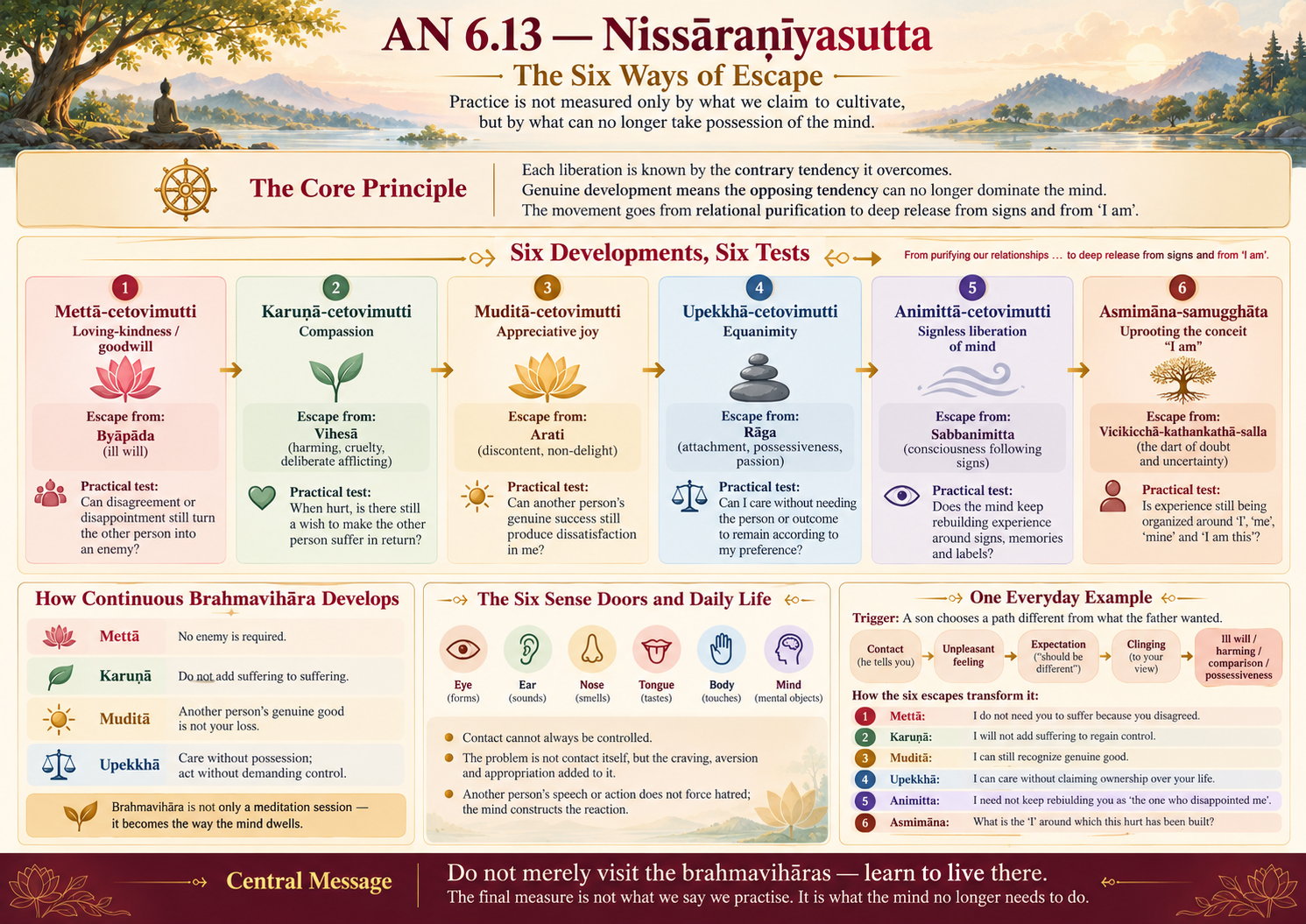 VISUAL SUMMARYSee this sutta in a pictureOpen the complete infographic for a visual overview before or after reading the full study.View infographic →
Practice is tested by what loses the power to occupy the mind
AN 6.13, the Nissāraṇīyasutta, is a remarkably demanding discourse because the Buddha does not merely name six wholesome developments. He gives a way of testing whether those developments have actually matured. A practitioner may claim that a liberation of mind has been developed, cultivated repeatedly, made a vehicle, made a basis, maintained, made familiar and well established. The Buddha then asks us to look at what still happens to the mind.
If mettā-cetovimutti has genuinely been developed in this full sense, can byāpāda still take possession of the mind and remain? If karuṇā-cetovimutti has matured, can vihesā still occupy the mind? If muditā has become established, can arati still dominate? If upekkhā has become a genuine liberation of mind, can rāga still seize it?
The discourse then moves further. If the signless liberation has truly matured, can consciousness still follow after signs? And if the conceit “I am” has been uprooted, can the dart of doubt and uncertainty remain?
This changes the usual way of evaluating meditation. The relevant question is no longer merely, “How often do I practise mettā?” or “How many minutes do I spend on compassion?” The more searching question is: what is happening to the opposing tendency in lived experience?
Does disagreement still require an enemy? Does being hurt still produce a desire to hurt in return? Does another person’s good become our dissatisfaction? Does affection turn into possession? Does an old event continue to be reconstructed around a single sign? Does everything finally organise itself around “me”, “mine” and “I am this”?
This also explains why the four brahmavihāras should not be reduced to pleasant emotional exercises undertaken during a meditation period. The repeated canonical language in AN 6.13 — bhāvitā, bahulīkatā, yānīkatā, vatthukatā, anuṭṭhitā, paricitā, susamāraddhā — points toward development that becomes repeated, familiar, foundational and established. The practice is moving toward an abiding: a way in which the citta increasingly lives.
The complete Pāḷi is therefore presented first, with natural English immediately beneath it. The later Deep Dive then examines the doctrinal and practical implications without mixing commentary into the translation itself.
AN 6.13 — Nissāraṇīyasutta
01 Six elements of escape
“Chayimā, bhikkhave, nissāraṇīyā dhātuyo. Katamā cha?
“Bhikkhus, there are these six elements of escape. What six?”
02 Mettā is the escape from byāpāda
Idha, bhikkhave, bhikkhu evaṁ vadeyya: ‘mettā hi kho me cetovimutti bhāvitā bahulīkatā yānīkatā vatthukatā anuṭṭhitā paricitā susamāraddhā; atha ca pana me byāpādo cittaṁ pariyādāya tiṭṭhatī’ti.
So ‘mā hevan’tissa vacanīyo: ‘māyasmā evaṁ avaca; mā bhagavantaṁ abbhācikkhi, na hi sādhu bhagavato abbhakkhānaṁ, na hi bhagavā evaṁ vadeyya.
Aṭṭhānametaṁ, āvuso, anavakāso yaṁ mettāya cetovimuttiyā bhāvitāya bahulīkatāya yānīkatāya vatthukatāya anuṭṭhitāya paricitāya susamāraddhāya; atha ca panassa byāpādo cittaṁ pariyādāya ṭhassati, netaṁ ṭhānaṁ vijjati.
Nissaraṇañhetaṁ, āvuso, byāpādassa yadidaṁ mettācetovimuttī’ti.
Here, bhikkhus, a bhikkhu might say: “My liberation of mind through mettā has been developed, cultivated repeatedly, made a vehicle, made a basis, maintained, made familiar and well established; and yet ill will still takes possession of my mind and remains.”
He should be told: “Venerable, do not say so. Do not speak in that way. Do not misrepresent the Blessed One, for it is not good to misrepresent the Blessed One, and the Blessed One would not speak in this way.
It is impossible, friend; there is no occasion that, when the liberation of mind through mettā has been developed, cultivated repeatedly, made a vehicle, made a basis, maintained, made familiar and well established, ill will could still take possession of the mind and remain. Such a possibility does not exist.
For this is the escape from ill will: the liberation of mind through mettā.
03 Karuṇā is the escape from vihesā
Idha pana, bhikkhave, bhikkhu evaṁ vadeyya: ‘karuṇā hi kho me cetovimutti bhāvitā bahulīkatā yānīkatā vatthukatā anuṭṭhitā paricitā susamāraddhā; atha ca pana me vihesā cittaṁ pariyādāya tiṭṭhatī’ti.
So ‘mā hevan’tissa vacanīyo: ‘māyasmā evaṁ avaca; mā bhagavantaṁ abbhācikkhi, na hi sādhu bhagavato abbhakkhānaṁ, na hi bhagavā evaṁ vadeyya.
Aṭṭhānametaṁ, āvuso, anavakāso yaṁ karuṇāya cetovimuttiyā bhāvitāya bahulīkatāya yānīkatāya vatthukatāya anuṭṭhitāya paricitāya susamāraddhāya; atha ca panassa vihesā cittaṁ pariyādāya ṭhassati, netaṁ ṭhānaṁ vijjati.
Nissaraṇañhetaṁ, āvuso, vihesāya yadidaṁ karuṇācetovimuttī’ti.
Here again, bhikkhus, a bhikkhu might say: “My liberation of mind through compassion has been developed, cultivated repeatedly, made a vehicle, made a basis, maintained, made familiar and well established; and yet harming or cruelty still takes possession of my mind and remains.”
He should be told: “Venerable, do not say so. Do not misrepresent the Blessed One. It is impossible that, when the liberation of mind through compassion has been developed and thoroughly established in this way, vihesā could still take possession of the mind and remain.”
For this is the escape from vihesā: the liberation of mind through karuṇā.
04 Muditā is the escape from arati
Idha pana, bhikkhave, bhikkhu evaṁ vadeyya: ‘muditā hi kho me cetovimutti bhāvitā bahulīkatā yānīkatā vatthukatā anuṭṭhitā paricitā susamāraddhā; atha ca pana me arati cittaṁ pariyādāya tiṭṭhatī’ti.
So ‘mā hevan’tissa vacanīyo: ‘māyasmā evaṁ avaca; mā bhagavantaṁ abbhācikkhi, na hi sādhu bhagavato abbhakkhānaṁ, na hi bhagavā evaṁ vadeyya.
Aṭṭhānametaṁ, āvuso, anavakāso yaṁ muditāya cetovimuttiyā bhāvitāya bahulīkatāya yānīkatāya vatthukatāya anuṭṭhitāya paricitāya susamāraddhāya; atha ca panassa arati cittaṁ pariyādāya ṭhassati, netaṁ ṭhānaṁ vijjati.
Nissaraṇañhetaṁ, āvuso, aratiyā yadidaṁ muditācetovimuttī’ti.
Here again, bhikkhus, a bhikkhu might say: “My liberation of mind through appreciative joy has been developed, cultivated repeatedly, made a vehicle, made a basis, maintained, made familiar and well established; and yet discontent or non-delight still takes possession of my mind and remains.”
He should be told that this cannot be so. When the liberation of mind through muditā has been thoroughly developed in this way, arati cannot still take possession of the mind and remain.
For this is the escape from arati: the liberation of mind through muditā.
05 Upekkhā is the escape from rāga
Idha pana, bhikkhave, bhikkhu evaṁ vadeyya: ‘upekkhā hi kho me cetovimutti bhāvitā bahulīkatā yānīkatā vatthukatā anuṭṭhitā paricitā susamāraddhā; atha ca pana me rāgo cittaṁ pariyādāya tiṭṭhatī’ti.
So ‘mā hevan’tissa vacanīyo: ‘māyasmā evaṁ avaca; mā bhagavantaṁ abbhācikkhi, na hi sādhu bhagavato abbhakkhānaṁ, na hi bhagavā evaṁ vadeyya.
Aṭṭhānametaṁ, āvuso, anavakāso yaṁ upekkhāya cetovimuttiyā bhāvitāya bahulīkatāya yānīkatāya vatthukatāya anuṭṭhitāya paricitāya susamāraddhāya; atha ca panassa rāgo cittaṁ pariyādāya ṭhassati, netaṁ ṭhānaṁ vijjati.
Nissaraṇañhetaṁ, āvuso, rāgassa yadidaṁ upekkhācetovimuttī’ti.
Here again, bhikkhus, a bhikkhu might say: “My liberation of mind through equanimity has been developed, cultivated repeatedly, made a vehicle, made a basis, maintained, made familiar and well established; and yet passion or attachment still takes possession of my mind and remains.”
He should be told that this cannot be so. When the liberation of mind through upekkhā has been thoroughly developed, rāga cannot still take possession of the mind and remain.
For this is the escape from rāga: the liberation of mind through upekkhā.
06 Animittā cetovimutti is the escape from all signs
Idha pana, bhikkhave, bhikkhu evaṁ vadeyya: ‘animittā hi kho me cetovimutti bhāvitā bahulīkatā yānīkatā vatthukatā anuṭṭhitā paricitā susamāraddhā; atha ca pana me nimittānusāri viññāṇaṁ hotī’ti.
So ‘mā hevan’tissa vacanīyo: ‘māyasmā evaṁ avaca; mā bhagavantaṁ abbhācikkhi, na hi sādhu bhagavato abbhakkhānaṁ, na hi bhagavā evaṁ vadeyya.
Aṭṭhānametaṁ, āvuso, anavakāso yaṁ animittāya cetovimuttiyā bhāvitāya bahulīkatāya yānīkatāya vatthukatāya anuṭṭhitāya paricitāya susamāraddhāya; atha ca panassa nimittānusāri viññāṇaṁ bhavissati, netaṁ ṭhānaṁ vijjati.
Nissaraṇañhetaṁ, āvuso, sabbanimittānaṁ yadidaṁ animittācetovimuttī’ti.
Here again, bhikkhus, a bhikkhu might say: “My signless liberation of mind has been developed, cultivated repeatedly, made a vehicle, made a basis, maintained, made familiar and well established; and yet my consciousness still follows after signs.”
He should be told that this cannot be so. When the signless liberation of mind has been fully developed and established in this way, consciousness cannot continue following after signs.
For this is the escape from all signs: the signless liberation of mind.
07 The uprooting of “I am” is the escape from the dart of doubt
Idha pana, bhikkhave, bhikkhu evaṁ vadeyya: ‘asmīti kho me vigataṁ, ayamahamasmīti ca na samanupassāmi; atha ca pana me vicikicchākathaṁkathāsallaṁ cittaṁ pariyādāya tiṭṭhatī’ti.
So ‘mā hevan’tissa vacanīyo: ‘māyasmā evaṁ avaca; mā bhagavantaṁ abbhācikkhi, na hi sādhu bhagavato abbhakkhānaṁ, na hi bhagavā evaṁ vadeyya.
Aṭṭhānametaṁ, āvuso, anavakāso yaṁ asmīti vigate ayamahamasmīti ca na samanupassato; atha ca panassa vicikicchākathaṁkathāsallaṁ cittaṁ pariyādāya ṭhassati, netaṁ ṭhānaṁ vijjati.
Nissaraṇañhetaṁ, āvuso, vicikicchākathaṁkathāsallassa yadidaṁ asmīti mānasamugghāto’ti.
Imā kho, bhikkhave, cha nissāraṇīyā dhātuyo”ti.
Here again, bhikkhus, a bhikkhu might say: “For me, ‘I am’ has disappeared, and I do not regard anything as ‘I am this’; and yet the dart of doubt and uncertainty still takes possession of my mind and remains.”
He should be told: “Venerable, do not say so. Do not misrepresent the Blessed One. It is impossible that, when ‘I am’ has disappeared and one does not regard anything as ‘I am this’, the dart of doubt and uncertainty could still take possession of the mind and remain.”
For this is the escape from the dart of doubt and uncertainty: the uprooting of the conceit ‘I am’.
“These, bhikkhus, are the six elements of escape.”
Six developments, six tests
| Development | Escape from | Practical test |
|---|---|---|
| Mettā-cetovimutti | Byāpāda | Can disagreement or disappointment still turn the other person into an enemy? |
| Karuṇā-cetovimutti | Vihesā | When I am hurt, is there still a wish to make the other person suffer in return? |
| Muditā-cetovimutti | Arati | Can another person’s genuine welfare or success still produce dissatisfaction in me? |
| Upekkhā-cetovimutti | Rāga | Can I care without needing the person, relationship or outcome to remain according to my preference? |
| Animittā-cetovimutti | Sabbanimitta | Does consciousness continue following and rebuilding experience around signs? |
| Asmimāna-samugghāta | Vicikicchā-kathaṅkathā-salla | Is experience still being organised around “I”, “me”, “mine” and “I am this”? |
The importance of these pairings is not merely theoretical. AN 6.13 turns practice into something that can be examined directly. We do not need to ask only whether mettā, karuṇā, muditā or upekkhā were practised during meditation. We can examine whether their corresponding contrary tendencies are still capable of occupying the mind in ordinary life.
Understanding AN 6.13 as one connected movement of release
01 The decisive phrase: bhāvitā, bahulīkatā, yānīkatā, vatthukatā…
The first five elements repeat a remarkable developmental formula: bhāvitā, bahulīkatā, yānīkatā, vatthukatā, anuṭṭhitā, paricitā, susamāraddhā . The force of the sequence is easily lost if it is reduced to the simple statement “I practise this often.”
The quality is developed and made much of; it becomes a vehicle and a basis; it is maintained, made familiar and properly established.
This vocabulary is central to understanding continuous brahmavihāra. A fifteen-minute mettā session may be a useful condition for development, but the Buddha’s language points beyond the session. The question is whether the citta is becoming increasingly familiar with non-hostility, compassion, appreciative joy and non-appropriation until these qualities become its more natural basis.
MN 19 helps explain why repetition matters. The Bodhisatta says that whatever one frequently thinks about and considers becomes the inclination of the mind. If irritation is repeatedly entertained, the mind becomes practised in irritation. If retaliation is rehearsed, retaliation becomes easier. If one repeatedly recognises byāpāda and abandons feeding it, that too becomes an inclination.
Bhāvanā therefore includes what happens in the minutes immediately after criticism, disappointment, success, loss and disagreement.
Gradual development can often be seen in duration. Initially resentment occupies the mind for days. Later it may be recognised after several hours. With further cultivation, it is noticed within minutes. Eventually it is known while forming the very sentence that would have perpetuated it.
The opposing tendency is not merely suppressed; the conditions that formerly allowed it to dominate have been progressively weakened.
This also helps us read cittaṁ pariyādāya tiṭṭhati. AN 6.13 is concerned with the contrary tendency taking possession of the mind and remaining. Mature development is known by the decreasing capacity of that tendency to occupy the whole field.
02 Brahmavihāra means learning to dwell differently
Brahmavihāra is frequently taught as if it were primarily an exercise: sit down, generate a benevolent phrase, extend it to selected people, and finish the practice period. Such formal development can be useful, but vihāra points toward an abiding — the manner in which the mind dwells.
The Karaṇīya Mettā Sutta makes the continuity explicit:
Tiṭṭhaṁ caraṁ nisinno vā,
sayāno vā yāvatassa vigatamiddho;
etaṁ satiṁ adhiṭṭheyya.
Standing, walking, sitting or lying down, for as long as one is awake, this mindfulness is to be maintained. Continuous practice therefore cannot be restricted to the cushion.
This does not mean the practitioner must silently repeat “May all beings be happy” every second while driving, working or preparing food. Continuous cultivation is better understood as a trained orientation that becomes available when the appropriate condition appears.
When another being is encountered, is the mind predisposed toward hostility or non-hostility? When suffering is encountered, does the mind add suffering or respond compassionately? When another person prospers, does the mind rejoice or contract into comparison? When conditions cannot be controlled, does caring become coercion or can it remain balanced?
Formal meditation strengthens the quality under simplified conditions. Daily life tests whether the training transfers. A peaceful mettā sitting is useful, but the deeper diagnostic comes ten minutes later when somebody speaks sharply.
Karuṇā becomes particularly revealing when the suffering being is the same person who has just hurt us. Muditā is tested when another person receives what we wanted. Upekkhā is tested when somebody we love chooses a path we would not have chosen for them.
The difficult person is not an interruption to brahmavihāra practice. The difficult person reveals how deeply brahmavihāra has been developed.
03 Mettā: goodwill that survives disagreement
AN 6.13 gives mettā a precise diagnostic relationship: mettā-cetovimutti is the nissaraṇa from byāpāda. MN 62 preserves the same pairing when the Buddha tells Rāhula to develop mettā so that ill will will be abandoned.
Mettā is therefore not adequately measured by whether the practitioner can produce warmth toward a friend. Its depth is revealed when conditions are unfavourable.
Ordinary affection often contains an unstated contract. “I love you” may mean, without our recognising it, “I will remain warm toward you as long as you stay close, appreciate me, agree with me and behave in ways that confirm my expectations.”
The hidden contract remains invisible while the relationship is comfortable. When the other person chooses differently, byāpāda may emerge with surprising speed.
A parent may love an adult child deeply and yet become hostile when the child chooses a different career. A teacher may care for a student and yet resent the student for learning elsewhere. A spouse may speak of love while deliberately wishing the other person distress during conflict.
These situations do not prove that the original affection was false; they show that goodwill was mixed with attachment and expectation.
Mettā removes the requirement that another person’s suffering resolve our discomfort. One may still disagree. One may say “no”. One may impose a boundary, refuse a request, end a harmful relationship or correct misconduct. What becomes unnecessary is enmity itself.
MN 21 pushes this training to an extreme. The Buddha distinguishes speech that is timely or untimely, true or false, gentle or harsh, beneficial or harmful, spoken with goodwill or with inner hate, and trains the disciple not to allow the mind to become corrupted.
The famous simile of the saw deliberately removes the excuse that goodwill is appropriate only when the other person behaves well.
A useful daily reflection is therefore: “I do not need you to suffer merely because you did not satisfy me.”
04 Karuṇā: the refusal to add suffering to suffering
The second relation is especially important: karuṇā-cetovimutti is the escape from vihesā. MN 62 again confirms the pairing when Rāhula is told to develop compassion so that vihesā will be abandoned.
This gives karuṇā a much more demanding meaning than “feeling sorry for someone.” Mature compassion changes the mind so that deliberate afflicting increasingly loses its basis.
Vihesā is broader than swearing. Abusive words can certainly be a form of vihesā when the intention is to wound, humiliate, frighten or punish. But one can avoid every obscene word and still deliberately inflict considerable pain.
Sarcasm, public humiliation, repeated needling, guilt manipulation, intimidating silence, deliberately touching a known insecurity, or continuing an argument simply to make the other person feel defeated can all reveal the harming direction of mind.
This should not be collapsed into pharusā vācā. Harsh speech identifies a form of verbal misconduct. Vihesā is the broader harming or cruel tendency from which words, bodily acts or sustained mental intentions may arise.
A sentence such as “You have always been a disappointment” contains no swear word, yet it may be chosen precisely because the speaker knows that it will injure.
MN 19 gives the consequence test. A thought of harming is seen as leading to attabyābādha, one’s own affliction; parabyābādha, another’s affliction; and ubhayabyābādha, affliction of both.
When another person hurts us and we deliberately retaliate, the outward injury is obvious. The inward injury is subtler: our own citta is being trained in the sequence: pain → hostility → retaliation.
Karuṇā interrupts that sequence. It does not demand passivity. A boundary may still be required. A harmful participant may need to leave a retreat. A teacher may need to correct a student. A parent may need to say no.
Compassion does not make every moment pleasant; it removes the need to make suffering itself the instrument through which we regain control.
This is particularly important in teaching. “I am only telling the truth” does not settle the ethical question. A teacher must also ask: am I saying this because it will help understanding, or because I want the student to feel the pain of having challenged me?
Wholesome content does not automatically make every manner of delivery wholesome. Timing, receptivity, intensity and cetanā matter.
A useful daily reflection is: “Your suffering, confusion or harmful action does not give me permission to add unnecessary suffering.”
05 Muditā: freedom from the suffering of comparison
Muditā is commonly summarised as sympathetic or appreciative joy, but AN 6.13 shows its deeper function by pairing it with arati — discontent, non-delight or dissatisfaction. AN 6.113 likewise connects the development of muditā with the abandonment of arati.
This becomes especially clear in comparison. A colleague receives a promotion. Another practitioner reports a deep meditation. Someone else’s child is successful. Another Dhamma teacher attracts a large audience. A former student prospers under someone else’s guidance.
Nothing has been physically taken from us, but the mind contracts: “Why them rather than me?”
Muditā changes the reference point. The question is no longer “Where am I compared with this person?” but “Is something genuinely wholesome present here?”
Another person’s generosity is good. Recovery from illness is good. Ethical growth is good. Becoming less greedy, less hostile and more wise is good, regardless of whose name, institution, lineage or family is associated with it.
This is why muditā can expose spiritual competition. If another practitioner’s wholesome development is immediately diminished — “perhaps he is imagining it” — because the development threatens our position, arati has turned another person’s good into material for self-reference.
Muditā nevertheless requires paññā. We do not need to rejoice merely because another person successfully fulfilled a craving. A person may be delighted after deceiving someone or profiting from exploitation. Their pleasure does not transform akusala into kusala.
Muditā appreciates genuine welfare and wholesome qualities rather than every successful desire.
A useful daily reflection is: “Your genuine good does not diminish mine.”
06 Upekkhā: care without possession
AN 6.13 pairs upekkhā-cetovimutti with the escape from rāga. MN 62 gives a complementary relation: develop upekkhā and paṭigha, aversive resistance, will be abandoned.
Read together, these passages illuminate a mind that is progressively less pulled by attraction and less pushed by aversion.
This is crucial because genuine care can quietly become ownership. A parent may sincerely say, “I want what is best for my child,” while the hidden addition becomes, “therefore my child must choose the future I have imagined.”
A teacher may sincerely want a student to progress yet resent the student for leaving. A spouse may care deeply but expect the other person to remain emotionally available in a prescribed way.
Upekkhā introduces wisdom regarding control. I can advise, support, warn, provide resources, remain available and act with compassion. But I do not control all the conditions governing another person’s body, mind, history, choices and future.
Recognising this is not abandonment; it can make care cleaner because the other person no longer has to satisfy my identity in order to receive goodwill.
Upekkhā must also be distinguished from indifference. Saying, “It is their kamma; not my problem,” does not transform avoidance into equanimity.
If somebody falls on the road and we can safely help, karuṇā may require action. Upekkhā means that action is not confused with ownership of the result. One can call an ambulance, stay with the person and offer every reasonable assistance while understanding that one does not command every subsequent condition.
The four brahmavihāras therefore protect one another. Mettā without upekkhā can become possessive affection. Karuṇā without upekkhā can become compulsive rescuing. Upekkhā without mettā and karuṇā can become emotional coldness. Muditā without discernment can become mere excitement.
Mature training remains warm without ownership, responsive without being overwhelmed, joyful without tribalism and balanced without indifference.
A useful daily reflection is: “I can care fully without demanding control over you or the outcome.”
07 The six sense doors: where expectation becomes conflict
Continuous brahmavihāra becomes easier to understand when it is placed within the Buddha’s analysis of the six sense fields: eye and forms, ear and sounds, nose and smells, tongue and tastes, body and tangibles, mind and mental phenomena.
Throughout the day, contact occurs whether or not it has been requested.
We would prefer agreeable sights, supportive words, pleasant tastes, comfortable bodily contact and thoughts that arise only when invited. But experience cannot be made to obey in this way.
More importantly, another person’s six sense fields cannot be placed under our command either. If I cannot completely order my own thought, feeling and body, on what basis can I insist that another human being must always think, speak and behave according to my expectation?
SN 35.233 gives an important clarification. The eye is not the fetter of forms and forms are not the fetter of the eye; the fetter is the desire and greed arising dependent on the pair. The same principle applies to the other five fields.
A criticism does not itself command the mind to retaliate. Sound is heard, contact occurs, unpleasant vedanā may arise, and then the mind adds:
“He should not say this.”
“She must understand me.”
“I will show him.”
“After everything I have done, how can she behave like this?”
The brahmavihāras operate precisely here. Mettā asks whether unpleasant contact must create an enemy. Karuṇā asks whether another person’s confusion authorises further harm. Muditā asks whether another person’s pleasant result must become our discontent. Upekkhā asks whether caring requires possession.
This also helps refine the statement “we get what we deserve.” The early texts do not support reducing every painful event to a simplistic moral payment. SN 36.21 explicitly identifies multiple possible conditions for painful experience rather than attributing every painful feeling solely to previous kamma.
A safer reflection is: we do not necessarily receive what we desire or expect; we experience what the presently assembled conditions allow to occur.
That formulation supports karuṇā rather than blame. I encounter painful and unwanted conditions; so does the other person. I cannot command every event; neither can they. Seeing this common vulnerability makes deliberate afflicting increasingly difficult to justify.
08 Animitta: when the external quarrel ends but the internal quarrel continues
After the four brahmavihāras, AN 6.13 moves into a subtler domain. Animittā cetovimutti is the escape from all signs, and the contradiction is expressed as consciousness still being nimittānusāri — following after signs.
This should not be trivialised into “do not label things.” SN 41.7 provides important context for the signless liberation of mind, and SN 40.9 describes Mahāmoggallāna recognising that consciousness had begun following signs during his training in the signless and being instructed to settle and establish the mind there.
Ordinary experience can nevertheless reveal the direction of the problem. Somebody insults us for ten seconds. Outwardly the exchange ends. Yet the mind spends the next twenty-four hours replaying the words, designing superior replies, explaining the injury to friends and reconstructing the person as “the one who insulted me.”
The external quarrel lasted seconds; the internal quarrel has continued for a day.
The same mechanism appears in family and spiritual relationships: “the child who disobeyed me”, “the student who left”, “the teacher who embarrassed me”, “the person from the other tradition”.
Consciousness selects a sign and repeatedly rebuilds the whole person around it. A living human being containing innumerable conditions and changes becomes reduced to the feature around which our attachment or aversion is organised.
Upekkhā reduces the pull and push surrounding experience. Animitta points more deeply toward release from the mode through which consciousness keeps pursuing and reconstructing signs.
09 Asmimāna: the “I am” around which the whole conflict is organised
The sixth element finally reaches the conceit asmīti — “I am”. This is not an unrelated philosophical appendix.
It exposes the organising structure beneath the previous conflicts: my child, my student, my reputation, my success, my teaching, my injury, my view.
SN 22.59 gives the familiar investigation of the five aggregates. Form, feeling, perception, formations and consciousness are impermanent and subject to alteration; they are not appropriately regarded as: “This is mine, I am this, this is my self.”
When a criticism is heard, however, the conditioned event can be appropriated almost instantaneously as: “He insulted me.”
Now my status, my correctness and my reputation require defence.
SN 22.89 is especially important because Khemaka distinguishes the residual conceit “I am” from explicitly identifying an aggregate as self. He does not regard any of the aggregates as self or belonging to self, yet a residual “I am” can remain.
This prevents us from confusing an intellectual statement such as “there is no self” with the uprooting of asmimāna.
The sixth test in AN 6.13 is therefore experiential. When the conceit “I am” has actually been uprooted and one no longer regards anything as “I am this,” the dart of doubt and uncertainty cannot continue taking possession of the mind.
The movement of the discourse has gone from interpersonal hostility to the structure of appropriation itself.
10 Brahmavihāra is sublime, but it is still conditioned
The importance of brahmavihāra should not lead to treating a refined loving state as the final end.
AN 4.126 is significant here. After describing the practitioner pervading the world with mettā, karuṇā, muditā or upekkhā, the discourse goes further: the practitioner examines the phenomena present in that state — form, feeling, perception, formations and consciousness — as impermanent, unsatisfactory, afflicted, alien, disintegrating, empty and not-self.
The implication is important. Even a sublime, expansive and purified consciousness is conditioned. It is not to be appropriated as “my true self”.
The same paññā that examines coarse experience penetrates the refined state as well.
This makes the architecture of AN 6.13 coherent. The first four elements transform the mind’s affective relationship with beings and circumstances. Animitta penetrates the tendency to follow signs. The final element reaches the appropriation around “I am”.
The sutta can therefore be read as an increasingly profound movement from cleaner relationship toward deeper relinquishment.
How the six escapes become visible in ordinary life
01 Complete case study — “My son did not follow my advice”
An adult son tells his father: “I have decided not to follow the career you planned for me. I am going to do something else.”
The father has invested money, effort and many years of hope in the son’s education. One ordinary sentence can reveal the entire movement explored in AN 6.13.
First there is phassa. The sentence enters through the ear. Ear-consciousness arises dependent on ear and sound. Contact occurs.
The father did not choose to hear those words, and he cannot return five seconds into the past and prevent them from having been spoken.
Then there is vedanā. An unpleasant hedonic tone may arise.
At this point the feeling itself does not say: “My son is ungrateful,” “He has destroyed his future,” or “I have failed as a father.”
Those are later constructions. Recognising this distinction matters because otherwise the whole conditioned process is collapsed into the sentence: “He made me angry.”
Saññā and memory join. Perception recognises the meaning. Memory supplies: “I paid for his education,” “I spent years guiding him,” “Everyone knows what he was preparing for.”
Then comes a decisive movement: “He should not do this.”
The father may have intelligent reasons for believing the decision risky, but assessment is turning into demand: reality must conform to my preferred result.
Taṇhā and upādāna develop. “I want him to choose the career I approve.”
Then: “my son”, “my sacrifice”, “our family”, “my judgment”, “my reputation”.
The son’s decision becomes entangled with the father’s identity. A role crystallises: “I am the father who sacrificed everything and whose son has disregarded him.”
Byāpāda becomes possible. The father thinks: “One day he will fail and then he will understand that I was right.”
The son’s future suffering has become desirable because it would validate the father.
Mettā intervenes here: “Even if I believe this decision is wrong, I do not need my son to suffer in order to prove that I was right.”
Vihesā becomes possible. The father knows the son’s vulnerabilities and could say: “You have always been irresponsible,” “You will never succeed,” or “Do not come back when you fail.”
These sentences may have little purpose except injury.
Karuṇā asks: “There is already uncertainty and pain here. What does deliberately adding more suffering accomplish?”
The father can still say: “I strongly disagree. Let us examine the risks carefully,” without turning disagreement into emotional punishment.
Arati appears through comparison. Months later a friend reports that his own son has obtained precisely the position this father had imagined for his child.
The mind contracts: “Why could my son not have done that?”
Another person’s success has become painful because it is measured against a disappointed expectation.
Muditā allows a different response: “This young man’s genuine success is good. My son’s different path does not require me to diminish it.”
Rāga appears as attachment to the desired outcome. The father repeatedly calls and persuades: “Have you reconsidered?” “Are you sure?” “Why don’t you return?”
Concern may remain genuine, but it has fused with possessive attachment to a particular result.
Upekkhā recognises the boundary: “I have advised him. I can remain available. I cannot command an adult person’s life.”
Nimitta can remain after the argument ends. One year later, every time the father sees his son, consciousness produces: “the son who did not listen to me.”
The son may have performed hundreds of wholesome actions, yet the relationship keeps being rebuilt around a single sign. Here the movement toward animitta becomes relevant.
Finally asmimāna becomes visible. Why did the career decision become such a personal injury?
Again and again: my son, my sacrifice, my judgment, my reputation, my success as a father.
Beneath the structure sits: “I am this father.”
An ordinary family disagreement has become a field for investigating appropriation itself.
Mettā: I will not become your enemy because you disagreed with me.
Karuṇā: I will not make you hurt simply to regain control.
Muditā: I can recognise genuine good even when it is not the good I planned.
Upekkhā: I can care without pretending that your life belongs to me.
Animitta: I need not continually rebuild you as “the person who disappointed me”.
Asmimāna: what is the “I” around which this entire injury has been constructed?
02 Traffic — three seconds of danger can become twenty minutes of hostility
Another driver suddenly cuts in front of us. The actual danger may last only a few seconds.
The mind can nevertheless keep the driver alive internally for the next twenty minutes: “Idiot! How dare he!”
The external event is already over, but the citta continues producing it.
Mettā prevents an unknown person from becoming an enemy. Karuṇā reminds us that we do not know the conditions operating in the other driver. Upekkhā recognises that replay cannot undo the event.
Animitta becomes relevant when the mind keeps following the image of: “the driver who did that to me”.
03 Social media — one hostile comment among fifty appreciative responses
An article receives fifty thoughtful or appreciative responses. One person writes: “This is nonsense.”
The mind may immediately abandon the fifty favourable contacts and organise itself around the one disagreeable one.
Mettā asks whether the critic needs to be verbally destroyed. Karuṇā asks whether humiliation will increase understanding. Upekkhā recognises that universal approval is impossible.
Animitta notices the repeated reconstruction of: “the person who attacked my article”.
Appropriate factual correction remains possible, but compulsion weakens.
04 Teaching — correction without vihesā
A student makes the same mistake repeatedly. Irritation arises.
The teacher can easily justify the reaction: “He is not listening.”
AN 6.13 turns the situation into an audit. If byāpāda is present, mettā requires development. If there is pleasure in humiliating the student, karuṇā has not fully displaced vihesā.
If another student learns faster and becomes the preferred student, attachment and comparison may also be involved.
Two teachers might use the same sentence — “This behaviour cannot continue” — while entirely different cetanā operates beneath it.
One may want to protect the training. Another may want the student to feel personally diminished.
Karuṇā does not remove firmness; it removes cruelty from firmness.
A useful check before correcting another is: “If this person understood the point without feeling humiliated, would I be completely satisfied?”
If the answer is yes, correction may be serving understanding. If some part of the mind still wants the other person to feel the pain of being wrong, vihesā deserves examination.
05 Muditā — another person’s promotion does not have to become my failure
A colleague is promoted while we are not. There may be genuine disappointment about our own situation.
Muditā does not require denying that feeling. Two truths can be known together:
“I am disappointed about my result.”
And:
“This person’s genuine achievement is still something wholesome I can appreciate.”
The crucial shift is that another person’s good no longer has to become evidence about “me”.
This is why muditā can be such a powerful training in loosening comparison.
06 From morning until sleep — what continuous practice actually looks like
A practitioner wakes and meets family. Mettā begins not as a phrase but as the intention not to make one’s mood another person’s burden.
At breakfast someone is irritable. Karuṇā recognises that conditions may be difficult for them.
On the road another driver behaves dangerously. Mettā prevents a three-second event from creating an enemy for the next twenty kilometres.
At work a colleague announces a promotion. A small contraction of comparison is noticed and muditā appreciates genuine good.
Later one’s own proposal is rejected. Upekkhā knows the disappointment without demanding that reality reverse itself before balance can return.
A family member telephones with a problem. Karuṇā listens. Advice is offered. The person refuses it.
Upekkhā prevents care from turning into coercion.
A student performs exceptionally well and muditā rejoices. Another student chooses a different teacher and upekkhā allows departure without resentment.
At night an old injury appears in memory. Instead of automatically following the sign into another inner argument, the construction itself is recognised.
Then one sleeps. The next day the training begins again.
This is not meditation being abandoned for daily life. It is meditation maturing into vihāra — the way the mind dwells.
07 Four immediate questions for continuous brahmavihāra
Mettā: Am I wishing this person harm simply because they did not satisfy my expectation?
Karuṇā: Is what I am about to say or do reducing suffering, or am I deliberately adding suffering because I want punishment, submission or revenge?
Muditā: Can I recognise another person’s genuine good without making myself the reference point?
Upekkhā: Can I care and act appropriately while accepting that I do not control every condition or the final outcome?
These questions are not slogans to be repeated mechanically. They are ways of inspecting the citta exactly where the opposing movement becomes visible.
The six escapes as a practical diagnostic
| Experience | Movement exposed | Nissāraṇa | Observable transformation |
|---|---|---|---|
| Someone opposes, criticises or disappoints me | Byāpāda — “I want harm or failure for you” | Mettā-cetovimutti | Disagreement no longer requires enmity. |
| Someone hurts me | Vihesā — “I will make you hurt too” | Karuṇā-cetovimutti | Firm correction remains possible without deliberate afflicting. |
| Another person prospers | Arati — “Why them rather than me?” | Muditā-cetovimutti | Their genuine good can be appreciated without self-comparison. |
| A person, state or result pleases me | Rāga — “I need this to remain mine” | Upekkhā-cetovimutti | Care continues without possessive dependence. |
| An old event is repeatedly reconstructed | Nimittānusāri viññāṇa — consciousness follows the sign | Animittā-cetovimutti | The mind no longer endlessly rebuilds experience around its sign. |
| “My child, my teaching, my status, my injury” | Asmimāna — experience organised around “I am” | Asmimāna-samugghāta | The organising conceit “I am this” is uprooted. |
Suttas that clarify the six elements of escape
| Sutta | Contribution to this study |
|---|---|
| MN 62 — Mahārāhulovādasutta | Mettā/byāpāda, karuṇā/vihesā, muditā/arati and upekkhā/paṭigha; also the training to become like the elements so pleasant and unpleasant contact does not take possession of the mind. |
| MN 19 — Dvedhāvitakka Sutta | Vihiṁsā is known as leading to self-affliction, other-affliction and the affliction of both; repeated thinking becomes an inclination of mind. |
| MN 21 — Kakacūpama Sutta | Goodwill is tested precisely when speech and treatment are disagreeable rather than only when others behave favourably. |
| Kp 9 / Snp 1.8 — Karaṇīya Mettā Sutta | Mettā is maintained while standing, walking, sitting and lying down for as long as one is awake — a direct basis for understanding continuous abiding. |
| SN 35.233 | The sense faculty and its object are not themselves the fetter; desire and greed arising dependent on them constitute the fetter. |
| SN 36.21 — Sīvaka Sutta | Prevents the simplistic view that every painful experience is merely something a person “deserved” through past kamma. |
| SN 41.7 — Godatta Sutta | Provides important context for the signless liberation of mind. |
| SN 40.9 | Shows Mahāmoggallāna recognising consciousness following signs during development of the signless liberation. |
| SN 22.59 — Anattalakkhaṇa Sutta | The five aggregates are not appropriately regarded as “mine, I am this, this is my self”. |
| SN 22.89 — Khemaka Sutta | Clarifies the subtle residual conceit “I am” even when the aggregates are not explicitly regarded as self. |
| AN 4.126 | Shows that after brahmavihāra development, the conditioned phenomena present there are still examined as impermanent, unsatisfactory, empty and not-self. |
| AN 6.113 | Confirms the development of muditā in relation to the abandonment of arati. |
Textual note: The Pāḷi of AN 6.13 follows the Mahāsaṅgīti / Chaṭṭha Saṅgāyana recension in Roman script. English on this page is a fresh working translation prepared for this study. Interpretive daily-life examples are kept separate from the canonical translation.
Do not merely visit the brahmavihāras — learn to live there
AN 6.13 does not ask us to decorate the mind with four pleasant emotions. It describes development deep enough that byāpāda, vihesā, arati and rāga progressively lose their capacity to take possession of consciousness.
The difficult person therefore becomes practice. The stubborn child becomes practice. The student who disagrees becomes practice. Another person’s success becomes practice. Praise becomes practice. Blame becomes practice. Pleasant contact becomes practice. Painful contact becomes practice.
Even the mind’s own failure to remain compassionate becomes something to understand rather than another reason for self-hostility.
The central question changes from: “Why is this happening to me?”
to: “Given that these conditions have arisen, what kind of mind am I developing now?”
Mettā says: no enemy is required.
Karuṇā says: do not add suffering to suffering.
Muditā says: another person’s genuine good is not your loss.
Upekkhā says: care without possession and act without demanding control.
Then the investigation becomes subtler.
Animitta exposes the signs around which consciousness continually reconstructs its world.
Finally, the uprooting of asmimāna penetrates the “I am” around which that world has been appropriated.
The six elements are therefore not six unrelated techniques. They can be read as one increasingly deep movement of release: from hostility toward non-hostility, from harming toward compassion, from comparison toward appreciative joy, from possession toward equanimity, from following signs toward the signless, and from “I am this” toward the uprooting of conceit.