From Dhamma-Vinaya to the Many Buddhisms of Asia
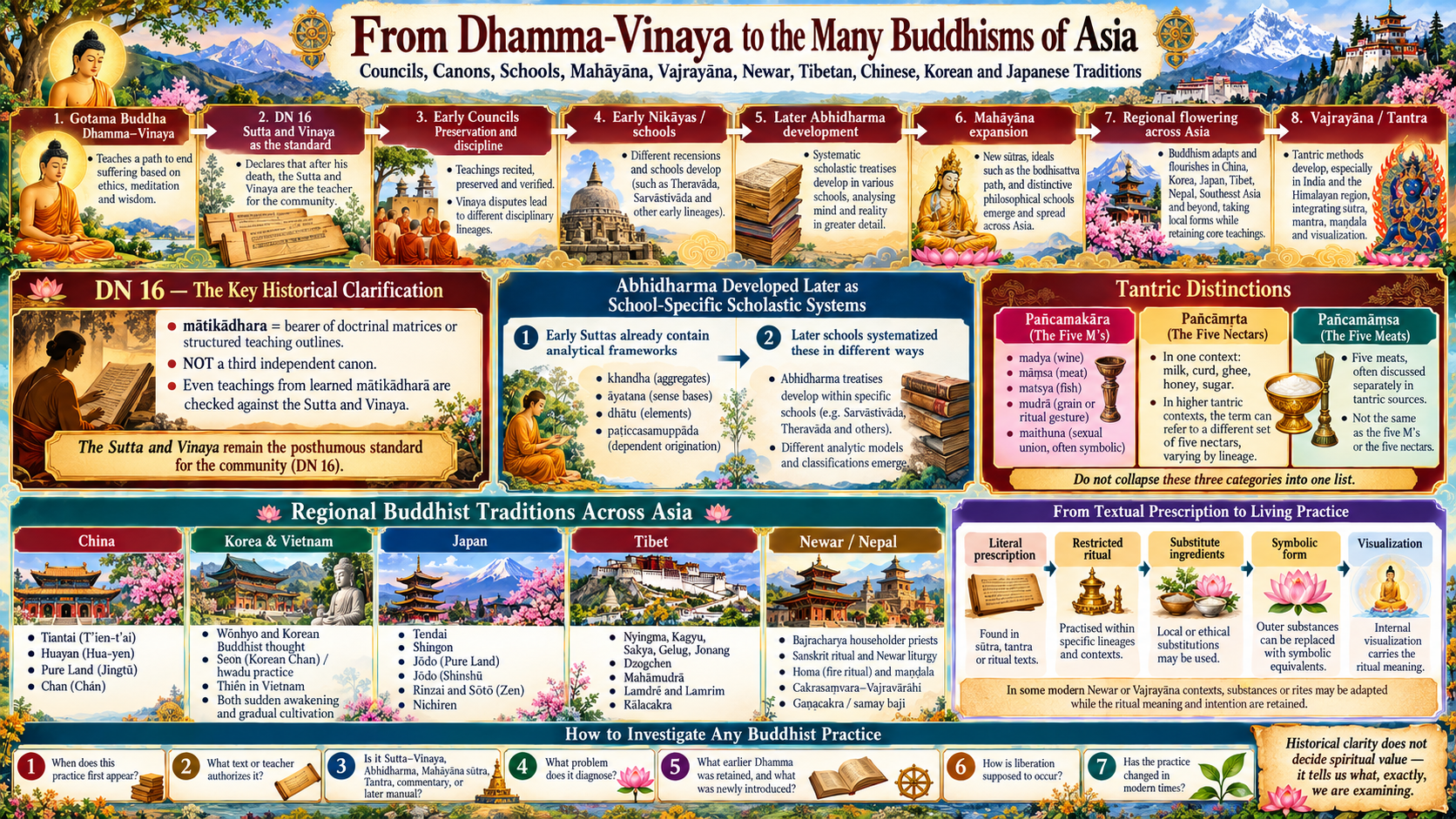 VISUAL SUMMARYSee this study in a pictureOpen the complete infographic for a visual overview before or after reading the full study.View infographic →
One historical Buddha, many later Buddhist worlds
A practitioner beginning with the early discourses and then looking at Buddhism as it exists across Asia can easily feel that several very different religious worlds are being described by the same word.
In the Nikāyas and Āgamas one repeatedly encounters a gradual training involving conduct, sense restraint, moderation in food, wakefulness, sati-sampajañña, seclusion, abandonment of the five hindrances, jhāna, direct knowledge and the ending of the āsavas.
Elsewhere Buddhism may mean recollecting Amitābha, practising Tiantai zhǐguān, investigating a Chan huatou, working through Rinzai kōans, sitting in Sōtō shikantaza, chanting Nichiren daimoku, performing Shingon mantra and mudrā, visualizing Cakrasaṃvara, practising Mahāmudrā or Dzogchen, undertaking Thai tudong, noting the rise and fall of the abdomen in the Mahāsi system, developing Pa-Auk jhānas and analytical meditation, scanning bodily sensations during a Goenka retreat, or entering Buddhism through Ambedkar’s Twenty-Two Vows.
All of these belong to Buddhist history.
But three propositions must not be collapsed into one another.
Historically Buddhist: the system genuinely arose and was transmitted within Buddhist history.
Historically taught by the Buddha in this form: the particular method is actually attested in early Sutta-Vinaya.
Conducive to liberation: the method actually moves toward the directions the Buddha identifies as authentic Dhamma.
A later method can contain important early-Buddhist elements without being identical to an early teaching.
A historically later method may also genuinely support dispassion and release.
Conversely, a method may repeatedly quote the Suttas and still turn those teachings into a later system that does not reproduce the original training in full.
Historical age therefore does not by itself settle spiritual value.
But historical clarity prevents us from calling every later innovation “the Buddha’s original technique.”
Deep Dive Why chronology matters without becoming a new dogma
Historical analysis is sometimes misunderstood as an attempt to decide spiritual truth merely by age.
That would be another form of attachment.
Something is not liberating merely because it is old.
Nor is something useless merely because it developed later.
The value of chronology is different.
It enables us to distinguish the Buddha’s early teaching from later interpretation and innovation.
Once that distinction is visible, the practitioner can ask a second, more important question:
Whatever its historical origin, what does this practice actually do to craving, appropriation, conceit, aversion and ignorance?
This is where AN 7.83 becomes indispensable.
A technique may be historically late but genuinely support nibbidā and virāga.
Another may be historically ancient but practised in a way that increases identity, rivalry and acquisition.
Therefore this essay uses chronology and liberative direction together.
DN 16 — lineage prestige is not self-authenticating
DN 16, the Mahāparinibbānasutta, gives an unusually important standard for examining teachings after the Buddha.
Someone may say that a teaching was heard directly from the Buddha.
Or from an entire Saṅgha.
Or from several learned elders.
Or from one learned elder.
The Buddha’s instruction is neither immediate acceptance nor immediate rejection.
The teaching is carefully learned and then:
sutte osāretabbāni, vinaye sandassetabbāni
—brought to the Suttas and compared with the Vinaya.
If it does not accord, the attribution is rejected.
If it accords, it may be accepted as correctly transmitted.
Mātikādhara
DN 16 also refers to learned elders as:
bahussutā āgatāgamā dhammadharā vinayadharā mātikādharā.
They are learned, versed in the received tradition, Dhamma-bearers, Vinaya-bearers and bearers of mātikā.
But even a teaching attributed to such a learned mātikādhara remains subject to the Sutta-Vinaya standard.
DN 16 therefore does not establish:
Sutta + Vinaya + Mātikā as three independent coequal final authorities.
A historically more cautious development is:
analytical Dhamma → mnemonic and doctrinal matrices → later school-specific Abhidhamma / Abhidharma systems.
Deep Dive DN 16 and the difference between lineage, preservation and authenticity
The principle in DN 16 becomes increasingly important as Buddhism develops elaborate lineages.
“My teacher received it from his teacher” can establish a real transmission relationship.
But it establishes that transmission only as far backward as the historical evidence can actually support it.
A documented twentieth-century lineage cannot automatically bridge an undocumented gap of fifteen or twenty centuries.
Nor does secrecy solve the historical problem. Saying that a teaching was “secretly transmitted” is a religious explanation of missing evidence; it is not itself historical evidence.
The Buddha’s own great standards are striking because even an impressive claimed source does not bypass verification.
The same principle applies today.
A Burmese meditation lineage may have genuine documented continuity through several teachers.
A Tibetan tantric lineage may possess meticulous initiation records.
A Zen lineage may construct patriarchal succession.
A Pure Land school may trace doctrinal interpretation through major masters.
These facts tell us something important about transmission.
They do not automatically answer:
Did the historical Buddha teach this exact technique?
DN 16 therefore protects the practitioner from two opposite mistakes.
One is credulity: accepting a teaching because the teacher or lineage is prestigious.
The other is prejudice: rejecting a claim merely because it is unfamiliar.
The Buddha’s instruction is investigation.
Yet even textual agreement does not complete the inquiry.
A person can quote an early Sutta correctly and still practise wrongly.
This is why AN 7.83 provides the second half of the authentication process.
DN 16 asks: Does the teaching accord with the received Dhamma-Vinaya?
AN 7.83 asks: Where does the teaching actually lead?
AN 7.83 — seven aspects through which a teaching can be examined
In AN 7.83 the Buddha gives Upāli a concise test for recognizing the Teacher’s instruction.
Teachings that lead unequivocally toward the following can be recognized as Dhamma, Vinaya and the Teacher’s instruction:
nibbidāya
virāgāya
nirodhāya
upasamāya
abhiññāya
sambodhāya
nibbānāya
| Pāli | Meaning in practice | What the practitioner should examine |
|---|---|---|
| Nibbidā | Disenchantment; conditioned things lose their promise of providing lasting satisfaction. | Is fascination weakening, or has worldly fascination merely been replaced by fascination with meditation, visions, status, ritual or attainments? |
| Virāga | Fading of passion and attachment. | Has rāga actually faded, or is it merely restrained, suppressed, redirected or spiritually rationalized? |
| Nirodha | Cessation. | What has ceased—one temporary experience, or the causal process of craving and appropriation? |
| Upasama | Stilling, pacification, settling. | Does the path move toward peace, or toward increasing stimulation, drama, identity and dependence? |
| Abhiññā | Direct knowing. | Is the understanding directly known, or mainly accepted because a text, teacher, institution or lineage says so? |
| Sambodhi | Awakening. | Is ignorance being uprooted, or is an unusual meditative event simply being labelled awakening? |
| Nibbāna | Final release from the fuel sustaining dukkha. | Is the final horizon release from greed, aversion and delusion—or principally bliss, concentration, healing, ritual power, identity or extraordinary experience? |
Deep Dive Why AN 7.83 is not a seven-point checklist or sectarian score
These seven expressions are best understood as a direction.
They are not seven independent boxes that allow us to say: “This tradition scores five out of seven.”
That would create false precision.
Nibbidā naturally inclines toward virāga.
Virāga inclines toward cessation.
Cessation is inseparable from pacification.
Direct knowing deepens the process.
Sambodhi and Nibbāna reveal the final liberative horizon.
The seven therefore describe an unfolding movement away from appropriation.
This matters because Buddhist traditions can produce many experiences that are impressive without necessarily being liberating.
One practitioner may experience extraordinary concentration.
Another may see lights or visions.
Another may experience subtle vibrations throughout the body.
Another may enter a powerful devotional state.
Another may feel energetic movement through a tantric subtle-body system.
Another may experience an apparent stopping of mental activity.
Another may receive recognition from a teacher as having passed a particular stage.
None of these events becomes Nibbāna merely because it is extraordinary.
AN 7.83 asks something more demanding:
What has happened to the causal structure of craving, passion, appropriation and ignorance?
This is also why a later teaching need not be rejected merely for being later.
Suppose a modern pedagogical technique genuinely helps a practitioner see conditioned experience as unreliable, diminishes attachment, produces pacification and supports direct understanding.
Its historical lateness does not erase those effects.
But one still should not say:
“The Buddha taught this exact modern method.”
Historical provenance and liberative fruit remain separate questions.
AN 8.53 — the Dhamma should also change how a person lives
AN 8.53 gives Mahāpajāpatī Gotamī another practical standard.
Teachings should tend not toward passion, bondage, accumulation, many wishes, discontent, crowding, laziness and burdensomeness, but toward their opposites.
| Not toward | Toward | What becomes visible |
|---|---|---|
| Sarāga — passion | Virāga — dispassion | Less attachment rather than spiritualized craving. |
| Saṃyoga — bondage | Visaṃyoga — disentanglement | Increasing freedom rather than dependence. |
| Ācaya — accumulation | Apacaya — shedding | Simplification rather than endless acquisition. |
| Mahicchatā — many wishes | Appicchatā — fewness of wishes | Fewer demands on the world. |
| Asantuṭṭhi — discontent | Santuṭṭhi — contentment | Sufficiency rather than restless dissatisfaction. |
| Saṅgaṇikā — crowding / entanglement | Paviveka — seclusion | Less dependence upon stimulation and social entanglement. |
| Kosajja — laziness | Vīriyārambha — aroused energy | Responsible effort rather than passivity. |
| Dubbharatā — being difficult to support | Subharatā — being easy to support | Simpler material needs rather than increasing demands. |
Deep Dive Why institutional success is not evidence of liberation
AN 8.53 is particularly important when Buddhism becomes institutional.
A religious organization may become wealthy, prestigious and globally successful.
That may indicate organizational effectiveness.
It does not automatically indicate the degree of liberation produced.
A meditation movement may attract hundreds of thousands of students.
A monastery may acquire beautiful buildings.
A lineage may possess international centres.
A guru may have thousands of disciples.
A teacher’s books may sell globally.
None of these facts by themselves answer:
Are passion, bondage, accumulation and many wishes actually diminishing?
AN 8.53 therefore makes Dhamma visible in ordinary conduct.
Does increased spiritual maturity make the person easier to support?
More content?
Less demanding?
Less dependent on praise?
More capable of seclusion?
Less interested in accumulation?
The same test applies to teachers and institutions.
This does not mean large institutions are automatically wrong.
It means size, wealth and success are not themselves measurements of Dhamma.
Preservation, Vinaya disputes, doctrinal boundaries and different canonical histories
Buddhist histories frequently speak of the First, Second, Third, Fourth, Fifth and Sixth Councils.
This can create the impression that one universally accepted sequence of six councils exists across Buddhism.
It does not.
After the earliest councils, Theravāda, northern Buddhist and regional traditions preserve different memories and different systems of numbering.
The historically useful question is therefore:
“Third, Fourth, Fifth or Sixth according to which Buddhist tradition?”
| Council / tradition | Approximate period | Location / patron | Principal figures | Main issue | Significance | Historical caution |
|---|---|---|---|---|---|---|
| First Council | Traditionally soon after parinibbāna | Rājagaha; traditionally under Ajātasattu | Mahākassapa, Ānanda, Upāli; traditionally 500 monks | Preservation of Dhamma and Vinaya | Ānanda associated with Dhamma; Upāli with Vinaya | The traditional narrative is foundational, while its exact historical form cannot be independently reconstructed. |
| Second Council | Traditionally about one century later | Vesālī | Yasa, Revata, Sabbakāmī; traditionally 700 monks | Ten disputed Vinaya practices | The Vajjian practices are rejected in the Pāli account | The precise relationship to the later Mahāsāṃghika–Sthavira division remains debated. |
| Third Council — Theravāda tradition | 3rd century BCE | Pāṭaliputta; Aśokan period | Moggaliputta Tissa | Saṅgha purification and doctrinal controversy | Associated in Theravāda tradition with the Kathāvatthu and missionary activity | Not a pan-Buddhist council remembered identically by all schools; not simply the moment “Abhidhamma was added.” |
| Fourth Council — Sri Lankan Theravāda reckoning | 1st century BCE | Sri Lanka; traditionally associated with Vaṭṭagāmaṇi Abhaya | Theravāda reciters and scribes | Preservation amid famine and political disruption | Traditionally associated with committing the Pāli Tipiṭaka to writing | This is the Theravāda “Fourth Council”; details and dating vary in traditional accounts. |
| Fourth Council — Northern / Sarvāstivāda tradition | Approx. 1st–2nd century CE | Traditionally Kashmir / northwest; Kaniṣka | Vasumitra; Aśvaghoṣa appears in some accounts | Sarvāstivāda doctrinal systematization | Associated with the Mahāvibhāṣā / Vaibhāṣika scholastic environment | Not the Theravāda Fourth Council; accounts vary in location, participants and literary outcome. |
| Samye Debate / regional conciliar event | Late 8th century CE | Tibet; associated with Trisong Detsen and Samye | Kamalaśīla and Moheyan / Heshang Mahāyāna | Gradual Indian cultivation versus Chinese sudden approaches | Later Tibetan historiography portrays the Indian approach as prevailing | Chinese and Tibetan records differ substantially; this is not part of the Theravāda numbering system. |
| Fifth Council — Burmese Theravāda | 1871 CE | Mandalay; King Mindon | Senior Burmese Theravāda elders | Recitation and textual preservation | Pāli text engraved on 729 marble slabs at Kuthodaw | “Fifth” is Burmese Theravāda numbering. |
| Sixth Council — Theravāda | 1954–1956 CE | Yangon / Rangoon; government of U Nu | Approximately 2,500 learned Theravāda monks | International recitation and comparison of the Pāli textual tradition | Major modern Theravāda canonical project | International Theravāda event, not a council representing every Buddhist tradition. |
Additional regional council and recitation traditions
| Event | Period | Location | Significance | Numbering issue |
|---|---|---|---|---|
| Early Sri Lankan recitation traditions | Traditionally 3rd century BCE | Anurādhapura | Connected in some traditions with establishment of Buddhism in Sri Lanka | Counted separately in some Thai Theravāda schemes. |
| Buddhaghosa / Mahāvihāra commentarial project | 5th century CE | Sri Lanka | Pāli redaction and transmission of major commentarial material | Included as a council or recitation in some Thai historical reckonings. |
| Parākkamabāhu I Saṅgha reform | 12th century CE | Polonnaruwa | Reorganization of the Sri Lankan Saṅgha and textual activity | Included in some later Theravāda regional sequences. |
| Chiang Mai / Lan Na Council | 1477 CE | Chiang Mai | Review of Pāli texts and orthography in the Lan Na world | Traditionally called the Eighth Council in one Thai reckoning. |
| Bangkok Council under Rāma I | 1788–1789 CE | Bangkok | Review and establishment of a Thai Pāli recension | Traditionally called the Ninth Council in the Thai Saṅgītiyavaṃsa sequence. |
| Modern Thai-script canonical recensions | 19th–20th centuries | Thailand | Printing and standardization of the Tipiṭaka in modern Thai-script editions | Important national recensions rather than universally numbered councils. |
The Second Council — the Ten Points in detail
| Pāli expression | Practice being permitted | Underlying Vinaya issue |
|---|---|---|
| Siṅgiloṇakappa | Keeping salt in a horn for future use | Storing food for later consumption |
| Dvaṅgulakappa | Eating shortly after noon according to a small shadow extension | Whether local convenience could alter the allowable eating period |
| Gāmantarakappa | Eating again after going to another village | Circumvention of restrictions concerning additional eating |
| Āvāsakappa | Separate Uposathas within one monastic boundary | Unity and legal functioning of the Saṅgha |
| Anumatikappa | Performing a Saṅgha act and obtaining absent monks’ approval afterward | Whether legally required consent can be retrospective |
| Āciṇṇakappa | Doing something because one’s teacher or preceptor habitually did it | Whether teacher-custom can override Vinaya |
| Amathitakappa | Taking a milk or curd preparation after the meal | Restrictions concerning food after the permitted meal |
| Jālogiṃ pātuṃ | Drinking a palm-sap / toddy preparation regarded as not fully fermented | Whether its condition exempted it from alcohol-related restriction |
| Adasakaṃ nisīdanaṃ | Using a sitting cloth outside the prescribed specification | Whether regulation of a requisite could be bypassed |
| Jātarūparajataṃ | Accepting gold and silver—money | The monastic relationship with wealth and monetary donations |
Deep Dive Councils through AN 7.83 — preservation is indispensable, but preservation is not yet liberation
Councils occupy a special place in our AN 7.83 analysis because a council is not itself a meditation technique.
Its function is preservation, clarification or adjudication.
Without preservation, later generations would have no reliable textual reference against which new claims could be examined.
Yet preserving every word correctly does not by itself create nibbidā.
A person can memorize the Tipiṭaka and remain strongly attached.
A scholar can know every Vinaya rule and still be driven by pride.
A recitation can reproduce texts perfectly without producing virāga.
Preservation therefore protects the map.
AN 7.83 asks whether anyone actually walks it.
The Second Council is especially illuminating because Āciṇṇakappa addresses a question that appears repeatedly throughout later Buddhism:
Is “my teacher does this” sufficient justification?
In the council narrative it is not.
This challenges a common modern reasoning pattern:
“Our lineage has always practised this.”
Even if that historical claim is true, custom and authenticity are not identical.
The Third Council then reveals another change.
Buddhism is no longer debating only disciplinary procedure.
Different Buddhist groups possess different interpretations of personhood, causality, arahantship and doctrine.
Correct doctrine becomes a major concern.
Yet doctrinal correctness itself must still be directed toward liberation.
A perfectly formulated theory that produces pride and contention has not necessarily produced upasama.
The later councils add another layer: textual recension.
The Sri Lankan writing of the tradition, Mandalay marble slabs and Yangon recitation all reflect a continuing concern that the text should not be lost.
Thus:
council → preservation of standard;
DN 16 → authentication against standard;
AN 7.83 → examination of liberative direction.
All three are necessary.
Many Buddhist schools existed before mature Mahāyāna
The simple historical diagram:
Buddha → Theravāda versus Mahāyāna
is inadequate.
Buddhist communities had already differentiated into multiple nikāyas before mature Mahāyāna became visible.
Important traditions included Mahāsāṃghika groups, Sarvāstivāda, Dharmaguptaka, Mahīśāsaka, Vātsīputrīya/Pudgalavāda, Saṃmitīya, Mūlasarvāstivāda and others.
Some differences involved Vinaya.
Some involved geography.
Others involved the nature of the person, arahantship, causation, temporality and the interpretation of Dhamma.
Living Vinaya inheritance
East Asian monastics generally follow Dharmaguptaka Vinaya.
Tibetan monastics follow Mūlasarvāstivāda Vinaya.
Theravāda follows its own Vinaya recension.
A Chinese Chan monk can therefore simultaneously be:
Dharmaguptaka in ordination, Mahāyāna in scriptural outlook, and Chan in contemplative practice.
Deep Dive Early schools through AN 7.83 — doctrinal victory is not the same as cessation
The early Buddhist schools already show that disagreement is not a uniquely modern problem.
Buddhists disagreed about what persists, what counts as a person, how kamma functions and what an arahant can or cannot do.
These debates may have genuine practical importance.
A wrong understanding of self could reinforce appropriation.
A wrong theory of causality could distort ethical responsibility.
But AN 7.83 prevents doctrinal sophistication from becoming the final measure.
A person may hold the philosophically winning argument and still not possess virāga.
Winning a debate does not establish nirodha.
Belonging to the oldest surviving school does not establish sambodhi.
The question remains whether the doctrine functions as a tool for seeing conditioned experience in a way that weakens appropriation.
Thus the emergence of schools should not be treated simply as a story of corruption.
Many doctrinal systems arose because serious practitioners were attempting to solve difficult questions generated by the Buddha’s own teaching.
The problem begins when the explanation becomes more important than the liberation it was designed to support.
From analytical Dhamma to school-specific Abhidharma systems
Early Dhamma is already highly analytical.
Khandha, āyatana, dhātu, phassa, vedanā, saññā, saṅkhārā, viññāṇa, dependent arising, hindrances and awakening factors are all analysed in the early discourses.
Later Abhidharma expands this into a comprehensive project of taxonomy, conditional relations and ontology.
Questions arise such as:
Which mental factors occur together? Which dhammas are wholesome? What counts as ultimate? How does past kamma produce future result? How long does a dhamma exist?
The surviving canonical Theravāda and Sarvāstivāda Abhidharma collections both contain seven works—but not the same seven works.
This is powerful evidence that school-specific Abhidharma literature developed historically rather than one identical seven-book corpus being universally transmitted by every early Buddhist community.
Sarvāstivāda
Sarvāstivāda develops sophisticated theories concerning dharmas across past, present and future, partly in response to the problem of karmic continuity.
Sautrāntika
Sautrāntika and related critics challenge aspects of scholastic orthodoxy and appeal more strongly to the sūtras.
Pudgalavāda
Pudgalavādins attempt to explain continuity, responsibility and liberation without simply positing an eternal self.
Anicca and momentariness
Early anicca should not simply be equated with a fully developed later theory that every conditioned dhamma lasts only one indivisible instant.
Buddhaghosa and the Visuddhimagga
Buddhaghosa’s fifth-century synthesis becomes enormously influential in Theravāda meditation theory.
This creates an enduring distinction:
early canonical term ≠ automatically the later technical commentarial definition of that term.
Deep Dive Abhidharma through AN 7.83 — when analysis liberates, and when analysis becomes another possession
Abhidharma can support liberation very powerfully when analysis dismantles the apparently solid person.
What seemed to be:
“I am angry”
can be investigated as conditions, contact, feeling, perception, intention and associated mental factors.
This analytical movement can support nibbidā.
Experience loses some of its solidity and personal ownership.
But another possibility emerges.
The practitioner can become fascinated with the map.
One may know hundreds of categories while becoming deeply upset when somebody questions one’s interpretation.
One may know technical definitions of rāga while rāga remains strong.
Thus:
classification is not virāga.
Likewise, describing cessation with philosophical precision is not nirodha.
A calm intellectual system is not necessarily upasama.
Abhidharma can also create an interesting problem for abhiññā.
Suppose the practitioner is taught an elaborate model and then interprets every meditation experience through that model.
Has the experience independently verified the model?
Or has the model structured how the experience is interpreted?
That distinction becomes extremely important in later meditation systems based heavily upon Abhidhamma maps.
The AN 7.83 standard therefore does not reject analytical knowledge.
It subordinates analysis to release.
The map succeeds when one eventually no longer clings even to the map.
New scriptures, the bodhisattva horizon and new theories of authority
Mahāyāna becomes identifiable around the final centuries BCE and early centuries CE within a Buddhist world that was already institutionally diverse.
It did not initially require one new universal Vinaya order.
The bodhisattva path and complete buddhahood become increasingly central.
New textual worlds appear: Prajñāpāramitā, Lotus, Avataṃsaka, Pure Land, Buddha-nature and others.
Mahāyāna and buddhavacana
Because these scriptures become historically visible long after the Buddha, Mahāyāna develops broader explanations of Buddha-word.
Teachings may have been preserved until beings were ready, entrusted to nonhuman guardians or accepted because they authentically express Dharma.
Historical chronology and religious authority should therefore be reported separately.
Prajñāpāramitā
Even the analytical categories used to dismantle selfhood should not themselves become objects of reification.
Madhyamaka
Nāgārjuna links dependent arising with the absence of independent svabhāva.
Yogācāra
Yogācāra develops sophisticated models of cognition, karmic seeds, subject-object construction and continuity.
Buddha-nature
Tathāgatagarbha traditions introduce an affirmative language of awakened potential that later requires careful interpretation to avoid reifying another permanent Self.
Deep Dive Mahāyāna through AN 7.83 — does an expanded path diminish self-appropriation?
Mahāyāna’s great expansion of the bodhisattva ideal can be examined positively through AN 7.83.
A practitioner no longer thinks only:
“How do I obtain my liberation?”
The aspiration expands toward innumerable beings.
This can challenge self-centred appropriation and therefore support virāga.
Prajñāpāramitā can support nibbidā by showing that even the categories used to analyse experience cannot provide a final object of security.
Madhyamaka can perform a similar function by exposing the impossibility of finding self-established essence.
But a conceptual understanding of emptiness is not itself nirodha.
The person can become strongly attached to being one who understands emptiness correctly.
Likewise a vast bodhisattva cosmology can enlarge the field of compassion, but it can also enlarge the field of belief.
AN 7.83 therefore asks:
Does bodhicitta reduce self-centred appropriation?
Does emptiness produce dispassion?
Does compassion coexist with upasama, or become exhausting emotional over-identification?
Does Buddha-nature language release identity, or create an even more subtle metaphysical identity?
Does acceptance of later scriptures become direct abhiññā, or remain inherited belief?
The historical fact that Mahāyāna is later than the earliest discourses does not answer these questions.
The fruits of practice must still be examined.
Translation, Tiantai, Huayan, Pure Land, Chan and esoteric Buddhism
China received Indian Buddhist materials belonging to different schools and historical periods in overlapping waves.
Āgamas, Vinaya, Abhidharma, Prajñāpāramitā, Lotus literature, Yogācāra, Pure Land texts, Buddha-nature teachings and esoteric materials could all claim authority.
This created a specifically Chinese problem:
How can apparently divergent teachings all belong to Buddhism?
Sanlun
Madhyamaka-related texts translated especially through Kumārajīva generate important Chinese philosophical traditions.
Faxiang
Xuanzang’s transmission develops a sophisticated Chinese Yogācāra environment.
Tiantai
Zhiyi develops scriptural classification, the Lotus One Vehicle, the Three Truths and zhǐguān.
Huayan
Huayan develops a profound vision of relationality, dharmadhātu and interpenetration.
Pure Land
Amitābha, Sukhāvatī, aspiration and nianfo become one of the great mass forms of East Asian Buddhism.
Chan
Chan emphasizes direct realization beyond mere conceptual understanding, even while existing inside highly textual and ritual monastic worlds.
Chinese esoteric Buddhism
Tang-period mantra, mudrā and maṇḍala traditions form an essential bridge between Indian Tantra and Japanese esotericism.
Deep Dive China through AN 7.83 — different methods, one demanding question
Chinese Buddhism is particularly useful because very different Buddhist methods coexist.
Tiantai uses sophisticated doctrinal organization.
Huayan develops profound relational metaphysics.
Pure Land emphasizes Amitābha and aspiration.
Chan warns against conceptual dependence.
Esoteric Buddhism introduces mantra, mudrā and maṇḍala.
AN 7.83 prevents us from assuming that one external form automatically possesses greater authenticity.
In Tiantai, the Three Truths may dismantle rigid conceptual fixation.
That can support nibbidā.
But encyclopedic classification can also become intellectual possession.
In Huayan, the isolated self can dissolve into radical interdependence.
Yet understanding interpenetration conceptually is not nirodha.
Pure Land may produce profound entrusting, humility and reduction of self-reliant spiritual striving.
This can support virāga.
But repetition of Amitābha’s name cannot be equated automatically with fading passion merely because it is repeated many times.
Chan places unusual emphasis upon something close to abhiññā: seeing rather than merely explaining.
Yet a dramatic breakthrough experience may itself become a new possession:
“I have awakened.”
AN 7.83 then asks whether rāga fades afterward.
Does the practitioner become quieter in appropriation?
Less defensive?
Less dependent on status and confirmation?
More capable of upasama?
Thus the Chinese traditions should not simply be compared by which technique looks closest to early meditation.
Their actual fruits remain the decisive question.
Harmonization, sudden awakening, gradual cultivation and mixed practice
Korea
Ŭisang becomes important for Korean Hwaeom.
Wŏnhyo develops hwajaeng, harmonizing apparent doctrinal conflict without simply saying that all teachings are identical.
Jinul later formulates:
sudden awakening → gradual cultivation.
Korean Seon subsequently gives major importance to hwadu.
Vietnam
Vietnamese Buddhism combines Thiền, Pure Land, chanting, ritual and ethical cultivation without always requiring exclusive denominational identity.
Trúc Lâm becomes an important indigenous Vietnamese Thiền tradition.
Deep Dive Sudden awakening through AN 7.83 — what happens after recognition?
Jinul’s distinction between sudden awakening and gradual cultivation is particularly useful for evaluating many later claims of sudden realization.
Something may genuinely be recognized suddenly.
But AN 7.83 asks about the direction that follows.
Does recognition generate nibbidā?
Does craving fade?
Does conceit remain?
Does aversion still dominate relationships?
Does the person become more peaceful?
If a powerful recognition is followed by years of cultivation, that need not invalidate the recognition.
It may instead reveal that recognition and full liberation are not identical.
This is important far beyond Korean Seon.
Modern teachers in Zen, Mahāmudrā, Dzogchen and other traditions may speak of direct recognition.
AN 7.83 supplies a practical test:
After recognition, what happens to rāga, dosa, moha and appropriation?
Vietnam offers another useful lesson.
A tradition may combine meditation, devotion and chanting rather than treating them as mutually exclusive.
Therefore external technique alone cannot tell us the result.
A recitation practice may genuinely calm attachment.
A sitting practice may strengthen conceit.
The direction remains more important than the label.
Tendai, Shingon, Pure Land, Zen and Nichiren
Before Zen
Nara Buddhism already contained Kusha, Jōjitsu, Sanron, Hossō, Kegon and Ritsu traditions.
Tendai
Saichō transforms Chinese Tiantai into a Japanese system combining Lotus teaching, contemplation, bodhisattva precepts and eventually substantial esoteric practice.
Hōnen, Shinran, Dōgen and Nichiren all emerge from environments strongly shaped by Tendai.
Shingon
Kūkai’s Shingon is a major Japanese Vajrayāna tradition.
The Three Mysteries align body, speech and mind through mudrā, mantra and maṇḍala contemplation.
Sokushin jōbutsu teaches buddhahood in this very body.
Goma
Fire ritual integrates offerings, mantra, mudrā and visualization.
Hōnen
Nembutsu becomes the selected accessible path in a world increasingly understood through mappō.
Shinran
Self-power, other-power and shinjin radically change how spiritual agency is understood.
Rinzai
Kōan becomes highly structured, especially in later reform through Hakuin.
Sōtō
Dōgen’s shikantaza expresses his understanding of practice-realization rather than merely “doing nothing.”
Ōbaku
Ming Chinese Chan enters Japan again in the seventeenth century.
Nichiren
Namu Myōhō-renge-kyō appears simple as a practice but rests upon a powerful doctrinal claim concerning the Lotus Sūtra and the efficacy of teachings in the present age.
Modern Nichiren traditions
Nichiren Shū, Nichiren Shōshū, Sōka Gakkai and other Lotus-centred movements develop very different institutional forms.
Deep Dive Japanese Buddhism through AN 7.83 — simple practices can carry complex attachments
Japanese Buddhism makes clear why outward simplicity is not enough to judge a practice.
Shingon ritual is externally complex.
Nembutsu can be as simple as repeating a short phrase.
Shikantaza can look like merely sitting.
Daimoku can sound like one repeated formula.
Yet each practice rests upon a complex theory of what makes the practice efficacious.
Shingon asks the practitioner to coordinate body, speech and mind with awakened form through mantra, mudrā and maṇḍala.
The AN 7.83 question is whether sacred identity reduces ordinary appropriation.
Does nibbidā deepen?
Does identification with a tantric Buddha-body eventually result in less identification altogether?
Pure Land creates another possibility.
The practitioner’s confidence in personal spiritual achievement may weaken.
That can challenge conceit and support virāga.
But entrusting should not simply become passive dependence upon a salvific concept.
Rinzai kōan work deliberately frustrates conceptual control.
This may support direct knowing.
Yet completing a kōan curriculum does not itself prove sambodhi.
The practitioner’s conduct after recognition remains relevant.
Sōtō challenges acquisitive meditation:
“I practise now so that I can possess enlightenment later.”
That challenge can be profound.
But merely sitting for many hours is not automatically nirodha.
Nichiren gives perhaps the most useful identity test.
A person may develop extraordinary faith in the Lotus and daimoku.
Does that confidence reduce rāga and dosa?
Or does religious identity become:
“Our teaching alone is correct; other Buddhists are inferior”?
Strong commitment is not itself contrary to Dhamma.
But when commitment produces agitation, antagonism and superiority, AN 7.83 and AN 8.53 allow the practitioner to question whether the fruit corresponds to virāga and upasama.
Thai Forest Buddhism, Tudong and Dhutaṅga
Theravāda has its own long history of reform and reinterpretation.
Modern Thailand includes Mahā Nikāya, Dhammayuttika Nikāya, village temple Buddhism, state institutions, meditation movements, merit-making, ritual and the modern Forest movement.
Thai Forest tradition
Ajahn Sao and Ajahn Mun become foundational figures.
Later teachers include Ajahn Lee, Ajahn Maha Bua and Ajahn Chah.
The movement emphasizes Vinaya, seclusion, meditation, wandering and the conviction that the liberating attainments described in the texts remain possible.
Dhutaṅga
| Dhutaṅga | Practice |
|---|---|
| Paṃsukūlikaṅga | Discarded-cloth robes |
| Tecīvarikaṅga | Limiting oneself to three robes |
| Piṇḍapātikaṅga | Living on almsfood |
| Sapadānacārikaṅga | House-to-house alms without selecting donors |
| Ekāsanikaṅga | Eating in one sitting |
| Pattapiṇḍikaṅga | Eating from the bowl |
| Khalupacchābhattikaṅga | No additional food after concluding the meal |
| Āraññikaṅga | Forest dwelling |
| Rukkhamūlikaṅga | Tree-root dwelling |
| Abbhokāsikaṅga | Open-air dwelling |
| Susānikaṅga | Cemetery / charnel-ground dwelling |
| Yathāsanthatikaṅga | Accepting whatever lodging is assigned |
| Nesajjikaṅga | Not lying down |
These are voluntary austerities rather than additional compulsory Vinaya rules.
Thai tudong also develops into a broader wandering-forest lifestyle and should not be equated mechanically with simultaneous observance of all thirteen practices.
Deep Dive Thai Forest through AN 7.83 — even renunciation can become something to appropriate
Among modern Buddhist traditions, Thai Forest practice visibly overlaps with many themes from the early renunciant world.
Vinaya matters.
Seclusion matters.
Fewness of wishes matters.
Food is restricted.
Forest dwelling and simplicity are valued.
From the perspective of AN 7.83, such conditions can strongly support nibbidā.
The ordinary sources of stimulation are reduced.
Desire can be observed without constantly feeding it.
Simplicity can support virāga.
Seclusion can support upasama.
Yet the Buddha’s warning in MN 113 becomes crucial.
A monk can be a forest dweller and still think:
“I am superior because I live in the forest.”
A monk can eat once a day and think:
“These other monks are soft.”
One can sleep under a tree and become attached to the identity of someone who owns nothing.
Thus material renunciation and mental anupādāna are related but not identical.
Dhutaṅga succeeds when simplicity loosens appropriation.
It becomes self-defeating when austerity becomes a new source of conceit.
AN 8.53 provides an especially strong confirmation here.
Fewness of wishes, contentment, seclusion and being easy to support align closely with the forest ideal.
But the actual person—not the robe, forest or austerity—must exhibit those qualities.
The transformation of Vipassanā into mass lay practice
Burma becomes one of the great centres of modern Buddhist meditation reform.
Colonial disruption changes the relationship between monarchy, Saṅgha and protection of the sāsana.
Lay Buddhists increasingly become responsible for study and meditation.
Ledi Sayadaw
Ledi was a major Abhidhamma scholar as well as a meditation teacher.
He helped make doctrinal analysis and serious meditation accessible to householders.
Saya Thetgyi
The emergence of a respected lay meditation teacher significantly changes the social structure of contemplative authority.
U Ba Khin
Intensive meditation enters urban professional and government life.
A lay civil servant can become a major meditation teacher.
The meditation centre becomes a modern Buddhist institution.
Deep Dive The Burmese revolution — when liberation-oriented meditation moves into lay hands
The importance of modern Burmese Buddhism cannot be reduced to one meditation technique.
The deeper transformation concerns who is expected to meditate intensively.
In many premodern Buddhist societies, ordinary lay religion strongly emphasized generosity, moral conduct, ritual, support of the Saṅgha and merit.
Advanced contemplative practice remained especially associated with specialists.
Burmese reform increasingly tells the householder:
You can practise seriously now.
This produces enormous benefit.
But it also creates a modern pressure to standardize practice for large numbers of people.
Once a meditation system must be taught to thousands of householders, it needs:
a clear primary object, repeatable instructions, stages, teacher training, retreat schedules, and easily communicated maps.
Mahāsi, U Ba Khin–Goenka and Pa-Auk solve this pedagogical problem very differently.
Their success should therefore not be interpreted as proof that one of these modern standardized systems must be the Buddha’s original technique.
Instead:
ancient Buddhist material + inherited Theravāda interpretation + modern pedagogical needs → distinctive meditation systems.
AN 7.83 then gives the common test for all of them.
Mahāsi Sayadaw — continuous noting and the rise-and-fall method
Mahāsi Sayadaw became one of the most internationally influential twentieth-century meditation teachers.
His method developed through the Burmese lineage associated especially with U Nārada, often known as Mingun Jetavana Sayadaw.
The basic practice
For beginners, the rise and fall of the abdomen generally functions as a primary object.
When another phenomenon becomes prominent it is acknowledged:
thinking, hearing, intending, pain, touching, moving, wanting, remembering.
The practitioner then returns to the primary object where appropriate.
Why the abdomen?
The early Satipaṭṭhāna discourses do not contain the literal instruction:
“Use the abdominal rise and fall as the standard primary object and mentally note it.”
Mahāsi justifies abdominal movement particularly through the vāyo-dhātu, wind-element aspect of pressure and movement.
Thus the system is more accurately represented as:
canonical Satipaṭṭhāna / dhātu principles + Abhidhamma-commentarial analysis + modern Burmese pedagogical standardization.
Insight maps
Mahāsi practice is commonly interpreted through detailed sequences of insight knowledges inherited largely from later Theravāda commentarial frameworks.
Deep Dive Mahāsi through all seven aspects of AN 7.83
Nibbidā — can repeated noting produce disenchantment?
Mahāsi practice repeatedly breaks apparently continuous experience into events.
Walking becomes lifting, moving and placing.
A thought becomes thinking.
Pain becomes a changing event.
An intention becomes something observable rather than “me deciding.”
This can powerfully undermine the apparent solidity of experience.
If phenomena are repeatedly seen to arise and vanish without obeying the demand for permanence, genuine nibbidā may develop.
The danger is that the practitioner can instead become fascinated with increasingly microscopic observation.
Then impermanence has become another field of acquisition:
“I can notice more phenomena than before.”
Virāga — has craving actually faded?
Continuous observation can weaken immediate reaction because an urge is recognized before being enacted.
This can support dispassion.
But technical competence at noting does not itself establish virāga.
One may note anger extremely accurately while still repeatedly indulging anger outside formal meditation.
The actual criterion is whether attraction and aversion lose force.
Nirodha — disappearance is not automatically liberative cessation
Mahāsi practice places enormous emphasis upon seeing events arise and pass away.
But every disappearing sensation is not the nirodha toward which liberation is directed.
The disappearance of an itch proves the instability of the itch.
The deeper question is whether craving for experience and appropriation of experience cease.
Upasama — does noting eventually become stillness?
Mental noting is pedagogically useful because it helps maintain continuity of mindfulness.
But if the practitioner becomes dependent upon constant internal verbal labels, the method needs to mature.
The purpose cannot be an endless interior commentator.
The direction of AN 7.83 is pacification.
Abhiññā — direct observation is a major strength
Mahāsi strongly encourages the practitioner not merely to believe impermanence but to observe experience directly.
This gives the method a strong connection with abhiññā.
Yet a subtle danger remains.
If the practitioner knows beforehand that a particular meditation map predicts fear, misery, disgust, equanimity and other stages, the map can shape interpretation of experience.
Direct knowing therefore needs to remain distinguishable from matching one’s experience to a predicted sequence.
Sambodhi — insight stages are not automatically awakening
A later map may be pedagogically useful.
But reaching a named stage within that map cannot itself prove awakening simply because the tradition calls it an insight knowledge.
The fruits in greed, aversion and delusion remain relevant.
Nibbāna — the technique cannot become the goal
Noting is a means.
It is not Nibbāna.
The method fulfils its purpose only insofar as the observer, observed, craving and appropriation become understood in a way that conduces to release.
Thus Mahāsi practice may contain powerful tools for direct observation while still being historically distinguishable from the exact meditation instructions preserved in the earliest discourses.
Pa-Auk — strong canonical components inside a later systematic architecture
Pa-Auk is particularly valuable for historical comparison because many individual components have clear early canonical antecedents.
The system can include:
ānāpānasati, four jhānas, kasiṇas, four-elements meditation, thirty-two body parts, mettā, recollection of the Buddha, recollection of death, discernment of mentality and materiality, dependent arising, and vipassanā.
Early components
Ānāpānasati is early.
Jhāna is early.
Element contemplation is early.
Body-part contemplation is early.
Mettā and several recollection practices have early roots.
Kasiṇa language also has canonical antecedents.
Later architecture
The complete Pa-Auk curriculum nevertheless is not simply MN 39 or MN 107 reproduced.
It is substantially organized through Abhidhamma and the Visuddhimagga.
Technical nimitta theory, discrete access-concentration stages, detailed rūpa-kalāpa analysis, mentality-materiality discernment and elaborate insight knowledge maps belong to this later interpretive environment.
Deep Dive Pa-Auk through all seven aspects of AN 7.83
Nibbidā — refined meditative beauty can support or obstruct disenchantment
Strong samādhi can profoundly alter the practitioner’s relationship with ordinary sensory gratification.
When the mind becomes internally collected, dependence upon ordinary stimulation can weaken.
This can strongly support nibbidā.
But refined concentration produces its own attractions.
Nimitta may become fascinating.
Jhānic pleasure can become something the practitioner repeatedly seeks.
Analytical precision can become a source of mastery.
Thus disenchantment must eventually include disenchantment even with refined meditative accomplishments.
Virāga — jhāna and dispassion are related but not synonymous
Jhāna can temporarily place the mind beyond ordinary sensuality.
But temporary absence of sensual thought does not necessarily mean rāga has been uprooted.
The practitioner must observe whether passion returns with its previous force after meditation.
AN 7.83 asks for fading, not merely suspension.
Nirodha — meditative stopping versus cessation of craving
Highly concentrated states may involve dramatic reduction of ordinary mental activity.
A nimitta may disappear.
Perceptual content may become extremely subtle.
These events should not automatically be called the cessation meant by the path.
The central question remains:
What happens to taṇhā and upādāna?
Upasama — a natural strength of samatha, but does it generalize?
Pa-Auk’s strong emphasis on samatha clearly creates conditions for profound pacification.
This is one of the method’s most direct relationships to upasama.
The deeper test comes after meditation.
Does the mind remain less reactive when criticized?
When desire arises?
When plans fail?
Upasama must become more than a state available only under highly controlled retreat conditions.
Abhiññā — experience and interpretive framework
Pa-Auk strongly values direct experiential discernment rather than mere intellectual belief.
This aligns well with abhiññā.
Yet when a detailed Abhidhamma map tells the practitioner what extremely subtle material units or past-life causal processes should be discerned, another question arises:
Is the practitioner independently knowing the phenomenon?
Or interpreting meditative experience according to a pre-existing theory?
The distinction cannot always be decided from outside, but it should remain visible.
Sambodhi — mastery is not awakening
Mastering several jhānas, kasiṇas and analytical stages is an extraordinary accomplishment.
But Buddhist history repeatedly warns us not to equate technical mastery with final awakening.
Nibbāna — the curriculum remains subordinate to release
Pa-Auk therefore presents an instructive mixed picture.
Numerous components are firmly rooted in early canonical meditation.
The complete sequencing and technical interpretation are later.
Neither statement invalidates the other.
The AN 7.83 question remains whether the complete system functions as a vehicle toward release rather than becoming an increasingly elaborate structure of meditative acquisition.
U Ba Khin, S. N. Goenka and the modern narrowing of “Vipassana”
In the U Ba Khin–Goenka stream, bodily sensation and equanimity become particularly central.
The standardized ten-day course develops approximately:
ānāpāna → narrowed attention → systematic bodily scanning → anicca → equanimity → mettā.
S. N. Goenka began teaching in India in 1969.
The highly standardized course, recorded instructions and non-sectarian presentation enabled enormous international expansion.
“Vipassana” becomes one particular method
In many Indian settings today:
“I am going for Vipassana”
is commonly understood as:
ten days + silence + Goenka recordings + body scanning.
But the Pāli term vipassanā is far broader than this.
Vedanā
Goenka practice strongly operationalizes vedanā through bodily sensation.
In the early discourses, vedanā is pleasant, painful or neutral feeling arising dependent upon contact through all six doors:
eye, ear, nose, tongue, body, mind.
Bodily sensation can therefore be a valuable contemplative field without exhausting the canonical field of vedanā.
Lineage and historical claim
Ledi → Saya Thetgyi → U Ba Khin → Goenka forms a meaningful modern lineage.
Claiming that the identical standardized head-to-foot scanning technique was transmitted unchanged from the Buddha through undocumented centuries is a different proposition and requires separate evidence.
Deep Dive Goenka through all seven aspects of AN 7.83
Nibbidā — impermanence can undermine fascination
Repeatedly observing bodily sensations arise and disappear can directly weaken the expectation that pleasant experience can be retained permanently.
This provides an understandable route toward nibbidā.
But bodily impermanence is only one field.
A practitioner may become equanimous toward pain while remaining intensely attached to reputation, relationships, praise or views.
Disenchantment must eventually encompass the full field of appropriation.
Virāga — equanimity is not automatically dispassion
Training not to react immediately to pleasant or unpleasant sensations can weaken craving and aversion.
This is a genuine strength.
But the practitioner needs to see whether the same equanimity appears when:
somebody criticizes them, a relationship changes, money is lost, a cherished view is challenged, or social approval disappears.
Virāga must extend beyond the body scan.
Nirodha — disappearance of sensation is not final cessation
A sensation may arise and disappear.
Observing this is valuable evidence of impermanence.
But the disappearance of a vibration or pain is not itself the nirodha toward which the path culminates.
The deeper question concerns cessation of craving and appropriation.
Upasama — can equanimity function without scanning?
A well-developed body scan can produce remarkable calm.
The test is whether calm becomes independent of the technique.
Does upasama remain when one cannot meditate formally?
Does the mind settle during disagreement?
In family life?
At work?
Under criticism?
Abhiññā — direct experience versus discourse interpretation
The movement strongly emphasizes experiential verification.
This has a clear affinity with direct knowing.
But practitioners also receive an interpretive framework explaining what their sensations signify.
Direct observation and inherited interpretation should remain distinguishable.
Sambodhi — repeated courses are not awakening
Completing ten-day courses, long courses or service periods can deepen discipline.
None of those institutional milestones is itself sambodhi.
Nibbāna — the whole path is larger than sensation
The decisive question is whether training in bodily equanimity opens into the broader ending of greed, aversion and delusion.
Thus body scanning can be an effective pedagogical tool without being synonymous with the complete canonical category of vipassanā or the whole Buddha’s path.
Buddhist Tantra and a new technology of transformation
Mature Buddhist Tantra becomes increasingly visible during the later first millennium CE.
It introduces a characteristic cluster:
empowerment, maṇḍala, mantra, mudrā, guru lineage, samaya, deity yoga, generation stage, completion stage, subtle-body practices, and in certain historical systems sexual and transgressive practices.
This is not simply Mahāyāna plus mantra.
The theory of practice has changed.
Abhiṣeka
Empowerment authorizes the practitioner to enter and perform a tantric system.
Guru
The teacher can become part of the contemplative structure itself rather than merely a source of verbal instruction.
Deity yoga
Ordinary identity is transformed into awakened symbolic identity.
Subtle body
Channels, winds, drops, inner heat, bliss and luminosity become important in many advanced systems.
Pañcamakāra, pañcāmṛta and pañcamāṃsa
These later tantric ritual systems must be distinguished carefully from one another and from ordinary Buddhist ethics.
Literal, sacramental, substituted and visualized forms also need to be distinguished historically.
Deep Dive Vajrayāna through all seven aspects of AN 7.83
Nibbidā — transformation can either dissolve or intensify fascination
Vajrayāna often does not reject appearance.
It transforms appearance into sacred appearance.
Ordinary body becomes deity-body.
Environment becomes maṇḍala.
Sound becomes mantra.
This can undermine ordinary concepts of identity and purity.
But it can also make experience increasingly elaborate, extraordinary and fascinating.
AN 7.83 therefore asks whether sacred appearance eventually produces disenchantment with appropriation, or merely replaces ordinary fascination with tantric fascination.
Virāga — transformation of desire must actually result in fading desire
Certain tantric systems make one of Buddhism’s boldest claims:
passions can be transformed rather than merely avoided.
The early test does not require rejecting that possibility in advance.
It asks for the result.
If desire is transformed into wisdom, rāga should actually diminish.
If desire remains strong but receives a new sacred explanation, the claim of transformation remains unverified.
Nirodha — replacing one identity with another is not cessation
Generation-stage practice replaces ordinary self-perception with deity identity.
But the final function cannot simply be:
ordinary ego → divine tantric ego.
The deity construction itself is eventually dissolved.
AN 7.83 asks whether appropriation ceases with it.
Upasama — what is the destination of intense practice?
Vajrayāna can use wrathful imagery, ritual intensity, sexual symbolism, energy practices and elaborate visualization.
None of those forms automatically contradicts pacification.
But the destination must still be examined.
Does increasing technical complexity produce increasing dependence?
Or does the mind become quieter and less appropriative?
Abhiññā — esoteric cosmology versus direct knowing
Tantric systems contain extremely elaborate descriptions of channels, deities, maṇḍalas, winds and states.
A practitioner’s confidence in these descriptions may arise initially through lineage authority.
AN 7.83 asks when belief becomes direct knowing.
Sambodhi — visionary experience is not self-validating
Visions, deity appearances, energy movement, bliss, inner heat and unusual states can be powerful.
They are not automatically awakening.
Nibbāna — later language should still confront greed, aversion and delusion
Vajrayāna may describe final realization through later Mahāyāna and tantric vocabulary.
The early test remains valuable:
Has the fuel of greed, aversion, delusion and appropriation actually ceased?
This question allows a serious examination of Tantra without either ridicule or automatic reverence.
From late Indian Yoginītantra to a major living Vajrayāna practice system
Cakrasaṃvara, also written Chakrasamvara, became one of the most influential systems of late Indian Buddhist Tantra.
Its principal textual world belongs to the Yoginītantra environment of medieval India, many centuries after the historical Buddha.
The central male deity is Cakrasaṃvara / Heruka, frequently represented in union with Vajravārāhī.
Historical environment
The Cakrasaṃvara textual tradition developed through interaction with the wider tantric culture of medieval India, including Śaiva and Śākta environments.
Buddhist authors adopted and reconfigured ritual technologies inside a Buddhist framework of bodhicitta, emptiness and buddhahood.
Twenty-four sacred sites
Cakrasaṃvara traditions connect the maṇḍala with networks of sacred places.
Later systems map outer sacred geography onto the practitioner’s body.
Thus:
sacred geography → maṇḍala → body-maṇḍala.
Generation stage
Ordinary identity is dissolved and the practitioner generates the deity and maṇḍala through visualization, mantra and ritual structure.
Completion stage
Later Cakrasaṃvara completion systems work with channels, winds, bodily centres, heat, bliss and clear-light-related processes.
Different Cakrasaṃvara lineages
Lūipa, Kṛṣṇācārya / Kāṇha and Ghaṇṭapā become important Indian lineage figures.
Kagyu, Sakya, Gelug and Newar traditions preserve differing forms.
There is therefore no single universal Cakrasaṃvara sādhana.
Vajravārāhī and Vajrayoginī
Related female deity cycles develop into major practices in their own right.
Historical provenance
There is no Cakrasaṃvara sādhana in the early Nikāyas or early Vinaya.
Its historical identity as a major Buddhist tantric system is secure.
Its claim to represent Buddha-word belongs to later tantric theories of revelation and authority rather than direct early-textual provenance.
Deep Dive Cakrasaṃvara through all seven aspects of AN 7.83
Nibbidā — what happens when the world becomes a maṇḍala?
Cakrasaṃvara radically reconstructs perception.
Ordinary identity becomes deity identity.
Ordinary landscape becomes sacred landscape.
The body becomes maṇḍala.
One possible liberative function is that ordinary categories lose their apparent solidity.
The practitioner sees that what seemed inherently ordinary or impure depends upon perception and designation.
This could support disenchantment with ordinary grasping.
Yet another possibility exists:
the practitioner becomes even more fascinated by sacred visions, intricate maṇḍalas, initiations and extraordinary experiences.
Nibbidā requires that sacred experience also eventually lose its capacity to be appropriated.
Virāga — the central question of tantric bliss
Cakrasaṃvara traditions can deliberately employ bliss within completion-stage practice.
The tantric theoretical claim is that bliss can be united with the understanding of emptiness rather than becoming ordinary sensual attachment.
AN 7.83 sharpens the question:
Does the result actually produce virāga?
If craving for refined bliss increases, the method has not yet demonstrated fading passion.
If bliss is experienced without appropriation and attachment genuinely diminishes, the situation is different.
The name “great bliss” cannot decide the issue.
The fruit must decide it.
Nirodha — dissolving visualization is not sufficient
Generation-stage sādhana eventually dissolves the constructed maṇḍala.
This can be an important training in the non-solidity of appearances.
But the disappearance of a visualization is not automatically cessation of craving.
The practitioner must ask:
What stopped besides the visualization?
Upasama — does energetic Tantra culminate in peace?
Completion practices may involve strong energetic experience.
Charnel-ground symbolism and wrathful imagery may be intense.
Yet the ultimate direction should still be pacification.
If practice produces greater agitation, status competition or dependence upon repeated extraordinary experience, the connection to upasama requires scrutiny.
Abhiññā — direct yogic knowing versus inherited cosmology
Cakrasaṃvara presents an intricate ritual and subtle-body universe.
A practitioner usually learns that structure through teacher and scripture before experiencing anything corresponding to it.
Therefore one should distinguish:
understanding the lineage map from directly knowing what the map claims to describe.
Sambodhi — extraordinary experience must not define awakening by itself
Deity experience, inner heat, subtle winds, bliss and luminous states may be transformative.
Sambodhi cannot be inferred merely from their intensity.
Nibbāna — does the method finally end appropriation?
Cakrasaṃvara therefore presents one of the strongest tests of our method.
Historically, it is unquestionably a later Buddhist tantric system.
That historical fact does not settle its liberative value.
Its liberative claim must be examined through the same seven directions:
disenchantment, dispassion, cessation, pacification, direct knowing, awakening, Nibbāna.
If tantric transformation is genuine, those fruits should become increasingly visible.
A living Indic-style Sanskrit Buddhist tantric tradition
Newar Buddhism of the Kathmandu Valley should not be reduced to Tibetan Buddhism in Nepal.
It preserves an Indic-style Vajrayāna world involving:
bāhā and bahī institutions, hereditary Vajrācāryas, Śākya communities, Sanskrit liturgy, homa, maṇḍala, Cakrasaṃvara, Vajravārāhī, gaṇacakra, caryā dance, and an extraordinary Sanskrit manuscript inheritance.
Householder ritual specialists
Vajrācāryas are married hereditary tantric priests rather than celibate monks in the Theravāda or Tibetan model.
Caryā dance
Deity yoga becomes embodied movement.
Homa
Fire, offerings, mantra, mudrā and visualization become an integrated Buddhist ritual system.
Ritual adaptation
Tantric foods, alcoholic substances and other ritual materials may be used literally, sacramentally, symbolically or through substitution depending on context and lineage.
Deep Dive Newar Vajrayāna through AN 7.83 — medieval continuity is not the same as early-Buddhist provenance
Newar Buddhism is invaluable precisely because it preserves practices closely related to late Indian Buddhist Tantra.
But that very strength needs to be understood correctly.
Preserving a medieval Indian Buddhist practice does not make the practice fifth-century-BCE Buddhism.
It demonstrates continuity with a later Indian Buddhist layer.
Nibbidā: elaborate ritual may reveal the constructed character of purity, identity and ordinary perception.
Yet ritual complexity can also become fascinating in itself.
Virāga: using substances conventionally regarded as forbidden does not itself prove freedom from attachment to those substances.
Neither abstinence nor participation automatically proves dispassion.
Nirodha: ritual transformation of impurity into sacred substance is not the same claim as cessation of craving.
Upasama: public ritual intensity and inner pacification should not be assumed to be identical.
Abhiññā: preservation of Sanskrit liturgy and esoteric knowledge is an extraordinary historical achievement.
But textual or ritual expertise is not itself direct liberative knowing.
Sambodhi and Nibbāna: hereditary ritual status cannot establish realization.
Thus Newar Buddhism should be honoured as a crucial living archive of Indic Vajrayāna while its liberative claims remain open to the same Dhamma test applied everywhere else.
Nyingma, Kagyu, Sakya, Gelug, Jonang and overlapping lineages
Tibet received Buddhism after many centuries of Indian development.
Vinaya, Abhidharma, Prajñāpāramitā, Madhyamaka, Yogācāra, Buddha-nature, Buddhist epistemology, and advanced Tantra arrived within the broader Tibetan inheritance.
Nyingma
Mahāyoga, Anuyoga and Atiyoga / Dzogchen belong to a larger nine-vehicle structure.
Terma
Treasure revelation develops a theory according to which teachings can be deliberately concealed and revealed later.
Kagyu
Tilopa, Nāropa, Marpa, Milarepa and Gampopa become major lineage figures.
Mahāmudrā and the Six Yogas are distinct although related path systems.
Sakya
Lamdré and Hevajra Tantra coexist with sophisticated scholastic and epistemological traditions.
Gelug
Tsongkhapa integrates Vinaya, Madhyamaka, pramāṇa, debate, lamrim and Tantra.
Jonang
Kālacakra and zhentong reveal that even Tibetan interpretations of emptiness remain contested.
Rimé
Nineteenth-century nonsectarian preservation aims to conserve different traditions without pretending they are doctrinally identical.
Deep Dive Tibetan systems through AN 7.83 — recognition, lineage and the danger of spiritual identity
Nyingma and Dzogchen
Dzogchen is often presented today through the language of direct recognition.
Recognition can have a clear affinity with direct knowing.
But AN 7.83 asks what follows recognition.
Does attachment fade?
Does conceit weaken?
Does ordinary reactivity decline?
Or does the practitioner acquire a new identity:
“I have recognized rigpa”?
Recognition and full virāga should not automatically be equated.
Terma and authority
Terma offers a theory of authentic later revelation.
Within Nyingma, that theory provides a coherent religious account of why later texts can possess ancient authority.
Historically, however, this differs from DN 16’s explicit procedure of checking a reported teaching against Sutta and Vinaya.
Both frameworks should be described without collapsing them.
Kagyu and Mahāmudrā
Direct examination of the mind can strongly support abhiññā.
But a spacious or nonconceptual state is not automatically nirodha.
The test is what happens to appropriation.
Six Yogas
Inner heat, dream and luminosity practices may produce powerful psychophysical experiences.
Their technical mastery should not replace the question of virāga.
Sakya
Lamdré’s path-and-result logic can be evaluated by whether result imagery and tantric identity actually reduce ordinary grasping.
Gelug
Rigorous analysis can help expose conceptual contradictions and mistaken views.
But intellectual certainty is not yet abhiññā.
Debate may refine understanding while still increasing attachment to being doctrinally correct.
Jonang
Affirmative descriptions of ultimate reality raise another appropriation question.
Does the doctrine release the need to grasp an ultimate object, or create a subtler object to grasp?
The common test
Tibetan traditions possess extraordinary philosophical and contemplative sophistication.
AN 7.83 does not ask how sophisticated the system is.
It asks whether sophistication culminates in:
nibbidā, virāga, nirodha, upasama, abhiññā, sambodhi, Nibbāna.
Drukpa Kagyu, Nyingma, terma and Buddhist civilization
Bhutan should not be reduced to “Tibetan Buddhism outside Tibet.”
Guru Rinpoche traditions, Nyingma, Pema Lingpa treasure lineages, Drukpa Kagyu, sacred landscape, local Himalayan traditions, monastic organization and state formation combine into a distinctive Buddhist civilization.
Zhabdrung Ngawang Namgyal
Drukpa Kagyu becomes deeply intertwined with seventeenth-century Bhutanese political unification.
Chos-srid and dzongs
Monastic and administrative structures become physically integrated within the great dzongs.
Tshechu and cham
Tantra becomes public culture through festival, masked dance, music, blessing and sacred narrative.
Gross National Happiness
GNH is a modern Bhutanese policy framework influenced partly by Buddhist cultural values; it should not be projected backward as an ancient doctrine taught by the Buddha.
Deep Dive Bhutan through AN 7.83 — Buddhist culture and liberative Dhamma are related but not identical
Bhutan demonstrates the enormous difference between a Buddhist practice and a Buddhist civilization.
Buddhism can shape:
architecture, festivals, state history, sacred geography, ethical language, education, identity, and public ritual.
All of this can preserve Buddhist values.
But AN 7.83 asks about liberation in the practitioner.
Participating in tshechu may strengthen community and devotion.
It does not by itself establish virāga.
Watching cham may convey profound tantric symbolism.
It does not automatically produce abhiññā.
Living in a society shaped by Buddhism does not automatically produce nibbidā.
Gross National Happiness can contain worthwhile ethical and social ideas while still being a modern policy framework rather than Nibbāna.
This distinction is useful far beyond Bhutan.
Buddhist culture can preserve favourable conditions.
Buddhist institutions can support practice.
Buddhist ritual can shape values.
But none of these should be substituted for the actual liberative movement of mind.
Śrīvijaya, Java, Borobudur and Cambodia
Today’s Southeast Asian Theravāda map cannot be projected directly into the ancient past.
Śrīvijaya became an important Buddhist scholarly centre within maritime networks.
Java produced Borobudur within a sophisticated Mahāyāna environment with esoteric dimensions.
Cambodia experienced important Mahāyāna phases before Theravāda later became dominant.
Borobudur
Architecture itself becomes a Buddhist practice environment.
Circumambulation, reliefs, images, ascent and spatial organization form an embodied contemplative journey.
Deep Dive Sacred architecture through AN 7.83 — environment can support practice without replacing practice
Borobudur reminds us that Buddhist cultivation need not occur only with closed eyes on a meditation cushion.
Architecture can shape attention.
Movement can become contemplative.
Narrative imagery can repeatedly expose the practitioner to Buddhist ethical and cosmological themes.
But the magnificent structure itself is not liberation.
A person can circumambulate while thinking entirely about status, photography or tourism.
Another person can use the same movement to contemplate conditioned existence deeply.
Thus AN 7.83 again shifts attention from external form to direction.
Does the sacred environment support disenchantment?
Does it reduce passion?
Does it support stillness and understanding?
Or has sacred architecture become another object of possession?
Global meditation, Buddhist reform and secular mindfulness
Colonialism, print culture, modern scholarship, science, psychology, nationalism and international travel transformed Buddhism again.
Modern movements frequently emphasize:
rationality, meditation, individual experience, lay practice, textual recovery, and compatibility with science.
Ritual and cosmological dimensions were sometimes deliberately minimized.
Lay meditation
Modernity did not invent Buddhist meditation.
It dramatically redistributed intensive meditation among laypeople.
Secular mindfulness
Sati becomes mindfulness and enters psychology, medicine, education and wellness.
Kamma, rebirth, renunciation, jhāna, Saṅgha and Nibbāna may be removed from the framework.
Deep Dive Secular mindfulness through AN 7.83 — useful according to which goal?
Secular mindfulness provides perhaps the clearest example of why we must identify a practice’s intended endpoint.
Suppose a clinical mindfulness program reduces anxiety.
That may be an excellent therapeutic result.
Suppose it helps a student regulate attention.
That may also be valuable.
But AN 7.83 asks another question.
Was the practice designed to cultivate nibbidā?
Virāga?
Nirodha?
Sambodhi?
Nibbāna?
Frequently the answer is simply:
No—that was never the program’s stated purpose.
In that case it is misleading to say the program has failed Buddhism.
It has a different goal.
It is equally misleading to claim that therapeutic mindfulness alone constitutes the complete Buddha’s path.
Thus:
psychological usefulness ≠ historical Buddha-origin ≠ complete liberative Dhamma.
What is early, what developed later, and what still has to be verified in practice?
This table is intentionally not a ranking.
It distinguishes historical provenance from possible liberative value.
| System | Directly attested in early Sutta-Vinaya in this complete form? | Important early elements | Important later elements | AN 7.83 question |
|---|---|---|---|---|
| Early gradual training | Broadly yes | Sīla, restraint, moderation, wakefulness, sati-sampajañña, hindrance abandonment, jhāna, paññā | Later systems may redefine individual stages | Does actual practice culminate in nibbidā, virāga, nirodha and Nibbāna? |
| Thai Forest | No single modern lineage curriculum in this exact form | Vinaya, seclusion, forest life, jhāna, dhutaṅga antecedents | Modern Thai lineage instructions and institutions | Does renunciation reduce craving and conceit? |
| Mahāsi | No | Satipaṭṭhāna, elements, six-door observation, impermanence | Abdominal primary object, standardized noting, commentarial insight maps | Does observation mature beyond technique into virāga and cessation? |
| Pa-Auk | Many components yes; complete system no | Ānāpāna, jhāna, elements, body parts, mettā, kasiṇa antecedents | Nimitta mechanics, Visuddhimagga sequencing, rūpa-kalāpa analysis, detailed insight maps | Do samādhi and analysis end appropriation or become meditative acquisitions? |
| Goenka | No | Sīla, ānāpāna, anicca, equanimity, mettā | Ten-day format, systematic body scanning, narrowed operational vedanā framework | Does equanimity extend beyond bodily sensation throughout all six doors? |
| Pure Land | No, not in the early Nikāyas | Recollection, confidence, ethics, generosity | Amitābha, Sukhāvatī, nianfo/nembutsu soteriology | Does entrusting reduce grasping and fear? |
| Chan / Zen | No, not as later formal systems | Meditative cultivation, non-attachment, direct knowing | Patriarchal lineage, gong’an, huatou, shikantaza | Does direct recognition mature into virāga and upasama? |
| Nichiren | No | Refuge and general Buddhist ethical aims | Lotus exclusivity, daimoku and mappō interpretation | Does commitment produce peace and dispassion rather than sectarian identity? |
| Shingon | No | Mahāyāna ethics and meditative foundations | Three Mysteries, Dainichi, maṇḍala, mantra, goma, empowerment | Does ritual identity ultimately reduce appropriation? |
| Cakrasaṃvara | No | Later Mahāyāna ethics, emptiness and bodhicitta | Heruka, Vajravārāhī, maṇḍala, body-maṇḍala, subtle body, Yoginītantra methods | Does bliss truly culminate in virāga and does deity identity culminate in non-appropriation? |
| Mahāmudrā / Dzogchen | No as their later formal systems | Direct knowing, non-clinging, emptiness-related foundations | Tantric initiation, later mind-nature literature and guru transmission | Does recognition lead to enduring reduction of craving and conceit? |
| Newar Vajrayāna | No as a complete institutional form | Mahāyāna ethics and late Indian Buddhist doctrines | Hereditary Vajrācāryas, Sanskrit tantric ritual, homa, caryā and gaṇacakra | Does ritual continuity result in the seven liberative directions? |
| Navayāna | No; explicitly modern | Ethics, compassion and non-harming themes | Anti-caste social reconstruction and modern reinterpretation | Does social liberation also cultivate inner virāga, nirodha and upasama? |
| Secular mindfulness | No | Attention and mindfulness practices with Buddhist ancestry | Clinical and psychological frameworks without much classical cosmology | Is Nibbāna even the stated goal? If not, do not confuse therapeutic success with full Buddhist liberation. |
The Buddhist historical layers at a glance
| Approximate period | Major development |
|---|---|
| c. 5th century BCE | Historical Buddha; early Dhamma-Vinaya and gradual training. |
| After parinibbāna | Traditional First Council. |
| About a century later | Second Council and the Ten Vinaya Points. |
| Following centuries | Development of multiple nikāya traditions. |
| 3rd century BCE | Aśokan period; Theravāda Third Council memory. |
| Last centuries BCE onward | Increasingly developed school-specific Abhidharma traditions. |
| 1st century BCE | Pāli textual tradition committed to writing in Sri Lanka; early Mahāyāna becomes increasingly visible. |
| Early centuries CE | Sarvāstivāda-Vaibhāṣika development and expanding Mahāyāna. |
| 2nd–3rd centuries CE | Nāgārjuna and major Madhyamaka development. |
| 4th–5th centuries | Yogācāra development. |
| 5th century | Buddhaghosa and major Theravāda commentarial systematization. |
| 5th–7th centuries | Dignāga-Dharmakīrti; Tiantai, Huayan and formative Chan. |
| 7th century onward | Increasingly mature Buddhist Tantra. |
| 7th–9th centuries | Tibetan first dissemination and Tang Chinese esoteric Buddhism. |
| Late 8th–9th centuries | Cakrasaṃvara / Yoginītantra textual formation. |
| 8th–9th centuries | Japanese Tendai and Shingon. |
| 10th–12th centuries | Tibetan later dissemination; Kadam, Kagyu and Sakya. |
| 12th–13th centuries | Jinul, Hōnen, Shinran, Dōgen and Nichiren. |
| 13th–15th centuries | Jonang, Kālacakra developments, Tsongkhapa and Gelug. |
| 15th–17th centuries | Pema Lingpa traditions and Bhutanese Drukpa state formation. |
| 19th century | Thai Dhammayut reform, Rimé and Buddhist modernism. |
| Late 19th–early 20th centuries | Ledi Sayadaw and modern Thai Forest development. |
| 20th century | Mahāsi, U Ba Khin, Pa-Auk, Goenka, global Zen and Tibetan diaspora. |
| 1954–1956 | Sixth Theravāda Council in Yangon. |
| 1956 | Ambedkar’s mass conversion at Nagpur and modern Navayāna expansion. |
| 1969 onward | Goenka teaches his Burmese-derived Vipassana system in India and subsequently worldwide. |
| Late 20th–21st centuries | Global Buddhism, modern lay practice and secular mindfulness. |
Historical provenance and liberative authenticity are different questions
Final Deep Dive What should a practitioner actually do when faced with competing Buddhist claims?
A modern practitioner is confronted with an unprecedented situation.
One can attend a Goenka course this month.
Learn Mahāsi noting next month.
Enter a Pa-Auk retreat later.
Read Dōgen.
Receive a Tibetan empowerment.
Chant daimoku.
Visit a Thai Forest monastery.
Attend an Ambedkarite Buddhist gathering.
Every system possesses explanations of why its approach is authentic.
Some say:
“The Buddha taught this.”
Others say:
“This teaching was secretly preserved.”
Others:
“This is direct transmission outside scripture.”
Others:
“This is the teaching appropriate to the present age.”
Others:
“This is universal Dhamma, not Buddhism.”
Others:
“This is the original ancient method.”
The practitioner need not become hostile toward any of them.
Nor need the practitioner accept every claim.
First ask:
Where does this exact practice become historically visible?
Then:
Which early texts actually describe it?
Then:
What comes from Sutta-Vinaya, what from Abhidhamma, commentary, Mahāyāna sūtra, Tantra, lineage instruction or modern pedagogy?
Then examine actual practice:
Has fascination decreased?
Has craving weakened?
Has aversion weakened?
Is the practitioner calmer?
Less possessive?
Less dependent upon praise and identity?
More content?
Easier to support?
More capable of seclusion?
Is understanding becoming direct rather than merely inherited?
Finally ask:
Is this movement continuing toward the extinguishing of greed, aversion, delusion and appropriation?
No lineage name can answer that question in advance.
No ancient date can answer it in advance.
No charismatic teacher can answer it in advance.
No mystical experience can answer it in advance.
No institutional success can answer it in advance.
The practice must be understood by its conditions, its direction and its fruit.
That is where historical investigation returns to Dhamma.
Primary textual anchors and historical scholarship
Primary authentication texts
DN 16 — Mahāparinibbānasutta
Dhamma-Vinaya after the Buddha and the four Mahāpadesa.
AN 7.83 — Satthusāsanasutta
Nibbidā, virāga, nirodha, upasama, abhiññā, sambodhi and Nibbāna
as directions through which the Teacher’s instruction is recognized.
AN 8.53
Dispassion, disentanglement, shedding, fewness of wishes, contentment,
seclusion, energy and being easy to support.
Gradual training
MN 39 and MN 107
Conduct, restraint, moderation in food, wakefulness,
sati-sampajañña, hindrance abandonment, jhāna and further knowledge.
Second Council
Vinaya Cullavagga
Vesālī dispute, Yasa and the Ten Points.
Samatha and Vipassanā
AN 4.170
Samatha preceding vipassanā, vipassanā preceding samatha,
and samatha-vipassanā developed together.
Dhutaṅga and austere practice
Theragāthā 16.7 and MN 113
Austere practices and the danger of conceit based upon them.
Burmese meditation history
Erik Braun, The Birth of Insight: Meditation, Modern Buddhism, and the Burmese Monk Ledi Sayadaw.
Mahāsi Sayadaw, Practical Insight Meditation and related manuals.
Pa-Auk Tawya Sayadaw, Knowing and Seeing, together with contemporary Pa-Auk training descriptions.
Cakrasaṃvara and Buddhist Tantra
David B. Gray, studies and translations of the Cakrasaṃvara Tantra.
Alexis Sanderson, studies of the formation of Buddhist Yoginītantra and its relationship with wider Indian tantric traditions.
Newar Buddhism
Scholarship by Todd Lewis, David Gellner and specialists in Newar Sanskrit Buddhism, Vajrācārya ritual, homa and caryā traditions.
Navayāna
B. R. Ambedkar, The Buddha and His Dhamma, together with historical scholarship on conversion, caste, equality, fraternity and modern Buddhist identity.
Methodological principle
A traditional religious claim and a historical-critical conclusion should be reported separately.
A lineage may regard a scripture or technique as Buddha-word.
Historical scholarship may place its visible formation much later.
Those two statements can be presented fairly without confusing them.
Liberative efficacy remains a third question and is examined here through the direction given in AN 7.83 and the observable tendencies given in AN 8.53.