From Buddha to Buddhism
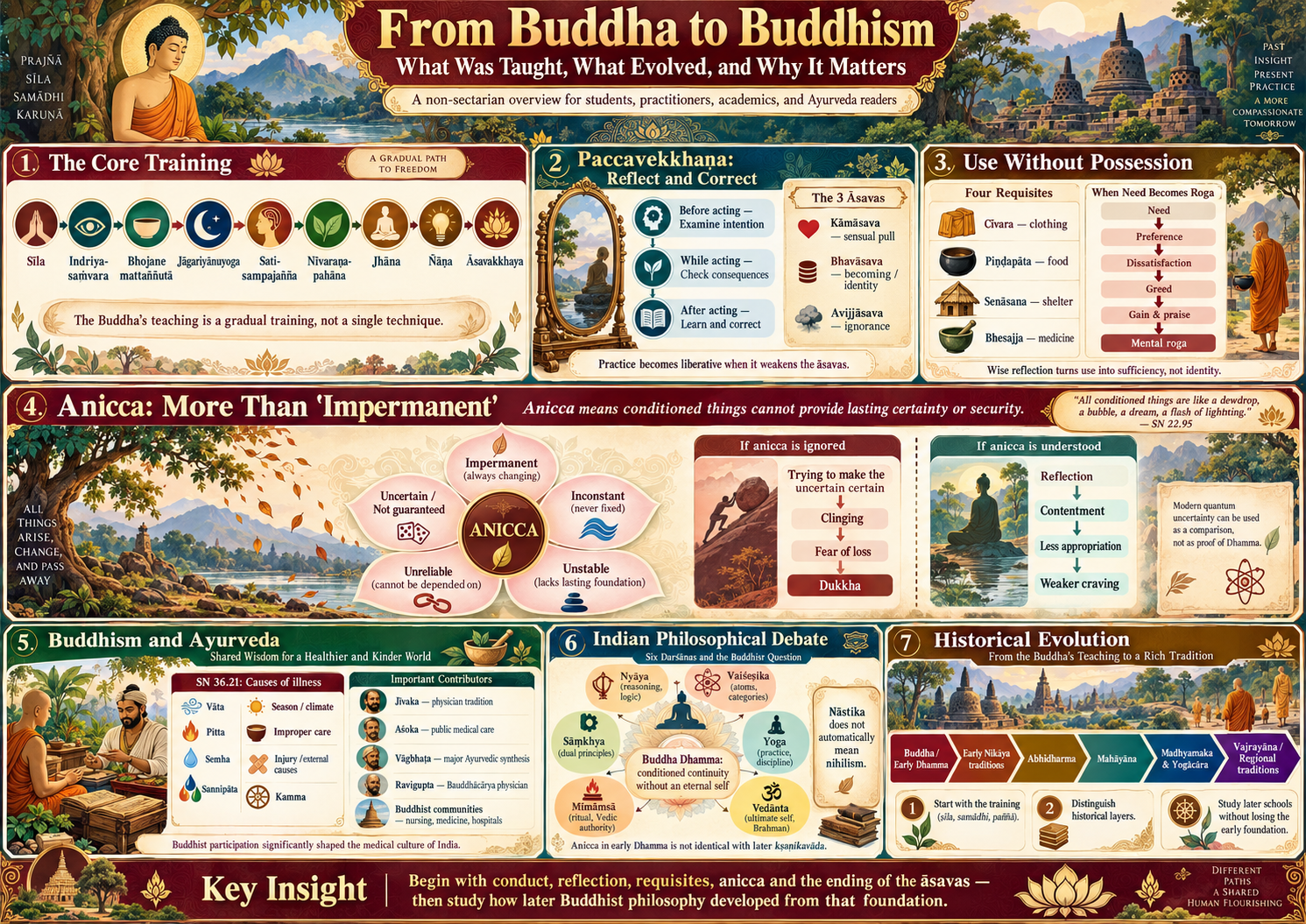 VISUAL SUMMARYSee this study in a pictureOpen the complete infographic for a visual overview before or after reading the full study.View infographic →
Before Studying “Buddhism,” Separate the Historical Layers
The word “Buddhism” is useful, but it can become historically misleading if everything associated with the Buddha over more than two millennia is placed into one undifferentiated category.
The historical Gotama, the early Dhamma-Vinaya, the early Buddhist nikāyas, Abhidharma, Mahāyāna, Madhyamaka, Yogācāra, Buddhist logic, Vajrayāna, Theravāda, Chan, Zen and Tibetan traditions are historically related. They are not one simultaneous body of teaching.
The first requirement of an academic investigation is therefore historical layering.
What belongs to the early discourses? What arose through monastic and scholastic classification? What belongs to later Mahāyāna literature? What developed during philosophical debates with other Indian systems? What belongs to still later institutional and regional Buddhism?
Do not project backwards — A philosophical doctrine formulated centuries later should not automatically be attributed to Gotama in the same technical form.
Do not erase development — Later Buddhist philosophy, medicine, literature and institutions deserve study in their own historical settings.
Do not begin with identity — First ask what is being trained, abandoned, developed and directly known.
This changes the opening question from: “What do Buddhists believe?” to:
“What did the Buddha actually train a person to do, step by step, and what problem was that training intended to bring to an end?”
One Investigation — Different Entry Points
Nothing in this essay requires the reader first to adopt a Buddhist identity, accept Ayurveda, reject Ayurveda or subscribe to one particular Indian philosophical system.
The same evidence can be investigated from several perspectives.
| Reader | Possible question | What this study investigates |
|---|---|---|
| Non-Buddhist | What did Gotama teach without requiring religious conversion? | The training itself: conduct, causality, mind, examination and release |
| Buddhist practitioner | Which teachings belong to which historical layer? | Early Dhamma versus Abhidharma, Mahāyāna and later traditions |
| Ayurvedic practitioner | How important were Buddhist communities in Indian medical history? | SN 36.21, Vinaya medicine, Jīvaka, Aśoka, Vāgbhaṭa and Ravigupta |
| BAMS / Padārtha Vijñāna student | Why is Buddhism called nāstika, momentary or even nihilistic in some textbooks? | The difference between doxographical shorthand and Buddhist textual history |
| Student of philosophy | How do anattā, anicca, kṣaṇikavāda, śūnyatā, puruṣa and Brahman differ? | A chronological comparison of competing explanations of continuity and reality |
| Student of science | Can ideas such as uncertainty in modern physics be compared with anicca? | A carefully bounded comparison without claiming that quantum mechanics proves Buddhist doctrine |
| Historian | How did one Dhamma-Vinaya become many Buddhist traditions? | Institutional, philosophical and regional development over centuries |
MN 39 and MN 107: Dhamma as a Gradual Training
If the question is “What did the Buddha teach?”, beginning only with philosophical propositions such as impermanence or non-self gives an incomplete picture.
MN 107 Gaṇakamoggallānasutta explicitly describes anupubbasikkhā, anupubbakiriyā and anupubbapaṭipadā — gradual training, gradual activity and gradual practice.
The comparison is with other skills that are learned progressively. A student is not placed at the final stage on the first day. Conditions required for later stages are developed first.
MN 39 Mahā-Assapurasutta makes the architecture still clearer. Conduct, restraint, consumption, wakefulness, everyday awareness, seclusion, abandonment of hindrances, jhāna and liberating knowledge form a connected training.
| Stage | Pāli / principle | What is trained? | Function |
|---|---|---|---|
| 1 | Hiri-ottappa | Moral sensitivity and concern about unskillful conduct | Creates willingness to examine and correct behaviour |
| 2 | Kāya-vacī-mano sucarita / Sīla | Bodily, verbal and mental conduct; livelihood | Reduces conflict, remorse and gross agitation |
| 3 | Indriya-saṁvara | Guarding eye, ear, nose, tongue, body and mind | Prevents contact from automatically becoming grasping or aversion |
| 4 | Bhojane mattaññutā | Knowing measure and purpose in eating | Separates bodily nourishment from sensual indulgence |
| 5 | Jāgariyānuyoga | Devotion to wakefulness and cleansing obstructive mental qualities | Makes training continuous rather than occasional |
| 6 | Sati-sampajañña | Mindfulness and clear comprehension in ordinary activity | Walking, eating, dressing, speaking and silence enter the field of training |
| 7 | Vivitta senāsana | Appropriate seclusion | Reduces unnecessary stimulation and supports deeper cultivation |
| 8 | Pañca nīvaraṇa pahāna | Abandoning the five hindrances | Removes conditions that weaken clarity and discernment |
| 9 | Catasso jhānā | The four jhānas | The mind becomes settled, unified, purified, equanimous and workable |
| 10 | Ñāṇa | Knowledge based upon the trained mind | Understanding is no longer merely conceptual |
| 11 | Āsavānaṁ ñāṇa | Knowing the āsavas, their arising, cessation and way to cessation | The deeper currents sustaining dukkha are directly addressed |
| 12 | Āsavakkhaya | Exhaustion of the āsavas | The training reaches its liberative completion |
Why the order matters
The Buddha does not begin the standard gradual training by saying: “Sit down and simply observe everything that arises.”
Before deep meditation, the training addresses the conditions that continually disturb the mind: how one behaves, what enters through the senses, how one eats, how one sleeps, how one moves through ordinary life and what environments one chooses.
This makes the path ecological in the broad sense: the condition of the mind cannot be separated from the conditions repeatedly supplied to it.
Samādhi is embedded in this architecture
Samādhi therefore should not be understood merely as forcing attention onto an object.
The mind reaching jhāna has already undergone restraint, simplification, reduction of remorse, management of sense contact, appropriate consumption, wakefulness, sati-sampajañña and abandonment of hindrances.
Sīla → Indriya-saṁvara → Bhojane mattaññutā → Jāgariyānuyoga → Sati-sampajañña → Nīvaraṇa-pahāna → Jhāna → Ñāṇa → Āsavakkhaya
MN 107: the teacher can show the road but cannot walk it for another
MN 107 adds an important dimension. The teaching can be described progressively and the route can be shown, yet different students respond differently.
This places responsibility for practice on the practitioner. Membership, reverence for the teacher or correct philosophical vocabulary cannot substitute for walking the path.
Paccavekkhaṇa, Yoniso Manasikāra and Āsavakkhaya
The gradual training explains what is progressively trained. Another question remains: how does the practitioner continually know whether the training is moving in the right direction?
MN 61 Ambalaṭṭhikarāhulovādasutta supplies a remarkably practical model through repeated reflection on bodily, verbal and mental action.
The Buddha asks Rāhula what a mirror is for. A mirror is used to examine. In the same way, action is not merely performed according to a rule; it is repeatedly reviewed in relation to intention and consequence.
Before acting — What is the intention? Is this likely to afflict oneself, another person, or both?
While acting — Is the actual result matching the original expectation? If harm is developing, stop.
After acting — What were the consequences? Learn from the unskillful and continue strengthening the skillful.
This creates a feedback-and-correction model of practice.
A precept without reflection can become mechanical. Reflection without ethical direction can become endless introspection. The two work together.
Paccavekkhaṇa therefore connects naturally with sīla, sati, sampajañña and paññā.
MN 2: knowing what method is appropriate
MN 2 Sabbāsavasutta begins by saying that the ending of the āsavas is for one who knows and sees.
Most importantly, MN 2 does not prescribe one universal reaction to every problem.
| Mode | Pāli | What the practitioner does |
|---|---|---|
| Seeing | Dassana | Corrects views and understanding through appropriate seeing |
| Restraining | Saṁvara | Guards the sense faculties where non-restraint would generate defilement |
| Using | Paṭisevana | Uses material supports according to their actual purpose |
| Enduring | Adhivāsana | Endures unavoidable heat, cold, hunger, pain and unpleasant conditions |
| Avoiding | Parivajjana | Avoids dangers, unsuitable places and harmful associations where appropriate |
| Removing | Vinodana | Actively abandons arisen sensual, hostile, harmful and other unskillful thoughts |
| Developing | Bhāvanā | Develops the awakening factors supported by seclusion, fading of rāga, cessation and letting go |
This is one reason the early training cannot be reduced to “observe whatever arises without doing anything.”
Sometimes one sees. Sometimes one restrains. Sometimes one uses something differently. Sometimes one endures. Sometimes one deliberately avoids. Sometimes one removes an arisen state. Beneficial qualities have to be actively developed.
The deeper target: the āsavas
Calmness, ethical behaviour and attentiveness are important, but the early discourses repeatedly place final liberation at a deeper level: āsavakkhaya — exhaustion of the āsavas.
| Āsava | Underlying movement | How it appears |
|---|---|---|
| Kāmāsava | Flow toward sensuality | Acquiring, preserving or repeating desirable sensory experience |
| Bhavāsava | Flow toward being and becoming | Construction around “what I am,” “what I will be” and identity |
| Avijjāsava | Flow sustained by ignorance | Conditions, dukkha, arising and cessation remain insufficiently understood |
Paccavekkhaṇa → examine action → Yoniso manasikāra → understand conditions → appropriate response → abandon akusala → bhāveti / bahulīkaroti → strengthen kusala → āsavakkhaya
The Four Requisites: When a Necessary Support Becomes a Disease of the Mind
The four requisites provide one of the clearest examples of how reflective examination enters ordinary life.
Food, clothing, shelter and medicine remain necessary. The problem therefore cannot simply be: “material things are bad.”
The deeper question is: what relationship does the mind establish with the thing being used?
MN 2: reflecting on purpose before use
In MN 2 the recurring expression is paṭisaṅkhā yoniso — having wisely considered.
The later monastic paccavekkhaṇā tradition preserves this orientation: use the requisite by understanding what it is actually for.
| Requisite | Functional purpose | What craving can turn it into |
|---|---|---|
| Cīvara | Protection and modest covering | Image, comparison, prestige and identity |
| Piṇḍapāta | Maintenance of the body | Sensual entertainment, compulsion and bodily display |
| Senāsana | Shelter and conditions supportive of seclusion | Luxury, status and escalating expectations |
| Bhesajja | Treatment of illness | Possessiveness, anxiety or unnecessary accumulation |
Object → What is its purpose? → How much is sufficient? → What mental state is arising? → Is use becoming possession? → Use without unnecessary appropriation
AN 4.157 Roga Sutta
AN 4.157 distinguishes kāyika roga — bodily illness — and cetasika roga — mental illness.
It then describes illnesses of one gone forth. Importantly, the four requisites themselves are not called diseases.
The illness begins when the practitioner becomes mahiccha — full of wants — and asantuṭṭha — dissatisfied — with the requisites that are available.
Mahicchā + asantuṭṭhi — available requisites no longer feel sufficient.
Lābha-sakkāra-siloka — desire expands toward gain, recognition, honour and praise.
Effort changes direction — energy becomes directed toward acquisition and recognition.
Calculated behaviour — even ostensibly religious behaviour can be manipulated to obtain support.
Necessary support → preference → dissatisfaction → multiplying wants → recognition → acquisition → impression-management → roga of the mind
MN 2 and AN 4.157 show two opposite movements
MN 2 asks: What is this actually for?
AN 4.157 shows what happens when this reflection disappears: a support becomes a platform upon which craving builds identity, dissatisfaction and social manipulation.
The principle is easily recognizable outside monastic life. Clothing, food, housing and healthcare may remain genuine needs, while the mind quietly converts them into measurements of self-worth.
A Practical Investigation of Dukkha, Conditionality and Release
Once the gradual training is visible, familiar Buddhist doctrines can be understood in their practical setting rather than as isolated philosophical propositions.
The Four Noble Truths are tasks
| Truth | What is investigated? | Task |
|---|---|---|
| Dukkha | The burden and unreliability of appropriated conditioned experience | Pariññeyya — fully understand |
| Samudaya | Conditions through which dukkha arises | Pahātabba — abandon |
| Nirodha | Cessation of conditions sustaining dukkha | Sacchikātabba — directly realize |
| Magga | Training leading to cessation | Bhāvetabba — develop |
Dependent arising
Paṭiccasamuppāda places conditionality at the centre.
When a condition is present, what follows? When that condition ceases, what no longer follows?
Anattā
Body, feeling, perception, formations and consciousness are examined according to conditionality, alteration and control.
The early argument does not require the proposition: “nothing exists.”
It asks whether conditioned processes can legitimately be taken as an independent, permanent and completely controllable self.
Kamma and rebirth
A modern reader may suspend judgment about rebirth. Historical accuracy nevertheless requires acknowledging that kamma, rebirth and release from renewed becoming belong to the early textual world.
Examine — action, intention, contact and consequence.
Understand — causes, conditions, arising and cessation.
Abandon — what feeds dukkha rather than merely watching it.
Develop — beneficial qualities repeatedly: bhāveti and bahulīkaroti.
Know release — when the causes cease, their results no longer have to be produced.
Buddhist Communities as a Formative Environment of Indian Medicine
Historical accuracy requires avoiding two opposite claims.
The Buddha did not compose the classical Caraka, Suśruta or Vāgbhaṭa Saṃhitās.
But Buddhist participation in Indian medicine was also far more substantial than an occasional monk knowing a herbal remedy.
Early Buddhist literature preserves physiological etiologies, therapeutic substances, food regulation, medical exemptions, nursing, hygiene and institutional responsibility for sick persons.
SN 36.21 Sīvakasutta
A particularly important discourse rejects the theory that every painful experience must be attributed exclusively to previous kamma.
| Cause | Broad meaning | Why it matters |
|---|---|---|
| Pitta | Bile-related disorder | Physiological causation |
| Semha | Phlegm-related disorder | Physiological causation |
| Vāta | Wind-related disorder | Physiological causation |
| Sannipāta | Combination of bodily disorders | Multi-factor bodily pathology |
| Utu | Climate / season | Environmental causation |
| Visamaparihāra | Improper bodily management | Behavioural causation |
| Opakkamika | External injury or intervention | External physical causation |
| Kammavipāka | Result of kamma | One causal category among several |
This prevents a sick person from automatically being morally blamed for illness.
It is also important historically that vāta, pitta and semha/śleṣman appear in early Buddhist medical discourse and later occupy a central position in Ayurvedic pathology.
The Vinaya and practical medicine
Monastic communities repeatedly had to answer practical medical questions. What may a sick monk consume? Which substances may be retained as medicines? What is appropriate treatment? How should a sick person be nursed?
A stable community could preserve treatments, compare experience, train attendants and transmit knowledge between generations and regions.
Nursing as part of the training
The famous Vinaya episode of the neglected sick monk is important precisely because care is not left as an optional act of kindness.
| Caregiver quality | Practical meaning |
|---|---|
| Competence | Know how medicine is appropriately prepared or administered |
| Suitability | Recognize what benefits or harms the patient |
| Goodwill | Care is not performed merely for material return |
| Non-disgust | Be willing to perform unpleasant physical care |
| Encouragement | Attend also to the patient’s mental condition |
Jīvaka
Jīvaka Komārabhacca becomes one of the most famous physician figures associated with the Buddha and Saṅgha.
Aśoka
Aśokan inscriptions provide another kind of evidence. Medical treatment for human beings and animals and the cultivation or introduction of medicinal herbs place healthcare within public administration.
Individual care → Saṅgha responsibility → institutional medicine → public welfare → medical literature → transregional transmission
From Jīvaka to Vāgbhaṭa and Ravigupta
Buddhist involvement in Indian medicine did not terminate with the early Saṅgha.
| Figure / institution | Buddhist connection | Medical importance | Historical caution |
|---|---|---|---|
| Early Saṅgha | Canonical Buddhist community | Etiology, medicines, nursing and institutional care | Predates surviving mature Ayurvedic compendia |
| Jīvaka | Connected with Buddha and Saṅgha in Buddhist literature | Physician traditions, therapeutics and surgical narratives | Accounts contain historical and literary layers |
| Aśoka | Buddhist Mauryan ruler | Public medical provisions and medicinal cultivation | Patron rather than medical author |
| Nāgārjuna-associated traditions | Buddhist associations | Medicine, pharmacology, minerals and later Rasashāstra traditions | Not every Nāgārjuna text belongs to the Madhyamaka philosopher |
| Vāgbhaṭa tradition | Substantial Buddhist associations | Aṣṭāṅgasaṅgraha and Aṣṭāṅgahṛdaya; major classical synthesis | Authorship and precise affiliation remain debated |
| Ravigupta | Remembered as Bauddhācārya | Siddhasāra and Siddhasāra Nighaṇṭu | Comparatively clear Buddhist medical affiliation |
Why Vāgbhaṭa matters
The Vāgbhaṭa tradition stands near the centre of classical Ayurveda. The Aṣṭāṅgahṛdaya became one of Ayurveda’s most influential texts, while the corpus systematically organizes the eight branches of medicine.
Buddhist associations around this corpus therefore matter considerably more than if the connection involved an obscure medical fragment.
Ravigupta
Ravigupta is especially significant because the tradition remembers him as Bauddhācārya Ravigupta.
Older healing cultures → Vedic, regional and śramaṇa interaction → Buddhist medical practice → classical systematization → Caraka / Suśruta / Vāgbhaṭa traditions → later medical transmission
How Did a Path to Āsavakkhaya Become a Debate About What Ultimately Exists?
One of the most consequential developments in Buddhist intellectual history is the movement from practical analysis toward increasingly technical questions about ontology, cognition and time.
| Practical question | Later scholastic question |
|---|---|
| How does dukkha arise? | What kind of entity is a dharma? |
| How is craving abandoned? | How does causation operate between dharmas? |
| How should contact be handled? | What is the relation between cognition and object? |
| How are hindrances removed? | How long does a conditioned event exist? |
| How are the āsavas ended? | How can continuity exist without permanent substance? |
Later Buddhist philosophers ordinarily still understood their work as relevant to liberation.
The shift is therefore not simply from “practice” to “useless philosophy.” Rather, increasingly complex questions emerged as Buddhists tried to systematize and defend the teaching.
Anicca Means More Than “Everything Eventually Passes Away”
Anicca is commonly translated as impermanent. This is correct, but if impermanence is understood only as “everything eventually disappears,” an important dimension of the teaching can be missed.
The lexical field of anicca includes meanings such as impermanent, inconstant, not lasting, unstable and unreliable.
Its opposite, nicca, carries the sense of something constant, stable, continuing or reliable.
Why “uncertain” is an important practical explanation
In lived experience, something that is inconstant, unstable and dependent upon changing conditions is also not guaranteed.
This is where the Hindi अनिश्चित — aniścita becomes an especially useful explanatory word: one cannot be certain that a conditioned situation will remain as it presently is.
Linguistically, however, this distinction should remain precise. Pāli anicca corresponds to Sanskrit anitya, not to the separate Sanskrit word aniścita.
Therefore “uncertain” is best presented as an experiential and practical implication of anicca rather than its literal etymological translation.
| Dimension of anicca | Meaning | Practical implication |
|---|---|---|
| Impermanent | It does not last indefinitely | Do not assume permanence |
| Inconstant | It does not remain continuously the same | Do not demand unchanging continuity |
| Unstable | Its configuration can alter when conditions alter | Do not build unconditional security upon its present state |
| Unreliable | It cannot always supply what is expected from it | Dependence upon it can become a basis for dukkha |
| Uncertain / not guaranteed | Its continuation in the desired form cannot be assured | Clinging to a guaranteed future becomes untenable |
Anicca is not merely “arising and passing away”
Consider health.
A person may be healthy today. Understanding that health is anicca does not require predicting that illness will arise tomorrow.
It means: the continuation of the present state cannot be guaranteed independently of conditions.
The same applies to relationships, wealth, reputation, employment, political conditions, bodily strength, pleasure, pain and meditative states.
One need not know exactly when a condition will alter in order to understand that it is dependent and therefore cannot promise permanent security.
Conditioned → dependent upon causes → causes themselves are conditional → continuation cannot be guaranteed → anicca → unconditional security cannot be extracted from it
Why this connects anicca to dukkha more clearly
Mere change is not always unpleasant.
Fever ending is change. Pain stopping is change. Debt disappearing is change.
Therefore the relationship between anicca and dukkha cannot simply be: “change is suffering.”
The deeper problem arises when a conditioned phenomenon is required to behave as though it were certain, controllable and permanently dependable.
One says: “This pleasant condition must remain.”
But its conditions alter.
One says: “This unpleasant state must disappear immediately.”
But its supporting conditions may still remain.
Anicca therefore reveals the inability of conditioned phenomena to provide unconditional reliability according to one’s demand.
Anicca and paccavekkhaṇa
This understanding also gives greater depth to the earlier discussion of paccavekkhaṇa and the four requisites.
If food, clothing, shelter, health and possessions are conditioned and therefore cannot be guaranteed, then trying to turn them into permanent psychological security inevitably creates tension.
Anicca not understood → try to make the uncertain certain → appropriation → fear of loss → dissatisfaction → further acquisition → roga / strengthening of āsava
Anicca understood → continuation is not guaranteed → paccavekkhaṇa → use according to purpose → contentment → reduced appropriation → weakening of craving and āsava
Anicca and quantum mechanics: a useful comparison, not a proof
Modern quantum mechanics offers an interesting comparison with the ordinary expectation that physical reality should always possess completely fixed, simultaneously knowable and individually predictable properties.
The Heisenberg uncertainty principle places fundamental limits on the simultaneous precision with which particular pairs of observables — classically exemplified by position and momentum — can be specified.
Quantum measurements also commonly yield a range of possible results described probabilistically rather than a single individually predictable outcome for each trial.
This is not identical with Buddhist anicca. Quantum mechanics is a mathematical physical theory; anicca belongs to an investigation of conditioned experience, appropriation, dukkha and release.
Quantum mechanics — particular observables and measurement outcomes are governed by precise limits and probabilities rather than unrestricted classical certainty.
Anicca — conditioned phenomena cannot be depended upon to remain unchanged or continue according to one’s wishes.
The comparison — both challenge an overly simple expectation of completely fixed, independently guaranteed states; they do so in very different domains.
What quantum mechanics does not mean
The uncertainty principle should not be paraphrased as: “nothing in the universe is certain.”
It is a technical relation governing particular pairs of observables in quantum theory.
Nor should probabilistic quantum measurement be used to say: “The Buddha discovered quantum mechanics 2,500 years ago.”
Such a claim would confuse two historically and methodologically different forms of inquiry.
The comparison is valuable when it remains modest: modern physics itself has shown that the classical expectation of unlimited simultaneous determinacy and individually predictable outcomes does not describe every physical situation.
From anicca to kṣaṇikavāda
This brings us to an important historical distinction.
The early discourses teach anicca: conditioned phenomena are not permanent, constant or reliable.
Later Buddhist scholastics ask a different and more technical question: how long does an individual conditioned dharma actually exist?
From this develops the much stronger philosophical doctrine of kṣaṇikavāda / kṣaṇabhaṅgavāda — radical momentariness.
| Historical layer | Primary concern | Characteristic formulation |
|---|---|---|
| Early Dhamma | Attachment, reliability and mistaken appropriation | Conditioned phenomena are anicca: unstable, inconstant and not secure |
| Abhidharma | Classification of experience | Dhammas/dharmas analysed into increasingly precise events |
| Developed momentarism | Temporal ontology | Conditioned dharmas interpreted as radically momentary |
| Later Buddhist epistemology | Causal efficacy and valid cognition | Formal philosophical arguments for momentariness |
| Brahmanical critiques | Memory, agency and continuity | Questions whether momentary causal series can explain enduring recognition and responsibility |
Thus: anicca and kṣaṇikavāda are historically related, but they should not be treated as identical propositions.
Śūnyatā, Yogācāra and the Expansion of Buddhist Philosophy
Mahāyāna was never one single philosophy.
It contained new scriptures, bodhisattva ideals, devotional forms, contemplative systems and several philosophical traditions.
| Development | Primary concern | Contribution |
|---|---|---|
| Prajñāpāramitā | Perfection of wisdom | Radical non-reification and emptiness discourse |
| Madhyamaka | Svabhāva | Critique of independently existing intrinsic nature |
| Yogācāra | Cognition and representation | Three natures, consciousness analysis and ālayavijñāna |
| Buddhist epistemology | Valid knowledge | Perception, inference, conceptual construction and causal efficacy |
| Tathāgatagarbha traditions | Buddhahood | New language concerning Buddha-nature and awakening |
What does śūnyatā mean?
Madhyamaka asks whether phenomena possess svabhāva — an intrinsic, independent nature through which they exist entirely from their own side.
Arises dependently → does not exist independently → lacks independent svabhāva → is śūnya of such intrinsic nature
This does not require the conclusion that conventionally functioning phenomena simply do not exist.
A medicine may lack independent existence yet still act under conditions. A flame depends upon fuel yet burns. A person depends upon innumerable bodily, psychological and social conditions yet experiences consequences.
The philosophical challenge
Once every candidate for independent intrinsic existence is rejected, opponents can ask: what ultimately grounds causation, knowledge and continuity?
Madhyamaka’s answer is not to introduce another hidden substrate. That is precisely where other Indian philosophical systems begin to disagree.
Six Classical Darśanas and Different Solutions to Continuity
The conventional six āstika darśanas are Nyāya, Vaiśeṣika, Sāṃkhya, Yoga, Mīmāṃsā and Vedānta.
They did not all exist in their mature classical forms during the Buddha’s lifetime.
Āstika does not simply mean “theist”
Vedic authority is central to the classical āstika/nāstika distinction. Thus a system can be nāstika without thereby maintaining that nothing exists.
| System | What provides continuity? | Question posed to Buddhist analysis |
|---|---|---|
| Nyāya | Enduring self and real substances | If the knower changes completely, who remembers? |
| Vaiśeṣika | Substances, atoms, selves and universals | Can stable objects be explained solely through changing events? |
| Sāṃkhya | Unchanging puruṣa with transforming prakṛti | What witnesses the changing mental field? |
| Yoga | Puruṣa distinct from changing citta | Does liberation require separating consciousness from mental process? |
| Mīmāṃsā | Enduring self and Vedic/language structures | How can action and linguistic continuity operate without persistence? |
| Vedānta | Ātman/Brahman | Does changing dependent experience require an unchanging ground? |
| Early Buddhist Dhamma | Conditioned continuity without immutable personal essence | Why posit an eternal self if causality can account for continuity? |
The shared philosophical problem — What, if anything, must remain numerically identical for memory, responsibility, continuity and liberation to be possible?
When Ayurveda Textbooks Call Buddhism Nāstika, Momentary or Nihilistic
Many Ayurveda students first encounter Buddhist philosophy through Padārtha Vijñāna rather than directly through the Nikāyas, Āgamas or later Buddhist philosophical texts.
Such textbooks commonly introduce the six āstika darśanas alongside Cārvāka, Jaina and Bauddha systems.
This is useful introductory doxography, but it can compress centuries of Buddhist history into a few pages.
Nāstika is not automatically nihilism
| Term | Meaning in context | What it does not automatically mean |
|---|---|---|
| Āstika | Generally accepts Vedic authority in the classical classificatory system | Simply “believes in God” |
| Nāstika | Does not acknowledge Vedic authority in that sense | Nothing exists or morality is meaningless |
| Natthikavāda | A specific denial of moral-causal consequences in early Buddhist debate | A synonym for Buddha Dhamma |
| Śūnyatā | Absence of independent svabhāva in Madhyamaka | Simple absolute non-existence |
SN 12.15 refuses both extremes
The Kaccānagottasutta identifies both “everything exists” and “everything does not exist” as extremes.
The middle analysis is dependent arising.
The momentariness compression
Some Padārtha Vijñāna presentations state broadly that the Buddha taught that everything is momentary.
Historically, anicca and developed kṣaṇikavāda need to be separated.
Early anicca says conditioned phenomena are impermanent, inconstant and unreliable. Later Buddhist scholasticism goes further by analyzing the temporal existence of individual dharmas.
The four Buddhist schools
| School | Historical setting | Major concern |
|---|---|---|
| Vaibhāṣika | Sarvāstivāda Abhidharma environment | Dharma analysis and scholastic realism |
| Sautrāntika | Later early-Buddhist scholastic current | Causation, cognition and critique of some Abhidharma positions |
| Yogācāra | Mahāyāna | Cognition, representation and consciousness |
| Madhyamaka | Mahāyāna | Dependent arising, svabhāva and emptiness |
These are therefore not four philosophical schools personally created by the Buddha.
What should the Ayurveda student distinguish?
| Textbook shorthand | More precise reading |
|---|---|
| “Buddhism is nāstika.” | Correct regarding non-acceptance of Vedic authority; this alone does not mean nihilism. |
| “The Buddha denied everything.” | Incorrect: early texts reject blanket non-existence as an extreme. |
| “Everything lasts one instant.” | A later technical momentarist development, not simply a synonym for early anicca. |
| “Madhyamaka says nothing exists.” | Misleading: independent svabhāva is denied while dependent functioning remains. |
| “Nibbāna means annihilation.” | Early discourse frames liberation through cessation of craving and destruction of āsavas. |
Śūnyatā and Brahman: Different Answers to the Search for Ultimate Ground
Advaita and Madhyamaka may superficially sound similar because both challenge ordinary assumptions about independently existing things.
Their ultimate claims, however, are radically different.
| Question | Madhyamaka | Advaita Vedānta |
|---|---|---|
| Independent reality of ordinary phenomena | No independent svabhāva | No independent reality apart from Brahman |
| Ultimate substrate | No independent svabhāva established | Brahman |
| Eternal self | No independent ātman | Ātman ultimately identical with Brahman |
| Direction | Do not reify even emptiness | Recognize nondual foundational reality |
The real dispute
The serious philosophical question is: does dependent experience require an independently existing metaphysical ground?
Advaita answers through Brahman. Madhyamaka challenges the need to posit such a foundation.
Return to the Buddha’s early question
MN 39 does not culminate in discovering the substance underlying the universe.
It culminates in āsavakkhaya.
This does not automatically settle later metaphysical disputes, but it shows that the original practical question was different.
Philosophical Competition and Historical Decline Are Different Questions
The common narrative that Śaṅkara defeated Buddhism in debate and therefore Buddhism disappeared from India is too simple.
Major Buddhist institutions remained active and well supported for centuries after Śaṅkara.
| Factor | Development | Potential significance |
|---|---|---|
| Philosophical competition | Nyāya, Mīmāṃsā and Vedānta developed sophisticated Buddhist critiques | Increasing intellectual competition |
| Advaita | Nondual system retaining Vedic authority and Brahman | Powerful alternative account of consciousness and reality |
| Śaiva / Vaiṣṇava expansion | Temple, devotional and ritual networks grew | Strong alternatives in lay life |
| Assimilation | Traditions shared concepts and practices | Boundaries became porous |
| Institutional concentration | Large monasteries became economically complex | Greater dependency on concentrated patronage |
| Changing patronage | Dynastic and economic support shifted | Major institutions became vulnerable |
| Military destruction | Important monastic centres were later damaged or destroyed | Educational networks lost crucial nodes |
Did śūnyatā contribute to intellectual vulnerability?
This can be investigated, but it should not be made into a predetermined historical conclusion.
The more radically intrinsic foundations were denied, the more critics could ask: what positive account of reality remains?
Vedānta offered a strong positive answer through Brahman.
But Mahāyāna was much broader than Madhyamaka, and Buddhist institutions continued for centuries.
How Did One Teaching Become Many Schools?
The diagram Buddha → Theravāda versus Mahāyāna → Vajrayāna is historically inadequate.
Early differentiation began among monastic communities with differing regional, Vinaya and doctrinal identities.
| Tradition | Historical significance |
|---|---|
| Theravāda | Surviving Sthavira-related tradition preserving the complete Pāli canon |
| Sarvāstivāda | Major northwestern Abhidharma tradition |
| Mahāsāṃghika family | Important early family of communities |
| Dharmaguptaka | Vinaya lineage eventually important in East Asia |
| Pudgalavāda traditions | Distinctive account of the person |
| Sautrāntika currents | Criticism of particular Abhidharma theories |
Early Dhamma-Vinaya → multiple nikāya / Vinaya communities → Abhidharma traditions → Mahāyāna movements → Madhyamaka / Yogācāra → Mantrayāna / Vajrayāna → regional Buddhist civilizations
Testing the Architecture Instead of Beginning With a Conclusion
01 Why does the gradual training begin before formal meditation?
If the remaining waking hours are dominated by uncontrolled speech, sense stimulation, compulsive consumption and conflict, formal meditation inherits the consequences.
Sīla, indriya-saṁvara, moderation in food, wakefulness and sati-sampajañña therefore alter the conditions before the person sits down to meditate.
Meditation begins much earlier than the meditation seat.
02 Why is paccavekkhaṇa more than introspection?
Introspection can merely notice: “anger is present.”
MN 61 adds causal learning. What preceded the anger? What action followed? What consequence occurred? What should now be changed?
The mind becomes something to be understood causally, not merely narrated autobiographically.
03 Why do the four requisites belong inside liberation?
Because craving organizes itself around ordinary necessities.
Food can become entertainment. Clothing can become identity. Housing can become prestige. Medicine can become anxiety.
MN 2 examines use. AN 4.157 examines what happens when sufficiency disappears.
04 Why does AN 4.157 use the language of roga?
Dissatisfaction does not remain an internal feeling.
It can reorganize behaviour around acquisition, reputation and manipulation.
The sutta then points beneath these symptoms toward the āsavas, associating complete freedom from mental roga with their ending.
05 Why are seven methods for the āsavas necessary?
Different problems possess different causal structures.
A dangerous situation may need avoidance. Cold may need endurance. Unskillful thinking may need active removal. Sensory vulnerability may need restraint. Requisites need appropriate use. Beneficial qualities require development.
One technique cannot intelligently replace all seven responses.
06 Does anicca simply mean that everything disappears?
No.
“Impermanent” is useful, but anicca also carries the sense of inconstancy, instability and unreliability.
The practical issue is not only that an object will eventually cease. It is that the current configuration cannot guarantee its own continuation.
Health today cannot promise health tomorrow. Praise today cannot guarantee praise tomorrow. Wealth today cannot guarantee wealth tomorrow. Even a refined meditative state cannot be demanded to remain independently of supporting conditions.
This makes “not certain / not guaranteed” an especially useful experiential explanation.
The Hindi word अनिश्चित communicates this well, provided the reader understands that it is an explanatory gloss, not the literal etymological equivalent of Pāli anicca.
07 Why does uncertainty make craving more intelligible?
Craving frequently tries to obtain certainty from something that cannot provide it.
“This person must always love me.” “This body must remain healthy.” “My wealth must remain secure.” “My position must continue.”
The problem is not affection, health, wealth or work. It is the demand that conditioned states provide unconditional certainty.
Once that demand is present, fear follows naturally because the mind senses that the guarantee cannot actually be obtained.
In this way: anicca → appropriation → insecurity → craving → dukkha becomes psychologically intelligible.
08 Does quantum mechanics prove anicca?
No.
Quantum mechanics and anicca belong to different domains and use different methods.
The uncertainty principle is a mathematically defined relation concerning particular pairs of quantum observables. It does not mean that every fact about the universe is vaguely uncertain.
Quantum measurements can also produce probabilistically distributed outcomes, and in some experimentally certified settings the individual outcome is fundamentally unpredictable.
The useful comparison is therefore narrower: twentieth-century physics itself undermined the simple classical expectation that every physical property can always be assigned simultaneously unlimited precision and that every individual measurement outcome is predetermined in the ordinary classical sense.
Anicca makes a different practical observation: conditioned phenomena cannot provide guaranteed permanence, stability or obedience to desire.
The resonance is intellectually interesting. Identity between the two would be historically and scientifically unjustified.
09 Why is anicca not identical with kṣaṇikavāda?
Anicca concerns the conditioned, unstable and unreliable character of phenomena.
Kṣaṇikavāda makes a stronger technical claim about the temporal duration of individual conditioned dharmas.
The second can be understood as a scholastic attempt to explain the first at a finer ontological level.
But that historical development should remain visible.
10 Does early Buddhism deserve the description “nihilism”?
If nihilism means that actions have no consequences, early Buddhist texts argue against that position.
If nihilism means that absolutely nothing exists, SN 12.15 treats blanket non-existence as an extreme.
Early Buddhism instead analyzes dependent arising and cessation.
11 Why can Padārtha Vijñāna distort chronology?
Padārtha Vijñāna has to teach Indian philosophical categories economically.
A compressed presentation may move rapidly from the Buddha to momentariness and then to four Buddhist schools.
As an exam map this may be useful. As history it needs expansion.
Restoring chronology allows the Ayurveda student to distinguish the Buddha’s early Dhamma from later Buddhist doctrines that Ayurvedic or Brahmanical authors may actually be criticizing.
12 Why does momentariness matter to Ayurveda and other darśanas?
Medicine presupposes meaningful causal continuity.
A medicine administered now is expected to affect a later condition.
Critics of radical momentariness therefore ask what connects one moment to the next.
Buddhist momentarists answer through causal succession. Opponents argue that succession alone may not adequately explain memory, recognition or agency.
This is a real philosophical problem rather than something resolved by simply labelling one side nihilistic.
13 Is śūnyatā a sophisticated nihilism?
Madhyamaka’s central target is independent svabhāva.
Something may lack independent intrinsic existence and still operate conventionally through conditions.
The stronger philosophical objection is not: “you say nothing exists.”
It is: can dependent functioning really be explained without an ultimately independent ground?
14 Why is Vedānta a formidable Buddhist opponent?
Advaita can agree that ordinary plurality lacks independent ultimate reality while supplying what Madhyamaka refuses: a positive metaphysical ground.
Brahman becomes immutable, nondual reality; ātman is identified with that ground.
Buddhist thinkers then challenge whether something completely immutable can explain changing causal phenomena.
Both systems therefore expose the explanatory cost of the other’s position.
15 Did Vedānta intellectually replace Buddhism?
Vedānta became enormously influential and Buddhist theories faced serious criticism.
Yet Buddhist monasteries and intellectual centres remained active for centuries after Śaṅkara.
The historical contraction of Buddhism therefore requires philosophical, institutional, economic, devotional, political and military explanations.
16 What becomes visible when the early training is placed side by side?
| Human domain | Training response |
|---|---|
| Ethical behaviour | Sīla, hiri and ottappa |
| Speech and consequences | Paccavekkhaṇa before, during and after action |
| Sensory stimulation | Indriya-saṁvara |
| Food | Bhojane mattaññutā |
| Possessions | Purpose, contentment and requisite reflection |
| Uncertainty | Understanding anicca rather than demanding guarantees from conditions |
| Sleep and energy | Jāgariyānuyoga |
| Daily activity | Sati-sampajañña |
| Environment | Seclusion and appropriate avoidance |
| Unavoidable discomfort | Adhivāsana |
| Arisen harmful thoughts | Vinodana |
| Wholesome qualities | Bhāvanā and bahulīkaraṇa |
| Hindrances | Explicit abandonment |
| Mental stabilization | Jhāna |
| Causal understanding | Four Noble Truths and paṭiccasamuppāda |
| Identity construction | Anattā investigation |
| Underlying recurrence | Knowledge and abandonment of āsavas |
| Liberative criterion | Āsavakkhaya |
The point is not to declare in advance that one system “covers everything.”
The reader can instead observe how the training moves from overt action through material life, sensory contact, emotional reaction, uncertainty, mental development, causality and finally the currents underlying renewed dukkha.
17 Why is this relevant to an Ayurvedic practitioner?
Ayurveda addresses embodied life and disease.
Buddhist texts simultaneously distinguish bodily and mental roga, recognize multiple bodily causes, regulate food and medicine, and examine craving around those very supports.
Medicine can address disease without implying that insight replaces appropriate treatment.
Conversely, even health itself is anicca and cannot provide permanent psychological security.
18 What method should be used when comparing philosophies?
Begin by identifying the exact problem each system is trying to solve.
Identify the question → date the source → define its terms → reconstruct the argument → state the strongest objection → examine the reply → only then compare
From Gotama to Ayurveda, Madhyamaka, Vedānta and Later Buddhism
| Broad period | Development | Significance |
|---|---|---|
| c. 5th century BCE | Historical Gotama and early Dhamma-Vinaya | Gradual training, dependent arising, anicca, anattā, jhāna and āsavakkhaya |
| Early Buddhist period | Jīvaka and monastic medical traditions | Disease, medicine, nursing and therapeutic practice |
| 3rd century BCE | Aśoka | Public medical welfare and major Buddhist patronage |
| Following centuries | Early nikāya differentiation | Multiple monastic and doctrinal communities |
| Last centuries BCE onward | Abhidharma systematization | Dharma analysis, causation and technical theories of time |
| Late BCE / early CE onward | Early Mahāyāna | Bodhisattva ideals and new scriptures |
| Early centuries CE | Madhyamaka | Svabhāva, dependent arising and śūnyatā become central philosophical questions |
| 4th–5th centuries CE | Yogācāra and Vasubandhu-era scholasticism | Consciousness, cognition and advanced Buddhist analysis |
| 5th–7th centuries CE | Dignāga–Dharmakīrti traditions | Logic, epistemology, causal efficacy and momentariness |
| Early medieval period | Vāgbhaṭa tradition | Major classical synthesis of Ayurveda |
| c. 7th century CE | Ravigupta | Clear Buddhist association within significant Ayurvedic literature |
| 7th century onward | Mantrayāna / Vajrayāna | Increasing development of tantric Buddhist systems |
| 8th century CE | Śaṅkara and mature Advaita | Influential Vedāntic engagement with Buddhist philosophical positions |
| 9th–12th centuries CE | Strong Pāla-period Buddhist patronage | Major monasteries remain active long after Śaṅkara |
| Early second millennium | Major contraction of institutional Buddhism in much of India | Economic, social, political and military factors converge |
The Questions Revisited
| Question | What the investigation shows |
|---|---|
| What did the Buddha train? | Conduct, senses, consumption, wakefulness, daily awareness, hindrances, jhāna and liberating knowledge. |
| What does paccavekkhaṇa do? | Turns practice into continual examination and correction of intention, action and consequence. |
| Why the four requisites? | They reveal how necessity can remain functional or become craving, status and identity. |
| What does anicca add? | Conditioned things are not merely temporary; they are inconstant and cannot provide guaranteed security. |
| Does quantum mechanics prove anicca? | No; it provides a limited modern comparison concerning determinacy, precision and probabilistic outcomes. |
| What was the Buddhist contribution to Ayurveda? | Substantial participation through medical etiologies, monastic healthcare, Jīvaka, Aśoka, Vāgbhaṭa-associated traditions and Ravigupta. |
| Did Buddha teach developed kṣaṇikavāda? | Early texts teach anicca; radical momentariness develops through later Buddhist scholasticism. |
| Is Buddhism nihilistic? | Early texts reject both denial of moral causality and blanket non-existence. |
| Is Madhyamaka nihilism? | It denies independent svabhāva, not dependent conventional functioning. |
| Why does Vedānta challenge Buddhism effectively? | Advaita offers Brahman as a positive nondual ground and an enduring account of consciousness. |
| Did Vedānta simply defeat Buddhism? | No single factor explains the historical contraction of Buddhism in India. |
Begin With the Training, Then Examine the Philosophies
Beginning with the word “Buddhism” can make the history appear more unified than it actually was.
Under that single label one may encounter a discourse on guarding the senses, an Abhidharma theory of dharmas, a momentarist argument, a Madhyamaka critique of svabhāva, a Yogācāra theory of consciousness, a Pure Land devotional tradition, tantric practice or Zen.
Each belongs to Buddhist history. They do not all belong to the same historical layer.
The early training provides a particularly useful starting point.
MN 39 and MN 107 progressively reshape conduct, sensory life, food, wakefulness, daily awareness, hindrances and samādhi.
MN 61 makes the process self-correcting through repeated reflection.
MN 2 shows that wisdom does not mean responding identically to every situation: some conditions require seeing, restraint, appropriate use, endurance, avoidance, removal or deliberate development.
AN 4.157 shows how even necessary material supports can become psychological disease when contentment gives way to escalating desire and status-seeking.
Anicca then reveals why attempts to establish unconditional security in these supports are structurally unstable.
A conditioned phenomenon may be useful. It may be pleasant. It may be valuable. But because its continuation depends upon conditions, it cannot guarantee itself.
This makes the experiential meaning of anicca much deeper than merely saying that “everything passes away.”
The teaching therefore investigates what happens when the mind tries to make the uncertain certain, the changing permanent and the uncontrollable completely controllable.
Beneath these visible struggles lie the āsavas.
The endpoint is therefore not simply becoming morally respectable, calm, mindful, intellectually sophisticated or metaphysically correct.
It is āsavakkhaya.
The medical history fits naturally into the same investigation. Physical disease is not reduced to kamma. Appropriate medicines are used. Sick persons are cared for. Buddhist institutions participate in Indian medicine.
Later Buddhist intellectual history then develops increasingly specialized questions: momentariness, svabhāva, śūnyatā, cognition and epistemology.
Other Indian systems respond with their own solutions: enduring self, puruṣa, substance, Vedic authority or Brahman.
Padārtha Vijñāna preserves part of this conversation for Ayurveda students, but its compressed classifications benefit from historical expansion.
Quantum mechanics can also enter the discussion as a modern comparison, but only when its limits are respected. Quantum uncertainty is a technical physical principle; anicca is a practical investigation of conditioned reliability.
Their domains are different, yet the comparison reminds the modern reader not to assume that reality must always conform to a naïvely fixed, perfectly predictable classical picture.
Texts and Academic Resources
Gradual training and reflective examination
- MN 39 Mahā-Assapurasutta — gradual training, jhāna and liberating knowledge.
- MN 107 Gaṇakamoggallānasutta — gradual training, gradual practice and the teacher who shows the road.
- MN 61 Ambalaṭṭhikarāhulovādasutta — reflection before, during and after bodily, verbal and mental action.
- MN 2 Sabbāsavasutta — seven methods for abandoning āsavas and wise use of the four requisites.
- AN 4.157 Roga Sutta — bodily and mental roga and illnesses associated with dissatisfaction and gain-seeking.
Anicca
- Digital Pāḷi Dictionary — anicca — lexical range including impermanent, inconstant, not lasting, unstable and unreliable; Sanskrit cognate anitya.
- Early sutta material on anicca should be distinguished from later scholastic theories of radical momentariness.
Quantum mechanics comparison
- NIST — introductory material on quantum mechanics — especially the Heisenberg uncertainty principle and limits on simultaneous precision for complementary observables.
- NIST research on quantum measurement and randomness — measurement outcomes in quantum systems may be described probabilistically.
- Quantum physics is used in this essay only as a conceptual comparison, not as scientific verification of Buddhist doctrine.
Early Dhamma and the nihilism question
- SN 12.15 Kaccānagottasutta — avoidance of “everything exists” and “everything does not exist.”
- MN 60 Apaṇṇakasutta — examination of views denying moral consequences and the next world.
- SN 56.11 Dhammacakkappavattanasutta — Four Noble Truths and their tasks.
- SN 12 Nidānasaṃyutta — dependent arising and cessation.
Buddhist medicine and Ayurveda
- SN 36.21 Sīvakasutta — multiple bodily, environmental, behavioural, external and kammic causes.
- Vinaya Mahāvagga — Bhesajjakkhandhaka — medicine, treatment and care of the sick.
- Kenneth G. Zysk, Asceticism and Healing in Ancient India.
- M. R. Raghava Varier, A Brief History of Āyurveda.
- M. S. Valiathan, The Legacy of Vāgbhaṭa.
- Historical studies of Jīvaka, Vāgbhaṭa and Bauddhācārya Ravigupta.
Padārtha Vijñāna
- Ayurvedic Padārtha Vijñāna texts dealing with Bauddha Darśana, nāstika classification and kṣaṇabhaṅgavāda.
- Such presentations should be compared with Buddhist primary texts and historical scholarship when chronology matters.
Abhidharma and momentariness
- Modern academic studies tracing the transition from early impermanence to radical momentariness.
- Studies of Vasubandhu, Dignāga and Dharmakīrti.
Mahāyāna
- Studies of Prajñāpāramitā literature.
- Studies of Nāgārjuna and Madhyamaka.
- Studies of Yogācāra and Buddhist epistemology.
Vedānta
- Primary and secondary scholarship on Gauḍapāda.
- Śaṅkara — Brahmasūtrabhāṣya, Upaniṣadic commentaries and Upadeśasāhasrī.
- Academic work on Advaita’s engagement with Buddhist philosophical traditions.
Methodological note
This study distinguishes early textual evidence, later Buddhist scholastic development, classical medical texts, commentarial interpretation, doxographical classification and modern historical reconstruction.
Where chronology, authorship or interpretation remains debated, uncertainty should remain visible rather than being replaced with artificial certainty.