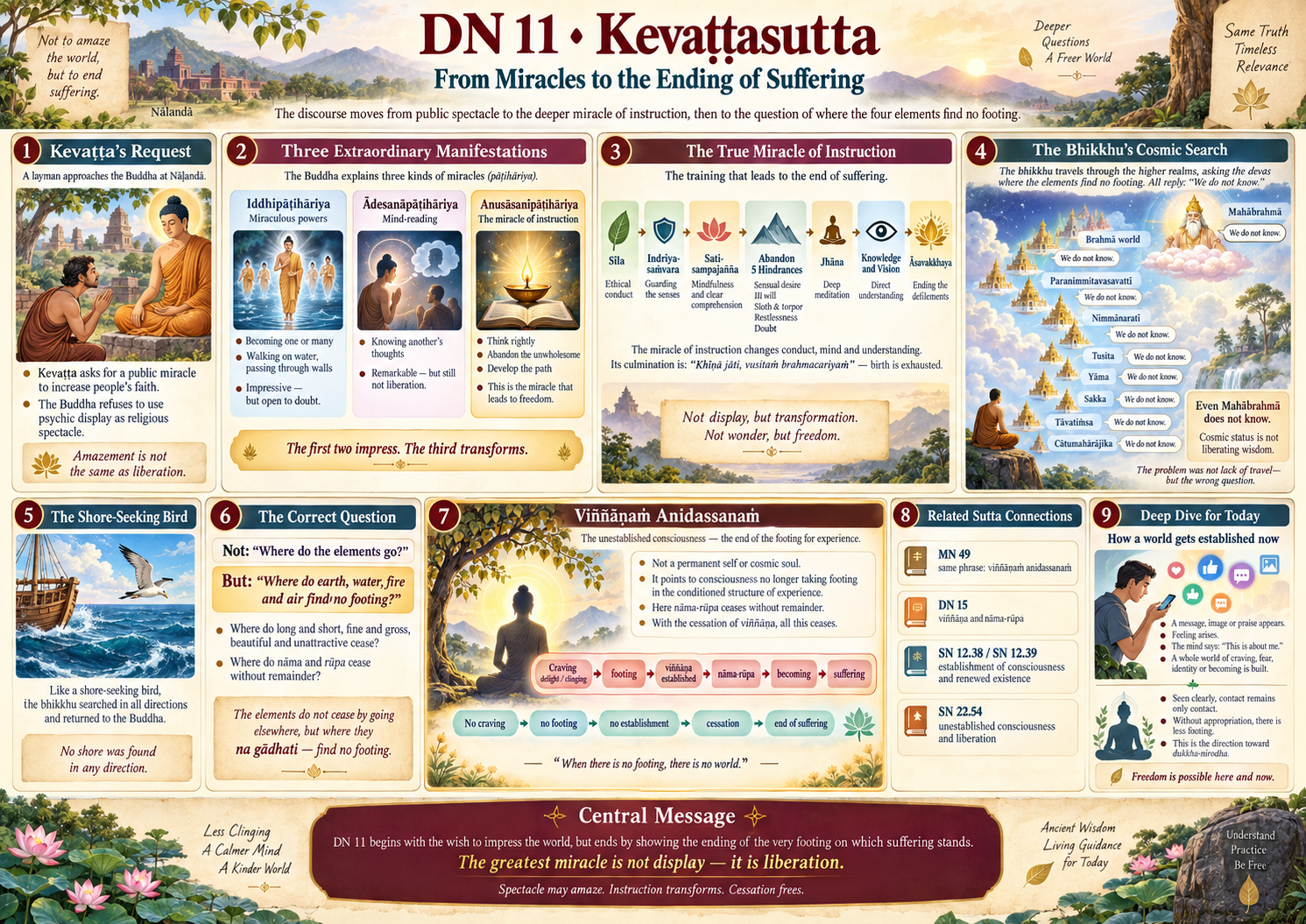
 VISUAL SUMMARYSee this sutta in a pictureOpen the complete infographic for a visual overview before or after reading the full study.View infographic →
The Kevaṭṭasutta has a remarkable architecture. It begins with a request that the Buddha use supernatural displays to increase public faith. It then distinguishes three kinds of extraordinary manifestation: psychic power, knowledge of another person’s mind, and transformative instruction. Finally, the discourse moves to a bhikkhu who searches through the deva and Brahmā worlds for the place where the four great elements cease, only to discover that he has framed the question incorrectly. The culmination is the difficult expression viññāṇaṁ anidassanaṁ, followed immediately by the cessation of nāma-rūpa and the cessation of viññāṇa.
The central movement is therefore:
spectacle → instruction → samādhi → cosmic search → limits of Brahmā → corrected question → viññāṇa and nāma-rūpa → nirodha
That progression is essential to understanding the final verse.
Opening: Kevaṭṭa’s Request
01The Setting
Evaṁ me sutaṁ—ekaṁ samayaṁ bhagavā nāḷandāyaṁ viharati pāvārikambavane.
Thus have I heard. On one occasion the Blessed One was staying at Nāḷandā, in Pāvārika’s Mango Grove.
02Kevaṭṭa Approaches the Buddha
Atha kho kevaṭṭo gahapatiputto yena bhagavā tenupasaṅkami; upasaṅkamitvā bhagavantaṁ abhivādetvā ekamantaṁ nisīdi.
Then Kevaṭṭa, the householder’s son, approached the Blessed One. He paid homage to him and sat down to one side.
Ekamantaṁ nisinno kho kevaṭṭo gahapatiputto bhagavantaṁ etadavoca: “ayaṁ, bhante, nāḷandā iddhā ceva phītā ca bahujanā ākiṇṇamanussā bhagavati abhippasannā.”
Seated to one side, Kevaṭṭa said:
“Venerable sir, this city of Nāḷandā is prosperous and flourishing, crowded with people, and its inhabitants have deep confidence in the Blessed One.”
“Sādhu, bhante, bhagavā ekaṁ bhikkhuṁ samādisatu, yo uttari manussadhammā iddhipāṭihāriyaṁ karissati; evāyaṁ nāḷandā bhiyyoso mattāya bhagavati abhippasīdissatī”ti.
“It would be good, venerable sir, if the Blessed One instructed one bhikkhu to perform a superhuman feat of psychic power. Then the people of Nāḷandā would have still greater confidence in the Blessed One.”
Kevaṭṭa’s proposal is straightforward: make the Dhamma convincing through spectacle.
The Buddha will challenge the assumption that amazement and liberating confidence are the same thing.
03The Buddha Refuses
Evaṁ vutte, bhagavā kevaṭṭaṁ gahapatiputtaṁ etadavoca: “na kho ahaṁ, kevaṭṭa, bhikkhūnaṁ evaṁ dhammaṁ desemi: ‘etha tumhe, bhikkhave, gihīnaṁ odātavasanānaṁ uttari manussadhammā iddhipāṭihāriyaṁ karothā’”ti.
When this was said, the Blessed One replied:
“Kevaṭṭa, I do not teach the Dhamma to the bhikkhus in this way: ‘Come, bhikkhus, perform superhuman feats of psychic power for householders dressed in white.’”
The Buddha is not saying that such abilities cannot exist. He will shortly describe them himself. His objection is to their public use as a device for generating religious belief.
04Kevaṭṭa Requests It a Second Time
Kevaṭṭa replies that he is not trying to pressure or trouble the Buddha. He again explains that Nāḷandā is prosperous, crowded, and already devoted to the Buddha. Precisely because of this, he thinks a display of psychic power would deepen the people’s confidence.
The Buddha gives exactly the same response:
“I do not instruct bhikkhus to perform superhuman psychic displays before householders.”
05Kevaṭṭa Requests It a Third Time
Kevaṭṭa asks for the same thing for a third time.
At this point the Buddha no longer simply refuses. He explains why Kevaṭṭa’s model of spiritual persuasion is inadequate.
Iddhipāṭihāriya — Psychic Power
06Three Extraordinary Manifestations
“Tīṇi kho imāni, kevaṭṭa, pāṭihāriyāni mayā sayaṁ abhiññā sacchikatvā paveditāni. Katamāni tīṇi? Iddhipāṭihāriyaṁ, ādesanāpāṭihāriyaṁ, anusāsanīpāṭihāriyaṁ.”
“Kevaṭṭa, there are three extraordinary manifestations that I have directly known and realized for myself and then made known.
What three?
The extraordinary manifestation of psychic power,
the extraordinary manifestation of revealing another’s mind,
and the extraordinary manifestation of instruction.”
The third will become the Buddha’s central concern.
07What Psychic Power Means
Katamañca, kevaṭṭa, iddhipāṭihāriyaṁ? Idha, kevaṭṭa, bhikkhu anekavihitaṁ iddhividhaṁ paccanubhoti—ekopi hutvā bahudhā hoti, bahudhāpi hutvā eko hoti; āvibhāvaṁ tirobhāvaṁ tirokuṭṭaṁ tiropākāraṁ tiropabbataṁ asajjamāno gacchati seyyathāpi ākāse; pathaviyāpi ummujjanimujjaṁ karoti seyyathāpi udake; udakepi abhijjamāne gacchati seyyathāpi pathaviyaṁ; ākāsepi pallaṅkena kamati seyyathāpi pakkhī sakuṇo; imepi candimasūriye evaṁ mahiddhike evaṁ mahānubhāve pāṇinā parāmasati parimajjati; yāva brahmalokāpi kāyena vasaṁ vatteti.
“And what, Kevaṭṭa, is the extraordinary manifestation of psychic power?
Here a bhikkhu experiences various kinds of psychic ability. Having been one, he becomes many; having been many, he becomes one. He appears and disappears. He passes unobstructed through walls, enclosures and mountains as though through space. He dives into and emerges from the earth as though it were water. He walks on water without breaking its surface as though walking on land. Sitting cross-legged, he travels through the sky like a winged bird. With his hand he touches and strokes even the moon and sun, so mighty and powerful. He exercises bodily mastery even as far as the Brahmā world.”
The Buddha is not ridiculing iddhi. The question is what iddhi accomplishes regarding avijjā, taṇhā and dukkha.
08Someone Sees the Miracle
A faithful and confident person sees such a bhikkhu exercising all these psychic abilities: becoming many from one and one from many; appearing and disappearing; passing through solid barriers; entering the earth; walking on water; travelling through the sky; touching the sun and moon; and exercising mastery as far as Brahmā’s world.
The witness is deeply impressed.
09He Reports It to a Skeptic
The faithful person tells someone who lacks faith:
“It is astonishing! It is extraordinary! Look at the great psychic power and potency of this ascetic. I saw him perform all these extraordinary abilities.”
The discourse repeats the same complete list of psychic abilities described immediately beforehand. The point is unchanged: the witness reports the entire display as evidence of extraordinary power.
10The Skeptic Has Another Explanation
The skeptical person replies:
“There is an art called the Gandhārī knowledge. By means of such an art, this bhikkhu performs these extraordinary feats.”
The Buddha’s point is subtle.
Even an authentic extraordinary event does not force another person to interpret it as evidence of awakening.
The believer says:
“Miracle.”
The skeptic says:
“Technique.”
Another person might say:
“Trick.”
The event itself does not remove ignorance.
11Kevaṭṭa Admits This
The Buddha asks:
“What do you think, Kevaṭṭa? Could an unbelieving person answer a believer in this way?”
Kevaṭṭa replies:
“Yes, venerable sir.”
Kevaṭṭa has therefore conceded the weakness of his original proposal.
12The Danger in Psychic Spectacle
“Imaṁ kho ahaṁ, kevaṭṭa, iddhipāṭihāriye ādīnavaṁ sampassamāno iddhipāṭihāriyena aṭṭīyāmi harāyāmi jigucchāmi.”
“Seeing this danger in the extraordinary manifestation of psychic power, Kevaṭṭa, I am troubled by it, ashamed of it, and repelled by its use in this manner.”
The danger lies in mistaking astonishment for liberation.
Ādesanāpāṭihāriya — Revealing Another Mind
13Revealing Another Person’s Mind
Katamañca, kevaṭṭa, ādesanāpāṭihāriyaṁ? Idha, kevaṭṭa, bhikkhu parasattānaṁ parapuggalānaṁ cittampi ādisati, cetasikampi ādisati, vitakkitampi ādisati, vicāritampi ādisati: “evampi te mano, itthampi te mano, itipi te cittan”ti.
“And what, Kevaṭṭa, is the extraordinary manifestation of revealing another’s mind?
Here a bhikkhu reveals the mind of other beings and persons, their mental qualities, what they are thinking and what they are reflecting upon, saying:
‘Your mind is like this. Your mind is of this kind. This is how your mind is.’”
14A Believer Witnesses Mind-Reading
A faithful person sees the bhikkhu accurately revealing the thoughts, mental qualities and reflections of other people.
He tells an unbelieving person:
“It is astonishing! This ascetic has remarkable power. I saw him know the minds and thoughts of other people.”
15The Skeptic Again Explains It Differently
The unbeliever responds:
“There is an art called the Maṇikā knowledge. Through that, a person can reveal another’s mind and thoughts.”
Again, the extraordinary experience does not compel right understanding.
16Kevaṭṭa Again Agrees
The Buddha asks whether such an objection could be made.
Kevaṭṭa says:
“Yes.”
17The Same Danger Exists
“Imaṁ kho ahaṁ, kevaṭṭa, ādesanāpāṭihāriye ādīnavaṁ sampassamāno ādesanāpāṭihāriyena aṭṭīyāmi harāyāmi jigucchāmi.”
“Seeing this danger in the extraordinary manifestation of revealing another’s mind, Kevaṭṭa, I am troubled by it, ashamed of it, and repelled by its use in this manner.”
Again, the Buddha is not reducing the possibility of unusual knowledge to fraud.
He is saying that knowing another person’s thoughts does not by itself end one’s own craving, becoming or birth.
Anusāsanīpāṭihāriya — Transformative Instruction
18The Extraordinary Manifestation the Buddha Values
Katamañca, kevaṭṭa, anusāsanīpāṭihāriyaṁ? Idha, kevaṭṭa, bhikkhu evamanusāsati: “evaṁ vitakketha, mā evaṁ vitakkayittha, evaṁ manasikarotha, mā evaṁ manasākattha, idaṁ pajahatha, idaṁ upasampajja viharathā”ti. Idaṁ vuccati, kevaṭṭa, anusāsanīpāṭihāriyaṁ.
“And what, Kevaṭṭa, is the extraordinary manifestation of instruction?
Here a bhikkhu instructs:
‘Think in this way; do not think in that way.
Direct your attention in this way; do not direct your attention in that way.
Abandon this.
Enter and dwell in this.’
This, Kevaṭṭa, is called the extraordinary manifestation of instruction.”
This is the turning point.
The genuine wonder is that the direction of a mind can be changed.
A mind accustomed to kāma can develop nekkhamma.
A mind accustomed to byāpāda can develop non-ill-will.
A scattered mind can become samāhita.
An ignorant mind can understand arising and cessation.
19The Gradual Training Contained Inside Anusāsanī
The discourse now moves through the familiar Dīgha gradual training. This sequence is essential because anusāsanīpāṭihāriya is not merely verbal advice; it is instruction capable of transforming the entire course of practice.
The Buddha’s instruction actually takes the disciple through an entire transformation.
A Tathāgata arises in the world, fully awakened, accomplished in knowledge and conduct, knower of the world, unsurpassed trainer of persons, teacher of devas and humans.
He teaches Dhamma that is good in the beginning, good in the middle and good in the end, complete in meaning and expression, revealing a purified brahmacariya.
A householder or householder’s child hears that Dhamma and acquires confidence. He reflects that household life is confined and dusty whereas going forth is open. Seeing the difficulty of living the brahmacariya completely while immersed in household life, he goes forth.
Having gone forth, he lives restrained by the training. He abandons killing, stealing and sexual activity. He speaks truthfully and abandons divisive, harsh and purposeless speech. He becomes careful about livelihood, possessions, entertainment, luxury, commercial activity, deception, manipulation and practices inconsistent with the renunciant life.
But morality alone is not the end of the instruction.
He guards the six sense doors. When seeing a form, hearing a sound, smelling an odor, tasting a flavor, touching a tangible object or cognizing a mental phenomenon, he does not seize upon the overall sign and then elaborate attractive or repulsive details. He protects each faculty so that covetousness, sadness and other unwholesome states do not invade the mind.
Then comes sati-sampajañña. He acts with clear comprehension while going forward and returning, looking ahead and aside, bending and extending, wearing his robe, eating and drinking, walking, standing, sitting, sleeping, waking, speaking and remaining silent.
He develops contentment with basic requisites.
He seeks seclusion.
Sitting with the body upright and mindfulness established, he abandons the five hindrances: sensual desire, ill will, sloth and torpor, restlessness and remorse, and doubt.
When he sees that these hindrances have been abandoned, gladness arises. From gladness comes pīti; from pīti the body becomes tranquil; with bodily tranquillity he experiences sukha; and the happy mind enters samādhi.
He then enters the first jhāna, secluded from sensuality and unwholesome states, with pīti and sukha born of seclusion.
With vitakka and vicāra settling, he enters the second jhāna, with inner unification and pīti-sukha born of samādhi.
With the fading of pīti he enters the third jhāna, dwelling equanimously, mindful and clearly comprehending, experiencing bodily sukha.
With pleasure and pain abandoned and joy and grief having disappeared, he enters the fourth jhāna: neither painful nor pleasant, with mindfulness purified by equanimity.
The purified, workable and imperturbable mind is then directed toward knowledge and vision. The practitioner understands the material body as composed of the four great elements, born from parents, sustained by food, subject to deterioration and destruction, while ordinary consciousness is dependent and connected with conditions.
The same developed mind may be directed toward further knowledges: mind-made form, psychic abilities, refined hearing, knowledge of other minds, recollection of former lives, and knowledge of the passing away and reappearance of beings according to their kamma.
But even these are not the culmination.
Finally the mind is directed toward the destruction of the āsavas.
The practitioner directly understands:
“This is dukkha.”
“This is the arising of dukkha.”
“This is the cessation of dukkha.”
“This is the way leading to the cessation of dukkha.”
He understands the āsavas, their arising, their cessation and the way to their cessation.
Knowing and seeing in this way, the mind becomes liberated from the āsava of sensuality, the āsava of becoming and the āsava of ignorance.
Then knowledge arises:
Khīṇā jāti, vusitaṁ brahmacariyaṁ, kataṁ karaṇīyaṁ, nāparaṁ itthattāyā.
“Birth is exhausted.
The brahmacariya has been lived.
What had to be done has been done.
There is no further return to this state of existence.”
That entire movement is what the Buddha calls anusāsanīpāṭihāriya.
Now its superiority becomes obvious.
Making one body appear as many is extraordinary.
But ending birth is more extraordinary.
Reading another person’s mind is extraordinary.
But uprooting ignorance from one’s own mind is the miracle that ends dukkha.
20The Three Manifestations Summarized
Imāni kho, kevaṭṭa, tīṇi pāṭihāriyāni mayā sayaṁ abhiññā sacchikatvā paveditāni.
“These, Kevaṭṭa, are the three extraordinary manifestations that I have directly known, personally realized and made known.”
The first two impress.
The third liberates.
The Bhikkhu Searching for the Cessation of the Elements
21A Bhikkhu Asks Where the Four Great Elements Cease
Bhūtapubbaṁ, kevaṭṭa, imasmiññeva bhikkhusaṅghe aññatarassa bhikkhuno evaṁ cetaso parivitakko udapādi: “kattha nu kho ime cattāro mahābhūtā aparisesā nirujjhanti, seyyathidaṁ—pathavīdhātu āpodhātu tejodhātu vāyodhātū”ti?
“Once, Kevaṭṭa, in this very Saṅgha of bhikkhus, a certain bhikkhu had this thought:
‘Where do these four great elements cease without remainder—namely, the earth element, the water element, the fire element and the air element?’”
The key word is kattha: “where?”
The bhikkhu has already assumed that cessation must be a place.
That assumption drives the entire cosmic search.
22He Enters Samādhi and Reaches the Devas
Atha kho so, kevaṭṭa, bhikkhu tathārūpaṁ samādhiṁ samāpajji, yathāsamāhite citte devayāniyo maggo pāturahosi.
“Then that bhikkhu entered such a samādhi that, with the mind thus concentrated, a path leading to the devas became apparent.”
Atha kho so, kevaṭṭa, bhikkhu yena cātumahārājikā devā tenupasaṅkami.
“He approached the devas of the Four Great Kings.”
He asks them:
“Friends, where do the four great elements cease without remainder: earth, water, fire and air?”
23The Devas Do Not Know
The devas answer:
“We also do not know where these four great elements cease without remainder.”
But they tell him:
“There are the Four Great Kings who are more excellent and refined than us. Perhaps they know.”
Already the pattern has begun:
We do not know, but someone higher surely must.
24The Four Great Kings Do Not Know
The bhikkhu goes to the Four Great Kings and asks exactly the same question.
They too say:
“We do not know.”
They direct him to the Tāvatiṁsa devas.
25The Tāvatiṁsa Devas Do Not Know
The bhikkhu goes to the Tāvatiṁsa devas.
They also admit ignorance and direct him to Sakka, lord of the devas.
26Sakka Does Not Know
The bhikkhu asks Sakka:
“Where do earth, water, fire and air cease without remainder?”
Sakka replies that he too does not know.
He sends the bhikkhu onward to more refined devas.
27The Search Through the Higher Deva Realms
The search continues through progressively higher deva realms:
Yāma devas,
Suyāma,
Tusita devas,
Santussita,
Nimmānaratī devas,
Sunimmita,
Paranimmitavasavattī devas,
Vasavattī,
and eventually the Brahmā hosts.
At each stage the bhikkhu asks the same question.
At each stage the answer is essentially the same:
“We do not know. There is someone or some realm considered more exalted than us. Perhaps they know.”
This is not merely cosmology.
It is teaching through repetition:
refinement of existence is still existence, and exalted rebirth is not the same as knowledge of cessation.
28The Brahmā Hosts Also Do Not Know
The bhikkhu enters such a samādhi that the way to the Brahmā world becomes apparent.
He goes to the Brahmā hosts and asks:
“Where do the four great elements cease without remainder?”
They reply:
“We do not know.”
But they speak of Mahābrahmā as superior and more refined.
They describe him as:
abhibhū, anabhibhūto, aññadatthudaso, vasavattī, issaro, kattā, nimmātā, seṭṭho, sajitā, vasī, pitā bhūtabhabyānaṁ
the Conqueror,
Unconquered,
All-Seeing,
Powerful,
Lord,
Maker,
Creator,
Supreme,
Ordainer,
Master,
Father of beings past and future.
The obvious implication is:
“Surely he knows.”
29But They Do Not Even Know Where Brahmā Is
The bhikkhu asks:
“Where is this Mahābrahmā now?”
The Brahmā hosts admit:
“We do not know where Brahmā is, in which direction he is, or where he may be.”
But they explain that certain signs appear before his manifestation: light and radiance arise.
Soon Mahābrahmā appears.
30The Bhikkhu Questions Mahābrahmā
The bhikkhu approaches and asks:
“Friend, where do these four great elements cease without remainder—earth, water, fire and air?”
Mahābrahmā replies:
“I am Brahmā, the Great Brahmā, the Conqueror, the Unconquered, the All-Seeing, the Powerful Lord, the Maker, the Creator, the Supreme, the Ordainer, the Master, the Father of beings past and future.”
He has not answered the question.
31The Bhikkhu Asks a Second Time
The bhikkhu says:
“Friend, I did not ask whether you are Brahmā, Great Brahmā, Maker or Creator.
I asked:
‘Where do these four great elements cease without remainder?’”
Mahābrahmā again responds by announcing his cosmic titles.
32A Third Question
The bhikkhu asks for the third time:
“I am not asking who you are. I am asking where earth, water, fire and air cease without remainder.”
The repetition exposes the difference between:
authority
and
knowledge.
33Brahmā Takes Him Aside
Mahābrahmā then takes the bhikkhu by the arm and leads him away privately.
He admits:
“These Brahmā devas believe that there is nothing unknown to me, nothing unseen by me, nothing I do not understand, and nothing I have not realized.
That is why I would not answer in front of them.
But I too do not know where the four great elements cease without remainder.”
Then Brahmā says something extraordinary:
“You made a mistake when you passed beyond the Blessed One and went searching outside for the answer.
Go back to the Blessed One.
Ask him.
And whatever he tells you, remember it.”
The highest cosmic authority the bhikkhu has found sends him back to the Buddha.
34The Bhikkhu Returns
The bhikkhu disappears from the Brahmā world and appears before the Buddha as quickly as a strong person might straighten a bent arm or bend a straightened arm.
He pays homage, sits to one side and asks:
“Venerable sir, where do these four great elements cease without remainder—earth, water, fire and air?”
The Buddha does not immediately answer.
He first gives a simile.
The Shore-Seeking Bird and the Corrected Question
35The Shore-Seeking Bird
Bhūtapubbaṁ, bhikkhu, sāmuddikā vāṇijā tīradassiṁ sakuṇaṁ gahetvā nāvāya samuddaṁ ajjhogāhanti.
“In former times, bhikkhu, sea-going merchants would take a shore-seeking bird with them when they entered the ocean in a ship.”
Te atīradakkhiniyā nāvāya tīradassiṁ sakuṇaṁ muñcanti.
“When the ship was out of sight of land, they would release the shore-seeking bird.”
The bird would fly east.
Then south.
Then west.
Then north.
Then upward and toward intermediate directions.
If the bird saw land anywhere, it would continue toward that land.
But if it saw no shore in any direction, it would return to the ship.
36The Bhikkhu Was Like the Bird
The Buddha says:
“In just the same way, bhikkhu, you searched as far as the Brahmā world and did not find an answer to this question.
So you have returned to me.”
The bhikkhu travelled extraordinarily far.
But distance was never the problem.
The error was conceptual.
37The Original Question Was Wrong
Na kho eso, bhikkhu, pañho evaṁ pucchitabbo: “kattha nu kho, bhante, ime cattāro mahābhūtā aparisesā nirujjhanti, seyyathidaṁ—pathavīdhātu āpodhātu tejodhātu vāyodhātū”ti?
“Bhikkhu, the question should not be asked in this way:
‘Where do these four great elements cease without remainder—earth, water, fire and air?’”
The Buddha does not give him a location.
He changes the question.
That is decisive.
38The Correct Question
tejo vāyo na gādhati;
Kattha dīghañca rassañca,
aṇuṁ thūlaṁ subhāsubhaṁ;
Kattha nāmañca rūpañca,
asesaṁ uparujjhati?
“Where do water and earth,
fire and air,
find no footing?
Where do long and short,
fine and gross,
beautiful and unattractive,
and where do nāma and rūpa
cease without remainder?”
The important shift is from:
“Where do the elements go?”
to:
“Where do they not gain footing?”
That moves the question from geography to conditionality.
39The Buddha’s Answer
anantaṁ sabbatopabhaṁ;
tejo vāyo na gādhati.
aṇuṁ thūlaṁ subhāsubhaṁ;
asesaṁ uparujjhati;
etthetaṁ uparujjhati.
A careful rendering is:
“Viññāṇa that is non-manifesting,
without limit,
with radiance in every direction;
here water and earth,
fire and air,
find no footing.
Here long and short,
fine and gross,
beautiful and unattractive,
find no footing.
Here nāma and rūpa
cease without remainder.
With the cessation of viññāṇa,
all of this ceases here.”
The expression sabbatopabhaṁ is textually difficult and has variant readings. It is therefore unwise to build an entire metaphysical theory on the word “luminous” alone. The more secure interpretive clues in the verse are anidassana, na gādhati, nāmañca rūpañca asesaṁ uparujjhati, and finally viññāṇassa nirodhena.
40Closing
Idamavoca bhagavā. Attamano kevaṭṭo gahapatiputto bhagavato bhāsitaṁ abhinandīti.
Thus spoke the Blessed One.
Kevaṭṭa, the householder’s son, was delighted and rejoiced in what the Blessed One had said.
Kevaṭṭasuttaṁ niṭṭhitaṁ ekādasamaṁ.
The Kevaṭṭasutta, the eleventh discourse, is finished.
01The Key to Understanding the Final Teaching
The phrase viññāṇaṁ anidassanaṁ should not be treated as an isolated mystical expression. If one lifts only those two words from DN 11, one can make them support almost any theory: an eternal consciousness, a cosmic mind, a pure Self, a luminous substance existing beyond the universe, or even a particular meditative attainment.
The sutta itself gives us much stronger controls on interpretation.
The first is the question that precedes the phrase.
The second is na gādhati—“does not gain footing.”
The third is the cessation of nāma-rūpa.
The fourth, and strongest, is:
viññāṇassa nirodhena
“with the cessation of viññāṇa.”
Any interpretation that turns viññāṇaṁ anidassanaṁ into a permanently existing consciousness that can never cease has difficulty accounting for the final line of the Buddha’s own answer.
02Anidassana
Dassana is connected with seeing, showing or manifestation.
With the negative prefix, anidassana points toward what is not shown, not manifest as an object, not appearing in the ordinary determinate way.
A careful reading therefore understands the phrase as viññāṇa not manifesting through the ordinary structure in which conditioned objects find footing, rather than as “an eternal consciousness.”
The related passage in MN 49 uses the same striking expression:
viññāṇaṁ anidassanaṁ anantaṁ sabbato pabhaṁ
and then says that it is not apprehended through “earthness,” “waterness,” “fireness,” “airness,” devas, Brahmā, or even “the all” in those respective modes. That is a significant parallel because it again separates the expression from the ordinary conditioned categories through which experience is appropriated.
But MN 49 does not suddenly authorize an attā doctrine either. The context is the Buddha correcting Brahmā’s mistaken belief that Brahmā’s realm is permanent, eternal and the highest possible escape. The same anti-eternalist direction appears in DN 11.
03Why “Na Gādhati” Matters So Much
The bhikkhu originally asked:
“Where do the four elements cease?”
The Buddha changes it to:
“Where do they not gain footing?”
That is much more revealing.
The problem is not that earth, water, fire and air need to travel to some hidden cosmic destination.
The problem is patiṭṭhā, establishment, support, footing.
This connects DN 11 to a whole family of dependent-origination discourses.
SN 12.38
SN 12.38 says that what one intends, plans and has an underlying tendency toward becomes a basis for the maintenance of consciousness. When such a basis exists, consciousness becomes established and grows; from that comes future renewed existence, and from renewed existence come future birth, aging, death, sorrow and distress.
When there is no intention, no planning and no underlying tendency providing a basis, consciousness does not become established and grow. Then future renewed existence is not generated, and future birth, aging and death cease. The discourse explicitly calls this the cessation of the entire mass of suffering.
That is directly relevant to the expression “find no footing.”
SN 12.39
SN 12.39 makes the next connection explicit.
When consciousness is established and grows, there is a descent or establishment of nāma-rūpa.
When consciousness is not established and does not grow, there is no descent of nāma-rūpa, and the subsequent conditioned sequence toward suffering ceases.
Now compare DN 11:
Ettha nāmañca rūpañca asesaṁ uparujjhati.
“Here nāma and rūpa cease without remainder.”
The relationship becomes very important.
DN 15
DN 15 examines the relationship from both sides.
With viññāṇa as condition, nāma-rūpa.
With nāma-rūpa as condition, viññāṇa.
The discourse then asks whether future birth, aging and death could occur if viññāṇa did not gain footing in nāma-rūpa.
The answer is no.
DN 15 says that the entire arena within which birth, death, designation, language and the round of existence operate extends as far as nāma-rūpa together with viññāṇa.
DN 11 is therefore not discussing an isolated thing called “consciousness.”
It is taking us to the ending of the conditioned viññāṇa–nāma-rūpa structure.
SN 12.65 and SN 12.67
SN 12.65 describes the Buddha’s pre-awakening investigation reaching the reciprocal relationship:
with viññāṇa, nāma-rūpa;
with nāma-rūpa, viññāṇa.
It then sees the reverse:
with the cessation of nāma-rūpa, viññāṇa ceases;
with the cessation of viññāṇa, nāma-rūpa ceases.
SN 12.67 uses the famous image of two bundles of reeds leaning against one another. Remove one support and the other falls. The image prevents us from imagining viññāṇa as an independent metaphysical entity floating free of conditioned experience.
04SN 12.64 — The Clearest “No Footing” Simile
SN 12.64 is particularly useful.
It says that wherever there is lust, delight and craving in relation to nutriment, consciousness becomes established and grows. Where consciousness becomes established, nāma-rūpa develops; from there the sequence proceeds toward renewed existence, birth, aging and death.
Where lust, delight and craving are absent, consciousness does not become established and grow. There is no corresponding development toward future birth and suffering.
The Buddha then gives the simile of sunlight entering a building.
If there is a wall, the ray lands on the wall.
If there is no wall, perhaps it lands on the ground.
If there is no ground, perhaps on water.
If there is no surface anywhere on which it can land, it is not established anywhere.
This is one of the best ways to approach DN 11.
The issue is not:
“Where is an eternal consciousness hiding?”
The issue is:
What happens when there is no conditioned footing upon which consciousness can become established and proliferate into renewed existence?
05SN 22.54 — Unestablished Consciousness and Nibbāna
SN 22.54 is even more direct.
When lust for form, feeling, perception, formations and consciousness is abandoned, the support for the establishment of consciousness is cut off.
That consciousness is described as:
unestablished, not growing, nongenerative, liberated.
Because it is liberated, there is steadiness; because there is steadiness, there is contentment; because there is no agitation, Nibbāna is personally realized.
Then comes the familiar declaration:
birth is destroyed,
the brahmacariya has been lived,
what had to be done has been done,
there is no further return to this state of being.
This gives us an extremely important interpretive direction.
Unestablished does not mean “a new eternal entity.”
It describes the ending of the process by which viññāṇa takes support, grows and generates further becoming.
06SN 22.55 — There Is No Independent Travelling Viññāṇa
SN 22.55 makes another safeguard explicit: it is impossible to meaningfully describe the coming, going, growth and expansion of consciousness apart from form, feeling, perception and volitional formations.
Again, when lust for these bases is abandoned, there is no support for the establishment of consciousness; unestablished consciousness is liberated and Nibbāna follows.
This directly undermines the idea of an independent eternal viññāṇa travelling by itself.
07So What Should Viññāṇaṁ Anidassanaṁ Mean in Practice?
A careful sutta-based reading would be:
viññāṇaṁ anidassanaṁ points toward viññāṇa no longer manifesting through, taking footing in, or becoming established upon the conditioned structure that sustains nāma-rūpa and renewed becoming.
The phrase should not be equated mechanically with the wording “unestablished consciousness,” because the Pāḷi terms are not identical.
But the family of teachings clearly illuminates the direction.
The key is not to find a special cosmic substance called “non-manifest consciousness.”
The key is to understand the ending of establishment.
When craving provides support:
viññāṇa establishes.
Nāma-rūpa develops.
Contact occurs.
Vedanā is appropriated.
Taṇhā grows.
Upādāna develops.
Bhava follows.
Birth follows.
Dukkha follows.
When craving, delight and the underlying tendencies no longer provide footing:
viññāṇa does not establish and grow.
Future nāma-rūpa is not generated.
Bhava does not continue.
Birth does not continue.
Aging and death do not continue.
That is how this teaching connects directly with dukkhanirodha.
08Why “Anantaṁ” Should Not Become “Eternal”
Ananta means without boundary, without limit or without a determinate end.
But “without limit” is not automatically synonymous with:
“eternal immortal Self.”
The final line remains:
viññāṇassa nirodhena.
Therefore it is safer to read anantaṁ in relation to the absence of ordinary delimiting categories than to turn it into a statement about eternal duration.
09Sabbatopabhaṁ
The expression sabbatopabhaṁ is difficult, and the textual reading is not entirely secure in the textual tradition.
It can suggest radiance or luminosity “on all sides” or “in every respect.”
But this is not the word on which I would base the interpretation.
The structurally clearer terms are:
anidassanaṁ
not manifest in the ordinary way,
na gādhati
no footing,
nāma-rūpa asesaṁ uparujjhati
nāma-rūpa completely stops,
and
viññāṇassa nirodhena
with the cessation of viññāṇa.
Together they point toward cessation, not toward an eternal luminous being.
| Sutta | Connection to DN 11 | Practice significance |
|---|---|---|
| MN 49 | Uses the same rare expression viññāṇaṁ anidassanaṁ anantaṁ sabbato pabhaṁ while correcting Brahmā’s claim to permanence. | Keeps the phrase within the critique of eternalist claims. |
| SN 12.38 | Intention, planning and underlying tendency provide a basis for consciousness to become established and grow. | Shows how renewed existence and the whole mass of suffering depend upon support. |
| SN 12.39 | When consciousness is established and grows, nāma-rūpa develops; when it is not established, the sequence toward suffering does not continue. | Illuminates “here nāma and rūpa cease without remainder.” |
| DN 15 | Viññāṇa and nāma-rūpa condition one another and delimit the arena of birth, aging, death, designation and experience. | Shows why DN 11 is not discussing an isolated independent consciousness. |
| SN 12.65 | The Buddha’s investigation reaches the reciprocal conditioning and cessation of viññāṇa and nāma-rūpa. | Connects DN 11 with dependent origination and its cessation. |
| SN 12.67 | The two bundles of reeds illustrate mutual dependence: remove one support and the other falls. | Guards against treating viññāṇa as a metaphysical entity floating free of conditions. |
| SN 12.64 | Lust, delight and craving provide a landing place for consciousness; the ray-of-light simile illustrates non-establishment when no surface remains. | Gives a concrete way to understand “no footing.” |
| SN 22.54 | When lust for the aggregates is abandoned, the basis for establishment is cut; consciousness is unestablished, nongenerative and liberated. | Links non-establishment with Nibbāna and the exhaustion of birth. |
| SN 22.55 | Consciousness cannot be described as independently coming, going, growing or expanding apart from the other aggregates. | Undermines the idea of an independently travelling eternal viññāṇa. |
01How Viññāṇa Establishes a World — A Practical Example
Suppose somebody sends you a critical WhatsApp message. At the most basic level there is a visible form. Eye-consciousness. Mental recognition. Contact.
Unpleasant vedanā. But almost immediately the mind supplies a footing: “He insulted me.” Then more footing: “He always behaves like this.”
Then: “I need to defend myself.” Then: “What will others think?” Then:
“I will show him.” Within seconds, twenty words on a screen have produced an entire experiential world. There is: a self, an enemy,
a past, a future, status, fear, anger,
intention, identity.
This is nāma-rūpa and viññāṇa not as abstract philosophy, but as a world becoming established around appropriation.
Now imagine the same contact with deep practice. The words are seen. Meaning is understood. Unpleasant vedanā is known. The movement toward anger is known.
No identity is built. No revenge narrative is cultivated. No “I have been diminished” gains footing. The contact happened. But it did not become a world in which the mind had to live.
This is not yet the final cessation of DN 11, but it helps us understand experientially what “footing” means.
02A Sensual Example
An attractive person appears. There is visual consciousness. Pleasant vedanā. Then the mind can provide a footing: “She is beautiful.”
“I want to see again.” “Who is she?” “Let me look at her profile.” “Perhaps I can contact her.” Now viññāṇa has not merely registered a form.
A whole structure of saññā, intention, delight, craving and becoming has begun. This connects directly with what we examined in the Mātāputtasutta.
Sensuality grows because the mind gives consciousness somewhere to establish itself through delight and craving.
When the attractive form is merely seen, pleasant vedanā known, and no craving takes hold, the process has less footing.
03A Meditation Example
A meditator enters a powerful samādhi. The body may become extremely subtle. Ordinary boundaries can fade. External sounds may lose relevance.
The usual world of size, direction and sensory distinction may become radically attenuated.
This is valuable because it demonstrates directly that the ordinary experienced world depends upon conditions.
But one must not immediately conclude: “I have discovered viññāṇaṁ anidassanaṁ.” Jhāna is conditioned. The formless attainments are conditioned.
DN 11 is pointing beyond merely refining experience to the ending of the support for continued becoming.
The final criterion remains nirodha, not extraordinariness.
Spectacle does not establish liberation
The Kevaṭṭasutta can initially seem like two different discourses joined together. The first half concerns supernatural powers. The second half concerns cosmology, Brahmā, the four great elements and the enigmatic phrase viññāṇaṁ anidassanaṁ. When read carefully, however, both halves make the same argument at different levels. Kevaṭṭa begins from a very human assumption: people are more likely to believe when they are impressed. His proposal resembles much of modern religious culture. A teacher claims to know the future, heal illnesses, read minds, know former lives, produce unusual objects, transmit energy, predict events or display extraordinary meditative capacities. Crowds gather precisely because something unusual has happened.
The Buddha asks a more important question: what does the unusual event actually prove? A psychic display can be interpreted as genuine iddhi by one person, trickery by another, hypnosis by a third, technology by a fourth and coincidence by a fifth. The same observable event does not necessarily remove avijjā from any of them. A person can be absolutely convinced that a miracle occurred and remain fully bound by kāma, byāpāda, sakkāyadiṭṭhi, māna and craving for renewed existence. This remains true in the age of social media. A thirty-second video can show a supposed miracle to twenty million people in a day. Comments fill with believers and skeptics. One group says, “Proof!” Another says, “Editing!” Another says, “AI!” Another says, “Fraud!” Even if the event were genuine, the argument continues because spectacle does not contain within itself the wisdom necessary for liberation. That is why anusāsanīpāṭihāriya is so profound.
The genuine miracle is transformation
Consider what instruction can accomplish when it is actually practised. A person who previously lied whenever convenient becomes incapable of intentional deception. A person controlled by sexual desire develops indriya-saṁvara. Someone who habitually reacts in anger learns to recognize byāpāda while it is still forming. A mind that could not remain still for thirty seconds develops samādhi. A practitioner who depended entirely upon sensual pleasure discovers the pīti and sukha of seclusion. The same practitioner eventually sees even refined states as conditioned and stops appropriating them. That transformation is less theatrical than walking on water, but much more radical. Water-walking leaves birth intact. Mind-reading leaves birth intact. Travelling to Brahmā’s world leaves birth intact.
The Buddha’s instruction aims at: khīṇā jāti the exhaustion of birth itself.
Extraordinary experience can still carry a wrong assumption
The second half of DN 11 demonstrates this dramatically. The bhikkhu has substantial samādhi. He can access deva realms. If spiritual development were measured simply by unusual experiences, he would look extraordinarily advanced. Yet he carries a wrong assumption into those experiences. He asks: “Where?” That one word sends him across the cosmos. First lower devas. Then higher devas. Then Sakka. Then increasingly refined celestial realms. Finally Brahmā. The narrative is humorous because every being says some version of: “I do not know, but surely somebody above me knows.”
This resembles modern knowledge structures. An employee asks a manager. The manager sends him to a director. The director sends him to headquarters. Headquarters sends him to an expert committee. Eventually everyone discovers that the original question was incorrectly framed. The Buddha does something that genuine wisdom often does: he refuses to answer the wrong question.
Wisdom corrects the question itself
Imagine someone asking: “How do I make my youth permanent?” A superficial answer offers cosmetics. A deeper answer asks why permanence is being demanded from an aging body. Someone asks: “How do I make sure nobody ever criticizes me?” A superficial answer teaches reputation management. A deeper answer asks what has been appropriated as “my reputation.” Someone asks: “Where does the self go after death?” A deeper investigation first asks whether the presumed self can actually be found in the conditioned aggregates.
Likewise the bhikkhu asks: “Where do the elements cease?” The Buddha asks instead: “Where do these categories no longer find footing?” That change is enormous.
The four elements are followed by long and short, fine and gross, beautiful and unattractive, then nāma and rūpa. These are the categories through which a determinate world is experienced, recognized and described. “Long” requires comparison with “short.” “Fine” requires comparison with “gross.” “Beautiful” depends upon perception and valuation in relation to “unattractive.” These are not independently existing absolutes. They arise within a structured field of experience. DN 15 tells us the limit of that experiential field: nāma-rūpa together with viññāṇa. Within this field there is birth, aging, death, naming, speaking, describing and the turning of the round. This helps explain why the Buddha’s answer cannot simply mean that there is some exotic location beyond Brahmā where physical matter vanishes. The entire idea of “location” belongs to the structured world. The teaching moves deeper: what allows a conditioned world to become established at all?
How consciousness gains footing and a world is built
Here the Saṁyutta Nikāya is invaluable. Intention gives footing. Planning gives footing. Underlying tendencies give footing. Lust gives footing. Delight gives footing. Craving gives footing. When these operate, consciousness becomes established. Where consciousness becomes established, nāma-rūpa develops. Where nāma-rūpa develops, the sense world unfolds. Contact. Feeling. Craving. Grasping. Becoming. Birth. And the entire mass of suffering follows.
This is not merely about some future rebirth mechanism. We can watch the same architecture repeatedly during the day. A Facebook comment criticizes us. A world arises. A bank balance rises sharply. A world arises. A doctor gives a frightening diagnosis. A world arises. Someone praises our meditation. A world arises. Someone attractive smiles at us. A world arises.
Each time the mind does something more than simply experience contact. It establishes itself. “This concerns me.” “This is mine.” “This says something about me.” “I need more.” “I need it to stop.” “I must become.” “I must not become.” That is bhava happening in miniature.
Social media as a laboratory for establishment
Social media provides an especially clear contemporary laboratory. The platform is designed around repeatedly presenting forms, sounds, opinions and social signals. But the platform alone is not enough to create bondage. The decisive part is the mind’s provision of footing. A notification arrives. Why does one notification mean nothing while another changes the entire mood? Because the second has a prepared field of craving. The name of someone we desire appears. Immediately the mind brightens. A reply does not come. Sadness. A like appears. Pleasure. Someone else receives the attention we wanted. Jealousy. This is a stream of viññāṇa continually gaining footing in nāma-rūpa through delight and identification. The Buddha’s teaching does not require destroying the phone to understand this. It requires seeing exactly where the footing is being supplied.
Neither eternalism nor annihilationism
This is why the light-beam simile of SN 12.64 is so powerful. A ray can land on a wall, on the ground, on water. Remove all possible landing places and it has nowhere to establish. In the same way, remove lust, delight and craving, and consciousness is not established in the way that generates further becoming. This helps us read viññāṇaṁ anidassanaṁ without turning it into either annihilationism or eternalism. The Buddha is not saying: “There is a secret immortal consciousness that is the real you.” Nor is he merely saying: “Everything becomes nothing.” He is showing the cessation of a conditioned process whose continuation depends upon support. SN 22.54 gives the liberative outcome very clearly. When lust toward the aggregates is abandoned, the basis supporting establishment is cut. Consciousness is unestablished, does not grow and becomes nongenerative. It is liberated. The practitioner then realizes Nibbāna and knows that birth is exhausted.
Notice how close this is to DN 11’s architecture. First: na gādhati no footing. Then: nāmañca rūpañca asesaṁ uparujjhati nāma and rūpa completely stop. Then: viññāṇassa nirodhena with the cessation of viññāṇa. What remains to be ended is not a material universe somewhere outside us. What ends is the conditioned structure sustaining another establishment of experience as a world of “I,” “mine” and renewed existence.
Meditative glamour and the criterion of nirodha
This is also why one must be very careful with profound meditation experiences. Suppose a practitioner enters a state in which the body is no longer perceived. There is extraordinary clarity, boundlessness and luminosity. The normal sensory world disappears. The temptation is immediate: “This must be the ultimate.” But DN 11 has already warned us through the bhikkhu travelling to Brahmā’s world. A refined state is not necessarily cessation. A luminous state is not necessarily cessation. A boundless state is not necessarily cessation. An extraordinary state is not necessarily cessation. The correct question remains: Does craving have footing? Does consciousness establish toward further becoming? Does nāma-rūpa continue as the basis for the round? Has jāti actually been exhausted? The Buddha’s path is therefore extraordinarily resistant to spiritual glamour. Kevaṭṭa wants glamour at the beginning. The bhikkhu is capable of cosmic travel in the middle. Mahābrahmā possesses cosmic status. Yet none of these supplies the final answer. The answer comes from understanding conditionality.
Authority, status and the humility to say ‘I do not know’
This is also why Mahābrahmā’s embarrassment is more than religious satire. It describes a universal human problem: authority tends to preserve its image. A spiritual teacher may not know an answer but fear saying, “I do not know.” A professor may speak outside their expertise. A social-media influencer with millions of followers may speak confidently about meditation, psychology, medicine or liberation because the audience expects certainty. A senior practitioner may secretly be confused but feel that their status requires an answer. Mahābrahmā represents this psychology perfectly. In public he repeats titles. In private he admits ignorance. The Dhamma gives us a very different model. Not knowing is not the problem. Pretending knowledge is the problem. The bhikkhu’s greatness is that after searching through the heavens, he still returns and asks. The Buddha’s greatness is that he does not merely give a better answer; he teaches the bhikkhu how to ask properly. Seen in this way, the Kevaṭṭasutta is a discourse about epistemic humility, spiritual spectacle, samādhi, cosmology, dependent origination and Nibbāna—all organized around the question of where the mind seeks footing.
What happens when the need for footing ends?
Its deepest lesson can therefore be expressed very simply. We spend our lives looking for a better place for consciousness to stand. A better relationship. A better body. More money. More recognition. A better rebirth. A deva realm. A Brahmā realm. A luminous meditation state. An infinite experience. But the Buddha eventually asks a different question: What happens when the need for footing itself ends? When craving no longer gives viññāṇa support, the structure of renewed becoming no longer develops. When there is no renewed becoming, there is no renewed birth. Where there is no birth, aging and death have no future basis. That is why viññāṇaṁ anidassanaṁ matters. Not because it gives us a new metaphysical object to believe in. But because it directs attention toward the cessation of the establishment that keeps saṁsāra functioning. The discourse begins with Kevaṭṭa asking: “How can we make more people believe?” It ends with the Buddha showing: how the entire structure of suffering comes to have no footing. That is the real miracle of DN 11.
DN 11 begins with Kevaṭṭa asking how extraordinary displays could make more people believe. The Buddha redirects attention from spectacle to transformation. Psychic powers and mind-reading may be remarkable, but neither necessarily uproots avijjā, taṇhā or renewed becoming. The extraordinary manifestation of instruction is superior because it can carry a practitioner from untrained conduct through restraint, samādhi and insight to khīṇā jāti—the exhaustion of birth.
The bhikkhu’s later journey through the deva worlds repeats the same lesson on a cosmic scale. Higher existence, refined samādhi, extraordinary access and even Brahmā’s status do not automatically reveal cessation. The bhikkhu’s decisive error is contained in the word kattha—“where?” He looks for a location inside conditioned existence where the elements disappear. The Buddha changes the question to where earth, water, fire, air, long and short, fine and gross, beautiful and unattractive, and finally nāma-rūpa do not gain footing.
Viññāṇaṁ anidassanaṁ; ettha nāmañca rūpañca asesaṁ uparujjhati; viññāṇassa nirodhena etthetaṁ uparujjhati.
The related Nikāya passages make the practical direction clearer. Lust, delight, craving, intention and underlying tendencies provide support for viññāṇa to become established. Where it establishes, nāma-rūpa and renewed becoming develop. When that support is exhausted, consciousness does not establish in the way that generates another round of becoming; nāma-rūpa does not continue toward future birth; and the whole mass of suffering has no future basis.
Viññāṇaṁ anidassanaṁ therefore should not become another object of metaphysical attachment. Its importance is that it directs practice toward the ending of establishment itself. When craving no longer gives viññāṇa a place to stand, there is no renewed bhava; without renewed bhava there is no renewed birth; and without birth, aging and death have no future footing.
That is the real miracle of the Kevaṭṭasutta: not making the impossible visible, but bringing the conditions for saṁsāra to cessation.