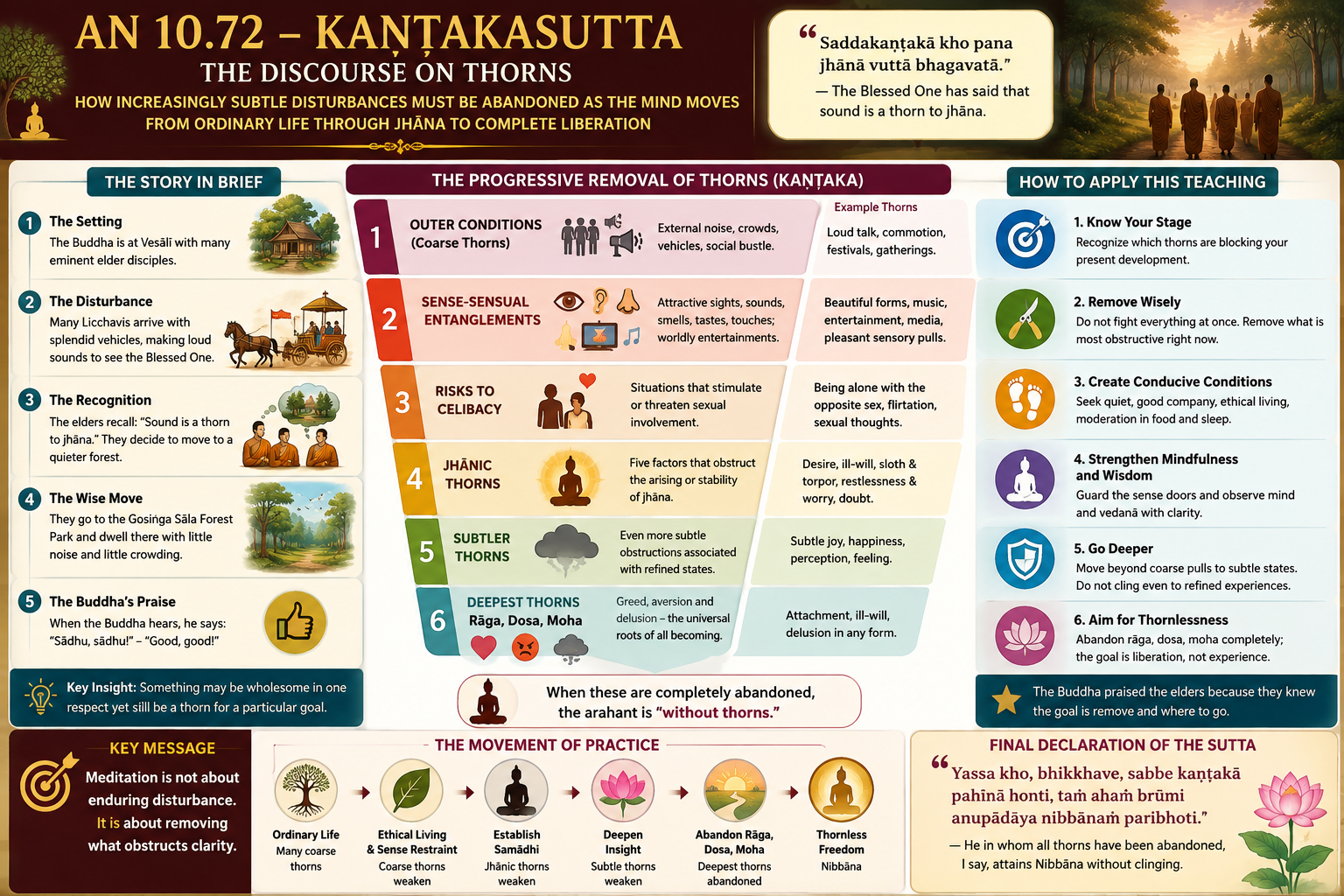
 VISUAL SUMMARYSee this sutta in a pictureOpen the complete infographic for a visual overview before or after reading the full study.View infographic →
The Kaṇṭakasutta of Aṅguttara Nikāya 10.72 begins with an apparently ordinary incident: a large and noisy group of Licchavis arrives to see the Buddha, and several accomplished elder disciples quietly leave for a more secluded forest. Yet the Buddha turns this simple event into a remarkably precise teaching about spiritual development. A kaṇṭaka is literally a thorn—something that pierces, irritates, disturbs, obstructs, or makes progress difficult. The discourse therefore does not merely give a miscellaneous list of things to avoid. It reveals an important principle of bhāvanā: at every stage of refinement, something that may have been tolerable earlier becomes a thorn to what is now being cultivated.
The movement of the discourse is especially significant. It begins with the environment of practice—seclusion, sense restraint, and brahmacariya—then moves inward through the four jhānas, proceeds to saññāvedayitanirodha, the cessation of perception and feeling, and finally reaches the deepest thorns of all: rāga, dosa, and moha. What begins with external noise ends with the complete removal of the internal causes of bondage.
011. The Setting at Vesālī
Ekaṁ samayaṁ bhagavā vesāliyaṁ viharati mahāvane kūṭāgārasālāyaṁ sambahulehi abhiññātehi abhiññātehi therehi sāvakehi saddhiṁ—āyasmatā ca cālena, āyasmatā ca upacālena, āyasmatā ca kukkuṭena, āyasmatā ca kaḷimbhena, āyasmatā ca nikaṭena, āyasmatā ca kaṭissahena; aññehi ca abhiññātehi abhiññātehi therehi sāvakehi saddhiṁ.
Variant: cālena → pālena (sya-all); cāḷena (pts1ed) | upacālena → upapālena (sya-all) | kukkuṭena → kakkaṭena (bj, sya-all, pts1ed) | kaḷimbhena → katimbhena (bj) | nikaṭena → kaṭena (bj).
At one time the Blessed One was staying at Vesālī, in the Great Wood, at the Hall with the Peaked Roof, together with many well-known elder disciples. Among them were Venerable Cāla, Venerable Upacāla, Venerable Kukkuṭa, Venerable Kaḷimbha, Venerable Nikaṭa, Venerable Kaṭissaha, and many other distinguished elder disciples.
The repetition abhiññātehi abhiññātehi gives emphasis: these were not inexperienced bhikkhus whose meditation was still unstable. They were recognized senior disciples. This becomes important when we observe what they do when the environment becomes unsuitable. Their response is not to prove that they can tolerate disturbance. Their maturity is expressed precisely in knowing what conditions support the mind and what conditions needlessly obstruct it.
022. The Noisy Arrival of the Licchavis
Tena kho pana samayena sambahulā abhiññātā abhiññātā licchavī bhadrehi bhadrehi yānehi parapurāya uccāsaddā mahāsaddā mahāvanaṁ ajjhogāhanti bhagavantaṁ dassanāya.
Variant: parapurāya → carapurāya (bj, pts1ed); paramparāya (sya-all); parampurāya (sya-a).
At that time many prominent Licchavis, travelling in splendid vehicles one after another, entered deeply into the Great Wood to see the Blessed One. As they came, they were making loud sounds and a great deal of noise.
The contrast is immediate. On one side are elder disciples established in a life directed toward seclusion and mental cultivation; on the other is the energetic arrival of prominent laypeople with vehicles, movement, conversation, and noise. There is no suggestion that the Licchavis are morally blameworthy merely because they have come to see the Buddha. The issue is much more precise: a condition can be harmless in itself and nevertheless be unsuitable for a particular practice.
This distinction is fundamental to understanding the entire sutta. A thorn need not be intrinsically evil. It is a thorn in relation to something being cultivated.
033. The Elders Recognize the Thorn of Sound
Atha kho tesaṁ āyasmantānaṁ etadahosi: “ime kho sambahulā abhiññātā abhiññātā licchavī bhadrehi bhadrehi yānehi parapurāya uccāsaddā mahāsaddā mahāvanaṁ ajjhogāhanti bhagavantaṁ dassanāya. Saddakaṇṭakā kho pana jhānā vuttā bhagavatā. Yannūna mayaṁ yena gosiṅgasālavanadāyo tenupasaṅkameyyāma. Tattha mayaṁ appasaddā appākiṇṇā phāsuṁ vihareyyāmā”ti.
Variant: phāsuṁ → phāsu (sya-all, mr).
Then the thought occurred to those venerable elders: “These many prominent Licchavis, travelling in splendid vehicles one after another, are entering the Great Wood making loud sounds and a great deal of noise in order to see the Blessed One. But the Blessed One has said that jhānas have sound as a thorn. What if we were to go to the Gosiṅga Sāla forest grove? There we could live comfortably, with little noise and without crowds.”
The key expression is saddakaṇṭakā … jhānā: sound is a thorn to jhāna. The elders do not become irritated with the Licchavis. They do not complain about society, condemn visitors, or develop aversion toward sound. They simply recognize a causal relationship: this environment is no longer supportive of what we are cultivating.
This is a profound expression of sampajañña. One recognizes what is suitable and unsuitable and acts accordingly without producing unnecessary mental conflict. There is an enormous difference between moving away from noise because one hates noise and moving away because one understands what supports the cultivation of the mind.
044. They Act on Their Understanding
Atha kho te āyasmanto yena gosiṅgasālavanadāyo tenupasaṅkamiṁsu; tattha te āyasmanto appasaddā appākiṇṇā phāsuṁ viharanti.
Then those venerable elders went to the Gosiṅga Sāla forest grove. There, with little noise and without crowding, they lived comfortably and at ease.
Their response contains no drama. They recognize the obstruction, change the conditions, and continue practising. This is exactly how mature bhāvanā functions. One does not intentionally surround the mind with unnecessary stimulation and then regard the resulting struggle as spiritual achievement.
There are occasions when difficult circumstances cannot be avoided, and practice must certainly continue within them. But deliberately choosing supportive conditions when they are available is not weakness. In this very discourse the Buddha will praise these great disciples for having done precisely that.
055. The Buddha Notices Their Absence
Atha kho bhagavā bhikkhū āmantesi: “kahaṁ nu kho, bhikkhave, cālo, kahaṁ upacālo, kahaṁ kukkuṭo, kahaṁ kaḷimbho, kahaṁ nikaṭo, kahaṁ kaṭissaho; kahaṁ nu kho te, bhikkhave, therā sāvakā gatā”ti?
Then the Blessed One addressed the bhikkhus: “Bhikkhus, where is Cāla? Where is Upacāla? Where is Kukkuṭa? Where is Kaḷimbha? Where is Nikaṭa? Where is Kaṭissaha? Bhikkhus, where have those elder disciples gone?”
The Buddha’s question creates the opportunity for the reason behind their departure to be made explicit. What might otherwise appear merely to be a preference for quiet surroundings is now connected directly with the training in jhāna.
066. The Bhikkhus Explain Why the Elders Left
“Idha, bhante, tesaṁ āyasmantānaṁ etadahosi: ‘ime kho sambahulā abhiññātā abhiññātā licchavī bhadrehi bhadrehi yānehi parapurāya uccāsaddā mahāsaddā mahāvanaṁ ajjhogāhanti bhagavantaṁ dassanāya saddakaṇṭakā kho pana jhānā vuttā bhagavatā yannūna mayaṁ yena gosiṅgasālavanadāyo tenupasaṅkameyyāma tattha mayaṁ appasaddā appākiṇṇā phāsuṁ vihareyyāmā’ti. Atha kho te, bhante, āyasmanto yena gosiṅgasālavanadāyo tenupasaṅkamiṁsu. Tattha te āyasmanto appasaddā appākiṇṇā phāsuṁ viharantī”ti.
“Venerable sir, the thought occurred to those venerable elders: ‘These many prominent Licchavis, travelling in splendid vehicles one after another, are entering the Great Wood making loud sounds and a great deal of noise in order to see the Blessed One. Yet the Blessed One has said that sound is a thorn to the jhānas. What if we were to go to the Gosiṅga Sāla forest grove? There we could live comfortably, with little noise and without crowding.’ Therefore, venerable sir, those venerable elders went to the Gosiṅga Sāla forest grove, and there they are living comfortably, with little noise and without crowding.”
The report repeats the elders’ reasoning almost word for word. Such repetition is important because the Buddha is about to explicitly approve not merely their destination, but their understanding of the relationship between sound and jhāna.
077. The Buddha Confirms Their Understanding
“Sādhu sādhu, bhikkhave, yathā te mahāsāvakā sammā byākaramānā byākareyyuṁ, saddakaṇṭakā hi, bhikkhave, jhānā vuttā mayā.
“Good, good, bhikkhus. Those great disciples have explained the matter exactly as it should rightly be explained. For I have indeed said, bhikkhus, that sound is a thorn to the jhānas.”
The Buddha does not say that the elders should have demonstrated superior equanimity by remaining amid the disturbance. He says, sādhu sādhu—“good, good.” Their decision reflects wisdom concerning conditions.
This prevents an important misunderstanding about practice. Equanimity does not mean deliberately maximizing sensory disturbance. Nor does seclusion mean hatred of the world. The path includes learning which conditions nourish a wholesome state and which repeatedly puncture it.
The image of a thorn is particularly effective. A thorn need not destroy the whole body. A small thorn may simply make every step uncomfortable. In the same way, a disturbance need not annihilate one’s entire meditation before it deserves attention. It may repeatedly agitate, pull, interrupt, reactivate, or prevent further refinement.
Dasayime, bhikkhave, kaṇṭakā. Katame dasa? Pavivekārāmassa saṅgaṇikārāmatā kaṇṭako, asubhanimittānuyogaṁ anuyuttassa subhanimittānuyogo kaṇṭako, indriyesu guttadvārassa visūkadassanaṁ kaṇṭako, brahmacariyassa mātugāmūpacāro kaṇṭako, paṭhamassa jhānassa saddo kaṇṭako, dutiyassa jhānassa vitakkavicārā kaṇṭakā, tatiyassa jhānassa pīti kaṇṭako, catutthassa jhānassa assāsapassāso kaṇṭako, saññāvedayitanirodhasamāpattiyā saññā ca vedanā ca kaṇṭako rāgo kaṇṭako doso kaṇṭako moho kaṇṭako.
Variant: brahmacariyassa → brahmacārissa (bj) | mātugāmūpacāro → mātugāmopavicāro (bj, pts1ed); mātugāmūpavicaro (mr).
“Bhikkhus, there are these ten thorns. What ten? Delight in company is a thorn for one who delights in seclusion. Attending to an attractive sign is a thorn for one devoted to attending to the sign of unattractiveness. Watching entertainments and spectacles is a thorn for one whose sense doors are guarded. Close association with women is a thorn to the brahmacariya. Sound is a thorn to the first jhāna. Vitakka and vicāra are thorns to the second jhāna. Pīti is a thorn to the third jhāna. In-breathing and out-breathing are a thorn to the fourth jhāna. Perception and feeling are a thorn to the attainment of the cessation of perception and feeling. Rāga is a thorn. Dosa is a thorn. Moha is a thorn.”
As transmitted, the passage announces “ten thorns,” while the wording then gives a sequence of specific practice-obstructions followed by the concluding triad rāga, dosa, and moha. Rather than altering the received wording merely to make the arithmetic conform, it is better to retain the Pāḷi exactly as transmitted and recognize that the concluding three function as the universal culmination of the teaching: whatever particular thorn is encountered along the path, greed or passion, aversion, and delusion are the deepest roots from which bondage ultimately arises. The canonical text itself presents the entire sequence together.
The stage-specific thorns — each is defined in relation to what is being cultivated.
099. A Thorn Is Defined by What One Is Cultivating
The first great lesson of the Kaṇṭakasutta is that the practice cannot be understood merely by making two categories called “good things” and “bad things.” The Buddha’s analysis is considerably more refined. Something becomes a kaṇṭaka because it interferes with a particular development of mind.
Company is not intrinsically unwholesome. Kalyāṇamittatā is indispensable to the path. Yet saṅgaṇikārāmatā—delighting in crowds, groups, social interaction, and constant association—is a thorn for someone cultivating paviveka, seclusion.
Beauty is not itself immoral. But deliberately feeding subhanimitta, the attractive sign, becomes a thorn when the mind is being trained through asubhanimitta to abandon sexual fascination and attachment to bodily attractiveness.
Seeing is not the problem in sense restraint. Yet deliberately seeking visūkadassana, stimulating spectacles and entertainments, undermines a mind being trained not to chase signs and features through the senses.
Human relationship is not condemned. Yet sexually charged proximity becomes a thorn where brahmacariya is being established.
Likewise, sound, vitakka-vicāra, pīti, breathing, perception, and feeling are not intrinsically defilements. But each becomes a thorn relative to a state whose refinement requires going beyond it.
This is why the discourse is so powerful as a map of progressive development. The thorn becomes subtler as the mind becomes subtler.
1010. Saṅgaṇikārāmatā — When Delight in Company Becomes a Thorn to Seclusion
Pavivekārāmassa saṅgaṇikārāmatā kaṇṭako.
For one who delights in seclusion, delight in company is a thorn.
The important word is ārāma—delight, enjoyment, taking pleasure in something. The problem is therefore deeper than merely being physically among people. A person might be alone while mentally craving conversation, messages, social interaction, recognition, news, videos, discussions, and continual external engagement. Such a person has bodily solitude without genuine inclination toward seclusion.
Conversely, someone may occasionally have to be among others without developing saṅgaṇikārāmatā. The mind does not feed on the crowd.
The movement toward seclusion begins when solitude stops feeling like deprivation. A practitioner who previously needed constant stimulation gradually discovers that quietness itself is nourishing. The mind ceases asking, “What can I engage with next?” and begins valuing the absence of unnecessary engagement.
This is crucial before deep samatha. If every unoccupied moment causes the hand to reach for a phone, conversation, entertainment, news, or some other sensory input, the obstacle is not simply insufficient meditation technique. The underlying delight in multiplicity has not yet been sufficiently relinquished.
The elder disciples demonstrate the opposite disposition. Noise arrives; they do not remain because of social interest in the famous Licchavis. They quietly go elsewhere. Their priority is clear.
1111. Subhanimitta — The Attractive Sign as a Thorn to Asubha
Asubhanimittānuyogaṁ anuyuttassa subhanimittānuyogo kaṇṭako.
For one devoted to cultivating the sign of unattractiveness, attending to the attractive sign is a thorn.
This passage goes directly to the mechanism by which sensual attraction grows. The eye contacts a form, but the mind does not merely register the form. It selects, highlights, constructs, remembers, and returns to certain features. It fashions a nimitta.
When lust is operating, attention does not neutrally encounter a human body. It selects what is attractive. It notices complexion, shape, movement, eyes, voice, scent, touch, mannerisms, clothing, or whatever characteristics stimulate desire. From these selected features the mind constructs subhanimitta—the sign of beauty or attractiveness—and then continues feeding it.
Asubha practice works in the opposite direction. It does not require hatred of the body. It corrects selective perception. Instead of mentally editing a body into an object of fascination, the practitioner learns to see the body as conditioned organic material, composed of bodily parts, vulnerable to ageing, disease, decay, dissolution, and death.
The thorn therefore appears whenever the practitioner deliberately returns to the very mode of attention that strengthens fascination.
One should notice how practical the Buddha’s language is. The danger is not merely the external object. It is anuyoga—repeated application, devotion, repeatedly engaging with a particular mode of perception. Repetition conditions the direction in which the mind naturally moves.
What one repeatedly attends to becomes easier to perceive again.
1212. Visūkadassana — Entertainment as a Thorn to Guarding the Sense Doors
Indriyesu guttadvārassa visūkadassanaṁ kaṇṭako.
For one whose sense doors are guarded, watching spectacles or entertainments is a thorn.
Sense restraint does not mean destroying the senses, refusing to see forms, or refusing to hear sounds. The training concerns what happens when contact occurs. Does the mind seize upon signs and features, pursue them, elaborate them, desire more of them, and construct an inner world around them?
Visūkadassana is especially instructive because entertainment is deliberately constructed to capture attention. Images, music, drama, beauty, sexuality, conflict, suspense, novelty, humour, outrage, and emotional stimulation are arranged precisely so that the senses remain engaged.
For a mind attempting to establish indriya-saṁvara, repeatedly seeking such stimulation creates contradictory training. One part of the day is spent calming proliferation; another part deliberately feeds the machinery of proliferation.
The issue becomes still clearer in the age of continuous digital stimulation. A person may sit for meditation for an hour yet spend many other hours repeatedly presenting the eye and ear with rapidly changing objects. The nervous momentum of such engagement does not necessarily disappear because one has closed the eyes and begun watching the breath.
The Kaṇṭakasutta asks the practitioner to examine the whole life supporting meditation. The question is not merely, “How good was my sitting?” It is also, “What have I been feeding the senses throughout the rest of the day?”
1313. Mātugāmūpacāra — Sexual Proximity as a Thorn to Brahmacariya
Brahmacariyassa mātugāmūpacāro kaṇṭako.
For the brahmacariya, close association with women is a thorn.
The statement is given within the male monastic setting of the discourse, and therefore it speaks of mātugāma, women. The underlying training principle can be understood more broadly: when celibacy is being established, intentionally cultivating sexually charged proximity to someone toward whom attraction can arise undermines the very state one is trying to establish.
Brahmacariya is therefore much deeper than merely preventing the final physical sexual act. The physical act has causes.
There may first be seeing, hearing, smelling, touching, remembering, imagining, evaluating, and attending to an attractive sign. Contact conditions feeling; feeling becomes enjoyable; the mind begins inclining toward repetition; fantasies may develop; bodily pleasure may be anticipated; and eventually conduct may follow.
If one defines celibacy only as “not performing intercourse,” most of this causal chain remains untouched.
The Buddha’s use of kaṇṭaka invites examination much earlier. What repeatedly stimulates sensual interest? What causes the mind to construct another person sexually? What environments encourage fantasy? What forms of communication create intimacy that feeds desire? What kinds of looking sustain subhanimitta?
A practitioner genuinely developing brahmacariya therefore does not merely restrain the final act. One removes the fuel from which the act would arise.
At the same time this should not be converted into fear, hostility, or contempt toward the opposite sex. If proximity is avoided while aversion grows, one thorn has merely been exchanged for another. The purpose is the fading of rāga, not the cultivation of dosa.
1414. Sound as the Thorn to the First Jhāna
Paṭhamassa jhānassa saddo kaṇṭako.
Sound is a thorn to the first jhāna.
This is the statement around which the narrative of the sutta has been constructed. The Licchavis arrive noisily. The elder disciples remember this principle. They leave for Gosiṅga. The Buddha explicitly approves their reasoning.
This gives a valuable practical instruction for anyone cultivating jhāna: do not underestimate environmental sound. The mind approaching jhāna is moving from multiplicity toward unification. Sudden speech, conversation, music, traffic, devices, movement, or other strong sounds can repeatedly pull attention outward and disrupt that gathering.
At the same time the word kaṇṭaka should not automatically be expanded into a claim that the sutta itself proves that absolutely no auditory event can ever be registered in first jhāna. The discourse explicitly calls sound a thorn—an interference or difficulty—and the elders respond by moving away from the noisy environment. One respected interpretation therefore cautions against turning “thorn” into a technical definition of total sensory incapacity.
For practical bhāvanā, however, the message is unambiguous. If one wants to establish jhāna reliably, unnecessary sound should not be treated casually. The elders did not.
This also explains why environmental preparation matters. Silence before meditation, reduced conversation, avoiding media, switching off notifications, completing duties beforehand, and allowing the mind time to disengage are not peripheral rituals. They reduce the thorns around the mind.
1515. Vitakka and Vicāra Become Thorns to the Second Jhāna
Dutiyassa jhānassa vitakkavicārā kaṇṭakā.
For the second jhāna, vitakka and vicāra are thorns.
Here the discourse makes a decisive turn. Until now several thorns have involved external circumstances or behavioural conditions. With the second jhāna, the thorn is a mental activity that belonged to the preceding jhānic development.
This is one of the deepest principles in the sutta: a factor may be useful at one level and obstructive at the next.
Vitakka and vicāra are present in the standard description of the first jhāna. Yet the second jhāna is entered with their subsiding. Therefore, once the mind is ready to move beyond the first jhāna, continuing to initiate, examine, mentally handle, or manipulate the meditation object becomes a disturbance.
The practitioner must learn a new skill: not how to do more, but how to stop doing what is no longer required.
This is often more difficult than acquiring a technique. The mind has learned that effort brought success, so it continues applying the same effort after the state has become self-sustaining. The very activity that helped collect the mind now prevents deeper stillness.
A useful analogy is learning to ride a bicycle. Initially one requires deliberate effort to balance, steer, and coordinate movement. Once balance is established, excessive correction produces wobbling. Skill eventually includes knowing when intervention itself has become the problem.
The second jhāna therefore represents not merely “stronger concentration,” but a qualitative simplification. Mental activity quietens because the mind no longer requires the same kind of internal handling.
1616. Pīti Becomes the Thorn to the Third Jhāna
Tatiyassa jhānassa pīti kaṇṭako.
For the third jhāna, pīti is a thorn.
Pīti is not being declared unwholesome. It belongs to the happiness of jhānic development. Yet when the mind is ready for the third jhāna, its energizing and exhilarating quality has become comparatively coarse.
This is another example of progressive refinement. A person unfamiliar with deep collectedness may consider pīti an extraordinary achievement and naturally wish to retain it. The Buddha’s sequence shows why attachment even to refined meditative pleasure becomes limiting.
The third jhāna requires relinquishing the excitement of pīti without losing the profound well-being of the collected mind.
There is a transition from exhilaration toward quiet contentment.
This has an important psychological implication. Ordinarily we assume that spiritual progress means acquiring increasingly intense experiences. The jhāna sequence demonstrates almost the reverse. Deeper refinement comes through letting intensity quieten.
The practitioner therefore learns not to measure depth by excitement.
Strong bodily waves, uplifting energy, thrill, lightness, joy, and powerful pleasant experiences may all be striking. Yet striking does not necessarily mean subtle. If pīti is being repeatedly sought, amplified, admired, or reproduced when the mind is ready to go beyond it, the practitioner is holding onto a thorn because it happens to be pleasant.
1717. Breathing Becomes the Thorn to the Fourth Jhāna
Catutthassa jhānassa assāsapassāso kaṇṭako.
For the fourth jhāna, in-breathing and out-breathing are a thorn.
This statement should be allowed its full force. The Pāḷi does not say merely that attention to breathing becomes a thorn. It says assāsapassāso—in-breathing and out-breathing themselves.
The point is reinforced elsewhere in the Nikāyas. SN 36.11 states that for one who has entered the fourth jhāna, in-breathing and out-breathing have ceased, and AN 9.31 gives the same progressive sequence: pīti ceases for one entered into the third jhāna, while assāsapassāsā cease for one entered into the fourth.
MN 44 also classifies assāsapassāsā as kāyasaṅkhāra, bodily formation, because breathing is bodily and connected with the body.
This makes the Kaṇṭakasutta particularly important when understanding the progressive tranquillization of bodily activity. The fourth jhāna is not simply first jhāna with stronger concentration. The whole system has become exceedingly quiet.
For a practitioner beginning with ānāpānasati, this also prevents an important mistake. The breath is an indispensable field of cultivation, but the practitioner should not conclude that because breathing was used as the doorway, deliberate breathing must be preserved indefinitely.
If breathing naturally becomes extremely subtle, the correct response is not to force it to become more obvious merely so that one can continue “watching the breath.”
A method must not become more important than the state the method was intended to develop.
The Kaṇṭakasutta repeatedly teaches this. At each transition something must be relinquished.
1818. Saññā and Vedanā Become Thorns to Nirodha
Saññāvedayitanirodhasamāpattiyā saññā ca vedanā ca kaṇṭako.
For the attainment of the cessation of perception and feeling, perception and feeling are a thorn.
The progression has now become extraordinarily subtle. Earlier the practitioner removed delight in crowds, attraction, entertainment, sexually stimulating proximity, sound, vitakka-vicāra, pīti, and finally breathing. Now even saññā and vedanā stand on the side of what must cease for the attainment called saññāvedayitanirodha.
This phrase is exact and should not be diluted. Saññā is perception or recognition—the marking and identifying function by which experience is discerned as this or that. Vedanā is feeling arising dependent upon contact: pleasant, painful, or neither-painful-nor-pleasant.
The attainment is called the cessation of perception and feeling precisely because these activities cease in that attainment.
Once again, this does not mean that perception and feeling are morally evil. Without saññā ordinary functioning would be impossible; without vedanā the normal structure of conditioned experience would not occur. Yet relative to saññāvedayitanirodhasamāpatti, their occurrence is a thorn.
The pattern of the entire discourse can now be seen clearly: the path progresses not by accumulating more and more mental content but through profound pacification.
Coarse disturbances disappear first.
Then increasingly subtle activities become visible.
Then those too are relinquished.
1919. Rāga, Dosa and Moha — The Fundamental Thorns
Rāgo kaṇṭako doso kaṇṭako moho kaṇṭako.
Rāga is a thorn. Dosa is a thorn. Moha is a thorn.
After describing thorns relative to particular practices and attainments, the Buddha arrives at the fundamental problem.
Rāga is not a thorn merely to meditation.
Dosa is not a thorn merely to meditation.
Moha is not a thorn merely to meditation.
They are thorns to liberation itself.
Rāga inclines consciousness toward appropriation: wanting, enjoying, holding, becoming involved, becoming fascinated, and seeking continuation.
Dosa moves in the opposite direction but preserves the same underlying bondage: resisting, rejecting, resenting, opposing, fearing, hating, and wanting an experience removed.
Moha prevents seeing either movement correctly. Under delusion, attraction appears as happiness, aversion appears justified, conditioned phenomena appear dependable, what is impermanent is treated as though stable, and what is not-self is appropriated as “I,” “me,” and “mine.”
These three therefore explain why the earlier thorns possess their power.
Why does company become attractive? Rāga and moha.
Why does the mind construct subhanimitta? Rāga and moha.
Why seek entertainment? Rāga.
Why does sexual proximity agitate brahmacariya? Rāga.
Why can sound disturb? Depending upon the mind, attraction, aversion, identification, and proliferation may all participate.
Why might someone cling even to pīti or a refined meditative state? Once again rāga can appropriate what is pleasant.
Thus the sutta eventually moves beyond managing conditions. The final task is not creating a perfectly thorn-free external environment. It is uprooting the mind’s capacity to manufacture bondage from experience.
2020. From External Thorns to Internal Thorns
The architecture of the discourse can now be appreciated as one continuous movement.
At first the practitioner learns to manage the environment. Crowds, stimulation, attractive objects, entertainment, sexually charged contact, and noise matter because the mind is still conditioned by them.
With development, the obvious environment becomes less central and subtler internal processes become the field of refinement. Vitakka-vicāra become too coarse. Then pīti becomes too coarse. Then even the bodily process of breathing becomes too coarse relative to the fourth jhāna. Eventually perception and feeling cease in saññāvedayitanirodha.
But none of these meditative refinements by themselves replaces the final work concerning rāga, dosa, and moha.
This distinction is crucial.
Jhāna demonstrates extraordinary tranquillization.
Nirodha demonstrates an extraordinary cessation of mental activity.
Liberation concerns the ending of the defilements.
The sutta ends not with admiration for an altered state of consciousness but with the arahant.
2121. Why the Elder Disciples Simply Walked Away
The opening story can now be reread differently.
The Licchavis arrive.
Noise arises.
The elders recognize the condition.
They remember the Dhamma.
They move to Gosiṅga.
They remain comfortably in seclusion.
This is almost a miniature model of wise practice.
There is contact without resentment.
Recognition without proliferation.
Decision without drama.
Action without attachment.
They do not remain in the noisy place and develop anger toward the Licchavis. They do not demand that everyone else become silent because they are meditators. They do not make their practice dependent on changing other people.
They simply understand, “This condition is a thorn; another suitable place is available,” and move.
There is a considerable lesson here for retreat practice. A practitioner should gradually learn to distinguish between escaping because of aversion and changing conditions because of wisdom.
They may look identical from outside.
Internally they are completely different.
2222. The Path Requires Increasing Sensitivity, Not Increasing Tolerance of Everything
A common assumption is that an advanced practitioner should be able to tolerate any environment whatsoever. The Kaṇṭakasutta gives a more nuanced picture.
An accomplished mind may certainly possess enormous equanimity. Yet wisdom also recognizes causality.
If one is cultivating seclusion, one does not deliberately cultivate delight in crowds.
If one is abandoning sexual attraction, one does not deliberately feed attractive signs.
If one is guarding the senses, one does not deliberately flood them with spectacle.
If one is establishing brahmacariya, one does not intentionally create conditions that repeatedly stimulate sexuality.
If one is establishing jhāna, one does not unnecessarily choose noise.
The practitioner becomes increasingly sensitive to cause and effect.
This is not fragility.
It is precision.
A skilled musician notices small changes in pitch that an untrained ear ignores. A skilled physician notices symptoms others overlook. In the same way, a developed practitioner notices increasingly subtle movements of mind.
What once appeared insignificant becomes recognizable as a cause.
2323. The Jhāna Sequence as Progressive Pacification
The four jhāna thorns deserve to be read together:
Paṭhamassa jhānassa saddo kaṇṭako.
Sound is the thorn to the first jhāna.
Dutiyassa jhānassa vitakkavicārā kaṇṭakā.
Vitakka and vicāra are thorns to the second jhāna.
Tatiyassa jhānassa pīti kaṇṭako.
Pīti is the thorn to the third jhāna.
Catutthassa jhānassa assāsapassāso kaṇṭako.
In-breathing and out-breathing are the thorn to the fourth jhāna.
Notice the direction.
Sound → mental activity → energizing joy → bodily respiration.
The field is becoming quieter.
The first concern is an external sensory disturbance.
The next is subtle mental engagement.
Then even the uplifting quality of pīti is relinquished.
Finally an extremely fundamental bodily activity has become still.
This is why describing jhāna simply as “concentration” misses so much of the dynamics contained in the Nikāyas. The sequence is better understood as progressive seclusion, unification, tranquillization, simplification, and relinquishment.
The practitioner does not merely concentrate harder.
The practitioner requires less and less activity.
2424. The Principle: Do Not Carry the Previous Stage into the Next
Perhaps the most useful practical teaching of the Kaṇṭakasutta can be expressed in one principle:
What helped you reach a stage may become the very thing that prevents you from passing beyond it.
Social Dhamma discussion may initially inspire practice. Eventually endless discussion can become a thorn to seclusion.
Contemplating bodily unattractiveness may weaken lust. Eventually even deliberate contemplation must give way when another form of cultivation is being undertaken.
Vitakka-vicāra help constitute the first jhāna. They must be relinquished for the second.
Pīti marks the earlier jhānic development. It must be relinquished for the third.
Breathing may be the field through which tranquillity has been cultivated. At the refinement described for fourth jhāna, breathing itself is said to have ceased.
This requires tremendous non-attachment to method.
One must know what one is doing, why one is doing it, and when the function has been fulfilled.
Otherwise practice becomes ritualized. Instead of using a method to bring about transformation, the practitioner continues reproducing the method indefinitely and mistakes repetition for development.
2525. “What Is the Thorn Now?”
The Kaṇṭakasutta can therefore become a powerful diagnostic framework for everyday practice.
Instead of asking only, “How long did I meditate?” one can ask: What is the thorn now?
If the mind cannot settle because it continually seeks conversation, social media, messages, or company, the present thorn may be saṅgaṇikārāmatā.
If sexual images and fantasies repeatedly dominate, the thorn may involve subhanimitta.
If meditation is continually disturbed by what has been watched, heard, browsed, or consumed during the day, visūkadassana and insufficient sense restraint deserve examination.
If brahmacariya remains unstable, the practitioner should examine the chain much earlier than the final physical act.
If the mind approaches jhāna but repeatedly gets pulled outward, sound and environmental preparation may require attention.
If first jhāna has become established but the mind keeps mentally manipulating the state, vitakka-vicāra may now be the thorn.
If pīti is repeatedly pursued because it is enjoyable or dramatic, attachment to pīti may obstruct further tranquillization.
At every stage the question changes because the mind changes.
This prevents the path from becoming a fixed technique.
2626. Do Not Turn the Removal of Thorns into Aversion
There is, however, an important safeguard.
One can become attached to silence.
One can become angry when disturbed.
One can become proud of celibacy.
One can despise entertainment while secretly craving it.
One can reject other people in the name of seclusion.
One can become obsessed with achieving a particular meditative state.
If this happens, the external thorn may have been removed while dosa, rāga, or moha remain firmly embedded.
This is precisely why the discourse ends where it does.
The purpose of silence is not to become a person who hates sound.
The purpose of seclusion is not to become a person who hates society.
The purpose of asubha is not to hate the body.
The purpose of brahmacariya is not to hate sexuality or those who evoke attraction.
The purpose of jhāna is not to despise ordinary consciousness.
The direction is dispassion, tranquillity, understanding, relinquishment, and liberation.
Eventually even the preference for particular conditions cannot be appropriated as self.
2727. Akaṇṭakā — Living Without Thorns
Akaṇṭakā, bhikkhave, viharatha. Nikkaṇṭakā, bhikkhave, viharatha. Akaṇṭakanikkaṇṭakā, bhikkhave, viharatha. Akaṇṭakā, bhikkhave, arahanto; nikkaṇṭakā, bhikkhave, arahanto; akaṇṭakanikkaṇṭakā, bhikkhave, arahanto”ti.
“Bhikkhus, dwell without thorns. Bhikkhus, dwell with the thorns removed. Bhikkhus, dwell both thornless and with the thorns completely extracted. The arahants, bhikkhus, are thornless; the arahants have had the thorns removed; the arahants are both thornless and completely free from thorns.”
The discourse ends with unusually emphatic repetition: akaṇṭakā, without thorns; nikkaṇṭakā, rid of thorns; akaṇṭakanikkaṇṭakā, completely thornless and freed from thorns.
And then the Buddha identifies those for whom this process has reached completion:
the arahants.
This final statement prevents the practitioner from mistaking temporary environmental quietness, jhāna, or even extraordinary meditative attainment for the final meaning of being thornless.
The arahant is thornless because the roots that enable the mind to be pierced by experience have been uprooted.
Forms may occur.
Sounds may occur.
Praise may occur.
Blame may occur.
Pleasure may occur.
Pain may occur.
The world does not have to become empty of objects.
What has ended is the appropriation governed by rāga, dosa, and moha.
This is the deepest akaṇṭakatā.
2828. The Entire Sutta as One Progressive Training
Read as a whole, the Kaṇṭakasutta presents a beautiful progression.
The practitioner begins by simplifying the environment.
One learns to enjoy seclusion rather than constant association.
One stops deliberately feeding attractive signs.
One guards the sense doors rather than continually stimulating them.
One protects brahmacariya by understanding the conditions from which sexual involvement develops.
With this foundation, the mind becomes capable of deeper stillness.
Sound is recognized as a thorn to first jhāna.
Vitakka-vicāra become thorns to the second.
Pīti becomes a thorn to the third.
Breathing becomes a thorn relative to the fourth.
Perception and feeling become thorns relative to saññāvedayitanirodhasamāpatti.
Finally, the analysis penetrates beneath all particular circumstances and identifies rāga, dosa, and moha.
The path has moved from managing conditions to pacifying formations and finally to ending the causes of bondage.
This is why the simple incident of some elder bhikkhus leaving a noisy monastery deserves careful attention. They embody the basic intelligence required for the entire path: knowing what supports a wholesome development, knowing what obstructs it, and relinquishing the obstruction without creating another one.
The deepest thorns remain: rāga — attraction and passion; dosa — aversion and resistance; moha — not understanding things as they actually are.
2929. The Essential Practice Message
The Kaṇṭakasutta therefore gives us a very practical question to carry throughout bhāvanā:
What am I presently cultivating, and what is the thorn to it?
If cultivating seclusion, remove unnecessary social entanglement.
If weakening sensual fascination, stop feeding the attractive sign.
If guarding the senses, stop deliberately flooding them with stimulation.
If establishing brahmacariya, remove the conditions that repeatedly generate sexual proliferation.
If cultivating first jhāna, protect quietness.
If moving toward the second, allow vitakka-vicāra to subside.
If moving toward the third, relinquish attachment to pīti.
If entering the refinement described for the fourth, do not interfere with the profound calming of the bodily formation of breathing.
If approaching the cessation of perception and feeling, understand how subtle the process of cessation has become.
But through every one of these stages, remember that the deepest thorns remain:
rāga — attraction and passion, dosa — aversion and resistance, moha — not understanding things as they actually are.
Removing secondary thorns creates the conditions in which these roots can be clearly known and abandoned.
The arahant is therefore not merely a person who has found a sufficiently quiet forest.
The arahant is one from whom the thorns have finally been extracted.
Akaṇṭakā arahanto. Nikkaṇṭakā arahanto. Akaṇṭakanikkaṇṭakā arahanto.
The arahants are thornless. The arahants are freed from thorns. The arahants are completely thornless and freed from thorns.