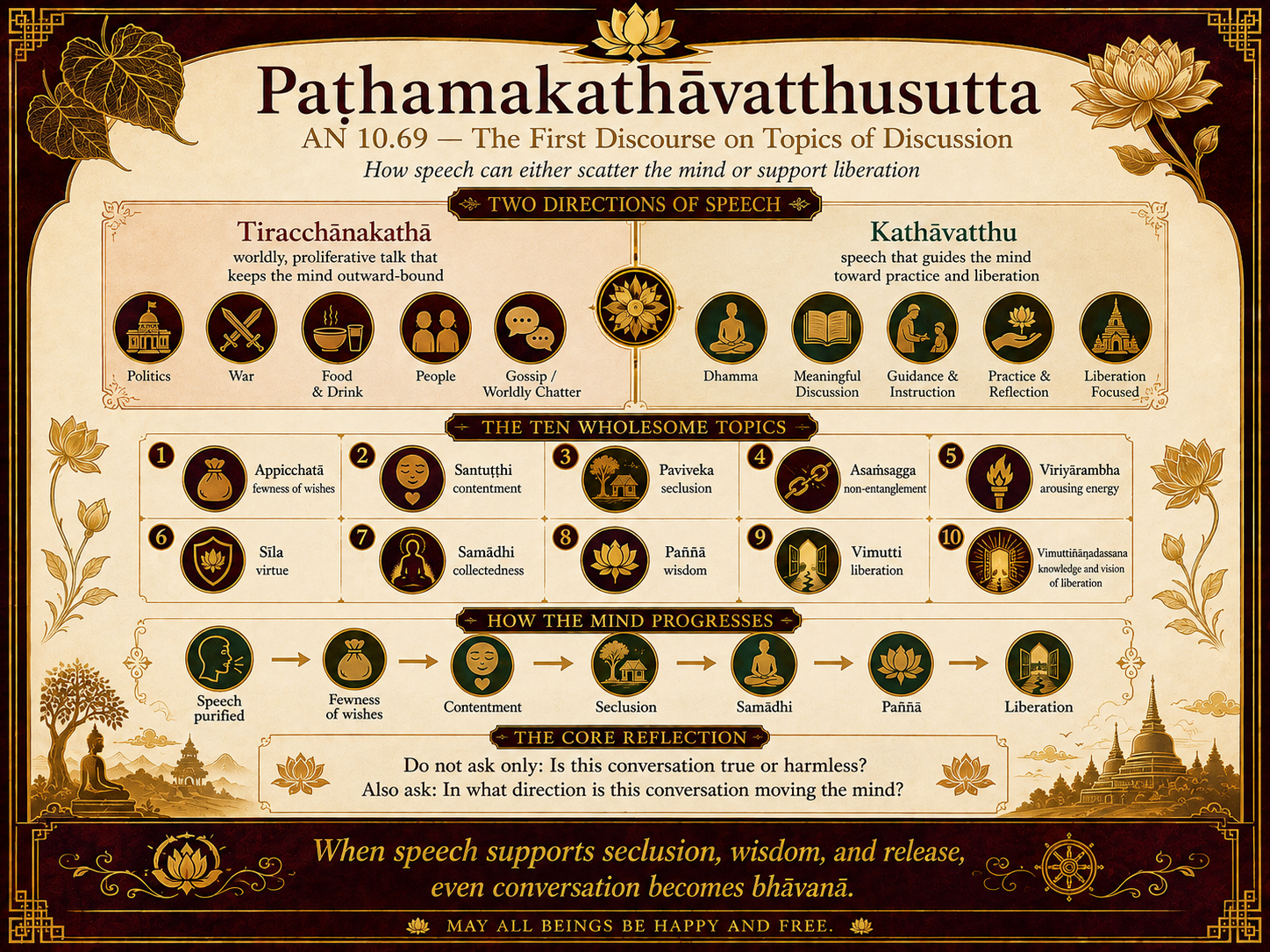
 VISUAL SUMMARYSee this sutta in a pictureOpen the complete infographic for a visual overview before or after reading the full study.View infographic →
From tiracchānakathā to speech that supports appicchatā, santuṭṭhi, paviveka, samādhi, paññā and vimutti
This discourse is AN 10.69, Paṭhamakathāvatthusutta, the first discourse on topics or bases for discussion.
At first sight this appears to be a simple teaching about avoiding idle conversation, but its depth is much greater. The Buddha does not merely tell the bhikkhus, “Do not gossip.” He gives them an alternative architecture for speech. The discourse contrasts tiracchānakathā—conversation that moves sideways into worldly proliferation—with kathāvatthu—conversation deliberately based upon qualities that conduce toward the goal. The ten recommended topics form a remarkable sequence: appicchatā → santuṭṭhi → paviveka → asaṁsagga → vīriyārambha → sīla → samādhi → paññā → vimutti → vimuttiñāṇadassana. Thus speech itself becomes training. A practitioner does not only ask, “Was what I said true?” A deeper question arises: “After this conversation, in which direction has the mind moved?”
II. The Sutta in Context
1. Setting at Jetavana
Ekaṁ samayaṁ bhagavā sāvatthiyaṁ viharati jetavane anāthapiṇḍikassa ārāme. On one occasion the Blessed One was dwelling at Sāvatthī, in Jeta’s Grove, in Anāthapiṇḍika’s monastery. The setting is important: these bhikkhus are not wandering through a marketplace or attending a festival; they are already inside the monastery. Yet merely being physically present in a monastery does not ensure that the mind is directed toward the purpose of the going forth.
2. The bhikkhus gather after the meal
Tena kho pana samayena sambahulā bhikkhū pacchābhattaṁ piṇḍapātapaṭikkantā upaṭṭhānasālāyaṁ sannisinnā sannipatitā anekavihitaṁ tiracchānakathaṁ anuyuttā viharanti, seyyathidaṁ— rājakathaṁ corakathaṁ mahāmattakathaṁ senākathaṁ bhayakathaṁ yuddhakathaṁ annakathaṁ pānakathaṁ vatthakathaṁ sayanakathaṁ mālākathaṁ gandhakathaṁ ñātikathaṁ yānakathaṁ gāmakathaṁ nigamakathaṁ nagarakathaṁ janapadakathaṁ itthikathaṁ sūrakathaṁ visikhākathaṁ kumbhaṭṭhānakathaṁ pubbapetakathaṁ nānattakathaṁ lokakkhāyikaṁ samuddakkhāyikaṁ itibhavābhavakathaṁ iti vāti.
Variant: itthikathaṁ → itthīkathaṁ (sya2ed); itthikathaṁ purisakathaṁ (mr)
Now at that time, after the meal, having returned from their alms round, a number of bhikkhus had assembled and were sitting together in the attendance hall. They were dwelling engaged in many kinds of tiracchānakathā, worldly or spiritually unprofitable conversation, namely:
Other early textual witnesses include purisakathaṁ, “talk about men,” alongside talk about women. The extended traditional catalogue is found elsewhere in early Buddhist texts as well. The crucial expression is anekavihitaṁ tiracchānakathaṁ anuyuttā viharanti. They were not merely mentioning these matters when necessary; anuyuttā means engaged in them, devoted to them, occupied with them, while viharanti indicates that they were dwelling in that mode. That distinction will become important.
II. WHAT DOES TIRACCHĀNAKATHĀ MEAN?
Tiracchānakathā is sometimes translated literally as “animal talk,” but that can easily mislead an English reader into thinking the Buddha means conversation about animals. That is not what the list shows. The sense is low, sideways, spiritually unproductive or “horizontal” conversation—conversation that does not lead upward toward the purpose of the contemplative life. Many subjects on this list are not immoral in themselves: food, vehicles, cities, relatives and political events are not inherently immoral. Therefore the teaching is more subtle than saying, “These subjects are evil.” The issue is what happens when the practitioner becomes anuyutta—absorbed, devoted, occupied in such conversation. A subject that is legitimate when necessary can become tiracchānakathā when it turns into entertainment, proliferation, fascination, comparison, emotional stimulation or an endless occupation of the mind.
3. The Buddha comes out of seclusion
Atha kho bhagavā sāyanhasamayaṁ paṭisallānā vuṭṭhito yena upaṭṭhānasālā tenupasaṅkami; upasaṅkamitvā paññatte āsane nisīdi.
Then, in the evening, the Blessed One emerged from seclusion and went to the attendance hall. Having approached, he sat down on the prepared seat. Notice the contrast: the bhikkhus have spent the period in conversation, while the Buddha emerges from paṭisallāna—seclusion, withdrawal. The discourse quietly places two directions beside one another: mental dispersal and seclusion.
4. The Buddha asks what they were discussing
Nisajja kho bhagavā bhikkhū āmantesi: “kāya nuttha, bhikkhave, etarahi kathāya sannisinnā sannipatitā, kā ca pana vo antarākathā vippakatā”ti?
After sitting down, the Blessed One addressed the bhikkhus: “Monks, what discussion were you sitting together engaged in just now? And what conversation among you was left unfinished?” The Buddha gives them an opportunity to state plainly what they were doing.
5. The monks answer honestly
“Idha mayaṁ, bhante, pacchābhattaṁ piṇḍapātapaṭikkantā upaṭṭhānasālāyaṁ sannisinnā sannipatitā anekavihitaṁ tiracchānakathaṁ anuyuttā viharāma, seyyathidaṁ— rājakathaṁ corakathaṁ …pe… itibhavābhavakathaṁ iti vā”ti.
“Here, venerable sir, after the meal, having returned from our alms round, we were assembled and sitting together in the attendance hall, dwelling engaged in many kinds of worldly and spiritually unprofitable conversation, namely talk about kings, talk about robbers … and so forth … through to talk about this or that kind of becoming and non-becoming.” The …pe… in the Pāḷi is the canonical abbreviation for the previously stated list. It does not indicate that the subject matter has changed; the entire catalogue is understood to be repeated. The monks make no attempt to excuse themselves; they simply report what happened.
6. The Buddha says: “This is not fitting for you”
“Na kho panetaṁ, bhikkhave, tumhākaṁ patirūpaṁ kulaputtānaṁ saddhāya agārasmā anagāriyaṁ pabbajitānaṁ, yaṁ tumhe anekavihitaṁ tiracchānakathaṁ anuyuttā vihareyyātha, seyyathidaṁ— rājakathaṁ corakathaṁ mahāmattakathaṁ senākathaṁ bhayakathaṁ yuddhakathaṁ annakathaṁ pānakathaṁ vatthakathaṁ sayanakathaṁ mālākathaṁ gandhakathaṁ ñātikathaṁ yānakathaṁ gāmakathaṁ nigamakathaṁ nagarakathaṁ janapadakathaṁ itthikathaṁ sūrakathaṁ visikhākathaṁ kumbhaṭṭhānakathaṁ pubbapetakathaṁ nānattakathaṁ lokakkhāyikaṁ samuddakkhāyikaṁ itibhavābhavakathaṁ iti vāti.
“Monks, it is not fitting for you—sons of good families who, out of faith, have gone forth from the household life into homelessness—to dwell engaged in many kinds of worldly and spiritually unprofitable conversation, such as talk about kings, robbers, high officials, armies, dangers, wars, food, drink, clothing, beds, garlands, fragrances, relatives, vehicles, villages, towns, cities, countries, women, heroes, streets, wells and gathering places, those who have passed away, miscellaneous matters, theories and stories about the world, stories about the ocean, and talk about this or that kind of becoming and non-becoming.” The sentence contains a powerful reminder in saddhāya agārasmā anagāriyaṁ pabbajitānaṁ—“having gone forth through faith from the home life into homelessness.” The Buddha brings them back to purpose. The question is not merely, “Is this conversation socially acceptable?” but “Does this correspond to why you left the household life?” This is why he uses na … patirūpaṁ—it is not fitting, appropriate or becoming.
IIIIII. Why This Matters Even for a Lay Practitioner
The immediate audience consists of bhikkhus who left the household life, so the strictness of the admonition belongs first to the monastic context. Yet the underlying principle applies directly to serious lay practice as well. If a person reserves only forty-five minutes for meditation but feeds the mind during the remaining waking hours with politics, wars, social media, food, property, people, controversy, entertainment and gossip, then meditation receives a mind already conditioned by those inputs. This sutta therefore has a close relationship with indriya-saṁvara. Speech is not isolated from mind: conversation involves hearing → contact → feeling → perception → thought → proliferation → memory. The conversation may end at 5 p.m., yet its mental continuation may still be operating at 8 p.m. when one sits for samathā. Thus restraint of speech is also preparation of the mind.
Dasayimāni, bhikkhave, kathāvatthūni. Katamāni dasa?
“Monks, there are these ten topics or bases for discussion. What ten?” The Buddha does something crucial here: he does not merely prohibit speech; he redirects it. Instead of “Do not talk,” the teaching becomes: “When conversation occurs, let it nourish these qualities.”
01APPICCHAKATHĀ
“Talk about fewness of wishes.” Appiccha means having few wishes, few wants, little demand. This is more subtle than possessing few objects, because one may own little yet mentally want much, while another may have necessities available without the mind continually reaching outward for more. Therefore appicchatā concerns the structure of desire. Proper conversation might examine how much one actually needs, whether something is a necessity or another form of wanting, and whether it simplifies practice or creates further involvement. In this way conversation itself can weaken craving rather than stimulate it. Ordinary talk about purchases, upgrades, food, vehicles, houses and possessions often multiplies desire; appicchakathā reduces its territory.
02SANTUṬṬHIKATHĀ
“Talk about contentment.” Santuṭṭhi is contentment with what is suitably available. Fewness of wishes and contentment are closely related but not identical: appicchatā says, “I do not need much,” while santuṭṭhi says, “What is sufficient is enough.” This undermines continual comparison. Much ordinary conversation operates through comparison—who has what, who went where, which retreat has better facilities, which centre serves better food, or who has the better room. Santuṭṭhi ends that movement. A practitioner learns that contentment is not deprivation; it is freedom from the constant mental demand that present conditions must become something else before one can practise peacefully.
03PAVIVEKAKATHĀ
“Talk about seclusion.” This connects directly with AN 10.72 Kaṇṭakasutta, where pavivekārāmassa saṅgaṇikārāmatā kaṇṭako means, “For one delighting in seclusion, delight in company is a thorn.” Here, in AN 10.69, paviveka itself becomes a proper topic of conversation. This may seem paradoxical—how can one talk about silence and seclusion?—but conversation can prepare the mind to value withdrawal instead of fearing it. One can discuss how unnecessary interaction disturbs the mind, how solitude reveals habitual mental movement, how sensory reduction supports samathā, and how one learns to delight in being undisturbed. The conversation should then naturally end in practice rather than demand further conversation. Good Dhamma conversation should eventually make silence easier.
04ASAṂSAGGAKATHĀ
Asaṁsaggakathā
“Talk about non-entanglement, non-association or freedom from excessive social involvement.” This differs subtly from paviveka: paviveka emphasizes seclusion, whereas asaṁsagga emphasizes not becoming entangled. A person may live alone and still be deeply entangled mentally with relationships, messages, approval, reputation, groups, disputes or what others think about them. Thus physical solitude does not automatically establish asaṁsagga. The deeper question is: What continues to bind the mind to social identity even when nobody else is physically present? This becomes increasingly important for anyone developing samathā.
05VĪRIYĀRAMBHAKATHĀ
“Talk about arousing energy and persistence.” Vīriya is energy, effort and vigour, while ārambha here carries the sense of initiating, arousing or undertaking. Dhamma discussion should not leave the listener merely intellectually impressed; it should generate the response, “This needs to be practised.” A useful conversation therefore asks what one is actually practising, where effort has become lax, what akusala must be abandoned, and what kusala needs to be developed and maintained. If an hour of “Dhamma discussion” produces only intellectual stimulation but no increase in practice, one may reasonably ask whether it has fulfilled the function indicated by vīriyārambhakathā.
06SĪLAKATHĀ
“Talk about sīla.” This is not merely discussion of rules; it means conversation that helps purify conduct. One examines bodily action and speech by asking what causes harm, where greed enters, where deception arises, where harshness enters speech, where carelessness weakens restraint, and how the ten kusala-kammapatha become established in ordinary life. Thus sīlakathā should lead from theory into observable behaviour. If one can explain sīla eloquently yet repeatedly behaves in ways contrary to sīla, the conversation has not accomplished its intended function.
07SAMĀDHIKATHĀ
“Talk about samādhi.” Notice the order: the Buddha does not begin with samādhi. Before it come appicchatā, santuṭṭhi, paviveka, asaṁsagga, vīriya and sīla. Only then comes samādhi. This itself is a teaching. The mind does not become collected merely by applying a meditation technique while the rest of one’s life continually cultivates desire, dissatisfaction, social involvement, laziness and careless conduct. Proper samādhikathā should therefore include not only how one sits, but also the conditions that permit the mind to settle. This directly complements AN 10.72, where noise, social involvement, attractive signs and sensory entertainment are described as thorns relative to particular developments.
08PAÑÑĀKATHĀ
“Talk about wisdom.” Samādhi is not the end of the sequence; next comes paññā. This keeps contemplative practice from degenerating into the pursuit of peaceful states alone. Paññā investigates what arises, what ceases, what is conditioned, what is taken as “I” or “mine,” what produces dukkha, and what leads to its cessation. Conversation directed toward paññā should therefore make phenomena clearer rather than increase metaphysical speculation. The point is not to accumulate Buddhist vocabulary; the point is to see correctly.
09VIMUTTIKATHĀ
“Talk about liberation.” Now the discourse reaches the purpose toward which all previous development points. Fewness of wishes, contentment, seclusion, sīla and samādhi are not the final goal; even paññā is cultivated toward vimutti—liberation, release. Proper Dhamma conversation therefore must not allow the practitioner to forget the destination. One can become fascinated with retreats, techniques, meditation states, philosophical systems, Pāḷi terminology or even sutta scholarship, but the decisive question remains: What is being released? And ultimately: Has the mind been liberated from rāga, dosa and moha?
10VIMUTTIÑĀṆADASSANAKATHĀ
“Talk about the knowledge and vision of liberation.” This final topic is especially important. The Buddha does not end simply with vimutti; he includes vimutti-ñāṇa-dassana, knowledge and seeing concerning liberation. This guards against vague spiritual assumption. One should know what has been abandoned and what remains, rather than merely thinking, “I felt very peaceful, therefore I must be liberated,” “There was no thought for some time, therefore defilements have ended,” or “There was cessation of a particular experience, therefore the task is finished.” The language ñāṇa-dassana points toward knowledge and seeing rather than imagination or self-congratulation. This final kathāvatthu therefore turns discussion toward verification.
The complete tenfold sequence
Dasayimāni, bhikkhave, kathāvatthūni. Katamāni dasa? Appicchakathā, santuṭṭhikathā, pavivekakathā, asaṁsaggakathā, vīriyārambhakathā, sīlakathā, samādhikathā, paññākathā, vimuttikathā, vimuttiñāṇadassanakathāti— imāni kho, bhikkhave, dasa kathāvatthūni.
“Monks, there are these ten topics of discussion. What ten? Talk about fewness of wishes, contentment, seclusion, non-entanglement, arousing energy, sīla, samādhi, wisdom, liberation, and the knowledge and vision of liberation. These, monks, are the ten topics of discussion.”
IVIV. THE TEN TOPICS ARE NOT TEN RANDOM SUBJECTS
The order deserves close attention because the ten topics form a progression: appicchatā reduces wanting; santuṭṭhi establishes sufficiency; paviveka turns the mind toward seclusion; asaṁsagga weakens entanglement; vīriyārambha arouses energy for cultivation; sīla purifies bodily and verbal conduct; samādhi allows the mind to become unified and settled; paññā sees phenomena according to their nature; vimutti is release; and vimuttiñāṇadassana is knowledge and seeing concerning that liberation. This resembles a curriculum for the whole contemplative life, and remarkably the Buddha presents it as topics for conversation. The implication is profound: the community’s speech should continually remind its members of the direction in which their lives are supposed to be moving.
VV. THE FINAL DECLARATION — OUTSHINING EVEN THE SUN AND MOON
Imesañce tumhe, bhikkhave, dasannaṁ kathāvatthūnaṁ upādāyupādāya kathaṁ katheyyātha, imesampi candimasūriyānaṁ evaṁmahiddhikānaṁ evaṁmahānubhāvānaṁ tejasā tejaṁ pariyādiyeyyātha, ko pana vādo aññatitthiyānaṁ paribbājakānan”ti.
“Monks, if you were to speak again and again, taking up these ten topics for discussion, you could overcome or surpass with your radiance even the radiance of the moon and the sun, so mighty and so powerful—let alone the wanderers belonging to other sects.” The key expression is upādāyupādāya—repeatedly taking up, repeatedly making these the basis of conversation. The Buddha is therefore not recommending an occasional lecture about contentment followed by an ordinary life dominated by other concerns; these topics are to become the habitual orientation of the community’s conversation. The concluding image, candima-sūriyānaṁ … tejasā tejaṁ pariyādiyeyyātha, presents their spiritual radiance as surpassing even the radiance of the moon and sun. The point should not be reduced to astronomical literalism. It is a declaration of the extraordinary power and dignity of speech aligned with Dhamma. A group of practitioners talking about kings, wars, food and gossip is indistinguishable in direction from an ordinary worldly gathering, but a community repeatedly speaking about fewness of wishes, contentment, seclusion, energy, sīla, samādhi, paññā and liberation becomes something radically different: its very conversation expresses the path.
VIVI. DEEP DIVE — THE BUDDHA IS NOT BANNING NECESSARY INFORMATION
This distinction is essential. A practitioner may need to know what food will be prepared, what vehicle will take someone to the retreat, what city a person is travelling from, whether a dangerous situation exists, whether a relative is ill, or what time the train leaves. These matters may correspond superficially to annakathā, yānakathā, nagarakathā, bhayakathā or ñātikathā, but the Buddha’s wording is not merely, “You once mentioned food.” It says anekavihitaṁ tiracchānakathaṁ anuyuttā viharanti: they were dwelling engaged in manifold worldly conversation. The problem therefore involves occupation and delight. Necessary functional speech ends when its function ends; proliferation continues because the mind wants to continue. That is a useful diagnostic.
Functional speech
“What time is lunch?” — “11:30.” The practical purpose is complete.
Proliferative speech
“What will there be for lunch?” becomes “Yesterday’s lunch was better,” “At another retreat they served…,” “I like…,” “I don’t like…,” or “Which restaurant…?” Thirty minutes later the mind has travelled through memories, preferences, comparisons and desire. The original practical requirement was tiny; the proliferation became enormous. That is where the teaching becomes immediately observable.
VIIVII. POLITICS, WAR AND CURRENT EVENTS
The first six worldly topics are especially striking: rājakathā, corakathā, mahāmattakathā, senākathā, bhayakathā, yuddhakathā—talk about kings, crime, officials, armies, dangers and wars. In modern language this resembles a large proportion of the daily news cycle. The sutta is not instructing a government official to remain ignorant of responsibilities; it addresses contemplatives whose lives are supposed to move toward dispassion and liberation. The practical question becomes: How much information is actually necessary, and at what point does information become psychological consumption? One may genuinely need to know what is happening, but after learning the necessary fact the mind can continue asking who is right, who is wrong, what a politician said, what will happen next, what others are saying, and what it means for future events. Hours can disappear, and even after the news stops the mind may contain bhaya—fear, dosa—aversion, rāga—preference and attachment, and vitakka—continuing thought. Then the practitioner sits down and asks, “Why is the mind not quiet?” AN 10.69 directs attention toward what happened before the meditation began.
VIIIVIII. FOOD, CLOTHING, BEDS, FRAGRANCES AND VEHICLES
The Buddha then names topics that appear completely ordinary: anna—food, pāna—drink, vattha—clothing, sayana—beds, mālā—garlands, gandha—fragrances, yāna—vehicles. These concern sensual and material life. Again, the issue is not that these things cannot be used: a robe must be worn, food must be eaten, a bed may be needed and transport may be necessary. But conversation can turn necessities into objects of fascination. Food ceases to be support for the body and becomes identity and entertainment; clothing becomes status, vehicles become comparison, and accommodation becomes preference. The mind starts constructing “mine,” “better,” “worse,” “I like,” “I dislike.” Thus mundane conversation can continuously feed the same structures that meditation later attempts to calm.
IXIX. TALK ABOUT PEOPLE
Then come ñātikathā—relatives, itthikathā—women, the variant purisakathā—men, and sūrakathā—heroes. These reveal another powerful human tendency: the mind loves talking about people—who married whom, who separated, who succeeded, who failed, who behaved badly, who attained what, who is famous, who is impressive, who is spiritual and who is not. Even Dhamma communities can convert this into “spiritual gossip”: “Who reached jhāna?”, “Who attained which stage?”, “What did teacher X say about teacher Y?”, or “Which lineage is superior?” The vocabulary may be Buddhist while the mental movement remains tiracchānakathā. That is why the subject matter alone does not always reveal the quality of the conversation; its function must be examined.
XX. WHEN DHAMMA TALK ITSELF BECOMES PROLIFERATION
This is perhaps the most important caution for serious students. It is possible to spend hours talking about jhāna, dependent origination, anattā, arahants, Mahāyāna, Theravāda, Abhidhamma, teachers, translations and Pāḷi terminology, and still not strengthen a single factor of the path. The ten kathāvatthūni therefore provide an excellent diagnostic for Dhamma discussion. After the conversation, has wanting decreased, has contentment increased, is seclusion more attractive, is entanglement weaker, has energy for practice increased, is sīla clearer, is samādhi supported, has paññā deepened, is liberation more clearly understood, and is there clearer knowledge concerning what has actually been abandoned? If not, the discussion may have been intellectually Buddhist while practically remaining horizontal.
XIXI. WHY SILENCE ALONE IS NOT THE COMPLETE TEACHING
One might read AN 10.69 and conclude, “Therefore the best thing is never to speak,” but that is not what the Buddha teaches here. If complete silence were the entire instruction, the discourse could have ended after Na kho panetaṁ … patirūpaṁ—“This is not fitting.” Instead, the Buddha immediately provides ten subjects to discuss. The training therefore contains both knowing when not to speak and knowing what kind of speech is worth developing. This is highly relevant to Dhamma communities: silence protects samādhi, while proper Dhamma conversation protects direction. Both are needed.
XIIXII. AN 10.69 AND AN 10.72 TOGETHER
The relationship between this discourse and the Kaṇṭakasutta studied immediately before it is extremely useful. AN 10.72 says Pavivekārāmassa saṅgaṇikārāmatā kaṇṭako—for one delighting in seclusion, delighting in company is a thorn. AN 10.69 recommends Pavivekakathā and Asaṁsaggakathā—talk about seclusion and non-entanglement. AN 10.72 also says Paṭhamassa jhānassa saddo kaṇṭako—sound is a thorn to the first jhāna—while AN 10.69 shows one major source of unnecessary sound: people gathered together engaged in tiracchānakathā. Thus the two discourses complement one another beautifully. One teaches, “Remove what becomes a thorn,” while the other teaches, “When speech does occur, let it support the path.” Together they provide a powerful discipline for retreat.
XIIIXIII. A PRACTICAL RETREAT APPLICATION
Imagine that meditation ends at 10:30 a.m. Several practitioners gather during the break and conversation begins: “How was your meditation?” “I had lots of pīti.” “How long?” “Maybe forty minutes.” “I had that yesterday.” “Did you see light?” “What did the teacher tell you?” Another practitioner joins, and soon everyone is comparing experiences. Although the vocabulary is meditative, comparison, expectation, conceit, doubt, desire to reproduce another person’s experience, fear of being behind and attachment to attainment may arise. This is not necessarily samādhikathā merely because samādhi was the subject. Proper samādhikathā should support samādhi; if the conversation destabilizes it, its function contradicts its label. A better exchange may be, “Was there any difficulty in practice?” — “Restlessness.” — “Check what the mind has been feeding through the sense doors. Establish seclusion and continue.” The conversation then returns the practitioner to cultivation. That is the spirit of the ten kathāvatthūni.
XIVXIV. THE SEQUENCE AS A SELF-ASSESSMENT
The ten topics can also function as a powerful personal audit. Appicchatā: are wants actually becoming fewer? Santuṭṭhi: is dissatisfaction decreasing? Paviveka: does the mind increasingly appreciate seclusion? Asaṁsagga: is dependence upon company, approval and interaction declining? Vīriyārambha: is practice energetic and sustained? Sīla: is conduct becoming increasingly clean? Samādhi: does the mind settle increasingly easily? Paññā: is conditional arising and ceasing being understood more clearly? Vimutti: what is actually being released? Vimuttiñāṇadassana: do I know what has ended and what has not? This turns the discourse from advice about conversation into a map for development.
XVXV. WHY THE LAST TWO TOPICS ARE SO IMPORTANT
The sequence could easily have ended with sīla → samādhi → paññā, but it does not. The Buddha continues with vimutti and vimuttiñāṇadassana. This prevents Dhamma practice from becoming an endless improvement project whose destination is merely better ethics, better meditation or more knowledge. The destination is liberation, followed by knowledge and seeing regarding that liberation. This is especially important wherever meditative experiences are interpreted as attainments. A practitioner may experience great stillness, cessation of thought, absence of sensual desire, absence of anger, extraordinary pīti, equanimity, subtle breathing or profound cessation. The correct question is not merely, “How extraordinary was the experience?” but “What has actually been destroyed such that it cannot arise again?” That moves inquiry toward vimuttiñāṇadassana.
XVIXVI. SPEECH AS KAMMA AND SPEECH AS BHĀVANĀ
AN 10.69 shows that speech has two dimensions. First, speech is kamma: it can be truthful or false, gentle or harsh, beneficial or harmful. Second, speech can become part of bhāvanā. Conversation repeatedly directs attention; attention shapes perception; perception conditions what the mind remembers; and memory provides material for further thought. Repeated conversation therefore gradually establishes a mental world. If one speaks continually about politics, crime, wars, food, possessions, people and controversy, those become ready-made contents of consciousness. If discussion repeatedly returns to contentment, seclusion, sīla, samādhi, paññā and liberation, these increasingly become the mind’s familiar territory. That is why upādāyupādāya—repeatedly taking these topics up—is so important. The Buddha is describing the formation of a culture of practice.
XVIIXVII. ESSAY — “WHAT DOES OUR CONVERSATION DO TO THE MIND?”
AN 10.69 begins with an ordinary scene. A number of bhikkhus have returned from collecting alms and are sitting together after their meal. Nothing dramatic is happening. They are not committing violence, stealing, lying or openly breaking major ethical principles. They are simply talking.
Yet when the Buddha comes from seclusion and asks what they have been discussing, their conversation becomes the subject of a serious instruction.
They have been speaking about rulers, thieves, officials, armies, dangers, wars, food, drinks, clothing, beds, ornaments, fragrances, relatives, vehicles, villages, towns, cities, countries, women, heroes, streets, gathering places, people of the past, theories about the world and oceans, and many other matters. In other words, they have been doing something that would look completely normal in almost any human gathering.
The Buddha tells them that this is not fitting for those who have gone forth from the household life out of faith.
That statement reveals something fundamental about Dhamma practice. The standard by which conduct is judged changes according to one’s purpose. An activity may be completely ordinary and socially acceptable yet still be inappropriate for someone whose life has been deliberately directed toward liberation.
The problem with tiracchānakathā is therefore not that every object mentioned is intrinsically corrupt. Food is necessary. Governments exist. Relatives exist. Vehicles are useful. Wars may genuinely affect people. The problem begins when the mind becomes anuyutta—engaged, occupied and absorbed in such conversation. What should have remained functional becomes an object of fascination and proliferation.
This distinction is easily seen today. A person may need two minutes to learn whether a political event affects travel. But after discovering the necessary information, another hour may be spent reading arguments, watching commentary, checking reactions and discussing who is right. The first two minutes served a practical purpose. The remaining hour primarily fed mental involvement.
The same happens with food. One needs to know when lunch is available. That may require a single sentence. But food can then become a twenty-minute discussion involving favourite dishes, restaurants, memories, comparisons and preferences. The practical requirement ends; craving continues the conversation.
This principle applies equally to Dhamma itself. The presence of Buddhist vocabulary does not automatically transform conversation into right discussion. People may gossip about teachers, compare practitioners, speculate about attainments, argue about traditions and endlessly classify meditative experiences. The subject sounds spiritual, yet the effect may be increased conceit, agitation, attachment and disagreement. Such conversation has acquired a Buddhist vocabulary without necessarily acquiring a Buddhist function.
The Buddha therefore provides something far more useful than a prohibition. He gives ten alternative topics. Talk about appicchatā—fewness of wishes—so that conversation reduces wanting rather than manufactures it. Talk about santuṭṭhi—contentment—so that comparison and the constant demand for better circumstances weaken. Talk about paviveka—seclusion—so that practitioners remember why withdrawal and quiet are valuable. Talk about asaṁsagga—non-entanglement—so that dependence upon social interaction, reputation and approval is seen clearly. Talk about vīriyārambha—arousing energy—so that Dhamma discussion produces actual practice rather than intellectual satisfaction. Talk about sīla so that bodily and verbal conduct become cleaner; about samādhi so that the conditions for mental stillness are understood and established; about paññā so that phenomena are seen according to their arising, passing and conditionality; about vimutti so that the goal of release is never forgotten; and about vimuttiñāṇadassana so that profound experiences are not confused with the final destruction of the causes of bondage. Taken together, these ten subjects form a movement from simplification of life to realization: want less, be content, withdraw, do not become entangled, apply energy, purify conduct, establish samādhi, develop wisdom, realize liberation and know liberation. Speech has now become a map of the path.
This is why the Buddha’s final statement is so powerful. If the bhikkhus repeatedly take up these ten subjects, he says, their radiance could surpass even that of the mighty sun and moon, let alone that of wanderers following other paths. The image expresses the extraordinary dignity of a community whose conversation itself has become aligned with liberation.
The practical implication is immediate. Before entering a conversation, one can ask, “Is this necessary?” While speaking, “What is this doing to the mind?” After speaking, one can examine whether the mind is quieter or more proliferated, whether wanting is weaker or stronger, whether contentment has increased or decreased, whether the mind inclines toward seclusion or further conversation, whether energy for practice has increased, and whether sīla, samādhi and paññā have been supported. These questions transform speech from an unconscious habit into part of bhāvanā.
Taken together with AN 10.72 Kaṇṭakasutta, the lesson becomes even clearer. There the Buddha says that delight in company is a thorn to one who delights in seclusion, and that sound is a thorn to jhāna. Here we see how easily practitioners themselves manufacture both company and sound through unnecessary conversation.
A retreat therefore cannot be understood merely as a schedule of sitting periods. If one meditates for an hour and then spends the break in uncontrolled conversation, the next meditation begins long before one returns to the cushion because the intervening speech has already been conditioning the mind. The discipline is not forced silence for its own sake; it is understanding cause and effect. When silence supports cultivation, remain silent. When speech is necessary, speak what is necessary. When Dhamma discussion is useful, let it move toward appicchatā, santuṭṭhi, paviveka, asaṁsagga, vīriya, sīla, samādhi, paññā, vimutti and vimuttiñāṇadassana. Then even conversation becomes practice. The deepest question AN 10.69 leaves us with is therefore not “How much do I speak?” but “What does my speech repeatedly cause the mind to become?”
If conversation multiplies wanting, comparison, excitement, fear, attachment and proliferation, then even pleasant and apparently harmless speech can lead the mind away from its purpose.
If conversation reduces wanting, strengthens contentment, encourages seclusion, arouses energy, purifies conduct, supports samādhi, deepens wisdom and continually points toward liberation, speech itself becomes part of the path.
That is the transformation taught in the Paṭhamakathāvatthusutta: from talking merely because there is something to talk about, to speaking only in ways worthy of the purpose for which one practises. Ultimately, it is the movement from a mind continuously occupied with the world to a mind increasingly oriented toward vimutti—liberation.