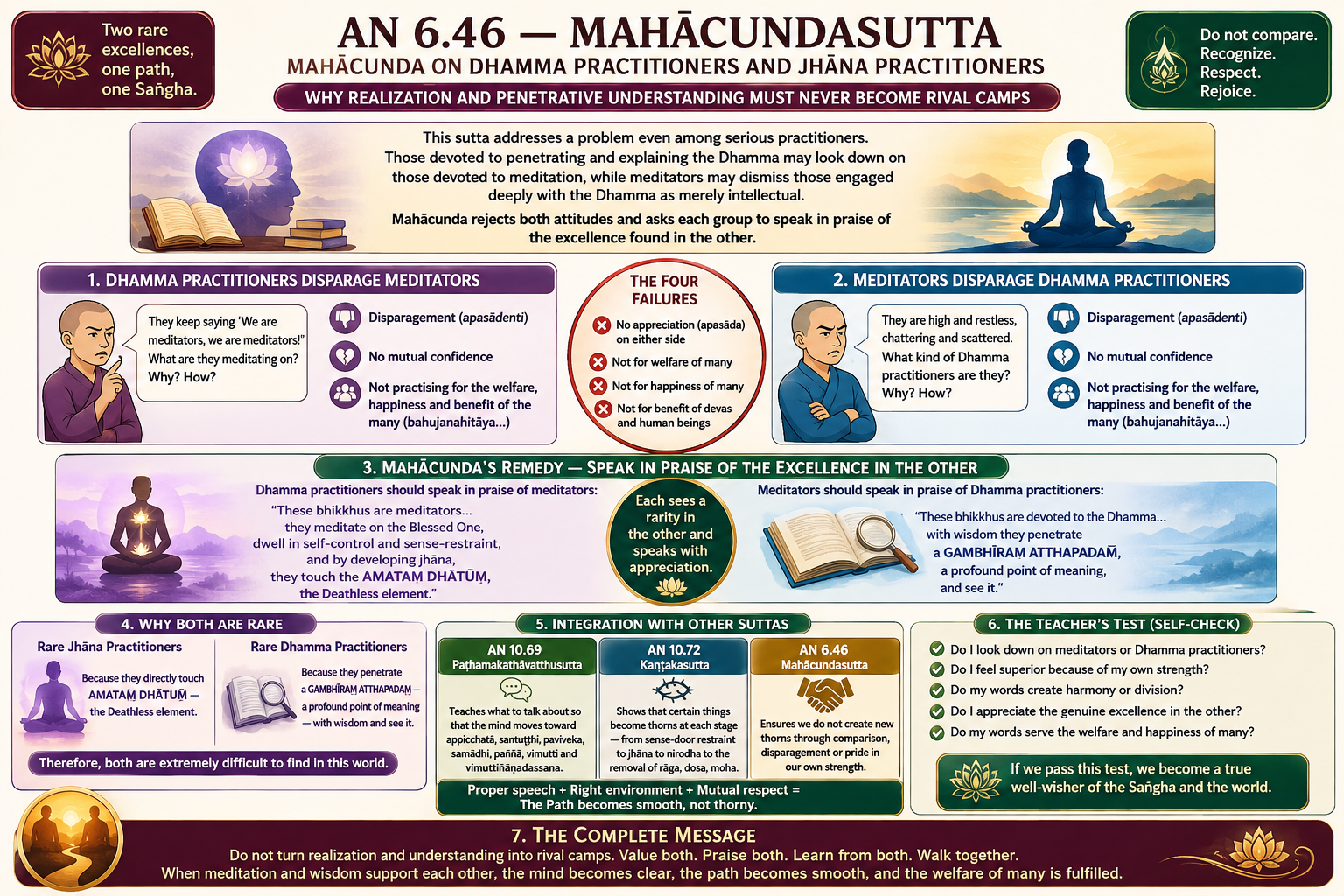
 VISUAL SUMMARYSee this sutta in a pictureOpen the complete infographic for a visual overview before or after reading the full study.View infographic →
Why realization and penetrative understanding must never become rival camps
The Mahācundasutta (AN 6.46) addresses a problem that can arise even among serious practitioners: those devoted to penetrating and explaining the Dhamma may look down upon those devoted to meditation, while meditators may dismiss those engaged deeply with the Dhamma as merely intellectual. Mahācunda rejects both attitudes. More remarkably, he does not merely ask the two groups to tolerate each other; he instructs each group to speak in praise of the excellence found in the other. (Depth of Dhamma)
The conclusion explains why. Genuine meditators are rare because they directly touch the amataṁ dhātuṁ — the Deathless element. Genuine Dhamma practitioners are equally rare because they penetrate a gambhīraṁ atthapadaṁ — profound point of meaning with wisdom and see it. Mahācunda therefore presents experiential realization and penetrative understanding not as competing alternatives, but as two extraordinary accomplishments worthy of mutual respect.
011. Setting in the Ceti country
Evaṁ me sutaṁ— ekaṁ samayaṁ āyasmā mahācundo cetīsu viharati sayaṁjātiyaṁ. Variant: sayaṁjātiyaṁ → sahajātiyaṁ (bj, pts1ed); sañjātiyaṁ (sya-all, km) Tatra kho āyasmā mahācundo bhikkhū āmantesi: “āvuso bhikkhave”ti.
Thus have I heard. On one occasion Venerable Mahācunda was dwelling among the Cetis at Sayaṁjāti. There Venerable Mahācunda addressed the monks: “Friends, monks!”
The locality appears with different readings in the textual traditions: Sayaṁjāti, Sahajāti, and Sañjāti. The variation does not affect the teaching. AN 6.46 is distinctive because Mahācunda himself delivers the instruction; the Buddha is not presented as the speaker in this discourse.
“Āvuso”ti kho te bhikkhū āyasmato mahācundassa paccassosuṁ. Āyasmā mahācundo etadavoca:
“Friend,” those monks replied to Venerable Mahācunda. Then Venerable Mahācunda said this:
The repeated āvuso, “friend” or “brother,” is appropriate to an elder addressing fellow monks. The tone that follows is therefore not that of an outsider criticizing two factions. Mahācunda is speaking from within the Saṅgha, correcting a division that damages both sides.
022. Dhamma practitioners disparage the meditators
“Idhāvuso, dhammayogā bhikkhū jhāyī bhikkhū apasādenti: ‘ime pana jhāyinomhā, jhāyinomhāti jhāyanti pajjhāyanti nijjhāyanti avajjhāyanti. Variant: nijjhāyanti avajjhāyanti → etthantare pāṭho si, sya-all, pts1ed potthakesu natthi; nijjhāyanti apajjhāyanti (9M:1740) Kimime jhāyanti, kintime jhāyanti, kathaṁ ime jhāyantī’ti? Variant: Kimime → kintime (bj); kiñhime (sya-all); kiṁ hime (km, pts1ed)
“Here, friends, monks who are devoted to the Dhamma disparage monks who are meditators, saying: ‘These people keep saying, “We are meditators, we are meditators!” They meditate, keep absorbed in meditating, brood over it and continue brooding over it. What are they meditating on? Why are they meditating? How are they meditating?’”
The cluster jhāyanti, pajjhāyanti, nijjhāyanti, avajjhāyanti is deliberately mocking wordplay. Some textual traditions omit the latter expressions or preserve a different final verb. The precise English wordplay cannot be reproduced perfectly, but the intention is clear: the dhammayogā are caricaturing the meditators as people who merely sit there “meditating and meditating” without understanding what they are doing.
The crucial term is apasādenti. It means more than disagreeing with someone. It carries the sense of disparaging, discrediting, or undermining confidence in them. The problem is therefore not reasoned examination of another person’s practice. It is speaking in a way that lowers regard for the whole class of practitioners.
Tattha dhammayogā ca bhikkhū nappasīdanti, jhāyī ca bhikkhū nappasīdanti, na ca bahujanahitāya paṭipannā honti bahujanasukhāya bahuno janassa atthāya hitāya sukhāya devamanussānaṁ.
“As a result, the monks devoted to the Dhamma are not pleased with the meditators, and the meditating monks are not pleased with those devoted to the Dhamma. And they are not practising for the welfare of the many, for the happiness of the many, for the benefit, welfare and happiness of the many, of devas and human beings.”
This repeated consequence is extremely important. Mahācunda does not treat the dispute as a harmless difference in temperament. Once one group disparages the other, pasāda—confidence, appreciation and harmonious regard—breaks down on both sides. The damage then extends beyond the individuals involved: the larger community no longer receives the full benefit it could have received from both forms of excellence.
033. The meditators disparage the Dhamma practitioners
Idha panāvuso, jhāyī bhikkhū dhammayoge bhikkhū apasādenti: ‘ime pana dhammayogamhā, dhammayogamhāti uddhatā unnaḷā capalā mukharā vikiṇṇavācā muṭṭhassatī asampajānā asamāhitā vibbhantacittā pākatindriyā. Kimime dhammayogā, kintime dhammayogā, kathaṁ ime dhammayogā’ti?
“Again, friends, monks who are meditators disparage monks devoted to the Dhamma, saying: ‘These people keep saying, “We are devoted to the Dhamma, we are devoted to the Dhamma!” Yet they are restless, puffed up, flighty, outspoken, loose and scattered in speech, forgetful of mindfulness, without clear knowing, uncollected, with distracted minds and unrestrained sense faculties. What kind of Dhamma practitioners are these? Why are they Dhamma practitioners? How are they Dhamma practitioners?’”
The criticism is severe. Each term deserves attention, because it depicts precisely the stereotype a meditation-oriented practitioner may form of a person who talks much about Dhamma but appears not to embody stillness.
Uddhatā is restless or agitated. Unnaḷā conveys being puffed up or conceited. Capalā suggests fickleness, vanity or flightiness. Mukharā is being excessively outspoken or rough-mouthed. Vikiṇṇavācā is scattered, uncontrolled or rambling speech. Muṭṭhassatī means mindfulness has been lost or forgotten. Asampajānā is lacking sampajañña, clear knowing or situational discernment. Asamāhitā means uncollected, without samādhi. Vibbhantacittā describes a wandering or distracted mind. Pākatindriyā points to faculties left exposed rather than properly guarded. The traditional explanations preserved alongside the text interpret these expressions in precisely this direction.
But an important distinction must be maintained: Mahācunda is reporting the meditators’ disparaging caricature; he is not declaring that genuine dhammayogā necessarily possess these faults. This becomes unmistakable at the end of the sutta, where he praises genuine Dhamma practitioners as exceptionally rare people capable of penetrating profound meaning with wisdom.
Tattha jhāyī ca bhikkhū nappasīdanti, dhammayogā ca bhikkhū nappasīdanti, na ca bahujanahitāya paṭipannā honti bahujanasukhāya bahuno janassa atthāya hitāya sukhāya devamanussānaṁ.
“As a result, the meditating monks are not pleased with those devoted to the Dhamma, and the monks devoted to the Dhamma are not pleased with the meditators. And they are not practising for the welfare of the many, for the happiness of the many, for the benefit, welfare and happiness of the many, of devas and human beings.”
The result is exactly the same whichever faction initiates the disparagement. Mahācunda gives no privileged group permission to look down upon the other.
044. Dhamma practitioners praise only their own group
Idha panāvuso, dhammayogā bhikkhū dhammayogānaññeva bhikkhūnaṁ vaṇṇaṁ bhāsanti, no jhāyīnaṁ bhikkhūnaṁ vaṇṇaṁ bhāsanti. Tattha dhammayogā ca bhikkhū nappasīdanti, jhāyī ca bhikkhū nappasīdanti, na ca bahujanahitāya paṭipannā honti bahujanasukhāya bahuno janassa atthāya hitāya sukhāya devamanussānaṁ.
“Again, friends, monks devoted to the Dhamma speak in praise only of monks devoted to the Dhamma, but they do not speak in praise of monks who are meditators. As a result, neither the monks devoted to the Dhamma nor the meditating monks are pleased, and they are not practising for the welfare and happiness of the many, for the benefit, welfare and happiness of the many, of devas and human beings.”
This introduces a subtler problem. Open criticism is not required for division to form. One can avoid insulting the other group yet repeatedly praise only one’s own people.
That alone creates factional identity.
One repeatedly hears: “Our way is profound. Our teachers understand the texts. Our interpretation is precise.” The meditators are simply absent from the field of appreciation. Over time, silence itself communicates the message that their contribution is of lesser worth.
Mahācunda treats this as harmful too.
055. Meditators praise only meditators
Idha panāvuso, jhāyī bhikkhū jhāyīnaññeva bhikkhūnaṁ vaṇṇaṁ bhāsanti, no dhammayogānaṁ bhikkhūnaṁ vaṇṇaṁ bhāsanti. Tattha jhāyī ca bhikkhū nappasīdanti, dhammayogā ca bhikkhū nappasīdanti, na ca bahujanahitāya paṭipannā honti bahujanasukhāya bahuno janassa atthāya hitāya sukhāya devamanussānaṁ.
“Again, friends, meditating monks speak in praise only of meditating monks, but they do not speak in praise of monks devoted to the Dhamma. As a result, neither the meditating monks nor those devoted to the Dhamma are pleased, and they are not practising for the welfare and happiness of the many, for the benefit, welfare and happiness of the many, of devas and human beings.”
The mirror structure is deliberate.
Mahācunda identifies four failures: the scholar-oriented group actively disparages the meditators; the meditators actively disparage the Dhamma-oriented group; the Dhamma-oriented group praises only itself; and the meditation-oriented group praises only itself.
The disease underneath all four is the same: identity around one’s mode of practice.
The problem is no longer simply “study versus meditation.” It is:
“We are this kind of practitioner.”
Once that identity becomes something to defend, another legitimate dimension of the Buddha’s training begins to look like competition.
066. Mahācunda instructs Dhamma practitioners to praise the meditators
Tasmātihāvuso, evaṁ sikkhitabbaṁ: ‘dhammayogā samānā jhāyīnaṁ bhikkhūnaṁ vaṇṇaṁ bhāsissāmā’ti. Evañhi vo, āvuso, sikkhitabbaṁ. Taṁ kissa hetu? Acchariyā hete, āvuso, puggalā dullabhā lokasmiṁ, ye amataṁ dhātuṁ kāyena phusitvā viharanti.
“Therefore, friends, you should train yourselves in this way: ‘Being practitioners devoted to the Dhamma, we will speak in praise of the meditating monks.’ That is how you should train. Why is that? Because, friends, such persons are extraordinary and difficult to find in the world: those who dwell having touched the Deathless element with the body.”
This is the turning point.
Mahācunda does not say:
“Dhamma practitioners should merely stop criticizing meditators.”
He requires something much stronger:
jhāyīnaṁ bhikkhūnaṁ vaṇṇaṁ bhāsissāma — “We will speak their praise.”
The remedy for factionalism is therefore not reluctant tolerance. It is cultivated recognition of the genuine excellence of the other mode of practice.
And why are genuine jhāyī worthy of praise?
Because:
ye amataṁ dhātuṁ kāyena phusitvā viharanti
They dwell having directly touched the Deathless element.
This is one of the deepest phrases in the discourse.
077. Mahācunda instructs meditators to praise the Dhamma practitioners
Tasmātihāvuso, evaṁ sikkhitabbaṁ: ‘jhāyī samānā dhammayogānaṁ bhikkhūnaṁ vaṇṇaṁ bhāsissāmā’ti. Evañhi vo, āvuso, sikkhitabbaṁ. Taṁ kissa hetu? Acchariyā hete, āvuso, puggalā dullabhā lokasmiṁ ye gambhīraṁ atthapadaṁ paññāya ativijjha passantī”ti.
“Therefore, friends, you should train yourselves in this way: ‘Being meditators, we will speak in praise of monks devoted to the Dhamma.’ That is how you should train. Why is that? Because, friends, such persons are extraordinary and difficult to find in the world: those who, having penetrated a profound point of meaning with wisdom, see it.”
The symmetry is complete.
The meditator’s excellence is expressed through:
amataṁ dhātuṁ kāyena phusitvā — directly touching the Deathless element.
The genuine Dhamma practitioner’s excellence is expressed through:
gambhīraṁ atthapadaṁ paññāya ativijjha passanti — penetrating a profound point of meaning with wisdom and seeing it.
The latter is not praise of mere memorization, recitation, intellectual cleverness or ability to quote texts. Mahācunda praises the person who has penetrated the meaning.
Ativijjha is forceful language: piercing through, penetrating through.
Paññāya tells us how: through wisdom.
Passanti tells us the result: they see.
Thus genuine dhammayoga is no more reducible to scholarship than genuine jhāna is reducible to merely sitting with closed eyes.
Open criticism destroys mutual confidence.
The same damage occurs in the opposite direction.
Selective admiration quietly creates factional identity.
Even without open criticism, one-sided praise divides the community.
Why? Genuine meditators are rare: ye amataṁ dhātuṁ kāyena phusitvā viharanti — they dwell having touched the Deathless element.
Why? Genuine Dhamma practitioners are rare: ye gambhīraṁ atthapadaṁ paññāya ativijjha passanti — they penetrate profound meaning with wisdom and see.
Mahācunda’s standard is demanding: he is not praising labels, mere scholarship, or merely sitting. He praises direct experiential contact with the Deathless and penetrative seeing through wisdom.
01I. DEEP DIVE — WHO ARE THE DHAMMAYOGĀ AND THE JHĀYĪ?
The easiest modern translation would be “scholars and meditators,” but that shorthand can become misleading.
A jhāyī is clearly one devoted to jhāna, meditation or meditative cultivation. Yet Mahācunda’s final description tells us that the genuine jhāyī he has in mind is not simply somebody who spends many hours sitting. Such people are remarkable because they dwell after directly touching the amata-dhātu, the Deathless element.
Likewise, dhammayogā should not be flattened into “bookish monks.” The term indicates people devoted or yoked to Dhamma. Later explanations associate them with reciters and learned Dhamma specialists, and modern translations often use “Dhamma devotees” or “scholar monks.”
But Mahācunda himself provides the decisive canonical criterion:
They penetrate a gambhīraṁ atthapadaṁ with paññā.
Thus the contrast is better understood as an emphasis:
one side develops deep direct contemplative realization;
the other develops deep penetrative understanding of Dhamma.
Neither description legitimizes superficiality.
02II. THE SUTTA IS NOT SAYING “STUDY IS ENOUGH” OR “MEDITATION IS ENOUGH”
This is perhaps the first major misunderstanding AN 6.46 prevents.
A person inclined toward study might quote the final praise of the dhammayogā and conclude:
“Deep knowledge of the texts is sufficient.”
But Mahācunda does not praise people merely for possessing texts. He praises those who penetrate profound meaning with wisdom.
Likewise, a meditator might quote the praise of the jhāyī and conclude:
“No need to study. Just meditate.”
Yet Mahācunda explicitly requires meditators to recognize the rarity and excellence of those who can penetrate profound Dhamma with wisdom.
The discourse therefore destroys the very argument by which either group could use it to establish superiority.
If the scholar reads this sutta correctly, the scholar must praise genuine meditators.
If the meditator reads it correctly, the meditator must praise genuine Dhamma penetrators.
Anyone using Mahācundasutta to attack the opposite group has already contradicted the sutta.
03III. THE REAL PROBLEM IS THE IDENTITY: “WE ARE…”
Look carefully at the language Mahācunda places in the mouths of the two factions.
The first group mocks:
“jhāyinomhā, jhāyinomhā” — “We are meditators! We are meditators!”
The second group is mocked as saying:
“dhammayogamhā, dhammayogamhā” — “We are Dhamma practitioners! We are Dhamma practitioners!”
The repetition exposes something psychologically significant.
The practice has become an identity.
“I practise jhāna” becomes:
“I am one of the meditators.”
“I study and penetrate Dhamma” becomes:
“I belong to the Dhamma people.”
From there comparison arises easily.
If my identity depends upon being a meditator, then the scholar threatens the specialness of my position.
If my identity depends upon being a Dhamma expert, then the meditator’s direct realization threatens the specialness of my knowledge.
The issue is therefore not the excellence itself.
The issue is appropriation of excellence into identity.
The sutta shows what happens next: one magnifies the weaknesses of the other group and magnifies the virtues of one’s own.
04IV. THE TWO CARICATURES ARE MIRROR IMAGES
The Dhamma-oriented monks caricature meditators as people who simply sit there absorbed in “meditating, meditating, meditating” without knowing what they are doing.
The meditators caricature the Dhamma-oriented monks as restless, conceited, talkative, unmindful, uncollected and unrestrained.
Both stereotypes can sound plausible because each takes a possible weakness and universalizes it.
There can certainly be a person who sits for long periods without understanding the purpose of practice.
There can certainly be a person who talks brilliantly about Dhamma while remaining restless, conceited and uncollected.
But Mahācunda refuses the leap from:
“This weakness can occur”
to:
“Therefore these people are inferior.”
The genuine jhāyī is measured by realization.
The genuine dhammayogā is measured by penetrative wisdom.
That is a much more demanding standard than factional labelling.
05V. APASĀDETI — WHY DISPARAGEMENT IS MORE SERIOUS THAN DIFFERENCE OF OPINION
Mahācunda repeatedly uses:
apasādenti
The problem is not disagreement itself.
Two experienced practitioners may interpret a difficult passage differently. A scholar may question a meditator’s interpretation. A meditator may point out that someone’s textual understanding is not reflected in lived practice.
Such examination can be useful.
Apasādana goes further. It devalues, belittles or undermines confidence.
One does not say:
“I think this interpretation needs reconsideration.”
One says:
“What do these people know? What kind of meditators are they?”
Or:
“They only read books. What kind of Dhamma practitioners are they?”
The concern shifts from examining a proposition or practice to reducing the standing of the person or group.
Then Mahācunda says something remarkable: both groups lose pasāda.
Hostility does not remain with the attacker.
It contaminates the relationship in both directions.
06VI. “NOT FOR THE WELFARE OF THE MANY”
After every form of factional behaviour Mahācunda repeats the same consequence:
na ca bahujanahitāya paṭipannā honti bahujanasukhāya bahuno janassa atthāya hitāya sukhāya devamanussānaṁ.
They are not practising for the welfare and happiness of the many.
Why such a strong conclusion merely because practitioners fail to appreciate each other?
Because different people need different forms of assistance.
A person may hear a profound Dhamma explanation and suddenly understand what meditation alone had not clarified.
Another may understand the texts conceptually but require guidance from someone who has actually cultivated profound stillness and direct experience.
When the two groups cooperate, the community receives both.
When they form rival camps, the people who depend upon them inherit the conflict.
The scholar tells students not to trust meditators.
The meditator tells students not to bother with textual understanding.
Now the next generation receives a divided path.
That is why Mahācunda frames the issue as bahujanahita—the welfare of the many.
07VII. AMATAṂ DHĀTUṂ KĀYENA PHUSITVĀ — TOUCHING THE DEATHLESS ELEMENT
This expression requires particular care:
ye amataṁ dhātuṁ kāyena phusitvā viharanti
“those who dwell having touched the Deathless element with the body.”
Amata literally means deathless or immortal in the sense of being free from death; in early Buddhist usage the Deathless is closely associated with Nibbāna. Dhātu is element or dimension. Phusitvā means having touched, contacted or experienced. The difficult word is kāyena—“with the body.” (Obo’s Web)
It would be unwise to silently rewrite this into:
“They merely understand Nibbāna intellectually.”
The Pāḷi is deliberately experiential:
phusitvā — having touched.
But it would be equally unwise to insist that this necessarily means an ordinary tactile bodily sensation.
The canonical expression should first be allowed to stand as it is: direct contact with the Deathless expressed through the idiom “touching with the body.” The later Aṅguttara commentary interprets kāya here as nāmakāya, the mental group rather than simply the physical body; that is useful historical interpretation, but it remains a later commentarial explanation rather than wording found in this sutta itself.
What matters for Mahācunda’s argument is unmistakable: the jhāyī being praised has gone far beyond meditation as technique.
There has been direct experiential contact.
That is why such practitioners are:
acchariyā — remarkable;
dullabhā lokasmiṁ — difficult to find in the world.
08VIII. GAMBHĪRAṂ ATTHAPADAṂ PAÑÑĀYA ATIVIJJHA PASSANTI — PENETRATING THE DEEP MEANING
The corresponding description of genuine Dhamma practitioners deserves equal care:
ye gambhīraṁ atthapadaṁ paññāya ativijjha passanti.
They “penetrate a profound point of meaning with wisdom and see it.”
This sentence alone destroys the idea that dhammayogā simply means people who have read many books.
Gambhīra means deep or profound.
Atthapada can mean a meaningful statement, point of meaning, or significant doctrinal expression.
Paññāya means through wisdom.
Ativijjha conveys penetrating, piercing through or comprehending deeply.
Passanti means they see.
The movement is therefore:
hearing or studying the Dhamma → penetrating its meaning → seeing through wisdom.
That is far removed from memorization.
A person may quote every relevant sutta yet still fail to penetrate a single deep atthapada.
Conversely, another person may take one statement such as:
“yaṁ kiñci samudayadhammaṁ sabbaṁ taṁ nirodhadhammaṁ”
and penetrate what it actually means in relation to experience.
That is much closer to the kind of excellence Mahācunda is praising.
09IX. THE WORD “SEE” OCCURS ON BOTH SIDES, EVEN IF DIFFERENTLY
The meditator:
kāyena phusitvā — touches directly.
The Dhamma practitioner:
paññāya ativijjha passati — penetrates through wisdom and sees.
The distinction is important, but it should not be converted into two mutually exclusive paths.
Mahācunda does not say:
“One group realizes but has no wisdom.”
Nor:
“The other has wisdom but never practises.”
He identifies the distinctive excellence for which each should be appreciated.
A mature practitioner would therefore naturally want both dimensions to develop:
directness without conceptual fabrication,
and wisdom capable of penetrating the meaning of the Dhamma.
The danger lies in taking one’s present strength and turning it into an argument against developing the other.
10X. STUDY MUST END IN SEEING; MEDITATION MUST NOT BECOME ANTI-DHAMMA
This may be the most useful practical synthesis of the sutta.
If Dhamma study merely produces more language, argument and identity, the meditators’ caricature begins to acquire uncomfortable relevance: mukharā, vikiṇṇavācā, asamāhitā—talkative, scattered in speech, uncollected.
But that is not genuine dhammayoga as Mahācunda finally describes it.
Study reaches fulfilment when:
paññāya ativijjha passanti — one penetrates and sees with wisdom.
Similarly, if meditation becomes:
“I don’t need to understand the Buddha’s teaching; experience alone is enough,”
the scholar’s criticism becomes relevant. How does one know what is being cultivated, what has been abandoned, what is conditioned, what is liberation, or whether an experience has been correctly understood?
The sutta does not tell the meditator to abandon meditation.
It tells the meditator to honour profound Dhamma penetration.
This protects meditation from becoming self-referential.
11XI. THIS IS NOT A CALL FOR A MECHANICAL “50% STUDY, 50% MEDITATION”
Another mistake would be to read the discourse as prescribing equal quantities.
Mahācunda does not say:
“Everyone must spend four hours studying and four hours meditating.”
People have different capacities.
At particular stages, one practitioner may need considerably more seclusion and bhāvanā.
Another may need to clarify wrong view through careful engagement with the Dhamma.
The sutta deals with attitude, not scheduling.
Whatever one’s present emphasis, one should not convert it into contempt for the other genuine excellence.
The Dhamma specialist should recognize direct realization as rare.
The meditator should recognize penetrating wisdom as rare.
That recognition itself protects one’s practice from conceit.
12XII. AN IMPORTANT DISTINCTION: DHAMMA KNOWLEDGE IS NOT THE SAME AS DHAMMA IDENTITY
The monks being criticized say:
“dhammayogamhā, dhammayogamhā”
“We are Dhamma practitioners.”
This resembles a phenomenon that can easily occur in modern Dhamma communities.
Someone studies the Nikāyas closely and eventually identity forms around being:
“sutta-based,”
“early Buddhist,”
“Theravādin,”
“scholarly,”
“meditative,”
“jhāna practitioner,”
or a follower of a particular approach.
The label may initially describe something useful.
But once the label becomes who I am, every alternative emphasis is unconsciously measured against it.
Mahācunda’s solution is brilliant because he does not attack the identity directly.
He prescribes behaviour that undermines it:
Praise the excellence of the group you do not belong to.
If I sincerely recognize the excellence of another mode of practice, the mind has less room to construct superiority from my own.
13XIII. THE DIFFERENCE BETWEEN PRAISE AND FLATTERY
Vaṇṇaṁ bhāsati means to speak praise or speak well of.
Mahācunda is not asking practitioners to flatter everyone indiscriminately.
The reason for praise is explicit.
Praise the genuine meditator because such people directly touch the Deathless.
Praise the genuine Dhamma practitioner because such people penetrate profound meaning with wisdom.
Thus the praise is grounded in quality.
This distinction matters.
The sutta does not say:
“All meditation teachers are wonderful.”
Nor:
“All scholars understand Dhamma.”
It says those who genuinely embody these extraordinary capacities are difficult to find.
Dullabhā lokasmiṁ.
Rare in the world.
The criterion remains demanding.
15XV. A PRACTICAL EXAMPLE — THE SCHOLAR AND THE MEDITATOR
Consider two practitioners.
The first knows the Pāḷi discourses extremely well. He can identify parallels, compare terms and explain dependent origination in considerable depth. Yet he has little experience of sustained seclusion.
The second can remain deeply collected for long periods and knows profound stillness directly, but has only a limited grasp of how the Buddha describes conditionality and liberation.
The immature response of the first is:
“He just sits. Does he even know what he is doing?”
That is exactly the spirit Mahācunda attributes to the disparaging dhammayogā.
The immature response of the second is:
“He only talks. All those suttas are just concepts.”
That corresponds to the disparaging jhāyī.
Mahācunda asks each to reverse direction.
The first should recognize:
“Direct realization of this kind is exceedingly rare.”
The second should recognize:
“Deep penetration of the Buddha’s meaning through wisdom is exceedingly rare.”
Once that happens, each may learn from the other without surrendering discernment.
That is kalyāṇa-mittatā rather than factionalism.
17XVII. THE DEEPEST TEACHING: DO NOT TURN THE PATH INTO A POSSESSION
The two groups are engaged in worthwhile things.
That is precisely what makes this sutta subtle.
If one group were practising something obviously wrong, the solution would simply be to correct the wrong practice.
But both groups are devoted to valuable dimensions of the Dhamma.
The corruption occurs when the mind appropriates them:
my meditation, my understanding, our practitioners, our method, our people.
Then even something as noble as jhāna or Dhamma study can become material for comparison.
Mahācunda does not ask them to abandon excellence.
He asks them to abandon sectarian possession of excellence.
That distinction is extremely important.
What should practitioners talk about? Let speech support the path rather than proliferation.
What obstructs the present stage? Recognize and remove the thorn appropriate to that development.
Do not turn legitimate strengths in Dhamma or meditation into group conceit.
XIVXIV. HOW THIS COMPLEMENTS AN 10.69 AND AN 10.72
The three discourses considered together form an unusually coherent training.
AN 10.69, Paṭhamakathāvatthusutta, asks what practitioners talk about. Speech should move away from tiracchānakathā toward contentment, seclusion, sīla, samādhi, paññā, vimutti and knowledge of liberation.
AN 10.72, Kaṇṭakasutta, asks what obstructs each level of development. Social entanglement, sensory stimulation, noise and increasingly subtle factors become thorns according to the stage of practice.
AN 6.46, Mahācundasutta, adds another danger: even Dhamma practice itself can become a basis for group conceit.
One group can become proud of understanding.
Another can become proud of meditation.
The first two suttas refine what practitioners do.
Mahācundasutta refines the attitude toward other practitioners who legitimately emphasize a different dimension of the same path.
XVIXVI. THE SUTTA ALSO GIVES A TEST FOR A TEACHER
A Dhamma teacher who continually belittles meditation practitioners should be examined in the light of Mahācundasutta.
Likewise, a meditation teacher who repeatedly dismisses careful sutta study as unnecessary intellectualism should be examined by the same standard.
The sutta does not support either attitude.
A mature teacher should be able to say:
There are practitioners whose direct contemplative realization exceeds mine, and that is worthy of respect.
And:
There are practitioners whose penetration of profound Dhamma exceeds mine, and that is worthy of respect.
This does not weaken authority.
It removes conceit from authority.
XVIIIXVIII. ESSAY — WHEN STUDY AND MEDITATION STOP COMPETING
The Mahācundasutta addresses a problem that appears whenever spiritual specialization becomes spiritual identity. Some practitioners develop a deep inclination toward the Buddha’s teaching itself: they study, remember, analyse, discuss and seek to penetrate its meaning. Others are drawn strongly toward seclusion and meditation, developing the mind through sustained contemplative practice. Both can become extraordinary strengths. Yet either can also become the basis for looking down upon the other.
Mahācunda begins with the first danger. The Dhamma-oriented monks mock the meditators. They depict them as people who keep declaring “We are meditators” while simply sitting there absorbed in meditation, and they ask scornfully what they meditate on, why they meditate and how they meditate. Their criticism is not a careful inquiry into whether a particular meditation method agrees with the Buddha’s teaching. It is a dismissal of the meditators as a class.
He then turns the mirror around. The meditators mock the Dhamma-oriented monks. These people, they say, call themselves Dhamma practitioners while remaining restless, conceited, flighty, talkative, unmindful, lacking clear knowing, uncollected and unrestrained in their faculties. Again, the criticism is no longer a careful assessment of particular behaviour. It has become a stereotype.
Mahācunda gives precisely the same result in both cases. Neither group develops confidence in the other, and their behaviour does not conduce to the welfare and happiness of the many. This repetition reveals the seriousness of the problem. A divided community cannot transmit the whole richness of the path because each side begins suppressing what the other side does well.
He then identifies an even subtler version of the same disease. Perhaps nobody openly criticizes anyone. The Dhamma practitioners simply praise other Dhamma practitioners. The meditators simply praise other meditators. Even this is insufficient. A community can become factional not only through attack but through selective admiration.
Mahācunda therefore prescribes a remarkable training. Those devoted to Dhamma should deliberately speak in praise of genuine meditators. Those devoted to meditation should deliberately speak in praise of genuine Dhamma practitioners.
The reason he gives prevents this from becoming sentimental pluralism. Genuine meditators deserve praise because people who directly touch the Deathless element are extraordinary and rare in the world. Genuine Dhamma practitioners deserve praise because people capable of penetrating a profound point of meaning through wisdom and seeing it are likewise extraordinary and rare.
The standard is therefore exceptionally high on both sides.
The genuine meditator is not merely someone who enjoys sitting quietly. Meditation has matured into direct experiential contact of extraordinary depth.
The genuine Dhamma practitioner is not merely someone who has accumulated texts, terminology or arguments. Study has matured into paññā capable of penetrating profound meaning.
Seen in this light, the apparent opposition begins to collapse. The meditator needs the Dhamma because experience must be correctly understood. Without right view, profound experiences can be misidentified, appropriated or turned into new views. The Dhamma practitioner needs cultivation because words have not fulfilled their purpose until their meaning is seen directly in experience.
Study is therefore not the opposite of practice.
Correctly undertaken, it tells the practitioner what should be understood, abandoned, realized and developed.
Meditation is not the opposite of understanding.
Correctly undertaken, it creates the conditions in which what the Buddha taught is no longer merely conceptual.
The problem begins only when either becomes identity.
“We are meditators.”
“We are Dhamma people.”
From that sentence, subtle conceit can grow. The practitioner stops asking whether the other person’s strength could reveal something missing in one’s own development. Instead, the other becomes a threat to one’s preferred identity.
Mahācunda provides an elegant antidote: speak the praise of the other excellence.
For the scholar, this means acknowledging that no quantity of learning substitutes for direct realization.
For the meditator, it means acknowledging that no unusual experience grants permission to become careless about what the Buddha actually taught.
For both, it means recognizing that the path is larger than the particular dimension in which one presently excels.
This also reveals why Mahācunda describes both kinds of practitioner as dullabhā lokasmiṁ—rare in the world. Genuine depth is rare. There are many people who can talk about Dhamma without penetrating it. There are many people who meditate without touching the Deathless. The sutta is not praising labels; it is praising accomplishment.
Thus the Mahācundasutta should never be used to argue:
“Scholarship is superior to meditation.”
Nor:
“Meditation is superior to study.”
Its actual message is almost the opposite:
When Dhamma penetration is genuine, recognize its rarity. When meditative realization is genuine, recognize its rarity. Do not transform either into a basis for conceit, faction or disparagement.
The deepest integration occurs when the distinction no longer has to function as a rivalry. The same practitioner can hear the Dhamma, investigate it, understand its meaning, enter seclusion, cultivate the mind, directly experience what the teaching points toward, and return to the Dhamma with a deeper capacity to penetrate its meaning.
Then dhammayoga strengthens jhāna, and jhāna strengthens paññā.
The text becomes clearer because it is being lived.
Experience becomes clearer because it is being understood through Dhamma.
And neither study nor meditation becomes something from which to construct:
“I am.”
That may be the most important lesson of Mahācunda’s instruction. The path contains many forms of excellence, but none of them should become an identity from which another practitioner is diminished.
The correct response to genuine excellence is:
vaṇṇaṁ bhāsati — speak its praise.
Because those who directly touch the Deathless are rare.
And those who penetrate the profound meaning with wisdom are rare.
A healthy Dhamma community needs to recognize both.
Dhamma knowledge fulfils its purpose when profound meaning is penetrated with paññā.
Direct experience still requires correct understanding of what the Buddha taught.
“We are meditators” and “we are Dhamma people” become grounds for comparison when appropriated.
The antidote to factionalism is not reluctant tolerance but sincere recognition of what is rare and worthy.