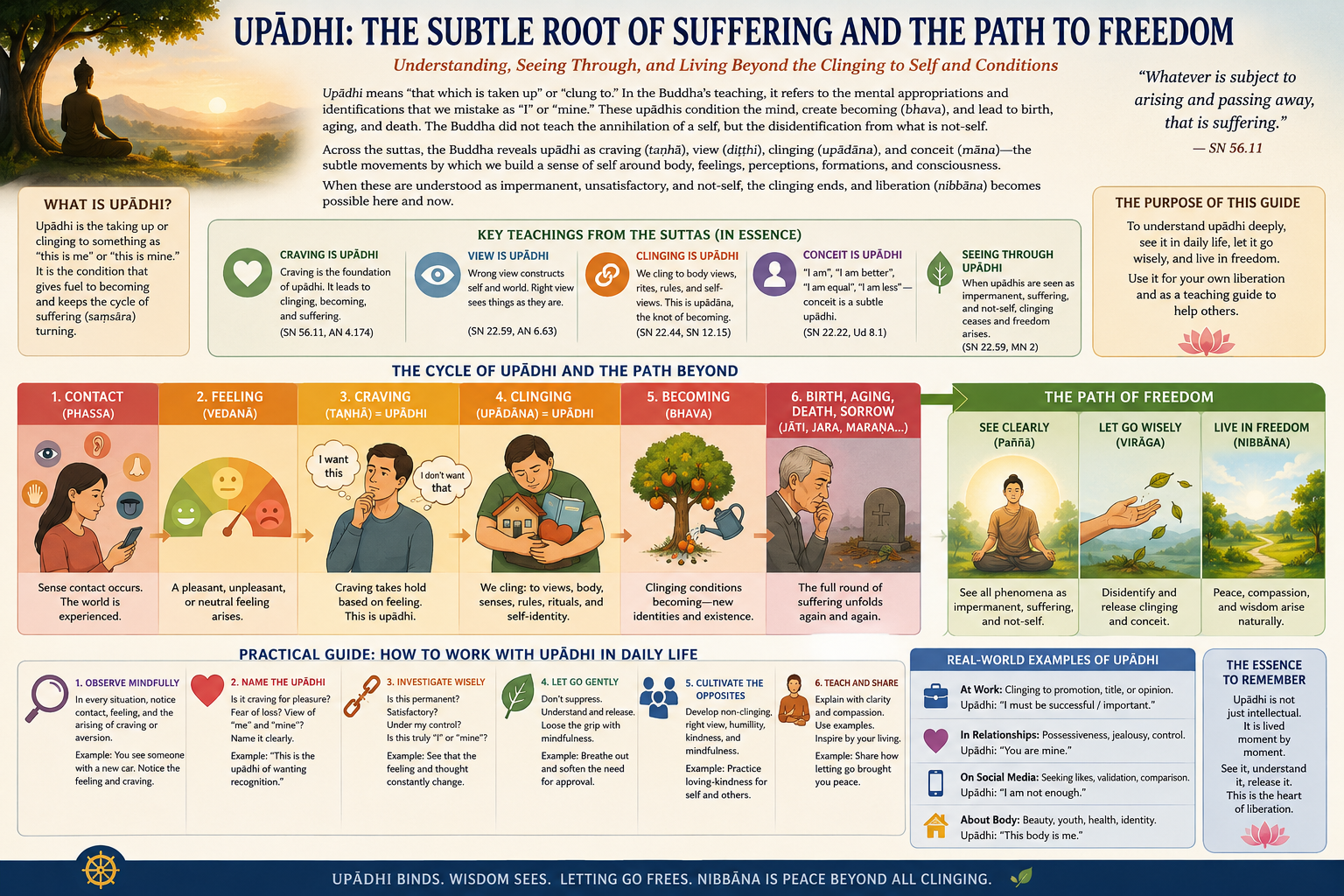
 VISUAL SUMMARYSee this study in a pictureOpen the complete infographic for a visual overview before or after reading the full study.View infographic →
Key practical question: What is the mind making into upadhi right now?
Liberating question: Can this be known, used, loved, cared for, remembered, or experienced without making it “mine”?
01 Why *upadhi* deserves careful investigation
Upadhi is one of those Pāli terms that becomes much poorer when it is translated by only one English word such as “attachment,” “acquisition,” “possession,” or “substratum.” Across the suttas, the word operates in several closely connected ways. In some places upadhī refers quite concretely to acquisitions around which life has been organised, such as children, cattle, possessions, status, or other things treated as “mine.” In other places upadhi functions more deeply as a condition from which suffering arises. The Buddha also speaks of one who upadhiṁ karoti, “makes” or constructs upadhi, and he describes liberation as nirupadhi, without upadhi. Most importantly, Nibbāna is repeatedly described through the expression sabbūpadhipaṭinissaggo, the relinquishment of every upadhi.
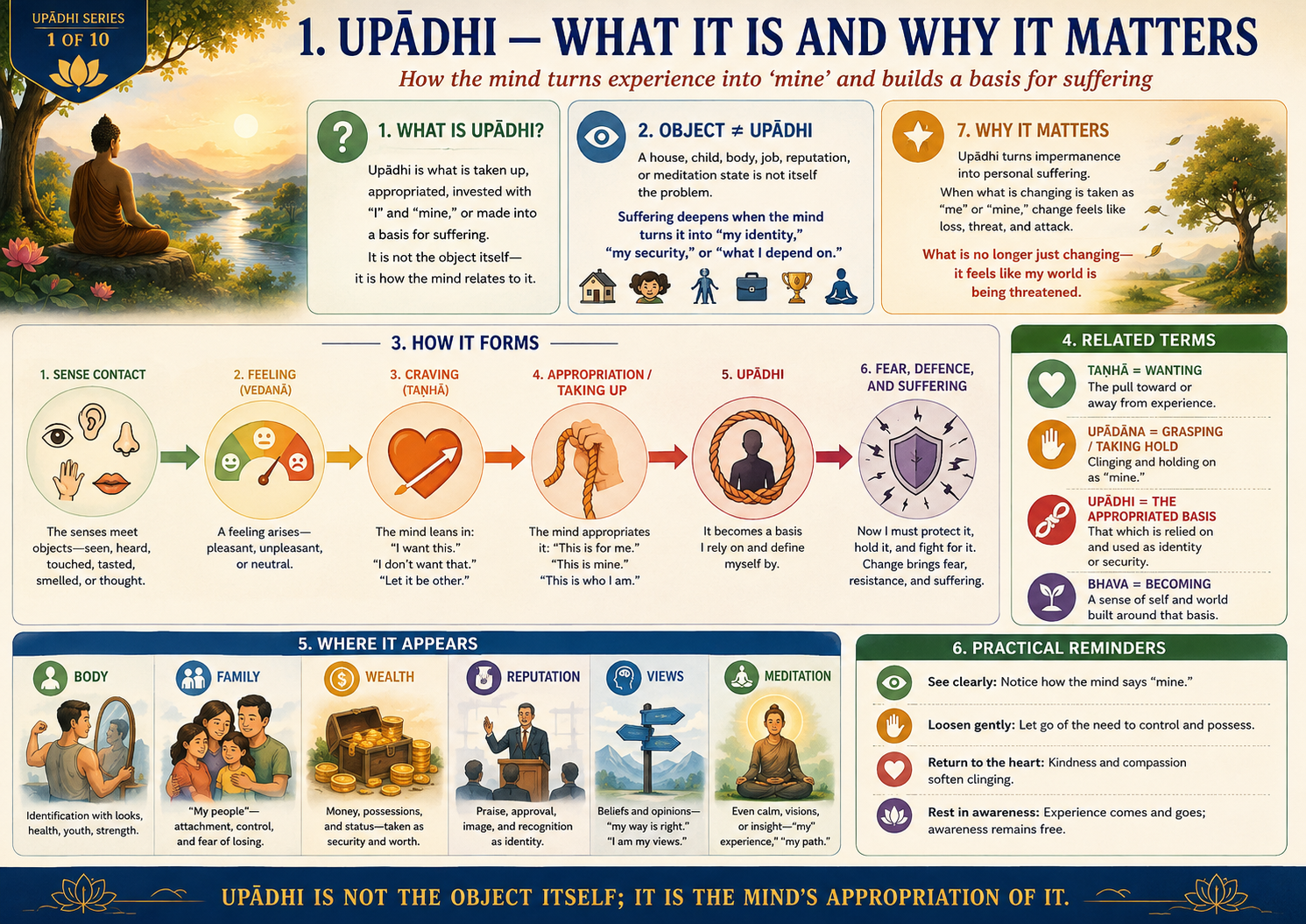
For practice, it is therefore better not to force one fixed English equivalent onto every occurrence. A useful working definition is this: upadhi is whatever has been acquired, appropriated, invested in, or taken into the structure of “me,” “mine,” “for me,” or “what I depend upon,” so that its presence becomes a source of delight and its alteration, loss, opposition, or destruction becomes a basis for dukkha. This is not intended as a dictionary definition but as a practical synthesis of the sutta usage.
The first insight follows immediately: the external object need not disappear for upadhi to disappear. A house may remain, a child may remain, wealth may remain, a position may remain, and even a refined meditative state may arise, while the mind ceases to establish identity and security upon them. The issue is therefore not merely what one possesses, but what the mind appropriates and depends upon.
02 The object is not the whole problem
Suppose there is a house. As an external object it is simply a conditioned arrangement of materials used for shelter. A person may relate to it functionally: “This is the house in which I presently live.” But the relationship can gradually change. The mind begins to say, “This is my house,” then, “I worked my whole life for this house,” then, “This house reflects my success,” and finally, “What would happen to me if I lost it?” At that stage the house has entered the structure of self-making. A scratch, a financial loss, a neighbour’s criticism, or the possibility of losing the property can now generate disproportionate fear or anger because something more than bricks and walls is being threatened.
This distinction is important. The sequence is not simply house → suffering. It is closer to contact with the object → pleasantness → wanting → appropriation → dependence → fear of alteration → dukkha. The external object becomes psychologically powerful because the mind has made it carry identity, security, status, or continuity.
03 Taṇhā, upādāna, upadhi and bhava
These terms are closely related, but collapsing them into one English word obscures the process. Taṇhā is the thirsting movement: “I want this,” “I want more,” “I want this to continue,” “I want this removed,” or “I want to become this.” Upādāna is the taking up, holding, grasping, or feeding of what craving has reached toward. Upadhi can then be understood as the acquired or appropriated basis around which “my world” becomes established. Bhava is the becoming that unfolds within that constructed world.
For practical purposes the movement may be expressed simply as: taṇhā says, “I want”; upādāna says, “I take hold”; upadhi says, “this now belongs to my world and supports who I take myself to be”; and bhava says, “I become within that world.” These are not rigid translations but an experiential way of seeing the progression.
SN 12.66, the Sammasasutta, is especially important because it states that upadhi has taṇhā as its source: upadhi taṇhānidāno. It then gives the direct conditional relationship, taṇhāya sati upadhi hoti; taṇhāya asati upadhi na hoti—when craving is present, upadhi comes to be; when craving is absent, upadhi does not come to be. This tells us that upadhi is not identical with craving. It is something built upon craving.
04 SN 12.66 Sammasasutta: the causal structure of upadhi
SN 12.66 should form the foundation of any serious study of upadhi. The bhikkhu investigates the suffering headed by aging and death and understands it as upadhinidāna, having upadhi as its source; upadhisamudaya, arising with upadhi; upadhijātika, born from upadhi; and upadhipabhava, produced from upadhi. He then investigates further and discovers that upadhi itself has taṇhā as its source.
The practical significance is profound. What appears at the end as grief over aging, separation, loss, death, status, possessions, or identity often began much earlier, when something appeared piyarūpa or sātarūpa—dear, attractive, agreeable—and craving entered. The mind then did more than merely enjoy the object. It began to incorporate it into “my life.” From that point onward, the natural instability of the object becomes personally threatening.
A contemporary example makes this very clear. A person sees a newly released phone. At first there is only seeing: cakkhu + rūpa + cakkhuviññāṇa → phassa. Pleasant vedanā may arise. Then the mind begins, “Very nice,” followed by, “I would like one,” then, “My current phone suddenly feels outdated.” Craving has entered. After purchase, the thought may deepen into, “I always buy the best model,” “This represents my taste,” or “I do not want to be seen using an old device.” The phone has now moved from useful equipment into identity-support. If someone then says, “You wasted your money,” irritation may arise immediately. The words did not damage the phone. They struck something that had been psychologically appropriated.
This is why the investigation of upadhi ultimately brings us back to the six sense doors. Upadhi is not first discovered in philosophical abstraction. It is seen where a sight, sound, smell, taste, touch, memory, idea, or imagined future becomes dear and agreeable, craving settles there, and the mind begins to make it “for me.”
05 Snp 3.12 Dvayatānupassanāsutta: seeing both arising and cessation
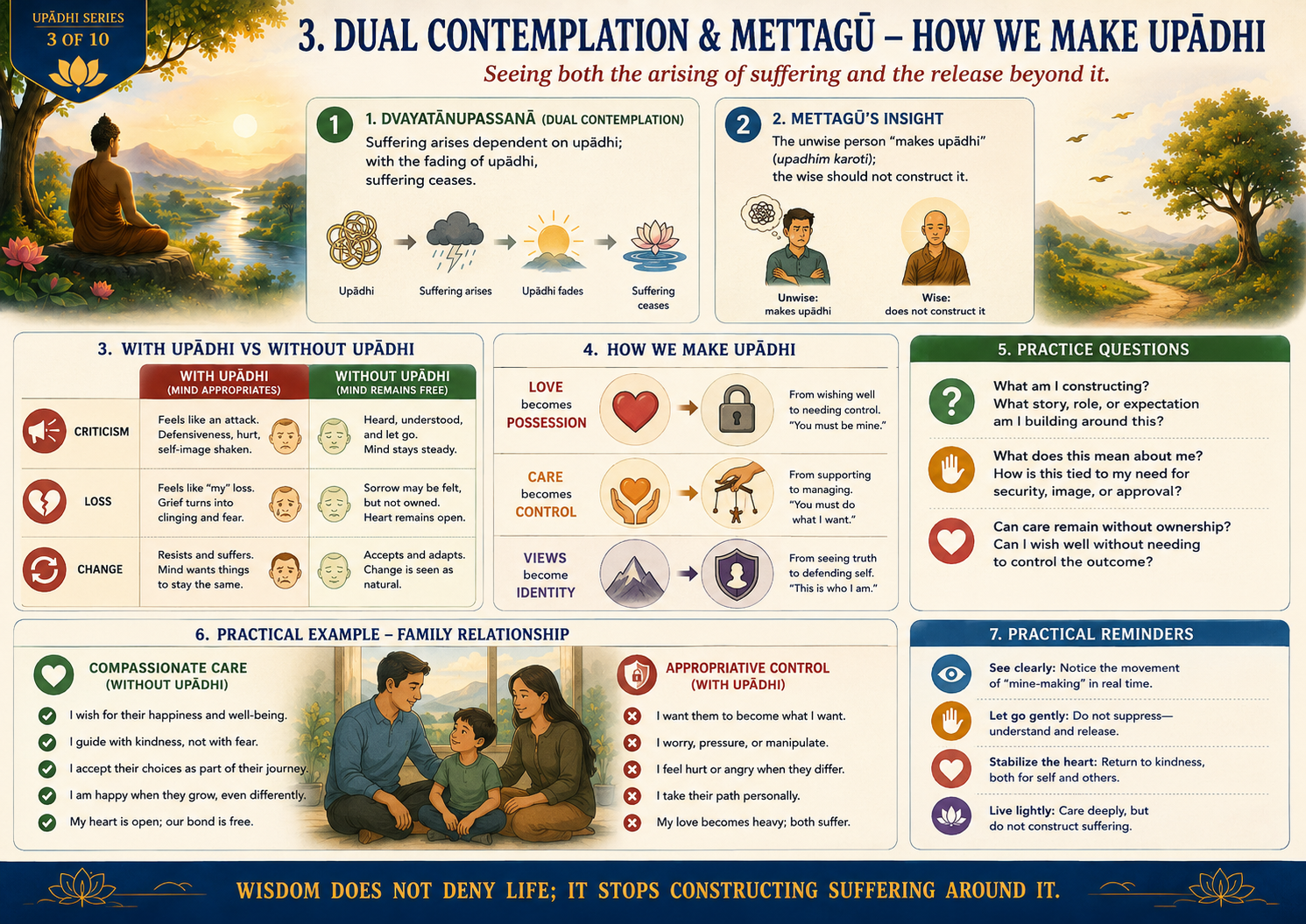
The Dvayatānupassanāsutta offers an exceptionally practical method because it trains the practitioner to contemplate in pairs: the arising side and the cessation side. Applied to upadhi, the investigation becomes: “When upadhi is present, how does suffering arise?” and “When upadhi fades and ceases, what happens to that suffering?” This is vipassanā made directly applicable to ordinary life.
Suppose someone criticises one’s teaching. Unpleasant vedanā appears. The ordinary mind immediately turns outward: “Who said this? Why did they say it? How should I answer?” Dvayatānupassanā turns attention inward: “What upadhi was present here?” Perhaps the mind had built “my reputation,” “my understanding of Dhamma,” “my standing among students,” or “my identity as an experienced practitioner.” Once this is seen, the cessation side can be contemplated: “What would this same criticism be like if there were no need to defend that identity?” Then the words can be examined as information. If the criticism is true, one learns; if it is false, one leaves it. The difference between these two responses is the difference between defending an appropriated self and investigating dhammas.
Snp 3.12 Dvayatānupassanāsutta — Seeing Upadhi from the Side of Arising and Cessation
The Dvayatānupassanāsutta adds an especially important dimension to the investigation of upadhi. SN 12.66 establishes that upadhi has taṇhā as its source; Snp 3.12 now shows how the practitioner should actually contemplate it. The method is called dvayatānupassanā, contemplation in a pair. One does not look only at the arising of suffering but also at the cessation of the condition upon which that suffering depends. In this way, the teaching does not leave the practitioner merely identifying attachment; it directs the mind toward release.
The Buddha is introducing another pair of contemplations. Dvayatānupassanā literally directs attention to two related aspects of the same process. The practitioner is not asked to speculate about suffering but to observe its conditional arising and its cessation.
The expression yaṁ kiñci makes the statement broad: whatever suffering comes into being is to be examined in relation to its conditions. Upadhipaccayā means “dependent upon upadhi” or “with upadhi as condition.” The first contemplation therefore asks us to look behind the experienced dukkha and discover the acquisition, appropriation, identity, possession, expectation, or basis upon which the suffering has become established.
The second contemplation completes the first. Asesa means without remainder; virāga is fading of passion or dispassion; nirodha is cessation. The Buddha is therefore not merely teaching us to recognise that we are attached. The practitioner is to contemplate what happens when that appropriative relationship completely fades. The object may remain, but the psychological basis upon which suffering depended is no longer established.
The …pe… in the source is an abbreviation for material repeated elsewhere in the discourse. It should not be mistaken for missing Pāli supplied by the translator. The important point for the present passage is that the Buddha treats this two-sided contemplation as a serious practice leading toward liberative knowledge, rather than merely as an intellectual way of analysing experience.
Ye keci lokasmimanekarūpā;
Yo ve avidvā upadhiṁ karoti,
Punappunaṁ dukkhamupeti mando;
Tasmā pajānaṁ upadhiṁ na kayirā,
Dukkhassa jātippabhavānupassīti.
Several expressions here are extremely important. Upadhinidānā pabhavanti dukkhā identifies upadhi as a source from which the many forms of dukkha arise. The particularly significant phrase is yo ve avidvā upadhiṁ karoti: the one who does not understand makes upadhi. The verb karoti is important because the Buddha does not present upadhi merely as something that happens to us; the mind participates in constructing it. The practical instruction therefore becomes upadhiṁ na kayirā—understanding the process, one should not continue making upadhi.
Here the investigation moves deeper. The earlier pair asked us to examine what has become upadhi. This pair asks us to investigate the ignorance within which such appropriation continues to appear sensible. The discourse should not be mechanically rewritten as though it had stated a new dependent-origination formula “avijjā → upadhi → dukkha”; the text presents separate two-sided contemplations. Nevertheless, when used practically, they deepen one another. Upadhi reveals what has been appropriated, while avijjā directs attention toward why the mind repeatedly mistakes impermanent, conditioned phenomena for reliable grounds of possession, identity, and security.
ye vajanti punappunaṁ;
Itthabhāvaññathābhāvaṁ,
avijjāyeva sā gati.
Avijjā hāyaṁ mahāmoho,
Yenidaṁ saṁsitaṁ ciraṁ;
Vijjāgatā ca ye sattā,
Na te gacchanti punabbhavanti.
The movement from avijjā to vijjā shows that this teaching is ultimately much more than a method for reducing ordinary emotional distress. The investigation of why a possession, relationship, view, identity, or meditative state causes suffering eventually opens into the larger question of why beings repeatedly establish themselves in bhava. The final issue is punabbhava, renewed becoming.
The great strength of Snp 3.12 is that it prevents the teaching on upadhi from becoming a moral instruction such as “do not be attached.” The Buddha instead asks us to observe a conditional process. When dukkha appears, the ordinary mind immediately looks outward and asks what person or circumstance caused it. If someone criticises us, we think the critic produced our suffering. If a child behaves differently from what we expected, we think the child produced our distress. If an investment falls, we blame the market; if a meditation becomes restless, we blame the conditions of practice. Dvayatānupassanā asks us to look one step deeper and inquire into the basis upon which that external event was able to become personal suffering.
Suppose someone says, “Your understanding of this sutta is wrong.” The sound reaches the ear, ear-consciousness arises, contact occurs, and unpleasant vedanā may appear. But two people can hear exactly the same sentence and react completely differently. One may examine the criticism calmly, while another may feel deeply wounded. What accounts for the difference? Snp 3.12 invites us to ask what had already become upadhi. Perhaps the mind had established “my understanding of Dhamma,” “my competence,” “my standing as a teacher,” or “my students’ respect.” The criticism therefore did not merely communicate information; it threatened something that had already been incorporated into the structure of “me.”
This is the first side of dvayatānupassanā: upadhipaccayā dukkhaṁ sambhoti. The practitioner learns to look beneath the immediate emotional reaction and recognise the appropriated basis. But this first insight is incomplete if it ends with, “I am attached to my reputation.” The second contemplation asks something far more liberating: what would this same contact be like if the upadhi were absent? The criticism might still need investigation. Perhaps it is correct and an error must be changed; perhaps it is incorrect and can simply be set aside. What disappears is not intelligent discernment but the need to defend a self constructed around being right. The external sentence remains; the psychological wound can cease.
The same method can be applied to family life. Consider a parent whose son chooses a career entirely different from what the parent expected. At first the parent may believe, “I am suffering because my son made the wrong choice.” Looking more carefully, however, the suffering may reveal a much larger structure: “my son must succeed in the way I define success,” “his career reflects my success as a parent,” “our relatives will judge our family,” or “after everything I have done for him, he should follow my advice.” The child has gradually been drawn into the parent’s self-construction. The issue is no longer merely loving concern for another person’s welfare; the child’s life has become an extension of “me.”
The first contemplation therefore recognises that the dukkha is arising dependent upon this upadhi. The second contemplation does not require the parent to stop loving the child. It asks whether love, advice, concern, and responsibility can remain when the appropriation fades. The child can still be guided and supported, but the thought “your life must validate my identity” can cease. This distinction is enormously important because mettā does not require mama. Removing ownership does not remove love; it can actually make love cleaner because another person is no longer being used as material for one’s own identity.
The verse sharpens the teaching further with upadhiṁ karoti. A house, for example, does not automatically become upadhi merely because one legally owns it. The house may simply function as shelter. But the mind can gradually construct around it: “this is my house,” “I spent my whole life earning it,” “this proves that I succeeded,” “my children must inherit it,” and “I cannot bear the thought of losing it.” The external building has become a psychological structure supporting identity, continuity, and security. When property prices fall, when damage occurs, or when another person acquires a larger house, the emotional reaction reveals what the mind has built. The Buddha’s phrase is therefore strikingly active: the uninstructed person makes upadhi.
This helps explain why merely giving up external possessions does not necessarily produce freedom. Someone may give away a large amount of money and then spend the next ten years thinking, “I was the person who donated that building.” Material ownership has disappeared, but psychological ownership has become even stronger. Another person may own a useful house, vehicle, computer, or phone while relating to it without status, comparison, or fear beyond reasonable care. The Buddhist inquiry is therefore subtler than a simple opposition between owning and not owning. It asks whether the mind is establishing itself upon the object.
The phrase punappunaṁ dukkhamupeti explains why this investigation must become habitual. An object may disappear, but unless the mechanism is understood the mind simply transfers appropriation elsewhere. Someone loses professional status and begins constructing identity around spiritual status. Someone gives up expensive possessions and becomes proud of simplicity. Someone abandons one meditation tradition because of attachment and immediately becomes fiercely identified with another. Someone no longer seeks sensual pleasure but becomes attached to a refined jhānic state. The outward object changes, while the inward architecture remains intact. This is “again and again”: the citta repeatedly manufactures new places in which “me” and “mine” can be established.
This can be seen particularly clearly at retirement. A person may have spent thirty years as a director, executive, professor, doctor, administrator, or organisational head. The professional position initially served a practical function, but over decades the role may gradually become “who I am.” People seek the person’s decisions, invitations arrive because of the title, staff members show respect, and social identity becomes intertwined with the office. Then retirement occurs. The office remains physically intact, but another person sits in the chair. Calls decline, decisions happen without consultation, and the former role disappears. The resulting emptiness may reveal that the actual loss was not merely employment; an entire upadhi had been constructed around importance, recognition, authority, and usefulness. Dvayatānupassanā asks first, “How did that appropriation condition suffering?” and then, “What would retirement be if the function ended but the identity were no longer required?”
The same investigation becomes extremely important in meditation. Suppose yesterday there was profound samatha or jhāna and today the mind is restless. If yesterday’s experience remained simply a conditioned state, today’s conditions can be investigated calmly. But if the mind converted yesterday into “my jhāna,” “my capacity,” or “the level I have reached,” today’s restlessness threatens an identity. Frustration then arises not merely because the meditation is restless but because something thought to belong to “me” appears to have been lost. The problem is subtle because what has become upadhi is no longer a house, bank balance, or sensual object; it is a refined Dhamma experience. The principle remains unchanged.
After establishing the upadhi pair, Snp 3.12 immediately turns to avijjā. This movement is crucial because otherwise practice could become a lifelong process of identifying one attachment after another without penetrating why the citta keeps manufacturing them. The avijjā contemplation asks: what is not being seen correctly that makes appropriation appear reasonable? Why does the mind believe a changing body can permanently secure beauty? Why does it believe a temporary position can establish lasting importance? Why does it believe another human being can permanently satisfy one’s expectations? Why does it believe a conditioned meditation state can safely become “my attainment”? Why does it believe a view should become “me”?
The answer is not merely that the mind is foolish in an ordinary sense. The verse calls avijjā mahāmoha, the great delusion. Conditioned things are repeatedly treated as though they could provide what their nature makes impossible: permanence, complete security, unchanging ownership, and stable selfhood. Because this fundamental mis-seeing remains, upadhi continues to be rebuilt after each loss. The house changes, another house becomes “mine.” The role changes, another identity is constructed. One relationship ends, another is asked to provide the same security. One state of being changes into another—itthabhāvaññathābhāvaṁ—and the search for establishment continues.
This is why the repeated punappunaṁ in these verses is so significant. In the upadhi verse, the foolish person comes to suffering again and again. In the avijjā verse, beings go again and again through the wandering of birth and death. At the level of daily life we can observe miniature versions of this process: one acquisition disappoints us, yet instead of understanding the mechanism we seek another acquisition. One identity fails, and we construct another. One pleasant state ends, and we chase the next. The Buddha’s investigation eventually expands this pattern from moment-to-moment psychological becoming to the much larger problem of jāti, maraṇa, saṁsāra, and punabbhava.
The purpose of the second contemplation is therefore especially important. Buddhist practice is not complete when we become skilled at explaining why suffering arises. One must become equally interested in why it can cease. When criticism hurts, do not only identify the ego involved; experience what happens when the need to defend that identity loosens. When a possession is threatened, observe whether care can remain without existential ownership. When a child chooses differently, notice whether love can remain without control. When meditation changes, see whether practice can continue without claiming the previous state. Every such moment provides a small laboratory for the phrase upadhīnaṁ asesavirāganirodhā natthi dukkhassa sambhavo: when the appropriative basis fades, the corresponding suffering loses the foundation upon which it was standing.
| First contemplation — arising | Second contemplation — cessation |
|---|---|
| “What upadhi is present?” | “What happens when this upadhi is not established?” |
| “What became mine?” | “Can this remain without being mine?” |
| “What identity is being protected?” | “Can the event be known without defending an identity?” |
| “What am I depending upon for happiness or security?” | “What remains when that dependency fades?” |
| Upadhipaccayā dukkhaṁ sambhoti | Upadhīnaṁ asesavirāganirodhā natthi dukkhassa sambhavo |
The avijjā pair then deepens the same investigation. Once the upadhi has been identified, ask, “What am I not seeing clearly?” If the mind is distressed by aging, perhaps it has quietly assumed that the body should remain youthful. If it fears losing wealth, perhaps conditioned resources have been asked to provide unconditional security. If criticism is unbearable, perhaps reputation has been mistaken for self-worth. If a jhāna must repeat exactly, perhaps a conditioned state has been appropriated as a permanent achievement. The move from avijjā toward vijjā is the move from these hidden assumptions toward direct understanding of arising, changing, ceasing, and non-ownership.
Thus Snp 3.12 gives us a very practical progression. When dukkha arises, first know the dukkha rather than immediately blaming the external condition. Then ask what has become upadhi. See how “mine,” expectation, dependency, identity, or ownership allowed the suffering to establish itself. Next contemplate the cessation side: what would remain if the event were exactly the same but the appropriation disappeared? Then go deeper into avijjā: what misunderstanding made the appropriation seem natural or necessary? Finally, cultivate the opposite direction, vijjā, seeing conditioned phenomena according to their actual nature rather than according to what craving wants them to provide.
The importance of the final line—na te gacchanti punabbhavaṁ, “they do not go to renewed becoming”—is that it prevents us from reducing this practice to emotional resilience. It is certainly useful when criticism, financial loss, relationship conflict, aging, professional change, or meditation difficulties occur, but the Buddha is pointing beyond becoming a psychologically comfortable person. The same structure of appropriation belongs to the larger process through which existence is repeatedly established. Understanding upadhi therefore becomes part of understanding how the mind repeatedly builds a place upon which it can stand and say, “This is mine; this is what I am; this is what I need to continue.”
For daily practice, the whole section can be condensed into four questions: What is the dukkha? What has become upadhi? What would this experience be without that appropriation? What avijjā is making me rebuild it? These questions are not meant merely for sitting meditation. They can be carried through walking, standing, sitting, lying down, family interactions, financial decisions, praise and criticism, teaching, study, and jhāna practice. Repeatedly applied, they make dvayatānupassanā an active method for seeing both the construction of suffering and the possibility of its cessation.
06 Mettagū’s question: *upadhiṁ karoti* — the mind manufactures its own basis of suffering
In Mettagū’s questions the Buddha says, Upadhinidānā pabhavanti dukkhā: suffering arises with upadhi as its basis. But the teaching goes even further with the statement yo ve avidvā upadhiṁ karoti—the one who does not understand makes upadhi. Therefore, tasmā pajānaṁ upadhiṁ na kayirā: understanding this, one should not make upadhi.
This is a crucial shift. Upadhi is not merely something that accidentally attaches itself to us. The mind participates in making it. A child provides a useful example. A parent may conventionally say, “my son,” without any problem. But the mind can gradually construct a much larger world: “My son must succeed; his success proves something about me; he should choose what I think is best; his decisions reflect upon our family; what will people think if he fails?” At that point the child is no longer encountered simply as another living being to be loved, supported, guided, and respected. His career, marriage, achievements, and behaviour have become integrated into the parent’s own self-construction.
This is why mettā does not require mama. Care does not require ownership. One can love deeply without turning another person’s life into property of one’s identity. The removal of upadhi is therefore not the removal of compassion; it is the removal of appropriation from compassion.
07 SN 1.12 Nandatisutta: delight and sorrow are two ends of one rope
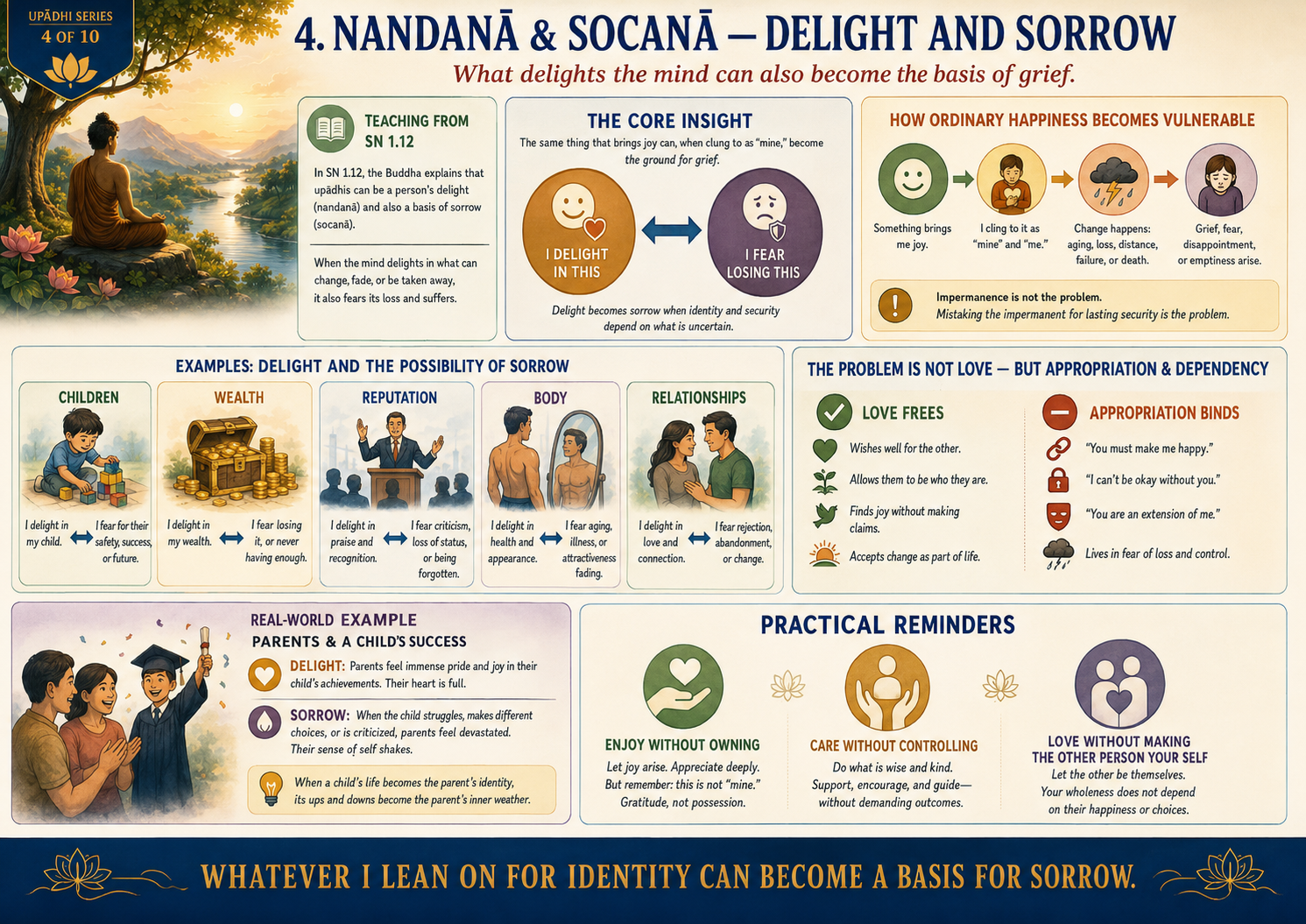
SN 1.12 gives one of the clearest everyday illustrations. A deity points out that those with children delight in children and those with cattle delight in cattle. The Buddha reverses the perspective and shows that the very same acquisitions become a basis for sorrow: upadhī hi narassa socanā. The one who is nirupadhi does not sorrow in that same appropriative way.
The teaching does not say that one should never enjoy children, family, possessions, health, friendship, or success. Rather, it exposes the hidden contract beneath appropriation: “I will be happy as long as you remain the way I want you to remain.” Every conditioned thing eventually violates that contract because every conditioned thing changes. Therefore, whenever something produces strong delight, it is useful to ask, “If this changes tomorrow, what exactly in me would suffer?” That question often reveals the upadhi immediately.
If a child receives a prestigious job, delight arises; what if the job disappears? If an investment rises sharply, there is pleasure; what if it falls forty percent? If people praise a Dhamma talk, happiness arises; what happens when the next talk is criticised? If meditation is exceptionally still today, what happens when tomorrow the mind is restless? The point is not pessimism. The point is to see conditionality before conditionality teaches through pain.
08 Ud 2.4 Sakkārasutta: why contact “hits” us
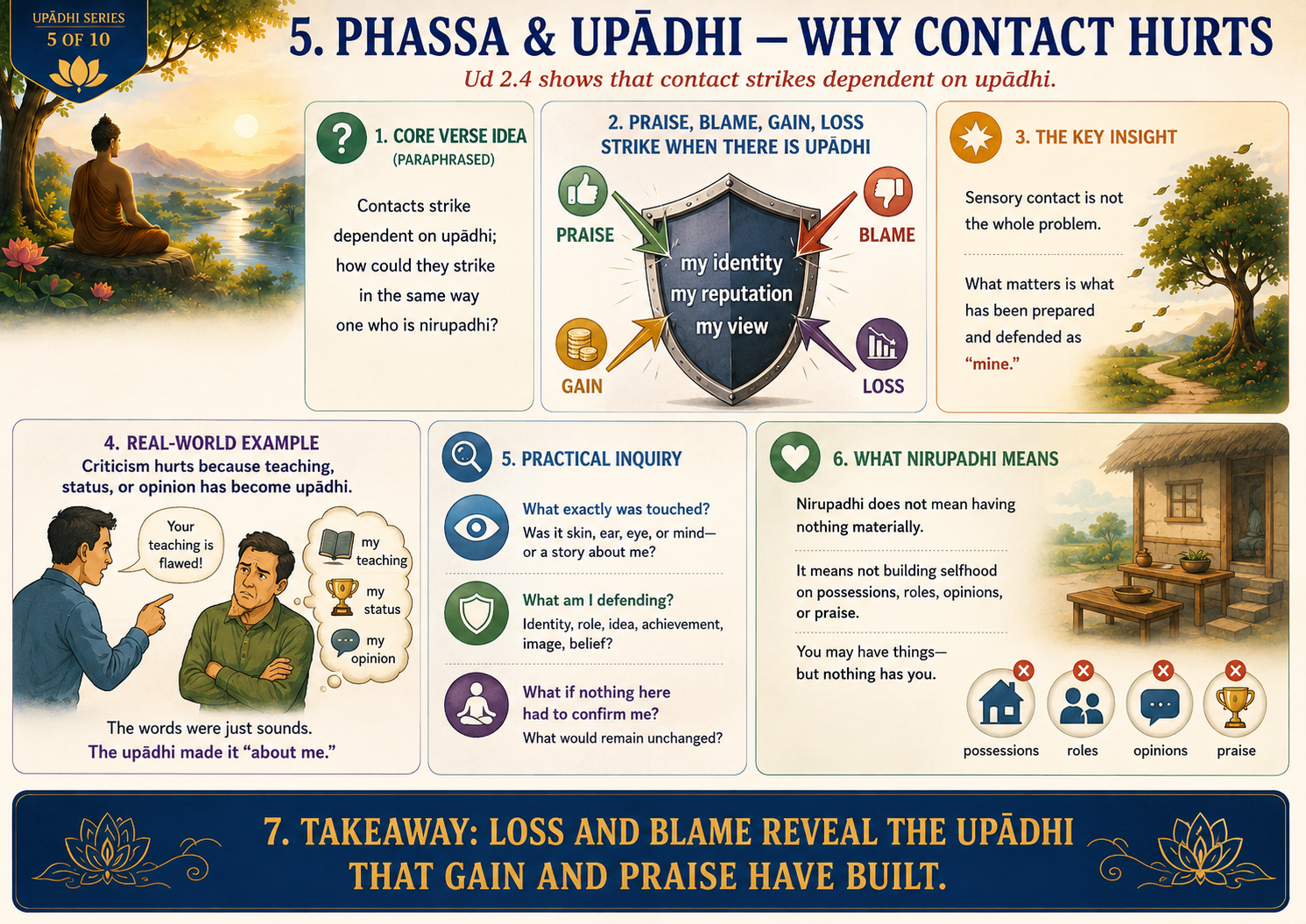
Ud 2.4 is especially useful because the context concerns honour, respect, offerings, robes, food, lodging, medicines, jealousy, and verbal abuse. The key verse says, Phusanti phassā upadhiṁ paṭicca—contacts strike dependent upon upadhi—and asks, Nirūpadhiṁ kena phuseyyu phassā? How could contacts strike one who is without upadhi in the same appropriative sense?
The context shows that nirupadhi cannot simply mean possessing nothing materially. The bhikkhus still have robes, food, lodging, and medicine. What is absent is the psychological establishment of “me,” “mine,” “my worth,” and “my security” upon those things. A person can therefore use possessions without building identity upon them. Conversely, a person can give away everything and then think, “I am more renounced than everyone else.” In that case material possession has decreased while psychological upadhi has increased.
This sutta also explains why criticism can hurt so much. If a stranger says, “Your red umbrella is ugly,” and one owns no red umbrella, very little happens. But if someone says, “Your understanding of Dhamma is wrong,” the body may tighten, defensive thoughts may arise, and the mind may immediately begin constructing a reply. The words struck not merely sound-consciousness but an already prepared structure: “my understanding,” “my intelligence,” “my credibility,” “my identity.” The sensory contact reveals the upadhi that was already there.
Gain and praise often build upadhi; loss and blame reveal it. This is why difficult experiences can become powerful vipassanā teachers. They show us precisely where identity has been deposited.
09 Ud 3.10 Lokasutta: upadhi and the machinery of becoming
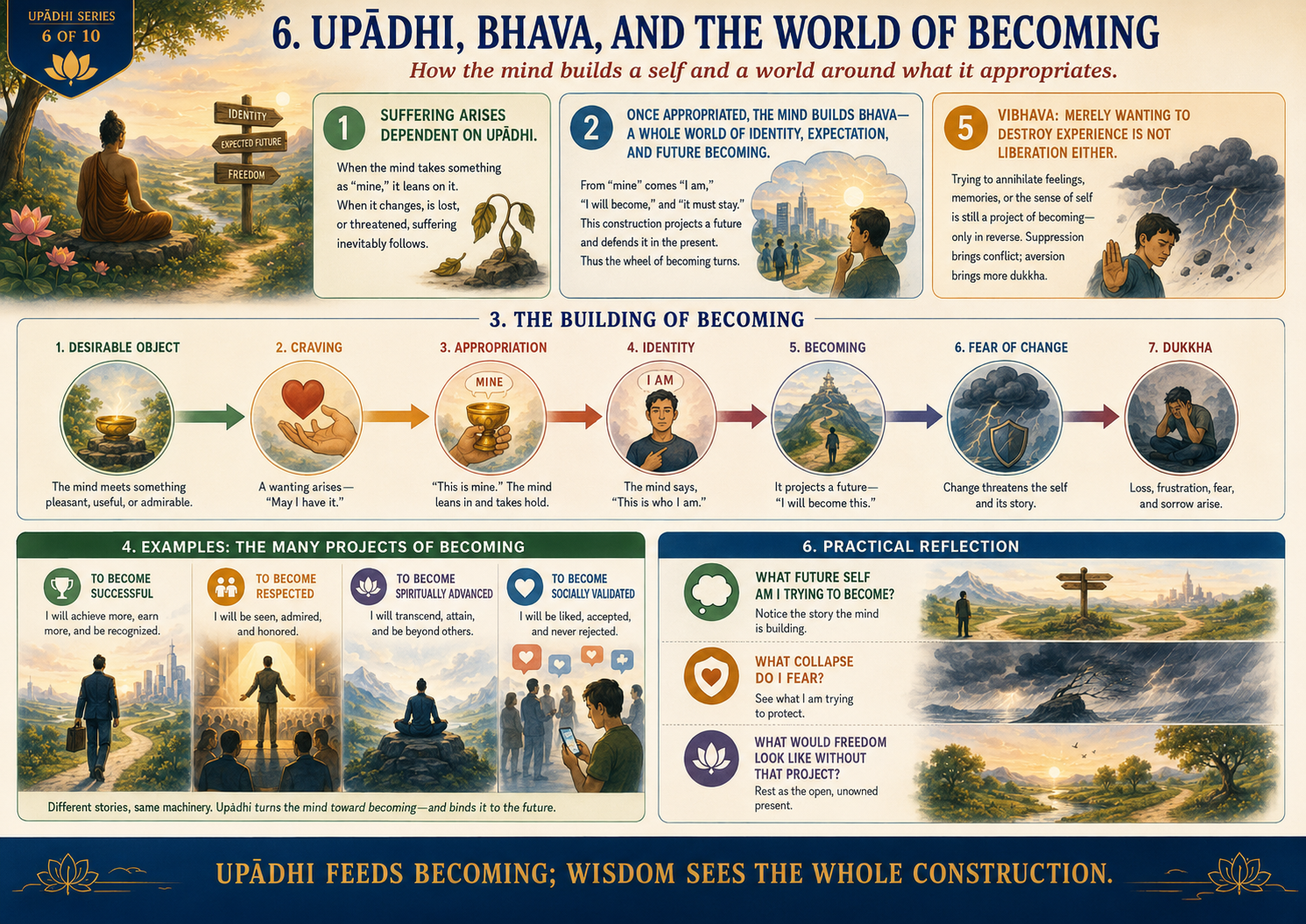
Ud 3.10 takes the investigation beyond possessions and relationships into bhava. The discourse observes that whatever forms of becoming exist are impermanent, unsatisfactory, and subject to change. Seeing this clearly leads to the abandonment of bhavataṇhā, while the practitioner also does not seek liberation through vibhava, the desire for non-being or annihilation.
This is important because upadhi can be constructed out of the future. “I want to become wealthy,” “I want to become famous,” “I want to become a respected Dhamma teacher,” “I want to become an advanced meditator,” or “I want people to recognise my attainment” may all create an imagined identity that begins governing the present. Once that future has been appropriated, anything that threatens it produces anxiety.
The opposite movement—“I want to destroy this situation,” “I want this feeling to disappear,” “I never want to encounter this person again,” or “I want to get rid of myself”—does not solve the problem. Liberation is not becoming the perfect self, nor annihilating an unwanted self. It is seeing and ending the machinery by which a self is repeatedly established around conditioned phenomena.
10 MN 66 and MN 105: the size of the object is less important than the strength of the bondage
MN 66, the Laṭukikopamasutta, helps us understand that a fetter does not have to be objectively large in order to hold the mind. A small bird can be trapped by a weak creeper that a large elephant would break effortlessly. In the same way, we often dismiss something as “only a small thing,” yet the mind may be powerfully bound to it. Tea, a phone, news, a particular chair, a preferred food, a specific routine, someone replying immediately, being right, or having the last word can all expose powerful dependence.
Therefore the useful question is not, “How important is this object objectively?” but, “How strongly is the citta disturbed when access to it is removed?” That reveals the actual strength of the bond.
MN 105, the Sunakkhattasutta, brings this directly to the six fields of contact. The practitioner restrains the six phassāyatanas, understands upadhi as a root of suffering, becomes nirupadhi, and is liberated through the exhaustion of upadhi. This places upadhi practice at the heart of indriya-saṁvara. Guarding the sense doors is not repression; it is preventing contact and vedanā from being repeatedly fed into craving, appropriation, identity, and fear.
The unguarded movement can be shown compactly as see/hear/think → pleasant or unpleasant vedanā → revisit → want or reject → obtain or resist → “mine” → protect → fear loss → dukkha. The guarded movement is see/hear/think → know the contact → know vedanā → recognise taṇhā → do not feed appropriation → let the object remain an object. The world remains available for wise use, but it does not need to become material for self-making.
11 Upadhi at the six sense doors
The eye should be investigated by asking what forms one repeatedly wants to see, what appearances create comparison, and which visual objects become identity-support. The ear reveals upadhi through the need for praise, intolerance of criticism, and repeated listening to views that confirm “me.” The nose and tongue expose craving through fragrance and food preferences that gradually move from liking to dependency. The body reveals it through comfort, temperature, clothing, touch, sexual pleasure, beds, chairs, and other conditions that become psychologically non-negotiable. Mano is the most expansive field because views, memories, plans, religious identities, political identities, meditation experiences, reputations, future selves, and stories about oneself can all become upadhi.
In this way the investigation becomes immediate. We do not have to wait for a major bereavement or financial crisis. Upadhi can be observed in the small moments when the mind says, “I need this,” “I cannot tolerate that,” “They must understand me,” “This is my view,” “This should continue,” or “This should not happen to me.”
12 MN 106: gross upadhi can disappear while subtle spiritual upadhi survives
MN 106, the Āneñjasappāyasutta, is essential for serious meditators because it shows that even extremely refined meditative states can become objects of delighting, welcoming, holding, and clinging. A practitioner may no longer care very much about money, fashion, entertainment, or possessions, yet a beautiful meditative experience may arise: profound stillness, pīti, extraordinary equanimity, or a subtle cessation-like state. The mind then begins, “That was extraordinary,” followed by, “I reached it,” then, “I need to reproduce it,” and finally, “Why can I not get back there today?”
At that point the gross object has disappeared, but the same architecture remains: experience → mine → identity → comparison → craving for repetition. Upadhi has simply become more refined.
This is why phrases such as “my jhāna,” “my attainment,” “my insight,” “my lineage,” “my teacher,” “my method,” “my interpretation,” “my students,” or even “my liberation” deserve very careful examination. Conventional language is not the problem. The problem is whether the experience or designation has become something the mind needs in order to maintain an identity.
The same applies to sutta scholarship. A person may know enormous amounts of Pāli, which is valuable, but when another translation is proposed the reaction may reveal whether the concern is purely accuracy or whether “my expertise” has been threatened. Correct understanding can be defended without defending a self around correct understanding.
13 MN 140, MN 26 and AN 10.60: from ordinary giving to *sabbūpadhipaṭinissagga*
MN 140, the Dhātuvibhaṅgasutta, takes relinquishment to its highest level. It describes the abandoning of previously taken-up upadhis and then calls sabbūpadhipaṭinissaggo, the relinquishment of all upadhi, paramo ariyo cāgo—the supreme noble relinquishment. This makes cāga much deeper than the ordinary meaning of generosity.
Giving money, food, possessions, time, or service is wholesome and can weaken “mine,” but it is possible to give materially while retaining psychological ownership. Someone may donate a building and then spend twenty years thinking, “That is the building I donated.” The physical object was given away, but it was exchanged for a stronger identity. Therefore a useful question after generosity is, “Did I give the object, or did I exchange material ownership for psychological ownership?”
MN 26 explains why this direction is difficult to see. Beings delight in ālaya, take pleasure in it, and rejoice in it. Against this ordinary orientation toward acquisition, accumulation, establishment, and identity, the Buddha describes the peaceful and sublime direction as sabbasaṅkhārasamatho, sabbūpadhipaṭinissaggo, taṇhākkhayo, virāgo, nirodho, nibbānaṁ—the calming of all formations, relinquishment of all upadhi, exhaustion of craving, fading, cessation, Nibbāna.
AN 10.60, the Girimānandasutta, makes this more than a philosophical conclusion. The practitioner repeatedly contemplates the peaceful and sublime nature of that relinquishment. The mind is trained to discover that peace is not merely getting circumstances arranged correctly. A deeper peace appears when the demand that circumstances obey disappears. Thus the question becomes not, “How can I make everyone praise me?” but, “What would it be like not to need praise?” Not, “How can I guarantee perfect financial security?” but, “Can money be managed wisely without making it the foundation of inner security?” Not, “How can I force meditation to reproduce yesterday’s stillness?” but, “Can this conditioned state be known without making an identity out of it?”
14 DN 27 Aggañña Sutta as a social-scale illustration of upadhi
The Aggañña Sutta provides a powerful social illustration of the same mechanism. The beings first taste the savoury earth and taṇhā cassa okkami—craving enters. Later, food is accumulated, rice is stored, boundaries are established, and the world becomes divided into “mine” and “yours.” Someone protects his own share while taking another’s share, and theft, lying, accusation, punishment, and political authority appear in succession.
Placed beside SN 12.66, this becomes almost a social-scale map of upadhi: pleasant object → taṇhā → increased consumption → accumulation → appropriation → mine/yours → boundary → defence → conflict → dukkha. What happens in the individual citta becomes, through repetition and imitation, the architecture of society.
This is particularly useful for teaching because it shows that social suffering does not begin only with bad institutions. Institutions can become necessary because craving, appropriation, competition, deception, and violence have already appeared. The Buddha’s analysis repeatedly returns us from external structure to the qualities being cultivated in the mind.
15 The most revealing word in ordinary life: “my”
Conventional speech requires words such as “my house,” “my child,” “my body,” and “my work,” so the word “my” is not itself a problem. But it is an excellent diagnostic signal. Whenever the mind says “my body,” “my spouse,” “my son,” “my money,” “my reputation,” “my country,” “my religion,” “my teacher,” “my students,” “my opinion,” “my time,” “my meditation,” “my attainment,” or “my suffering,” we can ask, “What exactly does ‘my’ mean experientially here?”
The body illustrates this clearly. “The hair is becoming grey” is simple observation. “I am becoming unattractive” adds identity. “This body should not age” adds demand. Illness then feels not only painful but like betrayal. None of this means neglecting health. One can exercise, eat wisely, seek medical care, and maintain the body while understanding that its condition does not establish who one is.
The same distinction applies to relationships. A parent can support a child without needing the child’s choices to validate the parent’s identity. A spouse can love faithfully without treating the other person as emotional property. Non-upadhi is not coldness; it is care without appropriation. In fact, love may become cleaner when another person is no longer being used to stabilise “me.”
Money provides another example. Money is functional, but upadhi begins when a bank balance is asked to answer questions such as, “Am I safe? Am I important? Am I successful? Am I superior?” A profession can work the same way. “I work as an engineer” is different from “I am an important engineer.” Retirement then reveals how much identity had been invested in the role.
16 Praise, social media, politics, religion and being right
Praise is one of the fastest ways to watch upadhi being built. Someone says, “You explained that beautifully.” Pleasant vedanā arises. Nothing is wrong yet. But the next thought may be, “They recognise my wisdom.” The construction begins. When the same person disagrees tomorrow, anger appears. The criticism exposes what the earlier praise helped build.
Social media provides an almost laboratory-like example. A post receives ten likes, then a hundred, then a thousand. Soon the mind asks why today’s post received only two hundred. The number has not merely changed; identity has been deposited into the metric. The algorithm now has access to the emotional state because the account has become upadhi.
Politics works similarly. A policy may initially be judged as more beneficial, but the mind can move from “this policy seems preferable” to “this is my side.” Criticism of the party then feels like criticism of oneself. Evidence threatening the group is resisted, while confirming evidence is welcomed. The issue is no longer simply truth or welfare; the mind is defending an appropriated identity.
Religion can become an even subtler field. “This is the Buddha’s teaching” can gradually become “this is my tradition,” then “our tradition is superior,” and eventually “criticism of our tradition is an attack on us.” The very Dhamma intended to dismantle appropriation can itself be appropriated. The same can happen with a meditation community, lineage, teacher, retreat, or institution. When another group succeeds and discomfort arises, that discomfort may reveal that concern for liberation has been mixed with concern for institutional identity.
One of the strongest contemporary upadhis is “being right.” A view begins as, “I think this explanation is correct.” Later it becomes, “If this explanation is wrong, something about me is diminished.” At that point evidence is no longer examined impartially. A powerful practice is to ask: Can the desire for truth become stronger than the desire for my view to survive?
17 Fear, anger, jealousy, grief and memory as detectors of upadhi
Fear often points directly toward appropriation. Ask, “What am I most afraid of losing?” The answers may include health, wealth, partner, child, independence, reputation, memory, physical ability, teacher role, meditation capacity, or a belief system. The next question should not be, “How do I get rid of this?” but, “What identity or security has been built around it?”
Anger is another detector. When anger arises, ask, “What upadhi was threatened?” Usually a view, expectation, boundary, possession, image, position, or demand for control was already present. The person who triggered the anger may be only the immediate condition; the combustible material had already been stored.
Jealousy and possessiveness reveal similar structures. Jealousy often says, “Something I depend upon may go elsewhere.” Possessiveness says, “This should belong to me.” Comparison says, “Their acquisition affects my worth.” Each points toward appropriation.
Grief must be approached with great sensitivity. The teaching should never be used to tell someone harshly, “You are grieving because you are attached.” The purpose is not blame. When the mind is ready, grief can become a compassionate inquiry into what had been woven into “my world.” Pain may remain, but wisdom begins to separate the raw pain of loss from the additional self-making built around it.
Memory can also become upadhi. “My childhood,” “my suffering,” “what they did to me,” “my sacrifices,” and “my achievements” can all be repeatedly renewed as identity. The past event is gone, yet the mind can recreate its ownership every time it says, “This is the story that defines me.” The practice is not forgetting; it is allowing memory to function without forcing it to manufacture a permanent self.
18 Upadhi practice is not suppression, indifference, poverty or passivity
This teaching can be badly misunderstood if it is reduced to “do not care” or “get rid of everything.” Suppression says, “I must not want this,” and often drives craving underground. Wisdom says, “Taṇhā is present; let me know it. What is it trying to acquire? What identity is being constructed? What would happen if I did not feed it?” The first is violence against experience; the second is investigation.
Likewise, forced indifference is not liberation. Saying, “I do not care about anyone,” may simply be aversion. The liberated direction is not less compassion but less appropriation. One can care enormously without demanding ownership.
Nor is upadhi practice equivalent to poverty. A poor person can be intensely attached to one bowl, while a wealthy person may use resources with comparatively less appropriation. Material simplicity is highly supportive because it reduces opportunities for entanglement, but the decisive question remains what the citta is doing.
Non-upadhi is also not passivity. If someone steals a phone, it may be appropriate to report it. If someone behaves unethically, wise action may be required. The question is whether the response can occur without building hatred, selfhood, and obsessive possession around the event. Sīla and wisdom remain fully operative; appropriation is what is being relinquished.
19 The Upadhi Ladder: from gross to extremely subtle
For teaching, it is helpful to recognise that upadhi can move through increasingly subtle levels. At the material level it includes money, houses, devices, clothing, and vehicles. At the relational level it can form around spouse, children, friends, teachers, and students. At the social level it can form around reputation, praise, status, position, and followers. At the intellectual level it can form around views, theories, qualifications, and knowledge. At the institutional level it can form around country, party, religion, lineage, or organisation. At the bodily level it can form around health, beauty, strength, and youth. At the emotional level it can appear as “I must always feel peaceful.” At the meditative level it can form around samādhi, pīti, jhāna, equanimity, and special experiences. At the existential level it can form around the person one wants to become. At the spiritual level it can become “I am a practitioner,” “I am advanced,” or “I have attained.”
At every level the same diagnostic question works: What happens when this changes? The intensity of fear, anger, disappointment, defensiveness, or grief often reveals the degree of appropriation.
A simple way to express the mechanism is: anicca is unavoidable; upadhi adds the demand, “this must not change because it is mine.” Conditioned change then becomes personally threatening. Without appropriation, change is still known, but the mind no longer requires reality to preserve an acquisition in order to preserve “me.”
20 A practical map of the whole process
The following compact diagram is not a quotation from one discourse but a synthesis, especially of SN 12.66, SN 1.12, Ud 2.4, Ud 3.10, MN 105, and the wider teaching on the six doors:
sense object → phassa → vedanā → piyarūpa/sātarūpa → taṇhā → taking/appropriation → upadhi → “mine / for me / what I depend upon” → nandanā → protection and fear → change, loss, blame, or opposition → phassa strikes the acquired basis → soka/dukkha → further craving and becoming.
The liberation movement reverses the process much earlier than we usually attempt. Phassa is known, vedanā is known, taṇhā is recognised before it is fed, upadhi is not manufactured, change is known simply as change, and the mind no longer has to defend an appropriated structure. From there the direction is toward virāga, nirodha, paṭinissagga, and ultimately sabbūpadhipaṭinissagga.
This shows why the crucial practice moment is earlier than anger, grief, or conflict. By the time anger explodes, many conditions have already accumulated. DN 27 shows the first tasting, the first craving, accumulation, boundary, stealing, and conflict. SN 12.66 takes us back to the same early point: catch taṇhā before it manufactures upadhi.
21 A six-step real-time practice
When disturbance occurs, first identify phassa: what was seen, heard, remembered, imagined, tasted, touched, or thought? Then identify vedanā: pleasant, painful, or neither. Third, identify taṇhā: what did the mind want—more, less, continuation, removal, recognition, or becoming? Fourth, identify upadhi: what had become “mine,” “for me,” “necessary for me,” or “who I am”? Fifth, identify vipariṇāma: what changed or threatened to change? Sixth, practise paṭinissagga by asking whether the object can remain exactly as it is while the appropriation is loosened.
Take criticism as an example. Someone says, “Your understanding is wrong.” The ear receives sound; unpleasant vedanā arises; taṇhā wants the criticism removed, wants approval restored, or wants the critic defeated. Investigation then reveals the upadhi: “my understanding,” “my competence,” “my standing.” Once this is seen, the statement can be examined without self-defence. If it is true, correct the understanding. If it is false, there is no need for hatred. Dhamma can be protected without protecting “me.”
Take a child’s unexpected career choice. The news is the contact; unpleasant vedanā follows; taṇhā wants the child to choose differently; upadhi appears as “my son must embody my idea of a successful life”; an imagined parental identity is threatened; disappointment and manipulation may follow. Paṭinissagga does not mean abandoning the child. It means recognising, “He is another conditioned being making choices and experiencing their results. I can advise without possessing.” Love remains while appropriation weakens.
Take meditation. Yesterday there was deep calm; today there is restlessness. Unpleasant vedanā arises and taṇhā says, “I want yesterday back.” Upadhi appears as “my meditation is good” or “I can attain deep states.” When today does not match yesterday, the identity is threatened. Wisdom remembers that yesterday’s state was conditioned and today’s state is conditioned. The task is to know today’s conditions rather than defend yesterday’s experience.
22 Daily exercises for weakening upadhi
A useful daily inventory is to review the strongest delight, the strongest irritation, what one feared losing, what one defended, and where one compared oneself with another person. Under all five events ask one question: “What upadhi was operating?” Repeated over several weeks, this reveals patterns that are difficult to see in isolated incidents.
Another exercise is, “If this disappeared tonight, what exactly would I feel had been lost?” Choose one object or role—phone, job, reputation, routine, possession, praise, meditation ability—and go deeper than the functional loss. Would the loss make one feel less important, less secure, less loved, less successful, less spiritual, or less capable? That reveals the psychological burden the object has been made to carry.
The “same object, no mine” experiment is also illuminating. Compare an attractive object belonging to someone else with an equally attractive object one owns. If the owned object is scratched, the reaction is often much stronger. The sensory qualities may be nearly identical; the difference is mama.
Before a non-essential purchase, ask, “What problem do I believe this will solve?” and distinguish the functional problem from the psychological one. “My shoes are worn out” is functional. “I want to feel more impressive” reveals another process. After buying something desirable, observe the first forty-eight hours: how often is it checked, cleaned, shown, compared, protected, or mentally revisited? This is a direct opportunity to watch upadhi being constructed.
For teachers, the practice can be especially direct. Before teaching, establish the intention, “May the Dhamma be understood.” After teaching, ask not “How did I perform?” but “Was what was taught accurate and beneficial?” Praise is known as pleasant vedanā, criticism as unpleasant vedanā. Neither needs to manufacture “successful teacher” or “failed teacher.” Teaching itself then becomes bhāvanā.
23 How to teach upadhi to householders and serious practitioners
The teaching should not be presented to householders as, “Your family is attachment; abandon them.” That is crude and potentially harmful. A better question is: “Can every responsibility be fulfilled while examining what has been psychologically appropriated?” Care for children, support parents, be faithful to a spouse, earn honestly, maintain a home, and pay bills—but observe where function becomes identity, where care becomes ownership, where preference becomes demand, and where love becomes fear because “mine” has been inserted.
For monastics or intensive practitioners, the examples must become subtler. Robe, bowl, kuti, routine, seniority, teacher position, followers, scholarship, views, recognition, samādhi, jhāna, and attainment can all become upadhi. A renunciant can possess very little materially and still possess an enormous psychological estate.
A seven-session teaching programme can therefore be built progressively. The first session introduces upadhi through SN 12.66, Snp 3.12, and Mettagū’s questions. The second examines upadhi at the six doors through SN 12.66 and MN 105. The third explores delight and sorrow through SN 1.12 and Dhaniya. The fourth uses Ud 2.4 to ask what contact actually strikes. The fifth uses Ud 3.10 to investigate becoming and the future self. The sixth studies spiritual upadhi through MN 66, MN 105, and MN 106. The seventh culminates in MN 140, MN 26, and AN 10.60 with the contemplation of sabbūpadhipaṭinissagga.
In group teaching, questions are often more powerful than lectures. Ask participants what currently gives them the greatest happiness, what would happen if it changed, what exactly would be lost, where taṇhā entered, when “mine” appeared, how the mind protects it, and what nirupadhi would mean in that specific example. Another powerful private exercise is to write, “The five things I most fear losing,” and then ask of each one, “If this disappeared, what would it say about me?” That final question often exposes hidden identity immediately.
24 A meditation on upadhi
Sit quietly and establish mindfulness. Bring to mind one personally significant object, person, role, view, or meditative experience. Do not analyse immediately. First notice the bodily response and the vedanā associated with it. Then ask, “What do I want from this?” After allowing the answer to emerge, ask, “What do I fear regarding this?” Then ask, “What does this mean about me?” Finally ask, “Can this be known, loved, used, remembered, or experienced without being made mine?”
Do not force a conceptual answer. Observe the mind. See that the object arose dependent on conditions, remains dependent on conditions, changes dependent on conditions, and will cease when its conditions cease. Then notice what happens when the mind does not reach out to establish itself there. This is not a demand to destroy the object. It is training in non-establishment.
The entire daily practice can be condensed into three questions whenever a strong reaction arises: What am I craving? What have I made into upadhi? What can be relinquished right now? Repeated hundreds of times, these questions turn a Pāli term into direct bhāvanā.
25 From ordinary ownership to *sabbūpadhipaṭinissagga*
The deepest test is not “What do I own?” but “What controls my citta?” Can a phone notification redirect the mind? Can praise inflate it? Can criticism destabilise it? Can financial movement frighten it? Can an attractive form capture it? Can an old memory dominate it? Can a meditative state make it proud? Whatever repeatedly commands the citta deserves investigation as potential upadhi.
The path is therefore not an attempt to make the world harmless. People will praise and blame, gain and lose, agree and disagree, come and go. Bodies will age, possessions will break, institutions will change, relationships will change, and meditation states will arise and cease. Practice does not construct an untouchable world; it removes the internal structures that require the world to remain fixed.
This is why sabbūpadhipaṭinissagga is radical. It does not mean reducing attachment by a certain percentage while leaving the structure of appropriation intact. MN 140 calls it paramo ariyo cāgo, the supreme noble relinquishment. MN 26 presents it as part of what is peaceful, sublime, and difficult for acquisition-loving beings to see. AN 10.60 makes it a repeated contemplation. The movement is from using conditioned things wisely to no longer asking conditioned things to provide identity, security, permanence, or selfhood.
The practical formula is therefore simple even though its completion is profound. When an object appears, know the object. When vedanā appears, know vedanā. When taṇhā begins, know wanting. Before upadhi is formed, notice that the mind is beginning to make something “for me.” Do not feed that appropriation. Let the object remain an object, the person remain a person, the view remain a view, and the meditative state remain a conditioned state. When something already appropriated is threatened, ask, “What is being defended?” Then see its conditionality and release not necessarily the functional object, but mama, dependency, identity, and the demand that this condition secure “me.”
The full movement may be summarised as follows:
Phassa → vedanā → taṇhā → upadhiṁ karoti → mama → nandanā → fear of alteration → phassa strikes the acquired basis → socanā/dukkha → further craving and becoming.
The liberating movement is:
Phassa → vedanā known → sati-sampajañña → taṇhā recognised but not fed → upadhiṁ na kayirā → no appropriated basis → change known as change → virāga → nirodha → paṭinissagga → sabbūpadhipaṭinissagga → Nibbāna.
26 Final teaching message
A person usually thinks, “I suffer because something I love changed.” The teaching on upadhi asks a deeper question: “What had the mind made out of that thing before it changed?” The object appeared, taṇhā moved toward it, the mind appropriated it, it became “mine,” the mind depended upon it, and only when change occurred did the suffering become obvious.
SN 12.66 takes us back toward the beginning with taṇhāya sati upadhi hoti: with craving, upadhi comes to be. Mettagū’s teaching tells us that the uninstructed person upadhiṁ karoti, makes upadhi, and therefore the wise should upadhiṁ na kayirā, not manufacture another basis for suffering. SN 1.12 shows that upadhi becomes both delight and the basis for sorrow. Ud 2.4 shows that contact strikes where upadhi gives it something to strike. MN 105 links the exhaustion of upadhi with liberation. MN 140 names sabbūpadhipaṭinissagga the supreme noble relinquishment. MN 26 and AN 10.60 place that relinquishment directly in the description and contemplation of the peaceful, sublime direction of Nibbāna.
Therefore perhaps the most useful question to carry through walking, standing, sitting, and lying down is: “What is the mind making into upadhi right now?” Immediately after recognising it, ask: “Can this be known, used, loved, cared for, remembered, or experienced without making it ‘mine’?”
When this question becomes habitual, upadhi stops being a philosophical term. It becomes visible at the eye, ear, nose, tongue, body, and mind. Every moment in which taṇhā is known before it becomes appropriation becomes an opportunity to practise upadhiṁ na kayirā. Repeatedly developed—bhāvita, bahulīkata—that movement leads from ordinary relinquishment toward the extraordinary phrase used again and again for the goal: sabbūpadhipaṭinissaggo, the relinquishment of every upadhi.
The study of upadhi is therefore a study of how the mind builds the very structures through which saṁsāra can continue to wound it, and how those structures can cease.
01Dissolving Upadhi — Infographic 01
02Dissolving Upadhi — Infographic 02

03Dissolving Upadhi — Infographic 03
04Dissolving Upadhi — Infographic 04
05Dissolving Upadhi — Infographic 05
06Dissolving Upadhi — Infographic 06
07Dissolving Upadhi — Infographic 07

08Dissolving Upadhi — Infographic 08

09Dissolving Upadhi — Infographic 09

10Dissolving Upadhi — Infographic 10
