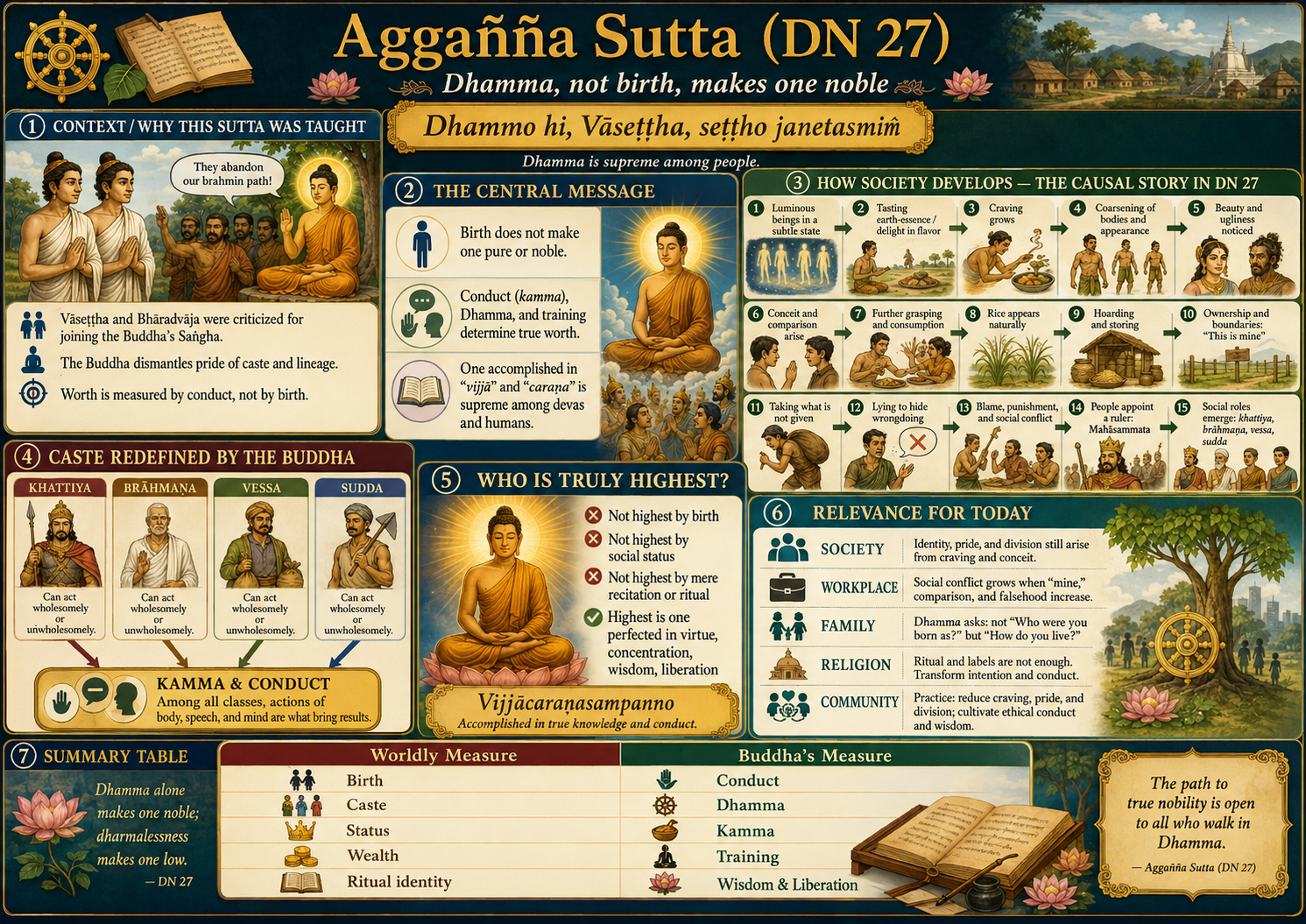
 VISUAL SUMMARYSee this sutta in a pictureOpen the complete infographic for a visual overview before or after reading the full study.View infographic →
The Aggañña Sutta (DN 27) dismantles the idea that human worth is determined by birth, caste, lineage, profession, social status or religious identity. When Vāseṭṭha and Bhāradvāja are criticized for leaving their brahmin background to join the Buddha’s Saṅgha, the Buddha points out that wholesome and unwholesome conduct can be found among all social groups. What makes a person noble is therefore not inherited identity, but Dhamma and conduct.
The discourse repeatedly returns to the refrain Dhammo hi, Vāseṭṭha, seṭṭho janetasmiṁ — “Dhamma is supreme among people.” It then goes much deeper by showing how pleasantness, craving, repeated consumption, comparison, conceit, accumulation, ownership, boundaries, theft, deception, punishment, political authority and social classifications arise conditionally.
DN 27 therefore becomes much more than an ancient account of human origins. It is a teaching on how an untrained citta constructs identity, hierarchy and social systems. Even religious status offers no exemption: khattiya, brāhmaṇa, vessa, sudda and samaṇa remain subject to the consequences of their own body, speech, mind and view.
The Buddha’s final measurement is not “What were you born as?”, “What position do you hold?”, or “How learned are you?” It is what has actually been developed. Ultimately, the one accomplished in vijjā and caraṇa — true knowledge and conduct — is supreme among devas and humans.
The central argument of DN 27
The discourse begins with Vāseṭṭha and Bhāradvāja being insulted for leaving the prestige of brahmin birth to join the Buddha’s Saṅgha. The Buddha answers by dismantling inherited superiority and repeatedly returns to one criterion:
The discourse then goes much further. It narrates how craving, imitation, comparison, conceit, accumulation, ownership, theft, punishment, political authority and occupational identities develop—and finally shows that none of those identities protects anyone from kamma or grants liberation. What matters is what is developed through body, speech and mind.
DN 27 — the entire teaching architecture
| Movement | Key idea | What happens | Teaching significance |
|---|---|---|---|
| Opening challenge | Brahmin birth-superiority claim | Buddha tests it against observable birth and conduct | Human worth cannot be secured by biological/divine status. |
| Four classes | Khattiya, brāhmaṇa, vessa, sudda | All four can display the same ten akusala or ten kusala pathways | No class has immunity from akusala or monopoly on kusala. |
| Central refrain | Dhammo hi … seṭṭho janetasmiṁ | Dhamma is supreme among people | Dhamma, not inherited position, is the real measure. |
| Beginning of decline | assāda → taṇhā | Pleasant experience is repeatedly appropriated | The first deterioration begins in citta. |
| Comparison | vaṇṇātimāna | Appearance becomes a basis for superiority/inferiority | Difference becomes hierarchy through māna. |
| Accumulation | sannidhi | Storage grows from convenience into accumulation | Abundance becomes bounded and managed. |
| Ownership | mariyādā | Rice is divided and boundaries established | Mine/yours becomes institutionalized. |
| Social pathology | adinnādāna → musāvāda → daṇḍādāna | Theft, lying, blame and coercion appear | One akusala condition feeds another. |
| Political authority | Mahāsammata / rājā | A ruler is appointed by social agreement to adjudicate disorder | Authority arises as a function, not as divine birth. |
| Religious status | jhāyanti → ganthe karontā | Those unable to accomplish jhāna turn to compiling texts; later this becomes prestigious | Textual status must not replace direct bhāvanā. |
| Final criterion | sucarita / duccarita / bodhipakkhiya bhāvanā | Results follow conduct across all social and religious identities | Liberation is developed, not inherited. |
| Highest measure | vijjācaraṇasampanno | Accomplished in true knowledge and conduct | This, not lineage, is supreme among devas and humans. |
The social-psychological flow in one line
Interpretive boundary for this study
DN 27 itself presents a cosmogonic and social-origin narrative. The supplied study deliberately reads that narrative as a practical map of craving, comparison, accumulation, ownership and identity. That psychological/social reading is valuable for practice, but it should not be presented as modern scientific anthropology or as a separate canonical dependent-origination formula.
Likewise, the discussion of jhāyanti → ganthe karontā is preserved as part of the supplied teaching. It can warn against substituting status or textual identity for bhāvanā, but it should not be generalized into a dismissal of textual learning itself.
01Opening — 10 Pāḷi–translation units
Evaṁ me sutaṁ—ekaṁ samayaṁ bhagavā sāvatthiyaṁ viharati pubbārāme migāramātupāsāde.
Thus have I heard. On one occasion the Blessed One was staying at Sāvatthī, in the Eastern Park, at the mansion of Migāra’s mother.
Tena kho pana samayena vāseṭṭhabhāradvājā bhikkhūsu parivasanti bhikkhubhāvaṁ ākaṅkhamānā. Atha kho bhagavā sāyanhasamayaṁ paṭisallānā vuṭṭhito pāsādā orohitvā pāsādapacchāyāyaṁ abbhokāse caṅkamati.
At that time Vāseṭṭha and Bhāradvāja were living among the bhikkhus, aspiring to become bhikkhus themselves.
Then, in the evening, the Blessed One emerged from seclusion, came down from the mansion, and walked back and forth in the open air in the shade of the building.
Addasā kho vāseṭṭho bhagavantaṁ sāyanhasamayaṁ paṭisallānā vuṭṭhitaṁ pāsādā orohitvā pāsādapacchāyāyaṁ abbhokāse caṅkamantaṁ. Disvāna bhāradvājaṁ āmantesi: “ayaṁ, āvuso bhāradvāja, bhagavā sāyanhasamayaṁ paṭisallānā vuṭṭhito pāsādā orohitvā pāsādapacchāyāyaṁ abbhokāse caṅkamati. Āyāmāvuso bhāradvāja, yena bhagavā tenupasaṅkamissāma; appeva nāma labheyyāma bhagavato santikā dhammiṁ kathaṁ savanāyā”ti.
Vāseṭṭha saw the Blessed One walking in the open air after emerging from evening seclusion. Seeing him, he said to Bhāradvāja:
“Friend Bhāradvāja, the Blessed One has emerged from seclusion and is walking in the open air. Come, friend, let us approach him. Perhaps we may have the opportunity to hear a Dhamma teaching directly from the Blessed One.”
“Evamāvuso”ti kho bhāradvājo vāseṭṭhassa paccassosi.
“Yes, friend,” Bhāradvāja replied to Vāseṭṭha.
Atha kho vāseṭṭhabhāradvājā yena bhagavā tenupasaṅkamiṁsu; upasaṅkamitvā bhagavantaṁ abhivādetvā bhagavantaṁ caṅkamantaṁ anucaṅkamiṁsu.
Then Vāseṭṭha and Bhāradvāja approached the Blessed One. After paying homage to him, they walked back and forth alongside him.
Atha kho bhagavā vāseṭṭhaṁ āmantesi: “tumhe khvattha, vāseṭṭha, brāhmaṇajaccā brāhmaṇakulīnā brāhmaṇakulā agārasmā anagāriyaṁ pabbajitā, kacci vo, vāseṭṭha, brāhmaṇā na akkosanti na paribhāsantī”ti?
The Blessed One addressed Vāseṭṭha:
“Vāseṭṭha, you were born as brahmins, born into brahmin families, and have gone forth from the household life into homelessness. Do the brahmins abuse and insult you because of this?”
“Taggha no, bhante, brāhmaṇā akkosanti paribhāsanti attarūpāya paribhāsāya paripuṇṇāya, no aparipuṇṇāyā”ti.
“Indeed, Bhante, the brahmins abuse and insult us—with a thoroughly complete measure of abuse, not an incomplete one.”
“Yathā kathaṁ pana vo, vāseṭṭha, brāhmaṇā akkosanti paribhāsanti attarūpāya paribhāsāya paripuṇṇāya, no aparipuṇṇāyā”ti?
“But Vāseṭṭha, in exactly what way do the brahmins abuse and insult you so completely?”
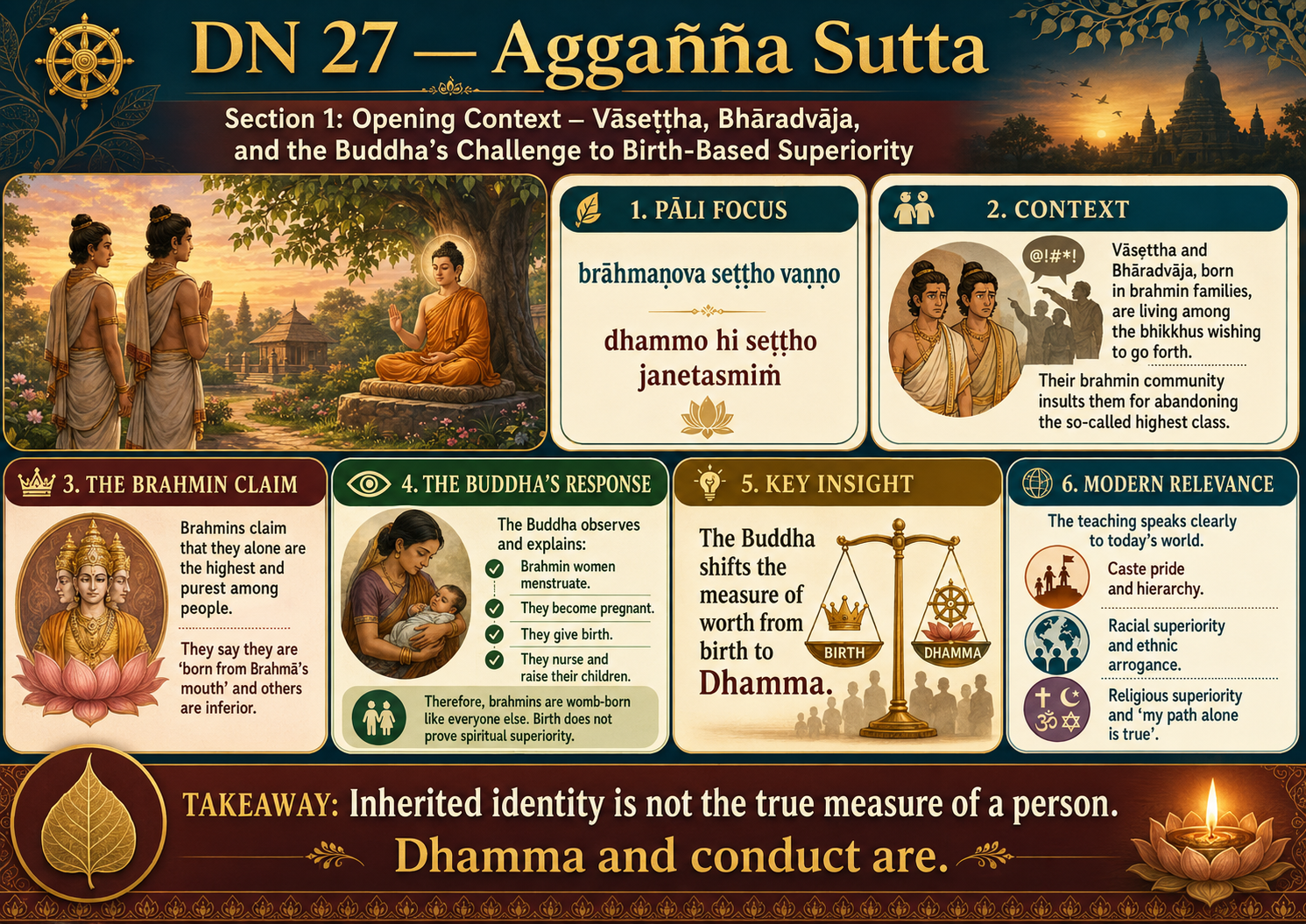
“Brāhmaṇā, bhante, evamāhaṁsu: ‘brāhmaṇova seṭṭho vaṇṇo, hīnā aññe vaṇṇā. Brāhmaṇova sukko vaṇṇo, kaṇhā aññe vaṇṇā. Brāhmaṇāva sujjhanti, no abrāhmaṇā. Brāhmaṇāva brahmuno puttā orasā mukhato jātā brahmajā brahmanimmitā brahmadāyādā. Te tumhe seṭṭhaṁ vaṇṇaṁ hitvā hīnamattha vaṇṇaṁ ajjhupagatā, yadidaṁ muṇḍake samaṇake ibbhe kaṇhe bandhupādāpacce. Tayidaṁ na sādhu, tayidaṁ nappatirūpaṁ, yaṁ tumhe seṭṭhaṁ vaṇṇaṁ hitvā hīnamattha vaṇṇaṁ ajjhupagatā yadidaṁ muṇḍake samaṇake ibbhe kaṇhe bandhupādāpacce’ti. Evaṁ kho no, bhante, brāhmaṇā akkosanti paribhāsanti attarūpāya paribhāsāya paripuṇṇāya, no aparipuṇṇāyā”ti.
“Bhante, the brahmins say:
‘The brahmin class alone is the highest; the other classes are inferior.
Brahmins alone are fair; the others are dark.
Brahmins alone are purified, not non-brahmins.
Brahmins alone are Brahmā’s true sons, born from his mouth, born of Brahmā, created by Brahmā, heirs of Brahmā.
Yet you have abandoned the highest class and joined an inferior class—these shaven-headed ascetics, these common, dark descendants of Brahmā’s feet.
That is not good; it is improper that you have abandoned the superior class and joined this inferior class.’
Bhante, that is how the brahmins thoroughly abuse and insult us.”
“Taggha vo, vāseṭṭha, brāhmaṇā porāṇaṁ assarantā evamāhaṁsu: ‘brāhmaṇova seṭṭho vaṇṇo, hīnā aññe vaṇṇā; brāhmaṇova sukko vaṇṇo, kaṇhā aññe vaṇṇā; brāhmaṇāva sujjhanti, no abrāhmaṇā; brāhmaṇāva brahmuno puttā orasā mukhato jātā brahmajā brahmanimmitā brahmadāyādā’ti. Dissanti kho pana, vāseṭṭha, brāhmaṇānaṁ brāhmaṇiyo utuniyopi gabbhiniyopi vijāyamānāpi pāyamānāpi. Te ca brāhmaṇā yonijāva samānā evamāhaṁsu: ‘brāhmaṇova seṭṭho vaṇṇo … brahmadāyādā’ti. Te brahmānañceva abbhācikkhanti, musā ca bhāsanti, bahuñca apuññaṁ pasavanti.”
“Indeed, Vāseṭṭha, the brahmins speak in that way because they have forgotten their own ancient origins.
They say:
‘The brahmin class alone is the highest; other classes are inferior. Brahmins alone are fair; the others are dark. Brahmins alone are purified, not non-brahmins. Brahmins alone are Brahmā’s true sons, born from his mouth, created by Brahmā, heirs of Brahmā.’
Yet brahmin women can plainly be seen menstruating, becoming pregnant, giving birth, and nursing their children.
Although brahmins themselves are womb-born, they nevertheless make these claims.
In doing so, they misrepresent Brahmā, speak falsely, and generate much demerit.”
021. Catuvaṇṇasuddhi — Purity among the Four Classes — 7 Pāḷi–translation units
Cattārome, vāseṭṭha, vaṇṇā—khattiyā, brāhmaṇā, vessā, suddā.
“Vāseṭṭha, there are these four classes:
khattiyas, brahmins, vessas, and suddas.
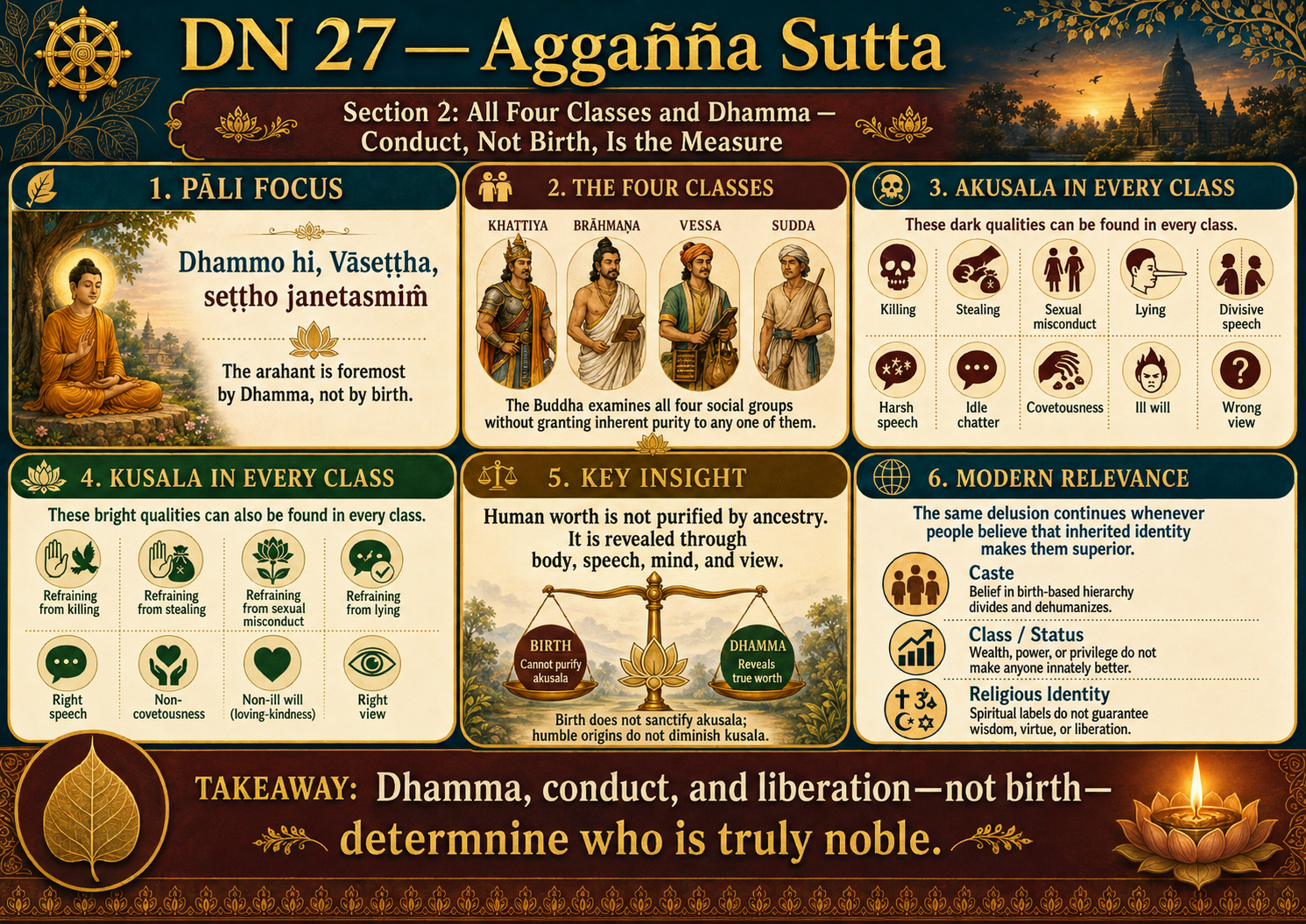
Khattiyopi kho, vāseṭṭha, idhekacco pāṇātipātī hoti adinnādāyī kāmesumicchācārī musāvādī pisuṇavāco pharusavāco samphappalāpī abhijjhālu byāpannacitto micchādiṭṭhī. Iti kho, vāseṭṭha, yeme dhammā akusalā akusalasaṅkhātā sāvajjā sāvajjasaṅkhātā asevitabbā asevitabbasaṅkhātā naalamariyā naalamariyasaṅkhātā kaṇhā kaṇhavipākā viññugarahitā, khattiyepi te idhekacce sandissanti. Brāhmaṇopi kho, vāseṭṭha …pe… vessopi kho, vāseṭṭha …pe… suddopi kho, vāseṭṭha, idhekacco pāṇātipātī hoti adinnādāyī kāmesumicchācārī musāvādī pisuṇavāco pharusavāco samphappalāpī abhijjhālu byāpannacitto micchādiṭṭhī. Iti kho … suddepi te idhekacce sandissanti.
Canonical peyyāla note. The supplied Pāli contracts the brahmin and vessa repetitions with …pe…. Their English sense is included immediately below without inventing unsupplied Pāli wording.
“A khattiya may be one who:
kills living beings,
takes what has not been given,
engages in sexual misconduct,
speaks falsely,
speaks divisively,
speaks harshly,
engages in useless chatter,
is covetous,
possesses a mind of ill will,
and holds wrong view.
These qualities are:
unwholesome,
reckoned as unwholesome,
blameworthy,
not to be cultivated,
unworthy of the noble,
dark,
productive of dark results,
and censured by the wise.
Such qualities are found among some khattiyas.
The same kinds of unwholesome qualities are also found among some brahmins, some vessas, and some suddas.”
Khattiyopi kho, vāseṭṭha, idhekacco pāṇātipātā paṭivirato hoti, adinnādānā paṭivirato, kāmesumicchācārā paṭivirato, musāvādā paṭivirato, pisuṇāya vācāya paṭivirato, pharusāya vācāya paṭivirato, samphappalāpā paṭivirato, anabhijjhālu abyāpannacitto, sammādiṭṭhī. Iti kho, vāseṭṭha, yeme dhammā kusalā kusalasaṅkhātā anavajjā anavajjasaṅkhātā sevitabbā sevitabbasaṅkhātā alamariyā alamariyasaṅkhātā sukkā sukkavipākā viññuppasatthā, khattiyepi te idhekacce sandissanti. Brāhmaṇopi kho, vāseṭṭha …pe… vessopi kho, vāseṭṭha …pe… suddopi kho, vāseṭṭha, idhekacco pāṇātipātā paṭivirato hoti …pe… anabhijjhālu, abyāpannacitto, sammādiṭṭhī. Iti kho … suddepi te idhekacce sandissanti.
Canonical peyyāla note. Again, the supplied Pāli contracts the repeated class-by-class wording. The English gives the repeated sense while leaving the Pāli exactly as supplied.
“Likewise, a khattiya may:
abstain from killing,
abstain from taking what has not been given,
abstain from sexual misconduct,
abstain from false speech,
abstain from divisive speech,
abstain from harsh speech,
abstain from useless chatter,
be free from covetousness,
possess a mind free from ill will,
and hold right view.
These qualities are:
wholesome,
reckoned as wholesome,
blameless,
worthy of cultivation,
fit for the noble,
bright,
productive of bright results,
and praised by the wise.
Such qualities are found among some khattiyas.
The same kinds of wholesome qualities are found among some brahmins, some vessas, and some suddas.”
Imesu kho, vāseṭṭha, catūsu vaṇṇesu evaṁ ubhayavokiṇṇesu vattamānesu kaṇhasukkesu dhammesu viññugarahitesu ceva viññuppasatthesu ca yadettha brāhmaṇā evamāhaṁsu: ‘brāhmaṇova seṭṭho vaṇṇo, hīnā aññe vaṇṇā; brāhmaṇova sukko vaṇṇo, kaṇhā aññe vaṇṇā; brāhmaṇāva sujjhanti, no abrāhmaṇā; brāhmaṇāva brahmuno puttā orasā mukhato jātā brahmajā brahmanimmitā brahmadāyādā’ti.
“Since both kinds of qualities—dark and bright, censured and praised by the wise—are found mixed among all four classes, the brahmins’ claim that only they are highest, pure, and heirs of Brahmā cannot be maintained.”
Taṁ tesaṁ viññū nānujānanti. Taṁ kissa hetu? Imesañhi, vāseṭṭha, catunnaṁ vaṇṇānaṁ yo hoti bhikkhu arahaṁ khīṇāsavo vusitavā katakaraṇīyo ohitabhāro anuppattasadattho parikkhīṇabhavasaṁyojano sammadaññāvimutto, so nesaṁ aggamakkhāyati dhammeneva, no adhammena. Dhammo hi, vāseṭṭha, seṭṭho janetasmiṁ, diṭṭhe ceva dhamme abhisamparāyañca.
“The wise do not approve of that claim.
Why?
Because from any of these four classes, a bhikkhu may become an arahant—one whose āsavas are destroyed, who has lived the holy life, done what had to be done, laid down the burden, reached the true goal, completely exhausted the fetters of becoming, and been rightly liberated through direct knowledge.
Such a person is declared the foremost among them through Dhamma, not through adhamma.
For, Vāseṭṭha:
Dhammo hi … seṭṭho janetasmiṁ Dhamma is supreme among people,
both in this present life and in what follows.”
This becomes the refrain of the entire discourse.
Tadamināpetaṁ, vāseṭṭha, pariyāyena veditabbaṁ, yathā dhammova seṭṭho janetasmiṁ, diṭṭhe ceva dhamme abhisamparāyañca.
“This should also be understood from the following example:
Dhamma itself is supreme among people, both in this present life and in what follows.”
Jānāti kho, vāseṭṭha, rājā pasenadi kosalo: ‘samaṇo gotamo anantarā sakyakulā pabbajito’ti. Sakyā kho pana, vāseṭṭha, rañño pasenadissa kosalassa anuyuttā bhavanti. Karonti kho, vāseṭṭha, sakyā raññe pasenadimhi kosale nipaccakāraṁ abhivādanaṁ paccuṭṭhānaṁ añjalikammaṁ sāmīcikammaṁ. Iti kho, vāseṭṭha, yaṁ karonti sakyā raññe pasenadimhi kosale nipaccakāraṁ abhivādanaṁ paccuṭṭhānaṁ añjalikammaṁ sāmīcikammaṁ, karoti taṁ rājā pasenadi kosalo tathāgate nipaccakāraṁ abhivādanaṁ paccuṭṭhānaṁ añjalikammaṁ sāmīcikammaṁ, na naṁ ‘sujāto samaṇo gotamo, dujjātohamasmi. Balavā samaṇo gotamo, dubbalohamasmi. Pāsādiko samaṇo gotamo, dubbaṇṇohamasmi. Mahesakkho samaṇo gotamo, appesakkhohamasmī’ti. Atha kho naṁ dhammaṁyeva sakkaronto dhammaṁ garuṁ karonto dhammaṁ mānento dhammaṁ pūjento dhammaṁ apacāyamāno evaṁ rājā pasenadi kosalo tathāgate nipaccakāraṁ karoti, abhivādanaṁ paccuṭṭhānaṁ añjalikammaṁ sāmīcikammaṁ. Imināpi kho etaṁ, vāseṭṭha, pariyāyena veditabbaṁ, yathā dhammova seṭṭho janetasmiṁ, diṭṭhe ceva dhamme abhisamparāyañca.
“King Pasenadi of Kosala knows:
‘The ascetic Gotama has gone forth from the Sakyan clan.’
The Sakyans are subjects of King Pasenadi. They show him:
respect,
salutation,
rising from the seat,
reverential salutation with joined palms,
and proper courtesy.
Yet King Pasenadi offers those very same forms of respect to the Tathāgata.
He does not do so thinking:
‘The ascetic Gotama is better-born and I am badly born;
Gotama is strong and I am weak;
Gotama is handsome and I am unattractive;
Gotama is powerful and I am insignificant.’
Rather, King Pasenadi honors, respects, esteems, venerates, and pays homage to the Tathāgata because he honors Dhamma.
By this too it should be understood:
Dhamma is supreme among people, both in this life and in what follows.”
03The World Contracts and Expands — 2 Pāḷi–translation units
Tumhe khvattha, vāseṭṭha, nānājaccā nānānāmā nānāgottā nānākulā agārasmā anagāriyaṁ pabbajitā. ‘Ke tumhe’ti—puṭṭhā samānā ‘samaṇā sakyaputtiyāmhā’ti—paṭijānātha. Yassa kho panassa, vāseṭṭha, tathāgate saddhā niviṭṭhā mūlajātā patiṭṭhitā daḷhā asaṁhāriyā samaṇena vā brāhmaṇena vā devena vā mārena vā brahmunā vā kenaci vā lokasmiṁ, tassetaṁ kallaṁ vacanāya: ‘bhagavatomhi putto oraso mukhato jāto dhammajo dhammanimmito dhammadāyādo’ti. Taṁ kissa hetu? Tathāgatassa hetaṁ, vāseṭṭha, adhivacanaṁ ‘dhammakāyo’ itipi, ‘brahmakāyo’ itipi, ‘dhammabhūto’ itipi, ‘brahmabhūto’ itipi.
“Vāseṭṭha, you have different births, names, clans, and families, yet you have gone forth from home into homelessness.
When asked, ‘Who are you?’ you declare:
‘We are ascetics, sons of the Sakyan.’
For someone whose confidence in the Tathāgata is deeply planted, rooted, established, firm, and unshakeable by any ascetic, brahmin, deva, Māra, Brahmā, or anyone else in the world, it is proper to say:
‘I am a true son of the Blessed One, born of his mouth, born of Dhamma, fashioned by Dhamma, an heir to Dhamma.’
Why?
Because the Tathāgata is designated:
Dhammakāyo — the embodiment/body of Dhamma,
Brahmakāyo,
Dhammabhūto — become Dhamma,
Brahmabhūto.”
Hoti kho so, vāseṭṭha, samayo yaṁ kadāci karahaci dīghassa addhuno accayena ayaṁ loko saṁvaṭṭati. Saṁvaṭṭamāne loke yebhuyyena sattā ābhassarasaṁvattanikā honti. Te tattha honti manomayā pītibhakkhā sayaṁpabhā antalikkhacarā subhaṭṭhāyino ciraṁ dīghamaddhānaṁ tiṭṭhanti.
“There comes a time, Vāseṭṭha, after a very long period, when this world contracts.
When the world contracts, beings mostly arise in the Ābhassara realm.
There they are:
mind-made,
feeding on rapture,
self-luminous,
moving through the sky,
beautiful,
and they remain there for a very long time.”
042. Rasapathavipātubhāva — Appearance of the Savoury Earth — 1 Pāḷi–translation units
Hoti kho so, vāseṭṭha, samayo yaṁ kadāci karahaci dīghassa addhuno accayena ayaṁ loko vivaṭṭati. Vivaṭṭamāne loke yebhuyyena sattā ābhassarakāyā cavitvā itthattaṁ āgacchanti. Tedha honti manomayā pītibhakkhā sayaṁpabhā antalikkhacarā subhaṭṭhāyino ciraṁ dīghamaddhānaṁ tiṭṭhanti.
“There also comes a time, Vāseṭṭha, after a very long period, when this world expands again.
As it expands, beings mostly pass away from the Ābhassara realm and come here.
Here too, initially, they are:
mind-made,
feeding on rapture,
self-luminous,
moving through the sky,
beautiful,
and remain for a long period.”
053. Candimasūriyādipātubhāva — Appearance of the Sun and Moon — 2 Pāḷi–translation units
Ekodakībhūtaṁ kho pana, vāseṭṭha, tena samayena hoti andhakāro andhakāratimisā. Na candimasūriyā paññāyanti, na nakkhattāni tārakarūpāni paññāyanti, na rattindivā paññāyanti, na māsaḍḍhamāsā paññāyanti, na utusaṁvaccharā paññāyanti, na itthipumā paññāyanti, sattā sattātveva saṅkhyaṁ gacchanti. Atha kho tesaṁ, vāseṭṭha, sattānaṁ kadāci karahaci dīghassa addhuno accayena rasapathavī udakasmiṁ samatani; seyyathāpi nāma payaso tattassa nibbāyamānassa upari santānakaṁ hoti; evameva pāturahosi. Sā ahosi vaṇṇasampannā gandhasampannā rasasampannā, seyyathāpi nāma sampannaṁ vā sappi sampannaṁ vā navanītaṁ evaṁvaṇṇā ahosi. Seyyathāpi nāma khuddamadhuṁ aneḷakaṁ; evamassādā ahosi.
“At that time everything is a single mass of water, enveloped in darkness and deep darkness.
The moon and sun are not discernible.
Stars and constellations are not discernible.
Night and day are not discernible.
Months and fortnights are not discernible.
Seasons and years are not discernible.
Female and male are not discernible.
Beings are simply reckoned as beings.
After a very long time, a rasapathavī—a savoury earth—spreads over the water, like the film that forms over hot milk as it cools.
It possesses:
excellent color,
excellent fragrance,
and excellent flavor.
Its appearance is like fine ghee or fine butter, and its taste is like pure honey.”
Atha kho, vāseṭṭha, aññataro satto lolajātiko: ‘ambho, kimevidaṁ bhavissatī’ti rasapathaviṁ aṅguliyā sāyi. Tassa rasapathaviṁ aṅguliyā sāyato acchādesi, taṇhā cassa okkami. Aññepi kho, vāseṭṭha, sattā tassa sattassa diṭṭhānugatiṁ āpajjamānā rasapathaviṁ aṅguliyā sāyiṁsu. Tesaṁ rasapathaviṁ aṅguliyā sāyataṁ acchādesi, taṇhā ca tesaṁ okkami.
“Then one being, inclined toward greediness or eager curiosity, thought:
‘What might this be?’
He tasted the savoury earth with his finger.
It pleased him.
Then:
taṇhā cassa okkami craving entered him.
Other beings followed what they had seen him do.
They too tasted the savoury earth with their fingers.
It pleased them, and craving entered them as well.”
064. Bhūmipappaṭakapātubhāva — Appearance of the Earth-Crust — 2 Pāḷi–translation units
Atha kho te, vāseṭṭha, sattā rasapathaviṁ hatthehi āluppakārakaṁ upakkamiṁsu paribhuñjituṁ. Yato kho te, vāseṭṭha, sattā rasapathaviṁ hatthehi āluppakārakaṁ upakkamiṁsu paribhuñjituṁ. Atha tesaṁ sattānaṁ sayaṁpabhā antaradhāyi. Sayaṁpabhāya antarahitāya candimasūriyā pāturahesuṁ. Candimasūriyesu pātubhūtesu nakkhattāni tārakarūpāni pāturahesuṁ. Nakkhattesu tārakarūpesu pātubhūtesu rattindivā paññāyiṁsu. Rattindivesu paññāyamānesu māsaḍḍhamāsā paññāyiṁsu. Māsaḍḍhamāsesu paññāyamānesu utusaṁvaccharā paññāyiṁsu. Ettāvatā kho, vāseṭṭha, ayaṁ loko puna vivaṭṭo hoti.
“Then the beings began consuming the savoury earth in handfuls.
When they began doing this, their self-radiance disappeared.
With the disappearance of their radiance:
the moon and sun appeared,
then stars and constellations,
then night and day,
then months and fortnights,
then seasons and years.
To this extent the world unfolded again.”
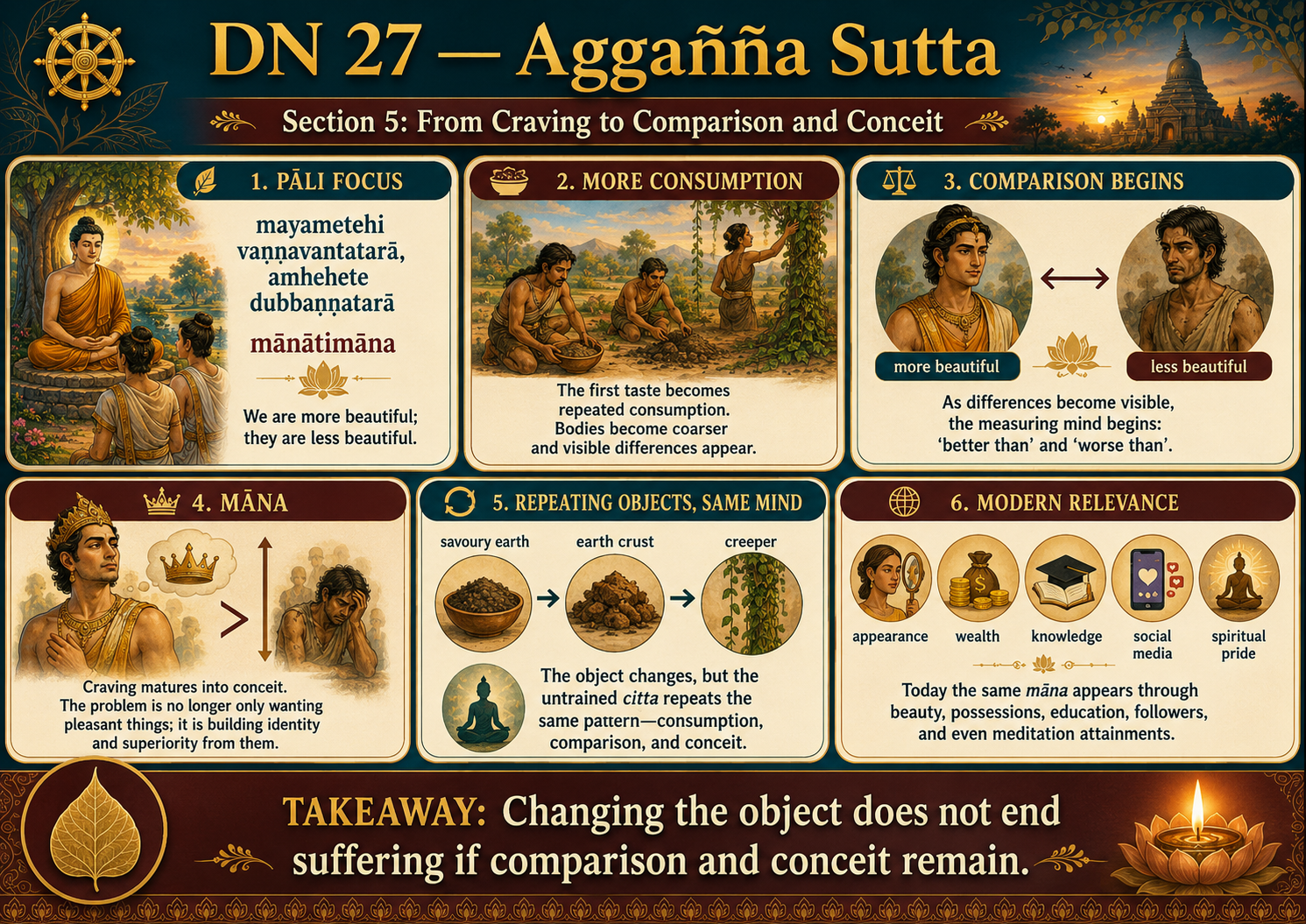
Atha kho te, vāseṭṭha, sattā rasapathaviṁ paribhuñjantā tambhakkhā tadāhārā ciraṁ dīghamaddhānaṁ aṭṭhaṁsu. Yathā yathā kho te, vāseṭṭha, sattā rasapathaviṁ paribhuñjantā tambhakkhā tadāhārā ciraṁ dīghamaddhānaṁ aṭṭhaṁsu tathā tathā tesaṁ sattānaṁ rasapathaviṁ paribhuñjantānaṁ kharattañceva kāyasmiṁ okkami, vaṇṇavevaṇṇatā ca paññāyittha. Ekidaṁ sattā vaṇṇavanto honti, ekidaṁ sattā dubbaṇṇā. Tattha ye te sattā vaṇṇavanto, te dubbaṇṇe satte atimaññanti: ‘mayametehi vaṇṇavantatarā, amhehete dubbaṇṇatarā’ti. Tesaṁ vaṇṇātimānapaccayā mānātimānajātikānaṁ rasapathavī antaradhāyi. Rasāya pathaviyā antarahitāya sannipatiṁsu. Sannipatitvā anutthuniṁsu: ‘aho rasaṁ, aho rasan’ti.
“They lived for a very long time feeding on the savoury earth.
As they continued consuming it, their bodies became increasingly coarse and differences in appearance became visible.
Some beings were attractive; others were less attractive.
Those considered attractive looked down upon those considered unattractive, thinking:
‘We are more beautiful than they are; they are uglier than us.’
Because of this conceit concerning appearance, the savoury earth disappeared.
When it disappeared, the beings gathered and lamented:
‘Oh, the flavor! Oh, the flavor!’”
075. Padālatāpātubhāva — Appearance of Creeping Plants — 3 Pāḷi–translation units
Atha kho tesaṁ, vāseṭṭha, sattānaṁ rasāya pathaviyā antarahitāya bhūmipappaṭako pāturahosi. Seyyathāpi nāma ahicchattako; evameva pāturahosi. So ahosi vaṇṇasampanno gandhasampanno rasasampanno, seyyathāpi nāma sampannaṁ vā sappi sampannaṁ vā navanītaṁ evaṁvaṇṇo ahosi. Seyyathāpi nāma khuddamadhuṁ aneḷakaṁ; evamassādo ahosi.
“When the savoury earth disappeared, an earth-crust appeared, somewhat like a mushroom.
It too possessed excellent color, fragrance, and taste.
Its appearance was like fine ghee or butter, and its taste like pure honey.”
Atha kho te, vāseṭṭha, sattā bhūmipappaṭakaṁ upakkamiṁsu paribhuñjituṁ. Te taṁ paribhuñjantā tambhakkhā tadāhārā ciraṁ dīghamaddhānaṁ aṭṭhaṁsu. Yathā yathā kho te … bhiyyoso mattāya kharattañceva kāyasmiṁ okkami, vaṇṇavevaṇṇatā ca paññāyittha. Ekidaṁ sattā vaṇṇavanto honti, ekidaṁ sattā dubbaṇṇā. Tattha ye te sattā vaṇṇavanto, te dubbaṇṇe satte atimaññanti: ‘mayametehi vaṇṇavantatarā, amhehete dubbaṇṇatarā’ti. Tesaṁ vaṇṇātimānapaccayā mānātimānajātikānaṁ bhūmipappaṭako antaradhāyi.
Canonical peyyāla note. The supplied Pāli abbreviates part of the repeated sentence with …. The English below gives the repeated sense without manufacturing missing Pāli.
“The beings began consuming the earth-crust and continued doing so for a long time.
Their bodies became still coarser, and differences in appearance became more pronounced.
Again some were attractive and others less attractive.
Again those considered attractive looked down upon those considered less attractive, thinking:
‘We are more beautiful; they are uglier.’
Because of this conceit regarding appearance, the earth-crust disappeared.”
Bhūmipappaṭake antarahite padālatā pāturahosi, seyyathāpi nāma kalambukā; evameva pāturahosi. Sā ahosi vaṇṇasampannā gandhasampannā rasasampannā, seyyathāpi nāma sampannaṁ vā sappi sampannaṁ vā navanītaṁ evaṁvaṇṇā ahosi. Seyyathāpi nāma khuddamadhuṁ aneḷakaṁ; evamassādā ahosi.
“When the earth-crust disappeared, creeping plants appeared.
They too had excellent color, fragrance, and flavor, comparable to fine ghee or butter and sweet like pure honey.”
086. Akaṭṭhapākasālipātubhāva — Appearance of Naturally Growing Rice — 1 Pāḷi–translation units
Atha kho te, vāseṭṭha, sattā padālataṁ upakkamiṁsu paribhuñjituṁ. Te taṁ paribhuñjantā tambhakkhā tadāhārā ciraṁ dīghamaddhānaṁ aṭṭhaṁsu. Yathā yathā kho te … bhiyyoso mattāya kharattañceva kāyasmiṁ okkami, vaṇṇavevaṇṇatā ca paññāyittha. Ekidaṁ sattā vaṇṇavanto honti, ekidaṁ sattā dubbaṇṇā. Tattha ye te sattā vaṇṇavanto, te dubbaṇṇe satte atimaññanti: ‘mayametehi vaṇṇavantatarā, amhehete dubbaṇṇatarā’ti. Tesaṁ vaṇṇātimānapaccayā mānātimānajātikānaṁ padālatā antaradhāyi.
Canonical peyyāla note. The repeated internal wording is abbreviated in the supplied Pāli.
“The beings began consuming the creeping plants and lived on them for a long time.
Again their bodies became coarser.
Again differences in appearance became evident.
Again the attractive looked down upon the unattractive.
Because of this conceit, the creeping plants disappeared.”
097. Itthipurisaliṅgapātubhāva — Appearance of Female and Male Characteristics — 2 Pāḷi–translation units
Padālatāya antarahitāya sannipatiṁsu. Sannipatitvā anutthuniṁsu: ‘ahu vata no, ahāyi vata no padālatā’ti. Tadetarahipi manussā kenaci dukkhadhammena phuṭṭhā evamāhaṁsu: ‘ahu vata no, ahāyi vata no’ti. Tadeva porāṇaṁ aggaññaṁ akkharaṁ anusaranti, na tvevassa atthaṁ ājānanti.
“When the creeping plants disappeared, the beings gathered and lamented:
‘We once had them! Alas, they have vanished from us!’
Even in later times, when people encounter painful circumstances and say:
‘We once had it; now we have lost it,’
they repeat an ancient expression without knowing its original meaning.”
Atha kho tesaṁ, vāseṭṭha, sattānaṁ padālatāya antarahitāya akaṭṭhapāko sāli pāturahosi akaṇo athuso suddho sugandho taṇḍulapphalo. Yaṁ taṁ sāyaṁ sāyamāsāya āharanti, pāto taṁ hoti pakkaṁ paṭivirūḷhaṁ. Yaṁ taṁ pāto pātarāsāya āharanti, sāyaṁ taṁ hoti pakkaṁ paṭivirūḷhaṁ; nāpadānaṁ paññāyati. Atha kho te, vāseṭṭha, sattā akaṭṭhapākaṁ sāliṁ paribhuñjantā tambhakkhā tadāhārā ciraṁ dīghamaddhānaṁ aṭṭhaṁsu.
“When the creeping plants disappeared, uncultivated rice appeared.
It had:
no husk,
no bran,
pure and fragrant grain.
When rice was collected in the evening for supper, by morning it had ripened and grown back.
When it was collected in the morning for breakfast, by evening it had ripened and grown back.
No sign of harvesting remained.
The beings lived for a long time feeding on this naturally growing rice.”
108. Methunadhammasamācāra — Sexual Relations, Houses and Accumulation — 5 Pāḷi–translation units
Yathā yathā kho te, vāseṭṭha, sattā akaṭṭhapākaṁ sāliṁ paribhuñjantā tambhakkhā tadāhārā ciraṁ dīghamaddhānaṁ aṭṭhaṁsu tathā tathā tesaṁ sattānaṁ bhiyyoso mattāya kharattañceva kāyasmiṁ okkami, vaṇṇavevaṇṇatā ca paññāyittha, itthiyā ca itthiliṅgaṁ pāturahosi purisassa ca purisaliṅgaṁ. Itthī ca purisaṁ ativelaṁ upanijjhāyati puriso ca itthiṁ. Tesaṁ ativelaṁ aññamaññaṁ upanijjhāyataṁ sārāgo udapādi, pariḷāho kāyasmiṁ okkami. Te pariḷāhapaccayā methunaṁ dhammaṁ paṭiseviṁsu.
“As the beings continued consuming the naturally growing rice, their bodies became still coarser and differentiation increased.
Female characteristics appeared in females and male characteristics in males.
Women gazed excessively at men and men excessively at women.
Because they kept looking at one another in this way, intense passion arose and a burning entered the body.
Because of that burning, they engaged in sexual intercourse.”
Ye kho pana te, vāseṭṭha, tena samayena sattā passanti methunaṁ dhammaṁ paṭisevante, aññe paṁsuṁ khipanti, aññe seṭṭhiṁ khipanti, aññe gomayaṁ khipanti: ‘nassa asuci, nassa asucī’ti. ‘Kathañhi nāma satto sattassa evarūpaṁ karissatī’ti. Tadetarahipi manussā ekaccesu janapadesu vadhuyā nibbuyhamānāya aññe paṁsuṁ khipanti, aññe seṭṭhiṁ khipanti, aññe gomayaṁ khipanti. Tadeva porāṇaṁ aggaññaṁ akkharaṁ anusaranti, na tvevassa atthaṁ ājānanti.
“Those who saw others engaging in sexual intercourse threw dirt, ashes, or cow dung at them, saying:
‘Away with you, unclean one! How could one being do such a thing to another?’
Later customs in some regions preserve traces of these old practices when a bride is led away, although people no longer understand their original meaning.”
Adhammasammataṁ kho pana, vāseṭṭha, tena samayena hoti, tadetarahi dhammasammataṁ. Ye kho pana, vāseṭṭha, tena samayena sattā methunaṁ dhammaṁ paṭisevanti, te māsampi dvemāsampi na labhanti gāmaṁ vā nigamaṁ vā pavisituṁ. Yato kho te, vāseṭṭha, sattā tasmiṁ asaddhamme ativelaṁ pātabyataṁ āpajjiṁsu. Atha agārāni upakkamiṁsu kātuṁ tasseva asaddhammassa paṭicchādanatthaṁ. Atha kho, vāseṭṭha, aññatarassa sattassa alasajātikassa etadahosi: ‘ambho, kimevāhaṁ vihaññāmi sāliṁ āharanto sāyaṁ sāyamāsāya pāto pātarāsāya. Yannūnāhaṁ sāliṁ āhareyyaṁ sakideva sāyapātarāsāyā’ti.
“What was then regarded as improper later came to be regarded as acceptable.
Those who engaged in intercourse were initially excluded for a month or two from entering villages and towns.
As beings became increasingly given to the activity, they began building houses partly to conceal it.
Then a certain being, inclined toward laziness, thought:
‘Why should I trouble myself collecting rice every evening for supper and every morning for breakfast?
Why not gather enough at one time for both?’”
Atha kho so, vāseṭṭha, satto sāliṁ āhāsi sakideva sāyapātarāsāya. Atha kho, vāseṭṭha, aññataro satto yena so satto tenupasaṅkami; upasaṅkamitvā taṁ sattaṁ etadavoca: ‘ehi, bho satta, sālāhāraṁ gamissāmā’ti. ‘Alaṁ, bho satta, āhato me sāli sakideva sāyapātarāsāyā’ti. Atha kho so, vāseṭṭha, satto tassa sattassa diṭṭhānugatiṁ āpajjamāno sāliṁ āhāsi sakideva dvīhāya. ‘Evampi kira, bho, sādhū’ti.
“That being collected enough rice at one time for both evening and morning.
Another being approached and invited him to gather rice.
He replied:
‘No need, friend. I have already gathered enough rice for both meals.’
The other being followed what he had seen and collected enough rice for two days, thinking:
‘Apparently this too is a good idea.’”
Atha kho … sāliṁ āhāsi sakideva catūhāya, ‘evampi kira, bho, sādhū’ti. Atha kho … sāliṁ āhāsi sakideva aṭṭhāhāya, ‘evampi kira, bho, sādhū’ti.
Canonical peyyāla note. The supplied Pāli intentionally abbreviates the repeated imitation sequence. The English below gives the repeated sense.
“Another being, seeing rice stored for two days, stored enough for four days, thinking:
‘Apparently this too is good.’
Then another stored enough for eight days, following the same pattern of imitation.”
119. Sālivibhāga — Division of the Rice Fields — 4 Pāḷi–translation units
Yato kho te, vāseṭṭha, sattā sannidhikārakaṁ sāliṁ upakkamiṁsu paribhuñjituṁ. Atha kaṇopi taṇḍulaṁ pariyonandhi, thusopi taṇḍulaṁ pariyonandhi; lūnampi nappaṭivirūḷhaṁ, apadānaṁ paññāyittha, saṇḍasaṇḍā sālayo aṭṭhaṁsu.
“When the beings began storing up rice, husk and bran developed around the grains.
Once harvested, the rice no longer grew back automatically.
The marks of cutting became visible.
Rice grew only in separate clusters.”
Atha kho te, vāseṭṭha, sattā sannipatiṁsu, sannipatitvā anutthuniṁsu: ‘pāpakā vata, bho, dhammā sattesu pātubhūtā. Mayañhi pubbe manomayā ahumhā pītibhakkhā sayaṁpabhā antalikkhacarā subhaṭṭhāyino, ciraṁ dīghamaddhānaṁ aṭṭhamhā … Yannūna mayaṁ sāliṁ vibhajeyyāma, mariyādaṁ ṭhapeyyāmā’ti. Atha kho te, vāseṭṭha, sattā sāliṁ vibhajiṁsu, mariyādaṁ ṭhapesuṁ.
Canonical peyyāla note. The supplied Pāli condenses the long retrospective list with …; no absent Pāli has been manufactured.
“The beings gathered and lamented:
‘Bad, unwholesome qualities have arisen among beings.
They recalled their earlier condition and the successive disappearance of the savoury earth, earth-crust, creepers, and naturally renewing rice.
Then they said:
‘Why don’t we divide the rice and establish boundaries?’
So they divided the rice fields and established boundaries.”
Atha kho, vāseṭṭha, aññataro satto lolajātiko sakaṁ bhāgaṁ parirakkhanto aññataraṁ bhāgaṁ adinnaṁ ādiyitvā paribhuñji.
“Then a certain greedy being, while protecting his own share, took another person’s share without it being given and consumed it.”
Tamenaṁ aggahesuṁ, gahetvā etadavocuṁ: ‘pāpakaṁ vata, bho satta, karosi, yatra hi nāma sakaṁ bhāgaṁ parirakkhanto aññataraṁ bhāgaṁ adinnaṁ ādiyitvā paribhuñjasi. Māssu, bho satta, punapi evarūpamakāsī’ti. ‘Evaṁ, bho’ti kho, vāseṭṭha, so satto tesaṁ sattānaṁ paccassosi. Dutiyampi kho … tatiyampi kho … sakaṁ bhāgaṁ parirakkhanto aññataraṁ bhāgaṁ adinnaṁ ādiyitvā paribhuñji. Tamenaṁ aggahesuṁ … Aññe pāṇinā pahariṁsu, aññe leḍḍunā pahariṁsu, aññe daṇḍena pahariṁsu. Tadagge kho, vāseṭṭha, adinnādānaṁ paññāyati, garahā paññāyati, musāvādo paññāyati, daṇḍādānaṁ paññāyati.
Canonical peyyāla note. The supplied Pāli contracts the second and third theft cycles. The English preserves the sequence without inventing missing Pāli.
“They caught him and said:
‘What a bad thing you have done!
While guarding your own share, you took another person’s share without it being given.
Do not do such a thing again.’
He agreed.
But he repeated the act a second and a third time.
Again they caught him.
Some struck him with their hands, some with clods of earth, and some with sticks.
From that point onward there appeared:
adinnādāna — taking what is not given,
garahā — accusation or blame,
musāvāda — false speech,
daṇḍādāna — punishment or the taking up of force.”
1210. Mahāsammatarājā — The First Ruler — 6 Pāḷi–translation units
Atha kho te, vāseṭṭha, sattā sannipatiṁsu, sannipatitvā anutthuniṁsu: ‘pāpakā vata bho dhammā sattesu pātubhūtā, yatra hi nāma adinnādānaṁ paññāyissati, garahā paññāyissati, musāvādo paññāyissati, daṇḍādānaṁ paññāyissati. Yannūna mayaṁ ekaṁ sattaṁ sammanneyyāma, yo no sammā khīyitabbaṁ khīyeyya, sammā garahitabbaṁ garaheyya, sammā pabbājetabbaṁ pabbājeyya. Mayaṁ panassa sālīnaṁ bhāgaṁ anuppadassāmā’ti.
“The beings assembled again and said:
‘Bad qualities have arisen:
taking what is not given,
accusation,
false speech,
and punishment.
Why don’t we appoint one being who will:
properly censure whoever deserves censure,
properly condemn whoever deserves condemnation,
and properly banish whoever deserves banishment?
In return, we will give that person a portion of our rice.’”
Atha kho te, vāseṭṭha, sattā yo nesaṁ satto abhirūpataro ca dassanīyataro ca pāsādikataro ca mahesakkhataro ca taṁ sattaṁ upasaṅkamitvā etadavocuṁ: ‘ehi, bho satta, sammā khīyitabbaṁ khīya, sammā garahitabbaṁ garaha, sammā pabbājetabbaṁ pabbājehi. Mayaṁ pana te sālīnaṁ bhāgaṁ anuppadassāmā’ti. ‘Evaṁ, bho’ti kho … Te panassa sālīnaṁ bhāgaṁ anuppadaṁsu.
“They approached the being among them who was:
more attractive,
more impressive,
more pleasing,
and more influential,
and said:
‘Come, friend.
Properly censure what deserves censure.
Properly condemn what deserves condemnation.
Properly banish what deserves banishment.
We will give you a portion of our rice.’
He agreed, and they gave him a share of the rice.”
Mahājanasammatoti kho, vāseṭṭha, ‘mahāsammato, mahāsammato’ tveva paṭhamaṁ akkharaṁ upanibbattaṁ.
“Because he was agreed upon by the great body of people, the designation arose:
Mahāsammata — ‘the one agreed upon by the people.’”
Khettānaṁ adhipatīti kho, vāseṭṭha, ‘khattiyo, khattiyo’ tveva dutiyaṁ akkharaṁ upanibbattaṁ.
“Because he was lord over the fields, the designation arose:
khattiyo.”
Dhammena pare rañjetīti kho, vāseṭṭha, ‘rājā, rājā’ tveva tatiyaṁ akkharaṁ upanibbattaṁ.
“Because he led or gladdened others through Dhamma—dhammena pare rañjeti—the designation arose:
rājā — ruler or king.”
Iti kho, vāseṭṭha, evametassa khattiyamaṇḍalassa porāṇena aggaññena akkharena abhinibbatti ahosi tesaṁyeva sattānaṁ, anaññesaṁ. Sadisānaṁyeva, no asadisānaṁ. Dhammeneva, no adhammena. Dhammo hi, vāseṭṭha, seṭṭho janetasmiṁ diṭṭhe ceva dhamme abhisamparāyañca.
“Thus the khattiya group arose from those very same beings, not from some different kind of beings;
from beings who were alike, not intrinsically different.
It arose in relation to Dhamma, not adhamma.
For:
Dhamma is supreme among people, both in this present life and in what follows.”
1311. Brāhmaṇamaṇḍala — Origin of the Brahmin Group — 9 Pāḷi–translation units
Atha kho tesaṁ, vāseṭṭha, sattānaṁyeva ekaccānaṁ etadahosi: ‘pāpakā vata, bho, dhammā sattesu pātubhūtā, yatra hi nāma adinnādānaṁ paññāyissati, garahā paññāyissati, musāvādo paññāyissati, daṇḍādānaṁ paññāyissati, pabbājanaṁ paññāyissati. Yannūna mayaṁ pāpake akusale dhamme vāheyyāmā’ti. Te pāpake akusale dhamme vāhesuṁ.
“Then some among those very same beings thought:
‘Bad qualities have arisen among beings:
taking what is not given,
accusation,
false speech,
punishment,
and banishment.
Why don’t we remove these bad, unwholesome qualities?’
So they sought to remove bad, unwholesome qualities.”
Pāpake akusale dhamme vāhentīti kho, vāseṭṭha, ‘brāhmaṇā, brāhmaṇā’ tveva paṭhamaṁ akkharaṁ upanibbattaṁ.
“Because they sought to remove bad, unwholesome qualities, the designation arose:
brāhmaṇā.”
Te araññāyatane paṇṇakuṭiyo karitvā paṇṇakuṭīsu jhāyanti vītaṅgārā vītadhūmā pannamusalā sāyaṁ sāyamāsāya pāto pātarāsāya gāmanigamarājadhāniyo osaranti ghāsamesamānā. Te ghāsaṁ paṭilabhitvā punadeva araññāyatane paṇṇakuṭīsu jhāyanti.
“They built leaf huts in forest regions and practised jhāna there.
Having put aside:
household fires,
smoke,
and pestles,
they went into villages, towns, and capitals in the morning and evening seeking food.
Having obtained food, they returned to their leaf huts and again practised jhāna.”
Tamenaṁ manussā disvā evamāhaṁsu: ‘ime kho, bho, sattā araññāyatane paṇṇakuṭiyo karitvā paṇṇakuṭīsu jhāyanti … Te ghāsaṁ paṭilabhitvā punadeva araññāyatane paṇṇakuṭīsu jhāyantī’ti.
Canonical peyyāla note. The supplied Pāli abbreviates the middle of the public description; the English below gives its clear repeated sense.
“People saw them and said:
‘These beings build leaf huts in the wilderness and practise jhāna there.
They go into villages and towns only to seek food.
Having obtained food, they return to the forest and practise jhāna again.’”
Jhāyantīti kho, vāseṭṭha, ‘jhāyakā, jhāyakā’ tveva dutiyaṁ akkharaṁ upanibbattaṁ.
“Because they practised jhāna—jhāyanti—they became known as:
jhāyakā — those who practise jhāna.”
Tesaṁyeva kho, vāseṭṭha, sattānaṁ ekacce sattā araññāyatane paṇṇakuṭīsu taṁ jhānaṁ anabhisambhuṇamānā gāmasāmantaṁ nigamasāmantaṁ osaritvā ganthe karontā acchanti.
“Some among those beings, unable to accomplish that jhāna while staying in their forest leaf huts, came down to the outskirts of villages and towns and remained there composing or compiling texts.”
Tamenaṁ manussā disvā evamāhaṁsu: ‘ime kho, bho, sattā araññāyatane paṇṇakuṭīsu taṁ jhānaṁ anabhisambhuṇamānā gāmasāmantaṁ nigamasāmantaṁ osaritvā ganthe karontā acchanti, na dānime jhāyantī’ti.
“People saw them and said:
‘These beings were unable to accomplish jhāna in their forest huts.
Now they live near villages and towns composing texts.
They no longer practise jhāna.’”
Na dānime jhāyantīti kho, vāseṭṭha, ‘ajjhāyakā, ajjhāyakā’ tveva tatiyaṁ akkharaṁ upanibbattaṁ. Hīnasammataṁ kho pana, vāseṭṭha, tena samayena hoti, tadetarahi seṭṭhasammataṁ.
“Because ‘now they no longer practise jhāna,’ they became known as:
ajjhāyakā — reciters or students of texts.
At that time this was considered inferior.
Later it came to be regarded as superior.”
Iti kho, vāseṭṭha, evametassa brāhmaṇamaṇḍalassa porāṇena aggaññena akkharena abhinibbatti ahosi tesaṁyeva sattānaṁ, anaññesaṁ sadisānaṁyeva no asadisānaṁ dhammeneva, no adhammena. Dhammo hi, vāseṭṭha, seṭṭho janetasmiṁ, diṭṭhe ceva dhamme abhisamparāyañca.
“Thus the brahmin group too arose from:
those very same beings, not from another kind;
from beings alike, not intrinsically different.
Again:
Dhamma is supreme among people, both in this life and in what follows.”
1412. Vessamaṇḍala — Origin of the Vessa Group — 3 Pāḷi–translation units
Tesaṁyeva kho, vāseṭṭha, sattānaṁ ekacce sattā methunaṁ dhammaṁ samādāya visukammante payojesuṁ.
“Some among those very same beings adopted household and sexual life and engaged in various kinds of work and occupations.”
Methunaṁ dhammaṁ samādāya visukammante payojentīti kho, vāseṭṭha, ‘vessā, vessā’ tveva akkharaṁ upanibbattaṁ.
“Because they undertook household life and engaged in various occupations, the designation arose:
vessā.”
Iti kho, vāseṭṭha, evametassa vessamaṇḍalassa porāṇena aggaññena akkharena abhinibbatti ahosi tesaññeva sattānaṁ anaññesaṁ sadisānaṁyeva, no asadisānaṁ, dhammeneva no adhammena. Dhammo hi, vāseṭṭha, seṭṭho janetasmiṁ diṭṭhe ceva dhamme abhisamparāyañca.
“Thus the vessa group arose from:
those same beings, not from another kind;
from beings alike, not fundamentally different.
Again:
Dhamma is supreme among people, both in this life and in what follows.”
1513. Suddamaṇḍala — Origin of the Sudda Group — 5 Pāḷi–translation units
Tesaññeva kho, vāseṭṭha, sattānaṁ ye te sattā avasesā te luddācārā khuddācārā ahesuṁ.
“The remaining beings took up rougher or lesser kinds of conduct and livelihood.”
Luddācārā khuddācārāti kho, vāseṭṭha, ‘suddā, suddā’ tveva akkharaṁ upanibbattaṁ.
“Because of these forms of conduct, the designation arose:
suddā.”
Iti kho, vāseṭṭha, evametassa suddamaṇḍalassa porāṇena aggaññena akkharena abhinibbatti ahosi tesaṁyeva sattānaṁ anaññesaṁ, sadisānaṁyeva no asadisānaṁ, dhammeneva, no adhammena. Dhammo hi, vāseṭṭha, seṭṭho janetasmiṁ diṭṭhe ceva dhamme abhisamparāyañca.
“Thus the sudda group too arose from:
those same beings, not from some different kind;
from beings alike, not fundamentally different.
Again:
Dhamma is supreme among people, both in this life and in what follows.”
Ahu kho so, vāseṭṭha, samayo, yaṁ khattiyopi sakaṁ dhammaṁ garahamāno agārasmā anagāriyaṁ pabbajati: ‘samaṇo bhavissāmī’ti. Brāhmaṇopi kho, vāseṭṭha …pe… vessopi kho, vāseṭṭha …pe… suddopi kho, vāseṭṭha, sakaṁ dhammaṁ garahamāno agārasmā anagāriyaṁ pabbajati: ‘samaṇo bhavissāmī’ti.
Canonical peyyāla note. The supplied Pāli contracts the brahmin and vessa repetitions; the English gives their clear repeated sense.
“There came a time when:
a khattiya, dissatisfied with his own way of life, went forth from home into homelessness, thinking,
‘I will become a samaṇa.’
A brahmin could do the same.
A vessa could do the same.
A sudda could do the same.”
Imehi kho, vāseṭṭha, catūhi maṇḍalehi samaṇamaṇḍalassa abhinibbatti ahosi, tesaṁyeva sattānaṁ anaññesaṁ, sadisānaṁyeva no asadisānaṁ, dhammeneva no adhammena. Dhammo hi, vāseṭṭha, seṭṭho janetasmiṁ diṭṭhe ceva dhamme abhisamparāyañca.
“Thus the samaṇa community arose from all four groups.
Again, it arose from:
those same human beings, not from another kind;
from beings alike, not fundamentally different.
And again:
Dhamma is supreme among people, both in this life and in what follows.”
1614. Duccaritādikathā — Conduct, Not Social Identity, Determines Result — 3 Pāḷi–translation units
Khattiyopi kho, vāseṭṭha, kāyena duccaritaṁ caritvā vācāya duccaritaṁ caritvā manasā duccaritaṁ caritvā micchādiṭṭhiko micchādiṭṭhikammasamādāno micchādiṭṭhikammasamādānahetu kāyassa bhedā paraṁ maraṇā apāyaṁ duggatiṁ vinipātaṁ nirayaṁ upapajjati. Brāhmaṇopi kho, vāseṭṭha …pe… vessopi kho … suddopi kho … samaṇopi kho … nirayaṁ upapajjati.
Canonical peyyāla note. The class-by-class repetitions are abbreviated in the supplied Pāli. Their repeated meaning is supplied below.
“A khattiya who:
conducts himself badly through body,
conducts himself badly through speech,
conducts himself badly through mind,
holds wrong view,
and undertakes actions based upon wrong view,
may, after death, arise in a bad destination.
The same is true of:
a brahmin,
a vessa,
a sudda,
and even a samaṇa.”
Khattiyopi kho, vāseṭṭha, kāyena sucaritaṁ caritvā vācāya sucaritaṁ caritvā manasā sucaritaṁ caritvā sammādiṭṭhiko sammādiṭṭhikammasamādāno sammādiṭṭhikammasamādānahetu kāyassa bhedā paraṁ maraṇā sugatiṁ saggaṁ lokaṁ upapajjati. Brāhmaṇopi kho … samaṇopi kho … sugatiṁ saggaṁ lokaṁ upapajjati.
Canonical peyyāla note. The supplied Pāli contracts the repeated class list. The English gives the repeated meaning.
“Likewise, a person who:
conducts himself well through body,
conducts himself well through speech,
conducts himself well through mind,
holds right view,
and undertakes actions based upon right view,
may, after death, arise in a good destination.
The same applies equally to:
khattiya,
brahmin,
vessa,
sudda,
and samaṇa.”
Khattiyopi kho, vāseṭṭha, kāyena dvayakārī, vācāya dvayakārī, manasā dvayakārī, vimissadiṭṭhiko vimissadiṭṭhikammasamādāno vimissadiṭṭhikammasamādānahetu kāyassa bhedā paraṁ maraṇā sukhadukkhappaṭisaṁvedī hoti. Brāhmaṇopi kho … samaṇopi kho … sukhadukkhappaṭisaṁvedī hoti.
Canonical peyyāla note. Again, the repeated class list is abbreviated in the supplied Pāli.
“One who acts in a mixed way through:
body,
speech,
and mind,
whose views and actions are mixed, experiences correspondingly mixed pleasant and painful results.
Again, this applies equally to all the social and religious designations.”
1715. Bodhipakkhiyabhāvanā — Development Leading to Liberation — 8 Pāḷi–translation units
Khattiyopi kho, vāseṭṭha, kāyena saṁvuto vācāya saṁvuto manasā saṁvuto sattannaṁ bodhipakkhiyānaṁ dhammānaṁ bhāvanamanvāya diṭṭheva dhamme parinibbāyati. Brāhmaṇopi kho, vāseṭṭha …pe… vessopi kho … suddopi kho … samaṇopi kho, vāseṭṭha, kāyena saṁvuto vācāya saṁvuto manasā saṁvuto sattannaṁ bodhipakkhiyānaṁ dhammānaṁ bhāvanamanvāya diṭṭheva dhamme parinibbāyati.
Canonical peyyāla note. The supplied Pāli contracts the middle class repetitions; the repeated meaning is retained below.
“A khattiya who is:
restrained in body,
restrained in speech,
restrained in mind,
and who develops the seven dhammas on the side of awakening,
may attain final liberation in this very life.
The same is true of:
a brahmin,
a vessa,
a sudda,
and a samaṇa.”
Imesañhi, vāseṭṭha, catunnaṁ vaṇṇānaṁ yo hoti bhikkhu arahaṁ khīṇāsavo vusitavā katakaraṇīyo ohitabhāro anuppattasadattho parikkhīṇabhavasaṁyojano sammadaññāvimutto, so nesaṁ aggamakkhāyati dhammeneva, no adhammena. Dhammo hi, vāseṭṭha, seṭṭho janetasmiṁ, diṭṭhe ceva dhamme abhisamparāyañca.
“From any of these four classes, whoever becomes a bhikkhu who is:
an arahant,
one whose āsavas are destroyed,
one who has lived the holy life,
done what had to be done,
laid down the burden,
reached the true goal,
exhausted the fetters of becoming,
and been rightly liberated through direct knowledge,
is declared the foremost through Dhamma, not through adhamma.
For:
Dhamma is supreme among people, both in this present life and in what follows.”
Brahmunā pesā, vāseṭṭha, sanaṅkumārena gāthā bhāsitā:
“Vāseṭṭha, Brahmā Sanaṅkumāra spoke this verse:”
‘Khattiyo seṭṭho janetasmiṁ, ye gottapaṭisārino;
Vijjācaraṇasampanno, so seṭṭho devamānuse’ti.
“Among people who rely upon lineage, the khattiya is regarded as foremost;
but one accomplished in vijjā and caraṇa— true knowledge and conduct— is supreme among devas and humans.”
Sā kho panesā, vāseṭṭha, brahmunā sanaṅkumārena gāthā sugītā, no duggītā. Subhāsitā, no dubbhāsitā. Atthasaṁhitā, no anatthasaṁhitā. Anumatā mayā. Ahampi, vāseṭṭha, evaṁ vadāmi—
“That verse spoken by Brahmā Sanaṅkumāra was well spoken, not badly spoken.
It was meaningful, not meaningless.
It is approved by me.
I too, Vāseṭṭha, say the same:”
Khattiyo seṭṭho janetasmiṁ, ye gottapaṭisārino;
Vijjācaraṇasampanno, so seṭṭho devamānuse”ti.
“Among those who rely upon lineage, the khattiya is regarded as foremost;
but one accomplished in knowledge and conduct is supreme among devas and humans.”
Idamavoca bhagavā. Attamanā vāseṭṭhabhāradvājā bhagavato bhāsitaṁ abhinandunti.
This is what the Blessed One said.
Vāseṭṭha and Bhāradvāja were satisfied and delighted in the Blessed One’s words.
Aggaññasuttaṁ niṭṭhitaṁ catutthaṁ.
The Aggañña Sutta — the fourth discourse in this division — is concluded.
Key Points
Seven distinctions that unlock DN 27
1
Birth does not confer spiritual superiority. Wholesome and unwholesome qualities are found among every class; the criterion is Dhamma and conduct.
2
The social narrative begins in citta. Pleasant experience becomes taṇhā, repetition, comparison and māna before larger social structures appear.
3
Changing objects does not change an untrained mind. New foods and new conditions appear, yet the same pattern of consumption, comparison and conceit repeats.
4
Accumulation develops into boundaries and appropriation. Sannidhi, division and mariyādā formalize mine and yours; theft, blame, lying and punishment then arise.
5
Political authority appears as a function, not divine birth. Mahāsammata is agreed upon by the people to regulate disorder; the ruler remains one of the same human beings.
6
Religious status is not exempt from kamma. Khattiya, brāhmaṇa, vessa, sudda and samaṇa are all measured by bodily, verbal and mental conduct and view.
7
The final standard is vijjā-caraṇa and liberation. The highest person is not the one born highest, but the one who completes knowledge, conduct and the path to release.
01The decline begins with taṇhā , not with government
The first decisive sentence is:
taṇhā cassa okkami craving entered him.
The being merely tastes something pleasant.
Nothing catastrophic has yet happened.
But watch the sequence:
object → taste → pleasure → craving → repetition → greater consumption.
He first touches it with a finger.
Later:
hatthehi āluppakārakaṁ
they start taking it in handfuls.
Modern human example
A person sees a new phone.
Initially:
“I’ll just look.”
Then:
“That display is beautiful.”
Then:
“I would really like that.”
Then:
“My present phone suddenly feels inadequate.”
Then:
“I should upgrade.”
A few months later another model comes.
Nothing in the external object tells the mind:
“You must make me yours.”
That movement is internal.
This can happen with:
- technology,
- clothing,
- houses,
- cars,
- food,
- relationships,
- political power,
- religious positions,
- reputation,
- followers,
- praise,
- meditation experiences.
DN 27 is therefore not really talking merely about food.
Rasapathavī is an object. Taṇhā is the mechanism.
02Then comes diṭṭhānugati — following what others do
After one being tastes:
diṭṭhānugatiṁ āpajjamānā
others follow what they see.
This is one of the earliest social mechanisms in the discourse.
One private craving becomes:
modelled behavior.
Then:
imitated behavior.
Then:
normal behavior.
Modern psychology would call part of this:
- social imitation,
- norm formation,
- status imitation,
- peer influence.
Modern example
One family conducts a huge wedding.
Another family thinks:
“People will compare us.”
They spend more.
Another family spends even more.
Soon what was:
“extravagant”
becomes:
“normal.”
People may even borrow money not because they need the event, but because:
“others are doing it.”
The same happens with:
- houses,
- cars,
- schooling,
- holidays,
- smartphones,
- retreats,
- Dhamma fashions.
03From craving comes comparison
As beings consume:
their bodies become:
kharattaṁ coarser.
Then differences appear.
Some are:
vaṇṇavanto beautiful / attractive.
Others:
dubbaṇṇā less attractive.
Then comes comparison:
mayametehi vaṇṇavantatarā we are more beautiful than them.
And:
amhehete dubbaṇṇatarā they are uglier than us.
This is the emergence of:
māna.
Modern forms of the same process
“My house is bigger.”
“My children study at a better school.”
“My skin is lighter.”
“My caste is higher.”
“My religion is more ancient.”
“My country is more advanced.”
“My meditation lineage is purer.”
“I have attained deeper jhāna.”
The content changes.
The mental mechanism does not.
04DN 27 exposes the structure of māna
Māna is not only:
“I am superior.”
It can take at least three common practical forms:
seyyo’ham asmi — I am better.
sadiso’ham asmi — I am equal.
hīno’ham asmi — I am worse.
All three still revolve around:
measuring me.
Example
Three people attend retreat.
One thinks:
“I can sit longer than them.”
One:
“I am roughly equal.”
One:
“I am terrible; everyone is better than me.”
All three are:
measuring.
The mind has constructed:
“I.”
“others.”
“position.”
This is already the psychological seed of:
- class,
- status,
- identity,
- hierarchy.
05The loss is repeatedly caused by akusala dhammas
One food disappears.
Then another.
Then another.
Each time the beings mourn:
“We had it.”
“Now it is gone.”
The sutta repeatedly shows:
assāda → appropriation → decline → loss → lamentation.
This is extremely close to how human beings treat modern happiness.
We think:
“If I obtain this, I’ll finally be settled.”
Then it changes.
Then:
“I used to have…”
We remember:
- youth,
- health,
- money,
- relationships,
- status,
- meditation states.
And say:
“Those were the days.”
The Buddha is showing how:
appropriation creates future lamentation.
06Accumulation changes human psychology
The rice originally:
regrows automatically.
No storage is needed.
Then one being thinks:
“Why collect every morning and evening?”
He stores enough for:
two meals.
Another sees.
Stores for:
two days.
Then:
four days.
Then:
eight days.
This is:
sannidhi
accumulation.
It begins innocently:
convenience.
But slowly becomes:
security through stock.
Then:
security through ownership.
Modern example
At first:
“I need savings for emergencies.”
Reasonable.
Then:
“Maybe I should buy one apartment.”
Then:
“Maybe two.”
Then:
“I need more passive income.”
Then:
“I cannot feel secure unless I have enough.”
But:
What is enough?
Taṇhā has no natural definition of:
enough.
07Accumulation produces mariyādā — boundaries
Eventually beings decide:
sāliṁ vibhajeyyāma let us divide the rice.
Then:
mariyādaṁ ṭhapeyyāma let us establish boundaries.
Thus appear:
“my field.”
“your field.”
“my share.”
“your share.”
Property is not merely physical.
It is also conceptual.
The boundary exists:
first in mind.
Then:
in the field.
Then:
in law.
Then:
in identity.
Modern example
A family has land.
Two brothers inherit.
Initially:
“our property.”
Later:
“my half.”
Then:
“your wall crossed my boundary.”
Then:
lawyer.
court.
anger.
family division.
All because:
mariyādā became “mine.”
08One of the most psychologically brilliant sentences in the sutta
sakaṁ bhāgaṁ parirakkhanto aññataraṁ bhāgaṁ adinnaṁ ādiyitvā
While:
protecting his own share
he takes:
someone else’s share.
This is extremely profound.
The mind says:
“Do not touch what is mine.”
But simultaneously:
“I want yours.”
This is the psychological structure of much:
- crime,
- war,
- politics,
- business exploitation,
- family inheritance dispute.
Modern example
A company says:
“Protect our intellectual property.”
Yet aggressively exploits loopholes to:
take others’ advantages.
A country says:
“Protect our borders.”
while trying to:
expand influence elsewhere.
The inner pattern is:
mine must be protected;
yours is desirable.
09Theft gives birth to another chain
The sutta explicitly says:
adinnādānaṁ paññāyati
garahā paññāyati
musāvādo paññāyati
daṇḍādānaṁ paññāyati
Meaning:
stealing appears,
accusation appears,
lying appears,
punishment appears.
Observe the psychology.
Someone steals.
Others accuse.
The thief:
lies.
Others:
punish.
One unwholesome act creates the conditions for:
more unwholesome states.
Modern example
An employee misuses company funds.
Then:
investigation.
Then:
denial.
Then:
lying.
Then:
surveillance.
Then:
rules.
Then:
punishment.
One person’s greed creates:
an entire control system.
10Government appears after the moral problem
The beings realize:
“We need someone to regulate this.”
Thus:
Mahāsammata
arises.
Government appears because:
- people steal,
- lie,
- accuse,
- fight.
This is critical.
The Buddha does not say:
government created greed.
Instead:
greed created social disorder.
Social disorder required governance.
Therefore
Changing government alone:
cannot remove greed.
Because the government itself consists of:
human beings with citta.
If those minds contain:
- lobha,
- dosa,
- moha,
- māna,
- diṭṭhi,
those tendencies enter:
institutions.
Therefore DN 27 explains why:
political reform without mental reform never permanently solves the problem.
11The ruler receives resources because he performs a function
People agree to give:
sālīnaṁ bhāgaṁ a portion of rice.
In return:
he regulates misconduct.
This resembles:
taxation.
But note:
The ruler does not own society.
He performs a function.
Power originates:
from collective agreement.
Then:
Mahāsammata “agreed upon by the people.”
This is a remarkably interesting social idea.
12The same warning applies to religion
DN 27 next explains how the brahmin class arises.
Some beings think:
“Let us remove bad unwholesome dhammas.”
They go to:
forest.
They build:
leaf huts.
They:
jhāyanti
practice jhāna.
People therefore call them:
jhāyakā
practitioners of jhāna.
Notice:
The name came from:
practice.
Not birth.
13One of the strongest passages for today’s Dhamma world: jhāyanti → ganthe karontā
Some cannot attain:
taṁ jhānaṁ anabhisambhuṇamānā
unable to accomplish that jhāna.
Then they go near towns and:
ganthe karontā
make / compile texts.
People say:
na dānime jhāyanti
“Now they no longer practice jhāna.”
Then the Buddha says:
At that time:
these were:
considered inferior.
Later:
considered superior.
This is extremely provocative.
It means:
Dhamma society can slowly replace:
practice
with:
scholarship.
Then scholarship becomes:
status.
Then eventually:
people who cannot practice deeply may be considered:
authorities on practice.
This does not dismiss study.
The warning is about:
substitution.
14A very contemporary Dhamma example
A person may know:
- all 12 nidānas,
- all 37 bodhipakkhiyā dhammā,
- all jhāna definitions,
- Abhidhamma categories,
- Pāli grammar.
But when insulted:
anger arises immediately.
When criticized:
identity defends.
When praised:
conceit grows.
When sensual object appears:
mind chases.
When sitting:
hindrances dominate.
Then:
has Dhamma been developed?
Or:
has Dhamma been:
studied?
The Buddha distinguishes:
knowing words
and:
developing citta.
15This also applies to our use of technology and even Dhamma content
Today a person can:
listen to Dhamma:
8 hours.
Watch YouTube.
Read suttas.
Discuss online.
Forward quotes.
Debate teachers.
At night:
the mind thinks:
“I spent the whole day with Dhamma.”
But:
Was there:
bhāvanā?
Was:
craving observed?
Was:
indriya-saṁvara practiced?
Was:
mind calmed?
Was:
samādhi developed?
Was:
paññā cultivated?
This passage is a warning especially for:
modern information-rich Dhamma culture.
16Social labels eventually forget how they arose
Initially:
brāhmaṇa = those removing bad dhammas.
jhāyaka = those practicing jhāna.
vessa = those doing trades.
sudda = those doing lower occupations.
khattiya = ruler function.
But later:
these become:
identities.
Then:
identities become:
status.
Then:
status becomes:
birth right.
Then:
birth right becomes:
superiority.
The Buddha exposes how:
functional labels
can turn into:
ontological identity.
Modern equivalent
Professor.
CEO.
Doctor.
Judge.
Monk.
Meditation teacher.
Politician.
Initially:
functional role.
Later:
identity.
Then:
status.
Then:
māna.
17This is how human beings still operate
Suppose someone becomes:
doctor.
Initially:
“I treat patients.”
Later:
“I am a doctor.”
Then:
“I am more educated.”
Then:
“People should respect me.”
Then:
“That person is only a technician.”
Function → identity → comparison → māna.
Same mechanism.
18The Buddha’s answer to hierarchy is not simply “everyone is equal”
The sutta is more subtle.
The Buddha does not say:
everyone is spiritually equal.
He says:
birth does not determine spiritual quality.
Instead:
conduct determines consequence.
Practice determines development.
Wisdom determines liberation.
Thus:
hierarchy of birth is false.
But:
hierarchy of development is real.
An arahant:
is spiritually superior
to someone dominated by greed, hatred, delusion.
Not because:
birth.
Because:
development.
19Therefore DN 27 is not teaching “all views and behaviours are equal”
It distinguishes clearly:
akusala.
kusala.
sāvajja.
anavajja.
sevitabba.
asevitabba.
sammādiṭṭhi.
micchādiṭṭhi.
The Buddha’s criterion is:
not identity.
But:
Dhamma.
20Why religious and political societies repeatedly decay
Because institutions are made of:
human minds.
If citta contains:
- lobha,
- dosa,
- moha,
- māna,
- diṭṭhi,
then eventually:
institution reflects:
lobha.
dosa.
moha.
māna.
diṭṭhi.
Therefore:
a perfectly designed political system
cannot permanently function
with completely untrained minds.
Similarly:
a perfect Dhamma teaching
can become distorted
if practitioners turn it into:
- status,
- identity,
- institution,
- power.
21Social media is almost a laboratory for DN 27
See something.
Like.
Want.
Imitate.
Compare.
Accumulate followers.
Protect identity.
Attack others.
Form tribes.
Need moderation.
Everything:
compressed into:
minutes.
DN 27’s causal story:
appears almost:
in real time.
22Family life shows the same process at a smaller scale
Child receives:
toy.
Then:
“mine.”
Another child touches.
Conflict.
Parent establishes:
rule.
Then punishment.
Society:
miniature version.
We can observe:
taṇhā.
upādāna-like holding.
māna.
boundaries.
punishment.
authority.
All in:
one living room.
23Consumer society shows the transition from need to identity
Food:
need.
Then:
cuisine.
Then:
brand.
Then:
status.
Clothing:
need.
Then:
style.
Then:
brand.
Then:
identity.
House:
shelter.
Then:
comfort.
Then:
status.
Then:
comparison.
Nothing wrong with:
food.
clothing.
house.
The issue is:
what citta constructs around them.
24Politics shows the transition from function to identity
Originally:
ruler = function.
Then:
office.
Then:
power.
Then:
status.
Then:
dynasty.
Then:
identity.
Then:
“Our group must rule.”
Then:
māna.
dosa.
conflict.
This can happen:
anywhere.
Any country.
Any party.
Any ideology.
Because:
the mechanism is:
human.
25Religion can become exactly what the Buddha criticized in the brahmins
Initially:
practice.
Then:
community.
Then:
identity.
Then:
institution.
Then:
status.
Then:
“We alone are pure.”
Same structure.
Thus:
Buddhist institution
can reproduce:
brahmin psychology.
If:
māna + diṭṭhi
enter.
26The sutta takes us from civilization back to the six doors
Everything began with:
seeing/tasting.
Then:
pleasant vedanā.
Then:
taṇhā.
This is where practice becomes powerful.
At the sense door:
if sati operates:
the chain can stop:
before:
accumulation.
comparison.
identity.
conflict.
Therefore:
indriya-saṁvara
is not a small practice.
It is:
civilizational prevention
at the level of:
one mind.
27DN 27 can therefore be read through paṭiccasamuppāda
Not because the sutta explicitly gives:
the standard 12-link formula.
But because it displays:
conditionality.
For example:
pleasant contact
conditions:
craving.
Craving conditions:
consumption.
Consumption conditions:
differentiation.
Differentiation conditions:
comparison.
Comparison conditions:
māna.
Accumulation conditions:
ownership.
Ownership conditions:
theft.
Theft conditions:
lying.
Lying conditions:
punishment.
Thus:
social systems emerge:
dependently.
28Notice the repeated formula: decline is gradual
Nothing happens:
instantly.
The chain unfolds:
little by little.
This is exactly how:
habits form.
At first:
small craving.
Then:
habit.
Then:
identity.
Then:
lifestyle.
Then:
institution.
Then:
culture.
This is:
bahulīkaroti
in the negative direction:
making much of.
29Therefore the reverse path must also be gradual
If civilization is built:
gradually
through repeated mental patterns,
liberation too is developed:
gradually.
Sīla.
Indriya-saṁvara.
Bhojane mattaññutā.
Jāgariyānuyoga.
Sati-sampajañña.
Samatha.
Jhāna.
Vipassanā.
Vimutti.
Nothing magical.
Condition:
by condition.
30The deepest message: civilization cannot liberate us
Society can produce:
law.
education.
medicine.
technology.
wealth.
comfort.
But:
birth.
aging.
death.
continue.
Craving:
continues.
Bhava:
continues.
Therefore Buddha does not teach:
perfect civilization.
He teaches:
ending the conditions for renewed becoming.
31The refrain gives us the measuring instrument
Dhammo hi, Vāseṭṭha, seṭṭho janetasmiṁ.
Not:
money.
caste.
power.
religion.
birth.
education.
institution.
But:
Dhamma.
Then finally:
Vijjācaraṇasampanno accomplished in knowledge and conduct.
This is:
the true human hierarchy.
Not:
social superiority.
But:
spiritual development.
32A practical DN 27 diagnostic for everyday life
When you see something attractive:
ask:
“Has taṇhā entered?”
When comparing:
ask:
“Is māna operating?”
When accumulating:
“What is enough?”
When protecting:
“What am I afraid of losing?”
When identifying:
“Is this function becoming ‘me’?”
When studying:
“Is this knowledge entering practice?”
When meditating:
“Am I developing?
Or accumulating attainment identity?”
33The entire sutta in one flow
34And the final reversal is even more important
That is the practical use of DN 27.
Not merely:
“how society began.”
But:
how an untrained mind creates society—and how a trained mind becomes free from the entire process.
In Pictures
Aggañña Sutta — ten-part visual teaching series
These ten infographics summarize the movement of DN 27 from inherited status and craving to social construction, Dhamma, practice and liberation.


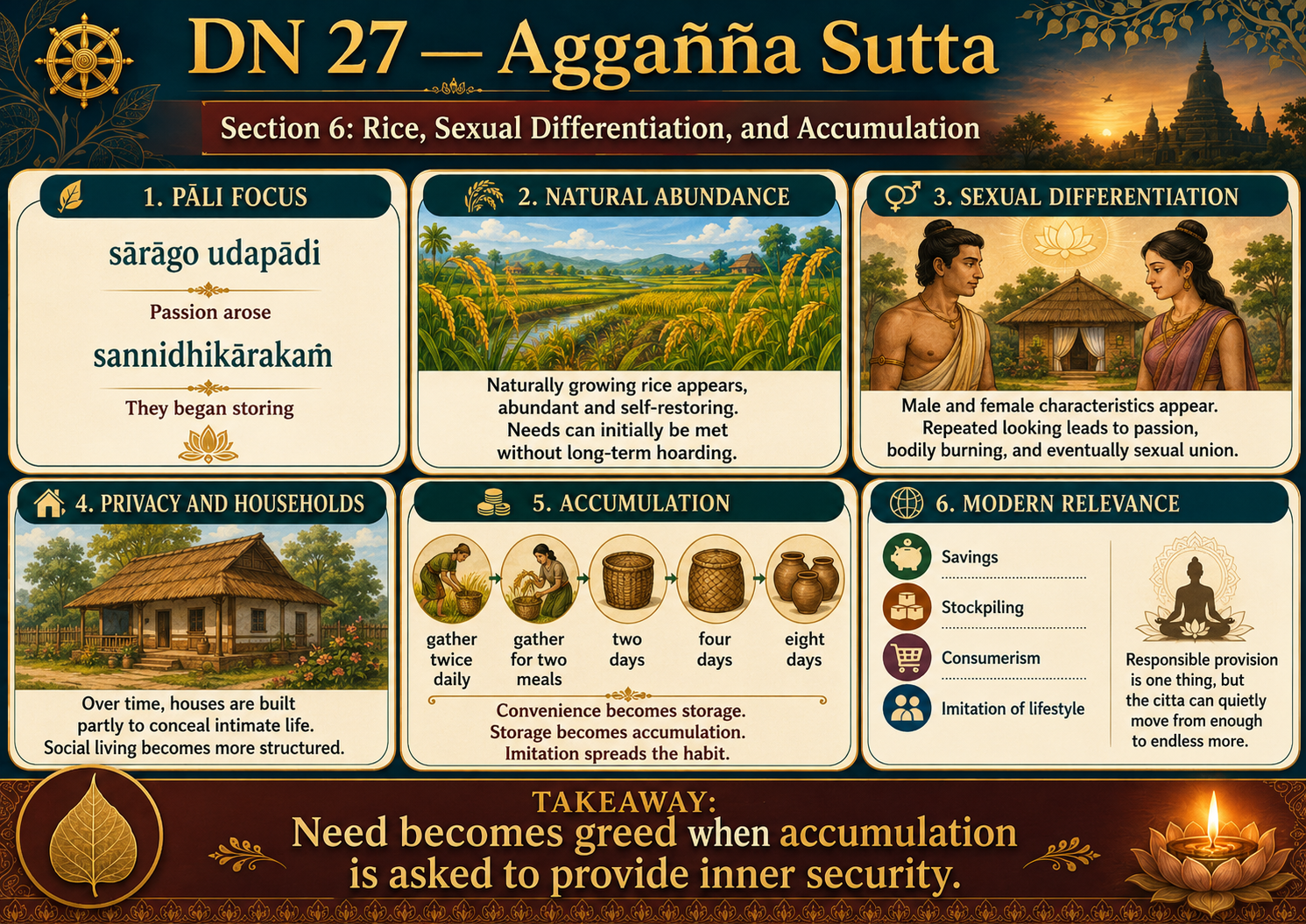

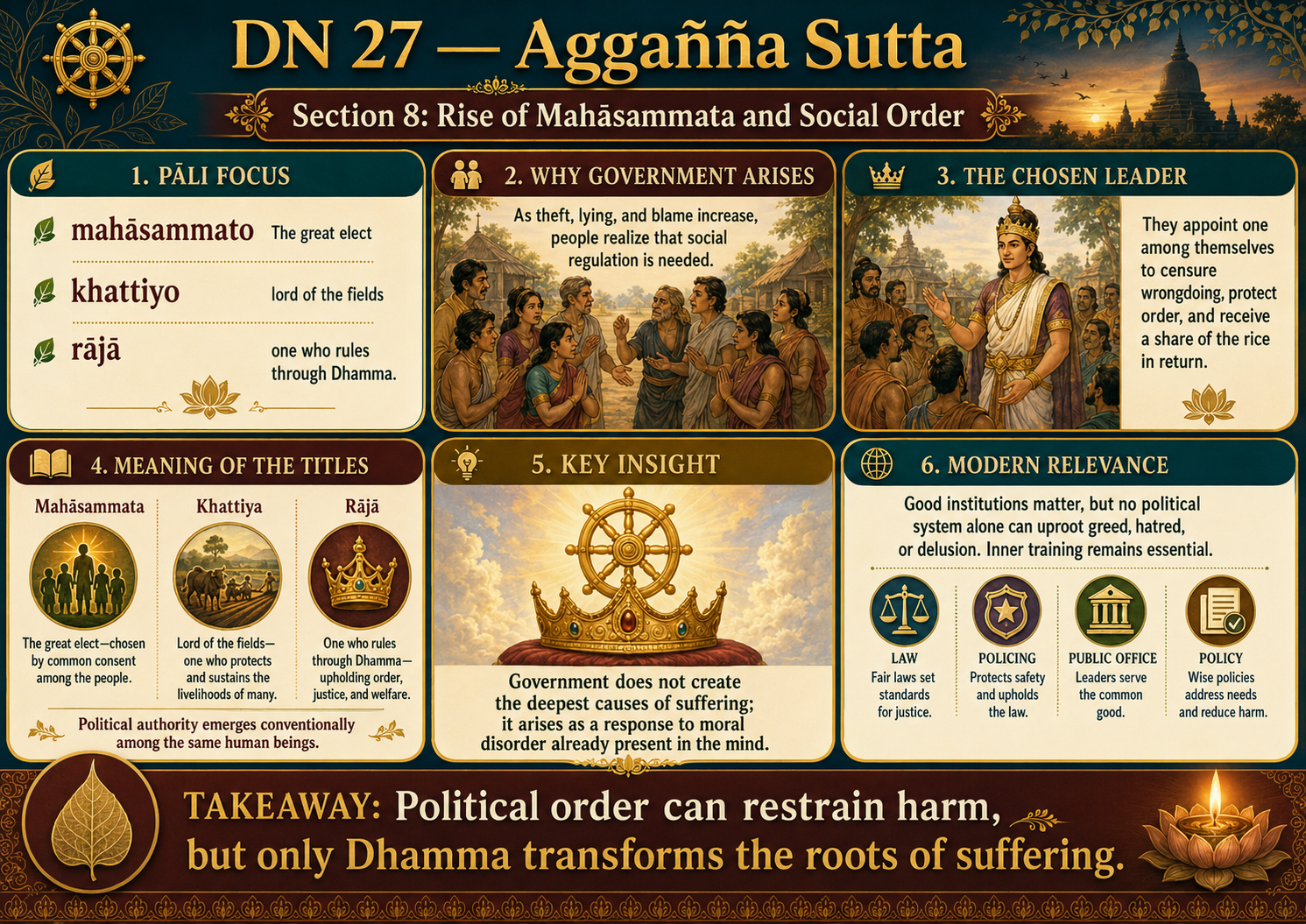
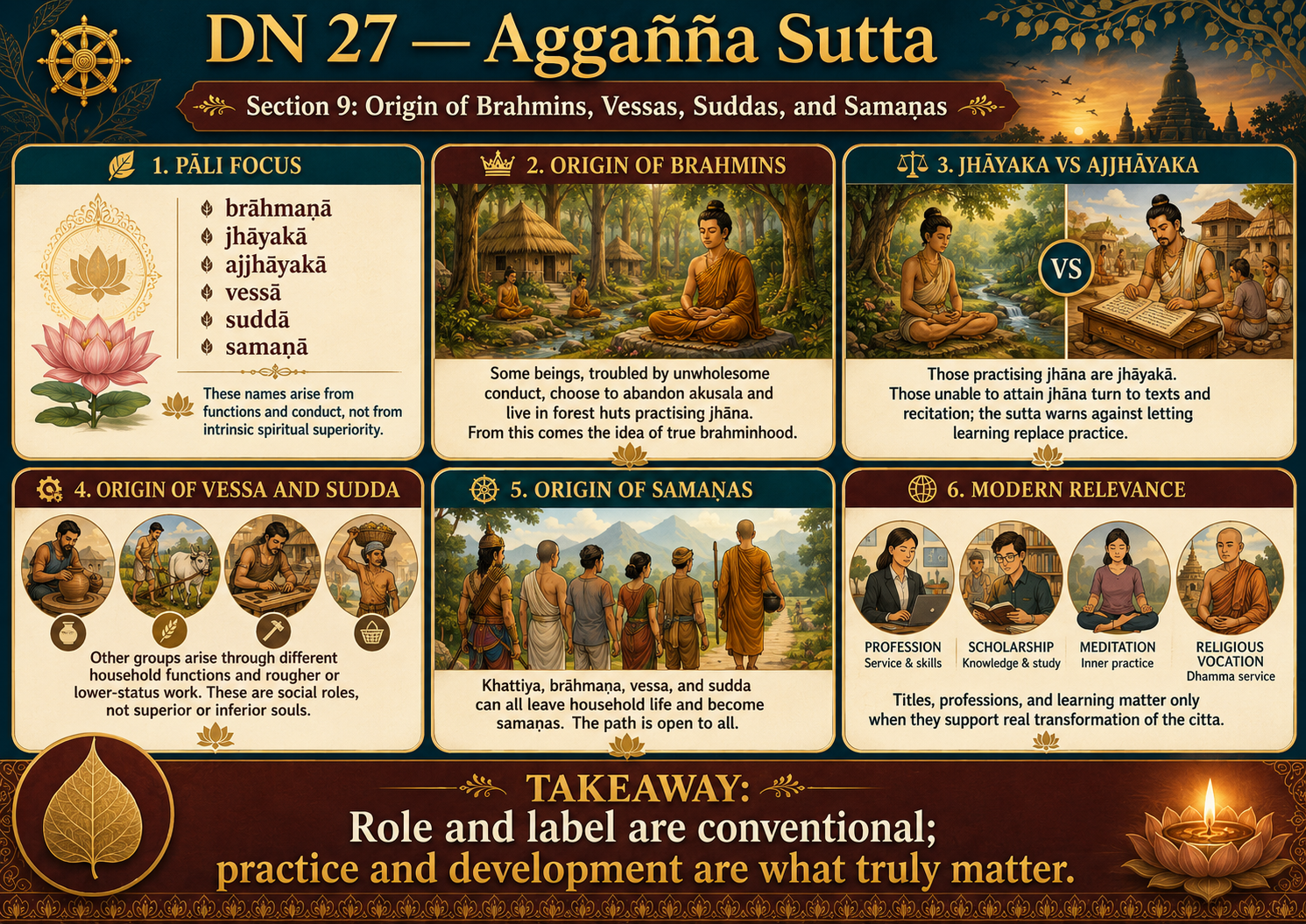
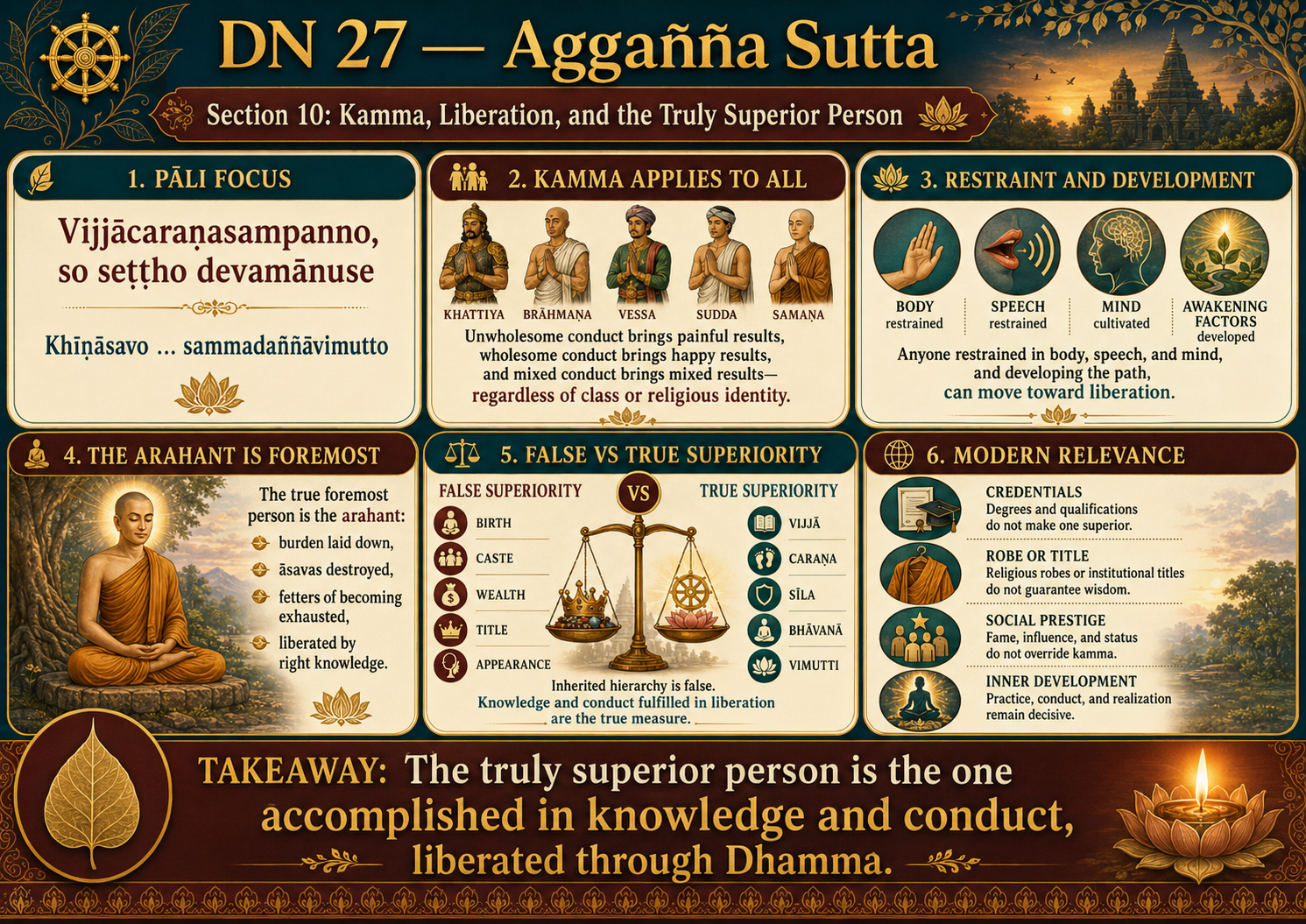
01Teaching aid — How an unguarded citta becomes a social system
| # | Pāli / stage | Development | Teaching insight |
|---|---|---|---|
| 1 | Assāda | Pleasantness / gratification is tasted | Object itself is not yet the problem. |
| 2 | Taṇhā | Craving enters | Pleasantness becomes wanted and repeated. |
| 3 | Paribhuñjana | Consumption escalates | Finger-tip tasting becomes handful consumption. |
| 4 | Bheda / differentiation | Bodies and appearances differ | Difference becomes salient. |
| 5 | Atimāna | Comparison becomes superiority/inferiority | “We are better; they are worse.” |
| 6 | Diṭṭhānugati | Others imitate what they see | A private tendency becomes social behavior. |
| 7 | Sannidhi | Accumulation / storing develops | Convenience becomes stockpiling. |
| 8 | Mariyādā | Boundaries and portions are established | Mine/yours is institutionalized. |
| 9 | Adinnādāna | Another’s share is taken | Possessiveness coexists with coveting. |
| 10 | Musāvāda / garahā / daṇḍa | Lying, blame and punishment emerge | Social conflict and coercion develop. |
| 11 | Mahāsammata | A ruler is agreed upon | Political function arises to regulate disorder. |
| 12 | Vaṇṇa / professional groups | Occupational identities develop | Functional labels later harden into status claims. |
02Teaching aid — Social groups arise from functions, not different kinds of human beings
| Group | How DN 27 explains the designation | What the discourse denies |
|---|---|---|
| Khattiya | Mahāsammata chosen to adjudicate; authority over fields; rule should be through Dhamma | That rulers are a different biological/spiritual species. |
| Brāhmaṇa | Those who sought to remove bad akusala dhammas; forest jhāna practitioners | That purity is inherited by birth. |
| Vessa | Householders engaged in various occupations | That occupation fixes intrinsic spiritual worth. |
| Sudda | Those engaged in rougher/lower-status work | That lower-status work makes someone an inferior kind of human. |
| Samaṇa | Can arise from any of the four classes through going forth | That the path belongs to one birth-group. |
tesaṁyeva sattānaṁ, anaññesaṁ — sadisānaṁyeva, no asadisānaṁ
They arise from those same beings, not different beings; from beings alike, not intrinsically different.
03The particularly important jhāna / textual-status warning
| Stage | Pāli | Meaning | Practice caution |
|---|---|---|---|
| Original aim | pāpake akusale dhamme vāheyyāma | Let us remove bad unwholesome dhammas. | The religious project begins as transformation. |
| Practice | jhāyanti | They practise jhāna. | The designation follows lived practice. |
| Difficulty | taṁ jhānaṁ anabhisambhuṇamānā | Unable to accomplish that jhāna. | Practice failure is not solved merely by changing status. |
| Textual turn | ganthe karontā | Composing / compiling texts. | Study can support practice, but it can also become substitution. |
| Public observation | na dānime jhāyanti | They no longer practise jhāna. | The central question remains: is bhāvanā actually occurring? |
| Status reversal | hīnasammataṁ … tadetarahi seṭṭhasammataṁ | Then considered inferior; later considered superior. | Institutional prestige can reverse the original practice hierarchy. |
04Practical DN 27 diagnostic — use the sutta on one’s own citta
| Situation | Possible DN 27 movement | Question to ask |
|---|---|---|
| Attractive object appears | assāda → taṇhā | “Has simple pleasantness become wanting?” |
| Others possess/achieve more | difference → comparison → māna | “Am I measuring myself against them?” |
| Buying / saving / stockpiling | convenience → sannidhi | “What is sufficient for the actual purpose?” |
| Something ‘mine’ is threatened | mariyādā → protection | “What exactly is the mind afraid of losing?” |
| Opportunity to take an advantage | protect mine / take yours | “Am I demanding a standard from others that I am not applying to myself?” |
| Praise or criticism | identity → māna / defence | “What self-position has been strengthened or struck?” |
| Dhamma study | knowledge → status risk | “Did this return me to sīla, saṁvara, samatha or paññā?” |
| Successful meditation | experience → appropriation | “Conditioned state—or my attainment?” |
05Final teaching summary
One-line practice essence
At every stage ask: what is being constructed in citta—craving, comparison, accumulation, identity, or Dhamma?
Dhammo hi, Vāseṭṭha, seṭṭho janetasmiṁ. DN 27 does not merely tell an origin story. It exposes how an unguarded citta constructs hierarchy and social worlds: pleasantness becomes craving, craving becomes repetition, difference becomes comparison, comparison becomes māna, convenience becomes accumulation, accumulation becomes ownership, ownership becomes conflict, conflict creates coercive structures, and functional labels later harden into claims of superiority.
The reverse is not achieved through a better birth-label, political identity or religious status. It comes through restraint of body, speech and mind, kusala, bodhipakkhiya bhāvanā, vijjā and caraṇa—culminating in liberation. The highest person is therefore not the one who was born highest, but the one who has actually completed the path.