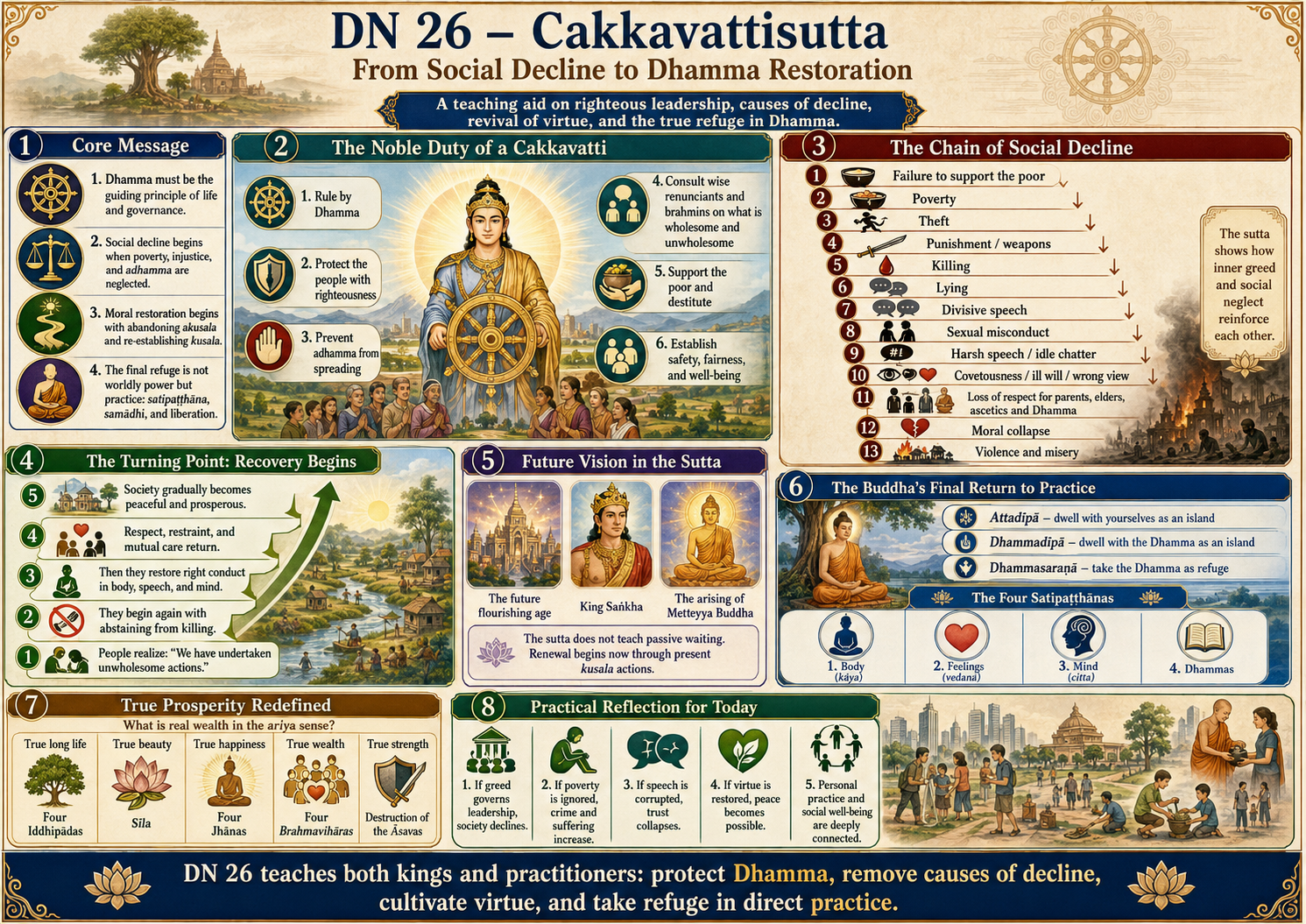
 VISUAL SUMMARYSee this sutta in a pictureOpen the complete infographic for a visual overview before or after reading the full study.View infographic →
The Cakkavattisutta (DN 26) is one of the most far-reaching discourses in the Dīgha Nikāya. It moves from the inner discipline of a bhāvanā practitioner to the ethical foundations of leadership, the causes of social decline, the restoration of wholesome conduct, the future arising of Metteyya Buddha, and finally back again to the practitioner’s own refuge in Dhamma. Significantly, the discourse both opens and later returns to the instruction: attadīpā ... attasaraṇā ... dhammadīpā ... dhammasaraṇā—dwell as an island and refuge unto oneself, with the Dhamma as one’s refuge—and the Buddha immediately defines this through the four satipaṭṭhānas.
At the social level, the discourse presents the ariya cakkavattivatta — the noble duty of a wheel-turning monarch. A righteous ruler is to make Dhamma the governing authority, provide protection and security, prevent adhamma, seek wise counsel concerning what is kusala and akusala, and—crucially—provide resources to those who are destitute.
The turning point occurs when a later king follows much of this duty but neglects that single responsibility. Poverty then spreads, followed by theft, weapons, killing and progressively deeper corruption of body, speech, mind and view: poverty → theft → weapons → killing → lying → divisive speech → sexual misconduct → harsh speech and pointless chatter → covetousness and ill will → wrong view → distorted craving and conduct → loss of respect → dehumanization → widespread violence. Yet the process reverses when survivors recognize that their suffering arose through repeatedly undertaking akusala dhammas and deliberately begin again with pāṇātipātā virati — abstaining from killing, progressively restoring the wholesome pathways of body, speech and mind.
Only after this long moral restoration does the discourse describe the flourishing age of King Saṅkha and the arising of Metteyya Buddha. The sutta therefore does not encourage passive waiting for a future Buddha or righteous ruler. It returns the bhikkhus to attadīpa, dhammadīpa, satipaṭṭhāna and proper gocara, and radically redefines true prosperity: lifespan becomes the four iddhipādas, beauty becomes sīla, happiness becomes the four jhānas, wealth becomes the four brahmavihāras, and strength becomes the destruction of the āsavas through cetovimutti and paññāvimutti.
Attadīpa / Dhammadīpa → Satipaṭṭhāna as refuge → Dhamma governs power → Destitute not supported → Poverty → kammapatha decline → Migasaññā / violence → Voluntary kusala reversal → Saṅkha & Metteyya → Return to Attadīpa → Āyu • Vaṇṇa • Sukha • Bhoga • Bala
Why this discourse requires careful reading. DN 26 is often remembered for the future Buddha Metteyya or for its dramatic account of social decline. But the discourse begins and ends with the same bhāvanā instruction: attadīpa, attasaraṇa, dhammadīpa, dhammasaraṇa, explicitly defined through the four satipaṭṭhānas. The social narrative is therefore framed by the practitioner’s own task of staying within the proper Dhamma-gocara, undertaking kusala, and not giving Māra an opening.
Methodological note. The Pāli below is retained exactly from the supplied source, including its textual variants and peyyāla abbreviations. The English rendering expands the repeated sense wherever it is securely recoverable. The deep-dive sections distinguish three levels: (1) what DN 26 explicitly says, (2) practice inference from the discourse, and (3) contemporary parallels from modern evidence. A contemporary parallel is not presented as scientific proof of the sutta’s exact causal chain.
The whole architecture of DN 26
| Movement | Key Pāli / theme | Teaching function |
|---|---|---|
| Opening | Attadīpa / Dhammadīpa | Four satipaṭṭhānas are the practical refuge. |
| Righteous kingship | Cakkavatti-ariyavatta | Dhamma above power; protection; no adhamma; resources for the destitute; counsel from the wise. |
| Critical omission | Adhanānaṁ dhanam anuppadāsi | Protection remains, but provision for the destitute is omitted. |
| Decline | Dāliddiya → adinnādāna → sattha → pāṇātipāta… | Material deprivation and moral responses form a cascading social breakdown. |
| Lowest point | Migasaññā / satthantarakappa | Others are perceived as prey; violence becomes normalized. |
| Reversal | Kusalaṁ kareyyāma | Recovery begins by voluntarily abstaining from killing and then rebuilding the remaining wholesome pathways. |
| Future flourishing | Saṅkha + Metteyya | Moral recovery precedes the flourishing era and the arising of Metteyya. |
| Closing | Attadīpa / Dhammadīpa again | The narrative returns the bhikkhu to satipaṭṭhāna and proper gocara. |
| Internal wealth | Āyu, vaṇṇa, sukha, bhoga, bala | Iddhipāda, sīla, jhāna, brahmavihāra, and āsavakkhaya are the bhikkhu’s true growth. |
The Noble Duty of the Wheel-Turning Monarch
| Pāli principle | Meaning | Practice / leadership implication |
|---|---|---|
| Dhammaṁyeva nissāya | Rely on Dhamma itself | Power is subordinate to Dhamma, not the reverse. |
| Dhammika rakkhāvaraṇagutti | Righteous protection, shelter, security | Protection extends across social classes and even to animals and birds. |
| Mā adhammakāro pavattittha | Do not let unrighteous conduct prevail | Law/order is a moral responsibility. |
| Adhanānaṁ dhanam anuppadeyyāsi | Provide resources to the destitute | This is not an optional charity item; its omission becomes the narrative’s turning point. |
| Paripuccheyyāsi samaṇabrāhmaṇe | Consult disciplined contemplatives | Ask what is kusala/akusala, blameworthy/blameless, to be cultivated/not cultivated. |
| Akusalaṁ abhinivajjeyyāsi; kusalaṁ samādāya vatteyyāsi | Avoid unwholesome; undertake wholesome | Leadership itself is treated as ethical training. |
The decline cascade — one of the most important teaching maps in the sutta
| # | Stage | What follows | Deep point |
|---|---|---|---|
| 1 | Resources not given to destitute adhanānaṁ dhane ananuppadiyamāne | Poverty becomes widespread | A system-level omission starts the chain. |
| 2 | Poverty dāliddiya | Theft spreads | Survival pressure enters the moral field. |
| 3 | Theft adinnādāna | Weapons spread | The response to theft alters the incentives and security environment. |
| 4 | Weapons sattha | Killing spreads | Coercion becomes normalized. |
| 5 | Killing pāṇātipāta | False speech spreads | Fear and self-protection reshape speech. |
| 6 | False speech musāvāda | Divisive speech spreads | Trust erodes. |
| 7 | Divisive speech pisuṇā vācā | Sexual misconduct spreads | Social bonds and restraint deteriorate. |
| 8 | Sexual misconduct kāmesumicchācāra | Harsh speech + pointless chatter spread | Restraint weakens further. |
| 9 | Harsh / pointless speech pharusā vācā / samphappalāpa | Covetousness + ill will spread | Verbal culture conditions mental culture. |
| 10 | Covetousness / ill will abhijjhā / byāpāda | Wrong view spreads | Akusala becomes cognitively justified. |
| 11 | Wrong view micchādiṭṭhi | Unrighteous lust, irregular greed, wrong practice | Norms invert. |
| 12 | Moral disintegration adhammarāga, visamalobha, micchādhamma | Respect for parents, renunciants and elders collapses | Basic structures of gratitude and restraint disappear. |
| 13 | Moral inversion akusala praised | Migasaññā and murderous intent | The other is no longer experienced as a fellow human being. |
How to use today’s examples responsibly
Contemporary parallels — 2025–2026
| Modern issue | Current evidence | How it relates to DN 26 |
|---|---|---|
| Failure to support vulnerable people | The World Bank’s 2025 State of Social Protection report says about 2 billion people in low- and middle-income countries remain uncovered or inadequately covered, and coverage is especially weak in fragile and hunger-affected regions. | This is a contemporary parallel to why the sutta places `adhanānaṁ dhanamanuppadeyyāsi` inside righteous governance. It does not prove that every crime is caused by poverty. |
| Poverty and conflict reinforcing one another | The World Bank’s 2025 work on fragile and conflict-affected economies reports that conflict has become more frequent and deadly and that poverty is increasingly concentrated in such settings. | This resembles DN 26’s feedback logic: material insecurity, violence and institutional weakness can reinforce one another. Modern causation is complex and multi-factorial. |
| Harsh/divisive speech at scale | UNESCO states that hate speech is rising worldwide and spreads faster and farther through social media; its 2026 materials stress dehumanization, polarization and the relationship between harmful online narratives and real-world threats. | This is a powerful modern mirror for `pharusā vācā`, `pisuṇā vācā`, and especially the later `migasaññā`—but the categories are not identical. |
| Violence and social conditions | UNODC’s Global Study on Homicide analyzes homicide alongside organized crime and broad social megatrends including inequality, urbanization and technological change. | Useful reminder: violence is not explained by one variable. DN 26 is a moral-causal teaching narrative, not a modern single-factor criminological model. |
Sources used for contemporary context: World Bank, State of Social Protection Report 2025; World Bank, Fragile and Conflict-Affected Situations: Intertwined Crises, Multiple Vulnerabilities; UNESCO 2025–2026 materials on hate speech and digital information integrity; UNODC, Global Study on Homicide 2023. These sources are used only as modern parallels.
The recovery cascade
| Stage | Pāli / action | What changes |
|---|---|---|
| Recognition | `akusalānaṁ dhammānaṁ samādānahetu…` | They acknowledge that repeatedly undertaking unwholesome dhammas brought collective ruin. |
| First restraint | `pāṇātipātā virameyyāma` | Recovery begins with the most immediate irreversible harm: stop killing. |
| Extend restraint | adinnādāna → kāmesumicchācāra → four speech pathways | Rebuild trust in body and speech. |
| Purify mind | abhijjhā → byāpāda → micchādiṭṭhi | Move from outer conduct into the mental roots and orientation. |
| Restore relational ethics | matteyyā, petteyyā, sāmaññā, brahmaññā, jeṭṭhāpacāyino | Gratitude, respect and moral reference points reappear. |
| Result | `kusalānaṁ dhammānaṁ samādānahetu` | The narrative reverses: wholesome adoption is associated with growth rather than decline. |
The bhikkhu’s true lifespan, beauty, happiness, wealth and strength
| Term | Buddha’s redefinition | Contents | Practice meaning |
|---|---|---|---|
| Āyu — lifespan | Four iddhipādas | chanda, vīriya, citta, vīmaṁsā with samādhi and striving | The practitioner’s ‘life’ is the capacity to sustain the path. |
| Vaṇṇa — beauty | Sīla | Pātimokkha restraint and careful training | Beauty is ethically redefined. |
| Sukha — happiness | Four jhānas | Progressive secluded and purified happiness | Happiness is not sensual abundance. |
| Bhoga — wealth | Four brahmavihāras | Mettā, karuṇā, muditā, upekkhā immeasurably pervaded | Wealth becomes vastness of heart. |
| Bala — strength | Āsavakkhaya | Taintless cetovimutti and paññāvimutti | The highest strength is liberation. |
011. Attadīpa and Dhammadīpa — the frame of the discourse — 4 Pāli–translation sections
Evaṁ me sutaṁ— ekaṁ samayaṁ bhagavā magadhesu viharati mātulāyaṁ. Tatra kho bhagavā bhikkhū āmantesi: “bhikkhavo”ti.
Thus have I heard. On one occasion the Blessed One was staying among the Magadhans at Mātulā. There the Blessed One addressed the bhikkhus: “Bhikkhus.”
“Bhaddante”ti te bhikkhū bhagavato paccassosuṁ. Bhagavā etadavoca:
“Bhante,” those bhikkhus replied. The Blessed One said:
“Attadīpā, bhikkhave, viharatha attasaraṇā anaññasaraṇā, dhammadīpā dhammasaraṇā anaññasaraṇā. Kathañca pana, bhikkhave, bhikkhu attadīpo viharati attasaraṇo anaññasaraṇo, dhammadīpo dhammasaraṇo anaññasaraṇo? Idha, bhikkhave, bhikkhu kāye kāyānupassī viharati ātāpī sampajāno satimā vineyya loke abhijjhādomanassaṁ. Vedanāsu vedanānupassī viharati ātāpī sampajāno satimā vineyya loke abhijjhādomanassaṁ. Citte cittānupassī viharati ātāpī sampajāno satimā vineyya loke abhijjhādomanassaṁ. Dhammesu dhammānupassī viharati ātāpī sampajāno satimā vineyya loke abhijjhādomanassaṁ. Evaṁ kho, bhikkhave, bhikkhu attadīpo viharati attasaraṇo anaññasaraṇo, dhammadīpo dhammasaraṇo anaññasaraṇo.
“Bhikkhus, dwell as islands unto yourselves, as your own refuge, with no other refuge; with the Dhamma as your island and refuge, with no other refuge. And how does a bhikkhu do this? He dwells contemplating the body in the body, ardent, clearly comprehending and mindful, having removed covetousness and sadness regarding the world; he dwells contemplating feelings in feelings in the same way; mind in mind in the same way; and dhammas in dhammas, ardent, clearly comprehending and mindful, having removed covetousness and sadness regarding the world. In this way a bhikkhu dwells as an island and refuge unto himself, with the Dhamma as island and refuge, with no other refuge.”
Gocare, bhikkhave, caratha sake pettike visaye. Gocare, bhikkhave, carataṁ sake pettike visaye na lacchati māro otāraṁ, na lacchati māro ārammaṇaṁ. Variant: ārammaṇaṁ → āramaṇaṁ (?) Kusalānaṁ, bhikkhave, dhammānaṁ samādānahetu evamidaṁ puññaṁ pavaḍḍhati.
“Bhikkhus, move within your proper pasture, your ancestral domain. For those who move within their proper pasture, Māra gains no opening and no object on which to fasten. It is through undertaking wholesome dhammas that this merit grows.”
022. King Daḷhanemi and the righteous wheel-turning tradition — 19 Pāli–translation sections
Bhūtapubbaṁ, bhikkhave, rājā daḷhanemi nāma ahosi cakkavattī dhammiko dhammarājā cāturanto vijitāvī janapadatthāvariyappatto sattaratanasamannāgato. Variant: cakkavattī → cakkavatti (sya-all, pts1ed) Tassimāni satta ratanāni ahesuṁ seyyathidaṁ— cakkaratanaṁ hatthiratanaṁ assaratanaṁ maṇiratanaṁ itthiratanaṁ gahapatiratanaṁ pariṇāyakaratanameva sattamaṁ. Parosahassaṁ kho panassa puttā ahesuṁ sūrā vīraṅgarūpā parasenappamaddanā. So imaṁ pathaviṁ sāgarapariyantaṁ adaṇḍena asatthena dhammena abhivijiya ajjhāvasi. Variant: asatthena dhammena → dhammena samena (sya-all, mr)
“Bhikkhus, in the past there was a king named Daḷhanemi, a wheel-turning monarch, a righteous king who ruled by Dhamma, victorious over the four quarters, whose realm was stable, and who possessed the seven treasures: the wheel, elephant, horse, jewel, woman, householder, and the counselor as the seventh. He had more than a thousand brave sons able to crush opposing armies. He conquered and dwelt over the earth to the ocean’s edge without rod or sword, by Dhamma.”
Atha kho, bhikkhave, rājā daḷhanemi bahunnaṁ vassānaṁ bahunnaṁ vassasatānaṁ bahunnaṁ vassasahassānaṁ accayena aññataraṁ purisaṁ āmantesi: ‘yadā tvaṁ, ambho purisa, passeyyāsi dibbaṁ cakkaratanaṁ osakkitaṁ ṭhānā cutaṁ, atha me āroceyyāsī’ti.
After many years, centuries and millennia, King Daḷhanemi instructed a man: “When you see the divine wheel-treasure slip from its place and shift from its position, report it to me.”
‘Evaṁ, devā’ti kho, bhikkhave, so puriso rañño daḷhanemissa paccassosi.
“Yes, sire,” the man replied to King Daḷhanemi.
Addasā kho, bhikkhave, so puriso bahunnaṁ vassānaṁ bahunnaṁ vassasatānaṁ bahunnaṁ vassasahassānaṁ accayena dibbaṁ cakkaratanaṁ osakkitaṁ ṭhānā cutaṁ, disvāna yena rājā daḷhanemi tenupasaṅkami; upasaṅkamitvā rājānaṁ daḷhanemiṁ etadavoca: ‘yagghe, deva, jāneyyāsi, dibbaṁ te cakkaratanaṁ osakkitaṁ ṭhānā cutan’ti.
After a very long time the man saw the divine wheel-treasure slip from its place. He went to King Daḷhanemi and said: “Sire, you should know that your divine wheel-treasure has slipped from its position.”
Atha kho, bhikkhave, rājā daḷhanemi jeṭṭhaputtaṁ kumāraṁ āmantāpetvā etadavoca: Variant: āmantāpetvā → āmantetvā (bj, sya-all, mr) ‘dibbaṁ kira me, tāta kumāra, cakkaratanaṁ osakkitaṁ ṭhānā cutaṁ. Sutaṁ kho pana metaṁ— yassa rañño cakkavattissa dibbaṁ cakkaratanaṁ osakkati ṭhānā cavati, na dāni tena raññā ciraṁ jīvitabbaṁ hotīti. Bhuttā kho pana me mānusakā kāmā, samayo dāni me dibbe kāme pariyesituṁ. Ehi tvaṁ, tāta kumāra, imaṁ samuddapariyantaṁ pathaviṁ paṭipajja. Ahaṁ pana kesamassuṁ ohāretvā kāsāyāni vatthāni acchādetvā agārasmā anagāriyaṁ pabbajissāmī’ti.
King Daḷhanemi summoned his eldest son and said: “Dear prince, my divine wheel-treasure has slipped from its place. I have heard that when this happens to a wheel-turning monarch, he has not long to live. I have enjoyed human sensual pleasures; now it is time to seek heavenly pleasures. Take charge of this earth bounded by the ocean. I will shave my hair and beard, put on ochre robes, and go forth from the household life into homelessness.”
Atha kho, bhikkhave, rājā daḷhanemi jeṭṭhaputtaṁ kumāraṁ sādhukaṁ rajje samanusāsitvā kesamassuṁ ohāretvā kāsāyāni vatthāni acchādetvā agārasmā anagāriyaṁ pabbaji. Sattāhapabbajite kho pana, bhikkhave, rājisimhi dibbaṁ cakkaratanaṁ antaradhāyi.
King Daḷhanemi carefully instructed his eldest son in kingship, shaved his hair and beard, put on ochre robes and went forth. Seven days after the royal sage had gone forth, the divine wheel-treasure disappeared.
Atha kho, bhikkhave, aññataro puriso yena rājā khattiyo muddhābhisitto tenupasaṅkami; upasaṅkamitvā rājānaṁ khattiyaṁ muddhābhisittaṁ etadavoca: Variant: muddhābhisitto → muddhāvasitto (sya-all, pts1ed) ‘yagghe, deva, jāneyyāsi, dibbaṁ cakkaratanaṁ antarahitan’ti. Atha kho, bhikkhave, rājā khattiyo muddhābhisitto dibbe cakkaratane antarahite anattamano ahosi, anattamanatañca paṭisaṁvedesi. So yena rājisi tenupasaṅkami; upasaṅkamitvā rājisiṁ etadavoca: ‘yagghe, deva, jāneyyāsi, dibbaṁ cakkaratanaṁ antarahitan’ti.
A man approached the newly anointed khattiya king and told him that the divine wheel-treasure had disappeared. The king became unhappy and distressed. He went to the former king, now a royal sage, and reported what had happened.
Evaṁ vutte, bhikkhave, rājisi rājānaṁ khattiyaṁ muddhābhisittaṁ etadavoca: ‘mā kho tvaṁ, tāta, dibbe cakkaratane antarahite anattamano ahosi, mā anattamanatañca paṭisaṁvedesi, na hi te, tāta, dibbaṁ cakkaratanaṁ pettikaṁ dāyajjaṁ. Iṅgha tvaṁ, tāta, ariye cakkavattivatte vattāhi. Ṭhānaṁ kho panetaṁ vijjati, yaṁ te ariye cakkavattivatte vattamānassa tadahuposathe pannarase sīsaṁnhātassa uposathikassa uparipāsādavaragatassa dibbaṁ cakkaratanaṁ pātubhavissati sahassāraṁ sanemikaṁ sanābhikaṁ sabbākāraparipūran’ti. Variant: sīsaṁnhātassa → sīsaṁ nahātassa (bj, pts1ed); sīsanhātassa (sya-all)
The royal sage said: “Dear son, do not be distressed because the divine wheel-treasure has disappeared. It is not a paternal inheritance. Conduct yourself according to the noble duty of a wheel-turning monarch. If you do so, it is possible that on the fifteenth-day observance, having washed your head, observed the uposatha and gone to the upper terrace of the palace, the divine wheel-treasure will appear—complete in every respect, with a thousand spokes, rim and hub.”
2.1. The Noble Duty of a Wheel-Turning Monarch
‘Katamaṁ pana taṁ, deva, ariyaṁ cakkavattivattan’ti?
The king asked: “Sire, what is this noble duty of a wheel-turning monarch?”
‘Tena hi tvaṁ, tāta, dhammaṁyeva nissāya dhammaṁ sakkaronto dhammaṁ garuṁ karonto dhammaṁ mānento dhammaṁ pūjento dhammaṁ apacāyamāno dhammaddhajo dhammaketu dhammādhipateyyo dhammikaṁ rakkhāvaraṇaguttiṁ saṁvidahassu antojanasmiṁ balakāyasmiṁ khattiyesu anuyantesu brāhmaṇagahapatikesu negamajānapadesu samaṇabrāhmaṇesu migapakkhīsu. Variant: anuyantesu → anuyuttesu (bj, pts1ed) | garuṁ karonto → garukaronto (bj, sya-all, pts1ed) Mā ca te, tāta, vijite adhammakāro pavattittha. Ye ca te, tāta, vijite adhanā assu, tesañca dhanamanuppadeyyāsi.
“Dear son, relying only on Dhamma—honoring, respecting, esteeming, venerating and paying homage to Dhamma, making Dhamma your banner, standard and sovereign—establish righteous protection, shelter and security for your household, army, nobles, subordinate rulers, brahmins and householders, townspeople and country people, ascetics and brahmins, and even animals and birds. Let no unrighteous conduct prevail in your realm. And to those in your realm who are destitute, provide resources.”
Ye ca te, tāta, vijite samaṇabrāhmaṇā madappamādā paṭiviratā khantisoracce niviṭṭhā ekamattānaṁ damenti, ekamattānaṁ samenti, ekamattānaṁ parinibbāpenti, te kālena kālaṁ upasaṅkamitvā paripuccheyyāsi pariggaṇheyyāsi: “kiṁ, bhante, kusalaṁ, kiṁ akusalaṁ, kiṁ sāvajjaṁ, kiṁ anavajjaṁ, kiṁ sevitabbaṁ, kiṁ na sevitabbaṁ, kiṁ me karīyamānaṁ dīgharattaṁ ahitāya dukkhāya assa, kiṁ vā pana me karīyamānaṁ dīgharattaṁ hitāya sukhāya assā”ti? Tesaṁ sutvā yaṁ akusalaṁ taṁ abhinivajjeyyāsi, yaṁ kusalaṁ taṁ samādāya vatteyyāsi.
“From time to time approach those ascetics and brahmins in your realm who abstain from intoxication and heedlessness, are established in patience and gentleness, and train, calm and cool themselves. Ask them: ‘What is wholesome? What is unwholesome? What is blameworthy and blameless? What should and should not be cultivated? What action would lead for a long time to my harm and suffering, and what to my welfare and happiness?’ Having heard them, avoid what is unwholesome and undertake and live by what is wholesome.”
Idaṁ kho, tāta, taṁ ariyaṁ cakkavattivattan’ti.
“This, dear son, is the noble duty of a wheel-turning monarch.”
2.2. The Appearance of the Wheel-Treasure
‘Evaṁ, devā’ti kho, bhikkhave, rājā khattiyo muddhābhisitto rājisissa paṭissutvā ariye cakkavattivatte vatti.
“Yes, sire,” the anointed king replied. He then conducted himself according to that noble wheel-turning duty.
Tassa ariye cakkavattivatte vattamānassa tadahuposathe pannarase sīsaṁnhātassa uposathikassa uparipāsādavaragatassa dibbaṁ cakkaratanaṁ pāturahosi sahassāraṁ sanemikaṁ sanābhikaṁ sabbākāraparipūraṁ. Disvāna rañño khattiyassa muddhābhisittassa etadahosi: ‘sutaṁ kho pana metaṁ—yassa rañño khattiyassa muddhābhisittassa tadahuposathe pannarase sīsaṁnhātassa uposathikassa uparipāsādavaragatassa dibbaṁ cakkaratanaṁ pātubhavati sahassāraṁ sanemikaṁ sanābhikaṁ sabbākāraparipūraṁ, so hoti rājā cakkavattīti. Assaṁ nu kho ahaṁ rājā cakkavattī’ti.
While he was living according to that noble duty, on the fifteenth-day observance, after washing his head, observing the uposatha and going to the upper palace terrace, the divine wheel-treasure appeared, complete with a thousand spokes, rim and hub. Seeing it, the king thought: “I have heard that when such a wheel appears to an anointed khattiya king under these conditions, he is a wheel-turning monarch. Perhaps I am such a king.”
Atha kho, bhikkhave, rājā khattiyo muddhābhisitto uṭṭhāyāsanā ekaṁsaṁ uttarāsaṅgaṁ karitvā vāmena hatthena bhiṅkāraṁ gahetvā dakkhiṇena hatthena cakkaratanaṁ abbhukkiri: ‘pavattatu bhavaṁ cakkaratanaṁ, abhivijinātu bhavaṁ cakkaratanan’ti.
The king rose, arranged his robe over one shoulder, took a water vessel in his left hand, sprinkled the wheel with his right, and said: “May the noble wheel-treasure roll forth; may the noble wheel-treasure conquer.”
Atha kho taṁ, bhikkhave, cakkaratanaṁ puratthimaṁ disaṁ pavatti, anvadeva rājā cakkavattī saddhiṁ caturaṅginiyā senāya. Yasmiṁ kho pana, bhikkhave, padese cakkaratanaṁ patiṭṭhāsi, tattha rājā cakkavattī vāsaṁ upagacchi saddhiṁ caturaṅginiyā senāya. Ye kho pana, bhikkhave, puratthimāya disāya paṭirājāno, te rājānaṁ cakkavattiṁ upasaṅkamitvā evamāhaṁsu: ‘ehi kho, mahārāja, svāgataṁ te mahārāja, sakaṁ te, mahārāja, anusāsa, mahārājā’ti. Variant: svāgataṁ te → svāgataṁ (sya-all); sāgataṁ (pts1ed) Rājā cakkavattī evamāha: ‘pāṇo na hantabbo, adinnaṁ nādātabbaṁ, kāmesumicchā na caritabbā, musā na bhāsitabbā, majjaṁ na pātabbaṁ, yathābhuttañca bhuñjathā’ti. Ye kho pana, bhikkhave, puratthimāya disāya paṭirājāno, te rañño cakkavattissa anuyantā ahesuṁ. Variant: anuyantā → anuyuttā (bj, pts1ed)
The wheel-treasure rolled toward the east and the wheel-turning king followed with his fourfold army. Wherever the wheel stopped, the king encamped. The eastern rulers came and welcomed him, offering their allegiance. The king instructed them: “Do not kill living beings; do not take what is not given; do not engage in sexual misconduct; do not speak falsely; do not drink intoxicants; eat according to what is proper.” They became his followers.
Atha kho taṁ, bhikkhave, cakkaratanaṁ puratthimaṁ samuddaṁ ajjhogāhetvā paccuttaritvā dakkhiṇaṁ disaṁ pavatti, anvadeva rājā cakkavattī saddhiṁ caturaṅginiyā senāya. Yasmiṁ kho pana, bhikkhave, padese cakkaratanaṁ patiṭṭhāsi, tattha rājā cakkavattī vāsaṁ upagacchi saddhiṁ caturaṅginiyā senāya. Ye kho pana, bhikkhave, dakkhiṇāya disāya paṭirājāno, te rājānaṁ cakkavattiṁ upasaṅkamitvā evamāhaṁsu: ‘ehi kho, mahārāja, svāgataṁ te, mahārāja, sakaṁ te, mahārāja, anusāsa, mahārājā’ti. Rājā cakkavattī evamāha: ‘pāṇo na hantabbo, adinnaṁ nādātabbaṁ, kāmesumicchā na caritabbā, musā na bhāsitabbā, majjaṁ na pātabbaṁ, yathābhuttañca bhuñjathā’ti. Ye kho pana, bhikkhave, dakkhiṇāya disāya paṭirājāno, te rañño cakkavattissa anuyantā ahesuṁ. Variant: ajjhogāhetvā → ajjhogāhitvā (bj); ajjhogahetvā (sya-all, pts1ed) dakkhiṇaṁ samuddaṁ ajjhogāhetvā paccuttaritvā pacchimaṁ disaṁ pavatti, anvadeva rājā cakkavattī saddhiṁ caturaṅginiyā senāya. Yasmiṁ kho pana, bhikkhave, padese cakkaratanaṁ patiṭṭhāsi, tattha rājā cakkavattī vāsaṁ upagacchi saddhiṁ caturaṅginiyā senāya. Variant: padese cakkaratanaṁ → dibbaṁ cakkaratanaṁ (bj, csp1ed) Ye kho pana, bhikkhave, pacchimāya disāya paṭirājāno, te rājānaṁ cakkavattiṁ upasaṅkamitvā evamāhaṁsu: ‘ehi kho, mahārāja, svāgataṁ te, mahārāja, sakaṁ te, mahārāja, anusāsa, mahārājā’ti. Rājā cakkavattī evamāha: ‘pāṇo na hantabbo, adinnaṁ nādātabbaṁ, kāmesumicchā na caritabbā, musā na bhāsitabbā, majjaṁ na pātabbaṁ, yathābhuttañca bhuñjathā’ti. Ye kho pana, bhikkhave, pacchimāya disāya paṭirājāno, te rañño cakkavattissa anuyantā ahesuṁ.
The wheel then entered and emerged from the eastern ocean and proceeded south. The same pattern occurred in the south. After emerging from the southern ocean it proceeded west; the king and army followed, rulers welcomed him, and he gave the same ethical instruction. They became his followers.
Atha kho taṁ, bhikkhave, cakkaratanaṁ pacchimaṁ samuddaṁ ajjhogāhetvā paccuttaritvā uttaraṁ disaṁ pavatti, anvadeva rājā cakkavattī saddhiṁ caturaṅginiyā senāya. Yasmiṁ kho pana, bhikkhave, padese cakkaratanaṁ patiṭṭhāsi, tattha rājā cakkavattī vāsaṁ upagacchi saddhiṁ caturaṅginiyā senāya. Variant: padese cakkaratanaṁ → dibbaṁ cakkaratanaṁ (bj, csp1ed) Ye kho pana, bhikkhave, uttarāya disāya paṭirājāno, te rājānaṁ cakkavattiṁ upasaṅkamitvā evamāhaṁsu: ‘ehi kho, mahārāja, svāgataṁ te, mahārāja, sakaṁ te, mahārāja, anusāsa, mahārājā’ti. Rājā cakkavattī evamāha: ‘pāṇo na hantabbo, adinnaṁ nādātabbaṁ, kāmesumicchā na caritabbā, musā na bhāsitabbā, majjaṁ na pātabbaṁ, yathābhuttañca bhuñjathā’ti. Ye kho pana, bhikkhave, uttarāya disāya paṭirājāno, te rañño cakkavattissa anuyantā ahesuṁ.
After emerging from the western ocean the wheel proceeded north. The king followed with his army. Wherever it stopped he encamped. The northern rulers welcomed him, and he gave the same instruction—not to kill, steal, commit sexual misconduct, lie, or drink intoxicants, and to live according to proper provision. They became his followers.
Atha kho taṁ, bhikkhave, cakkaratanaṁ samuddapariyantaṁ pathaviṁ abhivijinitvā tameva rājadhāniṁ paccāgantvā rañño cakkavattissa antepuradvāre atthakaraṇapamukhe akkhāhataṁ maññe aṭṭhāsi rañño cakkavattissa antepuraṁ upasobhayamānaṁ.
Having conquered the earth to the ocean’s edge, the wheel returned to the capital and stood at the entrance to the king’s inner palace near the hall of judgment, as though fixed on its axle, beautifying the palace.
033. The Successive Wheel-Turning Kings — and the Critical Break — 5 Pāli–translation sections
Dutiyopi kho, bhikkhave, rājā cakkavattī …pe… tatiyopi kho, bhikkhave, rājā cakkavattī … catutthopi kho, bhikkhave, rājā cakkavattī … pañcamopi kho, bhikkhave, rājā cakkavattī … chaṭṭhopi kho, bhikkhave, rājā cakkavattī … sattamopi kho, bhikkhave, rājā cakkavattī bahunnaṁ vassānaṁ bahunnaṁ vassasatānaṁ bahunnaṁ vassasahassānaṁ accayena aññataraṁ purisaṁ āmantesi: ‘yadā tvaṁ, ambho purisa, passeyyāsi dibbaṁ cakkaratanaṁ osakkitaṁ ṭhānā cutaṁ, atha me āroceyyāsī’ti. ‘Evaṁ, devā’ti kho, bhikkhave, so puriso rañño cakkavattissa paccassosi. Addasā kho, bhikkhave, so puriso bahunnaṁ vassānaṁ bahunnaṁ vassasatānaṁ bahunnaṁ vassasahassānaṁ accayena dibbaṁ cakkaratanaṁ osakkitaṁ ṭhānā cutaṁ. Disvāna yena rājā cakkavattī tenupasaṅkami; upasaṅkamitvā rājānaṁ cakkavattiṁ etadavoca: ‘yagghe, deva, jāneyyāsi, dibbaṁ te cakkaratanaṁ osakkitaṁ ṭhānā cutan’ti?
Source peyyāla deliberately retained: the second through sixth wheel-turning kings repeat the large preceding succession pattern. Because the supplied Pāli abbreviates entire narrative cycles, this edition does not invent unsupplied Pāli; the English gives their repeated sense and resumes with the seventh king.
The same pattern continued through a succession of wheel-turning kings. Eventually the seventh wheel-turning monarch, after a very long reign, instructed a man to report when the divine wheel slipped. The man later saw it slip from its place and reported this to the king.
Atha kho, bhikkhave, rājā cakkavattī jeṭṭhaputtaṁ kumāraṁ āmantāpetvā etadavoca: ‘dibbaṁ kira me, tāta kumāra, cakkaratanaṁ osakkitaṁ, ṭhānā cutaṁ, sutaṁ kho pana metaṁ— yassa rañño cakkavattissa dibbaṁ cakkaratanaṁ osakkati, ṭhānā cavati, na dāni tena raññā ciraṁ jīvitabbaṁ hotīti. Bhuttā kho pana me mānusakā kāmā, samayo dāni me dibbe kāme pariyesituṁ, ehi tvaṁ, tāta kumāra, imaṁ samuddapariyantaṁ pathaviṁ paṭipajja. Ahaṁ pana kesamassuṁ ohāretvā kāsāyāni vatthāni acchādetvā agārasmā anagāriyaṁ pabbajissāmī’ti.
The seventh wheel-turning king summoned his eldest son and repeated the former instruction: the slipping of the wheel signaled that his life was nearing its end; the son should rule the earth, while he himself would shave hair and beard, wear ochre robes and go forth.
Atha kho, bhikkhave, rājā cakkavattī jeṭṭhaputtaṁ kumāraṁ sādhukaṁ rajje samanusāsitvā kesamassuṁ ohāretvā kāsāyāni vatthāni acchādetvā agārasmā anagāriyaṁ pabbaji. Sattāhapabbajite kho pana, bhikkhave, rājisimhi dibbaṁ cakkaratanaṁ antaradhāyi.
He carefully instructed his eldest son in kingship and went forth. Seven days later the divine wheel-treasure disappeared.
Atha kho, bhikkhave, aññataro puriso yena rājā khattiyo muddhābhisitto tenupasaṅkami; upasaṅkamitvā rājānaṁ khattiyaṁ muddhābhisittaṁ etadavoca: ‘yagghe, deva, jāneyyāsi, dibbaṁ cakkaratanaṁ antarahitan’ti? Atha kho, bhikkhave, rājā khattiyo muddhābhisitto dibbe cakkaratane antarahite anattamano ahosi. Anattamanatañca paṭisaṁvedesi; no ca kho rājisiṁ upasaṅkamitvā ariyaṁ cakkavattivattaṁ pucchi. So samateneva sudaṁ janapadaṁ pasāsati. Tassa samatena janapadaṁ pasāsato pubbenāparaṁ janapadā na pabbanti, yathā taṁ pubbakānaṁ rājūnaṁ ariye cakkavattivatte vattamānānaṁ.
A man informed the newly anointed king that the divine wheel had disappeared. The king became distressed, but unlike the earlier successor he did not go to the royal sage to ask about the noble wheel-turning duty. He governed according to his own judgment. Under this self-devised administration, the realm did not prosper as it had under the earlier kings who followed the noble duty.
Atha kho, bhikkhave, amaccā pārisajjā gaṇakamahāmattā anīkaṭṭhā dovārikā mantassājīvino sannipatitvā rājānaṁ khattiyaṁ muddhābhisittaṁ etadavocuṁ: ‘na kho te, deva, samatena sudaṁ janapadaṁ pasāsato pubbenāparaṁ janapadā pabbanti, yathā taṁ pubbakānaṁ rājūnaṁ ariye cakkavattivatte vattamānānaṁ. Saṁvijjanti kho te, deva, vijite amaccā pārisajjā gaṇakamahāmattā anīkaṭṭhā dovārikā mantassājīvino mayañceva aññe ca ye mayaṁ ariyaṁ cakkavattivattaṁ dhārema. Iṅgha tvaṁ, deva, amhe ariyaṁ cakkavattivattaṁ puccha. Tassa te mayaṁ ariyaṁ cakkavattivattaṁ puṭṭhā byākarissāmā’ti.
The ministers, counselors, treasury officials, military officers, gatekeepers and advisers assembled and told the king that the realm was not prospering as before. They said that they and others still preserved knowledge of the noble wheel-turning duty and urged him to ask them about it.
044. The Decline in Lifespan and Beauty — the Causal Cascade — 40 Pāli–translation sections
Atha kho, bhikkhave, rājā khattiyo muddhābhisitto amacce pārisajje gaṇakamahāmatte anīkaṭṭhe dovārike mantassājīvino sannipātetvā ariyaṁ cakkavattivattaṁ pucchi. Variant: ti → ādiyasīti (sya-all) Tassa te ariyaṁ cakkavattivattaṁ puṭṭhā byākariṁsu. Tesaṁ sutvā dhammikañhi kho rakkhāvaraṇaguttiṁ saṁvidahi, no ca kho adhanānaṁ dhanamanuppadāsi. Adhanānaṁ dhane ananuppadiyamāne dāliddiyaṁ vepullamagamāsi.
The king assembled them and asked about the noble duty. They explained it. Having heard them, he did establish righteous protection and security—but he did not provide resources to the destitute. Because resources were not provided to the destitute, poverty became widespread.
Dāliddiye vepullaṁ gate aññataro puriso paresaṁ adinnaṁ theyyasaṅkhātaṁ ādiyi. Tamenaṁ aggahesuṁ. Gahetvā rañño khattiyassa muddhābhisittassa dassesuṁ: ‘ayaṁ, deva, puriso paresaṁ adinnaṁ theyyasaṅkhātaṁ ādiyī’ti.
As poverty became widespread, a man took from others what had not been given, committing theft. He was arrested and brought before the king.
Evaṁ vutte, bhikkhave, rājā khattiyo muddhābhisitto taṁ purisaṁ etadavoca: ‘saccaṁ kira tvaṁ, ambho purisa, paresaṁ adinnaṁ theyyasaṅkhātaṁ ādiyī’ti?
The king asked him: “Is it true that you took from others what had not been given?”
‘Saccaṁ, devā’ti.
“Yes, sire.”
‘Kiṁ kāraṇā’ti?
“Why?”
‘Na hi, deva, jīvāmī’ti.
“Sire, I cannot make a living.”
Atha kho, bhikkhave, rājā khattiyo muddhābhisitto tassa purisassa dhanamanuppadāsi: ‘iminā tvaṁ, ambho purisa, dhanena attanā ca jīvāhi, mātāpitaro ca posehi, puttadārañca posehi, kammante ca payojehi, samaṇabrāhmaṇesu uddhaggikaṁ dakkhiṇaṁ patiṭṭhāpehi sovaggikaṁ sukhavipākaṁ saggasaṁvattanikan’ti.
The king gave the man resources and said: “With this, support yourself, your mother and father, your wife and children; undertake work; and establish an uplifting gift to ascetics and brahmins, productive of happiness and a fortunate destination.”
‘Evaṁ, devā’ti kho, bhikkhave, so puriso rañño khattiyassa muddhābhisittassa paccassosi.
“Yes, sire,” the man replied.
Aññataropi kho, bhikkhave, puriso paresaṁ adinnaṁ theyyasaṅkhātaṁ ādiyi. Tamenaṁ aggahesuṁ. Gahetvā rañño khattiyassa muddhābhisittassa dassesuṁ: ‘ayaṁ, deva, puriso paresaṁ adinnaṁ theyyasaṅkhātaṁ ādiyī’ti.
Another man also stole what had not been given. He too was arrested and brought before the king.
Evaṁ vutte, bhikkhave, rājā khattiyo muddhābhisitto taṁ purisaṁ etadavoca: ‘saccaṁ kira tvaṁ, ambho purisa, paresaṁ adinnaṁ theyyasaṅkhātaṁ ādiyī’ti?
The king asked him whether it was true that he had stolen.
‘Saccaṁ, devā’ti.
“Yes, sire.”
‘Kiṁ kāraṇā’ti?
“Why?”
‘Na hi, deva, jīvāmī’ti.
“Sire, I cannot make a living.”
Atha kho, bhikkhave, rājā khattiyo muddhābhisitto tassa purisassa dhanamanuppadāsi: ‘iminā tvaṁ, ambho purisa, dhanena attanā ca jīvāhi, mātāpitaro ca posehi, puttadārañca posehi, kammante ca payojehi, samaṇabrāhmaṇesu uddhaggikaṁ dakkhiṇaṁ patiṭṭhāpehi sovaggikaṁ sukhavipākaṁ saggasaṁvattanikan’ti.
The king again gave him resources, telling him to support himself and his family, engage in work, and make meritorious gifts.
‘Evaṁ, devā’ti kho, bhikkhave, so puriso rañño khattiyassa muddhābhisittassa paccassosi.
“Yes, sire,” he replied.
Assosuṁ kho, bhikkhave, manussā: ‘ye kira, bho, paresaṁ adinnaṁ theyyasaṅkhātaṁ ādiyanti, tesaṁ rājā dhanamanuppadetī’ti. Sutvāna tesaṁ etadahosi: ‘yannūna mayampi paresaṁ adinnaṁ theyyasaṅkhātaṁ ādiyeyyāmā’ti. Atha kho, bhikkhave, aññataro puriso paresaṁ adinnaṁ theyyasaṅkhātaṁ ādiyi.
People heard: “It seems the king gives resources to those who steal.” They thought: “Why don’t we also steal?” Then another man stole.
Tamenaṁ aggahesuṁ. Gahetvā rañño khattiyassa muddhābhisittassa dassesuṁ: ‘ayaṁ, deva, puriso paresaṁ adinnaṁ theyyasaṅkhātaṁ ādiyī’ti.
He was arrested and brought before the king.
Evaṁ vutte, bhikkhave, rājā khattiyo muddhābhisitto taṁ purisaṁ etadavoca: ‘saccaṁ kira tvaṁ, ambho purisa, paresaṁ adinnaṁ theyyasaṅkhātaṁ ādiyī’ti?
The king asked whether he had indeed stolen.
‘Saccaṁ, devā’ti.
“Yes, sire.”
‘Kiṁ kāraṇā’ti?
“Why?”
‘Na hi, deva, jīvāmī’ti.
“Sire, I cannot make a living.”
Atha kho, bhikkhave, rañño khattiyassa muddhābhisittassa etadahosi: ‘sace kho ahaṁ yo yo paresaṁ adinnaṁ theyyasaṅkhātaṁ ādiyissati, tassa tassa dhanamanuppadassāmi, evamidaṁ adinnādānaṁ pavaḍḍhissati. Yannūnāhaṁ imaṁ purisaṁ sunisedhaṁ nisedheyyaṁ, mūlaghaccaṁ kareyyaṁ, sīsamassa chindeyyan’ti. Variant: mūlaghaccaṁ → mūlachejjaṁ (bj, mr); mūlaghacchaṁ (sya-all)
The king thought: “If I give resources to everyone who steals, theft will increase. I should make a strong example of this man, destroy him at the root, and cut off his head.”
Atha kho, bhikkhave, rājā khattiyo muddhābhisitto purise āṇāpesi: ‘tena hi, bhaṇe, imaṁ purisaṁ daḷhāya rajjuyā pacchābāhaṁ gāḷhabandhanaṁ bandhitvā khuramuṇḍaṁ karitvā kharassarena paṇavena rathikāya rathikaṁ siṅghāṭakena siṅghāṭakaṁ parinetvā dakkhiṇena dvārena nikkhamitvā dakkhiṇato nagarassa sunisedhaṁ nisedhetha, mūlaghaccaṁ karotha, sīsamassa chindathā’ti. Variant: pacchābāhaṁ → pacchābāhuṁ (sya-all)
The king ordered his men: “Bind his arms tightly behind his back with a strong rope, shave his head, parade him from street to street and crossroads to crossroads to the harsh sound of a drum, take him out the southern gate, and there punish him decisively and cut off his head.”
‘Evaṁ, devā’ti kho, bhikkhave, te purisā rañño khattiyassa muddhābhisittassa paṭissutvā taṁ purisaṁ daḷhāya rajjuyā pacchābāhaṁ gāḷhabandhanaṁ bandhitvā khuramuṇḍaṁ karitvā kharassarena paṇavena rathikāya rathikaṁ siṅghāṭakena siṅghāṭakaṁ parinetvā dakkhiṇena dvārena nikkhamitvā dakkhiṇato nagarassa sunisedhaṁ nisedhesuṁ, mūlaghaccaṁ akaṁsu, sīsamassa chindiṁsu.
The king’s men did exactly as ordered: they bound him, shaved him, paraded him publicly, took him outside the city and beheaded him.
Assosuṁ kho, bhikkhave, manussā: ‘ye kira, bho, paresaṁ adinnaṁ theyyasaṅkhātaṁ ādiyanti, te rājā sunisedhaṁ nisedheti, mūlaghaccaṁ karoti, sīsāni tesaṁ chindatī’ti. Sutvāna tesaṁ etadahosi: ‘yannūna mayampi tiṇhāni satthāni kārāpessāma, tiṇhāni satthāni kārāpetvā yesaṁ adinnaṁ theyyasaṅkhātaṁ ādiyissāma, te sunisedhaṁ nisedhessāma, mūlaghaccaṁ karissāma, sīsāni tesaṁ chindissāmā’ti. Variant: kārāpessāma → kārāpeyyāma (sya-all, pts1ed); kārāpeyyāmāti (si) Te tiṇhāni satthāni kārāpesuṁ, tiṇhāni satthāni kārāpetvā gāmaghātampi upakkamiṁsu kātuṁ, nigamaghātampi upakkamiṁsu kātuṁ, nagaraghātampi upakkamiṁsu kātuṁ, panthaduhanampi upakkamiṁsu kātuṁ. Yesaṁ te adinnaṁ theyyasaṅkhātaṁ ādiyanti, te sunisedhaṁ nisedhenti, mūlaghaccaṁ karonti, sīsāni tesaṁ chindanti.
People heard that thieves were now being executed. They thought: “Let us have sharp weapons made. When we steal from people, we will kill them and cut off their heads.” They had sharp weapons made and began raiding villages, towns and cities and attacking travelers, killing those from whom they stole.
Iti kho, bhikkhave, adhanānaṁ dhane ananuppadiyamāne dāliddiyaṁ vepullamagamāsi, dāliddiye vepullaṁ gate adinnādānaṁ vepullamagamāsi, adinnādāne vepullaṁ gate satthaṁ vepullamagamāsi, satthe vepullaṁ gate pāṇātipāto vepullamagamāsi, pāṇātipāte vepullaṁ gate tesaṁ sattānaṁ āyupi parihāyi, vaṇṇopi parihāyi. Tesaṁ āyunāpi parihāyamānānaṁ vaṇṇenapi parihāyamānānaṁ asītivassasahassāyukānaṁ manussānaṁ cattārīsavassasahassāyukā puttā ahesuṁ.
Thus, because resources were not provided to the destitute, poverty became widespread; from widespread poverty, theft spread; from theft, weapons spread; from weapons, killing spread. As killing became widespread, the lifespan and beauty of beings declined: people who had lived 80,000 years had children who lived 40,000 years.
Cattārīsavassasahassāyukesu, bhikkhave, manussesu aññataro puriso paresaṁ adinnaṁ theyyasaṅkhātaṁ ādiyi. Tamenaṁ aggahesuṁ. Gahetvā rañño khattiyassa muddhābhisittassa dassesuṁ: ‘ayaṁ, deva, puriso paresaṁ adinnaṁ theyyasaṅkhātaṁ ādiyī’ti.
Among people living 40,000 years, another man stole what was not given. He was arrested and brought before the king.
Evaṁ vutte, bhikkhave, rājā khattiyo muddhābhisitto taṁ purisaṁ etadavoca: ‘saccaṁ kira tvaṁ, ambho purisa, paresaṁ adinnaṁ theyyasaṅkhātaṁ ādiyī’ti?
The king asked whether he had stolen.
‘Na hi, devā’ti sampajānamusā abhāsi.
“No, sire,” he said, deliberately lying.
Iti kho, bhikkhave, adhanānaṁ dhane ananuppadiyamāne dāliddiyaṁ vepullamagamāsi. Dāliddiye vepullaṁ gate adinnādānaṁ vepullamagamāsi, adinnādāne vepullaṁ gate satthaṁ vepullamagamāsi. Satthe vepullaṁ gate pāṇātipāto vepullamagamāsi, pāṇātipāte vepullaṁ gate musāvādo vepullamagamāsi, musāvāde vepullaṁ gate tesaṁ sattānaṁ āyupi parihāyi, vaṇṇopi parihāyi. Tesaṁ āyunāpi parihāyamānānaṁ vaṇṇenapi parihāyamānānaṁ cattārīsavassasahassāyukānaṁ manussānaṁ vīsativassasahassāyukā puttā ahesuṁ.
Thus the chain continued: failure to provide for the destitute led to poverty, theft, weapons, and killing; with killing widespread, deliberate lying also spread. Lifespan and beauty declined, and those living 40,000 years had children who lived 20,000.
Vīsativassasahassāyukesu, bhikkhave, manussesu aññataro puriso paresaṁ adinnaṁ theyyasaṅkhātaṁ ādiyi. Tamenaṁ aññataro puriso rañño khattiyassa muddhābhisittassa ārocesi: ‘itthannāmo, deva, puriso paresaṁ adinnaṁ theyyasaṅkhātaṁ ādiyī’ti pesuññamakāsi.
Among people living 20,000 years, a man stole. Another person informed the king that so-and-so had stolen, engaging in divisive or backbiting speech.
Iti kho, bhikkhave, adhanānaṁ dhane ananuppadiyamāne dāliddiyaṁ vepullamagamāsi. Dāliddiye vepullaṁ gate adinnādānaṁ vepullamagamāsi, adinnādāne vepullaṁ gate satthaṁ vepullamagamāsi, satthe vepullaṁ gate pāṇātipāto vepullamagamāsi, pāṇātipāte vepullaṁ gate musāvādo vepullamagamāsi, musāvāde vepullaṁ gate pisuṇā vācā vepullamagamāsi, pisuṇāya vācāya vepullaṁ gatāya tesaṁ sattānaṁ āyupi parihāyi, vaṇṇopi parihāyi. Tesaṁ āyunāpi parihāyamānānaṁ vaṇṇenapi parihāyamānānaṁ vīsativassasahassāyukānaṁ manussānaṁ dasavassasahassāyukā puttā ahesuṁ.
Thus the chain continued through poverty, theft, weapons, killing and lying; then divisive speech became widespread. Lifespan and beauty declined, and those living 20,000 years had children who lived 10,000.
Dasavassasahassāyukesu, bhikkhave, manussesu ekidaṁ sattā vaṇṇavanto honti, ekidaṁ sattā dubbaṇṇā. Tattha ye te sattā dubbaṇṇā, te vaṇṇavante satte abhijjhāyantā paresaṁ dāresu cārittaṁ āpajjiṁsu.
Among people living 10,000 years, some were attractive and some unattractive. Those who regarded themselves as unattractive coveted the attractive and committed sexual misconduct with others’ partners.
Iti kho, bhikkhave, adhanānaṁ dhane ananuppadiyamāne dāliddiyaṁ vepullamagamāsi. Dāliddiye vepullaṁ gate adinnādānaṁ vepullamagamāsi, adinnādāne vepullaṁ gate satthaṁ vepullamagamāsi, satthe vepullaṁ gate pāṇātipāto vepullamagamāsi, pāṇātipāte vepullaṁ gate musāvādo vepullamagamāsi, musāvāde vepullaṁ gate pisuṇā vācā vepullamagamāsi, pisuṇāya vācāya vepullaṁ gatāya kāmesumicchācāro vepullamagamāsi, kāmesumicchācāre vepullaṁ gate tesaṁ sattānaṁ āyupi parihāyi, vaṇṇopi parihāyi. Tesaṁ āyunāpi parihāyamānānaṁ vaṇṇenapi parihāyamānānaṁ dasavassasahassāyukānaṁ manussānaṁ pañcavassasahassāyukā puttā ahesuṁ.
Thus, beginning with failure to provide resources to the destitute, poverty, theft, weapons, killing, lying and divisive speech had spread; then sexual misconduct spread. As sexual misconduct became widespread, lifespan and beauty declined, and those living 10,000 years had children who lived 5,000.
Pañcavassasahassāyukesu, bhikkhave, manussesu dve dhammā vepullamagamaṁsu— pharusāvācā samphappalāpo ca. Dvīsu dhammesu vepullaṁ gatesu tesaṁ sattānaṁ āyupi parihāyi, vaṇṇopi parihāyi. Tesaṁ āyunāpi parihāyamānānaṁ vaṇṇenapi parihāyamānānaṁ pañcavassasahassāyukānaṁ manussānaṁ appekacce aḍḍhateyyavassasahassāyukā, appekacce dvevassasahassāyukā puttā ahesuṁ.
Among people living 5,000 years, two things became widespread: harsh speech and pointless chatter. As these spread, lifespan and beauty declined; their children lived about 2,500 or 2,000 years.
Aḍḍhateyyavassasahassāyukesu, bhikkhave, manussesu abhijjhābyāpādā vepullamagamaṁsu. Abhijjhābyāpādesu vepullaṁ gatesu tesaṁ sattānaṁ āyupi parihāyi, vaṇṇopi parihāyi. Tesaṁ āyunāpi parihāyamānānaṁ vaṇṇenapi parihāyamānānaṁ aḍḍhateyyavassasahassāyukānaṁ manussānaṁ vassasahassāyukā puttā ahesuṁ.
Among people living about 2,500 years, covetousness and ill will became widespread. As these spread, lifespan and beauty declined; their children lived 1,000 years.
Vassasahassāyukesu, bhikkhave, manussesu micchādiṭṭhi vepullamagamāsi. Micchādiṭṭhiyā vepullaṁ gatāya tesaṁ sattānaṁ āyupi parihāyi, vaṇṇopi parihāyi. Tesaṁ āyunāpi parihāyamānānaṁ vaṇṇenapi parihāyamānānaṁ vassasahassāyukānaṁ manussānaṁ pañcavassasatāyukā puttā ahesuṁ.
Among people living 1,000 years, wrong view became widespread. As wrong view spread, lifespan and beauty declined; their children lived 500 years.
Pañcavassasatāyukesu, bhikkhave, manussesu tayo dhammā vepullamagamaṁsu— adhammarāgo visamalobho micchādhammo. Tīsu dhammesu vepullaṁ gatesu tesaṁ sattānaṁ āyupi parihāyi, vaṇṇopi parihāyi. Tesaṁ āyunāpi parihāyamānānaṁ vaṇṇenapi parihāyamānānaṁ pañcavassasatāyukānaṁ manussānaṁ appekacce aḍḍhateyyavassasatāyukā, appekacce dvevassasatāyukā puttā ahesuṁ.
Among people living 500 years, three things became widespread: unrighteous lust, irregular or excessive greed, and wrong practice. As these spread, lifespan and beauty declined; their children lived about 250 or 200 years.
Aḍḍhateyyavassasatāyukesu, bhikkhave, manussesu ime dhammā vepullamagamaṁsu. Amatteyyatā apetteyyatā asāmaññatā abrahmaññatā na kule jeṭṭhāpacāyitā.
Among people living about 250 years, these things became widespread: lack of respect for mother, lack of respect for father, lack of respect for ascetics, lack of respect for brahmins, and failure to honor elders in the family.
Iti kho, bhikkhave, adhanānaṁ dhane ananuppadiyamāne dāliddiyaṁ vepullamagamāsi. Dāliddiye vepullaṁ gate adinnādānaṁ vepullamagamāsi. Adinnādāne vepullaṁ gate satthaṁ vepullamagamāsi. Satthe vepullaṁ gate pāṇātipāto vepullamagamāsi. Pāṇātipāte vepullaṁ gate musāvādo vepullamagamāsi. Musāvāde vepullaṁ gate pisuṇā vācā vepullamagamāsi. Pisuṇāya vācāya vepullaṁ gatāya kāmesumicchācāro vepullamagamāsi. Kāmesumicchācāre vepullaṁ gate dve dhammā vepullamagamaṁsu, pharusā vācā samphappalāpo ca. Dvīsu dhammesu vepullaṁ gatesu abhijjhābyāpādā vepullamagamaṁsu. Abhijjhābyāpādesu vepullaṁ gatesu micchādiṭṭhi vepullamagamāsi. Micchādiṭṭhiyā vepullaṁ gatāya tayo dhammā vepullamagamaṁsu, adhammarāgo visamalobho micchādhammo. Tīsu dhammesu vepullaṁ gatesu ime dhammā vepullamagamaṁsu, amatteyyatā apetteyyatā asāmaññatā abrahmaññatā na kule jeṭṭhāpacāyitā. Imesu dhammesu vepullaṁ gatesu tesaṁ sattānaṁ āyupi parihāyi, vaṇṇopi parihāyi. Tesaṁ āyunāpi parihāyamānānaṁ vaṇṇenapi parihāyamānānaṁ aḍḍhateyyavassasatāyukānaṁ manussānaṁ vassasatāyukā puttā ahesuṁ.
The Buddha summarizes the whole decline: failure to provide resources to the destitute → poverty → theft → weapons → killing → lying → divisive speech → sexual misconduct → harsh speech and pointless chatter → covetousness and ill will → wrong view → unrighteous lust, irregular greed and wrong practice → lack of respect for mother, father, contemplatives, brahmins and family elders. As these became widespread, lifespan and beauty declined until people whose lifespan was around 250 years had children living around 100 years.
055. The Age of Ten-Year Lifespans — Moral Inversion and Violence — 7 Pāli–translation sections
Bhavissati, bhikkhave, so samayo, yaṁ imesaṁ manussānaṁ dasavassāyukā puttā bhavissanti. Dasavassāyukesu, bhikkhave, manussesu pañcavassikā kumārikā alaṁpateyyā bhavissanti. Variant: pañcavassikā → pañcamāsikā (si) Dasavassāyukesu, bhikkhave, manussesu imāni rasāni antaradhāyissanti, seyyathidaṁ— sappi navanītaṁ telaṁ madhu phāṇitaṁ loṇaṁ. Dasavassāyukesu, bhikkhave, manussesu kudrūsako aggaṁ bhojanānaṁ bhavissati. Variant: aggaṁ bhojanānaṁ → aggabhojanaṁ (sya-all) Seyyathāpi, bhikkhave, etarahi sālimaṁsodano aggaṁ bhojanānaṁ; evameva kho, bhikkhave, dasavassāyukesu manussesu kudrūsako aggaṁ bhojanānaṁ bhavissati.
A time will come when people have a lifespan of ten years. Girls of five will be considered of marriageable age. Fine foods such as ghee, butter, oil, honey, molasses and salt will disappear, and coarse grain will be considered the finest food, just as fine rice and meat are regarded as excellent now.
Dasavassāyukesu, bhikkhave, manussesu dasa kusalakammapathā sabbena sabbaṁ antaradhāyissanti, dasa akusalakammapathā atibyādippissanti. Dasavassāyukesu, bhikkhave, manussesu kusalantipi na bhavissati, kuto pana kusalassa kārako. Dasavassāyukesu, bhikkhave, manussesu ye te bhavissanti amatteyyā apetteyyā asāmaññā abrahmaññā na kule jeṭṭhāpacāyino, te pujjā ca bhavissanti pāsaṁsā ca. Seyyathāpi, bhikkhave, etarahi matteyyā petteyyā sāmaññā brahmaññā kule jeṭṭhāpacāyino pujjā ca pāsaṁsā ca; evameva kho, bhikkhave, dasavassāyukesu manussesu ye te bhavissanti amatteyyā apetteyyā asāmaññā abrahmaññā na kule jeṭṭhāpacāyino, te pujjā ca bhavissanti pāsaṁsā ca.
Among people with a ten-year lifespan, the ten wholesome pathways of action will disappear completely and the ten unwholesome pathways will become extremely prevalent. Even the word ‘wholesome’ will scarcely exist, still less one who acts wholesomely. Those who do not respect mother, father, contemplatives, brahmins or family elders will be honored and praised—the reverse of the present moral order.
Dasavassāyukesu, bhikkhave, manussesu na bhavissati mātāti vā mātucchāti vā mātulānīti vā ācariyabhariyāti vā garūnaṁ dārāti vā. Sambhedaṁ loko gamissati yathā ajeḷakā kukkuṭasūkarā soṇasiṅgālā. Variant: soṇasiṅgālā → soṇasigālā (bj, pts1ed); soṇā sigālā (sya-all)
At that time, distinctions and restraints regarding mother, aunt, teacher’s wife, or the wives of respected elders will no longer be recognized. The world will fall into sexual confusion like animals.
Dasavassāyukesu, bhikkhave, manussesu tesaṁ sattānaṁ aññamaññamhi tibbo āghāto paccupaṭṭhito bhavissati tibbo byāpādo tibbo manopadoso tibbaṁ vadhakacittaṁ. Mātupi puttamhi puttassapi mātari; pitupi puttamhi puttassapi pitari; bhātupi bhaginiyā bhaginiyāpi bhātari tibbo āghāto paccupaṭṭhito bhavissati tibbo byāpādo tibbo manopadoso tibbaṁ vadhakacittaṁ. Seyyathāpi, bhikkhave, māgavikassa migaṁ disvā tibbo āghāto paccupaṭṭhito hoti tibbo byāpādo tibbo manopadoso tibbaṁ vadhakacittaṁ; evameva kho, bhikkhave, dasavassāyukesu manussesu tesaṁ sattānaṁ aññamaññamhi tibbo āghāto paccupaṭṭhito bhavissati tibbo byāpādo tibbo manopadoso tibbaṁ vadhakacittaṁ. Mātupi puttamhi puttassapi mātari; pitupi puttamhi puttassapi pitari; bhātupi bhaginiyā bhaginiyāpi bhātari tibbo āghāto paccupaṭṭhito bhavissati tibbo byāpādo tibbo manopadoso tibbaṁ vadhakacittaṁ.
Among such people there will be intense resentment, ill will, corruption of mind and murderous intent toward one another—even between mothers and children, fathers and children, brothers and sisters—like the hostility of a hunter on seeing prey.
Dasavassāyukesu, bhikkhave, manussesu sattāhaṁ satthantarakappo bhavissati. Te aññamaññamhi migasaññaṁ paṭilabhissanti. Tesaṁ tiṇhāni satthāni hatthesu pātubhavissanti. Te tiṇhena satthena ‘esa migo esa migo’ti aññamaññaṁ jīvitā voropessanti. Variant: voropessanti → voropissanti (sya-all)
For seven days there will be a ‘sword interval.’ People will perceive one another as wild animals. Sharp weapons will appear in their hands and they will kill one another, crying: “This is a beast! This is a beast!”
Atha kho tesaṁ, bhikkhave, sattānaṁ ekaccānaṁ evaṁ bhavissati: ‘mā ca mayaṁ kañci, mā ca amhe koci, yannūna mayaṁ tiṇagahanaṁ vā vanagahanaṁ vā rukkhagahanaṁ vā nadīviduggaṁ vā pabbatavisamaṁ vā pavisitvā vanamūlaphalāhārā yāpeyyāmā’ti. Variant: tiṇagahanaṁ → … gahaṇaṁ (bj, sya-all) | kañci → kiñci (mr) | te tiṇagahanaṁ vā vanagahanaṁ vā vā rukkhagahanaṁ vā nadīviduggaṁ vā pabbatavisamaṁ vā → te tiṇagahanaṁ vanagahanaṁ rukkhagahanaṁ nadīviduggaṁ pabbatavisamaṁ (pts1ed) Te tiṇagahanaṁ vā vanagahanaṁ vā rukkhagahanaṁ vā nadīviduggaṁ vā pabbatavisamaṁ vā pavisitvā sattāhaṁ vanamūlaphalāhārā yāpessanti.
Some people will think: “Let us neither kill anyone nor be killed. Let us enter dense grass, forest, woodland, river ravines or mountain wilderness and survive for seven days on roots and fruits.” They will hide there and live through the seven days.
Te tassa sattāhassa accayena tiṇagahanā vanagahanā rukkhagahanā nadīviduggā pabbatavisamā nikkhamitvā aññamaññaṁ āliṅgitvā sabhāgāyissanti samassāsissanti: ‘diṭṭhā, bho, sattā jīvasi, diṭṭhā, bho, sattā jīvasī’ti.
After the seven days they will come out from their hiding places, embrace one another and rejoice: “You are alive! I see that you are alive!”
066. The Reversal — Rebuilding Society Through Kusala — 3 Pāli–translation sections
Atha kho tesaṁ, bhikkhave, sattānaṁ evaṁ bhavissati: ‘mayaṁ kho akusalānaṁ dhammānaṁ samādānahetu evarūpaṁ āyataṁ ñātikkhayaṁ pattā. Yannūna mayaṁ kusalaṁ kareyyāma. Kiṁ kusalaṁ kareyyāma? Yannūna mayaṁ pāṇātipātā virameyyāma, idaṁ kusalaṁ dhammaṁ samādāya vatteyyāmā’ti. Te pāṇātipātā viramissanti, idaṁ kusalaṁ dhammaṁ samādāya vattissanti. Te kusalānaṁ dhammānaṁ samādānahetu āyunāpi vaḍḍhissanti, vaṇṇenapi vaḍḍhissanti. Tesaṁ āyunāpi vaḍḍhamānānaṁ vaṇṇenapi vaḍḍhamānānaṁ dasavassāyukānaṁ manussānaṁ vīsativassāyukā puttā bhavissanti.
Then they will reflect: “Because we undertook unwholesome dhammas, we suffered such a terrible destruction of relatives. Let us now do what is wholesome. What wholesome thing should we do first? Let us abstain from killing living beings and live having undertaken this wholesome dhamma.” They will abstain from killing; because of undertaking wholesome dhammas, their lifespan and beauty will begin to increase, and the children of ten-year-lived people will live twenty years.
Atha kho tesaṁ, bhikkhave, sattānaṁ evaṁ bhavissati: ‘mayaṁ kho kusalānaṁ dhammānaṁ samādānahetu āyunāpi vaḍḍhāma, vaṇṇenapi vaḍḍhāma. Yannūna mayaṁ bhiyyoso mattāya kusalaṁ kareyyāma. Kiṁ kusalaṁ kareyyāma? Yannūna mayaṁ adinnādānā virameyyāma; kāmesumicchācārā virameyyāma; musāvādā virameyyāma; pisuṇāya vācāya virameyyāma; pharusāya vācāya virameyyāma; samphappalāpā virameyyāma; abhijjhaṁ pajaheyyāma; byāpādaṁ pajaheyyāma; micchādiṭṭhiṁ pajaheyyāma; tayo dhamme pajaheyyāma— adhammarāgaṁ visamalobhaṁ micchādhammaṁ; yannūna mayaṁ matteyyā assāma petteyyā sāmaññā brahmaññā kule jeṭṭhāpacāyino, idaṁ kusalaṁ dhammaṁ samādāya vatteyyāmā’ti. Te matteyyā bhavissanti petteyyā sāmaññā brahmaññā kule jeṭṭhāpacāyino, idaṁ kusalaṁ dhammaṁ samādāya vattissanti.
They will then reflect that wholesome conduct has brought increase, and decide to develop it further: abstaining from taking what is not given, sexual misconduct, false speech, divisive speech, harsh speech and pointless chatter; abandoning covetousness, ill will and wrong view; abandoning unrighteous lust, irregular greed and wrong practice; becoming respectful toward mother and father, contemplatives and brahmins, and honoring elders in the family. They will undertake and live by these wholesome dhammas.
Te kusalānaṁ dhammānaṁ samādānahetu āyunāpi vaḍḍhissanti, vaṇṇenapi vaḍḍhissanti. Tesaṁ āyunāpi vaḍḍhamānānaṁ vaṇṇenapi vaḍḍhamānānaṁ vīsativassāyukānaṁ manussānaṁ cattārīsavassāyukā puttā bhavissanti; cattārīsavassāyukānaṁ manussānaṁ asītivassāyukā puttā bhavissanti; asītivassāyukānaṁ manussānaṁ saṭṭhivassasatāyukā puttā bhavissanti; saṭṭhivassasatāyukānaṁ manussānaṁ vīsatitivassasatāyukā puttā bhavissanti; vīsatitivassasatāyukānaṁ manussānaṁ cattārīsachabbassasatāyukā puttā bhavissanti. Cattārīsachabbassasatāyukānaṁ manussānaṁ dvevassasahassāyukā puttā bhavissanti; dvevassasahassāyukānaṁ manussānaṁ cattārivassasahassāyukā puttā bhavissanti; cattārivassasahassāyukānaṁ manussānaṁ aṭṭhavassasahassāyukā puttā bhavissanti; aṭṭhavassasahassāyukānaṁ manussānaṁ vīsativassasahassāyukā puttā bhavissanti; vīsativassasahassāyukānaṁ manussānaṁ cattārīsavassasahassāyukā puttā bhavissanti; cattārīsavassasahassāyukānaṁ manussānaṁ asītivassasahassāyukā puttā bhavissanti; asītivassasahassāyukesu, bhikkhave, manussesu pañcavassasatikā kumārikā alaṁpateyyā bhavissanti.
Because of undertaking wholesome dhammas, lifespan and beauty will continue to increase: from 20 to 40 years, then 80, 160, 320, 640, 2,000, 4,000, 8,000, 20,000, 40,000 and finally 80,000 years. Among people living 80,000 years, women will reach marriageable age at about 500 years.
077. The Arising of King Saṅkha — 2 Pāli–translation sections
Asītivassasahassāyukesu, bhikkhave, manussesu tayo ābādhā bhavissanti, icchā, anasanaṁ, jarā. Asītivassasahassāyukesu, bhikkhave, manussesu ayaṁ jambudīpo iddho ceva bhavissati phīto ca, kukkuṭasampātikā gāmanigamarājadhāniyo. Asītivassasahassāyukesu, bhikkhave, manussesu ayaṁ jambudīpo avīci maññe phuṭo bhavissati manussehi, seyyathāpi naḷavanaṁ vā saravanaṁ vā. Variant: saravanaṁ → sāravanaṁ (sya-all) Asītivassasahassāyukesu, bhikkhave, manussesu ayaṁ bārāṇasī ketumatī nāma rājadhānī bhavissati iddhā ceva phītā ca bahujanā ca ākiṇṇamanussā ca subhikkhā ca. Asītivassasahassāyukesu, bhikkhave, manussesu imasmiṁ jambudīpe caturāsītinagarasahassāni bhavissanti ketumatīrājadhānīpamukhāni.
Among people living 80,000 years there will be only three afflictions: desire, not eating, and aging. Jambudīpa will be prosperous and flourishing, with villages, towns and capitals close together and densely populated. Bārāṇasī will be a prosperous capital called Ketumatī, and there will be 84,000 cities with Ketumatī foremost.
Asītivassasahassāyukesu, bhikkhave, manussesu ketumatiyā rājadhāniyā saṅkho nāma rājā uppajjissati cakkavattī dhammiko dhammarājā cāturanto vijitāvī janapadatthāvariyappatto sattaratanasamannāgato. Tassimāni satta ratanāni bhavissanti, seyyathidaṁ— cakkaratanaṁ hatthiratanaṁ assaratanaṁ maṇiratanaṁ itthiratanaṁ gahapatiratanaṁ pariṇāyakaratanameva sattamaṁ. Parosahassaṁ kho panassa puttā bhavissanti sūrā vīraṅgarūpā parasenappamaddanā. So imaṁ pathaviṁ sāgarapariyantaṁ adaṇḍena asatthena dhammena abhivijiya ajjhāvasissati.
At that time a king named Saṅkha will arise in Ketumatī, a righteous wheel-turning monarch who rules by Dhamma, victorious over the four quarters, with a stable realm and the seven treasures. He will have more than a thousand heroic sons and will rule the earth to the ocean’s edge without rod or sword, by Dhamma.
088. The Future Buddha Metteyya — 3 Pāli–translation sections
Asītivassasahassāyukesu, bhikkhave, manussesu metteyyo nāma bhagavā loke uppajjissati arahaṁ sammāsambuddho vijjācaraṇasampanno sugato lokavidū anuttaro purisadammasārathi satthā devamanussānaṁ buddho bhagavā. Seyyathāpāhametarahi loke uppanno arahaṁ sammāsambuddho vijjācaraṇasampanno sugato lokavidū anuttaro purisadammasārathi satthā devamanussānaṁ buddho bhagavā. So imaṁ lokaṁ sadevakaṁ samārakaṁ sabrahmakaṁ sassamaṇabrāhmaṇiṁ pajaṁ sadevamanussaṁ sayaṁ abhiññā sacchikatvā pavedessati, seyyathāpāhametarahi imaṁ lokaṁ sadevakaṁ samārakaṁ sabrahmakaṁ sassamaṇabrāhmaṇiṁ pajaṁ sadevamanussaṁ sayaṁ abhiññā sacchikatvā pavedemi. So dhammaṁ desessati ādikalyāṇaṁ majjhekalyāṇaṁ pariyosānakalyāṇaṁ sātthaṁ sabyañjanaṁ kevalaparipuṇṇaṁ parisuddhaṁ brahmacariyaṁ pakāsessati; seyyathāpāhametarahi dhammaṁ desemi ādikalyāṇaṁ majjhekalyāṇaṁ pariyosānakalyāṇaṁ sātthaṁ sabyañjanaṁ kevalaparipuṇṇaṁ parisuddhaṁ brahmacariyaṁ pakāsemi. So anekasahassaṁ bhikkhusaṅghaṁ pariharissati, seyyathāpāhametarahi anekasataṁ bhikkhusaṅghaṁ pariharāmi. Variant: anekasahassaṁ → anekasatasahassaṁ (bj, mr)
At that time the Blessed One named Metteyya will arise in the world: an arahant, perfectly awakened Buddha, accomplished in knowledge and conduct, a Well-Gone One, knower of worlds, unsurpassed trainer of persons to be tamed, teacher of devas and humans, Buddha and Blessed One—just as I am now. Having directly known this world with its devas, Māra, Brahmā, ascetics, brahmins, devas and humans, he will make it known. He will teach Dhamma good in the beginning, middle and end, complete in meaning and expression, and proclaim a wholly complete and pure spiritual life. He will lead a Saṅgha of many thousands of bhikkhus, just as I now lead many hundreds.
Atha kho, bhikkhave, saṅkho nāma rājā yo so yūpo raññā mahāpanādena kārāpito. Taṁ yūpaṁ ussāpetvā ajjhāvasitvā taṁ datvā vissajjitvā samaṇabrāhmaṇakapaṇaddhikavaṇibbakayācakānaṁ dānaṁ datvā metteyyassa bhagavato arahato sammāsambuddhassa santike kesamassuṁ ohāretvā kāsāyāni vatthāni acchādetvā agārasmā anagāriyaṁ pabbajissati. So evaṁ pabbajito samāno eko vūpakaṭṭho appamatto ātāpī pahitatto viharanto nacirasseva—yassatthāya kulaputtā sammadeva agārasmā anagāriyaṁ pabbajanti, tadanuttaraṁ—brahmacariyapariyosānaṁ diṭṭheva dhamme sayaṁ abhiññā sacchikatvā upasampajja viharissati.
King Saṅkha will give away the great sacrificial pillar associated with King Mahāpanāda, make gifts to ascetics, brahmins, the poor, travelers, mendicants and beggars, and then shave his hair and beard, put on ochre robes and go forth under the Blessed One Metteyya. Living alone, withdrawn, heedful, ardent and resolute, he will soon directly realize in this very life the unsurpassed consummation of the spiritual life for which people rightly go forth.
Attadīpā, bhikkhave, viharatha attasaraṇā anaññasaraṇā, dhammadīpā dhammasaraṇā anaññasaraṇā. Kathañca, bhikkhave, bhikkhu attadīpo viharati attasaraṇo anaññasaraṇo dhammadīpo dhammasaraṇo anaññasaraṇo? Idha, bhikkhave, bhikkhu kāye kāyānupassī viharati ātāpī sampajāno satimā vineyya loke abhijjhādomanassaṁ. Vedanāsu vedanānupassī viharati ātāpī sampajāno satimā vineyya loke abhijjhādomanassaṁ. Citte cittānupassī viharati ātāpī sampajāno satimā vineyya loke abhijjhādomanassaṁ. Dhammesu dhammānupassī viharati ātāpī sampajāno satimā vineyya loke abhijjhādomanassaṁ. Evaṁ kho, bhikkhave, bhikkhu attadīpo viharati attasaraṇo anaññasaraṇo dhammadīpo dhammasaraṇo anaññasaraṇo.
Again the Buddha says: “Bhikkhus, dwell as islands unto yourselves, your own refuge, with no other refuge; with Dhamma as island and refuge, with no other refuge. This means dwelling contemplating body in body, feelings in feelings, mind in mind and dhammas in dhammas—ardent, clearly comprehending and mindful, having removed covetousness and sadness regarding the world.”
099. What Lifespan, Beauty, Happiness, Wealth and Strength Mean for a Bhikkhu — 8 Pāli–translation sections
Gocare, bhikkhave, caratha sake pettike visaye. Gocare, bhikkhave, carantā sake pettike visaye āyunāpi vaḍḍhissatha, vaṇṇenapi vaḍḍhissatha, sukhenapi vaḍḍhissatha, bhogenapi vaḍḍhissatha, balenapi vaḍḍhissatha.
“Bhikkhus, move within your proper pasture, your ancestral domain. Doing so, you will grow in lifespan, beauty, happiness, wealth and strength.”
Kiñca, bhikkhave, bhikkhuno āyusmiṁ? Idha, bhikkhave, bhikkhu chandasamādhipadhānasaṅkhārasamannāgataṁ iddhipādaṁ bhāveti, vīriyasamādhipadhānasaṅkhārasamannāgataṁ iddhipādaṁ bhāveti, cittasamādhipadhānasaṅkhārasamannāgataṁ iddhipādaṁ bhāveti, vīmaṁsāsamādhipadhānasaṅkhārasamannāgataṁ iddhipādaṁ bhāveti. So imesaṁ catunnaṁ iddhipādānaṁ bhāvitattā bahulīkatattā ākaṅkhamāno kappaṁ vā tiṭṭheyya kappāvasesaṁ vā. Idaṁ kho, bhikkhave, bhikkhuno āyusmiṁ.
“What is a bhikkhu’s lifespan? A bhikkhu develops the four bases of spiritual power: concentration based on desire-to-act, energy, mind, and investigation, each accompanied by the formations of striving. By developing and cultivating these four bases, if he wished, he could remain for an aeon or the remainder of an aeon. This is what I call a bhikkhu’s lifespan.”
Kiñca, bhikkhave, bhikkhuno vaṇṇasmiṁ? Idha, bhikkhave, bhikkhu sīlavā hoti, pātimokkhasaṁvarasaṁvuto viharati ācāragocarasampanno, aṇumattesu vajjesu bhayadassāvī, samādāya sikkhati sikkhāpadesu. Idaṁ kho, bhikkhave, bhikkhuno vaṇṇasmiṁ.
“What is a bhikkhu’s beauty? A bhikkhu is virtuous, restrained by the Pātimokkha, accomplished in conduct and proper resort, seeing danger in the slightest faults, and trains in the training rules he has undertaken. This is what I call a bhikkhu’s beauty.”
Kiñca, bhikkhave, bhikkhuno sukhasmiṁ? Idha, bhikkhave, bhikkhu vivicceva kāmehi vivicca akusalehi dhammehi savitakkaṁ savicāraṁ vivekajaṁ pītisukhaṁ paṭhamaṁ jhānaṁ upasampajja viharati. Vitakkavicārānaṁ vūpasamā ajjhattaṁ sampasādanaṁ cetaso ekodibhāvaṁ avitakkaṁ avicāraṁ samādhijaṁ pītisukhaṁ dutiyaṁ jhānaṁ upasampajja viharati. Pītiyā ca virāgā upekkhako ca viharati sato ca sampajāno sukhañca kāyena paṭisaṁvedeti, yaṁ taṁ ariyā ācikkhanti ‘upekkhako satimā sukhavihārī’ti, tatiyaṁ jhānaṁ upasampajja viharati. Sukhassa ca pahānā dukkhassa ca pahānā pubbeva somanassadomanassānaṁ atthaṅgamā adukkhamasukhaṁ upekkhāsatipārisuddhiṁ catutthaṁ jhānaṁ upasampajja viharati. Idaṁ kho, bhikkhave, bhikkhuno, sukhasmiṁ.
“What is a bhikkhu’s happiness? Secluded from sensual pleasures and unwholesome dhammas, he enters and dwells in the first jhāna, with thought and examination and the rapture and pleasure born of seclusion. With the subsiding of thought and examination he enters the second jhāna; with the fading of rapture he enters the third; and with the abandoning of pleasure and pain and the previous disappearance of joy and sadness he enters the fourth jhāna, purified by equanimity and mindfulness. This is what I call a bhikkhu’s happiness.”
Kiñca, bhikkhave, bhikkhuno bhogasmiṁ? Idha, bhikkhave, bhikkhu mettāsahagatena cetasā ekaṁ disaṁ pharitvā viharati tathā dutiyaṁ. Tathā tatiyaṁ. Tathā catutthaṁ. Iti uddhamadho tiriyaṁ sabbadhi sabbattatāya sabbāvantaṁ lokaṁ mettāsahagatena cetasā vipulena mahaggatena appamāṇena averena abyāpajjena pharitvā viharati. Karuṇāsahagatena cetasā ekaṁ disaṁ pharitvā viharati tathā dutiyaṁ. Tathā tatiyaṁ. Tathā catutthaṁ. Iti uddhamadho tiriyaṁ sabbadhi sabbattatāya sabbāvantaṁ lokaṁ karuṇāsahagatena cetasā vipulena mahaggatena appamāṇena averena abyāpajjena pharitvā viharati. Muditāsahagatena cetasā ekaṁ disaṁ pharitvā viharati tathā dutiyaṁ. Tathā tatiyaṁ. Tathā catutthaṁ. Iti uddhamadho tiriyaṁ sabbadhi sabbattatāya sabbāvantaṁ lokaṁ muditāsahagatena cetasā vipulena mahaggatena appamāṇena averena abyāpajjena pharitvā viharati. upekkhāsahagatena cetasā ekaṁ disaṁ pharitvā viharati. Tathā dutiyaṁ. Tathā tatiyaṁ. Tathā catutthaṁ. Iti uddhamadho tiriyaṁ sabbadhi sabbattatāya sabbāvantaṁ lokaṁ upekkhāsahagatena cetasā vipulena mahaggatena appamāṇena averena abyāpajjena pharitvā viharati. Idaṁ kho, bhikkhave, bhikkhuno bhogasmiṁ.
“What is a bhikkhu’s wealth? He pervades the first direction with a mind of mettā, likewise the second, third and fourth; above, below and across, everywhere and in every respect, he pervades the whole world with a vast, exalted, immeasurable mind of mettā, free from enmity and affliction. In the same way he pervades the world with compassion, appreciative joy, and equanimity. This is what I call a bhikkhu’s wealth.”
Kiñca, bhikkhave, bhikkhuno balasmiṁ? Idha, bhikkhave, bhikkhu āsavānaṁ khayā anāsavaṁ cetovimuttiṁ paññāvimuttiṁ diṭṭheva dhamme sayaṁ abhiññā sacchikatvā upasampajja viharati. Idaṁ kho, bhikkhave, bhikkhuno balasmiṁ.
“What is a bhikkhu’s strength? With the destruction of the āsavas, a bhikkhu directly realizes and dwells in the taintless liberation of mind and liberation by wisdom in this very life. This is what I call a bhikkhu’s strength.”
Nāhaṁ, bhikkhave, aññaṁ ekabalampi samanupassāmi yaṁ evaṁ duppasahaṁ, yathayidaṁ, bhikkhave, mārabalaṁ. Kusalānaṁ, bhikkhave, dhammānaṁ samādānahetu evamidaṁ puññaṁ pavaḍḍhatī”ti.
“Bhikkhus, I do not see even one other power so difficult to overcome as the power of Māra. It is through undertaking wholesome dhammas that this merit grows.”
Idamavoca bhagavā. Attamanā te bhikkhū bhagavato bhāsitaṁ abhinandunti.
This is what the Blessed One said. Satisfied, those bhikkhus delighted in the Blessed One’s words.
Key Points
Seven distinctions that keep the whole sutta in view
1
Conditionality begins with practice refuge. DN 26 opens and later returns to attadīpa and dhammadīpa, explicitly defined through the four satipaṭṭhānas.
2
Dhamma is placed above power. The noble wheel-turning duty requires the ruler to honor Dhamma, protect the realm, prevent adhamma, support the destitute, and seek wise ethical counsel.
3
A single neglected condition can destabilize the whole system. The critical omission is failure to provide resources to the destitute; the narrative then traces poverty into theft, weaponization, killing and wider moral decline.
4
Akusala spreads through body, speech, mind and view. The decline is not only economic: it progressively includes the ten unwholesome pathways, loss of respect, wrong view and eventually dehumanizing perception.
5
Recovery begins with deliberate kusala. The survivors first recognize the causal role of repeatedly undertaking akusala and begin the reversal with abstaining from killing, then restore the remaining wholesome pathways.
6
Metteyya appears after moral recovery. The future Buddha is not presented as a substitute for present training; the flourishing age follows a long reversal toward kusala.
7
The final standard is liberation. The bhikkhu’s true lifespan, beauty, happiness, wealth and strength are redefined as iddhipāda, sīla, jhāna, brahmavihāra and finally āsavakkhaya.
Visual Teaching Aids
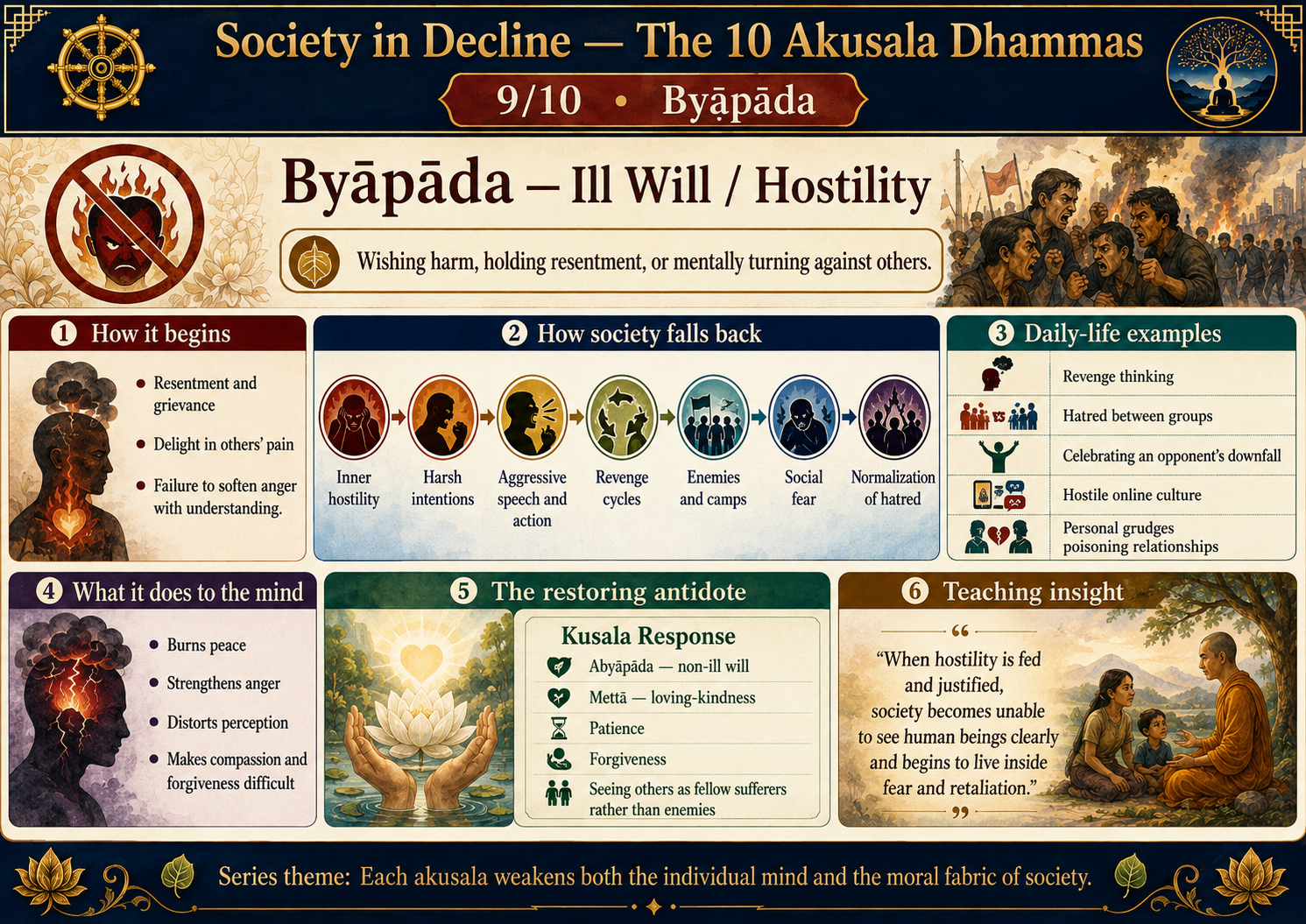
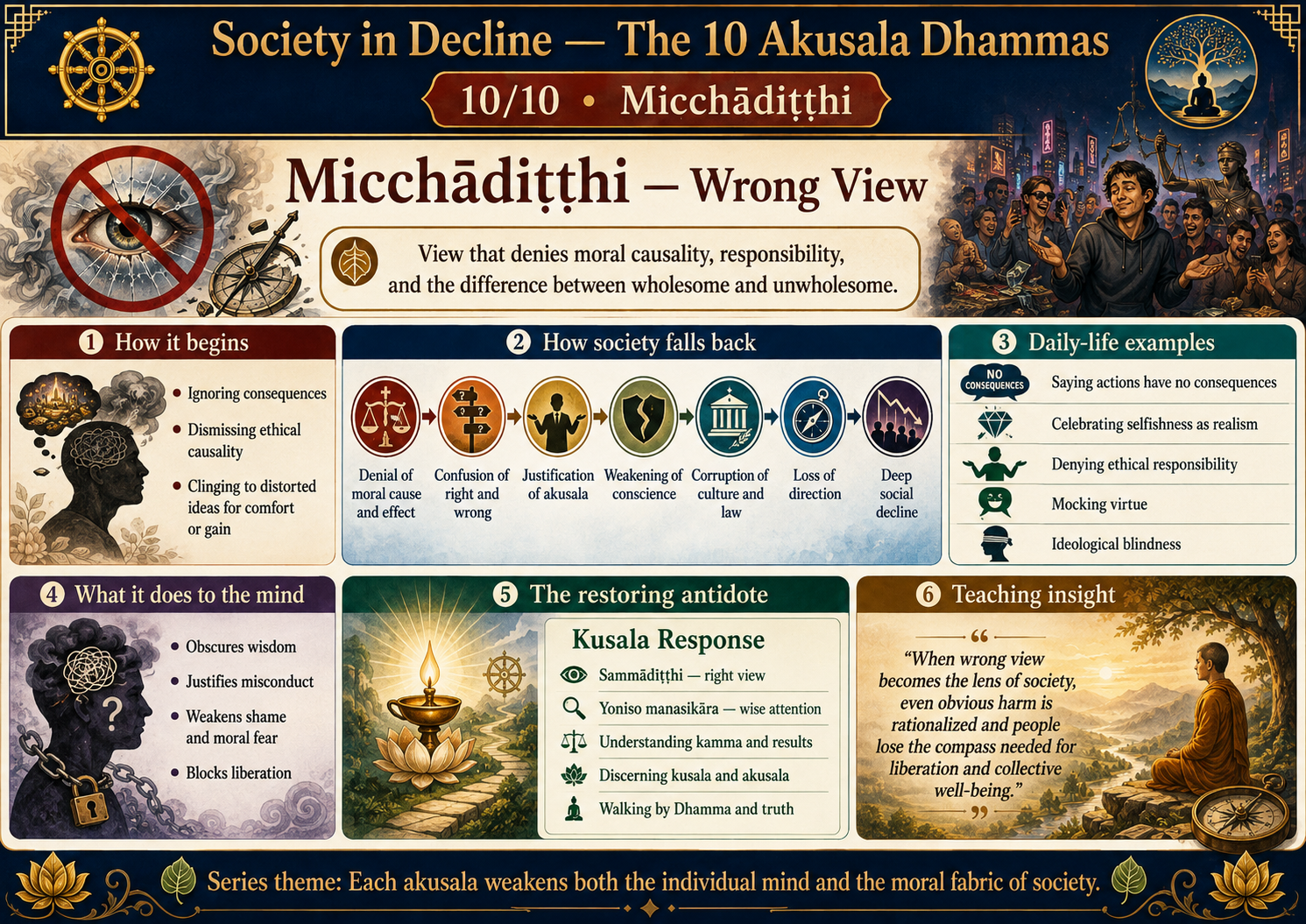
Ten Akusala Kammapathas
DN 26 progressively describes deterioration in bodily conduct, verbal conduct and mental orientation. These ten infographics bring the ten unwholesome pathways together as a visual teaching aid.
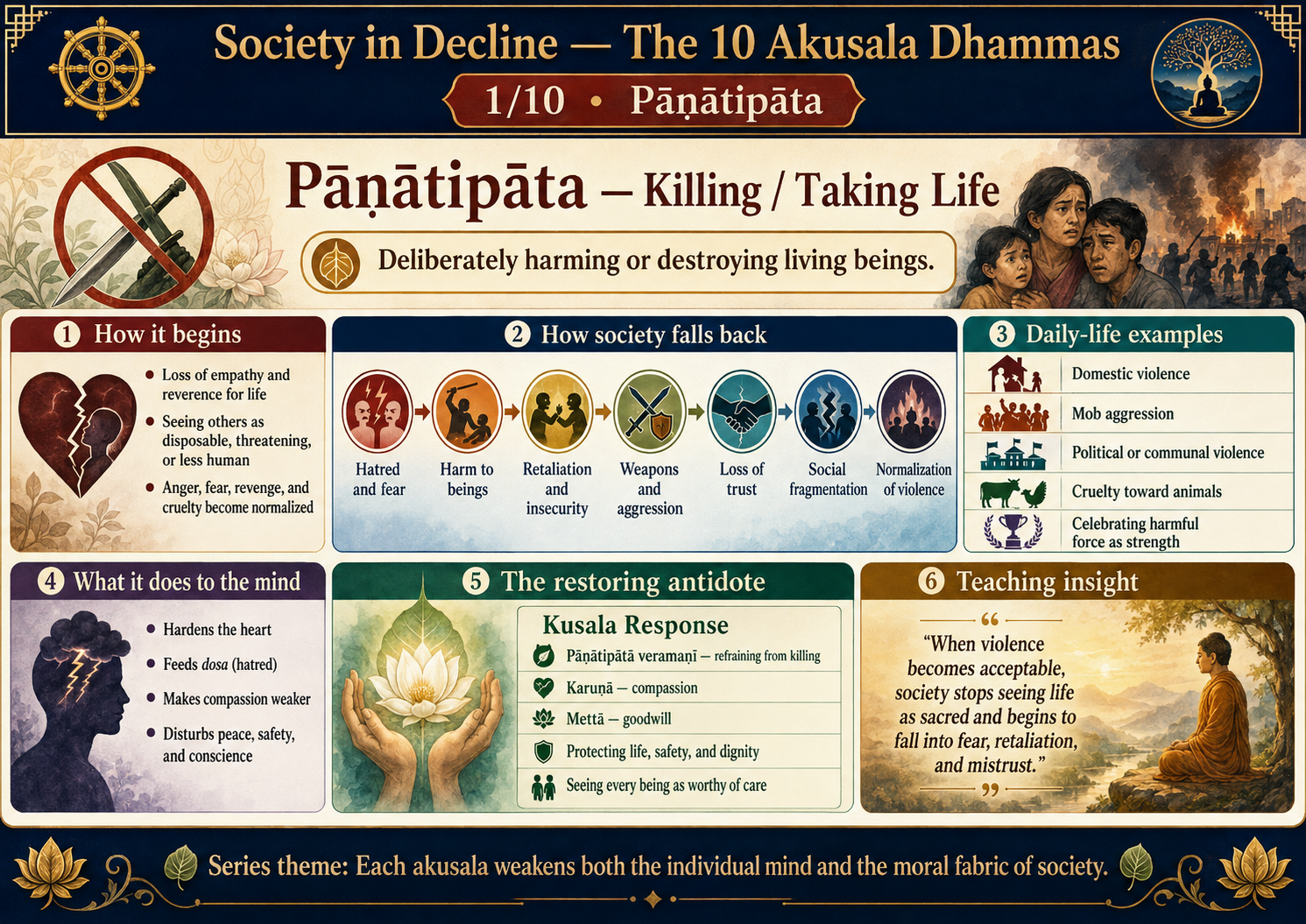

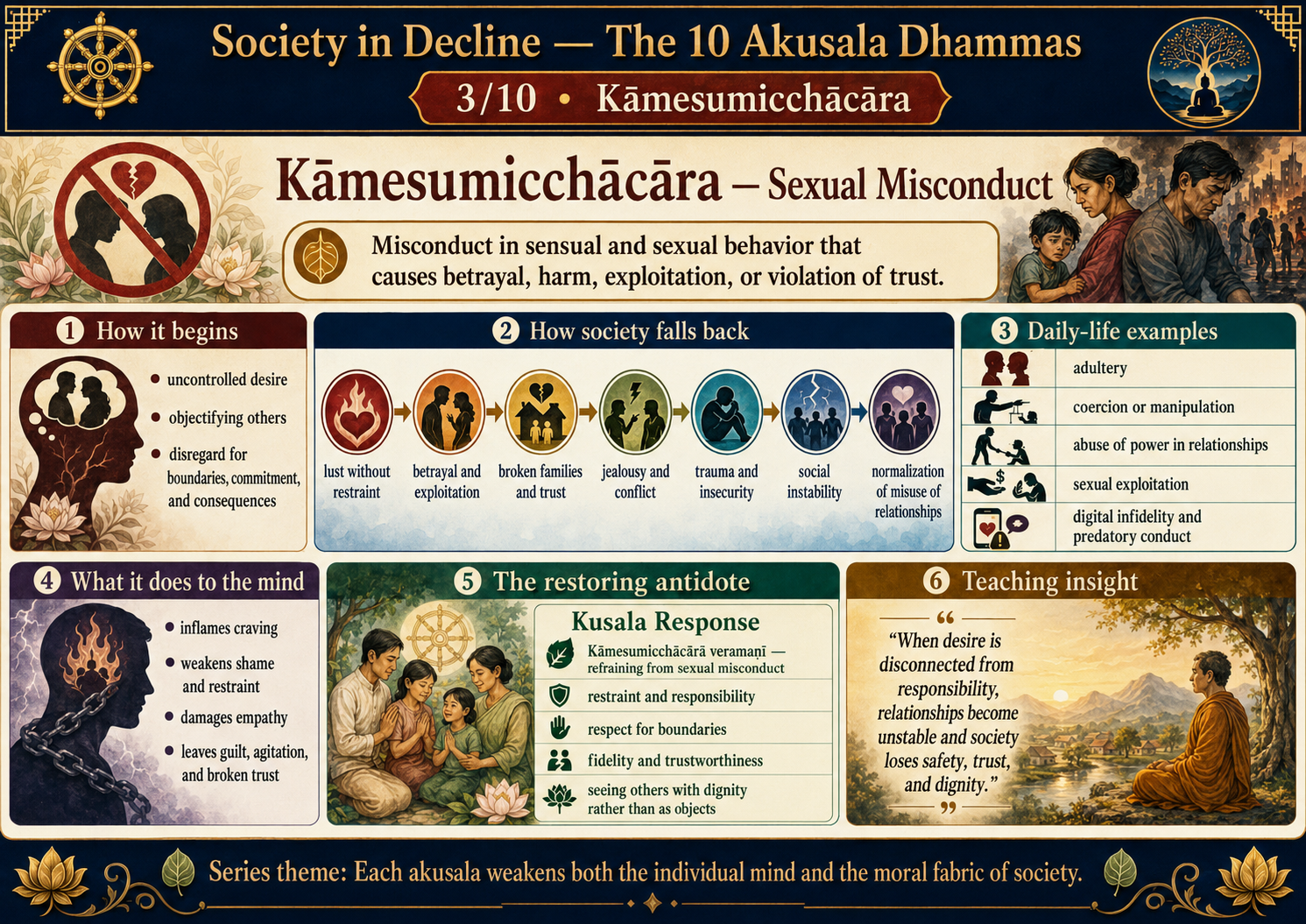
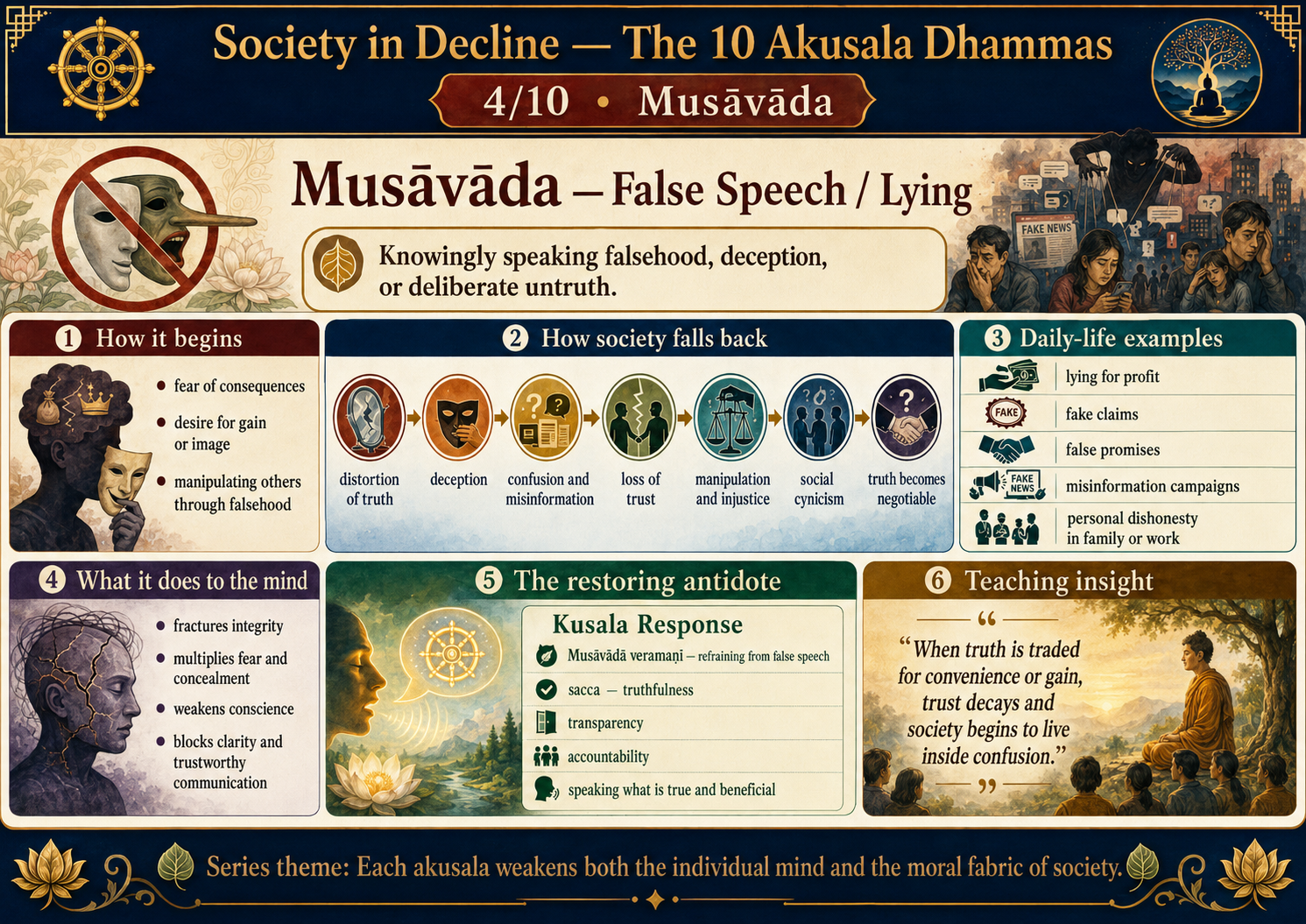
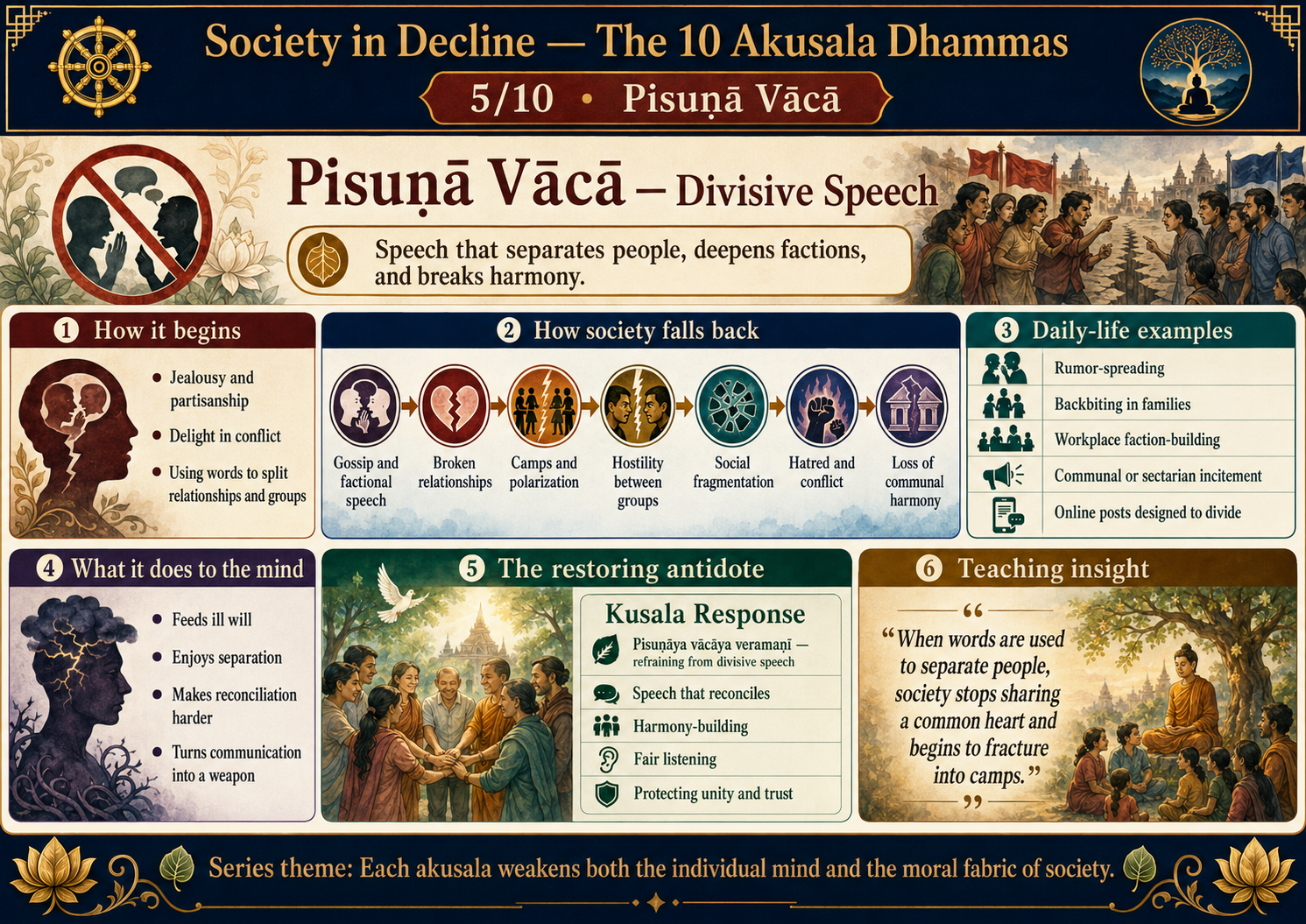
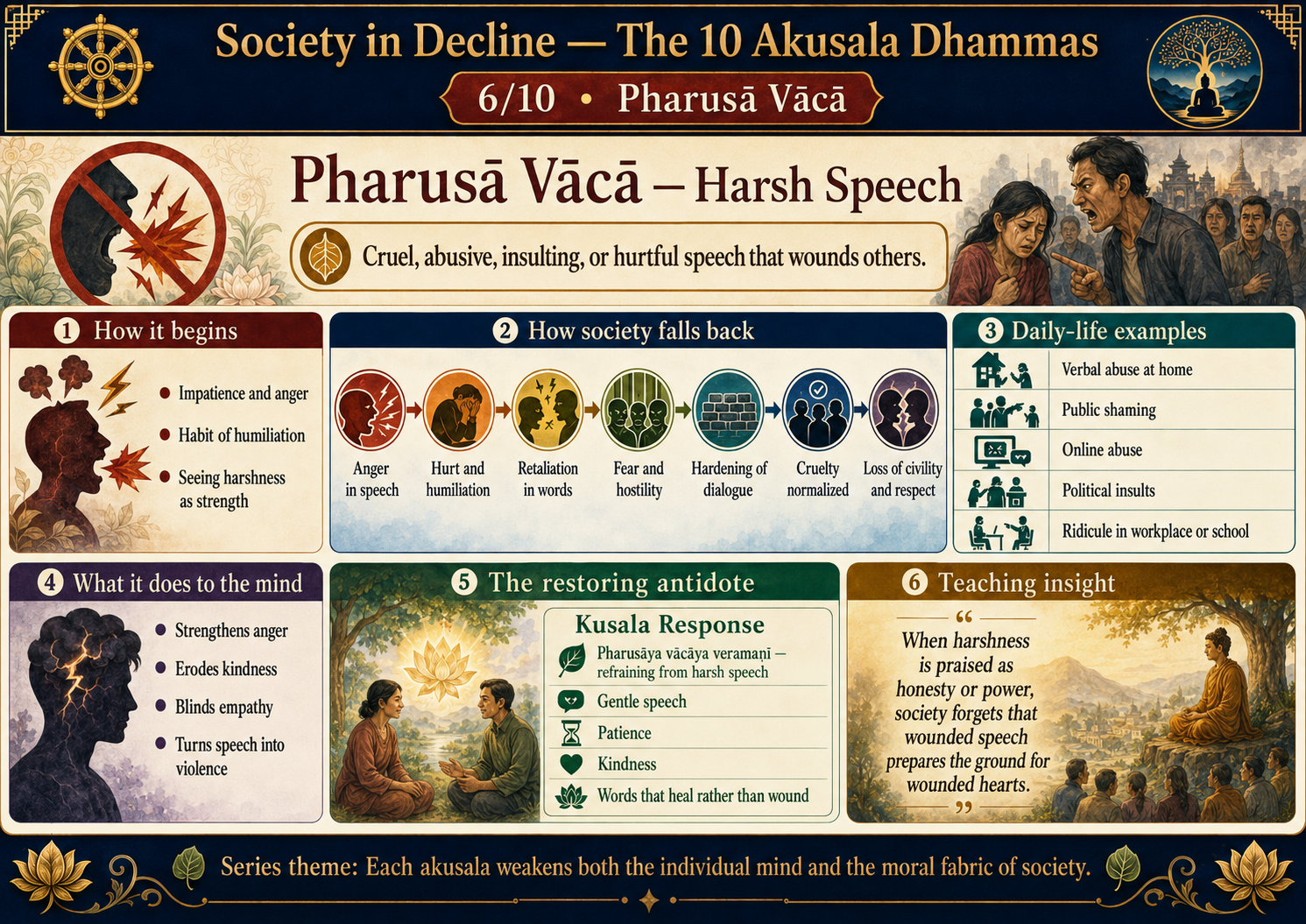
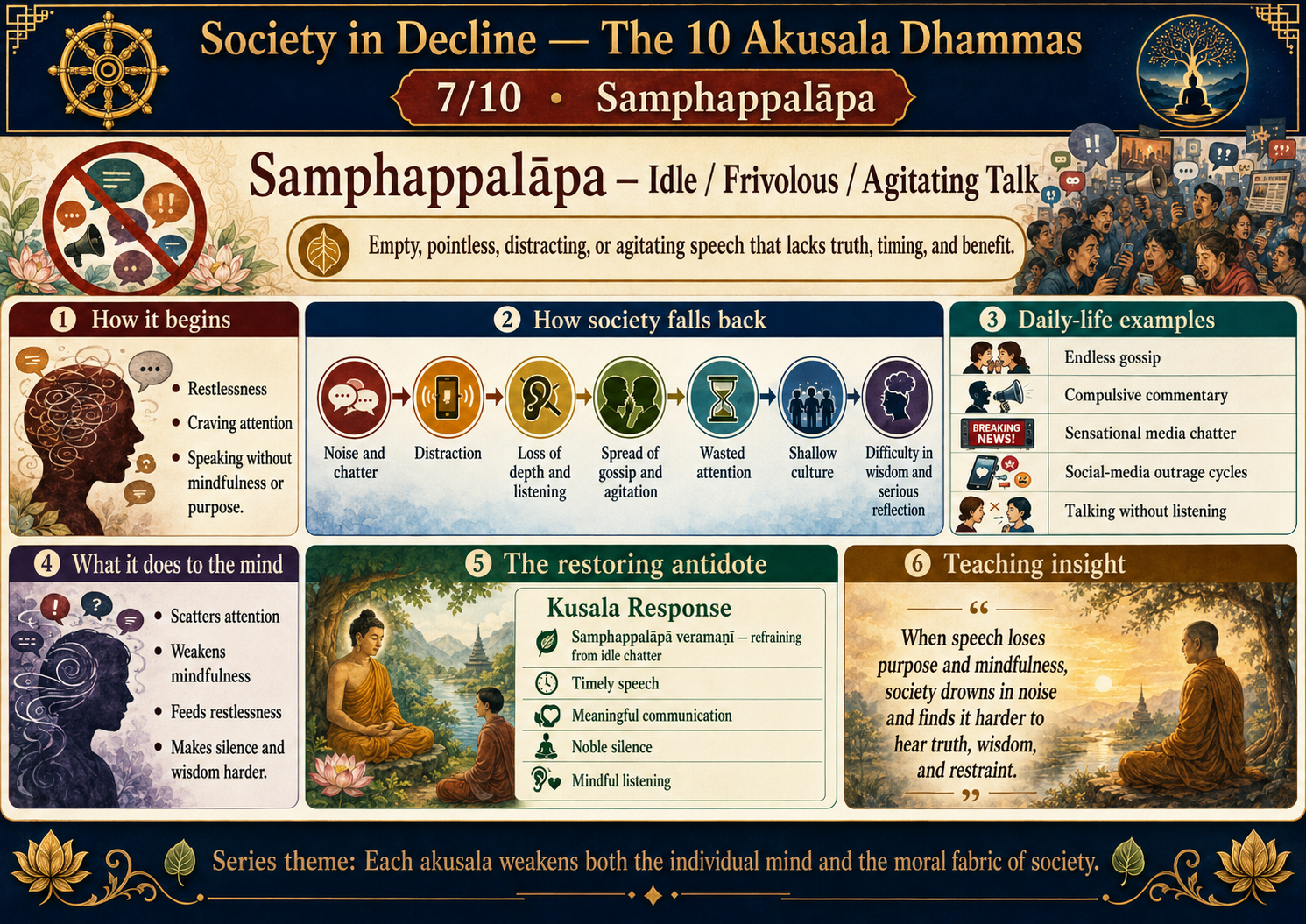
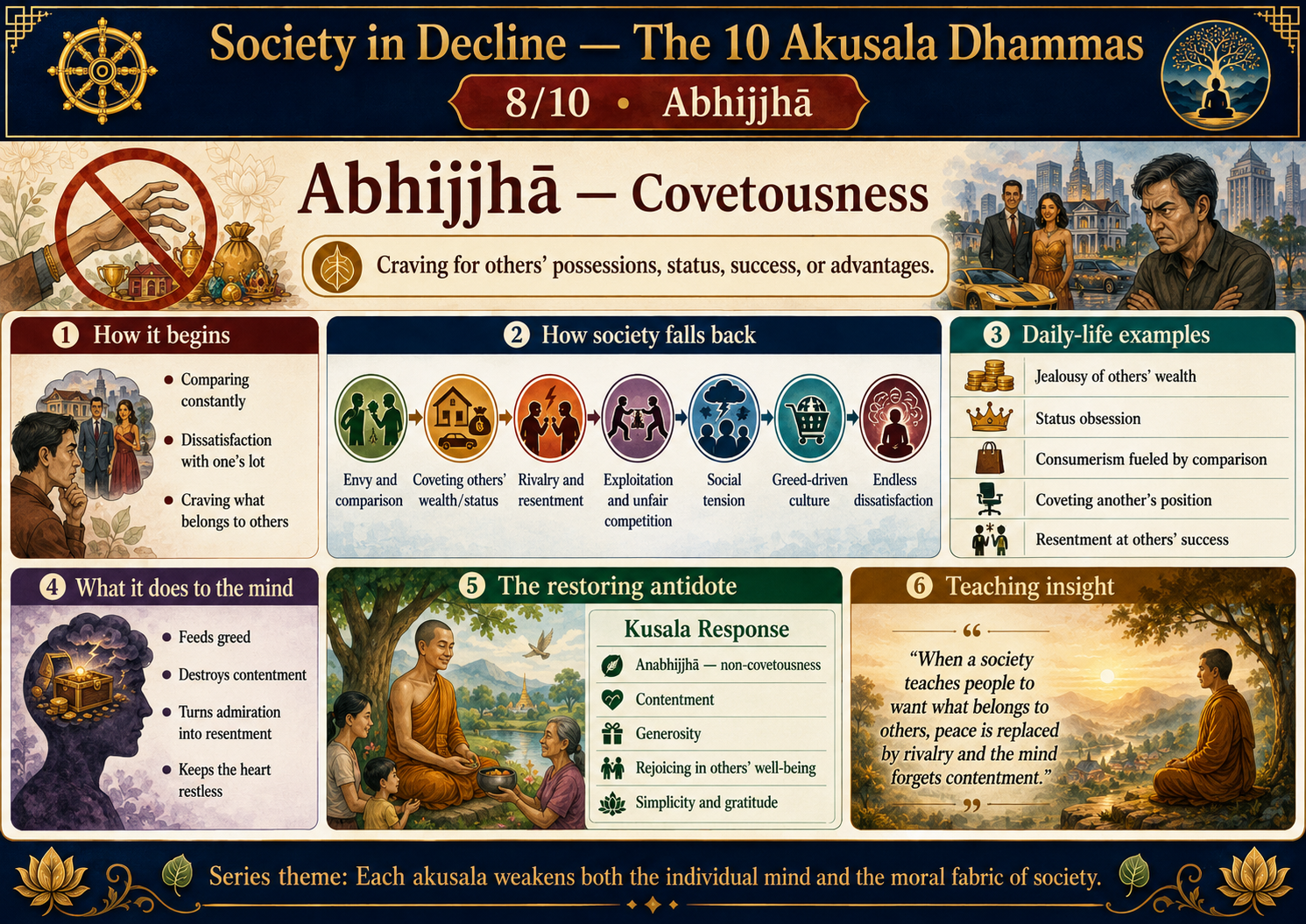
01Attadīpa Is Explicitly Defined by Satipaṭṭhāna
The sutta’s first words after the opening are easily misunderstood if `atta` is read through later philosophical debates. Here the Buddha immediately defines what he means operationally: contemplate body, feelings, mind and dhammas with ardency, sampajañña and sati, having removed covetousness and sadness regarding the world.
So `attadīpa / attasaraṇa` is not a doctrine of an eternal inner Self. Nor is it permission for “whatever I personally feel is true.” The refuge is inseparable from `dhammadīpa / dhammasaraṇa`, and its method is the four satipaṭṭhānas.
The discourse then tells the bhikkhu to remain in the proper `gocara`. This frames everything that follows. The long story of kings and social decline teaches what happens when beings leave the domain of Dhamma and repeatedly undertake akusala.
Today’s / practical examples
Example 1 When anger arises after reading the news, refuge means knowing body, vedanā, citta and dhamma—not instantly joining the outrage stream.
Example 2 When a teacher, political leader or institution fails, `anaññasaraṇa` does not mean rejecting wise guidance; it means liberation cannot be outsourced.
Example 3 When social conditions look unstable, the bhāvanā practitioner returns to the domain that can actually be cultivated now: sati, sampajañña, kusala and restraint.
Practice response
- Before reacting, identify the satipaṭṭhāna doorway.
- Ask whether citta is inside its proper gocara or feeding Māra through abhijjhā/domanassa.
- Use the discourse socially without abandoning its opening and closing bhāvanā frame.
02The Wheel Is Not Inherited — Dhamma Must Be Re-enacted
The former king tells his son that the divine wheel is not a hereditary inheritance: `na … pettikaṁ dāyajjaṁ`. The symbol of righteous sovereignty cannot simply be possessed because one has the title.
The son must enact `ariyaṁ cakkavattivattaṁ`. This is a major theme: wholesome structures survive only when their causes are renewed.
Institutions often inherit names, rituals, constitutions and offices while losing the practices that made them trustworthy. DN 26 dramatizes precisely that gap: title without Dhamma is not enough.
Today’s / practical examples
Example 1 A meditation group inherits a respected lineage name but stops practising the disciplines that gave the lineage credibility.
Example 2 A company has an ethics policy on the wall but rewards conduct that violates it.
Example 3 A government inherits laws and institutions but neglects the actual duties those institutions were meant to perform.
Practice response
- Separate symbol from causal practice.
- Ask: what practices make this institution worthy of its name?
- Renew causes rather than protecting prestige.
03The Noble Duty of Leadership Has Six Interlocking Dimensions
The cakkavatti duty is not reducible to charity. It includes Dhamma as sovereign, protection and security, prevention of adhamma, provision for the destitute, consultation with disciplined contemplatives, and active adoption of kusala.
The striking phrase `dhammādhipateyyo` makes Dhamma—not personal preference—the governing authority.
The leader is also told to ask exceptionally practical questions: What is wholesome/unwholesome? What is blameworthy/blameless? What should be cultivated? What leads to long-term harm or welfare?
This resembles yoniso-style governance: decision-making must look beyond immediate political convenience to causal consequences.
Today’s / practical examples
Example 1 Before implementing a policy, ask not only ‘Will this be popular?’ but ‘What behavior will this reward and normalize?’
Example 2 In a retreat community, provide rules and safety, but also make sure materially vulnerable participants are not simply excluded.
Example 3 A family leader protects, provides where needed, and consults wiser people instead of equating authority with certainty.
Practice response
- Use the six-duty table as a leadership audit.
- Ask the kusala/akusala questions before major decisions.
- Do not separate material welfare from ethical welfare.
04The Critical Failure Is Partial Compliance
The successor eventually asks about the noble duty and implements righteous protection—but omits one clause: he does not provide resources to the destitute.
This is important because the society does not collapse because ‘nothing good is being done.’ It collapses after a partial imitation of Dhamma leaves out a crucial condition.
The teaching is therefore subtler than ‘bad king causes bad society.’ A system can appear orderly while a neglected vulnerability grows underneath it.
The repeated phrase `adhanānaṁ dhane ananuppadiyamāne` becomes the initiating condition in the later summary.
Today’s / practical examples
Example 1 Security spending rises while basic livelihood collapse is ignored.
Example 2 A retreat demands strict discipline but provides no practical support for elderly or sick participants.
Example 3 A workplace enforces compliance tightly while wages or workloads make ordinary life untenable.
Practice response
- Look for omitted conditions, not only visible misconduct.
- Ask what vulnerability the current system leaves structurally untreated.
- Do not confuse enforcement with complete care.
05Poverty Does Not Erase Moral Agency — but Governance Must Address Conditions
The thief says simply: `na hi, deva, jīvāmi`—“I cannot make a living.”
The king’s first response recognizes condition: he gives resources so the man can support himself, parents and family, work, and give.
But the story then introduces a second problem: people learn that theft triggers a reward. The king’s reactive solution swings to the opposite extreme—public execution. That in turn generates weaponization and more lethal theft.
DN 26 therefore avoids a simplistic binary. It neither says ‘punishment alone fixes crime’ nor ‘material assistance alone fixes every incentive.’ It shows how policy responses themselves enter the causal field.
Today’s / practical examples
Example 1 A benefit system can fail if designed so that help arrives only after harmful behavior; good intention does not remove incentive effects.
Example 2 Purely punitive responses can escalate conflict when they address symptoms while leaving underlying conditions and retaliation dynamics untouched.
Example 3 Individual accountability and structural conditions can both matter at the same time.
Practice response
- When responding to misconduct, diagnose upstream conditions and downstream incentives.
- Do not romanticize poverty or criminality.
- Do not assume harsher punishment automatically removes the cause.
06From Weapons to `Migasaññā`: Violence Requires a Perceptual Shift
At the lowest point people acquire `migasaññā` toward one another—perception of the other as a beast or prey.
This is psychologically profound. Before killing becomes ordinary, perception itself changes. Another human is no longer apprehended through kinship, empathy or shared vulnerability but through a category that licenses destruction.
Modern dehumanizing rhetoric is therefore a useful parallel. UNESCO’s current work repeatedly warns that hate speech targets and dehumanizes groups and can fuel polarization and real-world threats.
The sutta’s point is not that every harsh word mechanically causes murder. It is that repeated perception and speech shape what actions become thinkable.
Today’s / practical examples
Example 1 Online labels reduce millions of people to one hated category.
Example 2 In war, propaganda may depict the other side as vermin, disease or animals.
Example 3 In family conflict, a person stops seeing a relative and sees only ‘the enemy.’
Practice response
- Catch dehumanizing labels at the perception stage.
- Replace category-only perception with recognition of living beings subject to suffering.
- Do not forward speech that intensifies `migasaññā`.
07The Decline Is a Kamma-Path Cascade, Not Merely an Economic Story
Although poverty initiates the social decline, the sequence progressively moves through the ten akusala kammapathas: theft, killing, lying, divisive speech, sexual misconduct, harsh speech, pointless chatter, covetousness, ill will and wrong view.
This links DN 26 closely with discourses such as the Cundasutta on the ten kammapathas. Social decline becomes internalized into body, speech and mind.
The culmination is moral inversion: even the concept `kusala` disappears, while disrespect is praised. At that point the problem is no longer only scarcity; the evaluative compass itself has failed.
Today’s / practical examples
Example 1 A culture normalizes lying because ‘everyone does it.’
Example 2 Cruel speech is praised as strength, while restraint is mocked as weakness.
Example 3 Constant distraction and empty commentary become the default mode of public discourse.
Practice response
- Track the cascade in your own day: body → speech → mind → view.
- Notice when akusala is being renamed as virtue.
- Protect sammādiṭṭhi because wrong view authorizes the rest.
08Contemporary Social Protection Is a Useful Parallel—Not a Proof Text
The 2025 World Bank State of Social Protection report says around two billion people in low- and middle-income countries remain inadequately covered, with particularly large gaps in fragile and hunger-affected regions.
This makes DN 26’s inclusion of `adhanānaṁ dhanamanuppadeyyāsi` remarkably relevant as a teaching question: can a society call itself protected if destitution is structurally ignored?
But a responsible teaching aid must not overclaim. Modern crime, poverty and violence arise through many interacting variables. The sutta gives a moral narrative about conditional social decline; it is not a regression model.
Its enduring value is the causal habit it teaches: ask what conditions are being produced upstream before only punishing downstream behavior.
Today’s / practical examples
Example 1 A city spends heavily on enforcement while homelessness, addiction and livelihood collapse remain untreated.
Example 2 A workplace punishes low performance without examining impossible workloads or inadequate training.
Example 3 A family condemns a young person’s behavior without noticing the deprivation, neglect or modeled conduct feeding it.
Practice response
- Use modern data to illuminate, not to ‘prove’ the sutta.
- Keep multiple causation in view.
- Ask which upstream conditions are ethically actionable.
09The Sword Interval Is the Collapse of Social Recognition
The seven-day `satthantarakappa` is the narrative extreme: human beings see one another through `migasaññā` and kill indiscriminately.
The deepest loss is not technological. They already had weapons earlier. The decisive collapse is relational and perceptual: kinship itself no longer restrains hatred.
The sutta explicitly says murderous hostility appears even between parent and child and between siblings. The social world has lost the categories that once limited aggression.
This is why the earlier stages—speech, greed, ill will, view, respect—matter. Catastrophic violence is shown as a late manifestation of a long moral ecology.
Today’s / practical examples
Example 1 A conflict escalates when family, ethnic, religious or political identity becomes less important than the label ‘enemy.’
Example 2 Repeated revenge cycles erase memory of the original grievance and preserve only reciprocal threat.
Example 3 Digital outrage can train instant enemy-perception even when no direct harm has occurred.
Practice response
- Do not wait for gross violence to begin restraint.
- Treat byāpāda and divisive speech as early-warning signals.
- Restore human recognition before arguing about positions.
10Recovery Begins With Moral Recognition, Not a New Ruler
After surviving the catastrophe, people themselves reflect: `mayaṁ kho akusalānaṁ dhammānaṁ samādānahetu…`—because of undertaking unwholesome dhammas we came to this destruction.
This is one of the most important lines in the sutta. Recovery begins with causal ownership.
They do not first wait for King Saṅkha or Buddha Metteyya. They begin with the most basic kusala: abstain from killing.
Only after repeated moral recovery and increasing wholesome pathways does the later flourishing society, King Saṅkha and Metteyya appear.
Today’s / practical examples
Example 1 A community stops a revenge cycle by mutually agreeing first to stop violence, before solving every dispute.
Example 2 A person rebuilding after addiction begins with one concrete restraint before reconstructing the whole life.
Example 3 An organization admits ‘our incentives produced this behavior’ instead of merely replacing one employee.
Practice response
- Name the akusala that has been repeatedly undertaken.
- Choose the first irreversible harm to stop.
- Expand kusala gradually and consistently.
11Metteyya Is Situated After the Recovery, Not as an Escape From It
The future Buddha Metteyya appears in a world that has already undergone a long moral recovery.
This matters for practice. The sutta does not encourage passive waiting for a future Buddha to repair a degraded world. The causal work precedes his arising in the narrative.
When Metteyya appears, he performs the fully awakened Buddha’s function: directly knows and proclaims Dhamma, teaches a complete spiritual life, and leads a large Saṅgha.
King Saṅkha then gives away wealth and goes forth, eventually realizing the goal.
Today’s / practical examples
Example 1 Future hope becomes unwholesome if it excuses present misconduct.
Example 2 A practitioner cannot postpone sīla because ‘the next retreat/teacher will fix me.’
Example 3 Social renewal cannot be outsourced to one charismatic leader.
Practice response
- Treat future Metteyya as part of the sutta’s long moral horizon, not an avoidance of present practice.
- Do today’s kusala first.
- Keep liberation—not utopian prosperity—as the final aim.
12The Sutta Returns to Satipaṭṭhāna After the Entire Cosmic-Social Story
Immediately after the Metteyya/Saṅkha account, the Buddha repeats `attadīpā … dhammadīpā` and again defines it through the four satipaṭṭhānas.
This literary return is crucial. A reader can become fascinated with predictions, lifespans, future cities and political symbolism and miss the instruction addressed to the bhikkhus.
The answer is: return to your proper gocara.
The sutta’s grand historical arc should strengthen practice of kāya, vedanā, citta and dhamma—not become another field for speculation and identity.
Today’s / practical examples
Example 1 A Dhamma discussion spends two hours calculating when Metteyya will appear and no time examining present byāpāda.
Example 2 Someone uses the sutta only to criticize governments while ignoring harsh speech at home.
Example 3 A practitioner turns future cosmology into entertainment rather than heedfulness.
Practice response
- After every social analysis, return to satipaṭṭhāna.
- Ask: what in my citta is the same causal pattern right now?
- Do not let prophecy replace bhāvanā.
13The Buddha Redefines Growth for the Bhikkhu
The final section transforms ordinary terms.
The bhikkhu’s `āyu` is the four iddhipādas. The bhikkhu’s `vaṇṇa` is sīla. The bhikkhu’s `sukha` is the four jhānas. The bhikkhu’s `bhoga` is the four immeasurable brahmavihāras. The bhikkhu’s `bala` is liberation through destruction of the āsavas.
This is a radical revaluation. The social story discussed material wealth, lifespan, beauty and power; the final section tells the renunciant what these words should mean within the Dhamma.
The culmination is not a prosperous kingdom but `anāsava cetovimutti paññāvimutti`.
Today’s / practical examples
Example 1 A practitioner measuring ‘wealth’ by retreat facilities has missed the closing definition.
Example 2 Meditative happiness is evaluated by jhāna rather than continuous sensual gratification.
Example 3 Strength is not dominance over others but freedom from the āsavas.
Practice response
- Use the five-growth table as a monthly assessment.
- Do not import worldly metrics into monastic/bhāvanā success.
- Keep āsavakkhaya as the final criterion.
14A Leadership and Community Practice Audit
DN 26 can be used responsibly as a practical audit for families, communities, organizations and public leadership.
The key is not to claim that a modern state must literally imitate ancient monarchy. Instead extract the causal questions the Buddha’s narrative makes explicit: – What is the governing standard? – Who is protected? – Who is materially abandoned? – What behavior do rewards and punishments incentivize? – Is wise ethical counsel sought? – What forms of speech and perception are becoming normal? – Are kusala pathways being strengthened or ridiculed?
This turns the sutta into a teaching aid without converting it into partisan policy advocacy.
Today’s / practical examples
Example 1 Retreat management: are rules fair, vulnerable people supported, and teachers open to correction?
Example 2 Business: do incentives reward dishonesty while the code of conduct condemns it?
Example 3 Family: does punishment escalate while the unmet cause of repeated misconduct remains untouched?
Practice response
- Run the six-duty leadership table quarterly.
- Map one current problem through upstream conditions and incentive effects.
- Ask both structural and personal kamma questions.
15Personal Practice: Find the Social Cascade Inside One Citta
The social cascade can be miniaturized into a single day.
A sense of deprivation can become coveting. Coveting can become appropriation. Fear of being exposed can produce lying. Lying produces further defensive speech. Conflict produces harshness and ill will. Repetition produces a view: ‘This is justified.’
The same architecture that the sutta dramatizes over generations can therefore be used as a real-time practice map.
This does not mean every personal episode literally begins with poverty. It means the practitioner learns to see how one unaddressed condition can feed the next akusala dhamma.
Today’s / practical examples
Example 1 You want recognition → take credit → lie when questioned → attack the colleague who challenges you → justify it as necessary politics.
Example 2 You feel deprived of affection → covet another relationship → conceal → lie → become hostile toward anyone who threatens exposure.
Example 3 You feel economically insecure → begin rationalizing small dishonesty → repeated justification changes view.
Practice response
- Catch the earliest condition you can see.
- Break the chain before it reaches speech/action.
- Review which kusala pathway would reverse it.
Addendum — Contemporary Relevance
Using DN 26 as a Diagnostic Framework for Society Today
If the Cakkavatti-Sīhanāda Sutta is used as a diagnostic framework rather than forced into a literal prediction of current events, its relevance is not confined to one country, political system, religion, ideology, or continent.
Important interpretive guardrail: We should not say, “DN 26 proves that the present world is exactly at this predicted stage.” The sutta is not a modern statistical model, and current societies have many interacting causes. What we can legitimately do is use the causal mechanisms and ethical measurements described in DN 26 to examine recurring patterns of human conduct.
01DN 26 describes a feedback process, not an isolated moral failure
The deterioration does not begin with everyone suddenly becoming immoral. The decisive failure is a neglected responsibility: the ruler establishes protection but does not provide resources to the destitute. The sutta then presents a cumulative sequence in which one condition becomes nutriment for the next:
Seen this way, DN 26 is not merely describing “bad individuals.” It examines how leadership decisions, material conditions, incentives, conduct, speech, perception and view can begin reinforcing one another.
02This is not fundamentally an Eastern, Western, religious or political problem
The outward identity around which conflict forms can differ enormously: religion, race, ethnicity, nationality, language, class, immigration, political ideology, economic status, caste, sect, region, or some new identity created by circumstances.
But a broader Dhamma lens repeatedly finds familiar mental dynamics underneath these different forms:
Textual distinction: DN 26 itself explicitly names many of the later items in its decline sequence—such as musāvāda, pisuṇā vācā, abhijjhā, byāpāda and micchādiṭṭhi. Lobha, dosa, moha, māna and macchariya are used here as a broader Nikāya/Dhamma diagnostic lens, not as a claim that DN 26 lists those exact terms at this point.
03The danger of “our side” and “their side”
Political, religious and social movements can organize identity around a psychologically powerful construction:
Once identification becomes strong enough, the same act can be condemned when performed by an opposing group but excused when performed by one’s own group.
This makes DN 26 useful as a non-partisan teaching tool. Instead of beginning with the label of the group, begin with the quality of the action, speech, intention and view.
04A simple “Cakkavatti diagnostic” for any society
Without first asking who governs, which ideology is dominant, or what religious label a society uses, ask whether these pathways are becoming stronger or weaker:
| Diagnostic question | Dhamma direction | What to observe |
|---|---|---|
| Is killing or normalized violence increasing or decreasing? | pāṇātipāta | Physical violence, cruelty, celebration of killing, willingness to harm. |
| Is taking what is not given becoming accepted or rationalized? | adinnādāna | Theft, exploitation, corruption, appropriation, dishonest gain. |
| Is harmful sexual conduct becoming normalized? | kāmesumicchācāra | Betrayal, exploitation, coercion and disregard for protected relationships. |
| Is deliberate falsehood increasingly rewarded? | musāvāda | Knowing distortion, propaganda, deception and strategic lying. |
| Is speech that divides people rewarded? | pisuṇā vācā | Speech designed to split communities and harden factions. |
| Is harsh speech celebrated as strength? | pharusā vācā | Humiliation, verbal aggression and cruelty becoming socially prestigious. |
| Is meaningless or agitating discourse overwhelming attention? | samphappalāpa | Noise, gossip, compulsive commentary and agitation without benefit. |
| Is craving for others’ wealth, status or advantages increasing? | abhijjhā | Covetous comparison and acquisitive preoccupation. |
| Is hostility toward other people or groups increasing? | byāpāda | Resentment, wishes for harm, demonization and vengeance. |
| Are conduct and consequences increasingly disconnected in people’s understanding? | micchādiṭṭhi | Views that deny or obscure ethical causality and responsibility. |
Ask instead: “Are kusala dhammas increasing, or are akusala dhammas increasing?”
05Governance and individual responsibility are not opposites in DN 26
The sutta avoids two simplistic explanations:
DN 26 instead gives a reciprocal picture:
This helps explain why moral decline can eventually become difficult to recognize. One generation condemns a form of conduct; another tolerates it; a later generation may celebrate it. At the extreme described in DN 26, even the ordinary moral category “kusala” disappears from social recognition and what was formerly shameful becomes praised.
06`Migasaññā` — the collapse of how human beings perceive one another
The terrifying culmination is not merely economic collapse or political disorder. People acquire migasaññā toward one another and kill while crying:
The deepest collapse is therefore perceptual: another person ceases to appear primarily as a living being and is instead apprehended as an enemy, threat, evil category, or something to be eliminated.
This is why contemporary religious hatred, racial hatred, ethnic hatred, political hatred and extreme nationalism can be examined fruitfully through DN 26—not by claiming they are identical to the satthantarakappa, but by asking whether speech and perception are moving toward dehumanization, hostility and loss of social recognition.
Contemporary reality check — illustrative, not proof of the sutta
- The World Bank’s State of Social Protection Report 2025 reports that about 2 billion people across low- and middle-income countries remain uncovered or inadequately covered by social protection, with the largest gaps among poorer and fragile populations.
- UNESCO’s 2026 work on countering hate speech notes that online hate speech can spread rapidly through digital platforms, undermine trust and social cohesion, deepen polarization, and fuel tensions.
These observations make DN 26’s questions about material vulnerability, divisive speech and dehumanizing perception highly relevant, while still leaving modern causation to be studied on its own evidence.
07The most important part: the reversal does not wait for a perfect political system
The survivors eventually recognize that they reached catastrophe through repeatedly undertaking akusala:
“Enough. We will not continue this.”
This is one of the most hopeful teachings in DN 26. Collective recovery starts when individuals refuse to continue feeding the destructive pattern.
Religious identity without transformation of conduct is insufficient.
Economic prosperity without transformation of conduct is insufficient.
The Dhamma measurement remains: What is happening to citta? Are greed, hostility and delusion being strengthened—or weakened?
08Why DN 26 continues to speak across countries and continents
Political systems, borders, technologies, economic models and religious identities change. The outward form of conflict changes. But the human capacity for craving, hostility, falsehood, divisive speech, rigid views, dehumanization—and also for restraint, generosity, truthfulness, mettā and wisdom—remains recognizable.
Used carefully, DN 26 therefore becomes neither a partisan weapon nor a simplistic prediction. It becomes a Dhamma diagnostic:
That last question returns the addendum to the framing of the sutta itself: attadīpa, dhammadīpa, satipaṭṭhāna and proper gocara. Social analysis is useful only if it also becomes a mirror for one’s own citta and conduct.
| Section | Core teaching | Practice takeaway |
|---|---|---|
| Opening refuge | Attadīpa + Dhammadīpa = four satipaṭṭhānas | Begin with direct practice, not dependence on external saviors. |
| Proper domain | Sake pettike gocare | Māra finds no opening when citta remains in its proper Dhamma field. |
| Good governance | Dhamma sovereign + protection + support of destitute + wise counsel | Ethical leadership must address both conduct and material vulnerability. |
| Failure point | Support for destitute omitted | A single neglected condition can destabilize an otherwise functioning system. |
| Decline | Poverty → theft → weaponization → killing → speech/mind/view deterioration | Akusala becomes a culture, not just isolated acts. |
| Lowest point | Migasaññā + murderous intent | Dehumanization precedes indiscriminate violence. |
| Recovery | Recognize akusala → undertake kusala beginning with non-killing | Moral restoration is voluntary, causal and incremental. |
| Metteyya | Appears after long recovery | Future Buddha is not a substitute for present kusala. |
| Return to refuge | Attadīpa + Dhammadīpa repeated | The bhikkhu is brought back to satipaṭṭhāna. |
| True growth | Iddhipāda, sīla, jhāna, brahmavihāra, āsavakkhaya | The final standard is internal Dhamma wealth and liberation. |
DN 26 moves on two levels at once. Socially, it shows how neglected conditions, badly designed responses, body-speech-mind akusala and corrupted view can accumulate into a culture of violence—and how the process can reverse through deliberate kusala. For the bhikkhu, however, the discourse begins and ends at the same place: attadīpa → dhammadīpa → four satipaṭṭhānas → proper gocara → cultivation of wholesome dhammas → iddhipāda, sīla, jhāna, brahmavihāra → āsavakkhaya. The final victory is not political domination but liberation from Māra’s power.