Sixteen Gateways to Sammādiṭṭhi
Know the dhamma. Know its arising. Know its cessation. Know the Noble Eightfold Path leading to cessation.
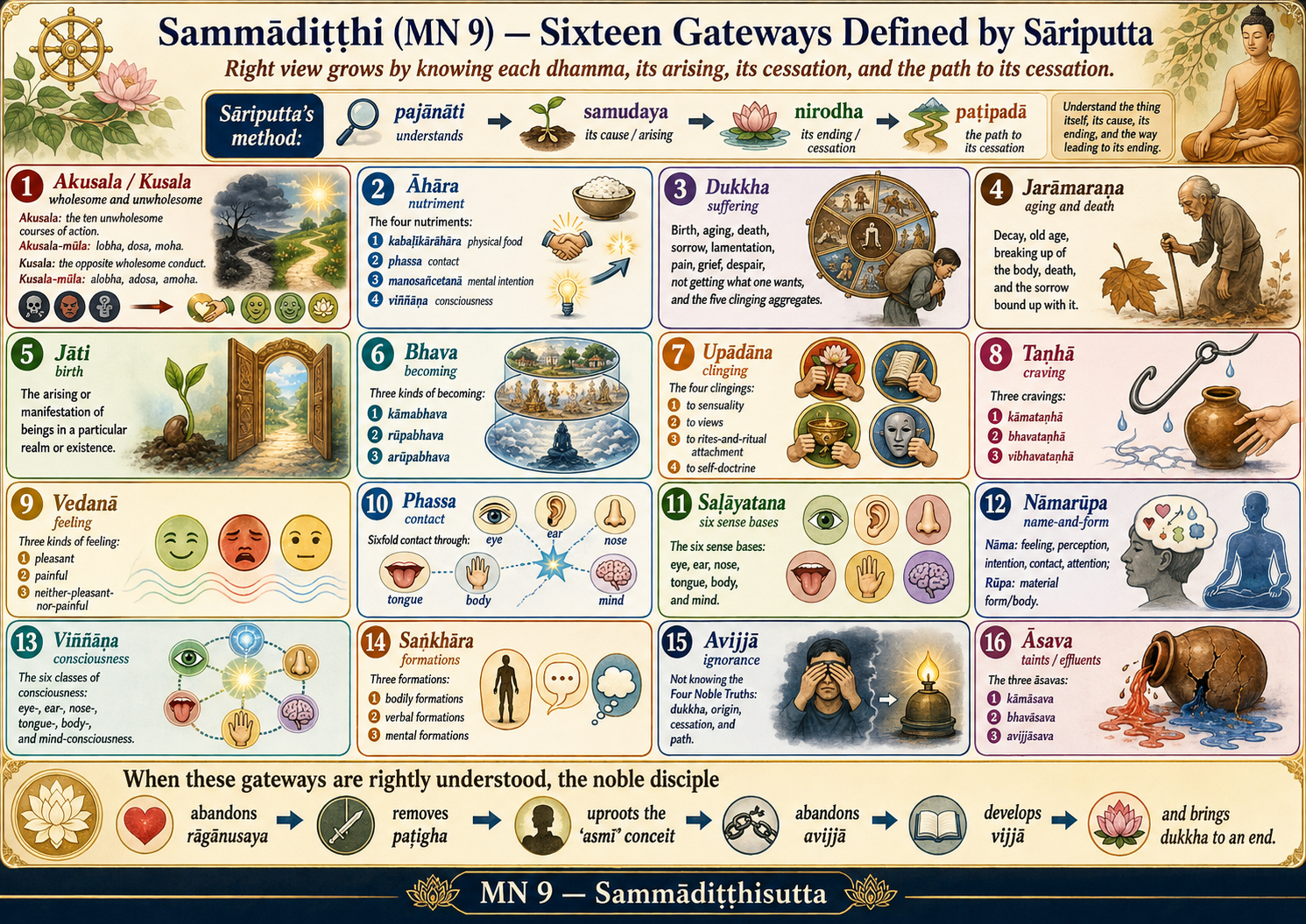 VISUAL SUMMARYSee this sutta in a pictureOpen the complete infographic for a visual overview before or after reading the full study.View infographic →
Right view is trained through a fourfold investigation
Why this discourse is a major training aid. Sāriputta does not define right view as the possession of one correct philosophical statement. Across sixteen gateways he repeatedly trains the noble disciple to understand a dhamma, its arising, its cessation and the Noble Eightfold Path leading to cessation. Each section culminates in the same liberation refrain: the underlying tendencies to lust and aversion are removed, the “I am” view-and-conceit tendency is uprooted, ignorance is abandoned, true knowledge arises and dukkha is ended here and now.
Sixteen gateways — one repeated way of knowing
| # | Gateway | What is investigated |
|---|---|---|
| 1 | Akusala / Kusala | Know deeds and their roots |
| 2 | Āhāra | Four nutriments; taṇhā as origin |
| 3 | Dukkha | Four Noble Truths explicitly |
| 4 | Jarāmaraṇa | Conditioned by jāti |
| 5 | Jāti | Conditioned by bhava |
| 6 | Bhava | Kāma, rūpa, arūpa; conditioned by upādāna |
| 7 | Upādāna | Four clingings; conditioned by taṇhā |
| 8 | Taṇhā | Six cravings; conditioned by vedanā |
| 9 | Vedanā | Six contact-born feelings |
| 10 | Phassa | Six contacts |
| 11 | Saḷāyatana | Six internal bases |
| 12 | Nāmarūpa | Nāma fivefold + rūpa |
| 13 | Viññāṇa | Six consciousness classes |
| 14 | Saṅkhāra | Body, verbal, mental formations |
| 15 | Avijjā | Not knowing the Four Noble Truths |
| 16 | Āsava | Kāma, bhava, avijjā; reciprocal loop |
The repeated liberation refrain
rāgānusaya pahāna → paṭighānusaya paṭivinodana → “asmī” diṭṭhi-mānānusaya samūhanana → avijjā pahāna → vijjā uppāda → diṭṭheva dhamme dukkhassantakaro. Right view is therefore tested by release from the underlying tendencies and self-making—not merely by doctrinal agreement.
The closing feedback loop
kāma • bhava • avijjā ⇄ Avijjā
not knowing the Four Noble Truths
MN 9 presents avijjā and āsava as mutually conditioning in the closing analysis, with the Noble Eightfold Path given as the way leading to cessation.
From akusala and kusala to the ending of avijjā and āsava
01Opening: What Is Sammādiṭṭhi?
Evaṁ me sutaṁ— ekaṁ samayaṁ bhagavā sāvatthiyaṁ viharati jetavane anāthapiṇḍikassa ārāme. Tatra kho āyasmā sāriputto bhikkhū āmantesi: “āvuso bhikkhave”ti.
Thus have I heard. On one occasion the Blessed One was staying at Sāvatthī in Jeta’s Grove, Anāthapiṇḍika’s monastery. There Venerable Sāriputta addressed the bhikkhus: “Friends, bhikkhus.”
“Āvuso”ti kho te bhikkhū āyasmato sāriputtassa paccassosuṁ. Āyasmā sāriputto etadavoca:
“Friend,” those bhikkhus replied to Venerable Sāriputta. Venerable Sāriputta said this:
“‘Sammādiṭṭhi sammādiṭṭhī’ti, āvuso, vuccati. Kittāvatā nu kho, āvuso, ariyasāvako sammādiṭṭhi hoti, ujugatāssa diṭṭhi, dhamme aveccappasādena samannāgato, āgato imaṁ saddhamman”ti?
Textual variant: sammādiṭṭhi → sammādiṭṭhī (bj, sya-all)
“Friends, people speak of ‘right view, right view.’ To what extent is a noble disciple one of right view, whose view is straight, who is endowed with confirmed confidence in the Dhamma, and who has arrived at this true Dhamma?”
“Dūratopi kho mayaṁ, āvuso, āgaccheyyāma āyasmato sāriputtassa santike etassa bhāsitassa atthamaññātuṁ. Sādhu vatāyasmantaṁyeva sāriputtaṁ paṭibhātu etassa bhāsitassa attho. Āyasmato sāriputtassa sutvā bhikkhū dhāressantī”ti.
“Friend, we would come even from far away to Venerable Sāriputta to understand the meaning of this statement. It would be good if Venerable Sāriputta himself would clarify its meaning. Having heard it from him, the bhikkhus will remember it.”
“Tena hi, āvuso, suṇātha, sādhukaṁ manasi karotha, bhāsissāmī”ti.
“Then listen, friends, attend carefully, and I will speak.”
“Evamāvuso”ti kho te bhikkhū āyasmato sāriputtassa paccassosuṁ. Āyasmā sāriputto etadavoca:
“Yes, friend,” the bhikkhus replied. Venerable Sāriputta said:
02Gateway 1 — Akusala, Kusala and Their Roots
“Yato kho, āvuso, ariyasāvako akusalañca pajānāti, akusalamūlañca pajānāti, kusalañca pajānāti, kusalamūlañca pajānāti— ettāvatāpi kho, āvuso, ariyasāvako sammādiṭṭhi hoti, ujugatāssa diṭṭhi, dhamme aveccappasādena samannāgato, āgato imaṁ saddhammaṁ.
“When a noble disciple understands the unwholesome, understands the root of the unwholesome, understands the wholesome, and understands the root of the wholesome—even to this extent a noble disciple is one of right view, whose view is straight, who has confirmed confidence in the Dhamma, and who has arrived at this true Dhamma.”
Katamaṁ panāvuso, akusalaṁ, katamaṁ akusalamūlaṁ, katamaṁ kusalaṁ, katamaṁ kusalamūlaṁ? Pāṇātipāto kho, āvuso, akusalaṁ, adinnādānaṁ akusalaṁ, kāmesumicchācāro akusalaṁ, musāvādo akusalaṁ, pisuṇā vācā akusalaṁ, pharusā vācā akusalaṁ, samphappalāpo akusalaṁ, abhijjhā akusalaṁ, byāpādo akusalaṁ, micchādiṭṭhi akusalaṁ— idaṁ vuccatāvuso akusalaṁ.
Textual variant: pharusā vācā → pharusavācā (mr) | pisuṇā vācā → pisuṇavācā (mr)
“And what, friends, is the unwholesome, what is its root, what is the wholesome, and what is its root? Killing living beings is unwholesome; taking what is not given is unwholesome; sexual misconduct is unwholesome; false speech is unwholesome; divisive speech is unwholesome; harsh speech is unwholesome; idle chatter is unwholesome; covetousness is unwholesome; ill will is unwholesome; wrong view is unwholesome. This is called the unwholesome.”
Katamañcāvuso, akusalamūlaṁ? Lobho akusalamūlaṁ, doso akusalamūlaṁ, moho akusalamūlaṁ— idaṁ vuccatāvuso, akusalamūlaṁ.
“And what is the root of the unwholesome? Greed is a root of the unwholesome, hatred is a root of the unwholesome, and delusion is a root of the unwholesome. This is called the root of the unwholesome.”
Katamañcāvuso, kusalaṁ? Pāṇātipātā veramaṇī kusalaṁ, adinnādānā veramaṇī kusalaṁ, kāmesumicchācārā veramaṇī kusalaṁ, musāvādā veramaṇī kusalaṁ, pisuṇāya vācāya veramaṇī kusalaṁ, pharusāya vācāya veramaṇī kusalaṁ, samphappalāpā veramaṇī kusalaṁ, anabhijjhā kusalaṁ, abyāpādo kusalaṁ, sammādiṭṭhi kusalaṁ— idaṁ vuccatāvuso, kusalaṁ.
“And what is the wholesome? Abstaining from killing living beings is wholesome; abstaining from taking what is not given is wholesome; abstaining from sexual misconduct is wholesome; abstaining from false speech, divisive speech, harsh speech, and idle chatter is wholesome; non-covetousness is wholesome; non-ill-will is wholesome; right view is wholesome. This is called the wholesome.”
Katamañcāvuso, kusalamūlaṁ? Alobho kusalamūlaṁ, adoso kusalamūlaṁ, amoho kusalamūlaṁ— idaṁ vuccatāvuso, kusalamūlaṁ.
“And what is the root of the wholesome? Non-greed is a root of the wholesome, non-hatred is a root of the wholesome, and non-delusion is a root of the wholesome. This is called the root of the wholesome.”
Yato kho, āvuso, ariyasāvako evaṁ akusalaṁ pajānāti, evaṁ akusalamūlaṁ pajānāti, evaṁ kusalaṁ pajānāti, evaṁ kusalamūlaṁ pajānāti, so sabbaso rāgānusayaṁ pahāya, paṭighānusayaṁ paṭivinodetvā, ‘asmī’ti diṭṭhimānānusayaṁ samūhanitvā, avijjaṁ pahāya vijjaṁ uppādetvā, diṭṭheva dhamme dukkhassantakaro hoti— ettāvatāpi kho, āvuso, ariyasāvako sammādiṭṭhi hoti, ujugatāssa diṭṭhi, dhamme aveccappasādena samannāgato, āgato imaṁ saddhamman”ti.
“When a noble disciple understands the unwholesome in this way, its root in this way, the wholesome in this way, and its root in this way, then—having completely abandoned the underlying tendency to lust, dispelled the underlying tendency to aversion, uprooted the underlying tendency to the view and conceit ‘I am,’ abandoned ignorance and aroused true knowledge—he makes an end of suffering here and now. Even to this extent he is one of right view, whose view is straight, who has confirmed confidence in the Dhamma, and who has arrived at this true Dhamma.”
“Sādhāvuso”ti kho te bhikkhū āyasmato sāriputtassa bhāsitaṁ abhinanditvā anumoditvā āyasmantaṁ sāriputtaṁ uttari pañhaṁ apucchuṁ: “siyā panāvuso, aññopi pariyāyo yathā ariyasāvako sammādiṭṭhi hoti, ujugatāssa diṭṭhi, dhamme aveccappasādena samannāgato, āgato imaṁ saddhamman”ti?
Textual variant: apucchuṁ → āpucchuṁ (bj); apucchiṁsu (sya-all) | uttari → uttariṁ (bj, sya-all, pts1ed)
The bhikkhus rejoiced in and approved Sāriputta’s words and asked a further question: “Friend, is there another way by which a noble disciple is one of right view, whose view is straight, who has confirmed confidence in the Dhamma, and who has arrived at this true Dhamma?”
03Gateway 2 — Āhāra
“Siyā, āvuso. Yato kho, āvuso, ariyasāvako āhārañca pajānāti, āhārasamudayañca pajānāti, āhāranirodhañca pajānāti, āhāranirodhagāminiṁ paṭipadañca pajānāti— ettāvatāpi kho, āvuso, ariyasāvako sammādiṭṭhi hoti, ujugatāssa diṭṭhi, dhamme aveccappasādena samannāgato, āgato imaṁ saddhammaṁ.
“There is, friends. When a noble disciple understands nutriment, the origin of nutriment, the cessation of nutriment, and the path leading to the cessation of nutriment—even to this extent he is one of right view, whose view is straight, who has confirmed confidence in the Dhamma, and who has arrived at this true Dhamma.”
Katamo panāvuso, āhāro, katamo āhārasamudayo, katamo āhāranirodho, katamā āhāranirodhagāminī paṭipadā? Cattārome, āvuso, āhārā bhūtānaṁ vā sattānaṁ ṭhitiyā, sambhavesīnaṁ vā anuggahāya. Katame cattāro? Kabaḷīkāro āhāro oḷāriko vā sukhumo vā, phasso dutiyo, manosañcetanā tatiyā, viññāṇaṁ catutthaṁ. Taṇhāsamudayā āhārasamudayo, taṇhānirodhā āhāranirodho, ayameva ariyo aṭṭhaṅgiko maggo āhāranirodhagāminī paṭipadā, seyyathidaṁ— sammādiṭṭhi sammāsaṅkappo sammāvācā sammākammanto, sammāājīvo sammāvāyāmo sammāsati sammāsamādhi.
“And what is nutriment, what is its origin, what is its cessation, and what is the path leading to its cessation? There are these four nutriments for the maintenance of beings already arisen and for the support of those seeking existence: physical food, whether coarse or subtle; contact as the second; mental volition as the third; and consciousness as the fourth. With the arising of craving there is the arising of nutriment; with the cessation of craving there is the cessation of nutriment. The Noble Eightfold Path—right view, right intention, right speech, right action, right livelihood, right effort, right mindfulness, and right samādhi—is the path leading to the cessation of nutriment.”
Yato kho, āvuso, ariyasāvako evaṁ āhāraṁ pajānāti, evaṁ āhārasamudayaṁ pajānāti, evaṁ āhāranirodhaṁ pajānāti, evaṁ āhāranirodhagāminiṁ paṭipadaṁ pajānāti, so sabbaso rāgānusayaṁ pahāya, paṭighānusayaṁ paṭivinodetvā, ‘asmī’ti diṭṭhimānānusayaṁ samūhanitvā, avijjaṁ pahāya vijjaṁ uppādetvā, diṭṭheva dhamme dukkhassantakaro hoti— ettāvatāpi kho, āvuso, ariyasāvako sammādiṭṭhi hoti, ujugatāssa diṭṭhi, dhamme aveccappasādena samannāgato, āgato imaṁ saddhamman”ti.
“When a noble disciple understands nutriment in this way, its origin, its cessation, and the path leading to its cessation, then—having completely abandoned the underlying tendency to lust, dispelled the underlying tendency to aversion, uprooted the underlying tendency to the view and conceit ‘I am,’ abandoned ignorance and aroused true knowledge—he makes an end of suffering here and now. Even to this extent he is one of right view.”
“Sādhāvuso”ti kho te bhikkhū āyasmato sāriputtassa bhāsitaṁ abhinanditvā anumoditvā āyasmantaṁ sāriputtaṁ uttari pañhaṁ apucchuṁ: “siyā panāvuso, aññopi pariyāyo yathā ariyasāvako sammādiṭṭhi hoti, ujugatāssa diṭṭhi, dhamme aveccappasādena samannāgato, āgato imaṁ saddhamman”ti?
The bhikkhus rejoiced and asked again whether there was another mode by which a noble disciple is one of right view.
04Gateway 3 — Dukkha
“Siyā, āvuso. Yato kho, āvuso, ariyasāvako dukkhañca pajānāti, dukkhasamudayañca pajānāti, dukkhanirodhañca pajānāti, dukkhanirodhagāminiṁ paṭipadañca pajānāti— ettāvatāpi kho, āvuso, ariyasāvako sammādiṭṭhi hoti, ujugatāssa diṭṭhi, dhamme aveccappasādena samannāgato, āgato imaṁ saddhammaṁ. Katamaṁ panāvuso, dukkhaṁ, katamo dukkhasamudayo, katamo dukkhanirodho, katamā dukkhanirodhagāminī paṭipadā? Jātipi dukkhā, jarāpi dukkhā, maraṇampi dukkhaṁ, sokaparidevadukkhadomanassupāyāsāpi dukkhā, appiyehi sampayogopi dukkho, piyehi vippayogopi dukkho, yampicchaṁ na labhati tampi dukkhaṁ, saṅkhittena pañcupādānakkhandhā dukkhā— idaṁ vuccatāvuso, dukkhaṁ. Katamo cāvuso, dukkhasamudayo? Yāyaṁ taṇhā ponobbhavikā nandīrāgasahagatā tatratatrābhinandinī, seyyathidaṁ— kāmataṇhā bhavataṇhā vibhavataṇhā— ayaṁ vuccatāvuso, dukkhasamudayo. Katamo cāvuso, dukkhanirodho? Yo tassāyeva taṇhāya asesavirāganirodho cāgo paṭinissaggo mutti anālayo— ayaṁ vuccatāvuso, dukkhanirodho. Katamā cāvuso, dukkhanirodhagāminī paṭipadā? Ayameva ariyo aṭṭhaṅgiko maggo, seyyathidaṁ— sammādiṭṭhi sammāsaṅkappo sammāvācā sammākammanto sammāājīvo sammāvāyāmo sammāsati sammāsamādhi— ayaṁ vuccatāvuso, dukkhanirodhagāminī paṭipadā.
Textual variant: ponobbhavikā → ponobhavikā (bj, pts1ed)
“There is. When a noble disciple understands suffering, its origin, its cessation, and the path leading to its cessation, he is one of right view. And what is suffering? Birth is suffering; aging is suffering; death is suffering; sorrow, lamentation, pain, sadness and distress are suffering; association with the disliked is suffering; separation from the liked is suffering; not getting what one wants is suffering; in brief, the five aggregates subject to clinging are suffering. And what is the origin of suffering? It is craving that leads to renewed existence, accompanied by delight and lust, delighting here and there: craving for sensual pleasures, craving for becoming, and craving for non-becoming. What is cessation? It is the remainderless fading away and cessation of that very craving—its relinquishment, release, letting go, and non-reliance. The Noble Eightfold Path is the path leading to the cessation of suffering.”
Yato kho, āvuso, ariyasāvako evaṁ dukkhaṁ pajānāti, evaṁ dukkhasamudayaṁ pajānāti, evaṁ dukkhanirodhaṁ pajānāti, evaṁ dukkhanirodhagāminiṁ paṭipadaṁ pajānāti, so sabbaso rāgānusayaṁ pahāya, paṭighānusayaṁ paṭivinodetvā, ‘asmī’ti diṭṭhimānānusayaṁ samūhanitvā, avijjaṁ pahāya vijjaṁ uppādetvā, diṭṭheva dhamme dukkhassantakaro hoti— ettāvatāpi kho, āvuso, ariyasāvako sammādiṭṭhi hoti, ujugatāssa diṭṭhi, dhamme aveccappasādena samannāgato, āgato imaṁ saddhamman”ti.
“When a noble disciple understands suffering in this way, its origin, cessation, and path, then by abandoning the underlying tendencies, uprooting ‘I am,’ abandoning ignorance and arousing true knowledge, he makes an end of suffering here and now. Even to this extent he is one of right view.”
“Sādhāvuso”ti kho te bhikkhū āyasmato sāriputtassa bhāsitaṁ abhinanditvā anumoditvā āyasmantaṁ sāriputtaṁ uttari pañhaṁ apucchuṁ: “siyā panāvuso, aññopi pariyāyo yathā ariyasāvako sammādiṭṭhi hoti, ujugatāssa diṭṭhi, dhamme aveccappasādena samannāgato, āgato imaṁ saddhamman”ti?
The bhikkhus rejoiced and again asked whether there was another mode of right view.
05Gateway 4 — Jarāmaraṇa
“Siyā, āvuso. Yato kho, āvuso, ariyasāvako jarāmaraṇañca pajānāti, jarāmaraṇasamudayañca pajānāti, jarāmaraṇanirodhañca pajānāti, jarāmaraṇanirodhagāminiṁ paṭipadañca pajānāti— ettāvatāpi kho, āvuso, ariyasāvako sammādiṭṭhi hoti, ujugatāssa diṭṭhi, dhamme aveccappasādena samannāgato, āgato imaṁ saddhammaṁ. Katamaṁ panāvuso, jarāmaraṇaṁ, katamo jarāmaraṇasamudayo, katamo jarāmaraṇanirodho, katamā jarāmaraṇanirodhagāminī paṭipadā? Yā tesaṁ tesaṁ sattānaṁ tamhi tamhi sattanikāye jarā jīraṇatā khaṇḍiccaṁ pāliccaṁ valittacatā āyuno saṁhāni indriyānaṁ paripāko— ayaṁ vuccatāvuso, jarā. Katamañcāvuso, maraṇaṁ? Yā tesaṁ tesaṁ sattānaṁ tamhā tamhā sattanikāyā cuti cavanatā bhedo antaradhānaṁ maccu maraṇaṁ kālaṅkiriyā khandhānaṁ bhedo, kaḷevarassa nikkhepo, jīvitindriyassupacchedo— idaṁ vuccatāvuso, maraṇaṁ. Iti ayañca jarā idañca maraṇaṁ— idaṁ vuccatāvuso, jarāmaraṇaṁ. Jātisamudayā jarāmaraṇasamudayo, jātinirodhā jarāmaraṇanirodho, ayameva ariyo aṭṭhaṅgiko maggo jarāmaraṇanirodhagāminī paṭipadā, seyyathidaṁ— sammādiṭṭhi sammāsaṅkappo sammāvācā sammākammanto sammāājīvo sammāvāyāmo sammāsati sammāsamādhi.
Textual variant: Yā → yaṁ (pts1ed, mr)
“There is. When a noble disciple understands aging-and-death, its origin, its cessation, and the path leading to its cessation, he is one of right view. What is aging? In whatever order of beings there is aging, decrepitude, brokenness, graying, wrinkling, decline of lifespan and maturation of the faculties—this is called aging. What is death? The passing away, departure, breakup, disappearance, mortality, dying, completion of one’s time, breakup of the aggregates, laying down of the carcass and cutting off of the life faculty—this is called death. This aging and this death together are called aging-and-death. With birth as condition comes the origin of aging-and-death; with the cessation of birth comes its cessation. The Noble Eightfold Path leads to its cessation.”
Yato kho, āvuso, ariyasāvako evaṁ jarāmaraṇaṁ pajānāti, evaṁ jarāmaraṇasamudayaṁ pajānāti, evaṁ jarāmaraṇanirodhaṁ pajānāti, evaṁ jarāmaraṇanirodhagāminiṁ paṭipadaṁ pajānāti, so sabbaso rāgānusayaṁ pahāya, paṭighānusayaṁ paṭivinodetvā, ‘asmī’ti diṭṭhimānānusayaṁ samūhanitvā, avijjaṁ pahāya vijjaṁ uppādetvā, diṭṭheva dhamme dukkhassantakaro hoti— ettāvatāpi kho, āvuso, ariyasāvako sammādiṭṭhi hoti, ujugatāssa diṭṭhi, dhamme aveccappasādena samannāgato, āgato imaṁ saddhamman”ti.
“When a noble disciple understands aging-and-death in this fourfold way, then—having completely abandoned the underlying tendency to lust, dispelled aversion, uprooted the view-and-conceit ‘I am,’ abandoned ignorance and aroused true knowledge—he makes an end of suffering here and now. Even to this extent he is one of right view.”
“Sādhāvuso”ti kho te bhikkhū āyasmato sāriputtassa bhāsitaṁ abhinanditvā anumoditvā āyasmantaṁ sāriputtaṁ uttari pañhaṁ apucchuṁ: “siyā panāvuso, aññopi pariyāyo yathā ariyasāvako sammādiṭṭhi hoti, ujugatāssa diṭṭhi, dhamme aveccappasādena samannāgato, āgato imaṁ saddhamman”ti?
The bhikkhus rejoiced in Sāriputta’s explanation and asked again: “Is there another mode by which a noble disciple is one of right view?”
06Gateway 5 — Jāti
“siyā, āvuso. Yato kho, āvuso, ariyasāvako jātiñca pajānāti, jātisamudayañca pajānāti, jātinirodhañca pajānāti, jātinirodhagāminiṁ paṭipadañca pajānāti— ettāvatāpi kho, āvuso, ariyasāvako sammādiṭṭhi hoti, ujugatāssa diṭṭhi, dhamme aveccappasādena samannāgato, āgato imaṁ saddhammaṁ. Katamā panāvuso, jāti, katamo jātisamudayo, katamo jātinirodho, katamā jātinirodhagāminī paṭipadā? Yā tesaṁ tesaṁ sattānaṁ tamhi tamhi sattanikāye jāti sañjāti okkanti abhinibbatti khandhānaṁ pātubhāvo, āyatanānaṁ paṭilābho— ayaṁ vuccatāvuso, jāti. Bhavasamudayā jātisamudayo, bhavanirodhā jātinirodho, ayameva ariyo aṭṭhaṅgiko maggo jātinirodhagāminī paṭipadā, seyyathidaṁ— sammādiṭṭhi sammāsaṅkappo sammāvācā sammākammanto sammāājīvo sammāvāyāmo sammāsati sammāsamādhi.
“There is. When a noble disciple understands birth, its origin, its cessation, and the path leading to its cessation, he is one of right view. What is birth? The birth, coming-to-birth, descent, production, manifestation of the aggregates and acquisition of the sense bases of beings in the various classes of beings—this is called birth. With becoming as condition comes the origin of birth; with the cessation of becoming comes the cessation of birth. The Noble Eightfold Path leads to the cessation of birth.”
Yato kho, āvuso, ariyasāvako evaṁ jātiṁ pajānāti, evaṁ jātisamudayaṁ pajānāti, evaṁ jātinirodhaṁ pajānāti, evaṁ jātinirodhagāminiṁ paṭipadaṁ pajānāti, so sabbaso rāgānusayaṁ pahāya, paṭighānusayaṁ paṭivinodetvā, ‘asmī’ti diṭṭhimānānusayaṁ samūhanitvā, avijjaṁ pahāya vijjaṁ uppādetvā, diṭṭheva dhamme dukkhassantakaro hoti— ettāvatāpi kho, āvuso, ariyasāvako sammādiṭṭhi hoti, ujugatāssa diṭṭhi, dhamme aveccappasādena samannāgato, āgato imaṁ saddhamman”ti.
“When a noble disciple understands birth in this fourfold way, then by abandoning the underlying tendencies, uprooting ‘I am,’ abandoning ignorance and arousing true knowledge, he makes an end of suffering here and now. Even to this extent he is one of right view.”
“Sādhāvuso”ti kho te bhikkhū āyasmato sāriputtassa bhāsitaṁ abhinanditvā anumoditvā āyasmantaṁ sāriputtaṁ uttari pañhaṁ apucchuṁ: “siyā panāvuso, aññopi pariyāyo yathā ariyasāvako sammādiṭṭhi hoti, ujugatāssa diṭṭhi, dhamme aveccappasādena samannāgato, āgato imaṁ saddhamman”ti?
The bhikkhus rejoiced and asked again whether there was another mode of right view.
07Gateway 6 — Bhava
“siyā, āvuso. Yato kho, āvuso, ariyasāvako bhavañca pajānāti, bhavasamudayañca pajānāti, bhavanirodhañca pajānāti, bhavanirodhagāminiṁ paṭipadañca pajānāti— ettāvatāpi kho, āvuso, ariyasāvako sammādiṭṭhi hoti, ujugatāssa diṭṭhi, dhamme aveccappasādena samannāgato, āgato imaṁ saddhammaṁ. Katamo panāvuso, bhavo, katamo bhavasamudayo, katamo bhavanirodho, katamā bhavanirodhagāminī paṭipadā? Tayome, āvuso, bhavā— kāmabhavo, rūpabhavo, arūpabhavo. Upādānasamudayā bhavasamudayo, upādānanirodhā bhavanirodho, ayameva ariyo aṭṭhaṅgiko maggo bhavanirodhagāminī paṭipadā, seyyathidaṁ— sammādiṭṭhi sammāsaṅkappo sammāvācā sammākammanto sammāājīvo sammāvāyāmo sammāsati sammāsamādhi.
“There is. When a noble disciple understands becoming, its origin, its cessation, and the path leading to its cessation, he is one of right view. There are three kinds of becoming: sensual becoming, form becoming, and formless becoming. With clinging as condition comes the origin of becoming; with the cessation of clinging comes the cessation of becoming. The Noble Eightfold Path leads to the cessation of becoming.”
Yato kho, āvuso, ariyasāvako evaṁ bhavaṁ pajānāti, evaṁ bhavasamudayaṁ pajānāti, evaṁ bhavanirodhaṁ pajānāti, evaṁ bhavanirodhagāminiṁ paṭipadaṁ pajānāti, so sabbaso rāgānusayaṁ pahāya, paṭighānusayaṁ paṭivinodetvā, ‘asmī’ti diṭṭhimānānusayaṁ samūhanitvā, avijjaṁ pahāya vijjaṁ uppādetvā, diṭṭheva dhamme dukkhassantakaro hoti. Ettāvatāpi kho, āvuso, ariyasāvako sammādiṭṭhi hoti, ujugatāssa diṭṭhi, dhamme aveccappasādena samannāgato, āgato imaṁ saddhamman”ti.
“When a noble disciple understands becoming in this fourfold way, then by abandoning the underlying tendencies, uprooting ‘I am,’ abandoning ignorance and arousing true knowledge, he makes an end of suffering here and now. Even to this extent he is one of right view.”
“Sādhāvuso”ti kho te bhikkhū āyasmato sāriputtassa bhāsitaṁ abhinanditvā anumoditvā āyasmantaṁ sāriputtaṁ uttari pañhaṁ apucchuṁ: “siyā panāvuso, aññopi pariyāyo yathā ariyasāvako sammādiṭṭhi hoti, ujugatāssa diṭṭhi, dhamme aveccappasādena samannāgato, āgato imaṁ saddhamman”ti?
The bhikkhus rejoiced and asked again whether there was another mode of right view.
08Gateway 7 — Upādāna
“siyā, āvuso. Yato kho, āvuso, ariyasāvako upādānañca pajānāti, upādānasamudayañca pajānāti, upādānanirodhañca pajānāti, upādānanirodhagāminiṁ paṭipadañca pajānāti— ettāvatāpi kho, āvuso, ariyasāvako sammādiṭṭhi hoti, ujugatāssa diṭṭhi, dhamme aveccappasādena samannāgato, āgato imaṁ saddhammaṁ. Katamaṁ panāvuso, upādānaṁ, katamo upādānasamudayo, katamo upādānanirodho, katamā upādānanirodhagāminī paṭipadā? Cattārimāni, āvuso, upādānāni— kāmupādānaṁ, diṭṭhupādānaṁ, sīlabbatupādānaṁ, attavādupādānaṁ. Taṇhāsamudayā upādānasamudayo, taṇhānirodhā upādānanirodho, ayameva ariyo aṭṭhaṅgiko maggo upādānanirodhagāminī paṭipadā, seyyathidaṁ— sammādiṭṭhi sammāsaṅkappo sammāvācā sammākammanto sammāājīvo sammāvāyāmo sammāsati sammāsamādhi.
“There is. When a noble disciple understands clinging, its origin, its cessation, and the path leading to its cessation, he is one of right view. There are four kinds of clinging: clinging to sensual pleasures, clinging to views, clinging to rules and observances, and clinging to doctrines of self. With craving as condition comes the origin of clinging; with the cessation of craving comes its cessation. The Noble Eightfold Path leads to the cessation of clinging.”
Yato kho, āvuso, ariyasāvako evaṁ upādānaṁ pajānāti, evaṁ upādānasamudayaṁ pajānāti, evaṁ upādānanirodhaṁ pajānāti, evaṁ upādānanirodhagāminiṁ paṭipadaṁ pajānāti, so sabbaso rāgānusayaṁ pahāya, paṭighānusayaṁ paṭivinodetvā, ‘asmī’ti diṭṭhimānānusayaṁ samūhanitvā, avijjaṁ pahāya vijjaṁ uppādetvā, diṭṭheva dhamme dukkhassantakaro hoti— ettāvatāpi kho, āvuso, ariyasāvako sammādiṭṭhi hoti, ujugatāssa diṭṭhi, dhamme aveccappasādena samannāgato, āgato imaṁ saddhamman”ti.
“When a noble disciple understands clinging in this fourfold way, then by abandoning the underlying tendencies, uprooting ‘I am,’ abandoning ignorance and arousing true knowledge, he makes an end of suffering here and now. Even to this extent he is one of right view.”
“Sādhāvuso”ti kho te bhikkhū āyasmato sāriputtassa bhāsitaṁ abhinanditvā anumoditvā āyasmantaṁ sāriputtaṁ uttari pañhaṁ apucchuṁ: “siyā panāvuso, aññopi pariyāyo yathā ariyasāvako sammādiṭṭhi hoti, ujugatāssa diṭṭhi, dhamme aveccappasādena samannāgato, āgato imaṁ saddhamman”ti?
The bhikkhus rejoiced and asked again whether there was another mode of right view.
09Gateway 8 — Taṇhā
“siyā, āvuso. Yato kho, āvuso, ariyasāvako taṇhañca pajānāti, taṇhāsamudayañca pajānāti, taṇhānirodhañca pajānāti, taṇhānirodhagāminiṁ paṭipadañca pajānāti— ettāvatāpi kho, āvuso, ariyasāvako sammādiṭṭhi hoti, ujugatāssa diṭṭhi, dhamme aveccappasādena samannāgato, āgato imaṁ saddhammaṁ. Katamā panāvuso, taṇhā, katamo taṇhāsamudayo, katamo taṇhānirodho, katamā taṇhānirodhagāminī paṭipadā? Chayime, āvuso, taṇhākāyā— rūpataṇhā, saddataṇhā, gandhataṇhā, rasataṇhā, phoṭṭhabbataṇhā, dhammataṇhā. Vedanāsamudayā taṇhāsamudayo, vedanānirodhā taṇhānirodho, ayameva ariyo aṭṭhaṅgiko maggo taṇhānirodhagāminī paṭipadā, seyyathidaṁ— sammādiṭṭhi sammāsaṅkappo sammāvācā sammākammanto sammāājīvo sammāvāyāmo sammāsati sammāsamādhi.
“There is. When a noble disciple understands craving, its origin, its cessation, and the path leading to its cessation, he is one of right view. There are six classes of craving: craving for forms, sounds, odors, tastes, tangible objects, and mental objects. With feeling as condition comes the origin of craving; with the cessation of feeling comes the cessation of craving. The Noble Eightfold Path leads to the cessation of craving.”
Yato kho, āvuso, ariyasāvako evaṁ taṇhaṁ pajānāti, evaṁ taṇhāsamudayaṁ pajānāti, evaṁ taṇhānirodhaṁ pajānāti, evaṁ taṇhānirodhagāminiṁ paṭipadaṁ pajānāti, so sabbaso rāgānusayaṁ pahāya, paṭighānusayaṁ paṭivinodetvā, ‘asmī’ti diṭṭhimānānusayaṁ samūhanitvā, avijjaṁ pahāya vijjaṁ uppādetvā, diṭṭheva dhamme dukkhassantakaro hoti— ettāvatāpi kho, āvuso, ariyasāvako sammādiṭṭhi hoti, ujugatāssa diṭṭhi, dhamme aveccappasādena samannāgato, āgato imaṁ saddhamman”ti.
“When a noble disciple understands craving in this fourfold way, then by abandoning the underlying tendencies, uprooting ‘I am,’ abandoning ignorance and arousing true knowledge, he makes an end of suffering here and now. Even to this extent he is one of right view.”
“Sādhāvuso”ti kho te bhikkhū āyasmato sāriputtassa bhāsitaṁ abhinanditvā anumoditvā āyasmantaṁ sāriputtaṁ uttari pañhaṁ apucchuṁ: “siyā panāvuso, aññopi pariyāyo yathā ariyasāvako sammādiṭṭhi hoti, ujugatāssa diṭṭhi, dhamme aveccappasādena samannāgato, āgato imaṁ saddhamman”ti?
The bhikkhus rejoiced and asked again whether there was another mode of right view.
10Gateway 9 — Vedanā
“siyā, āvuso. Yato kho, āvuso, ariyasāvako vedanañca pajānāti, vedanāsamudayañca pajānāti, vedanānirodhañca pajānāti, vedanānirodhagāminiṁ paṭipadañca pajānāti— ettāvatāpi kho, āvuso, ariyasāvako sammādiṭṭhi hoti, ujugatāssa diṭṭhi, dhamme aveccappasādena samannāgato, āgato imaṁ saddhammaṁ. Katamā panāvuso, vedanā, katamo vedanāsamudayo, katamo vedanānirodho, katamā vedanānirodhagāminī paṭipadā? Chayime, āvuso, vedanākāyā— cakkhusamphassajā vedanā, sotasamphassajā vedanā, ghānasamphassajā vedanā, jivhāsamphassajā vedanā, kāyasamphassajā vedanā, manosamphassajā vedanā. Phassasamudayā vedanāsamudayo, phassanirodhā vedanānirodho, ayameva ariyo aṭṭhaṅgiko maggo vedanānirodhagāminī paṭipadā, seyyathidaṁ— sammādiṭṭhi sammāsaṅkappo sammāvācā sammākammanto sammāājīvo sammāvāyāmo sammāsati sammāsamādhi.
“There is. When a noble disciple understands feeling, its origin, its cessation, and the path leading to its cessation, he is one of right view. There are six classes of feeling: feeling born of eye-contact, ear-contact, nose-contact, tongue-contact, body-contact, and mind-contact. With contact as condition comes the origin of feeling; with the cessation of contact comes the cessation of feeling. The Noble Eightfold Path leads to the cessation of feeling.”
Yato kho, āvuso, ariyasāvako evaṁ vedanaṁ pajānāti, evaṁ vedanāsamudayaṁ pajānāti, evaṁ vedanānirodhaṁ pajānāti, evaṁ vedanānirodhagāminiṁ paṭipadaṁ pajānāti, so sabbaso rāgānusayaṁ pahāya, paṭighānusayaṁ paṭivinodetvā, ‘asmī’ti diṭṭhimānānusayaṁ samūhanitvā, avijjaṁ pahāya vijjaṁ uppādetvā, diṭṭheva dhamme dukkhassantakaro hoti— ettāvatāpi kho, āvuso, ariyasāvako sammādiṭṭhi hoti, ujugatāssa diṭṭhi, dhamme aveccappasādena samannāgato, āgato imaṁ saddhamman”ti.
“When a noble disciple understands feeling in this fourfold way, then by abandoning the underlying tendencies, uprooting ‘I am,’ abandoning ignorance and arousing true knowledge, he makes an end of suffering here and now. Even to this extent he is one of right view.”
“Sādhāvuso”ti kho te bhikkhū āyasmato sāriputtassa bhāsitaṁ abhinanditvā anumoditvā āyasmantaṁ sāriputtaṁ uttari pañhaṁ apucchuṁ: “siyā panāvuso, aññopi pariyāyo yathā ariyasāvako sammādiṭṭhi hoti, ujugatāssa diṭṭhi, dhamme aveccappasādena samannāgato, āgato imaṁ saddhamman”ti?
The bhikkhus rejoiced and asked again whether there was another mode of right view.
11Gateway 10 — Phassa
“siyā, āvuso. Yato kho, āvuso, ariyasāvako phassañca pajānāti, phassasamudayañca pajānāti, phassanirodhañca pajānāti, phassanirodhagāminiṁ paṭipadañca pajānāti— ettāvatāpi kho, āvuso, ariyasāvako sammādiṭṭhi hoti, ujugatāssa diṭṭhi, dhamme aveccappasādena samannāgato, āgato imaṁ saddhammaṁ. Katamo panāvuso, phasso, katamo phassasamudayo, katamo phassanirodho, katamā phassanirodhagāminī paṭipadā? Chayime, āvuso, phassakāyā— cakkhusamphasso, sotasamphasso, ghānasamphasso, jivhāsamphasso, kāyasamphasso, manosamphasso. Saḷāyatanasamudayā phassasamudayo, saḷāyatananirodhā phassanirodho, ayameva ariyo aṭṭhaṅgiko maggo phassanirodhagāminī paṭipadā, seyyathidaṁ— sammādiṭṭhi sammāsaṅkappo sammāvācā sammākammanto sammāājīvo sammāvāyāmo sammāsati sammāsamādhi.
“There is. When a noble disciple understands contact, its origin, its cessation, and the path leading to its cessation, he is one of right view. There are six classes of contact: eye-contact, ear-contact, nose-contact, tongue-contact, body-contact, and mind-contact. With the six sense bases as condition comes the origin of contact; with their cessation comes the cessation of contact. The Noble Eightfold Path leads to the cessation of contact.”
Yato kho, āvuso, ariyasāvako evaṁ phassaṁ pajānāti, evaṁ phassasamudayaṁ pajānāti, evaṁ phassanirodhaṁ pajānāti, evaṁ phassanirodhagāminiṁ paṭipadaṁ pajānāti, so sabbaso rāgānusayaṁ pahāya, paṭighānusayaṁ paṭivinodetvā, ‘asmī’ti diṭṭhimānānusayaṁ samūhanitvā, avijjaṁ pahāya vijjaṁ uppādetvā, diṭṭheva dhamme dukkhassantakaro hoti— ettāvatāpi kho, āvuso, ariyasāvako sammādiṭṭhi hoti, ujugatāssa diṭṭhi, dhamme aveccappasādena samannāgato, āgato imaṁ saddhamman”ti.
“When a noble disciple understands contact in this fourfold way, then by abandoning the underlying tendencies, uprooting ‘I am,’ abandoning ignorance and arousing true knowledge, he makes an end of suffering here and now. Even to this extent he is one of right view.”
“Sādhāvuso”ti kho te bhikkhū āyasmato sāriputtassa bhāsitaṁ abhinanditvā anumoditvā āyasmantaṁ sāriputtaṁ uttari pañhaṁ apucchuṁ: “siyā panāvuso, aññopi pariyāyo yathā ariyasāvako sammādiṭṭhi hoti, ujugatāssa diṭṭhi, dhamme aveccappasādena samannāgato, āgato imaṁ saddhamman”ti?
The bhikkhus rejoiced and asked again whether there was another mode of right view.
12Gateway 11 — Saḷāyatana
“siyā, āvuso. Yato kho, āvuso, ariyasāvako saḷāyatanañca pajānāti, saḷāyatanasamudayañca pajānāti, saḷāyatananirodhañca pajānāti, saḷāyatananirodhagāminiṁ paṭipadañca pajānāti— ettāvatāpi kho, āvuso, ariyasāvako sammādiṭṭhi hoti, ujugatāssa diṭṭhi, dhamme aveccappasādena samannāgato, āgato imaṁ saddhammaṁ. Katamaṁ panāvuso, saḷāyatanaṁ, katamo saḷāyatanasamudayo, katamo saḷāyatananirodho, katamā saḷāyatananirodhagāminī paṭipadā? Chayimāni, āvuso, āyatanāni— cakkhāyatanaṁ, sotāyatanaṁ, ghānāyatanaṁ, jivhāyatanaṁ, kāyāyatanaṁ, manāyatanaṁ. Nāmarūpasamudayā saḷāyatanasamudayo, nāmarūpanirodhā saḷāyatananirodho, ayameva ariyo aṭṭhaṅgiko maggo saḷāyatananirodhagāminī paṭipadā, seyyathidaṁ— sammādiṭṭhi sammāsaṅkappo sammāvācā sammākammanto sammāājīvo sammāvāyāmo sammāsati sammāsamādhi.
“There is. When a noble disciple understands the six sense bases, their origin, their cessation, and the path leading to their cessation, he is one of right view. The six bases are the eye base, ear base, nose base, tongue base, body base, and mind base. With name-and-form as condition comes the origin of the six bases; with the cessation of name-and-form comes their cessation. The Noble Eightfold Path leads to their cessation.”
Yato kho, āvuso, ariyasāvako evaṁ saḷāyatanaṁ pajānāti, evaṁ saḷāyatanasamudayaṁ pajānāti, evaṁ saḷāyatananirodhaṁ pajānāti, evaṁ saḷāyatananirodhagāminiṁ paṭipadaṁ pajānāti, so sabbaso rāgānusayaṁ pahāya, paṭighānusayaṁ paṭivinodetvā, ‘asmī’ti diṭṭhimānānusayaṁ samūhanitvā, avijjaṁ pahāya vijjaṁ uppādetvā, diṭṭheva dhamme dukkhassantakaro hoti— ettāvatāpi kho, āvuso, ariyasāvako sammādiṭṭhi hoti, ujugatāssa diṭṭhi, dhamme aveccappasādena samannāgato, āgato imaṁ saddhamman”ti.
“When a noble disciple understands the six sense bases in this fourfold way, then by abandoning the underlying tendencies, uprooting ‘I am,’ abandoning ignorance and arousing true knowledge, he makes an end of suffering here and now. Even to this extent he is one of right view.”
“Sādhāvuso”ti kho te bhikkhū āyasmato sāriputtassa bhāsitaṁ abhinanditvā anumoditvā āyasmantaṁ sāriputtaṁ uttari pañhaṁ apucchuṁ: “siyā panāvuso, aññopi pariyāyo yathā ariyasāvako sammādiṭṭhi hoti, ujugatāssa diṭṭhi, dhamme aveccappasādena samannāgato, āgato imaṁ saddhamman”ti?
The bhikkhus rejoiced and asked again whether there was another mode of right view.
13Gateway 12 — Nāmarūpa
“siyā, āvuso. Yato kho, āvuso, ariyasāvako nāmarūpañca pajānāti, nāmarūpasamudayañca pajānāti, nāmarūpanirodhañca pajānāti, nāmarūpanirodhagāminiṁ paṭipadañca pajānāti— ettāvatāpi kho, āvuso, ariyasāvako sammādiṭṭhi hoti, ujugatāssa diṭṭhi, dhamme aveccappasādena samannāgato, āgato imaṁ saddhammaṁ. Katamaṁ panāvuso, nāmarūpaṁ, katamo nāmarūpasamudayo, katamo nāmarūpanirodho, katamā nāmarūpanirodhagāminī paṭipadā? Vedanā, saññā, cetanā, phasso, manasikāro— idaṁ vuccatāvuso, nāmaṁ; cattāri ca mahābhūtāni, catunnañca mahābhūtānaṁ upādāyarūpaṁ— idaṁ vuccatāvuso, rūpaṁ. Iti idañca nāmaṁ idañca rūpaṁ— idaṁ vuccatāvuso, nāmarūpaṁ. Viññāṇasamudayā nāmarūpasamudayo, viññāṇanirodhā nāmarūpanirodho, ayameva ariyo aṭṭhaṅgiko maggo nāmarūpanirodhagāminī paṭipadā, seyyathidaṁ— sammādiṭṭhi sammāsaṅkappo sammāvācā sammākammanto sammāājīvo sammāvāyāmo sammāsati sammāsamādhi.
“There is. When a noble disciple understands name-and-form, its origin, its cessation, and the path leading to its cessation, he is one of right view. Feeling, perception, volition, contact and attention—this is called name. The four great elements and the material form derived from them—this is called form. This name and this form together are called name-and-form. With consciousness as condition comes the origin of name-and-form; with the cessation of consciousness comes its cessation. The Noble Eightfold Path leads to its cessation.”
Yato kho, āvuso, ariyasāvako evaṁ nāmarūpaṁ pajānāti, evaṁ nāmarūpasamudayaṁ pajānāti, evaṁ nāmarūpanirodhaṁ pajānāti, evaṁ nāmarūpanirodhagāminiṁ paṭipadaṁ pajānāti, so sabbaso rāgānusayaṁ pahāya, paṭighānusayaṁ paṭivinodetvā, ‘asmī’ti diṭṭhimānānusayaṁ samūhanitvā, avijjaṁ pahāya vijjaṁ uppādetvā, diṭṭheva dhamme dukkhassantakaro hoti— ettāvatāpi kho, āvuso, ariyasāvako sammādiṭṭhi hoti, ujugatāssa diṭṭhi, dhamme aveccappasādena samannāgato, āgato imaṁ saddhamman”ti.
“When a noble disciple understands name-and-form in this fourfold way, then by abandoning the underlying tendencies, uprooting ‘I am,’ abandoning ignorance and arousing true knowledge, he makes an end of suffering here and now. Even to this extent he is one of right view.”
“Sādhāvuso”ti kho te bhikkhū āyasmato sāriputtassa bhāsitaṁ abhinanditvā anumoditvā āyasmantaṁ sāriputtaṁ uttari pañhaṁ apucchuṁ: “siyā panāvuso, aññopi pariyāyo yathā ariyasāvako sammādiṭṭhi hoti, ujugatāssa diṭṭhi, dhamme aveccappasādena samannāgato, āgato imaṁ saddhamman”ti?
The bhikkhus rejoiced and asked again whether there was another mode of right view.
14Gateway 13 — Viññāṇa
“siyā, āvuso. Yato kho, āvuso, ariyasāvako viññāṇañca pajānāti, viññāṇasamudayañca pajānāti, viññāṇanirodhañca pajānāti, viññāṇanirodhagāminiṁ paṭipadañca pajānāti— ettāvatāpi kho, āvuso, ariyasāvako sammādiṭṭhi hoti, ujugatāssa diṭṭhi, dhamme aveccappasādena samannāgato, āgato imaṁ saddhammaṁ. Katamaṁ panāvuso, viññāṇaṁ, katamo viññāṇasamudayo, katamo viññāṇanirodho, katamā viññāṇanirodhagāminī paṭipadā? Chayime, āvuso, viññāṇakāyā— cakkhuviññāṇaṁ, sotaviññāṇaṁ, ghānaviññāṇaṁ, jivhāviññāṇaṁ, kāyaviññāṇaṁ, manoviññāṇaṁ. Saṅkhārasamudayā viññāṇasamudayo, saṅkhāranirodhā viññāṇanirodho, ayameva ariyo aṭṭhaṅgiko maggo viññāṇanirodhagāminī paṭipadā, seyyathidaṁ— sammādiṭṭhi sammāsaṅkappo sammāvācā sammākammanto sammāājīvo sammāvāyāmo sammāsati sammāsamādhi.
“There is. When a noble disciple understands consciousness, its origin, its cessation, and the path leading to its cessation, he is one of right view. There are six classes of consciousness: eye-consciousness, ear-consciousness, nose-consciousness, tongue-consciousness, body-consciousness and mind-consciousness. With formations as condition comes the origin of consciousness; with the cessation of formations comes the cessation of consciousness. The Noble Eightfold Path leads to the cessation of consciousness.”
Yato kho, āvuso, ariyasāvako evaṁ viññāṇaṁ pajānāti, evaṁ viññāṇasamudayaṁ pajānāti, evaṁ viññāṇanirodhaṁ pajānāti, evaṁ viññāṇanirodhagāminiṁ paṭipadaṁ pajānāti, so sabbaso rāgānusayaṁ pahāya, paṭighānusayaṁ paṭivinodetvā, ‘asmī’ti diṭṭhimānānusayaṁ samūhanitvā, avijjaṁ pahāya vijjaṁ uppādetvā, diṭṭheva dhamme dukkhassantakaro hoti—
“When a noble disciple understands consciousness in this fourfold way, then—having completely abandoned the underlying tendency to lust, dispelled the underlying tendency to aversion, uprooted the underlying tendency to the view and conceit ‘I am,’ abandoned ignorance and aroused true knowledge—he makes an end of suffering here and now—”
ettāvatāpi kho, āvuso, ariyasāvako sammādiṭṭhi hoti, ujugatāssa diṭṭhi, dhamme aveccappasādena samannāgato, āgato imaṁ saddhamman”ti. “Sādhāvuso”ti kho te bhikkhū āyasmato sāriputtassa bhāsitaṁ abhinanditvā anumoditvā āyasmantaṁ sāriputtaṁ uttari pañhaṁ apucchuṁ: “siyā panāvuso, aññopi pariyāyo yathā ariyasāvako sammādiṭṭhi hoti, ujugatāssa diṭṭhi, dhamme aveccappasādena samannāgato, āgato imaṁ saddhamman”ti?
“—even to this extent a noble disciple is one of right view, whose view is straight, who has confirmed confidence in the Dhamma, and who has arrived at this true Dhamma.” The bhikkhus rejoiced and again asked whether there was another mode of right view.
15Gateway 14 — Saṅkhāra
“siyā, āvuso. Yato kho, āvuso, ariyasāvako saṅkhāre ca pajānāti, saṅkhārasamudayañca pajānāti, saṅkhāranirodhañca pajānāti, saṅkhāranirodhagāminiṁ paṭipadañca pajānāti— ettāvatāpi kho, āvuso, ariyasāvako sammādiṭṭhi hoti, ujugatāssa diṭṭhi, dhamme aveccappasādena samannāgato, āgato imaṁ saddhammaṁ. Katame panāvuso, saṅkhārā, katamo saṅkhārasamudayo, katamo saṅkhāranirodho, katamā saṅkhāranirodhagāminī paṭipadā? Tayome, āvuso, saṅkhārā— kāyasaṅkhāro, vacīsaṅkhāro, cittasaṅkhāro. Avijjāsamudayā saṅkhārasamudayo, avijjānirodhā saṅkhāranirodho, ayameva ariyo aṭṭhaṅgiko maggo saṅkhāranirodhagāminī paṭipadā, seyyathidaṁ— sammādiṭṭhi sammāsaṅkappo sammāvācā sammākammanto sammāājīvo sammāvāyāmo sammāsati sammāsamādhi.
“There is. When a noble disciple understands formations, their origin, their cessation, and the path leading to their cessation, he is one of right view. There are three formations: bodily formation, verbal formation and mental formation. With ignorance as condition comes the origin of formations; with the cessation of ignorance comes their cessation. The Noble Eightfold Path leads to the cessation of formations.”
Yato kho, āvuso, ariyasāvako evaṁ saṅkhāre pajānāti, evaṁ saṅkhārasamudayaṁ pajānāti, evaṁ saṅkhāranirodhaṁ pajānāti, evaṁ saṅkhāranirodhagāminiṁ paṭipadaṁ pajānāti, so sabbaso rāgānusayaṁ pahāya, paṭighānusayaṁ paṭivinodetvā, ‘asmī’ti diṭṭhimānānusayaṁ samūhanitvā, avijjaṁ pahāya vijjaṁ uppādetvā, diṭṭheva dhamme dukkhassantakaro hoti— ettāvatāpi kho, āvuso, ariyasāvako sammādiṭṭhi hoti, ujugatāssa diṭṭhi, dhamme aveccappasādena samannāgato, āgato imaṁ saddhamman”ti.
“When a noble disciple understands formations in this fourfold way, then—having completely abandoned the underlying tendency to lust, dispelled the underlying tendency to aversion, uprooted the underlying tendency to the view and conceit ‘I am,’ abandoned ignorance and aroused true knowledge—he makes an end of suffering here and now. Even to this extent he is one of right view.”
“Sādhāvuso”ti kho te bhikkhū āyasmato sāriputtassa bhāsitaṁ abhinanditvā anumoditvā āyasmantaṁ sāriputtaṁ uttari pañhaṁ apucchuṁ: “siyā panāvuso, aññopi pariyāyo yathā ariyasāvako sammādiṭṭhi hoti, ujugatāssa diṭṭhi, dhamme aveccappasādena samannāgato, āgato imaṁ saddhamman”ti?
The bhikkhus rejoiced and asked again whether there was another mode of right view.
16Gateway 15 — Avijjā
“siyā, āvuso. Yato kho, āvuso, ariyasāvako avijjañca pajānāti, avijjāsamudayañca pajānāti, avijjānirodhañca pajānāti, avijjānirodhagāminiṁ paṭipadañca pajānāti— ettāvatāpi kho, āvuso, ariyasāvako sammādiṭṭhi hoti, ujugatāssa diṭṭhi, dhamme aveccappasādena samannāgato, āgato imaṁ saddhammaṁ. Katamā panāvuso, avijjā, katamo avijjāsamudayo, katamo avijjānirodho, katamā avijjānirodhagāminī paṭipadā? Yaṁ kho, āvuso, dukkhe aññāṇaṁ, dukkhasamudaye aññāṇaṁ, dukkhanirodhe aññāṇaṁ, dukkhanirodhagāminiyā paṭipadāya aññāṇaṁ— ayaṁ vuccatāvuso, avijjā. Āsavasamudayā avijjāsamudayo, āsavanirodhā avijjānirodho, ayameva ariyo aṭṭhaṅgiko maggo avijjānirodhagāminī paṭipadā, seyyathidaṁ— sammādiṭṭhi sammāsaṅkappo sammāvācā sammākammanto sammāājīvo sammāvāyāmo sammāsati sammāsamādhi.
“There is. When a noble disciple understands ignorance, its origin, its cessation, and the path leading to its cessation, he is one of right view. What is ignorance? Not knowing suffering, not knowing its origin, not knowing its cessation, and not knowing the path leading to its cessation—this is called ignorance. With the arising of the āsavas comes the arising of ignorance; with the cessation of the āsavas comes the cessation of ignorance. The Noble Eightfold Path leads to the cessation of ignorance.”
Yato kho, āvuso, ariyasāvako evaṁ avijjaṁ pajānāti, evaṁ avijjāsamudayaṁ pajānāti, evaṁ avijjānirodhaṁ pajānāti, evaṁ avijjānirodhagāminiṁ paṭipadaṁ pajānāti, so sabbaso rāgānusayaṁ pahāya, paṭighānusayaṁ paṭivinodetvā, ‘asmī’ti diṭṭhimānānusayaṁ samūhanitvā, avijjaṁ pahāya vijjaṁ uppādetvā, diṭṭheva dhamme dukkhassantakaro hoti— ettāvatāpi kho, āvuso, ariyasāvako sammādiṭṭhi hoti, ujugatāssa diṭṭhi, dhamme aveccappasādena samannāgato, āgato imaṁ saddhamman”ti.
“When a noble disciple understands ignorance in this fourfold way, then—having completely abandoned the underlying tendency to lust, dispelled the underlying tendency to aversion, uprooted the underlying tendency to the view and conceit ‘I am,’ abandoned ignorance and aroused true knowledge—he makes an end of suffering here and now. Even to this extent he is one of right view.”
“Sādhāvuso”ti kho te bhikkhū āyasmato sāriputtassa bhāsitaṁ abhinanditvā anumoditvā āyasmantaṁ sāriputtaṁ uttari pañhaṁ apucchuṁ: “siyā panāvuso, aññopi pariyāyo yathā ariyasāvako sammādiṭṭhi hoti, ujugatāssa diṭṭhi, dhamme aveccappasādena samannāgato, āgato imaṁ saddhamman”ti?
The bhikkhus rejoiced in and approved Sāriputta’s words and asked a further question: “Friend, is there another way by which a noble disciple is one of right view, whose view is straight, who has confirmed confidence in the Dhamma, and who has arrived at this true Dhamma?”
17Gateway 16 — Āsava
“Siyā, āvuso. Yato kho, āvuso, ariyasāvako āsavañca pajānāti, āsavasamudayañca pajānāti, āsavanirodhañca pajānāti, āsavanirodhagāminiṁ paṭipadañca pajānāti— ettāvatāpi kho, āvuso, ariyasāvako sammādiṭṭhi hoti, ujugatāssa diṭṭhi, dhamme aveccappasādena samannāgato, āgato imaṁ saddhammaṁ.
“There is. When a noble disciple understands the āsavas, their origin, their cessation, and the path leading to their cessation—even to this extent he is one of right view, whose view is straight, who has confirmed confidence in the Dhamma, and who has arrived at this true Dhamma.”
Katamo panāvuso, āsavo, katamo āsavasamudayo, katamo āsavanirodho, katamā āsavanirodhagāminī paṭipadāti? Tayome, āvuso, āsavā— kāmāsavo, bhavāsavo, avijjāsavo. Avijjāsamudayā āsavasamudayo, avijjānirodhā āsavanirodho, ayameva ariyo aṭṭhaṅgiko maggo āsavanirodhagāminī paṭipadā, seyyathidaṁ— sammādiṭṭhi sammāsaṅkappo sammāvācā sammākammanto sammāājīvo sammāvāyāmo sammāsati sammāsamādhi.
“And what are the āsavas, what is their origin, what is their cessation, and what is the path leading to their cessation? There are these three āsavas: the influx of sensuality, the influx of becoming, and the influx of ignorance. With the arising of ignorance comes the arising of the āsavas; with the cessation of ignorance comes their cessation. The Noble Eightfold Path is the path leading to their cessation.”
Yato kho, āvuso, ariyasāvako evaṁ āsavaṁ pajānāti, evaṁ āsavasamudayaṁ pajānāti, evaṁ āsavanirodhaṁ pajānāti, evaṁ āsavanirodhagāminiṁ paṭipadaṁ pajānāti, so sabbaso rāgānusayaṁ pahāya, paṭighānusayaṁ paṭivinodetvā, ‘asmī’ti diṭṭhimānānusayaṁ samūhanitvā, avijjaṁ pahāya vijjaṁ uppādetvā, diṭṭheva dhamme dukkhassantakaro hoti— ettāvatāpi kho, āvuso, ariyasāvako sammādiṭṭhi hoti, ujugatāssa diṭṭhi, dhamme aveccappasādena samannāgato, āgato imaṁ saddhamman”ti.
“When a noble disciple understands the āsavas in this way, their origin, cessation and path, then—having completely abandoned the underlying tendency to lust, dispelled the underlying tendency to aversion, uprooted the underlying tendency to the view and conceit ‘I am,’ abandoned ignorance and aroused true knowledge—he makes an end of suffering here and now. Even to this extent he is one of right view.”
18Conclusion
Idamavocāyasmā sāriputto. Attamanā te bhikkhū āyasmato sāriputtassa bhāsitaṁ abhinandunti.
This is what Venerable Sāriputta said. Satisfied, the bhikkhus delighted in his words.
Sammādiṭṭhisuttaṁ niṭṭhitaṁ navamaṁ.
The ninth discourse, the Sammādiṭṭhisutta, is finished.
Sammādiṭṭhi as penetrative knowing of conditioned experience
01Right View Is Penetrative Knowing, Not Merely a Correct Opinion
The opening question asks when an ariyasāvaka can truly be called sammādiṭṭhi: the view has become ujugatā—straight—and the disciple has aveccappasāda, a confidence in Dhamma that is grounded rather than merely borrowed.
Sāriputta’s answer is striking because he does not give one philosophical proposition. He gives a repeatable mode of investigation. Again and again the disciple must pajānāti: clearly understand the dhamma itself, its arising, its cessation, and the path to cessation.
So right view in MN 9 is operational. It is the ability to read experience through conditionality and cessation. Correct doctrine matters, but its purpose is to transform how phenomena are known and how clinging is abandoned.
Everyday / Practice Examples
- Example 1
Knowing the definition of craving is not yet the same as recognizing craving as it arises after pleasant vedanā.
- Example 2
Saying “all things are impermanent” is weaker than seeing a specific pleasant state arise from conditions, change, and cease without ownership.
- Example 3
A practitioner may quote dependent origination correctly yet still react to criticism as though the hurt were an independent permanent fact.
Training Aid
- For every major disturbance ask four questions: What is it? What conditions it? What would its cessation mean? What path-factor is needed?
- Use Pāli categories only if they improve direct recognition.
- Judge right view by whether it weakens clinging and confusion.
02The First Gateway: Ten Akusala, Ten Kusala, and Their Roots
Sāriputta begins with conduct before moving into dependent origination. The ten unwholesome courses span body, speech and mind: killing, stealing, sexual misconduct; false, divisive, harsh and idle speech; covetousness, ill will and wrong view.
He then goes below behavior to the three roots: lobha, dosa, moha. The wholesome side is not merely “not committing offenses”; it includes anabhijjhā, abyāpāda, sammādiṭṭhi and the roots alobha, adosa, amoha.
This is crucial for training. Restraint at the level of action is necessary, but wisdom also asks which root was feeding the action. A person can remain externally silent while internally nourishing dosa. The deeper work is root-level transformation.
Everyday / Practice Examples
- Example 1
You avoid sending an angry message, but spend an hour rehearsing revenge. Speech is restrained, yet dosa remains active.
- Example 2
You do not buy the object, but continue mentally possessing it. Adinnādāna is absent, but lobha may still be nourished.
- Example 3
You give generously but mainly to be praised; wholesome-looking behavior can still contain mixed roots.
Training Aid
- At evening review, classify actions under body/speech/mind.
- Then ask which root—lobha, dosa, moha or their opposites—was present.
- Train replacement at the root, not only suppression at the surface.
03The Liberation Refrain Defines the Standard of Sammādiṭṭhi
After each major gateway comes the same remarkable result: rāgānusaya is abandoned, paṭighānusaya dispelled, the underlying tendency to the view-and-conceit asmī—“I am”—is uprooted, avijjā is abandoned, vijjā arises, and suffering is ended here and now.
This refrain prevents a shallow reading of the discourse. Sāriputta is not describing sixteen exam answers.
Anusaya points to underlying tendencies that can remain dormant until conditions activate them. Right view must penetrate deeply enough that the hidden tendency is no longer merely controlled but removed.
The asmī formula also shows the depth of self-making. Even when crude self-doctrine is absent, the conceit or stance “I am” can remain. The training therefore proceeds beyond opinion to appropriation itself.
Everyday / Practice Examples
- Example 1
A meditator no longer believes in an eternal soul but still thinks “I am the advanced meditator.”
- Example 2
A person restrains anger when watched, yet resentment appears instantly when status is threatened; the tendency remains.
- Example 3
Correct views become another identity: “I am the one who understands the true Dhamma.”
Training Aid
- After insight, check whether identity and defensiveness decreased.
- Notice where ‘I am’ forms around virtue, meditation, knowledge and attainment.
- Do not grasp even right view as a badge.
04Four Āhāras: What Sustains the Continuity of Experience
MN 9 identifies four nutriments: physical food, contact, mental volition, and consciousness. These are not four diet categories; they are ways conditioned existence is sustained.
Physical food supports the organism. Contact continually feeds experiential episodes through the six doors. Manosañcetanā points to intentional momentum—what the mind intends, chooses and moves toward. Consciousness supports the knowing of fields of experience.
Sāriputta then says the origin of these nutriments is craving. The practical message is that the practitioner should examine not only what is consumed physically, but what experiences, intentions and modes of knowing are being repeatedly supplied by taṇhā.
Everyday / Practice Examples
- Example 1
Food: eating continues after bodily need because pleasant taste is being fed.
- Example 2
Contact: repeatedly opening a social feed supplies fresh eye- and mind-contact for craving.
- Example 3
Volition: mentally planning a purchase keeps the movement toward possession alive even before buying.
- Example 4
Consciousness: repeatedly seeking a particular field of experience keeps that mode of engagement active.
Training Aid
- Before consuming anything, ask what need is being sustained—body or craving?
- Audit not just food but contact-diet and intention-diet.
- Notice whether craving is choosing the next field of consciousness.
05The Four Noble Truths Are the Template for Every Later Section
The dukkha section reveals the architecture of the whole sutta. Sāriputta defines the phenomenon, its samudaya, its nirodha, and the nirodhagāminī paṭipadā.
This fourfold template is then applied to aging-and-death, birth, becoming, clinging, craving, feeling, contact, the six bases, name-and-form, consciousness, formations, ignorance and the āsavas.
Thus the dependent-origination sequence is being read through the Four Noble Truths. Each link becomes a field for diagnosis and release.
This is one of the most useful ways to study paṭiccasamuppāda: not as a diagram to memorize, but as repeated Four-Truth investigation.
Everyday / Practice Examples
- Example 1
Instead of merely saying ‘vedanā conditions craving,’ ask: what is this vedanā now, what contact gave rise to it, can craving fail to arise, and what Path factor supports that?
- Example 2
With anger, define the actual dukkha before blaming a person; then locate the conditions and path response.
- Example 3
With attachment to meditation, examine the craving and clinging around the state rather than only the state itself.
Training Aid
- Turn each dependent-origination link into a Four-Truth worksheet.
- Practice with one live episode rather than only abstract chains.
- Always include nirodha and magga; do not study only arising.
06Jarāmaraṇa and Jāti: Right View Includes the Full Consequence of Becoming
Sāriputta defines aging concretely—decline of life, graying, wrinkling and maturation of faculties—and death as the passing away, breakup of aggregates and cutting off of the life faculty.
Birth is equally concrete: manifestation of aggregates and acquisition of sense bases in a class of beings.
The conditionality is direct: jāti → jarāmaraṇa, while bhava → jāti.
For practice, this means becoming is not harmless identity-play. Whatever bhava is generated tends toward a corresponding birth and therefore toward aging, loss and ending. Even within this life, repeatedly becoming “the offended one,” “the successful one,” or “the sensual consumer” gives birth to an identity-world that must be defended and eventually disrupted.
Everyday / Practice Examples
- Example 1
A promotion creates ‘I am important’; later loss of role becomes identity-aging and grief.
- Example 2
A quarrel gives birth to ‘enemy’ and ‘victim’ identities that then generate repeated suffering.
- Example 3
A meditation attainment becomes ‘my state’; its fading then produces fear and loss.
Training Aid
- Track moments when a new identity-position is born.
- Ask what clinging and craving fed that bhava.
- See the unavoidable instability of anything born.
07Bhava: Sensual, Form, and Formless Becoming
MN 9 names three modes: kāmabhava, rūpabhava, and arūpabhava. This prevents bhava from being reduced to ordinary career or social identity.
The same mechanism can operate around sensual life, refined form attainments, and formless attainments. Clinging conditions becoming in all three domains.
For a meditator this is a major warning: leaving coarse sensual becoming does not automatically end becoming. One can construct existence around refined samādhi, luminous form experience, infinite space, infinite consciousness, nothingness, or subtle formless identity.
Right view asks whether clinging is still creating a mode in which “I will be” or “this is what I am.”
Everyday / Practice Examples
- Example 1
‘I am a minimalist’ can be kāma-related identity even while rejecting consumption.
- Example 2
‘I am a jhāna practitioner’ can be rūpa-bhava if the attainment becomes self-definition.
- Example 3
‘I am pure awareness’ can turn formless experience into arūpa-bhava.
Training Aid
- After refined meditation ask what identity formed around it.
- Distinguish attainment from appropriation.
- Use samādhi as a basis for release, not renewed bhava.
08Upādāna: Four Ways Craving Becomes Gripping
The four upādānas are sensual clinging, view-clinging, clinging to rules and observances, and clinging to self-doctrines.
The sequence taṇhā → upādāna shows an escalation. Craving wants or resists; clinging grips, appropriates, defends and builds identity around the object.
Diṭṭhupādāna is particularly relevant in Dhamma study. Even correct teachings can be held wrongly if they become weapons of identity. Sīlabbatupādāna warns against treating practices or observances as sufficient in themselves when their function toward liberation is lost.
Attavādupādāna shows self-theory as a form of clinging, not merely a neutral philosophical question.
Everyday / Practice Examples
- Example 1
You prefer one meditation method; craving becomes ‘my method is the only authentic path.’
- Example 2
A fasting rule becomes a source of superiority rather than a support for restraint.
- Example 3
A political or religious view is defended because losing it feels like losing oneself.
Training Aid
- When defending a position, ask whether the issue is truth or identity.
- Use rules as training instruments, not metaphysical guarantees.
- Notice the bodily and emotional signature of gripping.
09Taṇhā Is Sixfold: Craving Operates at Every Sense Door
MN 9 names craving for forms, sounds, smells, tastes, tangibles and mental objects. This makes taṇhā a six-door phenomenon.
The mind door is crucial. One can be physically secluded yet feed dhammataṇhā through memories, fantasies, views, plans and meditation states.
The origin of craving is feeling. Thus the most practical intervention is often not after craving has become a story, but at the moment pleasant, painful or neutral vedanā is known.
This links directly with indriya-saṁvara: the sense door is where conditions can be recognized before appropriation grows.
Everyday / Practice Examples
- Example 1
Eye: seeing a product leads to wanting.
- Example 2
Ear: praise becomes craving for recognition.
- Example 3
Body: pleasant warmth becomes wanting to prolong comfort.
- Example 4
Mind: remembering a past jhāna becomes craving for reproduction.
Training Aid
- Name the door before naming the story.
- Know vedanā before craving is elaborated.
- Treat mental objects as sense objects too.
10Vedanā: Six Contact-Born Feelings, Not Merely Bodily Sensation
Sāriputta gives six classes: feeling born of eye-, ear-, nose-, tongue-, body-, and mind-contact.
This is important for practice because vedanā is not confined to tactile bodily sensation. A thought can condition mind-contact and a corresponding feeling; praise heard through the ear can generate pleasant feeling; a remembered insult can produce painful mind-born feeling.
Phassasamudayā vedanāsamudayo locates feeling within conditionality. Feeling is not a command. Because it is contact-born, it can be known as an event.
This is the pivot before taṇhā. When vedanā is not clearly known, the move into liking, disliking and identity happens rapidly.
Everyday / Practice Examples
- Example 1
An email subject line is seen: eye-contact → unpleasant feeling → urge to avoid.
- Example 2
A memory arises: mind-contact → pleasant feeling → longing.
- Example 3
A knee ache: body-contact → painful feeling; aversion is a subsequent response, not identical with the feeling.
Training Aid
- Train across all six doors, not only body sensations.
- Separate vedanā from the craving that follows it.
- Ask: what contact gave rise to this feeling?
11Phassa and Saḷāyatana: Contact Requires a Sense Field
MN 9 lists six contacts and six internal bases. Contact arises dependent on the six bases; the six bases arise dependent on name-and-form.
The practical value is de-personalization. Instead of ‘that person made me angry,’ the event can be analyzed through a door: sound was heard, mind interpreted, contact occurred, feeling arose, and subsequent craving or aversion developed.
This does not deny responsibility or meaning. It removes the illusion that reaction was mechanically inserted into a self by the external object.
Sense restraint becomes more intelligible when contact is seen as a conditioned junction.
Everyday / Practice Examples
- Example 1
A horn sounds: ear base + sound conditions hearing/contact; irritation is not inside the horn.
- Example 2
A face is seen: eye-contact occurs before the mind constructs attractive/unattractive narratives.
- Example 3
A thought appears at the mind base and can condition contact even with no external stimulus.
Training Aid
- Identify the operative sense door.
- Know contact before adding motive and identity.
- Use the six-door map in conflict situations.
12Nāmarūpa: A Precise Canonical Definition
MN 9 defines nāma as vedanā, saññā, cetanā, phassa and manasikāra; rūpa as the four great elements and material form dependent on them.
This should caution against loose translations of nāmarūpa as simply “mind-and-body.” The sutta provides a specific list.
Notice that contact and attention are included in nāma. The experiential organization is already complex before the six bases and later links are discussed.
Name-and-form arises dependent on consciousness. In DN 15, nāmarūpa and viññāṇa are also presented in reciprocal conditionality; MN 9 here follows the standard analytical sequence from viññāṇa to nāmarūpa.
Everyday / Practice Examples
- Example 1
A visual event includes material form, consciousness, perception, feeling, volition, contact and attention—not one indivisible ‘experience.’
- Example 2
Attention selects one detail; perception recognizes it; feeling evaluates it; volition inclines toward action.
- Example 3
Calling all of this ‘my mind’ can hide the differentiated conditioned processes.
Training Aid
- Use the fivefold nāma definition in analysis.
- Distinguish attention, perception, feeling and intention rather than blending them.
- Do not turn nāmarūpa into an eternal mind-body substance.
13Viññāṇa: Six Classes, Conditioned by Saṅkhāra
Consciousness is listed in six classes: eye-, ear-, nose-, tongue-, body-, and mind-consciousness.
This prevents reducing viññāṇa to a single hidden observer. Its classification is relational: consciousness is spoken of according to the field in dependence on which it occurs.
MN 9 says formations are the origin-condition for consciousness. The practical point is that knowing is not standing outside conditionality as an untouched self.
Even very subtle consciousness therefore has to be known within arising, cessation and path—not appropriated as permanent awareness.
Everyday / Practice Examples
- Example 1
Eye-consciousness occurs with visual conditions; when eyes close and the field changes, that instance is gone.
- Example 2
Mind-consciousness of a memory is not the same event as the earlier eye-consciousness that first saw the object.
- Example 3
A stable witnessing experience in meditation is still something to be investigated for conditions.
Training Aid
- Classify consciousness by door when helpful.
- Do not infer an eternal witness from continuity.
- Apply the same fourfold analysis to refined consciousness.
14Saṅkhāra: Bodily, Verbal, and Mental Formations
MN 9 gives three saṅkhāras: bodily, verbal and mental formations. Their origin is avijjā.
The important training point is not to translate saṅkhāra as an undefined mystical force. Here it is explicitly differentiated into three modes of formation/activity.
Ignorance conditions how these formations are generated; their cessation is linked to the cessation of ignorance.
This connects morality, attention and dependent origination. What is not seen clearly conditions patterns of body, speech and mind; those patterns in turn condition fields of consciousness.
Everyday / Practice Examples
- Example 1
Misunderstanding a colleague’s intention conditions defensive speech.
- Example 2
Ignorance about sensual gratification conditions repeated bodily seeking.
- Example 3
Self-view conditions internal verbal rehearsal and mental formation around status.
Training Aid
- Before action ask what ignorance or assumption is operating.
- Trace repetitive speech and bodily habits back to unseen views.
- Use wisdom to change the formation at its source.
15Avijjā Is Defined as Not Knowing the Four Noble Truths
MN 9 gives a precise definition: ignorance is not knowing dukkha, its origin, its cessation and the path leading to cessation.
This means avijjā is not mere lack of information. A person may know many facts and remain ignorant in the relevant liberative sense.
The definition also makes Four-Truth practice central to dependent origination. Whenever experience is not read in terms of dukkha, samudaya, nirodha and magga, ignorance retains its operating space.
The origin of avijjā is then said to be the āsavas. This prepares the final and most subtle move of the sutta.
Everyday / Practice Examples
- Example 1
A person understands neuroscience but does not recognize craving as the origin of their own distress.
- Example 2
A scholar can define dukkha yet still react as if pleasure must be made permanent.
- Example 3
Knowing ‘anger is bad’ is not yet knowing its samudaya, nirodha and path.
Training Aid
- Use the Four Truths in real episodes.
- Treat ignorance as a failure of liberative seeing, not low intelligence.
- Ask which truth is missing when confusion persists.
16The Final Loop: Avijjā ↔ Āsava
The sutta says āsavasamudayā avijjāsamudayo—with the arising of the āsavas comes the arising of ignorance. Then it says avijjāsamudayā āsavasamudayo—with the arising of ignorance comes the arising of the āsavas.
The three āsavas here are kāmāsava, bhavāsava and avijjāsava: influxes or deep currents of sensuality, becoming and ignorance.
This reciprocity is profound. Ignorance feeds the deep currents; the deep currents in turn obscure seeing and feed ignorance. It is a self-reinforcing loop.
The Noble Eightfold Path is given as the way to cessation on both sides. Liberation therefore requires breaking the feedback system, not merely suppressing one manifestation.
Everyday / Practice Examples
- Example 1
Sensuality clouds judgment; clouded judgment then rationalizes more sensuality.
- Example 2
Becoming around spiritual identity obscures self-making; that ignorance then strengthens the identity.
- Example 3
Not seeing dukkha in a habit keeps the āsava alive; the āsava keeps attention biased away from its danger.
Training Aid
- When a pattern recurs, look for both ignorance and āsava.
- Use samādhi to make the current visible and paññā to understand it.
- Measure progress by whether the loop loses fuel.
17MN 9 as a Daily Diagnostic and Training Map
The sixteen gateways can be organized into one practical sequence:
Conduct and roots → nutriments → Four Noble Truths → consequences (birth, aging, death) → becoming → clinging → craving → feeling → contact → six bases → nāmarūpa → consciousness → formations → ignorance → āsavas.
The discourse does not require waiting until every link can be perceived simultaneously. One can enter at the link that is clearest.
For daily practice, the most accessible entry points are often conduct, feeling, craving, clinging, sense contact and the roots. As samādhi and discernment mature, subtler relationships can be investigated.
Every entry point uses the same discipline: pajānāti the dhamma, samudaya, nirodha and the Noble Eightfold Path.
Everyday / Practice Examples
- Example 1
After an argument: start at harsh speech, trace to dosa, paṭigha, painful vedanā and clinging to being right.
- Example 2
After shopping craving: start at eye-contact, pleasant vedanā, taṇhā, kāmupādāna and bhava as ‘owner.’
- Example 3
After meditation pride: start at pleasant mind-contact, craving for becoming, view-clinging and ‘asmī’.
Training Aid
- Choose one gateway each week for intensive observation.
- Keep a four-column journal: dhamma / samudaya / nirodha / magga.
- At day’s end, note which anusaya or ‘I am’ construction became weaker or stronger.