Patilīna Sutta
True withdrawal is not merely physical solitude; the discourse culminates in the irreversible uprooting of asmimāna — the conceit “I am.”
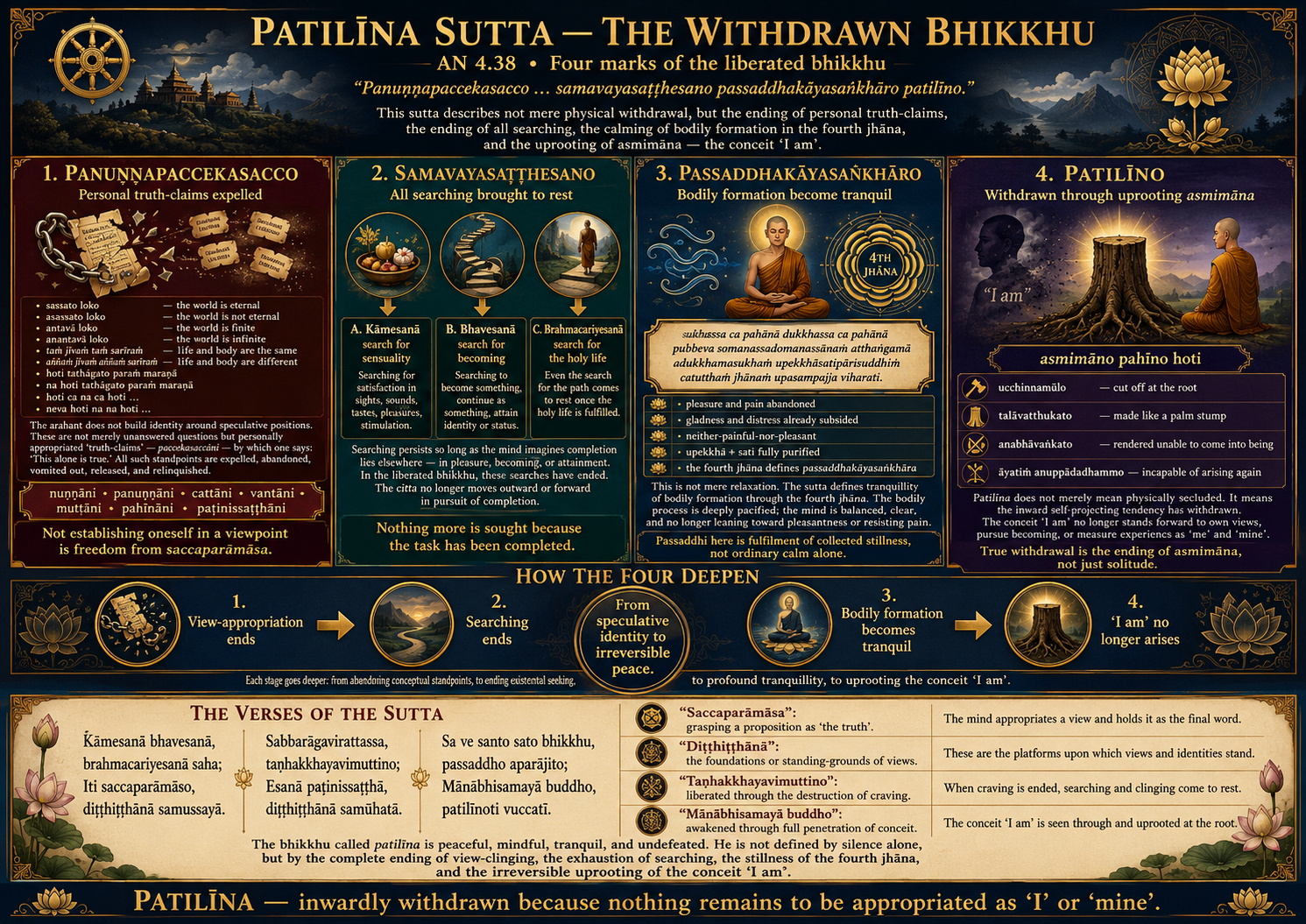 VISUAL SUMMARYSee this sutta in a pictureOpen the complete infographic for a visual overview before or after reading the full study.View infographic →
Four increasingly deep forms of withdrawal
The discourse does not define patilīna as merely living alone or withdrawing socially. It progressively removes four supports of self-projection: speculative truth-appropriation, searching for completion, disturbance of bodily formation, and finally the conceit “I am” — asmimāna .
The four defining expressions
| Pāli | What ends | Practical meaning |
|---|---|---|
| panuṇṇapaccekasacco | Speculative truth-positions and their appropriation are expelled | No standing on “my truth” |
| samavayasaṭṭhesano | Kāmesanā and bhavesanā abandoned; brahmacariyesanā subsided | Nothing further sought for completion |
| passaddhakāyasaṅkhāro | Defined through the fourth jhāna | Bodily formation completely tranquil |
| patilīno | Asmimāna uprooted beyond future arising | No “I am” at the centre of appropriation |
Four movements of withdrawal
Patilīna defined through views, searching, fourth jhāna and asmimāna
01 Opening declaration
“Panuṇṇapaccekasacco, bhikkhave, bhikkhu ‘samavayasaṭṭhesano passaddhakāyasaṅkhāro patilīno’ti vuccati.
Textual variant: Panuṇṇapaccekasacco → paṇunnapaccekasacco (?)
“Bhikkhus, a bhikkhu who has expelled individually held claims to truth, whose searching has been completely cast away, whose bodily formation has become tranquil, is called ‘one who has withdrawn.’”
02 Expelling individually held claims to truth
Kathañca, bhikkhave, bhikkhu panuṇṇapaccekasacco hoti? Idha, bhikkhave, bhikkhuno yāni tāni puthusamaṇabrāhmaṇānaṁ puthupaccekasaccāni, seyyathidaṁ— sassato lokoti vā, asassato lokoti vā, antavā lokoti vā, anantavā lokoti vā, taṁ jīvaṁ taṁ sarīranti vā, aññaṁ jīvaṁ aññaṁ sarīranti vā, hoti tathāgato paraṁ maraṇāti vā, na hoti tathāgato paraṁ maraṇāti vā, hoti ca na ca hoti tathāgato paraṁ maraṇāti vā, neva hoti na na hoti tathāgato paraṁ maraṇāti vā; sabbāni tāni nuṇṇāni honti panuṇṇāni cattāni vantāni muttāni pahīnāni paṭinissaṭṭhāni. Evaṁ kho, bhikkhave, bhikkhu panuṇṇapaccekasacco hoti.
“And how, bhikkhus, is a bhikkhu one who has expelled individually held claims to truth?
Here, bhikkhus, there are those numerous individual claims to truth held by the various ascetics and brahmins, namely:
‘The world is eternal,’ or ‘The world is not eternal,’ or ‘The world is finite,’ or ‘The world is infinite,’ or ‘The life principle and the body are the same,’ or ‘The life principle is one thing and the body another,’ or ‘The Tathāgata exists after death,’ or ‘The Tathāgata does not exist after death,’ or ‘The Tathāgata both exists and does not exist after death,’ or ‘The Tathāgata neither exists nor does not exist after death.’
All of these have been driven away, expelled, given up, vomited out, released, abandoned and relinquished by him.
In this way, bhikkhus, a bhikkhu is one who has expelled individually held claims to truth.”
03 All searching completely cast away
Kathañca, bhikkhave, bhikkhu samavayasaṭṭhesano hoti? Idha, bhikkhave, bhikkhuno kāmesanā pahīnā hoti, bhavesanā pahīnā hoti, brahmacariyesanā paṭippassaddhā. Evaṁ kho, bhikkhave, bhikkhu samavayasaṭṭhesano hoti.
“And how, bhikkhus, is a bhikkhu one whose searching has been completely cast away?
Here, bhikkhus, a bhikkhu’s search for sensuality has been abandoned, his search for becoming has been abandoned, and his search for the brahmacariya has completely subsided.
In this way, bhikkhus, a bhikkhu is one whose searching has been completely cast away.”
04 The bodily formation completely tranquil
Kathañca, bhikkhave, bhikkhu passaddhakāyasaṅkhāro hoti? Idha, bhikkhave, bhikkhu sukhassa ca pahānā dukkhassa ca pahānā pubbeva somanassadomanassānaṁ atthaṅgamā adukkhamasukhaṁ upekkhāsatipārisuddhiṁ catutthaṁ jhānaṁ upasampajja viharati. Evaṁ kho, bhikkhave, bhikkhu passaddhakāyasaṅkhāro hoti.
“And how, bhikkhus, is a bhikkhu one whose bodily formation has become tranquil?
Here, bhikkhus, with the abandonment of bodily pleasure and bodily pain, and with the earlier disappearance of mental gladness and mental distress, a bhikkhu enters and dwells in the fourth jhāna, which is neither painful nor pleasant and has purity of sati through upekkhā.
In this way, bhikkhus, a bhikkhu is one whose bodily formation has become tranquil.”
05 The meaning of patilīno
Kathañca, bhikkhave, bhikkhu patilīno hoti? Idha, bhikkhave, bhikkhuno asmimāno pahīno hoti ucchinnamūlo tālāvatthukato anabhāvaṅkato āyatiṁ anuppādadhammo. Evaṁ kho, bhikkhave, bhikkhu patilīno hoti.
“And how, bhikkhus, is a bhikkhu one who has withdrawn?
Here, bhikkhus, the conceit ‘I am’ has been abandoned in a bhikkhu, cut off at the root, made like the stump of a palm tree, made unable to come into being, and is incapable of arising in the future.
In this way, bhikkhus, a bhikkhu is one who has withdrawn.”
06 Repetition of the complete definition
Panuṇṇapaccekasacco, bhikkhave, bhikkhu ‘samavayasaṭṭhesano passaddhakāyasaṅkhāro patilīno’ti vuccatīti.
“Bhikkhus, a bhikkhu who has expelled individually held claims to truth, whose searching has been completely cast away and whose bodily formation has become tranquil, is called ‘one who has withdrawn.’”
07 First verse: the accumulated structure of searching and views
Kāmesanā bhavesanā, brahmacariyesanā saha; Iti saccaparāmāso, diṭṭhiṭṭhānā samussayā.
“The search for sensuality, the search for becoming, together with the search for the brahmacariya; the grasping, ‘Thus is the truth,’ and the accumulated foundations for views.”
08 Second verse: complete relinquishment
Sabbarāgavirattassa, taṇhakkhayavimuttino; Esanā paṭinissaṭṭhā, diṭṭhiṭṭhānā samūhatā.
“For one who has become dispassionate towards every colouring attachment, for one liberated through the ending of craving, the searches have been relinquished, and the foundations for views have been uprooted.”
09 Final verse: the one called patilīna
Sa ve santo sato bhikkhu, passaddho aparājito; Mānābhisamayā buddho, patilīnoti vuccatī”ti.
“That bhikkhu is indeed peaceful and mindful, tranquil and undefeated; awakened through the full penetration of conceit, he is called ‘one who has withdrawn.’”
10 Continuous English Reading
“Bhikkhus, a bhikkhu who has expelled individually held claims to truth, whose searching has been completely cast away, whose bodily formation has become tranquil, is called ‘one who has withdrawn.’
And how, bhikkhus, is a bhikkhu one who has expelled individually held claims to truth?
Here, bhikkhus, there are those numerous individual claims to truth held by the various ascetics and brahmins, namely: ‘The world is eternal,’ or ‘The world is not eternal,’ or ‘The world is finite,’ or ‘The world is infinite,’ or ‘The life principle and the body are the same,’ or ‘The life principle is one thing and the body another,’ or ‘The Tathāgata exists after death,’ or ‘The Tathāgata does not exist after death,’ or ‘The Tathāgata both exists and does not exist after death,’ or ‘The Tathāgata neither exists nor does not exist after death.’
All of these have been driven away, expelled, given up, vomited out, released, abandoned and relinquished by him. In this way, bhikkhus, a bhikkhu is one who has expelled individually held claims to truth.
And how, bhikkhus, is a bhikkhu one whose searching has been completely cast away?
Here, bhikkhus, a bhikkhu’s search for sensuality has been abandoned, his search for becoming has been abandoned, and his search for the brahmacariya has completely subsided. In this way, bhikkhus, a bhikkhu is one whose searching has been completely cast away.
And how, bhikkhus, is a bhikkhu one whose bodily formation has become tranquil?
Here, bhikkhus, with the abandonment of pleasure and pain, and with the earlier disappearance of mental gladness and mental distress, a bhikkhu enters and dwells in the fourth jhāna, which is neither painful nor pleasant and has purity of sati through upekkhā. In this way, bhikkhus, a bhikkhu is one whose bodily formation has become tranquil.
And how, bhikkhus, is a bhikkhu one who has withdrawn?
Here, bhikkhus, the conceit ‘I am’ has been abandoned in a bhikkhu, cut off at the root, made like the stump of a palm tree, abolished and made incapable of arising in the future. In this way, bhikkhus, a bhikkhu is one who has withdrawn.
Bhikkhus, a bhikkhu who has expelled individually held claims to truth, whose searching has been completely cast away and whose bodily formation has become tranquil, is called ‘one who has withdrawn.’
The search for sensuality, the search for becoming, together with the search for the brahmacariya; the grasping, ‘Thus is the truth,’ and the accumulated foundations for views.
For one dispassionate towards every rāga, for one liberated through the ending of craving, the searches have been relinquished, and the foundations for views have been uprooted.
That bhikkhu is indeed peaceful and mindful, tranquil and undefeated; awakened through the full penetration of conceit, he is called ‘one who has withdrawn.’”
From speculative truth-claims to the ending of “I am”
01 Opening declaration
The four descriptions
The opening sentence contains four closely connected expressions:
| Pāli expression | Close meaning |
|---|---|
| panuṇṇapaccekasacco | one who has driven away individually held claims to truth |
| samavayasaṭṭhesano | one whose searching has been completely cast away |
| passaddhakāyasaṅkhāro | one whose bodily formation has become tranquil |
| patilīno | one who has withdrawn, receded or ceased standing forward through “I am” |
These are not four superficial personality traits. The rest of the sutta defines each one precisely.
The sutta progresses through four increasingly deep dimensions:
- Freedom from speculative truth-claims.
- Freedom from every form of searching.
- Complete tranquillisation of bodily formation in the fourth jhāna.
- Uprooting of the conceit “I am.”
The word patilīna is therefore not explained merely as living alone, remaining silent or avoiding society. The Buddha defines it through the complete destruction of asmimāna.
02 Expelling individually held claims to truth
Kathañca, bhikkhave, bhikkhu panuṇṇapaccekasacco hoti?
“And how is a bhikkhu one who has expelled individually held claims to truth?”
The Buddha does not leave the unusual compound panuṇṇapaccekasacca undefined. He explains it through ten speculative positions and seven expressions of complete abandonment.
Panuṇṇa
Panuṇṇa carries the sense of:
- driven away,
- expelled,
- pushed out,
- removed,
- repelled.
It does not mean that a view is merely suppressed while its underlying attraction remains.
The remainder of the paragraph intensifies this meaning by adding:
cattāni, vantāni, muttāni, pahīnāni, paṭinissaṭṭhāni.
Thus the views are not being held secretly or retained as possibilities to which the practitioner might later return.
Paccekasacca
This compound consists of:
- pacceka — individual, separate, each one’s own;
- sacca — truth.
Here it does not refer to the realization of truth through direct knowledge. It refers to separate groups or individuals declaring their own speculative conclusion to be “the truth.”
A paccekasacca is therefore an individually appropriated truth-position:
“This alone is true; other positions are mistaken.”
The problem is not simply the existence of different statements. The problem is the mental appropriation through which a position becomes:
- my truth,
- my identity,
- my system,
- my side,
- my certainty,
- the position through which I measure others.
The verses later call this saccaparāmāsa—grasping at a claim as “truth.”
Idha, bhikkhave, bhikkhuno
“Here, bhikkhus, for a bhikkhu…”
- idha — here, in this training;
- bhikkhuno — for the bhikkhu, of the bhikkhu.
The passage concerns what has happened within the bhikkhu: these speculative positions no longer find a foundation in him.
Yāni tāni
“Those which are…”
This expression introduces a known category of positions.
Puthusamaṇabrāhmaṇānaṁ
“Of the numerous ascetics and brahmins.”
- puthu — many, numerous, diverse;
- samaṇa — ascetic, renunciant;
- brāhmaṇa — brahmin or religious contemplative;
- -ānaṁ — of.
The phrase points to the diversity of religious and philosophical positions circulating among different teachers and communities.
Each group may hold a different conclusion, although each regards its conclusion as definitive.
Puthupaccekasaccāni
“Numerous individually held truths.”
The repetition of puthu emphasises multiplicity:
- numerous teachers,
- numerous systems,
- numerous separate truth-claims.
The multiplicity itself reveals the difficulty: each person or school takes a particular conceptual construction and treats it as final truth.
Seyyathidaṁ
“Namely,” “such as the following,” or “that is to say.”
The Buddha now lists ten positions.
03 The ten speculative truth-positions
1. Sassato lokoti vā
“‘The world is eternal,’ or…”
- sassato — eternal, permanent;
- loko — the world;
- iti — thus, the proposition that;
- vā — or.
This position asserts that the world exists eternally and permanently.
The difficulty addressed by the sutta is not solved merely by replacing this position with its opposite. Both the eternalist and non-eternalist positions can become grasped paccekasaccāni.
2. Asassato lokoti vā
“‘The world is not eternal,’ or…”
- a-sassato — non-eternal, not permanent.
This is the opposite metaphysical conclusion.
The sutta does not tell the practitioner to grasp this proposition as a new identity. It places both “eternal” and “not eternal” among the speculative positions that have been completely relinquished.
3. Antavā lokoti vā
“‘The world is finite,’ or…”
- anta — boundary, end or limit;
- antavā — possessing an end, bounded, finite.
This position asserts that the world has a definite limit.
4. Anantavā lokoti vā
“‘The world is infinite,’ or…”
- ananta — without end or boundary;
- anantavā — infinite, unlimited.
Again, the sutta places both opposing conclusions together. The liberated person does not construct identity or certainty around either alternative.
5. Taṁ jīvaṁ taṁ sarīranti vā
“‘The life principle is the same as the body,’ or…”
- taṁ … taṁ — that very thing is that very thing; the same;
- jīvaṁ — life principle, living self or animating principle;
- sarīraṁ — body.
This proposition identifies the living principle entirely with the physical body.
It can lead to a view in which the person is understood solely as the body.
6. Aññaṁ jīvaṁ aññaṁ sarīranti vā
“‘The life principle is one thing and the body another,’ or…”
- aññaṁ — another, different;
- jīvaṁ — life principle;
- sarīraṁ — body.
This is the opposite proposition: a distinct inner life principle or self is separate from the body.
The sutta does not exchange bodily identity for a metaphysical inner entity. Both formulations remain conceptual positions capable of appropriation.
7. Hoti tathāgato paraṁ maraṇāti vā
“‘The Tathāgata exists after death,’ or…”
- hoti — exists, is;
- tathāgato — the Tathāgata;
- paraṁ maraṇā — after death.
The question attempts to apply the category “exists” to the Tathāgata after death.
8. Na hoti tathāgato paraṁ maraṇāti vā
“‘The Tathāgata does not exist after death,’ or…”
This applies the opposite category: non-existence.
9. Hoti ca na ca hoti tathāgato paraṁ maraṇāti vā
“‘The Tathāgata both exists and does not exist after death,’ or…”
- hoti ca — exists and;
- na ca hoti — does not exist.
This combines the first two alternatives.
10. Neva hoti na na hoti tathāgato paraṁ maraṇāti vā
“‘The Tathāgata neither exists nor does not exist after death,’ or…”
- neva hoti — neither exists;
- na na hoti — nor does not exist.
This rejects both simple alternatives.
Thus the complete fourfold logical scheme is given:
- exists;
- does not exist;
- both exists and does not exist;
- neither exists nor does not exist.
04 Why all ten are relinquished
The point is not that the practitioner adopts an eleventh speculative view:
“The correct truth is that none of these positions is true.”
That itself could become another paccekasacca.
The decisive issue is parāmāsa—taking hold of a proposition, appropriating it and making it a basis for identity, conflict or conceit.
One may argue:
- “I know the ultimate structure of the cosmos.”
- “My philosophical conclusion is superior.”
- “Those who reject my view are ignorant.”
- “My identity depends upon defending this position.”
The arahant has no need to establish himself upon such a standpoint.
The speculative question is not merely left unanswered intellectually. The mental need to obtain security through such a position has ended.
05 Seven expressions of complete abandonment
Sabbāni tāni nuṇṇāni honti panuṇṇāni cattāni vantāni muttāni pahīnāni paṭinissaṭṭhāni.
“All of those have been driven away, expelled, given up, vomited out, released, abandoned and relinquished.”
The accumulation of verbs prevents a weak interpretation. These truth-positions have not merely become less interesting. Their underlying appropriation has ended.
Sabbāni tāni
“All those.”
No position in the list is retained as a final metaphysical refuge.
Nuṇṇāni
“Driven away” or “pushed away.”
The positions no longer occupy or dominate the citta.
Panuṇṇāni
“Completely expelled.”
The prefix pa- strengthens the movement of removal. They have been decisively cast out.
Cattāni
“Given up” or “renounced.”
The practitioner no longer claims ownership of them:
- “This is my view.”
- “This is what I am.”
- “This is the truth through which I stand.”
Vantāni
“Vomited out.”
This is deliberately forceful language.
What has been vomited is not taken back and consumed again. The term conveys revulsion towards returning to what has already been recognised as unsuitable and harmful.
A speculative view that once seemed nourishing is now understood as something that cannot provide liberation.
Muttāni
“Released” or “let go.”
The grip has opened.
This has two inseparable aspects:
- the view is released;
- the mind is released from needing the view.
Pahīnāni
“Abandoned.”
Pahāna is not merely intellectual disagreement. The relevant mental basis has been removed.
Paṭinissaṭṭhāni
“Relinquished,” “surrendered,” or “fully let go.”
Paṭinissagga indicates no longer taking something up as:
- mine,
- myself,
- my truth,
- my security,
- my standpoint.
The sequence therefore moves from expulsion to complete non-appropriation.
Evaṁ kho, bhikkhave, bhikkhu panuṇṇapaccekasacco hoti
“In this way, bhikkhus, a bhikkhu is one who has expelled individually held claims to truth.”
The practitioner is not called panuṇṇapaccekasacco because he can refute every competing philosophy. He is so called because the entire mechanism of appropriating a private position as absolute truth has ended.
06 All searching completely cast away
Samavayasaṭṭhesano
The compact compound is defined by the sutta itself. Whatever its precise orthographic division, its meaning is clear from the following sentence:
The three esanā—three forms of searching—are no longer operating.
A close contextual rendering is:
- one whose searches are entirely cast away;
- one whose seeking has completely ceased;
- one in whom nothing further is being pursued for completion.
This does not describe depression, lack of interest or passive indifference. It describes the ending of searching because nothing further is required for liberation.
Esanā
Esanā means:
- search,
- seeking,
- pursuit,
- looking for something expected to provide satisfaction, identity, security or completion.
Searching exists because the mind assumes:
“Something has not yet been obtained. By obtaining it, I shall become complete.”
The sutta identifies three principal directions of that movement.
07 The three searches
1. Kāmesanā pahīnā hoti
“The search for sensuality has been abandoned.”
- kāma — sensual object, sensual enjoyment or sensual gratification;
- esanā — search, pursuit;
- pahīnā — abandoned;
- hoti — has become, is.
Kāmesanā is not limited to obvious sexual desire. It includes the continuous search for satisfaction through:
- sights,
- sounds,
- smells,
- tastes,
- bodily contacts,
- possessions,
- entertainment,
- praise,
- status,
- stimulation,
- repeated pleasant experience.
The mind assumes:
“The next agreeable object will finally satisfy me.”
The search continues even after an object has been obtained, because the pleasure changes, ends or fails to provide lasting security.
For the liberated bhikkhu, this search has been pahīnā—abandoned. The citta no longer projects fulfilment into sensual acquisition.
2. Bhavesanā pahīnā hoti
“The search for becoming has been abandoned.”
- bhava — becoming, existence, a mode of being or identity;
- esanā — pursuit;
- pahīnā — abandoned.
Bhavesanā is deeper than wanting a pleasant rebirth alone. It is the movement towards becoming something:
- becoming recognised,
- becoming powerful,
- becoming spiritually important,
- becoming a particular identity,
- becoming a refined being,
- becoming established in a state,
- continuing as “I am this.”
Even spiritual attainments may be appropriated through bhavesanā:
“I shall become a special person.”
The arahant may use conventional language and perform necessary activities, but there is no existential search through which a future identity is being constructed.
3. Brahmacariyesanā paṭippassaddhā
“The search for the brahmacariya has completely subsided.”
- brahmacariya — the holy life, the complete liberating training;
- esanā — search;
- paṭippassaddhā — fully quieted, settled, subsided.
This must not be misunderstood as abandoning the holy life before its purpose has been realised.
For a person still in training, the search for:
- the correct path,
- proper conduct,
- right samādhi,
- liberating understanding,
- the ending of the āsavas,
is necessary.
But when the holy life has been fulfilled, one no longer searches for another path, teacher, system or attainment that will complete what remains unfinished.
The search subsides because the task has been completed.
The wording is significant:
- kāmesanā pahīnā — sensual searching has been abandoned;
- bhavesanā pahīnā — searching for becoming has been abandoned;
- brahmacariyesanā paṭippassaddhā — searching for the holy life has settled and come to rest.
Brahmacariya itself is not rejected. The search for it ends through fulfilment.
Practical distinction
| Search | Assumption beneath it | Its ending |
|---|---|---|
| kāmesanā | “Pleasant objects will complete me.” | No further leaning towards sensual fulfilment |
| bhavesanā | “Becoming something will establish me.” | No construction of identity through becoming |
| brahmacariyesanā | “Liberation remains to be found or attained.” | The holy life is fulfilled; nothing further remains to be sought |
Evaṁ kho, bhikkhave, bhikkhu samavayasaṭṭhesano hoti
“In this way, bhikkhus, a bhikkhu is one whose searching has been completely cast away.”
The ending of searching does not produce emptiness in the ordinary sense of meaninglessness. It produces peace because the citta no longer runs outward or forward in search of completion.
08 The bodily formation completely tranquil
Passaddha
Passaddha means:
- calmed,
- tranquil,
- settled,
- quieted,
- free from disturbance.
It is not merely relaxation obtained through comfortable circumstances. It indicates that the relevant activity has become completely pacified.
Kāyasaṅkhāra
This compound contains:
- kāya — body;
- saṅkhāra — formation, conditioning activity or process.
The sutta itself defines passaddhakāyasaṅkhāra through the fourth jhāna.
In MN 44, in-breathing and out-breathing are explicitly called kāyasaṅkhāra, because they are bodily and connected with the body. AN 10.72 likewise calls in-breathing and out-breathing a “thorn” for the fourth jhāna. Read together, these passages clarify why the fourth jhāna is used here as the definition of the tranquil bodily formation.
The present sutta does not define the phrase through ordinary physical relaxation. It defines it through entry into and dwelling in the fourth jhāna.
09 The fourth-jhāna formula
Sukhassa ca pahānā
“With the abandonment of pleasure.”
- sukhassa — of pleasure or ease;
- pahānā — from the abandoning;
- ca — and.
The sukha associated with the earlier jhānic development is no longer present as an experience towards which the mind inclines.
This does not mean that the fourth jhāna is painful. It is beyond the contrast through which sukha is preferred and dukkha resisted.
Dukkhassa ca pahānā
“And with the abandonment of pain.”
- dukkhassa — of pain;
- pahānā — from the abandoning.
Both sides of the bodily pleasant–painful contrast have ceased to disturb the citta.
Pubbeva
“Already previously,” or “even before.”
This indicates that the following pair had disappeared earlier in the progression.
Somanassadomanassānaṁ atthaṅgamā
“With the disappearance of mental gladness and mental distress.”
- somanassa — mental pleasure, gladness or elation;
- domanassa — mental displeasure, sadness or distress;
- atthaṅgama — disappearance, setting, going out of manifestation.
The phrase distinguishes mental gladness and mental distress from the preceding sukha and dukkha.
By the fourth jhāna, the citta is not being lifted by agreeable feeling or lowered by disagreeable feeling.
Adukkhamasukhaṁ
“Neither painful nor pleasant.”
This is:
- a-dukkhaṁ — not painful;
- a-sukhaṁ — not pleasant.
This is not numbness or inability to know. The citta remains exceptionally clear, but it is no longer affected by the ordinary polarity of pleasure and pain.
Upekkhāsatipārisuddhiṁ
“Purity of sati through upekkhā.”
The compound contains:
- upekkhā — balanced observation, non-leaning equanimity;
- sati — keeping present, remembering and not losing the relevant field;
- pārisuddhi — complete purity.
Upekkhā is not indifference
Upekkhā does not mean:
- carelessness,
- emotional deadness,
- failure to understand,
- passively tolerating confusion.
It is the citta not leaning towards sukha and not leaning away from dukkha.
Because the mind is no longer being coloured by:
- preference,
- rejection,
- elation,
- distress,
sati becomes purified.
There is no pleasantness pulling sati in one direction and no painfulness pushing it in another.
Catutthaṁ jhānaṁ
“The fourth jhāna.”
The sutta does not use the expression passaddhakāyasaṅkhāro vaguely. It gives a specific attainment as its definition.
The bodily formation is tranquil in the complete composure of the fourth jhāna.
Upasampajja viharati
“He enters and dwells.”
- upasampajja — having entered, attained or arrived at;
- viharati — dwells, remains.
The formula contains both attainment and stability:
- The bhikkhu enters the fourth jhāna.
- He is capable of dwelling in it.
It is not merely a momentary glimpse or an intellectual understanding of the fourth jhāna.
Evaṁ kho, bhikkhave, bhikkhu passaddhakāyasaṅkhāro hoti
“In this way, bhikkhus, a bhikkhu is one whose bodily formation has become tranquil.”
This is an important sutta-based definition:
Passaddhakāyasaṅkhāra is demonstrated through the fourth jhāna.
The text does not define it merely as sitting motionless, breathing slowly or feeling bodily relaxation.
10 The meaning of patilīno
Patilīno
Possible English expressions include:
- withdrawn,
- drawn back,
- receded,
- retired inwardly,
- no longer projecting or asserting oneself.
But the sutta’s own definition must govern its meaning.
A bhikkhu is not patilīno merely because:
- he lives in a forest,
- avoids conversation,
- remains physically alone,
- closes his eyes,
- withdraws from social activities.
He is patilīno because asmimāna has been eradicated.
The movement of “I am” no longer stands forward to appropriate experience.
11 Asmimāna — the conceit “I am”
Asmimāno
- asmi — “I am”;
- māna — measuring, conceit or the tendency to position oneself.
Asmimāna is subtler than merely holding an explicit view:
“There is a permanent self.”
A person may intellectually reject a self-theory while the underlying movement still operates:
- “I am better.”
- “I am worse.”
- “I am equal.”
- “I am the one experiencing this.”
- “This attainment establishes what I am.”
- “This happened to me.”
- “I must continue.”
- “I must not disappear.”
Māna measures and locates experience around “I am.”
This is why the sutta does not define final withdrawal merely through abandonment of speculative views. Even after coarse views have been abandoned, the subtle conceit “I am” must be uprooted.
Pahīno hoti
“It has been abandoned.”
The conceit is not being deliberately held down. Its supporting conditions have been removed.
Ucchinnamūlo
“Cut off at the root.”
- ucchinna — cut off, severed;
- mūla — root.
If only branches are cut, growth can return. The expression shows that the basis from which asmimāna could regenerate has been removed.
Tālāvatthukato
“Made like the stump or base of a palm tree.”
- tāla — palm tree;
- vatthu — base, site or stump;
- kata — made.
When a palm tree has been cut at its growing point, it cannot produce new growth.
The image therefore indicates irreversibility.
Asmimāna has not temporarily disappeared during a peaceful state. It cannot regenerate.
Anabhāvaṅkato
“Made unable to come into being,” “brought to non-existence,” or “abolished.”
The conceit is no longer available as a functioning mental condition.
This is stronger than saying:
“At present I do not notice any conceit.”
It has been rendered incapable of renewed operation.
Āyatiṁ
“In the future,” “subsequently,” or “from now onward.”
The destruction applies beyond the present experience.
Anuppādadhammo
“Of a nature not to arise again.”
- an-uppāda — non-arising;
- dhammo — having the nature or quality.
The conceit has become incapable of future arising.
This completes the sequence:
- abandoned,
- root severed,
- made like a palm stump,
- abolished,
- unable to arise again.
Evaṁ kho, bhikkhave, bhikkhu patilīno hoti
“In this way, bhikkhus, a bhikkhu is one who has withdrawn.”
The true withdrawal is the withdrawal of appropriation.
Forms may be seen, sounds heard, duties performed and words spoken, but there is no inward construction:
“This establishes me as something.”
12 Repetition of the complete definition
The repeated statement gathers the four dimensions together.
| Dimension | What has ended |
|---|---|
| panuṇṇapaccekasacco | appropriation of speculative truth-positions |
| samavayasaṭṭhesano | pursuit of sensuality, becoming and further spiritual completion |
| passaddhakāyasaṅkhāro | disturbance of bodily formation in the fourth jhāna |
| patilīno | the conceit and measurement “I am” |
The deepest definition is the final one: asmimāna is incapable of arising again.
13 First verse: the accumulated structure of searching and views
The verse is grammatically compressed. It presents the structures that are relinquished in the next verse.
Kāmesanā
“The search for sensuality.”
This is the outward search for satisfaction through agreeable objects.
Bhavesanā
“The search for becoming.”
This is the forward movement towards continued existence, attainment, status or identity.
Brahmacariyesanā saha
“Together with the search for the brahmacariya.”
- saha — together with.
All three searches are included. Even the search for the path comes to rest when the destination has been reached.
Iti saccaparāmāso
“The grasping, ‘Thus is the truth.’”
This expression is extremely important.
- iti — thus, in this way;
- sacca — truth;
- parāmāsa — taking hold of, clinging to, appropriation or insistence.
The problem is not merely speaking the word “truth.” It is the mental act:
“It is exactly this. This alone is true. I stand upon this.”
Saccaparāmāsa turns a proposition into a position of identity.
Once appropriated, the mind begins to:
- defend it,
- compare itself with others,
- dismiss contrary evidence,
- become angry when challenged,
- derive superiority from possessing the “correct” view.
The arahant has abandoned this grasping.
Diṭṭhiṭṭhānā samussayā
“The accumulated foundations for views.”
- diṭṭhi — view;
- ṭhāna — basis, standpoint, position or ground;
- samussaya — accumulation, build-up or constructed mass.
Views do not arise in isolation. They accumulate around:
- craving,
- identity,
- memory,
- perception,
- emotional preference,
- fear,
- desire for certainty.
A standpoint is built up and then inhabited as “my truth.”
The verse gathers these accumulated view-bases together with the three searches.
14 Second verse: complete relinquishment
Sabbarāgavirattassa
“For one dispassionate towards all rāga.”
- sabba — all, every;
- rāga — colouring, attachment, passion;
- viratta — faded from, dispassionate towards, no longer coloured;
- -ssa — for/of one.
Rāga is the colouring through which an object no longer appears merely as it is. It becomes:
- wanted,
- beautiful for me,
- necessary for me,
- connected with my fulfilment.
Virāga is the fading of that colouring.
Sabbarāgaviratta therefore means that the citta is no longer coloured and bound through any rāga.
Taṇhakkhayavimuttino
“For one liberated through the ending of craving.”
- taṇhā — craving, thirst;
- khaya — exhaustion, destruction or ending;
- vimuttin — one who is liberated.
This verse establishes the level being described. It is not merely temporary quietness. The person is taṇhakkhayavimutta—liberated through craving’s complete ending.
Esanā paṭinissaṭṭhā
“The searches have been relinquished.”
Paṭinissaṭṭhā means fully given up or surrendered.
The citta no longer searches for:
- pleasure to complete itself,
- becoming to continue itself,
- another path to liberate itself.
Diṭṭhiṭṭhānā samūhatā
“The foundations for views have been uprooted.”
- samūhata — uprooted, demolished or removed completely.
The sutta does not merely say that certain conclusions are replaced by more refined conclusions. The bases upon which speculative views grow have been uprooted.
This corresponds to the earlier series:
nuṇṇāni, panuṇṇāni, cattāni, vantāni, muttāni, pahīnāni, paṭinissaṭṭhāni.
15 Final verse: the one called patilīna
Sa ve
“That one indeed.”
- sa — he, that person;
- ve — indeed, certainly.
The verse points back to the one whose craving, searching and view-foundations have ended.
Santo
“Peaceful,” “settled,” or “calmed.”
This peace is not dependent upon:
- agreeable contact,
- social approval,
- philosophical certainty,
- attainment of a future identity.
It arises because the movements that generate conflict have ended.
Sato
“Mindful.”
Sati remains present. The ending of searching is not unconsciousness, vagueness or dullness.
The bhikkhu is peaceful and fully mindful.
Bhikkhu
The term here refers to the one who has completed the characteristics described in the discourse.
Passaddho
“Tranquil.”
The same root appears in passaddhakāyasaṅkhāro.
There is tranquillity in:
- the bodily formation,
- the citta,
- the absence of searching,
- the absence of identity construction.
Aparājito
“Undefeated,” “unconquered,” or “not overcome.”
- a- — not;
- parājita — defeated, conquered.
Nothing within the described field can defeat him:
- sensual pursuit no longer pulls him,
- becoming no longer recruits him,
- speculative views no longer establish him,
- conceit no longer reconstructs him.
The word expresses irreversible freedom rather than competitive victory over another person.
Mānābhisamayā
“Through the full penetration of conceit.”
- māna — measuring, conceit;
- abhisamaya — penetrative realization, complete comprehension or direct breakthrough.
This is not merely recognising:
“Conceit is unwholesome.”
Abhisamaya indicates penetrating māna so completely that its operation and basis are understood and ended.
The practitioner sees the measuring movement through which experience becomes:
- I,
- me,
- mine,
- better than,
- worse than,
- equal to.
Because this has been penetrated, asmimāna is cut off at the root.
Buddho
“Awakened.”
Here buddho describes one awakened through complete penetration of māna.
It should not be read merely as someone who has acquired philosophical information. Awakening is shown through the irreversible ending of conceit.
Patilīnoti vuccati
“He is called ‘patilīna—withdrawn.’”
The final line returns to the sutta’s title.
He is called withdrawn because:
- he does not stand upon a speculative truth-position;
- he does not project himself towards sensuality or becoming;
- he does not search for further completion;
- bodily formation is tranquil;
- the conceit “I am” has been uprooted.
This is inward non-projection, not merely physical isolation.
16 The deeper architecture of the sutta
The sutta describes liberation across four fields.
1. Conceptual establishment ends
Panuṇṇapaccekasacco
The person no longer establishes identity upon:
“This alone is the truth.”
This ends conflict based on speculative views.
2. Craving’s movement ends
Samavayasaṭṭhesano
The citta no longer searches through:
- sensuality,
- becoming,
- further spiritual completion.
This ends forward movement towards imagined fulfilment.
3. Bodily formation is tranquil
Passaddhakāyasaṅkhāro
The fourth jhāna is entered and dwelt in:
- pleasure and pain abandoned;
- mental gladness and distress gone;
- neither-painful-nor-pleasant;
- sati purified through upekkhā.
4. The centre of appropriation ends
Patilīno
Asmimāna is:
- abandoned,
- cut at the root,
- made like a palm stump,
- abolished,
- incapable of arising again.
Without “I am,” there is no one inwardly standing forward to own a view, search for becoming or appropriate an attainment.
17 How the four are connected
| First expression | Underlying problem | Complete ending |
|---|---|---|
| panuṇṇapaccekasacco | “My proposition is the truth.” | Truth-claiming and view-appropriation are expelled |
| samavayasaṭṭhesano | “Something must still be obtained.” | Sensual, existential and spiritual searching ends |
| passaddhakāyasaṅkhāro | Bodily formation remains active and disturbing | Fourth jhāna completely tranquillises it |
| patilīno | “I am” remains as the centre of measuring | Asmimāna is uprooted beyond recurrence |
The first two concern what the mind takes up and pursues.
The third concerns the complete tranquillisation present in the fourth jhāna.
The fourth reaches the root: the conceit through which an “I” stands at the centre of experience.
18 What the sutta does not mean
It does not teach intellectual indecision
Relinquishing speculative views does not mean becoming incapable of discernment.
The bhikkhu understands wholesome and unwholesome, arising and cessation, bondage and liberation. What has ended is grasping a speculative position as personal truth.
It does not teach abandoning practice prematurely
The ending of brahmacariyesanā applies to one described as:
- liberated through the ending of craving;
- free from all rāga;
- one whose asmimāna cannot arise again.
A trainee cannot use this passage to justify abandoning discipline, investigation or bhāvanā.
The search ends when the work is completed.
It does not define tranquillity as ordinary relaxation
Passaddhakāyasaṅkhāro is explicitly defined through entry into the fourth jhāna.
Physical comfort or slow breathing alone does not fulfil the definition.
It does not define withdrawal geographically
Patilīna does not merely mean withdrawing to a forest, room or solitary dwelling.
The Buddha defines it as the irreversible destruction of asmimāna.
One could live alone while mentally constructing “I am.” Conversely, a liberated person may interact with others without inwardly constructing identity.
19 Central practical insight
The deepest movement exposed by the discourse is:
- A view appears.
- It is taken as “truth.”
- “I” becomes the holder of that truth.
- The view becomes a position from which “I” measure others.
- Searching continues for pleasure, becoming or spiritual completion.
- The process repeatedly reconstructs identity.
Liberation reverses this entire movement:
- Individually appropriated truth-claims are expelled.
- Their accumulated foundations are uprooted.
- Sensual and existential searches are abandoned.
- The search for the holy life settles because the task is completed.
- Bodily formation is completely tranquil in the fourth jhāna.
- The conceit “I am” is penetrated and uprooted.
- Nothing remains capable of regenerating that identity structure.
Therefore the bhikkhu is:
santo — peaceful, sato — mindful, passaddho — tranquil, aparājito — undefeated, buddho — awakened, patilīno — completely withdrawn from the construction “I am.”