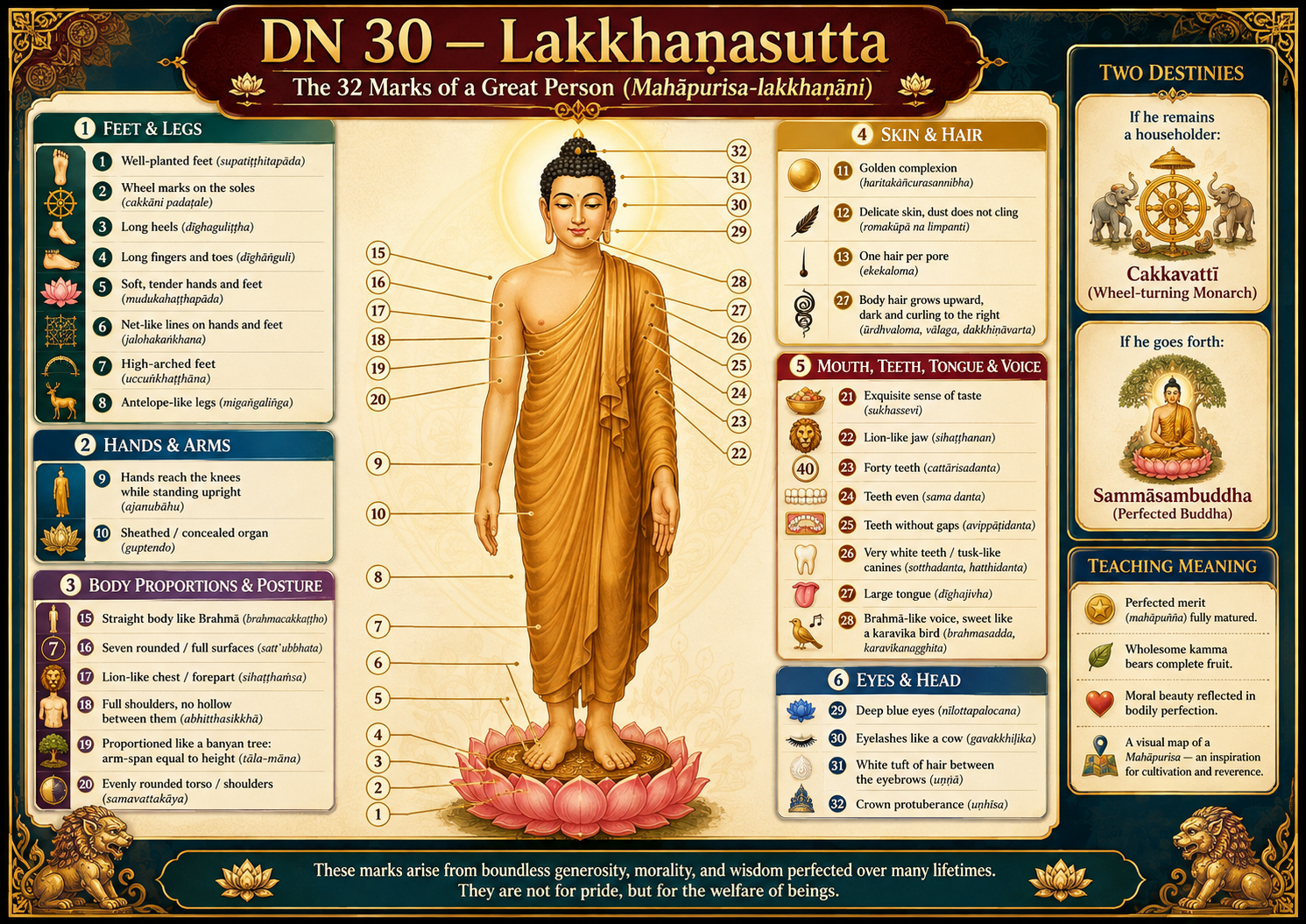
 VISUAL SUMMARYSee this sutta in a pictureOpen the complete infographic for a visual overview before or after reading the full study.View infographic →
The Lakkhaṇasutta (DN 30) presents the famous thirty-two marks of a Great Man (mahāpurisa-lakkhaṇāni) and explains that one endowed with these marks has two possible destinies: remaining in household life as a righteous cakkavattī, or going forth and becoming an arahant, a perfectly awakened Buddha.
What gives the discourse its practical force is that it does not merely catalogue unusual bodily characteristics. Again and again the Buddha traces a mark back to repeatedly cultivated conduct: firmness in kusala, non-killing, generosity, protection of others, the four saṅgahavatthūni, careful teaching, wise questioning, non-anger, reconciliation, fair discernment, concern for others’ growth, truthfulness, harmonious and gentle speech, meaningful speech, and right livelihood.
The repeated architecture is: purimaṁ kamma → kaṭattā, upacitattā, ussannattā, vipulattā → sugati / sagga → mahāpurisa-lakkhaṇa → corresponding ruler/Buddha fruit → Tatthetaṁ vuccati verse. The verse is therefore not an appendix; it is part of the causal teaching and often makes the ethical correspondence especially clear.
This rebuilt edition keeps the complete supplied Pāḷi and English meaning together first. The causal interpretation, deeper karmic explanation and practice reflections are then revisited separately, so the source text is not mixed with later commentary.
| # | Mahāpurisa-lakkhaṇa | Meaning |
|---|---|---|
| 1 | Suppatiṭṭhitapādo | well-planted feet |
| 2 | Heṭṭhāpādatalesu cakkāni | thousand-spoked wheel marks on soles |
| 3 | Āyatapaṇhi | long heels |
| 4 | Dīghaṅguli | long fingers and toes |
| 5 | Mudutalunahatthapādo | soft, tender hands and feet |
| 6 | Jālahatthapādo | net-like hands and feet |
| 7 | Ussaṅkhapādo | high-arched feet |
| 8 | Eṇijaṅgho | antelope-like calves |
| 9 | Jaṇṇukāni parimasati | standing upright, palms reach the knees |
| 10 | Kosohitavatthaguyho | male organ enclosed in a sheath |
| 11 | Suvaṇṇavaṇṇo | golden complexion |
| 12 | Sukhumacchavi | fine skin; dust does not cling |
| 13 | Ekekalomo | one hair per pore |
| 14 | Uddhaggalomo | upward-growing, right-curling body hair |
| 15 | Brahmujugatto | straight, upright body |
| 16 | Sattussado | seven prominent / rounded surfaces |
| 17 | Sīhapubbaddhakāyo | lion-like front of body |
| 18 | Citantaraṁso | filled-out space between shoulders |
| 19 | Nigrodhaparimaṇḍalo | arm-span equals height |
| 20 | Samavaṭṭakkhandho | evenly rounded shoulders |
| 21 | Rasaggasaggī | well-developed taste channels |
| 22 | Sīhahanu | lion-like jaw |
| 23 | Cattālīsadanto | forty teeth |
| 24 | Samadanto | even teeth |
| 25 | Aviraḷadanto | teeth without gaps |
| 26 | Susukkadāṭho | very white canine teeth |
| 27 | Pahūtajivho | large / extensive tongue |
| 28 | Brahmassaro karavīkabhāṇī | Brahmā-like, karavīka-like voice |
| 29 | Abhinīlanetto | deep blue eyes |
| 30 | Gopakhumo | cow-like eyelashes |
| 31 | Uṇṇā bhamukantare | white soft hair between eyebrows |
| 32 | Uṇhīsasīso | turban-like / crowned head |
011. Suppatiṭṭhitapādatālakkhaṇaṁ
Yampi, bhikkhave, tathāgato purimaṁ jātiṁ purimaṁ bhavaṁ purimaṁ niketaṁ pubbe manussabhūto samāno daḷhasamādāno ahosi kusalesu dhammesu, avatthitasamādāno kāyasucarite vacīsucarite manosucarite dānasaṁvibhāge sīlasamādāne uposathupavāse matteyyatāya petteyyatāya sāmaññatāya brahmaññatāya kule jeṭṭhāpacāyitāya aññataraññataresu ca adhikusalesu dhammesu. So tassa kammassa kaṭattā upacitattā ussannattā vipulattā kāyassa bhedā paraṁ maraṇā sugatiṁ saggaṁ lokaṁ upapajjati. So tattha aññe deve dasahi ṭhānehi adhiggaṇhāti dibbena āyunā dibbena vaṇṇena dibbena sukhena dibbena yasena dibbena ādhipateyyena dibbehi rūpehi dibbehi saddehi dibbehi gandhehi dibbehi rasehi dibbehi phoṭṭhabbehi. So tato cuto itthattaṁ āgato samāno imaṁ mahāpurisalakkhaṇaṁ paṭilabhati. Suppatiṭṭhitapādo hoti. Samaṁ pādaṁ bhūmiyaṁ nikkhipati, samaṁ uddharati, samaṁ sabbāvantehi pādatalehi bhūmiṁ phusati.
So tena lakkhaṇena samannāgato sace agāraṁ ajjhāvasati, rājā hoti cakkavattī dhammiko dhammarājā cāturanto vijitāvī janapadatthāvariyappatto sattaratanasamannāgato. Tassimāni satta ratanāni bhavanti; Seyyathidaṁ—cakkaratanaṁ hatthiratanaṁ assaratanaṁ maṇiratanaṁ itthiratanaṁ gahapatiratanaṁ pariṇāyakaratanameva sattamaṁ. Parosahassaṁ kho panassa puttā bhavanti sūrā vīraṅgarūpā parasenappamaddanā. So imaṁ pathaviṁ sāgarapariyantaṁ akhilamanimittamakaṇṭakaṁ iddhaṁ phītaṁ khemaṁ sivaṁ nirabbudaṁ adaṇḍena asatthena dhammena abhivijiya ajjhāvasati. Rājā samāno kiṁ labhati? Akkhambhiyo hoti kenaci manussabhūtena paccatthikena paccāmittena.
Variant: Akkhambhiyo → avikkhambhiyo (bj, pts1ed) Rājā samāno idaṁ labhati. Sace kho pana agārasmā anagāriyaṁ pabbajati, arahaṁ hoti sammāsambuddho loke vivaṭṭacchado. Buddho samāno kiṁ labhati? Akkhambhiyo hoti abbhantarehi vā bāhirehi vā paccatthikehi paccāmittehi rāgena vā dosena vā mohena vā samaṇena vā brāhmaṇena vā devena vā mārena vā brahmunā vā kenaci vā lokasmiṁ. Buddho samāno idaṁ labhati”. Etamatthaṁ bhagavā avoca.
Because that wholesome conduct had been done, accumulated, strengthened and made abundant, the sutta says he was reborn in a heavenly world and excelled other devas in ten respects. Returning to human existence, he acquired well-planted feet: he places the foot evenly, lifts it evenly, and the whole sole touches the ground evenly. If he remains a ruler, he is not shaken by human opponents. If he goes forth and becomes a Buddha, he is not shaken by inner or outer adversaries—rāga, dosa, moha, other religious opponents, devas, Māra, Brahmā, or anyone in the world.
“Sacce ca dhamme ca dame ca saṁyame,Soceyyasīlālayuposathesu ca;Dāne ahiṁsāya asāhase rato,Daḷhaṁ samādāya samattamācari. Variant: samattamācari → samantamācari (bj, sya-all, mr)
So tena kammena divaṁ samakkami, Variant: samakkami → apakkami (bj, sya-all, mr)Sukhañca khiḍḍāratiyo ca anvabhi; Variant: anvabhi → anubhi (cck); annubhi (sya1ed, sya2ed); ānubhi (pts1ed); aṁnubhi (ṭīkā)Tato cavitvā punarāgato idha,Samehi pādehi phusī vasundharaṁ.
Byākaṁsu veyyañjanikā samāgatā,Samappatiṭṭhassa na hoti khambhanā;Gihissa vā pabbajitassa vā puna, Variant: puna → pana (sya-all)Taṁ lakkhaṇaṁ bhavati tadatthajotakaṁ.
Akkhambhiyo hoti agāramāvasaṁ,Parābhibhū sattubhi nappamaddano;Manussabhūtenidha hoti kenaci,Akkhambhiyo tassa phalena kammuno.
Sace ca pabbajjamupeti tādiso,Nekkhammachandābhirato vicakkhaṇo;Aggo na so gacchati jātu khambhanaṁ,Naruttamo esa hi tassa dhammatā”ti.
- He formerly practiced truth, Dhamma, self-restraint, purity, sīla, uposatha, generosity, non-harming and non-violence with firm commitment.
- Through that kamma he reached heaven, enjoyed heavenly happiness, and on returning here touched the earth with evenly planted feet.
- Those skilled in marks declared that one so firmly planted would not be shaken; the mark points to that corresponding quality whether he remains a householder or goes forth.
- As a ruler he cannot be crushed by human enemies; this is the fruit of that former kamma.
- If he goes forth, delighting in renunciation and endowed with discernment, the supreme person is never brought down—the mark points to his unshakability.
022. Pādatalacakkalakkhaṇaṁ
“Yampi, bhikkhave, tathāgato purimaṁ jātiṁ purimaṁ bhavaṁ purimaṁ niketaṁ pubbe manussabhūto samāno bahujanassa sukhāvaho ahosi, ubbegauttāsabhayaṁ apanuditā, dhammikañca rakkhāvaraṇaguttiṁ saṁvidhātā, saparivārañca dānaṁ adāsi. So tassa kammassa kaṭattā upacitattā ussannattā vipulattā kāyassa bhedā paraṁ maraṇā sugatiṁ saggaṁ lokaṁ upapajjati. So tattha aññe deve dasahi ṭhānehi adhiggaṇhāti—dibbena āyunā, dibbena vaṇṇena, dibbena sukhena, dibbena yasena, dibbena ādhipateyyena, dibbehi rūpehi, dibbehi saddehi, dibbehi gandhehi, dibbehi rasehi, dibbehi phoṭṭhabbehi. So tato cuto itthattaṁ āgato samāno imaṁ mahāpurisalakkhaṇaṁ paṭilabhati. Heṭṭhāpādatalesu cakkāni jātāni honti sahassārāni sanemikāni sanābhikāni sabbākāraparipūrāni suvibhattantarāni.
So tena lakkhaṇena samannāgato sace agāraṁ ajjhāvasati, rājā hoti cakkavattī dhammiko dhammarājā cāturanto vijitāvī janapadatthāvariyappatto sattaratanasamannāgato. Tassimāni satta ratanāni bhavanti; seyyathidaṁ—cakkaratanaṁ hatthiratanaṁ assaratanaṁ maṇiratanaṁ itthiratanaṁ gahapatiratanaṁ pariṇāyakaratanameva sattamaṁ. Parosahassaṁ kho panassa puttā bhavanti sūrā vīraṅgarūpā parasenappamaddanā. So imaṁ pathaviṁ sāgarapariyantaṁ akhilamanimittamakaṇṭakaṁ iddhaṁ phītaṁ khemaṁ sivaṁ nirabbudaṁ adaṇḍena asatthena dhammena abhivijiya ajjhāvasati. Rājā samāno kiṁ labhati? Mahāparivāro hoti; mahāssa honti parivārā brāhmaṇagahapatikā negamajānapadā gaṇakamahāmattā anīkaṭṭhā dovārikā amaccā pārisajjā rājāno bhogiyā kumārā. Rājā samāno idaṁ labhati. Sace kho pana agārasmā anagāriyaṁ pabbajati, arahaṁ hoti sammāsambuddho loke vivaṭṭacchado. Buddho samāno kiṁ labhati? Mahāparivāro hoti; mahāssa honti parivārā bhikkhū bhikkhuniyo upāsakā upāsikāyo devā manussā asurā nāgā gandhabbā. Buddho samāno idaṁ labhati”. Etamatthaṁ bhagavā avoca.
Because this conduct was accumulated and made abundant, he later obtained complete wheel marks with a thousand spokes, rims and hubs on the soles. As a ruler, the corresponding fruit is a vast following of officials, householders, citizens, warriors, counselors and kings. As a Buddha, the corresponding following consists of bhikkhus, bhikkhunīs, laymen, laywomen, devas, humans, asuras, nāgas and gandhabbas.
“Pure puratthā purimāsu jātisu,Manussabhūto bahunaṁ sukhāvaho;Ubbhegauttāsabhayāpanūdano,Guttīsu rakkhāvaraṇesu ussuko.
So tena kammena divaṁ samakkami,Sukhañca khiḍḍāratiyo ca anvabhi;Tato cavitvā punarāgato idha,Cakkāni pādesu duvesu vindati.
Samantanemīni sahassarāni ca,Byākaṁsu veyyañjanikā samāgatā;Disvā kumāraṁ satapuññalakkhaṇaṁ,Parivāravā hessati sattumaddano.
Tathā hi cakkāni samantanemini,Sace na pabbajjamupeti tādiso;Vatteti cakkaṁ pathaviṁ pasāsati,Tassānuyantādha bhavanti khattiyā.
Mahāyasaṁ samparivārayanti naṁ,Sace ca pabbajjamupeti tādiso;Nekkhammachandābhirato vicakkhaṇo,Devā manussāsurasakkarakkhasā.
Gandhabbanāgā vihagā catuppadā,Anuttaraṁ devamanussapūjitaṁ;Mahāyasaṁ samparivārayanti nan”ti.
- In former lives he brought welfare to many, removed fear and terror, and was devoted to protection, security and safety.
- By that kamma he reached heaven; on returning here he obtained wheel marks on both feet.
- Experts in marks, seeing the thousand-spoked wheels, predicted that this meritorious person would have a great following.
- If he remains in household life, he turns the wheel and rules the earth, with rulers following him.
- If he goes forth, devas, humans, asuras and other beings surround and honor him.
- Gandhabbas, nāgas, birds and four-footed beings too are poetically included in the image of the great, unsurpassed one surrounded by a vast retinue.
033–5. Āyatapaṇhitāditilakkhaṇaṁ
“Yampi, bhikkhave, tathāgato purimaṁ jātiṁ purimaṁ bhavaṁ purimaṁ niketaṁ pubbe manussabhūto samāno pāṇātipātaṁ pahāya pāṇātipātā paṭivirato ahosi nihitadaṇḍo nihitasattho lajjī dayāpanno, sabbapāṇabhūtahitānukampī vihāsi. So tassa kammassa kaṭattā upacitattā ussannattā vipulattā kāyassa bhedā paraṁ maraṇā sugatiṁ saggaṁ lokaṁ upapajjati. So tattha aññe deve dasahi ṭhānehi adhiggaṇhāti—dibbena āyunā, dibbena vaṇṇena, dibbena sukhena, dibbena yasena, dibbena ādhipateyyena, dibbehi rūpehi, dibbehi saddehi, dibbehi gandhehi, dibbehi rasehi, dibbehi phoṭṭhabbehi. So tato cuto itthattaṁ āgato samāno imāni tīṇi mahāpurisalakkhaṇāni paṭilabhati. Āyatapaṇhi ca hoti, dīghaṅguli ca brahmujugatto ca.
So tehi lakkhaṇehi samannāgato sace agāraṁ ajjhāvasati, rājā hoti cakkavattī dhammiko dhammarājā cāturanto vijitāvī janapadatthāvariyappatto sattaratanasamannāgato. Tassimāni satta ratanāni bhavanti; seyyathidaṁ—cakkaratanaṁ hatthiratanaṁ assaratanaṁ maṇiratanaṁ itthiratanaṁ gahapatiratanaṁ pariṇāyakaratanameva sattamaṁ. Parosahassaṁ kho panassa puttā bhavanti sūrā vīraṅgarūpā parasenappamaddanā. So imaṁ pathaviṁ sāgarapariyantaṁ akhilamanimittamakaṇṭakaṁ iddhaṁ phītaṁ khemaṁ sivaṁ nirabbudaṁ adaṇḍena asatthena dhammena abhivijiya ajjhāvasati. Rājā samāno kiṁ labhati? Dīghāyuko hoti ciraṭṭhitiko, dīghamāyuṁ pāleti, na sakkā hoti antarā jīvitā voropetuṁ kenaci manussabhūtena paccatthikena paccāmittena. Rājā samāno idaṁ labhati. Sace kho pana agārasmā anagāriyaṁ pabbajati, arahaṁ hoti sammāsambuddho loke vivaṭṭacchado. Buddho samāno kiṁ labhati? Dīghāyuko hoti ciraṭṭhitiko, dīghamāyuṁ pāleti, na sakkā hoti antarā jīvitā voropetuṁ paccatthikehi paccāmittehi samaṇena vā brāhmaṇena vā devena vā mārena vā brahmunā vā kenaci vā lokasmiṁ. Buddho samāno idaṁ labhati”. Etamatthaṁ bhagavā avoca.
The accumulated fruit of abstaining from killing is connected with three marks: long heels, long digits and an upright body. If he remains a ruler, he is long-lived and cannot easily be deprived of life by human enemies. If he becomes a Buddha, he is long-lived and no opponent in the world can prematurely end his life.
“Māraṇavadhabhayattano viditvā,Paṭivirato paraṁ māraṇāyahosi;Tena sucaritena saggamagamā, Variant: Tena sucaritena saggamagamā → tena so sucaritena saggamagamāsi (sya-all)Sukataphalavipākamanubhosi.
Caviya punaridhāgato samāno,Paṭilabhati idha tīṇi lakkhaṇāni;Bhavati vipuladīghapāsaṇhiko,Brahmāva suju subho sujātagatto.
Subhujo susu susaṇṭhito sujāto,Mudutalunaṅguliyassa honti;Dīghā tībhi purisavaraggalakkhaṇehi,Cirayapanāya kumāramādisanti. Variant: Cirayapanāya → cirayāpanāya (sya-all)
Bhavati yadi gihī ciraṁ yapeti,Cirataraṁ pabbajati yadi tato hi;Yāpayati ca vasiddhibhāvanāya,Iti dīghāyukatāya taṁ nimittan”ti.
- Knowing for himself the fear of killing and death, he abstained from killing others; through that good conduct he reached heaven and experienced its wholesome result.
- Returning here, he obtained three marks: broad long heels and a straight, well-formed body.
- The verses describe the well-shaped limbs and long digits and say that experts read these marks as signs of longevity.
- If he remains a householder he lives long; if he goes forth, his life is even more securely sustained for the work of realization and teaching. Thus the marks point to long life.
046. Sattussadatālakkhaṇaṁ
“Yampi, bhikkhave, tathāgato purimaṁ jātiṁ purimaṁ bhavaṁ purimaṁ niketaṁ pubbe manussabhūto samāno dātā ahosi paṇītānaṁ rasitānaṁ khādanīyānaṁ bhojanīyānaṁ sāyanīyānaṁ lehanīyānaṁ pānānaṁ. So tassa kammassa kaṭattā upacitattā ussannattā vipulattā kāyassa bhedā paraṁ maraṇā sugatiṁ saggaṁ lokaṁ upapajjati. So tattha aññe deve dasahi ṭhānehi adhiggaṇhāti—dibbena āyunā, dibbena vaṇṇena, dibbena sukhena, dibbena yasena, dibbena ādhipateyyena, dibbehi rūpehi, dibbehi saddehi, dibbehi gandhehi, dibbehi rasehi, dibbehi phoṭṭhabbehi. So tato cuto itthattaṁ āgato samāno imaṁ mahāpurisalakkhaṇaṁ paṭilabhati, sattussado hoti, sattassa ussadā honti; ubhosu hatthesu ussadā honti, ubhosu pādesu ussadā honti, ubhosu aṁsakūṭesu ussadā honti, khandhe ussado hoti.
So tena lakkhaṇena samannāgato sace agāraṁ ajjhāvasati, rājā hoti cakkavattī dhammiko dhammarājā cāturanto vijitāvī janapadatthāvariyappatto sattaratanasamannāgato. Tassimāni satta ratanāni bhavanti; seyyathidaṁ—cakkaratanaṁ hatthiratanaṁ assaratanaṁ maṇiratanaṁ itthiratanaṁ gahapatiratanaṁ pariṇāyakaratanameva sattamaṁ. Parosahassaṁ kho panassa puttā bhavanti sūrā vīraṅgarūpā parasenappamaddanā. So imaṁ pathaviṁ sāgarapariyantaṁ akhilamanimittamakaṇṭakaṁ iddhaṁ phītaṁ khemaṁ sivaṁ nirabbudaṁ adaṇḍena asatthena dhammena abhivijiya ajjhāvasati. Rājā samāno kiṁ labhati? Lābhī hoti paṇītānaṁ rasitānaṁ khādanīyānaṁ bhojanīyānaṁ sāyanīyānaṁ lehanīyānaṁ pānānaṁ. Rājā samāno idaṁ labhati. Sace kho pana agārasmā anagāriyaṁ pabbajati, arahaṁ hoti sammāsambuddho loke vivaṭṭacchado. Buddho samāno kiṁ labhati? Lābhī hoti paṇītānaṁ rasitānaṁ khādanīyānaṁ bhojanīyānaṁ sāyanīyānaṁ lehanīyānaṁ pānānaṁ. Buddho samāno idaṁ labhati”. Etamatthaṁ bhagavā avoca.
The sutta says that the mature result is the mark of seven rounded or prominent bodily surfaces—on the hands, feet, shoulders and neck—and the corresponding fruit is ready access to fine food and drink whether he is ruler or Buddha.
“Khajjabhojjamatha leyya sāyiyaṁ, Variant: leyya sāyiyaṁ → lehasāyitaṁ (sya-all)Uttamaggarasadāyako ahu;Tena so sucaritena kammunā,Nandane ciramabhippamodati.
Satta cussade idhādhigacchati,Hatthapādamudutañca vindati;Āhu byañjananimittakovidā,Khajjabhojjarasalābhitāya naṁ.
Yaṁ gihissapi tadatthajotakaṁ, Variant: Yaṁ gihissapi → na taṁ gihissapi (sya-all, pts1ed)Pabbajjampi ca tadādhigacchati;Khajjabhojjarasalābhiruttamaṁ,Āhu sabbagihibandhanacchidan”ti.
- He formerly gave excellent food, meals, delicacies and things to taste; through that good kamma he delighted long in a heavenly realm.
- Returning here he obtained the seven bodily prominences, and the verse also praises the beauty and softness of the limbs.
- Experts in signs say that these marks indicate abundant access to fine food and nourishment.
- The same correspondence holds whether he remains a householder or goes forth: the fruit of having nourished others is abundance of nourishment.
057–8. Karacaraṇamudujālatālakkhaṇāni
“Yampi, bhikkhave, tathāgato purimaṁ jātiṁ purimaṁ bhavaṁ purimaṁ niketaṁ pubbe manussabhūto samāno catūhi saṅgahavatthūhi janaṁ saṅgāhako ahosi— dānena peyyavajjena atthacariyāya samānattatāya.
Variant: peyyavajjena → piyavācena (sya-all, mr); peyyavācena (pts1ed) So tassa kammassa kaṭattā upacitattā ussannattā vipulattā kāyassa bhedā paraṁ maraṇā sugatiṁ saggaṁ lokaṁ upapajjati. So tattha aññe deve dasahi ṭhānehi adhiggaṇhāti—dibbena āyunā, dibbena vaṇṇena, dibbena sukhena, dibbena yasena, dibbena ādhipateyyena, dibbehi rūpehi, dibbehi saddehi, dibbehi gandhehi, dibbehi rasehi, dibbehi phoṭṭhabbehi. So tato cuto itthattaṁ āgato samāno imāni dve mahāpurisalakkhaṇāni paṭilabhati. Mudutalunahatthapādo ca hoti jālahatthapādo ca.
So tehi lakkhaṇehi samannāgato sace agāraṁ ajjhāvasati, rājā hoti cakkavattī dhammiko dhammarājā cāturanto vijitāvī janapadatthāvariyappatto sattaratanasamannāgato. Tassimāni satta ratanāni bhavanti; seyyathidaṁ—cakkaratanaṁ hatthiratanaṁ assaratanaṁ maṇiratanaṁ itthiratanaṁ gahapatiratanaṁ pariṇāyakaratanameva sattamaṁ. Parosahassaṁ kho panassa puttā bhavanti sūrā vīraṅgarūpā parasenappamaddanā. So imaṁ pathaviṁ sāgarapariyantaṁ akhilamanimittamakaṇṭakaṁ iddhaṁ phītaṁ khemaṁ sivaṁ nirabbudaṁ adaṇḍena asatthena dhammena abhivijiya ajjhāvasati. Rājā samāno kiṁ labhati? Susaṅgahitaparijano hoti, susaṅgahitāssa honti brāhmaṇagahapatikā negamajānapadā gaṇakamahāmattā anīkaṭṭhā dovārikā amaccā pārisajjā rājāno bhogiyā kumārā. Rājā samāno idaṁ labhati. Sace kho pana agārasmā anagāriyaṁ pabbajati, arahaṁ hoti sammāsambuddho loke vivaṭṭacchado. Buddho samāno kiṁ labhati? Susaṅgahitaparijano hoti, susaṅgahitāssa honti bhikkhū bhikkhuniyo upāsakā upāsikāyo devā manussā asurā nāgā gandhabbā. Buddho samāno idaṁ labhati”. Etamatthaṁ bhagavā avoca.
From this way of bringing people together, the sutta connects two marks: soft hands and feet and net-like hands and feet. As ruler he has a well-united retinue; as Buddha, bhikkhus, bhikkhunīs, lay followers and celestial beings are well gathered around him.
“Dānampi catthacariyatañca,Piyavāditañca samānattatañca; Variant: Piyavāditañca samānattatañca → piyavadatañca samānachandatañca (bj, pts1ed); piyavadatañca samānachandañca (sya-all)Kariyacariyasusaṅgahaṁ bahūnaṁ,Anavamatena guṇena yāti saggaṁ.
Caviya punaridhāgato samāno,Karacaraṇamudutañca jālino ca;Atirucirasuvaggudassaneyyaṁ,Paṭilabhati daharo susu kumāro.
Bhavati parijanassavo vidheyyo,Mahimaṁ āvasito susaṅgahito;Piyavadū hitasukhataṁ jigīsamāno, Variant: jigīsamāno → jigiṁsamāno (bj, sya-all, pts1ed)Abhirucitāni guṇāni ācarati.
Yadi ca jahati sabbakāmabhogaṁ,Kathayati dhammakathaṁ jino janassa;Vacanapaṭikarassābhippasannā,Sutvāna dhammānudhammamācarantī”ti.
- He practiced giving, beneficial conduct, kindly speech and equality, using these qualities to gather many people without contempt.
- Returning from the heavenly result, the young great person obtains soft hands and feet and the net-like mark.
- As a ruler he has a compliant, well-knit following because he seeks their welfare and speaks pleasantly.
- If he goes forth, people listen with confidence to his Dhamma teaching and, having heard, practice in accordance with the Dhamma.
069–10. Ussaṅkhapāda-uddhaggalomatālakkhaṇāni
“Yampi, bhikkhave, tathāgato purimaṁ jātiṁ purimaṁ bhavaṁ purimaṁ niketaṁ pubbe manussabhūto samāno
Variant: pubbe manussabhūto samāno → samāno bahuno janassa (bj, pts1ed) atthūpasaṁhitaṁ dhammūpasaṁhitaṁ vācaṁ bhāsitā ahosi, bahujanaṁ nidaṁsesi, pāṇīnaṁ hitasukhāvaho dhammayāgī. So tassa kammassa kaṭattā upacitattā ussannattā vipulattā kāyassa bhedā paraṁ maraṇā sugatiṁ saggaṁ lokaṁ upapajjati. So tattha aññe deve dasahi ṭhānehi adhiggaṇhāti—dibbena āyunā, dibbena vaṇṇena, dibbena sukhena, dibbena yasena, dibbena ādhipateyyena, dibbehi rūpehi, dibbehi saddehi, dibbehi gandhehi, dibbehi rasehi, dibbehi phoṭṭhabbehi. So tato cuto itthattaṁ āgato samāno imāni dve mahāpurisalakkhaṇāni paṭilabhati. Ussaṅkhapādo ca hoti, uddhaggalomo ca.
So tehi lakkhaṇehi samannāgato, sace agāraṁ ajjhāvasati, rājā hoti cakkavattī dhammiko dhammarājā cāturanto vijitāvī janapadatthāvariyappatto sattaratanasamannāgato. Tassimāni satta ratanāni bhavanti; seyyathidaṁ—cakkaratanaṁ hatthiratanaṁ assaratanaṁ maṇiratanaṁ itthiratanaṁ gahapatiratanaṁ pariṇāyakaratanameva sattamaṁ. Parosahassaṁ kho panassa puttā bhavanti sūrā vīraṅgarūpā parasenappamaddanā. So imaṁ pathaviṁ sāgarapariyantaṁ akhilamanimittamakaṇṭakaṁ iddhaṁ phītaṁ khemaṁ sivaṁ nirabbudaṁ adaṇḍena asatthena dhammena abhivijiya ajjhāvasati. Rājā samāno kiṁ labhati? Aggo ca hoti seṭṭho ca pāmokkho ca uttamo ca pavaro ca kāmabhogīnaṁ. Rājā samāno idaṁ labhati. Sace kho pana agārasmā anagāriyaṁ pabbajati, arahaṁ hoti sammāsambuddho loke vivaṭṭacchado. Buddho samāno kiṁ labhati? Aggo ca hoti seṭṭho ca pāmokkho ca uttamo ca pavaro ca sabbasattānaṁ. Buddho samāno idaṁ labhati”. Etamatthaṁ bhagavā avoca.
The sutta associates this conduct with the high-arched feet and upward-growing hairs. The corresponding result is being foremost, chief, highest and excellent—among sensual householders if a ruler, and among all beings if a Buddha.
“Atthadhammasahitaṁ pure giraṁ,Erayaṁ bahujanaṁ nidaṁsayi;Pāṇinaṁ hitasukhāvaho ahu,Dhammayāgamayajī amaccharī.
Tena so sucaritena kammunā,Suggatiṁ vajati tattha modati;Lakkhaṇāni ca duve idhāgato,Uttamappamukhatāya vindati. Variant: vindati → saṁvindati (pts1ed)
Ubbhamuppatitalomavā saso,Pādagaṇṭhirahu sādhusaṇṭhitā;Maṁsalohitācitā tacotthatā,Uparicaraṇasobhanā ahu.
Gehamāvasati ce tathāvidho,Aggataṁ vajati kāmabhoginaṁ;Tena uttaritaro na vijjati,Jambudīpamabhibhuyya iriyati.
Pabbajampi ca anomanikkamo,Aggataṁ vajati sabbapāṇinaṁ;Tena uttaritaro na vijjati,Sabbalokamabhibhuyya viharatī”ti.
- He formerly spoke words joined with welfare and Dhamma, taught many people, and offered the Dhamma as a gift for beings’ welfare without stinginess.
- Through that good kamma he reached a fortunate destination and, returning here, obtained the two marks associated with being foremost.
- The verses describe the upward hair and well-shaped feet as bodily signs of this former conduct.
- If he remains at home he becomes foremost among those who enjoy sense pleasures and rules Jambudīpa.
- If he goes forth, he becomes foremost among beings; there is none higher.
0711. Eṇijaṅghalakkhaṇaṁ
“Yampi, bhikkhave, tathāgato purimaṁ jātiṁ purimaṁ bhavaṁ purimaṁ niketaṁ pubbe manussabhūto samāno sakkaccaṁ vācetā ahosi sippaṁ vā vijjaṁ vā caraṇaṁ vā kammaṁ vā: ‘kintime khippaṁ vijāneyyuṁ, khippaṁ paṭipajjeyyuṁ, na ciraṁ kilisseyyun’”ti. So tassa kammassa kaṭattā upacitattā ussannattā vipulattā kāyassa bhedā paraṁ maraṇā sugatiṁ saggaṁ lokaṁ upapajjati. So tattha aññe deve dasahi ṭhānehi adhiggaṇhāti—dibbena āyunā, dibbena vaṇṇena, dibbena sukhena, dibbena yasena, dibbena ādhipateyyena, dibbehi rūpehi, dibbehi saddehi, dibbehi gandhehi, dibbehi rasehi, dibbehi phoṭṭhabbehi. So tato cuto itthattaṁ āgato samāno imaṁ mahāpurisalakkhaṇaṁ paṭilabhati. Eṇijaṅgho hoti.
So tena lakkhaṇena samannāgato sace agāraṁ ajjhāvasati, rājā hoti cakkavattī dhammiko dhammarājā cāturanto vijitāvī janapadatthāvariyappatto sattaratanasamannāgato. Tassimāni satta ratanāni bhavanti; seyyathidaṁ—cakkaratanaṁ hatthiratanaṁ assaratanaṁ maṇiratanaṁ itthiratanaṁ gahapatiratanaṁ pariṇāyakaratanameva sattamaṁ. Parosahassaṁ kho panassa puttā bhavanti sūrā vīraṅgarūpā parasenappamaddanā. So imaṁ pathaviṁ sāgarapariyantaṁ akhilamanimittamakaṇṭakaṁ iddhaṁ phītaṁ khemaṁ sivaṁ nirabbudaṁ adaṇḍena asatthena dhammena abhivijiya ajjhāvasati. Rājā samāno kiṁ labhati? Yāni tāni rājārahāni rājaṅgāni rājūpabhogāni rājānucchavikāni tāni khippaṁ paṭilabhati. Rājā samāno idaṁ labhati. Sace kho pana agārasmā anagāriyaṁ pabbajati, arahaṁ hoti sammāsambuddho loke vivaṭṭacchado. Buddho samāno kiṁ labhati? Yāni tāni samaṇārahāni samaṇaṅgāni samaṇūpabhogāni samaṇānucchavikāni, tāni khippaṁ paṭilabhati. Buddho samāno idaṁ labhati”. Etamatthaṁ bhagavā avoca.
From that teaching-oriented intention he acquires antelope-like calves. The corresponding fruit is speed: a ruler quickly obtains what is fitting for a ruler; a Buddha quickly obtains what is fitting for a renunciant.
“Sippesu vijjācaraṇesu kammesu, Variant: kammesu → kammasu (bj, pts1ed)Kathaṁ vijāneyyuṁ lahunti icchati; Variant: vijāneyyuṁ → vijāneyya (bj, pts1ed); vijāneyyu (sya-all)Yadūpaghātāya na hoti kassaci,Vāceti khippaṁ na ciraṁ kilissati.
Taṁ kammaṁ katvā kusalaṁ sukhudrayaṁ, Variant: sukhudrayaṁ → sukhindriyaṁ (mr)Jaṅghā manuññā labhate susaṇṭhitā;Vaṭṭā sujātā anupubbamuggatā,Uddhaggalomā sukhumattacotthatā.
Eṇeyyajaṅghoti tamāhu puggalaṁ,Sampattiyā khippamidhāhu lakkhaṇaṁ; Variant: khippamidhāhu → khippamidāhu (bj)Gehānulomāni yadābhikaṅkhati,Apabbajaṁ khippamidhādhigacchati.
Sace ca pabbajjamupeti tādiso,Nekkhammachandābhirato vicakkhaṇo;Anucchavikassa yadānulomikaṁ,Taṁ vindati khippamanomavikkamo”ti.
- In skills, knowledge, conduct and work he wished: ‘How may they understand quickly?’ He taught without causing harm and did not make learners struggle unnecessarily.
- Having done that wholesome kamma, he obtains beautifully shaped calves covered with fine skin.
- Experts call them antelope-like calves and say the mark indicates quickly obtaining suitable attainments and supports.
- If he remains at home, what is appropriate to household rule comes quickly.
- If he goes forth, delighting in renunciation and discerning, he quickly obtains what accords with the homeless life.
0812. Sukhumacchavilakkhaṇaṁ
“Yampi, bhikkhave, tathāgato purimaṁ jātiṁ purimaṁ bhavaṁ purimaṁ niketaṁ pubbe manussabhūto samāno samaṇaṁ vā brāhmaṇaṁ vā upasaṅkamitvā paripucchitā ahosi: ‘kiṁ, bhante, kusalaṁ, kiṁ akusalaṁ, kiṁ sāvajjaṁ, kiṁ anavajjaṁ, kiṁ sevitabbaṁ, kiṁ na sevitabbaṁ, kiṁ me karīyamānaṁ dīgharattaṁ ahitāya dukkhāya assa, kiṁ vā pana me karīyamānaṁ dīgharattaṁ hitāya sukhāya assā’ti. So tassa kammassa kaṭattā upacitattā ussannattā vipulattā kāyassa bhedā paraṁ maraṇā sugatiṁ saggaṁ lokaṁ upapajjati. So tattha aññe deve dasahi ṭhānehi adhiggaṇhāti—dibbena āyunā, dibbena vaṇṇena, dibbena sukhena, dibbena yasena, dibbena ādhipateyyena, dibbehi rūpehi, dibbehi saddehi, dibbehi gandhehi, dibbehi rasehi, dibbehi phoṭṭhabbehi. So tato cuto itthattaṁ āgato samāno imaṁ mahāpurisalakkhaṇaṁ paṭilabhati. Sukhumacchavi hoti, sukhumattā chaviyā rajojallaṁ kāye na upalimpati.
So tena lakkhaṇena samannāgato sace agāraṁ ajjhāvasati, rājā hoti cakkavattī dhammiko dhammarājā cāturanto vijitāvī janapadatthāvariyappatto sattaratanasamannāgato. Tassimāni satta ratanāni bhavanti; seyyathidaṁ—cakkaratanaṁ hatthiratanaṁ assaratanaṁ maṇiratanaṁ itthiratanaṁ gahapatiratanaṁ pariṇāyakaratanameva sattamaṁ. Parosahassaṁ kho panassa puttā bhavanti sūrā vīraṅgarūpā parasenappamaddanā. So imaṁ pathaviṁ sāgarapariyantaṁ akhilamanimittamakaṇṭakaṁ iddhaṁ phītaṁ khemaṁ sivaṁ nirabbudaṁ adaṇḍena asatthena dhammena abhivijiya ajjhāvasati. Rājā samāno kiṁ labhati? Mahāpañño hoti, nāssa hoti koci paññāya sadiso vā seṭṭho vā kāmabhogīnaṁ. Rājā samāno idaṁ labhati. Sace kho pana agārasmā anagāriyaṁ pabbajati, arahaṁ hoti sammāsambuddho loke vivaṭṭacchado. Buddho samāno kiṁ labhati? Mahāpañño hoti puthupañño hāsapañño javanapañño tikkhapañño nibbedhikapañño, nāssa hoti koci paññāya sadiso vā seṭṭho vā sabbasattānaṁ.
Variant: hāsapañño → hāsupañño (pts1ed) Buddho samāno idaṁ labhati”. Etamatthaṁ bhagavā avoca.
Because he repeatedly sought this discriminating understanding, he later obtained fine skin. If a ruler, he possesses unsurpassed wisdom among householders. If a Buddha, he has great, broad, joyful, swift, sharp and penetrative wisdom, unsurpassed among beings.
“Pure puratthā purimāsu jātisu,Aññātukāmo paripucchitā ahu;Sussūsitā pabbajitaṁ upāsitā,Atthantaro atthakathaṁ nisāmayi.
Paññāpaṭilābhagatena kammunā,Manussabhūto sukhumacchavī ahu;Byākaṁsu uppādanimittakovidā,Sukhumāni atthāni avecca dakkhiti.
Sace na pabbajjamupeti tādiso,Vatteti cakkaṁ pathaviṁ pasāsati;Atthānusiṭṭhīsu pariggahesu ca,Na tena seyyo sadiso ca vijjati.
Sace ca pabbajjamupeti tādiso,Nekkhammachandābhirato vicakkhaṇo;Paññāvisiṭṭhaṁ labhate anuttaraṁ,Pappoti bodhiṁ varabhūrimedhaso”ti.
- In former lives, desiring to know, he questioned those gone forth, listened closely, approached them, and attended carefully to explanations of meaning.
- Through kamma leading to the acquisition of wisdom, he returned as a human with delicate skin; experts predicted that he would penetrate subtle meanings.
- If he remains a householder, no equal or superior is found in counsel, instruction and discerning affairs.
- If he goes forth, delighting in renunciation, he obtains unsurpassed excellence in wisdom and reaches awakening with great intelligence.
0913. Suvaṇṇavaṇṇalakkhaṇaṁ
“Yampi, bhikkhave, tathāgato purimaṁ jātiṁ purimaṁ bhavaṁ purimaṁ niketaṁ pubbe manussabhūto samāno akkodhano ahosi anupāyāsabahulo, bahumpi vutto samāno nābhisajji na kuppi na byāpajji na patitthīyi, na kopañca dosañca appaccayañca pātvākāsi. Dātā ca ahosi sukhumānaṁ mudukānaṁ attharaṇānaṁ pāvuraṇānaṁ khomasukhumānaṁ kappāsikasukhumānaṁ koseyyasukhumānaṁ kambalasukhumānaṁ.
Variant: pāvuraṇānaṁ → pāpuraṇānaṁ (bj, sya-all, pts1ed) So tassa kammassa kaṭattā upacitattā ussannattā vipulattā kāyassa bhedā paraṁ maraṇā sugatiṁ saggaṁ lokaṁ upapajjati. So tattha aññe deve dasahi ṭhānehi adhiggaṇhāti—dibbena āyunā, dibbena vaṇṇena, dibbena sukhena, dibbena yasena, dibbena ādhipateyyena, dibbehi rūpehi, dibbehi saddehi, dibbehi gandhehi, dibbehi rasehi, dibbehi phoṭṭhabbehi. So tato cuto itthattaṁ āgato samāno imaṁ mahāpurisalakkhaṇaṁ paṭilabhati. Suvaṇṇavaṇṇo hoti kañcanasannibhattaco.
So tena lakkhaṇena samannāgato sace agāraṁ ajjhāvasati, rājā hoti cakkavattī dhammiko dhammarājā cāturanto vijitāvī janapadatthāvariyappatto sattaratanasamannāgato. Tassimāni satta ratanāni bhavanti; seyyathidaṁ—cakkaratanaṁ hatthiratanaṁ assaratanaṁ maṇiratanaṁ itthiratanaṁ gahapatiratanaṁ pariṇāyakaratanameva sattamaṁ. Parosahassaṁ kho panassa puttā bhavanti sūrā vīraṅgarūpā parasenappamaddanā. So imaṁ pathaviṁ sāgarapariyantaṁ akhilamanimittamakaṇṭakaṁ iddhaṁ phītaṁ khemaṁ sivaṁ nirabbudaṁ adaṇḍena asatthena dhammena abhivijiya ajjhāvasati. Rājā samāno kiṁ labhati? Lābhī hoti sukhumānaṁ mudukānaṁ attharaṇānaṁ pāvuraṇānaṁ khomasukhumānaṁ kappāsikasukhumānaṁ koseyyasukhumānaṁ kambalasukhumānaṁ. Rājā samāno idaṁ labhati. Sace kho pana agārasmā anagāriyaṁ pabbajati, arahaṁ hoti sammāsambuddho loke vivaṭṭacchado. Buddho samāno kiṁ labhati? Lābhī hoti sukhumānaṁ mudukānaṁ attharaṇānaṁ pāvuraṇānaṁ khomasukhumānaṁ kappāsikasukhumānaṁ koseyyasukhumānaṁ kambalasukhumānaṁ. Buddho samāno idaṁ labhati”. Etamatthaṁ bhagavā avoca.
The sutta connects this conduct with a golden complexion like refined gold. Whether ruler or Buddha, the corresponding fruit includes ready receipt of fine, soft clothing and coverings.
“Akkodhañca adhiṭṭhahi adāsi, Variant: adāsi → adāsi ca (pts1ed)Dānañca vatthāni sukhumāni succhavīni;Purimatarabhave ṭhito abhivissaji,Mahimiva suro abhivassaṁ.
Taṁ katvāna ito cuto dibbaṁ,Upapajji sukataphalavipākamanubhutvā; Variant: Upapajji → upapajja (bj, pts1ed); dibbamupapajji (sya-all)Kanakatanusannibho idhābhibhavati,Suravarataroriva indo.
Gehañcāvasati naro apabbajjam’,icchaṁ mahatimahiṁ anusāsati; Variant: anusāsati → anusāsatī (bj); pasāsati (sya-all)Pasayha sahidha sattaratanaṁ, Variant: Pasayha sahidha sattaratanaṁ → pasayha sa hi ca sattaratanaṁ (bj); pasayha abhivasana-varataraṁ (pts1ed)Paṭilabhati vimalasukhumacchaviṁ suciñca.
Lābhī acchādanavatthamokkhapāvuraṇānaṁ,Bhavati yadi anāgāriyataṁ upeti;Sahito purimakataphalaṁ anubhavati, Variant: Sahito → sa hi (bj); suhita (sya-all); sahī (pts1ed)Na bhavati katassa panāso”ti.
- He established himself in non-anger and gave fine, beautiful cloth and coverings, pouring out generosity like rain upon the earth.
- Having done so, he was reborn in a divine realm; after experiencing that result he returned with a body like gold, radiant like a splendid celestial tree.
- If he remains in the household life and rules a great land, he obtains the seven treasures and beautiful, pure, fine coverings.
- If he goes forth, he likewise receives fine robes and coverings; the fruit of former action is not lost.
1014. Kosohitavatthaguyhalakkhaṇaṁ
“Yampi, bhikkhave, tathāgato purimaṁ jātiṁ purimaṁ bhavaṁ purimaṁ niketaṁ pubbe manussabhūto samāno cirappanaṭṭhe sucirappavāsino ñātimitte suhajje sakhino samānetā ahosi. Mātarampi puttena samānetā ahosi, puttampi mātarā samānetā ahosi, pitarampi puttena samānetā ahosi, puttampi pitarā samānetā ahosi, bhātarampi bhātarā samānetā ahosi, bhātarampi bhaginiyā samānetā ahosi, bhaginimpi bhātarā samānetā ahosi, bhaginimpi bhaginiyā samānetā ahosi, samaṅgīkatvā ca abbhanumoditā ahosi.
Variant: samaṅgīkatvā → samaggiṁ katvā (sya-all, pts1ed) So tassa kammassa kaṭattā upacitattā ussannattā vipulattā kāyassa bhedā paraṁ maraṇā sugatiṁ saggaṁ lokaṁ upapajjati. So tattha aññe deve dasahi ṭhānehi adhiggaṇhāti—dibbena āyunā, dibbena vaṇṇena, dibbena sukhena, dibbena yasena, dibbena ādhipateyyena, dibbehi rūpehi, dibbehi saddehi, dibbehi gandhehi, dibbehi rasehi, dibbehi phoṭṭhabbehi. So tato cuto itthattaṁ āgato samāno imaṁ mahāpurisalakkhaṇaṁ paṭilabhati— kosohitavatthaguyho hoti.
So tena lakkhaṇena samannāgato sace agāraṁ ajjhāvasati, rājā hoti cakkavattī dhammiko dhammarājā cāturanto vijitāvī janapadatthāvariyappatto sattaratanasamannāgato. Tassimāni satta ratanāni bhavanti; seyyathidaṁ—cakkaratanaṁ hatthiratanaṁ assaratanaṁ maṇiratanaṁ itthiratanaṁ gahapatiratanaṁ pariṇāyakaratanameva sattamaṁ. Parosahassaṁ kho panassa puttā bhavanti sūrā vīraṅgarūpā parasenappamaddanā. So imaṁ pathaviṁ sāgarapariyantaṁ akhilamanimittamakaṇṭakaṁ iddhaṁ phītaṁ khemaṁ sivaṁ nirabbudaṁ adaṇḍena asatthena dhammena abhivijiya ajjhāvasati. Rājā samāno kiṁ labhati? Pahūtaputto hoti, parosahassaṁ kho panassa puttā bhavanti sūrā vīraṅgarūpā parasenappamaddanā. Rājā samāno idaṁ labhati. Sace kho pana agārasmā anagāriyaṁ pabbajati, arahaṁ hoti sammāsambuddho loke vivaṭṭacchado. Buddho samāno kiṁ labhati? Pahūtaputto hoti, anekasahassaṁ kho panassa puttā bhavanti sūrā vīraṅgarūpā parasenappamaddanā. Buddho samāno idaṁ labhati”. Etamatthaṁ bhagavā avoca.
The corresponding physical mark is the sheathed organ. As a ruler he has many heroic sons; as Buddha he has many thousands of ‘sons’ who follow his instruction.
“Pure puratthā purimāsu jātisu,Cirappanaṭṭhe sucirappavāsino;Ñātī suhajje sakhino samānayi,Samaṅgikatvā anumoditā ahu. Variant: Samaṅgikatvā → samaggi katvā ca (sya-all); samaggiṁ katvā (pts1ed)
So tena kammena divaṁ samakkami, Variant: tena → sa tena (mr)Sukhañca khiḍḍāratiyo ca anvabhi;Tato cavitvā punarāgato idha,Kosohitaṁ vindati vatthachādiyaṁ.
Pahūtaputto bhavatī tathāvidho,Parosahassañca bhavanti atrajā; Variant: Parosahassañca → parosahassassa (pts1ed)Sūrā ca vīrā ca amittatāpanā, Variant: ca vīrā ca → vīraṅgarūpā (mr)Gihissa pītiṁ jananā piyaṁvadā.
Bahūtarā pabbajitassa iriyato,Bhavanti puttā vacanānusārino;Gihissa vā pabbajitassa vā puna,Taṁ lakkhaṇaṁ jāyati tadatthajotakan”ti.
- In former lives he brought together relatives, dear friends and companions who had been long separated and rejoiced after making them harmonious.
- Through that kamma he reached heaven; returning here he obtained the concealed bodily mark.
- Such a person, if a householder, has many sons—more than a thousand—brave, heroic and dear.
- If he lives gone forth, far more ‘sons’ arise: disciples who follow his word. The mark points to that result in either destiny.
Paṭhamabhāṇavāro niṭṭhito.
1115–16. Parimaṇḍalaanonamajaṇṇuparimasanalakkhaṇāni
“Yampi, bhikkhave, tathāgato purimaṁ jātiṁ purimaṁ bhavaṁ purimaṁ niketaṁ pubbe manussabhūto samāno mahājanasaṅgahaṁ samekkhamāno samaṁ jānāti sāmaṁ jānāti, purisaṁ jānāti purisavisesaṁ jānāti:
Variant: samekkhamāno → samapekkhamāno (mr) ‘ayamidamarahati ayamidamarahatī’ti tattha tattha purisavisesakaro ahosi. So tassa kammassa kaṭattā upacitattā ussannattā vipulattā kāyassa bhedā paraṁ maraṇā sugatiṁ saggaṁ lokaṁ upapajjati. So tattha aññe deve dasahi ṭhānehi adhiggaṇhāti—dibbena āyunā, dibbena vaṇṇena, dibbena sukhena, dibbena yasena, dibbena ādhipateyyena, dibbehi rūpehi, dibbehi saddehi, dibbehi gandhehi, dibbehi rasehi, dibbehi phoṭṭhabbehi. So tato cuto itthattaṁ āgato samāno imāni dve mahāpurisalakkhaṇāni paṭilabhati. Nigrodhaparimaṇḍalo ca hoti, ṭhitakoyeva ca anonamanto ubhohi pāṇitalehi jaṇṇukāni parimasati parimajjati.
So tehi lakkhaṇehi samannāgato sace agāraṁ ajjhāvasati, rājā hoti cakkavattī dhammiko dhammarājā cāturanto vijitāvī janapadatthāvariyappatto sattaratanasamannāgato. Tassimāni satta ratanāni bhavanti; seyyathidaṁ—cakkaratanaṁ hatthiratanaṁ assaratanaṁ maṇiratanaṁ itthiratanaṁ gahapatiratanaṁ pariṇāyakaratanameva sattamaṁ. Parosahassaṁ kho panassa puttā bhavanti sūrā vīraṅgarūpā parasenappamaddanā. So imaṁ pathaviṁ sāgarapariyantaṁ akhilamanimittamakaṇṭakaṁ iddhaṁ phītaṁ khemaṁ sivaṁ nirabbudaṁ adaṇḍena asatthena dhammena abhivijiya ajjhāvasati. Rājā samāno kiṁ labhati? Aḍḍho hoti mahaddhano mahābhogo pahūtajātarūparajato pahūtavittūpakaraṇo pahūtadhanadhañño paripuṇṇakosakoṭṭhāgāro. Rājā samāno idaṁ labhati. Sace kho pana agārasmā anagāriyaṁ pabbajati, arahaṁ hoti sammāsambuddho loke vivaṭṭacchado. Buddho samāno kiṁ labhati? Aḍḍho hoti mahaddhano mahābhogo. Tassimāni dhanāni honti, seyyathidaṁ— saddhādhanaṁ sīladhanaṁ hiridhanaṁ ottappadhanaṁ sutadhanaṁ cāgadhanaṁ paññādhanaṁ. Buddho samāno idaṁ labhati”. Etamatthaṁ bhagavā avoca.
He later obtains proportionate bodily form and long reach. As ruler the corresponding fruit is great material wealth and full treasuries. As Buddha, wealth is redefined as the seven noble treasures: faith, sīla, moral shame, moral caution, learning, generosity and wisdom.
“Tuliya paṭivicaya cintayitvā,Mahājanasaṅgahanaṁ samekkhamāno;Ayamidamarahati tattha tattha,Purisavisesakaro pure ahosi.
Mahiñca pana ṭhito anonamanto, Variant: Mahiñca pana ṭhito → sa hi ca pana ṭhito (bj, pts1ed); samā ca panaṭṭhito (sya-all)Phusati karehi ubhohi jaṇṇukāni;Mahiruhaparimaṇḍalo ahosi,Sucaritakammavipākasesakena.
Bahuvividhanimittalakkhaṇaññū,Atinipuṇā manujā byākariṁsu;Bahuvividhā gihīnaṁ arahāni,Paṭilabhati daharo susu kumāro.
Idha ca mahīpatissa kāmabhogī,Gihipatirūpakā bahū bhavanti;Yadi ca jahati sabbakāmabhogaṁ,Labhati anuttaraṁ uttamadhanaggan”ti.
- He weighed, investigated and reflected when gathering a large community, discerning what each person deserved and making distinctions according to genuine qualities.
- Standing upright, he can touch both knees; his proportions are like a great tree—the residual fruit of well-practiced action.
- Experts in signs predict that a young person with these marks will obtain many things fitting for household life.
- If he rules, he possesses abundant household resources; if he gives up sensuality, he gains the supreme wealth—the highest treasure.
1217–19. Sīhapubbaddhakāyāditilakkhaṇaṁ
“Yampi, bhikkhave, tathāgato purimaṁ jātiṁ purimaṁ bhavaṁ purimaṁ niketaṁ pubbe manussabhūto samāno bahujanassa atthakāmo ahosi hitakāmo phāsukāmo yogakkhemakāmo: ‘kintime saddhāya vaḍḍheyyuṁ, sīlena vaḍḍheyyuṁ, sutena vaḍḍheyyuṁ, cāgena vaḍḍheyyuṁ, dhammena vaḍḍheyyuṁ, paññāya vaḍḍheyyuṁ, dhanadhaññena vaḍḍheyyuṁ, khettavatthunā vaḍḍheyyuṁ, dvipadacatuppadehi vaḍḍheyyuṁ, puttadārehi vaḍḍheyyuṁ, dāsakammakaraporisehi vaḍḍheyyuṁ, ñātīhi vaḍḍheyyuṁ, mittehi vaḍḍheyyuṁ, bandhavehi vaḍḍheyyun’ti.
Variant: sutena vaḍḍheyyuṁ → buddhiyā vaḍḍheyyuṁ (sya-all) So tassa kammassa kaṭattā upacitattā ussannattā vipulattā kāyassa bhedā paraṁ maraṇā sugatiṁ saggaṁ lokaṁ upapajjati. So tattha aññe deve dasahi ṭhānehi adhiggaṇhāti—dibbena āyunā, dibbena vaṇṇena, dibbena sukhena, dibbena yasena, dibbena ādhipateyyena, dibbehi rūpehi, dibbehi saddehi, dibbehi gandhehi, dibbehi rasehi, dibbehi phoṭṭhabbehi. So tato cuto itthattaṁ āgato samāno imāni tīṇi mahāpurisalakkhaṇāni paṭilabhati. Sīhapubbaddhakāyo ca hoti citantaraṁso ca samavaṭṭakkhandho ca.
So tehi lakkhaṇehi samannāgato sace agāraṁ ajjhāvasati, rājā hoti cakkavattī dhammiko dhammarājā cāturanto vijitāvī janapadatthāvariyappatto sattaratanasamannāgato. Tassimāni satta ratanāni bhavanti; seyyathidaṁ—cakkaratanaṁ hatthiratanaṁ assaratanaṁ maṇiratanaṁ itthiratanaṁ gahapatiratanaṁ pariṇāyakaratanameva sattamaṁ. Parosahassaṁ kho panassa puttā bhavanti sūrā vīraṅgarūpā parasenappamaddanā. So imaṁ pathaviṁ sāgarapariyantaṁ akhilamanimittamakaṇṭakaṁ iddhaṁ phītaṁ khemaṁ sivaṁ nirabbudaṁ adaṇḍena asatthena dhammena abhivijiya ajjhāvasati. Rājā samāno kiṁ labhati? Aparihānadhammo hoti, na parihāyati dhanadhaññena khettavatthunā dvipadacatuppadehi puttadārehi dāsakammakaraporisehi ñātīhi mittehi bandhavehi, na parihāyati sabbasampattiyā. Rājā samāno idaṁ labhati. Sace kho pana agārasmā anagāriyaṁ pabbajati, arahaṁ hoti sammāsambuddho loke vivaṭṭacchado. Buddho samāno kiṁ labhati? Aparihānadhammo hoti, na parihāyati saddhāya sīlena sutena cāgena paññāya, na parihāyati sabbasampattiyā. Buddho samāno idaṁ labhati”. Etamatthaṁ bhagavā avoca.
The corresponding marks are a lion-like upper body and full, balanced shoulders. The corresponding result is non-decline: as ruler, his prosperity and relationships do not diminish; as Buddha, faith, sīla, learning, generosity, wisdom and all spiritual attainments do not decline.
“Saddhāya sīlena sutena buddhiyā,Cāgena dhammena bahūhi sādhuhi;Dhanena dhaññena ca khettavatthunā,Puttehi dārehi catuppadehi ca.
Ñātīhi mittehi ca bandhavehi ca,Balena vaṇṇena sukhena cūbhayaṁ;Kathaṁ na hāyeyyuṁ pareti icchati,Atthassa middhī ca panābhikaṅkhati. Variant: Atthassa middhī ca → idaṁ samiddhañca (bj, mr); addhaṁ samiddhañca (sya-all)
Sa sīhapubbaddhasusaṇṭhito ahu,Samavaṭṭakhandho ca citantaraṁso;Pubbe suciṇṇena katena kammunā,Ahāniyaṁ pubbanimittamassa taṁ.
Gihīpi dhaññena dhanena vaḍḍhati,Puttehi dārehi catuppadehi ca;Akiñcano pabbajito anuttaraṁ,Pappoti bodhiṁ asahānadhammatan”ti.
- He wished others to grow in faith, sīla, learning, understanding, generosity, Dhamma, wealth, grain, land, family and other wholesome forms of prosperity.
- He wished that relatives, friends and companions grow in strength, beauty and happiness and not decline.
- Through that former good kamma he obtained the lion-like front, rounded shoulders and filled-out upper body; the marks signify non-decline.
- If a householder, wealth, grain, family and livestock increase; if gone forth, he reaches unsurpassed awakening and a state not subject to decline.
1320. Rasaggasaggitālakkhaṇaṁ
“Yampi, bhikkhave, tathāgato purimaṁ jātiṁ purimaṁ bhavaṁ purimaṁ niketaṁ pubbe manussabhūto samāno sattānaṁ aviheṭhakajātiko ahosi pāṇinā vā leḍḍunā vā daṇḍena vā satthena vā. So tassa kammassa kaṭattā upacitattā ussannattā vipulattā kāyassa bhedā paraṁ maraṇā sugatiṁ saggaṁ lokaṁ upapajjati. So tattha aññe deve dasahi ṭhānehi adhiggaṇhāti—dibbena āyunā, dibbena vaṇṇena, dibbena sukhena, dibbena yasena, dibbena ādhipateyyena, dibbehi rūpehi, dibbehi saddehi, dibbehi gandhehi, dibbehi rasehi, dibbehi phoṭṭhabbehi. So tato cuto itthattaṁ āgato samāno imaṁ mahāpurisalakkhaṇaṁ paṭilabhati, rasaggasaggī hoti, uddhaggāssa rasaharaṇīyo gīvāya jātā honti samābhivāhiniyo.
So tena lakkhaṇena samannāgato sace agāraṁ ajjhāvasati, rājā hoti cakkavattī dhammiko dhammarājā cāturanto vijitāvī janapadatthāvariyappatto sattaratanasamannāgato. Tassimāni satta ratanāni bhavanti; seyyathidaṁ—cakkaratanaṁ hatthiratanaṁ assaratanaṁ maṇiratanaṁ itthiratanaṁ gahapatiratanaṁ pariṇāyakaratanameva sattamaṁ. Parosahassaṁ kho panassa puttā bhavanti sūrā vīraṅgarūpā parasenappamaddanā. So imaṁ pathaviṁ sāgarapariyantaṁ akhilamanimittamakaṇṭakaṁ iddhaṁ phītaṁ khemaṁ sivaṁ nirabbudaṁ adaṇḍena asatthena dhammena abhivijiya ajjhāvasati. Rājā samāno kiṁ labhati? Appābādho hoti appātaṅko, samavepākiniyā gahaṇiyā samannāgato nātisītāya nāccuṇhāya. Rājā samāno idaṁ labhati. Sace kho pana agārasmā anagāriyaṁ pabbajati, arahaṁ hoti sammāsambuddho loke vivaṭṭacchado. Buddho samāno kiṁ labhati? Appābādho hoti appātaṅko samavepākiniyā gahaṇiyā samannāgato nātisītāya nāccuṇhāya majjhimāya padhānakkhamāya. Buddho samāno idaṁ labhati”. Etamatthaṁ bhagavā avoca.
The corresponding mark concerns the channels by which taste is conveyed. The fruit is good health, little illness and balanced digestion; for the Buddha, a bodily constitution well suited to striving.
“Na pāṇidaṇḍehi panātha leḍḍunā,Satthena vā maraṇavadhena vā pana; Variant: maraṇavadhena → māraṇavadhena (mr)Ubbādhanāya paritajjanāya vā,Na heṭhayī janatamaheṭhako ahu.
Teneva so sugatimupecca modati,Sukhapphalaṁ kariya sukhāni vindati;Samojasā rasaharaṇī susaṇṭhitā, Variant: Samojasā → pāmuñjasā (sya-all); sampajjasā (pts1ed); sāmañca sā (mr)Idhāgato labhati rasaggasaggitaṁ.
Tenāhu naṁ atinipuṇā vicakkhaṇā,Ayaṁ naro sukhabahulo bhavissati;Gihissa vā pabbajitassa vā puna, Variant: puna → pana (sya-all)Taṁ lakkhaṇaṁ bhavati tadatthajotakan”ti.
- He did not strike beings with hand, stone, stick or weapon, nor harass, threaten or injure people.
- By that conduct he rejoiced in a fortunate destination and, returning here, obtained well-formed channels of taste.
- Those skilled in marks say that such a person will enjoy much bodily ease; the mark points to this whether he remains a householder or goes forth.
1421–22. Abhinīlanettagopakhumalakkhaṇāni
“Yampi, bhikkhave, tathāgato purimaṁ jātiṁ purimaṁ bhavaṁ purimaṁ niketaṁ pubbe manussabhūto samāno na ca visaṭaṁ, na ca visāci, na ca pana viceyya pekkhitā, ujuṁ tathā pasaṭamujumano, piyacakkhunā bahujanaṁ udikkhitā ahosi.
Variant: na ca visāci → na ca visācitaṁ (bj, pts1ed); na ca visāvi (sya-all) So tassa kammassa kaṭattā upacitattā ussannattā vipulattā kāyassa bhedā paraṁ maraṇā sugatiṁ saggaṁ lokaṁ upapajjati. So tattha aññe deve dasahi ṭhānehi adhiggaṇhāti—dibbena āyunā, dibbena vaṇṇena, dibbena sukhena, dibbena yasena, dibbena ādhipateyyena, dibbehi rūpehi, dibbehi saddehi, dibbehi gandhehi, dibbehi rasehi, dibbehi phoṭṭhabbehi. So tato cuto itthattaṁ āgato samāno imāni dve mahāpurisalakkhaṇāni paṭilabhati. Abhinīlanetto ca hoti gopakhumo ca.
So tehi lakkhaṇehi samannāgato, sace agāraṁ ajjhāvasati, rājā hoti cakkavattī dhammiko dhammarājā cāturanto vijitāvī janapadatthāvariyappatto sattaratanasamannāgato. Tassimāni satta ratanāni bhavanti; seyyathidaṁ—cakkaratanaṁ hatthiratanaṁ assaratanaṁ maṇiratanaṁ itthiratanaṁ gahapatiratanaṁ pariṇāyakaratanameva sattamaṁ. Parosahassaṁ kho panassa puttā bhavanti sūrā vīraṅgarūpā parasenappamaddanā. So imaṁ pathaviṁ sāgarapariyantaṁ akhilamanimittamakaṇṭakaṁ iddhaṁ phītaṁ khemaṁ sivaṁ nirabbudaṁ adaṇḍena asatthena dhammena abhivijiya ajjhāvasati. Rājā samāno kiṁ labhati? Piyadassano hoti bahuno janassa, piyo hoti manāpo brāhmaṇagahapatikānaṁ negamajānapadānaṁ gaṇakamahāmattānaṁ anīkaṭṭhānaṁ dovārikānaṁ amaccānaṁ pārisajjānaṁ rājūnaṁ bhogiyānaṁ kumārānaṁ. Rājā samāno idaṁ labhati. Sace kho pana agārasmā anagāriyaṁ pabbajati, arahaṁ hoti sammāsambuddho loke vivaṭṭacchado. Buddho samāno kiṁ labhati? Piyadassano hoti bahuno janassa, piyo hoti manāpo bhikkhūnaṁ bhikkhunīnaṁ upāsakānaṁ upāsikānaṁ devānaṁ manussānaṁ asurānaṁ nāgānaṁ gandhabbānaṁ. Buddho samāno idaṁ labhati”. Etamatthaṁ bhagavā avoca.
The corresponding marks are deep-blue eyes and cow-like eyelashes. The fruit is being pleasing and dear to many—householders and officials if ruler, and the fourfold assembly plus devas and other beings if Buddha.
“Na ca visaṭaṁ na ca visāci, Variant: visāci → visāvi (sya-all); visācitaṁ (pts1ed)Na ca pana viceyyapekkhitā;Ujuṁ tathā pasaṭamujumano,Piyacakkhunā bahujanaṁ udikkhitā.
Sugatīsu so phalavipākaṁ,Anubhavati tattha modati;Idha ca pana bhavati gopakhumo,Abhinīlanettanayano sudassano.
Abhiyogino ca nipuṇā,Bahū pana nimittakovidā;Sukhumanayanakusalā manujā,Piyadassanoti abhiniddisanti naṁ.
Piyadassano gihīpi santo ca,Bhavati bahujanapiyāyito;Yadi ca na bhavati gihī samaṇo hoti,Piyo bahūnaṁ sokanāsano”ti.
- He did not look at others with a scattered, crooked or scrutinizing gaze; with an upright and open mind he looked upon many with affectionate eyes.
- He experienced the wholesome result in fortunate realms and returned with beautiful deep-blue eyes and cow-like lashes.
- Experts skilled in subtle eye-signs identify such a person as pleasing to behold.
- Whether a householder or renunciant, he becomes dear to many; as a samaṇa he is beloved and removes sorrow.
1523. Uṇhīsasīsalakkhaṇaṁ
“Yampi, bhikkhave, tathāgato purimaṁ jātiṁ purimaṁ bhavaṁ purimaṁ niketaṁ pubbe manussabhūto samāno bahujanapubbaṅgamo ahosi kusalesu dhammesu bahujanapāmokkho kāyasucarite vacīsucarite manosucarite dānasaṁvibhāge sīlasamādāne uposathupavāse matteyyatāya petteyyatāya sāmaññatāya brahmaññatāya kule jeṭṭhāpacāyitāya aññataraññataresu ca adhikusalesu dhammesu. So tassa kammassa kaṭattā upacitattā ussannattā vipulattā kāyassa bhedā paraṁ maraṇā sugatiṁ saggaṁ lokaṁ upapajjati. So tattha aññe deve dasahi ṭhānehi adhiggaṇhāti—dibbena āyunā, dibbena vaṇṇena, dibbena sukhena, dibbena yasena, dibbena ādhipateyyena, dibbehi rūpehi, dibbehi saddehi, dibbehi gandhehi, dibbehi rasehi, dibbehi phoṭṭhabbehi. So tato cuto itthattaṁ āgato samāno imaṁ mahāpurisalakkhaṇaṁ paṭilabhati— uṇhīsasīso hoti.
So tena lakkhaṇena samannāgato sace agāraṁ ajjhāvasati, rājā hoti cakkavattī dhammiko dhammarājā cāturanto vijitāvī janapadatthāvariyappatto sattaratanasamannāgato. Tassimāni satta ratanāni bhavanti; seyyathidaṁ—cakkaratanaṁ hatthiratanaṁ assaratanaṁ maṇiratanaṁ itthiratanaṁ gahapatiratanaṁ pariṇāyakaratanameva sattamaṁ. Parosahassaṁ kho panassa puttā bhavanti sūrā vīraṅgarūpā parasenappamaddanā. So imaṁ pathaviṁ sāgarapariyantaṁ akhilamanimittamakaṇṭakaṁ iddhaṁ phītaṁ khemaṁ sivaṁ nirabbudaṁ adaṇḍena asatthena dhammena abhivijiya ajjhāvasati. Rājā samāno kiṁ labhati? Mahāssa jano anvāyiko hoti, brāhmaṇagahapatikā negamajānapadā gaṇakamahāmattā anīkaṭṭhā dovārikā amaccā pārisajjā rājāno bhogiyā kumārā. Rājā samāno idaṁ labhati. Sace kho pana agārasmā anagāriyaṁ pabbajati, arahaṁ hoti sammāsambuddho loke vivaṭṭacchado. Buddho samāno kiṁ labhati? Mahāssa jano anvāyiko hoti, bhikkhū bhikkhuniyo upāsakā upāsikāyo devā manussā asurā nāgā gandhabbā. Buddho samāno idaṁ labhati”. Etamatthaṁ bhagavā avoca.
The corresponding mark is the uṇhīsa-like head. The fruit is that many people follow him. As ruler, officials, householders and kings follow; as Buddha, bhikkhus, bhikkhunīs, lay followers, devas and other beings follow.
“Pubbaṅgamo sucaritesu ahu,Dhammesu dhammacariyābhirato;Anvāyiko bahujanassa ahu,Saggesu vedayittha puññaphalaṁ.
Veditvā so sucaritassa phalaṁ,Uṇhīsasīsattamidhajjhagamā;Byākaṁsu byañjananimittadharā,Pubbaṅgamo bahujanaṁ hessati.
Paṭibhogiyā manujesu idha,Pubbeva tassa abhiharanti tadā;Yadi khattiyo bhavati bhūmipati,Paṭihārakaṁ bahujane labhati.
Atha cepi pabbajati so manujo,Dhammesu hoti paguṇo visavī;Tassānusāsaniguṇābhirato,Anvāyiko bahujano bhavatī”ti.
- He was formerly a leader in good conduct, delighting in Dhamma practice and one whom many followed; he later experienced the fruit of merit in heaven.
- Returning after experiencing that fruit, he obtained the uṇhīsa mark; experts predicted that he would become a leader of many.
- If he becomes a ruler, people come forward to serve and follow him.
- If he goes forth, he becomes skilled and powerful in Dhamma, and many people delight in following his instruction.
1624–25. Ekekalomatāuṇṇālakkhaṇāni
“Yampi, bhikkhave, tathāgato purimaṁ jātiṁ purimaṁ bhavaṁ purimaṁ niketaṁ pubbe manussabhūto samāno musāvādaṁ pahāya musāvādā paṭivirato ahosi, saccavādī saccasandho theto paccayiko avisaṁvādako lokassa. So tassa kammassa kaṭattā upacitattā ussannattā vipulattā kāyassa bhedā paraṁ maraṇā sugatiṁ saggaṁ lokaṁ upapajjati. So tattha aññe deve dasahi ṭhānehi adhiggaṇhāti—dibbena āyunā, dibbena vaṇṇena, dibbena sukhena, dibbena yasena, dibbena ādhipateyyena, dibbehi rūpehi, dibbehi saddehi, dibbehi gandhehi, dibbehi rasehi, dibbehi phoṭṭhabbehi. So tato cuto itthattaṁ āgato samāno imāni dve mahāpurisalakkhaṇāni paṭilabhati. Ekekalomo ca hoti, uṇṇā ca bhamukantare jātā hoti odātā mudutūlasannibhā.
So tehi lakkhaṇehi samannāgato, sace agāraṁ ajjhāvasati, rājā hoti cakkavattī dhammiko dhammarājā cāturanto vijitāvī janapadatthāvariyappatto sattaratanasamannāgato. Tassimāni satta ratanāni bhavanti; seyyathidaṁ—cakkaratanaṁ hatthiratanaṁ assaratanaṁ maṇiratanaṁ itthiratanaṁ gahapatiratanaṁ pariṇāyakaratanameva sattamaṁ. Parosahassaṁ kho panassa puttā bhavanti sūrā vīraṅgarūpā parasenappamaddanā. So imaṁ pathaviṁ sāgarapariyantaṁ akhilamanimittamakaṇṭakaṁ iddhaṁ phītaṁ khemaṁ sivaṁ nirabbudaṁ adaṇḍena asatthena dhammena abhivijiya ajjhāvasati. Rājā samāno kiṁ labhati? Mahāssa jano upavattati, brāhmaṇagahapatikā negamajānapadā gaṇakamahāmattā anīkaṭṭhā dovārikā amaccā pārisajjā rājāno bhogiyā kumārā. Rājā samāno idaṁ labhati. Sace kho pana agārasmā anagāriyaṁ pabbajati, arahaṁ hoti sammāsambuddho loke vivaṭṭacchado. Buddho samāno kiṁ labhati? Mahāssa jano upavattati, bhikkhū bhikkhuniyo upāsakā upāsikāyo devā manussā asurā nāgā gandhabbā. Buddho samāno idaṁ labhati”. Etamatthaṁ bhagavā avoca.
The corresponding marks are one hair in each pore and the white, cotton-soft hair between the eyebrows. The corresponding fruit is that many people turn toward him and gather around him.
“Saccappaṭiñño purimāsu jātisu,Advejjhavāco alikaṁ vivajjayi;Na so visaṁvādayitāpi kassaci,Bhūtena tacchena tathena bhāsayi.
Setā susukkā mudutūlasannibhā,Uṇṇā sujātā bhamukantare ahu; Variant: sujātā → uṇṇāssa jātā (si)Na lomakūpesu duve ajāyisuṁ,Ekekalomūpacitaṅgavā ahu.
Taṁ lakkhaṇaññū bahavo samāgatā,Byākaṁsu uppādanimittakovidā;Uṇṇā ca lomā ca yathā susaṇṭhitā,Upavattatī īdisakaṁ bahujjano.
Gihimpi santaṁ upavattatī jano,Bahu puratthāpakatena kammunā;Akiñcanaṁ pabbajitaṁ anuttaraṁ,Buddhampi santaṁ upavattati jano”ti.
- In former lives he kept his pledge to truth, avoided double or false speech, deceived no one, and spoke what was real, accurate and true.
- Accordingly, the white soft uṇṇā appeared between the brows and hairs grew singly rather than in pairs.
- Experts in marks said that, because these hairs are orderly and well placed, many people would turn toward such a person.
- Many turn toward him as a householder because of former kamma; if he is the incomparable Buddha gone forth, people likewise turn toward him.
1726–27. Cattālīsaaviraḷadantalakkhaṇāni
“Yampi, bhikkhave tathāgato purimaṁ jātiṁ purimaṁ bhavaṁ purimaṁ niketaṁ pubbe manussabhūto samāno pisuṇaṁ vācaṁ pahāya pisuṇāya vācāya paṭivirato ahosi. Ito sutvā na amutra akkhātā imesaṁ bhedāya, amutra vā sutvā na imesaṁ akkhātā amūsaṁ bhedāya, iti bhinnānaṁ vā sandhātā, sahitānaṁ vā anuppadātā, samaggārāmo samaggarato samagganandī samaggakaraṇiṁ vācaṁ bhāsitā ahosi. So tassa kammassa kaṭattā upacitattā ussannattā vipulattā kāyassa bhedā paraṁ maraṇā sugatiṁ saggaṁ lokaṁ upapajjati. So tattha aññe deve dasahi ṭhānehi adhiggaṇhāti—dibbena āyunā, dibbena vaṇṇena, dibbena sukhena, dibbena yasena, dibbena ādhipateyyena, dibbehi rūpehi, dibbehi saddehi, dibbehi gandhehi, dibbehi rasehi, dibbehi phoṭṭhabbehi. So tato cuto itthattaṁ āgato samāno imāni dve mahāpurisalakkhaṇāni paṭilabhati. Cattālīsadanto ca hoti aviraḷadanto ca.
So tehi lakkhaṇehi samannāgato sace agāraṁ ajjhāvasati, rājā hoti cakkavattī dhammiko dhammarājā cāturanto vijitāvī janapadatthāvariyappatto sattaratanasamannāgato. Tassimāni satta ratanāni bhavanti; seyyathidaṁ—cakkaratanaṁ hatthiratanaṁ assaratanaṁ maṇiratanaṁ itthiratanaṁ gahapatiratanaṁ pariṇāyakaratanameva sattamaṁ. Parosahassaṁ kho panassa puttā bhavanti sūrā vīraṅgarūpā parasenappamaddanā. So imaṁ pathaviṁ sāgarapariyantaṁ akhilamanimittamakaṇṭakaṁ iddhaṁ phītaṁ khemaṁ sivaṁ nirabbudaṁ adaṇḍena asatthena dhammena abhivijiya ajjhāvasati. Rājā samāno kiṁ labhati? Abhejjapariso hoti, abhejjāssa honti parisā, brāhmaṇagahapatikā negamajānapadā gaṇakamahāmattā anīkaṭṭhā dovārikā amaccā pārisajjā rājāno bhogiyā kumārā. Rājā samāno idaṁ labhati. Sace kho pana agārasmā anagāriyaṁ pabbajati, arahaṁ hoti sammāsambuddho loke vivaṭṭacchado. Buddho samāno kiṁ labhati? Abhejjapariso hoti, abhejjāssa honti parisā, bhikkhū bhikkhuniyo upāsakā upāsikāyo devā manussā asurā nāgā gandhabbā. Buddho samāno idaṁ labhati”. Etamatthaṁ bhagavā avoca.
The corresponding marks are forty teeth and teeth without gaps. As ruler his assembly cannot be split; as Buddha his assembly of bhikkhus, bhikkhunīs, lay followers and other beings is firm and unbreakable.
“Vebhūtiyaṁ sahitabhedakāriṁ,Bhedappavaḍḍhanavivādakāriṁ;Kalahappavaḍḍhanaākiccakāriṁ,Sahitānaṁ bhedajananiṁ na bhaṇi.
Avivādavaḍḍhanakariṁ sugiraṁ,Bhinnānusandhijananiṁ abhaṇi;Kalahaṁ janassa panudī samaṅgī,Sahitehi nandati pamodati ca.
Sugatīsu so phalavipākaṁ,Anubhavati tattha modati;Dantā idha honti aviraḷā sahitā,Caturo dasassa mukhajā susaṇṭhitā.
Yadi khattiyo bhavati bhūmipati,Avibhediyāssa parisā bhavati;Samaṇo ca hoti virajo vimalo,Parisāssa hoti anugatā acalā”ti.
- He did not speak words that create division, expand quarrels, increase disputes or break apart those who are united.
- He spoke beautiful words that reduce dispute, reconnect those divided, dispel quarrels and create concord; he delighted together with those united.
- After enjoying the wholesome fruit, he returned with forty well-shaped teeth without gaps.
- If a ruler, his assembly cannot be divided; if a purified renunciant, his following is steady and does not break apart.
1828–29. Pahūtajivhābrahmassaralakkhaṇāni
“Yampi, bhikkhave, tathāgato purimaṁ jātiṁ purimaṁ bhavaṁ purimaṁ niketaṁ pubbe manussabhūto samāno pharusaṁ vācaṁ pahāya pharusāya vācāya paṭivirato ahosi. Yā sā vācā nelā kaṇṇasukhā pemanīyā hadayaṅgamā porī bahujanakantā bahujanamanāpā, tathārūpiṁ vācaṁ bhāsitā ahosi. So tassa kammassa kaṭattā upacitattā ussannattā vipulattā kāyassa bhedā paraṁ maraṇā sugatiṁ saggaṁ lokaṁ upapajjati. So tattha aññe deve dasahi ṭhānehi adhiggaṇhāti—dibbena āyunā, dibbena vaṇṇena, dibbena sukhena, dibbena yasena, dibbena ādhipateyyena, dibbehi rūpehi, dibbehi saddehi, dibbehi gandhehi, dibbehi rasehi, dibbehi phoṭṭhabbehi. So tato cuto itthattaṁ āgato samāno imāni dve mahāpurisalakkhaṇāni paṭilabhati. Pahūtajivho ca hoti brahmassaro ca karavīkabhāṇī.
So tehi lakkhaṇehi samannāgato sace agāraṁ ajjhāvasati, rājā hoti cakkavattī dhammiko dhammarājā cāturanto vijitāvī janapadatthāvariyappatto sattaratanasamannāgato. Tassimāni satta ratanāni bhavanti; seyyathidaṁ—cakkaratanaṁ hatthiratanaṁ assaratanaṁ maṇiratanaṁ itthiratanaṁ gahapatiratanaṁ pariṇāyakaratanameva sattamaṁ. Parosahassaṁ kho panassa puttā bhavanti sūrā vīraṅgarūpā parasenappamaddanā. So imaṁ pathaviṁ sāgarapariyantaṁ akhilamanimittamakaṇṭakaṁ iddhaṁ phītaṁ khemaṁ sivaṁ nirabbudaṁ adaṇḍena asatthena dhammena abhivijiya ajjhāvasati. Rājā samāno kiṁ labhati? Ādeyyavāco hoti, ādiyantissa vacanaṁ brāhmaṇagahapatikā negamajānapadā gaṇakamahāmattā anīkaṭṭhā dovārikā amaccā pārisajjā rājāno bhogiyā kumārā. Rājā samāno idaṁ labhati. Sace kho pana agārasmā anagāriyaṁ pabbajati, arahaṁ hoti sammāsambuddho loke vivaṭṭacchado. Buddho samāno kiṁ labhati? Ādeyyavāco hoti, ādiyantissa vacanaṁ bhikkhū bhikkhuniyo upāsakā upāsikāyo devā manussā asurā nāgā gandhabbā. Buddho samāno idaṁ labhati”. Etamatthaṁ bhagavā avoca.
The corresponding marks are the great tongue and Brahmā-like voice. The corresponding fruit is ādeyyavāca: people accept, take up and heed his words.
“Akkosabhaṇḍanavihesakāriṁ,Ubbādhikaṁ bahujanappamaddanaṁ; Variant: Ubbādhikaṁ → ubbādhakaṁ (bj); ubbādhakaraṁ (sya-all); ubbāyikaṁ (pts1ed)Abāḷhaṁ giraṁ so na bhaṇi pharusaṁ,Madhuraṁ bhaṇi susaṁhitaṁ sakhilaṁ. Variant: susaṁhitaṁ → susahitaṁ (sya-all)
Manaso piyā hadayagāminiyo,Vācā so erayati kaṇṇasukhā;Vācāsuciṇṇaphalamanubhavi,Saggesu vedayatha puññaphalaṁ. Variant: vedayatha → vedaya (bj); vedayitha (sya-all); vedayati (?)
Veditvā so sucaritassa phalaṁ,Brahmassarattamidhamajjhagamā;Jivhāssa hoti vipulā puthulā,Ādeyyavākyavacano bhavati.
Gihinopi ijjhati yathā bhaṇato,Atha ce pabbajati so manujo;Ādiyantissa vacanaṁ janatā,Bahuno bahuṁ subhaṇitaṁ bhaṇato”ti.
- He did not speak abusive, quarrelsome, oppressive or crushing harsh speech; instead he spoke sweet, coherent and friendly words.
- He uttered speech dear to the mind, entering the heart and pleasant to the ear, and later experienced the heavenly fruit of well-practiced speech.
- Having experienced that result, he returned with the Brahmā-like voice and a broad tongue; his words became worthy of acceptance.
- Whether a householder or one gone forth, people accept the many well-spoken words he utters.
1930. Sīhahanulakkhaṇaṁ
“Yampi, bhikkhave, tathāgato purimaṁ jātiṁ purimaṁ bhavaṁ purimaṁ niketaṁ pubbe manussabhūto samāno samphappalāpaṁ pahāya samphappalāpā paṭivirato ahosi kālavādī bhūtavādī atthavādī dhammavādī vinayavādī, nidhānavatiṁ vācaṁ bhāsitā ahosi kālena sāpadesaṁ pariyantavatiṁ atthasaṁhitaṁ. So tassa kammassa kaṭattā upacitattā ussannattā vipulattā kāyassa bhedā paraṁ maraṇā sugatiṁ saggaṁ lokaṁ upapajjati. So tattha aññe deve dasahi ṭhānehi adhiggaṇhāti—dibbena āyunā, dibbena vaṇṇena, dibbena sukhena, dibbena yasena, dibbena ādhipateyyena, dibbehi rūpehi, dibbehi saddehi, dibbehi gandhehi, dibbehi rasehi, dibbehi phoṭṭhabbehi. So tato cuto itthattaṁ āgato samāno imaṁ mahāpurisalakkhaṇaṁ paṭilabhati, sīhahanu hoti.
So tena lakkhaṇena samannāgato sace agāraṁ ajjhāvasati, rājā hoti cakkavattī dhammiko dhammarājā cāturanto vijitāvī janapadatthāvariyappatto sattaratanasamannāgato. Tassimāni satta ratanāni bhavanti; seyyathidaṁ—cakkaratanaṁ hatthiratanaṁ assaratanaṁ maṇiratanaṁ itthiratanaṁ gahapatiratanaṁ pariṇāyakaratanameva sattamaṁ. Parosahassaṁ kho panassa puttā bhavanti sūrā vīraṅgarūpā parasenappamaddanā. So imaṁ pathaviṁ sāgarapariyantaṁ akhilamanimittamakaṇṭakaṁ iddhaṁ phītaṁ khemaṁ sivaṁ nirabbudaṁ adaṇḍena asatthena dhammena abhivijiya ajjhāvasati. Rājā samāno kiṁ labhati? Appadhaṁsiyo hoti kenaci manussabhūtena paccatthikena paccāmittena. Rājā samāno idaṁ labhati. Sace kho pana agārasmā anagāriyaṁ pabbajati, arahaṁ hoti sammāsambuddho loke vivaṭṭacchado. Buddho samāno kiṁ labhati? Appadhaṁsiyo hoti abbhantarehi vā bāhirehi vā paccatthikehi paccāmittehi, rāgena vā dosena vā mohena vā samaṇena vā brāhmaṇena vā devena vā mārena vā brahmunā vā kenaci vā lokasmiṁ. Buddho samāno idaṁ labhati”. Etamatthaṁ bhagavā avoca.
The corresponding mark is a lion-like jaw. As ruler he is difficult for human enemies to overthrow. As Buddha he is difficult to overthrow by inner enemies such as rāga, dosa and moha or by any external opponent.
“Na samphappalāpaṁ na muddhataṁ, Variant: samphappalāpaṁ na muddhataṁ → na samphappalāpaṁ na vuccaddhatanti (sya-all); samphappalāpaṁ na abuddhatanti (mr)Avikiṇṇavacanabyappatho ahosi;Ahitamapi ca apanudi,Hitamapi ca bahujanasukhañca abhaṇi.
Taṁ katvā ito cuto divamupapajji,Sukataphalavipākamanubhosi;Caviya punaridhāgato samāno,Dvidugamavaratarahanuttamalattha.
Rājā hoti suduppadhaṁsiyo,Manujindo manujādhipati mahānubhāvo;Tidivapuravarasamo bhavati,Suravarataroriva indo.
Gandhabbāsurayakkharakkhasebhi,Surehi na hi bhavati suppadhaṁsiyo;Tathatto yadi bhavati tathāvidho,Idha disā ca paṭidisā ca vidisā cā”ti.
- He did not indulge in scattered, pointless chatter; he removed what was harmful and spoke what was beneficial and conducive to the happiness of many.
- Through that kamma he reached heaven and, returning after experiencing its fruit, obtained an excellent jaw.
- As ruler he is very difficult to overthrow, a powerful sovereign compared poetically to a chief among devas.
- If he becomes the Tathāgata, devas, gandhabbas, asuras, yakkhas and other beings cannot overthrow him in any direction.
2031–32. Samadantasusukkadāṭhālakkhaṇāni
“Yampi, bhikkhave, tathāgato purimaṁ jātiṁ purimaṁ bhavaṁ purimaṁ niketaṁ pubbe manussabhūto samāno micchājīvaṁ pahāya sammāājīvena jīvikaṁ kappesi, tulākūṭakaṁsakūṭamānakūṭaukkoṭanavañcananikatisāciyogachedanavadhabandhanaviparāmosaālopasahasākārā paṭivirato ahosi. So tassa kammassa kaṭattā upacitattā ussannattā vipulattā kāyassa bhedā paraṁ maraṇā sugatiṁ saggaṁ lokaṁ upapajjati. So tattha aññe deve dasahi ṭhānehi adhigaṇhāti dibbena āyunā dibbena vaṇṇena dibbena sukhena dibbena yasena dibbena ādhipateyyena dibbehi rūpehi dibbehi saddehi dibbehi gandhehi dibbehi rasehi dibbehi phoṭṭhabbehi. So tato cuto itthattaṁ āgato samāno imāni dve mahāpurisalakkhaṇāni paṭilabhati, samadanto ca hoti susukkadāṭho ca.
So tehi lakkhaṇehi samannāgato sace agāraṁ ajjhāvasati, rājā hoti cakkavattī dhammiko dhammarājā cāturanto vijitāvī janapadatthāvariyappatto sattaratanasamannāgato. Tassimāni satta ratanāni bhavanti, seyyathidaṁ— cakkaratanaṁ hatthiratanaṁ assaratanaṁ maṇiratanaṁ itthiratanaṁ gahapatiratanaṁ pariṇāyakaratanameva sattamaṁ. Parosahassaṁ kho panassa puttā bhavanti sūrā vīraṅgarūpā parasenappamaddanā. So imaṁ pathaviṁ sāgarapariyantaṁ akhilamanimittamakaṇṭakaṁ iddhaṁ phītaṁ khemaṁ sivaṁ nirabbudaṁ adaṇḍena asatthena dhammena abhivijiya ajjhāvasati. Rājā samāno kiṁ labhati? Suciparivāro hoti sucissa honti parivārā brāhmaṇagahapatikā negamajānapadā gaṇakamahāmattā anīkaṭṭhā dovārikā amaccā pārisajjā rājāno bhogiyā kumārā. Rājā samāno idaṁ labhati.
Sace kho pana agārasmā anagāriyaṁ pabbajati, arahaṁ hoti sammāsambuddho loke vivaṭṭacchado. Buddho samāno kiṁ labhati? Suciparivāro hoti, sucissa honti parivārā, bhikkhū bhikkhuniyo upāsakā upāsikāyo devā manussā asurā nāgā gandhabbā. Buddho samāno idaṁ labhati”. Etamatthaṁ bhagavā avoca.
The corresponding marks are even teeth and very white canine teeth. The sutta says that as ruler he is surrounded by a pure community that acts for people’s welfare; as Buddha, householders and renunciants who follow his instruction shake off impure, blameworthy evil and he is surrounded by the pure.
“Micchājīvañca avassaji samena vuttiṁ,Sucinā so janayittha dhammikena;Ahitamapi ca apanudi, Variant: apanudi → apānudi (bj)Hitamapi ca bahujanasukhañca acari. Variant: acari → ācari (bj, pts1ed)
Sagge vedayati naro sukhapphalāni,Karitvā nipuṇebhi vidūhi sabbhi;Vaṇṇitāni tidivapuravarasamo,Abhiramati ratikhiḍḍāsamaṅgī.
Laddhāna mānusakaṁ bhavaṁ tato, Variant: Laddhāna → laddhā (bj)Cavitvāna sukataphalavipākaṁ;Sesakena paṭilabhati lapanajaṁ,Samamapi sucisusukkaṁ. Variant: Samamapi sucisusukkaṁ → suci ca suvisuddhasusukkaṁ. (sya-all); suvisuddhaṁ suvisukkaṁ. (pts1ed)
Taṁ veyyañjanikā samāgatā bahavo,Byākaṁsu nipuṇasammatā manujā;Sucijanaparivāragaṇo bhavati,Dijasamasukkasucisobhanadanto.
Rañño hoti bahujano,Suciparivāro mahatiṁ mahiṁ anusāsato;Pasayha na ca janapadatudanaṁ,Hitamapi ca bahujanasukhañca caranti.
Atha ce pabbajati bhavati vipāpo,Samaṇo samitarajo vivaṭṭacchado;Vigatadarathakilamatho,Imamapi ca paramapi ca passati lokaṁ. Variant: Imamapi ca paramapi ca → paraṁpi paramaṁpi ca (sya-all); imampi ca parampi ca (pts1ed)
Tassovādakarā bahugihī ca pabbajitā ca,Asuciṁ garahitaṁ dhunanti pāpaṁ; Variant: ti → tassovādakarā bahugihī ca,Sa hi sucibhi parivuto bhavati,Malakhilakalikilese panudehī”ti.
- He abandoned wrong livelihood and generated his livelihood by what was even, pure and righteous; he removed what was harmful and acted for the welfare and happiness of many.
- Having done what the wise praise, he experienced pleasant heavenly fruits and delighted in the celestial realm.
- Returning to human existence after that wholesome result, he obtained even, clean and very white teeth.
- Experts in marks predicted that one with such pure and even teeth would be surrounded by pure people.
- As ruler, a great pure retinue supports him and acts for the welfare of the country rather than oppressing it.
- If he goes forth, he is purified, with defilement calmed, and sees this world and the next.
- Many householders and renunciants who follow his instruction shake away impure and blameworthy evil; surrounded by the pure, he removes stains, barrenness and defilements.
Lakkhaṇasuttaṁ niṭṭhitaṁ sattamaṁ.
Key Points
Seven threads running through DN 30
1
Firmness in kusala becomes the opening interpretive key. The first mark links daḷhasamādāna and avatthitasamādāna—firm and stable undertaking—to being physically well planted and spiritually unshakable.
2
The discourse repeatedly makes conduct causal, not decorative. The mark is paired with an earlier pattern of action and a later corresponding fruit; the visible body is used to point back to long cultivation.
3
Helping others grow is itself a major theme. Protection, nourishment, careful teaching, reconciliation, fair allocation and concern for others’ welfare recur throughout the twenty groups.
4
Paññā is cultivated through disciplined questioning. DN 30 explicitly praises asking what is kusala or akusala, blameworthy or blameless, to be practised or avoided, and what leads to long-term harm or welfare.
5
Speech is treated as a complete ethical training. Truthfulness, non-divisive speech, gentle speech and meaningful timely speech each receive their own causal correspondence.
6
Leadership is defined by going first in kusala. The one worthy of being followed is described as pubbaṅgama in good conduct, not merely as someone occupying a high position.
7
The discourse closes with right livelihood. False measures, bribery, deception, coercion, robbery and exploitation are made concrete; purity of livelihood is linked with purity of the surrounding community.
011. Suppatiṭṭhitapādatālakkhaṇaṁ
Past kamma: He was daḷhasamādāna and avatthitasamādāna in wholesome conduct: firmly established in bodily, verbal and mental good conduct, generosity, sīla, uposatha, respect for mother and father, respect for renunciants and brahmins, reverence for elders, and other higher wholesome qualities.
Mark(s): Suppatiṭṭhitapādo — well-planted feet
Corresponding fruit: remains a ruler, he is not shaken by human opponents.
This first section establishes the interpretive key for the entire sutta. The bodily mark is not presented as an isolated miracle; it is a visible counterpart of a repeatedly cultivated mental-ethical pattern. Daḷhasamādāna is firmness of undertaking, and avatthitasamādāna is stability in what has been undertaken. The result is therefore described in the same semantic field: a person who was morally firm becomes physically ‘well planted’ and, at the level of destiny, becomes akkhambhiya—not to be shaken. The Buddha-result deepens the symbolism: the real enemies are not merely external opponents but rāga, dosa and moha. Thus the verse turns the anatomical mark into a teaching on moral stability and unshakeable liberation.
022. Pādatalacakkalakkhaṇaṁ
Past kamma: He brought happiness to many, removed agitation, fear and terror, established righteous protection and security, and gave generously together with a surrounding community.
Mark(s): Thousand-spoked wheel marks on the soles
Corresponding fruit: Because this conduct was accumulated and made abundant, he later obtained complete wheel marks with a thousand spokes, rims and hubs on the soles. As a ruler, the corresponding fruit is a vast following of officials, householders, citizens, warriors, counselors and kings. As a Buddha, the corresponding following consists of bhikkhus, bhikkhunīs, laymen, laywomen, devas, humans, asuras, nāgas and gandhabbas.
The causal link is social rather than merely physical. In the past he created rakkhā, āvaraṇa and gutti—protection, shelter and safeguarding. He did not merely accumulate private merit; he created conditions in which many felt secure. The later mahāparivāra—great following—mirrors that earlier social action. The wheel is therefore not only a royal emblem; in this section it expresses ordered, protected community around a central ethical figure. A teacher who creates safety and gives support becomes someone whom beings willingly gather around.
033–5. Āyatapaṇhitāditilakkhaṇaṁ
Past kamma: He abandoned killing, laid down stick and weapon, possessed moral shame, was compassionate, and dwelt concerned for the welfare of all living beings.
Mark(s): Long heels; long fingers/toes; straight, upright body
Corresponding fruit: remains a ruler, he is long-lived and cannot easily be deprived of life by human enemies.
The logic is ethically transparent: one who protects the continuity of other beings’ lives creates kamma associated with continuity of his own life. The prose emphasizes more than bare non-killing: nihitadaṇḍa, nihitasattha, lajjī, dayāpanna, sabbapāṇabhūtahitānukampī. This is restraint joined with conscience and compassion. The later longevity is therefore not merely ‘reward for obeying a rule’; it mirrors the intention to let others live without threat.
046. Sattussadatālakkhaṇaṁ
Past kamma: He was a giver of excellent, flavorful food, drink, things to chew, meals, things to lick and nourishing refreshments.
Mark(s): Seven full / prominent surfaces
Corresponding fruit: The sutta says that the mature result is the mark of seven rounded or prominent bodily surfaces—on the hands, feet, shoulders and neck—and the corresponding fruit is ready access to fine food and drink whether he is ruler or Buddha.
Here DN 30 repeatedly employs a principle of correspondence: what one made available to others becomes what one later readily receives. The ethical center is not gourmet consumption but dātā—being a giver. Food is life-support. The verse’s focus on khajja-bhojja-rasa makes the connection concrete: someone who repeatedly relieved hunger and provided pleasant nourishment cultivated a field of generosity associated with future ease in receiving requisites.
057–8. Karacaraṇamudujālatālakkhaṇāni
Past kamma: He gathered people through the four saṅgahavatthūni: generosity, affectionate speech, beneficial conduct and samānattatā—impartiality / treating others on equal terms.
Mark(s): Soft, tender hands and feet; net-like / closely connected hands and feet
Corresponding fruit: From this way of bringing people together, the sutta connects two marks: soft hands and feet and net-like hands and feet. As ruler he has a well-united retinue; as Buddha, bhikkhus, bhikkhunīs, lay followers and celestial beings are well gathered around him.
This is one of the clearest places where the physical mark functions almost iconographically. The past act was saṅgaha—binding people together without coercion. The later body shows connection (jāla) and softness. More importantly, the corresponding Buddha-result is pedagogical: people do not merely admire him; sutvāna dhammānudhammamācaranti—having heard, they practice Dhamma in accordance with Dhamma. Thus successful spiritual leadership is rooted in generosity, kind speech, helpful action and equality.
069–10. Ussaṅkhapāda-uddhaggalomatālakkhaṇāni
Past kamma: He spoke words connected with welfare and Dhamma, instructed many, brought welfare and happiness to living beings, and gave the gift of Dhamma without stinginess.
Mark(s): High-arched feet; upward-growing body hair
Corresponding fruit: The sutta associates this conduct with the high-arched feet and upward-growing hairs. The corresponding result is being foremost, chief, highest and excellent—among sensual householders if a ruler, and among all beings if a Buddha.
The repeated upward imagery—raised arch, upward hair—corresponds to aggatā, being foremost. But the cause is not ambition to become number one. It is almost the opposite: he used speech and Dhamma to raise others. Dhammayāgī means one who sacrifices or gives through Dhamma; amaccharī means without stinginess. The sutta’s moral logic is that genuine elevation comes from elevating others, not from competing for superiority.
0711. Eṇijaṅghalakkhaṇaṁ
Past kamma: He carefully taught skills, knowledge, conduct or work with the explicit wish that others understand quickly, practice quickly and not remain troubled for long.
Mark(s): Calves like an antelope
Corresponding fruit: From that teaching-oriented intention he acquires antelope-like calves. The corresponding fruit is speed: a ruler quickly obtains what is fitting for a ruler; a Buddha quickly obtains what is fitting for a renunciant.
The ethical emphasis is on the teacher’s concern for the learner’s cognitive burden. Khippaṁ vijāneyyuṁ, khippaṁ paṭipajjeyyuṁ, na ciraṁ kilisseyyuṁ—may they understand quickly, practice quickly, and not be wearied for long. This is a remarkably modern pedagogical principle. The karmic fruit is likewise khippa: things conducive to his own path become available quickly. Efficient teaching, in this sutta, is compassionate teaching.
0812. Sukhumacchavilakkhaṇaṁ
Past kamma: He approached ascetics and brahmins and asked precise questions: What is wholesome and unwholesome? Blameworthy and blameless? What should and should not be practiced? What leads to long-term harm and suffering, and what leads to long-term welfare and happiness?
Mark(s): Fine, delicate skin to which dust does not cling
Corresponding fruit: Because he repeatedly sought this discriminating understanding, he later obtained fine skin. If a ruler, he possesses unsurpassed wisdom among householders. If a Buddha, he has great, broad, joyful, swift, sharp and penetrative wisdom, unsurpassed among beings.
This section is easily missed if attention stays on the unusual bodily mark. The real treasure is the questioning formula. DN 30 presents paññā as something cultivated through disciplined inquiry: kiṁ kusalaṁ? kiṁ akusalaṁ? … kiṁ me dīgharattaṁ ahitāya dukkhāya? kiṁ hitāya sukhāya? This is not abstract metaphysics; it is outcome-oriented ethical investigation. The later nibbedhikapaññā—penetrative wisdom—corresponds to a lifetime of refusing superficial answers and asking what actually leads to long-term harm or liberation.
0913. Suvaṇṇavaṇṇalakkhaṇaṁ
Past kamma: He was not habitually angry or distressed; even when much was said against him he did not cling to it, flare up, become hostile or display resentment. He also gave fine and soft cloth, bedding and coverings.
Mark(s): Golden-colored skin
Corresponding fruit: The sutta connects this conduct with a golden complexion like refined gold. Whether ruler or Buddha, the corresponding fruit includes ready receipt of fine, soft clothing and coverings.
Two strands are joined: emotional softness and material softness. The prose describes not simply suppressing anger but a mind that does not abhisajji, kuppi, byāpajji, or manifest resentment even when repeatedly spoken against. Alongside this he gives soft fabrics. The golden mark thus represents refined temperament and refined generosity. The section suggests that beauty, in the sutta’s karmic symbolism, is connected less with cosmetics than with non-anger and giving.
1014. Kosohitavatthaguyhalakkhaṇaṁ
Past kamma: He reunited relatives, friends and companions who had been long lost or separated—mother with child, father with child, sibling with sibling—and rejoiced in their harmony.
Mark(s): Male organ enclosed in a sheath
Corresponding fruit: The corresponding physical mark is the sheathed organ. As a ruler he has many heroic sons; as Buddha he has many thousands of ‘sons’ who follow his instruction.
The deeper theme is restoration of relationship. The prose laboriously lists mother-child, father-child, brother-sister and other pairings to emphasize samānetā—bringing together. The later abundance of ‘sons’ is thus a relational fruit. For the Buddha these are not biological descendants but disciples vacanānusārino—those who follow his word. Reconciliation becomes the karmic seed of a vast spiritual lineage.
1115–16. Parimaṇḍalaanonamajaṇṇuparimasanalakkhaṇāni
Past kamma: When caring for a large community, he carefully assessed people, understood individuals and their distinctions, and discerned fairly: ‘This person deserves this; that person deserves that.’
Mark(s): Banyan-like body proportions; standing upright, can touch both knees with the palms
Corresponding fruit: He later obtains proportionate bodily form and long reach. As ruler the corresponding fruit is great material wealth and full treasuries. As Buddha, wealth is redefined as the seven noble treasures: faith, sīla, moral shame, moral caution, learning, generosity and wisdom.
This section is about just allocation. Tuliya, paṭivicaya, cintayitvā—weighing, investigating, thinking carefully—precedes ayam idam arahati: this one deserves this. The sutta links fair discernment with abundance because wise distribution prevents both favoritism and waste. When the destiny is Buddhahood, the whole concept of wealth is transformed: the greatest riches are not gold but saddhā, sīla, hiri, ottappa, suta, cāga and paññā.
1217–19. Sīhapubbaddhakāyāditilakkhaṇaṁ
Past kamma: He actively wished for many people’s growth—in faith, sīla, learning, generosity, Dhamma, wisdom, material livelihood, land, animals, family, workers, relatives, friends and associates.
Mark(s): Lion-like front of the body; filled-out area between the shoulders; evenly rounded shoulders
Corresponding fruit: The corresponding marks are a lion-like upper body and full, balanced shoulders. The corresponding result is non-decline: as ruler, his prosperity and relationships do not diminish; as Buddha, faith, sīla, learning, generosity, wisdom and all spiritual attainments do not decline.
The phrase kathaṁ na hāyeyyuṁ pare—’how might others not decline?’—is the ethical core. This is muditā expressed as active stewardship. He did not merely wish others well vaguely; he wanted them to grow in spiritual and material supports. The result is aparihānadhamma: non-decline. DN 30 thus depicts sustainable abundance as the karmic echo of sincerely wanting others to flourish.
1320. Rasaggasaggitālakkhaṇaṁ
Past kamma: He was by nature non-harming and did not injure beings with hand, clod, stick or weapon.
Mark(s): Highly developed channels of taste / excellent sense of taste
Corresponding fruit: The corresponding mark concerns the channels by which taste is conveyed. The fruit is good health, little illness and balanced digestion; for the Buddha, a bodily constitution well suited to striving.
This is the second major non-harming section, but the fruit differs from the earlier longevity section. Here the emphasis is aviheṭhaka—not harassing, tormenting or physically disturbing beings. The corresponding result is not simply longer life but appābādha, appātaṅka and digestion balanced enough to tolerate striving. The ethical nuance matters: harm can occur short of killing. DN 30 treats everyday physical intimidation and roughness as karmically significant.
1421–22. Abhinīlanettagopakhumalakkhaṇāni
Past kamma: He did not look at people wildly, sideways or suspiciously. With an upright, open mind he looked directly upon many people with affectionate eyes.
Mark(s): Deep blue eyes; eyelashes like a cow’s
Corresponding fruit: The corresponding marks are deep-blue eyes and cow-like eyelashes. The fruit is being pleasing and dear to many—householders and officials if ruler, and the fourfold assembly plus devas and other beings if Buddha.
The sutta makes the gaze itself ethical. Piyacakkhunā bahujanaṁ udikkhitā—he looked at many with a dear / affectionate eye. This is not merely facial expression; the prose links the gaze to ujumano, an upright mind. A suspicious, objectifying or contemptuous gaze is contrasted with direct goodwill. The resulting piyadassana—being pleasant to see—mirrors how he formerly chose to see others.
1523. Uṇhīsasīsalakkhaṇaṁ
Past kamma: He was a forerunner and leader of many in wholesome qualities: good body, speech and mind conduct, generosity, sīla, uposatha, respect for parents, respect for renunciants and brahmins, reverence for elders and other higher wholesome dhammas.
Mark(s): Turban-like / crowned head
Corresponding fruit: The corresponding mark is the uṇhīsa-like head. The fruit is that many people follow him. As ruler, officials, householders and kings follow; as Buddha, bhikkhus, bhikkhunīs, lay followers, devas and other beings follow.
Leadership here is explicitly moral leadership: pubbaṅgamo sucaritesu. The mark associated with the head/crown is not caused by domination but by going first in kusala. This distinguishes authority from leadership. One can occupy a high position without being pubbaṅgama; DN 30 says the one worthy of being followed is the one who personally leads in sīla and good conduct.
1624–25. Ekekalomatāuṇṇālakkhaṇāni
Past kamma: He abandoned false speech and was truthful, reliable, trustworthy and not a deceiver of the world.
Mark(s): One hair per pore; white soft hair between the eyebrows
Corresponding fruit: The corresponding marks are one hair in each pore and the white, cotton-soft hair between the eyebrows. The corresponding fruit is that many people turn toward him and gather around him.
Truthfulness creates trust. The verse uses advejjhavāca—speech that is not double or duplicitous—and avisaṁvādaka—not misleading. The bodily orderliness of one hair per pore becomes a symbol of undivided speech. The social fruit upavattati jano is intelligible: people naturally turn toward someone whose word can be relied upon.
1726–27. Cattālīsaaviraḷadantalakkhaṇāni
Past kamma: He abandoned divisive speech: he did not carry tales to split people, but reconciled those divided, strengthened those united, delighted in harmony and spoke words that created concord.
Mark(s): Forty teeth; teeth without gaps
Corresponding fruit: The corresponding marks are forty teeth and teeth without gaps. As ruler his assembly cannot be split; as Buddha his assembly of bhikkhus, bhikkhunīs, lay followers and other beings is firm and unbreakable.
This is one of the most elegant symbolic correspondences in the sutta: speech that removes interpersonal gaps leads to teeth ‘without gaps’; speech that joins people leads to an abhejja parisā, an assembly that cannot be split. The ethical point is highly practical for Dhamma communities. Pisuṇavācā is not only malicious gossip; any speech whose function is to create factions falls under the danger being highlighted.
1828–29. Pahūtajivhābrahmassaralakkhaṇāni
Past kamma: He abandoned harsh speech and spoke words that were blameless, pleasant to the ear, affectionate, heart-touching, courteous, loved and agreeable to many.
Mark(s): Large tongue; Brahmā-like voice, beautiful like the karavīka bird
Corresponding fruit: The corresponding marks are the great tongue and Brahmā-like voice. The corresponding fruit is ādeyyavāca: people accept, take up and heed his words.
The fruit is not merely a beautiful sound. Ādeyyavāca means speech that others receive and heed. DN 30 therefore links communicative influence to the long cultivation of non-harsh speech. A person who habitually wounds others may become loud but not truly heard; a person whose speech is kaṇṇasukhā, pemanīyā, hadayaṅgamā creates the conditions for receptivity.
1930. Sīhahanulakkhaṇaṁ
Past kamma: He abandoned idle chatter and spoke at the proper time, truthfully, meaningfully, on Dhamma and Vinaya, with speech worth preserving, reasoned, bounded and connected with benefit.
Mark(s): Lion-like jaw
Corresponding fruit: The corresponding mark is a lion-like jaw. As ruler he is difficult for human enemies to overthrow. As Buddha he is difficult to overthrow by inner enemies such as rāga, dosa and moha or by any external opponent.
Here the sutta treats disciplined speech as structural strength. Kālavādī, bhūtavādī, atthavādī, dhammavādī, vinayavādī is a compact communication ethic: speak at the right time, what is factual, meaningful, connected with Dhamma and discipline. The jaw symbolizes firmness; the corresponding result is appadhaṁsiya—not easily demolished. Intellectual and spiritual stability are thus linked to not scattering the mind through endless meaningless speech.
2031–32. Samadantasusukkadāṭhālakkhaṇāni
Past kamma: He abandoned wrong livelihood and lived by right livelihood, refraining from false weights and measures, bribery, deception, fraud, trickery, violence, robbery and exploitation.
Mark(s): Even teeth; very white canine teeth
Corresponding fruit: The corresponding marks are even teeth and very white canine teeth. The sutta says that as ruler he is surrounded by a pure community that acts for people’s welfare; as Buddha, householders and renunciants who follow his instruction shake off impure, blameworthy evil and he is surrounded by the pure.
The discourse closes the 32 marks with economic ethics. The long compound listing false scales, false measures, bribery, deception, cutting, killing, bondage, robbery and violent appropriation makes sammā-ājīva concrete. The bodily marks are sama and suci—even and clean—and the social result is also purity: sucijanaparivāra. The final message is powerful: right livelihood is not a peripheral lay precept; it shapes the moral quality of the entire community around a leader or teacher.
011. Suppatiṭṭhitapādatālakkhaṇaṁ
Practice question: Is my sīla merely occasional, or have I become daḷhasamādāna—firmly established so that circumstances, praise, blame, gain or loss do not easily move me?
022. Pādatalacakkalakkhaṇaṁ
Teaching application: community does not become stable merely through charisma. DN 30 links enduring followership with making people safer, reducing fear, and offering righteous protection.
033–5. Āyatapaṇhitāditilakkhaṇaṁ
Sīla is deeper than ‘I did not kill.’ Ask whether the mind has actually laid down the weapon—anger, intimidation, threatening speech, or delight in another’s harm.
046. Sattussadatālakkhaṇaṁ
When giving food, notice whether the intention is merely disposal of surplus or genuine concern that another person be nourished well.
057–8. Karacaraṇamudujālatālakkhaṇāni
A Dhamma community should be tested by the four saṅgahavatthūni: Do we give? Speak kindly? Act for real benefit? Treat people without status games?
069–10. Ussaṅkhapāda-uddhaggalomatālakkhaṇāni
When teaching, ask: Am I using Dhamma to display knowledge, or to be hitasukhāvaho—a genuine bearer of welfare and happiness?
0711. Eṇijaṅghalakkhaṇaṁ
Teaching aid principle: clarity is an ethical responsibility. Do not make Dhamma unnecessarily obscure when a simpler explanation could help someone practice sooner.
0812. Sukhumacchavilakkhaṇaṁ
Use these exact questions in practice review: What is kusala here? What is akusala? What should be cultivated? What, if repeatedly done, leads to long-term dukkha?
0913. Suvaṇṇavaṇṇalakkhaṇaṁ
A practical beauty practice in DN 30 is: when criticized repeatedly, watch whether resentment is being manufactured. Non-anger is treated as a formative quality.
1014. Kosohitavatthaguyhalakkhaṇaṁ
Consider reconciliation as active kusala: not merely avoiding conflict, but helping estranged people reconnect where it is safe, truthful and beneficial.
1115–16. Parimaṇḍalaanonamajaṇṇuparimasanalakkhaṇāni
Leadership practice: before giving responsibility, resources or recognition, ask what the person genuinely merits and what will support welfare—not whom I personally prefer.
1217–19. Sīhapubbaddhakāyāditilakkhaṇaṁ
A teacher or leader can ask: Are people becoming stronger in saddhā, sīla, learning, generosity and paññā because of my involvement—or more dependent and diminished?
1320. Rasaggasaggitālakkhaṇaṁ
Expand ahiṁsā beyond not killing: Do I use physical presence, gestures, objects, or threats to frighten or pressure others?
1421–22. Abhinīlanettagopakhumalakkhaṇāni
Sense-door practice at the eye includes not only restraining attraction but also examining the intention embedded in how we look at people.
1523. Uṇhīsasīsalakkhaṇaṁ
Before asking others to follow a discipline, ask whether I am visibly pubbaṅgama—going first in doing it.
1624–25. Ekekalomatāuṇṇālakkhaṇāni
Truthfulness is more than avoiding blatant lies. Examine exaggeration, strategic omission, double messaging and promises made without intention to keep them.
1726–27. Cattālīsaaviraḷadantalakkhaṇāni
Before repeating information about one person to another, ask: Will this heal a necessary problem, or will it merely manufacture a gap?
1828–29. Pahūtajivhābrahmassaralakkhaṇāni
In teaching Dhamma, accuracy is essential, but tone is also kamma. Can the same truth be said without humiliation or unnecessary harshness?
1930. Sīhahanulakkhaṇaṁ
A useful filter before speaking: Is it timely? True? Meaningful? Connected with Dhamma? Helpful enough to be worth remembering?
2031–32. Samadantasusukkadāṭhālakkhaṇāni
Right livelihood review: Does my income depend on deception, manipulated measurement, hidden fees, coercion, exploitation, or harm—even if these are normal in the industry?
| # | Group | Past kamma | Mark(s) | Corresponding fruit |
|---|---|---|---|---|
| 1 | 1. Suppatiṭṭhitapādatālakkhaṇaṁ | He was daḷhasamādāna and avatthitasamādāna in wholesome conduct: firmly established in bodily, verbal and mental good conduct, generosity, sīla, uposatha, respect for mother and father, respect for renunciants and brahmins, reverence for elders, and other higher wholesome qualities. | Suppatiṭṭhitapādo — well-planted feet | remains a ruler, he is not shaken by human opponents. |
| 2 | 2. Pādatalacakkalakkhaṇaṁ | He brought happiness to many, removed agitation, fear and terror, established righteous protection and security, and gave generously together with a surrounding community. | Thousand-spoked wheel marks on the soles | Because this conduct was accumulated and made abundant, he later obtained complete wheel marks with a thousand spokes, rims and hubs on the soles. As a ruler, the corresponding fruit is a vast following of officials, householders, citizens, warriors, counselors and kings. As a Buddha, the corresponding following consists of bhikkhus, bhikkhunīs, laymen, laywomen, devas, humans, asuras, nāgas and gandhabbas. |
| 3 | 3–5. Āyatapaṇhitāditilakkhaṇaṁ | He abandoned killing, laid down stick and weapon, possessed moral shame, was compassionate, and dwelt concerned for the welfare of all living beings. | Long heels; long fingers/toes; straight, upright body | remains a ruler, he is long-lived and cannot easily be deprived of life by human enemies. |
| 4 | 6. Sattussadatālakkhaṇaṁ | He was a giver of excellent, flavorful food, drink, things to chew, meals, things to lick and nourishing refreshments. | Seven full / prominent surfaces | The sutta says that the mature result is the mark of seven rounded or prominent bodily surfaces—on the hands, feet, shoulders and neck—and the corresponding fruit is ready access to fine food and drink whether he is ruler or Buddha. |
| 5 | 7–8. Karacaraṇamudujālatālakkhaṇāni | He gathered people through the four saṅgahavatthūni: generosity, affectionate speech, beneficial conduct and samānattatā—impartiality / treating others on equal terms. | Soft, tender hands and feet; net-like / closely connected hands and feet | From this way of bringing people together, the sutta connects two marks: soft hands and feet and net-like hands and feet. As ruler he has a well-united retinue; as Buddha, bhikkhus, bhikkhunīs, lay followers and celestial beings are well gathered around him. |
| 6 | 9–10. Ussaṅkhapāda-uddhaggalomatālakkhaṇāni | He spoke words connected with welfare and Dhamma, instructed many, brought welfare and happiness to living beings, and gave the gift of Dhamma without stinginess. | High-arched feet; upward-growing body hair | The sutta associates this conduct with the high-arched feet and upward-growing hairs. The corresponding result is being foremost, chief, highest and excellent—among sensual householders if a ruler, and among all beings if a Buddha. |
| 7 | 11. Eṇijaṅghalakkhaṇaṁ | He carefully taught skills, knowledge, conduct or work with the explicit wish that others understand quickly, practice quickly and not remain troubled for long. | Calves like an antelope | From that teaching-oriented intention he acquires antelope-like calves. The corresponding fruit is speed: a ruler quickly obtains what is fitting for a ruler; a Buddha quickly obtains what is fitting for a renunciant. |
| 8 | 12. Sukhumacchavilakkhaṇaṁ | He approached ascetics and brahmins and asked precise questions: What is wholesome and unwholesome? Blameworthy and blameless? What should and should not be practiced? What leads to long-term harm and suffering, and what leads to long-term welfare and happiness? | Fine, delicate skin to which dust does not cling | Because he repeatedly sought this discriminating understanding, he later obtained fine skin. If a ruler, he possesses unsurpassed wisdom among householders. If a Buddha, he has great, broad, joyful, swift, sharp and penetrative wisdom, unsurpassed among beings. |
| 9 | 13. Suvaṇṇavaṇṇalakkhaṇaṁ | He was not habitually angry or distressed; even when much was said against him he did not cling to it, flare up, become hostile or display resentment. He also gave fine and soft cloth, bedding and coverings. | Golden-colored skin | The sutta connects this conduct with a golden complexion like refined gold. Whether ruler or Buddha, the corresponding fruit includes ready receipt of fine, soft clothing and coverings. |
| 10 | 14. Kosohitavatthaguyhalakkhaṇaṁ | He reunited relatives, friends and companions who had been long lost or separated—mother with child, father with child, sibling with sibling—and rejoiced in their harmony. | Male organ enclosed in a sheath | The corresponding physical mark is the sheathed organ. As a ruler he has many heroic sons; as Buddha he has many thousands of ‘sons’ who follow his instruction. |
| 11 | 15–16. Parimaṇḍalaanonamajaṇṇuparimasanalakkhaṇāni | When caring for a large community, he carefully assessed people, understood individuals and their distinctions, and discerned fairly: ‘This person deserves this; that person deserves that.’ | Banyan-like body proportions; standing upright, can touch both knees with the palms | He later obtains proportionate bodily form and long reach. As ruler the corresponding fruit is great material wealth and full treasuries. As Buddha, wealth is redefined as the seven noble treasures: faith, sīla, moral shame, moral caution, learning, generosity and wisdom. |
| 12 | 17–19. Sīhapubbaddhakāyāditilakkhaṇaṁ | He actively wished for many people’s growth—in faith, sīla, learning, generosity, Dhamma, wisdom, material livelihood, land, animals, family, workers, relatives, friends and associates. | Lion-like front of the body; filled-out area between the shoulders; evenly rounded shoulders | The corresponding marks are a lion-like upper body and full, balanced shoulders. The corresponding result is non-decline: as ruler, his prosperity and relationships do not diminish; as Buddha, faith, sīla, learning, generosity, wisdom and all spiritual attainments do not decline. |
| 13 | 20. Rasaggasaggitālakkhaṇaṁ | He was by nature non-harming and did not injure beings with hand, clod, stick or weapon. | Highly developed channels of taste / excellent sense of taste | The corresponding mark concerns the channels by which taste is conveyed. The fruit is good health, little illness and balanced digestion; for the Buddha, a bodily constitution well suited to striving. |
| 14 | 21–22. Abhinīlanettagopakhumalakkhaṇāni | He did not look at people wildly, sideways or suspiciously. With an upright, open mind he looked directly upon many people with affectionate eyes. | Deep blue eyes; eyelashes like a cow’s | The corresponding marks are deep-blue eyes and cow-like eyelashes. The fruit is being pleasing and dear to many—householders and officials if ruler, and the fourfold assembly plus devas and other beings if Buddha. |
| 15 | 23. Uṇhīsasīsalakkhaṇaṁ | He was a forerunner and leader of many in wholesome qualities: good body, speech and mind conduct, generosity, sīla, uposatha, respect for parents, respect for renunciants and brahmins, reverence for elders and other higher wholesome dhammas. | Turban-like / crowned head | The corresponding mark is the uṇhīsa-like head. The fruit is that many people follow him. As ruler, officials, householders and kings follow; as Buddha, bhikkhus, bhikkhunīs, lay followers, devas and other beings follow. |
| 16 | 24–25. Ekekalomatāuṇṇālakkhaṇāni | He abandoned false speech and was truthful, reliable, trustworthy and not a deceiver of the world. | One hair per pore; white soft hair between the eyebrows | The corresponding marks are one hair in each pore and the white, cotton-soft hair between the eyebrows. The corresponding fruit is that many people turn toward him and gather around him. |
| 17 | 26–27. Cattālīsaaviraḷadantalakkhaṇāni | He abandoned divisive speech: he did not carry tales to split people, but reconciled those divided, strengthened those united, delighted in harmony and spoke words that created concord. | Forty teeth; teeth without gaps | The corresponding marks are forty teeth and teeth without gaps. As ruler his assembly cannot be split; as Buddha his assembly of bhikkhus, bhikkhunīs, lay followers and other beings is firm and unbreakable. |
| 18 | 28–29. Pahūtajivhābrahmassaralakkhaṇāni | He abandoned harsh speech and spoke words that were blameless, pleasant to the ear, affectionate, heart-touching, courteous, loved and agreeable to many. | Large tongue; Brahmā-like voice, beautiful like the karavīka bird | The corresponding marks are the great tongue and Brahmā-like voice. The corresponding fruit is ādeyyavāca: people accept, take up and heed his words. |
| 19 | 30. Sīhahanulakkhaṇaṁ | He abandoned idle chatter and spoke at the proper time, truthfully, meaningfully, on Dhamma and Vinaya, with speech worth preserving, reasoned, bounded and connected with benefit. | Lion-like jaw | The corresponding mark is a lion-like jaw. As ruler he is difficult for human enemies to overthrow. As Buddha he is difficult to overthrow by inner enemies such as rāga, dosa and moha or by any external opponent. |
| 20 | 31–32. Samadantasusukkadāṭhālakkhaṇāni | He abandoned wrong livelihood and lived by right livelihood, refraining from false weights and measures, bribery, deception, fraud, trickery, violence, robbery and exploitation. | Even teeth; very white canine teeth | The corresponding marks are even teeth and very white canine teeth. The sutta says that as ruler he is surrounded by a pure community that acts for people’s welfare; as Buddha, householders and renunciants who follow his instruction shake off impure, blameworthy evil and he is surrounded by the pure. |
Across the twenty causal groups, DN 30 repeatedly redirects attention from appearance to conduct. The “perfected person” is visually described through thirty-two marks, but those marks are explained through long cultivation of non-harming, generosity, truthfulness, reconciliation, gentle and meaningful speech, right livelihood, wise questioning, good teaching, respect, leadership in kusala, and sincere concern for the growth of others.
The repeated phrases kaṭattā, upacitattā, ussannattā, vipulattā are important. The discourse is not presenting isolated good deeds as sufficient. It speaks of action that has been done, accumulated, strengthened and made abundant. Character is being described as something repeatedly cultivated until a pattern becomes powerful.
The verses make this ethical architecture explicit. Again and again the poetic section restates the former conduct, the resulting mark and the corresponding fruit, so that the reader does not stop at anatomy. The teaching keeps returning to what was practised.
For a practitioner, the most useful question is therefore not “Do I possess these marks?” but “What qualities does this discourse repeatedly ask me to make abundant?” DN 30 answers with concrete training: protect life, create safety, nourish others, reconcile, question wisely, teach clearly, restrain anger, speak truthfully and gently, avoid divisive and useless speech, live by right livelihood, and become one who goes first in kusala.