The Supreme Net — How Experience Becomes View
The central discipline is not to deny experience, but to prevent experience from becoming an unquestioned metaphysical identity.
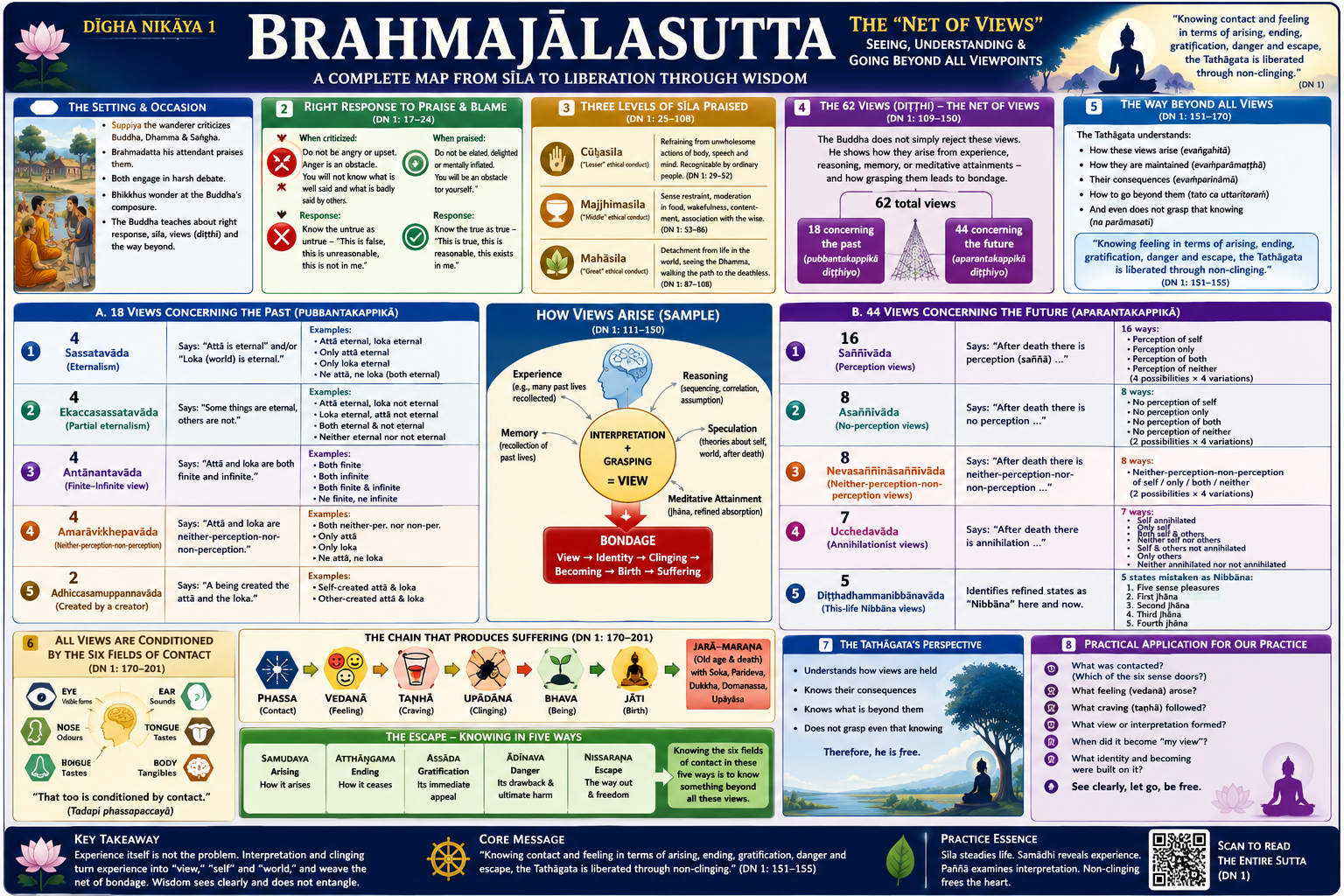 VISUAL SUMMARYSee this sutta in a pictureOpen the complete infographic for a visual overview before or after reading the full study.View infographic →
A foundational study of how experience hardens into view
The discourse then lays out a detailed foundation of ethical restraint, before moving to the much deeper teaching of the 62 speculative views concerning the past, future, self, world, eternity, annihilation, perception, and even refined meditative states. The Buddha does not merely reject these views; he shows how they arise from experience, reasoning, memory, samādhi, and incomplete understanding, and how they become bondage when grasped as truth or self.
The decisive insight comes near the end: all these views remain conditioned by the six fields of contact, giving rise through vedanā → taṇhā → upādāna → bhava → jāti → jarāmaraṇa and dukkha. The way beyond the entire “net” is therefore not another philosophical position, but knowing contact and feeling in terms of their arising, ending, gratification, danger, and escape, leading to anupādā-vimutti — liberation through non-clinging.
The Brahmajālasutta is therefore a foundational practice text showing how sīla steadies life, samādhi reveals experience, paññā examines interpretation, and non-clinging prevents experience from hardening into view, identity, and renewed suffering.
From praise and blame to non-clinging
Why this sutta is foundational. DN 1 begins before philosophy: do not lose discernment through anger at criticism or intoxication with praise. It lays out extensive sīla, maps sixty-two ways views are constructed, then traces all views back to contact, feeling, craving and clinging. The escape is not a sixty-third speculative answer but knowing conditionality without appropriation.
Three reading safeguards
62 views — 18 concerning the past and 44 concerning the future
| Orientation | Family | Count | Main claim |
|---|---|---|---|
| Past / pubbanta | Sassatavāda | 4 | eternal self & world |
| Past / pubbanta | Ekaccasassatavāda | 4 | part eternal, part non-eternal |
| Past / pubbanta | Antānantavāda | 4 | world finite/infinite/both/neither |
| Past / pubbanta | Amarāvikkhepavāda | 4 | evasive eel-wriggling |
| Past / pubbanta | Adhiccasamuppannavāda | 2 | self & world arisen by chance |
| Future / aparanta | Saññīvāda | 16 | postmortem percipient self |
| Future / aparanta | Asaññīvāda | 8 | postmortem non-percipient self |
| Future / aparanta | Nevasaññīnāsaññīvāda | 8 | neither-percipient-nor-non-percipient self |
| Future / aparanta | Ucchedavāda | 7 | annihilation of progressively subtler selves |
| Future / aparanta | Diṭṭhadhammanibbānavāda | 5 | sensuality or four jhānas as final Nibbāna |
| Total | 62 | 18 concerning the past + 44 concerning the future | |
From praise and blame through the sixty-two views to the escape from the net
01 Paribbājakakathā
Evaṁ me sutaṁ— ekaṁ samayaṁ bhagavā antarā ca rājagahaṁ antarā ca nāḷandaṁ addhānamaggappaṭipanno hoti mahatā bhikkhusaṅghena saddhiṁ pañcamattehi bhikkhusatehi. Suppiyopi kho paribbājako antarā ca rājagahaṁ antarā ca nāḷandaṁ addhānamaggappaṭipanno hoti saddhiṁ antevāsinā brahmadattena māṇavena. Tatra sudaṁ suppiyo paribbājako anekapariyāyena buddhassa avaṇṇaṁ bhāsati, dhammassa avaṇṇaṁ bhāsati, saṅghassa avaṇṇaṁ bhāsati; suppiyassa pana paribbājakassa antevāsī brahmadatto māṇavo anekapariyāyena buddhassa vaṇṇaṁ bhāsati, dhammassa vaṇṇaṁ bhāsati, saṅghassa vaṇṇaṁ bhāsati. Itiha te ubho ācariyantevāsī aññamaññassa ujuvipaccanīkavādā bhagavantaṁ piṭṭhito piṭṭhito anubandhā honti bhikkhusaṅghañca.
Textual variant material: Variant: anubandhā → anubaddhā (bj, pts1ed)
Thus have I heard. On one occasion the Blessed One was traveling on the road between Rājagaha and Nāḷandā with a large Saṅgha of about five hundred bhikkhus. The wanderer Suppiya traveled on the same road with his pupil, the young Brahmadatta. Suppiya spoke in many ways in dispraise of the Buddha, Dhamma, and Saṅgha, while Brahmadatta spoke in many ways in their praise. Teacher and pupil, holding directly opposing positions, followed behind the Blessed One and the Saṅgha.
Atha kho bhagavā ambalaṭṭhikāyaṁ rājāgārake ekarattivāsaṁ upagacchi saddhiṁ bhikkhusaṅghena.
Textual variant material: Variant: upagacchi → upagañchi (bj, sya-all, km, pts1ed) Suppiyopi kho paribbājako ambalaṭṭhikāyaṁ rājāgārake ekarattivāsaṁ upagacchi antevāsinā brahmadattena māṇavena. Tatrapi sudaṁ suppiyo paribbājako anekapariyāyena buddhassa avaṇṇaṁ bhāsati, dhammassa avaṇṇaṁ bhāsati, saṅghassa avaṇṇaṁ bhāsati; suppiyassa pana paribbājakassa antevāsī brahmadatto māṇavo anekapariyāyena buddhassa vaṇṇaṁ bhāsati, dhammassa vaṇṇaṁ bhāsati, saṅghassa vaṇṇaṁ bhāsati. Itiha te ubho ācariyantevāsī aññamaññassa ujuvipaccanīkavādā viharanti.
The Blessed One stayed for one night at the royal rest-house at Ambalaṭṭhikā with the Saṅgha. Suppiya and Brahmadatta stayed there too. Even there Suppiya continued criticizing the Buddha, Dhamma, and Saṅgha, while Brahmadatta continued praising them. Thus teacher and pupil remained in direct opposition.
Atha kho sambahulānaṁ bhikkhūnaṁ rattiyā paccūsasamayaṁ paccuṭṭhitānaṁ maṇḍalamāḷe sannisinnānaṁ sannipatitānaṁ ayaṁ saṅkhiyadhammo udapādi:
Toward dawn, several bhikkhus who had risen and assembled in the pavilion began this discussion:
“acchariyaṁ, āvuso, abbhutaṁ, āvuso, yāvañcidaṁ tena bhagavatā jānatā passatā arahatā sammāsambuddhena sattānaṁ nānādhimuttikatā suppaṭividitā. Ayañhi suppiyo paribbājako anekapariyāyena buddhassa avaṇṇaṁ bhāsati, dhammassa avaṇṇaṁ bhāsati, saṅghassa avaṇṇaṁ bhāsati; suppiyassa pana paribbājakassa antevāsī brahmadatto māṇavo anekapariyāyena buddhassa vaṇṇaṁ bhāsati, dhammassa vaṇṇaṁ bhāsati, saṅghassa vaṇṇaṁ bhāsati. Itihame ubho ācariyantevāsī aññamaññassa ujuvipaccanīkavādā bhagavantaṁ piṭṭhito piṭṭhito anubandhā honti bhikkhusaṅghañcā”ti.
“It is wonderful and marvelous, friends, how well the Blessed One—the knowing and seeing arahant, perfectly awakened Buddha—has penetrated the diversity of beings’ inclinations. Suppiya criticizes the Buddha, Dhamma, and Saṅgha in many ways, while Brahmadatta praises them in many ways. Teacher and pupil, directly opposed in speech, have been following behind the Blessed One and the Saṅgha.”
Atha kho bhagavā tesaṁ bhikkhūnaṁ imaṁ saṅkhiyadhammaṁ viditvā yena maṇḍalamāḷo tenupasaṅkami; upasaṅkamitvā paññatte āsane nisīdi. Nisajja kho bhagavā bhikkhū āmantesi: “kāya nuttha, bhikkhave, etarahi kathāya sannisinnā sannipatitā, kā ca pana vo antarākathā vippakatā”ti?
Knowing their discussion, the Blessed One approached the pavilion, sat on the prepared seat, and asked: “Bhikkhus, what discussion are you sitting together for now? What conversation was left unfinished when I arrived?”
Evaṁ vutte, te bhikkhū bhagavantaṁ etadavocuṁ: “idha, bhante, amhākaṁ rattiyā paccūsasamayaṁ paccuṭṭhitānaṁ maṇḍalamāḷe sannisinnānaṁ sannipatitānaṁ ayaṁ saṅkhiyadhammo udapādi: ‘acchariyaṁ, āvuso, abbhutaṁ, āvuso, yāvañcidaṁ tena bhagavatā jānatā passatā arahatā sammāsambuddhena sattānaṁ nānādhimuttikatā suppaṭividitā. Ayañhi suppiyo paribbājako anekapariyāyena buddhassa avaṇṇaṁ bhāsati, dhammassa avaṇṇaṁ bhāsati, saṅghassa avaṇṇaṁ bhāsati; suppiyassa pana paribbājakassa antevāsī brahmadatto māṇavo anekapariyāyena buddhassa vaṇṇaṁ bhāsati, dhammassa vaṇṇaṁ bhāsati, saṅghassa vaṇṇaṁ bhāsati. Itihame ubho ācariyantevāsī aññamaññassa ujuvipaccanīkavādā bhagavantaṁ piṭṭhito piṭṭhito anubandhā honti bhikkhusaṅghañcā’ti. Ayaṁ kho no, bhante, antarākathā vippakatā, atha bhagavā anuppatto”ti.
The bhikkhus repeated their entire discussion: they had been reflecting on the Buddha’s penetration of beings’ diverse inclinations, illustrated by Suppiya’s criticism and Brahmadatta’s praise, and that was the conversation interrupted by the Buddha’s arrival.
“Mamaṁ vā, bhikkhave, pare avaṇṇaṁ bhāseyyuṁ, dhammassa vā avaṇṇaṁ bhāseyyuṁ, saṅghassa vā avaṇṇaṁ bhāseyyuṁ, tatra tumhehi na āghāto na appaccayo na cetaso anabhiraddhi karaṇīyā. Mamaṁ vā, bhikkhave, pare avaṇṇaṁ bhāseyyuṁ, dhammassa vā avaṇṇaṁ bhāseyyuṁ, saṅghassa vā avaṇṇaṁ bhāseyyuṁ, tatra ce tumhe assatha kupitā vā anattamanā vā, tumhaṁ yevassa tena antarāyo. Mamaṁ vā, bhikkhave, pare avaṇṇaṁ bhāseyyuṁ, dhammassa vā avaṇṇaṁ bhāseyyuṁ, saṅghassa vā avaṇṇaṁ bhāseyyuṁ, tatra ce tumhe assatha kupitā vā anattamanā vā, api nu tumhe paresaṁ subhāsitaṁ dubbhāsitaṁ ājāneyyāthā”ti?
“Bhikkhus, if others should criticize me, the Dhamma, or the Saṅgha, you should not produce resentment, displeasure, or mental discontent. If you became angry or unhappy, that itself would be an obstruction for you. And if you were angry or unhappy, would you be able to know clearly whether what others said was well spoken or badly spoken?”
“No hetaṁ, bhante”.
“No, venerable sir.”
“Mamaṁ vā, bhikkhave, pare avaṇṇaṁ bhāseyyuṁ, dhammassa vā avaṇṇaṁ bhāseyyuṁ, saṅghassa vā avaṇṇaṁ bhāseyyuṁ, tatra tumhehi abhūtaṁ abhūtato nibbeṭhetabbaṁ: ‘itipetaṁ abhūtaṁ, itipetaṁ atacchaṁ, natthi cetaṁ amhesu, na ca panetaṁ amhesu saṁvijjatī’ti.
“If others criticize me, the Dhamma, or the Saṅgha, you should unravel what is false as false: ‘This is false; this is untrue; this is not found among us; this does not occur among us.’”
Mamaṁ vā, bhikkhave, pare vaṇṇaṁ bhāseyyuṁ, dhammassa vā vaṇṇaṁ bhāseyyuṁ, saṅghassa vā vaṇṇaṁ bhāseyyuṁ, tatra tumhehi na ānando na somanassaṁ na cetaso uppilāvitattaṁ karaṇīyaṁ.
Textual variant material: Variant: uppilāvitattaṁ → ubbilāvitattaṁ (bj, sya-all); ubbillāvitattaṁ (pts1ed) Mamaṁ vā, bhikkhave, pare vaṇṇaṁ bhāseyyuṁ, dhammassa vā vaṇṇaṁ bhāseyyuṁ, saṅghassa vā vaṇṇaṁ bhāseyyuṁ, tatra ce tumhe assatha ānandino sumanā uppilāvitā tumhaṁ yevassa tena antarāyo. Variant: uppilāvitā → ubbilāvino (bj); ubbilāvitattā (sya-all); ubbillāvitā (pts1ed) Mamaṁ vā, bhikkhave, pare vaṇṇaṁ bhāseyyuṁ, dhammassa vā vaṇṇaṁ bhāseyyuṁ, saṅghassa vā vaṇṇaṁ bhāseyyuṁ, tatra tumhehi bhūtaṁ bhūtato paṭijānitabbaṁ: ‘itipetaṁ bhūtaṁ, itipetaṁ tacchaṁ, atthi cetaṁ amhesu, saṁvijjati ca panetaṁ amhesū’ti.
“If others praise me, the Dhamma, or the Saṅgha, you should not generate delight, elation, or mental excitement. If you became delighted, uplifted, and carried away by praise, that too would obstruct you. Rather, acknowledge what is true as true: ‘This is true; this is accurate; this is found among us; this does occur among us.’”
02 Cūḷasīla
Appamattakaṁ kho panetaṁ, bhikkhave, oramattakaṁ sīlamattakaṁ, yena puthujjano tathāgatassa vaṇṇaṁ vadamāno vadeyya. Katamañca taṁ, bhikkhave, appamattakaṁ oramattakaṁ sīlamattakaṁ, yena puthujjano tathāgatassa vaṇṇaṁ vadamāno vadeyya?
“Bhikkhus, these are small matters, lower matters, matters merely of ethical conduct, by which an ordinary person might praise the Tathāgata. What are those small, lower, merely ethical matters?”
‘Pāṇātipātaṁ pahāya pāṇātipātā paṭivirato samaṇo gotamo nihitadaṇḍo, nihitasattho, lajjī, dayāpanno, sabbapāṇabhūtahitānukampī viharatī’ti— iti vā hi, bhikkhave, puthujjano tathāgatassa vaṇṇaṁ vadamāno vadeyya.
“Having abandoned killing living beings, the ascetic Gotama abstains from killing. He has laid down rod and weapon; he is conscientious and compassionate, dwelling sympathetic to the welfare of all living beings.”
‘Adinnādānaṁ pahāya adinnādānā paṭivirato samaṇo gotamo dinnādāyī dinnapāṭikaṅkhī, athenena sucibhūtena attanā viharatī’ti— iti vā hi, bhikkhave, puthujjano tathāgatassa vaṇṇaṁ vadamāno vadeyya.
“Having abandoned taking what is not given, the ascetic Gotama abstains from it. He takes only what is given, expects only what is given, and lives honestly, with a purified self.”
‘Abrahmacariyaṁ pahāya brahmacārī samaṇo gotamo ārācārī virato methunā gāmadhammā’ti—
Textual variant material: Variant: ārācārī → anācārī (mr) | virato → paṭivirato (katthaci) iti vā hi, bhikkhave, puthujjano tathāgatassa vaṇṇaṁ vadamāno vadeyya.
“Having abandoned the non-celibate life, the ascetic Gotama lives celibately, aloof from and abstaining from sexual intercourse, the practice of ordinary village life.”
‘Musāvādaṁ pahāya musāvādā paṭivirato samaṇo gotamo saccavādī saccasandho theto paccayiko avisaṁvādako lokassā’ti—
Textual variant material: Variant: theto → ṭheto (sya-all, km) iti vā hi, bhikkhave, puthujjano tathāgatassa vaṇṇaṁ vadamāno vadeyya.
“Having abandoned false speech, the ascetic Gotama abstains from falsehood. He speaks truth, is devoted to truth, trustworthy, reliable, and no deceiver of the world.”
‘Pisuṇaṁ vācaṁ pahāya pisuṇāya vācāya paṭivirato samaṇo gotamo, ito sutvā na amutra akkhātā imesaṁ bhedāya, amutra vā sutvā na imesaṁ akkhātā amūsaṁ bhedāya. Iti bhinnānaṁ vā sandhātā, sahitānaṁ vā anuppadātā samaggārāmo samaggarato samagganandī samaggakaraṇiṁ vācaṁ bhāsitā’ti— iti vā hi, bhikkhave, puthujjano tathāgatassa vaṇṇaṁ vadamāno vadeyya.
“Having abandoned divisive speech, he does not repeat here what he has heard elsewhere to divide people there, nor repeat there what he has heard here to divide people here. He reconciles the divided, strengthens the united, delights and rejoices in harmony, and speaks words that create harmony.”
‘Pharusaṁ vācaṁ pahāya pharusāya vācāya paṭivirato samaṇo gotamo, yā sā vācā nelā kaṇṇasukhā pemanīyā hadayaṅgamā porī bahujanakantā bahujanamanāpā tathārūpiṁ vācaṁ bhāsitā’ti— iti vā hi, bhikkhave, puthujjano tathāgatassa vaṇṇaṁ vadamāno vadeyya.
“Having abandoned harsh speech, he speaks words that are gentle, pleasing to the ear, lovable, going to the heart, courteous, desired by many, and agreeable to many.”
‘Samphappalāpaṁ pahāya samphappalāpā paṭivirato samaṇo gotamo kālavādī bhūtavādī atthavādī dhammavādī vinayavādī, nidhānavatiṁ vācaṁ bhāsitā kālena sāpadesaṁ pariyantavatiṁ atthasaṁhitan’ti— iti vā hi, bhikkhave, puthujjano tathāgatassa vaṇṇaṁ vadamāno vadeyya.
“Having abandoned idle chatter, he speaks at the right time, what is factual, meaningful, connected with Dhamma and discipline—words worth treasuring, timely, reasoned, bounded, and connected with benefit.”
‘Bījagāmabhūtagāmasamārambhā paṭivirato samaṇo gotamo’ti— iti vā hi, bhikkhave, puthujjano tathāgatassa vaṇṇaṁ vadamāno vadeyya.
“The ascetic Gotama abstains from damaging seed-life and plant-life.” This too is one way an ordinary person might praise him.
‘Ekabhattiko samaṇo gotamo rattūparato virato vikālabhojanā ’ti— iti vā hi, bhikkhave, puthujjano tathāgatassa vaṇṇaṁ vadamāno vadeyya.
Textual variant material: Variant: virato → vikālabhojanā paṭivirato (pts1ed); paṭivirato (katthaci)
“The ascetic Gotama eats one meal a day, abstains from eating at night, and abstains from food at improper times.”
Naccagītavāditavisūkadassanā paṭivirato samaṇo gotamo ’ti— iti vā hi, bhikkhave, puthujjano tathāgatassa vaṇṇaṁ vadamāno vadeyya.
“The ascetic Gotama abstains from dancing, singing, music, and unsuitable entertainments and shows.”
Mālāgandhavilepanadhāraṇamaṇḍanavibhūsanaṭṭhānā paṭivirato samaṇo gotamo ’ti— iti vā hi, bhikkhave, puthujjano tathāgatassa vaṇṇaṁ vadamāno vadeyya.
“The ascetic Gotama abstains from wearing garlands, perfumes, cosmetics, adornments, and decorations.”
Uccāsayanamahāsayanā paṭivirato samaṇo gotamo ’ti— iti vā hi, bhikkhave, puthujjano tathāgatassa vaṇṇaṁ vadamāno vadeyya.
“The ascetic Gotama abstains from high and luxurious beds and seats.”
Jātarūparajatapaṭiggahaṇā paṭivirato samaṇo gotamo ’ti— iti vā hi, bhikkhave, puthujjano tathāgatassa vaṇṇaṁ vadamāno vadeyya. Āmakadhaññapaṭiggahaṇā paṭivirato samaṇo gotamo ’ti— iti vā hi, bhikkhave, puthujjano tathāgatassa vaṇṇaṁ vadamāno vadeyya. Āmakamaṁsapaṭiggahaṇā paṭivirato samaṇo gotamo ’ti— iti vā hi, bhikkhave, puthujjano tathāgatassa vaṇṇaṁ vadamāno vadeyya. Itthikumārikapaṭiggahaṇā paṭivirato samaṇo gotamo ’ti— iti vā hi, bhikkhave, puthujjano tathāgatassa vaṇṇaṁ vadamāno vadeyya. Dāsidāsapaṭiggahaṇā paṭivirato samaṇo gotamo ’ti— iti vā hi, bhikkhave, puthujjano tathāgatassa vaṇṇaṁ vadamāno vadeyya. Ajeḷakapaṭiggahaṇā paṭivirato samaṇo gotamo ’ti— iti vā hi, bhikkhave, puthujjano tathāgatassa vaṇṇaṁ vadamāno vadeyya. Kukkuṭasūkarapaṭiggahaṇā paṭivirato samaṇo gotamo ’ti— iti vā hi, bhikkhave, puthujjano tathāgatassa vaṇṇaṁ vadamāno vadeyya. Hatthigavassavaḷavapaṭiggahaṇā paṭivirato samaṇo gotamo ’ti— iti vā hi, bhikkhave, puthujjano tathāgatassa vaṇṇaṁ vadamāno vadeyya. Khettavatthupaṭiggahaṇā paṭivirato samaṇo gotamo ’ti— iti vā hi, bhikkhave, puthujjano tathāgatassa vaṇṇaṁ vadamāno vadeyya.
“The ascetic Gotama abstains from accepting gold and silver; uncooked grain and raw meat; women and girls; male and female slaves; goats and sheep; chickens and pigs; elephants, cattle, horses and mares; and fields and property.” Each abstention belongs to the ethical qualities by which an ordinary person might praise him.
Dūteyyapahiṇagamanānuyogā paṭivirato samaṇo gotamo ’ti— iti vā hi, bhikkhave, puthujjano tathāgatassa vaṇṇaṁ vadamāno vadeyya. Kayavikkayā paṭivirato samaṇo gotamo ’ti— iti vā hi, bhikkhave, puthujjano tathāgatassa vaṇṇaṁ vadamāno vadeyya. Tulākūṭakaṁsakūṭamānakūṭā paṭivirato samaṇo gotamo ’ti— iti vā hi, bhikkhave, puthujjano tathāgatassa vaṇṇaṁ vadamāno vadeyya. Ukkoṭanavañcananikatisāciyogā paṭivirato samaṇo gotamo ’ti— iti vā hi, bhikkhave, puthujjano tathāgatassa vaṇṇaṁ vadamāno vadeyya. Chedanavadhabandhanaviparāmosaālopasahasākārā paṭivirato samaṇo gotamo’ti— iti vā hi, bhikkhave, puthujjano tathāgatassa vaṇṇaṁ vadamāno vadeyya.
“The ascetic Gotama abstains from acting as a messenger or running errands; from buying and selling; from false scales, false metal measures, or false measures; from bribery, deception, cheating, and crooked dealing; and from mutilation, killing, imprisonment, robbery, plunder, and violent assault.”
Cūḷasīlaṁ niṭṭhitaṁ.
03 Majjhimasīla
‘Yathā vā paneke bhonto samaṇabrāhmaṇā saddhādeyyāni bhojanāni bhuñjitvā te evarūpaṁ bījagāmabhūtagāmasamārambhaṁ anuyuttā viharanti, seyyathidaṁ—mūlabījaṁ khandhabījaṁ phaḷubījaṁ aggabījaṁ bījabījameva pañcamaṁ;
Textual variant material: Variant: seyyathidaṁ → seyyathīdaṁ (bj, sya-all, pts1ed) | pañcamaṁ → pañcamaṁ iti vā (bj, sya-all, mr) iti evarūpā bījagāmabhūtagāmasamārambhā paṭivirato samaṇo gotamo’ti— iti vā hi, bhikkhave, puthujjano tathāgatassa vaṇṇaṁ vadamāno vadeyya.
“Whereas some ascetics and brahmins, after eating food given in faith, remain engaged in damaging seed-life and plant-life—root-propagated plants, stem-propagated plants, joint-propagated plants, shoot-propagated plants, and seed-propagated plants as the fifth—the ascetic Gotama abstains from such destruction.”
‘Yathā vā paneke bhonto samaṇabrāhmaṇā saddhādeyyāni bhojanāni bhuñjitvā te evarūpaṁ sannidhikāraparibhogaṁ anuyuttā viharanti, seyyathidaṁ—annasannidhiṁ pānasannidhiṁ vatthasannidhiṁ yānasannidhiṁ sayanasannidhiṁ gandhasannidhiṁ āmisasannidhiṁ iti vā iti evarūpā sannidhikāraparibhogā paṭivirato samaṇo gotamo’ti— iti vā hi, bhikkhave, puthujjano tathāgatassa vaṇṇaṁ vadamāno vadeyya.
“Whereas some supported ascetics and brahmins use stored-up provisions—stores of food, drink, clothing, vehicles, bedding, perfumes, and material goods—the ascetic Gotama abstains from such stored-up use.”
‘Yathā vā paneke bhonto samaṇabrāhmaṇā saddhādeyyāni bhojanāni bhuñjitvā te evarūpaṁ visūkadassanaṁ anuyuttā viharanti, seyyathidaṁ—naccaṁ gītaṁ vāditaṁ pekkhaṁ akkhānaṁ pāṇissaraṁ vetāḷaṁ kumbhathūṇaṁ sobhanakaṁ caṇḍālaṁ vaṁsaṁ dhovanaṁ hatthiyuddhaṁ assayuddhaṁ mahiṁsayuddhaṁ usabhayuddhaṁ ajayuddhaṁ meṇḍayuddhaṁ kukkuṭayuddhaṁ vaṭṭakayuddhaṁ daṇḍayuddhaṁ muṭṭhiyuddhaṁ nibbuddhaṁ uyyodhikaṁ balaggaṁ senābyūhaṁ anīkadassanaṁ
Textual variant material: Variant: meṇḍayuddhaṁ → meṇḍakayuddhaṁ (pts1ed) | sobhanakaṁ → sobhanagarakaṁ (sya-all, km, pts1ed) | mahiṁsayuddhaṁ → mahisayuddhaṁ (bj, sya-all, km, pts1ed) | kumbhathūṇaṁ → kumbhathūnaṁ (bj, sya-all, mr) | dhovanaṁ → dhopanaṁ (pts1ed) iti vā iti evarūpā visūkadassanā paṭivirato samaṇo gotamo’ti— iti vā hi, bhikkhave, puthujjano tathāgatassa vaṇṇaṁ vadamāno vadeyya.
“Whereas some supported ascetics and brahmins engage in entertainments and spectacles—dancing, singing, music, performances, recitations and traditional shows; elephant, horse, buffalo, bull, goat, ram, cock and quail fights; stick and fist fights, wrestling, mock battles, military musters, battle formations and troop reviews—the ascetic Gotama abstains from such spectacles.”
‘Yathā vā paneke bhonto samaṇabrāhmaṇā saddhādeyyāni bhojanāni bhuñjitvā te evarūpaṁ jūtappamādaṭṭhānānuyogaṁ anuyuttā viharanti, seyyathidaṁ—aṭṭhapadaṁ dasapadaṁ ākāsaṁ parihārapathaṁ santikaṁ khalikaṁ ghaṭikaṁ salākahatthaṁ akkhaṁ paṅgacīraṁ vaṅkakaṁ mokkhacikaṁ ciṅgulikaṁ pattāḷhakaṁ rathakaṁ dhanukaṁ akkharikaṁ manesikaṁ yathāvajjaṁ
Textual variant material: Variant: ciṅgulikaṁ → ciṅgulakaṁ (bj) iti vā iti evarūpā jūtappamādaṭṭhānānuyogā paṭivirato samaṇo gotamo’ti— iti vā hi, bhikkhave, puthujjano tathāgatassa vaṇṇaṁ vadamāno vadeyya.
“Whereas some supported ascetics and brahmins engage in games and gambling—various board games, dice and guessing games, toy games, games with sticks, letters, minds, bows, miniature vehicles, and other ancient games of chance and distraction—the ascetic Gotama abstains from such gambling and heedlessness.”
‘Yathā vā paneke bhonto samaṇabrāhmaṇā saddhādeyyāni bhojanāni bhuñjitvā te evarūpaṁ uccāsayanamahāsayanaṁ anuyuttā viharanti, seyyathidaṁ—āsandiṁ pallaṅkaṁ gonakaṁ cittakaṁ paṭikaṁ paṭalikaṁ tūlikaṁ vikatikaṁ uddalomiṁ ekantalomiṁ kaṭṭissaṁ koseyyaṁ kuttakaṁ hatthattharaṁ assattharaṁ rathattharaṁ ajinappaveṇiṁ kadalimigapavarapaccattharaṇaṁ sauttaracchadaṁ ubhatolohitakūpadhānaṁ
Textual variant material: Variant: hatthattharaṁ assattharaṁ rathattharaṁ → hatthattharaṇaṁ assattharaṇaṁ rathattharaṇaṁ (pts1ed, mr) iti vā iti evarūpā uccāsayanamahāsayanā paṭivirato samaṇo gotamo’ti— iti vā hi, bhikkhave, puthujjano tathāgatassa vaṇṇaṁ vadamāno vadeyya.
“Whereas some supported ascetics and brahmins use high and luxurious furnishings—large couches, ornate seats, fleeces, patterned covers, quilts, woolen spreads, silk, carpets, animal-skin rugs, canopies, cushions, and rich bedding—the ascetic Gotama abstains from such luxury.”
‘Yathā vā paneke bhonto samaṇabrāhmaṇā saddhādeyyāni bhojanāni bhuñjitvā te evarūpaṁ maṇḍanavibhūsanaṭṭhānānuyogaṁ anuyuttā viharanti, seyyathidaṁ— ucchādanaṁ parimaddanaṁ nhāpanaṁ sambāhanaṁ ādāsaṁ añjanaṁ mālāgandhavilepanaṁ mukhacuṇṇaṁ mukhalepanaṁ hatthabandhaṁ sikhābandhaṁ daṇḍaṁ nāḷikaṁ asiṁ chattaṁ citrupāhanaṁ uṇhīsaṁ maṇiṁ vālabījaniṁ odātāni vatthāni dīghadasāni
Textual variant material: Variant: daṇḍaṁ → daṇḍakaṁ (bj, pts1ed) | nāḷikaṁ → nālikaṁ (sya-all) | asiṁ → asiṁ khaggaṁ (sya-all, km); khaggaṁ (pts1ed) iti vā iti evarūpā maṇḍanavibhūsanaṭṭhānānuyogā paṭivirato samaṇo gotamo’ti— iti vā hi, bhikkhave, puthujjano tathāgatassa vaṇṇaṁ vadamāno vadeyya.
“Whereas some supported ascetics and brahmins engage in beautification and adornment—rubbing, massage, bathing, grooming, mirrors, eye-cosmetics, garlands, perfumes, face powders and creams, bracelets, hair arrangements, staffs, cases, swords, parasols, decorated sandals, turbans, jewels, fans, and fine long-fringed garments—the ascetic Gotama abstains from such adornment.”
‘Yathā vā paneke bhonto samaṇabrāhmaṇā saddhādeyyāni bhojanāni bhuñjitvā te evarūpaṁ tiracchānakathaṁ anuyuttā viharanti, seyyathidaṁ—rājakathaṁ corakathaṁ mahāmattakathaṁ senākathaṁ bhayakathaṁ yuddhakathaṁ annakathaṁ pānakathaṁ vatthakathaṁ sayanakathaṁ mālākathaṁ gandhakathaṁ ñātikathaṁ yānakathaṁ gāmakathaṁ nigamakathaṁ nagarakathaṁ janapadakathaṁ itthikathaṁ sūrakathaṁ visikhākathaṁ kumbhaṭṭhānakathaṁ pubbapetakathaṁ nānattakathaṁ lokakkhāyikaṁ samuddakkhāyikaṁ itibhavābhavakathaṁ
Textual variant material: Variant: itthikathaṁ → itthīkathaṁ (bj); itthikathaṁ purisakathaṁ (cck, km, mr); itthīkathaṁ purisakathaṁ (sya1ed, sya2ed) iti vā iti evarūpāya tiracchānakathāya paṭivirato samaṇo gotamo’ti— iti vā hi, bhikkhave, puthujjano tathāgatassa vaṇṇaṁ vadamāno vadeyya.
“Whereas some supported ascetics and brahmins engage in low or distracting talk—about kings, thieves, ministers, armies, dangers, wars, food, drink, clothing, beds, garlands, perfumes, relatives, vehicles, villages, towns, cities, countries, women, heroes, streets and gathering places, the dead, miscellaneous matters, the world and sea, and stories of becoming and non-becoming—the ascetic Gotama abstains from such talk.”
‘Yathā vā paneke bhonto samaṇabrāhmaṇā saddhādeyyāni bhojanāni bhuñjitvā te evarūpaṁ viggāhikakathaṁ anuyuttā viharanti, seyyathidaṁ—na tvaṁ imaṁ dhammavinayaṁ ājānāsi, ahaṁ imaṁ dhammavinayaṁ ājānāmi, kiṁ tvaṁ imaṁ dhammavinayaṁ ājānissasi, micchā paṭipanno tvamasi, ahamasmi sammā paṭipanno, sahitaṁ me, asahitaṁ te, purevacanīyaṁ pacchā avaca, pacchāvacanīyaṁ pure avaca, adhiciṇṇaṁ te viparāvattaṁ, āropito te vādo, niggahito tvamasi, cara vādappamokkhāya, nibbeṭhehi vā sace pahosīti
Textual variant material: Variant: adhiciṇṇaṁ → āciṇṇaṁ (bj); aviciṇṇaṁ (pts1ed) iti vā iti evarūpāya viggāhikakathāya paṭivirato samaṇo gotamo’ti— iti vā hi, bhikkhave, puthujjano tathāgatassa vaṇṇaṁ vadamāno vadeyya.
“Whereas some supported ascetics and brahmins engage in contentious debate—‘You do not understand this Dhamma and discipline; I do. You practice wrongly; I practice rightly. My statement is coherent, yours is not. You put what should come first later and what should come later first. Your position is overturned; your doctrine refuted. Go and free your view—disentangle it if you can!’—the ascetic Gotama abstains from such contentious speech.”
‘Yathā vā paneke bhonto samaṇabrāhmaṇā saddhādeyyāni bhojanāni bhuñjitvā te evarūpaṁ dūteyyapahiṇagamanānuyogaṁ anuyuttā viharanti, seyyathidaṁ—raññaṁ, rājamahāmattānaṁ, khattiyānaṁ, brāhmaṇānaṁ, gahapatikānaṁ, kumārānaṁ “idha gaccha, amutrāgaccha, idaṁ hara, amutra idaṁ āharā”ti iti vā iti evarūpā dūteyyapahiṇagamanānuyogā paṭivirato samaṇo gotamo’ti— iti vā hi, bhikkhave, puthujjano tathāgatassa vaṇṇaṁ vadamāno vadeyya.
“Whereas some supported ascetics and brahmins act as messengers for kings, ministers, nobles, brahmins, householders and princes—‘Go here, go there, take this, bring that’—the ascetic Gotama abstains from such errands.”
‘Yathā vā paneke bhonto samaṇabrāhmaṇā saddhādeyyāni bhojanāni bhuñjitvā te kuhakā ca honti, lapakā ca nemittikā ca nippesikā ca, lābhena lābhaṁ nijigīsitāro ca
Textual variant material: Variant: lābhena lābhaṁ nijigīsitāro ca → lābhena ca lābhaṁ nijigiṁsitāro (bj, sya-all, pts1ed) iti evarūpā kuhanalapanā paṭivirato samaṇo gotamo’ti— Variant: iti → iti (bj, mr) iti vā hi, bhikkhave, puthujjano tathāgatassa vaṇṇaṁ vadamāno vadeyya.
“Whereas some supported ascetics and brahmins are schemers, flatterers, hint-droppers, belittlers, and seekers of gain by means of further gain, the ascetic Gotama abstains from such scheming and flattery.”
Majjhimasīlaṁ niṭṭhitaṁ.
04 Mahāsīla
‘Yathā vā paneke bhonto samaṇabrāhmaṇā saddhādeyyāni bhojanāni bhuñjitvā te evarūpāya tiracchānavijjāya micchājīvena jīvitaṁ kappenti, seyyathidaṁ—aṅgaṁ nimittaṁ uppātaṁ supinaṁ lakkhaṇaṁ mūsikacchinnaṁ aggihomaṁ dabbihomaṁ thusahomaṁ kaṇahomaṁ taṇḍulahomaṁ sappihomaṁ telahomaṁ mukhahomaṁ lohitahomaṁ aṅgavijjā vatthuvijjā khattavijjā sivavijjā bhūtavijjā bhūrivijjā ahivijjā visavijjā vicchikavijjā mūsikavijjā sakuṇavijjā vāyasavijjā pakkajjhānaṁ saraparittāṇaṁ migacakkaṁ
Textual variant material: Variant: khattavijjā → khettavijjā (sya-all) iti vā iti evarūpāya tiracchānavijjāya micchājīvā paṭivirato samaṇo gotamo’ti— iti vā hi, bhikkhave, puthujjano tathāgatassa vaṇṇaṁ vadamāno vadeyya.
“Whereas some supported ascetics and brahmins make a living by wrong livelihood through low arts: interpreting bodily marks, signs, omens, dreams, auspicious signs and mouse-bites; performing fire offerings with various substances; practicing named forms of physiognomy, site-lore, warrior/political lore, auspicious lore, spirit and earth lore, snake, poison, scorpion, mouse, bird and crow lore, and other protective or prognostic arts—the ascetic Gotama abstains from such wrong livelihood.”
‘Yathā vā paneke bhonto samaṇabrāhmaṇā saddhādeyyāni bhojanāni bhuñjitvā te evarūpāya tiracchānavijjāya micchājīvena jīvitaṁ kappenti, seyyathidaṁ—maṇilakkhaṇaṁ vatthalakkhaṇaṁ daṇḍalakkhaṇaṁ satthalakkhaṇaṁ asilakkhaṇaṁ usulakkhaṇaṁ dhanulakkhaṇaṁ āvudhalakkhaṇaṁ itthilakkhaṇaṁ purisalakkhaṇaṁ kumāralakkhaṇaṁ kumārilakkhaṇaṁ dāsalakkhaṇaṁ dāsilakkhaṇaṁ hatthilakkhaṇaṁ assalakkhaṇaṁ mahiṁsalakkhaṇaṁ usabhalakkhaṇaṁ golakkhaṇaṁ ajalakkhaṇaṁ meṇḍalakkhaṇaṁ kukkuṭalakkhaṇaṁ vaṭṭakalakkhaṇaṁ godhālakkhaṇaṁ kaṇṇikālakkhaṇaṁ kacchapalakkhaṇaṁ migalakkhaṇaṁ iti vā iti evarūpāya tiracchānavijjāya micchājīvā paṭivirato samaṇo gotamo’ti— iti vā hi, bhikkhave, puthujjano tathāgatassa vaṇṇaṁ vadamāno vadeyya.
“Whereas some make a living by interpreting the marks of gems, cloth, staffs, weapons, swords, arrows, bows and other arms; women, men, boys, girls and slaves; elephants, horses, buffaloes, bulls, cattle, goats, rams, chickens, quails, monitor lizards, certain birds, tortoises, deer and other beings—the ascetic Gotama abstains from such wrong livelihood.”
‘Yathā vā paneke bhonto samaṇabrāhmaṇā saddhādeyyāni bhojanāni bhuñjitvā te evarūpāya tiracchānavijjāya micchājīvena jīvitaṁ kappenti, seyyathidaṁ—raññaṁ niyyānaṁ bhavissati, raññaṁ aniyyānaṁ bhavissati, abbhantarānaṁ raññaṁ upayānaṁ bhavissati, bāhirānaṁ raññaṁ apayānaṁ bhavissati, bāhirānaṁ raññaṁ upayānaṁ bhavissati, abbhantarānaṁ raññaṁ apayānaṁ bhavissati, abbhantarānaṁ raññaṁ jayo bhavissati, bāhirānaṁ raññaṁ parājayo bhavissati, bāhirānaṁ raññaṁ jayo bhavissati, abbhantarānaṁ raññaṁ parājayo bhavissati, iti imassa jayo bhavissati, imassa parājayo bhavissati iti vā iti evarūpāya tiracchānavijjāya micchājīvā paṭivirato samaṇo gotamo’ti— iti vā hi, bhikkhave, puthujjano tathāgatassa vaṇṇaṁ vadamāno vadeyya.
“Whereas some make a living by predicting political and military outcomes—whether kings will march or not, whether internal or external rulers will advance or retreat, and who will win or lose—the ascetic Gotama abstains from such wrong livelihood.”
‘Yathā vā paneke bhonto samaṇabrāhmaṇā saddhādeyyāni bhojanāni bhuñjitvā te evarūpāya tiracchānavijjāya micchājīvena jīvitaṁ kappenti, seyyathidaṁ—candaggāho bhavissati, sūriyaggāho bhavissati, nakkhattaggāho bhavissati, candimasūriyānaṁ pathagamanaṁ bhavissati, candimasūriyānaṁ uppathagamanaṁ bhavissati, nakkhattānaṁ pathagamanaṁ bhavissati, nakkhattānaṁ uppathagamanaṁ bhavissati, ukkāpāto bhavissati, disāḍāho bhavissati, bhūmicālo bhavissati, devadudrabhi bhavissati, candimasūriyanakkhattānaṁ uggamanaṁ ogamanaṁ saṅkilesaṁ vodānaṁ bhavissati, evaṁvipāko candaggāho bhavissati, evaṁvipāko sūriyaggāho bhavissati, evaṁvipāko nakkhattaggāho bhavissati, evaṁvipākaṁ candimasūriyānaṁ pathagamanaṁ bhavissati, evaṁvipākaṁ candimasūriyānaṁ uppathagamanaṁ bhavissati, evaṁvipākaṁ nakkhattānaṁ pathagamanaṁ bhavissati, evaṁvipākaṁ nakkhattānaṁ uppathagamanaṁ bhavissati, evaṁvipāko ukkāpāto bhavissati, evaṁvipāko disāḍāho bhavissati, evaṁvipāko bhūmicālo bhavissati, evaṁvipāko devadudrabhi bhavissati, evaṁvipākaṁ candimasūriyanakkhattānaṁ uggamanaṁ ogamanaṁ saṅkilesaṁ vodānaṁ bhavissati
Textual variant material: Variant: sūriyaggāho → suriyaggāho (bj, sya-all, km, pts1ed) | devadudrabhi → devadundubhi (bj, sya-all, km, pts1ed) iti vā iti evarūpāya tiracchānavijjāya micchājīvā paṭivirato samaṇo gotamo’ti— iti vā hi, bhikkhave, puthujjano tathāgatassa vaṇṇaṁ vadamāno vadeyya.
“Whereas some make a living by prognostication concerning eclipses of moon, sun or constellations; regular or irregular courses of celestial bodies; meteors, fiery horizons, earthquakes and celestial thunder; rising, setting, obscuration and clearing of sun, moon and stars; and the supposed results of such events—the ascetic Gotama abstains from such wrong livelihood.”
‘Yathā vā paneke bhonto samaṇabrāhmaṇā saddhādeyyāni bhojanāni bhuñjitvā te evarūpāya tiracchānavijjāya micchājīvena jīvitaṁ kappenti, seyyathidaṁ—suvuṭṭhikā bhavissati, dubbuṭṭhikā bhavissati, subhikkhaṁ bhavissati, dubbhikkhaṁ bhavissati, khemaṁ bhavissati, bhayaṁ bhavissati, rogo bhavissati, ārogyaṁ bhavissati, muddā, gaṇanā, saṅkhānaṁ, kāveyyaṁ, lokāyataṁ iti vā iti evarūpāya tiracchānavijjāya micchājīvā paṭivirato samaṇo gotamo’ti— iti vā hi, bhikkhave, puthujjano tathāgatassa vaṇṇaṁ vadamāno vadeyya.
“Whereas some make a living by predicting good or poor rainfall, abundance or famine, safety or danger, disease or health, and by calculation, reckoning, accounting, poetry, or speculative worldly systems used as livelihood—the ascetic Gotama abstains from such wrong livelihood.”
‘Yathā vā paneke bhonto samaṇabrāhmaṇā saddhādeyyāni bhojanāni bhuñjitvā te evarūpāya tiracchānavijjāya micchājīvena jīvitaṁ kappenti, seyyathidaṁ—āvāhanaṁ vivāhanaṁ saṁvaraṇaṁ vivaraṇaṁ saṅkiraṇaṁ vikiraṇaṁ subhagakaraṇaṁ dubbhagakaraṇaṁ viruddhagabbhakaraṇaṁ jivhānibandhanaṁ hanusaṁhananaṁ hatthābhijappanaṁ hanujappanaṁ kaṇṇajappanaṁ ādāsapañhaṁ kumārikapañhaṁ devapañhaṁ ādiccupaṭṭhānaṁ mahatupaṭṭhānaṁ abbhujjalanaṁ sirivhāyanaṁ iti vā iti evarūpāya tiracchānavijjāya micchājīvā paṭivirato samaṇo gotamo’ti— iti vā hi, bhikkhave, puthujjano tathāgatassa vaṇṇaṁ vadamāno vadeyya.
“Whereas some make a living through rites and spells connected with joining or separating couples, binding and unbinding, attracting and repelling, making fortunate or unfortunate, affecting pregnancy, tongue or jaw binding, hand or ear incantations, mirror-, girl-, or deity-oracles, sun or power worship, fire rites, and invocation of fortune—the ascetic Gotama abstains from such wrong livelihood.”
‘Yathā vā paneke bhonto samaṇabrāhmaṇā saddhādeyyāni bhojanāni bhuñjitvā te evarūpāya tiracchānavijjāya micchājīvena jīvitaṁ kappenti, seyyathidaṁ—santikammaṁ paṇidhikammaṁ bhūtakammaṁ bhūrikammaṁ vassakammaṁ vossakammaṁ vatthukammaṁ vatthuparikammaṁ ācamanaṁ nhāpanaṁ juhanaṁ vamanaṁ virecanaṁ uddhaṁvirecanaṁ adhovirecanaṁ sīsavirecanaṁ kaṇṇatelaṁ nettatappanaṁ natthukammaṁ añjanaṁ paccañjanaṁ sālākiyaṁ sallakattiyaṁ dārakatikicchā mūlabhesajjānaṁ anuppadānaṁ osadhīnaṁ paṭimokkho iti vā iti evarūpāya tiracchānavijjāya micchājīvā paṭivirato samaṇo gotamo’ti— iti vā hi, bhikkhave, puthujjano tathāgatassa vaṇṇaṁ vadamāno vadeyya.
“Whereas some make a living through rites of appeasement, vows, spirit and prosperity rites, rain rites and related rituals; preparing sites; cleansing, bathing and sacrifice; inducing vomiting or purging; administering ear oils, eye and nasal treatments, ointments and counter-ointments; surgery and related treatment, treatment of children, root medicines and medicinal preparations—the ascetic Gotama abstains from such wrong livelihood.”
Idaṁ kho, bhikkhave, appamattakaṁ oramattakaṁ sīlamattakaṁ, yena puthujjano tathāgatassa vaṇṇaṁ vadamāno vadeyya.
“Bhikkhus, these are the small, lower, merely ethical matters by which an ordinary person might praise the Tathāgata.”
Mahāsīlaṁ niṭṭhitaṁ.
05 Pubbantakappika
Atthi, bhikkhave, aññeva dhammā gambhīrā duddasā duranubodhā santā paṇītā atakkāvacarā nipuṇā paṇḍitavedanīyā, ye tathāgato sayaṁ abhiññā sacchikatvā pavedeti, yehi tathāgatassa yathābhuccaṁ vaṇṇaṁ sammā vadamānā vadeyyuṁ. Katame ca te, bhikkhave, dhammā gambhīrā duddasā duranubodhā santā paṇītā atakkāvacarā nipuṇā paṇḍitavedanīyā, ye tathāgato sayaṁ abhiññā sacchikatvā pavedeti, yehi tathāgatassa yathābhuccaṁ vaṇṇaṁ sammā vadamānā vadeyyuṁ?
“Bhikkhus, there are other dhammas—deep, difficult to see, difficult to understand, peaceful, sublime, beyond the sphere of mere reasoning, subtle, to be experienced by the wise—which the Tathāgata has directly known and realized for himself and then teaches. It is by these that one speaking rightly and in accordance with reality would truly praise the Tathāgata. What are these deep dhammas?”
Santi, bhikkhave, eke samaṇabrāhmaṇā pubbantakappikā pubbantānudiṭṭhino, pubbantaṁ ārabbha anekavihitāni adhimuttipadāni abhivadanti aṭṭhārasahi vatthūhi. Te ca bhonto samaṇabrāhmaṇā kimāgamma kimārabbha pubbantakappikā pubbantānudiṭṭhino pubbantaṁ ārabbha anekavihitāni adhimuttipadāni abhivadanti aṭṭhārasahi vatthūhi?
“There are ascetics and brahmins who speculate about the beginning of the past, hold views concerning the past, and make many assertions about it on eighteen grounds. On what do they rely, and with reference to what do they make these eighteen assertions?”
06 Sassatavāda
Santi, bhikkhave, eke samaṇabrāhmaṇā sassatavādā, sassataṁ attānañca lokañca paññapenti catūhi vatthūhi. Te ca bhonto samaṇabrāhmaṇā kimāgamma kimārabbha sassatavādā sassataṁ attānañca lokañca paññapenti catūhi vatthūhi?
“Some ascetics and brahmins are eternalists. On four grounds they describe the self and the world as eternal. On what basis do they do so?”
Idha, bhikkhave, ekacco samaṇo vā brāhmaṇo vā ātappamanvāya padhānamanvāya anuyogamanvāya appamādamanvāya sammāmanasikāramanvāya tathārūpaṁ cetosamādhiṁ phusati, yathāsamāhite citte (…) anekavihitaṁ pubbenivāsaṁ anussarati.
Textual variant material: Variant: (…) → (parisuddhe pariyodāte anaṅgaṇe vigatūpakkilese) (sya-all, mr) Seyyathidaṁ—ekampi jātiṁ dvepi jātiyo tissopi jātiyo catassopi jātiyo pañcapi jātiyo dasapi jātiyo vīsampi jātiyo tiṁsampi jātiyo cattālīsampi jātiyo paññāsampi jātiyo jātisatampi jātisahassampi jātisatasahassampi anekānipi jātisatāni anekānipi jātisahassāni anekānipi jātisatasahassāni: ‘amutrāsiṁ evaṁnāmo evaṅgotto evaṁvaṇṇo evamāhāro evaṁsukhadukkhappaṭisaṁvedī evamāyupariyanto, so tato cuto amutra udapādiṁ; tatrāpāsiṁ evaṁnāmo evaṅgotto evaṁvaṇṇo evamāhāro evaṁsukhadukkhappaṭisaṁvedī evamāyupariyanto, so tato cuto idhūpapanno’ti. Iti sākāraṁ sauddesaṁ anekavihitaṁ pubbenivāsaṁ anussarati. Variant: udapādiṁ → upapādiṁ (bj, pts1ed)
“Here an ascetic or brahmin, through ardor, striving, devotion, heedfulness, and right attention, reaches such concentration of mind that with the concentrated mind he recollects many former lives: one, two, three, four, five; ten, twenty, thirty, forty, fifty; a hundred, a thousand, a hundred thousand; many hundreds, thousands, and hundreds of thousands of births. He remembers: ‘There I had such a name, clan, appearance and food; I experienced such pleasure and pain and had such a lifespan. Passing from there I arose elsewhere; there too I had such characteristics; passing from there I was reborn here.’ Thus he remembers many former lives with their features and details.”
So evamāha: ‘sassato attā ca loko ca vañjho kūṭaṭṭho esikaṭṭhāyiṭṭhito; te ca sattā sandhāvanti saṁsaranti cavanti upapajjanti, atthi tveva sassatisamaṁ. Taṁ kissa hetu? Ahañhi ātappamanvāya padhānamanvāya anuyogamanvāya appamādamanvāya sammāmanasikāramanvāya tathārūpaṁ cetosamādhiṁ phusāmi, yathāsamāhite citte anekavihitaṁ pubbenivāsaṁ anussarāmi. Seyyathidaṁ—ekampi jātiṁ dvepi jātiyo tissopi jātiyo catassopi jātiyo pañcapi jātiyo dasapi jātiyo vīsampi jātiyo tiṁsampi jātiyo cattālīsampi jātiyo paññāsampi jātiyo jātisatampi jātisahassampi jātisatasahassampi anekānipi jātisatāni anekānipi jātisahassāni anekānipi jātisatasahassāni: “amutrāsiṁ evaṁnāmo evaṅgotto evaṁvaṇṇo evamāhāro evaṁsukhadukkhappaṭisaṁvedī evamāyupariyanto, so tato cuto amutra udapādiṁ; tatrāpāsiṁ evaṁnāmo evaṅgotto evaṁvaṇṇo evamāhāro evaṁsukhadukkhappaṭisaṁvedī evamāyupariyanto, so tato cuto idhūpapanno”ti. Iti sākāraṁ sauddesaṁ anekavihitaṁ pubbenivāsaṁ anussarāmi.
“He concludes: ‘The self and world are eternal—fixed, immovable, standing firm like a pillar. Beings run and wander through saṁsāra, pass away and are reborn, yet there is an eternal principle. Why? Because through this concentration I recollect many former lives in their details. From that I know the self and world are eternal.’”
Imināmahaṁ etaṁ jānāmi:
“By this I know it:”
“yathā sassato attā ca loko ca vañjho kūṭaṭṭho esikaṭṭhāyiṭṭhito; te ca sattā sandhāvanti saṁsaranti cavanti upapajjanti, atthi tveva sassatisaman”’ti. Idaṁ, bhikkhave, paṭhamaṁ ṭhānaṁ, yaṁ āgamma yaṁ ārabbha eke samaṇabrāhmaṇā sassatavādā sassataṁ attānañca lokañca paññapenti.
“‘The self and world are eternal; beings wander, die and arise, while an eternal principle remains.’ This is the first ground on which some eternalists describe self and world as eternal.”
Dutiye ca bhonto samaṇabrāhmaṇā kimāgamma kimārabbha sassatavādā sassataṁ attānañca lokañca paññapenti? Idha, bhikkhave, ekacco samaṇo vā brāhmaṇo vā ātappamanvāya padhānamanvāya anuyogamanvāya appamādamanvāya sammāmanasikāramanvāya tathārūpaṁ cetosamādhiṁ phusati, yathāsamāhite citte anekavihitaṁ pubbenivāsaṁ anussarati. Seyyathidaṁ—ekampi saṁvaṭṭavivaṭṭaṁ dvepi saṁvaṭṭavivaṭṭāni tīṇipi saṁvaṭṭavivaṭṭāni cattāripi saṁvaṭṭavivaṭṭāni pañcapi saṁvaṭṭavivaṭṭāni dasapi saṁvaṭṭavivaṭṭāni: ‘amutrāsiṁ evaṁnāmo evaṅgotto evaṁvaṇṇo evamāhāro evaṁsukhadukkhappaṭisaṁvedī evamāyupariyanto, so tato cuto amutra udapādiṁ; tatrāpāsiṁ evaṁnāmo evaṅgotto evaṁvaṇṇo evamāhāro evaṁsukhadukkhappaṭisaṁvedī evamāyupariyanto, so tato cuto idhūpapanno’ti. Iti sākāraṁ sauddesaṁ anekavihitaṁ pubbenivāsaṁ anussarati.
“On the second ground, an ascetic or brahmin develops such concentration that he remembers one, two, three, four, five, or ten cycles of cosmic contraction and expansion, together with the detailed lives lived within them.”
So evamāha: ‘sassato attā ca loko ca vañjho kūṭaṭṭho esikaṭṭhāyiṭṭhito; te ca sattā sandhāvanti saṁsaranti cavanti upapajjanti, atthi tveva sassatisamaṁ. Taṁ kissa hetu? Ahañhi ātappamanvāya padhānamanvāya anuyogamanvāya appamādamanvāya sammāmanasikāramanvāya tathārūpaṁ cetosamādhiṁ phusāmi yathāsamāhite citte anekavihitaṁ pubbenivāsaṁ anussarāmi. Seyyathidaṁ—ekampi saṁvaṭṭavivaṭṭaṁ dvepi saṁvaṭṭavivaṭṭāni tīṇipi saṁvaṭṭavivaṭṭāni cattāripi saṁvaṭṭavivaṭṭāni pañcapi saṁvaṭṭavivaṭṭāni dasapi saṁvaṭṭavivaṭṭāni: “amutrāsiṁ evaṁnāmo evaṅgotto evaṁvaṇṇo evamāhāro evaṁsukhadukkhappaṭisaṁvedī evamāyupariyanto, so tato cuto amutra udapādiṁ; tatrāpāsiṁ evaṁnāmo evaṅgotto evaṁvaṇṇo evamāhāro evaṁsukhadukkhappaṭisaṁvedī evamāyupariyanto, so tato cuto idhūpapanno”ti. Iti sākāraṁ sauddesaṁ anekavihitaṁ pubbenivāsaṁ anussarāmi.
“From remembering those cycles in detail he makes the same eternalist inference: ‘The self and world are eternal and stable; beings wander, die and arise, yet eternity remains. I know this because I remember these cycles directly.’”
Imināmahaṁ etaṁ jānāmi:
“By this I know it:”
“yathā sassato attā ca loko ca vañjho kūṭaṭṭho esikaṭṭhāyiṭṭhito, te ca sattā sandhāvanti saṁsaranti cavanti upapajjanti, atthi tveva sassatisaman”’ti. Idaṁ, bhikkhave, dutiyaṁ ṭhānaṁ, yaṁ āgamma yaṁ ārabbha eke samaṇabrāhmaṇā sassatavādā sassataṁ attānañca lokañca paññapenti.
“This is the second ground on which eternalists describe the self and world as eternal.”
Tatiye ca bhonto samaṇabrāhmaṇā kimāgamma kimārabbha sassatavādā sassataṁ attānañca lokañca paññapenti? Idha, bhikkhave, ekacco samaṇo vā brāhmaṇo vā ātappamanvāya padhānamanvāya anuyogamanvāya appamādamanvāya sammāmanasikāramanvāya tathārūpaṁ cetosamādhiṁ phusati, yathāsamāhite citte anekavihitaṁ pubbenivāsaṁ anussarati. Seyyathidaṁ—dasapi saṁvaṭṭavivaṭṭāni vīsampi saṁvaṭṭavivaṭṭāni tiṁsampi saṁvaṭṭavivaṭṭāni cattālīsampi saṁvaṭṭavivaṭṭāni: ‘amutrāsiṁ evaṁnāmo evaṅgotto evaṁvaṇṇo evamāhāro evaṁsukhadukkhappaṭisaṁvedī evamāyupariyanto, so tato cuto amutra udapādiṁ; tatrāpāsiṁ evaṁnāmo evaṅgotto evaṁvaṇṇo evamāhāro evaṁsukhadukkhappaṭisaṁvedī evamāyupariyanto, so tato cuto idhūpapanno’ti. Iti sākāraṁ sauddesaṁ anekavihitaṁ pubbenivāsaṁ anussarati.
“On the third ground, an ascetic or brahmin develops concentration and remembers ten, twenty, thirty, or forty cycles of contraction and expansion, including the detailed circumstances of former lives.”
So evamāha: ‘sassato attā ca loko ca vañjho kūṭaṭṭho esikaṭṭhāyiṭṭhito; te ca sattā sandhāvanti saṁsaranti cavanti upapajjanti, atthi tveva sassatisamaṁ. Taṁ kissa hetu? Ahañhi ātappamanvāya padhānamanvāya anuyogamanvāya appamādamanvāya sammāmanasikāramanvāya tathārūpaṁ cetosamādhiṁ phusāmi, yathāsamāhite citte anekavihitaṁ pubbenivāsaṁ anussarāmi. Seyyathidaṁ—dasapi saṁvaṭṭavivaṭṭāni vīsampi saṁvaṭṭavivaṭṭāni tiṁsampi saṁvaṭṭavivaṭṭāni cattālīsampi saṁvaṭṭavivaṭṭāni: “amutrāsiṁ evaṁnāmo evaṅgotto evaṁvaṇṇo evamāhāro evaṁsukhadukkhappaṭisaṁvedī evamāyupariyanto, so tato cuto amutra udapādiṁ; tatrāpāsiṁ evaṁnāmo evaṅgotto evaṁvaṇṇo evamāhāro evaṁsukhadukkhappaṭisaṁvedī evamāyupariyanto, so tato cuto idhūpapanno”ti. Iti sākāraṁ sauddesaṁ anekavihitaṁ pubbenivāsaṁ anussarāmi.
“From that still deeper recollection he again concludes that self and world are eternal, using the remembered continuity of many cycles as his evidence.”
Imināmahaṁ etaṁ jānāmi:
“By this I know it:”
“yathā sassato attā ca loko ca vañjho kūṭaṭṭho esikaṭṭhāyiṭṭhito, te ca sattā sandhāvanti saṁsaranti cavanti upapajjanti, atthi tveva sassatisaman”’ti. Idaṁ, bhikkhave, tatiyaṁ ṭhānaṁ, yaṁ āgamma yaṁ ārabbha eke samaṇabrāhmaṇā sassatavādā sassataṁ attānañca lokañca paññapenti.
“This is the third ground on which eternalists describe the self and world as eternal.”
Catutthe ca bhonto samaṇabrāhmaṇā kimāgamma kimārabbha sassatavādā sassataṁ attānañca lokañca paññapenti? Idha, bhikkhave, ekacco samaṇo vā brāhmaṇo vā takkī hoti vīmaṁsī, so takkapariyāhataṁ vīmaṁsānucaritaṁ sayaṁ paṭibhānaṁ evamāha: ‘sassato attā ca loko ca vañjho kūṭaṭṭho esikaṭṭhāyiṭṭhito; te ca sattā sandhāvanti saṁsaranti cavanti upapajjanti, atthi tveva sassatisaman’ti. Idaṁ, bhikkhave, catutthaṁ ṭhānaṁ, yaṁ āgamma yaṁ ārabbha eke samaṇabrāhmaṇā sassatavādā sassataṁ attānañca lokañca paññapenti.
“On the fourth ground, an ascetic or brahmin is a reasoner and investigator. Hammering out a conclusion by reasoning and following inquiry according to his own intelligence, he says: ‘The self and world are eternal, fixed and unchanging; beings continue wandering, passing away and being reborn, while an eternal principle remains.’ This is the fourth ground.”
Imehi kho te, bhikkhave, samaṇabrāhmaṇā sassatavādā sassataṁ attānañca lokañca paññapenti catūhi vatthūhi. Ye hi keci, bhikkhave, samaṇā vā brāhmaṇā vā sassatavādā sassataṁ attānañca lokañca paññapenti, sabbe te imeheva catūhi vatthūhi, etesaṁ vā aññatarena; natthi ito bahiddhā.
“These are the four grounds by which eternalists describe the self and world as eternal. Anyone making such an eternalist assertion does so on these grounds or one of them; there is no other ground outside them.”
Tayidaṁ, bhikkhave, tathāgato pajānāti: ‘ime diṭṭhiṭṭhānā evaṅgahitā evaṁparāmaṭṭhā evaṅgatikā bhavanti evaṁabhisamparāyā’ti, tañca tathāgato pajānāti, tato ca uttaritaraṁ pajānāti; tañca pajānanaṁ na parāmasati, aparāmasato cassa paccattaññeva nibbuti viditā.
Textual variant material: Variant: pajānanaṁ → pajānaṁ (?) Vedanānaṁ samudayañca atthaṅgamañca assādañca ādīnavañca nissaraṇañca yathābhūtaṁ viditvā anupādāvimutto, bhikkhave, tathāgato.
“The Tathāgata understands this: ‘When these standpoints of view are grasped in this way and held to in this way, they lead to such a destination and such a future outcome.’ He understands that, and he understands what goes beyond it. Yet he does not grasp even that understanding. Because he does not grasp, he has personally known extinguishment. Having understood as they actually are the arising, ending, gratification, danger, and escape regarding feelings, the Tathāgata is liberated through non-clinging.”
Ime kho te, bhikkhave, dhammā gambhīrā duddasā duranubodhā santā paṇītā atakkāvacarā nipuṇā paṇḍitavedanīyā, ye tathāgato sayaṁ abhiññā sacchikatvā pavedeti, yehi tathāgatassa yathābhuccaṁ vaṇṇaṁ sammā vadamānā vadeyyuṁ.
“These are those dhammas that are deep, difficult to see, difficult to understand, peaceful, sublime, beyond the sphere of mere reasoning, subtle, and knowable by the wise; the Tathāgata has directly known and realized them for himself and teaches them, and by these one could rightly praise him in accordance with reality.”
Paṭhamabhāṇavāro.
07 Ekaccasassatavāda
Santi, bhikkhave, eke samaṇabrāhmaṇā ekaccasassatikā ekaccaasassatikā ekaccaṁ sassataṁ ekaccaṁ asassataṁ attānañca lokañca paññapenti catūhi vatthūhi. Te ca bhonto samaṇabrāhmaṇā kimāgamma kimārabbha ekaccasassatikā ekaccaasassatikā ekaccaṁ sassataṁ ekaccaṁ asassataṁ attānañca lokañca paññapenti catūhi vatthūhi?
“Some ascetics and brahmins are partial eternalists and partial non-eternalists. On four grounds they describe part of the self and world as eternal and part as non-eternal. On what basis?”
Hoti kho so, bhikkhave, samayo, yaṁ kadāci karahaci dīghassa addhuno accayena ayaṁ loko saṁvaṭṭati. Saṁvaṭṭamāne loke yebhuyyena sattā ābhassarasaṁvattanikā honti. Te tattha honti manomayā pītibhakkhā sayaṁpabhā antalikkhacarā subhaṭṭhāyino, ciraṁ dīghamaddhānaṁ tiṭṭhanti.
“There comes a time, after a very long period, when this world contracts. During contraction, beings for the most part go to the Ābhassara realm. There they are mind-made, feed on rapture, are self-luminous, move through the sky, remain beautiful, and live for a very long time.”
Hoti kho so, bhikkhave, samayo, yaṁ kadāci karahaci dīghassa addhuno accayena ayaṁ loko vivaṭṭati. Vivaṭṭamāne loke suññaṁ brahmavimānaṁ pātubhavati. Atha kho aññataro satto āyukkhayā vā puññakkhayā vā ābhassarakāyā cavitvā suññaṁ brahmavimānaṁ upapajjati. So tattha hoti manomayo pītibhakkho sayampabho antalikkhacaro subhaṭṭhāyī, ciraṁ dīghamaddhānaṁ tiṭṭhati.
“There comes a time when the world expands again and an empty Brahmā mansion appears. A certain being, due to the ending of lifespan or merit in the Ābhassara realm, passes away and arises in that empty Brahmā mansion. There he remains mind-made, rapture-fed, self-luminous, moving through the sky, beautiful, for a long time.”
Tassa tattha ekakassa dīgharattaṁ nivusitattā anabhirati paritassanā uppajjati:
Textual variant material: Variant: uppajjati → upapajjati (sya-all, csp1ed) ‘aho vata aññepi sattā itthattaṁ āgaccheyyun’ti. Atha aññepi sattā āyukkhayā vā puññakkhayā vā ābhassarakāyā cavitvā brahmavimānaṁ upapajjanti tassa sattassa sahabyataṁ. Tepi tattha honti manomayā pītibhakkhā sayaṁpabhā antalikkhacarā subhaṭṭhāyino, ciraṁ dīghamaddhānaṁ tiṭṭhanti.
“Having lived there alone for a long time, dissatisfaction and agitation arise in him: ‘If only other beings would come to this state!’ Then other beings, through the ending of lifespan or merit in the Ābhassara realm, pass away and arise in that Brahmā mansion with him, likewise mind-made, rapture-fed, luminous, and long-lived.”
Tatra, bhikkhave, yo so satto paṭhamaṁ upapanno tassa evaṁ hoti: ‘ahamasmi brahmā mahābrahmā abhibhū anabhibhūto aññadatthudaso vasavattī issaro kattā nimmātā seṭṭho sajitā vasī pitā bhūtabhabyānaṁ.
Textual variant material: Variant: sajitā → sajjitā (sya-all, km); sañjitā (pts1ed) Mayā ime sattā nimmitā. Taṁ kissa hetu? Mamañhi pubbe etadahosi:
“The first being thinks: ‘I am Brahmā, Great Brahmā, conqueror, unconquered, all-seeing, powerful, lord, maker, creator, chief, master, father of what has been and is to be. These beings were created by me. Why?’ Previously he had thought:”
“aho vata aññepi sattā itthattaṁ āgaccheyyun”ti. Iti mama ca manopaṇidhi, ime ca sattā itthattaṁ āgatā’ti.
Textual variant material: Variant: mama ca → mamañca (bj, sya-all, pts1ed)
“‘If only other beings would come here!’ His wish occurred, and then these beings arrived. So he links his wish with their appearance.”
Yepi te sattā pacchā upapannā, tesampi evaṁ hoti:
Textual variant material: Variant: upapannā → uppannā (si) ‘ayaṁ kho bhavaṁ brahmā mahābrahmā abhibhū anabhibhūto aññadatthudaso vasavattī issaro kattā nimmātā seṭṭho sajitā vasī pitā bhūtabhabyānaṁ. Iminā mayaṁ bhotā brahmunā nimmitā. Taṁ kissa hetu? Imañhi mayaṁ addasāma idha paṭhamaṁ upapannaṁ, mayaṁ panamha pacchā upapannā’ti.
“The beings who arose later also think: ‘This venerable one is Brahmā, Great Brahmā, ruler, maker, creator, chief and father of beings. We were created by him. Why? We saw that he was here before us, while we appeared later.’”
Tatra, bhikkhave, yo so satto paṭhamaṁ upapanno, so dīghāyukataro ca hoti vaṇṇavantataro ca mahesakkhataro ca. Ye pana te sattā pacchā upapannā, te appāyukatarā ca honti dubbaṇṇatarā ca appesakkhatarā ca.
“The being who arose first is longer-lived, more beautiful, and more powerful; the later beings are shorter-lived, less beautiful, and less powerful.”
Ṭhānaṁ kho panetaṁ, bhikkhave, vijjati, yaṁ aññataro satto tamhā kāyā cavitvā itthattaṁ āgacchati. Itthattaṁ āgato samāno agārasmā anagāriyaṁ pabbajati. Agārasmā anagāriyaṁ pabbajito samāno ātappamanvāya padhānamanvāya anuyogamanvāya appamādamanvāya sammāmanasikāramanvāya tathārūpaṁ cetosamādhiṁ phusati, yathāsamāhite citte taṁ pubbenivāsaṁ anussarati, tato paraṁ nānussarati.
“It is possible that one of those later beings passes from that realm and comes to the human state, goes forth, and through ardor and concentration recollects that former life—but not what preceded it.”
So evamāha: ‘yo kho so bhavaṁ brahmā mahābrahmā abhibhū anabhibhūto aññadatthudaso vasavattī issaro kattā nimmātā seṭṭho sajitā vasī pitā bhūtabhabyānaṁ, yena mayaṁ bhotā brahmunā nimmitā, so nicco dhuvo sassato avipariṇāmadhammo sassatisamaṁ tatheva ṭhassati. Ye pana mayaṁ ahumhā tena bhotā brahmunā nimmitā, te mayaṁ aniccā addhuvā appāyukā cavanadhammā itthattaṁ āgatā’ti. Idaṁ, bhikkhave, paṭhamaṁ ṭhānaṁ, yaṁ āgamma yaṁ ārabbha eke samaṇabrāhmaṇā ekaccasassatikā ekaccaasassatikā ekaccaṁ sassataṁ ekaccaṁ asassataṁ attānañca lokañca paññapenti.
Textual variant material: Variant: Idaṁ → idaṁ kho (csp1ed)
“He then concludes: ‘That Brahmā by whom we were created is permanent, stable, eternal, not subject to change, and will remain forever. But we who were created by him are impermanent, unstable, short-lived, subject to passing away, and have come here.’ This is the first ground for partial eternalism.”
Dutiye ca bhonto samaṇabrāhmaṇā kimāgamma kimārabbha ekaccasassatikā ekaccaasassatikā ekaccaṁ sassataṁ ekaccaṁ asassataṁ attānañca lokañca paññapenti? Santi, bhikkhave, khiḍḍāpadosikā nāma devā, te ativelaṁ hassakhiḍḍāratidhammasamāpannā viharanti. Tesaṁ ativelaṁ hassakhiḍḍāratidhammasamāpannānaṁ viharataṁ sati sammussati. Satiyā sammosā te devā tamhā kāyā cavanti.
Textual variant material: Variant: sammussati → mussati (bj, pts1ed); pamussati (sya-all)
“On the second ground, there are devas called ‘corrupted by play.’ They become excessively absorbed in laughter, play, and enjoyment; their mindfulness becomes confused, and through that loss of mindfulness they pass from that realm.”
Ṭhānaṁ kho panetaṁ, bhikkhave, vijjati yaṁ aññataro satto tamhā kāyā cavitvā itthattaṁ āgacchati. Itthattaṁ āgato samāno agārasmā anagāriyaṁ pabbajati. Agārasmā anagāriyaṁ pabbajito samāno ātappamanvāya padhānamanvāya anuyogamanvāya appamādamanvāya sammāmanasikāramanvāya tathārūpaṁ cetosamādhiṁ phusati, yathāsamāhite citte taṁ pubbenivāsaṁ anussarati, tato paraṁ nānussarati.
“It is possible for one such being to be reborn here, go forth, develop deep concentration, and remember that former life but not what preceded it.”
So evamāha: ‘ye kho te bhonto devā na khiḍḍāpadosikā, te na ativelaṁ hassakhiḍḍāratidhammasamāpannā viharanti. Tesaṁ na ativelaṁ hassakhiḍḍāratidhammasamāpannānaṁ viharataṁ sati na sammussati. Satiyā asammosā te devā tamhā kāyā na cavanti; niccā dhuvā sassatā avipariṇāmadhammā sassatisamaṁ tatheva ṭhassanti. Ye pana mayaṁ ahumhā khiḍḍāpadosikā, te mayaṁ ativelaṁ hassakhiḍḍāratidhammasamāpannā viharimhā. Tesaṁ no ativelaṁ hassakhiḍḍāratidhammasamāpannānaṁ viharataṁ sati sammussati. Satiyā sammosā evaṁ mayaṁ tamhā kāyā cutā aniccā addhuvā appāyukā cavanadhammā itthattaṁ āgatā’ti. Idaṁ, bhikkhave, dutiyaṁ ṭhānaṁ, yaṁ āgamma yaṁ ārabbha eke samaṇabrāhmaṇā ekaccasassatikā ekaccaasassatikā ekaccaṁ sassataṁ ekaccaṁ asassataṁ attānañca lokañca paññapenti.
“He concludes: ‘Those devas not corrupted by play did not lose mindfulness and therefore did not pass away; they are permanent and eternal. But we were corrupted by play, lost mindfulness, passed from that realm, and are impermanent and short-lived.’ This is the second ground.”
Tatiye ca bhonto samaṇabrāhmaṇā kimāgamma kimārabbha ekaccasassatikā ekaccaasassatikā ekaccaṁ sassataṁ ekaccaṁ asassataṁ attānañca lokañca paññapenti? Santi, bhikkhave, manopadosikā nāma devā, te ativelaṁ aññamaññaṁ upanijjhāyanti. Te ativelaṁ aññamaññaṁ upanijjhāyantā aññamaññamhi cittāni padūsenti. Te aññamaññaṁ paduṭṭhacittā kilantakāyā kilantacittā. Te devā tamhā kāyā cavanti.
“On the third ground, there are devas called ‘corrupted by mind.’ They dwell excessively scrutinizing one another; their minds become mutually corrupted, body and mind grow exhausted, and they pass from that realm.”
Ṭhānaṁ kho panetaṁ, bhikkhave, vijjati yaṁ aññataro satto tamhā kāyā cavitvā itthattaṁ āgacchati. Itthattaṁ āgato samāno agārasmā anagāriyaṁ pabbajati. Agārasmā anagāriyaṁ pabbajito samāno ātappamanvāya padhānamanvāya anuyogamanvāya appamādamanvāya sammāmanasikāramanvāya tathārūpaṁ cetosamādhiṁ phusati, yathāsamāhite citte taṁ pubbenivāsaṁ anussarati, tato paraṁ nānussarati.
“A being from that realm may later be reborn here, go forth, develop concentration, and remember that former life but not what came before it.”
So evamāha: ‘ye kho te bhonto devā na manopadosikā, te nātivelaṁ aññamaññaṁ upanijjhāyanti. Te nātivelaṁ aññamaññaṁ upanijjhāyantā aññamaññamhi cittāni nappadūsenti. Te aññamaññaṁ appaduṭṭhacittā akilantakāyā akilantacittā. Te devā tamhā kāyā na cavanti, niccā dhuvā sassatā avipariṇāmadhammā sassatisamaṁ tatheva ṭhassanti. Ye pana mayaṁ ahumhā manopadosikā, te mayaṁ ativelaṁ aññamaññaṁ upanijjhāyimhā. Te mayaṁ ativelaṁ aññamaññaṁ upanijjhāyantā aññamaññamhi cittāni padūsimhā, te mayaṁ aññamaññaṁ paduṭṭhacittā kilantakāyā kilantacittā. Evaṁ mayaṁ tamhā kāyā cutā aniccā addhuvā appāyukā cavanadhammā itthattaṁ āgatā’ti. Idaṁ, bhikkhave, tatiyaṁ ṭhānaṁ, yaṁ āgamma yaṁ ārabbha eke samaṇabrāhmaṇā ekaccasassatikā ekaccaasassatikā ekaccaṁ sassataṁ ekaccaṁ asassataṁ attānañca lokañca paññapenti.
“He concludes: ‘Those devas who did not become mentally hostile did not exhaust body and mind and therefore remain eternal; but we became hostile, exhausted ourselves, passed away, and are impermanent.’ This is the third ground.”
Catutthe ca bhonto samaṇabrāhmaṇā kimāgamma kimārabbha ekaccasassatikā ekaccaasassatikā ekaccaṁ sassataṁ ekaccaṁ asassataṁ attānañca lokañca paññapenti? Idha, bhikkhave, ekacco samaṇo vā brāhmaṇo vā takkī hoti vīmaṁsī. So takkapariyāhataṁ vīmaṁsānucaritaṁ sayampaṭibhānaṁ evamāha: ‘yaṁ kho idaṁ vuccati cakkhuṁ itipi sotaṁ itipi ghānaṁ itipi jivhā itipi kāyo itipi, ayaṁ attā anicco addhuvo asassato vipariṇāmadhammo. Yañca kho idaṁ vuccati cittanti vā manoti vā viññāṇanti vā ayaṁ attā nicco dhuvo sassato avipariṇāmadhammo sassatisamaṁ tatheva ṭhassatī’ti. Idaṁ, bhikkhave, catutthaṁ ṭhānaṁ, yaṁ āgamma yaṁ ārabbha eke samaṇabrāhmaṇā ekaccasassatikā ekaccaasassatikā ekaccaṁ sassataṁ ekaccaṁ asassataṁ attānañca lokañca paññapenti.
“On the fourth ground, a reasoner argues: ‘What is called eye, ear, nose, tongue, and body is a self that is impermanent, unstable, non-eternal, and subject to change. But what is called citta, mano, or viññāṇa is a self that is permanent, stable, eternal, not subject to change, and will remain forever.’ This is the fourth ground.”
Imehi kho te, bhikkhave, samaṇabrāhmaṇā ekaccasassatikā ekaccaasassatikā ekaccaṁ sassataṁ ekaccaṁ asassataṁ attānañca lokañca paññapenti catūhi vatthūhi. Ye hi keci, bhikkhave, samaṇā vā brāhmaṇā vā ekaccasassatikā ekaccaasassatikā ekaccaṁ sassataṁ ekaccaṁ asassataṁ attānañca lokañca paññapenti, sabbe te imeheva catūhi vatthūhi, etesaṁ vā aññatarena; natthi ito bahiddhā.
“These are the four grounds of partial eternalism. Anyone describing part as eternal and part as non-eternal does so on these or one of them; there is no other ground.”
Tayidaṁ, bhikkhave, tathāgato pajānāti: ‘ime diṭṭhiṭṭhānā evaṅgahitā evaṁparāmaṭṭhā evaṅgatikā bhavanti evaṁabhisamparāyā’ti. Tañca tathāgato pajānāti, tato ca uttaritaraṁ pajānāti, tañca pajānanaṁ na parāmasati, aparāmasato cassa paccattaññeva nibbuti viditā. Vedanānaṁ samudayañca atthaṅgamañca assādañca ādīnavañca nissaraṇañca yathābhūtaṁ viditvā anupādāvimutto, bhikkhave, tathāgato.
“The Tathāgata understands this: ‘When these standpoints of view are grasped in this way and held to in this way, they lead to such a destination and such a future outcome.’ He understands that, and he understands what goes beyond it. Yet he does not grasp even that understanding. Because he does not grasp, he has personally known extinguishment. Having understood as they actually are the arising, ending, gratification, danger, and escape regarding feelings, the Tathāgata is liberated through non-clinging.”
Ime kho te, bhikkhave, dhammā gambhīrā duddasā duranubodhā santā paṇītā atakkāvacarā nipuṇā paṇḍitavedanīyā, ye tathāgato sayaṁ abhiññā sacchikatvā pavedeti, yehi tathāgatassa yathābhuccaṁ vaṇṇaṁ sammā vadamānā vadeyyuṁ.
“These are those dhammas that are deep, difficult to see, difficult to understand, peaceful, sublime, beyond the sphere of mere reasoning, subtle, and knowable by the wise; the Tathāgata has directly known and realized them for himself and teaches them, and by these one could rightly praise him in accordance with reality.”
08 Antānantavāda
Santi, bhikkhave, eke samaṇabrāhmaṇā antānantikā antānantaṁ lokassa paññapenti catūhi vatthūhi. Te ca bhonto samaṇabrāhmaṇā kimāgamma kimārabbha antānantikā antānantaṁ lokassa paññapenti catūhi vatthūhi?
“Some ascetics and brahmins describe the world as finite or infinite on four grounds. On what basis?”
Idha, bhikkhave, ekacco samaṇo vā brāhmaṇo vā ātappamanvāya padhānamanvāya anuyogamanvāya appamādamanvāya sammāmanasikāramanvāya tathārūpaṁ cetosamādhiṁ phusati, yathāsamāhite citte antasaññī lokasmiṁ viharati.
“One develops such concentration that, with the concentrated mind, one dwells perceiving a boundary in the world.”
So evamāha: ‘antavā ayaṁ loko parivaṭumo. Taṁ kissa hetu? Ahañhi ātappamanvāya padhānamanvāya anuyogamanvāya appamādamanvāya sammāmanasikāramanvāya tathārūpaṁ cetosamādhiṁ phusāmi, yathāsamāhite citte antasaññī lokasmiṁ viharāmi. Imināmahaṁ etaṁ jānāmi:
“He says: ‘This world is finite and bounded. Why? Because with concentrated mind I dwell perceiving a boundary in the world. By this I know it:’”
“yathā antavā ayaṁ loko parivaṭumo”’ti. Idaṁ, bhikkhave, paṭhamaṁ ṭhānaṁ, yaṁ āgamma yaṁ ārabbha eke samaṇabrāhmaṇā antānantikā antānantaṁ lokassa paññapenti.
“‘The world is finite and bounded.’ This is the first ground.”
Dutiye ca bhonto samaṇabrāhmaṇā kimāgamma kimārabbha antānantikā antānantaṁ lokassa paññapenti? Idha, bhikkhave, ekacco samaṇo vā brāhmaṇo vā ātappamanvāya padhānamanvāya anuyogamanvāya appamādamanvāya sammāmanasikāramanvāya tathārūpaṁ cetosamādhiṁ phusati, yathāsamāhite citte anantasaññī lokasmiṁ viharati.
“A second contemplative develops such concentration that he dwells perceiving the world as infinite.”
So evamāha: ‘ananto ayaṁ loko apariyanto. Ye te samaṇabrāhmaṇā evamāhaṁsu: “antavā ayaṁ loko parivaṭumo”ti, tesaṁ musā. Ananto ayaṁ loko apariyanto. Taṁ kissa hetu? Ahañhi ātappamanvāya padhānamanvāya anuyogamanvāya appamādamanvāya sammāmanasikāramanvāya tathārūpaṁ cetosamādhiṁ phusāmi, yathāsamāhite citte anantasaññī lokasmiṁ viharāmi. Imināmahaṁ etaṁ jānāmi:
“He says: ‘The world is infinite and without boundary. Those who say it is finite are wrong. Why? Because in concentration I dwell perceiving it as infinite. By this I know it:’”
“yathā ananto ayaṁ loko apariyanto”’ti. Idaṁ, bhikkhave, dutiyaṁ ṭhānaṁ, yaṁ āgamma yaṁ ārabbha eke samaṇabrāhmaṇā antānantikā antānantaṁ lokassa paññapenti.
“‘The world is infinite and unbounded.’ This is the second ground.”
Tatiye ca bhonto samaṇabrāhmaṇā kimāgamma kimārabbha antānantikā antānantaṁ lokassa paññapenti? Idha, bhikkhave, ekacco samaṇo vā brāhmaṇo vā ātappamanvāya padhānamanvāya anuyogamanvāya appamādamanvāya sammāmanasikāramanvāya tathārūpaṁ cetosamādhiṁ phusati, yathāsamāhite citte uddhamadho antasaññī lokasmiṁ viharati, tiriyaṁ anantasaññī.
“A third contemplative develops concentration and perceives the world as bounded above and below but infinite across.”
So evamāha: ‘antavā ca ayaṁ loko ananto ca. Ye te samaṇabrāhmaṇā evamāhaṁsu: “antavā ayaṁ loko parivaṭumo”ti, tesaṁ musā. Yepi te samaṇabrāhmaṇā evamāhaṁsu: “ananto ayaṁ loko apariyanto”ti, tesampi musā. Antavā ca ayaṁ loko ananto ca. Taṁ kissa hetu? Ahañhi ātappamanvāya padhānamanvāya anuyogamanvāya appamādamanvāya sammāmanasikāramanvāya tathārūpaṁ cetosamādhiṁ phusāmi, yathāsamāhite citte uddhamadho antasaññī lokasmiṁ viharāmi, tiriyaṁ anantasaññī. Imināmahaṁ etaṁ jānāmi:
“He therefore concludes the world is both finite and infinite, rejecting the first two simpler positions and treating his particular meditative perception as the structure of the world itself.”
“yathā antavā ca ayaṁ loko ananto cā”’ti. Idaṁ, bhikkhave, tatiyaṁ ṭhānaṁ, yaṁ āgamma yaṁ ārabbha eke samaṇabrāhmaṇā antānantikā antānantaṁ lokassa paññapenti.
“‘The world is both finite and infinite.’ This is the third ground.”
Catutthe ca bhonto samaṇabrāhmaṇā kimāgamma kimārabbha antānantikā antānantaṁ lokassa paññapenti? Idha, bhikkhave, ekacco samaṇo vā brāhmaṇo vā takkī hoti vīmaṁsī. So takkapariyāhataṁ vīmaṁsānucaritaṁ sayampaṭibhānaṁ evamāha: ‘nevāyaṁ loko antavā, na panānanto. Ye te samaṇabrāhmaṇā evamāhaṁsu: “antavā ayaṁ loko parivaṭumo”ti, tesaṁ musā. Yepi te samaṇabrāhmaṇā evamāhaṁsu: “ananto ayaṁ loko apariyanto”ti, tesampi musā. Yepi te samaṇabrāhmaṇā evamāhaṁsu: “antavā ca ayaṁ loko ananto cā”ti, tesampi musā. Nevāyaṁ loko antavā, na panānanto’ti. Idaṁ, bhikkhave, catutthaṁ ṭhānaṁ, yaṁ āgamma yaṁ ārabbha eke samaṇabrāhmaṇā antānantikā antānantaṁ lokassa paññapenti.
“A fourth person, reasoning and investigating, concludes: ‘The world is neither finite nor infinite,’ rejecting all three preceding positions. This is the fourth ground.”
Imehi kho te, bhikkhave, samaṇabrāhmaṇā antānantikā antānantaṁ lokassa paññapenti catūhi vatthūhi. Ye hi keci, bhikkhave, samaṇā vā brāhmaṇā vā antānantikā antānantaṁ lokassa paññapenti, sabbe te imeheva catūhi vatthūhi, etesaṁ vā aññatarena; natthi ito bahiddhā.
“These are the four grounds for finite/infinite-world views; anyone taking such positions does so on these or one of them.”
Tayidaṁ, bhikkhave, tathāgato pajānāti: ‘ime diṭṭhiṭṭhānā evaṅgahitā evaṁparāmaṭṭhā evaṅgatikā bhavanti evaṁabhisamparāyā’ti. Tañca tathāgato pajānāti, tato ca uttaritaraṁ pajānāti, tañca pajānanaṁ na parāmasati, aparāmasato cassa paccattaññeva nibbuti viditā. Vedanānaṁ samudayañca atthaṅgamañca assādañca ādīnavañca nissaraṇañca yathābhūtaṁ viditvā anupādāvimutto, bhikkhave, tathāgato.
“The Tathāgata understands this: ‘When these standpoints of view are grasped in this way and held to in this way, they lead to such a destination and such a future outcome.’ He understands that, and he understands what goes beyond it. Yet he does not grasp even that understanding. Because he does not grasp, he has personally known extinguishment. Having understood as they actually are the arising, ending, gratification, danger, and escape regarding feelings, the Tathāgata is liberated through non-clinging.”
Ime kho te, bhikkhave, dhammā gambhīrā duddasā duranubodhā santā paṇītā atakkāvacarā nipuṇā paṇḍitavedanīyā, ye tathāgato sayaṁ abhiññā sacchikatvā pavedeti, yehi tathāgatassa yathābhuccaṁ vaṇṇaṁ sammā vadamānā vadeyyuṁ.
“These are those dhammas that are deep, difficult to see, difficult to understand, peaceful, sublime, beyond the sphere of mere reasoning, subtle, and knowable by the wise; the Tathāgata has directly known and realized them for himself and teaches them, and by these one could rightly praise him in accordance with reality.”
09 Amarāvikkhepavāda
Santi, bhikkhave, eke samaṇabrāhmaṇā amarāvikkhepikā, tattha tattha pañhaṁ puṭṭhā samānā vācāvikkhepaṁ āpajjanti amarāvikkhepaṁ catūhi vatthūhi. Te ca bhonto samaṇabrāhmaṇā kimāgamma kimārabbha amarāvikkhepikā tattha tattha pañhaṁ puṭṭhā samānā vācāvikkhepaṁ āpajjanti amarāvikkhepaṁ catūhi vatthūhi?
“Some ascetics and brahmins are eel-wrigglers. When questioned on various points, they resort to verbal evasiveness and eel-like wriggling on four grounds. What are they?”
Idha, bhikkhave, ekacco samaṇo vā brāhmaṇo vā ‘idaṁ kusalan’ti yathābhūtaṁ nappajānāti, ‘idaṁ akusalan’ti yathābhūtaṁ nappajānāti. Tassa evaṁ hoti: ‘ahaṁ kho “idaṁ kusalan”ti yathābhūtaṁ nappajānāmi, “idaṁ akusalan”ti yathābhūtaṁ nappajānāmi. Ahañce kho pana “idaṁ kusalan”ti yathābhūtaṁ appajānanto, “idaṁ akusalan”ti yathābhūtaṁ appajānanto, “idaṁ kusalan”ti vā byākareyyaṁ, “idaṁ akusalan”ti vā byākareyyaṁ, taṁ mamassa musā. Yaṁ mamassa musā, so mamassa vighāto. Yo mamassa vighāto so mamassa antarāyo’ti. Iti so musāvādabhayā musāvādaparijegucchā nevidaṁ kusalanti byākaroti, na panidaṁ akusalanti byākaroti, tattha tattha pañhaṁ puṭṭho samāno vācāvikkhepaṁ āpajjati amarāvikkhepaṁ: ‘evantipi me no; tathātipi me no; aññathātipi me no; notipi me no; no notipi me no’ti. Idaṁ, bhikkhave, paṭhamaṁ ṭhānaṁ, yaṁ āgamma yaṁ ārabbha eke samaṇabrāhmaṇā amarāvikkhepikā tattha tattha pañhaṁ puṭṭhā samānā vācāvikkhepaṁ āpajjanti amarāvikkhepaṁ.
“First, a person does not know as it really is what is wholesome and what is unwholesome. He thinks: ‘If, not knowing, I declared this wholesome or that unwholesome, my statement might be false; that falsehood would trouble and obstruct me.’ Out of fear and disgust of false speech, he refuses either declaration and answers evasively: ‘I do not say it is thus; I do not say it is so; I do not say it is otherwise; I do not say it is not; I do not say it is not-not.’ This is the first ground.”
Dutiye ca bhonto samaṇabrāhmaṇā kimāgamma kimārabbha amarāvikkhepikā tattha tattha pañhaṁ puṭṭhā samānā vācāvikkhepaṁ āpajjanti amarāvikkhepaṁ? Idha, bhikkhave, ekacco samaṇo vā brāhmaṇo vā ‘idaṁ kusalan’ti yathābhūtaṁ nappajānāti, ‘idaṁ akusalan’ti yathābhūtaṁ nappajānāti. Tassa evaṁ hoti: ‘ahaṁ kho “idaṁ kusalan”ti yathābhūtaṁ nappajānāmi, “idaṁ akusalan”ti yathābhūtaṁ nappajānāmi. Ahañce kho pana “idaṁ kusalan”ti yathābhūtaṁ appajānanto, “idaṁ akusalan”ti yathābhūtaṁ appajānanto, “idaṁ kusalan”ti vā byākareyyaṁ, “idaṁ akusalan”ti vā byākareyyaṁ, tattha me assa chando vā rāgo vā doso vā paṭigho vā. Yattha me assa chando vā rāgo vā doso vā paṭigho vā, taṁ mamassa upādānaṁ.
Textual variant material: Variant: Yattha → yo (?) Yaṁ mamassa upādānaṁ, so mamassa vighāto. Yo mamassa vighāto, so mamassa antarāyo’ti. Iti so upādānabhayā upādānaparijegucchā nevidaṁ kusalanti byākaroti, na panidaṁ akusalanti byākaroti, tattha tattha pañhaṁ puṭṭho samāno vācāvikkhepaṁ āpajjati amarāvikkhepaṁ: ‘evantipi me no; tathātipi me no; aññathātipi me no; notipi me no; no notipi me no’ti. Idaṁ, bhikkhave, dutiyaṁ ṭhānaṁ, yaṁ āgamma yaṁ ārabbha eke samaṇabrāhmaṇā amarāvikkhepikā tattha tattha pañhaṁ puṭṭhā samānā vācāvikkhepaṁ āpajjanti amarāvikkhepaṁ.
“Second, again not knowing wholesome and unwholesome, he fears that taking a position might generate desire, lust, aversion, or resistance; that would become clinging, which would trouble and obstruct him. Out of fear of clinging he refuses commitment and gives the same evasive answers. This is the second ground.”
Tatiye ca bhonto samaṇabrāhmaṇā kimāgamma kimārabbha amarāvikkhepikā tattha tattha pañhaṁ puṭṭhā samānā vācāvikkhepaṁ āpajjanti amarāvikkhepaṁ? Idha, bhikkhave, ekacco samaṇo vā brāhmaṇo vā ‘idaṁ kusalan’ti yathābhūtaṁ nappajānāti, ‘idaṁ akusalan’ti yathābhūtaṁ nappajānāti. Tassa evaṁ hoti: ‘ahaṁ kho “idaṁ kusalan”ti yathābhūtaṁ nappajānāmi, “idaṁ akusalan”ti yathābhūtaṁ nappajānāmi. Ahañce kho pana “idaṁ kusalan”ti yathābhūtaṁ appajānanto “idaṁ akusalan”ti yathābhūtaṁ appajānanto “idaṁ kusalan”ti vā byākareyyaṁ, “idaṁ akusalan”ti vā byākareyyaṁ; santi hi kho samaṇabrāhmaṇā paṇḍitā nipuṇā kataparappavādā vālavedhirūpā, te bhindantā maññe caranti paññāgatena diṭṭhigatāni,
Textual variant material: Variant: bhindantā → vobhindantā (bj, pts1ed) te maṁ tattha samanuyuñjeyyuṁ samanugāheyyuṁ samanubhāseyyuṁ. Ye maṁ tattha samanuyuñjeyyuṁ samanugāheyyuṁ samanubhāseyyuṁ, tesāhaṁ na sampāyeyyaṁ. Yesāhaṁ na sampāyeyyaṁ, so mamassa vighāto. Yo mamassa vighāto, so mamassa antarāyo’ti. Iti so anuyogabhayā anuyogaparijegucchā nevidaṁ kusalanti byākaroti, na panidaṁ akusalanti byākaroti, tattha tattha pañhaṁ puṭṭho samāno vācāvikkhepaṁ āpajjati amarāvikkhepaṁ: ‘evantipi me no; tathātipi me no; aññathātipi me no; notipi me no; no notipi me no’ti. Idaṁ, bhikkhave, tatiyaṁ ṭhānaṁ, yaṁ āgamma yaṁ ārabbha eke samaṇabrāhmaṇā amarāvikkhepikā tattha tattha pañhaṁ puṭṭhā samānā vācāvikkhepaṁ āpajjanti amarāvikkhepaṁ.
“Third, not knowing wholesome and unwholesome, he fears that learned, subtle debaters—skilled at splitting views as an archer splits a hair—might interrogate, cross-question, and press him, and he would be unable to answer. Out of fear of interrogation he gives the same evasive replies. This is the third ground.”
Catutthe ca bhonto samaṇabrāhmaṇā kimāgamma kimārabbha amarāvikkhepikā tattha tattha pañhaṁ puṭṭhā samānā vācāvikkhepaṁ āpajjanti amarāvikkhepaṁ? Idha, bhikkhave, ekacco samaṇo vā brāhmaṇo vā mando hoti momūho. So mandattā momūhattā tattha tattha pañhaṁ puṭṭho samāno vācāvikkhepaṁ āpajjati amarāvikkhepaṁ: ‘atthi paro loko’ti iti ce maṁ pucchasi, ‘atthi paro loko’ti iti ce me assa, ‘atthi paro loko’ti iti te naṁ byākareyyaṁ, ‘evantipi me no; tathātipi me no; aññathātipi me no; notipi me no; no notipi me no’ti. ‘natthi paro loko’ti iti ce maṁ pucchasi, ‘natthi paro loko’ti iti ce me assa, ‘natthi paro loko’ti iti te naṁ byākareyyaṁ, ‘evantipi me no; tathātipi me no; aññathātipi me no; notipi me no; no notipi me no’ti. ‘atthi ca natthi ca paro loko’ti iti ce maṁ pucchasi, ‘atthi ca natthi ca paro loko’ti iti ce me assa, ‘atthi ca natthi ca paro loko’ti iti te naṁ byākareyyaṁ, ‘evantipi me no; tathātipi me no; aññathātipi me no; notipi me no; no notipi me no’ti. ‘nevatthi na natthi paro loko’ti iti ce maṁ pucchasi, ‘nevatthi na natthi paro loko’ti iti ce me assa, ‘nevatthi na natthi paro loko’ti iti te naṁ byākareyyaṁ, ‘evantipi me no; tathātipi me no; aññathātipi me no; notipi me no; no notipi me no’ti. ‘atthi sattā opapātikā’ti iti ce maṁ pucchasi, ‘atthi sattā opapātikā’ti iti ce me assa, ‘atthi sattā opapātikā’ti iti te naṁ byākareyyaṁ, ‘evantipi me no; tathātipi me no; aññathātipi me no; notipi me no; no notipi me no’ti. ‘natthi sattā opapātikā’ti iti ce maṁ pucchasi, ‘natthi sattā opapātikā’ti iti ce me assa, ‘natthi sattā opapātikā’ti iti te naṁ byākareyyaṁ, ‘evantipi me no; tathātipi me no; aññathātipi me no; notipi me no; no notipi me no’ti. ‘atthi ca natthi ca sattā opapātikā’ti iti ce maṁ pucchasi, ‘atthi ca natthi ca sattā opapātikā’ti iti ce me assa, ‘atthi ca natthi ca sattā opapātikā’ti iti te naṁ byākareyyaṁ, ‘evantipi me no; tathātipi me no; aññathātipi me no; notipi me no; no notipi me no’ti. ‘nevatthi na natthi sattā opapātikā’ti iti ce maṁ pucchasi, ‘nevatthi na natthi sattā opapātikā’ti iti ce me assa, ‘nevatthi na natthi sattā opapātikā’ti iti te naṁ byākareyyaṁ, ‘evantipi me no; tathātipi me no; aññathātipi me no; notipi me no; no notipi me no’ti. ‘atthi sukatadukkaṭānaṁ kammānaṁ phalaṁ vipāko’ti iti ce maṁ pucchasi, ‘atthi sukatadukkaṭānaṁ kammānaṁ phalaṁ vipāko’ti iti ce me assa, ‘atthi sukatadukkaṭānaṁ kammānaṁ phalaṁ vipāko’ti iti te naṁ byākareyyaṁ, ‘evantipi me no; tathātipi me no; aññathātipi me no; notipi me no; no notipi me no’ti. ‘natthi sukatadukkaṭānaṁ kammānaṁ phalaṁ vipāko’ti iti ce maṁ pucchasi, ‘natthi sukatadukkaṭānaṁ kammānaṁ phalaṁ vipāko’ti iti ce me assa, ‘natthi sukatadukkaṭānaṁ kammānaṁ phalaṁ vipāko’ti iti te naṁ byākareyyaṁ, ‘evantipi me no; tathātipi me no; aññathātipi me no; notipi me no; no notipi me no’ti. ‘atthi ca natthi ca sukatadukkaṭānaṁ kammānaṁ phalaṁ vipāko’ti iti ce maṁ pucchasi, ‘atthi ca natthi ca sukatadukkaṭānaṁ kammānaṁ phalaṁ vipāko’ti iti ce me assa, ‘atthi ca natthi ca sukatadukkaṭānaṁ kammānaṁ phalaṁ vipāko’ti iti te naṁ byākareyyaṁ, ‘evantipi me no; tathātipi me no; aññathātipi me no; notipi me no; no notipi me no’ti. ‘nevatthi na natthi sukatadukkaṭānaṁ kammānaṁ phalaṁ vipāko’ti iti ce maṁ pucchasi, ‘nevatthi na natthi sukatadukkaṭānaṁ kammānaṁ phalaṁ vipāko’ti iti ce me assa, ‘nevatthi na natthi sukatadukkaṭānaṁ kammānaṁ phalaṁ vipāko’ti iti te naṁ byākareyyaṁ, ‘evantipi me no; tathātipi me no; aññathātipi me no; notipi me no; no notipi me no’ti. ‘hoti tathāgato paraṁ maraṇā’ti iti ce maṁ pucchasi, ‘hoti tathāgato paraṁ maraṇā’ti iti ce me assa, ‘hoti tathāgato paraṁ maraṇā’ti iti te naṁ byākareyyaṁ, ‘evantipi me no; tathātipi me no; aññathātipi me no; notipi me no; no notipi me no’ti. ‘na hoti tathāgato paraṁ maraṇā’ti iti ce maṁ pucchasi, ‘na hoti tathāgato paraṁ maraṇā’ti iti ce me assa, ‘na hoti tathāgato paraṁ maraṇā’ti iti te naṁ byākareyyaṁ, ‘evantipi me no; tathātipi me no; aññathātipi me no; notipi me no; no notipi me no’ti. ‘hoti ca na ca hoti tathāgato paraṁ maraṇā’ti iti ce maṁ pucchasi, ‘hoti ca na ca hoti tathāgato paraṁ maraṇā’ti iti ce me assa, ‘hoti ca na ca hoti tathāgato paraṁ maraṇā’ti iti te naṁ byākareyyaṁ, ‘evantipi me no; tathātipi me no; aññathātipi me no; notipi me no; no notipi me no’ti. ‘neva hoti na na hoti tathāgato paraṁ maraṇā’ti iti ce maṁ pucchasi, ‘neva hoti na na hoti tathāgato paraṁ maraṇā’ti iti ce me assa, ‘neva hoti na na hoti tathāgato paraṁ maraṇā’ti iti te naṁ byākareyyaṁ, ‘evantipi me no; tathātipi me no; aññathātipi me no; notipi me no; no notipi me no’ti. Idaṁ, bhikkhave, catutthaṁ ṭhānaṁ, yaṁ āgamma yaṁ ārabbha eke samaṇabrāhmaṇā amarāvikkhepikā tattha tattha pañhaṁ puṭṭhā samānā vācāvikkhepaṁ āpajjanti amarāvikkhepaṁ.
“Fourth, a dull and confused person evades every one of sixteen standard questions: whether there is another world, whether there is not, both, or neither; whether spontaneously arisen beings exist, do not, both, or neither; whether good and bad kamma have fruit, do not, both, or neither; and whether the Tathāgata exists after death, does not, both, or neither. For every proposition he says in effect: ‘If that were my view I would state it, but I do not say yes, no, otherwise, not, or not-not.’ This is the fourth ground.”
Imehi kho te, bhikkhave, samaṇabrāhmaṇā amarāvikkhepikā tattha tattha pañhaṁ puṭṭhā samānā vācāvikkhepaṁ āpajjanti amarāvikkhepaṁ catūhi vatthūhi. Ye hi keci, bhikkhave, samaṇā vā brāhmaṇā vā amarāvikkhepikā tattha tattha pañhaṁ puṭṭhā samānā vācāvikkhepaṁ āpajjanti amarāvikkhepaṁ, sabbe te imeheva catūhi vatthūhi, etesaṁ vā aññatarena, natthi ito bahiddhā. Tayidaṁ, bhikkhave, tathāgato pajānāti: ‘ime diṭṭhiṭṭhānā evaṅgahitā evaṁparāmaṭṭhā evaṅgatikā bhavanti evaṁabhisamparāyā’ti. Tañca tathāgato pajānāti, tato ca uttaritaraṁ pajānāti, tañca pajānanaṁ na parāmasati, aparāmasato cassa paccattaññeva nibbuti viditā. Vedanānaṁ samudayañca atthaṅgamañca assādañca ādīnavañca nissaraṇañca yathābhūtaṁ viditvā anupādāvimutto, bhikkhave, tathāgato. Ime kho te, bhikkhave, dhammā gambhīrā duddasā duranubodhā santā paṇītā atakkāvacarā nipuṇā paṇḍitavedanīyā, ye tathāgato sayaṁ abhiññā sacchikatvā pavedeti, yehi tathāgatassa yathābhuccaṁ vaṇṇaṁ sammā vadamānā vadeyyuṁ.
“These are the four grounds of eel-wriggling; anyone who evades questions in this way does so on these or one of them; there is no ground outside them.” “The Tathāgata understands this: ‘When these standpoints of view are grasped in this way and held to in this way, they lead to such a destination and such a future outcome.’ He understands that, and he understands what goes beyond it. Yet he does not grasp even that understanding. Because he does not grasp, he has personally known extinguishment. Having understood as they actually are the arising, ending, gratification, danger, and escape regarding feelings, the Tathāgata is liberated through non-clinging.” “These are those dhammas that are deep, difficult to see, difficult to understand, peaceful, sublime, beyond the sphere of mere reasoning, subtle, and knowable by the wise; the Tathāgata has directly known and realized them for himself and teaches them, and by these one could rightly praise him in accordance with reality.”
10 Adhiccasamuppannavāda
Santi, bhikkhave, eke samaṇabrāhmaṇā adhiccasamuppannikā adhiccasamuppannaṁ attānañca lokañca paññapenti dvīhi vatthūhi. Te ca bhonto samaṇabrāhmaṇā kimāgamma kimārabbha adhiccasamuppannikā adhiccasamuppannaṁ attānañca lokañca paññapenti dvīhi vatthūhi?
“Some ascetics and brahmins hold that self and world have arisen by chance, on two grounds. On what basis?”
Santi, bhikkhave, asaññasattā nāma devā. Saññuppādā ca pana te devā tamhā kāyā cavanti. Ṭhānaṁ kho panetaṁ, bhikkhave, vijjati, yaṁ aññataro satto tamhā kāyā cavitvā itthattaṁ āgacchati. Itthattaṁ āgato samāno agārasmā anagāriyaṁ pabbajati. Agārasmā anagāriyaṁ pabbajito samāno ātappamanvāya padhānamanvāya anuyogamanvāya appamādamanvāya sammāmanasikāramanvāya tathārūpaṁ cetosamādhiṁ phusati, yathāsamāhite citte saññuppādaṁ anussarati, tato paraṁ nānussarati. So evamāha: ‘adhiccasamuppanno attā ca loko ca. Taṁ kissa hetu? Ahañhi pubbe nāhosiṁ, somhi etarahi ahutvā santatāya pariṇato’ti. Idaṁ, bhikkhave, paṭhamaṁ ṭhānaṁ, yaṁ āgamma yaṁ ārabbha eke samaṇabrāhmaṇā adhiccasamuppannikā adhiccasamuppannaṁ attānañca lokañca paññapenti.
“There are devas called non-percipient beings. When perception arises in them they pass from that realm. It is possible that one is reborn here, goes forth, develops deep concentration, and remembers only the arising of perception, not anything before it. He concludes: ‘Self and world have arisen by chance. Why? Previously I did not exist; now, having not existed, I have come into being.’ This is the first ground.”
Dutiye ca bhonto samaṇabrāhmaṇā kimāgamma kimārabbha adhiccasamuppannikā adhiccasamuppannaṁ attānañca lokañca paññapenti? Idha, bhikkhave, ekacco samaṇo vā brāhmaṇo vā takkī hoti vīmaṁsī. So takkapariyāhataṁ vīmaṁsānucaritaṁ sayampaṭibhānaṁ evamāha: ‘adhiccasamuppanno attā ca loko cā’ti. Idaṁ, bhikkhave, dutiyaṁ ṭhānaṁ, yaṁ āgamma yaṁ ārabbha eke samaṇabrāhmaṇā adhiccasamuppannikā adhiccasamuppannaṁ attānañca lokañca paññapenti.
“On the second ground, a reasoner and investigator arrives by reasoning and his own intelligence at the conclusion: ‘Self and world have arisen by chance.’”
Imehi kho te, bhikkhave, samaṇabrāhmaṇā adhiccasamuppannikā adhiccasamuppannaṁ attānañca lokañca paññapenti dvīhi vatthūhi. Ye hi keci, bhikkhave, samaṇā vā brāhmaṇā vā adhiccasamuppannikā adhiccasamuppannaṁ attānañca lokañca paññapenti, sabbe te imeheva dvīhi vatthūhi, etesaṁ vā aññatarena, natthi ito bahiddhā. Tayidaṁ, bhikkhave, tathāgato pajānāti: ‘ime diṭṭhiṭṭhānā evaṅgahitā evaṁparāmaṭṭhā evaṅgatikā bhavanti evaṁabhisamparāyā’ti. Tañca tathāgato pajānāti, tato ca uttaritaraṁ pajānāti, tañca pajānanaṁ na parāmasati, aparāmasato cassa paccattaññeva nibbuti viditā. Vedanānaṁ samudayañca atthaṅgamañca assādañca ādīnavañca nissaraṇañca yathābhūtaṁ viditvā anupādāvimutto, bhikkhave, tathāgato. Ime kho te, bhikkhave, dhammā gambhīrā duddasā duranubodhā santā paṇītā atakkāvacarā nipuṇā paṇḍitavedanīyā, ye tathāgato sayaṁ abhiññā sacchikatvā pavedeti, yehi tathāgatassa yathābhuccaṁ vaṇṇaṁ sammā vadamānā vadeyyuṁ.
“These are the two grounds for fortuitous origination; anyone asserting it does so on these or one of them.” “The Tathāgata understands this: ‘When these standpoints of view are grasped in this way and held to in this way, they lead to such a destination and such a future outcome.’ He understands that, and he understands what goes beyond it. Yet he does not grasp even that understanding. Because he does not grasp, he has personally known extinguishment. Having understood as they actually are the arising, ending, gratification, danger, and escape regarding feelings, the Tathāgata is liberated through non-clinging.” “These are those dhammas that are deep, difficult to see, difficult to understand, peaceful, sublime, beyond the sphere of mere reasoning, subtle, and knowable by the wise; the Tathāgata has directly known and realized them for himself and teaches them, and by these one could rightly praise him in accordance with reality.”
Imehi kho te, bhikkhave, samaṇabrāhmaṇā pubbantakappikā pubbantānudiṭṭhino pubbantaṁ ārabbha anekavihitāni adhimuttipadāni abhivadanti aṭṭhārasahi vatthūhi. Ye hi keci, bhikkhave, samaṇā vā brāhmaṇā vā pubbantakappikā pubbantānudiṭṭhino pubbantamārabbha anekavihitāni adhimuttipadāni abhivadanti, sabbe te imeheva aṭṭhārasahi vatthūhi, etesaṁ vā aññatarena, natthi ito bahiddhā.
“These are the eighteen grounds on which those who speculate about the beginning of the past make their many assertions. Anyone making such assertions concerning the past does so on these eighteen grounds or one of them; there is no other ground.”
Tayidaṁ, bhikkhave, tathāgato pajānāti: ‘ime diṭṭhiṭṭhānā evaṅgahitā evaṁparāmaṭṭhā evaṅgatikā bhavanti evaṁabhisamparāyā’ti. Tañca tathāgato pajānāti, tato ca uttaritaraṁ pajānāti, tañca pajānanaṁ na parāmasati, aparāmasato cassa paccattaññeva nibbuti viditā. Vedanānaṁ samudayañca atthaṅgamañca assādañca ādīnavañca nissaraṇañca yathābhūtaṁ viditvā anupādāvimutto, bhikkhave, tathāgato.
“The Tathāgata understands this: ‘When these standpoints of view are grasped in this way and held to in this way, they lead to such a destination and such a future outcome.’ He understands that, and he understands what goes beyond it. Yet he does not grasp even that understanding. Because he does not grasp, he has personally known extinguishment. Having understood as they actually are the arising, ending, gratification, danger, and escape regarding feelings, the Tathāgata is liberated through non-clinging.”
Ime kho te, bhikkhave, dhammā gambhīrā duddasā duranubodhā santā paṇītā atakkāvacarā nipuṇā paṇḍitavedanīyā, ye tathāgato sayaṁ abhiññā sacchikatvā pavedeti, yehi tathāgatassa yathābhuccaṁ vaṇṇaṁ sammā vadamānā vadeyyuṁ.
“These are those dhammas that are deep, difficult to see, difficult to understand, peaceful, sublime, beyond the sphere of mere reasoning, subtle, and knowable by the wise; the Tathāgata has directly known and realized them for himself and teaches them, and by these one could rightly praise him in accordance with reality.”
Dutiyabhāṇavāro.
11 Aparantakappika
Santi, bhikkhave, eke samaṇabrāhmaṇā aparantakappikā aparantānudiṭṭhino, aparantaṁ ārabbha anekavihitāni adhimuttipadāni abhivadanti catucattārīsāya vatthūhi. Te ca bhonto samaṇabrāhmaṇā kimāgamma kimārabbha aparantakappikā aparantānudiṭṭhino aparantaṁ ārabbha anekavihitāni adhimuttipadāni abhivadanti catucattārīsāya vatthūhi?
“Some ascetics and brahmins speculate about the future or final end, hold views about it, and make many assertions on forty-four grounds. What are those grounds?”
12 Saññīvāda
Santi, bhikkhave, eke samaṇabrāhmaṇā uddhamāghātanikā saññīvādā uddhamāghātanaṁ saññiṁ attānaṁ paññapenti soḷasahi vatthūhi. Te ca bhonto samaṇabrāhmaṇā kimāgamma kimārabbha uddhamāghātanikā saññīvādā uddhamāghātanaṁ saññiṁ attānaṁ paññapenti soḷasahi vatthūhi?
“Some hold postmortem-percipient-self views: on sixteen grounds they describe a self after death as healthy and percipient. On what basis?”
‘Rūpī attā hoti arogo paraṁ maraṇā saññī’ti naṁ paññapenti.
“They describe the self as material, healthy after death, and percipient.”
‘Arūpī attā hoti arogo paraṁ maraṇā saññī’ti naṁ paññapenti.
“They describe the self as immaterial, healthy after death, and percipient.”
‘Rūpī ca arūpī ca attā hoti arogo paraṁ maraṇā saññī’ti naṁ paññapenti.
“They describe the self as both material and immaterial, healthy after death, and percipient.”
‘Nevarūpī nārūpī attā hoti arogo paraṁ maraṇā saññī’ti naṁ paññapenti.
“They describe the self as neither material nor immaterial, healthy after death, and percipient.”
‘Antavā attā hoti arogo paraṁ maraṇā saññī’ti naṁ paññapenti.
“They describe the self as finite, healthy after death, and percipient.”
‘Anantavā attā hoti arogo paraṁ maraṇā saññī’ti naṁ paññapenti.
“They describe the self as infinite, healthy after death, and percipient.”
‘Antavā ca anantavā ca attā hoti arogo paraṁ maraṇā saññī’ti naṁ paññapenti.
“They describe the self as both finite and infinite, healthy after death, and percipient.”
‘Nevantavā nānantavā attā hoti arogo paraṁ maraṇā saññī’ti naṁ paññapenti.
“They describe the self as neither finite nor infinite, healthy after death, and percipient.”
‘Ekattasaññī attā hoti arogo paraṁ maraṇā saññī’ti naṁ paññapenti.
“They describe the self as having unified perception, healthy after death, and percipient.”
‘Nānattasaññī attā hoti arogo paraṁ maraṇā saññī’ti naṁ paññapenti.
“They describe the self as having diverse perception, healthy after death, and percipient.”
‘Parittasaññī attā hoti arogo paraṁ maraṇā saññī’ti naṁ paññapenti.
“They describe the self as having limited perception, healthy after death, and percipient.”
‘Appamāṇasaññī attā hoti arogo paraṁ maraṇā saññī’ti naṁ paññapenti.
“They describe the self as having measureless perception, healthy after death, and percipient.”
‘Ekantasukhī attā hoti arogo paraṁ maraṇā saññī’ti naṁ paññapenti.
“They describe the self as exclusively happy, healthy after death, and percipient.”
‘Ekantadukkhī attā hoti arogo paraṁ maraṇā saññī’ti naṁ paññapenti.
“They describe the self as exclusively painful, healthy after death, and percipient.”
‘Sukhadukkhī attā hoti arogo paraṁ maraṇā saññī’ti naṁ paññapenti.
“They describe the self as both happy and painful, healthy after death, and percipient.”
‘Adukkhamasukhī attā hoti arogo paraṁ maraṇā saññī’ti naṁ paññapenti. arogo paraṁ maraṇā saññī’ti naṁ paññapenti.
“They describe the self as neither painful nor pleasant, healthy after death, and percipient.”
Imehi kho te, bhikkhave, samaṇabrāhmaṇā uddhamāghātanikā saññīvādā uddhamāghātanaṁ saññiṁ attānaṁ paññapenti soḷasahi vatthūhi. Ye hi keci, bhikkhave, samaṇā vā brāhmaṇā vā uddhamāghātanikā saññīvādā uddhamāghātanaṁ saññiṁ attānaṁ paññapenti, sabbe te imeheva soḷasahi vatthūhi, etesaṁ vā aññatarena, natthi ito bahiddhā. Tayidaṁ, bhikkhave, tathāgato pajānāti: ‘ime diṭṭhiṭṭhānā evaṅgahitā evaṁparāmaṭṭhā evaṅgatikā bhavanti evaṁabhisamparāyā’ti. Tañca tathāgato pajānāti, tato ca uttaritaraṁ pajānāti, tañca pajānanaṁ na parāmasati, aparāmasato cassa paccattaññeva nibbuti viditā. Vedanānaṁ samudayañca atthaṅgamañca assādañca ādīnavañca nissaraṇañca yathābhūtaṁ viditvā anupādāvimutto, bhikkhave, tathāgato. Ime kho te, bhikkhave, dhammā gambhīrā duddasā duranubodhā santā paṇītā atakkāvacarā nipuṇā paṇḍitavedanīyā, ye tathāgato sayaṁ abhiññā sacchikatvā pavedeti, yehi tathāgatassa yathābhuccaṁ vaṇṇaṁ sammā vadamānā vadeyyuṁ.
“These are the sixteen grounds for describing a postmortem self as percipient; anyone making that assertion does so on these grounds.” “The Tathāgata understands this: ‘When these standpoints of view are grasped in this way and held to in this way, they lead to such a destination and such a future outcome.’ He understands that, and he understands what goes beyond it. Yet he does not grasp even that understanding. Because he does not grasp, he has personally known extinguishment. Having understood as they actually are the arising, ending, gratification, danger, and escape regarding feelings, the Tathāgata is liberated through non-clinging.” “These are those dhammas that are deep, difficult to see, difficult to understand, peaceful, sublime, beyond the sphere of mere reasoning, subtle, and knowable by the wise; the Tathāgata has directly known and realized them for himself and teaches them, and by these one could rightly praise him in accordance with reality.”
13 Asaññīvāda
Santi, bhikkhave, eke samaṇabrāhmaṇā uddhamāghātanikā asaññīvādā uddhamāghātanaṁ asaññiṁ attānaṁ paññapenti aṭṭhahi vatthūhi. Te ca bhonto samaṇabrāhmaṇā kimāgamma kimārabbha uddhamāghātanikā asaññīvādā uddhamāghātanaṁ asaññiṁ attānaṁ paññapenti aṭṭhahi vatthūhi?
“Some hold postmortem non-percipient-self views: on eight grounds they describe a self after death as healthy and non-percipient. On what basis?”
‘Rūpī attā hoti arogo paraṁ maraṇā asaññī’ti naṁ paññapenti.
“They describe the self as material, healthy after death, and non-percipient.”
‘Arūpī attā hoti arogo paraṁ maraṇā asaññī’ti naṁ paññapenti.
“They describe the self as immaterial, healthy after death, and non-percipient.”
‘Rūpī ca arūpī ca attā hoti arogo paraṁ maraṇā asaññī’ti naṁ paññapenti.
“They describe the self as both material and immaterial, healthy after death, and non-percipient.”
‘Nevarūpī nārūpī attā hoti arogo paraṁ maraṇā asaññī’ti naṁ paññapenti.
“They describe the self as neither material nor immaterial, healthy after death, and non-percipient.”
‘Antavā attā hoti arogo paraṁ maraṇā asaññī’ti naṁ paññapenti.
“They describe the self as finite, healthy after death, and non-percipient.”
‘Anantavā attā hoti arogo paraṁ maraṇā asaññī’ti naṁ paññapenti.
“They describe the self as infinite, healthy after death, and non-percipient.”
‘Antavā ca anantavā ca attā hoti arogo paraṁ maraṇā asaññī’ti naṁ paññapenti.
“They describe the self as both finite and infinite, healthy after death, and non-percipient.”
‘Nevantavā nānantavā attā hoti arogo paraṁ maraṇā asaññī’ti naṁ paññapenti. arogo paraṁ maraṇā asaññī’ti naṁ paññapenti.
“They describe the self as neither finite nor infinite, healthy after death, and non-percipient.”
Imehi kho te, bhikkhave, samaṇabrāhmaṇā uddhamāghātanikā asaññīvādā uddhamāghātanaṁ asaññiṁ attānaṁ paññapenti aṭṭhahi vatthūhi. Ye hi keci, bhikkhave, samaṇā vā brāhmaṇā vā uddhamāghātanikā asaññīvādā uddhamāghātanaṁ asaññiṁ attānaṁ paññapenti, sabbe te imeheva aṭṭhahi vatthūhi, etesaṁ vā aññatarena, natthi ito bahiddhā. Tayidaṁ, bhikkhave, tathāgato pajānāti: ‘ime diṭṭhiṭṭhānā evaṅgahitā evaṁparāmaṭṭhā evaṅgatikā bhavanti evaṁabhisamparāyā’ti. Tañca tathāgato pajānāti, tato ca uttaritaraṁ pajānāti, tañca pajānanaṁ na parāmasati, aparāmasato cassa paccattaññeva nibbuti viditā. Vedanānaṁ samudayañca atthaṅgamañca assādañca ādīnavañca nissaraṇañca yathābhūtaṁ viditvā anupādāvimutto, bhikkhave, tathāgato. Ime kho te, bhikkhave, dhammā gambhīrā duddasā duranubodhā santā paṇītā atakkāvacarā nipuṇā paṇḍitavedanīyā, ye tathāgato sayaṁ abhiññā sacchikatvā pavedeti, yehi tathāgatassa yathābhuccaṁ vaṇṇaṁ sammā vadamānā vadeyyuṁ.
“These are the eight grounds for describing a postmortem self as non-percipient.” “The Tathāgata understands this: ‘When these standpoints of view are grasped in this way and held to in this way, they lead to such a destination and such a future outcome.’ He understands that, and he understands what goes beyond it. Yet he does not grasp even that understanding. Because he does not grasp, he has personally known extinguishment. Having understood as they actually are the arising, ending, gratification, danger, and escape regarding feelings, the Tathāgata is liberated through non-clinging.” “These are those dhammas that are deep, difficult to see, difficult to understand, peaceful, sublime, beyond the sphere of mere reasoning, subtle, and knowable by the wise; the Tathāgata has directly known and realized them for himself and teaches them, and by these one could rightly praise him in accordance with reality.”
14 Nevasaññīnāsaññīvāda
Santi, bhikkhave, eke samaṇabrāhmaṇā uddhamāghātanikā nevasaññīnāsaññīvādā, uddhamāghātanaṁ nevasaññīnāsaññiṁ attānaṁ paññapenti aṭṭhahi vatthūhi. Te ca bhonto samaṇabrāhmaṇā kimāgamma kimārabbha uddhamāghātanikā nevasaññīnāsaññīvādā uddhamāghātanaṁ nevasaññīnāsaññiṁ attānaṁ paññapenti aṭṭhahi vatthūhi?
“Some hold views of a postmortem self that is neither percipient nor non-percipient, describing it in eight ways. On what basis?”
‘Rūpī attā hoti arogo paraṁ maraṇā nevasaññīnāsaññī’ti naṁ paññapenti.
“They describe the self as material, healthy after death, and neither percipient nor non-percipient.”
‘Arūpī attā hoti arogo paraṁ maraṇā nevasaññīnāsaññī’ti naṁ paññapenti.
“They describe the self as immaterial, healthy after death, and neither percipient nor non-percipient.”
‘Rūpī ca arūpī ca attā hoti arogo paraṁ maraṇā nevasaññīnāsaññī’ti naṁ paññapenti.
“They describe the self as both material and immaterial, healthy after death, and neither percipient nor non-percipient.”
‘Nevarūpī nārūpī attā hoti arogo paraṁ maraṇā nevasaññīnāsaññī’ti naṁ paññapenti.
“They describe the self as neither material nor immaterial, healthy after death, and neither percipient nor non-percipient.”
‘Antavā attā hoti arogo paraṁ maraṇā nevasaññīnāsaññī’ti naṁ paññapenti.
“They describe the self as finite, healthy after death, and neither percipient nor non-percipient.”
‘Anantavā attā hoti arogo paraṁ maraṇā nevasaññīnāsaññī’ti naṁ paññapenti.
“They describe the self as infinite, healthy after death, and neither percipient nor non-percipient.”
‘Antavā ca anantavā ca attā hoti arogo paraṁ maraṇā nevasaññīnāsaññī’ti naṁ paññapenti.
“They describe the self as both finite and infinite, healthy after death, and neither percipient nor non-percipient.”
‘Nevantavā nānantavā attā hoti arogo paraṁ maraṇā nevasaññīnāsaññī’ti naṁ paññapenti.
“They describe the self as neither finite nor infinite, healthy after death, and neither percipient nor non-percipient.”
Imehi kho te, bhikkhave, samaṇabrāhmaṇā uddhamāghātanikā nevasaññīnāsaññīvādā uddhamāghātanaṁ nevasaññīnāsaññiṁ attānaṁ paññapenti aṭṭhahi vatthūhi. Ye hi keci, bhikkhave, samaṇā vā brāhmaṇā vā uddhamāghātanikā nevasaññīnāsaññīvādā uddhamāghātanaṁ nevasaññīnāsaññiṁ attānaṁ paññapenti, sabbe te imeheva aṭṭhahi vatthūhi. Tayidaṁ, bhikkhave, tathāgato pajānāti: ‘ime diṭṭhiṭṭhānā evaṅgahitā evaṁparāmaṭṭhā evaṅgatikā bhavanti evaṁabhisamparāyā’ti. Tañca tathāgato pajānāti, tato ca uttaritaraṁ pajānāti, tañca pajānanaṁ na parāmasati, aparāmasato cassa paccattaññeva nibbuti viditā. Vedanānaṁ samudayañca atthaṅgamañca assādañca ādīnavañca nissaraṇañca yathābhūtaṁ viditvā anupādāvimutto, bhikkhave, tathāgato. Ime kho te, bhikkhave, dhammā gambhīrā duddasā duranubodhā santā paṇītā atakkāvacarā nipuṇā paṇḍitavedanīyā, ye tathāgato sayaṁ abhiññā sacchikatvā pavedeti, yehi tathāgatassa yathābhuccaṁ vaṇṇaṁ sammā vadamānā vadeyyuṁ.
“These are the eight grounds for describing a postmortem self as neither percipient nor non-percipient.” “The Tathāgata understands this: ‘When these standpoints of view are grasped in this way and held to in this way, they lead to such a destination and such a future outcome.’ He understands that, and he understands what goes beyond it. Yet he does not grasp even that understanding. Because he does not grasp, he has personally known extinguishment. Having understood as they actually are the arising, ending, gratification, danger, and escape regarding feelings, the Tathāgata is liberated through non-clinging.” “These are those dhammas that are deep, difficult to see, difficult to understand, peaceful, sublime, beyond the sphere of mere reasoning, subtle, and knowable by the wise; the Tathāgata has directly known and realized them for himself and teaches them, and by these one could rightly praise him in accordance with reality.”
15 Ucchedavāda
Santi, bhikkhave, eke samaṇabrāhmaṇā ucchedavādā sato sattassa ucchedaṁ vināsaṁ vibhavaṁ paññapenti sattahi vatthūhi. Te ca bhonto samaṇabrāhmaṇā kimāgamma kimārabbha ucchedavādā sato sattassa ucchedaṁ vināsaṁ vibhavaṁ paññapenti sattahi vatthūhi?
“Some ascetics and brahmins are annihilationists. On seven grounds they declare the cutting off, destruction, and non-being of an existing being. On what basis?”
Idha, bhikkhave, ekacco samaṇo vā brāhmaṇo vā evaṁvādī hoti evaṁdiṭṭhi:
Textual variant material: Variant: evaṁdiṭṭhi → evaṁdiṭṭhī (bj, pts1ed, mr) ‘yato kho, bho, ayaṁ attā rūpī cātumahābhūtiko mātāpettikasambhavo kāyassa bhedā ucchijjati vinassati, na hoti paraṁ maraṇā, ettāvatā kho, bho, ayaṁ attā sammā samucchinno hotī’ti. Ittheke sato sattassa ucchedaṁ vināsaṁ vibhavaṁ paññapenti.
“One says: ‘This self is material, composed of the four great elements, born from mother and father. With the breakup of the body it is cut off, destroyed, and does not exist after death. At this point the self is completely annihilated.’ Thus some proclaim annihilation.”
Tamañño evamāha: ‘atthi kho, bho, eso attā, yaṁ tvaṁ vadesi, neso natthīti vadāmi; no ca kho, bho, ayaṁ attā ettāvatā sammā samucchinno hoti. Atthi kho, bho, añño attā dibbo rūpī kāmāvacaro kabaḷīkārāhārabhakkho. Taṁ tvaṁ na jānāsi na passasi. Tamahaṁ jānāmi passāmi. So kho, bho, attā yato kāyassa bhedā ucchijjati vinassati, na hoti paraṁ maraṇā, ettāvatā kho, bho, ayaṁ attā sammā samucchinno hotī’ti. Ittheke sato sattassa ucchedaṁ vināsaṁ vibhavaṁ paññapenti.
“Another says: ‘I do not deny that self, but it is not completely annihilated at that level. There is another self—divine, material, of the sensual realm, feeding on solid food. You do not know or see it, but I do. When that self is cut off and is no more after death, then the self is completely annihilated.’”
Tamañño evamāha: ‘atthi kho, bho, eso attā, yaṁ tvaṁ vadesi, neso natthīti vadāmi; no ca kho, bho, ayaṁ attā ettāvatā sammā samucchinno hoti. Atthi kho, bho, añño attā dibbo rūpī manomayo sabbaṅgapaccaṅgī ahīnindriyo. Taṁ tvaṁ na jānāsi na passasi. Tamahaṁ jānāmi passāmi. So kho, bho, attā yato kāyassa bhedā ucchijjati vinassati, na hoti paraṁ maraṇā, ettāvatā kho, bho, ayaṁ attā sammā samucchinno hotī’ti. Ittheke sato sattassa ucchedaṁ vināsaṁ vibhavaṁ paññapenti.
“Another says the deeper self is a divine, material, mind-made self, complete in all limbs and faculties. When that self is destroyed at death, then complete annihilation occurs.”
Tamañño evamāha: ‘atthi kho, bho, eso attā, yaṁ tvaṁ vadesi, neso natthīti vadāmi; no ca kho, bho, ayaṁ attā ettāvatā sammā samucchinno hoti. Atthi kho, bho, añño attā sabbaso rūpasaññānaṁ samatikkamā paṭighasaññānaṁ atthaṅgamā nānattasaññānaṁ amanasikārā “ananto ākāso”ti ākāsānañcāyatanūpago.
Textual variant material: Variant: atthaṅgamā → atthagamā (bj, pts1ed) Taṁ tvaṁ na jānāsi na passasi. Tamahaṁ jānāmi passāmi. So kho, bho, attā yato kāyassa bhedā ucchijjati vinassati, na hoti paraṁ maraṇā, ettāvatā kho, bho, ayaṁ attā sammā samucchinno hotī’ti. Ittheke sato sattassa ucchedaṁ vināsaṁ vibhavaṁ paññapenti.
“Another identifies the self with one gone beyond perceptions of form and diversity to the base of infinite space. He claims that when that self is destroyed, complete annihilation occurs.”
Tamañño evamāha: ‘atthi kho, bho, eso attā yaṁ tvaṁ vadesi, neso natthīti vadāmi; no ca kho, bho, ayaṁ attā ettāvatā sammā samucchinno hoti. Atthi kho, bho, añño attā sabbaso ākāsānañcāyatanaṁ samatikkamma “anantaṁ viññāṇan”ti viññāṇañcāyatanūpago. Taṁ tvaṁ na jānāsi na passasi. Tamahaṁ jānāmi passāmi. So kho, bho, attā yato kāyassa bhedā ucchijjati vinassati, na hoti paraṁ maraṇā, ettāvatā kho, bho, ayaṁ attā sammā samucchinno hotī’ti. Ittheke sato sattassa ucchedaṁ vināsaṁ vibhavaṁ paññapenti.
“Another identifies the subtler self with the base of infinite consciousness and claims its destruction is complete annihilation.”
Tamañño evamāha: ‘atthi kho, bho, so attā, yaṁ tvaṁ vadesi, neso natthīti vadāmi; no ca kho, bho, ayaṁ attā ettāvatā sammā samucchinno hoti. Atthi kho, bho, añño attā sabbaso viññāṇañcāyatanaṁ samatikkamma “natthi kiñcī”ti ākiñcaññāyatanūpago. Taṁ tvaṁ na jānāsi na passasi. Tamahaṁ jānāmi passāmi. So kho, bho, attā yato kāyassa bhedā ucchijjati vinassati, na hoti paraṁ maraṇā, ettāvatā kho, bho, ayaṁ attā sammā samucchinno hotī’ti. Ittheke sato sattassa ucchedaṁ vināsaṁ vibhavaṁ paññapenti.
“Another identifies the subtler self with the base of nothingness and claims its destruction is complete annihilation.”
Tamañño evamāha: ‘atthi kho, bho, eso attā, yaṁ tvaṁ vadesi, neso natthīti vadāmi; no ca kho, bho, ayaṁ attā ettāvatā sammā samucchinno hoti. Atthi kho, bho, añño attā sabbaso ākiñcaññāyatanaṁ samatikkamma “santametaṁ paṇītametan”ti nevasaññānāsaññāyatanūpago. Taṁ tvaṁ na jānāsi na passasi. Tamahaṁ jānāmi passāmi. So kho, bho, attā yato kāyassa bhedā ucchijjati vinassati, na hoti paraṁ maraṇā, ettāvatā kho, bho, ayaṁ attā sammā samucchinno hotī’ti. Ittheke sato sattassa ucchedaṁ vināsaṁ vibhavaṁ paññapenti.
“Another identifies the subtlest self with the base of neither-perception-nor-non-perception, calling it peaceful and sublime, and claims that when that self is destroyed there is complete annihilation.”
Imehi kho te, bhikkhave, samaṇabrāhmaṇā ucchedavādā sato sattassa ucchedaṁ vināsaṁ vibhavaṁ paññapenti sattahi vatthūhi. Ye hi keci, bhikkhave, samaṇā vā brāhmaṇā vā ucchedavādā sato sattassa ucchedaṁ vināsaṁ vibhavaṁ paññapenti, sabbe te imeheva sattahi vatthūhi. Tayidaṁ, bhikkhave, tathāgato pajānāti: ‘ime diṭṭhiṭṭhānā evaṅgahitā evaṁparāmaṭṭhā evaṅgatikā bhavanti evaṁabhisamparāyā’ti. Tañca tathāgato pajānāti, tato ca uttaritaraṁ pajānāti, tañca pajānanaṁ na parāmasati, aparāmasato cassa paccattaññeva nibbuti viditā. Vedanānaṁ samudayañca atthaṅgamañca assādañca ādīnavañca nissaraṇañca yathābhūtaṁ viditvā anupādāvimutto, bhikkhave, tathāgato. Ime kho te, bhikkhave, dhammā gambhīrā duddasā duranubodhā santā paṇītā atakkāvacarā nipuṇā paṇḍitavedanīyā, ye tathāgato sayaṁ abhiññā sacchikatvā pavedeti, yehi tathāgatassa yathābhuccaṁ vaṇṇaṁ sammā vadamānā vadeyyuṁ.
“These are the seven annihilationist grounds. Anyone declaring destruction and non-being of an existing being does so on these grounds.” “The Tathāgata understands this: ‘When these standpoints of view are grasped in this way and held to in this way, they lead to such a destination and such a future outcome.’ He understands that, and he understands what goes beyond it. Yet he does not grasp even that understanding. Because he does not grasp, he has personally known extinguishment. Having understood as they actually are the arising, ending, gratification, danger, and escape regarding feelings, the Tathāgata is liberated through non-clinging.” “These are those dhammas that are deep, difficult to see, difficult to understand, peaceful, sublime, beyond the sphere of mere reasoning, subtle, and knowable by the wise; the Tathāgata has directly known and realized them for himself and teaches them, and by these one could rightly praise him in accordance with reality.”
16 Diṭṭhadhammanibbānavāda
Santi, bhikkhave, eke samaṇabrāhmaṇā diṭṭhadhammanibbānavādā sato sattassa paramadiṭṭhadhammanibbānaṁ paññapenti pañcahi vatthūhi. Te ca bhonto samaṇabrāhmaṇā kimāgamma kimārabbha diṭṭhadhammanibbānavādā sato sattassa paramadiṭṭhadhammanibbānaṁ paññapenti pañcahi vatthūhi?
“Some ascetics and brahmins proclaim a supreme Nibbāna here and now for an existing being on five grounds. On what basis?”
Idha, bhikkhave, ekacco samaṇo vā brāhmaṇo vā evaṁvādī hoti evaṁdiṭṭhi: ‘yato kho, bho, ayaṁ attā pañcahi kāmaguṇehi samappito samaṅgībhūto paricāreti, ettāvatā kho, bho, ayaṁ attā paramadiṭṭhadhammanibbānaṁ patto hotī’ti. Ittheke sato sattassa paramadiṭṭhadhammanibbānaṁ paññapenti.
“One says: ‘When this self is furnished and endowed with the five strands of sensual pleasure and enjoys them, then it has attained supreme Nibbāna here and now.’ Thus some identify sensual indulgence with supreme present Nibbāna.”
Tamañño evamāha: ‘atthi kho, bho, eso attā, yaṁ tvaṁ vadesi, neso natthīti vadāmi; no ca kho, bho, ayaṁ attā ettāvatā paramadiṭṭhadhammanibbānaṁ patto hoti. Taṁ kissa hetu? Kāmā hi, bho, aniccā dukkhā vipariṇāmadhammā, tesaṁ vipariṇāmaññathābhāvā uppajjanti sokaparidevadukkhadomanassupāyāsā. Yato kho, bho, ayaṁ attā vivicceva kāmehi vivicca akusalehi dhammehi savitakkaṁ savicāraṁ vivekajaṁ pītisukhaṁ paṭhamaṁ jhānaṁ upasampajja viharati, ettāvatā kho, bho, ayaṁ attā paramadiṭṭhadhammanibbānaṁ patto hotī’ti. Ittheke sato sattassa paramadiṭṭhadhammanibbānaṁ paññapenti.
“Another says: ‘That self exists, but this is not yet supreme Nibbāna, because sensual pleasures are impermanent, painful in their instability, and subject to change; from their change arise sorrow, lamentation, pain, sadness, and distress. But when this self, secluded from sensual pleasures and unwholesome qualities, enters and dwells in first jhāna—with thought and examination, and rapture and pleasure born of seclusion—then supreme Nibbāna here and now is attained.’”
Tamañño evamāha: ‘atthi kho, bho, eso attā, yaṁ tvaṁ vadesi, neso natthīti vadāmi; no ca kho, bho, ayaṁ attā ettāvatā paramadiṭṭhadhammanibbānaṁ patto hoti. Taṁ kissa hetu? Yadeva tattha vitakkitaṁ vicāritaṁ, etenetaṁ oḷārikaṁ akkhāyati. Yato kho, bho, ayaṁ attā vitakkavicārānaṁ vūpasamā ajjhattaṁ sampasādanaṁ cetaso ekodibhāvaṁ avitakkaṁ avicāraṁ samādhijaṁ pītisukhaṁ dutiyaṁ jhānaṁ upasampajja viharati, ettāvatā kho, bho, ayaṁ attā paramadiṭṭhadhammanibbānaṁ patto hotī’ti. Ittheke sato sattassa paramadiṭṭhadhammanibbānaṁ paññapenti.
“Another says first jhāna is still coarse because thought and examination remain. When the self enters second jhāna—with their subsiding, inner confidence and unification, without thought and examination, with rapture and pleasure born of samādhi—then, he claims, supreme Nibbāna is attained.”
Tamañño evamāha: ‘atthi kho, bho, eso attā, yaṁ tvaṁ vadesi, neso natthīti vadāmi; no ca kho, bho, ayaṁ attā ettāvatā paramadiṭṭhadhammanibbānaṁ patto hoti. Taṁ kissa hetu? Yadeva tattha pītigataṁ cetaso uppilāvitattaṁ, etenetaṁ oḷārikaṁ akkhāyati. Yato kho, bho, ayaṁ attā pītiyā ca virāgā upekkhako ca viharati, sato ca sampajāno, sukhañca kāyena paṭisaṁvedeti, yaṁ taṁ ariyā ācikkhanti “upekkhako satimā sukhavihārī”ti, tatiyaṁ jhānaṁ upasampajja viharati, ettāvatā kho, bho, ayaṁ attā paramadiṭṭhadhammanibbānaṁ patto hotī’ti. Ittheke sato sattassa paramadiṭṭhadhammanibbānaṁ paññapenti.
“Another says second jhāna is still coarse because of the uplift of rapture. When rapture fades and the self enters third jhāna—equanimous, mindful, clearly comprehending, experiencing bodily pleasure, the state the noble ones call ‘equanimous, mindful, dwelling happily’—then, he claims, supreme Nibbāna is attained.”
Tamañño evamāha: ‘atthi kho, bho, eso attā, yaṁ tvaṁ vadesi, neso natthīti vadāmi; no ca kho, bho, ayaṁ attā ettāvatā paramadiṭṭhadhammanibbānaṁ patto hoti. Taṁ kissa hetu? Yadeva tattha sukhamiti cetaso ābhogo, etenetaṁ oḷārikaṁ akkhāyati. Yato kho, bho, ayaṁ attā sukhassa ca pahānā dukkhassa ca pahānā pubbeva somanassadomanassānaṁ atthaṅgamā adukkhamasukhaṁ upekkhāsatipārisuddhiṁ catutthaṁ jhānaṁ upasampajja viharati, ettāvatā kho, bho, ayaṁ attā paramadiṭṭhadhammanibbānaṁ patto hotī’ti. Ittheke sato sattassa paramadiṭṭhadhammanibbānaṁ paññapenti.
“Another says third jhāna is still coarse because the mind still attends to ‘pleasure.’ When pleasure and pain are abandoned, earlier gladness and sadness disappear, and the self enters fourth jhāna—neither painful nor pleasant, with purification of mindfulness by equanimity—then, he claims, supreme Nibbāna here and now is attained.”
Imehi kho te, bhikkhave, samaṇabrāhmaṇā diṭṭhadhammanibbānavādā sato sattassa paramadiṭṭhadhammanibbānaṁ paññapenti pañcahi vatthūhi. Ye hi keci, bhikkhave, samaṇā vā brāhmaṇā vā diṭṭhadhammanibbānavādā sato sattassa paramadiṭṭhadhammanibbānaṁ paññapenti, sabbe te imeheva pañcahi vatthūhi. Tayidaṁ, bhikkhave, tathāgato pajānāti: ‘ime diṭṭhiṭṭhānā evaṅgahitā evaṁparāmaṭṭhā evaṅgatikā bhavanti evaṁabhisamparāyā’ti. Tañca tathāgato pajānāti, tato ca uttaritaraṁ pajānāti, tañca pajānanaṁ na parāmasati, aparāmasato cassa paccattaññeva nibbuti viditā. Vedanānaṁ samudayañca atthaṅgamañca assādañca ādīnavañca nissaraṇañca yathābhūtaṁ viditvā anupādāvimutto, bhikkhave, tathāgato. Ime kho te, bhikkhave, dhammā gambhīrā duddasā duranubodhā santā paṇītā atakkāvacarā nipuṇā paṇḍitavedanīyā, ye tathāgato sayaṁ abhiññā sacchikatvā pavedeti, yehi tathāgatassa yathābhuccaṁ vaṇṇaṁ sammā vadamānā vadeyyuṁ.
“These are the five grounds for proclaiming supreme Nibbāna here and now for an existing self.” “The Tathāgata understands this: ‘When these standpoints of view are grasped in this way and held to in this way, they lead to such a destination and such a future outcome.’ He understands that, and he understands what goes beyond it. Yet he does not grasp even that understanding. Because he does not grasp, he has personally known extinguishment. Having understood as they actually are the arising, ending, gratification, danger, and escape regarding feelings, the Tathāgata is liberated through non-clinging.” “These are those dhammas that are deep, difficult to see, difficult to understand, peaceful, sublime, beyond the sphere of mere reasoning, subtle, and knowable by the wise; the Tathāgata has directly known and realized them for himself and teaches them, and by these one could rightly praise him in accordance with reality.”
Imehi kho te, bhikkhave, samaṇabrāhmaṇā aparantakappikā aparantānudiṭṭhino aparantaṁ ārabbha anekavihitāni adhimuttipadāni abhivadanti catucattārīsāya vatthūhi. Ye hi keci, bhikkhave, samaṇā vā brāhmaṇā vā aparantakappikā aparantānudiṭṭhino aparantaṁ ārabbha anekavihitāni adhimuttipadāni abhivadanti, sabbe te imeheva catucattārīsāya vatthūhi. Tayidaṁ, bhikkhave, tathāgato pajānāti: ‘ime diṭṭhiṭṭhānā evaṅgahitā evaṁparāmaṭṭhā evaṅgatikā bhavanti evaṁabhisamparāyā’ti. Tañca tathāgato pajānāti, tato ca uttaritaraṁ pajānāti, tañca pajānanaṁ na parāmasati, aparāmasato cassa paccattaññeva nibbuti viditā. Vedanānaṁ samudayañca atthaṅgamañca assādañca ādīnavañca nissaraṇañca yathābhūtaṁ viditvā anupādāvimutto, bhikkhave, tathāgato. Ime kho te, bhikkhave, dhammā gambhīrā duddasā duranubodhā santā paṇītā atakkāvacarā nipuṇā paṇḍitavedanīyā, ye tathāgato sayaṁ abhiññā sacchikatvā pavedeti, yehi tathāgatassa yathābhuccaṁ vaṇṇaṁ sammā vadamānā vadeyyuṁ.
“These are the forty-four grounds on which future-speculators make their various assertions. Anyone asserting views about the future does so on these forty-four grounds or one of them.” “The Tathāgata understands this: ‘When these standpoints of view are grasped in this way and held to in this way, they lead to such a destination and such a future outcome.’ He understands that, and he understands what goes beyond it. Yet he does not grasp even that understanding. Because he does not grasp, he has personally known extinguishment. Having understood as they actually are the arising, ending, gratification, danger, and escape regarding feelings, the Tathāgata is liberated through non-clinging.” “These are those dhammas that are deep, difficult to see, difficult to understand, peaceful, sublime, beyond the sphere of mere reasoning, subtle, and knowable by the wise; the Tathāgata has directly known and realized them for himself and teaches them, and by these one could rightly praise him in accordance with reality.”
Imehi kho te, bhikkhave, samaṇabrāhmaṇā pubbantakappikā ca aparantakappikā ca pubbantāparantakappikā ca pubbantāparantānudiṭṭhino pubbantāparantaṁ ārabbha anekavihitāni adhimuttipadāni abhivadanti dvāsaṭṭhiyā vatthūhi.
“Taken together, these are the sixty-two grounds on which past-speculators, future-speculators, and those speculating about both past and future make their many assertions.”
Ye hi keci, bhikkhave, samaṇā vā brāhmaṇā vā pubbantakappikā vā aparantakappikā vā pubbantāparantakappikā vā pubbantāparantānudiṭṭhino pubbantāparantaṁ ārabbha anekavihitāni adhimuttipadāni abhivadanti, sabbe te imeheva dvāsaṭṭhiyā vatthūhi, etesaṁ vā aññatarena; natthi ito bahiddhā.
“Anyone—ascetic or brahmin—who makes speculative assertions about past, future, or both does so on these sixty-two grounds or one of them; there is no position outside these possibilities.”
Tayidaṁ, bhikkhave, tathāgato pajānāti: ‘ime diṭṭhiṭṭhānā evaṅgahitā evaṁparāmaṭṭhā evaṅgatikā bhavanti evaṁabhisamparāyā’ti. Tañca tathāgato pajānāti, tato ca uttaritaraṁ pajānāti, tañca pajānanaṁ na parāmasati, aparāmasato cassa paccattaññeva nibbuti viditā. Vedanānaṁ samudayañca atthaṅgamañca assādañca ādīnavañca nissaraṇañca yathābhūtaṁ viditvā anupādāvimutto, bhikkhave, tathāgato.
“The Tathāgata understands this: ‘When these standpoints of view are grasped in this way and held to in this way, they lead to such a destination and such a future outcome.’ He understands that, and he understands what goes beyond it. Yet he does not grasp even that understanding. Because he does not grasp, he has personally known extinguishment. Having understood as they actually are the arising, ending, gratification, danger, and escape regarding feelings, the Tathāgata is liberated through non-clinging.”
Ime kho te, bhikkhave, dhammā gambhīrā duddasā duranubodhā santā paṇītā atakkāvacarā nipuṇā paṇḍitavedanīyā, ye tathāgato sayaṁ abhiññā sacchikatvā pavedeti, yehi tathāgatassa yathābhuccaṁ vaṇṇaṁ sammā vadamānā vadeyyuṁ.
“These are those dhammas that are deep, difficult to see, difficult to understand, peaceful, sublime, beyond the sphere of mere reasoning, subtle, and knowable by the wise; the Tathāgata has directly known and realized them for himself and teaches them, and by these one could rightly praise him in accordance with reality.”
17 Paritassitavipphanditavāra
Tatra, bhikkhave, ye te samaṇabrāhmaṇā sassatavādā sassataṁ attānañca lokañca paññapenti catūhi vatthūhi, tadapi tesaṁ bhavataṁ samaṇabrāhmaṇānaṁ ajānataṁ apassataṁ vedayitaṁ taṇhāgatānaṁ paritassitavipphanditameva.
“Regarding eternalists and their four grounds: for those ascetics and brahmins who do not know and do not see, that too is something felt or experienced; it is merely the agitation and wriggling of those who have come under craving.”
Tatra, bhikkhave, ye te samaṇabrāhmaṇā ekaccasassatikā ekaccaasassatikā ekaccaṁ sassataṁ ekaccaṁ asassataṁ attānañca lokañca paññapenti catūhi vatthūhi, tadapi tesaṁ bhavataṁ samaṇabrāhmaṇānaṁ ajānataṁ apassataṁ vedayitaṁ taṇhāgatānaṁ paritassitavipphanditameva.
“Regarding partial eternalists and their four grounds: for those ascetics and brahmins who do not know and do not see, that too is something felt or experienced; it is merely the agitation and wriggling of those who have come under craving.”
Tatra, bhikkhave, ye te samaṇabrāhmaṇā antānantikā antānantaṁ lokassa paññapenti catūhi vatthūhi, tadapi tesaṁ bhavataṁ samaṇabrāhmaṇānaṁ ajānataṁ apassataṁ vedayitaṁ taṇhāgatānaṁ paritassitavipphanditameva.
“Regarding finite/infinite-world theorists and their four grounds: for those ascetics and brahmins who do not know and do not see, that too is something felt or experienced; it is merely the agitation and wriggling of those who have come under craving.”
Tatra, bhikkhave, ye te samaṇabrāhmaṇā amarāvikkhepikā tattha tattha pañhaṁ puṭṭhā samānā vācāvikkhepaṁ āpajjanti amarāvikkhepaṁ catūhi vatthūhi, tadapi tesaṁ bhavataṁ samaṇabrāhmaṇānaṁ ajānataṁ apassataṁ vedayitaṁ taṇhāgatānaṁ paritassitavipphanditameva.
“Regarding eel-wrigglers and their four grounds: for those ascetics and brahmins who do not know and do not see, that too is something felt or experienced; it is merely the agitation and wriggling of those who have come under craving.”
Tatra, bhikkhave, ye te samaṇabrāhmaṇā adhiccasamuppannikā adhiccasamuppannaṁ attānañca lokañca paññapenti dvīhi vatthūhi, tadapi tesaṁ bhavataṁ samaṇabrāhmaṇānaṁ ajānataṁ apassataṁ vedayitaṁ taṇhāgatānaṁ paritassitavipphanditameva.
“Regarding chance-origination theorists and their two grounds: for those ascetics and brahmins who do not know and do not see, that too is something felt or experienced; it is merely the agitation and wriggling of those who have come under craving.”
Tatra, bhikkhave, ye te samaṇabrāhmaṇā pubbantakappikā pubbantānudiṭṭhino pubbantaṁ ārabbha anekavihitāni adhimuttipadāni abhivadanti aṭṭhārasahi vatthūhi, tadapi tesaṁ bhavataṁ samaṇabrāhmaṇānaṁ ajānataṁ apassataṁ vedayitaṁ taṇhāgatānaṁ paritassitavipphanditameva.
“Regarding all eighteen past-speculators: for those ascetics and brahmins who do not know and do not see, that too is something felt or experienced; it is merely the agitation and wriggling of those who have come under craving.”
Tatra, bhikkhave, ye te samaṇabrāhmaṇā uddhamāghātanikā saññīvādā uddhamāghātanaṁ saññiṁ attānaṁ paññapenti soḷasahi vatthūhi, tadapi tesaṁ bhavataṁ samaṇabrāhmaṇānaṁ ajānataṁ apassataṁ vedayitaṁ taṇhāgatānaṁ paritassitavipphanditameva.
“Regarding the sixteen postmortem percipient-self views: for those ascetics and brahmins who do not know and do not see, that too is something felt or experienced; it is merely the agitation and wriggling of those who have come under craving.”
Tatra, bhikkhave, ye te samaṇabrāhmaṇā uddhamāghātanikā asaññīvādā uddhamāghātanaṁ asaññiṁ attānaṁ paññapenti aṭṭhahi vatthūhi, tadapi tesaṁ bhavataṁ samaṇabrāhmaṇānaṁ ajānataṁ apassataṁ vedayitaṁ taṇhāgatānaṁ paritassitavipphanditameva.
“Regarding the eight postmortem non-percipient-self views: for those ascetics and brahmins who do not know and do not see, that too is something felt or experienced; it is merely the agitation and wriggling of those who have come under craving.”
Tatra, bhikkhave, ye te samaṇabrāhmaṇā uddhamāghātanikā nevasaññīnāsaññīvādā uddhamāghātanaṁ nevasaññīnāsaññiṁ attānaṁ paññapenti aṭṭhahi vatthūhi, tadapi tesaṁ bhavataṁ samaṇabrāhmaṇānaṁ ajānataṁ apassataṁ vedayitaṁ taṇhāgatānaṁ paritassitavipphanditameva.
“Regarding the eight postmortem neither-percipient-nor-non-percipient-self views: for those ascetics and brahmins who do not know and do not see, that too is something felt or experienced; it is merely the agitation and wriggling of those who have come under craving.”
Tatra, bhikkhave, ye te samaṇabrāhmaṇā ucchedavādā sato sattassa ucchedaṁ vināsaṁ vibhavaṁ paññapenti sattahi vatthūhi, tadapi tesaṁ bhavataṁ samaṇabrāhmaṇānaṁ ajānataṁ apassataṁ vedayitaṁ taṇhāgatānaṁ paritassitavipphanditameva.
“Regarding the seven annihilationist views: for those ascetics and brahmins who do not know and do not see, that too is something felt or experienced; it is merely the agitation and wriggling of those who have come under craving.”
Tatra, bhikkhave, ye te samaṇabrāhmaṇā diṭṭhadhammanibbānavādā sato sattassa paramadiṭṭhadhammanibbānaṁ paññapenti pañcahi vatthūhi, tadapi tesaṁ bhavataṁ samaṇabrāhmaṇānaṁ ajānataṁ apassataṁ vedayitaṁ taṇhāgatānaṁ paritassitavipphanditameva.
“Regarding the five here-and-now-Nibbāna views: for those ascetics and brahmins who do not know and do not see, that too is something felt or experienced; it is merely the agitation and wriggling of those who have come under craving.”
Tatra, bhikkhave, ye te samaṇabrāhmaṇā aparantakappikā aparantānudiṭṭhino aparantaṁ ārabbha anekavihitāni adhimuttipadāni abhivadanti catucattārīsāya vatthūhi, tadapi tesaṁ bhavataṁ samaṇabrāhmaṇānaṁ ajānataṁ apassataṁ vedayitaṁ taṇhāgatānaṁ paritassitavipphanditameva.
“Regarding all forty-four future-speculators: for those ascetics and brahmins who do not know and do not see, that too is something felt or experienced; it is merely the agitation and wriggling of those who have come under craving.”
Tatra, bhikkhave, ye te samaṇabrāhmaṇā pubbantakappikā ca aparantakappikā ca pubbantāparantakappikā ca pubbantāparantānudiṭṭhino pubbantāparantaṁ ārabbha anekavihitāni adhimuttipadāni abhivadanti dvāsaṭṭhiyā vatthūhi, tadapi tesaṁ bhavataṁ samaṇabrāhmaṇānaṁ ajānataṁ apassataṁ vedayitaṁ taṇhāgatānaṁ paritassitavipphanditameva.
“Regarding all sixty-two past-and-future speculative views: for those ascetics and brahmins who do not know and do not see, that too is something felt or experienced; it is merely the agitation and wriggling of those who have come under craving.”
18 Phassapaccayāvāra
Tatra, bhikkhave, ye te samaṇabrāhmaṇā sassatavādā sassataṁ attānañca lokañca paññapenti catūhi vatthūhi, tadapi phassapaccayā.
“Regarding eternalists and their four grounds: that too is conditioned by contact.”
Tatra, bhikkhave, ye te samaṇabrāhmaṇā ekaccasassatikā ekaccaasassatikā ekaccaṁ sassataṁ ekaccaṁ asassataṁ attānañca lokañca paññapenti catūhi vatthūhi, tadapi phassapaccayā.
“Regarding partial eternalists and their four grounds: that too is conditioned by contact.”
Tatra, bhikkhave, ye te samaṇabrāhmaṇā antānantikā antānantaṁ lokassa paññapenti catūhi vatthūhi, tadapi phassapaccayā.
“Regarding finite/infinite-world theorists and their four grounds: that too is conditioned by contact.”
Tatra, bhikkhave, ye te samaṇabrāhmaṇā amarāvikkhepikā tattha tattha pañhaṁ puṭṭhā samānā vācāvikkhepaṁ āpajjanti amarāvikkhepaṁ catūhi vatthūhi, tadapi phassapaccayā.
“Regarding eel-wrigglers and their four grounds: that too is conditioned by contact.”
Tatra, bhikkhave, ye te samaṇabrāhmaṇā adhiccasamuppannikā adhiccasamuppannaṁ attānañca lokañca paññapenti dvīhi vatthūhi, tadapi phassapaccayā.
“Regarding chance-origination theorists and their two grounds: that too is conditioned by contact.”
Tatra, bhikkhave, ye te samaṇabrāhmaṇā pubbantakappikā pubbantānudiṭṭhino pubbantaṁ ārabbha anekavihitāni adhimuttipadāni abhivadanti aṭṭhārasahi vatthūhi, tadapi phassapaccayā.
“Regarding all eighteen past-speculators: that too is conditioned by contact.”
Tatra, bhikkhave, ye te samaṇabrāhmaṇā uddhamāghātanikā saññīvādā uddhamāghātanaṁ saññiṁ attānaṁ paññapenti soḷasahi vatthūhi, tadapi phassapaccayā.
“Regarding the sixteen postmortem percipient-self views: that too is conditioned by contact.”
Tatra, bhikkhave, ye te samaṇabrāhmaṇā uddhamāghātanikā asaññīvādā uddhamāghātanaṁ asaññiṁ attānaṁ paññapenti aṭṭhahi vatthūhi, tadapi phassapaccayā.
“Regarding the eight postmortem non-percipient-self views: that too is conditioned by contact.”
Tatra, bhikkhave, ye te samaṇabrāhmaṇā uddhamāghātanikā nevasaññīnāsaññīvādā uddhamāghātanaṁ nevasaññīnāsaññiṁ attānaṁ paññapenti aṭṭhahi vatthūhi, tadapi phassapaccayā.
“Regarding the eight postmortem neither-percipient-nor-non-percipient-self views: that too is conditioned by contact.”
Tatra, bhikkhave, ye te samaṇabrāhmaṇā ucchedavādā sato sattassa ucchedaṁ vināsaṁ vibhavaṁ paññapenti sattahi vatthūhi, tadapi phassapaccayā.
“Regarding the seven annihilationist views: that too is conditioned by contact.”
Tatra, bhikkhave, ye te samaṇabrāhmaṇā diṭṭhadhammanibbānavādā sato sattassa paramadiṭṭhadhammanibbānaṁ paññapenti pañcahi vatthūhi, tadapi phassapaccayā.
“Regarding the five here-and-now-Nibbāna views: that too is conditioned by contact.”
Tatra, bhikkhave, ye te samaṇabrāhmaṇā aparantakappikā aparantānudiṭṭhino aparantaṁ ārabbha anekavihitāni adhimuttipadāni abhivadanti catucattārīsāya vatthūhi, tadapi phassapaccayā.
“Regarding all forty-four future-speculators: that too is conditioned by contact.”
Tatra, bhikkhave, ye te samaṇabrāhmaṇā pubbantakappikā ca aparantakappikā ca pubbantāparantakappikā ca pubbantāparantānudiṭṭhino pubbantāparantaṁ ārabbha anekavihitāni adhimuttipadāni abhivadanti dvāsaṭṭhiyā vatthūhi, tadapi phassapaccayā.
“Regarding all sixty-two past-and-future speculative views: that too is conditioned by contact.”
19 Netaṁṭhānaṁvijjativāra
Tatra, bhikkhave, ye te samaṇabrāhmaṇā sassatavādā sassataṁ attānañca lokañca paññapenti catūhi vatthūhi, te vata aññatra phassā paṭisaṁvedissantīti netaṁ ṭhānaṁ vijjati.
“Regarding eternalists and their four grounds: that they could experience what they experience apart from contact—such a possibility does not exist.”
Tatra, bhikkhave, ye te samaṇabrāhmaṇā ekaccasassatikā ekaccaasassatikā ekaccaṁ sassataṁ ekaccaṁ asassataṁ attānañca lokañca paññapenti catūhi vatthūhi, te vata aññatra phassā paṭisaṁvedissantīti netaṁ ṭhānaṁ vijjati.
“Regarding partial eternalists and their four grounds: that they could experience what they experience apart from contact—such a possibility does not exist.”
Tatra, bhikkhave, ye te samaṇabrāhmaṇā antānantikā antānantaṁ lokassa paññapenti catūhi vatthūhi, te vata aññatra phassā paṭisaṁvedissantīti netaṁ ṭhānaṁ vijjati.
“Regarding finite/infinite-world theorists and their four grounds: that they could experience what they experience apart from contact—such a possibility does not exist.”
Tatra, bhikkhave, ye te samaṇabrāhmaṇā amarāvikkhepikā tattha tattha pañhaṁ puṭṭhā samānā vācāvikkhepaṁ āpajjanti amarāvikkhepaṁ catūhi vatthūhi, te vata aññatra phassā paṭisaṁvedissantīti netaṁ ṭhānaṁ vijjati.
“Regarding eel-wrigglers and their four grounds: that they could experience what they experience apart from contact—such a possibility does not exist.”
Tatra, bhikkhave, ye te samaṇabrāhmaṇā adhiccasamuppannikā adhiccasamuppannaṁ attānañca lokañca paññapenti dvīhi vatthūhi, te vata aññatra phassā paṭisaṁvedissantīti netaṁ ṭhānaṁ vijjati.
“Regarding chance-origination theorists and their two grounds: that they could experience what they experience apart from contact—such a possibility does not exist.”
Tatra, bhikkhave, ye te samaṇabrāhmaṇā pubbantakappikā pubbantānudiṭṭhino pubbantaṁ ārabbha anekavihitāni adhimuttipadāni abhivadanti aṭṭhārasahi vatthūhi, te vata aññatra phassā paṭisaṁvedissantīti netaṁ ṭhānaṁ vijjati.
“Regarding all eighteen past-speculators: that they could experience what they experience apart from contact—such a possibility does not exist.”
Tatra, bhikkhave, ye te samaṇabrāhmaṇā uddhamāghātanikā saññīvādā uddhamāghātanaṁ saññiṁ attānaṁ paññapenti soḷasahi vatthūhi, te vata aññatra phassā paṭisaṁvedissantīti netaṁ ṭhānaṁ vijjati.
“Regarding the sixteen postmortem percipient-self views: that they could experience what they experience apart from contact—such a possibility does not exist.”
Tatra, bhikkhave, ye te samaṇabrāhmaṇā uddhamāghātanikā asaññīvādā, uddhamāghātanaṁ asaññiṁ attānaṁ paññapenti aṭṭhahi vatthūhi, te vata aññatra phassā paṭisaṁvedissantīti netaṁ ṭhānaṁ vijjati.
“Regarding the eight postmortem non-percipient-self views: that they could experience what they experience apart from contact—such a possibility does not exist.”
Tatra, bhikkhave, ye te samaṇabrāhmaṇā uddhamāghātanikā nevasaññīnāsaññīvādā uddhamāghātanaṁ nevasaññīnāsaññiṁ attānaṁ paññapenti aṭṭhahi vatthūhi, te vata aññatra phassā paṭisaṁvedissantīti netaṁ ṭhānaṁ vijjati.
“Regarding the eight postmortem neither-percipient-nor-non-percipient-self views: that they could experience what they experience apart from contact—such a possibility does not exist.”
Tatra, bhikkhave, ye te samaṇabrāhmaṇā ucchedavādā sato sattassa ucchedaṁ vināsaṁ vibhavaṁ paññapenti sattahi vatthūhi, te vata aññatra phassā paṭisaṁvedissantīti netaṁ ṭhānaṁ vijjati.
“Regarding the seven annihilationist views: that they could experience what they experience apart from contact—such a possibility does not exist.”
Tatra, bhikkhave, ye te samaṇabrāhmaṇā diṭṭhadhammanibbānavādā sato sattassa paramadiṭṭhadhammanibbānaṁ paññapenti pañcahi vatthūhi, te vata aññatra phassā paṭisaṁvedissantīti netaṁ ṭhānaṁ vijjati.
“Regarding the five here-and-now-Nibbāna views: that they could experience what they experience apart from contact—such a possibility does not exist.”
Tatra, bhikkhave, ye te samaṇabrāhmaṇā aparantakappikā aparantānudiṭṭhino aparantaṁ ārabbha anekavihitāni adhimuttipadāni abhivadanti catucattārīsāya vatthūhi, te vata aññatra phassā paṭisaṁvedissantīti netaṁ ṭhānaṁ vijjati.
“Regarding all forty-four future-speculators: that they could experience what they experience apart from contact—such a possibility does not exist.”
Tatra, bhikkhave, ye te samaṇabrāhmaṇā pubbantakappikā ca aparantakappikā ca pubbantāparantakappikā ca pubbantāparantānudiṭṭhino pubbantāparantaṁ ārabbha anekavihitāni adhimuttipadāni abhivadanti dvāsaṭṭhiyā vatthūhi, te vata aññatra phassā paṭisaṁvedissantīti netaṁ ṭhānaṁ vijjati.
“Regarding all sixty-two past-and-future speculative views: that they could experience what they experience apart from contact—such a possibility does not exist.”
20 Diṭṭhigatikādhiṭṭhānavaṭṭakathā
Tatra, bhikkhave, ye te samaṇabrāhmaṇā sassatavādā sassataṁ attānañca lokañca paññapenti catūhi vatthūhi, ye te samaṇabrāhmaṇā ekaccasassatikā ekaccaasassatikā ekaccaṁ sassataṁ ekaccaṁ asassataṁ attānañca lokañca paññapenti catūhi vatthūhi, ye te samaṇabrāhmaṇā antānantikā antānantaṁ lokassa paññapenti catūhi vatthūhi, ye te samaṇabrāhmaṇā amarāvikkhepikā tattha tattha pañhaṁ puṭṭhā samānā vācāvikkhepaṁ āpajjanti amarāvikkhepaṁ catūhi vatthūhi, ye te samaṇabrāhmaṇā adhiccasamuppannikā adhiccasamuppannaṁ attānañca lokañca paññapenti dvīhi vatthūhi, ye te samaṇabrāhmaṇā pubbantakappikā pubbantānudiṭṭhino pubbantaṁ ārabbha anekavihitāni adhimuttipadāni abhivadanti aṭṭhārasahi vatthūhi, ye te samaṇabrāhmaṇā uddhamāghātanikā saññīvādā uddhamāghātanaṁ saññiṁ attānaṁ paññapenti soḷasahi vatthūhi, ye te samaṇabrāhmaṇā uddhamāghātanikā asaññīvādā uddhamāghātanaṁ asaññiṁ attānaṁ paññapenti aṭṭhahi vatthūhi, ye te samaṇabrāhmaṇā uddhamāghātanikā nevasaññīnāsaññīvādā uddhamāghātanaṁ nevasaññīnāsaññiṁ attānaṁ paññapenti aṭṭhahi vatthūhi, ye te samaṇabrāhmaṇā ucchedavādā sato sattassa ucchedaṁ vināsaṁ vibhavaṁ paññapenti sattahi vatthūhi, ye te samaṇabrāhmaṇā diṭṭhadhammanibbānavādā sato sattassa paramadiṭṭhadhammanibbānaṁ paññapenti pañcahi vatthūhi, ye te samaṇabrāhmaṇā aparantakappikā aparantānudiṭṭhino aparantaṁ ārabbha anekavihitāni adhimuttipadāni abhivadanti catucattārīsāya vatthūhi, ye te samaṇabrāhmaṇā pubbantakappikā ca aparantakappikā ca pubbantāparantakappikā ca pubbantāparantānudiṭṭhino pubbantāparantaṁ ārabbha anekavihitāni adhimuttipadāni abhivadanti dvāsaṭṭhiyā vatthūhi, sabbe te chahi phassāyatanehi phussa phussa paṭisaṁvedenti; tesaṁ vedanāpaccayā taṇhā, taṇhāpaccayā upādānaṁ, upādānapaccayā bhavo, bhavapaccayā jāti, jātipaccayā jarāmaraṇaṁ sokaparidevadukkhadomanassupāyāsā sambhavanti.
“All these groups—the four eternalist views, four partial-eternalist views, four finite/infinite-world views, four eel-wriggling positions, two chance-origination views, all eighteen past-speculations; the sixteen percipient-self, eight non-percipient-self, eight neither-percipient-nor-non-percipient-self, seven annihilationist, five here-and-now-Nibbāna views, all forty-four future-speculations, and all sixty-two past-and-future speculations—repeatedly contact through the six fields of contact and experience accordingly. For them, with feeling as condition there is craving; with craving, clinging; with clinging, becoming; with becoming, birth; and with birth as condition there arise aging-and-death, sorrow, lamentation, pain, sadness, and distress.”
21 Vivaṭṭakathādi
Yato kho, bhikkhave, bhikkhu channaṁ phassāyatanānaṁ samudayañca atthaṅgamañca assādañca ādīnavañca nissaraṇañca yathābhūtaṁ pajānāti, ayaṁ imehi sabbeheva uttaritaraṁ pajānāti.
“But when a bhikkhu understands as they actually are the arising, ending, gratification, danger, and escape regarding the six fields of contact, he understands something beyond all these views.”
Ye hi keci, bhikkhave, samaṇā vā brāhmaṇā vā pubbantakappikā vā aparantakappikā vā pubbantāparantakappikā vā pubbantāparantānudiṭṭhino pubbantāparantaṁ ārabbha anekavihitāni adhimuttipadāni abhivadanti, sabbe te imeheva dvāsaṭṭhiyā vatthūhi antojālīkatā, ettha sitāva ummujjamānā ummujjanti, ettha pariyāpannā antojālīkatāva ummujjamānā ummujjanti.
“Whatever ascetics and brahmins speculate about past, future, or both, all are enclosed within these sixty-two grounds. When they surface, they surface inside this net; they are contained within it and cannot emerge outside it.”
Seyyathāpi, bhikkhave, dakkho kevaṭṭo vā kevaṭṭantevāsī vā sukhumacchikena jālena parittaṁ udakadahaṁ otthareyya. Tassa evamassa: ‘ye kho keci imasmiṁ udakadahe oḷārikā pāṇā, sabbe te antojālīkatā. Ettha sitāva ummujjamānā ummujjanti; ettha pariyāpannā antojālīkatāva ummujjamānā ummujjantī’ti;
Textual variant material: Variant: udakadahaṁ → udakarahadaṁ (sya-all) evameva kho, bhikkhave, ye hi keci samaṇā vā brāhmaṇā vā pubbantakappikā vā aparantakappikā vā pubbantāparantakappikā vā pubbantāparantānudiṭṭhino pubbantāparantaṁ ārabbha anekavihitāni adhimuttipadāni abhivadanti, sabbe te imeheva dvāsaṭṭhiyā vatthūhi antojālīkatā ettha sitāva ummujjamānā ummujjanti, ettha pariyāpannā antojālīkatāva ummujjamānā ummujjanti.
“Suppose a skilled fisherman or apprentice covered a small pond with a fine-meshed net. He would know: ‘Whatever large creatures are in this pond are enclosed in this net. Whenever they surface, they surface inside it; they are contained in it.’ In the same way, all speculative views concerning past and future are enclosed within these sixty-two grounds.”
Ucchinnabhavanettiko, bhikkhave, tathāgatassa kāyo tiṭṭhati. Yāvassa kāyo ṭhassati, tāva naṁ dakkhanti devamanussā. Kāyassa bhedā uddhaṁ jīvitapariyādānā na naṁ dakkhanti devamanussā.
“The cord leading to becoming has been cut for the Tathāgata, yet his body remains. As long as the body remains, devas and humans see him. With the breakup of the body and exhaustion of life, devas and humans will no longer see him.”
Seyyathāpi, bhikkhave, ambapiṇḍiyā vaṇṭacchinnāya yāni kānici ambāni vaṇṭapaṭibandhāni, sabbāni tāni tadanvayāni bhavanti; evameva kho, bhikkhave, ucchinnabhavanettiko tathāgatassa kāyo tiṭṭhati, yāvassa kāyo ṭhassati, tāva naṁ dakkhanti devamanussā, kāyassa bhedā uddhaṁ jīvitapariyādānā na naṁ dakkhanti devamanussā”ti.
“Just as when the stalk of a cluster of mangoes is cut, all mangoes attached to that stalk follow with it, so too the Tathāgata has cut the cord leading to becoming. His body remains and is seen while life continues; after the breakup of the body and exhaustion of life, devas and humans will no longer see him.”
Evaṁ vutte, āyasmā ānando bhagavantaṁ etadavoca: “acchariyaṁ, bhante, abbhutaṁ, bhante, ko nāmo ayaṁ, bhante, dhammapariyāyo”ti?
Venerable Ānanda said: “It is wonderful, venerable sir, it is marvelous! What is the name of this exposition of Dhamma?”
“Tasmātiha tvaṁ, ānanda, imaṁ dhammapariyāyaṁ atthajālantipi naṁ dhārehi, dhammajālantipi naṁ dhārehi, brahmajālantipi naṁ dhārehi, diṭṭhijālantipi naṁ dhārehi, anuttaro saṅgāmavijayotipi naṁ dhārehī”ti.
“Ānanda, you may remember this exposition as the Net of Meaning, the Net of Dhamma, the Supreme Net, the Net of Views, and the Unsurpassed Victory in Battle.”
Idamavoca bhagavā. Attamanā te bhikkhū bhagavato bhāsitaṁ abhinandunti. Imasmiñca pana veyyākaraṇasmiṁ bhaññamāne dasasahassī lokadhātu akampitthāti.
Textual variant material: Variant: dasasahassī → sahassī (pts1ed)
That is what the Blessed One said. The bhikkhus were satisfied and delighted in his words. And while this exposition was being spoken, the ten-thousandfold world-system shook.
Brahmajālasuttaṁ niṭṭhitaṁ paṭhamaṁ.
How powerful experience, interpretation and grasping generate the net of views
01 Praise and Blame — Equanimity Before Philosophy
DN 1 begins with a practice test before the catalogue of views. Criticism of Buddha, Dhamma, or Saṅgha is not to generate resentment, displeasure, or mental discontent; praise is not to generate elation or mental inflation.
The reason is epistemic as much as emotional: anger makes it harder to distinguish what is well said from what is badly said. Elation obstructs discernment in the opposite direction. The practitioner must correct falsehood as false and acknowledge truth as truth without depending on attack or applause.
This is the doorway into the sixty-two views. A person whose identity depends on winning, defending, or being praised is already vulnerable to diṭṭhupādāna before philosophy begins.
Practical Examples
- Example 1
A criticism of one’s teacher can trigger defense before the factual claim is examined.
- Example 2
Flattery can make weak reasoning seem correct because it produces pleasant vedanā.
- Example 3
A Dhamma debate can become identity-defense rather than investigation.
Training Aid
Practice workout- At criticism, identify vedanā before replying.
- Separate factual correction from resentment.
- At praise, acknowledge what is accurate without constructing superiority.
- Use both praise and blame to test whether citta remains fit for discernment.
02 Sīla — Foundation, Simplification, but Not the Final Praise
The Buddha calls the sīla material appamattakaṁ, oramattakaṁ, and sīlamattakaṁ: small, lower, merely ethical matters relative to the deeper qualities by which the Tathāgata is properly praised.
This does not make sīla dispensable. DN 1 gives it extensive detail. The contrast is between ethical reputation, which even a puthujjana can recognize, and liberating paññā, which sees the conditional arising and ending of views.
Cūḷa-, majjhima-, and mahāsīla progressively simplify life: violence, theft, sexuality, false/divisive/harsh/idle speech, entertainment, accumulation, commerce, contentious debate, political errands, scheming, divination and manipulative livelihood are relinquished. This reduces remorse, stimulation, gain-seeking, status competition and distraction, preparing the mind for samādhi and discernment.
Practical Examples
- Example 1
A person may keep obvious precepts yet spend hours in contentious debate; DN 1 explicitly includes debate addiction in the wider discipline.
- Example 2
A renunciant may avoid money but manipulate donors through hints and flattery; the text addresses this directly.
- Example 3
The Mahāsīla warns against using occult or predictive arts as livelihood and authority.
Training Aid
Practice workout- Audit body, speech, livelihood, entertainment, possessions and gain-seeking separately.
- Ask which socially acceptable activities still keep the mind outwardly scattered.
- Treat sīla as functional simplification for bhāvanā, not moral decoration.
03 The 62 Views — How Experience Becomes Metaphysics
The sixty-two positions consist of eighteen concerning the past and forty-four concerning the future.
The past group is: four eternalist, four partial-eternalist, four finite/infinite-world, four eel-wriggling, and two chance-origination positions. The future group is: sixteen percipient-self, eight non-percipient-self, eight neither-percipient-nor-non-percipient-self, seven annihilationist, and five here-and-now-Nibbāna positions.
The practice value lies in the mechanisms of view formation: memory, samādhi perception, incomplete recollection, cosmological experience, fear, reasoning, conceptual matrices about self, and attachment to sensual or refined meditative states.
DN 1 repeatedly teaches a crucial distinction: an experience may be genuine; the interpretation may exceed what the experience proves; clinging to the interpretation turns it into bondage.
Practical Examples
- Example 1
‘I remember many lives, therefore an eternal self must underlie them.’
- Example 2
‘I experienced infinite consciousness, therefore consciousness is eternal.’
- Example 3
‘I cannot remember anything earlier, therefore nothing existed earlier.’
- Example 4
‘Fourth jhāna is supremely peaceful, therefore it must be final Nibbāna.’
Training Aid
Practice workout- For any strong conclusion write: direct experience / inference / assumption.
- Mark where inference becomes certainty.
- Notice whether being right has become part of identity.
04 Sassatavāda — Vast Memory Still Does Not Establish Eternity
The first three eternalist grounds arise from progressively more extensive recollection, not mere fantasy. The fourth arises by reasoning.
The Buddha does not need to deny the recalled experience in order to expose the view. Even an unimaginably large set of remembered lives remains a conditioned range of knowledge. ‘Very long’ does not logically establish ‘eternal’; continuity of episodes does not prove an unchanging attā underlying them.
This is one of DN 1’s deepest lessons for serious meditators: meditative evidence and metaphysical interpretation must be distinguished. Samādhi can disclose extraordinary material while paññā is still required to understand it without appropriation.
Practical Examples
- Example 1
Remembering every day of a long career would not prove the company existed eternally.
- Example 2
A mental pattern recurring for decades does not prove an eternal mental substance.
- Example 3
A genuine recollection can be followed by an unjustified sentence: ‘therefore that continuing entity is me.’
Training Aid
Practice workout- Record raw recollection before interpretation.
- Do not infer eternal from repeated or vast.
- Examine the pleasant certainty that accompanies a grand conclusion.
05 Ekaccasassatavāda — Creator Misattribution and the ‘Eternal Consciousness’ Move
The Brahmā account analyzes causal misattribution. A being appears first, wishes others would arrive, and later other beings arrive due to their own conditions. Temporal sequence and wish-fulfillment are interpreted as creation. The later beings see him already there and reinforce the same story.
The fourth partial-eternalist position is especially relevant today: eye, ear, nose, tongue and body are admitted to be impermanent, while citta, mano, or viññāṇa is declared a permanent self. DN 1 explicitly includes this inside the net.
Thus the sutta does not support moving selfhood from the changing body into an supposedly unchanging ‘witness consciousness.’ Stability of an experience is not proof of metaphysical permanence.
Practical Examples
- Example 1
A manager announces a plan; results improve later; the manager concludes ‘I caused everything,’ overlooking multiple conditions.
- Example 2
The witnessing quality in meditation seems more stable than bodily sensation; it is then reified into ‘my eternal awareness.’
- Example 3
A memory starts with Brahmā and the limit of memory is mistaken for the beginning of existence.
Training Aid
Practice workout- Look for ‘after this, therefore caused by this’.
- When consciousness feels stable, investigate its conditions rather than calling it attā.
- Distinguish ‘I do not remember prior conditions’ from ‘there were no prior conditions’.
06 Antānantavāda and Amarāvikkhepa — Overclaiming versus Evasion
The finite/infinite-world theories show a meditator universalizing a particular perception: boundary, infinity, a mixture of boundary and infinity, or a reasoned fourth alternative.
The eel-wrigglers show the opposite failure. Some fear speaking falsely, some fear attachment, some fear being defeated in debate, and one is simply confused. Instead of responsibly knowing or admitting uncertainty, they make evasiveness into a position.
The Buddha’s alternative is neither dogmatic certainty nor permanent indecision. It is yathābhūta knowledge without grasping. ‘I do not know’ can be accurate; making evasiveness an identity or strategy is not wisdom.
Practical Examples
- Example 1
A boundless meditative perception becomes the claim ‘the physical universe is literally infinite.’
- Example 2
Someone refuses every ethical judgment because ‘taking any position is attachment.’
- Example 3
Sophisticated ambiguity is used to avoid admitting uncertainty under questioning.
Training Aid
Practice workout- Differentiate the meditation perception from the cosmological proposition.
- Say ‘not known’ when appropriate without wriggling.
- Answer what is supported; leave unsupported claims open.
07 Adhiccasamuppanna — Memory’s Horizon Is Not Reality’s Beginning
The chance-origination view can arise when a being from a non-percipient realm remembers only the arising of perception and nothing before it. The first remembered moment is then taken as the beginning of existence.
This is an epistemic error: absence of accessible memory is converted into proof of absence of prior conditions.
The second view reaches the same conclusion through reasoning alone. Dependent origination instead asks what conditions are present and does not require an unconditioned first event to explain what is currently arising.
Practical Examples
- Example 1
Childhood amnesia does not prove one did not exist before the first remembered scene.
- Example 2
Not knowing what conditioned a mood does not make the mood uncaused.
- Example 3
A meditation event may appear suddenly because its subtle preparation was not noticed.
Training Aid
Practice workout- Replace ‘came from nowhere’ with ‘conditions not yet known’.
- Investigate preceding mental and bodily conditions around sudden events.
- Do not make the limit of memory the limit of reality.
08 The 44 Future Views — Self-Making Becomes Increasingly Subtle
The future views show the mind repeatedly reconstructing attā after death: material or immaterial, finite or infinite, percipient or non-percipient, endowed with various kinds of perception and feeling, or so subtle as to be neither percipient nor non-percipient.
Simply making the proposed self subtler does not end self-grasping. Meditative refinement can therefore become fuel for bhava when the state is converted into ‘what I truly am.’
The matrices are valuable practice tools because they reveal how conceptual thought combines a few dimensions—form, scope, perception, feeling—and then treats the result as an enduring essence.
Practical Examples
- Example 1
‘The body dies, but the real formless me survives.’
- Example 2
‘My true self is infinite consciousness.’
- Example 3
‘The deepest me is beyond both perception and non-perception.’
Training Aid
Practice workout- When experience becomes subtle, ask whether ‘I’ has merely migrated into subtlety.
- Do not use arūpa terminology as identity language.
- Know states as states rather than owners or essences.
09 Ucchedavāda — Annihilationism Also Starts by Positing a Self
The seven annihilationist views range from the four-element body through divine bodies and the four increasingly subtle formless levels.
Each proponent says, in effect: ‘This particular level is the real self; when it is destroyed, that is total annihilation.’ Eternalism and annihilationism therefore share a hidden premise: a real self has first been taken up. They disagree about how long it lasts.
The Buddha’s path does not need to choose between ‘eternal self’ and ‘self that is annihilated.’ It examines conditioned phenomena and the grasping that makes them self.
Practical Examples
- Example 1
‘When the brain dies my truly existing self is destroyed’ still begins with a self-concept.
- Example 2
The self can be relocated from body to mind-made body to infinite consciousness without removing appropriation.
- Example 3
Fear of annihilation can disclose how intensely experience is being owned.
Training Aid
Practice workout- Before asking what happens to self, investigate how self is constructed now.
- Notice the appropriation beneath annihilation fear.
- Do not turn anattā into a nihilistic metaphysical doctrine.
10 Diṭṭhadhammanibbānavāda — Why Jhāna Must Not Become the Final Identity
The five positions progress from indulgence in the five kāmaguṇā through first, second, third, and fourth jhāna.
Each later speaker correctly sees the coarseness in the prior state. Sensual pleasure changes; first jhāna still has vitakka-vicāra; second contains the uplift of pīti; third still has an attention to sukha. But every speaker makes the same final mistake: the conditioned state is declared the supreme Nibbāna of an existing self.
DN 1 therefore does not demean jhāna. It protects jhāna from being misidentified as attā or final liberation. Samādhi has to become a basis for paññā, not a refined possession.
Practical Examples
- Example 1
‘This is the most peaceful experience I have ever known; therefore it must be Nibbāna.’
- Example 2
‘Fourth jhāna is pure equanimity, therefore the self has reached final perfection.’
- Example 3
After deep samādhi, ‘my attainment’ becomes something to defend.
Training Aid
Practice workout- Master jhāna without ownership language.
- After emergence examine arising, ending, gratification, danger and escape.
- Assess liberation by what happens to clinging and āsavas, not intensity alone.
11 The Tathāgata’s Refrain — He Does Not Grasp Even His Knowing
After view families the discourse repeatedly says the Tathāgata knows how the standpoint is grasped, what destination and outcome follow from that grasping, and what lies beyond it.
Then comes the decisive phrase: tañca pajānanaṁ na parāmasati—he does not grasp even that knowing.
This stops Buddhist knowledge becoming another diṭṭhupādāna. The Buddha is not offering a sixty-third speculative metaphysics. He sees the machinery by which views are constructed and does not appropriate even superior understanding.
The refrain immediately turns to vedanā: knowing its arising, ending, gratification, danger and escape, the Tathāgata is anupādāvimutta—liberated through non-clinging.
Practical Examples
- Example 1
One can build conceit around ‘I understand why everyone else is trapped in views.’
- Example 2
Correct sutta knowledge itself becomes identity when criticism of one’s interpretation feels threatening.
- Example 3
An insight can be grasped as status rather than used to relinquish grasping.
Training Aid
Practice workout- After gaining clarity, check for māna and ownership.
- Use knowledge to release rather than establish ‘the knower’.
- Return to vedanā and its fivefold analysis.
12 Views Are `vedayitaṁ` — They Have an Affective Base
Section 4 says each family is something vedayitaṁ—felt or experienced—by those who do not know and see, a paritassitavipphandita, a trembling or wriggling of those caught in craving.
A view is therefore not just an abstract proposition. Certainty can feel safe; challenge can feel painful; belonging to a worldview can be pleasant; uncertainty can feel threatening.
That is why purely logical refutation often fails. Upādāna is guarding a felt strategy for safety and identity. Practice has to uncover the vedanā under the proposition.
Practical Examples
- Example 1
A belief is challenged and contraction appears before any reasoning.
- Example 2
A grand doctrine produces pleasant certainty and becomes hard to question.
- Example 3
Fear of uncertainty drives the mind toward an extreme answer.
Training Aid
Practice workout- During disagreement, locate vedanā first.
- Ask what comfort or threat the view is regulating.
- Learn to tolerate uncertainty without rushing to identity-producing certainty.
13 `Tadapi phassapaccayā` — Every View Remains Conditioned by Contact
For each view family DN 1 repeats: tadapi phassapaccayā—that too is conditioned by contact. It then says that experiencing these views apart from contact is impossible.
The final synthesis traces the process through the six fields of contact: contact → feeling → craving → clinging → becoming → birth → aging-and-death, sorrow, lamentation, pain, sadness and distress.
This turns the sixty-two-view catalogue into a meditation instruction. An object is contacted; feeling occurs; craving wants certainty, continuation, identity or escape; an interpretation is appropriated; a believer-self and corresponding bhava are built; challenge to the identity generates dukkha.
Practical Examples
- Example 1
A statement contradicts one’s meditation system: contact → painful feeling → craving to refute → view-clinging → defender identity.
- Example 2
A vast experience produces sublime feeling → craving for permanence → metaphysical self-view.
- Example 3
Praise of one’s doctrine produces pleasant feeling → confirmation-seeking → stronger grasping.
Training Aid
Practice workout- Trace one argument backward to initial contact.
- Identify feeling before the proposition hardens.
- Notice when wanting-to-know becomes wanting-to-be-right.
- Interrupt the process before view becomes identity.
14 The Brahmajāla — Going Beyond the Net
The escape is stated through the six fields of contact. One who knows their arising, ending, gratification, danger and escape as they actually are knows something beyond all sixty-two positions.
The fisherman’s net gives the title its force: every creature in the pond surfaces within the net; every speculative position surfaces within this conditioned field.
The Tathāgata is ucchinnabhavanettika—the cord leading to becoming has been cut. The mango-stalk simile reinforces the point: once the stalk is cut, what depended on it follows.
DN 1 therefore moves as one practice architecture: emotional non-reactivity → sīla → deep experience and its interpretation → diagnosis of view-grasping → contact and feeling → dependent origination → knowledge of gratification, danger and escape → non-clinging. Liberation is not winning the argument inside the net; it is ending the conditional appropriation that keeps the net binding.
Practical Examples
- Example 1
The goal is not to invent a more sophisticated cage inside the sixty-two positions.
- Example 2
Knowing contact and feeling before identity formation is practice at the point the sutta identifies.
- Example 3
Sīla simplifies, samādhi stabilizes, paññā sees conditionality, and non-clinging cuts continuation.
Training Aid
Practice workout- Establish sīla as the base.
- Guard all six doors, including the mind door.
- At contact know feeling; at feeling know craving.
- Separate direct experience from inference.
- Apply samudaya, atthaṅgama, assāda, ādīnava, nissaraṇa to experiences and views.
- Do not grasp even correct knowing.
- Measure practice by reduction of upādāna and dukkha.