Five Aggregates: See Them Until No Core Can Be Found
 VISUAL SUMMARYSee this sutta in a pictureOpen the complete infographic for a visual overview before or after reading the full study.View infographic →
Five aggregates: examine them until no stable core can be found
The Buddha uses five unforgettable similes—foam, bubble, mirage, plantain trunk and magical illusion—to train the practitioner to examine each aggregate directly, across every dimension of experience, until no stable sāra remains available for appropriation as “I,” “mine,” or “self.”
Passati → Nijjhāyati → Yoniso Upaparikkhati — see, contemplate, investigate wisely.
Key point: the similes do not say that the aggregates fail to function. They expose the mistake of searching within them for permanence, ownership, refuge or an enduring self.
Five Aggregate Infographics
Five different ways apparent solidity deceives the mind
Each card combines the aggregate, its simile, the practical insight and the full teaching infographic. The same infographic appears again later with its corresponding Deep Dive section.
Rūpa
Pheṇapiṇḍa — Foam
Apparent bulk, no solid core

Click infographic to enlarge ↗
Vedanā
Bubbuḷa — Bubble
Arises and bursts with changing conditions
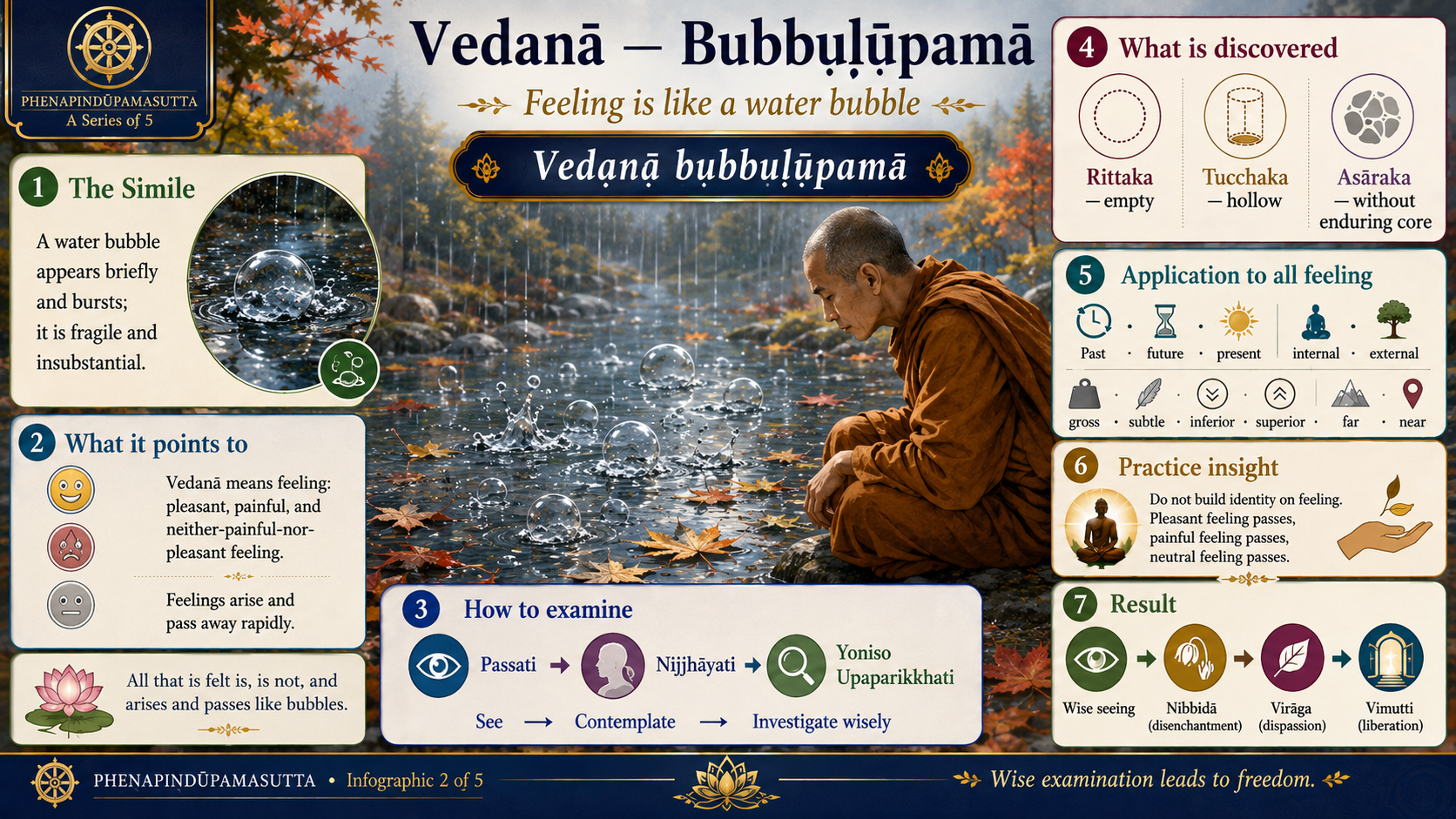
Click infographic to enlarge ↗
Saññā
Marīcikā — Mirage
Appearance invites mistaken interpretation
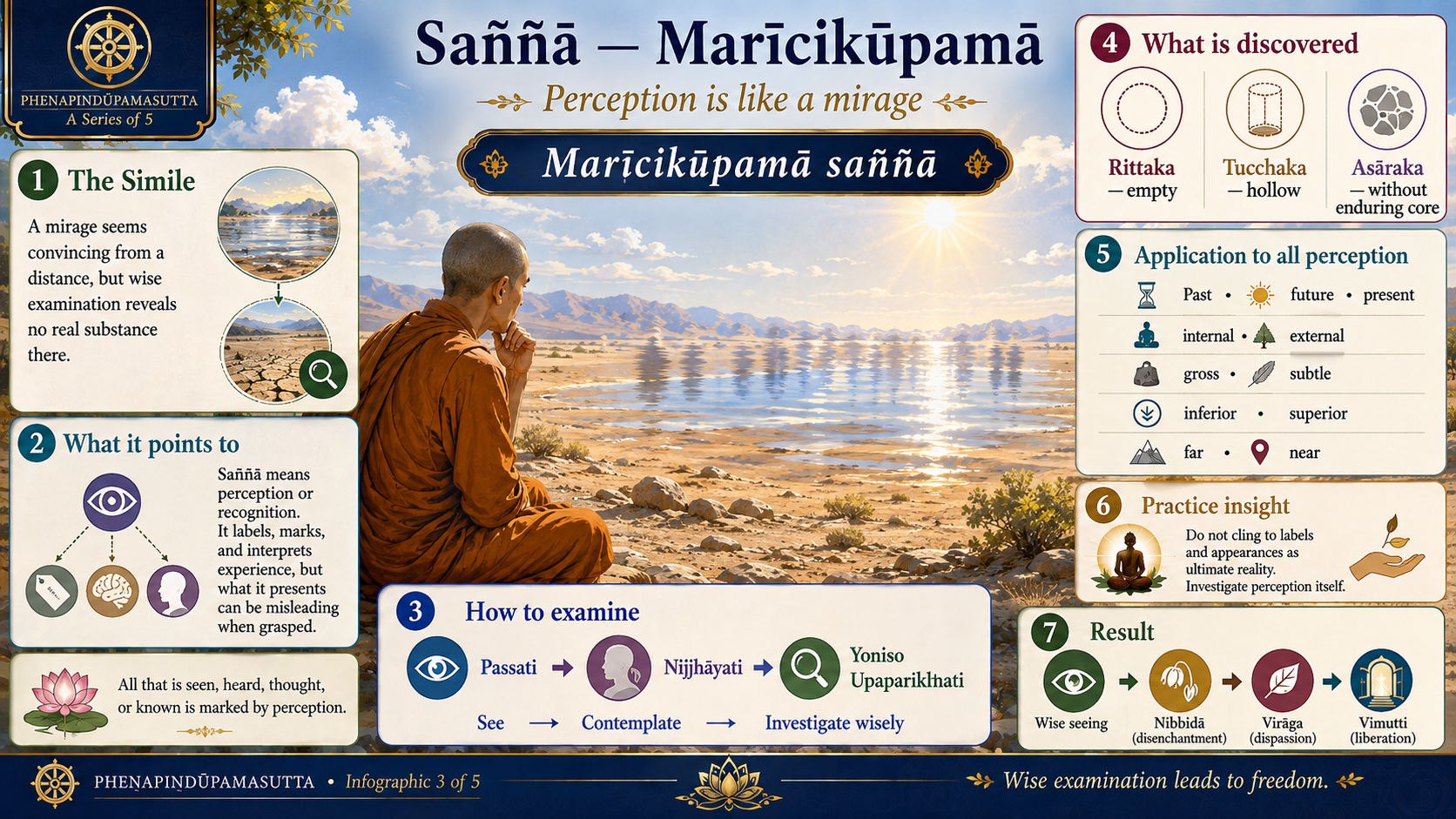
Click infographic to enlarge ↗
Saṅkhārā
Kadalikkhandha — Plantain Trunk
Layers upon layers, no heartwood-self
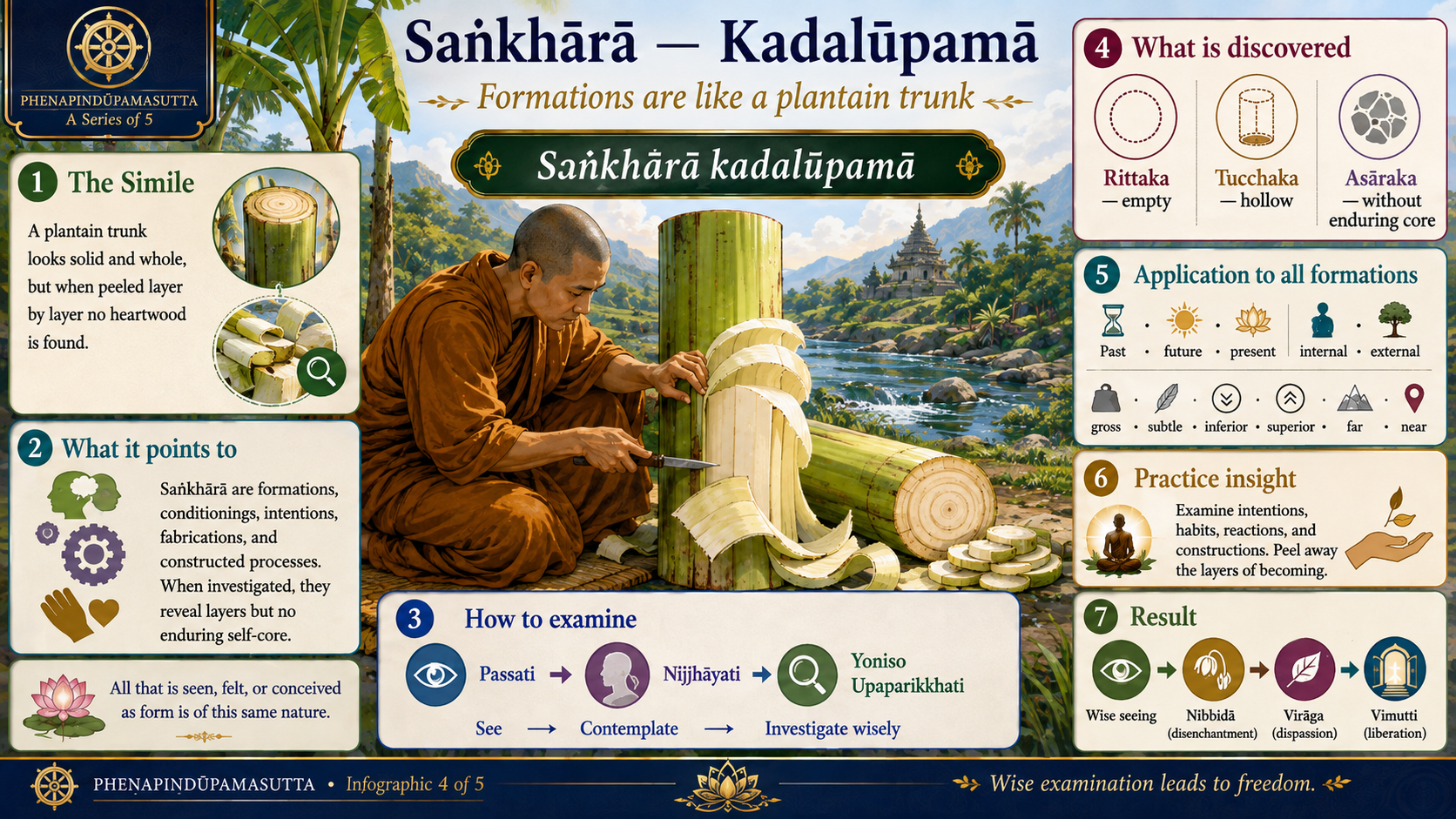
Click infographic to enlarge ↗
Viññāṇa
Māyā — Magical Illusion
Convincing knowing, no enduring knower
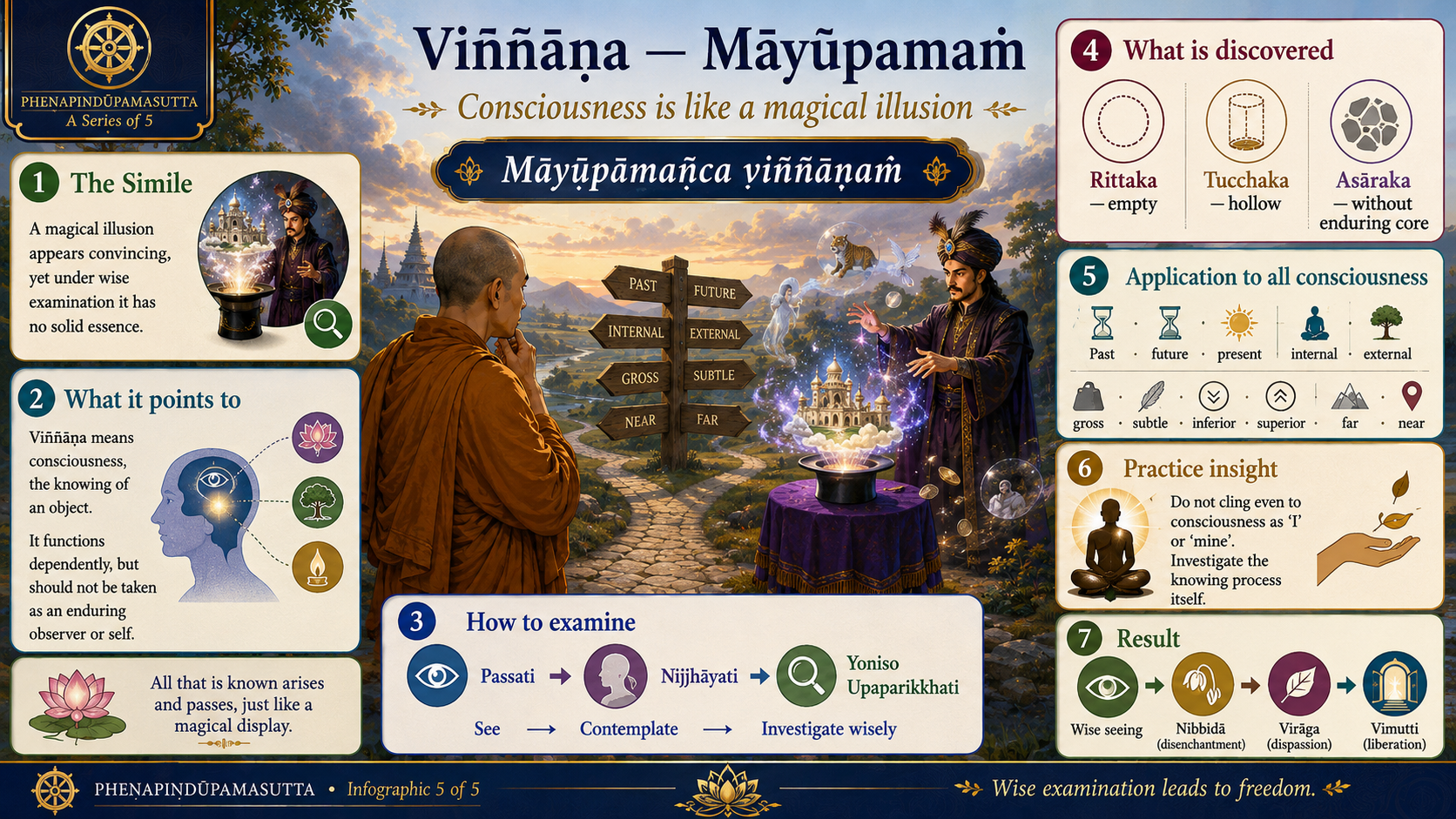
Click infographic to enlarge ↗
Elevenfold Examination
Every possible version of each aggregate is brought under investigation
1
Atīta • Anāgata • Paccuppanna. Past • Future • Present.
2
Ajjhatta • Bahiddhā. Internal • External.
3
Oḷārika • Sukhuma. Gross • Subtle.
4
Hīna • Paṇīta. Inferior • Superior.
5
Dūre • Santike. Far • Near.
No escape route: past, future, present, internal, external, gross, subtle, inferior, superior, far and near are all examined. Even subtle or refined meditative experience is not exempt.
Vipassanā Method
Investigation leads naturally to disenchantment, fading and release
1
Passati. See directly.
2
Nijjhāyati. Contemplate deeply.
3
Yoniso upaparikkhati. Investigate wisely and thoroughly.
4
Rittaka • Tucchaka • Asāraka. Discover emptiness of stable core.
5
Nibbidā → Virāga → Vimutti. Disenchantment → fading of passion → liberation.
Evaṁ passaṁ: nibbidā arises from seeing correctly, not from cultivating aversion toward body or mind. Once the aggregates are understood as incapable of providing a permanent core, fascination loses its basis.
All 14 sections — Pāḷi with English immediately underneath
01Setting: On the Bank of the Gaṅgā
Ekaṁ samayaṁ bhagavā ayujjhāyaṁ viharati gaṅgāya nadiyā tīre. Tatra kho bhagavā bhikkhū āmantesi:
At one time the Blessed One was dwelling at Ayujjhā on the bank of the river Gaṅgā. There the Blessed One addressed the bhikkhus:
02Rūpa Is Like a Lump of Foam
“Seyyathāpi, bhikkhave, ayaṁ gaṅgā nadī mahantaṁ pheṇapiṇḍaṁ āvaheyya. Tamenaṁ cakkhumā puriso passeyya nijjhāyeyya yoniso upaparikkheyya. Tassa taṁ passato nijjhāyato yoniso upaparikkhato rittakaññeva khāyeyya, tucchakaññeva khāyeyya, asārakaññeva khāyeyya. Kiñhi siyā, bhikkhave, pheṇapiṇḍe sāro?
Evameva kho, bhikkhave, yaṁ kiñci rūpaṁ atītānāgatapaccuppannaṁ ajjhattaṁ vā bahiddhā vā oḷārikaṁ vā sukhumaṁ vā hīnaṁ vā paṇītaṁ vā yaṁ dūre santike vā, taṁ bhikkhu passati nijjhāyati yoniso upaparikkhati. Tassa taṁ passato nijjhāyato yoniso upaparikkhato rittakaññeva khāyati, tucchakaññeva khāyati, asārakaññeva khāyati. Kiñhi siyā, bhikkhave, rūpe sāro?”
“Bhikkhus, suppose this river Gaṅgā were carrying along a great lump of foam. A person with good eyesight would see it, contemplate it, and investigate it wisely. To one who sees it, contemplates it, and investigates it wisely, it would appear empty, hollow, and without substance. For what core could there be in a lump of foam?
In the same way, whatever form there is—past, future, or present; internal or external; gross or subtle; inferior or superior; far or near—a bhikkhu sees it, contemplates it, and investigates it wisely. To one who examines it in this way, it appears empty, hollow, and without substance. For what core could there be in form?”
03Vedanā Is Like a Water Bubble
“Seyyathāpi, bhikkhave, saradasamaye thullaphusitake deve vassante udake udakapubbuḷaṁ uppajjati ceva nirujjhati ca. Tamenaṁ cakkhumā puriso passeyya nijjhāyeyya yoniso upaparikkheyya. Tassa taṁ passato nijjhāyato yoniso upaparikkhato rittakaññeva khāyeyya, tucchakaññeva khāyeyya, asārakaññeva khāyeyya. Kiñhi siyā, bhikkhave, udakapubbuḷe sāro?
Evameva kho, bhikkhave, yā kāci vedanā atītānāgatapaccuppannā ajjhattā vā bahiddhā vā oḷārikā vā sukhumā vā hīnā vā paṇītā vā yā dūre santike vā, taṁ bhikkhu passati nijjhāyati yoniso upaparikkhati. Tassa taṁ passato nijjhāyato yoniso upaparikkhato rittakaññeva khāyati, tucchakaññeva khāyati, asārakaññeva khāyati. Kiñhi siyā, bhikkhave, vedanāya sāro?”
“Bhikkhus, suppose that in the autumn, when heavy drops of rain are falling, a water bubble arises on the water and disappears. A person with good eyesight would see it, contemplate it, and investigate it wisely. It would appear empty, hollow, and without substance. For what core could there be in a water bubble?
In the same way, whatever feeling there is—past, future, or present; internal or external; gross or subtle; inferior or superior; far or near—a bhikkhu sees it, contemplates it, and investigates it wisely. It appears empty, hollow, and without substance. For what core could there be in feeling?”
04Saññā Is Like a Mirage
“Seyyathāpi, bhikkhave, gimhānaṁ pacchime māse ṭhite majjhanhike kāle marīcikā phandati. Tamenaṁ cakkhumā puriso passeyya nijjhāyeyya yoniso upaparikkheyya. Tassa taṁ passato nijjhāyato yoniso upaparikkhato rittakaññeva khāyeyya, tucchakaññeva khāyeyya, asārakaññeva khāyeyya. Kiñhi siyā, bhikkhave, marīcikāya sāro?
Evameva kho, bhikkhave, yā kāci saññā atītānāgatapaccuppannā ajjhattā vā bahiddhā vā oḷārikā vā sukhumā vā hīnā vā paṇītā vā yā dūre santike vā, taṁ bhikkhu passati nijjhāyati yoniso upaparikkhati. Tassa taṁ passato nijjhāyato yoniso upaparikkhato rittakaññeva khāyati, tucchakaññeva khāyati, asārakaññeva khāyati. Kiñhi siyā, bhikkhave, saññāya sāro?”
“Bhikkhus, suppose that in the last month of the hot season, at midday, a mirage were shimmering. A person with good eyesight would see it, contemplate it, and investigate it wisely. It would appear empty, hollow, and without substance. For what core could there be in a mirage?
In the same way, whatever perception there is—past, future, or present; internal or external; gross or subtle; inferior or superior; far or near—a bhikkhu sees it, contemplates it, and investigates it wisely. It appears empty, hollow, and without substance. For what core could there be in perception?”
05Saṅkhārā Are Like a Plantain Trunk
“Seyyathāpi, bhikkhave, puriso sāratthiko sāragavesī sārapariyesanaṁ caramāno tiṇhaṁ kuṭhāriṁ ādāya vanaṁ paviseyya. So tattha passeyya mahantaṁ kadalikkhandhaṁ ujuṁ navaṁ akukkukajātaṁ. Tamenaṁ mūle chindeyya; mūle chetvā agge chindeyya, agge chetvā pattavaṭṭiṁ vinibbhujeyya. So tassa pattavaṭṭiṁ vinibbhujanto pheggumpi nādhigaccheyya, kuto sāraṁ.
Tamenaṁ cakkhumā puriso passeyya nijjhāyeyya yoniso upaparikkheyya. Tassa taṁ passato nijjhāyato yoniso upaparikkhato rittakaññeva khāyeyya, tucchakaññeva khāyeyya, asārakaññeva khāyeyya. Kiñhi siyā, bhikkhave, kadalikkhandhe sāro?
Evameva kho, bhikkhave, ye keci saṅkhārā atītānāgatapaccuppannā ajjhattā vā bahiddhā vā oḷārikā vā sukhumā vā hīnā vā paṇītā vā ye dūre santike vā, taṁ bhikkhu passati nijjhāyati yoniso upaparikkhati. Tassa taṁ passato nijjhāyato yoniso upaparikkhato rittakaññeva khāyati, tucchakaññeva khāyati, asārakaññeva khāyati. Kiñhi siyā, bhikkhave, saṅkhāresu sāro?”
“Bhikkhus, suppose a person seeking heartwood, searching for heartwood, wandering in search of heartwood, were to take a sharp axe and enter a forest. There he might see a large plantain trunk, straight, young, and without a developed core. He would cut it at the root, cut off the top, and peel away the leaf-sheaths. As he peeled them away, he would not find even sapwood, much less heartwood.
A person with good eyesight would see it, contemplate it, and investigate it wisely. It would appear empty, hollow, and without substance. For what core could there be in a plantain trunk?
In the same way, whatever formations there are—past, future, or present; internal or external; gross or subtle; inferior or superior; far or near—a bhikkhu sees them, contemplates them, and investigates them wisely. They appear empty, hollow, and without substance. For what core could there be in formations?”
06Viññāṇa Is Like a Magical Illusion
“Seyyathāpi, bhikkhave, māyākāro vā māyākārantevāsī vā catumahāpathe māyaṁ vidaṁseyya. Tamenaṁ cakkhumā puriso passeyya nijjhāyeyya yoniso upaparikkheyya. Tassa taṁ passato nijjhāyato yoniso upaparikkhato rittakaññeva khāyeyya, tucchakaññeva khāyeyya, asārakaññeva khāyeyya. Kiñhi siyā, bhikkhave, māyāya sāro?
Evameva kho, bhikkhave, yaṁ kiñci viññāṇaṁ atītānāgatapaccuppannaṁ ajjhattaṁ vā bahiddhā vā oḷārikaṁ vā sukhumaṁ vā hīnaṁ vā paṇītaṁ vā yaṁ dūre santike vā, taṁ bhikkhu passati nijjhāyati yoniso upaparikkhati. Tassa taṁ passato nijjhāyato yoniso upaparikkhato rittakaññeva khāyati, tucchakaññeva khāyati, asārakaññeva khāyati. Kiñhi siyā, bhikkhave, viññāṇe sāro?”
“Bhikkhus, suppose a magician or a magician’s apprentice were to display an illusion at a crossroads. A person with good eyesight would see it, contemplate it, and investigate it wisely. It would appear empty, hollow, and without substance. For what core could there be in a magical illusion?
In the same way, whatever consciousness there is—past, future, or present; internal or external; gross or subtle; inferior or superior; far or near—a bhikkhu sees it, contemplates it, and investigates it wisely. It appears empty, hollow, and without substance. For what core could there be in consciousness?”
07Correct Seeing Leads to Nibbidā, Virāga and Vimutti
“Evaṁ passaṁ, bhikkhave, sutavā ariyasāvako rūpasmimpi nibbindati, vedanāyapi nibbindati, saññāyapi nibbindati, saṅkhāresupi nibbindati, viññāṇasmimpi nibbindati. Nibbindaṁ virajjati; virāgā vimuccati. Vimuttasmiṁ vimuttamiti ñāṇaṁ hoti.
‘Khīṇā jāti, vusitaṁ brahmacariyaṁ, kataṁ karaṇīyaṁ, nāparaṁ itthattāyā’ti pajānāti”.
“Seeing in this way, bhikkhus, the learned noble disciple becomes disenchanted with form, feeling, perception, formations, and consciousness. Through disenchantment, passion fades. Through fading of passion, one is liberated. When liberated, there is the knowledge: ‘Liberated.’
One understands: ‘Birth is ended, the holy life has been lived, what had to be done has been done; there is no further coming to any state of being.’”
08The Five Similes Summarized
Idamavoca bhagavā. Idaṁ vatvāna sugato athāparaṁ etadavoca satthā:
“Pheṇapiṇḍūpamaṁ rūpaṁ,
vedanā bubbuḷūpamā;
Marīcikūpamā saññā,
saṅkhārā kadalūpamā;
Māyūpamañca viññāṇaṁ,
desitādiccabandhunā.”
This is what the Blessed One said. Having said this, the Fortunate One, the Teacher, further said:
“Form is like a lump of foam,
feeling is like a water bubble;
perception is like a mirage,
formations are like a plantain trunk;
and consciousness is like a magical illusion—
so it was taught by the Kinsman of the Sun.”
09Wise Investigation Reveals the Lack of Core
“Yathā yathā nijjhāyati,
yoniso upaparikkhati;
Rittakaṁ tucchakaṁ hoti,
yo naṁ passati yoniso.”
“However one contemplates it
and investigates it wisely,
it becomes evident as empty and hollow
to one who sees it wisely.”
10The Body and the Three Supporting Conditions
“Imañca kāyaṁ ārabbha,
bhūripaññena desitaṁ;
Pahānaṁ tiṇṇaṁ dhammānaṁ,
rūpaṁ passatha chaḍḍitaṁ.
Āyu usmā ca viññāṇaṁ,
yadā kāyaṁ jahantimaṁ;
Apaviddho tadā seti,
parabhattaṁ acetanaṁ.”
“With reference to this body,
the One of Broad Wisdom has taught
the abandoning of three things:
see form then cast aside.
When life, heat, and consciousness
leave this body,
then it lies cast away,
without awareness, food for others.”
11The Continuum Beguiles the Fool
“Etādisāyaṁ santāno,
māyāyaṁ bālalāpinī;
Vadhako esa akkhāto,
sāro ettha na vijjati.”
“Such is this continuum,
an illusion that beguiles the foolish;
it has been declared a killer—
no enduring core is found here.”
12Examine the Aggregates Day and Night
“Evaṁ khandhe avekkheyya,
bhikkhu āraddhavīriyo;
Divā vā yadi vā rattiṁ,
sampajāno paṭissato.”
“A bhikkhu with energy aroused
should examine the aggregates in this way,
whether by day or by night,
clearly comprehending and mindful.”
13Practice as Though One’s Head Were Ablaze
“Jaheyya sabbasaṁyogaṁ,
kareyya saraṇattano;
Careyyādittasīsova,
patthayaṁ accutaṁ padan”ti.
“One should abandon every bond
and make a refuge for oneself;
one should practice as though one’s head were ablaze,
aspiring to the imperishable state.”
14The Entire Practice in One View
Rūpaṁ — pheṇapiṇḍūpamaṁ.
Vedanā — bubbuḷūpamā.
Saññā — marīcikūpamā.
Saṅkhārā — kadalūpamā.
Viññāṇaṁ — māyūpamaṁ.
Passati → nijjhāyati → yoniso upaparikkhati.
Rittakaṁ → tucchakaṁ → asārakaṁ.
Nibbidā → virāga → vimutti.
Divā vā rattiṁ — sampajāno paṭissato.
Careyyādittasīsova → patthayaṁ accutaṁ padaṁ.
Form → lump of foam.
Feeling → water bubble.
Perception → mirage.
Formations → plantain trunk.
Consciousness → magical illusion.
See → contemplate → investigate wisely.
Empty → hollow → without enduring core.
Disenchantment → fading of passion → liberation.
By day or night → clearly comprehending and mindful.
Practice as though the head were ablaze → aspiring to the imperishable state.
All 14 explanations with the five infographics in their corresponding aggregate sections
01Setting: On the Bank of the Gaṅgā
The setting is significant for the first simile. The Buddha is teaching beside the Gaṅgā, where a mass of foam carried by the river could be directly observed. The discourse begins from something immediate and visible rather than from abstract speculation.
Throughout the sutta the method is the same: look carefully at what appears substantial, examine it wisely, and discover whether there is actually any enduring core there.
02Rūpa Is Like a Lump of Foam
A mass of foam can look large and substantial from a distance, but close examination reveals no solid heart within it. This is the Buddha’s image for rūpa.
Three verbs define the practice: passati—one sees; nijjhāyati—one contemplates and looks into it; yoniso upaparikkhati—one investigates it wisely and thoroughly. This is much deeper than repeating a doctrine that “form is empty.”
The result is rittaka, tucchaka, asāraka: empty, hollow, and without sāra—without an enduring core. This does not mean rūpa is nonexistent. It means that when rūpa is searched for as a permanent possession, identity, refuge, or self, no such core is found.
The elevenfold formula removes every escape route. Past form, future form, present form, internal or external, gross or subtle, inferior or superior, far or near—all must undergo the same investigation. No refined or desirable form is exempt.
03Vedanā Is Like a Water Bubble
The bubble emphasizes not apparent bulk but extraordinary fragility. It appears, takes form for a moment, and bursts.
This is a precise image for vedanā. Pleasant, painful, and neither-painful-nor-pleasant feeling arise dependent on conditions and cease as those conditions change. Yet the mind readily treats a present feeling as reality itself: “I am happy,” “I am suffering,” “this must continue,” “this must end.”
Seeing vedanā as bubble-like does not mean refusing to feel. It means no longer expecting vedanā to provide identity or lasting security. The entire range of feeling—including subtle and refined feeling—remains conditioned and therefore asāraka when searched for as a permanent refuge.
04Saññā Is Like a Mirage
A mirage is persuasive because it presents an appearance that invites an interpretation not supported by closer examination. What looks like water from a distance cannot be obtained as water.
This is highly appropriate for saññā. Saññā recognizes, marks, categorizes, and supplies familiar meaning. It lets the mind say “person,” “beautiful,” “danger,” “success,” “failure,” “mine,” and countless other recognitions.
The problem is not that saññā has no useful function. The problem begins when its designation is mistaken for an independent essence. The practitioner learns to recognize the recognizing process itself rather than automatically inhabiting the world produced by its labels.
Past memories, present perceptions, and future images are all brought under the same wise examination.
05Saṅkhārā Are Like a Plantain Trunk
A plantain or banana trunk looks like a single trunk, but peeling it layer after layer does not reveal hardwood at the center. There are only further layers.
This is the simile for saṅkhārā—the constructing, conditioning, intending, and fabricating activities of experience. Intentions, reactions, habits, plans, preferences, tendencies, and identity projects form layers of conditioning.
The mind may assume that there must be a permanent constructor behind these constructions. But the Buddha directs investigation to the processes themselves. Peel away the conditioned layers and no independent controller or heartwood-self is discovered.
Wholesome saṅkhārā remain useful on the path, but even refined spiritual constructions are not to be converted into a new identity such as “I am the practitioner,” “I am pure,” or “I am the achiever.”
06Viññāṇa Is Like a Magical Illusion
A magical display may be vivid and convincing while it appears, yet wise examination reveals that the apparent entity is not there in the way it seems to be.
The Buddha applies this image to viññāṇa. Consciousness knows an object through a conditioned sense domain. The subtle danger is then to convert this functioning knowing into an enduring observer: “I am awareness,” “I am the knower,” or “consciousness is my true self.”
The magician simile prevents consciousness from becoming the final refuge for identity. Viññāṇa functions, but when searched for as an independent and enduring essence it is rittaka, tucchaka, asāraka.
The full elevenfold formula is particularly important here: even subtle, refined, meditative, past, future, or present consciousness remains subject to examination. No form of consciousness is granted exemption as a hidden self.
07Correct Seeing Leads to Nibbidā, Virāga and Vimutti
Evaṁ passaṁ—“seeing in this way”—is crucial. Nibbidā is not produced by forcing dislike toward the body or mind. It arises because the object has been correctly understood.
Once foam is known as foam, it no longer fascinates as solid substance. Once a mirage is understood, it is no longer pursued for water. Likewise, when the aggregates are directly understood as without a stable core, their power to support appropriation weakens.
Nibbindaṁ virajjati: disenchantment leads to the fading of rāga. Virāgā vimuccati: with the fading of passion comes release. The culmination is not a theory about emptiness but the knowledge that birth is exhausted and the work is complete.
08The Five Similes Summarized
The verse turns the entire discourse into five portable teaching images.
Rūpa → foam: apparent bulk without a solid core.
Vedanā → bubble: arising and vanishing with extreme fragility.
Saññā → mirage: appearance that easily invites mistaken interpretation.
Saṅkhārā → plantain trunk: layer upon conditioned layer, with no heartwood-self.
Viññāṇa → magical illusion: convincing knowing without an independent enduring knower.
These images are powerful because they can be recalled in immediate experience, not merely memorized as philosophy.
09Wise Investigation Reveals the Lack of Core
This verse states the method in compact form. The insight is not obtained by accepting a proposition because the Buddha said it. One repeatedly examines.
Yoniso means that attention goes to the actual conditions, structure, arising, change, and nature of the aggregate rather than following habitual appearance and proliferation.
Thus rittaka and tucchaka are discoveries of wise investigation. The deeper one looks for an unchanging core suitable for “I” or “mine,” the more clearly its absence is seen.
10The Body and the Three Supporting Conditions
The next verse identifies the three: āyu—life or vitality; usmā—bodily heat; and viññāṇa—consciousness.
While these conditions operate, the body is readily appropriated as “me” and “mine.” When they depart, the same rūpa lies insentient and eventually becomes food for other beings or returns to the elements.
The teaching is not contempt for the body. It reveals how dependent its apparent personal significance is upon changing supporting conditions. No independent owner is found inside the discarded form.
11The Continuum Beguiles the Fool
Santāna points to the ongoing succession or continuity of conditioned phenomena. Because events succeed one another smoothly, the mind can imagine a permanent entity behind the flow.
The illusion lies not in saying that nothing occurs, but in attributing solidity, ownership, and permanence to what is conditioned.
Vadhako—“killer”—is intentionally severe. Whatever is taken as a permanent refuge among the aggregates eventually changes, separates, decays, or dies. Clinging to it therefore becomes a basis for dukkha.
Sāro ettha na vijjati: no heartwood-like essence suitable for self-identification can be found in this continuum.
12Examine the Aggregates Day and Night
The five similes are now converted into continuous practice.
Avekkheyya means one should inspect or contemplate. This is not restricted to a formal sitting period. Divā vā yadi vā rattiṁ—by day or by night—the aggregates are to be understood whenever they are functioning.
Āraddhavīriyo indicates aroused energy. Sampajāno adds clear comprehension. Paṭissato emphasizes mindfulness and recollection of the training.
The practitioner therefore carries the investigation into seeing, hearing, thinking, feeling, acting, remembering, planning, walking, sitting, and every other mode of experience.
13Practice as Though One’s Head Were Ablaze
The final verse gives the discourse urgency.
Sabbasaṁyogaṁ—every bondage or binding connection—is to be abandoned. The aggregates cease to function as grounds for clinging and identity.
Kareyya saraṇattano means taking responsibility for establishing refuge through the training; it should not be interpreted as introducing an eternal self after the entire discourse has dismantled such appropriation.
Careyyādittasīsova—practice as though one’s head were burning—shows how secondary concerns should fall away when the problem of birth, ageing, and death is directly understood.
Accutaṁ padaṁ is the unfailing or imperishable state, pointing to Nibbāna: that which is not another conditioned aggregate destined to collapse.
14The Entire Practice in One View
Pheṇapiṇḍūpamasutta provides a compact but complete vipassanā framework.
First comes investigation: passati, nijjhāyati, yoniso upaparikkhati. The Buddha asks the practitioner to look, not merely believe.
Second comes discovery: the aggregates continue to appear and function, yet no stable sāra can be found within them.
Third comes the natural consequence of correct seeing: nibbidā. When substantiality is no longer projected onto the aggregates, fascination loses its basis.
Fourth comes virāga and vimutti. The mind stops demanding permanence and identity from processes incapable of providing them.
Finally comes urgency. With sati, sampajañña, and aroused energy, this examination is to continue by day and night, aiming not at a better identity within the aggregates but at accutaṁ padaṁ—the imperishable state.