Sammasasutta — Trace Suffering Back to What the Mind Has Taken Up
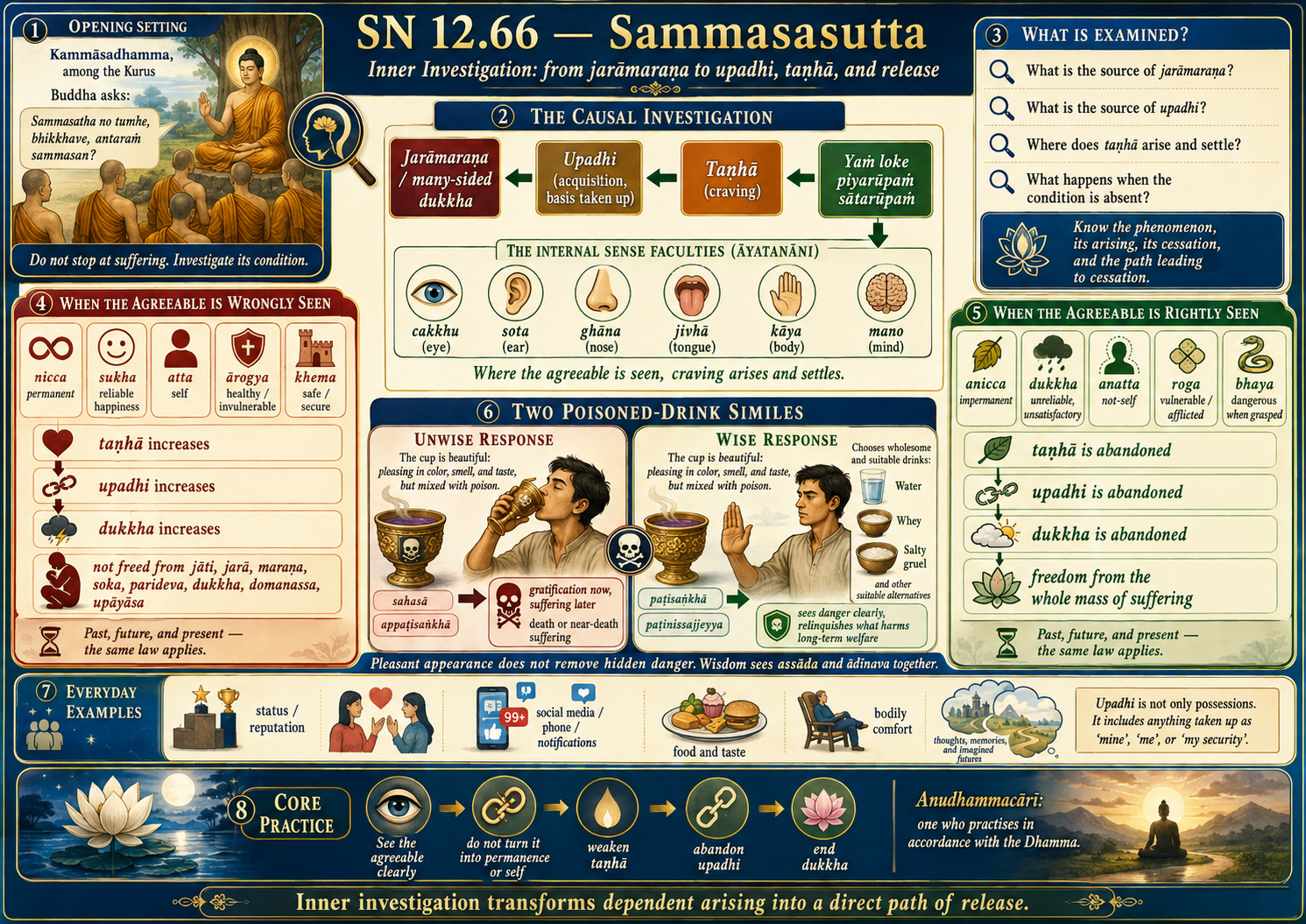 VISUAL SUMMARYSee this sutta in a pictureOpen the complete infographic for a visual overview before or after reading the full study.View infographic →
Trace suffering backward through its supporting conditions
SN 12.66 turns dependent arising into a practical method of investigation. The practitioner begins with aging-and-death and manifold suffering, asks what they depend upon, traces them to upadhi, traces upadhi to taṇhā, and then observes where craving arises and settles: in what is experienced as piyarūpa and sātarūpa—dear, attractive and agreeable—at the six sense faculties.
The decisive question is not whether something is pleasant. It is whether the pleasant is being seen as permanent, reliably satisfying, self, invulnerable and safe—or seen with enough wisdom that craving no longer needs to settle there.
Start with dukkha and ask: “What is this dependent upon?”
Sammasati is the operative verb: examine, investigate, scrutinize. The sutta repeatedly asks about source, arising, birth-ground and condition, and then requires knowing the phenomenon, its arising, its cessation and the practice leading appropriately to cessation.
Practice Sequence
Five steps for applying inner investigation
These are the recurring moves of the sutta, expressed as a practical investigation rather than as an abstract theory.
1
Begin with dukkha. Take aging-and-death or a concrete form of suffering and ask what it depends upon.
2
Trace dukkha to upadhi. Identify the acquisition, basis, identity or support that has been taken up and is making change painful.
3
Trace upadhi to taṇhā. Ask what craving is sustaining that acquisition and continuing to invest in it.
4
Locate where taṇhā settles. Observe piyarūpaṁ and sātarūpaṁ—the dear, attractive and agreeable—at eye, ear, nose, tongue, body and mind.
5
Examine how the agreeable is seen. Wrong seeing feeds craving; accurate seeing as anicca, dukkha, anatta, roga and bhaya removes its footing.
The same agreeable experience can feed craving—or undermine it
| Seeing that increases craving | Meaning | Seeing that abandons craving | Meaning |
|---|---|---|---|
| niccato | as permanent / lasting | aniccato | as impermanent |
| sukhato | as happiness / reliably satisfying | dukkhato | as suffering / unreliable as lasting security |
| attato | as self / belonging to self | anattato | as not-self |
| ārogyato | as healthy / invulnerable | rogato | as vulnerable / afflicted |
| khemato | as safe / secure | bhayato | as dangerous when grasped |
Wrong seeing: taṇhā grows → upadhi grows → dukkha grows.
Accurate seeing: taṇhā abandoned → upadhi abandoned → dukkha abandoned.
This is not a command to hate pleasant things. The contrast is between mis-seeing and accurate seeing. Pleasantness may be present, but craving grows when the mind demands permanence, selfhood, invulnerability or security from what cannot provide them.
Immediate gratification versus whole causal consequence
01First person — sahasā appaṭisaṅkhā
Sees the attractive colour, smell and taste, but does not reflect on the poison. Immediate gratification dominates the decision; the longer causal consequence is ignored.
02Second person — paṭisaṅkhā … paṭinissajjeyya
Recognizes the thirst and the attractiveness of the drink, but also understands the danger, considers alternatives, and relinquishes what would bring long-term harm.
The simile’s power lies in paṭisaṅkhā. Wise reflection does not deny thirst or pretend the drink is unattractive. It sees both gratification and danger, then allows paṭinissagga—relinquishment—to become intelligent rather than forced.
Pāḷi with English immediately underneath
01The Setting at Kammāsadhamma and the Question of Inner Investigation
Evaṁ me sutaṁ— ekaṁ samayaṁ bhagavā kurūsu viharati kammāsadhammaṁ nāma kurūnaṁ nigamo. Tatra kho bhagavā bhikkhū āmantesi: “bhikkhavo”ti.
“Bhadante”ti te bhikkhū bhagavato paccassosuṁ. Bhagavā etadavoca:
“Sammasatha no tumhe, bhikkhave, antaraṁ sammasan”ti.
Variant: antaraṁ sammasan”ti → antarā sammasananti (bj)
Thus have I heard. On one occasion the Blessed One was dwelling among the Kurus, at a town of the Kurus named Kammāsadhamma. There the Blessed One addressed the bhikkhus:
“Bhikkhus.”
“Venerable sir,” those bhikkhus replied. The Blessed One said:
“Bhikkhus, do you examine inwardly—do you undertake this inner investigation?”
02A Bhikkhu Answers, but the Buddha Calls for a Deeper Explanation
Evaṁ vutte, aññataro bhikkhu bhagavantaṁ etadavoca: “ahaṁ kho, bhante, sammasāmi antaraṁ sammasan”ti.
“Yathā kathaṁ pana tvaṁ, bhikkhu, sammasasi antaraṁ sammasan”ti? Atha kho so bhikkhu byākāsi. Yathā so bhikkhu byākāsi na so bhikkhu bhagavato cittaṁ ārādhesi.
Evaṁ vutte, āyasmā ānando bhagavantaṁ etadavoca: “etassa, bhagavā, kālo; etassa, sugata, kālo; yaṁ bhagavā antaraṁ sammasaṁ bhāseyya. Bhagavato sutvā bhikkhū dhāressantī”ti.
“Tenahānanda, suṇātha, sādhukaṁ manasi karotha, bhāsissāmī”ti.
“Evaṁ, bhante”ti kho te bhikkhū bhagavato paccassosuṁ. Bhagavā etadavoca:
When this was said, a certain bhikkhu said to the Blessed One:
“Venerable sir, I do examine inwardly.”
“But in what way, bhikkhu, do you examine inwardly?”
Then that bhikkhu gave an answer. But the way he answered did not satisfy the Blessed One.
Then Venerable Ānanda said to the Blessed One:
“Blessed One, now is the time; Fortunate One, now is the time for the Blessed One to explain inner investigation. Having heard it from the Blessed One, the bhikkhus will remember it.”
“Then, Ānanda, listen and attend carefully. I will speak.”
“Yes, venerable sir,” those bhikkhus replied. The Blessed One said:
03Investigating Jarāmaraṇa: Aging-and-Death Depends on Upadhi
“Idha, bhikkhave, bhikkhu sammasamāno sammasati antaraṁ sammasaṁ:
‘Yaṁ kho idaṁ anekavidhaṁ nānappakārakaṁ dukkhaṁ loke uppajjati jarāmaraṇaṁ. Idaṁ kho dukkhaṁ kiṁnidānaṁ kiṁsamudayaṁ kiṁjātikaṁ kiṁpabhavaṁ, kismiṁ sati jarāmaraṇaṁ hoti, kismiṁ asati jarāmaraṇaṁ na hotī’ti?
So sammasamāno evaṁ jānāti: ‘yaṁ kho idaṁ anekavidhaṁ nānappakārakaṁ dukkhaṁ loke uppajjati jarāmaraṇaṁ. Idaṁ kho dukkhaṁ upadhinidānaṁ upadhisamudayaṁ upadhijātikaṁ upadhipabhavaṁ, upadhismiṁ sati jarāmaraṇaṁ hoti, upadhismiṁ asati jarāmaraṇaṁ na hotī’ti.
So jarāmaraṇañca pajānāti jarāmaraṇasamudayañca pajānāti jarāmaraṇanirodhañca pajānāti yā ca jarāmaraṇanirodhasāruppagāminī paṭipadā tañca pajānāti. Tathāpaṭipanno ca hoti anudhammacārī. Ayaṁ vuccati, bhikkhave, bhikkhu sabbaso sammā dukkhakkhayāya paṭipanno jarāmaraṇanirodhāya.”
Variant: sammasaṁ → sammasanaṁ (bj)
“Here, bhikkhus, while examining, a bhikkhu investigates inwardly:
‘This many-sided and manifold suffering that arises in the world—aging-and-death: what is its source, what is its origin, from what is it born, from what does it arise? When what exists does aging-and-death occur? When what does not exist does aging-and-death not occur?’
Examining in this way, he knows:
‘This many-sided and manifold suffering that arises in the world—aging-and-death—has acquisition (upadhi) as its source, acquisition as its origin, is born from acquisition, and arises from acquisition. When acquisition exists, aging-and-death occurs; when acquisition does not exist, aging-and-death does not occur.’
He understands aging-and-death, its arising, its cessation, and the practice that is suitable for and leads to the cessation of aging-and-death. And he practises accordingly, living in conformity with the Dhamma.
This is called a bhikkhu who is practising completely and rightly for the destruction of suffering, for the cessation of aging-and-death.”
04Investigating Upadhi: Acquisition Depends on Taṇhā
“Athāparaṁ sammasamāno sammasati antaraṁ sammasaṁ: ‘upadhi panāyaṁ kiṁnidāno kiṁsamudayo kiṁjātiko kiṁpabhavo, kismiṁ sati upadhi hoti, kismiṁ asati upadhi na hotī’ti?
So sammasamāno evaṁ jānāti: ‘upadhi taṇhānidāno taṇhāsamudayo taṇhājātiko taṇhāpabhavo, taṇhāya sati upadhi hoti, taṇhāya asati upadhi na hotī’ti.
So upadhiñca pajānāti upadhisamudayañca pajānāti upadhinirodhañca pajānāti yā ca upadhinirodhasāruppagāminī paṭipadā tañca pajānāti. Tathāpaṭipanno ca hoti anudhammacārī. Ayaṁ vuccati, bhikkhave, bhikkhu sabbaso sammā dukkhakkhayāya paṭipanno upadhinirodhāya.”
“Then, examining further, he investigates inwardly:
‘What is the source of this acquisition? What is its origin? From what is it born? From what does it arise? When what exists does acquisition exist? When what does not exist does acquisition not exist?’
Examining in this way, he knows:
‘Acquisition has craving as its source, craving as its origin, is born from craving, and arises from craving. When craving exists, acquisition exists; when craving does not exist, acquisition does not exist.’
He understands acquisition, its arising, its cessation, and the practice that is suitable for and leads to its cessation. And he practises accordingly, living in conformity with the Dhamma.
This is called a bhikkhu who is practising completely and rightly for the destruction of suffering, for the cessation of acquisition.”
05Where Taṇhā Arises and Settles: The Six Sense Faculties
“Athāparaṁ sammasamāno sammasati antaraṁ sammasaṁ: ‘taṇhā panāyaṁ kattha uppajjamānā uppajjati, kattha nivisamānā nivisatī’ti?
So sammasamāno evaṁ jānāti— yaṁ kho loke piyarūpaṁ sātarūpaṁ etthesā taṇhā uppajjamānā uppajjati, ettha nivisamānā nivisati.
Kiñca loke piyarūpaṁ sātarūpaṁ?
Cakkhuṁ loke piyarūpaṁ sātarūpaṁ, etthesā taṇhā uppajjamānā uppajjati, ettha nivisamānā nivisati.
Sotaṁ loke piyarūpaṁ sātarūpaṁ, etthesā taṇhā uppajjamānā uppajjati, ettha nivisamānā nivisati.
Ghānaṁ loke piyarūpaṁ sātarūpaṁ, etthesā taṇhā uppajjamānā uppajjati, ettha nivisamānā nivisati.
Jivhā loke piyarūpaṁ sātarūpaṁ, etthesā taṇhā uppajjamānā uppajjati, ettha nivisamānā nivisati.
Kāyo loke piyarūpaṁ sātarūpaṁ, etthesā taṇhā uppajjamānā uppajjati, ettha nivisamānā nivisati.
Mano loke piyarūpaṁ sātarūpaṁ, etthesā taṇhā uppajjamānā uppajjati, ettha nivisamānā nivisati.”
“Then, examining further, he investigates inwardly:
‘Where does this craving arise when it arises? Where does it settle when it settles?’
Examining in this way, he knows:
‘Whatever in the world has an appealing and agreeable nature—there this craving arises when it arises, and there it settles when it settles.’
And what in the world has an appealing and agreeable nature?
The eye is appealing and agreeable in the world; there craving arises and there it settles.
The ear is appealing and agreeable in the world; there craving arises and there it settles.
The nose is appealing and agreeable in the world; there craving arises and there it settles.
The tongue is appealing and agreeable in the world; there craving arises and there it settles.
The body is appealing and agreeable in the world; there craving arises and there it settles.
The mind is appealing and agreeable in the world; there craving arises and there it settles.”
06Past Practitioners Who Saw the Agreeable as Permanent, Pleasant, Self, Healthy, and Safe
“Ye hi keci, bhikkhave, atītamaddhānaṁ samaṇā vā brāhmaṇā vā yaṁ loke piyarūpaṁ sātarūpaṁ taṁ niccato addakkhuṁ sukhato addakkhuṁ attato addakkhuṁ ārogyato addakkhuṁ khemato addakkhuṁ. Te taṇhaṁ vaḍḍhesuṁ. Ye taṇhaṁ vaḍḍhesuṁ te upadhiṁ vaḍḍhesuṁ. Ye upadhiṁ vaḍḍhesuṁ te dukkhaṁ vaḍḍhesuṁ. Ye dukkhaṁ vaḍḍhesuṁ te na parimucciṁsu jātiyā jarāya maraṇena sokehi paridevehi dukkhehi domanassehi upāyāsehi, ‘na parimucciṁsu dukkhasmā’ti vadāmi.”
“Bhikkhus, whatever ascetics and brahmins in the past saw what is appealing and agreeable in the world as permanent, as happiness, as self, as healthy, and as safe—they increased craving.
Those who increased craving increased acquisition. Those who increased acquisition increased suffering. Those who increased suffering were not freed from birth, aging, death, sorrow, lamentation, pain, displeasure, and despair. I say: they were not freed from suffering.”
07Future Practitioners Who See the Agreeable in the Same Distorted Way
“Yepi hi keci, bhikkhave, anāgatamaddhānaṁ samaṇā vā brāhmaṇā vā yaṁ loke piyarūpaṁ sātarūpaṁ taṁ niccato dakkhissanti sukhato dakkhissanti attato dakkhissanti ārogyato dakkhissanti khemato dakkhissanti.
Te taṇhaṁ vaḍḍhissanti. Ye taṇhaṁ vaḍḍhissanti te upadhiṁ vaḍḍhissanti. Ye upadhiṁ vaḍḍhissanti te dukkhaṁ vaḍḍhissanti. Ye dukkhaṁ vaḍḍhissanti te na parimuccissanti jātiyā jarāya maraṇena sokehi paridevehi dukkhehi domanassehi upāyāsehi, ‘na parimuccissanti dukkhasmā’ti vadāmi.”
Variant: dakkhissanti → dakkhinti (bj, pts1ed, pts2ed)
“Whatever ascetics and brahmins in the future will see what is appealing and agreeable in the world as permanent, as happiness, as self, as healthy, and as safe—they will increase craving.
Those who increase craving will increase acquisition. Those who increase acquisition will increase suffering. Those who increase suffering will not be freed from birth, aging, death, sorrow, lamentation, pain, displeasure, and despair. I say: they will not be freed from suffering.”
08Present Practitioners: The Mechanism is Operating Now
“Yepi hi keci, bhikkhave, etarahi samaṇā vā brāhmaṇā vā yaṁ loke piyarūpaṁ sātarūpaṁ taṁ niccato passanti sukhato passanti attato passanti ārogyato passanti khemato passanti. Te taṇhaṁ vaḍḍhenti. Ye taṇhaṁ vaḍḍhenti te upadhiṁ vaḍḍhenti. Ye upadhiṁ vaḍḍhenti te dukkhaṁ vaḍḍhenti. Ye dukkhaṁ vaḍḍhenti te na parimuccanti jātiyā jarāya maraṇena sokehi paridevehi dukkhehi domanassehi upāyāsehi, ‘na parimuccanti dukkhasmā’ti vadāmi.”
“Whatever ascetics and brahmins at present see what is appealing and agreeable in the world as permanent, as happiness, as self, as healthy, and as safe—they increase craving.
Those who increase craving increase acquisition. Those who increase acquisition increase suffering. Those who increase suffering are not freed from birth, aging, death, sorrow, lamentation, pain, displeasure, and despair. I say: they are not freed from suffering.”
09The First Poisoned-Drink Simile: Pleasant Appearance Can Conceal Danger
“Seyyathāpi, bhikkhave, āpānīyakaṁso vaṇṇasampanno gandhasampanno rasasampanno. So ca kho visena saṁsaṭṭho. Atha puriso āgaccheyya ghammābhitatto ghammapareto kilanto tasito pipāsito. Tamenaṁ evaṁ vadeyyuṁ: ‘ayaṁ te, ambho purisa, āpānīyakaṁso vaṇṇasampanno gandhasampanno rasasampanno; so ca kho visena saṁsaṭṭho. Sace ākaṅkhasi piva. Pivato hi kho taṁ chādessati vaṇṇenapi gandhenapi rasenapi, pivitvā ca pana tatonidānaṁ maraṇaṁ vā nigacchasi maraṇamattaṁ vā dukkhan’ti.
So taṁ āpānīyakaṁsaṁ sahasā appaṭisaṅkhā piveyya, nappaṭinissajjeyya. So tatonidānaṁ maraṇaṁ vā nigaccheyya maraṇamattaṁ vā dukkhaṁ.”
“Suppose, bhikkhus, there were a drinking cup excellent in colour, smell, and taste, but mixed with poison.
Then a man came along, overcome by heat, exhausted, thirsty, and parched. They would say to him:
‘Good man, here is a drinking cup excellent in colour, smell, and taste, but it is mixed with poison. Drink if you wish. When you drink it, its colour, smell, and taste will please you; but because of drinking it you will meet death or suffering close to death.’
He might impulsively, without reflection, drink that cup and not give it up. Because of that he would meet death or suffering close to death.”
10Applying the Poisoned-Drink Simile to Past, Future, and Present Wrong Seeing
“Evameva kho, bhikkhave, ye hi keci atītamaddhānaṁ samaṇā vā brāhmaṇā vā yaṁ loke piyarūpaṁ sātarūpaṁ taṁ niccato addakkhuṁ sukhato addakkhuṁ attato addakkhuṁ ārogyato addakkhuṁ khemato addakkhuṁ. Te taṇhaṁ vaḍḍhesuṁ. Ye taṇhaṁ vaḍḍhesuṁ te upadhiṁ vaḍḍhesuṁ. Ye upadhiṁ vaḍḍhesuṁ te dukkhaṁ vaḍḍhesuṁ. Ye dukkhaṁ vaḍḍhesuṁ te na parimucciṁsu jātiyā jarāya maraṇena sokehi paridevehi dukkhehi domanassehi upāyāsehi, ‘na parimucciṁsu dukkhasmā’ti vadāmi.
Yepi hi keci, bhikkhave, anāgatamaddhānaṁ samaṇā vā brāhmaṇā vā yaṁ loke piyarūpaṁ sātarūpaṁ taṁ niccato dakkhissanti sukhato dakkhissanti attato dakkhissanti ārogyato dakkhissanti khemato dakkhissanti. Te taṇhaṁ vaḍḍhissanti. Ye taṇhaṁ vaḍḍhissanti te upadhiṁ vaḍḍhissanti. Ye upadhiṁ vaḍḍhissanti te dukkhaṁ vaḍḍhissanti. Ye dukkhaṁ vaḍḍhissanti te na parimuccissanti jātiyā jarāya maraṇena sokehi paridevehi dukkhehi domanassehi upāyāsehi, ‘na parimuccissanti dukkhasmā’ti vadāmi.
Yepi hi keci, bhikkhave, etarahi samaṇā vā brāhmaṇā vā yaṁ loke piyarūpaṁ sātarūpaṁ taṁ niccato passanti sukhato passanti attato passanti ārogyato passanti khemato passanti. Te taṇhaṁ vaḍḍhenti. Ye taṇhaṁ vaḍḍhenti te upadhiṁ vaḍḍhenti. Ye upadhiṁ vaḍḍhenti te dukkhaṁ vaḍḍhenti. Ye dukkhaṁ vaḍḍhenti te na parimuccanti jātiyā jarāya maraṇena sokehi paridevehi dukkhehi domanassehi upāyāsehi, ‘na parimuccanti dukkhasmā’ti vadāmi.”
“In the same way, bhikkhus, whatever ascetics and brahmins in the past saw what is appealing and agreeable in the world as permanent, as happiness, as self, as healthy, and as safe increased craving; by increasing craving they increased acquisition; by increasing acquisition they increased suffering; and they were not freed from the entire mass of suffering.
Whatever ascetics and brahmins in the future will see what is appealing and agreeable in that same way will increase craving, acquisition, and suffering, and will not be freed from suffering.
And whatever ascetics and brahmins at present see what is appealing and agreeable as permanent, happiness, self, healthy, and safe increase craving, acquisition, and suffering, and are not freed from suffering.”
11Past Practitioners Who Saw the Agreeable as Impermanent, Suffering, Not-Self, Diseased, and Fearful
“Ye ca kho keci, bhikkhave, atītamaddhānaṁ samaṇā vā brāhmaṇā vā yaṁ loke piyarūpaṁ sātarūpaṁ taṁ aniccato addakkhuṁ dukkhato addakkhuṁ anattato addakkhuṁ rogato addakkhuṁ bhayato addakkhuṁ, te taṇhaṁ pajahiṁsu. Ye taṇhaṁ pajahiṁsu te upadhiṁ pajahiṁsu. Ye upadhiṁ pajahiṁsu te dukkhaṁ pajahiṁsu. Ye dukkhaṁ pajahiṁsu te parimucciṁsu jātiyā jarāya maraṇena sokehi paridevehi dukkhehi domanassehi upāyāsehi, ‘parimucciṁsu dukkhasmā’ti vadāmi.”
“But whatever ascetics and brahmins in the past saw what is appealing and agreeable in the world as impermanent, as suffering, as not-self, as a disease, and as fearful—they abandoned craving.
Those who abandoned craving abandoned acquisition. Those who abandoned acquisition abandoned suffering. Those who abandoned suffering were freed from birth, aging, death, sorrow, lamentation, pain, displeasure, and despair. I say: they were freed from suffering.”
12Future Practitioners Who See Correctly
“Yepi hi keci, bhikkhave, anāgatamaddhānaṁ samaṇā vā brāhmaṇā vā yaṁ loke piyarūpaṁ sātarūpaṁ taṁ aniccato dakkhissanti dukkhato dakkhissanti anattato dakkhissanti rogato dakkhissanti bhayato dakkhissanti, te taṇhaṁ pajahissanti.
Ye taṇhaṁ pajahissanti te upadhiṁ pajahissanti. Ye upadhiṁ pajahissanti te dukkhaṁ pajahissanti. Ye dukkhaṁ pajahissanti te parimuccissanti jātiyā jarāya maraṇena sokehi paridevehi dukkhehi domanassehi upāyāsehi, ‘parimuccissanti dukkhasmā’ti vadāmi.”
“Whatever ascetics and brahmins in the future will see what is appealing and agreeable in the world as impermanent, as suffering, as not-self, as a disease, and as fearful will abandon craving.
Those who abandon craving will abandon acquisition. Those who abandon acquisition will abandon suffering. Those who abandon suffering will be freed from birth, aging, death, sorrow, lamentation, pain, displeasure, and despair. I say: they will be freed from suffering.”
13Present Practitioners Who See Correctly
“Yepi hi keci, bhikkhave, etarahi samaṇā vā brāhmaṇā vā yaṁ loke piyarūpaṁ sātarūpaṁ taṁ aniccato passanti dukkhato passanti anattato passanti rogato passanti bhayato passanti, te taṇhaṁ pajahanti. Ye taṇhaṁ pajahanti te upadhiṁ pajahanti. Ye upadhiṁ pajahanti te dukkhaṁ pajahanti. Ye dukkhaṁ pajahanti te parimuccanti jātiyā jarāya maraṇena sokehi paridevehi dukkhehi domanassehi upāyāsehi, ‘parimuccanti dukkhasmā’ti vadāmi.”
“Whatever ascetics and brahmins at present see what is appealing and agreeable in the world as impermanent, as suffering, as not-self, as a disease, and as fearful abandon craving.
Those who abandon craving abandon acquisition. Those who abandon acquisition abandon suffering. Those who abandon suffering are freed from birth, aging, death, sorrow, lamentation, pain, displeasure, and despair. I say: they are freed from suffering.”
14The Second Poisoned-Drink Simile: Wise Reflection Refuses What Causes Long-Term Harm
“Seyyathāpi, bhikkhave, āpānīyakaṁso vaṇṇasampanno gandhasampanno rasasampanno. So ca kho visena saṁsaṭṭho. Atha puriso āgaccheyya ghammābhitatto ghammapareto kilanto tasito pipāsito. Tamenaṁ evaṁ vadeyyuṁ: ‘ayaṁ te, ambho purisa, āpānīyakaṁso vaṇṇasampanno gandhasampanno rasasampanno so ca kho visena saṁsaṭṭho. Sace ākaṅkhasi piva. Pivato hi kho taṁ chādessati vaṇṇenapi gandhenapi rasenapi; pivitvā ca pana tatonidānaṁ maraṇaṁ vā nigacchasi maraṇamattaṁ vā dukkhan’ti.
Atha kho, bhikkhave, tassa purisassa evamassa: ‘sakkā kho me ayaṁ surāpipāsitā pānīyena vā vinetuṁ dadhimaṇḍakena vā vinetuṁ bhaṭṭhaloṇikāya vā vinetuṁ loṇasovīrakena vā vinetuṁ, na tvevāhaṁ taṁ piveyyaṁ, yaṁ mama assa dīgharattaṁ hitāya sukhāyā’ti.
So taṁ āpānīyakaṁsaṁ paṭisaṅkhā na piveyya, paṭinissajjeyya. So tatonidānaṁ na maraṇaṁ vā nigaccheyya maraṇamattaṁ vā dukkhaṁ.”
Variant: surāpipāsitā → surāpipāsā (?) | bhaṭṭhaloṇikāya → matthaloṇikāya (bj, pts1ed, pts2ed); maṭṭhaloṇikāya (sya-all, km)
“Suppose, bhikkhus, there were a drinking cup excellent in colour, smell, and taste, but mixed with poison. A man came along overcome by heat, exhausted, thirsty, and parched. They told him that the drink would please him in colour, smell, and taste, but that drinking it would result in death or suffering close to death.
Then that man might think:
‘I can remove this thirst by water, or by whey, or by another suitable salty drink, or by salted sour gruel. I certainly should not drink that which would not be for my welfare and happiness for a long time.’
Having reflected, he would not drink that cup; he would relinquish it. Because of that he would not meet death or suffering close to death.”
15Applying the Wise Simile: Correct Seeing in Past, Future, and Present Leads to Release
“Evameva kho, bhikkhave, ye hi keci atītamaddhānaṁ samaṇā vā brāhmaṇā vā yaṁ loke piyarūpaṁ sātarūpaṁ taṁ aniccato addakkhuṁ dukkhato addakkhuṁ anattato addakkhuṁ rogato addakkhuṁ bhayato addakkhuṁ, te taṇhaṁ pajahiṁsu. Ye taṇhaṁ pajahiṁsu te upadhiṁ pajahiṁsu. Ye upadhiṁ pajahiṁsu te dukkhaṁ pajahiṁsu. Ye dukkhaṁ pajahiṁsu te parimucciṁsu jātiyā jarāya maraṇena sokehi paridevehi dukkhehi domanassehi upāyāsehi, ‘parimucciṁsu dukkhasmā’ti vadāmi.
Yepi hi keci, bhikkhave, anāgatamaddhānaṁ samaṇā vā brāhmaṇā vā yaṁ loke piyarūpaṁ sātarūpaṁ taṁ aniccato dakkhissanti dukkhato dakkhissanti anattato dakkhissanti rogato dakkhissanti bhayato dakkhissanti, te taṇhaṁ pajahissanti. Ye taṇhaṁ pajahissanti te upadhiṁ pajahissanti. Ye upadhiṁ pajahissanti te dukkhaṁ pajahissanti. Ye dukkhaṁ pajahissanti te parimuccissanti jātiyā jarāya maraṇena sokehi paridevehi dukkhehi domanassehi upāyāsehi, ‘parimuccissanti dukkhasmā’ti vadāmi.
Yepi hi keci, bhikkhave, etarahi samaṇā vā brāhmaṇā vā yaṁ loke piyarūpaṁ sātarūpaṁ taṁ aniccato passanti dukkhato passanti anattato passanti rogato passanti bhayato passanti, te taṇhaṁ pajahanti. Ye taṇhaṁ pajahanti te upadhiṁ pajahanti. Ye upadhiṁ pajahanti te dukkhaṁ pajahanti. Ye dukkhaṁ pajahanti te parimuccanti jātiyā jarāya maraṇena sokehi paridevehi dukkhehi domanassehi upāyāsehi, ‘parimuccanti dukkhasmā’ti vadāmī”ti.
“In the same way, bhikkhus, whatever ascetics and brahmins in the past saw what is appealing and agreeable in the world as impermanent, suffering, not-self, diseased, and fearful abandoned craving. By abandoning craving they abandoned acquisition; by abandoning acquisition they abandoned suffering; and they were freed from birth, aging, death, sorrow, lamentation, pain, displeasure, and despair. I say: they were freed from suffering.
Whatever ascetics and brahmins in the future will see what is appealing and agreeable in this way will abandon craving, acquisition, and suffering, and will be freed from the whole mass of suffering.
And whatever ascetics and brahmins at present see what is appealing and agreeable as impermanent, suffering, not-self, diseased, and fearful abandon craving; by abandoning craving they abandon acquisition; by abandoning acquisition they abandon suffering; and they are freed from the whole mass of suffering. I say: they are freed from suffering.”
How investigation changes the causal chain
01The Setting at Kammāsadhamma and the Question of Inner Investigation
The key word is sammasati: to examine, investigate, scrutinize, or thoroughly consider. The Buddha is not asking whether the bhikkhus merely know a doctrine. He asks whether they actually investigate the conditional structure of their own suffering.
Antaraṁ sammasaṁ points the investigation inward. The sutta will immediately demonstrate what this means: take an experienced fact—aging-and-death and the many forms of dukkha—and ask what it depends upon, what gives rise to it, and what happens when that condition is absent.
This is therefore a practical investigation of conditionality. Instead of beginning with “What do I believe?”, the practitioner begins with “What is this suffering dependent upon?”
Everyday application
Suppose criticism at work produces hours of distress. Inner investigation does not stop at “I am upset.” It asks: What am I protecting? Reputation? Position? An image of myself? What craving is sustaining that acquisition? The investigation moves backward from the distress to its condition.
02A Bhikkhu Answers, but the Buddha Calls for a Deeper Explanation
The text does not preserve the bhikkhu’s incorrect answer here. That omission itself keeps the focus on the Buddha’s method rather than on criticizing the bhikkhu.
Ānanda asks for an explicit explanation so the training can be remembered and reproduced. The phrase sādhukaṁ manasi karotha—attend carefully—is important because the teaching that follows is a sequence of conditional questions, not merely a list to memorize.
The practitioner is being trained in how to think with Dhamma: identify a phenomenon, identify its condition, know its arising, know its cessation, and know the practice appropriate to cessation.
03Investigating Jarāmaraṇa: Aging-and-Death Depends on Upadhi
The investigation is framed through conditional questions: kiṁnidānaṁ, kiṁsamudayaṁ, kiṁjātikaṁ, kiṁpabhavaṁ—what is the source, origin, birth-ground, and cause of arising?
The answer given is upadhi. The word can mean an acquisition, basis, substrate, or something taken up and maintained. It is broader than material possessions. Anything appropriated as a basis for “my existence,” “my security,” “my identity,” or “my happiness” can function as upadhi.
The crucial formula is: upadhismiṁ sati jarāmaraṇaṁ hoti—when upadhi is present, aging-and-death occurs. The sutta is tracing suffering to what has been taken up as a basis of existence.
The practitioner does not stop with intellectual understanding. He knows four things: the phenomenon, its arising, its cessation, and the practice leading appropriately to cessation. Tathāpaṭipanno—he actually practises in that way.
Everyday application
A professional title can become an upadhi. The title itself is conventional, but if “I am this position” becomes a basis of identity, retirement, demotion, or criticism can produce intense suffering. The investigation asks not merely how to protect the title, but what acquisition of identity makes its change painful.
04Investigating Upadhi: Acquisition Depends on Taṇhā
The inquiry now goes one step deeper. Upadhi is not random: taṇhā gives rise to it.
Craving seeks, selects, settles upon, repeats, and invests. What is repeatedly wanted can become something taken up: “my possession,” “my relationship,” “my body,” “my view,” “my future,” “my attainment.”
This is why abandoning upadhi cannot be accomplished merely by giving away external objects. If the craving that constructs acquisitions remains, the mind can create new upadhi immediately.
The investigation therefore moves from the object of attachment to the craving that makes it an acquisition.
Everyday application
Someone may delete one social-media app because it creates agitation, but immediately become compulsively attached to another source of stimulation. The specific object changed; the taṇhā that creates upadhi did not. The sutta asks the practitioner to work at the level of the condition.
05Where Taṇhā Arises and Settles: The Six Sense Faculties
The Pāli uses piyarūpaṁ sātarūpaṁ—what appears dear, attractive, agreeable, gratifying, or pleasant.
Taṇhā not only uppajjati—arises—but nivisati—settles down, takes up residence, becomes established. This distinction is practically important. A brief liking can become an enduring occupation of the mind.
The sutta identifies all six internal faculties, including mano. Therefore craving is not limited to visible objects, sounds, tastes, or touch. It can settle on memories, ideas, expectations, beliefs, imagined futures, and meditative experiences.
This connects directly with guarding the six sense doors: the danger is not contact itself, but how the mind sees and settles upon what is agreeable.
Everyday application
A new phone may first be seen for a few seconds. Then the mind compares models, watches reviews, imagines owning it, revisits the website, and begins to feel that happiness depends on getting it. The visible object was brief; taṇhā ‘settled’ in the mind and began constructing an upadhi.
06Past Practitioners Who Saw the Agreeable as Permanent, Pleasant, Self, Healthy, and Safe
The sutta now explains what causes craving to grow: a distorted mode of seeing what is agreeable.
Five perceptions are named:
niccato — as permanent or lasting; sukhato — as happiness or reliably satisfying; attato — as self or belonging to self; ārogyato — as healthy, free of disease, or not inherently vulnerable; khemato — as safe or secure.
The problem is not that something appears pleasant. The problem is treating the pleasant as possessing qualities it cannot sustain.
The causal sequence is explicit: wrong seeing → taṇhā grows → upadhi grows → dukkha grows → no liberation from the whole mass of suffering.
Everyday application
A relationship can be genuinely joyful. The problem begins when the mind silently adds: “This must remain exactly as it is; this person guarantees my happiness; without this relationship I lose myself; this is secure.” The sutta is asking us to distinguish appreciation from appropriation.
07Future Practitioners Who See the Agreeable in the Same Distorted Way
By extending the formula to the future, the Buddha makes the principle timeless. It is not a critique of a historical school; it is a causal law of practice.
Whenever what is agreeable is misread as permanent, reliable, self, invulnerable, or safe, the same chain operates.
The future tense also turns the teaching into a warning: if the mode of seeing is not changed now, the same mechanism will continue.
08Present Practitioners: The Mechanism is Operating Now
The present tense is the practice point. We do not need to speculate about past or future teachers. We can watch the mechanism occurring now.
Every time the mind treats a pleasant experience as “this should stay,” “this will satisfy me,” “this is me/mine,” or “this is secure,” it gives taṇhā a place to grow.
The entire chain can therefore be studied during ordinary life, not only in formal sitting.
09The First Poisoned-Drink Simile: Pleasant Appearance Can Conceal Danger
The simile does not deny the pleasant qualities of the drink. It explicitly says the colour, smell, and taste are attractive. The danger lies in seeing only assāda—the gratification—while ignoring the consequence.
The decisive phrase is sahasā appaṭisaṅkhā—impulsively, without reflection.
This precisely illustrates how taṇhā grows around piyarūpaṁ sātarūpaṁ. Pleasantness is real as an experience, but the mind fails to investigate impermanence, vulnerability, and the suffering produced by appropriation.
The problem is therefore not pleasure itself. It is pleasure consumed without wisdom regarding its conditions and consequences.
Everyday application
A notification, video, food, purchase, flirtation, or argument can be immediately gratifying. The relevant question is not only “Does this feel good now?” but “What pattern does repeatedly feeding this create in the mind?” The poisoned cup symbolizes attractive gratification whose long-term cost is ignored.
10Applying the Poisoned-Drink Simile to Past, Future, and Present Wrong Seeing
The simile is now explicitly mapped back onto the causal chain.
The attractive colour, smell, and taste correspond to piyarūpaṁ sātarūpaṁ. The poison corresponds to the danger ignored when the pleasant is seen as permanent, fully satisfying, self, invulnerable, and secure.
The repetition across past, future, and present removes every possibility of treating this as someone else’s problem. The mechanism is impersonal: whenever the conditions are present, the result follows.
11Past Practitioners Who Saw the Agreeable as Impermanent, Suffering, Not-Self, Diseased, and Fearful
The five distorted perceptions are now reversed:
aniccato — as impermanent; dukkhato — as incapable of providing lasting security and therefore bound up with suffering; anattato — as not-self; rogato — as vulnerable, like a disease or affliction; bhayato — as dangerous or fearful when grasped.
This is not a command to hate pleasant things. Aversion would create another form of bondage. The purpose is accurate seeing that removes the conditions for craving.
The reversal of seeing reverses the whole chain: taṇhā is abandoned → upadhi is abandoned → dukkha is abandoned → liberation from suffering.
Everyday application
You can enjoy a beautiful trip while knowing it will end; care for the body while knowing it ages; love people without demanding permanence from them; use possessions without making them the basis of self. Accurate seeing reduces the need to grasp.
12Future Practitioners Who See Correctly
The omitted chain in the source abbreviation has been written out fully here so the reader can see that the logic does not change.
Correct seeing is not merely philosophical agreement with anicca, dukkha, and anattā. The test is causal: does seeing in this way actually weaken and abandon taṇhā?
The Buddha’s measure is transformation of the chain, not possession of terminology.
13Present Practitioners Who See Correctly
Again the present tense brings the teaching into immediate practice.
The crucial task is to see the attractive without mentally converting it into permanence, reliable happiness, self, health, or safety.
This is vipassanā in a very concrete sense: a change in how phenomena are known that results in a change in craving.
14The Second Poisoned-Drink Simile: Wise Reflection Refuses What Causes Long-Term Harm
The contrast with the first man is one word in action: paṭisaṅkhā—having reflected, having carefully considered.
The wise man does not deny his thirst. He does not pretend the poisoned drink is unattractive. He recognizes both the immediate gratification and the longer causal consequence, then chooses an alternative that does not carry the same danger.
This is very different from repression. Wisdom gives the mind options.
Paṭinissajjeyya—he would relinquish it—is possible because the situation has been understood correctly. Renunciation becomes intelligent rather than forced.
Everyday application
If stress creates a strong urge to scroll, shop, overeat, or lash out, the practice is not simply “I must not want this.” It can be: “The urge is real. What else can meet the legitimate need—rest, connection, movement, food, quiet—without feeding a pattern that leaves more craving and agitation?” This is the logic of the wise man refusing the poisoned cup.
15Applying the Wise Simile: Correct Seeing in Past, Future, and Present Leads to Release
The sutta ends by applying the wise man’s reflection across all three times.
Its complete causal movement can now be seen:
jarāmaraṇa and manifold dukkha ← upadhi ← taṇhā ← what is piyarūpa and sātarūpa.
When the agreeable is mis-seen as nicca, sukha, atta, ārogya, and khema: taṇhā grows → upadhi grows → dukkha grows.
When the agreeable is seen as anicca, dukkha, anatta, roga, and bhaya: taṇhā is abandoned → upadhi is abandoned → dukkha is abandoned.
The sutta therefore turns vipassanā into a direct causal intervention. Correct seeing matters because it changes what the mind craves and appropriates.
The endpoint is not indifference to life. It is freedom from making changing phenomena carry the impossible burden of providing permanent identity and security.