Nayasamuṭṭhāna — How Many Teachings Become One Map of Bondage and Release
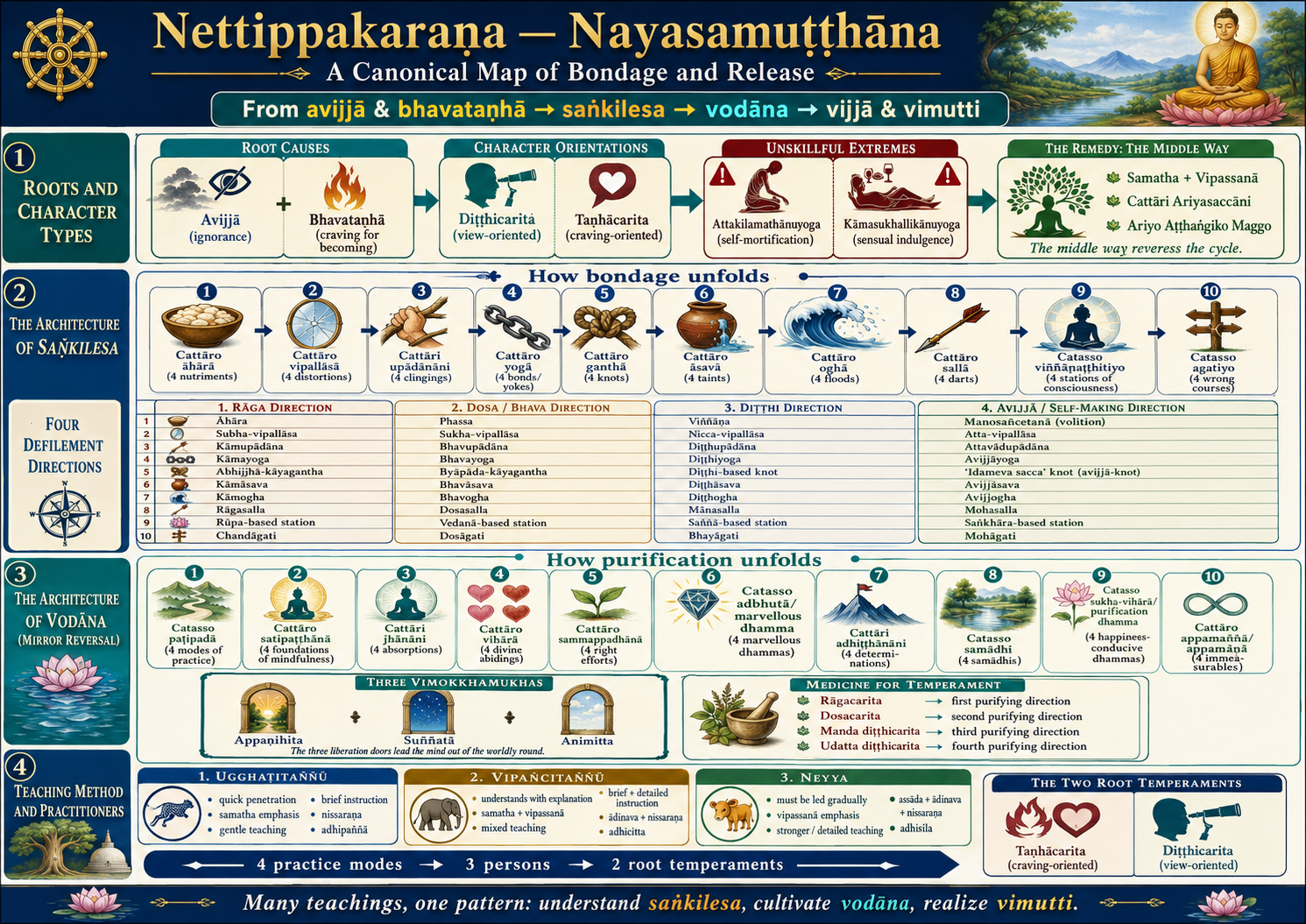 VISUAL SUMMARYSee this study in a pictureOpen the complete infographic for a visual overview before or after reading the full study.View infographic →
A systematic interpretive text—not an individual Buddha-sutta
The supplied source identifies this passage as belonging to the Nettippakaraṇa, in its Nayasamuṭṭhāna section. It is best studied as an organized interpretive method that brings many doctrinal lists into correspondence, rather than assuming every alignment is a formula stated in this exact form in an early discourse.
Reading rule: preserve the Pāḷi and learn the architecture, but distinguish a Netti correspondence from a chronological causal sequence or a standard Nikāya formula.
Two Root Orientations
Avijjā • Bhavataṇhā → Diṭṭhicarita • Taṇhācarita
1
Avijjā — ignorance-side orientation. The Netti associates this with diṭṭhicarita: experience organized around views, self-making and conceptual certainty.
2
Bhavataṇhā — craving-for-becoming orientation. The Netti associates this with taṇhācarita: acquisition, enjoyment, preservation and becoming.
3
Diṭṭhicarita — view-temperament. Use this diagnostically in the Netti’s scheme, not as a permanent personality identity.
4
Taṇhācarita — craving-temperament. A second diagnostic orientation used for tailoring analysis and practice.
Ten clusters aligned as one diagnostic map
Important: the source explains this as an exegetical correspondence. It is not simply another twelve-link Paṭiccasamuppāda chain. The same underlying pattern is being viewed through ten different doctrinal vocabularies.
The Reversal
Three Vimokkhamukhas
1
Appaṇihita. The desireless or non-directed liberation door is used particularly against the first two craving-oriented columns.
2
Suññatā. Emptiness is assigned especially to the view/permanence column and related patterns.
3
Animitta. The signless door is assigned especially to the self/ignorance column; these allocations belong to the Netti’s systematic architecture.
Teaching According to the Person
Ugghaṭitaññū • Vipañcitaññū • Neyya
1
Ugghaṭitaññū. A person able to penetrate rapidly when the teaching is given in concise form.
2
Vipañcitaññū. A person who requires the meaning to be unfolded and explained in greater detail.
3
Neyya. A person who progresses gradually through instruction, questioning, wise attention and good spiritual friendship.
Pedagogical point: the later sections progressively compress four practice modes into three persons and then two root character-types. This is a teaching strategy: the same Dhamma is presented with different degrees of expansion according to what the person can penetrate.
All 63 Pāḷi passages with English immediately underneath
1. Roots, Extremes & Modes of Practice
Avijjā and bhavataṇhā • two extremes • Four Noble Truths • sakkāyadiṭṭhi • path • character-types • four modes of practice
01Two Root Tendencies: Avijjā and Bhavataṇhā
Tattha katamaṁ nayasamuṭṭhānaṁ? Pubbā koṭi na paññāyati avijjāya ca bhavataṇhāya ca, tattha avijjānīvaraṇaṁ taṇhāsaṁyojanaṁ. Avijjānīvaraṇā sattā avijjāsaṁyuttā avijjāpakkhena vicaranti, te vuccanti diṭṭhicaritāti. Variant: avijjāsaṁyuttā → avijjāya saṁyuttā (si, pts-vp-pli1, mr) Taṇhāsaṁyojanā sattā taṇhāsaṁyuttā taṇhāpakkhena vicaranti, te vuccanti taṇhācaritāti. Diṭṭhicaritā ito bahiddhā pabbajitā attakilamathānuyogamanuyuttā viharanti. Taṇhācaritā ito bahiddhā pabbajitā kāmesu kāmasukhallikānuyogamanuyuttā viharanti.
“Here, what is the arising of the method? No first beginning is discerned for ignorance and craving for existence. Here ignorance is the obstruction, and craving is the fetter. Beings obstructed by ignorance, joined with ignorance, move on the side of ignorance; they are called those of view-temperament (diṭṭhicarita). Beings fettered by craving, joined with craving, move on the side of craving; they are called those of craving-temperament (taṇhācarita). Outside this teaching, renunciants of view-temperament dwell devoted to self-mortification, while renunciants of craving-temperament dwell devoted to indulgence in sensual pleasures.”
02Why the Two Extremes Fail
Tattha kiṅkāraṇaṁ yaṁ diṭṭhicaritā ito bahiddhā pabbajitā attakilamathānuyogamanuyuttā viharanti, taṇhācaritā ito bahiddhā pabbajitā kāmesu kāmasukhallikānuyogamanuyuttā viharanti? Ito bahiddhā natthi saccavavatthānaṁ, kuto catusaccappakāsanā vā samathavipassanākosallaṁ vā upasamasukhappatti vā. Te upasamasukhassa anabhiññā viparītacetā evamāhaṁsu “natthi sukhena sukhaṁ, dukkhena nāma sukhaṁ adhigantabban”ti. Yo kāme paṭisevati, so lokaṁ vaḍḍhayati, yo lokaṁ vaḍḍhayati, so bahuṁ puññaṁ pasavatīti te evaṁsaññī evaṁdiṭṭhī dukkhena sukhaṁ patthayamānā kāmesu puññasaññī attakilamathānuyogamanuyuttā ca viharanti kāmasukhallikānuyogamanuyuttā ca, te tadabhiññā santā rogameva vaḍḍhayanti, gaṇḍameva vaḍḍhayanti, sallameva vaḍḍhayanti, te rogābhitunnā gaṇḍapaṭipīḷitā sallānuviddhā nirayatiracchānayonipetāsuresu ummujjanimujjāni karontā ugghātanigghātaṁ paccanubhontā rogagaṇḍasallabhesajjaṁ na vindanti. Tattha attakilamathānuyogo kāmasukhallikānuyogo ca saṅkileso, samathavipassanā vodānaṁ. Attakilamathānuyogo kāmasukhallikānuyogo ca rogo, samathavipassanā roganigghātakabhesajjaṁ. Attakilamathānuyogo kāmasukhallikānuyogo ca gaṇḍo, samathavipassanā gaṇḍanigghātakabhesajjaṁ. Attakilamathānuyogo kāmasukhallikānuyogo ca sallo, samathavipassanā salluddharaṇabhesajjaṁ.
“Why is it that renunciants of view-temperament outside this teaching devote themselves to self-mortification, while those of craving-temperament devote themselves to sensual indulgence? Outside this teaching there is no proper determination of truth; how then could there be a disclosure of the Four Truths, skill in samatha and vipassanā, or attainment of the happiness of peace?
Not directly knowing the happiness of peace, with their minds inverted, they say: ‘Happiness is not obtained through happiness; happiness must be attained through suffering.’ Others think: ‘One who partakes of sensual pleasures makes the world prosper; one who makes the world prosper produces much merit.’ Holding such perceptions and views, they either seek happiness through suffering or regard sensuality as merit.
Thus they increase the disease, the boil, and the dart. Afflicted by disease, oppressed by the boil, pierced by the dart, they sink and rise in hell, the animal realm, the ghost realm, and the asura realm, undergoing repeated striking down and rising up, without finding the medicine for disease, boil, and dart.
Self-mortification and sensual indulgence are defilement; samatha and vipassanā are purification. The two extremes are disease, boil, and dart; samatha and vipassanā are the medicine that destroys the disease and boil and extracts the dart.”
03The Four Noble Truths Applied
Tattha saṅkileso dukkhaṁ, tadabhisaṅgo taṇhā samudayo, taṇhānirodho dukkhanirodho, samathavipassanā dukkhanirodhagāminī paṭipadā, imāni cattāri saccāni. Dukkhaṁ pariññeyyaṁ, samudayo pahātabbo, maggo bhāvetabbo, nirodho sacchikātabbo.
“Here defilement is suffering. Attachment to it is craving, the origin. The cessation of craving is the cessation of suffering. Samatha and vipassanā are the practice leading to the cessation of suffering. These are the Four Truths. Suffering is to be fully understood, the origin is to be abandoned, the path is to be developed, and cessation is to be realized.”
04The Twenty Forms of Sakkāyadiṭṭhi
Tattha diṭṭhicaritā rūpaṁ attato upagacchanti. Vedanaṁ attato upagacchanti. Saññaṁ attato upagacchanti. Saṅkhāre attato upagacchanti. Viññāṇaṁ attato upagacchanti. Taṇhācaritā rūpavantaṁ attānaṁ upagacchanti. Attani vā rūpaṁ, rūpasmiṁ vā attānaṁ, vedanāvantaṁ attānaṁ upagacchanti, attani vā vedanaṁ, vedanāya vā attānaṁ; saññāvantaṁ attānaṁ upagacchanti, attani vā saññaṁ, saññāya vā attānaṁ; saṅkhāravantaṁ attānaṁ upagacchanti, attani vā saṅkhāre, saṅkhāresu vā attānaṁ; viññāṇavantaṁ attānaṁ upagacchanti, attani vā viññāṇaṁ, viññāṇasmiṁ vā attānaṁ, ayaṁ vuccati vīsativatthukā sakkāyadiṭṭhi.
“Here those of view-temperament take form as self; they take feeling as self, perception as self, formations as self, and consciousness as self.
Those of craving-temperament take the self as possessing form, or form as being in the self, or the self as being in form. In the same way they take the self as possessing feeling, perception, formations, and consciousness; or each aggregate as being in the self; or the self as being in each aggregate. This is called the twenty-based identity view (vīsativatthukā sakkāyadiṭṭhi).”
05The Noble Eightfold Path as the Opposite
Tassā paṭipakkho lokuttarā sammādiṭṭhi, anvāyikā sammāsaṅkappo sammāvācā sammākammanto sammāājīvo sammāvāyāmo sammāsati sammāsamādhi, ayaṁ ariyo aṭṭhaṅgiko maggo. Te tayo khandhā sīlakkhandho samādhikkhandho paññākkhandho. Sīlakkhandho samādhikkhandho ca samatho, paññākkhandho vipassanā. Tattha sakkāyo dukkhaṁ, sakkāyasamudayo dukkhasamudayo, sakkāyanirodho dukkhanirodho, ariyo aṭṭhaṅgiko maggo dukkhanirodhagāminī paṭipadā, imāni cattāri saccāni. Dukkhaṁ pariññeyyaṁ, samudayo pahātabbo, maggo bhāvetabbo, nirodho sacchikātabbo.
“Its opposite is supramundane right view; following upon it are right determination, right speech, right action, right livelihood, right effort, right mindfulness, and right samādhi. This is the Noble Eightfold Path.
These form three aggregates: the aggregate of virtue, the aggregate of samādhi, and the aggregate of wisdom. The aggregates of virtue and samādhi are here classed as samatha, and the aggregate of wisdom as vipassanā.
Identity is suffering; the arising of identity is the arising of suffering; the cessation of identity is the cessation of suffering; and the Noble Eightfold Path is the practice leading to the cessation of suffering. These are the Four Truths: suffering is to be fully understood, its origin abandoned, the path developed, and cessation realized.”
06Uccheda and Sassata as the Two Extremes
Tattha ye rūpaṁ attato upagacchanti. Vedanaṁ attato upagacchanti. Saññaṁ attato upagacchanti. Saṅkhāre attato upagacchanti. Viññāṇaṁ attato upagacchanti. Ime vuccanti “ucchedavādino”ti. Ye rūpavantaṁ attānaṁ upagacchanti. Attani vā rūpaṁ, rūpasmiṁ vā attānaṁ. Ye vedanāvantaṁ attānaṁ upagacchanti, attani vā vedanaṁ, vedanāya vā attānaṁ. Ye saññāvantaṁ attānaṁ upagacchanti, attani vā saññaṁ, saññāya vā attānaṁ. Ye saṅkhāravantaṁ attānaṁ upagacchanti, attani vā saṅkhāre, saṅkhāresu vā attānaṁ. Ye viññāṇavantaṁ attānaṁ upagacchanti, attani vā viññāṇaṁ, viññāṇasmiṁ vā attānaṁ. Ime vuccanti “sassatavādino”ti, tattha ucchedasassatavādā ubho antā, ayaṁ saṁsārapavatti. Tassa paṭipakkho majjhimā paṭipadā ariyo aṭṭhaṅgiko maggo, ayaṁ saṁsāranivatti. Tattha pavatti dukkhaṁ, tadabhisaṅgo taṇhā samudayo, taṇhānirodho dukkhanirodho, ariyo aṭṭhaṅgiko maggo dukkhanirodhagāminī paṭipadā, imāni cattāri saccāni. Dukkhaṁ pariññeyyaṁ, samudayo pahātabbo, maggo bhāvetabbo, nirodho sacchikātabbo.
“Those who take form, feeling, perception, formations, or consciousness as self are here called annihilationists. Those who take the self as possessing an aggregate, the aggregate as being in the self, or the self as being in the aggregate are called eternalists.
Annihilationism and eternalism are the two extremes; this is the continuation of saṁsāra. Their opposite is the middle practice, the Noble Eightfold Path; this is the turning away from saṁsāra.
Here continuation is suffering; attachment to it is craving, the origin; the cessation of craving is the cessation of suffering; and the Noble Eightfold Path is the way leading to that cessation. These are the Four Truths.”
07The Net of Views and the Vajra of Knowledge
Tattha ucchedasassataṁ samāsato vīsativatthukā sakkāyadiṭṭhi, vitthārato dvāsaṭṭhi diṭṭhigatāni, tesaṁ paṭipakkho tecattālīsaṁ bodhipakkhiyā dhammā aṭṭha vimokkhā dasa kasiṇāyatanāni. Dvāsaṭṭhi diṭṭhigatāni mohajālaṁ anādianidhanappavattaṁ. Tecattālīsaṁ bodhipakkhiyā dhammā ñāṇavajiraṁ mohajālappadālanaṁ. Variant: Tecattālīsaṁ → tetālīsaṁ (bj); tecattālīsa (pts-vp-pli1) Tattha moho avijjā, jālaṁ bhavataṇhā, tena vuccati “pubbā koṭi na paññāyati avijjāya ca bhavataṇhāya cā”ti.
“In brief, annihilationism and eternalism are the twenty-based identity view; in detail they are the sixty-two speculative views. Their opposites are the forty-three factors belonging to awakening, the eight liberations, and the ten kasiṇa bases.
The sixty-two views are a net of delusion beginninglessly in motion. The forty-three factors belonging to awakening are the vajra of knowledge that shatters the net of delusion. Here delusion is ignorance, and the net is craving for existence. Therefore it is said: ‘No first beginning is discerned for ignorance and craving for existence.’”
08Diṭṭhicarita and Taṇhācarita within the Sāsana
Tattha diṭṭhicarito asmiṁ sāsane pabbajito sallekhānusantatavutti bhavati sallekhe tibbagāravo. Taṇhācarito asmiṁ sāsane pabbajito sikkhānusantatavutti bhavati sikkhāya tibbagāravo. Diṭṭhicarito sammattaniyāmaṁ okkamanto dhammānusārī bhavati. Taṇhācarito sammattaniyāmaṁ okkamanto saddhānusārī bhavati, diṭṭhicarito sukhāya paṭipadāya dandhābhiññāya khippābhiññāya ca niyyāti. Taṇhācarito dukkhāya paṭipadāya dandhābhiññāya khippābhiññāya ca niyyāti.
“A person of view-temperament who has gone forth in this teaching tends to maintain a life of effacement and holds effacement in high esteem. A person of craving-temperament tends to maintain a life of training and holds the training in high esteem.
When entering the fixed course of rightness, the view-temperament becomes a Dhamma-follower; the craving-temperament becomes a faith-follower. The view-temperament proceeds by a pleasant mode of practice, either with slow or quick direct knowledge; the craving-temperament proceeds by a painful mode of practice, again with either slow or quick direct knowledge.”
09Four Modes of Practice
Tattha kiṅkāraṇaṁ, yaṁ taṇhācarito dukkhāya paṭipadāya dandhābhiññāya khippābhiññāya ca niyyāti, tassa hi kāmā apariccattā bhavanti, so kāmehi viveciyamāno dukkhena paṭinissarati dandhañca dhammaṁ ājānāti? Yo panāyaṁ diṭṭhicarito ayaṁ āditoyeva kāmehi anatthiko bhavati. So tato viveciyamāno khippañca paṭinissarati, khippañca dhammaṁ ājānāti. Dukkhāpi paṭipadā duvidhā dandhābhiññā ca khippābhiññā ca. Sukhāpi paṭipadā duvidhā dandhābhiññā ca khippābhiññā ca. Sattāpi duvidhā mudindriyāpi tikkhindriyāpi. Ye mudindriyā, te dandhañca paṭinissaranti dandhañca dhammaṁ ājānanti. Ye tikkhindriyā, te khippañca paṭinissaranti, khippañca dhammaṁ ājānanti, imā catasso paṭipadā. Ye hi keci niyyiṁsu vā niyyanti vā niyyissanti vā, te imāhi eva catūhi paṭipadāhi. Evaṁ ariyā catukkamaggaṁ paññāpenti abudhajanasevitāya bālakantāya rattavāsiniyā nandiyā bhavataṇhāya avaṭṭanatthaṁ. Variant: avaṭṭanatthaṁ → āvaṭṭanatthaṁ (bj, mr); āvattanatthaṁ (pts-vp-pli1) Ayaṁ vuccati nandiyāvaṭṭassa nayassa bhūmīti, tenāha “taṇhañca avijjampi ca samathenā”ti.
“Why does the person of craving-temperament proceed by a painful mode of practice, with either slow or quick realization? Because sensual desires have not yet been relinquished. When separated from sensuality, such a person relinquishes it painfully and may understand the Dhamma slowly.
The person of view-temperament, however, is from the outset not interested in sensual pleasures. When separated from them, that person relinquishes quickly and understands the Dhamma quickly.
The painful practice is twofold—slow realization and quick realization. The pleasant practice is likewise twofold. Beings also have faculties that are either soft or sharp. Those with soft faculties relinquish and understand slowly; those with sharp faculties relinquish and understand quickly. These are the four modes of practice. Whoever has gone out, is going out, or will go out does so by these four modes of practice.”
2. The Tenfold Saṁsāra Architecture
Āhāra → vipallāsa → upādāna → yoga → gantha → āsava → ogha → salla → viññāṇaṭṭhiti → agati
10Ten Clusters that Sustain the Round
Veyyākaraṇesu hi ye kusalākusalāti te duvidhā upaparikkhitabbā— lokavaṭṭānusārī ca lokavivaṭṭānusārī ca. Vaṭṭaṁ nāma saṁsāro. Vivaṭṭaṁ nibbānaṁ. Kammakilesā hetu saṁsārassa. Tattha kammaṁ cetanā cetasikañca niddisitabbaṁ. Taṁ kathaṁ daṭṭhabbaṁ? Upacayena sabbepi kilesā catūhi vipallāsehi niddisitabbā. Te kattha daṭṭhabbā? Dasa vatthuke kilesapuñje. Katamāni dasa vatthūni? Cattāro āhārā, cattāro vipallāsā, cattāri upādānāni, cattāro yogā, cattāro ganthā, cattāro āsavā, cattāro oghā, cattāro sallā, catasso viññāṇaṭṭhitiyo cattāri agatigamanāni. Paṭhame āhāre paṭhamo vipallāso, dutiye āhāre dutiyo vipallāso, tatiye āhāre tatiyo vipallāso, catutthe āhāre catuttho vipallāso. Paṭhame vipallāse paṭhamaṁ upādānaṁ. Dutiye vipallāse dutiyaṁ upādānaṁ, tatiye vipallāse tatiyaṁ upādānaṁ, catutthe vipallāse catutthaṁ upādānaṁ. Paṭhame upādāne paṭhamo yogo, dutiye upādāne dutiyo yogo, tatiye upādāne tatiyo yogo, catutthe upādāne catuttho yogo. Paṭhame yoge paṭhamo gantho, dutiye yoge dutiyo gantho, tatiye yoge tatiyo gantho, catutthe yoge catuttho gantho. Paṭhame ganthe paṭhamo āsavo, dutiye ganthe dutiyo āsavo, tatiye ganthe tatiyo āsavo, catutthe ganthe catuttho āsavo. Paṭhame āsave paṭhamo ogho, dutiye āsave dutiyo ogho, tatiye āsave tatiyo ogho, catutthe āsave catuttho ogho. Paṭhame oghe paṭhamo sallo, dutiye oghe dutiyo sallo, tatiye oghe tatiyo sallo, catutthe oghe catuttho sallo. Paṭhame salle paṭhamā viññāṇaṭṭhiti, dutiye salle dutiyā viññāṇaṭṭhiti, tatiye salle tatiyā viññāṇaṭṭhiti, catutthe salle catutthī viññāṇaṭṭhiti. Variant: catutthī → catuttho (bj); catutthā (pts-vp-pli1) Paṭhamāyaṁ viññāṇaṭṭhitiyaṁ paṭhamaṁ agatigamanaṁ, dutiyāyaṁ viññāṇaṭṭhitiyaṁ dutiyaṁ agatigamanaṁ, tatiyāyaṁ viññāṇaṭṭhitiyaṁ tatiyaṁ agatigamanaṁ, catutthiyaṁ viññāṇaṭṭhitiyaṁ catutthaṁ agatigamanaṁ. Variant: catutthiyaṁ → catutthāyaṁ (si, pts-vp-pli1)
“In analytical teachings, wholesome and unwholesome dhammas should be investigated in two ways: as following the round of the world and as following the turning-away from the world. The round is saṁsāra; the turning-away is Nibbāna. Kamma and defilements are the causes of saṁsāra. Here kamma is to be indicated as intention and associated mental activity.
All defilements, by accumulation, are to be traced through four distortions. They are seen in ten groups: the four nutriments, four distortions, four clingings, four bonds, four knots, four āsavas, four floods, four darts, four stations of consciousness, and four courses of bias.
The first item in each group is connected with the first in the next, the second with the second, the third with the third, and the fourth with the fourth—from nutriment all the way to wrong course.”
11How the Ten Clusters Divide by Character
Tattha yo ca kabaḷīkāro āhāro phasso āhāro, ime taṇhācaritassa puggalassa upakkilesā. Yo ca manosañcetanāhāro yo ca viññāṇāhāro, ime diṭṭhicaritassa puggalassa upakkilesā. Tattha yo ca “asubhe subhan”ti vipallāso, yo ca “dukkhe sukhan”ti vipallāso, ime taṇhācaritassa puggalassa upakkilesā. Yo ca “anicce niccan”ti vipallāso, yo ca “anattani attā”ti vipallāso, ime diṭṭhicaritassa puggalassa upakkilesā. Tattha yañca kāmupādānaṁ yañca bhavupādānaṁ, ime taṇhācaritassa puggalassa upakkilesā. Yañca diṭṭhupādānaṁ yañca attavādupādānaṁ, ime diṭṭhicaritassa puggalassa upakkilesā. Tattha yo ca kāmayogo, yo ca bhavayogo, ime taṇhācaritassa puggalassa upakkilesā. Yo ca diṭṭhiyogo, yo ca avijjāyogo, ime diṭṭhicaritassa puggalassa upakkilesā. Tattha yo ca abhijjhākāyagantho, yo ca byāpādo kāyagantho, ime taṇhācaritassa puggalassa upakkilesā. Yo ca parāmāsakāyagantho, yo ca idaṁsaccābhinivesakāyagantho, ime diṭṭhicaritassa puggalassa upakkilesā. Tattha yo ca kāmāsavo, yo ca bhavāsavo, ime taṇhācaritassa puggalassa upakkilesā. Yo ca diṭṭhāsavo, yo ca avijjāsavo, ime diṭṭhicaritassa puggalassa upakkilesā. Tattha yo ca kāmogho, yo ca bhavogho, ime taṇhācaritassa puggalassa upakkilesā. Yo ca diṭṭhogho, yo ca avijjogho, ime diṭṭhicaritassa puggalassa upakkilesā. Tattha yo ca rāgasallo, yo ca dosasallo, ime taṇhācaritassa puggalassa upakkilesā. Yo ca mānasallo, yo ca mohasallo, ime diṭṭhicaritassa puggalassa upakkilesā. Tattha yā ca rūpūpagā viññāṇaṭṭhiti, yā ca vedanūpagā viññāṇaṭṭhiti, ime taṇhācaritassa puggalassa upakkilesā. Yā ca saññūpagā viññāṇaṭṭhiti, yā ca saṅkhārūpagā viññāṇaṭṭhiti, ime diṭṭhicaritassa puggalassa upakkilesā. Tattha yañca chandā agatigamanaṁ yañca dosā agatigamanaṁ, ime taṇhācaritassa puggalassa upakkilesā. Yañca bhayā agatigamanaṁ, yañca mohā agatigamanaṁ, ime diṭṭhicaritassa puggalassa upakkilesā.
“Edible-food nutriment and contact as nutriment are defilements especially associated with the craving-temperament; volition as nutriment and consciousness as nutriment with the view-temperament.
Seeing the beautiful in the unbeautiful and happiness in what is suffering belong to the craving side. Seeing permanence in the impermanent and self in the not-self belong to the view side.
Likewise sensual clinging and clinging to existence, sensual bond and existence bond, covetousness-knot and ill-will-knot, sensual āsava and existence āsava, sensual flood and existence flood, the darts of lust and hate, stations of consciousness based on form and feeling, and wrong courses through desire and hate are placed on the craving side.
View-clinging and self-doctrine clinging, view-bond and ignorance-bond, the knots of misapprehension and insistence ‘this alone is truth’, the āsavas and floods of views and ignorance, the darts of conceit and delusion, stations of consciousness based on perception and formations, and wrong courses through fear and delusion are placed on the view side.”
12From Nutriment to Distortion to Clinging
Tattha kabaḷīkāre āhāre “asubhe subhan”ti vipallāso, phasse āhāre “dukkhe sukhan”ti vipallāso, viññāṇe āhāre “anicce niccan”ti vipallāso, manosañcetanāya āhāre “anattani attā”ti vipallāso. Paṭhame vipallāse ṭhito kāme upādiyati, idaṁ vuccati kāmupādānaṁ; dutiye vipallāse ṭhito anāgataṁ bhavaṁ upādiyati, idaṁ vuccati bhavupādānaṁ; tatiye vipallāse ṭhito saṁsārābhinandiniṁ diṭṭhiṁ upādiyati, idaṁ vuccati diṭṭhupādānaṁ; catutthe vipallāse ṭhito attānaṁ kappiyaṁ upādiyati, idaṁ vuccati attavādupādānaṁ.
“With edible-food nutriment there is the distortion ‘beautiful in the unbeautiful’; with contact, ‘happiness in suffering’; with consciousness, ‘permanence in the impermanent’; with volition, ‘self in the not-self.’
Standing on the first distortion one clings to sensuality—this is sensual clinging. Standing on the second, one clings to future existence—this is clinging to existence. Standing on the third, one clings to a view that delights in saṁsāra—this is view-clinging. Standing on the fourth, one constructs and clings to a self—this is clinging to a doctrine of self.”
13From Clinging to Bondage
Kāmupādānena kāmehi saṁyujjati, ayaṁ vuccati kāmayogo; bhavupādānena bhavehi saṁyujjati, ayaṁ vuccati bhavayogo; diṭṭhupādānena pāpikāya diṭṭhiyā saṁyujjati, ayaṁ vuccati diṭṭhiyogo; attavādupādānena avijjāya saṁyujjati, ayaṁ vuccati avijjāyogo.
“Through sensual clinging one is yoked to sensual pleasures: this is the sensual bond. Through clinging to existence one is yoked to modes of existence: this is the existence bond. Through view-clinging one is yoked to a harmful view: this is the bond of views. Through self-doctrine clinging one is yoked to ignorance: this is the bond of ignorance.”
14From Bondage to Knots
Paṭhame yoge ṭhito abhijjhāya kāyaṁ ganthati, ayaṁ vuccati abhijjhākāyagantho; dutiye yoge ṭhito byāpādena kāyaṁ ganthati, ayaṁ vuccati byāpādakāyagantho; tatiye yoge ṭhito parāmāsena kāyaṁ ganthati, ayaṁ vuccati parāmāsakāyagantho; catutthe yoge ṭhito idaṁsaccābhinivesena kāyaṁ ganthati, ayaṁ vuccati idaṁsaccābhinivesakāyagantho.
“Standing on the first bond, one ties the personality with covetousness: this is the bodily knot of covetousness. On the second, one ties it with ill will: the knot of ill will. On the third, one ties it through misapprehension: the knot of misapprehension. On the fourth, one ties it through insistence that ‘this alone is truth’: the knot of dogmatic insistence.”
15From Knots to Āsavas
Tassa evaṅganthitā kilesā āsavanti. Kuto ca vuccati āsavantīti? Anusayato vā pariyuṭṭhānato vā. Tattha abhijjhākāyaganthena kāmāsavo, byāpādakāyaganthena bhavāsavo, parāmāsakāyaganthena diṭṭhāsavo, idaṁsaccābhinivesakāyaganthena avijjāsavo.
“When the defilements are knotted in this way, they flow as āsavas. Why are they said to flow? Because they persist as underlying tendencies or break out as obsessions.
From the knot of covetousness comes the sensual āsava; from the knot of ill will, the āsava of existence; from the knot of misapprehension, the āsava of views; from dogmatic insistence, the āsava of ignorance.”
16From Āsavas to Floods
Tassa ime cattāro āsavā vepullaṁ gatā oghā bhavanti. Iti āsavavepullā oghavepullaṁ. Tattha kāmāsavena kāmogho, bhavāsavena bhavogho, diṭṭhāsavena diṭṭhogho, avijjāsavena avijjogho.
“When these four āsavas become abundant, they become floods. Thus enlargement of the āsavas is enlargement of the floods. From the sensual āsava comes the sensual flood; from the existence āsava, the flood of existence; from the view āsava, the flood of views; from the ignorance āsava, the flood of ignorance.”
17From Floods to Darts
Tassa ime cattāro oghā anusayasahagatā ajjhāsayaṁ anupaviṭṭhā hadayaṁ āhacca tiṭṭhanti, tena vuccanti sallāiti. Tattha kāmoghena rāgasallo, bhavoghena dosasallo, diṭṭhoghena mānasallo, avijjoghena mohasallo.
“When these four floods, accompanied by underlying tendencies, enter the disposition and strike the heart, they are called darts. From the sensual flood comes the dart of lust; from the existence flood, the dart of hate; from the view flood, the dart of conceit; from the ignorance flood, the dart of delusion.”
18From Darts to Stations of Consciousness
Tassa imehi catūhi sallehi pariyādinnaṁ viññāṇaṁ catūsu dhammesu saṇṭhahati rūpe vedanāya saññāya saṅkhāresu. Variant: pariyādinnaṁ → pariyādiṇṇaṁ (pts-vp-pli1, mr) Tattha rāgasallena nandūpasecanena viññāṇena rūpūpagā viññāṇaṭṭhiti, dosasallena nandūpasecanena viññāṇena vedanūpagā viññāṇaṭṭhiti, mānasallena nandūpasecanena viññāṇena saññūpagā viññāṇaṭṭhiti, mohasallena nandūpasecanena viññāṇena saṅkhārūpagā viññāṇaṭṭhiti.
“Consciousness, consumed by these four darts, becomes established in four things: form, feeling, perception, and formations.
With consciousness watered by delight and struck by the dart of lust there is a station of consciousness based on form; with the dart of hate, a station based on feeling; with the dart of conceit, a station based on perception; with the dart of delusion, a station based on formations.”
19From Stations of Consciousness to Wrong Courses
Tassa imāhi catūhi viññāṇaṭṭhitīhi upatthaddhaṁ viññāṇaṁ catūhi dhammehi agatiṁ gacchati chandā dosā bhayā mohā. Tattha rāgena chandāgatiṁ gacchati, dosena dosāgatiṁ gacchati, bhayena bhayāgatiṁ gacchati, mohena mohāgatiṁ gacchati. Iti kho tañca kammaṁ ime ca kilesā, esa hetu saṁsārassa, evaṁ sabbe kilesā catūhi vipallāsehi niddisitabbā.
“Consciousness supported by these four stations of consciousness goes into wrong courses through four conditions: desire, hate, fear, and delusion. Through lust it goes into the wrong course of desire; through hate, the wrong course of hate; through fear, the wrong course of fear; through delusion, the wrong course of delusion.
Thus this kamma together with these defilements is the cause of saṁsāra. In this way all defilements are to be indicated through the four distortions.”
3. Four Defilement Directions
Rāga • dosa • diṭṭhi (manda) • diṭṭhi (udatta): ten expressions, one underlying direction
20First Direction: Rāga / Sensual Orientation
Tattha imā catasso disā kabaḷīkāro āhāro “asubhe subhan”ti vipallāso, kāmupādānaṁ, kāmayogo, abhijjhākāyagantho, kāmāsavo, kāmogho, rāgasallo, rūpūpagā viññāṇaṭṭhiti, chandā agatigamananti paṭhamā disā.
“These are the four directions. The first direction is: edible-food nutriment → the distortion ‘beautiful in the unbeautiful’ → sensual clinging → sensual bond → knot of covetousness → sensual āsava → sensual flood → dart of lust → station of consciousness based on form → wrong course through desire.”
21Second Direction: Dosa / Reactive Becoming
Phasso āhāro “dukkhe sukhan”ti vipallāso, bhavupādānaṁ, bhavayogo, byāpādakāyagantho, bhavāsavo, bhavogho, dosasallo, vedanūpagā viññāṇaṭṭhiti, dosā agatigamananti dutiyā disā.
“The second direction is: contact as nutriment → the distortion ‘happiness in suffering’ → clinging to existence → existence bond → knot of ill will → existence āsava → flood of existence → dart of hate → station of consciousness based on feeling → wrong course through hate.”
22Third Direction: View-Based Orientation
Viññāṇāhāro “anicce niccan”ti vipallāso, diṭṭhupādānaṁ, diṭṭhiyogo parāmāsakāyagantho, diṭṭhāsavo, diṭṭhogho, mānasallo, saññūpagā viññāṇaṭṭhiti, bhayā agatigamananti tatiyā disā.
“The third direction is: consciousness as nutriment → the distortion ‘permanence in the impermanent’ → view-clinging → bond of views → knot of misapprehension → view āsava → flood of views → dart of conceit → station of consciousness based on perception → wrong course through fear.”
23Fourth Direction: Self-Making through Ignorance
Manosañcetanāhāro “anattani attā”ti vipallāso, attavādupādānaṁ, avijjāyogo, idaṁsaccābhinivesakāyagantho, avijjāsavo, avijjogho, mohasallo, saṅkhārūpagā viññāṇaṭṭhiti, mohā agatigamananti catutthī disā.
“The fourth direction is: volition as nutriment → the distortion ‘self in the not-self’ → self-doctrine clinging → bond of ignorance → knot of insisting ‘this alone is truth’ → ignorance āsava → flood of ignorance → dart of delusion → station of consciousness based on formations → wrong course through delusion.”
24Ten Expressions, One Meaning — Rāgacarita
Tattha yo ca kabaḷīkāro āhāro yo ca “asubhe subhan”ti vipallāso, kāmupādānaṁ, kāmayogo, abhijjhākāyagantho, kāmāsavo, kāmogho, rāgasallo, rūpūpagā viññāṇaṭṭhiti chandā agatigamananti, imesaṁ dasannaṁ suttānaṁ eko attho, byañjanameva nānaṁ. Ime rāgacaritassa puggalassa upakkilesā.
“Edible-food nutriment, the distortion ‘beautiful in the unbeautiful’, sensual clinging, sensual bond, the knot of covetousness, sensual āsava, sensual flood, dart of lust, station of consciousness based on form, and wrong course through desire—these ten formulations have one meaning though their expressions differ. They are defilements of a person of lustful temperament.”
25Ten Expressions, One Meaning — Dosacarita
Tattha yo ca phasso āhāro yo ca “dukkhe sukhan”ti vipallāso, bhavupādānaṁ, bhavayogo, byāpādakāyagantho, bhavāsavo, bhavogho, dosasallo, vedanūpagā viññāṇaṭṭhiti, dosā agatigamananti imesaṁ dasannaṁ suttānaṁ eko attho byañjanameva nānaṁ, ime dosacaritassa puggalassa upakkilesā.
“Contact as nutriment, the distortion ‘happiness in suffering’, clinging to existence, existence bond, knot of ill will, existence āsava, existence flood, dart of hate, station of consciousness based on feeling, and wrong course through hate—these ten have one meaning though their expressions differ. They are defilements of a person of hateful temperament.”
26Ten Expressions, One Meaning — Diṭṭhicarita, Manda
Tattha yo ca viññāṇāhāro yo ca “anicce niccan”ti vipallāso, diṭṭhupādānaṁ, diṭṭhiyogo, parāmāsakāyagantho, diṭṭhāsavo, diṭṭhogho, mānasallo, saññūpagā viññāṇaṭṭhiti, bhayā agatigamananti imesaṁ dasannaṁ suttānaṁ eko attho, byañjanameva nānaṁ. Ime diṭṭhicaritassa mandassa upakkilesā.
“Consciousness as nutriment, the distortion ‘permanence in the impermanent’, view-clinging, view-bond, knot of misapprehension, view āsava, view flood, dart of conceit, station of consciousness based on perception, and wrong course through fear—these ten have one meaning though their expressions differ. They are defilements of the dull or less-developed person of view-temperament.”
27Ten Expressions, One Meaning — Diṭṭhicarita, Udatta
Tattha yo ca manosañcetanāhāro yo ca “anattani attā”ti vipallāso, attavādupādānaṁ, avijjāyogo, idaṁsaccābhinivesakāyagantho, avijjāsavo, avijjogho, mohasallo, saṅkhārūpagā viññāṇaṭṭhiti, mohā agatigamananti, imesaṁ dasannaṁ suttānaṁ eko attho, byañjanameva nānaṁ. Ime diṭṭhicaritassa udattassa upakkilesā. Variant: udattassa → udatthassa (bj, mr)
“Volition as nutriment, the distortion ‘self in the not-self’, self-doctrine clinging, ignorance-bond, the knot of ‘this alone is truth’, ignorance āsava, ignorance flood, dart of delusion, station of consciousness based on formations, and wrong course through delusion—these ten have one meaning though their expressions differ. They are defilements of the elevated or keen person of view-temperament.”
4. Three Doors to Liberation
Appaṇihita • suññatā • animitta and the reversal from lokavaṭṭa toward niyyāna
28The Three Doors to Liberation Begin the Reversal
Tattha yo ca kabaḷīkāro āhāro yo ca phasso āhāro, ime appaṇihitena vimokkhamukhena pariññaṁ gacchanti, viññāṇāhāro suññatāya, manosañcetanāhāro animittena, tattha yo ca “asubhe subhan”ti vipallāso, yo ca “dukkhe sukhan”ti vipallāso, ime appaṇihitena vimokkhamukhena pahānaṁ abbhatthaṁ gacchanti. “Anicce niccan”ti vipallāso suññatāya, “anattani attā”ti vipallāso animittena. Tattha kāmupādānañca bhavupādānañca appaṇihitena vimokkhamukhena pahānaṁ gacchanti. Diṭṭhupādānaṁ suññatāya, attavādupādānaṁ animittena. Tattha kāmayogo ca bhavayogo ca appaṇihitena vimokkhamukhena pahānaṁ gacchanti, diṭṭhiyogo suññatāya, avijjāyogo animittena. Tattha abhijjhākāyagantho ca byāpādakāyagantho ca appaṇihitena vimokkhamukhena pahānaṁ gacchanti, parāmāsakāyagantho suññatāya, idaṁsaccābhinivesakāyagantho animittena.
“Edible-food nutriment and contact are brought to full understanding through the desireless (appaṇihita) door to liberation; consciousness as nutriment through emptiness (suññatā); volition as nutriment through the signless (animitta).
The distortions ‘beautiful in the unbeautiful’ and ‘happiness in suffering’ are brought to abandonment through the desireless door; ‘permanence in the impermanent’ through emptiness; ‘self in the not-self’ through the signless.
Sensual clinging and clinging to existence are abandoned through the desireless door; view-clinging through emptiness; self-doctrine clinging through the signless. The same threefold allocation is then applied to the four bonds and the four knots.”
29Three Liberation Doors Applied to Āsavas and Beyond
Tattha kāmāsavo ca bhavāsavo ca appaṇihitena vimokkhamukhena pahānaṁ gacchanti, diṭṭhāsavo suññatāya, avijjāsavo animittena. Tattha kāmogho ca bhavogho ca appaṇihitena vimokkhamukhena pahānaṁ gacchanti, diṭṭhogho suññatāya, avijjogho animittena. Tattha rāgasallo ca dosasallo ca appaṇihitena vimokkhamukhena pahānaṁ gacchanti, mānasallo suññatāya, mohasallo animittena. Tattha rūpūpagā ca viññāṇaṭṭhiti vedanūpagā ca viññāṇaṭṭhiti appaṇihitena vimokkhamukhena pariññaṁ gacchanti, saññūpagā suññatāya, saṅkhārūpagā animittena.
“The sensual and existence āsavas are abandoned through the desireless liberation door; the view āsava through emptiness; the ignorance āsava through the signless. The sensual and existence floods are treated in the same way; so too the darts of lust and hate, while the dart of conceit is assigned to emptiness and the dart of delusion to the signless.
The stations of consciousness based on form and feeling are fully understood through the desireless door; that based on perception through emptiness; that based on formations through the signless.”
30The Round is Led Out through Three Vimokkhamukhas
Tattha chandā ca agatigamanaṁ dosā ca agatigamanaṁ appaṇihitena vimokkhamukhena pahānaṁ gacchanti, bhayā agatigamanaṁ suññatāya, mohā agatigamanaṁ animittena vimokkhamukhena pahānaṁ gacchanti. Iti sabbe lokavaṭṭānusārino dhammā niyyanti. Te lokā tīhi vimokkhamukhehi.
“Wrong courses through desire and hate are abandoned through the desireless door to liberation; the wrong course through fear through emptiness; the wrong course through delusion through the signless.
Thus all dhammas that follow the round of the world are led out from the world through the three doors to liberation.”
31The Going-Out
Tatridaṁ niyyānaṁ—
“This is the going-out:”
5. Ten Purifying Sets & Four Medicines
Paṭipadā • satipaṭṭhāna • jhāna • vihāra • sammappadhāna • adhiṭṭhāna • samādhibhāvanā • appamāṇa and person-specific medicines
32Ten Sets of Four Purifying Dhammas
Catasso paṭipadā, cattāro satipaṭṭhānā, cattāri jhānāni, cattāro vihārā, cattāro sammappadhānā, cattāro acchariyā abbhutā dhammā, cattāri adhiṭṭhānāni, catasso samādhibhāvanā, cattāro sukhabhāgiyā dhammā, catasso appamāṇā.
“The four modes of practice; four establishments of mindfulness; four jhānas; four modes of dwelling; four right efforts; four wonderful and marvellous dhammas; four determinations; four developments of samādhi; four dhammas conducive to happiness; and four immeasurables.”
33The First Half of the Purification Chain
Paṭhamā paṭipadā paṭhamaṁ satipaṭṭhānaṁ, dutiyā paṭipadā dutiyaṁ satipaṭṭhānaṁ, tatiyā paṭipadā tatiyaṁ satipaṭṭhānaṁ, catutthī paṭipadā catutthaṁ satipaṭṭhānaṁ. Paṭhamaṁ satipaṭṭhānaṁ paṭhamaṁ jhānaṁ, dutiyaṁ satipaṭṭhānaṁ dutiyaṁ jhānaṁ, tatiyaṁ satipaṭṭhānaṁ tatiyaṁ jhānaṁ, catutthaṁ satipaṭṭhānaṁ catutthaṁ jhānaṁ. Paṭhamaṁ jhānaṁ paṭhamo vihāro, dutiyaṁ jhānaṁ dutiyo vihāro, tatiyaṁ jhānaṁ tatiyo vihāro, catutthaṁ jhānaṁ catuttho vihāro. Paṭhamo vihāro paṭhamaṁ sammappadhānaṁ, dutiyo vihāro dutiyaṁ sammappadhānaṁ, tatiyo vihāro tatiyaṁ sammappadhānaṁ, catuttho vihāro catutthaṁ sammappadhānaṁ. Paṭhamaṁ sammappadhānaṁ paṭhamo acchariyo abbhuto dhammo, dutiyaṁ dutiyo, tatiyaṁ tatiyo, catutthaṁ sammappadhānaṁ catuttho acchariyo abbhuto dhammo. Paṭhamo acchariyo abbhuto dhammo paṭhamaṁ adhiṭṭhānaṁ, dutiyo acchariyo abbhuto dhammo dutiyaṁ adhiṭṭhānaṁ, tatiyo acchariyo abbhuto dhammo tatiyaṁ adhiṭṭhānaṁ, catuttho acchariyo abbhuto dhammo catutthaṁ adhiṭṭhānaṁ. Paṭhamaṁ adhiṭṭhānaṁ paṭhamā samādhibhāvanā, dutiyaṁ adhiṭṭhānaṁ dutiyā samādhibhāvanā, tatiyaṁ adhiṭṭhānaṁ tatiyā samādhibhāvanā, catutthaṁ adhiṭṭhānaṁ catutthī samādhibhāvanā. Paṭhamā samādhibhāvanā paṭhamo sukhabhāgiyo dhammo, dutiyā samādhibhāvanā dutiyo sukhabhāgiyo dhammo, tatiyā samādhibhāvanā tatiyo sukhabhāgiyo dhammo, catutthī samādhibhāvanā catuttho sukhabhāgiyo dhammo. Paṭhamo sukhabhāgiyo dhammo paṭhamaṁ appamāṇaṁ, dutiyo sukhabhāgiyo dhammo dutiyaṁ appamāṇaṁ, tatiyo sukhabhāgiyo dhammo tatiyaṁ appamāṇaṁ, catuttho sukhabhāgiyo dhammo catutthaṁ appamāṇaṁ. Paṭhamā paṭipadā bhāvitā bahulīkatā paṭhamaṁ satipaṭṭhānaṁ paripūreti, dutiyā paṭipadā bhāvitā bahulīkatā dutiyaṁ satipaṭṭhānaṁ paripūreti, tatiyā paṭipadā bhāvitā bahulīkatā tatiyaṁ satipaṭṭhānaṁ paripūreti, catutthī paṭipadā bhāvitā bahulīkatā catutthaṁ satipaṭṭhānaṁ paripūreti. Variant: bahulīkatā → bahulikatā (mr) Paṭhamo satipaṭṭhāno bhāvito bahulīkato paṭhamaṁ jhānaṁ paripūreti, dutiyo satipaṭṭhāno bhāvito bahulīkato dutiyaṁ jhānaṁ paripūreti, tatiyo satipaṭṭhāno bhāvito bahulīkato tatiyaṁ jhānaṁ paripūreti, catuttho satipaṭṭhāno bhāvito bahulīkato catutthaṁ jhānaṁ paripūreti.
“The first mode of practice corresponds to the first establishment of mindfulness, the second to the second, the third to the third, and the fourth to the fourth. Each establishment of mindfulness corresponds in turn to its respective jhāna; each jhāna to its respective dwelling; each dwelling to its respective right effort; each right effort to its respective wonderful and marvellous dhamma; each of those to its respective determination; each determination to its respective development of samādhi; each samādhi-development to its respective happiness-conducive dhamma; and each of those to its respective immeasurable.
When each mode of practice is developed and cultivated repeatedly, it fulfils its corresponding satipaṭṭhāna. When each satipaṭṭhāna is developed and cultivated repeatedly, it fulfils its corresponding jhāna.”
34The Second Half of the Purification Chain
Paṭhamaṁ jhānaṁ bhāvitaṁ bahulīkataṁ paṭhamaṁ vihāraṁ paripūreti, dutiyaṁ jhānaṁ bhāvitaṁ bahulīkataṁ dutiyaṁ vihāraṁ paripūreti, tatiyaṁ jhānaṁ bhāvitaṁ bahulīkataṁ tatiyaṁ vihāraṁ paripūreti, catutthaṁ jhānaṁ bhāvitaṁ bahulīkataṁ catutthaṁ vihāraṁ paripūreti. Paṭhamo vihāro bhāvito bahulīkato anuppannānaṁ pāpakānaṁ akusalānaṁ dhammānaṁ anuppādaṁ paripūreti, dutiyo vihāro bhāvito bahulīkato uppannānaṁ pāpakānaṁ akusalānaṁ dhammānaṁ pahānaṁ paripūreti, tatiyo vihāro bhāvito bahulīkato anuppannānaṁ kusalānaṁ dhammānaṁ uppādaṁ paripūreti, catuttho vihāro bhāvito bahulīkato uppannānaṁ kusalānaṁ dhammānaṁ ṭhitiṁ asammosaṁ bhiyyobhāvaṁ paripūreti. Paṭhamaṁ sammappadhānaṁ bhāvitaṁ bahulīkataṁ mānappahānaṁ paripūreti, dutiyaṁ sammappadhānaṁ bhāvitaṁ bahulīkataṁ ālayasamugghātaṁ paripūreti, tatiyaṁ sammappadhānaṁ bhāvitaṁ bahulīkataṁ avijjāpahānaṁ paripūreti, catutthaṁ sammappadhānaṁ bhāvitaṁ bahulīkataṁ bhavūpasamaṁ paripūreti. Mānappahānaṁ bhāvitaṁ bahulīkataṁ saccādhiṭṭhānaṁ paripūreti, ālayasamugghāto bhāvito bahulīkato cāgādhiṭṭhānaṁ paripūreti, avijjāpahānaṁ bhāvitaṁ bahulīkataṁ paññādhiṭṭhānaṁ paripūreti, bhavūpasamo bhāvito bahulīkato upasamādhiṭṭhānaṁ paripūreti. Saccādhiṭṭhānaṁ bhāvitaṁ bahulīkataṁ chandasamādhiṁ paripūreti, cāgādhiṭṭhānaṁ bhāvitaṁ bahulīkataṁ vīriyasamādhiṁ paripūreti, paññādhiṭṭhānaṁ bhāvitaṁ bahulīkataṁ cittasamādhiṁ paripūreti, upasamādhiṭṭhānaṁ bhāvitaṁ bahulīkataṁ vīmaṁsāsamādhiṁ paripūreti. Chandasamādhi bhāvito bahulīkato indriyasaṁvaraṁ paripūreti, vīriyasamādhi bhāvito bahulīkato tapaṁ paripūreti, cittasamādhi bhāvito bahulīkato buddhiṁ paripūreti, vīmaṁsāsamādhi bhāvito bahulīkato sabbūpadhipaṭinissaggaṁ paripūreti. Indriyasaṁvaro bhāvito bahulīkato mettaṁ paripūreti, tapo bhāvito bahulīkato karuṇaṁ paripūreti, buddhi bhāvitā bahulīkatā muditaṁ paripūreti, sabbūpadhipaṭinissaggo bhāvito bahulīkato upekkhaṁ paripūreti.
“When each of the four jhānas is developed and cultivated repeatedly, it fulfils the corresponding dwelling. The four dwellings, when developed, fulfil respectively: preventing unarisen unwholesome dhammas; abandoning arisen unwholesome dhammas; arousing unarisen wholesome dhammas; and maintaining, preventing the loss of, increasing, and bringing to fulfilment arisen wholesome dhammas.
The four right efforts, when developed, fulfil respectively: abandoning conceit; uprooting attachment; abandoning ignorance; and calming becoming.
These in turn fulfil the four determinations: determination on truth, relinquishment, wisdom, and peace. Those fulfil four samādhis based on desire-to-act, energy, mind, and investigation. These fulfil respectively sense restraint, austerity/ardour, understanding, and relinquishment of all acquisitions. Finally, these fulfil the four immeasurables: mettā, karuṇā, muditā, and upekkhā.”
35First Purifying Direction
Tattha imā catasso disā paṭhamā paṭipadā paṭhamo satipaṭṭhāno paṭhamaṁ jhānaṁ paṭhamo vihāro paṭhamo sammappadhāno paṭhamo acchariyo abbhuto dhammo saccādhiṭṭhānaṁ chandasamādhi indriyasaṁvaro mettā iti paṭhamā disā.
“The first direction is: first mode of practice → first satipaṭṭhāna → first jhāna → first dwelling → first right effort → first wonderful dhamma → determination on truth → samādhi based on desire-to-act → sense restraint → mettā.”
36Second Purifying Direction
Dutiyā paṭipadā dutiyo satipaṭṭhāno dutiyaṁ jhānaṁ dutiyo vihāro dutiyo sammappadhāno dutiyo acchariyo abbhuto dhammo bhavādhiṭṭhānaṁ vīriyasamādhi tapo karuṇā iti dutiyā disā.
“The second direction is: second mode of practice → second satipaṭṭhāna → second jhāna → second dwelling → second right effort → second wonderful dhamma → determination on relinquishment → samādhi based on energy → austerity/ardour → karuṇā.”
37Third Purifying Direction
Tatiyā paṭipadā tatiyo satipaṭṭhāno tatiyaṁ jhānaṁ tatiyo vihāro tatiyo sammappadhāno tatiyo acchariyo abbhuto dhammo paññādhiṭṭhānaṁ cittasamādhi buddhi muditā iti tatiyā disā.
“The third direction is: third mode of practice → third satipaṭṭhāna → third jhāna → third dwelling → third right effort → third wonderful dhamma → determination on wisdom → samādhi based on mind → understanding → muditā.”
38Fourth Purifying Direction
Catutthī paṭipadā catuttho satipaṭṭhāno catutthaṁ jhānaṁ catuttho vihāro catuttho sammappadhāno catuttho acchariyo abbhuto dhammo upasamādhiṭṭhānaṁ vīmaṁsāsamādhi sabbūpadhipaṭinissaggo upekkhā iti catutthī disā.
“The fourth direction is: fourth mode of practice → fourth satipaṭṭhāna → fourth jhāna → fourth dwelling → fourth right effort → fourth wonderful dhamma → determination on peace → samādhi based on investigation → relinquishment of all acquisitions → upekkhā.”
39Medicine for the Rāgacarita
Tattha paṭhamā paṭipadā paṭhamo satipaṭṭhāno paṭhamaṁ jhānaṁ paṭhamo vihāro paṭhamo sammappadhāno paṭhamo acchariyo abbhuto dhammo saccādhiṭṭhānaṁ chandasamādhi indriyasaṁvaro, mettā iti imesaṁ dasannaṁ suttānaṁ eko attho, byañjanameva nānaṁ. Idaṁ rāgacaritassa puggalassa bhesajjaṁ.
“The first mode of practice, first satipaṭṭhāna, first jhāna, first dwelling, first right effort, first wonderful dhamma, determination on truth, desire-based samādhi, sense restraint, and mettā—these ten formulations have one meaning though their wording differs. This is medicine for the person of lustful temperament.”
40Medicine for the Dosacarita
Dutiyā paṭipadā dutiyo satipaṭṭhāno dutiyaṁ jhānaṁ dutiyo vihāro dutiyo sammappadhāno dutiyo acchariyo abbhuto dhammo cāgādhiṭṭhānaṁ vīriyasamādhi tapo karuṇā iti imesaṁ dasannaṁ suttānaṁ eko attho, byañjanameva nānaṁ. Idaṁ dosacaritassa puggalassa bhesajjaṁ.
“The second mode of practice, second satipaṭṭhāna, second jhāna, second dwelling, second right effort, second wonderful dhamma, determination on relinquishment, energy-based samādhi, austerity/ardour, and karuṇā—these ten have one meaning though their wording differs. This is medicine for the person of hateful temperament.”
41Medicine for the Manda Diṭṭhicarita
Tatiyā paṭipadā tatiyo satipaṭṭhāno tatiyaṁ jhānaṁ tatiyo vihāro tatiyo sammappadhāno tatiyo acchariyo abbhuto dhammo paññādhiṭṭhānaṁ cittasamādhi buddhi muditā iti imesaṁ dasannaṁ suttānaṁ eko attho, byañjanameva nānaṁ. Idaṁ diṭṭhicaritassa mandassa bhesajjaṁ.
“The third mode of practice, third satipaṭṭhāna, third jhāna, third dwelling, third right effort, third wonderful dhamma, determination on wisdom, mind-based samādhi, understanding, and muditā—these ten have one meaning though their wording differs. This is medicine for the dull or less-developed person of view-temperament.”
42Medicine for the Udatta Diṭṭhicarita
Catutthī paṭipadā catuttho satipaṭṭhāno catutthaṁ jhānaṁ catuttho vihāro catuttho sammappadhāno catuttho acchariyo abbhuto dhammo upasamādhiṭṭhānaṁ vīmaṁsāsamādhi sabbūpadhipaṭinissaggo upekkhā iti imesaṁ dasannaṁ suttānaṁ eko attho, byañjanameva nānaṁ. Idaṁ diṭṭhicaritassa udattassa bhesajjaṁ.
“The fourth mode of practice, fourth satipaṭṭhāna, fourth jhāna, fourth dwelling, fourth right effort, fourth wonderful dhamma, determination on peace, investigation-based samādhi, relinquishment of all acquisitions, and upekkhā—these ten have one meaning though their wording differs. This is medicine for the elevated or keen person of view-temperament.”
6. Applying the Liberation Doors
Practice modes • satipaṭṭhāna • jhāna • vihāra • sammappadhāna • adhiṭṭhāna • samādhi • indriya-saṁvara • appamāṇa
43Four Modes of Practice and Three Liberation Doors
Tattha dukkhā ca paṭipadā dandhābhiññā dukkhā ca paṭipadā khippābhiññā appaṇihitaṁ vimokkhamukhaṁ, sukhā paṭipadā dandhābhiññā suññataṁ vimokkhamukhaṁ, sukhā paṭipadā khippābhiññā animittaṁ vimokkhamukhaṁ.
“The painful practice with slow realization and the painful practice with quick realization belong to the desireless door to liberation. The pleasant practice with slow realization belongs to the emptiness door. The pleasant practice with quick realization belongs to the signless door.”
44Satipaṭṭhāna and the Three Liberation Doors
Tattha kāye kāyānupassitā satipaṭṭhānañca vedanāsu vedanānupassitā satipaṭṭhānañca appaṇihitaṁ vimokkhamukhaṁ, citte cittānupassitā suññataṁ vimokkhamukhaṁ. Dhammesu dhammānupassitā animittaṁ vimokkhamukhaṁ.
“Contemplation of body in the body and contemplation of feelings in feelings as establishments of mindfulness belong to the desireless door to liberation. Contemplation of mind in mind belongs to the emptiness door. Contemplation of dhammas in dhammas belongs to the signless door.”
45Jhāna and the Three Liberation Doors
Tattha paṭhamañca jhānaṁ dutiyañca jhānaṁ appaṇihitaṁ vimokkhamukhaṁ, tatiyaṁ jhānaṁ suññataṁ vimokkhamukhaṁ, catutthaṁ jhānaṁ animittaṁ vimokkhamukhaṁ.
“The first and second jhānas belong to the desireless door to liberation; the third jhāna to the emptiness door; the fourth jhāna to the signless door.”
46Vihāra and the Three Liberation Doors
Tattha paṭhamo ca vihāro dutiyo ca vihāro appaṇihitaṁ vimokkhamukhaṁ, tatiyo vihāro suññataṁ vimokkhamukhaṁ, catuttho vihāro animittaṁ vimokkhamukhaṁ.
“The first and second dwellings belong to the desireless door to liberation; the third dwelling to the emptiness door; the fourth dwelling to the signless door.”
47Sammappadhāna and the Three Liberation Doors
Yattha paṭhamañca sammappadhānaṁ dutiyañca sammappadhānaṁ appaṇihitaṁ vimokkhamukhaṁ, tatiyaṁ sammappadhānaṁ suññataṁ vimokkhamukhaṁ, catutthaṁ sammappadhānaṁ animittaṁ vimokkhamukhaṁ.
“The first and second right efforts belong to the desireless door to liberation; the third right effort to the emptiness door; the fourth right effort to the signless door.”
48Abandoning Conceit, Uprooting Attachment, Ending Ignorance and Calming Becoming
Tattha mānappahānañca ālayasamugghāto ca appaṇihitaṁ vimokkhamukhaṁ, avijjāpahānaṁ suññataṁ vimokkhamukhaṁ, bhavūpasamo animittaṁ vimokkhamukhaṁ.
“Abandoning conceit and uprooting attachment belong to the desireless door to liberation; abandoning ignorance to the emptiness door; calming becoming to the signless door.”
49Four Adhiṭṭhānas and the Three Liberation Doors
Tattha saccādhiṭṭhānañca cāgādhiṭṭhānañca appaṇihitaṁ vimokkhamukhaṁ, paññādhiṭṭhānaṁ suññataṁ vimokkhamukhaṁ, upasamādhiṭṭhānaṁ animittaṁ vimokkhamukhaṁ.
“Determination on truth and determination on relinquishment belong to the desireless door to liberation; determination on wisdom to the emptiness door; determination on peace to the signless door.”
50Four Samādhis and the Three Liberation Doors
Tattha chandasamādhi ca vīriyasamādhi ca appaṇihitaṁ vimokkhamukhaṁ, cittasamādhi suññataṁ vimokkhamukhaṁ, vīmaṁsāsamādhi animittaṁ vimokkhamukhaṁ.
“Samādhi based on desire-to-act and samādhi based on energy belong to the desireless door to liberation; mind-based samādhi to the emptiness door; investigation-based samādhi to the signless door.”
51Indriya-saṁvara, Tapa, Buddhi and Paṭinissagga
Tattha indriyasaṁvaro ca tapo ca appaṇihitaṁ vimokkhamukhaṁ, buddhi suññataṁ vimokkhamukhaṁ sabbūpadhipaṭinissaggo animittaṁ vimokkhamukhaṁ.
“Sense restraint and austerity/ardour belong to the desireless door to liberation; understanding belongs to the emptiness door; relinquishment of all acquisitions belongs to the signless door.”
52The Four Appamāṇas and the Three Liberation Doors
Tattha mettā ca karuṇā ca appaṇihitaṁ vimokkhamukhaṁ, muditā suññataṁ vimokkhamukhaṁ upekkhā animittaṁ vimokkhamukhaṁ.
“Mettā and karuṇā belong to the desireless door to liberation; muditā belongs to the emptiness door; upekkhā belongs to the signless door.”
53The Ten Defilement Sets and Their Opposites
Tesaṁ vikkīḷitaṁ. Cattāro āhārā tesaṁ paṭipakkho catasso paṭipadā. Cattāro vipallāsā tesaṁ paṭipakkho cattāro satipaṭṭhānā. Cattāri upādānāni tesaṁ paṭipakkho cattāri jhānāni. Cattāro yogā tesaṁ paṭipakkho cattāro vihārā. Cattāro ganthā tesaṁ paṭipakkho cattāro sammappadhānā. Cattāro āsavā tesaṁ paṭipakkho cattāro acchariyā abbhutā dhammā. Cattāro oghā tesaṁ paṭipakkho cattāri adhiṭṭhānāni. Cattāro sallā tesaṁ paṭipakkho catasso samādhibhāvanā. Catasso viññāṇaṭṭhitiyo tāsaṁ paṭipakkho cattāro sukhabhāgiyā dhammā. Cattāri agatigamanāni tesaṁ paṭipakkho catasso appamāṇā.
“This is their ‘lion’s play’: the four nutriments have as their opposites the four modes of practice; the four distortions, the four satipaṭṭhānas; the four clingings, the four jhānas; the four bonds, the four dwellings; the four knots, the four right efforts; the four āsavas, the four wonderful and marvellous dhammas; the four floods, the four determinations; the four darts, the four developments of samādhi; the four stations of consciousness, the four happiness-conducive dhammas; and the four wrong courses, the four immeasurables.”
54The Lion’s Play and Looking to the Directions
Sīhā buddhā paccekabuddhā sāvakā ca hatarāgadosamohā, tesaṁ vikkīḷitaṁ bhāvanā sacchikiriyā byantīkiriyā ca. Vikkīḷitaṁ indriyādhiṭṭhānaṁ vikkīḷitaṁ vipariyāsānadhiṭṭhānañca. Indriyāni saddhammagocaro vipariyāsā kilesagocaro. Ayaṁ vuccati sīhavikkīḷitassa ca nayassa disālocanassa ca nayassa bhūmīti. Tenāha “yo neti vipallāsehi saṅkilese”ti. Veyyākaraṇesu hi ye “kusalākusalā”ti ca.
“The lions are Buddhas, Paccekabuddhas, and disciples who have destroyed lust, hate, and delusion. Their lion’s play is development, realization, and bringing defilements to an end.
The lion’s play is established on the faculties and also on the overturning of distortions. The faculties have the true Dhamma as their range; distortions have the defilements as their range. This is called the ground of the Lion’s Play method and the Looking-to-the-Directions method.”
7. Persons, Teaching Strategy & Closure
Four persons → three persons → two root character-types • ugghaṭitaññū • vipañcitaññū • neyya • Tipukkhala • Aṅkusa
55Four Persons: Defilement and Purification
Tattha ye dukkhāya paṭipadāya dandhābhiññāya khippābhiññāya ca niyyanti, ime dve puggalā; ye sukhāya paṭipadāya dandhābhiññāya khippābhiññāya ca niyyanti, ime dve puggalā. Tesaṁ catunnaṁ puggalānaṁ ayaṁ saṅkileso, cattāro āhārā, cattāro vipallāsā, cattāri upādānāni, cattāro yogā, cattāro ganthā, cattāro āsavā, cattāro oghā, cattāro sallā, catasso viññāṇaṭṭhitiyo, cattāri agatigamanānīti. Tesaṁ catunnaṁ puggalānaṁ idaṁ vodānaṁ, catasso paṭipadā, cattāro satipaṭṭhānā, cattāri jhānāni, cattāro vihārā, cattāro sammappadhānā, cattāro acchariyā abbhutā dhammā, cattāri adhiṭṭhānāni, catasso samādhibhāvanā, cattāro sukhabhāgiyā dhammā, catasso appamāṇā iti.
“Those who proceed by painful practice with slow or quick realization are two persons; those who proceed by pleasant practice with slow or quick realization are two persons.
For these four persons, the defilement side consists of the four nutriments, distortions, clingings, bonds, knots, āsavas, floods, darts, stations of consciousness, and wrong courses.
Their purification side consists of the four modes of practice, satipaṭṭhānas, jhānas, dwellings, right efforts, wonderful dhammas, determinations, developments of samādhi, happiness-conducive dhammas, and immeasurables.”
56Four Modes Become Three Persons
Tattha ye dukkhāya paṭipadāya dandhābhiññāya khippābhiññāya ca niyyanti ime dve puggalā. Ye sukhāya paṭipadāya dandhābhiññāya khippābhiññāya ca niyyanti, ime dve puggalā. Tattha yo sukhāya paṭipadāya khippābhiññāya niyyāti, ayaṁ ugghaṭitaññū. Yo sādhāraṇāya, ayaṁ vipañcitaññū. Yo dukkhāya paṭipadāya dandhābhiññāya niyyāti, ayaṁ neyyo.
“Again, the two who proceed by painful practice and the two who proceed by pleasant practice make four. Of them, one who proceeds by a pleasant practice with quick realization is an ugghaṭitaññū. One who proceeds by the intermediate/common mode is a vipañcitaññū. One who proceeds by a painful practice with slow realization is a neyya.”
57How the Buddha Teaches the Three Persons
Tattha bhagavā ugghaṭitaññussa puggalassa samathaṁ upadisati, neyyassa vipassanaṁ, samathavipassanaṁ vipañcitaññussa. Tattha bhagavā ugghaṭitaññussa puggalassa mudukaṁ dhammadesanaṁ upadisati, tikkhaṁ neyyassa, mudutikkhaṁ vipañcitaññussa, tattha bhagavā ugghaṭitaññussa puggalassa saṅkhittena dhammaṁ desayati, saṅkhittavitthārena vipañcitaññussa, vitthārena neyyassa. Tattha bhagavā ugghaṭitaññussa puggalassa nissaraṇaṁ upadisati, vipañcitaññussa ādīnavañca nissaraṇañca upadisati, neyyassa assādañca ādīnavañca nissaraṇañca upadisati. Tattha bhagavā ugghaṭitaññussa adhipaññāsikkhaṁ paññāpayati, adhicittaṁ vipañcitaññussa, adhisīlaṁ neyyassa.
“For the ugghaṭitaññū the Blessed One teaches samatha; for the neyya, vipassanā; for the vipañcitaññū, samatha-and-vipassanā.
For the ugghaṭitaññū he gives a gentle Dhamma teaching; for the neyya, a sharp or intensive teaching; for the vipañcitaññū, one combining gentle and sharp.
For the ugghaṭitaññū he teaches the Dhamma briefly; for the vipañcitaññū both briefly and in detail; for the neyya in detail.
For the ugghaṭitaññū he teaches escape (nissaraṇa); for the vipañcitaññū danger and escape (ādīnava and nissaraṇa); for the neyya gratification, danger, and escape (assāda, ādīnava, nissaraṇa).
For the ugghaṭitaññū he establishes the higher training in wisdom; for the vipañcitaññū the higher training in mind; for the neyya the higher training in virtue.”
58Four Become Three
Tattha ye dukkhāya paṭipadāya dandhābhiññāya khippābhiññāya ca niyyanti, ime dve puggalā. Ye sukhāya paṭipadāya dandhābhiññāya khippābhiññāya ca niyyanti. Ime dve puggalā. Iti kho cattāri hutvā tīṇi bhavanti ugghaṭitaññū vipañcitaññū neyyoti.
“Thus the two painful modes and the two pleasant modes make four persons. These four become three: ugghaṭitaññū, vipañcitaññū, and neyya.”
59The Three Persons: Saṅkilesa and Vodāna
Tesaṁ tiṇṇaṁ puggalānaṁ ayaṁ saṅkileso, tīṇi akusalamūlāni lobho akusalamūlaṁ doso akusalamūlaṁ moho akusalamūlaṁ, tīṇi duccaritāni— kāyaduccaritaṁ vacīduccaritaṁ manoduccaritaṁ; tayo akusalavitakkā— kāmavitakko byāpādavitakko vihiṁsāvitakko; tisso akusalasaññā— kāmasaññā byāpādasaññā vihiṁsāsaññā; tisso viparītasaññā— niccasaññā sukhasaññā attasaññā; tisso vedanā— sukhā vedanā dukkhā vedanā adukkhamasukhā vedanā; tisso dukkhatā— dukkhadukkhatā saṅkhāradukkhatā vipariṇāmadukkhatā; tayo aggī— rāgaggi dosaggi mohaggi; tayo sallā— rāgasallo dosasallo mohasallo; tisso jaṭā— rāgajaṭā dosajaṭā mohajaṭā; tisso akusalūpaparikkhā— akusalaṁ kāyakammaṁ akusalaṁ vacīkammaṁ akusalaṁ manokammaṁ. Tisso vipattiyo— sīlavipatti diṭṭhivipatti ācāravipattīti. Tesaṁ tiṇṇaṁ puggalānaṁ idaṁ vodānaṁ. Tīṇi kusalamūlāni— alobho kusalamūlaṁ adoso kusalamūlaṁ amoho kusalamūlaṁ. Tīṇi sucaritāni— kāyasucaritaṁ vacīsucaritaṁ manosucaritaṁ. Tayo kusalavitakkā— nekkhammavitakko abyāpādavitakko avihiṁsāvitakko. Tayo samādhī— savitakko savicāro samādhi avitakko vicāramatto samādhi avitakko avicāro samādhi. Tisso kusalasaññā— nekkhammasaññā abyāpādasaññā avihiṁsāsaññā. Tisso aviparītasaññā— aniccasaññā dukkhasaññā anattasaññā. Tisso kusalūpaparikkhā— kusalaṁ kāyakammaṁ kusalaṁ vacīkammaṁ kusalaṁ manokammaṁ. Tīṇi soceyyāni— kāyasoceyyaṁ vacīsoceyyaṁ manosoceyyaṁ; tisso sampattiyo— sīlasampatti samādhisampatti paññāsampatti. Tisso sikkhā— adhisīlasikkhā adhicittasikkhā adhipaññāsikkhā; tayo khandhā— sīlakkhandho samādhikkhandho paññākkhandho. Tīṇi vimokkhamukhāni— suññataṁ animittaṁ appaṇihitanti.
“For these three persons, the defilement side is presented in groups of three: the three unwholesome roots—greed, hate, delusion; three kinds of misconduct—bodily, verbal, mental; three unwholesome thoughts—sensuality, ill will, cruelty; three unwholesome perceptions of the same three; three inverted perceptions—permanence, happiness, self; three feelings; three kinds of suffering; three fires; three darts; three tangles; three examinations of unwholesome bodily, verbal, and mental kamma; and three failures—failure in virtue, view, and conduct.
Their purification side is likewise presented in threes: non-greed, non-hate, non-delusion; bodily, verbal, and mental good conduct; thoughts and perceptions of renunciation, non-ill-will, and non-cruelty; three kinds of samādhi; correct perceptions of impermanence, suffering, and not-self; wholesome examination of bodily, verbal, and mental kamma; three purities; accomplishment in virtue, samādhi, and wisdom; the three higher trainings; the three aggregates of virtue, samādhi, and wisdom; and the three doors to liberation—emptiness, signless, and desireless.”
60Three Become Two
Iti kho cattāri hutvā tīṇi bhavanti, tīṇi hutvā dve bhavanti taṇhācarito ca diṭṭhicarito ca.
“Thus four become three, and the three become two: the person of craving-temperament and the person of view-temperament.”
61The Two Root Character-Types: Their Defilements
Tesaṁ dvinnaṁ puggalānaṁ ayaṁ saṅkileso, taṇhā ca avijjā ca ahirikañca anottappañca assati ca asampajaññañca ayoniso manasikāro ca kosajjañca dovacassañca ahaṅkāro ca mamaṅkāro ca assaddhā ca pamādo ca asaddhammassavanañca asaṁvaro ca abhijjhā ca byāpādo ca nīvaraṇañca saṁyojanañca kodho ca upanāho ca makkho ca palāso ca issā ca maccherañca māyā ca sāṭheyyañca sassatadiṭṭhi ca ucchedadiṭṭhi cāti.
“For these two persons the defilement side includes craving and ignorance; shamelessness and lack of moral concern; lack of mindfulness and lack of clear comprehension; unwise attention; laziness; difficult-to-instruct behaviour; I-making and mine-making; lack of faith; heedlessness; failure to hear the true Dhamma; lack of restraint; covetousness and ill will; hindrances and fetters; anger and resentment; denigration and rivalry; envy and stinginess; deceit and fraud; eternalist view and annihilationist view.”
62The Two Root Character-Types: Their Purification
Tesaṁ dvinnaṁ puggalānaṁ idaṁ vodānaṁ, samatho ca vipassanā ca hirī ca ottappañca sati ca sampajaññañca yoniso manasikāro ca vīriyārambho ca sovacassañca dhamme ñāṇañca anvaye ñāṇañca khaye ñāṇañca anuppāde ñāṇañca saddhā ca appamādo ca saddhammassavanañca saṁvaro ca anabhijjhā ca abyāpādo ca rāgavirāgā ca cetovimutti avijjāvirāgā ca paññāvimutti abhisamayo ca appicchatā ca santuṭṭhi ca akkodho ca anupanāho ca amakkho ca apalāso ca issāpahānañca macchariyappahānañca vijjā ca vimutti ca saṅkhatārammaṇo ca vimokkho asaṅkhatārammaṇo ca vimokkho saupādisesā ca nibbānadhātu anupādisesā ca nibbānadhātūti.
“For these two persons the purification side includes samatha and vipassanā; moral shame and moral concern; mindfulness and clear comprehension; wise attention; aroused energy; teachability; knowledge of Dhamma, knowledge of regularity, knowledge of destruction, and knowledge of non-arising; faith and heedfulness; hearing the true Dhamma; restraint; non-covetousness and non-ill-will; liberation of mind through fading of lust and liberation by wisdom through fading of ignorance; penetration; fewness of wishes and contentment; non-anger and non-resentment; absence of denigration and rivalry; abandonment of envy and stinginess; knowledge and liberation; liberation with a conditioned object and liberation with the unconditioned as object; and the Nibbāna-element with residue remaining and without residue remaining.”
63Tipukkhala and Aṅkusa: The Closing Statement
Ayaṁ vuccati tipukkhalassa ca nayassa aṅkusassa ca nayassa bhūmīti. Tenāha “yo akusale samūlehi netī”ti “oloketvā disalocanenā”ti ca.
“This is called the ground of the Tipukkhala method and of the Aṅkusa method. Therefore it was said: ‘He leads from the unwholesome together with its roots,’ and ‘having looked by means of Looking-to-the-Directions.’”
All 63 practice-oriented explanations, kept separate from the translation
1. Roots, Extremes & Modes of Practice
Avijjā and bhavataṇhā • two extremes • Four Noble Truths • sakkāyadiṭṭhi • path • character-types • four modes of practice
01Two Root Tendencies: Avijjā and Bhavataṇhā
The opening reduces the enormous diversity of saṁsāric behaviour to two deep currents: avijjā and bhavataṇhā. The text then treats these not merely as abstract causes but as tendencies that shape a person’s entire orientation.
Diṭṭhicarita is dominated by the need to make experience fit a view; taṇhācarita by the drive to acquire, enjoy, preserve, or become. The later analysis repeatedly returns to these two roots.
02Why the Two Extremes Fail
The Netti interprets the two well-known extremes—self-mortification and sensual indulgence—as expressions of two different distorted orientations. Its striking medical imagery is deliberate: the extremes are not merely ‘wrong opinions’; they worsen the disease of saṁsāra.
Samatha-vipassanā is presented as the medicine because it does not feed either extreme. Samatha calms the compulsive drive, while vipassanā penetrates the mistaken way experience is understood.
03The Four Noble Truths Applied
This paragraph explicitly places the entire analysis inside the Four Noble Truths. Saṅkilesa is to be known as dukkha; the craving that attaches to it is samudaya; cessation of that craving is nirodha; and samatha-vipassanā is placed on the magga side.
The four duties are equally important: pariññeyya, pahātabba, bhāvetabba, sacchikātabba—fully understand, abandon, develop, realize.
04The Twenty Forms of Sakkāyadiṭṭhi
The text now uses the standard twenty identity-views as a diagnostic map. Five aggregates multiplied by four modes of appropriation give twenty.
The supplied abbreviation has been expanded in the Pāli block so the reader can see all twenty patterns rather than only the first and last. The practical point is that self-making can occur through any aggregate and in several structural forms.
05The Noble Eightfold Path as the Opposite
The remedy to sakkāyadiṭṭhi is not another metaphysical view but lokuttarā sammādiṭṭhi together with the remaining seven path factors.
The threefold grouping into sīla, samādhi, and paññā also shows the Netti’s synthetic method: many teachings are reorganized into a functional training structure. Its identification of sīla+samādhi with the samatha side and paññā with vipassanā is the interpretive framework being used here.
06Uccheda and Sassata as the Two Extremes
The classification of the first set as ucchedavāda and the remaining self-relations as sassatavāda belongs to the Netti’s own analytical scheme. The important practical contrast is between the two extremes that keep pavatti—continuation—going and the majjhimā paṭipadā that brings nivatti, turning away.
Again the text immediately maps the scheme onto the Four Noble Truths.
07The Net of Views and the Vajra of Knowledge
The ‘net’ metaphor shows how views trap cognition. The counter-image is ñāṇavajira—the vajra or thunderbolt of knowledge—capable of breaking the net.
The numerical scheme here is part of the Netti’s exegetical architecture. It should be read as a systematic harmonization of many doctrinal lists, not as a single sutta formula spoken in this exact form by the Buddha.
08Diṭṭhicarita and Taṇhācarita within the Sāsana
The text now moves from pathology to pedagogy. Different temperaments may incline toward different aspects of training: effacement for the view-oriented person, disciplined training for the craving-oriented person.
It also connects the two temperaments with dhammānusārī and saddhānusārī. The main point is not to turn these into fixed personality labels, but to recognize differing entry conditions into the path.
09Four Modes of Practice
Two variables create four modes: whether the practice feels painful or pleasant, and whether realization is slow or quick. The text further explains these in terms of soft and sharp faculties.
This is a valuable corrective to one-size-fits-all practice models. Difficulty and speed are independent dimensions: difficult practice can culminate quickly, and pleasant practice can mature slowly.
2. The Tenfold Saṁsāra Architecture
Āhāra → vipallāsa → upādāna → yoga → gantha → āsava → ogha → salla → viññāṇaṭṭhiti → agati
10Ten Clusters that Sustain the Round
This is the central saṁsāra map of the passage. Ten doctrinal groups are aligned column by column. The Netti is saying that apparently different teachings can describe the same underlying movement at different stages or from different angles.
The chain is not presented as a simple chronological dependent-origination sequence. It is an exegetical correspondence: nutriment conditions a distortion; distortion supports clinging; clinging becomes bondage; bondage knots; knots flow as āsavas; enlarged āsavas become floods; floods become darts; darts condition stations of consciousness; supported consciousness goes into biased courses.
11How the Ten Clusters Divide by Character
This paragraph divides the tenfold system into the craving side and the view side. The first and second columns cluster around attraction and reactive becoming; the third and fourth around views, self-construction, and ignorance.
It is best used diagnostically: identify which pattern is dominant in actual experience rather than treating the categories as permanent personal identities.
12From Nutriment to Distortion to Clinging
The movement from āhāra to vipallāsa to upādāna is crucial. What sustains experience is interpreted through distortion, and distorted interpretation then becomes grasping.
The fourth line is especially revealing: ‘anattani attā’ leads to attavādupādāna—clinging to a doctrine of self. Self-making is therefore shown as a constructed appropriation, not as the discovery of an underlying entity.
13From Clinging to Bondage
Upādāna is here shown becoming yoga—something that yokes or binds. What is repeatedly grasped eventually becomes a structure in which the person is tied.
The mapping preserves four channels: sensuality, becoming, views, and ignorance.
14From Bondage to Knots
Yoga becomes gantha, a knot. The language intensifies: what first appeared as grasping and bonding now ties the person’s experiential ‘body’ or complex.
The fourth knot—idaṁsaccābhinivesa—is dogmatic insistence that ‘this alone is truth’, a particularly important form of view-clinging.
15From Knots to Āsavas
The term āsava is interpreted dynamically: the knotted defilements ‘flow’ either as latent tendencies (anusaya) or as overt obsessions (pariyuṭṭhāna).
This gives a practical way to recognize an āsava: it can remain beneath the surface or manifest as a state that takes over the mind.
16From Āsavas to Floods
When āsavas gain strength they are called ogha—floods. The metaphor changes from something that leaks or flows to something powerful enough to overwhelm.
The same four channels are retained, showing continuity of the underlying pattern.
17From Floods to Darts
When the floods penetrate deeply, they are described as sallā—darts lodged in the heart. The four darts are lust, hate, conceit, and delusion.
This is an experiential description: the defilement is no longer just a concept; it wounds, presses, and biases the whole field of experience.
18From Darts to Stations of Consciousness
The text now connects the four darts to the four stations of consciousness familiar from aggregate-based teaching. Consciousness is said to become established in form, feeling, perception, or formations when ‘watered by delight’.
The crucial mechanism is nandūpasecana—delight as nourishment or irrigation. Consciousness becomes stationed where delight and appropriation sustain it.
19From Stations of Consciousness to Wrong Courses
The final stage of the defilement-side map is agati—going off course through desire, hate, fear, or delusion.
The text then explicitly identifies kamma together with these kilesas as the cause of saṁsāra. Thus the map ends not in theory but in biased action.
3. Four Defilement Directions
Rāga • dosa • diṭṭhi (manda) • diṭṭhi (udatta): ten expressions, one underlying direction
20First Direction: Rāga / Sensual Orientation
The first direction gathers ten different doctrinal expressions into one rāga-oriented pattern. Each term highlights a different layer of the same movement.
For teaching, this can be read vertically: how attraction begins with what sustains experience and ends in biased conduct.
21Second Direction: Dosa / Reactive Becoming
The second direction is organized around reactive aversion and becoming. The surprising association of bhava with dosa reflects the Netti’s internal four-column architecture rather than a claim that every instance of bhavataṇhā is simply anger.
Use the column as an exegetical correspondence, not as a replacement for the contextual meanings of each term in the suttas.
22Third Direction: View-Based Orientation
The third direction moves from consciousness nutriment through permanence-view, view-clinging, misapprehension, conceit, and fear.
It describes how the need for stability and conceptual certainty can become an entire architecture of bondage.
23Fourth Direction: Self-Making through Ignorance
The fourth direction is the deepest ignorance/self-making column. Volition, the distortion of self in not-self, self-doctrine clinging, ignorance, dogmatic insistence, and delusion are brought into one line.
This is the column most directly concerned with constructing and defending ‘I’ and ‘mine’.
24Ten Expressions, One Meaning — Rāgacarita
The phrase eko attho, byañjanameva nānaṁ is a key to the Netti: ‘one meaning; only the wording differs.’
It does not mean the ten terms are dictionary synonyms. It means that within this interpretive method they disclose the same underlying rāga-pattern from different doctrinal angles.
25Ten Expressions, One Meaning — Dosacarita
The same hermeneutic principle is applied to the dosa-oriented column. Contact, the distortion of happiness, becoming-clinging, ill will, and the later stages are treated as different expressions of one pattern.
The intended use is integrative: when one teaching mentions one item, the interpreter can look along the ‘direction’ to related teachings.
26Ten Expressions, One Meaning — Diṭṭhicarita, Manda
This third bundle is assigned to a manda—less sharp or less developed—form of view-temperament.
The qualification is part of the Netti’s person-analysis. It should not be used as a judgmental label; it describes how a certain view-based pattern may require a particular medicine later in the text.
27Ten Expressions, One Meaning — Diṭṭhicarita, Udatta
The fourth bundle is assigned to the udatta or elevated/keen form of view-temperament.
The supplied textual variant is retained. The practical importance is that even a refined, intellectually strong orientation can still be organized around avijjā and self-making.
4. Three Doors to Liberation
Appaṇihita • suññatā • animitta and the reversal from lokavaṭṭa toward niyyāna
28The Three Doors to Liberation Begin the Reversal
The text now reverses direction from saṅkilesa to niyyāna. It maps the four columns onto three vimokkhamukhas: appaṇihita, suññatā, and animitta.
Appaṇihita can be understood as the desireless/non-directed door, suññatā as emptiness, and animitta as the signless. The allocation is the Netti’s systematic interpretive scheme.
29Three Liberation Doors Applied to Āsavas and Beyond
The same three doors are extended through the later stages of the tenfold chain—āsavas, floods, darts, and stations of consciousness.
Notice that some items are said to go to pariññā, full understanding, while others go to pahāna, abandonment. The text preserves the distinction between what must be comprehended and what must be removed.
30The Round is Led Out through Three Vimokkhamukhas
The conclusion is explicit: the dhammas that follow loka-vaṭṭa, the worldly round, are led out through the three liberation doors.
The next major part of the passage therefore turns from diagnosis to a large purification architecture.
31The Going-Out
This brief line is a hinge. Tatridaṁ niyyānaṁ—‘here is the going-out’—announces the constructive path map that follows.
5. Ten Purifying Sets & Four Medicines
Paṭipadā • satipaṭṭhāna • jhāna • vihāra • sammappadhāna • adhiṭṭhāna • samādhibhāvanā • appamāṇa and person-specific medicines
32Ten Sets of Four Purifying Dhammas
Ten sets of four are now placed on the purification side. This mirrors the ten sets of four on the defilement side.
The Netti’s method is symmetrical: ten bundles diagnose the round; ten corresponding bundles describe the way out.
33The First Half of the Purification Chain
This paragraph constructs a serial correspondence across the ten purifying groups. The first item in one group is linked to the first in the next, and so on through all four columns.
The repeated bhāvita/bahulīkata language is important: the sequence is fulfilled through development and repeated cultivation, not merely intellectual recognition.
34The Second Half of the Purification Chain
The chain is then given functional content. The four dwellings fulfil the four right efforts; right effort matures into abandoning conceit, uprooting attachment, abandoning ignorance, and calming becoming.
These fulfil truth, relinquishment, wisdom, and peace; those fulfil four samādhis; those fulfil sense restraint, ardour, understanding, and relinquishment of all acquisitions; and these finally fulfil mettā, karuṇā, muditā, and upekkhā.
This is one of the densest integrative maps in the passage.
35First Purifying Direction
The first purification direction is the medicine aligned with the first defilement direction. It culminates in mettā.
The progression links practice-mode, mindfulness, jhāna, effort, determination, samādhi, sense restraint, and immeasurable friendliness into one teaching-direction.
36Second Purifying Direction
The second purification direction culminates in karuṇā and is later identified as medicine for the dosa-oriented person.
The movement through vīriyasamādhi and tapa emphasizes energetic purification rather than passive suppression of aversion.
37Third Purifying Direction
The third direction culminates in muditā and is aligned with wisdom-oriented elements such as paññādhiṭṭhāna and buddhi.
It is used as medicine for the less-developed view-temperament.
38Fourth Purifying Direction
The fourth direction culminates in upekkhā and includes upasamādhiṭṭhāna, vīmaṁsāsamādhi, and sabbūpadhipaṭinissagga—the relinquishment of every acquisition or basis of appropriation.
It is the most explicitly releasing of the four positive columns.
39Medicine for the Rāgacarita
The Netti now explicitly calls the first positive column bhesajja—medicine—for the lustful temperament.
This medical metaphor should be read functionally: the appropriate practice is selected because it counteracts a dominant pattern.
40Medicine for the Dosacarita
The second positive column is medicine for the hateful temperament. Karuṇā at its culmination is not accidental: compassion directly opposes the hardening and harmful orientation of dosa.
The earlier stages—effort, relinquishment, and ardour—support that transformation.
41Medicine for the Manda Diṭṭhicarita
The third positive column is medicine for the less-developed view-temperament.
The presence of paññā, cittasamādhi, buddhi, and muditā indicates a route that clarifies and brightens a mind caught in conceptual fixation.
42Medicine for the Udatta Diṭṭhicarita
The fourth positive column is medicine for the keen or elevated view-temperament.
Its culmination in sabbūpadhipaṭinissagga and upekkhā is particularly significant: even refined views and attainments must finally be relinquished as bases of appropriation.
6. Applying the Liberation Doors
Practice modes • satipaṭṭhāna • jhāna • vihāra • sammappadhāna • adhiṭṭhāna • samādhi • indriya-saṁvara • appamāṇa
43Four Modes of Practice and Three Liberation Doors
The four practice modes are now compressed into the same three liberation doors used earlier for the defilement chain.
This shows the Netti’s central technique: many fourfold teachings can be read through a threefold liberative lens.
44Satipaṭṭhāna and the Three Liberation Doors
Body and feeling contemplation are grouped under appaṇihita, mind contemplation under suññatā, and dhamma contemplation under animitta.
This is an exegetical allocation within the Netti. It should not be taken to mean that a satipaṭṭhāna can only function through one liberation door in every sutta context.
45Jhāna and the Three Liberation Doors
The first two jhānas are placed under appaṇihita, the third under suññatā, and the fourth under animitta.
The point is the structural correspondence of the method, not a redefinition of the jhānas themselves.
46Vihāra and the Three Liberation Doors
The four vihāras are distributed in the same 2–1–1 pattern across the three liberation doors.
Repeated allocations like this are what allow the Netti to ‘look in directions’ across different bodies of teaching.
47Sammappadhāna and the Three Liberation Doors
The four right efforts follow the same pattern: first and second to appaṇihita, third to suññatā, fourth to animitta.
The method is consistent across list after list.
48Abandoning Conceit, Uprooting Attachment, Ending Ignorance and Calming Becoming
Abandoning conceit and uprooting attachment are assigned to appaṇihita; abandoning ignorance to suññatā; calming becoming to animitta.
Here the names themselves make the liberative logic more transparent: non-desire undermines appropriation, emptiness penetrates ignorance, and signlessness quiets the construction of becoming.
49Four Adhiṭṭhānas and the Three Liberation Doors
Truth and relinquishment determinations are mapped to appaṇihita; wisdom to suññatā; peace to animitta.
The four adhiṭṭhānas are therefore not isolated resolutions but are integrated into the three-door model.
50Four Samādhis and the Three Liberation Doors
Desire-based and energy-based samādhi are placed under appaṇihita; mind-based samādhi under suññatā; investigation-based samādhi under animitta.
Again, this is a correspondence scheme rather than a claim that only one door can ever accompany a given samādhi.
51Indriya-saṁvara, Tapa, Buddhi and Paṭinissagga
Sense restraint and tapa are linked to appaṇihita; buddhi to suññatā; complete relinquishment of upadhi to animitta.
The progression makes the fourth item especially powerful: the signless culminates in relinquishing every basis that can be taken up as ‘mine’.
52The Four Appamāṇas and the Three Liberation Doors
Mettā and karuṇā are mapped to appaṇihita, muditā to suññatā, and upekkhā to animitta.
The four appamāṇas thus complete the tenfold purification architecture.
53The Ten Defilement Sets and Their Opposites
This paragraph places every defilement group directly opposite a purifying group. It is the clearest summary table embedded in the text itself.
For a blog reader, this can be used as the master diagnostic chart: identify the defilement-side category and then see the practice-family placed opposite it.
54The Lion’s Play and Looking to the Directions
Sīhavikkīḷita—‘the lion’s play’—is presented as the activity of Buddhas, Paccekabuddhas, and disciples whose greed, hate, and delusion are destroyed.
The metaphor conveys freedom and mastery. The liberating side consists of bhāvanā, realization, and bringing defilements to an end; the defilement side is the field of distortions. This establishes the ground for both the Lion’s Play and the Looking-to-the-Directions methods.
7. Persons, Teaching Strategy & Closure
Four persons → three persons → two root character-types • ugghaṭitaññū • vipañcitaññū • neyya • Tipukkhala • Aṅkusa
55Four Persons: Defilement and Purification
The four persons created by painful/pleasant practice and slow/quick realization are now given the same tenfold diagnosis and tenfold purification already developed.
This shows that the elaborate doctrinal map is ultimately pedagogical: it is meant to fit real differences in practitioners.
56Four Modes Become Three Persons
The fourfold practice typology is compressed into three pedagogical types. Ugghaṭitaññū represents very rapid penetration, vipañcitaññū one who understands with explanation, and neyya one who must be led progressively.
In this passage neyya is specifically associated with painful practice and slow realization.
57How the Buddha Teaches the Three Persons
This is one of the most practically valuable paragraphs in the entire passage because the Buddha’s teaching is shown as adaptive.
The three practitioners receive different emphases, intensity, length, analytical depth, and even different starting points in the three higher trainings. Neyya receives detailed teaching that includes assāda, ādīnava, and nissaraṇa and begins with adhisīla; vipañcitaññū receives a mixed approach; ugghaṭitaññū receives concise instruction focused on escape.
58Four Become Three
The text explicitly states the compression: four modes of practice become three persons.
This is not a claim that human beings are permanently fixed into only three psychological boxes. It is a teaching-device for matching instruction to the manner in which understanding matures.
59The Three Persons: Saṅkilesa and Vodāna
The text now creates another threefold saṅkilesa/vodāna mirror. Unwholesome roots, misconduct, thoughts, perceptions, distorted perceptions, fires, darts, tangles, and failures are opposed by wholesome roots, good conduct, renunciation/non-ill-will/non-cruelty, correct perceptions, purity, accomplishment, the three trainings, and the three liberation doors.
The pattern is again therapeutic: every diagnostic cluster is paired with a route of purification.
60Three Become Two
The analytical movement continues by reducing three pedagogical persons to two root temperaments: taṇhācarita and diṭṭhicarita.
This brings the text back to the twofold scheme with which the Nayasamuṭṭhāna began.
61The Two Root Character-Types: Their Defilements
The long list shows how many familiar defilements can be gathered under the two roots of craving and ignorance. It includes failures of ethical sensitivity, attention, energy, teachability, faith, restraint, emotional purification, and right view.
Ahaṅkāra and mamaṅkāra—‘I-making’ and ‘mine-making’—are especially important because they show how the two roots become personal appropriation.
62The Two Root Character-Types: Their Purification
The final purification list is correspondingly comprehensive: samatha-vipassanā, hiri-ottappa, sati-sampajañña, yoniso manasikāra, energy, teachability, several knowledges, faith, heedfulness, hearing true Dhamma, restraint, non-covetousness, non-ill-will, liberation of mind and wisdom, fewness of wishes, contentment, removal of anger, envy, and stinginess, vijjā and vimutti, and finally the two Nibbāna-elements.
The whole Nayasamuṭṭhāna therefore ends by moving from the broadest roots of bondage to a broad inventory of qualities that reverse them.
63Tipukkhala and Aṅkusa: The Closing Statement
The closing sentence names the methodological ground: Tipukkhala and Aṅkusa, used together with looking to the directions.
The text’s method is now complete: begin from root unwholesome tendencies, trace their many doctrinal expressions, identify the corresponding purifying directions, adapt the teaching to the practitioner, and lead the analysis toward liberation.