Life Is Short: Seven Similes That Destroy the Illusion of “Plenty of Time”
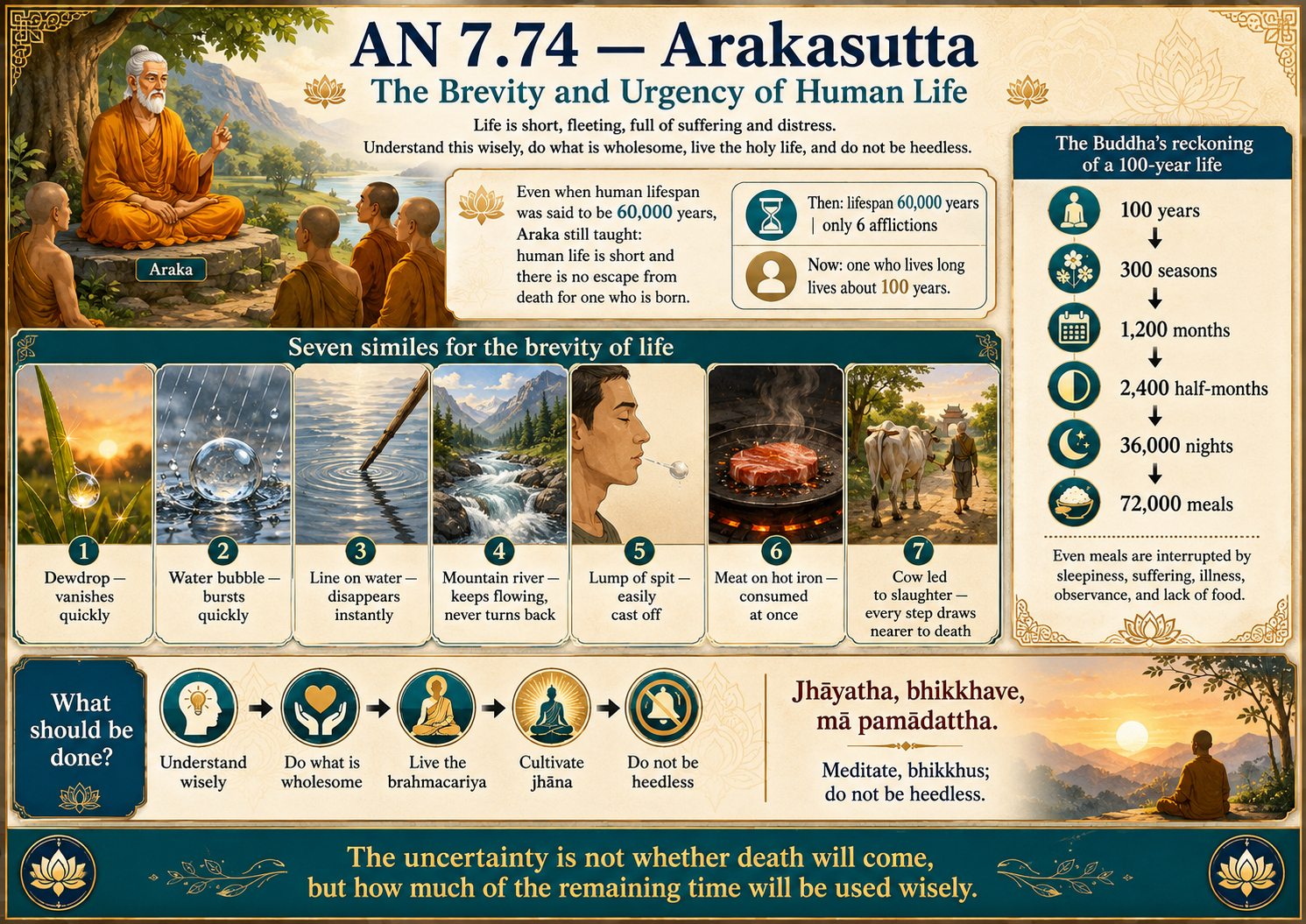 VISUAL SUMMARYSee this sutta in a pictureOpen the complete infographic for a visual overview before or after reading the full study.View infographic →
Life is short—but the teaching ends in practice, not fear
Arakasutta uses seven vivid similes to show that human life is fragile, fleeting, irreversible and continuously moving toward death. The discourse then turns mortality into a practical instruction: understand wisely, do what is wholesome, live the brahmacariya, cultivate jhāna and do not be heedless.
Appakaṁ jīvitaṁ → mantāyaṁ boddhabbaṁ → kattabbaṁ kusalaṁ → caritabbaṁ brahmacariyaṁ → jhāyatha → mā pamādattha.
Key distinction: the discourse does not ask the practitioner to become morbid or fearful. Each simile removes complacency so that the remaining life is used for kusala, brahmacariya and bhāvanā.
Seven Ways of Seeing Life
Each simile exposes a different dimension of impermanence
1
Ussāvabindu — dewdrop. Fragile before ordinary conditions; the rising sun is enough for it to disappear.
2
Udakabubbuḷa — water bubble. Brief, fragile and easily broken.
3
Daṇḍarāji — line on water. Disappears almost as it is being made.
4
Nadī pabbateyyā — mountain river. Always moving onward and never turning back.
5
Kheḷapiṇḍa — lump of spit. Life can be cast off with startling ease.
6
Maṁsapesi — meat on hot iron. Conditioned form is already being altered by conditions.
7
Gāvī vajjhā — cow led to slaughter. Every step taken is a step nearer death.
The Arithmetic of Impermanence
A century becomes concrete when counted in seasons, months, nights and meals
1
100 years. One seemingly large lifespan.
2
300 seasons. 100 cold • 100 hot • 100 rainy.
3
1,200 months. A finite sequence of opportunities.
4
2,400 fortnights. Countable practice cycles.
5
36,000 nights. Every night used is one less remaining.
6
72,000 meals. Even nourishment is countable and subject to interruption.
Saṅkhāta — reckoned: the Buddha repeatedly counts the lifespan to make finitude tangible. What seems like the huge abstraction “my life” is actually a countable and exhaustible sequence of opportunities.
The Direction of the Teaching
Mortality must end in practice, not merely in reflection
1
Appakaṁ jīvitaṁ. Life is short.
2
Mantāyaṁ boddhabbaṁ. Understand this with wisdom.
3
Kattabbaṁ kusalaṁ. Do what is wholesome.
4
Caritabbaṁ brahmacariyaṁ. Live the holy life.
5
Jhāyatha. Cultivate jhāna; practise.
6
Mā pamādattha. Do not be heedless.
Final movement: AN 7.74 culminates in Jhāyatha, bhikkhave, mā pamādattha. The contemplation of death is successful only when it changes how one lives and practises now.
All 19 sections — Pāḷi with English immediately underneath
01Araka, an Ancient Teacher Free from Sensual Passion
“Bhūtapubbaṁ, bhikkhave, arako nāma satthā ahosi titthakaro kāmesu vītarāgo. Arakassa kho pana, bhikkhave, satthuno anekāni sāvakasatāni ahesuṁ. Arako satthā sāvakānaṁ evaṁ dhammaṁ deseti:
‘Appakaṁ, brāhmaṇa, jīvitaṁ manussānaṁ parittaṁ lahukaṁ bahudukkhaṁ bahupāyāsaṁ mantāyaṁ boddhabbaṁ, kattabbaṁ kusalaṁ, caritabbaṁ brahmacariyaṁ, natthi jātassa amaraṇaṁ.’”
“Bhikkhus, once in the past there was a teacher named Araka, a religious founder who was free from passion for sensual pleasures. Araka had many hundreds of disciples. He taught his disciples in this way:
‘Brahmins, human life is short, limited, fleeting, full of suffering and distress. This should be understood with wisdom; what is wholesome should be done, the holy life should be lived, for there is no freedom from death for one who is born.’”
021. Human Life Is Like a Dewdrop
“Seyyathāpi, brāhmaṇa, tiṇagge ussāvabindu sūriye uggacchante khippaṁyeva paṭivigacchati, na ciraṭṭhitikaṁ hoti; evamevaṁ kho, brāhmaṇa, ussāvabindūpamaṁ jīvitaṁ manussānaṁ appakaṁ, brāhmaṇa, jīvitaṁ manussānaṁ parittaṁ lahukaṁ bahudukkhaṁ bahupāyāsaṁ mantāyaṁ boddhabbaṁ, kattabbaṁ kusalaṁ, caritabbaṁ brahmacariyaṁ, natthi jātassa amaraṇaṁ.”
“Brahmin, just as a dewdrop on the tip of a blade of grass quickly disappears when the sun rises and does not last long, so too human life is like a dewdrop: Human life is short, limited, fleeting, full of suffering and distress. This should be understood with wisdom; what is wholesome should be done, the holy life should be lived, for there is no freedom from death for one who is born.”
032. Human Life Is Like a Water Bubble
“Seyyathāpi, brāhmaṇa, thullaphusitake deve vassante udakabubbuḷaṁ khippaṁyeva paṭivigacchati, na ciraṭṭhitikaṁ hoti; evamevaṁ kho, brāhmaṇa, udakabubbuḷūpamaṁ jīvitaṁ manussānaṁ appakaṁ, brāhmaṇa, jīvitaṁ manussānaṁ parittaṁ lahukaṁ bahudukkhaṁ bahupāyāsaṁ mantāyaṁ boddhabbaṁ, kattabbaṁ kusalaṁ, caritabbaṁ brahmacariyaṁ, natthi jātassa amaraṇaṁ.”
“Brahmin, just as when heavy drops of rain are falling, a bubble on the water quickly breaks up and does not last long, so too human life is like a water bubble: Human life is short, limited, fleeting, full of suffering and distress. This should be understood with wisdom; what is wholesome should be done, the holy life should be lived, for there is no freedom from death for one who is born.”
043. Human Life Is Like a Line Drawn on Water
“Seyyathāpi, brāhmaṇa, udake daṇḍarāji khippaṁyeva paṭivigacchati, na ciraṭṭhitikā hoti; evamevaṁ kho, brāhmaṇa, udake daṇḍarājūpamaṁ jīvitaṁ manussānaṁ appakaṁ, brāhmaṇa, jīvitaṁ manussānaṁ parittaṁ lahukaṁ bahudukkhaṁ bahupāyāsaṁ mantāyaṁ boddhabbaṁ, kattabbaṁ kusalaṁ, caritabbaṁ brahmacariyaṁ, natthi jātassa amaraṇaṁ.”
“Brahmin, just as a line drawn on water with a stick quickly disappears and does not last long, so too human life is like a line drawn on water: Human life is short, limited, fleeting, full of suffering and distress. This should be understood with wisdom; what is wholesome should be done, the holy life should be lived, for there is no freedom from death for one who is born.”
054. Human Life Is Like a Swift Mountain River
“Seyyathāpi, brāhmaṇa, nadī pabbateyyā dūraṅgamā sīghasotā hārahārinī, natthi so khaṇo vā layo vā muhutto vā yaṁ sā āvattati, atha kho sā gacchateva vattateva sandateva; evamevaṁ kho, brāhmaṇa, nadīpabbateyyūpamaṁ jīvitaṁ manussānaṁ appakaṁ, brāhmaṇa, jīvitaṁ manussānaṁ parittaṁ lahukaṁ bahudukkhaṁ bahupāyāsaṁ mantāyaṁ boddhabbaṁ, kattabbaṁ kusalaṁ, caritabbaṁ brahmacariyaṁ, natthi jātassa amaraṇaṁ.”
“Brahmin, just as a mountain river travels far, flows swiftly, and carries everything along; there is no moment, interval, or instant in which it turns back and remains, but it keeps going, rolling, and flowing onward—so too human life is like a mountain river: Human life is short, limited, fleeting, full of suffering and distress. This should be understood with wisdom; what is wholesome should be done, the holy life should be lived, for there is no freedom from death for one who is born.”
065. Human Life Is Like a Lump of Spit
“Seyyathāpi, brāhmaṇa, balavā puriso jivhagge kheḷapiṇḍaṁ saṁyūhitvā akasireneva vameyya; evamevaṁ kho, brāhmaṇa, kheḷapiṇḍūpamaṁ jīvitaṁ manussānaṁ appakaṁ, brāhmaṇa, jīvitaṁ manussānaṁ parittaṁ lahukaṁ bahudukkhaṁ bahupāyāsaṁ mantāyaṁ boddhabbaṁ, kattabbaṁ kusalaṁ, caritabbaṁ brahmacariyaṁ, natthi jātassa amaraṇaṁ.”
“Brahmin, just as a strong person could gather a lump of saliva on the tip of the tongue and expel it without difficulty, so too human life is like a lump of spit: Human life is short, limited, fleeting, full of suffering and distress. This should be understood with wisdom; what is wholesome should be done, the holy life should be lived, for there is no freedom from death for one who is born.”
076. Human Life Is Like Meat on a Blazing Iron Pan
“Seyyathāpi, brāhmaṇa, divasaṁsantatte ayokaṭāhe maṁsapesi pakkhittā khippaṁyeva paṭivigacchati, na ciraṭṭhitikā hoti; evamevaṁ kho, brāhmaṇa, maṁsapesūpamaṁ jīvitaṁ manussānaṁ appakaṁ, brāhmaṇa, jīvitaṁ manussānaṁ parittaṁ lahukaṁ bahudukkhaṁ bahupāyāsaṁ mantāyaṁ boddhabbaṁ, kattabbaṁ kusalaṁ, caritabbaṁ brahmacariyaṁ, natthi jātassa amaraṇaṁ.”
“Brahmin, just as a piece of meat thrown onto an iron pan heated throughout the day quickly shrivels and does not last long, so too human life is like a piece of meat on a blazing iron pan: Human life is short, limited, fleeting, full of suffering and distress. This should be understood with wisdom; what is wholesome should be done, the holy life should be lived, for there is no freedom from death for one who is born.”
087. Human Life Is Like a Cow Being Led to Slaughter
“Seyyathāpi, brāhmaṇa, gāvī vajjhā āghātanaṁ nīyamānā yaṁ yadeva pādaṁ uddharati, santikeva hoti vadhassa santikeva maraṇassa; evamevaṁ kho, brāhmaṇa, govajjhūpamaṁ jīvitaṁ manussānaṁ appakaṁ, brāhmaṇa, jīvitaṁ manussānaṁ parittaṁ lahukaṁ bahudukkhaṁ bahupāyāsaṁ mantāyaṁ boddhabbaṁ, kattabbaṁ kusalaṁ, caritabbaṁ brahmacariyaṁ, natthi jātassa amaraṇaṁ.”
“Brahmin, just as a cow being led to the slaughterhouse, with every step it lifts, comes nearer to being killed and nearer to death, so too human life is like a cow being led to slaughter: Human life is short, limited, fleeting, full of suffering and distress. This should be understood with wisdom; what is wholesome should be done, the holy life should be lived, for there is no freedom from death for one who is born.”
09Why Araka’s Teaching Was So Striking
“Tena kho pana, bhikkhave, samayena manussānaṁ saṭṭhivassasahassāni āyuppamāṇaṁ ahosi, pañcavassasatikā kumārikā alaṁpateyyā ahosi. Tena kho pana, bhikkhave, samayena manussānaṁ chaḷeva ābādhā ahesuṁ— sītaṁ, uṇhaṁ, jighacchā, pipāsā, uccāro, passāvo.
So hi nāma, bhikkhave, arako satthā evaṁ dīghāyukesu manussesu evaṁ ciraṭṭhitikesu evaṁ appābādhesu sāvakānaṁ evaṁ dhammaṁ desessati:
‘Appakaṁ, brāhmaṇa, jīvitaṁ manussānaṁ parittaṁ lahukaṁ bahudukkhaṁ bahupāyāsaṁ mantāyaṁ boddhabbaṁ, kattabbaṁ kusalaṁ, caritabbaṁ brahmacariyaṁ, natthi jātassa amaraṇan’ti.”
“At that time, bhikkhus, the human lifespan was 60,000 years, and a girl of five hundred years was considered of marriageable age. At that time human beings had only six afflictions: cold, heat, hunger, thirst, defecation, and urination.
Yet even when people were so long-lived, endured for so long, and had so few afflictions, the teacher Araka taught his disciples:
‘Human life is short, limited, fleeting, full of suffering and distress. This should be understood with wisdom; what is wholesome should be done, the holy life should be lived, for there is no freedom from death for one who is born.’”
10The Buddha Applies the Teaching to a Hundred-Year Life
“Etarahi taṁ, bhikkhave, sammā vadamāno vadeyya: ‘appakaṁ jīvitaṁ manussānaṁ parittaṁ lahukaṁ bahudukkhaṁ bahupāyāsaṁ mantāyaṁ boddhabbaṁ, kattabbaṁ kusalaṁ, caritabbaṁ brahmacariyaṁ, natthi jātassa amaraṇan’ti.
Etarahi, bhikkhave, yo ciraṁ jīvati so vassasataṁ appaṁ vā bhiyyo.”
“Now, bhikkhus, one speaking rightly would say: ‘Human life is short, limited, fleeting, full of suffering and distress. This should be understood with wisdom; what is wholesome should be done, the holy life should be lived, for there is no freedom from death for one who is born.’
Nowadays, bhikkhus, one who lives a long time lives for a hundred years, or a little more.”
11A Hundred Years = Three Hundred Seasons
“Vassasataṁ kho pana, bhikkhave, jīvanto tīṇiyeva utusatāni jīvati— utusataṁ hemantānaṁ, utusataṁ gimhānaṁ, utusataṁ vassānaṁ.”
“A person who lives for one hundred years lives through only three hundred seasons: one hundred cold seasons, one hundred hot seasons, and one hundred rainy seasons.”
12Three Hundred Seasons = Twelve Hundred Months
“Tīṇi kho pana, bhikkhave, utusatāni jīvanto dvādasayeva māsasatāni jīvati— cattāri māsasatāni hemantānaṁ, cattāri māsasatāni gimhānaṁ, cattāri māsasatāni vassānaṁ.”
“Living through three hundred seasons, one lives through only twelve hundred months: four hundred months of the cold season, four hundred of the hot season, and four hundred of the rainy season.”
13Twelve Hundred Months = Twenty-Four Hundred Fortnights
“Dvādasa kho pana, bhikkhave, māsasatāni jīvanto catuvīsatiyeva addhamāsasatāni jīvati— aṭṭhaddhamāsasatāni hemantānaṁ, aṭṭhaddhamāsasatāni gimhānaṁ, aṭṭhaddhamāsasatāni vassānaṁ.”
“Living through twelve hundred months, one lives through only twenty-four hundred half-months: eight hundred in the cold season, eight hundred in the hot season, and eight hundred in the rainy season.”
14Twenty-Four Hundred Fortnights = Thirty-Six Thousand Nights
“Catuvīsati kho pana, bhikkhave, addhamāsasatāni jīvanto chattiṁsaṁyeva rattisahassāni jīvati— dvādasa rattisahassāni hemantānaṁ, dvādasa rattisahassāni gimhānaṁ, dvādasa rattisahassāni vassānaṁ.”
“Living through twenty-four hundred fortnights, one lives through only thirty-six thousand nights: twelve thousand in the cold season, twelve thousand in the hot season, and twelve thousand in the rainy season.”
15Thirty-Six Thousand Nights = Seventy-Two Thousand Meals
“Chattiṁsaṁ kho pana, bhikkhave, rattisahassāni jīvanto dvesattatiyeva bhattasahassāni bhuñjati— catuvīsati bhattasahassāni hemantānaṁ, catuvīsati bhattasahassāni gimhānaṁ, catuvīsati bhattasahassāni vassānaṁ saddhiṁ mātuthaññāya saddhiṁ bhattantarāyena.”
“Living through thirty-six thousand nights, one eats only seventy-two thousand meals: twenty-four thousand in the cold season, twenty-four thousand in the hot season, and twenty-four thousand in the rainy season—counting the nourishment of mother’s milk and allowing for interruptions to meals.”
16Even the Number of Meals Is Reduced by Interruptions
“Tatrime bhattantarāyā: kapimiddhopi bhattaṁ na bhuñjati, dukkhitopi bhattaṁ na bhuñjati, byādhitopi bhattaṁ na bhuñjati, uposathikopi bhattaṁ na bhuñjati, alābhakenapi bhattaṁ na bhuñjati.”
“And these are interruptions to meals: one may not eat because of light or broken sleep, one may not eat because of suffering, one may not eat because of illness, one may not eat while observing the uposatha, and one may not eat because food is unavailable.”
17The Buddha Has Reckoned the Whole Century
“Iti kho, bhikkhave, mayā vassasatāyukassa manussassa āyupi saṅkhāto, āyuppamāṇampi saṅkhātaṁ, utūpi saṅkhātā, saṁvaccharāpi saṅkhātā, māsāpi saṅkhātā, addhamāsāpi saṅkhātā, rattipi saṅkhātā, divāpi saṅkhātā, bhattāpi saṅkhātā, bhattantarāyāpi saṅkhātā.”
“Thus, bhikkhus, I have reckoned the life of a person who lives for one hundred years: the lifespan has been reckoned, the measure of life has been reckoned, the seasons have been reckoned, the years have been reckoned, the months have been reckoned, the fortnights have been reckoned, the nights have been reckoned, the days have been reckoned, the meals have been reckoned, and even the interruptions to meals have been reckoned.”
18The Buddha’s Final Instruction — Jhāyatha, Mā Pamādattha
“Yaṁ, bhikkhave, satthārā karaṇīyaṁ sāvakānaṁ hitesinā anukampakena anukampaṁ upādāya; kataṁ vo taṁ mayā.
Etāni, bhikkhave, rukkhamūlāni, etāni suññāgārāni. Jhāyatha, bhikkhave, mā pamādattha; mā pacchā vippaṭisārino ahuvattha. Ayaṁ vo amhākaṁ anusāsanī”ti.
“Bhikkhus, whatever should be done by a teacher who seeks the welfare of his disciples and has compassion for them, that I have done for you.
Here are the roots of trees; here are empty dwellings. Practise jhāna, bhikkhus. Do not be heedless. Do not later become remorseful. This is my instruction to you.”
19The Seven Similes in One View
Ussāvabindūpamaṁ — dewdrop.
Udakabubbuḷūpamaṁ — water bubble.
Udake daṇḍarājūpamaṁ — line drawn on water.
Nadīpabbateyyūpamaṁ — swift mountain river.
Kheḷapiṇḍūpamaṁ — lump of spit.
Maṁsapesūpamaṁ — piece of meat on a heated iron pan.
Govajjhūpamaṁ — cow being led to slaughter.
Appakaṁ jīvitaṁ → mantāyaṁ boddhabbaṁ → kattabbaṁ kusalaṁ → caritabbaṁ brahmacariyaṁ → jhāyatha → mā pamādattha.
Dewdrop → vanishes with the rising sun.
Water bubble → bursts almost immediately.
Line on water → disappears as it is made.
Mountain river → never stops or turns back.
Lump of spit → can be expelled instantly.
Meat on blazing iron → is already being consumed by conditions.
Cow led to slaughter → every step is nearer death.
Life is short → understand this with wisdom → do what is wholesome → live the holy life → practise jhāna → do not be heedless.
All 19 explanations, separated from the translation
01Araka, an Ancient Teacher Free from Sensual Passion
The sutta begins in an unexpected way: the teaching on urgency is placed in the mouth of an ancient non-Buddhist teacher, Araka, who had become free of sensual passion. The Buddha does not reject a true observation merely because it came from outside his own dispensation. He uses Araka’s teaching because its central perception is undeniable: whatever is born must die.
The repeated phrase appakaṁ … jīvitaṁ manussānaṁ does not merely mean that life contains a small number of years. Its force is existential: compared with the work still to be done, the available span is slight.
Parittaṁ emphasizes limitation; lahukaṁ suggests lightness, fleetingness, or rapid passing; bahudukkhaṁ and bahupāyāsaṁ point to the many forms of suffering, pressure, exertion, and distress that occupy the span.
Mantāyaṁ boddhabbaṁ is crucial. Here mantā is to be understood in the sense of wisdom or discernment: life’s condition must be known intelligently, not merely feared emotionally. Once this is understood, two responses follow: kattabbaṁ kusalaṁ—do what is wholesome; caritabbaṁ brahmacariyaṁ—live the holy life.
The refrain ends with the fact that gives urgency to everything else: natthi jātassa amaraṇaṁ—there is no non-death for one who has been born.
021. Human Life Is Like a Dewdrop
The first simile emphasizes disappearance under ordinary conditions. A dewdrop can be beautiful and perfectly formed in the early morning, yet the rising sun is enough to make it vanish.
Likewise, life can appear secure when conditions are temporarily favourable. Health, plans, possessions, relationships, and routines create a feeling of continuity. But the very conditions of existence are already moving toward change.
The practice insight is not “life is meaningless.” The opposite follows in the sutta: precisely because the opportunity is fragile, kusala must be done now and the brahmacariya must be lived now. The dewdrop makes every available moment ethically significant.
032. Human Life Is Like a Water Bubble
The water bubble adds another dimension: life is not only brief, it is structurally fragile. A bubble has a recognizable shape and can reflect light beautifully, yet almost nothing is needed for it to burst.
Human beings commonly build identity as though continuity were guaranteed: “I will do this later,” “after this project,” “after retirement,” “when circumstances improve.” The bubble challenges the assumption that a future moment has been promised.
This simile therefore targets pamāda—heedlessness produced by imagined time. The correct response is not anxiety but appamāda: do not postpone the wholesome on the assumption of guaranteed continuity.
043. Human Life Is Like a Line Drawn on Water
A mark made on earth may remain; a mark made on stone may remain much longer. A line drawn in water disappears almost as it is being made.
This is a powerful image for the present moment. Life is not a fixed quantity stored somewhere that is slowly being consumed. It is occurring and vanishing together.
Past experience survives only through conditions such as memory, records, bodily consequences, habits, and kamma; the actual lived moment has already gone.
The line-on-water simile therefore helps cut attachment to the idea that experience can be retained. What can be carried forward is the direction of one’s conduct. Hence Araka’s refrain returns again to kusala and brahmacariya.
054. Human Life Is Like a Swift Mountain River
The first three similes stress fragility and disappearance. The mountain river stresses irreversibility.
Natthi so khaṇo vā layo vā muhutto vā—there is no moment, interval, or instant in which the current stops and returns. Gacchateva, vattateva, sandateva—it goes, moves, flows.
Ageing works in exactly this direction. A day lived cannot be called back and lived again. The body of yesterday cannot literally be retrieved. Even while one says, “I am waiting to begin practice,” the stream is moving.
This is why the proper response is not to negotiate with time but to use the current conditions. Whatever remains of life is upstream only in imagination; the actual movement is one-way.
065. Human Life Is Like a Lump of Spit
This simile is deliberately undignified. Human beings give enormous importance to the body and biography, but life can be expelled with startling ease.
A small shift in bodily conditions—heart rhythm, breathing, circulation, injury, infection, temperature, or countless other causes—can end what was being defended as a secure life.
The image undermines conceit. It is difficult to maintain grand ideas of permanence and control when life itself is compared to something expelled from the mouth without effort.
Again, the Buddha’s use of the simile is practical rather than nihilistic: because life is easily lost, the time available for kusala and liberation should not be wasted.
076. Human Life Is Like Meat on a Blazing Iron Pan
Here life is presented not merely as passing, but as being continuously acted upon by conditions.
A piece of flesh on intensely heated iron does not remain unchanged while waiting for some future event; alteration begins immediately. Likewise, the living body is never static. Metabolism, ageing, wear, repair, heat, hunger, fatigue, disease, and environmental contact are continuously affecting rūpa.
The simile therefore counters the idea that ageing begins only when one becomes “old.” From birth onward, conditioned form is undergoing alteration.
The urgency is not based on a prediction of the exact day of death. It is based on seeing that change is already occurring now.
087. Human Life Is Like a Cow Being Led to Slaughter
The seventh simile is the culmination of the series. Every step forward is simultaneously a step nearer death.
Ordinarily, birthdays are understood only as an increase in age: “I have lived another year.” The simile introduces the other side: one year has also been removed from whatever lifespan remained.
Santikeva vadhassa, santikeva maraṇassa—nearer to killing, nearer to death. Death does not need to begin approaching us later; with the arising of birth, the trajectory has already been established.
This is the experiential meaning of natthi jātassa amaraṇaṁ. Once jāti has occurred, death is not merely possible; it is inevitable. The uncertain element is only the interval.
09Why Araka’s Teaching Was So Striking
This paragraph changes the scale of the entire discourse. Within the narrative world of the sutta, Araka lived in an age of extraordinary longevity: 60,000 years. Even then he said, “Life is short.”
Why? Because “short” is not only a comparison with eighty, one hundred, or sixty thousand years. Against death—and against the task of ending saṁsāra—any conditioned lifespan is finite.
The reference to only six ābādhā emphasizes the same point: even in a world portrayed as dramatically healthier and longer-lived than ours, Araka still saw no basis for heedlessness.
This prevents a common excuse: “If only I had better health, fewer duties, or more time, then I would practise seriously.” The sutta says that even ideal longevity would not remove the fundamental urgency created by birth and death.
10The Buddha Applies the Teaching to a Hundred-Year Life
The Buddha now removes the historical distance. If Araka’s statement was appropriate for people imagined to live 60,000 years, how much more appropriate is it for a lifespan around one hundred years.
Etarahi—“now”—is the turning point of the sutta. The discourse ceases to be a story about an ancient teacher and becomes a direct instruction to the present Saṅgha.
The Buddha is not trying to produce pessimism about life expectancy. He is changing the unit with which life is measured. A century sounds large when spoken as “one hundred years.” The next passage breaks that seemingly large number into smaller and smaller countable units until its finitude becomes tangible.
11A Hundred Years = Three Hundred Seasons
A hundred years is reframed as only one hundred repetitions of each seasonal cycle.
The rhetorical strategy is powerful: instead of imagining “a lifetime” as a vague large block, count how many winters, summers, and rains remain. For a person already partway through life, the number becomes smaller still.
The teaching encourages saṅkhāna—reckoning. Not obsessive counting, but sober recognition that opportunities are finite.
12Three Hundred Seasons = Twelve Hundred Months
The scale contracts again: 100 years becomes 1,200 months.
A “month” feels immediately more spendable than a “life.” Each month used in heedlessness is not stored for later recovery.
This is why the calculation belongs directly to practice. Time is not merely passing around us; practice opportunities are being consumed.
13Twelve Hundred Months = Twenty-Four Hundred Fortnights
The half-month was an important rhythm in ancient Indian life, including the uposatha cycle.
The Buddha’s reckoning continues to remove psychological distance. What seemed like a long life is a finite sequence of recurring periods.
For a practitioner, this naturally raises a question: how many such cycles have passed with genuine cultivation, and how many remain?
14Twenty-Four Hundred Fortnights = Thirty-Six Thousand Nights
Now the entire century has become a count of nights.
This has direct relevance to jāgariya. Every evening is one of a finite number. A night spent in practice and a night lost in heedlessness are not equivalent in the development of the path.
The number is intentionally concrete. The Buddha wants impermanence to move from an abstract idea into arithmetic.
15Thirty-Six Thousand Nights = Seventy-Two Thousand Meals
The calculation becomes strikingly physical. A century of life is reduced to a finite number of occasions on which the body is fed.
This also links the contemplation of death to bhojane mattaññutā. Much of life can be organized around obtaining, preparing, choosing, enjoying, and thinking about food. Yet even the total number of eating occasions is countable and ends.
The canonical arithmetic should be read as a contemplative reckoning rather than as a modern demographic or nutritional model. Its point is finitude: even a full century can be counted down to the meals that sustain it.
16Even the Number of Meals Is Reduced by Interruptions
Even the theoretical count of meals does not unfold without interruption.
Kapimiddha literally evokes “monkey sleep”—light, brief, broken sleep or drowsiness. Other textual traditions read a variant associated with being upset or angry; the practical point of the passage is unchanged: ordinary conditions interrupt even something as basic as eating.
Dukkha, illness, voluntary observance, and simple non-availability further reduce the imagined regularity of life.
The larger message is that life cannot be planned as though the body will always cooperate. The conditions needed for practice should be used while they are available.
17The Buddha Has Reckoned the Whole Century
Saṅkhāta—reckoned, counted, calculated—is repeated again and again.
The repetition is the teaching. What appears as the enormous abstraction “my life” is countable.
Once something is countable, its exhaustion becomes undeniable. Every unit that has passed is no longer available for practice.
This is maraṇassati expressed through arithmetic: not imagining the manner of death, but seeing clearly that the supply of conditioned time is finite.
18The Buddha’s Final Instruction — Jhāyatha, Mā Pamādattha
The entire discourse culminates in action.
The Buddha says that the teacher’s work has been done: the Dhamma has been explained out of compassion. What remains cannot be delegated to the teacher.
Etāni rukkhamūlāni, etāni suññāgārāni—there are the roots of trees; there are empty dwellings. These are places of seclusion, but the deeper point is that the conditions for practice have been pointed out.
Jhāyatha is the imperative: practise jhāna, cultivate, meditate. The discourse does not end with “think about death.” Contemplation of life’s brevity must lead to actual bhāvanā.
Mā pamādattha—do not be heedless. Pamāda is the real danger exposed by every simile: behaving as though there will always be more time.
Mā pacchā vippaṭisārino ahuvattha—do not later be full of regret. The regret envisaged is not that life was short; that cannot be changed. The avoidable regret is that the available life was not used for the work that mattered.
Ayaṁ vo amhākaṁ anusāsanī—this is the instruction. The final movement is therefore:
understand the brevity of life → do kusala → live the brahmacariya → cultivate jhāna → do not be heedless.
19The Seven Similes in One View
The seven similes are not seven different doctrines. They illuminate seven dimensions of the same fact:
The dewdrop shows fragility before conditions.
The bubble shows momentariness.
The line on water shows non-retainability.
The river shows irreversible movement.
The spit shows how easily life can be cast off.
The meat on hot iron shows continuous alteration.
The slaughter-bound cow shows that every step of life is a step nearer death.
Together they destroy the most dangerous assumption in practice: “There is plenty of time.”
Arakasutta therefore does not teach morbidity. It teaches urgency with direction. The refrain does not end with death; it tells us exactly what to do before death: understand wisely, establish kusala, live the brahmacariya, cultivate jhāna, and abandon heedlessness.