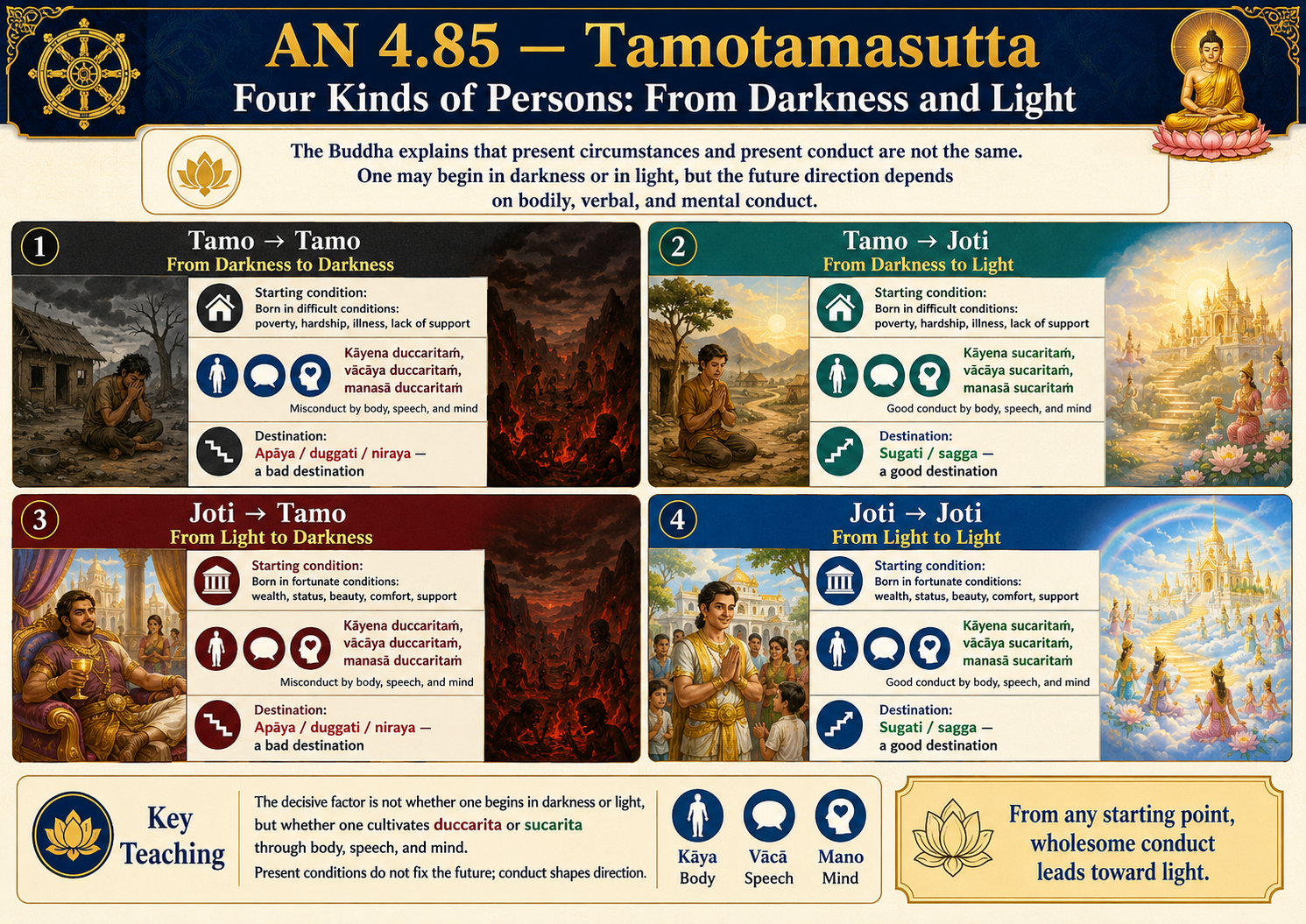
 VISUAL SUMMARYSee this sutta in a pictureOpen the complete infographic for a visual overview before or after reading the full study.View infographic →
01Four Kinds of Persons
“Cattārome, bhikkhave, puggalā santo saṁvijjamānā lokasmiṁ. Katame cattāro?
1. Tamo tamaparāyaṇo,
2. tamo jotiparāyaṇo,
3. joti tamaparāyaṇo,
4. joti jotiparāyaṇo.”
“Bhikkhus, these four kinds of persons are found existing in the world. What four?
1. One in darkness who is headed toward darkness. 2. One in darkness who is headed toward light. 3. One in light who is headed toward darkness. 4. One in light who is headed toward light.”
The entire sutta is built on a simple two-axis model:
• present circumstances: tamo or joti; • future direction: tamaparāyaṇo or jotiparāyaṇo.
In the descriptions that follow, tamo refers to difficult social, material, bodily, and health circumstances, while joti refers to fortunate social, material, bodily, and health circumstances.
The crucial point is that present circumstances do not dictate the future direction. What changes the trajectory is conduct: kāya, vācā, and mano—body, speech, and mind.
This makes the second and third persons especially important. A difficult beginning can move toward light through sucarita, while a fortunate beginning can move toward darkness through duccarita.
021. Tamo Tamaparāyaṇo — From Darkness to Darkness
“Kathañca, bhikkhave, puggalo tamo hoti tamaparāyaṇo? Idha, bhikkhave, ekacco puggalo nīce kule paccājāto hoti—caṇḍālakule vā venakule vā nesādakule vā rathakārakule vā pukkusakule vā dalidde appannapānabhojane kasiravuttike, yattha kasirena ghāsacchādo labbhati.
So ca hoti dubbaṇṇo duddasiko okoṭimako bavhābādho kāṇo vā kuṇī vā khañjo vā pakkhahato vā, na lābhī annassa pānassa vatthassa yānassa mālāgandhavilepanassa seyyāvasathapadīpeyyassa.
So kāyena duccaritaṁ carati, vācāya duccaritaṁ carati, manasā duccaritaṁ carati.
So kāyena duccaritaṁ caritvā, vācāya duccaritaṁ caritvā, manasā duccaritaṁ caritvā kāyassa bhedā paraṁ maraṇā apāyaṁ duggatiṁ vinipātaṁ nirayaṁ upapajjati.
Evaṁ kho, bhikkhave, puggalo tamo hoti tamaparāyaṇo.”
“And how, bhikkhus, is a person in darkness and headed toward darkness?
Here, a certain person is reborn into a socially low and impoverished family—among communities such as those named in the text—poor, with little food or drink, living with hardship, where food and clothing are obtained only with difficulty.
That person may also be unattractive in appearance, of poor physical development, frequently ill, or affected by disabilities, and may lack food, drink, clothing, transport, garlands, perfumes, ointments, bedding, lodging, and lighting.
That person engages in misconduct by body, misconduct by speech, and misconduct by mind.
Having engaged in misconduct by body, speech, and mind, with the breakup of the body, after death, that person is reborn in a state of deprivation, a bad destination, a lower realm, in hell.
This is how a person is in darkness and headed toward darkness.”
The first “darkness” refers to difficult present conditions. The second “darkness” refers to the direction created by present misconduct.
The Buddha’s emphasis is not that poverty, illness, appearance, disability, or birth-community make someone morally inferior. The sutta contrasts circumstances with conduct. The moral factor appears only when it says: so kāyena duccaritaṁ carati, vācāya duccaritaṁ carati, manasā duccaritaṁ carati.
This is essential for reading the passage responsibly. The inherited social vocabulary reflects ancient Indian classifications; the practice point is that hardship does not excuse the creation of further harmful kamma.
Darkness becomes “darkness leading to darkness” only when difficult conditions are answered with unwholesome bodily, verbal, and mental conduct.
A person grows up with financial hardship and repeated difficulties. If resentment becomes theft, cruelty, deception, or harmful thinking, present suffering is being used to generate further suffering. The sutta asks us to distinguish “what has happened to me” from “what I am creating now.”
032. Tamo Jotiparāyaṇo — From Darkness to Light
“Kathañca, bhikkhave, puggalo tamo hoti jotiparāyaṇo? Idha, bhikkhave, ekacco puggalo nīce kule paccājāto hoti—caṇḍālakule vā venakule vā nesādakule vā rathakārakule vā pukkusakule vā dalidde appannapānabhojane kasiravuttike, yattha kasirena ghāsacchādo labbhati; so ca hoti dubbaṇṇo duddasiko okoṭimako bavhābādho kāṇo vā kuṇī vā khañjo vā pakkhahato vā na lābhī annassa pānassa vatthassa yānassa mālāgandhavilepanassa seyyāvasathapadīpeyyassa.
So kāyena sucaritaṁ carati, vācāya sucaritaṁ carati, manasā sucaritaṁ carati.
So kāyena sucaritaṁ caritvā, vācāya sucaritaṁ caritvā, manasā sucaritaṁ caritvā kāyassa bhedā paraṁ maraṇā sugatiṁ saggaṁ lokaṁ upapajjati.
Evaṁ kho, bhikkhave, puggalo tamo hoti jotiparāyaṇo.”
“And how, bhikkhus, is a person in darkness but headed toward light?
Here, a certain person is reborn into difficult and impoverished circumstances, with little food or drink and a hard livelihood, where food and clothing are obtained only with difficulty. That person may also experience poor health, unattractive appearance, disability, or lack of material necessities.
Yet that person conducts themselves well by body, well by speech, and well by mind.
Having practised good conduct by body, speech, and mind, with the breakup of the body, after death, that person is reborn in a good destination, in a heavenly world.
This is how a person is in darkness but headed toward light.”
This is one of the most encouraging categories in the sutta.
The starting point may be difficult, but the trajectory is not fixed. Tamo does not determine tamaparāyaṇo.
The decisive shift is sucarita:
kāya-sucarita — good bodily conduct; vacī-sucarita — good verbal conduct; mano-sucarita — good mental conduct.
The sutta therefore gives agency to practice. One may not control birth-family, inherited wealth, bodily appearance, health, or many external circumstances, but one can train the quality of action now.
This person turns difficult conditions into the basis for a bright direction rather than into justification for further harm.
Someone has limited money, chronic health difficulties, and little social advantage, yet remains honest, generous within their means, careful in speech, and committed to learning Dhamma. Their current circumstances may be difficult, but the direction of the mind and kamma is toward light.
043. Joti Tamaparāyaṇo — From Light to Darkness
“Kathañca, bhikkhave, puggalo joti hoti tamaparāyaṇo? Idha, bhikkhave, ekacco puggalo ucce kule paccājāto hoti—khattiyamahāsālakule vā brāhmaṇamahāsālakule vā gahapatimahāsālakule vā aḍḍhe mahaddhane mahābhoge pahūtajātarūparajate pahūtavittūpakaraṇe pahūtadhanadhaññe; so ca hoti abhirūpo dassanīyo pāsādiko paramāya vaṇṇapokkharatāya samannāgato, lābhī annassa pānassa vatthassa yānassa mālāgandhavilepanassa seyyāvasathapadīpeyyassa.
So kāyena duccaritaṁ carati, vācāya duccaritaṁ carati, manasā duccaritaṁ carati.
So kāyena duccaritaṁ caritvā, vācāya duccaritaṁ caritvā, manasā duccaritaṁ caritvā kāyassa bhedā paraṁ maraṇā apāyaṁ duggatiṁ vinipātaṁ nirayaṁ upapajjati.
Evaṁ kho, bhikkhave, puggalo joti hoti tamaparāyaṇo.”
“And how, bhikkhus, is a person in light but headed toward darkness?
Here, a certain person is reborn into a socially prominent and prosperous family—into a wealthy khattiya, brahmin, or householder family—rich, very wealthy, with abundant property, gold and silver, resources, money, and grain.
That person is attractive, pleasing to look at, graceful, endowed with excellent complexion and appearance, and has access to food, drink, clothing, transport, garlands, perfumes, ointments, bedding, lodging, and lighting.
Yet that person engages in misconduct by body, misconduct by speech, and misconduct by mind.
Having engaged in misconduct by body, speech, and mind, with the breakup of the body, after death, that person is reborn in a state of deprivation, a bad destination, a lower realm, in hell.
This is how a person is in light but headed toward darkness.”
This category overturns the assumption that favourable circumstances indicate spiritual safety.
Joti refers to fortunate conditions: wealth, status, health, beauty, and access to material comforts. None of these protects a person from the results of duccarita.
Indeed, favourable conditions can become spiritually dangerous when they produce heedlessness, entitlement, indulgence, contempt, or the assumption that present success proves moral superiority.
The sutta therefore refuses to equate prosperity with goodness. What matters is what one does with prosperity.
A successful executive has wealth, influence, excellent health, and social respect, but uses these advantages to exploit employees, deceive clients, indulge harmful desires, and cultivate arrogance. The outer life appears bright; the direction created by conduct is dark.
054. Joti Jotiparāyaṇo — From Light to Light
“Kathañca, bhikkhave, puggalo joti hoti jotiparāyaṇo? Idha, bhikkhave, ekacco puggalo ucce kule paccājāto hoti—khattiyamahāsālakule vā brāhmaṇamahāsālakule vā gahapatimahāsālakule vā aḍḍhe mahaddhane mahābhoge pahūtajātarūparajate pahūtavittūpakaraṇe pahūtadhanadhaññe; so ca hoti abhirūpo dassanīyo pāsādiko paramāya vaṇṇapokkharatāya samannāgato, lābhī annassa pānassa vatthassa yānassa mālāgandhavilepanassa seyyāvasathapadīpeyyassa.
So kāyena sucaritaṁ carati, vācāya sucaritaṁ carati, manasā sucaritaṁ carati.
So kāyena sucaritaṁ caritvā, vācāya sucaritaṁ caritvā, manasā sucaritaṁ caritvā kāyassa bhedā paraṁ maraṇā sugatiṁ saggaṁ lokaṁ upapajjati.
Evaṁ kho, bhikkhave, puggalo joti hoti jotiparāyaṇo.”
“And how, bhikkhus, is a person in light and headed toward light?
Here, a certain person is reborn into a socially prominent and prosperous family, rich and abundantly supplied with wealth and material resources. That person is attractive and healthy and has access to food, drink, clothing, transport, ornaments, lodging, and other comforts.
That person conducts themselves well by body, well by speech, and well by mind.
Having practised good conduct by body, speech, and mind, with the breakup of the body, after death, that person is reborn in a good destination, in a heavenly world.
This is how a person is in light and headed toward light.”
The fourth person receives favourable conditions and uses them wisely.
Prosperity becomes an opportunity for generosity rather than greed, influence for protection rather than exploitation, speech for truth rather than manipulation, and mental development for wisdom rather than conceit.
The sutta therefore does not condemn wealth or comfort. It asks what direction is being created from them.
This person is “light heading toward light” because favourable conditions are accompanied by sucarita rather than being wasted through heedlessness.
A financially secure person uses wealth to support family responsibly, help those in need, sustain Dhamma activities, avoid exploitation, speak truthfully, and cultivate the mind. Their advantages become supports for wholesome kamma rather than fuel for attachment.
06The Buddha’s Conclusion
“Ime kho, bhikkhave, cattāro puggalā santo saṁvijjamānā lokasmin”ti.
“These, bhikkhus, are the four kinds of persons found existing in the world.”
The fourfold model can be summarized in a simple matrix:
Present difficulty + duccarita → darkness toward darkness. Present difficulty + sucarita → darkness toward light. Present advantage + duccarita → light toward darkness. Present advantage + sucarita → light toward light.
The teaching prevents two errors.
First, do not judge a person’s moral worth simply from present fortune or misfortune.
Second, do not assume present conditions determine the future. The decisive practical question is: what bodily, verbal, and mental kamma is being made now?
For a practitioner, the most useful question is therefore not “Am I presently in darkness or light?” but “Which direction am I creating from here?”