Mūlakasutta — Ten Questions that Map the Whole Practice
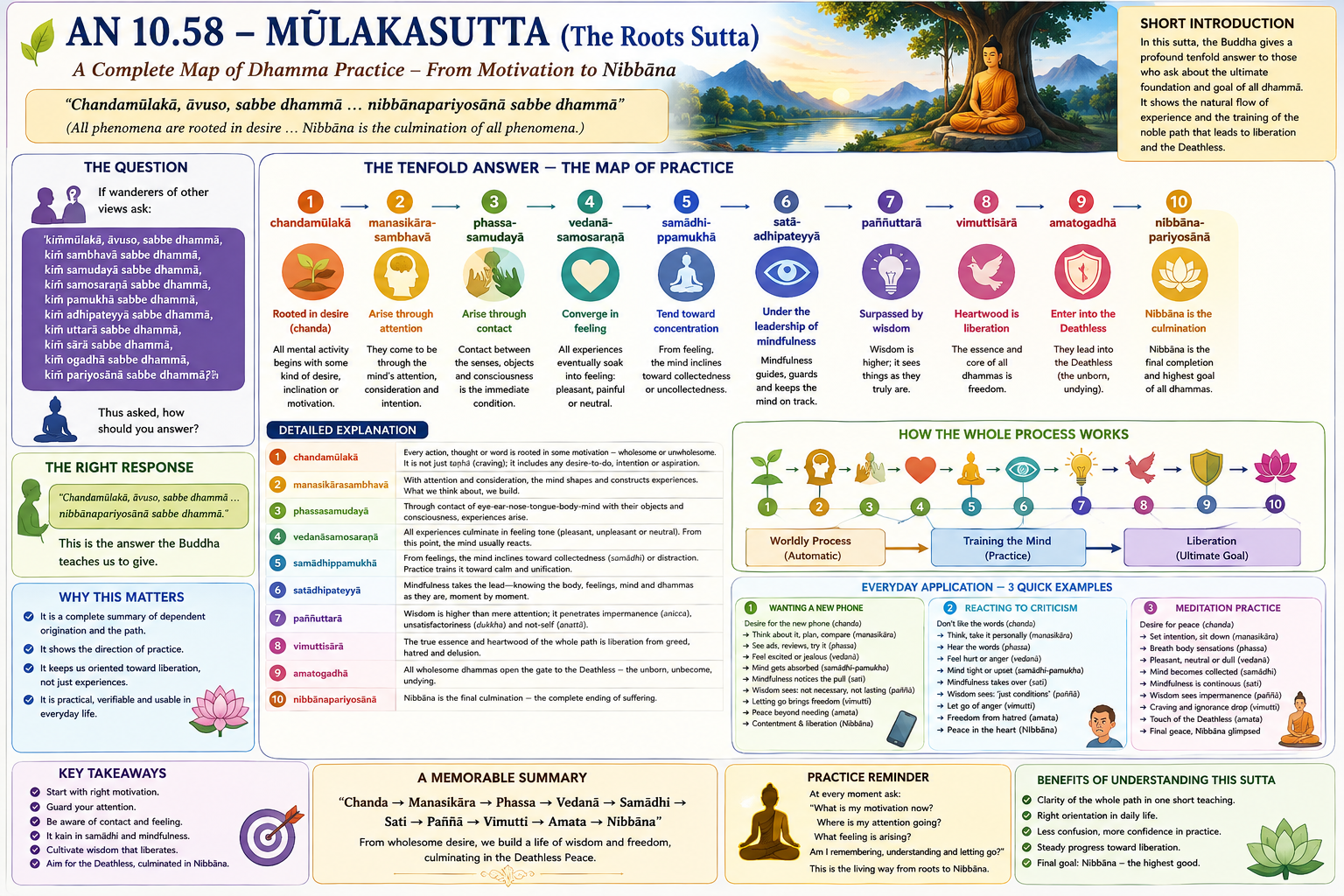 VISUAL SUMMARYSee this sutta in a pictureOpen the complete infographic for a visual overview before or after reading the full study.View infographic →
Ten questions that keep the whole training pointed toward Nibbāna
AN 10.58 gives a remarkably compact way of examining dhammas: what roots them, how they come into being, what gives rise to them, where they converge, what should lead and govern them, what is higher, what their heartwood is, where they enter, and where the entire training finally culminates.
The sequence begins inside ordinary experience and ends beyond ordinary experience: motivation and attention lead into contact and feeling; training establishes samādhi, sati and paññā; the real criterion is then vimutti, amata and Nibbāna.
From Chanda to Nibbāna
| Movement | Factors | Practical meaning |
|---|---|---|
| Conditioned field | chanda • manasikāra • phassa • vedanā | Motivation, attention, contact and feeling. |
| Training | samādhi • sati • paññā | Steadiness leads, mindfulness governs, wisdom goes beyond. |
| Culmination | vimutti • amata • Nibbāna | Liberation is the heartwood, the Deathless the depth, and Nibbāna the final culmination. |
Reading point: the sutta states these as ten answers about sabbe dhammā. The grouping into “conditioned field / training / culmination” is a practical teaching organization of the sequence, not a claim that the ten terms form a simple chronological dependent-origination chain.
Pāḷi with English immediately underneath
01The Buddha Sets Ten Questions
“Sace, bhikkhave, aññatitthiyā paribbājakā evaṁ puccheyyuṁ: ‘kiṁmūlakā, āvuso, sabbe dhammā, kiṁsambhavā sabbe dhammā, kiṁsamudayā sabbe dhammā, kiṁsamosaraṇā sabbe dhammā, kiṁpamukhā sabbe dhammā, kiṁadhipateyyā sabbe dhammā, kiṁuttarā sabbe dhammā, kiṁsārā sabbe dhammā, kiṁogadhā sabbe dhammā, kiṁpariyosānā sabbe dhammā’ti, evaṁ puṭṭhā tumhe, bhikkhave, tesaṁ aññatitthiyānaṁ paribbājakānaṁ kinti byākareyyāthā”ti?
“Bhikkhus, if wanderers of other sects were to ask you: ‘Friends, what are all dhammas rooted in? Through what do all dhammas come into being? From what do all dhammas arise? In what do all dhammas converge? What is foremost among all dhammas? What governs all dhammas? What is higher than all dhammas? What is the essence of all dhammas? In what are all dhammas immersed? What is the final culmination of all dhammas?’—if you were asked in this way, how would you answer those wanderers of other sects?”
02The Bhikkhus Take the Buddha as Guide and Refuge
“Bhagavaṁmūlakā no, bhante, dhammā bhagavaṁnettikā bhagavaṁpaṭisaraṇā. Sādhu vata, bhante, bhagavantaṁyeva paṭibhātu etassa bhāsitassa attho. Bhagavato sutvā bhikkhū dhāressantī”ti.
“Venerable sir, our dhammas have the Blessed One as their root, the Blessed One as their guide, and the Blessed One as their refuge. It would be good if the Blessed One himself would clarify the meaning of this statement. Having heard it from the Blessed One, the bhikkhus will remember it.”
03Listen Carefully
“Tena hi, bhikkhave, suṇātha, sādhukaṁ manasi karotha, bhāsissāmī”ti.
“Evaṁ, bhante”ti kho te bhikkhū bhagavato paccassosuṁ. Bhagavā etadavoca:
“Then, bhikkhus, listen and attend carefully. I will speak.”
“Yes, venerable sir,” those bhikkhus replied to the Blessed One. The Blessed One said:
04The Complete Tenfold Answer
“Sace, bhikkhave, aññatitthiyā paribbājakā evaṁ puccheyyuṁ: ‘kiṁmūlakā, āvuso, sabbe dhammā, kiṁsambhavā sabbe dhammā, kiṁsamudayā sabbe dhammā, kiṁsamosaraṇā sabbe dhammā, kiṁpamukhā sabbe dhammā, kiṁ adhipateyyā sabbe dhammā, kiṁuttarā sabbe dhammā, kiṁsārā sabbe dhammā, kiṁogadhā sabbe dhammā, kiṁpariyosānā sabbe dhammā’ti, evaṁ puṭṭhā tumhe, bhikkhave, tesaṁ aññatitthiyānaṁ paribbājakānaṁ evaṁ byākareyyātha:
‘chandamūlakā, āvuso, sabbe dhammā, manasikārasambhavā sabbe dhammā, phassasamudayā sabbe dhammā, vedanāsamosaraṇā sabbe dhammā, samādhippamukhā sabbe dhammā, satādhipateyyā sabbe dhammā, paññuttarā sabbe dhammā, vimuttisārā sabbe dhammā, amatogadhā sabbe dhammā, nibbānapariyosānā sabbe dhammā’ti.
Evaṁ puṭṭhā tumhe, bhikkhave, tesaṁ aññatitthiyānaṁ paribbājakānaṁ evaṁ byākareyyāthā”ti.
“Bhikkhus, if wanderers of other sects were to ask you those ten questions, you should answer them in this way:
‘Friends, all dhammas are rooted in chanda. All dhammas come into being through attention. All dhammas arise from contact. All dhammas converge in feeling. Samādhi is foremost among all dhammas. Mindfulness governs all dhammas. Wisdom is higher than all dhammas. Liberation is the essence of all dhammas. All dhammas are immersed in the Deathless. All dhammas have Nibbāna as their final culmination.’
If you are questioned in this way, bhikkhus, this is how you should answer those wanderers of other sects.”
051. Chandamūlakā — Rooted in Chanda
“Chandamūlakā, āvuso, sabbe dhammā.”
“Friends, all dhammas are rooted in chanda.”
062. Manasikārasambhavā — Coming into Being through Attention
“Manasikārasambhavā sabbe dhammā.”
“All dhammas come into being through attention.”
073. Phassasamudayā — Contact as Origin
“Phassasamudayā sabbe dhammā.”
“All dhammas have contact as their origin.”
084. Vedanāsamosaraṇā — Converging in Feeling
“Vedanāsamosaraṇā sabbe dhammā.”
“All dhammas converge in feeling.”
095. Samādhippamukhā — Samādhi is Foremost
“Samādhippamukhā sabbe dhammā.”
“Samādhi is foremost among all dhammas.”
106. Satādhipateyyā — Mindfulness Governs
“Satādhipateyyā sabbe dhammā.”
“Mindfulness governs all dhammas.”
117. Paññuttarā — Wisdom is Higher
“Paññuttarā sabbe dhammā.”
“Wisdom is higher than all dhammas.”
128. Vimuttisārā — Liberation is the Heartwood
“Vimuttisārā sabbe dhammā.”
“Liberation is the essence—the heartwood—of all dhammas.”
139. Amatogadhā — Immersed in the Deathless
“Amatogadhā sabbe dhammā.”
“All dhammas are immersed in, or find their footing in, the Deathless.”
1410. Nibbānapariyosānā — Nibbāna is the Final Culmination
“Nibbānapariyosānā sabbe dhammā.”
“All dhammas have Nibbāna as their final culmination.”
Understanding the function of each part of the tenfold teaching
01The Buddha Sets Ten Questions
The Buddha begins not with answers but with ten diagnostic questions. Each question looks at dhammas from a different functional angle: root, arising, origin, convergence, leadership, governance, superiority, essence, immersion, and final culmination.
The repeated phrase sabbe dhammā should be handled carefully. In this sutta the emphasis is practical and relational: whatever dhammas are being examined, the Buddha gives a tenfold way of understanding how they arise, how they should be trained, and where the training should ultimately lead.
The sequence is therefore not simply a cosmological claim about “everything that exists.” It functions as a complete practice map.
02The Bhikkhus Take the Buddha as Guide and Refuge
The bhikkhus do not improvise an answer. They acknowledge the Buddha as the authoritative guide for understanding the Dhamma and ask him to explain the tenfold structure.
Bhagavaṁnettikā is especially evocative: the Blessed One is the guide or leader who shows the direction. Bhagavaṁpaṭisaraṇā indicates taking the Buddha as the reliable point of reference.
This establishes the right attitude toward the rest of the discourse: listen carefully, understand the sequence, then retain it as a practical framework.
03Listen Carefully
Suṇātha—listen—and sādhukaṁ manasi karotha—attend carefully—prepare the mind for a concise teaching in which every word carries a distinct role.
The ten answers are easy to memorize, but their value lies in seeing the progression. The first four describe how dhammas come into the experienced field; the next three describe how practice should govern that field; the final three define the real purpose and culmination of the path.
04The Complete Tenfold Answer
This is the entire teaching in one compact sequence. The first four answers describe the conditioned mechanics of experience:
chanda → manasikāra → phassa → vedanā.
The next three describe the training architecture:
samādhi → sati → paññā.
The final three establish the criterion by which practice should be judged:
vimutti → amata → Nibbāna.
The movement is therefore from what initiates and conditions experience to what disciplines it, understands it, releases it, and brings it to its final end.
051. Chandamūlakā — Rooted in Chanda
Chanda is desire-to-do, interest, intention, inclination, or wish. It should not automatically be translated as taṇhā. Chanda can be wholesome, unwholesome, or ethically variable depending on its object and context.
Calling chanda the mūla—the root—draws attention to motivation. Dhammas do not become a field of practice in a vacuum; there is some inclination, interest, or intention that gives them direction.
For practice, the first question is therefore: “What is the chanda behind this?” A wholesome chanda can orient the mind toward sīla, bhāvanā, understanding, and release; an unwholesome inclination can orient the same capacities toward acquisition and proliferation.
062. Manasikārasambhavā — Coming into Being through Attention
Manasikāra is the turning or directing of the mind toward an object. Sambhava indicates coming into being, manifestation, or production.
What is repeatedly attended to becomes experientially prominent. Attention selects, feeds, and organizes the field of experience.
This is why yoniso manasikāra is so important elsewhere in the Nikāyas: attention is not neutral. The same object can be attended to in a way that strengthens rāga, dosa, and moha, or in a way that reveals conditionality, impermanence, and the path of abandoning.
073. Phassasamudayā — Contact as Origin
Phassa is contact: the meeting of a sense faculty, its object, and the corresponding consciousness.
Samudaya here points to arising or origin. The sutta directs us to look earlier than the fully developed reaction. Before a story becomes large, there is contact.
This gives practice a very precise entry point. If phassa is known clearly, the mind can observe what follows before craving, aversion, or proliferation fully takes over.
084. Vedanāsamosaraṇā — Converging in Feeling
Samosaraṇa is a meeting point or place of convergence. Vedanā—pleasant, painful, or neither-painful-nor-pleasant feeling—is where the experienced process becomes affectively charged.
This does not mean every dhamma is identical to vedanā. It means feeling is a decisive junction in lived experience.
Pleasant feeling can invite grasping; painful feeling can invite resistance; neutral feeling can invite ignorance or dullness. Knowing vedanā clearly interrupts the automatic move from feeling to reaction.
095. Samādhippamukhā — Samādhi is Foremost
Pamukha means foremost, leading, or at the front. Once the sutta has described motivation, attention, contact, and feeling, it turns to the discipline that should lead the mind: samādhi.
Samādhi is not merely forceful concentration. It is collectedness, steadiness, composure, and unification that enables the mind to remain with experience without being scattered by every contact and feeling.
Thus the path does not leave the mind at the mercy of what arises. Samādhi gives stability from which clear seeing becomes possible.
106. Satādhipateyyā — Mindfulness Governs
Adhipateyya conveys rulership, authority, or governing influence. Sati should govern the process.
Sati keeps the relevant Dhamma present. It remembers what is being practised, prevents forgetfulness, and allows arising states to be known without immediately becoming identified with them.
The combination is powerful: samādhi steadies the mind; sati governs the ongoing field so that the purpose of practice is not lost.
117. Paññuttarā — Wisdom is Higher
Uttara means higher, superior, or going beyond. The collected and mindful mind must culminate in paññā.
Paññā sees conditionality and knows what should be fully understood, abandoned, developed, and realized. It sees that conditioned states arise and pass and cannot safely be appropriated as permanent self or possession.
This prevents samādhi and sati from becoming ends in themselves. Their higher purpose is to support liberating understanding.
128. Vimuttisārā — Liberation is the Heartwood
Sāra means essence, core, or heartwood. The sutta sets a demanding criterion: the real core of the practice is vimutti.
Knowledge, discipline, meditation, serenity, and insight are not being cultivated merely to become learned, calm, respected, or spiritually accomplished. Their heartwood is release from bondage.
This is an excellent test for practice: is this training reducing greed, aversion, delusion, appropriation, and conceit? If not, one may still be occupied with the bark and branches rather than the heartwood.
139. Amatogadhā — Immersed in the Deathless
Amata—the Deathless—is a standard designation for Nibbāna. Ogadha carries the sense of entering, being immersed, grounded, or finding footing in.
The movement has now gone beyond management of conditioned experience. The Dhamma trajectory is directed toward that which is not subject to birth and death.
This gives every earlier factor its final orientation. Chanda, attention, contact, feeling, samādhi, sati, and paññā are understood within a path whose essence is liberation and whose depth is the Deathless.
1410. Nibbānapariyosānā — Nibbāna is the Final Culmination
Pariyosāna means ending, completion, consummation, or final culmination.
The tenfold sequence ends unambiguously with Nibbāna. The path is not complete merely when attention improves, samādhi deepens, mindfulness becomes continuous, or wisdom becomes sophisticated.
The final measure is whether the process moves toward cessation of the causes of suffering.
This gives AN 10.58 its extraordinary compactness: it begins with motivation and ends with Nibbāna, connecting everyday mental activity directly with the final purpose of the Dhamma.
A five-step way to apply AN 10.58 during ordinary life
011. Chanda
What is motivating this mental process?
022. Manasikāra
What is receiving repeated attention?
033. Phassa + Vedanā
What contact occurred, and what feeling tone followed?
044. Samādhi + Sati + Paññā
Is the mind steady, governed and seeing clearly?
055. Vimutti → Nibbāna
Is the direction toward less bondage—or merely better management of saṁsāra?
The crucial shift: the sutta does not end with better attention or mindfulness. It deliberately keeps asking “what is higher?”, “what is the essence?”, and “what is the culmination?” so that calmness and clarity remain servants of liberation rather than new objects of attachment.
Three situations where the tenfold map becomes visible
01Phone / purchase desire
A device catches the eye. Chanda appears, manasikāra returns repeatedly, phassa is renewed through images and reviews, and pleasant vedanā strengthens the pull. The practice question is whether samādhi, sati and paññā interrupt automatic acquisition.
02Criticism / difficult message
Contact occurs, unpleasant vedanā appears, and attention constructs a story. Establishing samādhi and sati creates enough space for paññā to distinguish the message itself from the self-making added around it.
03Meditation itself
Wholesome chanda can initiate practice, but the sutta prevents stopping at calmness. Samādhi and sati support paññā; paññā is measured by vimutti; the path remains oriented to amata and Nibbāna.