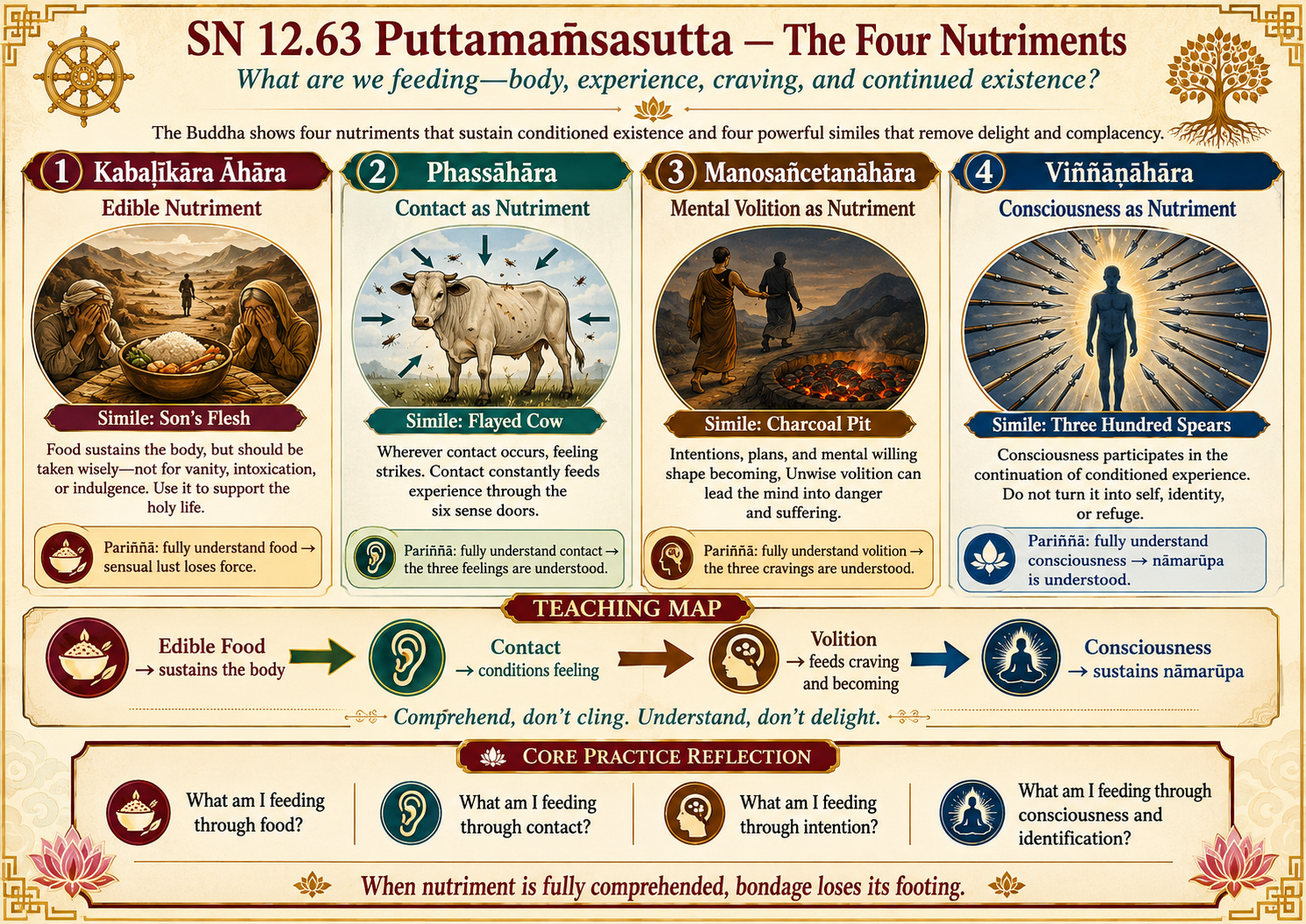
 VISUAL SUMMARYSee this sutta in a pictureOpen the complete infographic for a visual overview before or after reading the full study.View infographic →
0101 At SāvatthīThe discourse is set at Sāvatthī. The source text abbreviates the familiar setting formula and moves immediately to the teaching. What follows is not merely a discus…
Sāvatthiyaṁ …
At Sāvatthī …
The discourse is set at Sāvatthī. The source text abbreviates the familiar setting formula and moves immediately to the teaching. What follows is not merely a discussion about physical nutrition. The Buddha uses āhāra—“nutriment” or “that which sustains”—for four conditions that maintain embodied life and support the continuation of conditioned existence.
0202 The Four NutrimentsThe word āhāra should not be reduced to “food.” Only the first nutriment is material food. The other three—phassa, manosañcetanā, and viññāṇa—belong to the experient…
“Cattārome, bhikkhave, āhārā bhūtānaṁ vā sattānaṁ ṭhitiyā sambhavesīnaṁ vā anuggahāya. Katame cattāro? Kabaḷīkāro āhāro oḷāriko vā sukhumo vā, phasso dutiyo, manosañcetanā tatiyā, viññāṇaṁ catutthaṁ. Ime kho, bhikkhave, cattāro āhārā bhūtānaṁ vā sattānaṁ ṭhitiyā sambhavesīnaṁ vā anuggahāya.”
“Bhikkhus, there are these four nutriments for the maintenance of beings who have come into existence and for the support of those seeking to come into existence. What four? Edible nutriment, whether gross or subtle; contact as the second; mental volition as the third; and consciousness as the fourth. These, bhikkhus, are the four nutriments for the maintenance of beings who have come into existence and for the support of those seeking to come into existence.”
The word āhāra should not be reduced to “food.” Only the first nutriment is material food. The other three—phassa, manosañcetanā, and viññāṇa—belong to the experiential and mental process.
The teaching therefore covers two levels at once. The body is sustained by edible food, while the ongoing process of experience is sustained through contact, intention, and consciousness. The phrase bhūtānaṁ vā sattānaṁ ṭhitiyā points to the maintenance of beings already arisen; sambhavesīnaṁ vā anuggahāya points to the support of continued arising or renewed existence.
The crucial question of the sutta is not merely “What are the four nutriments?” but “How should each nutriment be seen?” The Buddha answers through four deliberately powerful similes. Each simile removes delight, romance, identification, and complacency from the corresponding nutriment.
0303 1. Kabaḷīkāra Āhāra — Edible NutrimentThis is intentionally one of the most shocking similes in the Nikāyas. Its function is not to discuss an ordinary moral choice. It is designed to transform the pract…
Kathañca, bhikkhave, kabaḷīkāro āhāro daṭṭhabbo? Seyyathāpi, bhikkhave, dve jāyampatikā parittaṁ sambalaṁ ādāya kantāramaggaṁ paṭipajjeyyuṁ. Tesamassa ekaputtako piyo manāpo. Atha kho tesaṁ, bhikkhave, dvinnaṁ jāyampatikānaṁ kantāragatānaṁ yā parittā sambalamattā, sā parikkhayaṁ pariyādānaṁ gaccheyya. Siyā ca nesaṁ kantārāvaseso anatiṇṇo.
Atha kho tesaṁ, bhikkhave, dvinnaṁ jāyampatikānaṁ evamassa: ‘amhākaṁ kho yā parittā sambalamattā sā parikkhīṇā pariyādiṇṇā. Atthi cāyaṁ kantārāvaseso anittiṇṇo. Yannūna mayaṁ imaṁ ekaputtakaṁ piyaṁ manāpaṁ vadhitvā vallūrañca soṇḍikañca karitvā puttamaṁsāni khādantā evaṁ taṁ kantārāvasesaṁ nitthareyyāma, mā sabbeva tayo vinassimhā’ti.
Atha kho te, bhikkhave, dve jāyampatikā taṁ ekaputtakaṁ piyaṁ manāpaṁ vadhitvā vallūrañca soṇḍikañca karitvā puttamaṁsāni khādantā evaṁ taṁ kantārāvasesaṁ nitthareyyuṁ. Te puttamaṁsāni ceva khādeyyuṁ, ure ca paṭipiseyyuṁ: ‘kahaṁ, ekaputtaka, kahaṁ, ekaputtakā’ti.
“And how, bhikkhus, should edible nutriment be regarded? Suppose a husband and wife, taking only a small amount of provisions, were travelling along a road through a wilderness. They had with them their only son, dear and beloved. While that husband and wife were travelling through the wilderness, their small supply of provisions would become exhausted and used up, yet a remaining stretch of wilderness would still be uncrossed.
Then the husband and wife would think: ‘Our small supply of provisions has been exhausted and used up, but this remaining stretch of wilderness has not yet been crossed. What if we were to kill our only son, dear and beloved, prepare dried and preserved meat from him, and, eating our son’s flesh, cross the remainder of this wilderness, so that all three of us do not perish?’
Then, bhikkhus, that husband and wife would kill their only son, dear and beloved, prepare dried and preserved meat, and, eating their son’s flesh, cross the remainder of the wilderness. And while eating their son’s flesh, they would beat their breasts, crying: ‘Where are you, our only son? Where are you, our only son?’”
This is intentionally one of the most shocking similes in the Nikāyas. Its function is not to discuss an ordinary moral choice. It is designed to transform the practitioner’s relationship to food.
The parents do not eat their son’s flesh because it is delicious, attractive, entertaining, prestigious, or emotionally satisfying. They eat only because it is necessary to cross the wilderness and remain alive. Every mouthful is accompanied by the knowledge of what it actually is. Delight has been stripped away.
In the same way, the practitioner is asked to see edible food primarily as support for crossing the “wilderness” of conditioned existence. Food maintains the body so that the training can continue. Once food becomes an object of intoxication, identity, display, entertainment, compulsive pursuit, or sensual fascination, the mind has moved away from the purpose represented by the simile.
The force of puttamaṁsa—“son’s flesh”—therefore directly challenges rāga associated with eating. The contemplation is not meant to produce hatred toward food. It is meant to remove enchantment and establish wise use.
0404 Why Is Food Taken?The Buddha now makes the purpose of the simile explicit. Four distorted motives are excluded: davāya—amusement or indulgence; madāya—intoxication or pride; maṇḍanāya…
Taṁ kiṁ maññatha, bhikkhave, api nu te davāya vā āhāraṁ āhāreyyuṁ, madāya vā āhāraṁ āhāreyyuṁ, maṇḍanāya vā āhāraṁ āhāreyyuṁ, vibhūsanāya vā āhāraṁ āhāreyyun”ti?
“No hetaṁ, bhante”.
“Nanu te, bhikkhave, yāvadeva kantārassa nittharaṇatthāya āhāraṁ āhāreyyun”ti?
“Evaṁ, bhante”.
“What do you think, bhikkhus? Would they consume that food for amusement, for intoxication, for beautification, or for adornment?”
“No, venerable sir.”
“Would they not consume that food only for the purpose of crossing the wilderness?”
“Yes, venerable sir.”
The Buddha now makes the purpose of the simile explicit. Four distorted motives are excluded: davāya—amusement or indulgence; madāya—intoxication or pride; maṇḍanāya—beautification; and vibhūsanāya—adornment or enhancement of appearance.
The positive purpose is yāvadeva kantārassa nittharaṇatthāya: only for crossing the wilderness. This gives a practical test for eating: does food support the journey, or has the journey become subordinate to food?
This connects closely with bhojane mattaññutā, moderation in eating. Moderation is not merely measuring quantity. It begins with correctly understanding the purpose of nourishment.
0505 Comprehending Edible NutrimentThe Buddha does not stop at dietary restraint. The consequence reaches directly into kāmarāga—sensual passion.
“Evameva khvāhaṁ, bhikkhave, kabaḷīkāro āhāro daṭṭhabboti vadāmi. Kabaḷīkāre, bhikkhave, āhāre pariññāte pañca kāmaguṇiko rāgo pariññāto hoti. Pañca kāmaguṇike rāge pariññāte natthi taṁ saṁyojanaṁ yena saṁyojanena saṁyutto ariyasāvako puna imaṁ lokaṁ āgaccheyya.”
“In just this way, bhikkhus, I say that edible nutriment should be regarded. When edible nutriment is fully understood, lust connected with the five cords of sensual pleasure is fully understood. When lust connected with the five cords of sensual pleasure is fully understood, there is no fetter bound by which a noble disciple would return again to this world.”
The Buddha does not stop at dietary restraint. The consequence reaches directly into kāmarāga—sensual passion.
The five kāmaguṇā are the attractive forms, sounds, smells, tastes, and tactile objects that can become bases for sensual delight. Food is therefore used here as an entry point into the wider structure of sensuality. If one fully understands the nutriment of edible food—not merely intellectually, but through pariññā, complete comprehension—the underlying mechanism of sensual lust is exposed.
The final sentence is very strong: when that sensual lust is fully comprehended, the fetter that would bring the noble disciple back to “this world” no longer remains. The emphasis is not on dieting. It is on uprooting the rāga that binds the mind to sensual existence.
0606 2. Phassāhāra — Contact as NutrimentThe flayed cow has no protective skin. Wherever it goes—wall, tree, water, or open air—it is exposed. There is no place where contact does not touch the raw body.
Kathañca, bhikkhave, phassāhāro daṭṭhabbo? Seyyathāpi, bhikkhave, gāvī niccammā kuṭṭañce nissāya tiṭṭheyya. Ye kuṭṭanissitā pāṇā te naṁ khādeyyuṁ. Rukkhañce nissāya tiṭṭheyya, ye rukkhanissitā pāṇā te naṁ khādeyyuṁ. Udakañce nissāya tiṭṭheyya, ye udakanissitā pāṇā te naṁ khādeyyuṁ. Ākāsañce nissāya tiṭṭheyya, ye ākāsanissitā pāṇā te naṁ khādeyyuṁ. Yaṁ yadeva hi sā, bhikkhave, gāvī niccammā nissāya tiṭṭheyya, ye tannissitā pāṇā te naṁ khādeyyuṁ.
Evameva khvāhaṁ, bhikkhave, ‘phassāhāro daṭṭhabbo’ti vadāmi. Phasse, bhikkhave, āhāre pariññāte tisso vedanā pariññātā honti. Tīsu vedanāsu pariññātāsu ariyasāvakassa natthi kiñci uttarikaraṇīyanti vadāmi.
“And how, bhikkhus, should contact as nutriment be regarded? Suppose there were a cow with its hide removed. If it stood leaning against a wall, the creatures living by the wall would eat it. If it stood leaning against a tree, the creatures living by the tree would eat it. If it stood in water, the creatures living in the water would eat it. If it stood in the open air, the creatures living in the air would eat it. Whatever that flayed cow depended upon for standing, the creatures living there would eat it.
In just this way, bhikkhus, I say that contact as nutriment should be regarded. When contact as nutriment is fully understood, the three kinds of feeling are fully understood. When the three kinds of feeling are fully understood, I say that there is nothing further for a noble disciple to do.”
The flayed cow has no protective skin. Wherever it goes—wall, tree, water, or open air—it is exposed. There is no place where contact does not touch the raw body.
This is an exceptionally precise image for phassa. Experience continually occurs through the six doors: eye and forms, ear and sounds, nose and smells, tongue and tastes, body and tangibles, mind and dhammas. Wherever there is the meeting of sense base, object, and corresponding consciousness, there is contact. From contact, feeling follows.
The simile therefore shifts practice from trying to find a world in which nothing contacts us to understanding contact itself. One cannot solve the problem merely by changing walls, trees, water, people, places, devices, sounds, or situations. Without understanding phassa, the mind remains “raw” to experience.
The Buddha then links full comprehension of contact to full comprehension of the three vedanās: pleasant, painful, and neither-painful-nor-pleasant. Contact is not yet craving. But when contact conditions feeling, and feeling is not understood, the movement toward craving can begin. When feeling is fully comprehended, that work has been brought to completion.
0707 3. Manosañcetanāhāra — Mental Volition as NutrimentManosañcetanā is intentional mental movement—the willing, inclining, projecting, choosing, constructing, and directing of the mind. Calling it āhāra means that inten…
Kathañca, bhikkhave, manosañcetanāhāro daṭṭhabbo? Seyyathāpi, bhikkhave, aṅgārakāsu sādhikaporisā puṇṇā aṅgārānaṁ vītaccikānaṁ vītadhūmānaṁ. Atha puriso āgaccheyya jīvitukāmo amaritukāmo sukhakāmo dukkhappaṭikūlo. Tamenaṁ dve balavanto purisā nānābāhāsu gahetvā taṁ aṅgārakāsuṁ upakaḍḍheyyuṁ.
Atha kho, bhikkhave, tassa purisassa ārakāvassa cetanā ārakā patthanā ārakā paṇidhi. Taṁ kissa hetu? Evañhi, bhikkhave, tassa purisassa hoti: ‘imañcāhaṁ aṅgārakāsuṁ papatissāmi, tatonidānaṁ maraṇaṁ vā nigacchāmi maraṇamattaṁ vā dukkhan’ti.
Evameva khvāhaṁ, bhikkhave, ‘manosañcetanāhāro daṭṭhabbo’ti vadāmi. Manosañcetanāya, bhikkhave, āhāre pariññāte tisso taṇhā pariññātā honti. Tīsu taṇhāsu pariññātāsu ariyasāvakassa natthi kiñci uttarikaraṇīyanti vadāmi.
“And how, bhikkhus, should mental volition as nutriment be regarded? Suppose there were a charcoal pit deeper than a man’s height, filled with glowing coals, without flame and without smoke. Then a man would come along who wanted to live, did not want to die, wanted happiness, and recoiled from suffering. Two strong men would seize him by both arms and drag him toward that charcoal pit.
Then, bhikkhus, that man’s intention would be far from it, his aspiration would be far from it, and his resolve would be far from it. Why is that? Because he would think: ‘If I fall into this charcoal pit, because of that I will meet death or suffering like death.’
In just this way, bhikkhus, I say that mental volition as nutriment should be regarded. When mental volition as nutriment is fully understood, the three kinds of craving are fully understood. When the three kinds of craving are fully understood, I say that there is nothing further for a noble disciple to do.”
Manosañcetanā is intentional mental movement—the willing, inclining, projecting, choosing, constructing, and directing of the mind. Calling it āhāra means that intention is not a trivial internal event; it feeds continuation.
The man being dragged toward the pit understands the consequence so clearly that his cetanā, patthanā, and paṇidhi—his intention, aspiration, and resolve—are all directed away from the fire. There is no romantic attraction to the pit because he sees where the movement leads.
The practical implication is profound. A practitioner learns to examine not only what is being experienced but where the mind is intending to go. What is it seeking? What is it constructing? What is it hoping to become? What experience is it trying to repeat? What experience is it trying to annihilate or escape?
The Buddha links full comprehension of mental volition with full comprehension of the three taṇhās. In the standard Nikāya framework these are craving for sensuality (kāmataṇhā), craving for becoming (bhavataṇhā), and craving for non-becoming (vibhavataṇhā). Intention feeds these movements when they are not understood. Once the three forms of craving are fully comprehended, there is nothing further to be done.
0808 4. Viññāṇāhāra — Consciousness as NutrimentThe fourth simile is relentless: one hundred spear-thrusts in the morning, another hundred at midday, and another hundred in the evening. The image conveys repeated …
Kathañca, bhikkhave, viññāṇāhāro daṭṭhabbo? Seyyathāpi, bhikkhave, coraṁ āgucāriṁ gahetvā rañño dasseyyuṁ: ‘ayaṁ te, deva, coro āgucārī, imassa yaṁ icchasi taṁ daṇḍaṁ paṇehī’ti.
Tamenaṁ rājā evaṁ vadeyya: ‘gacchatha, bho, imaṁ purisaṁ pubbaṇhasamayaṁ sattisatena hanathā’ti. Tamenaṁ pubbaṇhasamayaṁ sattisatena haneyyuṁ. Atha rājā majjhanhikasamayaṁ evaṁ vadeyya: ‘ambho, kathaṁ so puriso’ti? ‘Tatheva, deva, jīvatī’ti.
Tamenaṁ rājā evaṁ vadeyya: ‘gacchatha, bho, taṁ purisaṁ majjhanhikasamayaṁ sattisatena hanathā’ti. Tamenaṁ majjhanhikasamayaṁ sattisatena haneyyuṁ. Atha rājā sāyanhasamayaṁ evaṁ vadeyya: ‘ambho, kathaṁ so puriso’ti? ‘Tatheva, deva, jīvatī’ti.
Tamenaṁ rājā evaṁ vadeyya: ‘gacchatha, bho, taṁ purisaṁ sāyanhasamayaṁ sattisatena hanathā’ti. Tamenaṁ sāyanhasamayaṁ sattisatena haneyyuṁ.
“And how, bhikkhus, should consciousness as nutriment be regarded? Suppose they were to seize a thief, a criminal, and present him to the king, saying: ‘Your Majesty, this man is a thief and a criminal. Impose on him whatever punishment you wish.’
The king would say: ‘Go, men, and in the morning strike this man with one hundred spears.’ So in the morning they would strike him with one hundred spears. Then at midday the king would say: ‘Men, how is that man?’ ‘He is still alive, Your Majesty.’
The king would say: ‘Go, men, and at midday strike that man with one hundred spears.’ So at midday they would strike him with one hundred spears. Then in the evening the king would say: ‘Men, how is that man?’ ‘He is still alive, Your Majesty.’
The king would say: ‘Go, men, and in the evening strike that man with one hundred spears.’ So in the evening they would strike him with one hundred spears.”
The fourth simile is relentless: one hundred spear-thrusts in the morning, another hundred at midday, and another hundred in the evening. The image conveys repeated impact, not something to be appropriated as “me” or enjoyed as a secure refuge.
Viññāṇa is consciousness—the knowing of an object through a corresponding domain of experience. In dependent arising it conditions nāmarūpa, and nāmarūpa in turn provides the structured field in which experience proceeds. By calling viññāṇa a nutriment, the Buddha points to its sustaining role in conditioned existence.
The simile should not be read as saying that every moment of consciousness is literally identical with physical pain. Rather, it dismantles the tendency to treat consciousness as a permanent essence, safe home, observer-self, or something worthy of clinging to. Conditioned consciousness participates in the very process whose complete understanding is required for release.
Morning, noon, and evening also give the teaching a sense of continuity: as long as the process is being fed, the impacts of conditioned experience continue.
0909 Three Hundred SpearsThe bhikkhus’ answer makes the simile unmistakable. One spear would be enough to produce suffering; three hundred intensify the point beyond doubt.
Taṁ kiṁ maññatha, bhikkhave, api nu so puriso divasaṁ tīhi sattisatehi haññamāno tatonidānaṁ dukkhaṁ domanassaṁ paṭisaṁvediyethā”ti?
“Ekissāpi, bhante, sattiyā haññamāno tatonidānaṁ dukkhaṁ domanassaṁ paṭisaṁvediyetha; ko pana vādo tīhi sattisatehi haññamāno”ti.
“What do you think, bhikkhus? Would that man, being struck during the day by three hundred spears, experience pain and mental distress because of that?”
“Venerable sir, even if he were struck by a single spear, he would experience pain and mental distress because of that; what then could be said of being struck by three hundred spears?”
The bhikkhus’ answer makes the simile unmistakable. One spear would be enough to produce suffering; three hundred intensify the point beyond doubt.
The practitioner is therefore not encouraged to make viññāṇa into a metaphysical refuge—“pure consciousness,” “my awareness,” or an enduring inner knower. The sutta asks that consciousness itself be known as nutriment: conditioned, functional, sustaining a process, and therefore something to be fully comprehended rather than appropriated.
This is particularly important when studying viññāṇa alongside nāmarūpa. The Buddha’s conclusion does not tell us to destroy a self called consciousness. It tells us that when consciousness is fully understood, nāmarūpa is fully understood. The emphasis is knowledge of conditionality, not metaphysical speculation.
1010 Comprehending Consciousness and NāmarūpaThe discourse ends by linking viññāṇa directly to nāmarūpa. This is the dependent-arising structure in practical form. Consciousness is not being treated as an isola…
“Evameva khvāhaṁ, bhikkhave, viññāṇāhāro daṭṭhabboti vadāmi. Viññāṇe, bhikkhave, āhāre pariññāte nāmarūpaṁ pariññātaṁ hoti, nāmarūpe pariññāte ariyasāvakassa natthi kiñci uttarikaraṇīyanti vadāmī”ti.
“In just this way, bhikkhus, I say that consciousness as nutriment should be regarded. When consciousness as nutriment is fully understood, name-and-form is fully understood. When name-and-form is fully understood, I say that there is nothing further for a noble disciple to do.”
The discourse ends by linking viññāṇa directly to nāmarūpa. This is the dependent-arising structure in practical form. Consciousness is not being treated as an isolated substance. It functions in dependence, and the experiential organism designated as nāmarūpa likewise belongs to a conditioned network.
Pariññā—full comprehension—is the key word throughout the final statements. The Buddha is not asking merely for a conceptual definition of food, contact, intention, consciousness, feeling, craving, or name-and-form. Complete comprehension means penetrating these processes to the point that clinging no longer needs to operate.
That is why the recurring conclusion is so strong: natthi kiñci uttarikaraṇīyaṁ—“there is nothing further to be done.” The four nutriments are therefore not a peripheral doctrine about nourishment. They provide a compact map of how life and experience are sustained and how, through full comprehension, the sustaining conditions of renewed dukkha cease to bind.
1111 The Teaching in One ViewThe four similes can be held together as a single practice framework:
Kabaḷīkāro āhāro — phasso — manosañcetanā — viññāṇaṁ.
Edible nutriment — contact — mental volition — consciousness.
The four similes can be held together as a single practice framework:
- Edible food is to be seen like a desperate means of crossing a wilderness: use it for support, not delight.
- Contact is to be seen like a flayed cow exposed wherever it stands: every sense door is a field of contact, so protection comes through understanding rather than merely changing external conditions.
- Mental volition is to be seen like being dragged toward a burning charcoal pit: understand where intentions, aspirations, and resolves are taking the mind.
- Consciousness is to be seen like repeated spear-thrusts: do not convert conditioned knowing into an identity or refuge; fully understand its role in sustaining nāmarūpa and conditioned existence.
The movement of the discourse is therefore from nourishment to comprehension, and from comprehension to the ending of bondage.
SN 12.63 turns the ordinary idea of “food” into a profound investigation of what sustains conditioned life and experience. The four similes train the practitioner to see each nutriment without romance or appropriation, and to carry that seeing toward full comprehension.