The Four Factors of Noble Progression
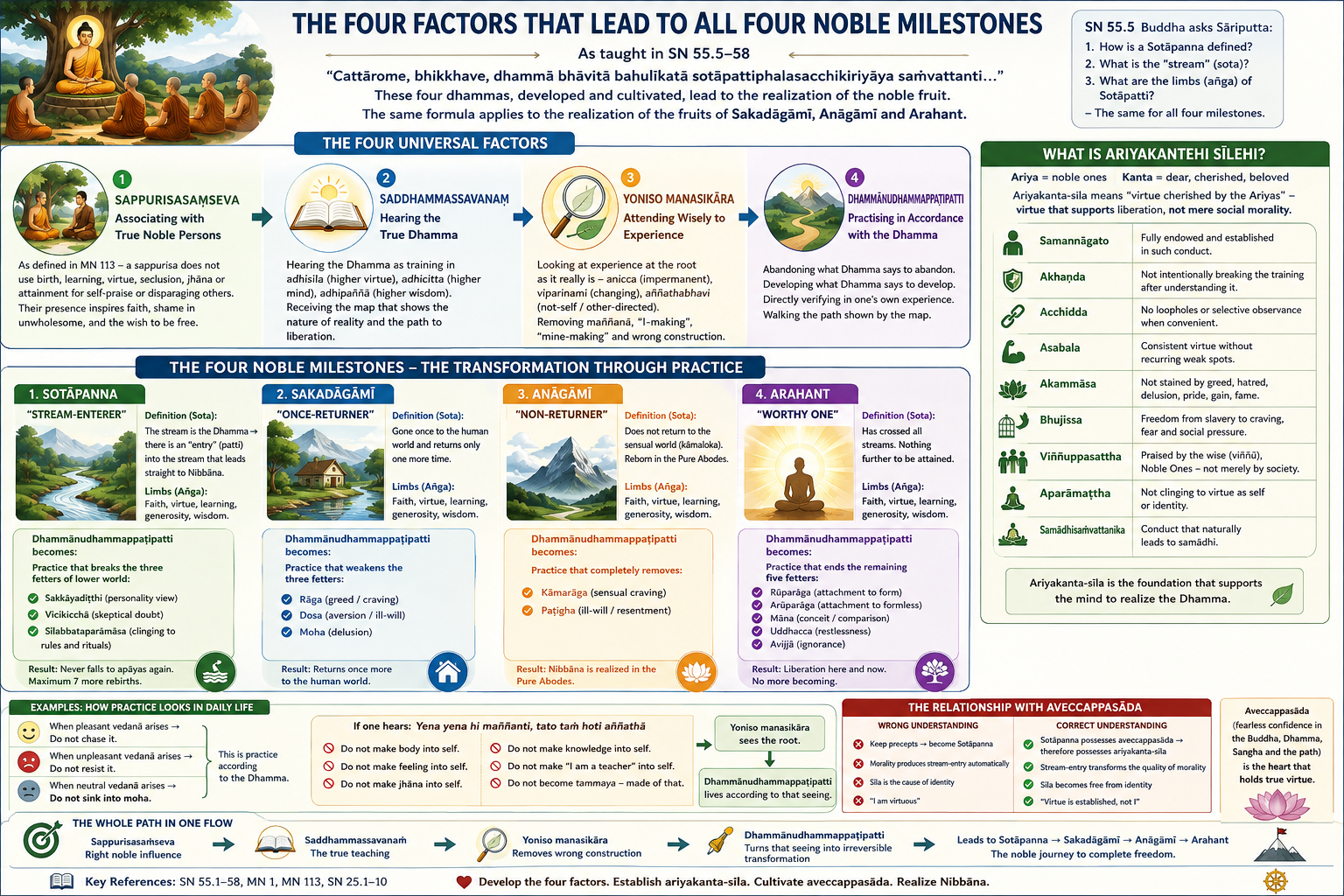 VISUAL SUMMARYSee this sutta in a pictureOpen the complete infographic for a visual overview before or after reading the full study.View infographic →
Four conditions that support the entire noble progression
Sappurisasaṁseva — Associate with true noble persons who do not build identity around birth, learning, virtue, seclusion, jhāna or attainment.
Saddhammassavanaṁ — Hear the true Dhamma as training in adhisīla, adhicitta and adhipaññā.
Yoniso manasikāra — Attend wisely to experience at its root so wrong construction and maññanā are exposed.
Dhammānudhammappaṭipatti — Live according to the Dhamma seen: abandon what is to be abandoned and develop what is to be developed.
The same practice deepens through four noble stages
Sotāpanna — Practice breaks sakkāyadiṭṭhi, vicikicchā and sīlabbataparāmāsa.
Sakadāgāmī — Practice further weakens rāga, dosa and moha.
Anāgāmī — Practice removes kāmarāga and paṭigha.
Arahant — Practice ends rūparāga, arūparāga, māna, uddhacca and avijjā.
Virtue cherished by the Noble Ones
Akhaṇḍa — Virtue is not intentionally broken after understanding the training.
Acchidda — No loopholes or selective observance when convenient.
Asabala — Consistency without recurring weak spots.
Akammāsa — Conduct is not stained by greed, hatred, delusion, pride, gain or fame.
Bhujissa — Freedom from slavery to craving, fear and social pressure.
Viññuppasattha — Praised by the wise rather than merely approved by society.
Aparāmaṭṭha — Virtue is not appropriated as self or identity.
Samādhisaṁvattanika — Conduct naturally supports samādhi and liberation.
Ten Dhamma topics worth hearing, discussing and practising
Appicchakathā — Fewness of wishes.
Santuṭṭhikathā — Contentment.
Pavivekakathā — Seclusion.
Asaṁsaggakathā — Non-entanglement.
Vīriyārambhakathā — Arousing energy.
Sīlakathā — Virtue — adhisīla.
Samādhikathā — Samādhi — adhicitta.
Paññākathā — Wisdom — adhipaññā.
Vimuttikathā — Liberation.
Vimuttiñāṇadassanakathā — Knowledge and vision of liberation.
Do not turn even Dhamma attainment into self-exaltation
MN 113 provides the ethical and psychological standard for sappurisa: birth, wealth, learning, discipline, seclusion, austerity, jhāna and refined attainment can all become bases for self-praise and disparagement if appropriated.
The key movement is atammayatā: even wholesome qualities and refined attainments are not made into “what I am.”
Two complementary views of the same six sense doors
Indriya — View the sense door as a faculty or power to be trained, guarded and governed.
Āyatana — View the same sense door as a base or field in which conditioned experience arises.
Indriyasaṁvara — Training asks whether wisdom governs the faculty or the object dominates the mind.
Saḷāyatana analysis — Insight asks how contact, feeling, craving and suffering arise dependently in the field.
All six original sections preserved
01The Four Factors Supporting the Noble Progression
In SN 55.5, the Buddha asks Venerable Sāriputta to explain three important aspects of stream-entry: who is called a Sotāpanna, what is meant by the “stream” (sota), and what are the factors or limbs of stream-entry (sotāpattiyaṅgāni). This framework is not limited to the first noble milestone. The same principle continues through the successive realizations of Sakadāgāmī, Anāgāmī, and Arahat.
Cattārome, bhikkhave, dhammā bhāvitā bahulīkatā sotāpattiphalasacchikiriyāya saṁvattanti.
“These four dhammas, developed and cultivated, lead to the realization of the fruit of stream-entry.” The same formula is applied to the realization of the fruits of once-returning, non-returning, and arahantship.
Sappurisasaṁseva — Associating with true noble persons.
Saddhammassavanaṁ — Hearing the true Dhamma.
Yoniso manasikāra — Attending wisely to experience at its root.
Dhammānudhammappaṭipatti — Practising precisely in accordance with the Dhamma heard and understood.
SN 55.55–58 shows that these four factors are not merely preliminary conditions for becoming a Sotāpanna. When repeatedly developed and cultivated, they support the entire noble progression up to arahattaphala. Liberation is therefore not achieved through belief, intellectual knowledge, or a single experience, but through continued association with the wise, correct hearing of the Dhamma, penetrative examination of experience, and a life transformed according to what has been directly understood.
Deep Meaning of the Four Factors
| Factor | Deep meaning |
|---|---|
| sappurisasaṁseva | Associating with the sappurisa as defined in MN 113 — one who does not use birth, learning, virtue, seclusion, jhāna, or attainment for self-praise and disparaging others. |
| saddhammassavanaṁ | Hearing the true Dhamma as training in adhisīla, adhicitta, and adhipaññā. |
| yoniso manasikāra | Attending to experience at the root — removing maññanā, “I-making,” “mine-making,” and wrong construction as indicated in MN 1. |
| dhammānudhammappaṭipatti | Practising exactly in accordance with that seen Dhamma — abandoning what Dhamma says to abandon, developing what Dhamma says to develop, and directly verifying it. MN 1 can again be taken for this purpose. |
02Dhammānudhammappaṭipatti: Living According to What Is Seen
Example: Sabbe saṅkhārā aniccā
Dhammānudhammappaṭipatti is not merely saying, “All conditioned things are impermanent.” It means:
- When pleasant vedanā arises, one does not chase it.
- When unpleasant vedanā arises, one does not resist it.
- When neutral vedanā arises, one does not sink into moha.
That is practice according to the Dhamma.
Example: Yena yena hi maññanti, tato taṁ hoti aññathā
Here, dhammānudhammappaṭipatti means:
- Do not make body into self.
- Do not make feeling into self.
- Do not make jhāna into self.
- Do not make knowledge into self.
- Do not make “I am a teacher” into self.
- Do not become tammaya — made of that.
Yoniso manasikāra sees the root.
Dhammānudhammappaṭipatti lives according to that seeing.
Receiving the map → Yoniso manasikāra
Understanding the map correctly → Dhammānudhammappaṭipatti
Walking the path shown by the map
How Practice Matures Through the Four Stages
| Stage | Dhammānudhammappaṭipatti becomes |
|---|---|
| Sotāpanna | Practice that breaks sakkāyadiṭṭhi, vicikicchā, and sīlabbataparāmāsa. |
| Sakadāgāmī | Practice that weakens rāga, dosa, and moha. |
| Anāgāmī | Practice that removes kāmarāga and paṭigha. |
| Arahant | Practice that ends rūparāga, arūparāga, māna, uddhacca, and avijjā. |
Sappurisasaṁseva gives right noble influence.
Saddhammassavanaṁ gives the true teaching.
Yoniso manasikāra removes wrong construction.
Dhammānudhammappaṭipatti turns that seeing into irreversible transformation.
03Ariyakantehi Sīlehi: Virtues Cherished by the Noble Ones
Starting from SN 55.1 onwards, the following quality is explained as a basis for examining whether one qualifies as a Sotāpanna:
Ariyakantehi sīlehi samannāgato hoti akhaṇḍehi acchiddehi asabalehi akammāsehi bhujissehi viññuppasatthehi aparāmaṭṭhehi samādhisaṁvattanikehi.
Ariya means Noble Ones, while kanta means dear, beloved, or cherished. Thus, ariyakanta sīla means “virtues cherished by the Ariyas” or “the kind of virtue approved and loved by noble disciples.” Many kinds of morality exist in the world. The Buddha does not merely say sīlavā; he points to virtue that supports liberation.
Common Misunderstanding and Noble Understanding
| Pāli term | Common misunderstanding | Noble understanding — SN 55.1 onwards |
|---|---|---|
| Ariyakantehi sīlehi | Any morality, ethics, or religious rules | Virtue cherished by Ariyas because it supports liberation |
| Samannāgato | Occasionally follows precepts | Fully endowed with and established in such conduct |
| Akhaṇḍa | Never made a mistake in life | Not intentionally breaking the training after understanding it |
| Acchidda | Perfectionism | No loopholes or selective observance when convenient |
| Asabala | External appearance of purity | Consistent virtue without recurring weak spots |
| Akammāsa | Ritual purity | Not stained by greed, hatred, delusion, pride, gain, or fame |
| Bhujissa | Freedom to do whatever one wants | Freedom from slavery to craving, fear, and social pressure |
| Viññuppasattha | Praised by society | Praised by the wise (viññū), the Noble Ones |
| Aparāmaṭṭha | Virtue as clinging to it | Not clinging to virtue as self or identity |
| Samādhisaṁvattanika | Moral goodness for its own sake | Conduct that naturally leads to samādhi |
The Relationship with Aveccappasāda
Many people reverse the order.
| Wrong understanding | Correct understanding |
|---|---|
| Keep precepts → become Sotāpanna | Sotāpanna possesses aveccappasāda → therefore possesses ariyakanta-sīla |
| Morality produces stream-entry automatically | Stream-entry transforms the quality of morality |
| Sīla is the cause of identity | Sīla becomes free from identity |
| “I am virtuous” | “Virtue is established; no self is built around it” |
The Sappurisa Pattern
| Stage | What happens |
|---|---|
| Sīla arises | Virtue is practised |
| Yoniso manasikāra | Sees virtue as a condition |
| Aparāmaṭṭha | Does not grasp it |
| Atammayatā | Does not become made of it |
| Samādhi grows | Mind becomes peaceful |
| Paññā grows | Sees things as they are |
| Liberation advances | Path develops |
Applying the Four Factors
| Factor | Practical meaning |
|---|---|
| Sappurisasaṁseva | Learn from the MN 113 sappurisa who does not build identity around attainments |
| Saddhammassavanaṁ | Hear the true Dhamma (SN 25.1–25.10), including the ten topics of AN 10.69 and the three trainings |
| Yoniso manasikāra | Detect and remove maññanā: “I am virtuous,” “my virtue,” “I am superior” |
| Dhammānudhammappaṭipatti | Actually live akhaṇḍa, acchidda, asabala, akammāsa, bhujissa, viññuppasattha, aparāmaṭṭha, and samādhisaṁvattanika |
The Deepest Meaning of Aparāmaṭṭha
This is perhaps the most misunderstood word in the entire passage.
| Wrong understanding | Correct understanding |
|---|---|
| Not caring about precepts | Not appropriating precepts |
| Relaxed morality | Non-clinging morality |
| Virtue does not matter | Virtue matters, but is not “I” |
| No standards | Standards without self-view |
The Sotāpanna does not think: “I am a moral person.”
Nor: “My virtue makes me noble.”
Nor: “Others are inferior.”
Instead: “These qualities are conducive to samādhi and liberation.”
That is why the passage ends with samādhisaṁvattanikehi. The Buddha’s interest is not moral status. The practical question is: Does this conduct lead to collectedness, wisdom, and the ending of suffering? That is why these are called ariyakantāni sīlāni — virtues cherished by the Noble Ones.
04How AN 10.69 Supports Saddhammassavanaṁ
Paṭhamakathāvatthusutta presents ten proper Dhamma topics to be heard, discussed, reflected upon, and practised: fewness of wishes, contentment, seclusion, non-entanglement, energy, virtue, samādhi, wisdom, liberation, and knowledge-and-vision of liberation.
| AN 10.69 Pāli | Meaning | Place in the four-factor model |
|---|---|---|
| appicchakathā | Talk on fewness of wishes | Supports sīla and renunciation |
| santuṭṭhikathā | Talk on contentment | Reduces craving and comparison |
| pavivekakathā | Talk on seclusion | Supports bodily and mental withdrawal |
| asaṁsaggakathā | Talk on non-entanglement | Prevents social and sensory scattering |
| vīriyārambhakathā | Talk on arousing energy | Supports continuous bhāvanā |
| sīlakathā | Talk on virtue | Adhisīla |
| samādhikathā | Talk on samādhi | Adhicitta |
| paññākathā | Talk on wisdom | Adhipaññā |
| vimuttikathā | Talk on liberation | Fruit of the path |
| vimuttiñāṇadassanakathā | Talk on knowledge and vision of liberation | Direct knowing of release |
05MN 113: Sappurisa and Asappurisa
MN 113 shows how birth, wealth, learning, discipline, seclusion, austerity, jhāna, and refined attainment can all become bases for self-exaltation and disparagement. The sappurisa does not build identity out of any of them.
| Basis | Asappurisa — not a true person | Sappurisa — true person |
|---|---|---|
| High birth | “I am high-born; others are not.” Praises self and disparages others. | Does not become proud due to birth. Sees that noble conduct, Dhamma, and liberation do not depend on birth. |
| Great clan | “I am from a great family; others are not.” | Does not measure self or others by family status. |
| Wealth | “I am wealthy; others are poor.” | Does not become intoxicated by wealth. |
| Fame | “I am famous; others are unknown.” | Does not use reputation for self-making. |
| Gains | “I receive robes, food, lodging, and medicines; others do not.” | Does not become conceited because of offerings. |
| Learning | “I am learned; others are not learned.” | Does not make learning into identity. Uses learning for practice. |
| Vinaya knowledge | “I know discipline; others do not.” | Does not become proud even because of discipline. |
| Dhamma speaker | “I am a speaker of Dhamma; others are not.” | Speaks Dhamma without self-exaltation. |
| Forest dwelling | “I live in the forest; others live near villages.” | Does not use seclusion as superiority. |
| Rag-robe wearing | “I wear rag-robes; others do not.” | Does not turn simplicity into conceit. |
| Alms-round practice | “I go for alms; others accept invitations.” | Does not compare practice forms. |
| Tree-root dwelling | “I dwell at the root of a tree; others do not.” | Does not identify with austerity. |
| Cemetery dwelling | “I live in cemeteries; others do not.” | Does not turn austere practice into self-view. |
| Open-air dwelling | “I live in the open air; others do not.” | Does not become proud of hardship. |
| Sitting practice | “I am a sitter; others lie down.” | Does not use posture for superiority. |
| First jhāna | “I have attained first jhāna; others have not.” | Reflects: even regarding first jhāna, the Buddha taught atammayatā — not being made of that. |
| Second jhāna | The same self-praise and disparagement. | Does not become “jhāna-made.” |
| Third jhāna | The same conceit. | Does not appropriate the attainment. |
| Fourth jhāna | The same conceit. | Does not construct identity from purity of equanimity. |
| Ākāsānañcāyatana | “I attained the base of infinite space.” | Does not become made of infinite space. |
| Viññāṇañcāyatana | “I attained the base of infinite consciousness.” | Does not become made of infinite consciousness. |
| Ākiñcaññāyatana | “I attained the base of nothingness.” | Does not become made of nothingness. |
| Nevasaññānāsaññāyatana | “I attained neither-perception-nor-non-perception.” | Does not become made of that refined state. |
| Saññāvedayitanirodha | The true person enters cessation and through wisdom the āsavas are destroyed. | This is the culmination: not merely not conceiving, but full liberation. |
06Indriya and Āyatana: Two Views of the Sense Doors
Indriya is the sense door viewed as a faculty to be trained and guarded. Āyatana is the sense door viewed as a base or field in the arising of contact and experience.
Indriya asks: Who is governing—wisdom or the faculty? — If the eye is unguarded, visible forms dominate the mind. If the eye is guarded, wisdom governs the faculty.
Āyatana asks: What is the field in which contact arises? — Eye-base + form-base + eye-consciousness = contact. Contact gives rise to feeling; feeling, if wrongly attended to, can condition craving.
Indriya shows the faculty as power.
Āyatana shows the same faculty as a conditioned field.
This is the etymological and practical difference.
Complete Comparative Table
| Aspect | Indriya — इन्द्रिय | Āyatana — आयतन |
|---|---|---|
| Pāli | indriya | āyatana |
| Basic meaning | Faculty | Base, sphere, domain |
| Etymology | From Inda — lord, ruler, chief, power | From āyata — extended, stretched out, spread out |
| Root idea | Governing power | Field or range where something operates |
| Emphasis | Function and control | Domain and conditionality |
| Perspective | Training | Analysis |
| Question asked | “How is this faculty functioning?” | “How does experience arise here?” |
| Associated with | Restraint, development, mastery | Contact, feeling, dependent arising |
| Main concern | Governance | Conditionality |
| Focus | Subject-side | Structural-side |
| Practical theme | Guarding faculties | Understanding arising |
| Leads to | indriyasaṁvara | saḷāyatana-vibhaṅga |
| Seen as | A power or faculty | A base or field |
| Training language | Yes | Less |
| Dependent Origination language | Rarely | Frequently |
Practical Example: Seeing a Beautiful Form
| Stage | Indriya perspective | Āyatana perspective |
|---|---|---|
| Form appears | Is the eye guarded? | Eye-base and form-base are present |
| Seeing occurs | Is craving entering? | Eye-consciousness arises |
| Contact | Guard against grasping signs | Contact occurs conditionally |
| Feeling | Maintain restraint | Feeling arises from contact |
| Craving | Prevent taṇhā | See taṇhā arising from conditions |
| Wisdom | Indriyasaṁvara | Saḷāyatana understanding |
Indriya in Training
| Pāli | Meaning |
|---|---|
| indriyasaṁvara | Restraint of faculties |
| indriyabhāvanā | Development of faculties |
| indriyaparopariyattañāṇa | Knowledge of maturity of faculties |
| guttadvāra | Guarded sense doors |
Āyatana in Dependent Arising
| Sequence | Pāli |
|---|---|
| Six sense bases | saḷāyatana |
| Contact | phassa |
| Feeling | vedanā |
| Craving | taṇhā |
| Clinging | upādāna |
| Becoming | bhava |
Connection with the Four Sotāpatti Factors
| Factor | Indriya aspect | Āyatana aspect |
|---|---|---|
| Sappurisasaṁseva | Learn restraint | Learn conditionality |
| Saddhammassavanaṁ | Hear indriyasaṁvara | Hear saḷāyatana |
| Yoniso manasikāra | Guard faculties wisely | Understand arising wisely |
| Dhammānudhammappaṭipatti | Practise restraint | Practise insight into conditions |
Final Contrast
| Indriya | Āyatana |
|---|---|
| How to guard the door | How the door functions |
| Training | Understanding |
| Restraint | Dependent arising |
| Preventing suffering | Explaining suffering |
| Govern the faculty | Understand the field |
Two Angles on the Same Six Doors
Indriyasaṁvara protects the mind. Saḷāyatana-vibhaṅga explains the arising of experience. The same eye, ear, nose, tongue, body, and mind are viewed from two complementary angles.
Indriya — The six faculties as powers to be trained and guarded.
Āyatana — The six bases as conditioned domains through which contact, feeling, craving, and liberation are understood.