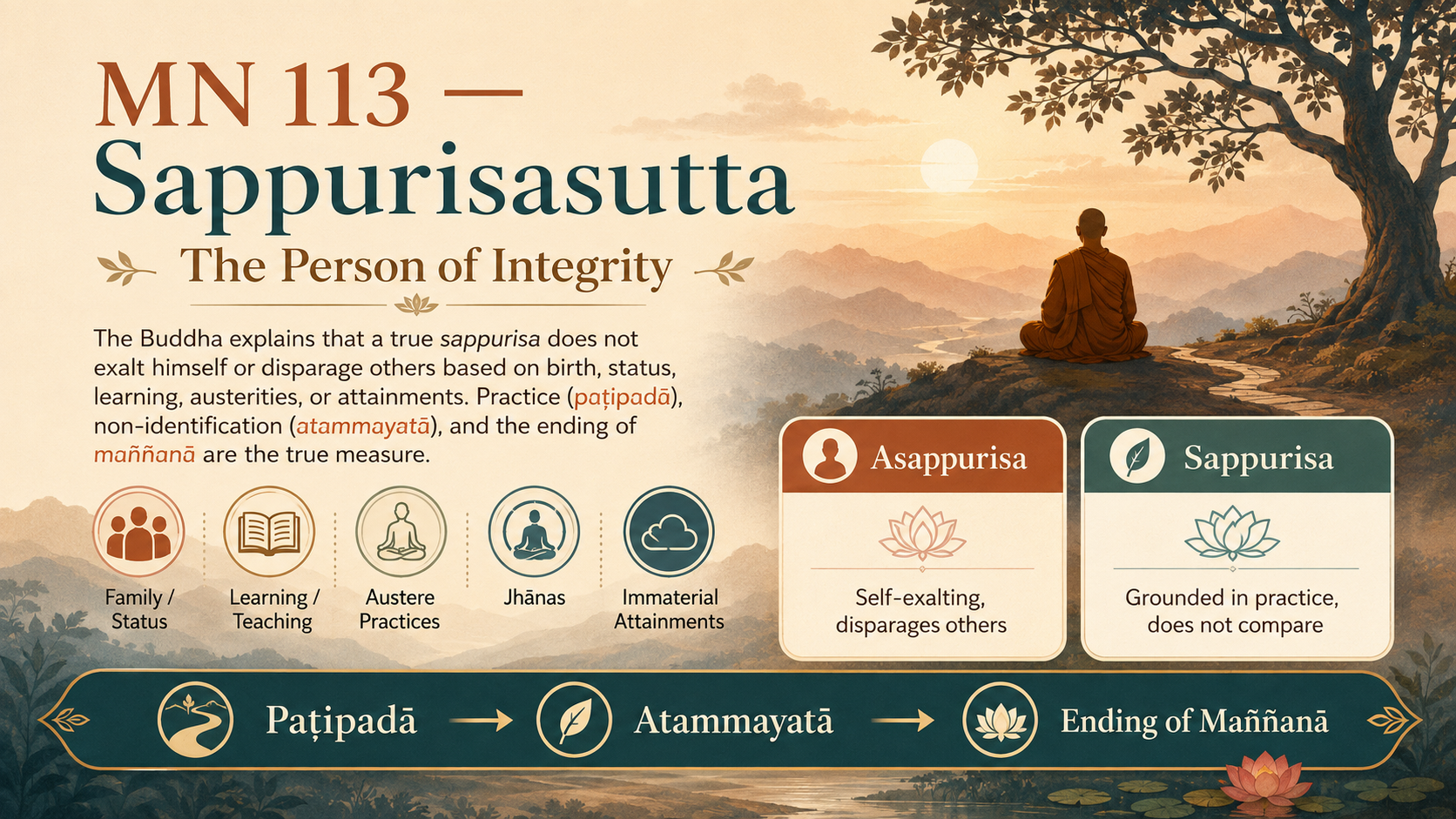
 VISUAL SUMMARYSee this sutta in a pictureOpen the complete infographic for a visual overview before or after reading the full study.View infographic →
Textual note: Every Pāli paragraph and variant reading supplied in the source is retained below. Where the source itself uses peyyāla contractions (…pe…), they remain preserved; the repeated meaning is explained in the English rendering and enumerated individually in the comparative table.
- External standing: family, wealth, reputation, and material support
- Learning and teaching status
- Austere practices and lifestyle
- The four jhānas
- The four immaterial attainments
- Cessation and the ending of maññanā
011. Setting
Evaṁ me sutaṁ— ekaṁ samayaṁ bhagavā sāvatthiyaṁ viharati jetavane anāthapiṇḍikassa ārāme. Tatra kho bhagavā bhikkhū āmantesi: “bhikkhavo”ti.
Thus have I heard. On one occasion the Blessed One was dwelling at Sāvatthī, in Jeta’s Grove, Anāthapiṇḍika’s monastery. There the Blessed One addressed the bhikkhus: ‘Bhikkhus!’
022. The bhikkhus respond
“Bhadante”ti te bhikkhū bhagavato paccassosuṁ. Bhagavā etadavoca:
‘Venerable Sir,’ those bhikkhus replied to the Blessed One. The Blessed One said this:
033. The teaching announced
“sappurisadhammañca vo, bhikkhave, desessāmi asappurisadhammañca. Taṁ suṇātha, sādhukaṁ manasi karotha, bhāsissāmī”ti.
‘Bhikkhus, I shall teach you the quality of a person of integrity and the quality of a person without integrity. Listen and attend carefully; I shall speak.’
044. The bhikkhus assent
“Evaṁ, bhante”ti kho te bhikkhū bhagavato paccassosuṁ. Bhagavā etadavoca:
‘Yes, Venerable Sir,’ those bhikkhus replied to the Blessed One. The Blessed One said this:
055. High family background
“Katamo ca, bhikkhave, asappurisadhammo? Idha, bhikkhave, asappuriso uccākulā pabbajito hoti. So iti paṭisañcikkhati: ‘ahaṁ khomhi uccākulā pabbajito, ime panaññe bhikkhū na uccākulā pabbajitā’ti. So tāya uccākulīnatāya attānukkaṁseti, paraṁ vambheti. Ayaṁ, bhikkhave, asappurisadhammo. Variant: Ayaṁ → ayampi (bj, pts1ed) Sappuriso ca kho, bhikkhave, iti paṭisañcikkhati: ‘na kho uccākulīnatāya lobhadhammā vā parikkhayaṁ gacchanti, dosadhammā vā parikkhayaṁ gacchanti, mohadhammā vā parikkhayaṁ gacchanti. No cepi uccākulā pabbajito hoti; so ca hoti dhammānudhammappaṭipanno sāmīcippaṭipanno anudhammacārī, so tattha pujjo, so tattha pāsaṁso’ti. So paṭipadaṁyeva antaraṁ karitvā tāya uccākulīnatāya nevattānukkaṁseti na paraṁ vambheti. Ayaṁ, bhikkhave, sappurisadhammo.
‘And what, bhikkhus, is the quality of a person without integrity? Here a person without integrity has gone forth from a high-ranking family. He reflects: “I have gone forth from a high-ranking family, whereas these other bhikkhus have not.” Because of that high family background, he praises himself and disparages others. This is the quality of a person without integrity.
But a person of integrity reflects: “It is not because of high family background that states of greed, aversion, or delusion come to exhaustion. Even if someone has not gone forth from a high-ranking family, when he practises the Dhamma in accordance with the Dhamma, practises properly, and lives in accordance with the Dhamma, he is worthy of honour and praise.” Making the practice itself the decisive distinction, he neither praises himself nor disparages others because of his family background. This is the quality of a person of integrity.’
066. Great and wealthy families
Puna caparaṁ, bhikkhave, asappuriso mahākulā pabbajito hoti …pe… mahābhogakulā pabbajito hoti …pe… uḷārabhogakulā pabbajito hoti. So iti paṭisañcikkhati: ‘ahaṁ khomhi uḷārabhogakulā pabbajito, ime panaññe bhikkhū na uḷārabhogakulā pabbajitā’ti. So tāya uḷārabhogatāya attānukkaṁseti, paraṁ vambheti. Ayampi, bhikkhave, asappurisadhammo. Sappuriso ca kho, bhikkhave, iti paṭisañcikkhati: ‘na kho uḷārabhogatāya lobhadhammā vā parikkhayaṁ gacchanti, dosadhammā vā parikkhayaṁ gacchanti, mohadhammā vā parikkhayaṁ gacchanti. No cepi uḷārabhogakulā pabbajito hoti; so ca hoti dhammānudhammappaṭipanno sāmīcippaṭipanno anudhammacārī, so tattha pujjo, so tattha pāsaṁso’ti. So paṭipadaṁyeva antaraṁ karitvā tāya uḷārabhogatāya nevattānukkaṁseti, na paraṁ vambheti. Ayampi, bhikkhave, sappurisadhammo.
‘Furthermore, a person without integrity has gone forth from a great family, from a wealthy family, or from an exceptionally prosperous family. He reflects: “I have gone forth from an exceptionally prosperous family, whereas these other bhikkhus have not.” Because of that prosperity, he praises himself and disparages others. This too is the quality of a person without integrity.
But a person of integrity reflects: “It is not because of prosperity that states of greed, aversion, or delusion come to exhaustion. Even if someone has not gone forth from an exceptionally prosperous family, when he practises the Dhamma in accordance with the Dhamma, practises properly, and lives in accordance with the Dhamma, he is worthy of honour and praise.” Making the practice itself the decisive distinction, he neither praises himself nor disparages others because of prosperity. This too is the quality of a person of integrity.’
077. Fame and influence
Puna caparaṁ, bhikkhave, asappuriso ñāto hoti yasassī. So iti paṭisañcikkhati: ‘ahaṁ khomhi ñāto yasassī, ime panaññe bhikkhū appaññātā appesakkhā’ti. So tena ñattena attānukkaṁseti, paraṁ vambheti. Variant: ñattena → ñātattena (bj, sya-all, km, pts1ed); ñātena (si, mr) Ayampi, bhikkhave, asappurisadhammo. Sappuriso ca kho, bhikkhave, iti paṭisañcikkhati: ‘na kho ñattena lobhadhammā vā parikkhayaṁ gacchanti, dosadhammā vā parikkhayaṁ gacchanti, mohadhammā vā parikkhayaṁ gacchanti. No cepi ñāto hoti yasassī; so ca hoti dhammānudhammappaṭipanno sāmīcippaṭipanno anudhammacārī, so tattha pujjo, so tattha pāsaṁso’ti. So paṭipadaṁyeva antaraṁ karitvā tena ñattena nevattānukkaṁseti, na paraṁ vambheti. Ayampi, bhikkhave, sappurisadhammo.
‘Furthermore, a person without integrity is well known and renowned. He reflects: “I am well known and renowned, whereas these other bhikkhus are little known and have little influence.” Because of his recognition, he praises himself and disparages others. This too is the quality of a person without integrity.
But a person of integrity reflects: “It is not through being well known that states of greed, aversion, or delusion come to exhaustion. Even if someone is not well known or renowned, when he practises the Dhamma in accordance with the Dhamma, practises properly, and lives in accordance with the Dhamma, he is worthy of honour and praise.” Making the practice itself the decisive distinction, he neither praises himself nor disparages others because of his reputation. This too is the quality of a person of integrity.’
088. Abundant requisites
Puna caparaṁ, bhikkhave, asappuriso lābhī hoti cīvarapiṇḍapātasenāsanagilānappaccayabhesajjaparikkhārānaṁ. So iti paṭisañcikkhati: ‘ahaṁ khomhi lābhī cīvarapiṇḍapātasenāsanagilānappaccayabhesajjaparikkhārānaṁ, ime panaññe bhikkhū na lābhino cīvarapiṇḍapātasenāsanagilānappaccayabhesajjaparikkhārānan’ti. So tena lābhena attānukkaṁseti, paraṁ vambheti. Ayampi, bhikkhave, asappurisadhammo. Sappuriso ca kho, bhikkhave, iti paṭisañcikkhati: ‘na kho lābhena lobhadhammā vā parikkhayaṁ gacchanti, dosadhammā vā parikkhayaṁ gacchanti, mohadhammā vā parikkhayaṁ gacchanti. No cepi lābhī hoti cīvarapiṇḍapātasenāsanagilānappaccayabhesajjaparikkhārānaṁ; so ca hoti dhammānudhammappaṭipanno sāmīcippaṭipanno anudhammacārī, so tattha pujjo, so tattha pāsaṁso’ti. So paṭipadaṁyeva antaraṁ karitvā tena lābhena nevattānukkaṁseti, na paraṁ vambheti. Ayampi, bhikkhave, sappurisadhammo.
‘Furthermore, a person without integrity receives abundant robes, alms-food, lodging, and medicinal requisites for illness. He reflects: “I receive these requisites abundantly, whereas these other bhikkhus do not.” Because of his gains, he praises himself and disparages others. This too is the quality of a person without integrity.
But a person of integrity reflects: “It is not through gain that states of greed, aversion, or delusion come to exhaustion. Even if someone does not receive abundant robes, alms-food, lodging, and medicines, when he practises the Dhamma in accordance with the Dhamma, practises properly, and lives in accordance with the Dhamma, he is worthy of honour and praise.” Making the practice itself the decisive distinction, he neither praises himself nor disparages others because of his gains. This too is the quality of a person of integrity.’
099. Learning, teaching, and austere practices
Puna caparaṁ, bhikkhave, asappuriso bahussuto hoti. So iti paṭisañcikkhati: ‘ahaṁ khomhi bahussuto, ime panaññe bhikkhū na bahussutā’ti. So tena bāhusaccena attānukkaṁseti, paraṁ vambheti. Ayampi, bhikkhave, asappurisadhammo. Sappuriso ca kho, bhikkhave, iti paṭisañcikkhati: ‘na kho bāhusaccena lobhadhammā vā parikkhayaṁ gacchanti, dosadhammā vā parikkhayaṁ gacchanti, mohadhammā vā parikkhayaṁ gacchanti. No cepi bahussuto hoti; so ca hoti dhammānudhammappaṭipanno sāmīcippaṭipanno anudhammacārī, so tattha pujjo, so tattha pāsaṁso’ti. So paṭipadaṁyeva antaraṁ karitvā tena bāhusaccena nevattānukkaṁseti, na paraṁ vambheti. Ayampi, bhikkhave, sappurisadhammo. Puna caparaṁ, bhikkhave, asappuriso vinayadharo hoti. So iti paṭisañcikkhati: ‘ahaṁ khomhi vinayadharo, ime panaññe bhikkhū na vinayadharā’ti. So tena vinayadharattena attānukkaṁseti, paraṁ vambheti. Ayampi, bhikkhave, asappurisadhammo. Sappuriso ca kho, bhikkhave, iti paṭisañcikkhati: ‘na kho vinayadharattena lobhadhammā vā parikkhayaṁ gacchanti, dosadhammā vā parikkhayaṁ gacchanti, mohadhammā vā parikkhayaṁ gacchanti. No cepi vinayadharo hoti; so ca hoti dhammānudhammappaṭipanno sāmīcippaṭipanno anudhammacārī, so tattha pujjo, so tattha pāsaṁso’ti. So paṭipadaṁyeva antaraṁ karitvā tena vinayadharattena nevattānukkaṁseti, na paraṁ vambheti. Ayampi, bhikkhave, sappurisadhammo. Puna caparaṁ, bhikkhave, asappuriso dhammakathiko hoti. So iti paṭisañcikkhati: ‘ahaṁ khomhi dhammakathiko, ime panaññe bhikkhū na dhammakathikā’ti. So tena dhammakathikattena attānukkaṁseti, paraṁ vambheti. Ayampi, bhikkhave, asappurisadhammo. Sappuriso ca kho, bhikkhave, iti paṭisañcikkhati: ‘na kho dhammakathikattena lobhadhammā vā parikkhayaṁ gacchanti, dosadhammā vā parikkhayaṁ gacchanti, mohadhammā vā parikkhayaṁ gacchanti. No cepi dhammakathiko hoti; so ca hoti dhammānudhammappaṭipanno sāmīcippaṭipanno anudhammacārī, so tattha pujjo, so tattha pāsaṁso’ti. So paṭipadaṁyeva antaraṁ karitvā tena dhammakathikattena nevattānukkaṁseti, na paraṁ vambheti. Ayampi, bhikkhave, sappurisadhammo. Puna caparaṁ, bhikkhave, asappuriso āraññiko hoti. So iti paṭisañcikkhati: ‘ahaṁ khomhi āraññiko ime panaññe bhikkhū na āraññikā’ti. So tena āraññikattena attānukkaṁseti, paraṁ vambheti. Ayampi, bhikkhave, asappurisadhammo. Sappuriso ca kho, bhikkhave, iti paṭisañcikkhati: ‘na kho āraññikattena lobhadhammā vā parikkhayaṁ gacchanti, dosadhammā vā parikkhayaṁ gacchanti, mohadhammā vā parikkhayaṁ gacchanti. No cepi āraññiko hoti; so ca hoti dhammānudhammappaṭipanno sāmīcippaṭipanno anudhammacārī, so tattha pujjo, so tattha pāsaṁso’ti. So paṭipadaṁyeva antaraṁ karitvā tena āraññikattena nevattānukkaṁseti, na paraṁ vambheti. Ayampi, bhikkhave, sappurisadhammo. Puna caparaṁ, bhikkhave, asappuriso paṁsukūliko hoti. So iti paṭisañcikkhati: ‘ahaṁ khomhi paṁsukūliko, ime panaññe bhikkhū na paṁsukūlikā’ti. So tena paṁsukūlikattena attānukkaṁseti, paraṁ vambheti. Ayampi, bhikkhave, asappurisadhammo. Sappuriso ca kho, bhikkhave, iti paṭisañcikkhati: ‘na kho paṁsukūlikattena lobhadhammā vā parikkhayaṁ gacchanti, dosadhammā vā parikkhayaṁ gacchanti, mohadhammā vā parikkhayaṁ gacchanti. No cepi paṁsukūliko hoti; so ca hoti dhammānudhammappaṭipanno sāmīcippaṭipanno anudhammacārī, so tattha pujjo, so tattha pāsaṁso’ti. So paṭipadaṁyeva antaraṁ karitvā tena paṁsukūlikattena nevattānukkaṁseti, na paraṁ vambheti. Ayampi, bhikkhave, sappurisadhammo. Puna caparaṁ, bhikkhave, asappuriso piṇḍapātiko hoti. So iti paṭisañcikkhati: ‘ahaṁ khomhi piṇḍapātiko, ime panaññe bhikkhū na piṇḍapātikā’ti. So tena piṇḍapātikattena attānukkaṁseti, paraṁ vambheti. Ayampi, bhikkhave, asappurisadhammo. Sappuriso ca kho, bhikkhave, iti paṭisañcikkhati: ‘na kho piṇḍapātikattena lobhadhammā vā parikkhayaṁ gacchanti, dosadhammā vā parikkhayaṁ gacchanti, mohadhammā vā parikkhayaṁ gacchanti. No cepi piṇḍapātiko hoti; so ca hoti dhammānudhammappaṭipanno sāmīcippaṭipanno anudhammacārī, so tattha pujjo, so tattha pāsaṁso’ti. So paṭipadaṁyeva antaraṁ karitvā tena piṇḍapātikattena nevattānukkaṁseti, na paraṁ vambheti. Ayampi, bhikkhave, sappurisadhammo. Puna caparaṁ, bhikkhave, asappuriso rukkhamūliko hoti. So iti paṭisañcikkhati: ‘ahaṁ khomhi rukkhamūliko, ime panaññe bhikkhū na rukkhamūlikā’ti. So tena rukkhamūlikattena attānukkaṁseti, paraṁ vambheti. Ayampi, bhikkhave, asappurisadhammo. Sappuriso ca kho, bhikkhave, iti paṭisañcikkhati: ‘na kho rukkhamūlikattena lobhadhammā vā parikkhayaṁ gacchanti, dosadhammā vā parikkhayaṁ gacchanti, mohadhammā vā parikkhayaṁ gacchanti. No cepi rukkhamūliko hoti; so ca hoti dhammānudhammappaṭipanno sāmīcippaṭipanno anudhammacārī, so tattha pujjo, so tattha pāsaṁso’ti. So paṭipadaṁyeva antaraṁ karitvā tena rukkhamūlikattena nevattānukkaṁseti, na paraṁ vambheti. Ayampi, bhikkhave, sappurisadhammo. Puna caparaṁ, bhikkhave, asappuriso sosāniko hoti …pe… abbhokāsiko hoti … nesajjiko hoti …pe… yathāsanthatiko hoti …pe… ekāsaniko hoti. So iti paṭisañcikkhati: ‘ahaṁ khomhi ekāsaniko, ime panaññe bhikkhū na ekāsanikā’ti. So tena ekāsanikattena attānukkaṁseti, paraṁ vambheti. Ayampi, bhikkhave, asappurisadhammo. Sappuriso ca kho, bhikkhave, iti paṭisañcikkhati: ‘na kho ekāsanikattena lobhadhammā vā parikkhayaṁ gacchanti, dosadhammā vā parikkhayaṁ gacchanti, mohadhammā vā parikkhayaṁ gacchanti. No cepi ekāsaniko hoti; so ca hoti dhammānudhammappaṭipanno sāmīcippaṭipanno anudhammacārī, so tattha pujjo, so tattha pāsaṁso’ti. So paṭipadaṁyeva antaraṁ karitvā tena ekāsanikattena nevattānukkaṁseti, na paraṁ vambheti. Ayampi, bhikkhave, sappurisadhammo.
‘Furthermore, the same distinction applies to all of the following:
- being greatly learned (bahussuta);
- being a bearer and expert of the Vinaya (vinayadhara);
- being a Dhamma speaker (dhammakathika);
- being a forest dweller (āraññika);
- wearing robes made from discarded cloth (paṁsukūlika);
- living on food collected on the alms-round (piṇḍapātika);
- dwelling at the foot of a tree (rukkhamūlika);
- dwelling in a charnel ground (sosānika);
- dwelling in the open air (abbhokāsika);
- maintaining the sitting practice without lying down (nesajjika);
- accepting whatever resting place has been assigned (yathāsanthatika); and
- eating only in one sitting (ekāsanika).
In each case, the person without integrity thinks: “I possess or practise this; these other bhikkhus do not.” On that basis he praises himself and disparages others.
In each case, the person of integrity reflects that the possession or austerity itself does not bring states of greed, aversion, and delusion to exhaustion. A person who does not possess that distinction, but who is dhammānudhammappaṭipanna, sāmīcippaṭipanna, and anudhammacārī—practising the Dhamma in accordance with the Dhamma, practising properly, and living in accordance with the Dhamma—is worthy of honour and praise. Therefore, he makes paṭipadā, the actual course of practice, the decisive distinction and neither praises himself nor disparages others.
1010. First jhāna
Puna caparaṁ, bhikkhave, asappuriso vivicceva kāmehi vivicca akusalehi dhammehi savitakkaṁ savicāraṁ vivekajaṁ pītisukhaṁ paṭhamaṁ jhānaṁ upasampajja viharati. So iti paṭisañcikkhati: ‘ahaṁ khomhi paṭhamajjhānasamāpattiyā lābhī, ime panaññe bhikkhū paṭhamajjhānasamāpattiyā na lābhino’ti. So tāya paṭhamajjhānasamāpattiyā attānukkaṁseti, paraṁ vambheti. Ayampi, bhikkhave, asappurisadhammo. Sappuriso ca kho, bhikkhave, iti paṭisañcikkhati: ‘paṭhamajjhānasamāpattiyāpi kho atammayatā vuttā bhagavatā. Yena yena hi maññanti tato taṁ hoti aññathā’ti. So atammayataññeva antaraṁ karitvā tāya paṭhamajjhānasamāpattiyā nevattānukkaṁseti, na paraṁ vambheti. Ayampi, bhikkhave, sappurisadhammo.
‘Furthermore, secluded from sensual pleasures and secluded from unwholesome dhammas, a person without integrity enters and dwells in the first jhāna, accompanied by vitakka and vicāra, with pīti and sukha born of seclusion. He reflects: “I attain the first jhāna, whereas these other bhikkhus do not.” Because of that attainment he praises himself and disparages others. This too is the quality of a person without integrity.
But a person of integrity reflects: “Even regarding the attainment of the first jhāna, the Blessed One has taught atammayatā—not being made of that, not identifying with it. For in whatever way one conceives it, it is otherwise than that conception.” Making atammayatā itself the decisive distinction, he neither praises himself nor disparages others because of the first-jhāna attainment. This too is the quality of a person of integrity.’
1111. Second to fourth jhānas
Puna caparaṁ, bhikkhave, asappuriso vitakkavicārānaṁ vūpasamā ajjhattaṁ sampasādanaṁ cetaso ekodibhāvaṁ avitakkaṁ avicāraṁ samādhijaṁ pītisukhaṁ dutiyaṁ jhānaṁ …pe… tatiyaṁ jhānaṁ … catutthaṁ jhānaṁ upasampajja viharati. So iti paṭisañcikkhati: ‘ahaṁ khomhi catutthajjhānasamāpattiyā lābhī, ime panaññe bhikkhū catutthajjhānasamāpattiyā na lābhino’ti. So tāya catutthajjhānasamāpattiyā attānukkaṁseti, paraṁ vambheti. Ayampi, bhikkhave, asappurisadhammo. Sappuriso ca kho, bhikkhave, iti paṭisañcikkhati: ‘catutthajjhānasamāpattiyāpi kho atammayatā vuttā bhagavatā. Yena yena hi maññanti tato taṁ hoti aññathā’ti. So atammayataññeva antaraṁ karitvā tāya catutthajjhānasamāpattiyā nevattānukkaṁseti, na paraṁ vambheti. Ayampi, bhikkhave, sappurisadhammo.
‘Furthermore, with the settling of vitakka and vicāra, having inner clarity and unification of citta, without vitakka and vicāra, with pīti and sukha born of samādhi, a person without integrity enters and dwells in the second jhāna; he similarly enters the third jhāna and the fourth jhāna. Regarding the fourth jhāna he reflects: “I attain the fourth jhāna, whereas these other bhikkhus do not.” Because of that attainment he praises himself and disparages others. This too is the quality of a person without integrity.
But a person of integrity reflects: “Even regarding the attainment of the fourth jhāna, the Blessed One has taught atammayatā. For in whatever way one conceives it, it is otherwise than that conception.” Making atammayatā itself the decisive distinction, he neither praises himself nor disparages others because of the fourth-jhāna attainment. This too is the quality of a person of integrity.
1212. Four immaterial attainments
Puna caparaṁ, bhikkhave, asappuriso sabbaso rūpasaññānaṁ samatikkamā paṭighasaññānaṁ atthaṅgamā nānattasaññānaṁ amanasikārā ‘ananto ākāso’ti ākāsānañcāyatanaṁ upasampajja viharati. So iti paṭisañcikkhati: ‘ahaṁ khomhi ākāsānañcāyatanasamāpattiyā lābhī, ime panaññe bhikkhū ākāsānañcāyatanasamāpattiyā na lābhino’ti. So tāya ākāsānañcāyatanasamāpattiyā attānukkaṁseti, paraṁ vambheti. Ayampi, bhikkhave, asappurisadhammo. Sappuriso ca kho, bhikkhave, iti paṭisañcikkhati: ‘ākāsānañcāyatanasamāpattiyāpi kho atammayatā vuttā bhagavatā. Yena yena hi maññanti tato taṁ hoti aññathā’ti. So atammayataññeva antaraṁ karitvā tāya ākāsānañcāyatanasamāpattiyā nevattānukkaṁseti, na paraṁ vambheti. Ayampi, bhikkhave, sappurisadhammo. Puna caparaṁ, bhikkhave, asappuriso sabbaso ākāsānañcāyatanaṁ samatikkamma ‘anantaṁ viññāṇan’ti viññāṇañcāyatanaṁ upasampajja viharati. So iti paṭisañcikkhati: ‘ahaṁ khomhi viññāṇañcāyatanasamāpattiyā lābhī, ime panaññe bhikkhū viññāṇañcāyatanasamāpattiyā na lābhino’ti. So tāya viññāṇañcāyatanasamāpattiyā attānukkaṁseti, paraṁ vambheti. Ayampi, bhikkhave, asappurisadhammo. Sappuriso ca kho, bhikkhave, iti paṭisañcikkhati: ‘viññāṇañcāyatanasamāpattiyāpi kho atammayatā vuttā bhagavatā. Yena yena hi maññanti tato taṁ hoti aññathā’ti. So atammayataññeva antaraṁ karitvā tāya viññāṇañcāyatanasamāpattiyā nevattānukkaṁseti, na paraṁ vambheti. Ayampi, bhikkhave, sappurisadhammo. Puna caparaṁ, bhikkhave, asappuriso sabbaso viññāṇañcāyatanaṁ samatikkamma ‘natthi kiñcī’ti ākiñcaññāyatanaṁ upasampajja viharati. So iti paṭisañcikkhati: ‘ahaṁ khomhi ākiñcaññāyatanasamāpattiyā lābhī, ime panaññe bhikkhū ākiñcaññāyatanasamāpattiyā na lābhino’ti. So tāya ākiñcaññāyatanasamāpattiyā attānukkaṁseti, paraṁ vambheti. Ayampi, bhikkhave, asappurisadhammo. Sappuriso ca kho, bhikkhave, iti paṭisañcikkhati: ‘ākiñcaññāyatanasamāpattiyāpi kho atammayatā vuttā bhagavatā. Yena yena hi maññanti tato taṁ hoti aññathā’ti. So atammayataññeva antaraṁ karitvā tāya ākiñcaññāyatanasamāpattiyā nevattānukkaṁseti, na paraṁ vambheti. Ayampi, bhikkhave, sappurisadhammo. Puna caparaṁ, bhikkhave, asappuriso sabbaso ākiñcaññāyatanaṁ samatikkamma nevasaññānāsaññāyatanaṁ upasampajja viharati. So iti paṭisañcikkhati: ‘ahaṁ khomhi nevasaññānāsaññāyatanasamāpattiyā lābhī, ime panaññe bhikkhū nevasaññānāsaññāyatanasamāpattiyā na lābhino’ti. So tāya nevasaññānāsaññāyatanasamāpattiyā attānukkaṁseti, paraṁ vambheti. Ayampi, bhikkhave, asappurisadhammo. Sappuriso ca kho, bhikkhave, iti paṭisañcikkhati: ‘nevasaññānāsaññāyatanasamāpattiyāpi kho atammayatā vuttā bhagavatā. Yena yena hi maññanti tato taṁ hoti aññathā’ti. So atammayataññeva antaraṁ karitvā tāya nevasaññānāsaññāyatanasamāpattiyā nevattānukkaṁseti, na paraṁ vambheti. Ayampi, bhikkhave, sappurisadhammo.
‘Furthermore, by completely transcending perceptions of form, with the disappearance of perceptions of sensory impact, and by not attending to perceptions of diversity, a person without integrity enters and dwells in the dimension of infinite space, aware that “space is infinite.” He regards himself as an attainer and others as non-attainers, and on that basis praises himself and disparages others. A person of integrity remembers that atammayatā has been taught even regarding this attainment: whatever one conceives it to be, it is otherwise. Therefore, he neither praises himself nor disparages others.
The same analysis applies as one completely transcends the dimension of infinite space and enters the dimension of infinite viññāṇa, aware that “viññāṇa is infinite”; transcends that and enters the dimension of nothingness, aware that “there is nothing”; and transcends that and enters the dimension of neither-perception-nor-non-perception.
At each level, the person without integrity creates identity and comparison from the attainment. At each level, the person of integrity makes atammayatā the decisive distinction and does not elevate himself or lower others.’
1313. Cessation of perception and what is felt
Puna caparaṁ, bhikkhave, sappuriso sabbaso nevasaññānāsaññāyatanaṁ samatikkamma saññāvedayitanirodhaṁ upasampajja viharati. Paññāya cassa disvā āsavā parikkhīṇā honti. Variant: cassa disvā āsavā → ekacce āsavā (mr) Ayaṁ, bhikkhave, bhikkhu na kiñci maññati, na kuhiñci maññati, na kenaci maññatī”ti. Variant: Ayaṁ → ayaṁ kho (bj, sya-all, km); ayampi (si); ayaṁ pi (pts1ed)
‘Furthermore, by completely transcending the dimension of neither-perception-nor-non-perception, a person of integrity enters and dwells in the cessation of perception and what is felt—saññāvedayitanirodha. Having seen with paññā, his āsavas are exhausted. This bhikkhu does not conceive anything, does not conceive anywhere, and does not conceive by means of anything.’
1414. Conclusion
Idamavoca bhagavā. Attamanā te bhikkhū bhagavato bhāsitaṁ abhinandunti.
This is what the Blessed One said. Satisfied, those bhikkhus delighted in the Blessed One’s words.
01Paṭipadā — Make the actual practice decisive
For family background, reputation, requisites, learning, teaching status, and austerities, the decisive distinction is the actual course of practice—not the possession of an advantage or special lifestyle.
Measure: Is lobha, dosa and moha actually moving toward exhaustion?
02Atammayatā — Do not become identified with attainment
For jhāna and the immaterial attainments, the practitioner does not become identified with the attainment, construct “I am this” from it, or use it to compare himself with others.
Key formula: Yena yena hi maññanti tato taṁ hoti aññathā — whatever one conceives it to be, it is otherwise than that conception.
03Ending of maññanā — The machinery of self-making ends
With the exhaustion of the āsavas, the bhikkhu does not conceive anything, anywhere, or through any basis. Comparison and identification no longer find a footing.
Final formula: Na kiñci maññati, na kuhiñci maññati, na kenaci maññati.
| No. | Pāli ground | Meaning | Asappurisa response | Sappurisa response | Decisive criterion |
|---|---|---|---|---|---|
| 1 | Uccākulā pabbajito | Gone forth from a high-ranking family | “I possess or practise this; the others do not.” He praises himself and disparages others. | This distinction does not itself exhaust greed, aversion, or delusion. A person practising Dhamma in accordance with Dhamma is worthy of honour, even without it. | Paṭipadaṁyeva antaraṁ karitvā — make the actual practice the decisive distinction. |
| 2 | Mahākulā pabbajito | Gone forth from a great or distinguished family | “I possess or practise this; the others do not.” He praises himself and disparages others. | This distinction does not itself exhaust greed, aversion, or delusion. A person practising Dhamma in accordance with Dhamma is worthy of honour, even without it. | Paṭipadaṁyeva antaraṁ karitvā — make the actual practice the decisive distinction. |
| 3 | Mahābhogakulā pabbajito | Gone forth from a wealthy family | “I possess or practise this; the others do not.” He praises himself and disparages others. | This distinction does not itself exhaust greed, aversion, or delusion. A person practising Dhamma in accordance with Dhamma is worthy of honour, even without it. | Paṭipadaṁyeva antaraṁ karitvā — make the actual practice the decisive distinction. |
| 4 | Uḷārabhogakulā pabbajito | Gone forth from an exceptionally prosperous family | “I possess or practise this; the others do not.” He praises himself and disparages others. | This distinction does not itself exhaust greed, aversion, or delusion. A person practising Dhamma in accordance with Dhamma is worthy of honour, even without it. | Paṭipadaṁyeva antaraṁ karitvā — make the actual practice the decisive distinction. |
| 5 | Ñāto yasassī | Well known and renowned | “I possess or practise this; the others do not.” He praises himself and disparages others. | This distinction does not itself exhaust greed, aversion, or delusion. A person practising Dhamma in accordance with Dhamma is worthy of honour, even without it. | Paṭipadaṁyeva antaraṁ karitvā — make the actual practice the decisive distinction. |
| 6 | Lābhī…parikkhārānaṁ | Receives abundant robes, food, lodging, and medicines | “I possess or practise this; the others do not.” He praises himself and disparages others. | This distinction does not itself exhaust greed, aversion, or delusion. A person practising Dhamma in accordance with Dhamma is worthy of honour, even without it. | Paṭipadaṁyeva antaraṁ karitvā — make the actual practice the decisive distinction. |
| 7 | Bahussuto | Greatly learned | “I possess or practise this; the others do not.” He praises himself and disparages others. | This distinction does not itself exhaust greed, aversion, or delusion. A person practising Dhamma in accordance with Dhamma is worthy of honour, even without it. | Paṭipadaṁyeva antaraṁ karitvā — make the actual practice the decisive distinction. |
| 8 | Vinayadharo | Expert and bearer of the Vinaya | “I possess or practise this; the others do not.” He praises himself and disparages others. | This distinction does not itself exhaust greed, aversion, or delusion. A person practising Dhamma in accordance with Dhamma is worthy of honour, even without it. | Paṭipadaṁyeva antaraṁ karitvā — make the actual practice the decisive distinction. |
| 9 | Dhammakathiko | Dhamma speaker or teacher | “I possess or practise this; the others do not.” He praises himself and disparages others. | This distinction does not itself exhaust greed, aversion, or delusion. A person practising Dhamma in accordance with Dhamma is worthy of honour, even without it. | Paṭipadaṁyeva antaraṁ karitvā — make the actual practice the decisive distinction. |
| 10 | Āraññiko | Forest dweller | “I possess or practise this; the others do not.” He praises himself and disparages others. | This distinction does not itself exhaust greed, aversion, or delusion. A person practising Dhamma in accordance with Dhamma is worthy of honour, even without it. | Paṭipadaṁyeva antaraṁ karitvā — make the actual practice the decisive distinction. |
| 11 | Paṁsukūliko | Wears discarded-cloth robes | “I possess or practise this; the others do not.” He praises himself and disparages others. | This distinction does not itself exhaust greed, aversion, or delusion. A person practising Dhamma in accordance with Dhamma is worthy of honour, even without it. | Paṭipadaṁyeva antaraṁ karitvā — make the actual practice the decisive distinction. |
| 12 | Piṇḍapātiko | Lives on collected alms-food | “I possess or practise this; the others do not.” He praises himself and disparages others. | This distinction does not itself exhaust greed, aversion, or delusion. A person practising Dhamma in accordance with Dhamma is worthy of honour, even without it. | Paṭipadaṁyeva antaraṁ karitvā — make the actual practice the decisive distinction. |
| 13 | Rukkhamūliko | Dwells at the foot of a tree | “I possess or practise this; the others do not.” He praises himself and disparages others. | This distinction does not itself exhaust greed, aversion, or delusion. A person practising Dhamma in accordance with Dhamma is worthy of honour, even without it. | Paṭipadaṁyeva antaraṁ karitvā — make the actual practice the decisive distinction. |
| 14 | Sosāniko | Dwells in a charnel ground | “I possess or practise this; the others do not.” He praises himself and disparages others. | This distinction does not itself exhaust greed, aversion, or delusion. A person practising Dhamma in accordance with Dhamma is worthy of honour, even without it. | Paṭipadaṁyeva antaraṁ karitvā — make the actual practice the decisive distinction. |
| 15 | Abbhokāsiko | Dwells in the open air | “I possess or practise this; the others do not.” He praises himself and disparages others. | This distinction does not itself exhaust greed, aversion, or delusion. A person practising Dhamma in accordance with Dhamma is worthy of honour, even without it. | Paṭipadaṁyeva antaraṁ karitvā — make the actual practice the decisive distinction. |
| 16 | Nesajjiko | Maintains sitting without lying down | “I possess or practise this; the others do not.” He praises himself and disparages others. | This distinction does not itself exhaust greed, aversion, or delusion. A person practising Dhamma in accordance with Dhamma is worthy of honour, even without it. | Paṭipadaṁyeva antaraṁ karitvā — make the actual practice the decisive distinction. |
| 17 | Yathāsanthatiko | Accepts whatever resting place is assigned | “I possess or practise this; the others do not.” He praises himself and disparages others. | This distinction does not itself exhaust greed, aversion, or delusion. A person practising Dhamma in accordance with Dhamma is worthy of honour, even without it. | Paṭipadaṁyeva antaraṁ karitvā — make the actual practice the decisive distinction. |
| 18 | Ekāsaniko | Eats only in one sitting | “I possess or practise this; the others do not.” He praises himself and disparages others. | This distinction does not itself exhaust greed, aversion, or delusion. A person practising Dhamma in accordance with Dhamma is worthy of honour, even without it. | Paṭipadaṁyeva antaraṁ karitvā — make the actual practice the decisive distinction. |
| 19 | Paṭhamaṁ jhānaṁ | First jhāna | “I attain this; the others do not.” The attainment becomes a basis for identity, superiority, and comparison. | The Blessed One taught atammayatā even regarding this attainment. He neither identifies with it nor uses it to elevate himself or lower others. | Atammayatā — non-identification: “Yena yena hi maññanti tato taṁ hoti aññathā.” |
| 20 | Dutiyaṁ jhānaṁ | Second jhāna | “I attain this; the others do not.” The attainment becomes a basis for identity, superiority, and comparison. | The Blessed One taught atammayatā even regarding this attainment. He neither identifies with it nor uses it to elevate himself or lower others. | Atammayatā — non-identification: “Yena yena hi maññanti tato taṁ hoti aññathā.” |
| 21 | Tatiyaṁ jhānaṁ | Third jhāna | “I attain this; the others do not.” The attainment becomes a basis for identity, superiority, and comparison. | The Blessed One taught atammayatā even regarding this attainment. He neither identifies with it nor uses it to elevate himself or lower others. | Atammayatā — non-identification: “Yena yena hi maññanti tato taṁ hoti aññathā.” |
| 22 | Catutthaṁ jhānaṁ | Fourth jhāna | “I attain this; the others do not.” The attainment becomes a basis for identity, superiority, and comparison. | The Blessed One taught atammayatā even regarding this attainment. He neither identifies with it nor uses it to elevate himself or lower others. | Atammayatā — non-identification: “Yena yena hi maññanti tato taṁ hoti aññathā.” |
| 23 | Ākāsānañcāyatanaṁ | Dimension of infinite space | “I attain this; the others do not.” The attainment becomes a basis for identity, superiority, and comparison. | The Blessed One taught atammayatā even regarding this attainment. He neither identifies with it nor uses it to elevate himself or lower others. | Atammayatā — non-identification: “Yena yena hi maññanti tato taṁ hoti aññathā.” |
| 24 | Viññāṇañcāyatanaṁ | Dimension of infinite viññāṇa | “I attain this; the others do not.” The attainment becomes a basis for identity, superiority, and comparison. | The Blessed One taught atammayatā even regarding this attainment. He neither identifies with it nor uses it to elevate himself or lower others. | Atammayatā — non-identification: “Yena yena hi maññanti tato taṁ hoti aññathā.” |
| 25 | Ākiñcaññāyatanaṁ | Dimension of nothingness | “I attain this; the others do not.” The attainment becomes a basis for identity, superiority, and comparison. | The Blessed One taught atammayatā even regarding this attainment. He neither identifies with it nor uses it to elevate himself or lower others. | Atammayatā — non-identification: “Yena yena hi maññanti tato taṁ hoti aññathā.” |
| 26 | Nevasaññānāsaññāyatanaṁ | Dimension of neither-perception-nor-non-perception | “I attain this; the others do not.” The attainment becomes a basis for identity, superiority, and comparison. | The Blessed One taught atammayatā even regarding this attainment. He neither identifies with it nor uses it to elevate himself or lower others. | Atammayatā — non-identification: “Yena yena hi maññanti tato taṁ hoti aññathā.” |
| 27 | Saññāvedayitanirodha | Cessation of perception and what is felt; āsavas exhausted | No asappurisa comparison is presented at this culmination. | Having seen with paññā, the āsavas are exhausted. He does not conceive anything, anywhere, or by means of anything. | Na kiñci maññati, na kuhiñci maññati, na kenaci maññati — ending of maññanā. |
- Am I using family, wealth, recognition, learning, teaching, austerity, or attainment to create a superior identity?
- Is lobha, dosa, and moha actually coming to exhaustion through the way I live and practise?
- Do I evaluate a practitioner by outward distinction, or by dhammānudhamma-paṭipadā—the practice that accords with Dhamma?
- When an attainment occurs, is there atammayatā, or does the citta construct “I am an attainer”?
- Can I see maññanā forming as “I,” “mine,” “better,” “equal,” or “inferior,” and cease feeding it?
The person without integrity repeatedly takes a genuine distinction—birth, wealth, recognition, learning, austere practice or attainment—and turns it into comparison: “I have this; the others do not.” The person of integrity asks a different question: does this distinction itself exhaust greed, aversion and delusion?
With the meditative attainments, the teaching becomes subtler. Even jhāna and the immaterial attainments are not to be appropriated as identity. The decisive quality becomes atammayatā—not being made of that, not constructing oneself out of the attainment.
The discourse culminates beyond comparison itself: na kiñci maññati, na kuhiñci maññati, na kenaci maññati—he does not conceive anything, anywhere, or by means of anything.