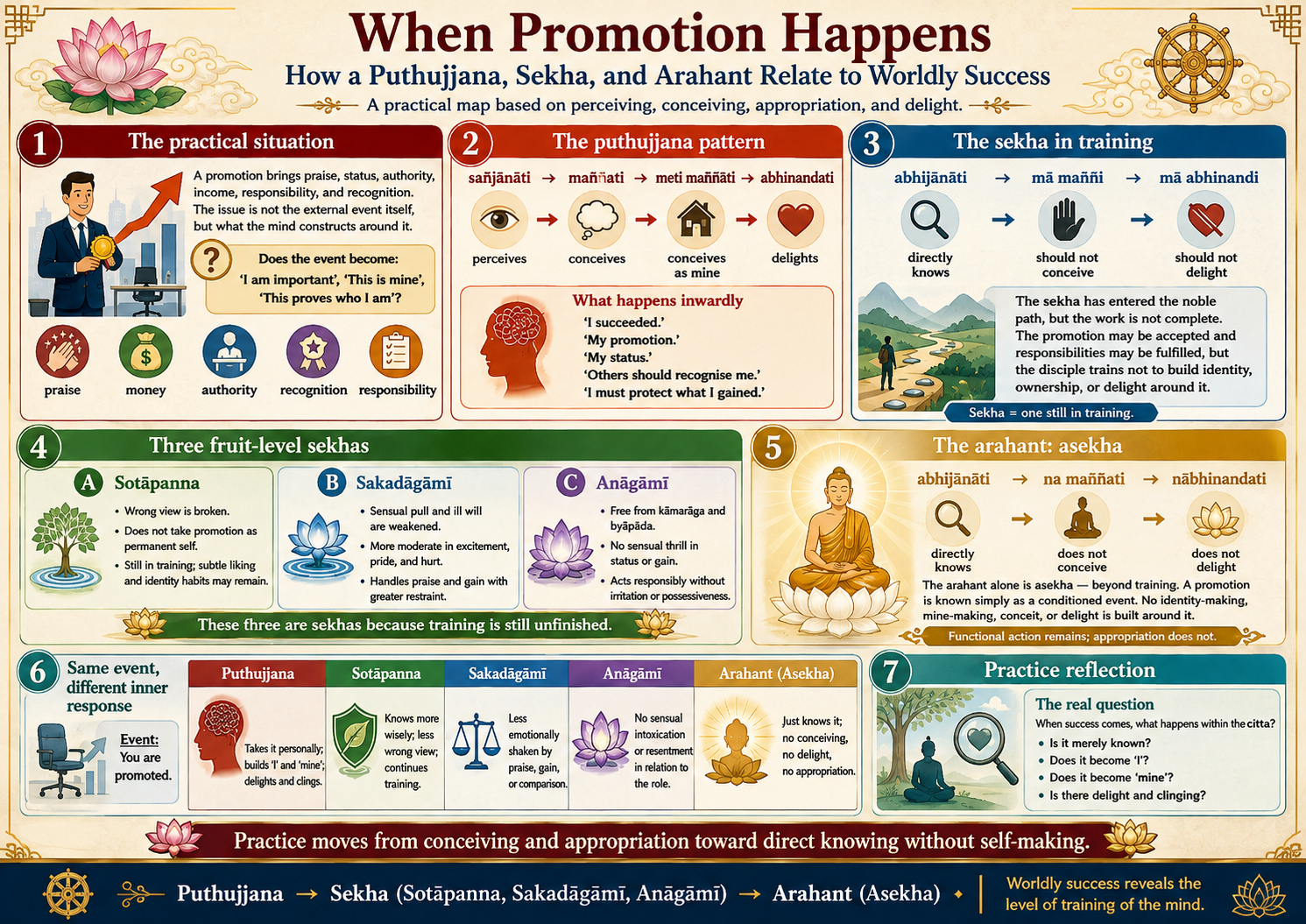
 VISUAL SUMMARYSee this study in a pictureOpen the complete infographic for a visual overview before or after reading the full study.View infographic →
Puthujjana: perceives and conceives around the object.
Sekha: directly knows and trains not to conceive or delight.
Arahant: directly knows without conceiving, appropriation, or delight.
01 The Worldly Event and What the Mind Builds Around It
This essay examines the ordinary worldly experience of being promoted and uses it as a practical setting to understand the difference between a puthujjana, a sekha, and an arahant.
The main question is not whether a person accepts a promotion, performs a responsible role, earns more money, or receives appreciation. The deeper question is:
What does the mind construct around that experience?
Does the promotion become a basis for identity, ownership, comparison, pride, fear, attachment, and delight? Or is it known simply as a conditioned event that has arisen due to causes and conditions?
The Movement of the Untrained Mind
The person perceives the experience, conceives around it, regards it as “mine,” and then delights in it. A promotion is no longer merely a change in responsibility. It becomes:
The Sekha and the Arahant
Sekha
abhijānāti → mā maññi → mā abhinandi
The experience is directly known, but the disciple trains not to conceive around it, not to appropriate it, and not to delight in it as a basis of selfhood.
Arahant
abhijānāti → na maññati → nābhinandati
The event is directly known, but no conceiving, possessiveness, identity-making, or delight arises around it.
Asekha
The arahant alone is asekha — no longer in training — because the roots of conceiving, appropriation, conceit, craving, and delight have been brought to an end.
A sekha has entered the noble path but has not completed the training. Here the focus is on the three fruit-level sekhas: Sotāpanna, Sakadāgāmī, and Anāgāmī. Each has removed or weakened particular fetters, so their internal relationship to the same promotion, praise, authority, and material advantages is not identical.
The mirror for practice: When success comes, what happens within the citta?
Is the event merely known, or does it become “I,” “me,” and “mine”?
02 The 24 Fields Covered in MN 1
These 24 fields cover gross matter, beings, divine identities, refined meditative attainments, sense experience, conceptual totalities, and even Nibbāna.
| No. | Pāli | Meaning |
|---|---|---|
| 1 | pathavī | earth / solidity |
| 2 | āpo | water / cohesion |
| 3 | tejo | fire / temperature |
| 4 | vāyo | air / motion |
| 5 | bhūta | beings |
| 6 | deva | devas |
| 7 | pajāpati | Pajāpati |
| 8 | brahmā | Brahmā |
| 9 | ābhassarā | radiant devas |
| 10 | subhakiṇhā | devas of streaming radiance / beautiful radiance |
| 11 | vehapphalā | devas of great fruit |
| 12 | abhibhū | overlord / conqueror |
| 13 | ākāsānañcāyatana | sphere of infinite space |
| 14 | viññāṇañcāyatana | sphere of infinite consciousness |
| 15 | ākiñcaññāyatana | sphere of nothingness |
| 16 | nevasaññānāsaññāyatana | sphere of neither-perception-nor-non-perception |
| 17 | diṭṭhaṁ | the seen |
| 18 | sutaṁ | the heard |
| 19 | mutaṁ | the sensed |
| 20 | viññātaṁ | the cognized |
| 21 | ekattaṁ | unity |
| 22 | nānattaṁ | diversity |
| 23 | sabbaṁ | the all |
| 24 | nibbānaṁ | Nibbāna |
The central principle: Whatever the mind can take as an object can become a basis for maññanā if it is not fully understood.
MN 1 Formula for the Sekha
He directly knows X as X. Having directly known X as X, he should not conceive X, should not conceive in X, should not conceive from X, should not conceive X as “mine,” and should not delight in X.
Why is that? Because it is still to be fully understood, I say.
Sekha: pariññeyyaṁ — it is to be fully understood.
Arahant: pariññātaṁ — it has been fully understood.
The 24 Objects in Four Practical Groups
| Group | Objects | Main danger |
|---|---|---|
| Elemental / bodily | pathavī, āpo, tejo, vāyo | body-identification, comfort, health, appearance |
| Personal / cosmic beings | bhūta, deva, pajāpati, brahmā, ābhassarā, subhakiṇhā, vehapphalā, abhibhū | superiority, divine identity, refined existence |
| Meditative / formless | ākāsānañcāyatana, viññāṇañcāyatana, ākiñcaññāyatana, nevasaññānāsaññāyatana | attachment to samāpatti, subtle becoming |
| Experiential / conceptual / ultimate | diṭṭhaṁ, sutaṁ, mutaṁ, viññātaṁ, ekattaṁ, nānattaṁ, sabbaṁ, nibbānaṁ | view, knowledge, totality, realization-identity |
03 The Three Sekhas
| Sekha | Fetters removed or weakened | Main remaining danger | How MN 1 applies |
|---|---|---|---|
| Sotāpanna | Removed identity-view, doubt, and ritual-clinging | Coarse attachment, aversion, conceit, and subtle mine-making | Should not conceive any of the 24 as self, in self, from self, or mine; still training toward full understanding |
| Sakadāgāmī | The same first three removed; sensual desire and aversion weakened | Softer sensual delight, mild irritation, and subtle comparison | Should not delight in pleasant objects, status, feeling, or refined ideas; must continue weakening nandi |
| Anāgāmī | The first five fetters removed, including sensual desire and ill will | Refined becoming, jhānic attachment, formless attachment, māna, and subtle “I am” | Especially must not conceive refined states, unity, the all, or Nibbāna as mine or self |
Applying the 24 Objects to the Three Sekhas
| MN 1 field | Sotāpanna’s training | Sakadāgāmī’s training | Anāgāmī’s training |
|---|---|---|---|
| 1–4: pathavī, āpo, tejo, vāyo | Does not hold body or elements as self-view, but may still enjoy body, comfort, and health | Less sensual attachment to bodily comfort; less irritation when the body changes | No sensual craving toward the body, but still must fully understand rūpa without subtle conceit |
| 5: bhūta — beings | Does not hold beings as permanent selves in wrong view, but may still attach to people | Attachment and aversion toward people are weaker | No sensual attachment or ill will toward beings, but subtle compassion/self-position may remain |
| 6–12: deva to abhibhū | May still be impressed by divine or superior states | Less fascinated by pleasurable heavenly possibilities | Must abandon refined attraction to form-sphere becoming |
| 13–16: four formless attainments | May intellectually understand they are not self, but may still be impressed | Less grasping, but refined aspiration may remain | A very important area: arūparāga can remain; must not conceive these attainments as mine |
| 17–20: seen, heard, sensed, cognized | Sense-contact may still trigger desire and irritation | Sense-triggered rāga and dosa are weakened | Sensual rāga and dosa are absent, but subtle knowing-consciousness must not become “I am the knower” |
| 21: ekattaṁ — unity | May still form views around oneness | Less emotionally captured by such views | Must not conceive unity as ultimate self or refined attainment |
| 22: nānattaṁ — diversity | May still delight in distinctions and categories | Less reactive to difference | Must not subtly conceive diversity or multiplicity through refined knowing |
| 23: sabbaṁ — the all | May still conceptualize “the all” philosophically | Less clinging to conceptual totality | Must not make “the all” into a metaphysical object |
| 24: nibbānaṁ | Does not doubt Nibbāna, but must not make it “my attainment” | Less delight in attainment-identity | Must not conceive even Nibbāna as mine; final subtle nandi and māna remain to be ended |
Comparison by Practical Group
| Group | Sotāpanna | Sakadāgāmī | Anāgāmī |
|---|---|---|---|
| Elemental / bodily | No self-view, but body-pleasure and discomfort still affect him | Body-pleasure and irritation weakened | Sensual craving toward body absent |
| Personal / cosmic beings | No fixed self-view, but may still admire status or identity | Less fascination and less comparison | No sensual attachment, but refined form-becoming may remain |
| Meditative / formless | May still be impressed by refined states | Less gross clinging | Major remaining danger: rūparāga and arūparāga |
| Experiential / conceptual / ultimate | Must guard against view and mine-making | Less emotional investment | Must cut subtle “I am,” knower, and Nibbāna-conceiving |
04 Applying the Teaching to Vilas and the Promotion
Sotāpanna Response
A Sotāpanna Vilas may feel joy, excitement, pleasant feeling, pride, and future planning. But when examined, he knows:
- This promotion is not ultimately me.
- This salary is not my self.
- This happiness is conditioned.
- This success-label is only paññatti or designation.
Yet some delight may still arise: “This is good for me,” “I am happy this happened,” or “May this continue.” His training is not to conceive promotion as mine, not to delight in status, and to understand feeling, perception, and formations fully.
Sakadāgāmī Response
A Sakadāgāmī Vilas has a weaker reaction. Joy may arise, but with less intoxication. If the promotion is delayed, irritation is weaker. He sees more quickly:
- This pleasant feeling is changing.
- This status is only convention.
- This excitement is not worth clinging to.
The training remains: do not delight, do not conceive, and do not form identity around success.
Anāgāmī Response
An Anāgāmī Vilas would not be caught by sensual delight or ill will in the same way. The salary raise, comfort, and status would not trigger sensual craving as before. But subtle conceit may remain:
- “This shows competence.”
- There is refined satisfaction in capability.
- There is subtle knowing of achievement.
- There may be a subtle “I am” around excellence.
The training is very refined: not even the knowing of success should become “I am the knower”; not even inner composure should become “my samādhi”; not even non-reactivity should become “my attainment.”
The Sekha Formula Applied to All 24
- X is to be directly known.
- X should not be conceived.
- X should not be conceived in.
- X should not be conceived from.
- X should not be conceived as mine.
- X should not be delighted in.
Why? Because X is still to be fully understood.
Example: Rūpa or Body
- Body should be directly known as body.
- Body should not be conceived.
- One should not conceive “I am in body.”
- One should not conceive “I come from body.”
- One should not conceive “body is mine.”
- One should not delight in body.
Example: Vedanā
Although vedanā is not one of the 24 named directly in MN 1, the same principle applies through the aggregate teaching.
- Feeling should be directly known as feeling.
- Feeling should not be conceived as “I am happy,” “I am suffering,” or “my peace.”
- Feeling should not be delighted in.
Example: Nibbāna
- Nibbāna should be directly known as Nibbāna.
- Nibbāna should not be conceived.
- One should not conceive in Nibbāna.
- One should not conceive from Nibbāna.
- One should not conceive Nibbāna as mine.
- One should not delight in Nibbāna.
For the sekha, it is still to be fully understood.
05 Sakkāyadiṭṭhi and Asmimāna
The Sotāpanna has removed sakkāyadiṭṭhi, but māna remains. The wrong view “the aggregates are self” is removed, while the felt tendency toward “I am,” “mine,” “for me,” “my progress,” “my practice,” and “my attainment” can still appear.
| Aspect | Sakkāyadiṭṭhi | Asmimāna |
|---|---|---|
| Basic meaning | Identity-view | Conceit “I am” |
| Pāli structure | sakkāya + diṭṭhi | asmi + māna |
| Literal sense | View regarding the existing body or personality-group | The conceit or measuring around “I am” |
| Main error | The five aggregates are taken as self or belonging to self | Even after self-view is weakened, a subtle “I am” still remains |
| Level | Wrong view | Subtle conceit |
| Related to | diṭṭhi — view | māna — conceit / comparison |
| How it appears | “This body, feeling, perception, formations, or consciousness is me or mine.” | “I am better, equal, inferior,” or simply “I am.” |
| Coarseness | Coarser | More subtle |
| Removed by | Sotāpatti-magga | Arahattamagga |
| Present in puthujjana? | Yes | Yes |
| Present in sotāpanna? | No | Yes |
| Present in sakadāgāmī? | No | Yes, but with weaker rāga and dosa |
| Present in anāgāmī? | No | Yes, very subtle |
| Present in arahant? | No | No |
How Both Appear in Vilas’s Promotion
| Aggregate | Sakkāyadiṭṭhi version | Asmimāna version |
|---|---|---|
| Rūpa — body | “This confident professional body is me.” “My appearance and body are part of who I am.” | “I look more successful than others.” “I carry myself like a senior person now.” |
| Vedanā — feeling | “This happiness is me.” “My joy from promotion is mine.” | “I am happier than others.” “I am now in a better emotional state than before.” |
| Saññā — perception | “This success-label is me.” “My reputation defines me.” | “I am seen as better now.” “I am equal to senior engineers.” |
| Saṅkhārā — formations | “My ambition, intelligence, discipline, and hard work are me.” | “I worked harder than others.” “I deserve this more than others.” |
| Viññāṇa — consciousness | “I am the one experiencing this success.” “My awareness of achievement is mine.” | “I know my success.” “I understand better than others how to rise.” |
20-Fold Sakkāyadiṭṭhi and 3-Fold Asmimāna
| Framework | Structure | Example in Vilas |
|---|---|---|
| Sakkāyadiṭṭhi | 5 aggregates × 4 self-views = 20 identity-views | “This promotion-feeling is me.” “This success-image is mine.” “I am in this role.” “This ambition is in me.” |
| Asmimāna | 3 comparisons based on “I am” | “I am better than those not promoted.” “I am equal to other senior engineers.” “I am still inferior to managers.” |
In Terms of MN 1
| MN 1 pattern | Sakkāyadiṭṭhi | Asmimāna |
|---|---|---|
| maññati | Conceives the aggregate as self | Conceives subtle “I am” around the aggregate |
| meti maññati | “This is mine” | “This mine makes me better, equal, or inferior” |
| abhinandati | Delights in the aggregate as self or mine | Delights in the position of “I am” |
| bhava | Identity is formed | Status-position is formed |
| jāti | A self-view is born | A comparison-self is born |
Comparison Through the Promotion Example
| Person | With promotion |
|---|---|
| Puthujjana | May believe: “This promotion proves who I am. My value is in this status.” This is sakkāyadiṭṭhi and asmimāna together. |
| Sotāpanna | Does not hold the aggregates as true self, but subtle joy, pride, comparison, and “I am successful” conceit may still arise. Sakkāyadiṭṭhi is removed, but asmimāna remains. |
| Sakadāgāmī | The same absence of sakkāyadiṭṭhi; less sensual excitement and less irritation if the promotion changes. Asmimāna still remains. |
| Anāgāmī | No sensual craving or ill will around salary or status in the ordinary way, but subtle “I am competent,” “I am refined,” or “I am above worldly craving” can remain. |
| Arahant | No sakkāyadiṭṭhi and no asmimāna. Promotion is known as convention; no “I am” is constructed around it. |
06 Puthujjana and Sekha in MN 1
| Aspect | Puthujjana | Sekha | Meaning |
|---|---|---|---|
| Person | Assutavā puthujjano | Sekho | Uninstructed ordinary person versus trainee noble disciple |
| First knowing | pathaviṁ pathavito sañjānāti | pathaviṁ pathavito abhijānāti | Puthujjana merely perceives; sekha directly knows |
| After knowing | pathaviṁ pathavito saññatvā | pathaviṁ pathavito abhiññāya | Having perceived versus having directly known |
| Conceives object | pathaviṁ maññati | pathaviṁ mā maññi | He conceives earth versus he should not conceive earth |
| Conceives in object | pathaviyā maññati | pathaviyā mā maññi | He conceives in earth versus he should not conceive in earth |
| Conceives from object | pathavito maññati | pathavito mā maññi | He conceives from earth versus he should not conceive from earth |
| Conceives as mine | pathaviṁ meti maññati | pathaviṁ meti mā maññi | He conceives earth as “mine” versus he should not conceive earth as “mine” |
| Delights | pathaviṁ abhinandati | pathaviṁ mābhinandi | He delights in earth versus he should not delight in earth |
| Reason | Apariññātaṁ tassāti vadāmi | Pariññeyyaṁ tassāti vadāmi | Not fully understood versus still to be fully understood |
Puthujjana: the experience becomes “I,” “me,” and “mine.”
Sekha: the experience is directly known, while training continues so that conceiving, appropriation, and delight are not established.
Arahant: the event is known as a conditioned convention, without maññanā, mine-making, conceit, craving, or delight.
The question is therefore not whether success occurs. The question is whether the citta constructs a self around it.