Ānāpānasati — The Sixteen Steps, Breath and Physiology
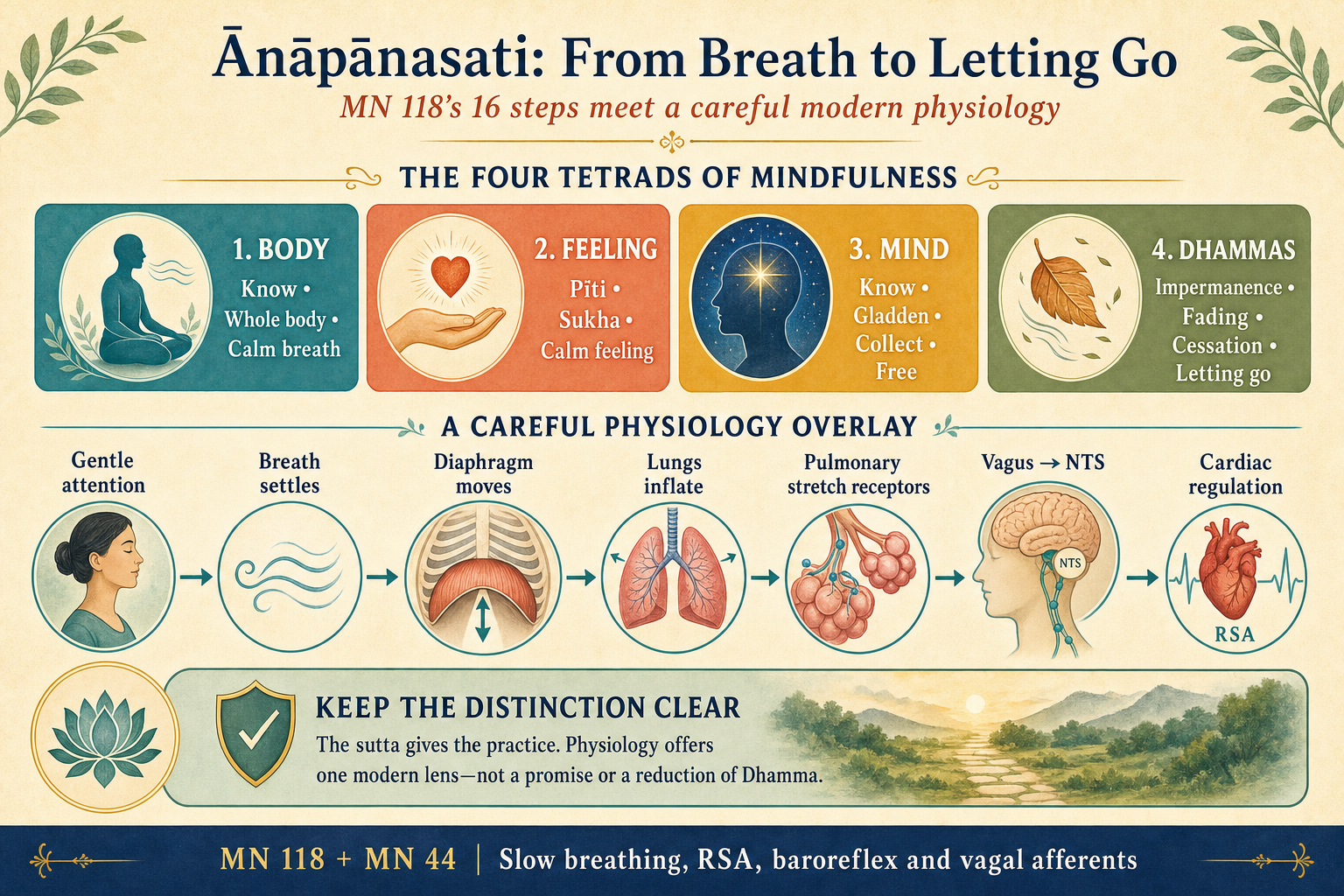 VISUAL SUMMARYSee this study in a pictureOpen the complete infographic for a visual overview before or after reading the full study.View infographic →
Why this post—and what to expect
This post was written to answer a common and worthwhile question: when the Ānāpānasati Sutta speaks of calming the bodily formation, what may be happening in lived breathing, and how far can modern physiology help us understand it? The aim is to give practitioners a reliable bridge between close sutta study and contemporary language about breath, heart rhythms, and the vagus nerve—without confusing either domain for the other.
First, you will be guided through the sixteen steps of MN 118 and the way its four tetrads unfold from body to feeling, mind, and dhammas. Then the article carefully separates the text’s own claims from a modern account of lungs, pulmonary receptors, respiratory sinus arrhythmia, baroreflex rhythms, and vagal afferent fibres. It closes by naming the limits of the comparison, so the practice remains grounded in calm observation rather than medical or wellness promises.
Expect — a clear sutta-based map, a precise physiology primer, and practical cautions.
Do not expect — a claim that meditation is reducible to biology, or that HRV measures enlightenment, safety, or a single quantity called “vagal tone.”
Use it as — an invitation to observe the breath gently, let it settle naturally, and continue toward the insight and letting go that MN 118 describes.
MN 118 presents mindfulness of breathing as a complete path: four tetrads of practice that mature through body, feeling, mind, and dhammas. This article reads that architecture closely, then places a carefully bounded modern physiology alongside it. The purpose is not to reduce the Dhamma to biology, but to see where a calm breath and a calmer nervous system may genuinely meet.
Sixteen steps arranged as four progressive tetrads
The Ānāpānasati Sutta gives sixteen steps, arranged as four tetrads. Each tetrad is explicitly related to one of the four establishments of mindfulness: body, feeling, mind, and dhammas. The arrangement is progressive and interlocking rather than a loose list of techniques.
Body: — knowing long and short breathing; experiencing the whole body; calming the bodily formation.
Feeling: — experiencing rapture (pīti) and ease (sukha); experiencing mental formation; calming mental formation.
Mind: — experiencing the mind; gladdening, concentrating, and liberating it.
Dhammas: — contemplating impermanence, fading of passion, cessation, and letting go.
A closer reading of the four tetrads
The four tetrads are best read as one continuous training. They are not four separate meditation styles to be picked from at will. The practice begins by learning the texture and settling of the breath, then makes feeling knowable, brings the mind into steadiness, and finally uses that steadiness to contemplate the way all conditioned experience changes and is released.
01First tetrad — body: steps 1–4
Steps 1 and 2: “Breathing in long, one knows ‘I breathe in long’; breathing out long, one knows ‘I breathe out long’”; likewise for short breathing. The task is recognition, not manufacture. A long breath need not be made longer and a short breath need not be corrected. What is trained is a continuous, unconfused intimacy with the actual breath as it is.
Step 3: one trains to experience the “whole body.” This may be approached as the whole bodily field touched by breathing—the chest, abdomen, throat, posture, and the changing sensations of the respiratory cycle. It protects the practice from becoming a tight fixation at the nostrils. The body is felt as a living, changing whole rather than as a problem to solve.
Step 4: one trains to calm the bodily formation. MN 44 makes the relevant identification: in-and-out breathing is bodily formation because it is bodily and bound up with the body. The practical instruction is therefore to know the breathing so patiently that agitation can fall away. A quieter, more subtle breath may follow, but it is the settling that matters—not forcing a ratio, holding the breath, or pursuing a special sensation.
02Second tetrad — feeling: steps 5–8
Steps 5 and 6: one trains to experience pīti and sukha. Pīti is the enlivening, bright, sometimes thrilling aspect of joy; sukha is the more settled sense of comfort, ease, or well-being. Neither is an achievement badge. Both are conditioned experiences to be known without clinging. In a settled practice they can signal that the mind is becoming more unified and less burdened by resistance.
Step 7: one trains to experience mental formation. MN 44 identifies mental formation here with perception and feeling. This directs attention to the way the mind gives a tone, name, and significance to experience. The point is not to stop feeling; it is to see feeling as feeling and perception as perception rather than immediately taking them to be “me,” “mine,” or a command to act.
Step 8: one trains to calm mental formation. The bodily settling of the first tetrad can support this, but the step is subtler: it concerns the cooling of reactivity in feeling and perception. Pleasant states need not be grasped, unpleasant states need not be fought, and neutral states need not disappear into inattention. The field becomes more balanced, receptive, and clear.
03Third tetrad — mind: steps 9–12
Step 9: one trains to experience the mind. This means recognizing its present flavour: collected or scattered, bright or dull, contracted or open, burdened or free. The sutta does not ask for an abstract theory of consciousness. It asks for direct knowledge of the mind that is present now, so that confusion loses the protection of vagueness.
Steps 10 and 11: one trains to gladden the mind and to concentrate it. Gladdening is a wise encouragement, not artificial cheerfulness. It can be supported by recollecting the value of the practice, appreciating the relief of non-harming, or attending to a naturally wholesome ease. Concentration then means bringing the mind together—less dispersed among memories, plans, and sense objects; more stably with the meditation theme.
Step 12: one trains to liberate the mind. On a modest, immediate level, the mind is freed from a particular hindrance or from being caught in a particular object. In the larger movement of the path, liberation matures through non-clinging. This step should not be rushed into a claim of final attainment; it is an instruction to recognize and cultivate every genuine opening from confinement.
04Fourth tetrad — dhammas: steps 13–16
Step 13: one contemplates impermanence. The breath is ideal for this because it is plainly arising and passing: each in-breath begins, alters, and ends; each out-breath does the same. The same observation extends to feeling, attention, joy, irritation, and the very sense of a stable meditator. Impermanence is not merely an idea; it is repeatedly seen in immediate experience.
Step 14: one contemplates fading of passion or dispassion. When impermanence is seen clearly, fascination with holding experience still begins to weaken. This is not dislike of life. It is the gradual loss of compulsion—the cooling of the impulse to possess, defend, repeat, or become.
Steps 15 and 16: one contemplates cessation and letting go. Cessation is noticed wherever a conditioned event ceases when its conditions are not sustained: a breath, an urge, a thought, a knot of tension. Letting go is the appropriate response to that insight. Rather than creating another identity around meditation, the practitioner releases the need to appropriate what arises. This is where the article’s physiology discussion must remain secondary: the sutta’s direction is release, not self-optimization.
How the cited texts and articles support this reading
MN 118 is the primary map: it supplies the sixteen steps, the four tetrads, and their relationship to the four establishments of mindfulness. MN 44 is the key companion text for this article because it identifies breathing as bodily formation and perception-and-feeling as mental formation. These are textual claims, not modern speculation.
The modern articles play a different role. The review by Gerritsen and Band surveys slow breathing, baroreflex sensitivity, RSA, and heart-rate variability. Mazzone and Undem distinguishes the pathways of pulmonary vagal afferents, including slowly adapting receptors, rapidly adapting receptors, and C-fibres. Grossman and Taylor explains why RSA has both central and peripheral contributions. Together they support careful possibilities about breathing and autonomic regulation; none turns a sutta instruction into a medical intervention.
A gentle way to practise all four tetrads
This is a study-and-practice guide, not a medical protocol. Begin with an upright but unstrained posture and let breathing be ordinary. The governing principle is recognition before regulation: know the breath first, then allow unnecessary effort to fade. Do not hold the breath, strain for a deeper inhale, or force the abdomen outward. If practice brings dizziness, chest pain, faintness, panic, or a sense of air hunger, return to normal breathing and seek appropriate clinical guidance when needed.
01Tetrad 1 — establish the body: steps 1–4
Choose one clear contact — For a few minutes, rest attention where breathing is easiest to feel: nostrils, chest, abdomen, or the movement of the lower ribs. There is no requirement to use one location. The aim is a stable, kind contact with what is already occurring.
Know long and short — When a breath is long, silently recognize “long”; when it is short, recognize “short.” Do not count, judge, or try to make the breath fit an ideal. This is step 1 and step 2 as a training in accurate present-moment knowing.
Include the whole breathing body — Let the field widen to include posture, throat, chest, ribs, abdomen, and the changing pressure of the breath. Notice where effort gathers. The “whole body” is experienced as a changing field, not as a rigid object.
Allow the bodily formation to calm — On each exhale, release any extra tightening in the jaw, shoulders, belly, or hands. Let the next inhale arrive by itself. If the breath becomes quieter, shorter, deeper, or more diaphragmatic, simply know that change. Do not turn calm into another project.
Practice sign: the breath feels more continuous and less owned. Common trap: turning “calm the breath” into forceful breathing. In MN 118, the training stays paired with knowing; the breath is allowed to settle rather than commanded to perform.
02Tetrad 2 — know feeling without grasping it: steps 5–8
Recognize uplift when it is present — If a lightness, brightness, interest, or energy appears, know it as pīti. It may be subtle; it need not be dramatic. Let it spread naturally through the body without chasing it.
Recognize ease when it is present — If the body and mind feel comfortable, settled, or content, know this as sukha. Rest with the ease, but continue to see it as conditioned and changing.
Notice perception and feeling at work — Ask quietly: “What is the tone of this moment—pleasant, unpleasant, or neither?” Notice the labels, images, and meanings that the mind adds to bodily sensation. This is a practical entry into experiencing mental formation.
Soften reactivity — With each breath, stop feeding the extra story. Pleasant experience does not need to be prolonged; discomfort does not need to be attacked. Return to the whole body and let perception-and-feeling become less agitated.
Practice sign: sensations are felt clearly without immediately becoming a problem or a reward. Common trap: mistaking pīti or sukha for the goal. The tetrad trains a calmer relationship to feeling, not a search for special states.
03Tetrad 3 — work directly with the mind: steps 9–12
Name the mind’s present condition — Without criticism, recognize whether the mind is scattered, dull, tight, bright, peaceful, restless, or collected. This is experiencing mind: a direct report of its current condition, not a theory about a permanent self.
Gladden wisely — When the mind is heavy, bring to mind a trustworthy source of gladness: the value of harmlessness, gratitude, confidence in practice, or the simple relief of being present. Use only what genuinely brightens the mind without excitement.
Gather attention — Let one object lead—usually the breathing body. Each time attention wanders, return softly and repeatedly. Concentration grows from continuity, not from mental pressure.
Notice small releases — When a hindrance loosens, when a thought loses its grip, or when the mind is no longer compelled to follow an impulse, recognize the freedom already present. This is a practical way to train in liberating the mind without making premature claims about final liberation.
Practice sign: the mind returns more easily and stays less entangled. Common trap: trying to dominate the mind. Gladdening and concentrating work through skilful conditions—interest, steadiness, and gentle return—not coercion.
04Tetrad 4 — turn calm into insight: steps 13–16
Observe change at close range — Choose one breath, feeling, mood, or sound. Notice its beginning, alteration, and ending. Repeat often. Impermanence becomes convincing when it is seen in particulars rather than recited as an idea.
Notice fading interest — As changing phenomena are seen again and again, ask: “What happens when I do not feed this?” Allow fascination, craving, and resistance to cool. Dispassion is not indifference; it is freedom from compulsion.
Recognize cessation — Notice the end of an out-breath, the vanishing of a thought, the dissolving of an urge, or the easing of tension. Cessation is repeatedly visible in conditioned events when attention is quiet enough to notice the ending.
Practise relinquishment — At the end of each cycle, consciously do less: do not add a commentary, do not claim the experience, do not rebuild the tension that has just passed. Letting go is enacted in these small moments and gradually becomes the direction of the path.
Practice sign: experience seems less solid and less personally owned. Common trap: treating cessation as blankness to be manufactured. The instruction is to see what ceases when conditions change, then release the urge to hold it.
Diaphragmatic breathing and vagal pathways: a careful practice lens
“Diaphragmatic breathing” is best understood here as an unforced pattern: during inhalation the diaphragm descends, the lower ribs and abdomen may move gently, and the lungs expand; during exhalation the diaphragm relaxes and the breath leaves without being pushed. The diaphragm is the respiratory pump, but its own muscle sense is chiefly conveyed through phrenic and spinal pathways. The breath-related vagal sensory route emphasized in this article begins mainly in the lungs and airways: diaphragm movement → lung inflation → pulmonary stretch receptors → vagal afferents → NTS in the brainstem.
Settle the posture — Sit or lie where the lower ribs can move freely. Loosen belts or restrictive clothing. Place a hand lightly on the lower ribs or upper abdomen only if that helps awareness; do not press down.
Let the inhale arrive — Receive the in-breath rather than pulling it in. Notice a small, comfortable expansion in the lower ribs, abdomen, or back. If there is little movement, that is fine; remain with the actual sensation.
Let the exhale complete itself — Feel the ribs and abdomen settle. Release shoulder, jaw, and abdominal gripping. Do not squeeze the air out and do not impose a long exhale; any lengthening should be comfortable and spontaneous.
Return to natural rhythm — Continue for a few minutes with the instruction “know—soften—release.” If the breath becomes uneasy, shallow, or effortful, abandon the exercise and breathe normally. The measure of success is less struggle, not a particular number of breaths per minute.
In larger, comfortable breaths, slowly adapting pulmonary receptors may contribute more vagal afferent traffic than in very shallow breathing. Those signals converge in the NTS with baroreceptor, chemoreceptor, and central respiratory inputs. The NTS can influence cardiac vagal circuits, including neurons associated with the nucleus ambiguus, while respiratory timing itself also shapes RSA. This is a plausible physiological context for why a gently settled breath may coincide with a quieter felt state; it is not evidence that a meditator can switch on a single “vagus activation” mechanism at will.
Laboratory studies often examine slow breathing near six breaths per minute because it can interact with baroreflex rhythms and enlarge some HRV measures. For ānāpānasati, use that information as background rather than a target. A pace is not required by MN 118, and pushing toward it can make the breath artificial. For scientific detail, return to the linked reviews by Gerritsen and Band, Mazzone and Undem, and Grossman and Taylor.
Where the practical mechanism begins
The opening begins simply: know a long in-breath as long and a short in-breath as short. This is tracking rather than manipulation. Attention then broadens: one trains to experience “the whole body” while breathing. Whether understood as the whole living body or the whole breath-body, the movement is from a narrow point of contact to a more complete field of embodied awareness.
The decisive instruction is to train in calming the bodily formation (kāya-saṅkhāra) while breathing in and out. MN 44 defines in-and-out breathing itself as the bodily formation: it is bodily and bound up with the body. The instruction therefore has a direct breath dimension. It does not require force, breath-holding, or a prescribed “belly-breathing” technique. Rather, as hurried or effortful breathing settles, the breath commonly becomes softer, slower, and less upper-chest dominated; diaphragmatic movement may become more apparent as a consequence.
What modern physiology can—and cannot—add
There is a plausible physiological bridge here, but it needs precise wording. The diaphragm is the pump, not the main vagal sensor. Its own muscle proprioception travels chiefly through phrenic and spinal pathways. The important vagal link is what diaphragmatic descent does: it increases thoracic volume, lowers intrapleural pressure, and allows the lungs to inflate. Stretch-sensitive receptors in airway and lung tissue then send signals centrally through vagal afferents to the nucleus tractus solitarius (NTS) in the brainstem.
Pulmonary receptors are not all doing the same job
Slowly adapting receptors (SARs) — lie mainly in airway smooth muscle. Their tonic firing broadly tracks lung inflation and, at sufficient volumes, contributes to the Hering–Breuer inflation reflex. They are carried largely by fast, myelinated vagal afferents.
Rapidly adapting receptors (RARs) — , often called irritant receptors, respond briefly to irritation and rapid mechanical change. Their reflex roles include cough, bronchoconstriction, and altered breathing; they are not the central story of a settled breath.
Bronchopulmonary C-fibres — are unmyelinated vagal afferents responsive to chemical and congestive signals. Their presence is an important reminder that “vagal” never simply means “calming.”
In ordinary adult tidal breathing, the Hering–Breuer reflex is often relatively quiet. Larger, comfortable breaths are more likely to recruit pulmonary stretch signalling than very shallow breathing. This supports a modest claim: slow, deeper breathing can change cardiopulmonary afferent input. It does not prove that every quiet breath “activates the vagus” in a single, uniform way.
Exhalation, RSA, and the baroreflex
Heart rate ordinarily rises a little during inhalation and falls during exhalation, a pattern called respiratory sinus arrhythmia (RSA). Cardiac vagal output is relatively disinhibited during expiration, so a naturally lengthened, unforced exhale gives more time in that phase. RSA is not driven by one mechanism alone: respiratory pattern-generating circuits in the brainstem couple directly with cardiac vagal neurons, while pulmonary, pressure, and baroreceptor feedback also contribute. The relative weighting remains debated.
Slow breathing around six breaths per minute is often studied because it can synchronize respiratory and baroreflex oscillations and increase measured heart-rate variability (HRV). HRV is a useful readout of beat-to-beat cardiac regulation, but it is not a direct measurement of vagal afferent traffic and should not be treated as a simple score of “vagal tone.”
Feeling and mental formation
The first fruits named in the next tetrad are pīti (rapture or uplift) and sukha (ease or pleasure). A less activated body and a steadier breath make these experiences physiologically understandable without exhausting their contemplative meaning. Step eight then extends the calming movement to mental formation. MN 44 identifies this as perception and feeling: the affective and perceptual layer through which experience is known begins to settle too.
A useful working sequence is: attention rests with the breath; the breath is allowed to settle; respiratory and cardiovascular rhythms change; bodily ease becomes more available; perception and feeling can be observed and quieted rather than reflexively followed. It is a conditional process, not a promise and not a mechanical shortcut to insight.
Stability, insight and release
By the third tetrad, practice works directly with the quality of mind: experiencing it, brightening it, collecting it, and freeing it. Such stability is difficult when the system is persistently agitated, but it is more than a nervous-system state. The fourth tetrad turns the clarified mind toward impermanence, dispassion, cessation, and relinquishment. This is the vipassanā dimension: seeing conditioned phenomena change, losing fascination with what fades, and loosening appropriation.
The four tetrads therefore give a coherent arc: embodied attention; an easing of felt tone; a steadier, freer mind; and insight into change and release. Physiology can illuminate some bodily conditions of the first movements. It cannot substitute for the ethical, contemplative, and liberating work expressed by the later ones.
Vagal afferent fibres
Vagal sensory neurons are pseudo-unipolar: their cell bodies sit outside the brainstem, with one branch going to the organ and another entering the central nervous system. Most visceral signals from lungs, heart, and gut arise from the nodose (inferior) ganglion, which is developmentally distinct from the jugular (superior) ganglion. The jugular ganglion carries more somatic-like information, including some ear, meningeal, pharyngeal, and laryngeal sensation.
Classically, fibres are grouped by conduction velocity: fast myelinated A-fibres, thinly myelinated B-fibres, and slow unmyelinated C-fibres. C-fibres make up much of the vagal afferent population, with the gastrointestinal tract a very large source of traffic. Molecular mapping has sharpened this older classification: nodose neurons contain distinct populations tuned to lung stretch, airway irritation, cardiac mechanics, gastric stretch, nutrients, and other visceral states.
These signals do not dissolve into one undifferentiated “vagus centre.” They terminate in an organized NTS map, then influence multiple reflex and higher pathways. Glutamate is the principal fast transmitter at this first central synapse. From there, afferent input can influence vagal efferent neurons—including neurons in the nucleus ambiguus that regulate the sinoatrial node. Those efferents release acetylcholine at the heart; the changing result is part of what appears in HRV.
From visceral signals to experienced breathing
The physiology becomes more useful when it is followed as a neural pathway rather than compressed into the phrase “the vagus calms you.” During breathing, mechanical and chemical events in the airways, lungs, heart, and blood vessels are sampled by several receptor populations. Their sensory neurons have cell bodies mainly in the nodose ganglia, with some functionally distinct input involving the jugular ganglia. Each neuron has a peripheral branch at the organ and a central branch entering the brainstem; this is why vagal afferent traffic is best understood as information flowing from the viscera toward the brain.
011. The brainstem receives a patterned stream, not a single “calm signal”
For the breath-related pathway emphasized here, comfortable lung inflation can increase signalling from slowly adapting pulmonary receptors. Other airway receptors respond to irritation, rapid mechanical change, congestion, or inflammatory chemistry. These signals are therefore diverse in both meaning and consequence: cough, breathlessness, satiety, nausea, airway defence, and cardiovascular adjustment are all carried within the wider vagal sensory system. This is why it is inaccurate to equate more vagal afferent activity with more calm.
The afferent fibres enter the medulla and terminate principally in the nucleus tractus solitarius (NTS). The NTS is not an empty relay station. It is a densely connected integrative region that receives respiratory, cardiovascular, and other visceral inputs, combines them with ongoing brainstem state, and helps coordinate reflex responses. Research mapping vagal ganglia and brainstem targets shows that different afferent subsets preferentially reach different NTS regions; “the vagus” is thus a family of pathways with partially organized targets, not one undifferentiated wire.
022. From NTS to cardiac vagal output
One important NTS output influences the nucleus ambiguus, where cardiac vagal motor neurons contribute to beat-to-beat control of the sinoatrial node. Their peripheral terminals release acetylcholine, which can slow the heart. For many subdiaphragmatic targets, the dorsal motor nucleus of the vagus supplies a major component of efferent output. Keeping afferent and efferent directions separate is crucial: the breathing-related sensory information comes in; central circuits integrate it; cardiac vagal motor output goes back out. HRV is measured at the cardiac, efferent end of this loop—not at the sensory end.
This distinction also clarifies the practice connection. In the first tetrad, mindful contact with breathing may help a person stop adding unnecessary struggle to the respiratory cycle. If the breath then naturally slows or deepens, cardiorespiratory reflex pathways may be engaged differently. But the sutta does not instruct the meditator to manipulate the NTS, the nucleus ambiguus, or heart-rate variability. It instructs knowing and calming bodily formation.
033. RSA and the baroreflex: central rhythm and peripheral feedback
Respiratory sinus arrhythmia (RSA) is the ordinary phase-linked pattern in which heart rate tends to increase during inspiration and decrease during expiration. It reflects both central coupling—interactions between respiratory rhythm-generating circuits and cardiac vagal neurons—and peripheral feedback from lung inflation, blood pressure, venous return, and arterial baroreceptors. In other words, a calm exhale is not simply “pressing a vagus switch.” It participates in a rhythmically organized cardiorespiratory system.
At slow breathing rates, commonly near six breaths per minute in laboratory studies, respiratory cycles may align with baroreflex oscillations. This can amplify rhythmic variation in heart period and increase some HRV measures. The slow-breathing review linked below describes this area as promising but still in need of further research. That wording is worth retaining: HRV can be informative, yet it is sensitive to breathing rate, posture, measurement method, and many other conditions. It is neither a complete measure of parasympathetic function nor a measure of contemplative progress.
044. From brainstem sensing to interoception and awareness
Visceral information does not stop at the NTS. Through brainstem and thalamic relays—including pathways involving the parabrachial region—it contributes to broader networks concerned with arousal, salience, affect, and interoception. Contemporary interoception research describes the insula, anterior cingulate, and prefrontal systems as important for integrating internal bodily signals with emotion, attention, and interpretation. These are multi-step network relationships, not a claim that a particular breath sensation travels directly into one cortical area.
This provides a modest neuroscience language for a familiar meditation observation: as attention becomes steadier, subtle bodily signals can become clearer; as reactivity settles, their meaning may be interpreted less urgently. The Buddhist account is still richer than a neural map, because it asks what is known, how it is felt, how it is appropriated, and whether clinging has ceased. Neuroscience can describe some conditions and pathways of interoception; MN 118 directs the ethical and liberating use of that knowing.
Reading the linked neuroscience articles
Mazzone and Undem is especially useful for distinguishing SARs, RARs, and bronchopulmonary C-fibres, and for following their central projections. Gerritsen and Band provides the broad slow-breathing review for RSA, baroreflex sensitivity, and HRV. Grossman and Taylor explains the mixed central and peripheral origins of RSA. For the wider interoceptive picture, Khalsa and colleagues review how vagal and spinal signals are sensed, integrated, interpreted, and regulated. These sources support a careful explanatory layer; they do not change the canonical meaning of the tetrads.
Do not turn a physiological correlate into a Dhamma attainment
The textual foundations are strong: MN 118 gives the tetrads, and MN 44 defines breathing as bodily formation and perception-and-feeling as mental formation. The vagal account is a modern explanatory overlay. Individual mechanisms—RSA, baroreflex dynamics, pulmonary stretch afferents, and changes in HRV with slow breathing—are supported by research, but popular language often turns them into claims that are broader than the evidence. In practice, let the breath calm without strain. If breathing exercises provoke dizziness, panic, pain, or other symptoms, stop and seek appropriate clinical guidance.
The practice and the physiology
MN 118 at a glance
Four Tetrads — Body → Feeling → Mind → Dhammas
A visual summary of the sixteen steps and the carefully limited physiology lens used in this study.
Click infographic to enlarge ↗
A visual summary of MN 118’s four tetrads and the carefully limited physiology lens used in this article.
Canonical texts and modern research used in this study
- MN 118, Ānāpānasati Sutta — the sixteen steps and their relation to the four establishments of mindfulness.
- MN 44, Cūḷavedalla Sutta — breathing as bodily formation; perception and feeling as mental formation.
- Gerritsen & Band, “The physiological effects of slow breathing in the healthy human”.
- Mazzone & Undem, “Central pathways of pulmonary and lower airway vagal afferents”.
- Grossman & Taylor, “Respiratory sinus arrhythmia: autonomic origins, physiological mechanisms, and psychophysiological implications”.