How to Understand Paṭiccasamuppāda and Paṭiccasamuppannā Dhammā?
 VISUAL SUMMARYSee this sutta in a pictureOpen the complete infographic for a visual overview before or after reading the full study.View infographic →
The principle and the phenomena are not the same
Paṭiccasamuppāda explains how suffering arises through conditions, while Paṭiccasamuppannā Dhammā reveals the characteristics shared by all conditioned phenomena. Together they provide a complete framework for understanding experience and cultivating liberating wisdom.
1. Setting
Sāvatthiyaṁ viharati. – The Blessed One was dwelling at Sāvatthī.
The discourse takes place at Sāvatthī. The conventional opening is abbreviated in the preserved text, but the teaching immediately begins with a highly precise distinction that is central to understanding the Buddha’s Dhamma.
PART ONE
PAṬICCASAMUPPĀDA — THE PRINCIPLE OF DEPENDENT ARISING
The Buddha announces the teaching
“Paṭiccasamuppādañca vo, bhikkhave, desessāmi paṭiccasamuppanne ca dhamme. Taṁ suṇātha, sādhukaṁ manasi karotha, bhāsissāmī”ti.
“Bhikkhus, I will teach you dependent arising and the phenomena that have arisen dependently. Listen to it and attend to it carefully. I will speak.” The Buddha announces that he will explain two related but different things:
Paṭiccasamuppāda – The dependable conditional relationship: When this condition is present, that phenomenon comes to be.
Paṭiccasamuppannā dhammā – The phenomena that arise because of those conditions. This distinction is indispensable. For example:
“Dependent on feeling, craving arises” is paṭiccasamuppāda.
Feeling and craving themselves are paṭiccasamuppannā dhammā.
The first is the conditional principle and the second consists of the conditioned phenomena participating in that relationship.
The bhikkhus respond – “Evaṁ, bhante”ti kho te bhikkhū bhagavato paccassosuṁ. Bhagavā etadavoca: “Yes, venerable sir,” those bhikkhus replied to the Blessed One. The Blessed One said:
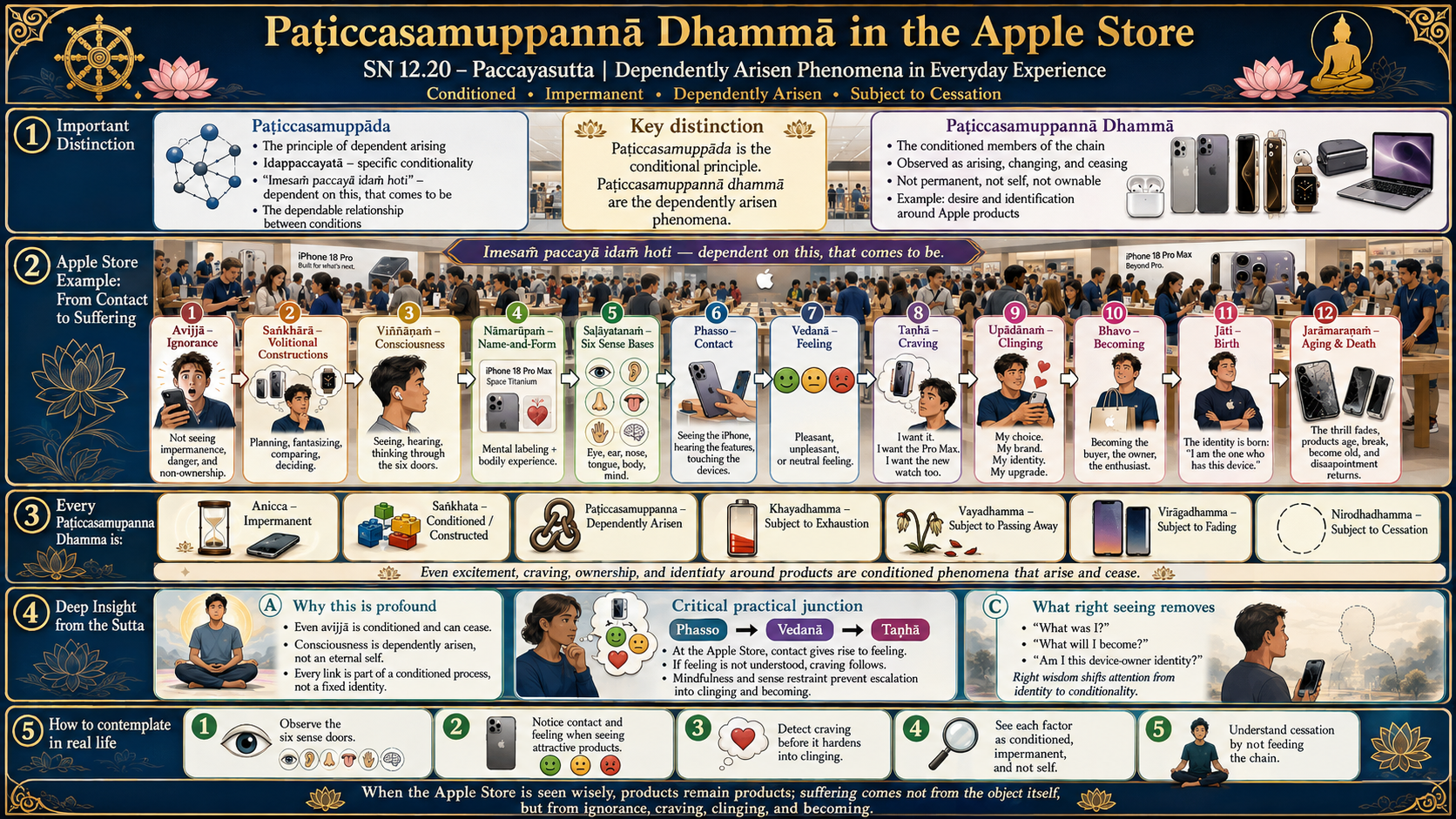
Paṭiccasamuppāda — The dependable conditional relationship: dependent on this, that comes to be.
Paṭiccasamuppannā dhammā — The conditioned phenomena that arise and cease within that relationship.
Paṭiccasamuppannā Dhammā through a concrete example
Paṭiccasamuppannā Dhammā
Principle versus conditioned phenomena
The source overview infographic illustrates the distinction through an Apple Store example.
Click infographic to enlarge ↗
Paṭiccasamuppāda — The Principle of Dependent Arising
01 Birth conditions aging and death
What is paṭiccasamuppāda? Birth conditions aging and death
“Katamo ca, bhikkhave, paṭiccasamuppādo? Jātipaccayā, bhikkhave, jarāmaraṇaṁ. Uppādā vā tathāgatānaṁ anuppādā vā tathāgatānaṁ, ṭhitāva sā dhātu dhammaṭṭhitatā dhammaniyāmatā idappaccayatā. Taṁ tathāgato abhisambujjhati abhisameti. Abhisambujjhitvā abhisametvā ācikkhati deseti paññāpeti paṭṭhapeti vivarati vibhajati uttānīkaroti. ‘Passathā’ti cāha: ‘jātipaccayā, bhikkhave, jarāmaraṇaṁ’.
“And what, bhikkhus, is dependent arising? Dependent on birth, aging and death come to be. Whether Tathāgatas arise or whether Tathāgatas do not arise, that principle remains established: the stability of the Dhamma, the fixed regularity of the Dhamma, and this specific conditionality. A Tathāgata fully awakens to it and penetrates it. Having fully awakened to it and penetrated it, he explains it, teaches it, makes it known, establishes it, discloses it, analyzes it, and makes it plain. He says, ‘See! Dependent on birth, bhikkhus, aging and death come to be.’”
The Buddha does not claim to have invented dependent arising. He discovers and penetrates an already operative conditional principle. Wherever there is jāti, there must be:
◉ aging
◉ alteration
◉ decline
◉ separation
◉ death
Birth is not simply an event that happened long ago. Whatever has arisen into a defined condition, status or identity has already entered the field of alteration and cessation. When something is internally taken as:
◉ I am this
◉ this belongs to me
◉ this is what I have become
the aging, alteration and loss of that condition become personally threatening.
Birth conditions aging and death
Conditional Link 01
Visual teaching aid for this link in the dependent-arising sequence.

Click infographic to enlarge ↗
02 Becoming conditions birth
Becoming conditions birth
Bhavapaccayā, bhikkhave, jāti. Uppādā vā tathāgatānaṁ anuppādā vā tathāgatānaṁ, ṭhitāva sā dhātu dhammaṭṭhitatā dhammaniyāmatā idappaccayatā. Taṁ tathāgato abhisambujjhati abhisameti. Abhisambujjhitvā abhisametvā ācikkhati deseti paññāpeti paṭṭhapeti vivarati vibhajati uttānīkaroti. ‘Passathā’ti cāha: ‘bhavapaccayā, bhikkhave, jāti’.
“Dependent on becoming, bhikkhus, birth comes to be. Whether Tathāgatas arise or whether Tathāgatas do not arise, that principle remains established: the stability of the Dhamma, the fixed regularity of the Dhamma, and this specific conditionality. A Tathāgata fully awakens to it and penetrates it. Having fully awakened to it and penetrated it, he explains it, teaches it, makes it known, establishes it, discloses it, analyzes it, and makes it plain. He says, ‘See! Dependent on becoming, bhikkhus, birth comes to be.’” Bhava should not be reduced merely to a future rebirth. It is the process or field of becoming within which a corresponding birth can occur. When a particular kind of becoming is established, the appropriate identity is born within it. For example:
◉ sensual becoming supports the birth of a sensual identity
◉ angry becoming supports the birth of “the offended person
◉ professional becoming supports the birth of “my status and position
◉ meditative becoming can support the birth of “I am an advanced practitioner.” Where becoming is repeatedly cultivated, a corresponding “being” or identity appears
Becoming conditions birth
Conditional Link 02
Visual teaching aid for this link in the dependent-arising sequence.

Click infographic to enlarge ↗
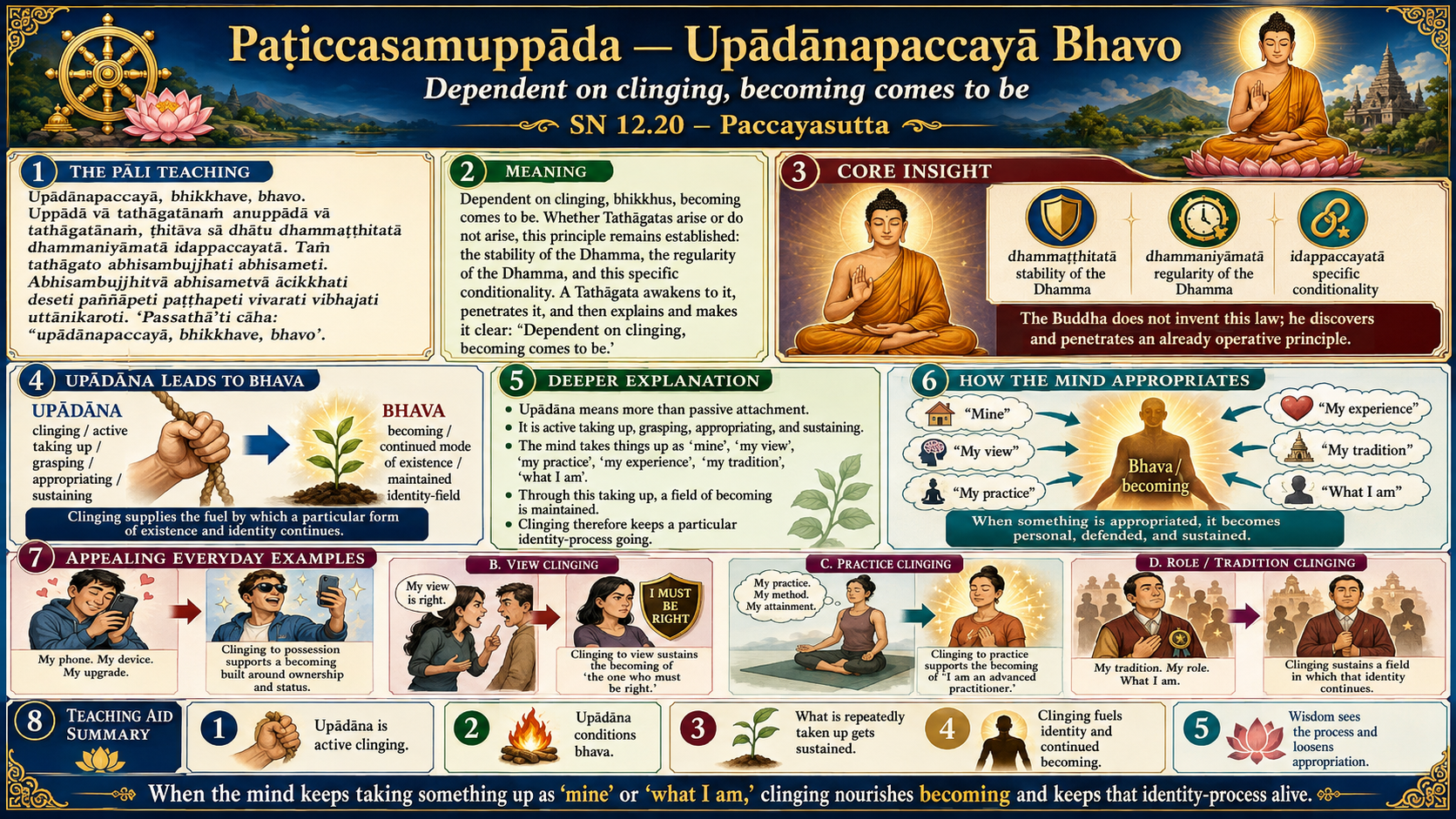
03 Clinging conditions becoming
Clinging conditions becoming
Upādānapaccayā, bhikkhave, bhavo. Uppādā vā tathāgatānaṁ anuppādā vā tathāgatānaṁ, ṭhitāva sā dhātu dhammaṭṭhitatā dhammaniyāmatā idappaccayatā. Taṁ tathāgato abhisambujjhati abhisameti. Abhisambujjhitvā abhisametvā ācikkhati deseti paññāpeti paṭṭhapeti vivarati vibhajati uttānīkaroti. ‘Passathā’ti cāha: ‘upādānapaccayā, bhikkhave, bhavo’.
“Dependent on clinging, bhikkhus, becoming comes to be.
Whether Tathāgatas arise or whether Tathāgatas do not arise, that principle remains established: the stability of the Dhamma, the fixed regularity of the Dhamma, and this specific conditionality. A Tathāgata fully awakens to it and penetrates it. Having fully awakened to it and penetrated it, he explains it, teaches it, makes it known, establishes it, discloses it, analyzes it, and makes it plain. He says, ‘See! Dependent on clinging, bhikkhus, becoming comes to be.’”
Upādāna means more than attachment. It is an active taking up, grasping, appropriating and sustaining.
The mind takes something up as:
◉ mine
◉ my view
◉ my practice
◉ my experience
◉ my tradition
◉ what I am
Through this taking up, a field of becoming is maintained. Clinging therefore supplies the fuel by which a particular form of existence and identity continues.
Clinging conditions becoming
Conditional Link 03
Visual teaching aid for this link in the dependent-arising sequence.
Click infographic to enlarge ↗
04 Craving conditions clinging
Craving conditions clinging
Taṇhāpaccayā, bhikkhave, upādānaṁ. Uppādā vā tathāgatānaṁ anuppādā vā tathāgatānaṁ, ṭhitāva sā dhātu dhammaṭṭhitatā dhammaniyāmatā idappaccayatā. Taṁ tathāgato abhisambujjhati abhisameti. Abhisambujjhitvā abhisametvā ācikkhati deseti paññāpeti paṭṭhapeti vivarati vibhajati uttānīkaroti. ‘Passathā’ti cāha: ‘taṇhāpaccayā, bhikkhave, upādānaṁ’.
“Dependent on craving, bhikkhus, clinging comes to be. Whether Tathāgatas arise or whether Tathāgatas do not arise, that principle remains established: the stability of the Dhamma, the fixed regularity of the Dhamma, and this specific conditionality. A Tathāgata fully awakens to it and penetrates it. Having fully awakened to it and penetrated it, he explains it, teaches it, makes it known, establishes it, discloses it, analyzes it, and makes it plain. He says, ‘See! Dependent on craving, bhikkhus, clinging comes to be.’”
Taṇhā is thirst:
◉ thirst to obtain
◉ thirst to continue
◉ thirst to become
◉ thirst to remove
◉ thirst to annihilate
◉ thirst to prevent change
At the stage of taṇhā, the mind reaches toward or pushes against experience.
When this thirst is repeatedly acted upon, it hardens into upādāna:
◉ desire becomes possession;
◉ preference becomes identity;
◉ an opinion becomes “my truth”;
◉ an experience becomes “my attainment.”
Craving conditions clinging
Conditional Link 04
Visual teaching aid for this link in the dependent-arising sequence.

Click infographic to enlarge ↗
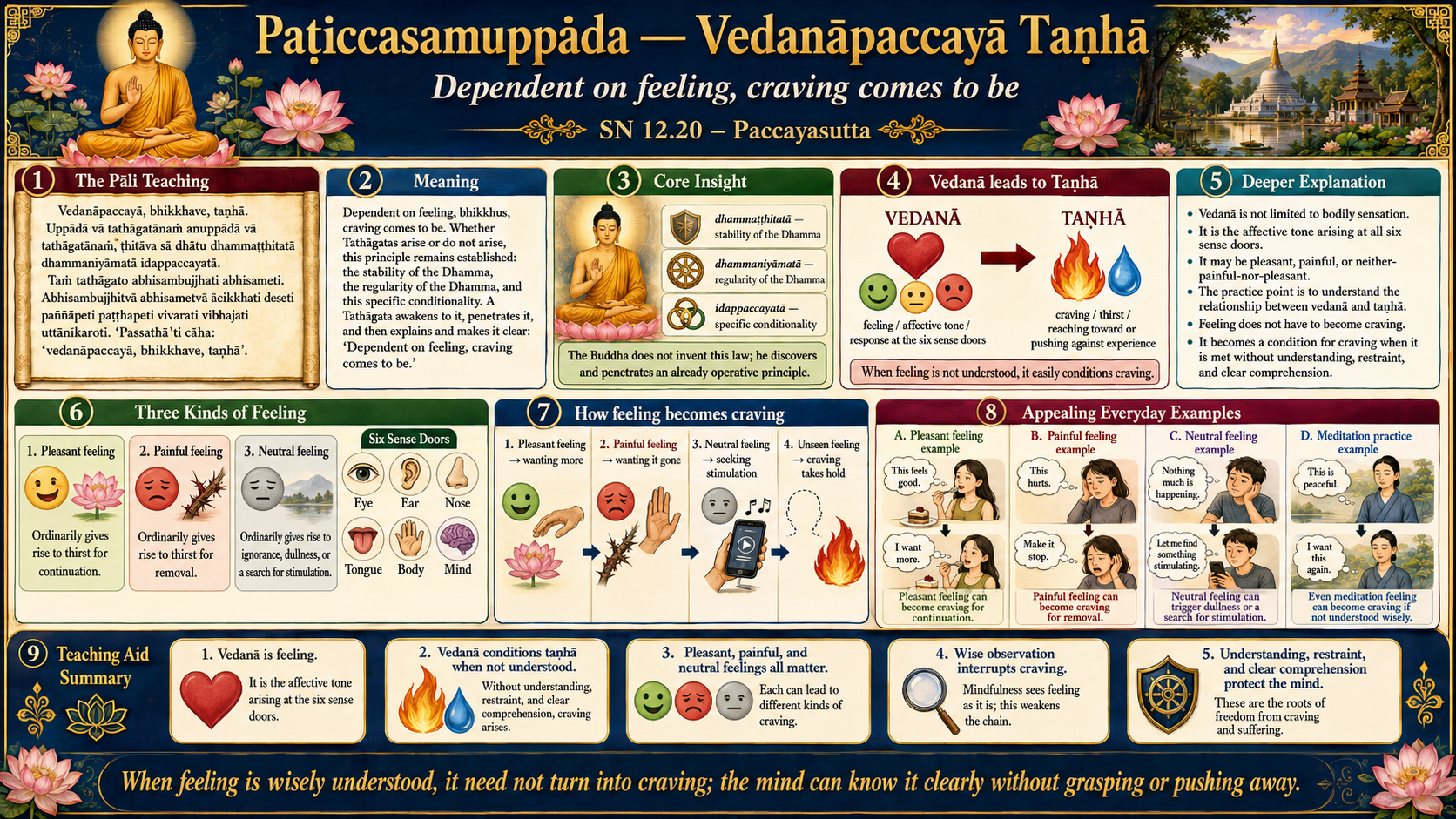
05 Feeling conditions craving
Feeling conditions craving
Vedanāpaccayā, bhikkhave, taṇhā. Uppādā vā tathāgatānaṁ anuppādā vā tathāgatānaṁ, ṭhitāva sā dhātu dhammaṭṭhitatā dhammaniyāmatā idappaccayatā. Taṁ tathāgato abhisambujjhati abhisameti. Abhisambujjhitvā abhisametvā ācikkhati deseti paññāpeti paṭṭhapeti vivarati vibhajati uttānīkaroti. ‘Passathā’ti cāha: ‘vedanāpaccayā, bhikkhave, taṇhā’.
“Dependent on feeling, bhikkhus, craving comes to be.
Whether Tathāgatas arise or whether Tathāgatas do not arise, that principle remains established: the stability of the Dhamma, the fixed regularity of the Dhamma, and this specific conditionality. A Tathāgata fully awakens to it and penetrates it. Having fully awakened to it and penetrated it, he explains it, teaches it, makes it known, establishes it, discloses it, analyzes it, and makes it plain. He says, ‘See! Dependent on feeling, bhikkhus, craving comes to be.’”
Vedanā is not limited to bodily sensation. It is the affective tone arising at all six sense doors:
◉ pleasant;
◉ painful;
◉ neither-painful-nor-pleasant.
Ordinarily:
◉ pleasant feeling produces thirst for continuation;
◉ painful feeling produces thirst for removal;
◉ neutral feeling produces ignorance, dullness or a search for stimulation.
The decisive practice point is therefore not merely to observe objects, but to understand the relationship between vedanā and taṇhā.
Feeling does not have to become craving. It becomes a condition for craving when it is met without understanding, restraint and clear comprehension.
Feeling conditions craving
Conditional Link 05
Visual teaching aid for this link in the dependent-arising sequence.
Click infographic to enlarge ↗
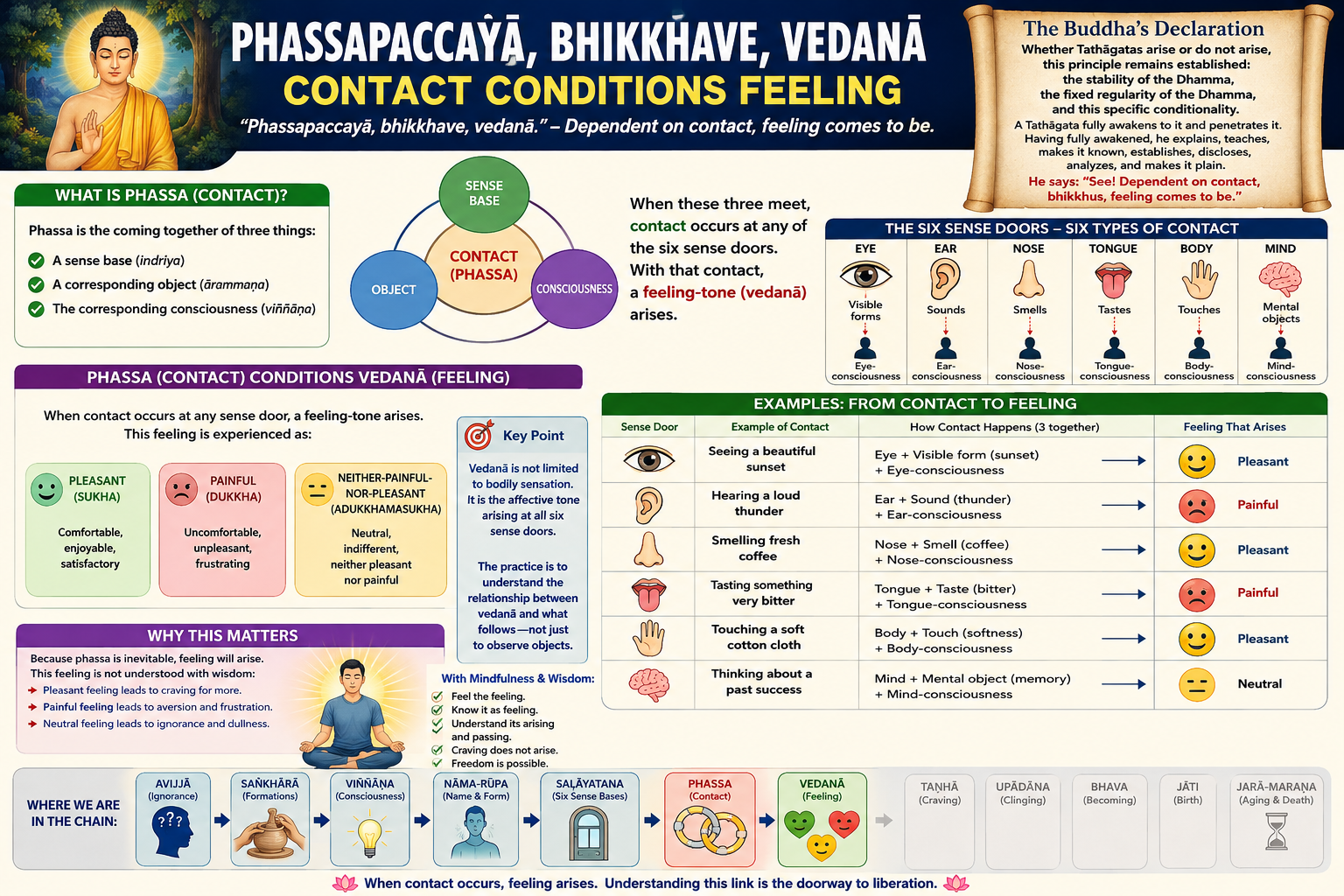
06 Contact conditions feeling
Contact conditions feeling
Phassapaccayā, bhikkhave, vedanā. Uppādā vā tathāgatānaṁ anuppādā vā tathāgatānaṁ, ṭhitāva sā dhātu dhammaṭṭhitatā dhammaniyāmatā idappaccayatā. Taṁ tathāgato abhisambujjhati abhisameti. Abhisambujjhitvā abhisametvā ācikkhati deseti paññāpeti paṭṭhapeti vivarati vibhajati uttānīkaroti. ‘Passathā’ti cāha: ‘phassapaccayā, bhikkhave, vedanā’.
“Dependent on contact, bhikkhus, feeling comes to be. Whether Tathāgatas arise or whether Tathāgatas do not arise, that principle remains established: the stability of the Dhamma, the fixed regularity of the Dhamma, and this specific conditionality. A Tathāgata fully awakens to it and penetrates it. Having fully awakened to it and penetrated it, he explains it, teaches it, makes it known, establishes it, discloses it, analyzes it, and makes it plain. He says, ‘See! Dependent on contact, bhikkhus, feeling comes to be.’”
Phassa is the coming together of:
◉ a sense base
◉ a corresponding object
◉ the corresponding consciousness.
For example: eye -> visible form -> eye-consciousness. Their meeting is eye-contact. With that contact, a feeling-tone arises. This explains why vedanā is present not only with the body but also with:
◉ sights;
◉ sounds;
◉ smells;
◉ tastes;
◉ touches;
◉ mental objects.
Contact conditions feeling
Conditional Link 06
Visual teaching aid for this link in the dependent-arising sequence.
Click infographic to enlarge ↗
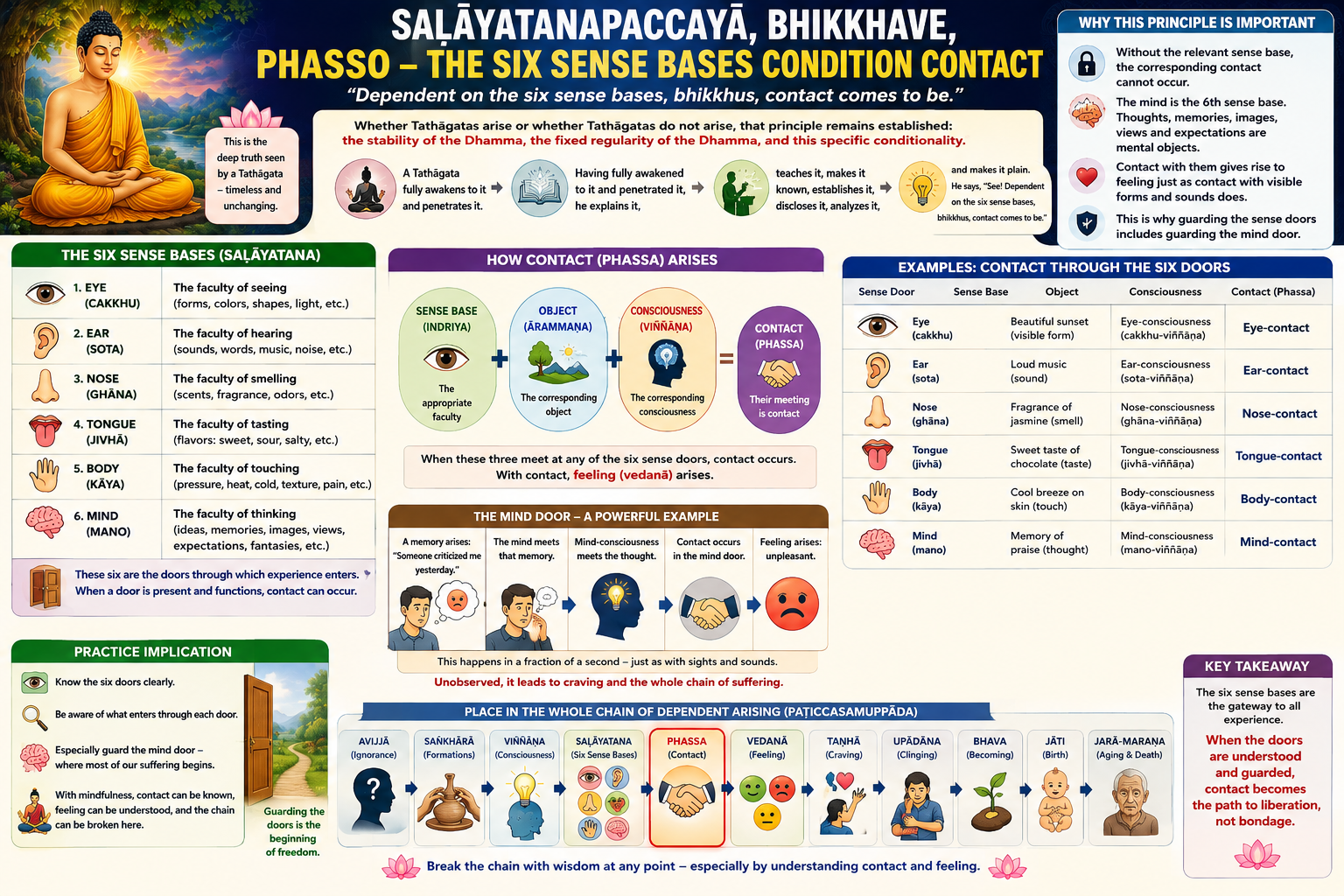
07 The six sense bases condition contact
The six sense bases condition contact
Saḷāyatanapaccayā, bhikkhave, phasso. Uppādā vā tathāgatānaṁ anuppādā vā tathāgatānaṁ, ṭhitāva sā dhātu dhammaṭṭhitatā dhammaniyāmatā idappaccayatā. Taṁ tathāgato abhisambujjhati abhisameti. Abhisambujjhitvā abhisametvā ācikkhati deseti paññāpeti paṭṭhapeti vivarati vibhajati uttānīkaroti. ‘Passathā’ti cāha: ‘saḷāyatanapaccayā, bhikkhave, phasso’.
“Dependent on the six sense bases, bhikkhus, contact comes to be. Whether Tathāgatas arise or whether Tathāgatas do not arise, that principle remains established: the stability of the Dhamma, the fixed regularity of the Dhamma, and this specific conditionality. A Tathāgata fully awakens to it and penetrates it. Having fully awakened to it and penetrated it, he explains it, teaches it, makes it known, establishes it, discloses it, analyzes it, and makes it plain. He says, ‘See! Dependent on the six sense bases, bhikkhus, contact comes to be.’”
The six sense bases are:
◉ eye
◉ ear
◉ nose
◉ tongue
◉ body
◉ mind
Without the relevant sense base, the corresponding contact cannot occur. The inclusion of the mind as the sixth sense base is important. Thoughts, memories, images, views and expectations are mental objects. Contact with them gives rise to feeling just as contact with visible forms and sounds does. This is why guarding the sense doors includes guarding the mind door.
The six sense bases condition contact
Conditional Link 07
Visual teaching aid for this link in the dependent-arising sequence.
Click infographic to enlarge ↗
08 Name-and-form conditions the six sense bases
Name-and-form conditions the six sense bases
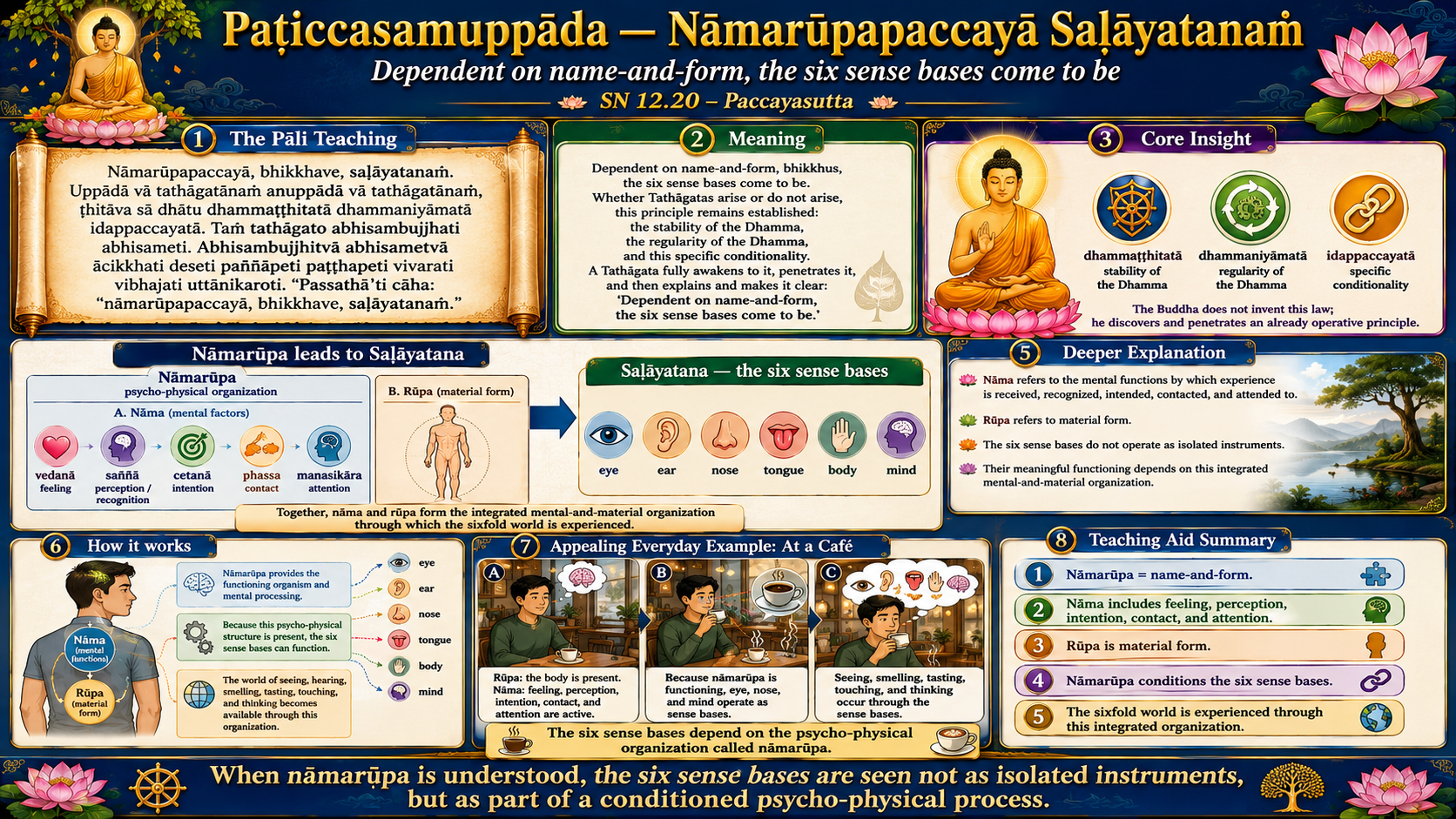
Nāmarūpapaccayā, bhikkhave, saḷāyatanaṁ. Uppādā vā tathāgatānaṁ anuppādā vā tathāgatānaṁ, ṭhitāva sā dhātu dhammaṭṭhitatā dhammaniyāmatā idappaccayatā. Taṁ tathāgato abhisambujjhati abhisameti. Abhisambujjhitvā abhisametvā ācikkhati deseti paññāpeti paṭṭhapeti vivarati vibhajati uttānīkaroti. ‘Passathā’ti cāha: ‘nāmarūpapaccayā, bhikkhave, saḷāyatanaṁ’.
“Dependent on name-and-form, bhikkhus, the six sense bases come to be. Whether Tathāgatas arise or whether Tathāgatas do not arise, that principle remains established: the stability of the Dhamma, the fixed regularity of the Dhamma, and this specific conditionality. A Tathāgata fully awakens to it and penetrates it. Having fully awakened to it and penetrated it, he explains it, teaches it, makes it known, establishes it, discloses it, analyzes it, and makes it plain.
He says, ‘See! Dependent on name-and-form, bhikkhus, the six sense bases come to be.’” Nāma refers to the mental functions by which experience is received, recognized, intended, contacted and attended to.
It is traditionally explained through:
◉ vedanā — feeling
◉ saññā — recognition or perception
◉ cetanā — intention
◉ phassa — contact
◉ manasikāra — attention
Rūpa refers to material form
Together, nāma and rūpa form the psycho-physical organization through which the sixfold world is experienced.
The six sense bases do not operate as isolated instruments. Their meaningful functioning depends on this integrated mental-and-material organization.
Name-and-form conditions the six sense bases
Conditional Link 08
Visual teaching aid for this link in the dependent-arising sequence.
Click infographic to enlarge ↗
09 Consciousness conditions name-and-form
Consciousness conditions name-and-form
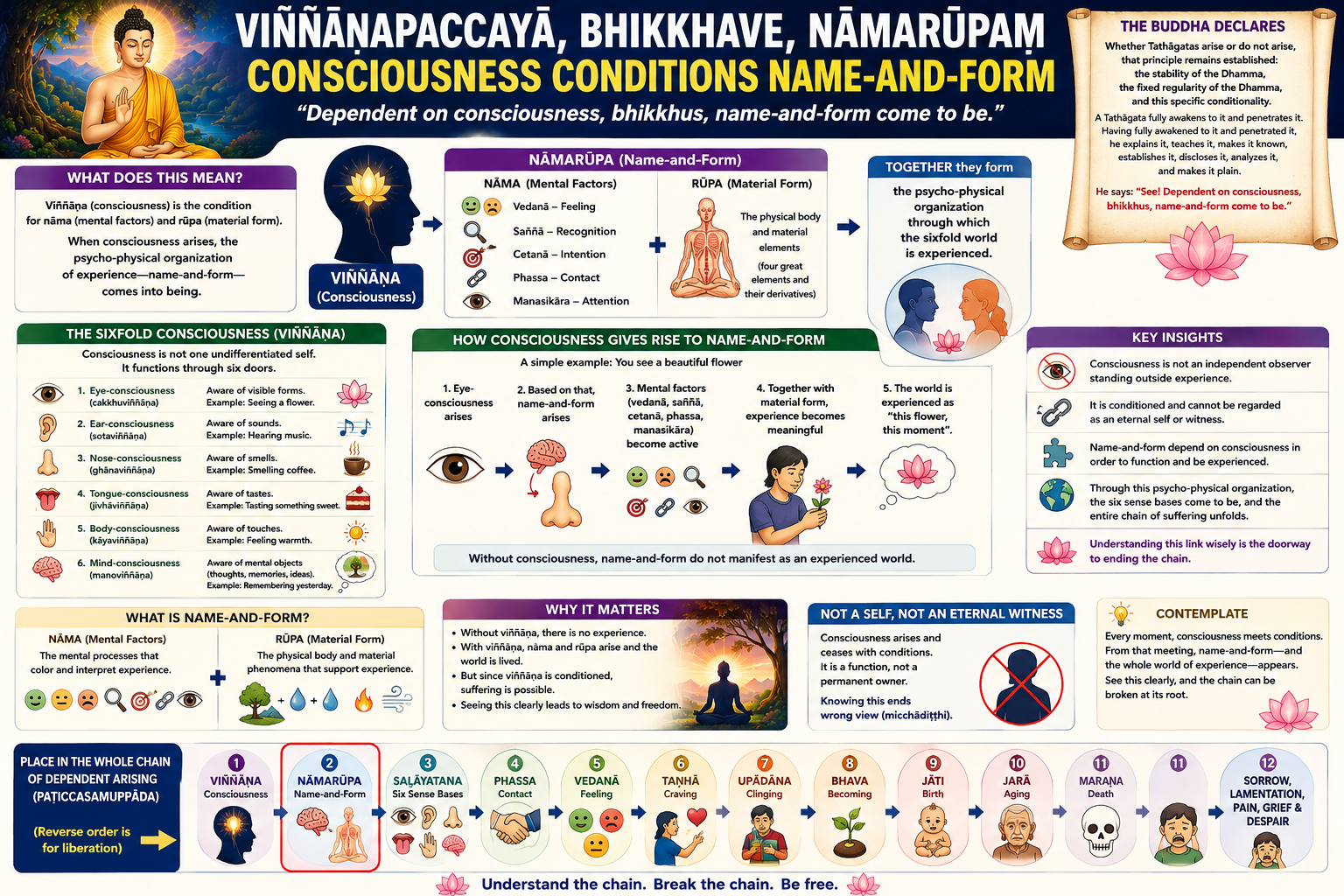
Viññāṇapaccayā, bhikkhave, nāmarūpaṁ. Uppādā vā tathāgatānaṁ anuppādā vā tathāgatānaṁ, ṭhitāva sā dhātu dhammaṭṭhitatā dhammaniyāmatā idappaccayatā. Taṁ tathāgato abhisambujjhati abhisameti. Abhisambujjhitvā abhisametvā ācikkhati deseti paññāpeti paṭṭhapeti vivarati vibhajati uttānīkaroti. ‘Passathā’ti cāha: ‘viññāṇapaccayā, bhikkhave, nāmarūpaṁ’.
“Dependent on consciousness, bhikkhus, name-and-form come to be. Whether Tathāgatas arise or whether Tathāgatas do not arise, that principle remains established: the stability of the Dhamma, the fixed regularity of the Dhamma, and this specific conditionality. A Tathāgata fully awakens to it and penetrates it. Having fully awakened to it and penetrated it, he explains it, teaches it, makes it known, establishes it, discloses it, analyzes it, and makes it plain.
He says, ‘See! Dependent on consciousness, bhikkhus, name-and-form come to be.’”
Viññāṇa is differentiated consciousness:
eye-consciousness; ear-consciousness; nose-consciousness; tongue-consciousness; body-consciousness; mind-consciousness. It is not presented as an independent observer standing outside experience. Without consciousness, name-and-form cannot manifest as an experienced world. At the same time, consciousness is itself conditioned and cannot be regarded as an eternal self or witness.
Consciousness conditions name-and-form
Conditional Link 09
Visual teaching aid for this link in the dependent-arising sequence.
Click infographic to enlarge ↗
10 Volitional constructions condition consciousness
Volitional constructions condition consciousness
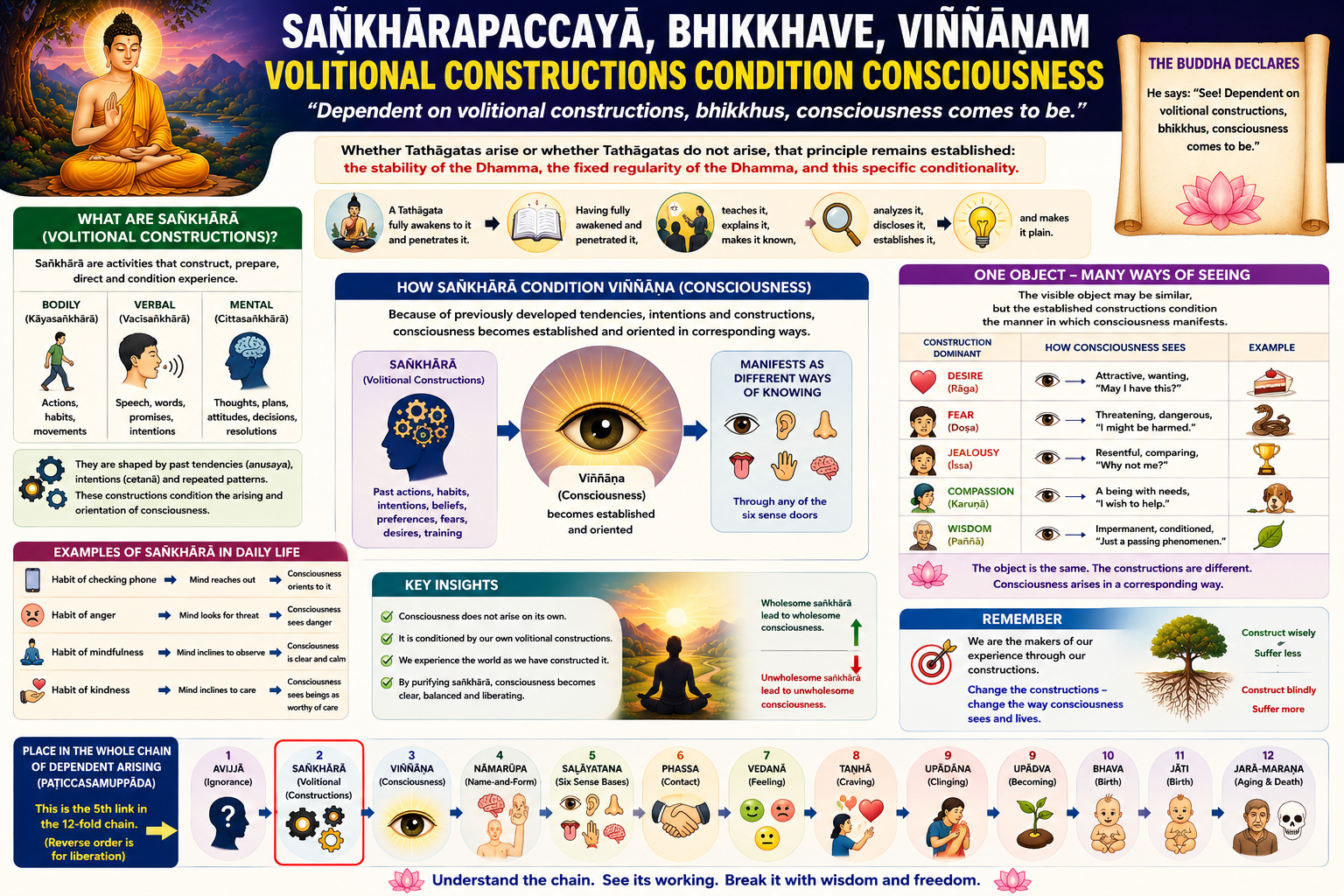
Saṅkhārapaccayā, bhikkhave, viññāṇaṁ. Uppādā vā tathāgatānaṁ anuppādā vā tathāgatānaṁ, ṭhitāva sā dhātu dhammaṭṭhitatā dhammaniyāmatā idappaccayatā. Taṁ tathāgato abhisambujjhati abhisameti. Abhisambujjhitvā abhisametvā ācikkhati deseti paññāpeti paṭṭhapeti vivarati vibhajati uttānīkaroti. ‘Passathā’ti cāha: ‘saṅkhārapaccayā, bhikkhave, viññāṇaṁ’.
“Dependent on volitional constructions, bhikkhus, consciousness comes to be. Whether Tathāgatas arise or whether Tathāgatas do not arise, that principle remains established: the stability of the Dhamma, the fixed regularity of the Dhamma, and this specific conditionality. A Tathāgata fully awakens to it and penetrates it. Having fully awakened to it and penetrated it, he explains it, teaches it, makes it known, establishes it, discloses it, analyzes it, and makes it plain.
He says, ‘See! Dependent on volitional constructions, bhikkhus, consciousness comes to be.’”
Saṅkhārā are activities that construct, prepare, direct and condition experience. They operate bodily, verbally and mentally. Because of previously developed tendencies, intentions and constructions, consciousness becomes established and oriented in corresponding ways. Thus, one person may see an object through:
◉ desire
◉ fear
◉ jealousy
◉ compassion
◉ wisdom
The visible object may be similar, but the established constructions condition the manner in which consciousness manifests.
Volitional constructions condition consciousness
Conditional Link 10
Visual teaching aid for this link in the dependent-arising sequence.
Click infographic to enlarge ↗
11 Ignorance conditions volitional constructions
Ignorance conditions volitional constructions
Avijjāpaccayā, bhikkhave, saṅkhārā. Uppādā vā tathāgatānaṁ anuppādā vā tathāgatānaṁ, ṭhitāva sā dhātu dhammaṭṭhitatā dhammaniyāmatā idappaccayatā. Taṁ tathāgato abhisambujjhati abhisameti. Abhisambujjhitvā abhisametvā ācikkhati deseti paññāpeti paṭṭhapeti vivarati vibhajati uttānīkaroti. ‘Passathā’ti cāha: ‘avijjāpaccayā, bhikkhave, saṅkhārā’.
“Dependent on ignorance, bhikkhus, volitional constructions come to be. Whether Tathāgatas arise or whether Tathāgatas do not arise, that principle remains established: the stability of the Dhamma, the fixed regularity of the Dhamma, and this specific conditionality. A Tathāgata fully awakens to it and penetrates it. Having fully awakened to it and penetrated it, he explains it, teaches it, makes it known, establishes it, discloses it, analyzes it, and makes it plain. He says, ‘See! Dependent on ignorance, bhikkhus, volitional constructions come to be.’”
Avijjā is not merely the absence of information.
It is not knowing experience in terms of:
◉ suffering
◉ the arising of suffering
◉ the cessation of suffering
◉ the way leading to its cessation
Because the nature of experience is not understood, activities are constructed under the influence of:
◉ permanence
◉ satisfactoriness
◉ ownership
◉ identity
◉ control
Avijjā therefore conditions the very activities that continue the structure of suffering. However, as the next section makes clear, avijjā itself is conditioned, impermanent and capable of cessation. It is not a first cause or eternal principle. The precise meaning of paṭiccasamuppāda
Iti kho, bhikkhave, yā tatra tathatā avitathatā anaññathatā idappaccayatā—ayaṁ vuccati, bhikkhave, paṭiccasamuppādo.
“Thus, bhikkhus, the suchness in this, its non-falseness, its non-otherwiseness and its specific conditionality: this is called dependent arising.” Explanation of the four expressions
Tathatā — suchness – The relationship operates in accordance with its nature. When the required conditions are established, the corresponding result occurs. This is not referring to a mystical substance called “suchness.” It refers to the dependability of the conditional relationship.
Avitathatā — non-falseness – The relationship does not deceive.
Craving accompanied by continued appropriation does not lead to freedom from appropriation. Clinging does not produce release. Birth does not avoid aging and death.
Anaññathatā — non-otherwiseness – The relationship does not operate arbitrarily or become something entirely different. Feeling conditions craving when ignorance and habitual reaction are operating. Craving conditions clinging. Clinging conditions becoming.
Idappaccayatā — specific conditionality – Literally, it is the state of having this as condition. This is more precise than saying that everything causes everything else. It means: This particular phenomenon, under relevant conditions, supports the arising or continuation of that particular phenomenon.
Ignorance conditions volitional constructions
Conditional Link 11
Visual teaching aid for this link in the dependent-arising sequence.

Click infographic to enlarge ↗
Paṭiccasamuppannā Dhammā — Phenomena Arisen Dependently
PART TWO
PAṬICCASAMUPPANNĀ DHAMMĀ – PHENOMENA THAT HAVE ARISEN DEPENDENTLY
The Buddha asks about dependently arisen phenomena
Katame ca, bhikkhave, paṭiccasamuppannā dhammā? “And what, bhikkhus, are the phenomena that have arisen dependently?” The Buddha now turns from the principle of conditionality to the actual phenomena occurring within the conditional structure. Every member of the sequence is:
◉ conditioned
◉ dependently arisen
◉ impermanent
◉ liable to exhaustion
◉ liable to passing away
◉ liable to fading
◉ liable to cessation
Seven characteristics repeatedly applied to the conditioned factors
Anicca — Impermanent.
Saṅkhata — Conditioned or constructed.
Paṭiccasamuppanna — Dependently arisen.
Khayadhamma — Subject to exhaustion.
Vayadhamma — Subject to passing away.
Virāgadhamma — Subject to fading.
Nirodhadhamma — Subject to cessation.
The twelve dependently arisen factors examined in the discourse
Aging and death — Conditioned, dependently arisen, impermanent, and capable of cessation.
Birth — Conditioned, dependently arisen, impermanent, and capable of cessation.
Becoming — Conditioned, dependently arisen, impermanent, and capable of cessation.
Clinging — Conditioned, dependently arisen, impermanent, and capable of cessation.
Craving — Conditioned, dependently arisen, impermanent, and capable of cessation.
Feeling — Conditioned, dependently arisen, impermanent, and capable of cessation.
Contact — Conditioned, dependently arisen, impermanent, and capable of cessation.
The six sense bases — Conditioned, dependently arisen, impermanent, and capable of cessation.
Name-and-form — Conditioned, dependently arisen, impermanent, and capable of cessation.
Consciousness — Conditioned, dependently arisen, impermanent, and capable of cessation.
Volitional constructions — Conditioned, dependently arisen, impermanent, and capable of cessation.
Ignorance — Conditioned, dependently arisen, impermanent, and capable of cessation.
Paṭiccasamuppannā Dhammā
The conditioned members of the sequence
A visual teaching aid accompanying the source discussion of the dependently arisen phenomena.
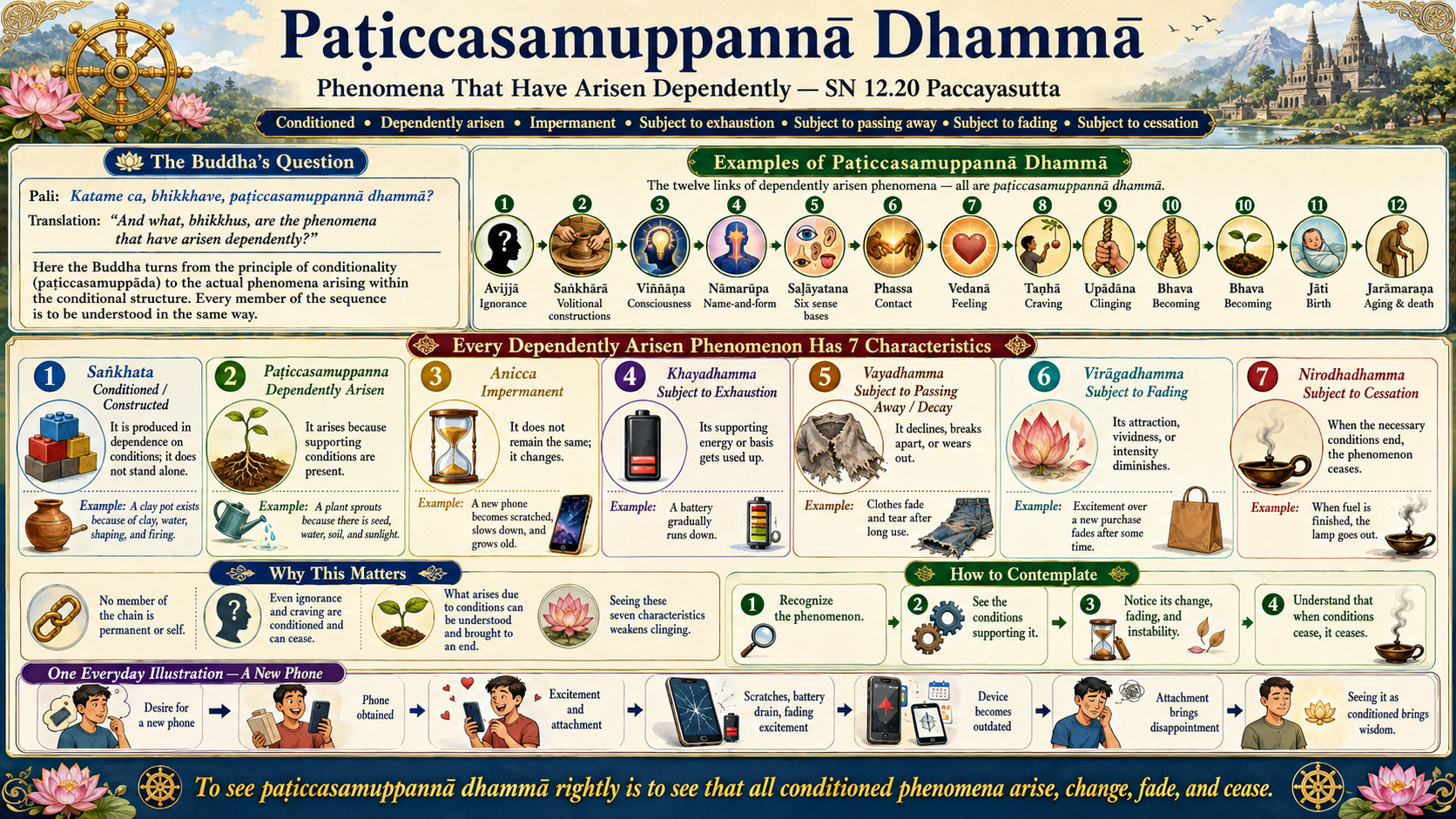
Click infographic to enlarge ↗
01 Complete Part II — Pāḷi, translation and explanation
1 Aging and death
Jarāmaraṇaṁ, bhikkhave, aniccaṁ saṅkhataṁ paṭiccasamuppannaṁ khayadhammaṁ vayadhammaṁ virāgadhammaṁ nirodhadhammaṁ.
“Aging and death, bhikkhus, are impermanent, conditioned, dependently arisen, subject to exhaustion, subject to passing away, subject to fading and subject to cessation.”
2 Birth
Jāti, bhikkhave, aniccā saṅkhatā paṭiccasamuppannā khayadhammā vayadhammā virāgadhammā nirodhadhammā.
“Birth, bhikkhus, is impermanent, conditioned, dependently arisen, subject to exhaustion, subject to passing away, subject to fading and subject to cessation.”
3 Becoming
Bhavo, bhikkhave, anicco saṅkhato paṭiccasamuppanno khayadhammo vayadhammo virāgadhammo nirodhadhammo.
“Becoming, bhikkhus, is impermanent, conditioned, dependently arisen, subject to exhaustion, subject to passing away, subject to fading and subject to cessation.”
4 Clinging
Upādānaṁ, bhikkhave, aniccaṁ saṅkhataṁ paṭiccasamuppannaṁ khayadhammaṁ vayadhammaṁ virāgadhammaṁ nirodhadhammaṁ.
“Clinging, bhikkhus, is impermanent, conditioned, dependently arisen, subject to exhaustion, subject to passing away, subject to fading and subject to cessation.”
5 Craving
Taṇhā, bhikkhave, aniccā saṅkhatā paṭiccasamuppannā khayadhammā vayadhammā virāgadhammā nirodhadhammā.
“Craving, bhikkhus, is impermanent, conditioned, dependently arisen, subject to exhaustion, subject to passing away, subject to fading and subject to cessation.”
6 Feeling
Vedanā, bhikkhave, aniccā saṅkhatā paṭiccasamuppannā khayadhammā vayadhammā virāgadhammā nirodhadhammā.
“Feeling, bhikkhus, is impermanent, conditioned, dependently arisen, subject to exhaustion, subject to passing away, subject to fading and subject to cessation.”
7 Contact
Phasso, bhikkhave, anicco saṅkhato paṭiccasamuppanno khayadhammo vayadhammo virāgadhammo nirodhadhammo.
“Contact, bhikkhus, is impermanent, conditioned, dependently arisen, subject to exhaustion, subject to passing away, subject to fading and subject to cessation.”
8 The six sense bases
Saḷāyatanaṁ, bhikkhave, aniccaṁ saṅkhataṁ paṭiccasamuppannaṁ khayadhammaṁ vayadhammaṁ virāgadhammaṁ nirodhadhammaṁ.
“The six sense bases, bhikkhus, are impermanent, conditioned, dependently arisen, subject to exhaustion, subject to passing away, subject to fading and subject to cessation.”
9 Name-and-form
Nāmarūpaṁ, bhikkhave, aniccaṁ saṅkhataṁ paṭiccasamuppannaṁ khayadhammaṁ vayadhammaṁ virāgadhammaṁ nirodhadhammaṁ.
“Name-and-form, bhikkhus, is impermanent, conditioned, dependently arisen, subject to exhaustion, subject to passing away, subject to fading and subject to cessation.”
10 Consciousness
Viññāṇaṁ, bhikkhave, aniccaṁ saṅkhataṁ paṭiccasamuppannaṁ khayadhammaṁ vayadhammaṁ virāgadhammaṁ nirodhadhammaṁ.
“Consciousness, bhikkhus, is impermanent, conditioned, dependently arisen, subject to exhaustion, subject to passing away, subject to fading and subject to cessation.” This statement directly prevents consciousness from being taken as an eternal self, pure observer or permanent witness.
Consciousness is:
◉ conditioned
◉ dependently arisen
◉ impermanent
◉ liable to cessation
The Buddha does not place an unconditioned consciousness behind conditioned experience.
11 Volitional constructions
Saṅkhārā, bhikkhave, aniccā saṅkhatā paṭiccasamuppannā khayadhammā vayadhammā virāgadhammā nirodhadhammā.
“Volitional constructions, bhikkhus, are impermanent, conditioned, dependently arisen, subject to exhaustion, subject to passing away, subject to fading and subject to cessation.”
Important distinction
Saṅkhārā are conditioning activities or constructions.
Saṅkhatā means conditioned or constructed.
Thus, saṅkhārā themselves are saṅkhatā. The conditioning activities are not independent; they too have arisen because of conditions.
12 Ignorance
Avijjā, bhikkhave, aniccā saṅkhatā paṭiccasamuppannā khayadhammā vayadhammā virāgadhammā nirodhadhammā.
“Ignorance, bhikkhus, is impermanent, conditioned, dependently arisen, subject to exhaustion, subject to passing away, subject to fading and subject to cessation.”
This is one of the most significant statements in the discourse.
Although the forward sequence begins with:
Avijjāpaccayā saṅkhārā – Dependent on ignorance, constructions arise, the Buddha does not present ignorance as an absolute beginning.
Ignorance itself is:
◉ conditioned;
◉ dependently arisen;
◉ impermanent;
◉ capable of fading;
◉ capable of cessation.
Therefore, the sequence does not propose an eternal first cause. It reveals the conditions presently sustaining suffering so that those conditions can be understood and brought to cessation.
13 Conclusion of this section
Ime vuccanti, bhikkhave, paṭiccasamuppannā dhammā.
These, bhikkhus, are called the phenomena that have arisen dependently
The practical distinction
The reliable relationship and the changing participants
| Paṭiccasamuppāda | Paṭiccasamuppannā dhammā |
|---|---|
| The principle of conditionality | The phenomena arising through conditions |
| “Dependent on this, that comes to be” | Avijjā, saṅkhārā, viññāṇa and the remaining factors |
| Tathatā, avitathatā, anaññathatā, idappaccayatā | Anicca, saṅkhata, khayadhamma, vayadhamma, virāgadhamma, nirodhadhamma |
| The dependable relationship | The impermanent participants in the relationship |
| Discovered and explained by a Buddha | Directly observed as arising and ceasing |
The conditional principle remains true, but the conditioned phenomena do not remain.
For example, Vedanāpaccayā taṇhā — feeling conditions craving. The dependability of that conditional relationship is paṭiccasamuppāda.
But the particular feeling and craving occurring within that relationship are paṭiccasamuppannā dhammā—conditioned phenomena that arise, change and cease.
The particular feeling — is impermanent.
The particular craving — is impermanent.
Both phenomena — are dependently arisen.
Both phenomena — can cease.
How Right Seeing Ends Speculation About “I”
Past speculation — The question shifts from “What was I?” to “Dependent on what did this phenomenon arise?”
Future speculation — The practical question becomes: what conditions am I presently establishing?
Present identity — The conditioned process is examined without adding an independent controller or permanent witness.
Right seeing — Yathābhūtaṁ, sammappaññāya, sudiṭṭhā — see the process as it actually is, with right wisdom, thoroughly.
Feeling as the junction — At the six doors: phassa → vedanā → taṇhā. Feeling need not become craving.
Practice — Investigate condition, arising, continuation and cessation instead of constructing identity.
01 Complete explanation — from identity speculation to conditional seeing
PART THREE – HOW RIGHT SEEING ENDS SPECULATION ABOUT “I”
Seeing dependent arising correctly
Yato kho, bhikkhave, ariyasāvakassa ‘ayañca paṭiccasamuppādo, ime ca paṭiccasamuppannā dhammā’ yathābhūtaṁ sammappaññāya sudiṭṭhā honti, so vata pubbantaṁ vā paṭidhāvissati:
“When, bhikkhus, a noble disciple has clearly seen with right wisdom, as it actually is, ‘This is dependent arising, and these are the dependently arisen phenomena,’ would he run back toward the past in speculation?”
This is not merely knowledge acquired from a book. The expressions are strong:
◉ yathābhūtaṁ — as it has actually come to be
◉ sammappaññāya — with right or correct wisdom
◉ sudiṭṭhā — thoroughly and clearly seen
The noble disciple sees experience as a conditional process rather than as the activity of an independent, permanent “I.”
Speculation about the past
‘Ahosiṁ nu kho ahaṁ atītamaddhānaṁ, nanu kho ahosiṁ atītamaddhānaṁ, kiṁ nu kho ahosiṁ atītamaddhānaṁ, kathaṁ nu kho ahosiṁ atītamaddhānaṁ, kiṁ hutvā kiṁ ahosiṁ nu kho ahaṁ atītamaddhānan’ti;
◉ Did I exist in the past?
◉ Did I not exist in the past?
◉ What was I in the past?
◉ How was I in the past?
◉ Having been what, what did I become in the past?’”
All these questions begin with an assumed entity: “I.”
The investigation then tries to determine:
◉ whether this “I” existed?
◉ what kind of thing it was?
◉ what form it possessed?
◉ how it moved from one existence or state into another?
Dependent arising changes the question.Instead of asking: What was I? wisdom investigates: Dependent on what did this phenomenon arise?
The focus shifts:
◉ from entity to condition
◉ from identity to process
◉ from speculation to direct knowledge
This does not mean that the Buddha denies conventional continuity. It means that continuity should not be misconceived as a permanent owner traveling unchanged through conditions.
Speculation about the future
Aparantaṁ vā upadhāvissati: ‘bhavissāmi nu kho ahaṁ anāgatamaddhānaṁ, nanu kho bhavissāmi anāgatamaddhānaṁ, kiṁ nu kho bhavissāmi anāgatamaddhānaṁ, kathaṁ nu kho bhavissāmi anāgatamaddhānaṁ, kiṁ hutvā kiṁ bhavissāmi nu kho ahaṁ anāgatamaddhānan’ti
“Or would he run forward toward the future in speculation:
◉ Will I exist in the future?
◉ Will I not exist in the future?
◉ What will I be in the future?
◉ How will I be in the future?
◉ Having been what, what will I become in the future?’”
These questions arise from craving and clinging to existence or non-existence:
◉ Will I continue?
◉ What will happen to me?
◉ Will I become something superior?
◉ Will I disappear completely?
The noble disciple does not solve these anxieties by constructing a more pleasing theory of self. He understands the present conditions producing becoming.
When:
◉ craving is present
◉ clinging is present
◉ becoming is cultivated; birth follows
When those conditions cease, the corresponding birth and suffering cease.
The practical question is therefore not: What will I become? It is: What conditions am I presently establishing?
Confusion regarding the present
Etarahi vā paccuppannaṁ addhānaṁ ajjhattaṁ kathaṅkathī bhavissati: ‘ahaṁ nu khosmi, no nu khosmi, kiṁ nu khosmi, kathaṁ nu khosmi, ayaṁ nu kho satto kuto āgato, so kuhiṁ gamissatī’ti—netaṁ ṭhānaṁ vijjati.
Or would he now, regarding the present period, be inwardly uncertain:
Am I?
Am I not?
What am I?
How am I?
Where has this being come from?
Where will this being go?’
That is not possible
Explanation of the questions
Ahaṁ nu khosmi? — Am I? – This seeks affirmation of an enduring entity.
No nu khosmi? — Am I not? – This moves toward the opposite extreme: total denial or annihilation.
Kiṁ nu khosmi? — What am I?
This attempts to identify the self with:
◉ the body
◉ feeling
◉ perception
◉ constructions
◉ consciousness
◉ something possessing them
◉ something inside or outside them
Kathaṁ nu khosmi? — How am I? – This seeks a theory about the mode in which the supposed self exists.
Ayaṁ nu kho satto kuto āgato? — Where has this being come from? – This presumes that an independently existing being has entered the present experience from somewhere else.
So kuhiṁ gamissati? — Where will that being go? – This presumes that the same independent entity must depart and continue somewhere.
The Buddha does not replace these questions with another metaphysical theory. He exposes the mistaken basis from which they arise. What is present is a dependently arisen process:
◉ conditioned consciousness
◉ conditioned name-and-form
◉ conditioned sense bases
◉ conditioned contact
◉ conditioned feeling
◉ conditioned craving
◉ conditioned clinging
◉ conditioned becoming
No independent controller needs to be added to the process.
Why such confusion is impossible for the noble disciple?
Taṁ kissa hetu? Tathā hi, bhikkhave, ariyasāvakassa ayañca paṭiccasamuppādo ime ca paṭiccasamuppannā dhammā yathābhūtaṁ sammappaññāya sudiṭṭhā”ti.
Why is that? Because, bhikkhus, the noble disciple has clearly seen with right wisdom, as it actually is, both this dependent arising and these dependently arisen phenomena.” The noble disciple does not merely repeat:
There is no self. Such repetition can itself become a view.
Instead, the disciple directly sees
◉ this arises dependent upon this
◉ when its condition changes, it changes
◉ when its condition ceases, it ceases
◉ none of it is independent
◉ none of it can be permanently possessed
◉ none of it can serve as an unchanging “I.”
The identity question loses its foundation because experience is understood conditionally.
The deepest message of the discourse – A Buddha discovers conditionality; he does not invent it Whether a Buddha appears or not, conditionality operates.
The Buddha’s role is to:
◉ awaken to it
◉ penetrate it
◉ explain it
◉ analyze it
◉ make it directly visible.
Paṭiccasamuppāda is not simply a list of twelve objects
The list reveals conditional relationships and the essence is not merely remembering:
avijjā, saṅkhārā, viññāṇa, nāmarūpa. – The essence is seeing: Dependent on this, that arises.
Every factor, including ignorance, is conditioned and there is no permanent first factor.
Avijjā is itself:
◉ aniccā
◉ saṅkhatā
◉ paṭiccasamuppannā
◉ nirodhadhammā
Therefore, ignorance can be extinguished.
Consciousness is not an eternal witness Viññāṇa is described as:
◉ impermanent
◉ conditioned
◉ dependently arisen
◉ liable to cessation
It cannot be identified as an eternal observer standing behind experience.
Feeling is the crucial practical junction At the six sense doors: phassa → vedanā → taṇhā
Contact gives rise to feeling. When feeling is not understood, craving follows.
Therefore, guarding the sense doors, mindfulness and clear comprehension allow feeling to be known before it develops into thirst, appropriation and becoming.
The sequence is relevant to immediate experience. The discourse does not instruct the disciple merely to construct theories about past and future lives.
Its culmination is freedom from speculation concerning:
what I was
what I will become
what I presently am
This freedom arises by seeing the conditional process directly and the teaching avoids both eternalism and annihilationism
It does not say: An eternal self continues unchanged nor does it say a truly existing self is destroyed.
It shows conditioned continuation without an independent, permanent possessor.
There is:
◉ conditional arising
◉ conditional continuation
◉ conditional cessation
The complete practical sequence – Forward movement of suffering
Avijjāpaccayā saṅkhārā – Not understanding conditions constructions.
Saṅkhārapaccayā viññāṇaṁ – Constructions condition consciousness.
Viññāṇapaccayā nāmarūpaṁ – Consciousness conditions name-and-form.
Nāmarūpapaccayā saḷāyatanaṁ – Name-and-form conditions the six sense bases.
Saḷāyatanapaccayā phasso – The six sense bases condition contact.
Phassapaccayā vedanā – Contact conditions feeling.
Vedanāpaccayā taṇhā – Feeling conditions craving.
Taṇhāpaccayā upādānaṁ – Craving conditions clinging.
Upādānapaccayā bhavo – Clinging conditions becoming.
Bhavapaccayā jāti – Becoming conditions birth.
Jātipaccayā jarāmaraṇaṁ – Birth conditions aging and death.
Practice application At any sense door, examine:
◉ What contact has occurred?
◉ What feeling has arisen?
◉ Is thirst developing toward or against it?
◉ Is the mind taking it up as “mine”?
◉ What kind of becoming is being established?
◉ What identity is being born?
◉ What suffering will follow when that identity changes?
The work is not to suppress feeling.
The work is to know feeling so clearly that ignorance does not turn it into craving.
Final insight: The discourse does not answer the question:
Who suffers?
◉ It reveals: Dependent on what does suffering arise?
◉ It does not answer: Where did I come from and where will I go?
◉ It reveals: What conditions are presently sustaining becoming and birth?
When conditionality and conditioned phenomena are seen with right wisdom
◉ speculation ends
◉ identity-view loses its basis
◉ craving is understood
◉ clinging is abandoned
◉ becoming is no longer nourished
◉ birth and the entire mass of suffering are brought to cessation
The eleven conditional links in sequence
Avijjāpaccayā saṅkhārā — Ignorance conditions volitional constructions.
Saṅkhārapaccayā viññāṇaṁ — Volitional constructions condition consciousness.
Viññāṇapaccayā nāmarūpaṁ — Consciousness conditions name-and-form.
Nāmarūpapaccayā saḷāyatanaṁ — Name-and-form conditions the six sense bases.
Saḷāyatanapaccayā phasso — The six sense bases condition contact.
Phassapaccayā vedanā — Contact conditions feeling.
Vedanāpaccayā taṇhā — Feeling conditions craving.
Taṇhāpaccayā upādānaṁ — Craving conditions clinging.
Upādānapaccayā bhavo — Clinging conditions becoming.
Bhavapaccayā jāti — Becoming conditions birth.
Jātipaccayā jarāmaraṇaṁ — Birth conditions aging and death.
Investigate the sequence at the six sense doors
Contact — What contact has occurred?
Feeling — What feeling-tone has arisen?
Craving — Is thirst moving toward or against it?
Clinging — Is the mind taking it up as “mine”?
Becoming — What mode of becoming is being established?
Birth and suffering — What identity is being born, and what suffering follows?
The work is not to suppress feeling. The work is to know feeling so clearly that ignorance does not turn it into craving.