The Five Warriors and the Battle for Liberation
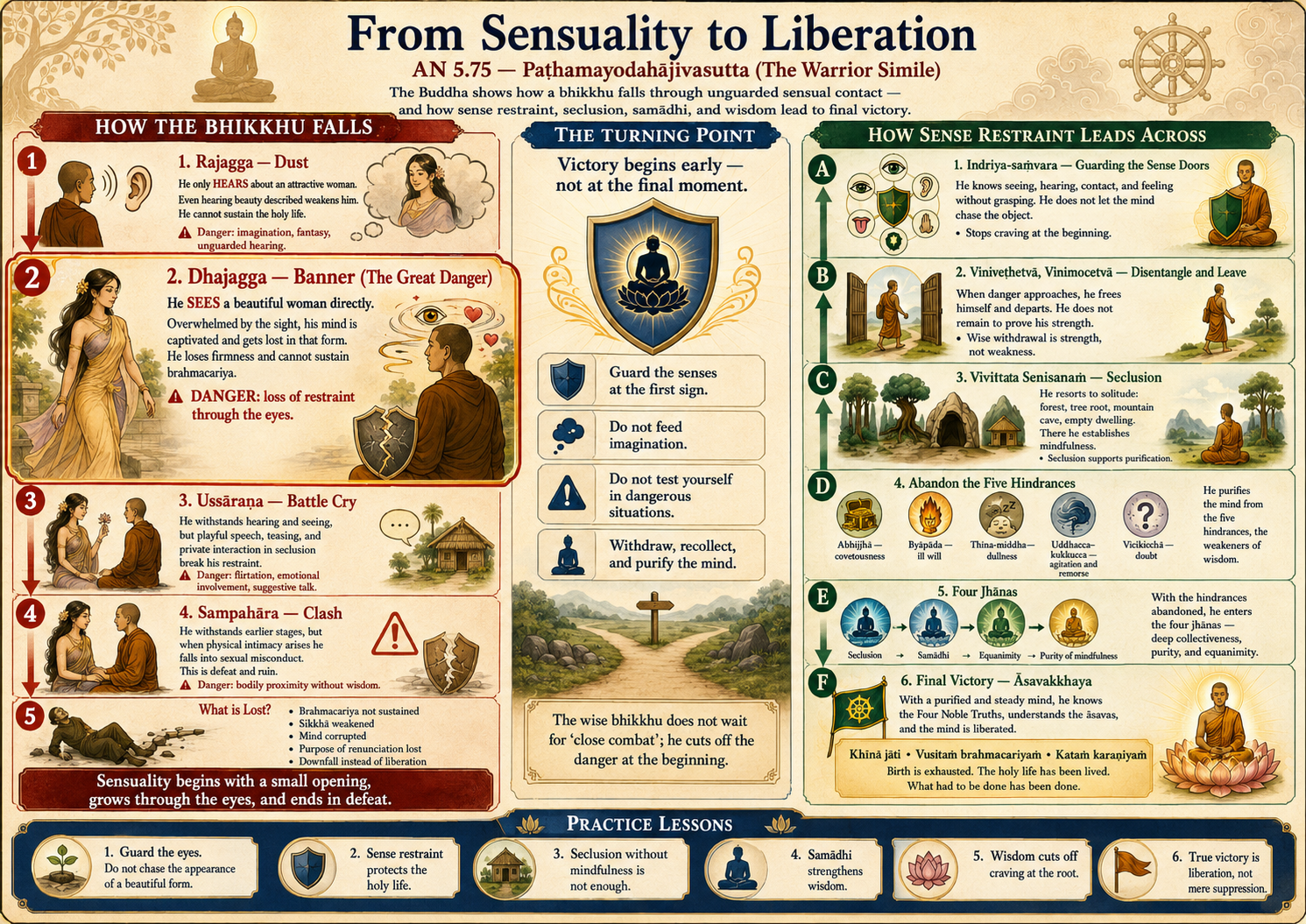 VISUAL SUMMARYSee this sutta in a pictureOpen the complete infographic for a visual overview before or after reading the full study.View infographic →
Courage is revealed as danger comes closer
Five kinds of warriors in the world
Pañcime, bhikkhave, yodhājīvā santo saṁvijjamānā lokasmiṁ. Katame pañca?
“Bhikkhus, these five kinds of professional warriors are found existing in the world. What five?”
The compound yodhājīva consists of:
yodha — one who fights, a warrior;
ājīva — livelihood or profession.
Thus, this is not merely someone who happens to fight once, but a person whose profession demands courage, steadiness and competence in battle.
The Buddha is not glorifying warfare. He is using a familiar occupation to demonstrate that people possess different degrees of endurance. A person may appear courageous from a distance but collapse when danger becomes immediate.
The five warriors represent five stages of proximity to danger:
◉ seeing the dust of the army
◉ seeing the army’s banners / flags
◉ hearing its battle cry
◉ entering physical combat
◉ overcoming the enemy and holding the battlefield
The same graded structure is later applied to sensual entanglement.
Rajagga — Dust — A remote sign or description is enough to destabilise the mind.
Dhajagga — Banners — Direct seeing brings the attractive object into immediate sensory presence.
Ussāraṇa — Battle cry — Personal speech, teasing and reciprocal engagement intensify the pressure.
Sampahāra — Close combat — Bodily proximity tests restraint at the strongest immediate level.
Saṅgāmavijaya — Victory — The practitioner disengages, leaves, purifies the mind, develops jhāna and completes liberation.
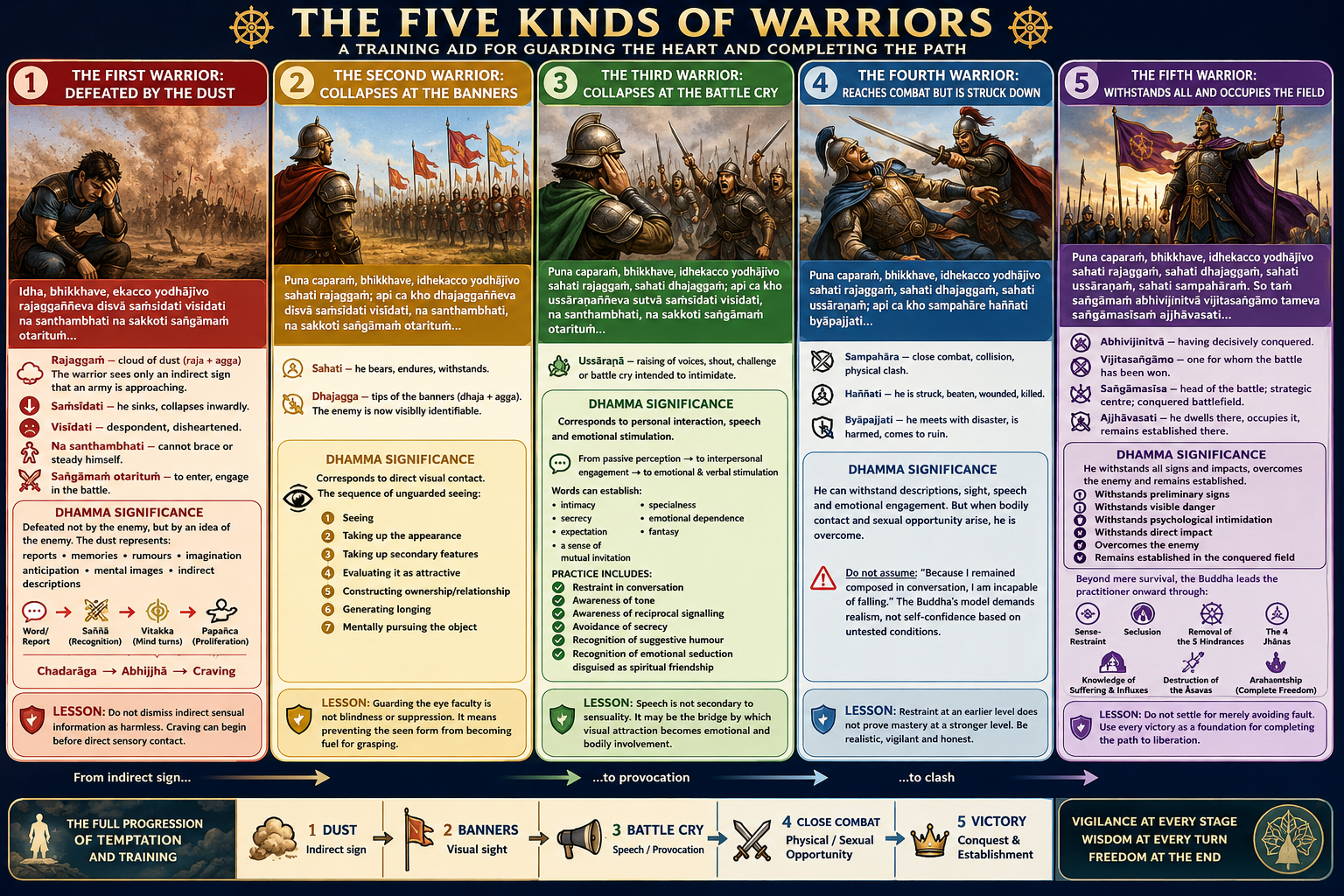
The five worldly warriors and their Dhamma correspondence
Click infographic to enlarge ↗
The Five Worldly Warriors
01 Defeated by the dust
The first warrior: defeated by the dust
Idha, bhikkhave, ekacco yodhājīvo rajaggaññeva disvā saṁsīdati visīdati na santhambhati na sakkoti saṅgāmaṁ otarituṁ. Evarūpopi, bhikkhave, idhekacco yodhājīvo hoti. Ayaṁ, bhikkhave, paṭhamo yodhājīvo santo saṁvijjamāno lokasmiṁ.
“Here, bhikkhus, a certain professional warrior, merely on seeing the cloud of dust, sinks down and becomes dejected. He does not remain firm and is incapable of entering the battle.
Such a professional warrior is also found in the world. This, bhikkhus, is the first kind of professional warrior found existing in the world.”
Important terms
Rajaggaṁ
raja — dust
agga — the upper part, crest or mass
It refers to the cloud of dust rising above an approaching army. The warrior has not yet seen the enemy. He sees only an indirect sign that an army is approaching.
Saṁsīdati – Literally, “he sinks.” His courage collapses inwardly.
Visīdati – He becomes despondent, disheartened or psychologically paralysed.
Na santhambhati – He cannot brace himself, steady himself or remain internally supported.
Saṅgāmaṁ otarituṁ – To descend into, enter or engage in the battle.
Dhamma significance – This first warrior is defeated not by an enemy but by an idea of the enemy.
The dust represents:
reports
memories
rumours
imagination
anticipation
mental images
indirect descriptions
The person’s mind constructs an entire sensual world from a remote sign. The actual object need not be present.
This shows how craving frequently begins before sensory contact becomes direct. A word, description or remembered image can activate:
saññā — recognition and labelling
vitakka — the mind turning toward the theme
papañca — proliferation
chandarāga — interested attachment and colouring
abhijjhā — covetous absorption in the desired object
The first practical lesson is therefore: Do not dismiss indirect sensual information as harmless merely because the object is absent.
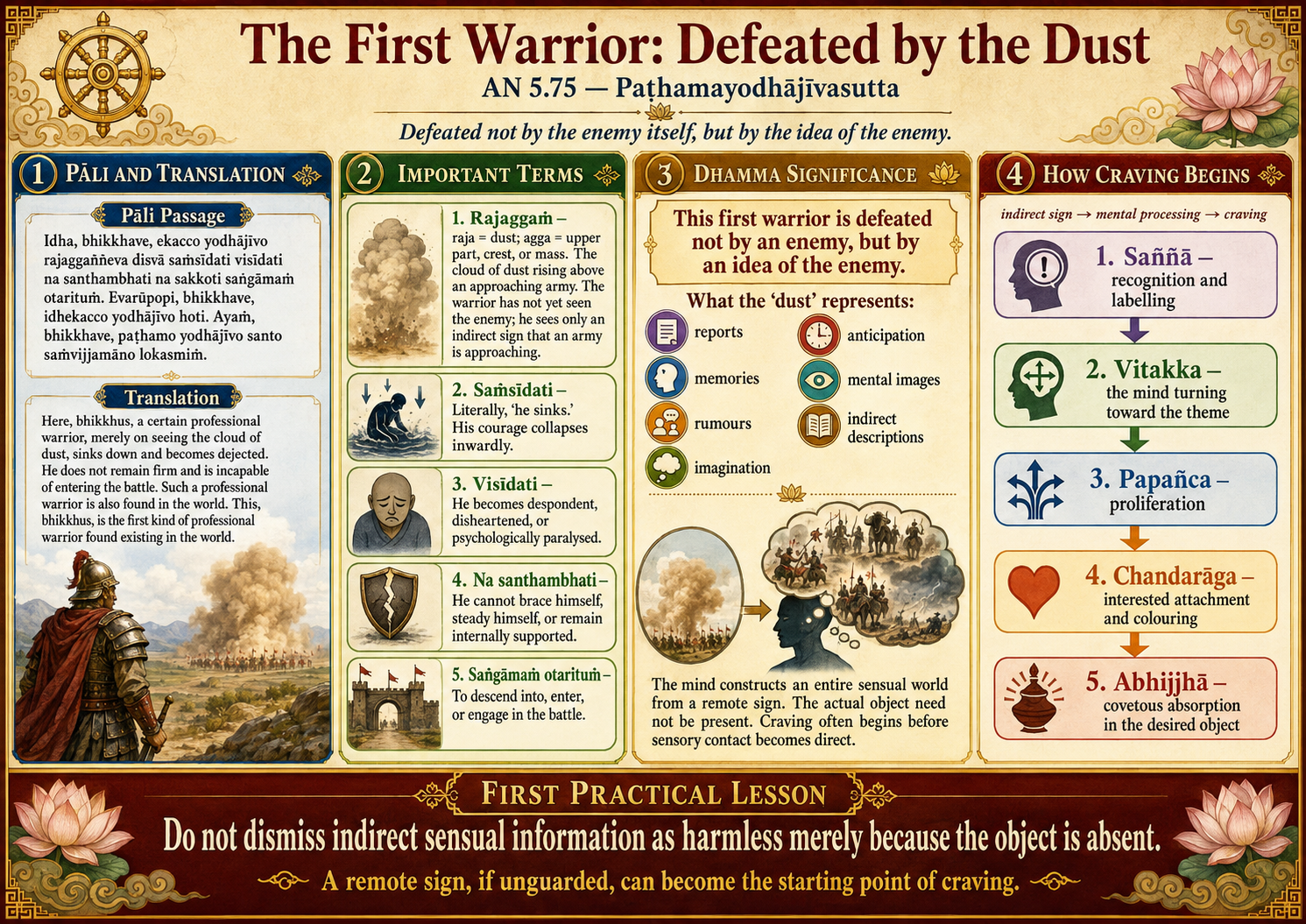
Worldly warrior 1: Defeated by the dust
Click infographic to enlarge ↗
02 Withstands the dust, collapses at the banners
Puna caparaṁ, bhikkhave, idhekacco yodhājīvo sahati rajaggaṁ; api ca kho dhajaggaññeva disvā saṁsīdati visīdati, na santhambhati, na sakkoti saṅgāmaṁ otarituṁ. Evarūpopi, bhikkhave, idhekacco yodhājīvo hoti. Ayaṁ, bhikkhave, dutiyo yodhājīvo santo saṁvijjamāno lokasmiṁ.
“Again, bhikkhus, another professional warrior withstands the cloud of dust. But merely on seeing the tips of the banners, he sinks down and becomes dejected. He does not remain firm and is incapable of entering the battle.
Such a professional warrior is also found in the world. This, bhikkhus, is the second kind of professional warrior found existing in the world.”
Sahati – He bears, endures, withstands or remains unaffected by something. The second warrior is stronger than the first. He can tolerate the idea that an enemy is approaching. But when the approaching force becomes visibly identifiable, his courage fails.
Dhajagga
dhaja — banner, flag or military standard;
agga — tip or upper part. The banners reveal that the enemy is no longer hypothetical. The threatening army can now be seen.
Dhamma significance – The second stage corresponds to direct visual contact.
A person may remain composed while merely hearing about an attractive object. But when the object is actually seen, the mind becomes coloured.
The problem is not the bare presence of visible form. The problem is the uncontrolled sequence:
◉ seeing
◉ taking up the appearance
◉ taking up secondary features
◉ evaluating it as attractive
◉ constructing ownership or relationship
◉ generating longing
◉ mentally pursuing the object
This is why guarding the eye faculty does not mean blindness or suppression. It means preventing the seen form from becoming fuel for grasping.
The practitioner must know:
Seeing has occurred
Pleasant contact has arisen
A pleasant feeling is present
Interest is beginning
The mind is constructing a story
Attachment is not inevitable

Worldly warrior 2: Withstands the dust, collapses at the banners
Click infographic to enlarge ↗
03 Withstands sight, collapses at the battle cry
Puna caparaṁ, bhikkhave, idhekacco yodhājīvo sahati rajaggaṁ sahati dhajaggaṁ; api ca kho ussāraṇaññeva sutvā saṁsīdati visīdati, na santhambhati, na sakkoti saṅgāmaṁ otarituṁ. Evarūpopi, bhikkhave, idhekacco yodhājīvo hoti. Ayaṁ, bhikkhave, tatiyo yodhājīvo santo saṁvijjamāno lokasmiṁ.
“Again, bhikkhus, another professional warrior withstands the cloud of dust and withstands the tips of the banners. But merely on hearing the battle cry, he sinks down and becomes dejected. He does not remain firm and is incapable of entering the battle. Such a professional warrior is also found in the world. This, bhikkhus, is the third kind of professional warrior found existing in the world.”
Ussāraṇā – Here it refers to a raising of voices, a shout, challenge, battle cry or tumult intended to intimidate the opposing side. The enemy is now not merely seen. It communicates, challenges and psychologically engages the warrior. The third warrior can tolerate remote signs and visual presence but cannot withstand direct provocation.
Dhamma significance
In the later application, this corresponds to flirtation, teasing, seductive speech, laughter and personal interaction.
The movement is:
◉ from passive perception
◉ to interpersonal engagement
◉ to emotional and verbal stimulation
Words can establish:
◉ intimacy
◉ specialness
◉ secrecy
◉ emotional dependence
◉ expectation
◉ fantasy
◉ a sense of mutual invitation
For this reason, speech is not secondary to sensuality. Speech may be the bridge by which visual attraction becomes emotional and bodily involvement.
The practice must therefore include:
◉ restraint in conversation
◉ awareness of tone
◉ awareness of reciprocal signalling
◉ avoidance of secrecy
◉ recognition of suggestive humour
◉ recognition of emotional seduction disguised as spiritual friendship
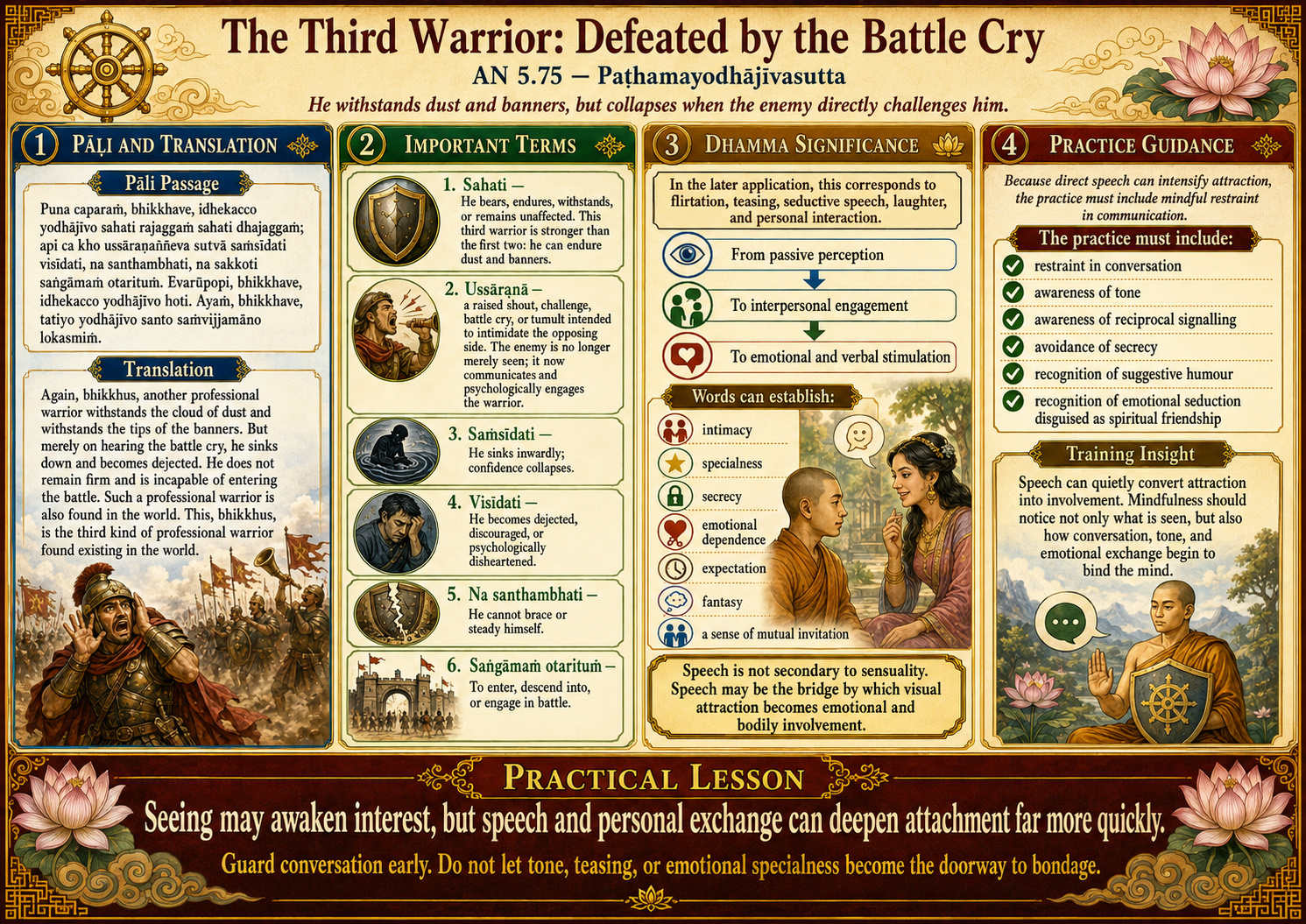
Worldly warrior 3: Withstands sight, collapses at the battle cry
Click infographic to enlarge ↗
04 Reaches close combat but is struck down
Puna caparaṁ, bhikkhave, idhekacco yodhājīvo sahati rajaggaṁ, sahati dhajaggaṁ, sahati ussāraṇaṁ; api ca kho sampahāre haññati byāpajjati. Evarūpopi, bhikkhave, idhekacco yodhājīvo hoti. Ayaṁ, bhikkhave, catuttho yodhājīvo santo saṁvijjamāno lokasmiṁ.
“Again, bhikkhus, another professional warrior withstands the cloud of dust, withstands the tips of the banners and withstands the battle cry. But in the clash of battle he is struck down and comes to ruin.
Such a professional warrior is also found in the world. This, bhikkhus, is the fourth kind of professional warrior found existing in the world.”
Important terms
Sampahāra – Close combat, collision, physical clash or hand-to-hand engagement.
Haññati – He is struck, beaten, wounded or killed.
Byāpajjati – He meets with disaster, is harmed or comes to ruin.
Dhamma significance
This person has considerable endurance. He can withstand:
◉ descriptions
◉ visible beauty
◉ personal teasing
◉ emotionally charged interaction
But when bodily contact and sexual opportunity arise, he is overcome. This reveals that restraint demonstrated at an earlier level does not prove complete mastery at a stronger level.
A practitioner should therefore never assume: “Because I remained composed during conversation, I am incapable of falling.” The Buddha’s model demands realism rather than self-confidence based on untested conditions.

Worldly warrior 4: Reaches close combat but is struck down
Click infographic to enlarge ↗
05 Withstands all and occupies the field
Puna caparaṁ, bhikkhave, idhekacco yodhājīvo sahati rajaggaṁ, sahati dhajaggaṁ, sahati ussāraṇaṁ, sahati sampahāraṁ. So taṁ saṅgāmaṁ abhivijinitvā vijitasaṅgāmo tameva saṅgāmasīsaṁ ajjhāvasati. Evarūpopi, bhikkhave, idhekacco yodhājīvo hoti. Ayaṁ, bhikkhave, pañcamo yodhājīvo santo saṁvijjamāno lokasmiṁ.
“Again, bhikkhus, another professional warrior withstands the cloud of dust, withstands the tips of the banners, withstands the battle cry and withstands the clash of battle. Having completely conquered that battle, victorious in battle, he remains occupying the very head of the battlefield. Such a professional warrior is also found in the world. This, bhikkhus, is the fifth kind of professional warrior found existing in the world.”
Important terms
Abhivijinitvā – Having decisively conquered or completely overcome.
Vijitasaṅgāmo – One for whom the battle has been won.
Saṅgāmasīsa – Literally, the “head of the battle”: the strategic centre, foremost position or conquered battlefield.
Ajjhāvasati – He dwells there, occupies it, remains established there.
The fifth warrior does not merely escape. He is not saved accidentally. He:
◉ withstands preliminary signs
◉ withstands visible danger
◉ withstands psychological intimidation
◉ withstands direct impact
◉ overcomes the enemy
◉ remains established in the conquered field
In the Dhamma application, “victory” will not merely mean avoiding sexual misconduct. The Buddha leads the practitioner onward through:
◉ sense-restraint
◉ seclusion
◉ removal of the five hindrances
◉ the four jhānas
◉ knowledge of suffering and the influxes
◉ destruction of the āsavas
◉ arahantship
Thus, merely surviving a temptation is not the final victory. It becomes the occasion for completing the path.
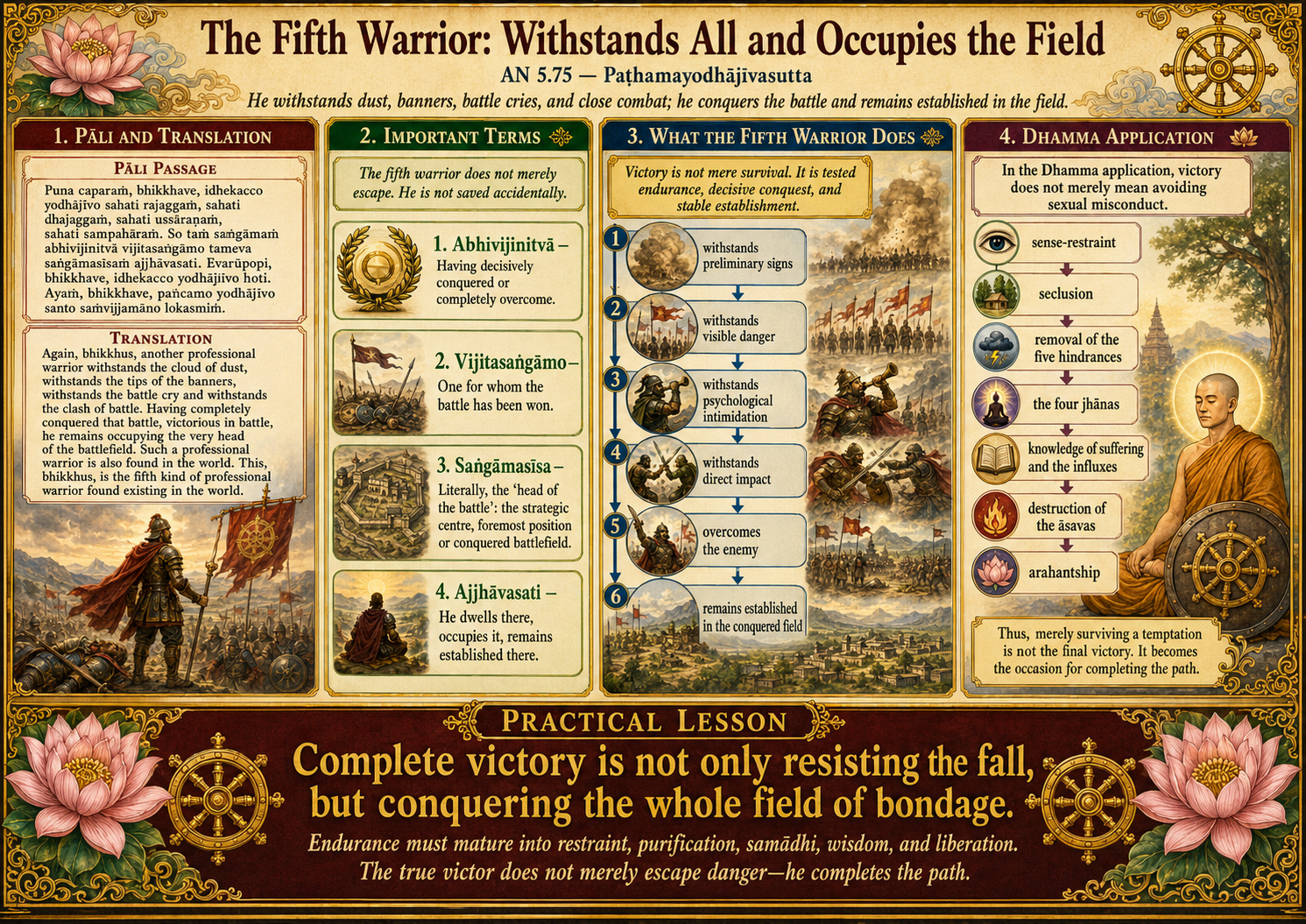
Worldly warrior 5: Withstands all and occupies the field
Click infographic to enlarge ↗
Ime kho, bhikkhave, pañca yodhājīvā santo saṁvijjamānā lokasmiṁ.
“These, bhikkhus, are the five kinds of professional warriors found existing in the world.”
The worldly classification is now complete. The Buddha next transfers every element of the battlefield imagery to the training in brahmacariya.
Five Warrior-like Persons Among the Bhikkhus
Introduction to the spiritual comparison
Evamevaṁ kho, bhikkhave, pañcime yodhājīvūpamā puggalā santo saṁvijjamānā bhikkhūsu. Katame pañca?
“In the same way, bhikkhus, these five kinds of persons comparable to professional warriors are found existing among the bhikkhus. What five?”
Evamevaṁ “Just so,” or “in exactly the same manner.” It establishes a systematic correspondence between the military stages and the spiritual stages.
Yodhājīvūpamā – yodhājīva — professional warrior; upamā — comparable to, resembling.
The Buddha is examining practitioners not according to:
◉ reputation
◉ robes
◉ years of ordination
◉ knowledge of texts
◉ public composure
He examines what happens when pressure progressively approaches the mind.
01 The first practitioner — defeated by imagination
He collapses merely at the “dust”
Idha, bhikkhave, bhikkhu rajaggaññeva disvā saṁsīdati visīdati, na santhambhati, na sakkoti brahmacariyaṁ sandhāretuṁ. Sikkhādubbalyaṁ āvikatvā sikkhaṁ paccakkhāya hīnāyāvattati.
“Here, bhikkhus, a bhikkhu, merely on seeing the cloud of dust, sinks down and becomes dejected. He does not remain firm and is incapable of sustaining the holy life. Having disclosed his weakness regarding the training, he renounces the training and returns to the lower life.”
Brahmacariya – The complete holy life or purified mode of conduct directed toward the ending of suffering. In this context, it includes celibacy but is not limited to celibacy.
Sandhāretuṁ – To maintain, sustain, uphold or continue. The variant santānetuṁ similarly conveys continuing or carrying on.
Sikkhādubbalya – sikkhā — training; dubbalya — weakness. A weakening in one’s ability or willingness to continue the training.
Āvikatvā – Having made it open, declared it or disclosed it.
Sikkhaṁ paccakkhāya – Having formally rejected or renounced the training.
Hīnāyāvattati – hīna — lower, inferior; āvattati — returns. In the monastic context, he returns to household life after disrobing. This person has not secretly committed a pārājika offence. He recognises that he cannot sustain celibacy, properly discloses his weakness and formally leaves the training. Although he has failed to continue as a bhikkhu, there remains a distinction between: honestly relinquishing the training before sexual activity; secretly violating the training while continuing to claim the status of a bhikkhu. This distinction becomes important in the fourth case.
What is the “dust” for him?
Kimassa rajaggasmiṁ? Idha, bhikkhave, bhikkhu suṇāti: ‘amukasmiṁ nāma gāme vā nigame vā itthī vā kumārī vā abhirūpā dassanīyā pāsādikā paramāya vaṇṇapokkharatāya samannāgatā’ti. So taṁ sutvā saṁsīdati visīdati, na santhambhati, na sakkoti brahmacariyaṁ sandhāretuṁ. Sikkhādubbalyaṁ āvikatvā sikkhaṁ paccakkhāya hīnāyāvattati. Idamassa rajaggasmiṁ.
“And what, for him, is the cloud of dust? Here, bhikkhus, a bhikkhu hears: ‘In such-and-such a village or market town there is a woman or young woman who is beautiful, attractive to behold, pleasing and endowed with the supreme beauty of complexion.’ Having heard this, he sinks down and becomes dejected. He does not remain firm and is incapable of sustaining the holy life. Having disclosed his weakness regarding the training, he renounces the training and returns to the lower life. This, for him, is the cloud of dust.”
Depth of practice – The bhikkhu has never seen her. Yet mere information becomes sufficient to destabilise the holy life. The sequence may be:
◉ He hears a description
◉ Saññā forms a mental image
◉ The image becomes embellished.
◉ Attention returns repeatedly to the imagined person
◉ An internal relationship is constructed
◉ Celibacy begins to appear burden some
◉ Household life is idealised
◉ Training is abandoned
The collapse begins with ayoniso manasikāra—attention that nourishes the attractive theme without examining its origin, instability, danger or consequence.
Appropriate practice includes:
◉ not seeking further details
◉ not asking who she is or where she lives
◉ not constructing an image
◉ recognising the arising of kāmacchanda
◉ recollecting the purpose of brahmacariya
◉ contemplating impermanence and the unattractive aspects of the body
◉ returning attention to a wholesome domain
◉ consulting a competent teacher before the mental theme becomes dominant
Contemporary application – Today the “cloud of dust” may include:
◉ a verbal description
◉ a social-media profile mentioned by another person
◉ romantic gossip
◉ messages about someone’s beauty
◉ a remembered name
◉ online comments
◉ an imagined relationship with someone never met
The teaching is therefore extremely relevant even before direct contact occurs.
Completion of the first comparison
Seyyathāpi so, bhikkhave, yodhājīvo rajaggaññeva disvā saṁsīdati visīdati, na santhambhati, na sakkoti saṅgāmaṁ otarituṁ; tathūpamāhaṁ, bhikkhave, imaṁ puggalaṁ vadāmi. Evarūpopi, bhikkhave, idhekacco puggalo hoti. Ayaṁ, bhikkhave, paṭhamo yodhājīvūpamo puggalo santo saṁvijjamāno bhikkhūsu.
“Just as that professional warrior, merely on seeing the cloud of dust, sinks down and becomes dejected, does not remain firm and is incapable of entering the battle, so, bhikkhus, do I declare this person to be comparable to him. Such a person is also found among the bhikkhus. This, bhikkhus, is the first person comparable to a professional warrior found existing among the bhikkhus.” The danger is not “woman” as an ontological category. The danger is the practitioner’s untrained response to an attractive perceptual theme. The corresponding discourse could be framed with genders reversed for a female practitioner.

Warrior-like practitioner 1
Click infographic to enlarge ↗
02 The second practitioner — defeated by direct sight
He withstands the dust but collapses upon seeing the banner
Puna caparaṁ, bhikkhave, bhikkhu sahati rajaggaṁ; api ca kho dhajaggaññeva disvā saṁsīdati visīdati, na santhambhati, na sakkoti brahmacariyaṁ sandhāretuṁ. Sikkhādubbalyaṁ āvikatvā sikkhaṁ paccakkhāya hīnāyāvattati.
“Again, bhikkhus, another bhikkhu withstands the cloud of dust. But merely on seeing the tip of the banner, he sinks down and becomes dejected. He does not remain firm and is incapable of sustaining the holy life.
Having disclosed his weakness regarding the training, he renounces the training and returns to the lower life.” This practitioner is not destabilised by hearsay. He can hear descriptions without abandoning the training. However, direct visual contact is more powerful than the conceptual image. When beauty is immediately present, restraint fails. This shows that different sense-door conditions possess different strength. One should not conclude: “Because descriptions do not affect me, my sensual craving has ended.” It may only mean that the trigger has not yet become sufficiently immediate.
What is the “banner” for him?
Kimassa dhajaggasmiṁ? Idha, bhikkhave, bhikkhu na heva kho suṇāti: ‘amukasmiṁ nāma gāme vā nigame vā itthī vā kumārī vā abhirūpā dassanīyā pāsādikā paramāya vaṇṇapokkharatāya samannāgatā’ti; api ca kho sāmaṁ passati itthiṁ vā kumāriṁ vā abhirūpaṁ dassanīyaṁ pāsādikaṁ paramāya vaṇṇapokkharatāya samannāgataṁ. So taṁ disvā saṁsīdati visīdati, na santhambhati, na sakkoti brahmacariyaṁ sandhāretuṁ. Sikkhādubbalyaṁ āvikatvā sikkhaṁ paccakkhāya hīnāyāvattati. Idamassa dhajaggasmiṁ.
“And what, for him, is the tip of the banner?
Here, bhikkhus, the bhikkhu does not merely hear: ‘In such-and-such a village or market town there is a woman or young woman who is beautiful, attractive to behold, pleasing and endowed with the supreme beauty of complexion.’ Rather, he himself sees a woman or young woman who is beautiful, attractive to behold, pleasing and endowed with the supreme beauty of complexion. Having seen her, he sinks down and becomes dejected. He does not remain firm and is incapable of sustaining the holy life. Having disclosed his weakness regarding the training, he renounces the training and returns to the lower life. This, for him, is the tip of the banner.”
Important distinction – Na heva kho suṇāti … api ca kho sāmaṁ passati “He does not merely hear … rather, he sees for himself.” The movement is from a mentally constructed image to immediate visual experience.
Practice at the eye faculty Guarding the eye faculty means that, when seeing a form:
◉ one knows seeing as seeing
◉ one does not seize the overall appearance as a basis for craving
◉ one does not pursue attractive details
◉ one recognises pleasant feeling
◉ one prevents the arising or expansion of covetousness and distress
This does not require hatred toward beauty. Aversion is not liberation from attraction. Both attraction and aversion are forms of bondage. The task is to see:
◉ form as form
◉ contact as contact
◉ feeling as feeling
◉ perception as perception
◉ mental colouring as colouring
◉ arising as arising
◉ cessation as cessation
Why direct vision is stronger – Visual contact provides detail to imagination:
◉ bodily features
◉ expression
◉ movement
◉ gesture
◉ clothing
◉ voice and personality anticipated from appearance
The mind then adds:
◉ She is special
◉ She would understand me.
◉ Life with her would be fulfilling
◉ My present training deprives me
◉ I am losing something valuable
These are not contained in the visible form. They are produced through maññanā—conceiving and appropriative construction.
Completion of the second comparison
Seyyathāpi so, bhikkhave, yodhājīvo sahati rajaggaṁ; api ca kho dhajaggaññeva disvā saṁsīdati visīdati, na santhambhati, na sakkoti saṅgāmaṁ otarituṁ; tathūpamāhaṁ, bhikkhave, imaṁ puggalaṁ vadāmi. Evarūpopi, bhikkhave, idhekacco puggalo hoti. Ayaṁ, bhikkhave, dutiyo yodhājīvūpamo puggalo santo saṁvijjamāno bhikkhūsu.
“Just as that professional warrior withstands the cloud of dust, but merely on seeing the tip of the banner sinks down and becomes dejected, does not remain firm and is incapable of entering the battle, so, bhikkhus, do I declare this person to be comparable to him. Such a person is also found among the bhikkhus. This, bhikkhus, is the second person comparable to a professional warrior found existing among the bhikkhus.”
This practitioner has some strength but insufficiently developed sense-restraint. His stability depended upon distance from the object. True training is not measured only in protected conditions. It is measured by whether wisdom, sati and restraint remain operative when an attractive form actually appears.

Warrior-like practitioner 2
Click infographic to enlarge ↗
03 The third practitioner — defeated by personal engagement
He withstands hearing and seeing but collapses at personal engagement
Puna caparaṁ, bhikkhave, bhikkhu sahati rajaggaṁ, sahati dhajaggaṁ; api ca kho ussāraṇaññeva sutvā saṁsīdati visīdati, na santhambhati, na sakkoti brahmacariyaṁ sandhāretuṁ. Sikkhādubbalyaṁ āvikatvā sikkhaṁ paccakkhāya hīnāyāvattati.
“Again, bhikkhus, another bhikkhu withstands the cloud of dust and withstands the tip of the banner. But merely on hearing the battle cry, he sinks down and becomes dejected. He does not remain firm and is incapable of sustaining the holy life.
Having disclosed his weakness regarding the training, he renounces the training and returns to the lower life.”
This practitioner can:
◉ hear about an attractive person;
◉ see an attractive person.
But he cannot withstand being personally approached and playfully engaged.
The crucial transition is from: “There is an attractive person to this person is giving attention to me.”
The sense of “me” and “for me” greatly intensifies craving.
What is the “battle cry” for him?
Kimassa ussāraṇāya? Idha, bhikkhave, bhikkhuṁ araññagataṁ vā rukkhamūlagataṁ vā suññāgāragataṁ vā mātugāmo upasaṅkamitvā ūhasati ullapati ujjagghati uppaṇḍeti. So mātugāmena ūhasiyamāno ullapiyamāno ujjagghiyamāno uppaṇḍiyamāno saṁsīdati visīdati, na santhambhati, na sakkoti brahmacariyaṁ sandhāretuṁ. Sikkhādubbalyaṁ āvikatvā sikkhaṁ paccakkhāya hīnāyāvattati. Idamassa ussāraṇāya.
“And what, for him, is the battle cry?
Here, bhikkhus, when a bhikkhu has gone to the wilderness, to the root of a tree or to an empty dwelling, a woman approaches him and jokes with him, speaks alluringly to him, laughs with him and teases him.
While being joked with, spoken to alluringly, laughed with and teased by the woman, he sinks down and becomes dejected. He does not remain firm and is incapable of sustaining the holy life. Having disclosed his weakness regarding the training, he renounces the training and returns to the lower life.
This, for him, is the battle cry.”
The secluded settings
Araññagataṁ – Gone to the wilderness or forest.
Rukkhamūlagataṁ – Gone to the root or foot of a tree.
Suññāgāragataṁ – Gone to an empty dwelling or secluded hut.
These settings are normally supportive of bhāvanā. However, physical seclusion by itself does not eliminate craving. A secluded location can become dangerous when:
◉ internal restraint is undeveloped
◉ another person approaches
◉ social accountability is absent
◉ the practitioner assumes that seclusion automatically guarantees purity
The four actions
The precise shades of the verbs overlap, but together they indicate playful, familiar, flirtatious or mocking engagement:
Ūhasati – To joke with, ridicule, provoke or make suggestive fun.
Ullapati – To chat up, address enticingly, flatter or speak in a familiar manner.
Ujjagghati – To laugh loudly, giggle, joke or engage in playful laughter.
Uppaṇḍeti – To tease, mock, flirt or make sport of someone.
The point is not that laughter itself is immoral. The context is a direct attempt to emotionally and sensually engage a celibate practitioner in seclusion.
Why this is stronger than seeing?
The bhikkhu no longer encounters only a visible form. He experiences:
◉ recognition
◉ reciprocal attention
◉ emotional warmth
◉ humour
◉ invitation
◉ personal validation
◉ perceived desirability
The mind may think:
◉ She notices me.
◉ She likes me
◉ This is harmless conversation
◉ I can manage it
◉ I should not appear rude
◉ We have a special understanding
Thus, attachment is often disguised as:
◉ kindness
◉ counselling
◉ friendship
◉ spiritual guidance
◉ compassion
◉ harmless humour.
The practitioner must distinguish genuine compassion from the pleasure of being emotionally wanted.
Practical safeguards
A practitioner should:
◉ avoid private and ambiguous meetings
◉ keep conversation purposeful
◉ avoid suggestive humour
◉ not cultivate secrecy
◉ recognise bodily and emotional activation immediately
◉ leave the unsuitable setting
◉ recollect the training and its purpose
◉ disclose recurring difficulty to a trustworthy elder
◉ avoid testing oneself unnecessarily
This is not fear. It is sappāya-sampajañña—understanding what is suitable and unsuitable for the training.
Completion of the third comparison
Seyyathāpi so, bhikkhave, yodhājīvo sahati rajaggaṁ, sahati dhajaggaṁ; api ca kho ussāraṇaññeva sutvā saṁsīdati visīdati, na santhambhati, na sakkoti saṅgāmaṁ otarituṁ; tathūpamāhaṁ, bhikkhave, imaṁ puggalaṁ vadāmi. Evarūpopi, bhikkhave, idhekacco puggalo hoti. Ayaṁ, bhikkhave, tatiyo yodhājīvūpamo puggalo santo saṁvijjamāno bhikkhūsu.
“Just as that professional warrior withstands the cloud of dust and withstands the tip of the banner, but merely on hearing the battle cry sinks down and becomes dejected, does not remain firm and is incapable of entering the battle, so, bhikkhus, do I declare this person to be comparable to him. Such a person is also found among the bhikkhus. This, bhikkhus, is the third person comparable to a professional warrior found existing among the bhikkhus.”
The first three practitioners withdraw from the monastic training before sexual intercourse occurs.
Their degrees of endurance differ:
◉ the first falls through imagination
◉ the second through direct sight
◉ the third through personal engagement
But all three eventually recognise that they cannot maintain celibacy and relinquish the training.

Warrior-like practitioner 3
Click infographic to enlarge ↗
04 The fourth practitioner — defeated in close combat
He withstands the preliminary stages but falls in close combat
Puna caparaṁ, bhikkhave, bhikkhu sahati rajaggaṁ, sahati dhajaggaṁ, sahati ussāraṇaṁ; api ca kho sampahāre haññati byāpajjati.
“Again, bhikkhus, another bhikkhu withstands the cloud of dust, withstands the tip of the banner and withstands the battle cry. But in the clash of battle he is struck down and comes to ruin.”
This person appears highly resilient. He is not overcome by:
◉ descriptions
◉ visual beauty
◉ joking and flirtation
Yet he has not removed sensual craving. When the situation becomes physically intimate, his restraint collapses.
His earlier endurance may have been supported by:
◉ lack of opportunity
◉ social inhibition
◉ fear of exposure
◉ bodily distance
◉ confidence without wisdom
The deeper defilement remained.
What is the “close combat” for him?
Kimassa sampahārasmiṁ? Idha, bhikkhave, bhikkhuṁ araññagataṁ vā rukkhamūlagataṁ vā suññāgāragataṁ vā mātugāmo upasaṅkamitvā abhinisīdati abhinipajjati ajjhottharati. So mātugāmena abhinisīdiyamāno abhinipajjiyamāno ajjhotthariyamāno sikkhaṁ apaccakkhāya dubbalyaṁ anāvikatvā methunaṁ dhammaṁ paṭisevati. Idamassa sampahārasmiṁ.
“And what, for him, is the clash of battle?
Here, bhikkhus, when a bhikkhu has gone to the wilderness, to the root of a tree or to an empty dwelling, a woman approaches him, sits down pressed close against him, lies down pressed close against him and throws herself upon him. While the woman is sitting close against him, lying close against him and pressing herself upon him, without renouncing the training and without disclosing his weakness, he engages in sexual intercourse. This, for him, is the clash of battle.”
Important terms
Abhinisīdati – She sits very close, sits against him or presses near him.
Abhinipajjati – She lies down beside or against him.
Ajjhottharati – She overwhelms, covers, embraces forcefully or throws herself upon him.
Sikkhaṁ apaccakkhāya – Without formally renouncing the training.
Dubbalyaṁ anāvikatvā – Without revealing or declaring his weakness.
Methunaṁ dhammaṁ paṭisevati – He engages in sexual intercourse.
The decisive distinction: The fourth person differs from the first three.
The earlier practitioners:
◉ recognised their inability
◉ disclosed weakness
◉ relinquished the training
◉ then returned to household life
The fourth:
◉ does not relinquish the training
◉ does not disclose his weakness
◉ engages in sexual intercourse while still claiming bhikkhu status
For a bhikkhu, intentional sexual intercourse constitutes defeat in the monastic discipline. The person is no longer in communion as a bhikkhu from the moment the offence is completed.
The Dhamma point: Buddha describes him as one who is:
haññati — struck down
byāpajjati — ruined
The language is severe because this is not merely the arising of sensual thought. It is the collapse of the fundamental celibate training while retaining its appearance.
The deeper danger includes:
◉ deception
◉ concealment
◉ rationalisation
◉ misuse of religious authority
◉ continuation under a false identity
◉ possible harm to another person or community
Practical lesson – The training must not depend upon heroic resistance at the final moment.
Wise practice acts much earlier:
◉ at perception
◉ at attention
◉ at conversation
◉ at environmental suitability
◉ at emotional dependency
◉ at physical proximity
Waiting until “close combat” to establish mindfulness is unwise. By then, craving may have accumulated great momentum.
Completion of the fourth comparison
Seyyathāpi so, bhikkhave, yodhājīvo sahati rajaggaṁ, sahati dhajaggaṁ, sahati ussāraṇaṁ, api ca kho sampahāre haññati byāpajjati; tathūpamāhaṁ, bhikkhave, imaṁ puggalaṁ vadāmi. Evarūpopi, bhikkhave, idhekacco puggalo hoti. Ayaṁ, bhikkhave, catuttho yodhājīvūpamo puggalo santo saṁvijjamāno bhikkhūsu.
“Just as that professional warrior withstands the cloud of dust, withstands the tip of the banner and withstands the battle cry, but in the clash of battle is struck down and comes to ruin, so, bhikkhus, do I declare this person to be comparable to him. Such a person is also found among the bhikkhus. This, bhikkhus, is the fourth person comparable to a professional warrior found existing among the bhikkhus.” The fourth person’s failure demonstrates that endurance is not identical with purification. A person may suppress outward reaction while inwardly retaining:
◉ delight
◉ fantasy
◉ identification
◉ expectation
◉ latent lust
When supporting conditions arise, the concealed tendency manifests.

Warrior-like practitioner 4
Click infographic to enlarge ↗
05 The fifth practitioner — disengages and completes the path
He withstands all stages and wins the battle
Puna caparaṁ, bhikkhave, bhikkhu sahati rajaggaṁ, sahati dhajaggaṁ, sahati ussāraṇaṁ, sahati sampahāraṁ, so taṁ saṅgāmaṁ abhivijinitvā vijitasaṅgāmo tameva saṅgāmasīsaṁ ajjhāvasati.
“Again, bhikkhus, another bhikkhu withstands the cloud of dust, withstands the tip of the banner, withstands the battle cry and withstands the clash of battle.
Having completely conquered that battle, victorious in battle, he remains occupying the very head of the battlefield.”
This practitioner does not collapse at:
◉ hearing
◉ seeing
◉ social seduction
◉ bodily approach
However, the Buddha does not describe his achievement merely as “he did not have intercourse.” That is only the immediate victory.
The practitioner uses the event to deepen the path until the entire battle against the āsavas is completed.
What is his victory in battle?
Kimassa saṅgāmavijayasmiṁ? Idha, bhikkhave, bhikkhuṁ araññagataṁ vā rukkhamūlagataṁ vā suññāgāragataṁ vā mātugāmo upasaṅkamitvā abhinisīdati abhinipajjati ajjhottharati. So mātugāmena abhinisīdiyamāno abhinipajjiyamāno ajjhotthariyamāno viniveṭhetvā vinimocetvā yena kāmaṁ pakkamati.
“And what, for him, is victory in battle? Here, bhikkhus, when a bhikkhu has gone to the wilderness, to the root of a tree or to an empty dwelling, a woman approaches him, sits pressed close against him, lies pressed close against him and throws herself upon him. While the woman is sitting close against him, lying close against him and pressing herself upon him, he disentangles himself, frees himself and departs wherever he wishes.”
Important terms
Viniveṭhetvā – Having unwound, disentangled or extricated himself.
Vinimocetvā – Having freed or released himself completely.
Yena kāmaṁ pakkamati – He goes wherever he chooses; he leaves the situation freely.
Depth of practice – The practitioner does not remain there to prove his purity. He gets free and leaves and this is crucial.
Spiritual strength is not:
◉ remaining in danger unnecessarily;
◉ enjoying the attention while claiming detachment;
◉ repeatedly testing oneself;
◉ believing that physical proximity cannot affect an advanced practitioner.
He does what is practically required:
◉ disengages
◉ frees himself
◉ departs
This is both restraint and wisdom. The wording does not require anger toward the woman. He neither yields nor retaliates. He simply releases himself from the unsuitable situation.
Inner victory versus suppression
At this immediate stage, the text does not yet say that sensual desire has been permanently uprooted. It says he withstands the encounter and acts according to the training.
He must still proceed to:
◉ seclusion;
◉ abandonment of the hindrances;
◉ jhāna;
◉ insight;
◉ destruction of the āsavas.
Thus, behavioural victory is necessary but not the final liberation.
He seeks a secluded dwelling
So vivittaṁ senāsanaṁ bhajati araññaṁ rukkhamūlaṁ pabbataṁ kandaraṁ giriguhaṁ susānaṁ vanapatthaṁ abbhokāsaṁ palālapuñjaṁ.
“He resorts to a secluded lodging: a wilderness, the root of a tree, a mountain, a ravine, a mountain cave, a charnel ground, a forest grove, the open air or a heap of straw.”
Important terms
Vivittaṁ senāsanaṁ – A secluded dwelling or resting place separated from disturbance.
Bhajati – He frequents, resorts to, cultivates or makes use of it.
The listed places are:
araññaṁ — wilderness or forest
rukkhamūlaṁ — root of a tree
pabbataṁ — mountain
kandaraṁ — ravine, glen or mountain cleft
giriguhaṁ — mountain cave
susānaṁ — charnel ground
vanapatthaṁ — remote forest region
abbhokāsaṁ — open air
palālapuñjaṁ — heap or stack of straw
Why he goes into seclusion? He has just faced a powerful sensual challenge. He does not:
◉ celebrate his self-control
◉ tell stories about his victory
◉ remain near the object
◉ seek another opportunity
◉ assume the work is finished
He withdraws to examine and purify the mind
The physical encounter may have left:
◉ images
◉ pleasant bodily memory
◉ excitement
◉ pride
◉ agitation
◉ resentment
◉ fear
◉ renewed fantasy
Therefore, the external escape must be followed by internal purification.
Establishing the body and mindfulness
So araññagato vā rukkhamūlagato vā suññāgāragato vā nisīdati pallaṅkaṁ ābhujitvā ujuṁ kāyaṁ paṇidhāya parimukhaṁ satiṁ upaṭṭhapetvā.
“Having gone to the wilderness, to the root of a tree or to an empty dwelling, he sits down, folds his legs crosswise, holds his body upright and establishes mindfulness before him.”
Nisīdati – He sits down.
Pallaṅkaṁ ābhujitvā – Having folded the legs crosswise. This indicates a stable seated posture, not a compulsory cultural performance. The function is bodily stability.
Ujuṁ kāyaṁ paṇidhāya – Having placed or held the body upright.
The body is neither collapsed nor rigid. Uprightness supports:
◉ wakefulness
◉ balanced breathing
◉ clear comprehension
◉ reduced drowsiness
Parimukhaṁ satiṁ upaṭṭhapetvā – Having established mindfulness in front, to the fore or as the primary governing presence.
The phrase does not itself restrict mindfulness to a tiny physical point. The important action is upaṭṭhapetvā—establishing sati so that it stands present and operative.
Dhamma sequence – The practitioner has now moved through:
◉ danger recognised
◉ bodily disentanglement
◉ departure
◉ suitable seclusion
◉ stable posture
◉ establishment of sati
Only then does the discourse describe removal of the hindrances.
The Five Hindrances
Abandoning covetousness — Purification of citta before jhāna and liberating knowledge.
Abandoning ill will — Purification of citta before jhāna and liberating knowledge.
Abandoning dullness and drowsiness — Purification of citta before jhāna and liberating knowledge.
Abandoning restlessness and remorse — Purification of citta before jhāna and liberating knowledge.
Abandoning doubt — Purification of citta before jhāna and liberating knowledge.
Why the hindrances weaken wisdom — Purification of citta before jhāna and liberating knowledge.
01 Abandoning covetousness
Abandoning covetousness
So abhijjhaṁ loke pahāya vigatābhijjhena cetasā viharati, abhijjhāya cittaṁ parisodheti.
“Having abandoned covetousness regarding the world, he dwells with a mind free from covetousness. He purifies the mind of covetousness.”
Abhijjhā – Covetousness, acquisitive desire or the mind leaning toward possession and enjoyment. It is more pointed than the simple occurrence of a pleasant feeling. It includes the movement:
“May this be mine; may I enjoy this; may this continue for me.”
Loke – Regarding the world: the field of experience grasped through the six sense doors.
Pahāya – Having abandoned, left behind or relinquished.
Vigatābhijjhena cetasā – With a mind from which covetousness has departed.
Cittaṁ parisodheti – He cleanses or thoroughly purifies the mind.
Connection with the preceding event
After a sensual encounter, covetousness is the most obvious danger. He examines:
◉ Is the image still being replayed?
◉ Is there delight in remembering the contact?
◉ Is there a wish to meet again?
◉ Is there regret that he left?
◉ Is there conceiving of “my opportunity” or “my loss”?
The aim is not temporary distraction but purification of the mind from appropriative longing.
02 Abandoning ill will
Byāpādapadosaṁ pahāya abyāpannacitto viharati, sabbapāṇabhūtahitānukampī byāpādapadosā cittaṁ parisodheti.
“Having abandoned ill will and hostility, he dwells with a mind free from ill will, compassionate for the welfare of all living beings. He purifies the mind of ill will and hostility.”
Important terms
Byāpāda – Ill will, the wish that another be harmed or removed.
Padosa – Hostility, anger, corruption of the mind through aversion.
Abyāpannacitto – With an unhostile, unafflicted mind.
Sabbapāṇabhūtahitānukampī – Compassionately concerned for the welfare of all breathing and living beings.
Why ill will may arise here? After rejecting a sensual approach, the practitioner might develop:
◉ anger at the person;
◉ blame
◉ contempt
◉ fear
◉ hatred of the opposite sex
◉ resentment toward his own mind
◉ shame turning into self-aversion
That would not be purification. It would replace lust with hostility.
The fifth warrior therefore abandons both:
◉ attraction
◉ aversion
He maintains concern for the welfare of all beings, including the person who approached him.
The correct response is:
◉ no participation
◉ no hatred
◉ no exploitation
◉ no retaliation
◉ no continuing entanglement
03 Abandoning dullness and drowsiness
Thinamiddhaṁ pahāya vigatathinamiddho viharati ālokasaññī sato sampajāno, thinamiddhā cittaṁ parisodheti.
“Having abandoned dullness and drowsiness, he dwells free from dullness and drowsiness, perceiving light, mindful and clearly comprehending. He purifies the mind of dullness and drowsiness.”
Thina– Mental stiffness, sluggishness or lack of responsiveness.
Middha – Drowsiness, torpor or heaviness.
Ālokasaññī – Perceiving light or maintaining a perception of illumination and clarity.
Sato sampajāno – Mindful and clearly comprehending.
Practice After intense emotional activation, the system may swing into exhaustion or collapse. The practitioner must not mistake heaviness for calmness.
Signs of thinamiddha include:
◉ blurred awareness
◉ nodding
◉ loss of continuity
◉ mental fog
◉ inability to examine the mind
◉ passive drifting
The remedy includes:
◉ upright posture
◉ opening awareness
◉ recollecting light
◉ energising investigation
◉ walking
◉ reviewing inspiring Dhamma
◉ balancing food, sleep and effort
Sati alone is not described. It is sato sampajāno—mindfulness joined with lucid comprehension.
04 Abandoning restlessness and remorse
Uddhaccakukkuccaṁ pahāya anuddhato viharati ajjhattaṁ vūpasantacitto, uddhaccakukkuccā cittaṁ parisodheti.
“Having abandoned restlessness and remorse, he dwells without agitation, with the mind inwardly calmed. He purifies the mind of restlessness and remorse.”
Uddhacca – Restlessness, agitation, scattering or elevation of the mind away from stability.
Kukkucca – Remorse, worry, regret or anxious brooding about what was done or left undone.
Anuddhato – Unagitated, not scattered.
Ajjhattaṁ vūpasantacitto – With the mind internally settled and pacified.
Connection with the incident
Even though the practitioner did not violate the training, the encounter may produce:
replaying of events;
◉ “What if?” thinking;
◉ anxiety about reputation;
◉ concern about future recurrence;
◉ excitement;
◉ self-congratulation;
◉ regret about having enjoyed some part of the interaction.
He must settle the mind inwardly without suppression or proliferation.
05 Abandoning doubt
Vicikicchaṁ pahāya tiṇṇavicikiccho viharati akathaṅkathī kusalesu dhammesu, vicikicchāya cittaṁ parisodheti.
“Having abandoned doubt, he dwells having crossed beyond doubt, no longer perplexed regarding wholesome qualities. He purifies the mind of doubt.”
Vicikicchā – Paralysing doubt, indecision or sceptical uncertainty that prevents practice.
Tiṇṇavicikiccho – One who has crossed over doubt.
Akathaṅkathī – Not asking inwardly, “How is this? Is it this way or another?” He is no longer trapped in perplexity.
Kusalesu dhammesu – Regarding wholesome qualities and the effective means of cultivation.
Possible doubts:
After the encounter, doubt might take forms such as:
◉ Is celibacy really necessary?
◉ Is sensuality actually harmful?
◉ Could I maintain both?
◉ Is this practice worthwhile?
◉ Am I capable of liberation?
◉ Did I act correctly?
◉ Perhaps attraction itself is awakening.
The practitioner resolves doubt through:
◉ understanding the teaching
◉ observing cause and effect
◉ recollecting the purpose of training
◉ confidence grounded in direct verification
06 Why the hindrances weaken wisdom
So ime pañca nīvaraṇe pahāya cetaso upakkilese paññāya dubbalīkaraṇe …“Having abandoned these five hindrances—corruptions of the mind and weakeners of wisdom—…”
Why the formulation matters – The five hindrances do not merely make concentration uncomfortable. They weaken the capacity to know correctly.
◉ Sensual desire bends perception toward gratification.
◉ Ill will bends it toward rejection.
◉ Dullness obscures detail.
◉ Restlessness fragments observation.
◉ Doubt prevents commitment to investigation.
Therefore, purification from the hindrances is essential for insight, not merely for tranquillity.
The Four Jhānas
First jhāna — Secluded from sensual pleasures and unwholesome states; pīti-sukha born of seclusion.
Second jhāna — Vitakka and vicāra settle; internal confidence and unification; pīti-sukha born of samādhi.
Third jhāna — Pīti fades; upekkhā, sati and sampajañña remain with embodied sukha.
Fourth jhāna — Neither painful nor pleasant; purity of mindfulness through equanimity.
01 From seclusion to purity of mindfulness
First jhāna
Vivicceva kāmehi vivicca akusalehi dhammehi savitakkaṁ savicāraṁ vivekajaṁ pītisukhaṁ paṭhamaṁ jhānaṁ upasampajja viharati.
“Quite secluded from sensual pleasures, secluded from unwholesome qualities, he enters and dwells in the first jhāna, which is accompanied by vitakka and vicāra and has rapture and happiness born of seclusion.”
Vivicceva kāmehi – Separated and disengaged from sensual pleasures.
This includes both:
◉ external sensual involvement;
◉ internal sensual preoccupation.
Vivicca akusalehi dhammehi – Separated from unwholesome states, especially the five hindrances just described.
Savitakkaṁ savicāraṁ – With the mind placing itself upon and remaining engaged with the wholesome domain. These terms should not be reduced merely to ordinary discursive thinking.
Vivekajaṁ – Born of separation or discrimination from the unwholesome and sensual field.=
Pīti – Uplift, gladness, enlivening joy.
Sukha – Ease, well-being or happiness.
Relation to the battle
The practitioner’s happiness is no longer dependent upon sensual acquisition. A non-sensual happiness has become available through seclusion. This is strategically decisive. Sensual craving remains powerful when the mind believes:
“Without sensual pleasure there is only deprivation.”
The first jhāna shows directly that relinquishment can produce a more stable and blameless well-being.
Second jhāna
Vitakkavicārānaṁ vūpasamā ajjhattaṁ sampasādanaṁ cetaso ekodibhāvaṁ avitakkaṁ avicāraṁ samādhijaṁ pītisukhaṁ dutiyaṁ jhānaṁ upasampajja viharati.
“With the calming of vitakka and vicāra, he enters and dwells in the second jhāna, which has internal confidence and unification of mind, is without vitakka and vicāra, and has rapture and happiness born of samādhi.”
Vitakkavicārānaṁ vūpasamā – The activity required to place and maintain the mind settles.
Ajjhattaṁ sampasādanaṁ – Internal clarity, confidence and serene composure.
Cetaso ekodibhāvaṁ – The mind becomes unified, gathered into oneness rather than fragmented.
Samādhijaṁ pītisukhaṁ – Rapture and happiness born of samādhi itself.
The mind no longer requires active maintenance of the first-jhāna mode. Unification becomes internally established.
Third jhāna
Pītiyā ca virāgā upekkhako ca viharati, sato ca sampajāno, sukhañca kāyena paṭisaṁvedeti, yaṁ taṁ ariyā ācikkhanti: ‘upekkhako satimā sukhavihārī’ti, tatiyaṁ jhānaṁ upasampajja viharati.
“With the fading of rapture, he dwells equanimous, mindful and clearly comprehending, and experiences happiness with the body. He enters and dwells in the third jhāna, concerning which the noble ones declare: ‘Equanimous and mindful, one dwells happily.’”
Pītiyā virāgā – Rapture fades or loses its compelling colouring.
Upekkhako – He remains equanimous, neither grasping at the pleasant state nor rejecting change.
Sato sampajāno – Mindful and clearly comprehending.
Sukhañca kāyena paṭisaṁvedeti – He directly experiences happiness through the embodied field.
The mind becomes subtler. Even refined rapture is not clung to.
Fourth jhāna
Sukhassa ca pahānā dukkhassa ca pahānā, pubbeva somanassadomanassānaṁ atthaṅgamā, adukkhamasukhaṁ upekkhāsatipārisuddhiṁ catutthaṁ jhānaṁ upasampajja viharati.
“With the abandoning of pleasure and pain, and with the previous disappearance of mental joy and sorrow, he enters and dwells in the fourth jhāna, which is neither painful nor pleasant and has purity of mindfulness due to equanimity.”
Sukhassa pahānā, dukkhassa pahānā – Pleasure and pain no longer govern the experience.
Pubbeva somanassadomanassānaṁ atthaṅgamā – Mental gladness and sadness have already subsided.
Adukkhamasukhaṁ – Neither painful nor pleasant.
Upekkhāsatipārisuddhi – Purification of mindfulness through equanimity.
The mind is no longer conquered by:
◉ attractive feeling
◉ painful feeling
◉ emotional excitement
◉ emotional dejection
This represents profound mastery over precisely the affective forces that defeated the earlier warrior-like practitioners.
From a Purified Mind to the Destruction of the Āsavas
The qualities of the purified and collected mind — A further step from purified samādhi toward complete release.
Knowing the Four Noble Truths — A further step from purified samādhi toward complete release.
Knowing the āsavas and their causal structure — A further step from purified samādhi toward complete release.
Release from the three āsavas — A further step from purified samādhi toward complete release.
The knowledge of completion — A further step from purified samādhi toward complete release.
01 The qualities of the purified and collected mind
The qualities of the samāhita mind
So evaṁ samāhite citte parisuddhe pariyodāte anaṅgaṇe vigatūpakkilese mudubhūte kammaniye ṭhite āneñjappatte āsavānaṁ khayañāṇāya cittaṁ abhininnāmeti.
“When his mind is thus samāhita—purified, bright, stainless, free from corruptions, pliant, workable, steady and attained to imperturbability—he directs and inclines it toward the knowledge of the destruction of the āsavas.”
Evaṁ samāhite citte – With the mind thus gathered, settled and harmonised.
Parisuddhe – Purified.
Pariyodāte – Bright, clear and radiant.
Anaṅgaṇe – Without stain or blemish.
Vigatūpakkilese – Free from corruptions.
Mudubhūte – Made pliant, flexible or malleable.
Kammaniye – Workable, serviceable, capable of being applied effectively.
Ṭhite – Steady, established.
Āneñjappatte – Attained to non-shaking or imperturbability.
Āsavānaṁ khayañāṇāya – Toward the knowledge of the destruction of the āsavas.
Cittaṁ abhininnāmeti – He bends, directs and inclines the mind toward that knowledge.
Important point
Jhāna is not presented as the final achievement. The purified and workable mind is applied to liberating understanding.
Samādhi serves paññā and the path does not end in peaceful abiding.
02 Knowing the Four Noble Truths
So ‘idaṁ dukkhan’ti yathābhūtaṁ pajānāti, ‘ayaṁ dukkhasamudayo’ti yathābhūtaṁ pajānāti, ‘ayaṁ dukkhanirodho’ti yathābhūtaṁ pajānāti, ‘ayaṁ dukkhanirodhagāminī paṭipadā’ti yathābhūtaṁ pajānāti.
“He understands as it actually is: ‘This is suffering.’
He understands as it actually is: ‘This is the arising of suffering.’
He understands as it actually is: ‘This is the cessation of suffering.’
He understands as it actually is: ‘This is the practice leading to the cessation of suffering.’”
Yathābhūtaṁ pajānāti – He understands according to what has actually come to be—not according to preference, theory, imagination or tradition.
Idaṁ dukkhaṁ – “This is dukkha.” It is directly discerned in experience.
Ayaṁ dukkhasamudayo – “This is the arising of dukkha.” The causal process is understood.
Ayaṁ dukkhanirodho – “This is the cessation of dukkha.” The ending is directly understood.
Ayaṁ dukkhanirodhagāminī paṭipadā – “This is the course of practice leading to that cessation.”
Relation to the sensual encounter
The practitioner can understand:
◉ attraction is conditioned;
◉ pleasant feeling is unstable;
◉ appropriation generates suffering;
◉ craving does not provide lasting fulfilment;
◉ cessation is possible;
◉ the training is the path to cessation.
The experience that could have destroyed the training becomes material for liberating knowledge.
03 Knowing the āsavas and their causal structure
‘Ime āsavā’ti yathābhūtaṁ pajānāti, ‘ayaṁ āsavasamudayo’ti yathābhūtaṁ pajānāti, ‘ayaṁ āsavanirodho’ti yathābhūtaṁ pajānāti, ‘ayaṁ āsavanirodhagāminī paṭipadā’ti yathābhūtaṁ pajānāti.
“He understands as it actually is: ‘These are the āsavas.’
He understands as it actually is: ‘This is the arising of the āsavas.’
He understands as it actually is: ‘This is the cessation of the āsavas.’
He understands as it actually is: ‘This is the practice leading to the cessation of the āsavas.’”
What are āsavas?
Āsava can convey an outflow, influx, fermentation or deep contaminating tendency that sustains saṁsāric existence.
The discourse subsequently specifies:
kāmāsava — the āsava connected with sensuality;
bhavāsava — the āsava connected with continued existence or becoming;
avijjāsava — the āsava of ignorance.
Fourfold investigation
The practitioner does not merely label the āsavas as bad. He knows:
◉ their presence;
◉ their arising conditions;
◉ their cessation;
◉ the path that brings cessation.
This is yoniso investigation applied to the roots of bondage.
04 Release from the three āsavas
Tassa evaṁ jānato evaṁ passato kāmāsavāpi cittaṁ vimuccati, bhavāsavāpi cittaṁ vimuccati, avijjāsavāpi cittaṁ vimuccati, vimuttasmiṁ vimuttamiti ñāṇaṁ hoti.
“For him, knowing thus and seeing thus, the mind is liberated from the āsava of sensuality; the mind is liberated from the āsava of continued existence; and the mind is liberated from the āsava of ignorance.
When it is liberated, there is the knowledge: ‘It is liberated.’”
Evaṁ jānato evaṁ passato – For one knowing in this way and seeing in this way. Liberation arises through direct knowing and seeing—not merely belief, suppression or ritual.
Kāmāsavā cittaṁ vimuccati – The mind is released from the deep current of sensuality. This goes far beyond avoiding a single act.
Bhavāsavā cittaṁ vimuccati – The mind is released from the current that drives identification with, and continuation in, modes of existence.
Avijjāsavā cittaṁ vimuccati – The mind is released from not knowing things according to actuality.
Vimuttasmiṁ vimuttamiti ñāṇaṁ hoti – When released, knowledge arises that release has occurred.
This is not hopeful interpretation. Liberation and the knowledge of liberation are both present.
05 The knowledge of completion
‘Khīṇā jāti, vusitaṁ brahmacariyaṁ, kataṁ karaṇīyaṁ, nāparaṁ itthattāyā’ti pajānāti. Idamassa saṅgāmavijayasmiṁ.
“He understands:
‘Birth is exhausted.
The holy life has been lived.
What had to be done has been done.
There is no further coming to any state of being.’
This, for him, is victory in battle.”
Khīṇā jāti – Birth has been exhausted or brought to an end. The conditions generating renewed birth have been destroyed.
Vusitaṁ brahmacariyaṁ – The holy life has been fully lived or completed. This contrasts strikingly with the first three persons, who could not sandhāretuṁ brahmacariyaṁ—sustain the holy life. The fifth not only sustains it; he completes it.
Kataṁ karaṇīyaṁ – What needed to be done has been done and no further path-development remains.
Nāparaṁ itthattāya – There is no further coming to this or any conditioned mode of existence.
Idamassa saṅgāmavijayasmiṁ – This is his victory in battle.
What constitutes final victory?
Not:
resisting one temptation;
preserving reputation;
maintaining monastic status;
entering jhāna;
experiencing peace;
acquiring special knowledge.
Final victory is the destruction of the āsavas and the ending of renewed birth.
Completion of the fifth comparison
Seyyathāpi so, bhikkhave, yodhājīvo sahati rajaggaṁ, sahati dhajaggaṁ, sahati ussāraṇaṁ, sahati sampahāraṁ, so taṁ saṅgāmaṁ abhivijinitvā vijitasaṅgāmo tameva saṅgāmasīsaṁ ajjhāvasati; tathūpamāhaṁ, bhikkhave, imaṁ puggalaṁ vadāmi. Evarūpopi, bhikkhave, idhekacco puggalo hoti. Ayaṁ, bhikkhave, pañcamo yodhājīvūpamo puggalo santo saṁvijjamāno bhikkhūsu.
“Just as that professional warrior withstands the cloud of dust, withstands the tip of the banner, withstands the battle cry and withstands the clash of battle, and having completely conquered that battle, victorious in battle, remains occupying the very head of the battlefield, so, bhikkhus, do I declare this person to be comparable to him.
Such a person is also found among the bhikkhus. This, bhikkhus, is the fifth person comparable to a professional warrior found existing among the bhikkhus.” The comparison is now complete:
The Five Persons in Comparison
The Five Persons in One Table
| Type | Battlefield image | Spiritual condition | Result |
| First | Sees dust | Hears of an attractive person | Abandons monastic training |
| Second | Sees banners | Directly sees an attractive person | Abandons monastic training |
| Third | Hears battle cry | Is teased, flattered and flirted with | Abandons monastic training |
| Fourth | Enters close combat | Is physically approached and engages in intercourse without relinquishing training | Defeated and ruined |
| Fifth | Withstands and conquers battle | Disengages, leaves, purifies the mind, develops four jhānas and destroys the āsavas | Arahantship |
Detailed Comparison of the Five Warriors and Five Bhikkhus
| Stage | Warrior’s battlefield experience | Warrior’s point of defeat | Corresponding experience of the bhikkhu | Bhikkhu’s point of defeat | Result |
|---|---|---|---|---|---|
| 1. Rajagga — Dust cloud | The warrior sees only the dust rising from the approaching army. He has not yet seen the soldiers, banners or weapons. | He becomes mentally discouraged merely from an indirect sign of danger. He saṁsīdati—sinks inwardly; visīdati—becomes dejected; na santhambhati—cannot steady himself; and cannot enter the battle. | The bhikkhu merely hears that in a certain village or town there is a woman or young woman who is beautiful, attractive and exceptionally pleasing in appearance. He has not actually seen her. | Hearing the description creates imagination, fantasy and sensual expectation. His mind constructs an attractive form, becomes dissatisfied with celibacy and cannot sustain brahmacariya. | He reveals weakness in the training, formally relinquishes the training and returns to household life. |
| 2. Dhajagga — Banner tips | The warrior can withstand the dust cloud, but when the enemy’s banners become visible, the approaching danger becomes real and identifiable. | Direct visual evidence overwhelms him. He loses courage before entering actual combat. | The bhikkhu is not overcome merely by hearing about beauty. But he personally sees a beautiful and attractive woman. | The visible form captures his attention. He takes up the overall appearance and attractive details, becomes mentally coloured by what he sees and cannot sustain the holy life. | He discloses weakness, relinquishes the training and returns to household life. |
| 3. Ussāraṇa — Battle cry | The warrior withstands the dust and the banners. But when he hears the enemy’s shouting, challenge and battle cry, he collapses. | The enemy is no longer merely present; it directly intimidates and psychologically engages him. | The bhikkhu withstands hearing about and seeing an attractive woman. But while he is in the forest, at the root of a tree or in an empty dwelling, a woman approaches, jokes, speaks familiarly, laughs and teases him. | Personal attention, playful speech, flirtation and emotional engagement break his restraint. The danger becomes “She is interested in me,” rather than merely “She is attractive.” | He reveals his weakness, formally relinquishes the training and returns to household life. |
| 4. Sampahāra — Close combat | The warrior withstands dust, banners and battle cries. He enters direct combat but is struck down and ruined. | His courage lasts until bodily collision and actual fighting. In close combat he is defeated. | The bhikkhu withstands hearing, seeing and playful interaction. But when the woman sits pressed close, lies close or physically overwhelms him, he engages in sexual intercourse. | Bodily contact and immediate sexual opportunity overpower him. Unlike the first three, he does not first relinquish the training or disclose his weakness. | He is defeated in the training. He engages in sexual intercourse while still claiming the bhikkhu’s training and status. |
| 5. Saṅgāmavijaya — Victory in battle | The warrior withstands dust, banners, battle cries and close combat. He completely conquers the battle and occupies the head of the battlefield. | He is not defeated at any stage. He remains steady before indirect signs, visible danger, intimidation and direct combat. | The bhikkhu withstands hearing, seeing, verbal seduction and physical approach. When physically overwhelmed, he disentangles himself, frees himself and leaves. He then seeks seclusion, abandons the hindrances, develops the four jhānas and directs the purified mind toward destruction of the āsavas. | He does not permit the sensual encounter to become participation. More importantly, he does not stop at behavioural restraint; he removes the roots that could cause future defeat. | He understands the Four Noble Truths and the āsavas as they actually are. His mind is liberated from kāmāsava, bhavāsava and avijjāsava. This is the complete victory of arahantship. |
Battlefield Symbol and Dhamma Correspondence
| Battlefield symbol | Literal meaning for the warrior | Correspondence for the bhikkhu | Sense-door or mental process involved | Main danger |
|---|---|---|---|---|
| Rajagga | Dust raised by an approaching army | Hearing about an attractive person | Ear contact followed by mental imagination | The mind manufactures a sensual image even without direct sight |
| Dhajagga | Tips of the enemy’s banners becoming visible | Directly seeing an attractive person | Eye contact, perception and attention to attractive features | The visible form is pursued, embellished and appropriated |
| Ussāraṇa | Battle cry, challenge or intimidating shouting | Joking, teasing, laughing, flattering and familiar conversation | Ear, mind, emotion and personal identification | Attraction becomes reciprocal and emotionally personal |
| Sampahāra | Hand-to-hand battle or bodily collision | Close bodily proximity and sexual contact | Body contact combined with accumulated craving | Restraint fails at the point of immediate gratification |
| Saṅgāmavijaya | Conquering the battle and holding the battlefield | Disentangling, leaving, purifying the mind and destroying the āsavas | Sati, sampajañña, indriya-saṁvara, jhāna and paññā | The roots of sensuality, becoming and ignorance are eradicated |