Seven Questions for Liberation — and Their Opposites
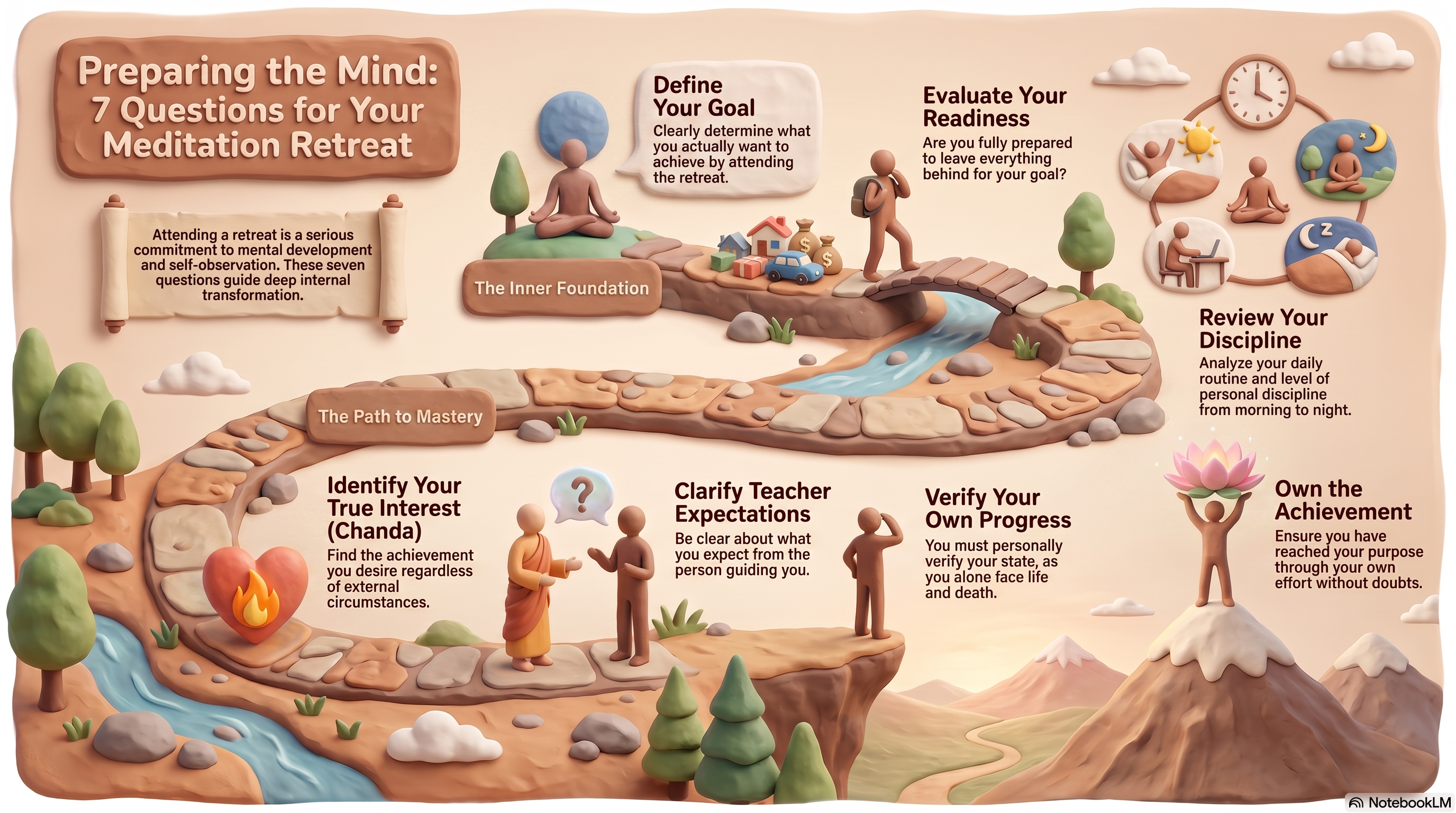 VISUAL SUMMARYSee this study in a pictureOpen the complete infographic for a visual overview before or after reading the full study.View infographic →
A practice diagnostic, not merely a checklist
The page asks whether training is being governed by clear purpose, renunciation, discipline, wholesome chanda, appropriate guidance, direct verification, and confidence grounded in realization—or by the opposite tendencies that keep the citta dependent and moving within saṁsāra.
Framework note
This page presents the seven questions as a practical diagnostic framework for training. The individual Dhamma terms—such as sīla, chanda, taṇhā, vicikicchā, nibbidā, virāga, nirodha, upasama, abhiññā, sambodhi and Nibbāna—are canonical vocabulary, but the exact seven-question arrangement should be understood as a teaching synthesis rather than a fixed canonical list unless separately established from a specific sutta.
The Seven Right Questions and Their Opposites
01 The Seven Right Questions and Their Opposites
These seven questions reveal whether the practice is genuinely directed toward liberation or whether it remains governed by uncertainty, attachment, carelessness, craving, dependence, borrowed belief, and doubt.
| Right Question / Quality | Opposite — What Keeps One in Saṁsāra | Characteristics |
|---|---|---|
| 1. What do you want? Clear purpose |
Aimlessness, confusion, lack of direction | Drifting from one practice to another and seeking experiences rather than liberation. |
| 2. Are you ready? Renunciation |
Clinging, upādāna, attachment, hesitation | “I want Nibbāna, but I cannot let go of my comforts, views, possessions, or identity.” |
| 3. What is your discipline? Sīla, restraint, consistency |
Carelessness, pamāda, laziness, inconsistency | Practice depends on mood; there is no stable routine and mindfulness is repeatedly neglected. |
| 4. What is your chanda? Wholesome aspiration |
Taṇhā, worldly ambition, sensual desire | Driven by pleasure, status, recognition, or mystical experiences rather than liberation. |
| 5. What do you want from the teacher? Guidance |
Dependence, blind faith, personality worship | Expecting the teacher to “give” realization or solve one’s suffering. |
| 6. How will you verify? Direct knowledge |
Assumptions, speculation, borrowed beliefs | Accepting teachings because of tradition, authority, or emotion instead of seeing for oneself. |
| 7. Have you achieved it yourself? Confidence from realization |
Doubt, vicikicchā, dependence on external validation | Constantly asking others, “How am I doing?” without direct experiential certainty. |
The seven questions are not theoretical.
They expose the actual governing force behind one’s conduct: clear purpose or drift, renunciation or clinging, discipline or carelessness, chanda or taṇhā, guidance or dependence, direct verification or borrowed belief, and realization or doubt.
The Opposites of the Seven Dhamma Goals
02 The Opposites of the Seven Dhamma Goals
The Buddha’s repeated sequence toward liberation also has a clear reverse movement. Each liberating quality has an opposite that sustains attraction, craving, production of suffering, agitation, ignorance, delusion, and continued wandering.
| Leads Towards | Opposite | Result |
|---|---|---|
| Nibbidāya — disenchantment | Nandī / abhirati — delight, fascination, intoxication with the world | Continued attraction to conditioned phenomena. |
| Virāgāya — dispassion | Rāga — passion, greed, attachment | More craving and appropriation. |
| Nirodhāya — cessation | Samudayāya — origination and arising of suffering | Continued production of dukkha. |
| Upasamāya — calming and peace | Āyūhana / daratha — agitation, disturbance, proliferation | The mind remains unsettled and reactive. |
| Abhiññāya — direct knowing | Avijjā — ignorance and not knowing things as they are | Misperception and wrong understanding continue. |
| Sambodhāya — awakening | Moha / asambodha — delusion and non-awakening | Remaining asleep to reality despite practice. |
| Nibbānāya — liberation | Saṁsārāya — continued wandering in birth and death | The cycle of becoming continues. |
Visual Teaching Aid
03 Visual Teaching Aid

Seven Questions for Liberation — Right Direction and Opposite Tendencies
Click infographic to enlarge ↗
How the Reverse Movement Continues Saṁsāra
04 How the Reverse Movement Continues Saṁsāra
The collapse does not usually happen all at once. Each weakness conditions the next.
No clear purpose — leads to undisciplined practice.
Undisciplined practice — strengthens craving rather than wholesome aspiration.
Craving — leads to dependence upon others rather than personal verification.
Without verification — doubt remains.
With doubt — there is no nibbidā.
Without nibbidā — there is no virāga.
Without virāga — there is no nirodha.
Without nirodha — there is no upasama.
Without upasama — there is no abhiññā.
Without abhiññā — there is no sambodhi.
Without sambodhi — there is no Nibbāna.
This mirrors the progressive structure of the Dhamma.
Each stage depends upon the conditions established before it. When the foundation is absent, the later stages do not arise merely through desire, belief, or repeated claims.
Practical Self-Review
05 Practical Self-Review
Purpose — Am I seeking liberation, or am I seeking unusual experiences, recognition, comfort, or belonging?
Readiness — What am I still unwilling to relinquish even though I say I want freedom?
Discipline — Does my practice continue when motivation falls, or only when conditions are pleasant?
Chanda — Is my energy directed toward cultivation, or driven by taṇhā for achievement and identity?
Teacher — Do I seek guidance that makes me independent, or reassurance that keeps me dependent?
Verification — What have I seen directly, and what am I merely repeating from memory, authority, or tradition?
Confidence — Is my confidence grounded in direct understanding, or does it repeatedly require confirmation from others?
Direction — Is the present training leading toward nibbidā, virāga, nirodha, upasama, abhiññā, sambodhi, and Nibbāna?