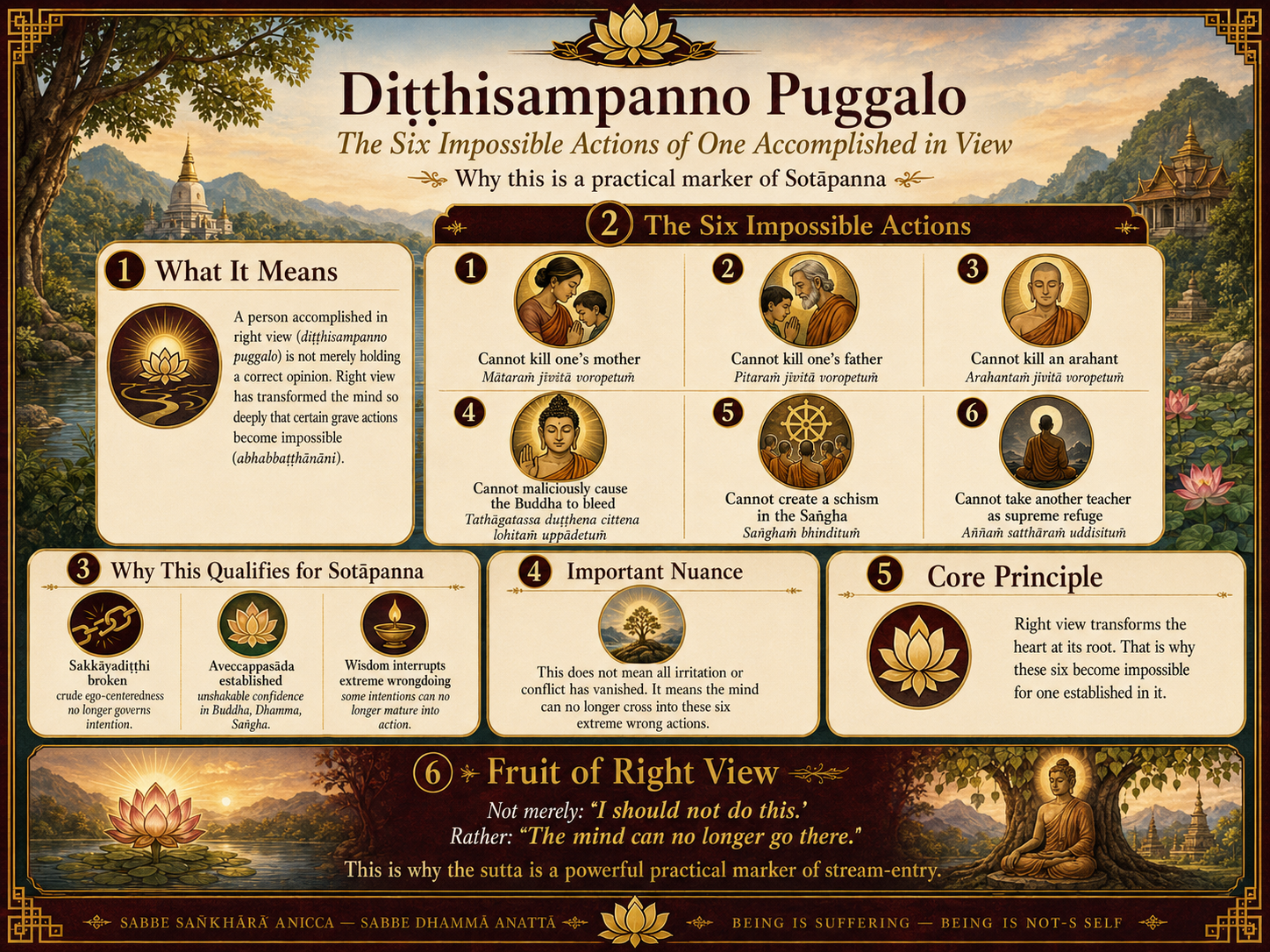
 VISUAL SUMMARYSee this sutta in a pictureOpen the complete infographic for a visual overview before or after reading the full study.View infographic →
This is a very important distinction. The sutta is not merely saying that such a person should not commit these acts. It says they are abhabba — incapable of them. The transformation of view has changed the range of actions the mind can intentionally cross into.
Wrong Identity View Removed→
Confidence Becomes Unshakable→
Wisdom Interrupts Extreme Wrong Intention→
Six Grave Actions Become Impossible
01Mātaraṁ jīvitā voropetuṁ — To deprive one’s mother of life
This is not merely an ethical rule. For a Sotāpanna, it has become psychologically impossible.
A Sotāpanna has seen the Dhamma directly to some extent and has removed sakkāyadiṭṭhi. The crude self-centred view that can justify absolutely anything for “me” has been broken at its root.
The mother represents one of the strongest fields for kataññutā — gratitude — because she is a primary source of life, care and support. Irritation or conflict may still arise, but hatred cannot mature into the blindness required for the deliberate killing of one’s mother.
Key point: the mind cannot cross that threshold because wisdom interrupts the movement toward such an extreme intention.
02Pitaraṁ jīvitā voropetuṁ — To deprive one’s father of life
The structure is the same, though the relationship has its own nuance. The father represents support, protection, responsibility and another primary field of gratitude.
A Sotāpanna understands the gravity of intentional kamma in a way that is no longer merely conceptual. Therefore, even if serious conflict exists, the mind cannot form and carry through the intention to kill one’s father.
The moral compass is no longer functioning merely as an external rule imposed by society or religion. It has become internalized through insight.
Key point: this is not simply restraint under pressure; it is inability born of understanding.
03Arahantaṁ jīvitā voropetuṁ — To deprive an Arahant of life
This goes deeper still. A Sotāpanna has confidence grounded in direct seeing — aveccappasāda — and recognizes what arahantship represents: complete liberation.
Even if a Sotāpanna cannot identify every Arahant explicitly, the mental conditions required for deliberately killing one — extreme delusion combined with extreme hatred — are incompatible with stream-entry vision.
The citta has crossed a threshold in its relationship to the Dhamma and to those who have fulfilled it.
Key point: the mind recoils from such an act; the required combination of hatred and delusion can no longer be sustained to that degree.
04Tathāgatassa duṭṭhena cittena lohitaṁ uppādetuṁ — To maliciously cause the Buddha to bleed
The phrase duṭṭhena cittena is important: “with a corrupt, hostile or malicious mind.” The sutta is not speaking of accidental harm. It is speaking of intentional hostility directed toward the Tathāgata.
A Sotāpanna has unshakable confidence in the Buddha and an experiential recognition that this is the Teacher who reveals the path to liberation. Therefore the mind cannot turn against the Buddha with the degree of hatred required to intentionally injure him.
Key point: the impossibility concerns not only the physical act but the hostile intention from which such an act would have to arise.
05Saṅghaṁ bhindituṁ — To create a schism in the Saṅgha
Saṅgha-bheda is not ordinary disagreement. It is the deliberate creation of a schism in the Saṅgha, rooted in wrong intention and knowingly divisive action.
A Sotāpanna has deep confidence in the Ariya-Saṅgha and has removed sīlabbataparāmāsa together with sakkāyadiṭṭhi. Therefore the practitioner cannot knowingly oppose the Dhamma in the manner required to create a schism for personal ambition, gain, status or view-based pride.
Differences of interpretation or disagreement may still occur. But deliberate Saṅgha-bheda is a different order of action.
Key point: disagreement remains possible; intentional schism becomes impossible.
06Aññaṁ satthāraṁ uddisituṁ — To acknowledge another teacher as the supreme guide
This is perhaps the most doctrinally revealing of the six.
A Sotāpanna has aveccappasāda in the Buddha, Dhamma and Saṅgha and has directly verified, at least to the degree of stream-entry, that this path leads to liberation. Therefore the practitioner cannot internally transfer ultimate refuge to another teacher as the one who leads to final liberation.
This does not mean that a Sotāpanna cannot respect other teachers or learn worldly skills, useful information or even compatible practices from others.
Important nuance: the impossibility is taking another teacher, in the deepest liberative sense, as the supreme refuge or final guide in place of the Buddha.
The importance of this sutta lies in the word abhabba. A person accomplished in view is not merely someone who holds the correct Buddhist philosophy. Right view has become penetrative enough that certain forms of intentional misconduct can no longer arise to completion.
This is why the passage is so useful when discussing Sotāpanna. Stream-entry is not defined only by what a person believes or says about the Dhamma. It has behavioural consequences because three fetters have been broken: sakkāyadiṭṭhi, vicikicchā and sīlabbataparāmāsa.
At the same time, this should not be misunderstood to mean that a Sotāpanna has eliminated all anger, irritation, sensual desire or ordinary human conflict. Those can remain. What has changed is that the citta can no longer descend into certain extreme forms of wrong intention that contradict the direct seeing already established.
When view is truly accomplished, it changes what the mind is capable — and incapable — of intentionally doing.
Three fetters are broken→
Confidence becomes irreversible→
Extreme wrong intention loses its basis→
Six grave actions become impossible
That is why this passage is such a powerful practical marker for understanding what stream-entry changes.