Micchā Diṭṭhi — The Ten Improper Views
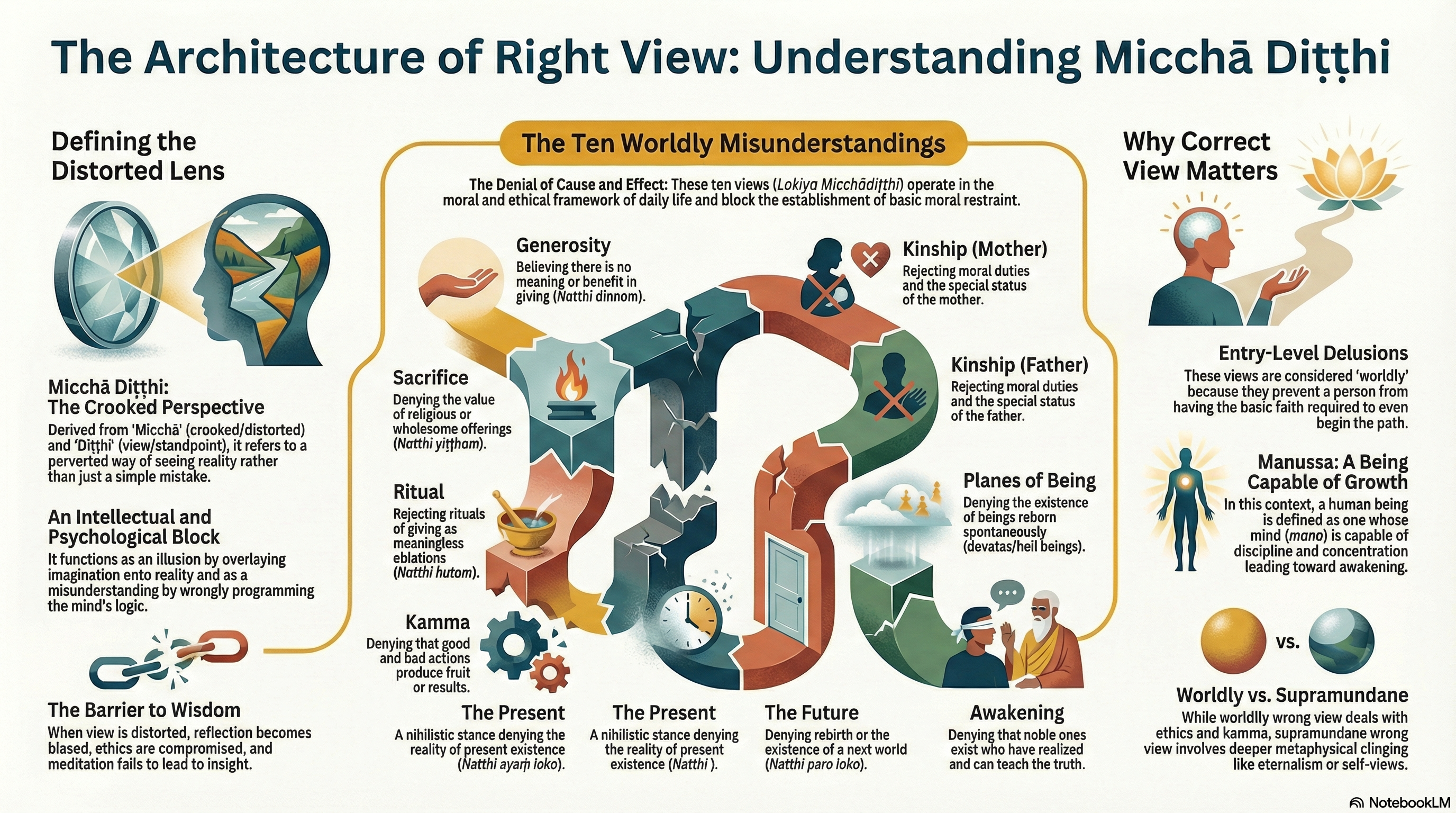 VISUAL SUMMARYSee this study in a pictureOpen the complete infographic for a visual overview before or after reading the full study.View infographic →
Why Wrong View Has to Be Corrected First
In the Buddha’s teaching, liberation does not begin with rituals, beliefs, or external practices. It begins with seeing rightly. When our way of seeing reality is distorted, even sincere effort becomes misdirected. We may practice, give, study, or meditate—yet remain bound to suffering. This fundamental distortion is called micchā diṭṭhi (wrong view).
The Buddha repeatedly emphasized that without correcting wrong view, progress on the path is impossible. Therefore, understanding micchā diṭṭhi is not a philosophical exercise—it is the foundation of spiritual life.
This blog explains:
The meaning of micchā diṭṭhi
Its psychological and practical significance
The ten major wrong views taught in the suttas
Their relevance in daily life
The distinction between worldly and deeper wrong views
Meaning of Micchā Diṭṭhi
Etymological Meaning Micchā → Improper, crooked, distorted, perverted, misleading
Diṭṭhi → View, perspective, way of seeing, standpoint
Micchā-diṭṭhi→ A distorted or misaligned way of seeing reality
(Opposite of sammā — right, aligned, correct or proper)
It does not merely mean having a wrong opinion, but seeing life through improper lens.
Is Micchā Diṭṭhi an Illusion or a Misunderstanding? Yes—micchā diṭṭhi is both.
As Illusion – It takes: Permanence in the impermanent, Self in the non-self and happiness in what is stressful
Security in what is unstable and it overlays imagination onto reality.
As Misunderstanding – It programs the mind wrongly.
When view is distorted: Reflection becomes biased, ethics are compromised and meditation is not possible due to which wisdom does not arise to see the reality
Thus, micchā diṭṭhi blocks alignment with Dhamma at the root.
The Tenfold Wrong-View Formula
Katamā ca, bhikkhave, micchādiṭṭhi?
“Natthi dinnaṁ, natthi yiṭṭhaṁ, natthi hutaṁ,
natthi sukatadukkaṭānaṁ kammānaṁ phalaṁ vipāko,
natthi ayaṁ loko, natthi paro loko,
natthi mātā, natthi pitā,
natthi sattā opapātikā,
natthi loke samaṇabrāhmaṇā sammaggatā sammāpaṭipannā ye imañca lokaṁ parañca lokaṁ sayaṁ abhiññā sacchikatvā pavedentī”ti.
And what, bhikkhus, is wrong view (micchādiṭṭhi)?
‘There is no meaning in giving, no result of sacrifice, no fruit of offerings
There is no fruit or result of good and bad actions;
There is no this world, no next world;
There is no mother, no father to be treated in special way
There are no beings reborn spontaneously (opapātika);
There are no ascetics and brahmins who, practicing rightly, realize for themselves by direct knowledge this world and the next and declare them.’
This is called wrong view.”
The Ten Statements at a Glance
Explanation of worldly misunderstandings
These are not abstract doctrines, but ways people delude themselves in everyday life:
| No. | Pāli statement | Everyday misunderstanding |
|---|---|---|
| 1 | Natthi dinnaṁ No giving |
Believing generosity, helping, and sharing bring no meaningful benefit. |
| 2 | Natthi yiṭṭhaṁ No sacrifice / offerings |
Denying the value of wholesome sacrifice, renunciation, or meaningful offerings. |
| 3 | Natthi hutaṁ No oblations |
Rejecting offerings and acts of giving as meaningless or without consequence. |
| 4 | Natthi sukatadukkaṭānaṁ kammānaṁ phalaṁ vipāko No fruit or ripening of actions |
Denying kamma and its results: “Actions do not really matter.” |
| 5 | Natthi ayaṁ loko No this world |
Denying the significance or moral reality of present existence. |
| 6 | Natthi paro loko No next world |
Denying rebirth or any continuation beyond the present life. |
| 7 | Natthi mātā No mother |
Denying the special moral significance of one’s mother and the importance of gratitude and responsibility toward her. |
| 8 | Natthi pitā No father |
Denying the special moral significance of one’s father and the importance of gratitude and responsibility toward him. |
| 9 | Natthi sattā opapātikā No spontaneously arisen beings |
Denying modes or planes of existence beyond ordinary human and animal perception. |
| 10 | Natthi loke samaṇabrāhmaṇā sammaggatā sammāpaṭipannā… No rightly practising realized contemplatives |
Denying that there are practitioners who have directly realized this world and the next and can teach from direct knowledge. |
Why these are “worldly” misunderstandings?
They are called lokiya micchādiṭṭhi because they operate in the day-to-day moral, ethical, and karmic framework of ordinary people.
A person with such views cannot even establish basic moral restraint or have faith in the path.
They are entry-level delusions — rejecting cause-and-effect, gratitude, rebirth, and noble teachers.
By contrast, supramundane micchādiṭṭhi would be deeper metaphysical clinging: eternalism, annihilationism, self-views about the aggregates, etc which are presented in DN1 – Brahmajalasutta
In the Buddha’s teaching, manussa signifies a being whose mana is capable of growth—through discipline, concentration, and wisdom—towards awakening.
Primary Sutta References
The discourse references below open the corresponding Depth of Dhamma text in a new tab.
How Wrong View Damages and Collapses the Path
01Diagnostic Table: How Each Wrong View Damages the Path
| Pāli Statement | Literal Meaning | Inner Attitude | Mental Damage | Path Factor Destroyed | Practical Result |
|---|---|---|---|---|---|
| Natthi dinnaṁ | Giving has no value | “Helping is useless” | Loss of compassion | Right Action, Right Livelihood | Selfish life |
| Natthi yiṭṭhaṁ | Sacrifice is useless | “Renunciation is pointless” | Loss of discipline | Right Intention, Right Effort | Addiction to comfort |
| Natthi hutaṁ | No unseen offering | “No spiritual dimension” | Loss of faith | Right View, Right Mindfulness | Materialism |
| Natthi sukatadukkaṭānaṁ phalaṁ | No kamma result | “Actions don’t matter” | Loss of conscience | Right View, Right Effort | Moral collapse |
| Natthi ayaṁ loko | No meaning here | “Life is random” | Loss of purpose | Right Intention | Hedonism |
| Natthi paro loko | No next world | “Nothing after death” | Loss of urgency | Right Effort, Right Samādhi | Casual practice |
| Natthi mātā, pitā | No parents | “No gratitude” | Loss of humility | Right Speech, Right Action | Harshness |
| Natthi sattā opapātikā | No other realms | “Only matter exists” | Loss of aspiration | Right View | Flat worldview |
| Natthi samaṇabrāhmaṇā… | No noble ones | “No real teachers” | Loss of confidence | Right View, Right Mindfulness | Doubt |
02The Three Layers of Collapse
🟢 Level 1: Destruction of Giving & Renunciation (Foundation) – These three destroy the starting point:
| View | Destroys | Result |
|---|---|---|
| Natthi dinnaṁ | Generosity | No soft heart |
| Natthi yiṭṭhaṁ | Renunciation | No discipline |
| Natthi hutaṁ | Faith | No spiritual confidence |
🟡 Level 2: Destruction of Moral Causality
| View | Destroys | Result |
|---|---|---|
| No kamma result | Responsibility | “Anything is okay” |
🔴 Level 3: Destruction of Meaning & Guidance
| View | Destroys | Result |
|---|---|---|
| No this world | Purpose | Empty life |
| No next world | Urgency | Laziness |
| No parents | Gratitude | Rootlessness |
| No realms | Aspiration | No depth |
| No saints | Faith | No direction |
➡ Without these, practice cannot even begin.
➡ Ethics becomes meaningless.
➡ Liberation becomes impossible.
The Buddha arranged these in three levels.
Here is how it unfolds step by step:
Integrated Collapse Model
Natthi dinnaṁ / yiṭṭhaṁ / hutaṁ — “Giving, sacrifice, spirituality are useless.”
Natthi kamma-phala — “Actions don’t matter.”
Natthi loko / paro loko — “Life is meaningless without fun and enjoyment and ends at death.”
Natthi mātā-pitā / samaṇabrāhmaṇā — “No gratitude, no true teachers.”
This is complete spiritual nihilism.
The Ten Improper Views, One by One
The canonical sequence remains visible in the badges. Mother and father are discussed together in the source, so views 7 and 8 remain one combined study module rather than duplicating the same discussion.
01Natthi Dinnaṁ — Denial of Giving
1️⃣ Basic Form Dinnaṁ is the past participle of the verb: and dadāti = “to give”
root: √dā = to give, to hand over, to distribute
This same root appears in:
Sanskrit: dāna (giving)
Latin: dōnum (gift → donate, donation)
English: donate, donor
Greek: didōmi (to give)
So dinnaṁ belongs to a very ancient root meaning release / transfer / offer.
Dinnaṁ = “that which has been completely given.” and not half-given nor not lent. nor not shared temporarily, but completely released.
Why does a person have this improper view?
Because the person sees that “acts of giving, helping, and sharing have no real moral or spiritual value” since the entire society works in that way as per his opinion and view point.
Modern Forms of “Natthi Dinnaṁ”
Today it appears as:
- 1️⃣ Extreme Individualism – “Everyone for himself.”
- 2️⃣ Corporate Mentality – “Profit first. People later.”
- 3️⃣ Spiritual Cynicism – “Charity is just social drama.”
- 4️⃣ Family Neglect – “Why support old parents?”
- 5️⃣ Practice Neglect – “Why help Sangha? Waste.”
All of this = natthi dinnaṁ.
When one believes “giving has no value”:
Heart becomes dry and empathy weakens leading to declining of trust. This inturn leads to isolation, fear and greed which becomes an obstacle for jhāna entry. This is because, one has to start to give up or letting go of sensual in order to get into more profound states of existence which is jhāna.
Buddha’s Redefinition of Giving – He purified the act of giving to not just food, shelter, clothing and medicines but the following and that comes under dinnam
| Type | Example |
|---|---|
| Material | Food, clothes |
| Time | Listening |
| Energy | Helping |
| Knowledge | Teaching |
| Forgiveness | Letting go |
| Patience | Enduring |
Highest Meaning (Dhamma Level) – At the deepest level:
True giving = Giving up “mine”.
Letting go of: Possessions, views, identity and control which becomes preparation for Nibbāna.
02Natthi Yiṭṭhaṁ — Denial of Sacrifice and Renunciation
1️⃣ Basic Form or etymology – Yiṭṭha comes from the root yaj (to sacrifice, to offer).
In ancient India it meant:
Fire sacrifices (yajña)
Ritual offerings
Gifts given with reverence
Acts of renunciation
But in the Buddha’s usage, yiṭṭha is broader: Any intentional act of giving up something valuable for a higher good. this includes: Giving wealth, giving time, giving food, giving service and supporting spiritual life while renouncing pleasure for virtue. So yiṭṭha = meaningful self-sacrifice.
The Inner View Behind “Natthi Yiṭṭhaṁ”
A person holding this view thinks:
“Why give? It changes nothing.”
“Why restrain myself? No result anyway.”
“Why donate? No karmic effect.”
“Why sacrifice comfort? No meaning.”
So even if they externally perform rituals, inwardly they believe: “This is pointless.” and that is micchādiṭṭhi.
📊 Universal Comparison of Sacrifice, Giving, and Renunciation in world religions
Practical Modern Examples of “Natthi Yiṭṭhaṁ”
Today it appears as:
- 1️⃣ In Charity – “I won’t donate. Waste of money.”
- 2️⃣ In Family – “Why sacrifice for parents? No use.”
- 3️⃣ In Practice – “Why meditate? Nothing changes.”
- 4️⃣ In Ethics – “Why be honest? Everyone cheats.”
- 5️⃣ In Teaching – “Why help others? No reward.”
All of this = Natthi yiṭṭhaṁ.
| Religion / Tradition | Main Practices of Sacrifice / Giving | Core Meaning | Inner Intention Emphasized? | Spiritual Aim |
|---|---|---|---|---|
| Hinduism | Yajña, Homa, Dāna, Tapas | Offering to devas, cosmic balance, merit | Yes (in Upaniṣadic/Vedāntic level) | Mokṣa (Liberation) |
| Buddhism | Dāna, Saṅgha support, Renunciation | Removal of greed, purification of mind | Central | Nibbāna |
| Jainism | Dāna, Tapas, Ahimsa, Aparigraha | Burning karma, non-attachment | Very strong | Kevala Jñāna (Liberation) |
| Christianity | Tithes, Charity, Self-sacrifice, Fasting | Love, obedience, humility | Central | Salvation |
| Islam | Zakāt, Ṣadaqah, Qurbānī | Purification of wealth and heart | Central | Taqwa, Jannah |
| Judaism (Hebrew Tradition) | Korban, Tzedakah, Fasting | Atonement, covenant duty | Yes | Righteousness before God |
| Zoroastrianism | Yasna, Charity, Fire offerings | Purity, truth (Asha) | Yes | Union with Ahura Mazda |
| Sikhism | Vand Chhako (share), Seva | Service, humility | Central | Mukti |
| Taoism | Simplicity, Non-hoarding, Offerings | Harmony with Dao | Yes | Natural balance |
| Confucianism | Filial duty, Charity, Ritual | Moral cultivation | Yes | Junzi (Noble person) |
| Shinto | Offerings, Purification rites | Gratitude, purity | Moderate | Harmony with Kami |
| Indigenous / Tribal Traditions | Food/animal offerings, fasting | Gratitude to nature/spirits | Yes | Balance with cosmos |
| Baháʼí Faith | Charity, Service, Detachment | Unity and service | Central | Spiritual maturity |
| Ancient Greek (Classical) | Temple sacrifices, Offerings | Appeasing gods | Limited | Divine favor |
| Ancient Egyptian | Offerings to gods/dead | Cosmic order (Ma’at) | Moderate | Afterlife harmony |
Buddha’s Redefinition of Sacrifice: Buddha did not reject sacrifice, but he redefined it.
From External → Internal
Old view: “Offer ghee to fire.”
Buddha’s view: “Offer greed, hatred, delusion into wisdom.”
| Old Sacrifice | Buddhist Sacrifice |
|---|---|
| Fire ritual | Giving up craving |
| Animal offering | Giving up ego |
| Money to gods | Supporting Dhamma |
| Ritual fasting | Sense restraint |
03Natthi Hutaṁ — Denial of Offerings to Unseen Fields
1️⃣ Basic Form or etymology – Huta comes from the root hu = “to pour, to offer”
Traditionally, it refers to: Offerings placed into sacred fire / Oblations given in rituals
Food/offerings dedicated to devas, ancestors, unseen beings and acts done for “invisible recipients”
So: Yiṭṭha = sacrifice / giving up and Huta = offering to unseen / higher / subtle fields
Natthi hutaṁ = “There is no value in offerings made to unseen recipients.”
In deeper terms: “There is no meaningful connection between our actions and unseen moral/spiritual fields.”
It is the denial that: Devas exist, ancestors matter, subtle planes exist, invisible moral networks exist and spiritual fields respond to virtue. Thus, it is denial of the unseen moral universe.
Difference Between Yiṭṭha and Huta (Very Important)
| Term | Focus | Meaning |
|---|---|---|
| Yiṭṭha | Personal sacrifice | Giving up something valuable |
| Huta | Invisible field | Offering to unseen realms |
A person holding this view thinks:
There are no devas, no ancestors watching, no higher beings, no subtle worlds and what I see through eyes is only reality which is materialistic reductionism.
Comparative Table: “Huta” Across Religions
| Tradition | Form of “Huta” (Offering ) | External or Internal? | Purpose | Spiritual Meaning |
|---|---|---|---|---|
| Vedic / Hinduism | Homa, Yajña (ghee, grains into fire) | External ritual → internalized later | Cosmic harmony, merit | Offering ego into sacred fire |
| Buddhism | No fire sacrifice; Dāna replaces Huta | Internalized | Burn greed, not grain | Sacrifice defilements |
| Jainism | No animal sacrifice; austerity replaces fire | Internal austerity | Burn karma | Tapas as inner fire |
| Judaism (Ancient Hebrew) | Korban (animal/grain temple sacrifice) | External → prophetic shift inward | Atonement | Repentant heart > animal |
| Christianity | Christ as ultimate sacrifice | Internalized symbolically | Redemption | Self-sacrifice & love |
| Islam | Qurbani (animal sacrifice), also intention | External ritual + inner submission | Obedience, remembrance | Sacrifice ego to Allah |
| Zoroastrianism | Fire rituals (Yasna) | External + purity focus | Uphold Asha (Truth) | Purify thought/word/deed |
| Sikhism | Rejects ritual fire sacrifice | Internal service (Seva) | Share and serve | Sacrifice selfishness |
| Taoism | Incense/fire offerings | External symbolic | Harmony with Dao | Simplicity |
| Shinto | Offerings of food/sake to Kami | External gratitude | Harmony | Purity and respect |
| Indigenous traditions | Animal/food offerings | External ritual | Gratitude to spirits | Reciprocity with nature |
| Ancient Greek | Animal sacrifice to gods | External | Gain favor | Appease divine powers |
| Ancient Egyptian | Offerings to gods/dead | External ritual | Maintain Ma’at | Cosmic order |
| Baháʼí | No ritual sacrifice | Service & detachment | Unity | Sacrifice ego |
Buddha’s simplified and effective way of huta
| Vedic Fire | Buddhist Fire |
|---|---|
| External Agni | Internal defilements |
| Pour ghee | Pour wisdom |
| Burn grain | Burn craving |
| Smoke rises | Ignorance ends |
Huta through religions:
| Religion | Highest Offering |
|---|---|
| Hinduism | Ego into Brahman |
| Buddhism | Craving into wisdom for liberation |
| Jainism | Attachment into austerity for liberation |
| Christianity | Self for love |
| Islam | Will into submission |
| Judaism | Heart into repentance |
| Zoroastrianism | Falsehood into truth |
| Sikhism | Ego into service |
04Denial of Kamma, Fruit and Ripening
There is no fruit and result of good and bad actions as in:
Sukaṭa = well-done action
Dukkaṭa = badly done action
Kamma = intentional action
Phala = fruit (immediate result)
Vipāka = ripening (long-term result)
Meaning: This is denial of moral causality
One then perceives that “Good and bad actions don’t really matter.”
Inner Psychology
“Cheating is fine.”
“Hurting others has no consequence.”
“Everyone dies anyway.”
This destroys conscience.
05Natthi Ayaṁ Loko — Denial of This Moral-Experiential World
Which means – There is no real moral world, no inner world of consequences, no meaningful order behind life, but everything is in “random”. After this life, everything ends.
In the Buddha’s context, “loka” (world) means:
👉 The lived world of experience shaped by: kamma (action), intention (cetanā), result (vipāka), responsibility and continuity of life.
Philosophical Position Behind This View – This view belongs to uccheda / natthika thinking:
“Everything ends here. as there is nothing beyond sensation and matter.”
Such a person believes: No real meaning in life except for having fun and no spiritual development.
There is no need for inner purification and no karmic order exist. Whatever worldly laws/policing is what one has to adhere to and ultimate aim of this life is to earn, eat, enjoy and die.
To do that, whatever possible ways and means one can do, can do it as there is no karmic consequences to it.
Modern day examples
📱 Example 1: Corporate Corruption
A businessman thinks: “Everyone cheats. and if I don’t, I’ll lose. as there is no karma. no after-effect.”
He then bribes, cheats customers, exploit the works and belives that “only profit matters and no need for moral obligation or responsiblity
💻 Example 2: Online Abuse & Troll Culture
A person abuses others online:
“It’s just the internet. and there is no real harm. and no consequence.”
He believes that words don’t matter, whatever that is coming in mind does not matter and wrong intention does not matter as well. While he burns due to hatredness, he does not realize that he is burning.
💑 Example 3: Sexual Exploitation / Rape / Abuse
A person says:“Consenting adults, that’s it and he can have affairs or have sexual relationship with anyone and there is no deeper effect and emotional karma. While he sees the trauma, attachment and craving for sexual activity, he believes in just chemical and biological need and nothing other than that.
🛍️ Example 4: Consumer Addiction
Person lives only for: Shopping and food, travel and gadgets, clothing and accessorie, lands and buildings. The philosophy is that “Life equals pleasure and there is no deeper purpose than that.
🏫 Example 5: Student Cheating
Student cheats in exams: “If I pass, that’s enough. No inner cost.”
Later: Lacks confidence and fears exposure and having a weak character
But earlier he thought: – “No moral world.”
Summary Table
| Aspect | Natthi Ayaṁ Loko | Atthi Ayaṁ Loko |
|---|---|---|
| View of life | Random | Lawful |
| View of action | No consequence | Has result |
| View of mind | Irrelevant | Central |
| Lifestyle | Hedonistic | Disciplined |
| Long-term result | Suffering | Peace |
06Natthi Paro Loko — Denial of Continuity Beyond Death
A person holding this view thinks:
“After death = total blackout. – No rebirth. no result nor responsibility.” This is like switching off a phone forever.
So life becomes – “One shot, one chance. Take what you can.”
Philosophical Background (Ancient & Modern)
In Buddha’s time – This was held by materialists (Lokāyatas / Ajīvikas):
“Man is made of elements and when he dies, all is finished.”
In modern times too same view appears as hardcore atheism, biological reductionism and consciousness means only brain and neurons. What is visible is what is reality and nothing beyond that.
Consequences of this view:
| Result | Effect |
|---|---|
| No long-term accountability | Moral shortcuts |
| No future cost | Risky behaviour |
| No continuity | Carelessness |
| No spiritual urgency | Laziness |
| Aspect | Natthi Paro Loko | Atthi Paro Loko |
|---|---|---|
| After death | Nothing | Continuation |
| Moral restraint | Weak | Strong |
| Life focus | Pleasure | Purification |
| Death view | Fear / denial | Clarity |
| Practice | Casual | Serious |
07–08Natthi Mātā, Natthi Pitā — Denial of Gratitude to Parents
Going further on this, a person now concludes that there is no special position for both parents and rejects the sacrifice they have done for him/her and does not feel moral debt to the parents. Thus, they feel no gratitude, no reverence and responsibility to any kind towards them
They miss the following aspects of being parents:
- 1. They are the first teachers
- 2. They are the first to give love as soon as they come out of womb and give food, shelter, clothing and medicines
- 3. They are the first protectors until the child comes to age
- 4. They are the ones who have sacrificed their sleep, food, comforts and wealth to bring up the child
Denying this makes one lose connection and become a loner in this world in effect society becomes rootless with no respect for elders.
09Natthi Sattā Opapātikā — Denial of Spontaneously Reborn Beings
Generally, one sees insects, birds, animals and humans and assume that only what is seen only exist and do not agree or know that there can be spontaneous beings in following realms
- 1. Hell
- 2. Hungry ghost or peta
- 3. Devas
- 4. Brahmas
This creates strict materialism and sees no danger as one does not know other life forms and what circumstances or conditions make this possible.
10Denial of Noble Practitioners and Direct Knowledge
ye imañca lokaṁ parañca lokaṁ sayaṁ abhiññā sacchikatvā pavedenti
There are no true renunciants and brahmins who have realized this world and the next and teach from direct knowledge.
This means a view that there are no enlightened beings, arahats – both in recluse and lay life, real masters who have crossed the samsara, genuine teachers who completely follow and know the dhamma.
With the above, one assumes as under:
- 1. No one is enlightened
- 2. There are no teachers who know it and everyone is a fake
- 3. What is seen is what it is. These people project something that does not exist
- 4. They brand it as “pseudo-science” and mock those beings who have certainly crossed over
- 5. Asking for proof of other existence and calling that as “hallucination” or “drugged up”, mocking that samsara is a created or crafted one to make money or wealth at the cost of others.
- 6. Creating a view that atheist or reductionist or annihilationist attitude is the right one
Kamma, Rebirth and the Long Animal-Rebirth Analysis
This large material originally sat in the middle of wrong view no. 4 and interrupted the ten-view sequence. It is preserved here as a separate extended study.
Source-status note: the Pāḷi quotation, translation, tables and interpretive species/mental-trait mappings are retained as supplied. The detailed mappings should be distinguished from the canonical tenfold wrong-view formula above.
01Canonical Starting Point: Birth Follows Kamma
How does different animals/birds/insects gets established due to kamma and kamma vipaka?
First Principle: Birth Follows Kamma
In many suttas (e.g. MN 135, MN 136, AN 3.23, AN10.216), Buddha says:
Kammassakā, bhikkhave, sattā kammadāyādā, kammayonī, kammabandhū, kammapaṭisaraṇā, yaṁ kammaṁ karonti— kalyāṇaṁ vā pāpakaṁ vā— tassa dāyādā bhavanti.
Ayaṁ kho so, bhikkhave,saṁsappanīyapariyāyo dhammapariyāyo.
“Bhikkhus, beings are owners of their actions, heirs to their actions, born from their actions, related to their actions, supported by their actions. Whatever action they do— good or bad—of that they become the heirs. This, bhikkhus, is the Dhamma explanation concerning the wandering-on (in saṁsāra).”
Thus, repeated action → habit → character → destiny and kamma = memory of intention stored in mind-stream.
| Stage | Process |
|---|---|
| Action | Cetanā (intention) |
| Storage | Saṅkhāra |
| Habit | Āciṇṇa / Gati |
| Death | Final citta |
| Rebirth | New bhava |
This means: Rebirth in any realm — human, deva, animal, hell — is conditioned by:
- 1. Dominant intentions (cetanā)
- 2. Repeated habits
- 3. Strength of wholesome vs unwholesome actions
- 4. Mental quality at death (cuti-citta)
02Animal Birth and the Conditions Discussed in the Essay
Animal Birth (Tiracchānayoni)
Tiracchāna-yoni where in Tira = across and acchāna = going
Meaning: “those who go horizontally” (as opposed to upright humans)
This includes mammals, birds, reptiles, insects and aquatic creatures
What Kind of Kamma Leads to Animal Birth?
The suttas indicate animal rebirth results from:
🔹 1. Strong Ignorance (Avijjā)
Animal existence is characterized by: limited discernment, instinct-driven behavior and fear-dominance
Thus habitual delusion and confusion support such rebirth.
🔹 2. Strong Greed and Sensual Obsession
A mind constantly driven by: food craving, sexual obsession, territorial instinct which creates strong grossness
🔹 3. Habitual Violence
Cruelty without remorse can incline toward lower births.
🔹 4. Mental Narrowness
Very restricted awareness, no reflection, purely reactive living.
Thus rebirth in this realm depends on:
- 1️⃣ Weight of kamma (garuka kamma)
- 2️⃣ Habitual kamma (bahula kamma)
- 3️⃣ Death-moment consciousness (cuti-citta)
- 4️⃣ Stored karmic potential (kamma-vipaka)
Thus, it is probabilistic, not symbolic
03Mental Roots, Realms and Animal-Class Patterns
General pattern in different realms
| Dominant Mental Quality | Likely Direction of Rebirth |
|---|---|
| Hatred, cruelty | Hell realms |
| Ignorance + instinct | Animal realm |
| Mixed virtue + ignorance | Human |
| Generosity + morality | Deva |
| Jhāna | Brahma realms |
Let us now explore how raga, dvesha and moha affect the rebirth in different realms, especially the lower ones from animal, to birds, to insects, to reptiles etc.,
1️⃣ Fundamental Principle
Rebirth form follows dominant mental habits (gati) built over many lives in different proportions shown as greed, hatred and delusion which is the standard pillar on which each being comes and goes into existence.
2️⃣ General Pattern Across Animal Classes
| Class | Rāga | Dosa | Moha | Dominant Feature |
|---|---|---|---|---|
| Mammals | High | Medium–High | Medium | Emotion + attachment |
| Birds | Medium | Medium | Medium | Alert craving |
| Reptiles | Low–Medium | High | High | Cold instinct |
| Fish | Low | Low–Medium | High | Survival-driven |
| Insects | Very Low | Low | Very High | Mechanical living |
Kamma-Based Psychological Origins of Animal Birth (3–7)
| Rebirth Type | Mental Structure (Dominant Mind Traits) | Kamma Pattern (Rāga–Dosa–Moha) | Origin: Past Mental Habits | Example in Human Life | Resulting Rebirth Tendency |
|---|---|---|---|---|---|
| Mammals (Dogs, Cows, Monkeys) | Strong emotional bonding; sexual craving; possessiveness; jealousy; fear of separation | High rāga; moderate dosa; moderate moha | Emotional dependence; pleasure-centered living; attachment to people and comfort | Living mainly for family, romance, food, and security without deep reflection | Social, attachment-driven mammal rebirth |
| Birds (Crows, Eagles, Sparrows) | High alertness; restlessness; opportunism; constant scanning; low contemplation | Medium rāga; medium dosa; medium moha; high uddhacca | Always busy; never settled; always seeking advantage | Chasing money, status, gossip, and trends nonstop | Restless, vigilant bird rebirth |
| Reptiles (Snakes, Crocodiles) | Emotional coldness; predatory patience; suppressed aggression; minimal bonding | Low rāga; high dosa; high moha | Long resentment; cold cruelty; revenge mentality | Silent hatred, holding grudges, and enjoying others’ suffering | Cold, detached reptile rebirth |
| Fish / Aquatic Life | Panic-driven; survival reflex; constant movement; no bonding | Low rāga; low–medium dosa; high moha | Fear-based life; confusion; no moral vision | Living only to survive and escape danger, with no ethics | Fearful aquatic rebirth |
| Honey Bees / Hoarding Insects | Constant collecting; extreme storing; possessiveness; fear of loss | High lobha; low dosa; high moha | Chronic stinginess; hoarding wealth; no generosity | Saving obsessively, never sharing, and being obsessed with accumulation | Hoarder-type insect rebirth |
| Other Insects (Flies, Worms, Ants) | Mechanical behavior; autopilot living; no empathy; no planning | Very high moha; minimal rāga/dosa; thīna-middha | Addiction; dullness; spiritual sleep | Endless distraction, intoxication, and no mindfulness | Low-awareness insect rebirth |
| Peta (Hungry Ghost) | Chronic hunger; emotional emptiness; obsession with lack; never satisfied | Extreme rāga; low–medium dosa; high moha | Extreme greed; exploitation; never giving; taking without gratitude | Exploiting others, hoarding, cheating, and emotional emptiness | Starving, craving-driven ghost rebirth |
| Asura (Titan / Demi-god) | Competitive; aggressive pride; jealousy; power obsession | High dosa; high māna/rāga; medium moha | Chronic rivalry; ego battles; desire to dominate | Living in conflict, politics, power games, envy, and pride | Fighting, jealous asura rebirth |
🌱 Core Psychological Pattern
| Dominant Mental Habit | Resulting Realm |
|---|---|
| Strong attachment | Mammal |
| Restless ambition | Bird |
| Cold hatred | Reptile |
| Fear & confusion | Fish |
| Hoarding | Bee |
| Dull addiction | Insect |
| Extreme greed | Peta |
| Pride + rivalry | Asura |
04Mixed Patterns, Human Birth, Practice and Self-Test
Why insects are so numerous?
Because moha is most common in saṁsāra.
Most beings live in: Ignorance, distraction and mechanical habits patterns and hence insects
What it takes to become a human being?
Human birth requires:
- ✔ Balanced rāga
- ✔ Controlled dosa
- ✔ Manageable moha
- ✔ Some wisdom
That balance is rare and animals lack balance.
Mixed Kamma → Mixed Forms
No one has “pure” rāga/dosa/moha and so births are mixed.
Example:
A greedy + dull person → pig-like mammal
A restless + clever person → crow
A angry + patient person → snake
A dull + fearful person → fish
A extremely dull person → worm
Not symbolic but psychological. So rebirth is the continuation of personality based upon the strength of habits and not something random.
Then, what shapes rebirth is on how you think daily and what you crave for, what you fear for and what you ignore. Finally, what one cultivates one becomes as the habits grow stronger.
Relation to Sotāpanna – A Sotāpanna will never again be born as an animal, peta, asura or a hell being because the moha is broken and without dominant moha, lower forms is not possible.
Relation to practice – This table explains why the Buddha emphasized on these and create a preventive medicine in this life before death
| Practice | Prevents |
|---|---|
| Dāna | Bee / Peta |
| Sīla | Reptile / Asura |
| Samādhi | Bird / Fish |
| Paññā | Insect |
Self Test
Ask yourself: Am I hoarding? → Bee/Peta tendency
Am I angry? → Reptile/Asura tendency
Am I restless? → Bird tendency
Am I addicted? → Insect tendency
Am I fearful? → Fish tendency
Am I attached? → Mammal tendency
Then correct immediately.
05Guiding Principle: Human → Deva → Brahmā → Liberation
Guiding principle
Gross rāga–dosa–moha → lower realms
Refined rāga–dosa–moha → human and other higher realms
No rāga–dosa–moha → Nibbāna
Heaven is refined saṁsāra, not liberation.
Complete Comparative Table: Human → Deva → Brahmā → Liberation
| Realm / Birth | Main Supporting Kamma | Rāga (Craving) | Dosa (Aversion) | Moha (Delusion) | Dominant Mental Style | Spiritual Potential |
|---|---|---|---|---|---|---|
| Human (Manussa) | Mixed kamma (good + bad), some virtue, some wisdom | Medium | Medium | Medium | Balance of pleasure, pain, reflection | Highest (best for liberation) |
| Deva (Kāmāvacara Heaven) | Strong dāna + sīla + devotion | High (refined sensual) | Low | Medium | Enjoyment, beauty, comfort | Low–Medium (complacency) |
| Rūpa Brahmā (Form Realm) | Jhāna without insight | Very subtle | Very low | Subtle | Deep peace, absorption | Medium (if insight arises) |
| Arūpa Brahmā (Formless Realm) | Arūpa-jhāna without insight | Extremely subtle | Nil | Very subtle | Abstract “being/awareness” | Very low (easy stagnation) |
| Nibbāna (Arahant) | Insight + non-clinging | None | None | None | Freedom | Complete |
From Wrong View to Right Alignment
The teaching presented in this page traces how distorted view damages generosity, restraint, responsibility, gratitude, aspiration, confidence, and practice.
The practical task is to identify these views in daily attitudes, understand their consequences, and replace denial, indifference, and nihilism with careful examination, wholesome action, and direct verification.