Turn the Five Khandhas Like a Jewel—Until “I” and “Mine” Cannot Be Found
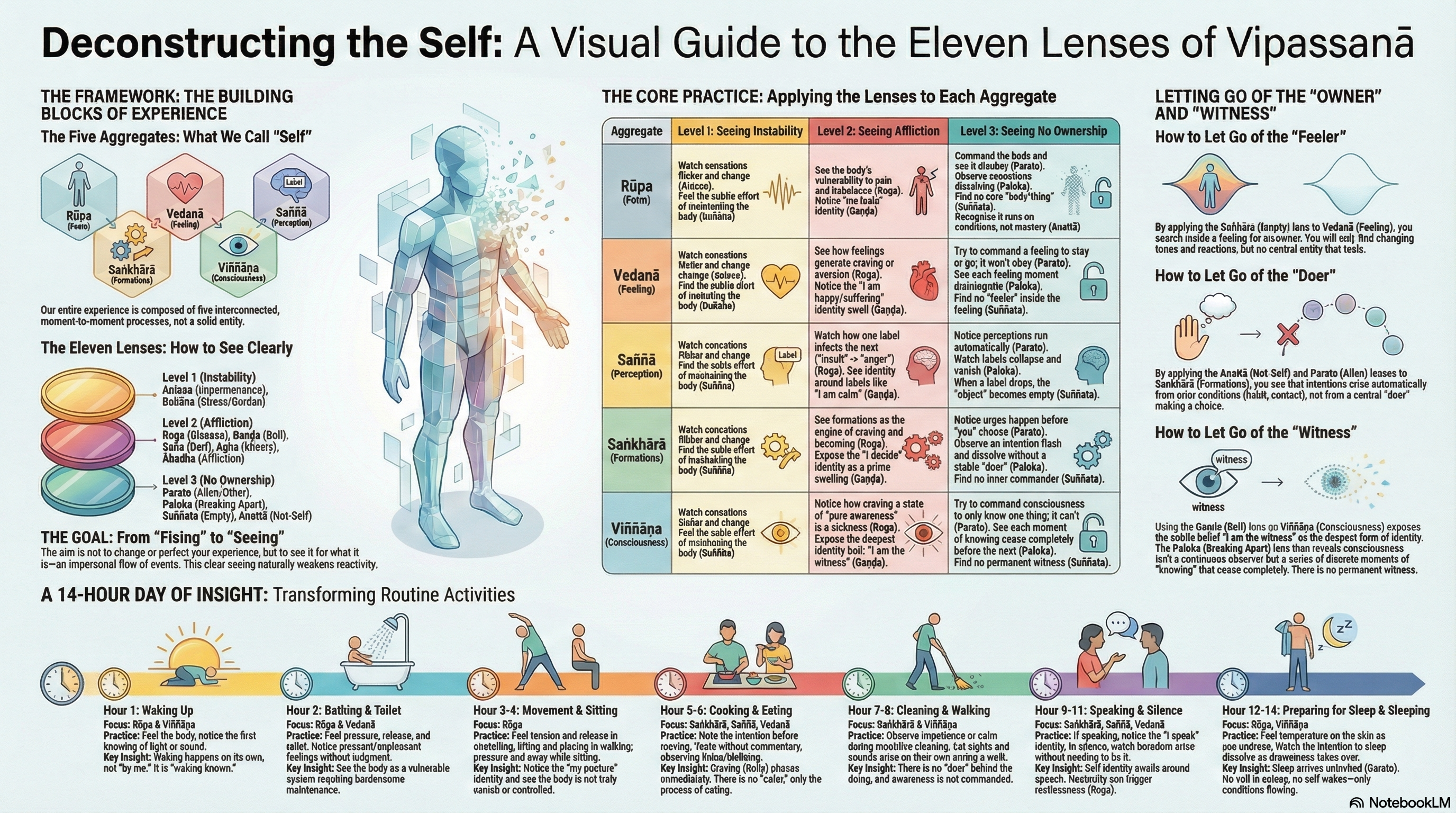 VISUAL SUMMARYSee this study in a pictureOpen the complete infographic for a visual overview before or after reading the full study.View infographic →
What This Practice Is Trying to Change
This essay presents a powerful way of practising vipassanā with the five khandhas by examining each of them through eleven insight lenses—anicca, dukkha, roga, gaṇḍa, salla, agha, ābādha, parato, paloka, suññata and anattā. Rather than merely thinking about impermanence or not-self, the practitioner repeatedly tests these qualities in direct experience.
Applied to rūpa, vedanā, saññā, saṅkhārā and viññāṇa, the practice gradually changes the perception of experience from “this is happening to me” or “this is mine” into seeing conditioned phenomena that arise, change, break apart and cannot be controlled. The purpose is therefore not to fix experience, but to see it so clearly that identification and clinging begin to lose their foundation.
Practice architecture: the same eleven lenses are applied repeatedly to each aggregate, then carried into ordinary activity. The purpose is not to create eleven separate meditations, but to examine the same conditioned field from different angles until ownership and identification weaken.
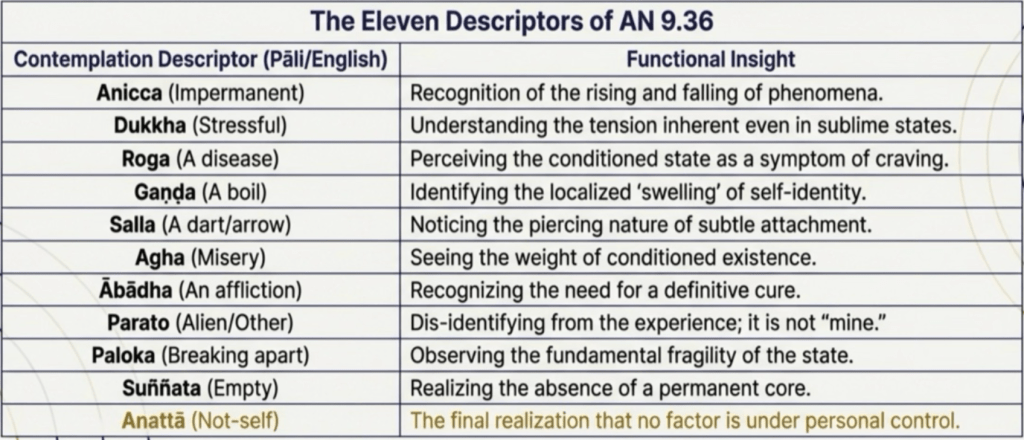
Eleven Lenses, Three Progressive Levels of Seeing
Anicca — Changing / unstable
Dukkha — Burden / unreliable
Roga — Disease / vulnerability
Gaṇḍa — Boil / swelling
Salla — Dart / piercing
Agha — Misery / heaviness
Ābādha — Affliction / oppression
Parato — Alien / other
Paloka — Breaking apart
Suññata — Empty of core / owner
Anattā — Not-self / not under mastery
Three levels of seeing
See Instability — Anicca • Dukkha
See Affliction — Roga • Gaṇḍa • Salla • Agha • Ābādha
See No Ownership — Parato • Paloka • Suññata • Anattā
Eleven analytical lenses applied as one progressive practice
Click infographic to enlarge ↗
Apply the Same Lenses to Each Khandha
Rūpa — Body / material form
Vedanā — Feeling tone
Saññā — Perception / labeling
Saṅkhārā — Formations / intentions
Viññāṇa — Consciousness / knowing
the source combines canonical terms with an applied vipassanā framework and contemporary explanatory language. Claims such as “knowing without a knower,” “the deepest swelling is ‘I am the witness’,” or specific interpretations of sleep and momentary consciousness are preserved as the article’s practice explanations rather than presented here as direct wording of AN 9.36 or another sutta.
01 Rūpa — Form / Body
1) Rūpa (Form) — body sensations and postures consisting of solidity, liquidity, breath as air and warmth
1st Level – Seeing instability/uncertainty
Anicca (uncertainity and impermanence)
Watch sensations flicker, pulse, drift, change shape: pressure becomes vibration; heat spreads; breath texture changes.
Dukkha (burden / stressful / unable to satisfy)
Even “good” body comfort requires maintenance; the body’s balance is never finally secured.
2nd Level – Seeing affliction
Roga (disease) See rūpa as vulnerable by nature: the body is inherently “unstable,” liable to irritation, fatigue, imbalance, movement and other unpleasant things appearing time to time
Gaṇḍa (boil) Notice how the body becomes a site of swelling identification: “my body, my posture, my health.” That “my-ness” is the boil-like swelling. There is always an irritation of some kind or other as in “itchy-ness”
Salla (dart/arrow) See subtle “piercing” in clinging: craving comfort, fearing discomfort, tightening around posture to make it right—this is the “arrow” embedded.
Agha (misery) Feel the body weight: the body must be fed, cleaned, protected, positioned. Not pessimism—just honest seeing of burden.
Ābādha (affliction) Recognize that rūpa is liable to afflict: pain, stiffness of muscles and tissues, hunger, temperature rising, aging of various parts—affliction is built in.
3rd Level – Seeing no ownership
Parato (alien/other) Directly test: can you command the body —sit straight now, do not sleep now or sleep now, never age, never have to visit the washroom, never ache? It behaves like “some other” and not yours
Paloka (breaking apart) Perceive continuous micro-decay: sensations dissolve; breath ends each out-breath; stability is only appearance.
Suññata (empty) Look for a “core body-thing” inside sensations. You find sensations + perception + knowing, but no central essence.
Anattā (not-self) The clearest test: rūpa runs by conditions (food, temperature, hormones, posture, kamma/biology). It is not “I,” not “mine,” not “under mastery.”
02 Vedanā — Feeling Tone
1st Level – Seeing instability/uncertainty
Anicca – Pleasant turns neutral; neutral turns painful; pain shifts location/intensity and can become otherwise too. Vedanā is unstable and uncertain by nature as it is dependent upon the rupa and in this case, body
Dukkha – Burdened by feelings and expecting no suffering. Even pleasant feeling has built-in insecurity: fear of ending, subtle pressure to continue, and the drop when it fades or changes otherwise.
2nd Level – Seeing affliction
Roga – See vedanā as a symptom generator: pleasant → craving; painful → aversion; neutral → dullness/forgetting.
Gaṇḍa Watch the “swelling” of identity: “I am happy,” “I am suffering,” “I am fine.” The self-sense inflames around feeling.
Salla – Feel the “dart”: the moment you grab pleasant or resist pain, the mind gets pierced—reactivity is the wound.
Agha – See the burden of mysery: chasing pleasant, managing pain, escaping boredom—an endless labor in getting a great feeling
Ābādha – Notice how vedanā drives agitation: even mild feeling can dominate attention and disturb composure.
3rd Level – Seeing no ownership
Parato – Try commanding: “pleasant stay,” “pain stop,” “neutral become pleasant.” It doesn’t obey—feeling is “some other” and cannot be commanded.
Paloka – Observe “breaking apart”: each feeling moment disintegrates into the next set dependent on the form —no continuous feeling-line exists.
Suññata Look for a “feeler” inside feeling. You find only changing tones + reactions + knowing—no owner.
Anattā Vedanā arises due to contact and conditions which is form; it is not a self and cannot be possessed as “my happiness” or “my pain.”
03 Saññā — Perception
1st Level – Seeing instability/uncertainty
Anicca – Labels change fast: what was “pain” becomes “throbbing,” then “heat,” then “vibration.” Perception re-draws reality due to change in conditions in feelings related to form
Dukkha – Because saññā is unstable, your “world” is unstable which is why there is burden and needs to be borne at whatever cost. Mislabeling causes confusion, fear, and grasping as feelings are always fleeting due to changing conditions and environment of the form.
2nd Level – Seeing affliction
Roga – Saññā can “infect” experience: one label triggers a chain—“danger,” “insult,” “failure,” “success.” Perception spreads craving/aversion due to changing in feelings
Gaṇḍa – Identity swells around labels: “I am disrespected,” “I am a meditator,” “I am calm.” The “I” piggybacks on perception driven by feelings relating to the form
Salla – A wrong or sticky label becomes an arrow: it pierces and keeps hurting (“this should not be happening”) due to feelings which have become otherwise
Agha – The burden and misery of constant interpretation: the mind keeps naming, comparing, judging—never resting.
Ābādha – Perception can afflict by projecting: imagining future pain, replaying insult, constructing fear—all from labels.
3rd Level – Seeing no ownership
Parato – Perception often runs automatically. You can’t fully control what seems “important,” “threatening,” “attractive.” It is “something other” as it is just labels moving here and there
Paloka – See perceptions collapse: the label falls away, the “thing” vanishes, another label replaces it—continuous breakup and seeming to join back which is wrong perception.
Suññata – When you stop naming, where is the “object” as a solid entity? Much of “thingness” is empty—constructed by saññā or just labeling over feelings.
Anattā – Saññā is conditioned (memory, habit, language). It arises and passes without a controller.
04 Saṅkhārā — Formations
1st Level – Seeing instability/uncertainty
Anicca – Watch intentions arise: “adjust posture,” “swallow,” “think,” “stop thinking”, get up and walk etc., They come and go like bubbles.
Dukkha – Formations are work. Even “trying to be calm” is stress when there is clinging to a result or expectations which is a burden.
2nd Level – Seeing affliction
Roga – Saṅkhārā are the “symptom engine” of becoming: they generate momentum—craving plans, defensive reactions, mental spinning.
Gaṇḍa – The ego swells here strongly: “I decided,” “I control,” “I will achieve.” This is a prime site of “self-boil.”
Salla – This is where the dart often sits: subtle pushing/pulling—forcing, suppressing, grabbing—and the sting is immediate.
Agha – Feel the heaviness of doing: constant micro-manufacturing of stance, opinion, strategy, self-image in terms of what others think or perceive or wish for.
Ābādha – Formations afflict by agitation: even quiet restlessness, subtle impatience, background “must fix” energy.
3rd Level – Seeing no ownership
Parato – Notice how urges happen before “you” choose. Much is automatic conditioning—so it behaves like “other.”
Paloka – See the breakup: an intention flashes, dissolves, reappears differently. There is no single stable “doer.”
Suññata – Look inside an urge for an inner commander. You find sensations + feeling + perceptions + knowing—no core agent.
Anattā – Saṅkhārā are dependent on causes (contact, feeling, habit, views). They are not self, not owned.
05 Viññāṇa — Consciousness
1st Level – Seeing instability/uncertainty
Anicca – Consciousness is not one stream—it is many momentary knowings: sound-knowing, then body-knowing, then thought-knowing etc., which is dependent upon form and contact to get conscious experience. Thus, it also arises and passes away along with sense objects
Dukkha Even refined consciousness is unreliable as refuge: it changes object, fades, gets pulled, cannot be held and hence huge burden to keep the experience stable and certain
2nd Level – Seeing affliction
Roga – Consciousness becomes “ill” when it carries craving: “I want this knowing,” “I want a special state.” That craving is the sickness.
Gaṇḍa – The deepest swelling: “I am the witness.” This is the subtle “boil” of identity around consciousness which can be found in head region or heart region or both.
Salla – The dart: attachment to “pure awareness,” fear of blankness, fear of losing control—this pierces due to experience of death
Agha – Burden of knowing: the compulsion to keep experiencing, keep confirming existence through knowing of all the sense doors
Ābādha – Affliction: consciousness easily gets hijacked—by sound, memory, fantasy, irritation—showing its vulnerability.
3rd Level – Seeing no ownership
Parato – Try commanding: “only know breath, never know sound.” It doesn’t obey fully. Consciousness is conditioned—“something other.”
Paloka – See it breaking apart: each consciousness moment ceases completely; the next arises newly with conditions of that particular sense base
Suññata – Look for a permanent witness inside knowing. You find only knowing-of, always dependent on an object—empty of a core.
Anattā This is the key insight: consciousness arises dependent on conditions (sense-base + object + contact). It cannot be self or master
Less Fixing — More Seeing
Less “fixing” experience; more seeing experience. and reactivity weakens because the mind stops believing: “this is mine / this is me.” The sense of a solid observer softens—experience becomes events, not possessions. and you start to recognize: clinging is the arrow, not the sensation itself.
Daily practice structure
Morning • 90 min • Rūpa — Sitting body + breath sensations
Mid-morning • Vedanā — Walking, bathing, breakfast, chores
Late morning / lunch • Saññā — Labels, recognition, interpretation
Afternoon • Saṅkhārā — Intentions, urges, effort, resistance
Evening • 120 min • Viññāṇa — Knowing across sense experience
Before sleep • 10 min • Review — Where did identity swell? Where did release occur?
01 Morning Session — Rūpa
Morning Session (90 min)
Primary aggregate: RŪPA (Form / Body)
Object: sitting body + breath sensations
How to work?
Stay with raw bodily sensations (pressure, warmth, movement of breath).
Apply each lens lightly, 10 minutes each.
Anicca – Feel micro-change: pulsing, shifting, fading.
Dukkha – Notice subtle effort even in stillness.
Roga – Sense vulnerability: body is condition-dependent and can pain, swell, stiffen etc., and one needs to change postures
Gaṇḍa – Observe “my posture,” “my comfort” swelling identity.
Salla – Detect tightening when resisting discomfort at the cost of comfort
Agha – Feel the weight of maintaining the body posture
Ābādha – See affliction potential in any sensation that arises in the body while watching the breath
Parato – Test control: can you command the body?
Paloka – Watch sensations dissolve continuously as new one arises
Suññata – Search for a core “body-thing” → not found.
Anattā – Let the body be known as conditioned process.
02 Mid-Morning — Vedanā
Primary aggregate: VEDANĀ (Feeling tone)
Object: pleasant / unpleasant / neutral feeling during activity of bathing / washing / breakfast etc.,
How to work?
While walking, bathing, or chores—track feeling tone only.
Anicca – Pleasant shifts; neutral drifts; pain fluctuates.
Dukkha – Even pleasant requires maintenance which is a burdensome and sore
Roga – Feeling breeds craving or aversion.
Gaṇḍa – “I am happy / annoyed” inflates identity which is like a boil ready to break apart
Salla – Grasping or resisting = immediate sting in seeing, tasting, hearing, thinking, smelling and touching
Agha – See the endless work around feelings to make it good
Ābādha – Feeling hijacks attention easily and gets into confusion
Parato – Feelings arise without permission.
Paloka – Each feeling breaks apart instantly.
Suññata – No “feeler” inside feeling.
Anattā – Feeling = contact-conditioned event.
03 Late Morning / Lunch — Saññā
Primary aggregate: SAÑÑĀ (Perception / Labeling)
Object: naming, recognizing, interpreting
How to work?
Notice labels like “taste,” “noise,” “good,” “annoying.”
Anicca – Labels change rapidly.
Dukkha – Mislabeling causes agitation.
Roga – Perception infects experience.
Gaṇḍa – Identity grows around labels.
Salla – Sticky labels pierce repeatedly.
Agha – Burden of constant interpretation.
Ābādha – Perception projects suffering.
Parato – Labels arise automatically.
Paloka – Each perception collapses.
Suññata – Object empties when label drops.
Anattā – Perception is conditioned, not self.
04 Afternoon — Saṅkhārā
Primary aggregate: SAṄKHĀRĀ (Formations / Intentions)
Object: urges, plans, effort, resistance
How to work?
Sit or walk quietly and notice intending, adjusting, thinking, controlling.
Anicca – Intentions flash and vanish.
Dukkha – Doing itself is stress.
Roga – Formations drive becoming.
Gaṇḍa – “I decide” identity inflates.
Salla – Forcing practice hurts.
Agha – Burden of constant doing.
Ābādha – Restlessness, subtle agitation.
Parato – Urges arise before choice.
Paloka – Intentions disintegrate.
Suññata – No inner commander found.
Anattā – Formations arise by conditions.
05 Evening Sitting — Viññāṇa
Primary aggregate: VIÑÑĀṆA (Consciousness / Knowing)
Object: bare knowing of sounds, thoughts, sensations on body and smell
How to work?
Rest as simple knowing—no object preference.
Anicca – Knowing shifts object to object.
Dukkha – Consciousness cannot be held.
Roga – Craving special awareness disturbs.
Gaṇḍa – “I am the witness” swells.
Salla – Fear of losing awareness.
Agha – Burden of needing to experience.
Ābādha – Consciousness is easily disturbed.
Parato – Knowing is not commanded.
Paloka – Each knowing ceases completely.
Suññata – No permanent witness exists.
Anattā – Consciousness is dependently arisen.
06 Before Sleep — Reflection
Quietly recollect:
Which aggregate was most deceptive today?
Where did identity swell?
Where did release naturally happen?
End with:
“Yaṃ kiñci samudayadhammaṃ
sabbaṃ taṃ nirodhadhammaṃ.”
Whatever objects and phenomena arises by maturity of conditions, ceases by the same conditions without a trace
Less correction, more seeing and reduced urgency to control
Softer “observer” sense and experience feels event-like, not personal
A Full 14-Hour Vipassanā Day
Recognize — Know what is present
Do not comment — Do not build a story
Do not interfere — See before fixing
Do not appropriate — Do not turn the event into “I” or “mine”
🧘♂️ A FULL 14-HOUR VIPASSANĀ DAY
Five Aggregates × Eleven Insight Lenses (AN 9.36 mode)
Master instruction for the whole day:
👉 Recognize → do not comment → do not interfere → do not appropriate.
01 WAKING UP → GETTING OUT OF BED
Postures:
lying, turning, sitting, standing
Aggregate focus: RŪPA + VIÑÑĀṆA
Practice:
Feel contact of body with bed.
Notice first knowing of sound, light, thought.
Lenses active
Anicca – sensations of sleep dissolve
Paloka – sleep consciousness breaks
Parato – waking happens, not “by me”
Anattā – no controller of waking
📌 Do not think “I woke up”
👉 Just: waking-known
02 BATHING, TOILET (URINATION / FECES), CLEANING BODY
Aggregate focus: RŪPA + VEDANĀ
Practice:
Feel pressure, warmth, release, relief.
Notice pleasant / unpleasant / neutral feeling.
Lenses active
Roga – body as vulnerable system
Agha – maintenance burden
Ābādha – bodily affliction potential
Suññata – no pure or impure essence
📌 This is one of the strongest ego-cutting periods if done cleanly.
⏰
03 STRETCHING, WALKING, STANDING STILL
Aggregate focus: RŪPA
Practice:
Stretching → tension → release
Walking → lifting, moving, placing
Standing → sway, pressure
Lenses active
Anicca – micro-movement everywhere
Dukkha – effort even in balance
Salla – tightening when forcing
Parato – posture does not obey
⏰
04 SITTING MEDITATION (FORM-BASED)
Aggregate focus: RŪPA → VEDANĀ
Practice:
Sit without correction.
Let sensations speak for themselves.
Lenses active
Gaṇḍa – “my posture” swelling
Agha – weight of embodiment
Paloka – sensations dissolving
Anattā – body not owned
📌 No fixing posture unless necessary.
⏰
05 COOKING, CUTTING, WASHING VEGETABLES
Aggregate focus: SAṄKHĀRĀ + SAÑÑĀ
Practice: Notice intention before movement.
Notice labels: “knife,” “danger,” “taste.”
Lenses active
Anicca – intentions flash
Roga – fabrication leads to becoming
Gaṇḍa – “I am doing”
Parato – actions arise automatically
⏰
06 EATING (SILENT)
Aggregate focus: VEDANĀ + SAÑÑĀ
Practice:
Taste without commentary.
Observe liking / disliking.
Lenses active
Salla – craving pierces immediately
Dukkha – pleasure is unstable
Suññata – taste without owner
Anattā – no eater found
📌 Chew knowing → swallow knowing.
⏰
07 WASHING UTENSILS, CLOTHES, CLEANING
Aggregate focus: SAṄKHĀRĀ
Practice: Repetitive movement.
Watch impatience or calm.
Lenses active
Agha – burden of repetition
Ābādha – irritation potential
Paloka – intention dissolves instantly
Anattā – no doer behind doing
⏰
08 WALKING OUTSIDE / SLOW WALK
Aggregate focus: VIÑÑĀṆA
Practice
: Sounds, sights, touch arise on their own.
Lenses active
Anicca – knowing jumps sense-doors
Parato – awareness not commanded
Paloka – each knowing ceases
Suññata – no witness found
⏰
09 TALKING (MINIMAL, NECESSARY ONLY)
Aggregate focus: SAṄKHĀRĀ + SAÑÑĀ
Practice: Notice intention before speech.
Notice self-identity forming.
Lenses active
Gaṇḍa – “I speak / I explain”
Salla – desire to impress
Dukkha – tension in self-presentation
Anattā – speech happens via conditions
📌 Silence is insight-friendly.
⏰
10 NOT TALKING / QUIET ACTIVITY
Aggregate focus: VEDANĀ
Practice: Neutral feeling becomes clear.
Watch boredom without fixing.
Lenses active
Roga – neutrality triggers restlessness
Agha – discomfort of non-stimulation
Suññata – neutrality without owner
⏰
11 EVENING SITTING (OPEN AWARENESS)
Aggregate focus: VIÑÑĀṆA
Practice:
Let knowing be objectless.
Lenses active
Gaṇḍa – “I am the observer”
Salla – fear of vanishing
Paloka – knowing ceases moment by moment
Anattā – no knower remains
📌 This is where sakkāyadiṭṭhi weakens.
⏰
12 REMOVING CLOTHES, PREPARING FOR SLEEP
Aggregate focus: RŪPA + SAÑÑĀ
Practice:
Temperature, touch, modesty concepts.
Lenses active
Parato – body-image is learned
Suññata – no inherent “me-ness”
Anicca – sensations change rapidly
⏰
13 LYING DOWN, DROWSINESS
Aggregate focus: SAṄKHĀRĀ → VIÑÑĀṆA
Practice:
Watch intention to sleep dissolve.
Lenses active
Paloka – formations collapse
Anicca – awareness thins
Parato – sleep arrives uninvited
⏰
14 FULL SLEEP
Aggregate status: All aggregates suspended except latent conditions
Insight (non-conceptual)
No self asleep
No self waking
Only conditions flowing
📌 This directly undermines “I am.”
🔑
Breaks ownership across all aggregates
Severs identity during ordinary acts
Makes insight continuous, not session-based
Aligns exactly with sutta way of vipassanā
The 11-Lens Checklist
Anicca — “Is it changing right now?”
Dukkha (burden) — “Is there a weight in holding it / keeping it?”
Roga — “Is it symptomatic/conditioned?”
Gaṇḍa — “Where is the ‘mine’ swelling around it?”
Salla — “Where is the sting when it shifts?”
Agha — “What is the overall heaviness of relying on it?”
Ābādha — “How does it oppress/press when appropriated?”
Parato — “Is it actually ‘other’, not mine?”
Paloka — “Is it breaking up / losing coherence?”
Suññata — “Empty of core/owner?”
Anattā — “Not under mastery, not ‘I’?”
Practice synthesis
01 How the Eleven Lenses Deconstruct the Five Aggregates
The text provides a structured daily schedule for applying these insights to routine activities, ranging from eating to sleeping. This systematic approach aims to transform direct experience into a series of conditioned events rather than personal possessions. Ultimately, the practice serves to weaken ego-attachment and foster a profound sense of liberation from suffering.
02 Turning the Five Khandhas Like a Jewel — Aggregate by Aggregate
This transformation occurs across the five aggregates in the following ways:
Breaking Down Materiality (Rūpa)
The lenses transform the body from a solid “me” into a vulnerable, condition-dependent process. By applying the lens of Anicca (impermanence), sensations are seen to flicker and pulse rather than remain stable. The lens of Parato (alien/other) reveals that the body does not obey commands to never age or ache, proving it behaves like “other” rather than a self. Ultimately, the lens of Anattā (not-self) shows the body runs by biology and kamma, not under personal mastery.
Deconstructing Feeling Tone (Vedanā)
Feelings are transformed from personal states of happiness or suffering into momentary events,.
Roga (disease): The practitioner sees feelings as “symptom generators” that breed craving or aversion.
Gaṇḍa (boil): This lens exposes how identity “inflames” around a feeling (e.g., “I am suffering”).
Suññata (empty): Searching for a “feeler” inside the feeling reveals only changing tones and reactions, but no owner.
Exposing the Labels of Perception (Saññā)
The mind’s habit of naming and interpreting is transformed from a “factual reality” into a burden of interpretation. The lens of Paloka (breaking apart) allows the practitioner to see labels collapse and vanish as they are replaced by new ones. This demonstrates that much of what we consider “thingness” is actually empty and constructed by perception.
Neutralizing Mental Formations (Saṅkhārā)
Intentions and urges are transformed from “my choices” into automatic conditioning.
Salla (dart/arrow): This lens reveals the immediate “sting” or tension that occurs when the mind pushes or pulls at experience.
Agha (misery): Insight reveals the “heaviness of misery” of constant micro-manufacturing of self-image and strategy.
Anattā: Recognition that formations arise due to causes like contact and habit, not a central “doer”.
Seeing Through Consciousness (Viññāṇa)
Consciousness is transformed from a “permanent witness” into momentary knowings.
Gaṇḍa (boil): This lens exposes the “deepest swelling” of identity: the belief “I am the witness”.
Paloka: By observing the breakup of consciousness, the practitioner sees that each moment of knowing ceases completely before the next arises.
Suññata: The practitioner finds no permanent core, only a “knowing-of” that is always dependent on an object.
The Result of the Transformation
When these lenses are applied consistently, reactivity weakens because the mind stops believing that experiences are “mine” or “me”. This process severs identity during ordinary acts—such as eating, walking, or bathing—and results in a state of knowing without a knower,.
To understand this transformation, imagine looking at a cinema screen: normally, you are lost in the “story” (the self). Applying these eleven lenses is like walking up to the screen to see the individual pixels flickering and the light of the projector changing; the story doesn’t disappear, but you no longer mistake the flickering light for a solid, personal reality.
AN 9.36 Interactive Study
The old page embedded the external study as a full-width iframe. V3 keeps the destination without embedding an entire second webpage inside this article.
From Possession to Conditioned Events
Five Khandhas × Eleven Insight Lenses — reorganized from the uploaded source for progressive study and daily practice.