What Starves the Hindrances Feeds Awakening
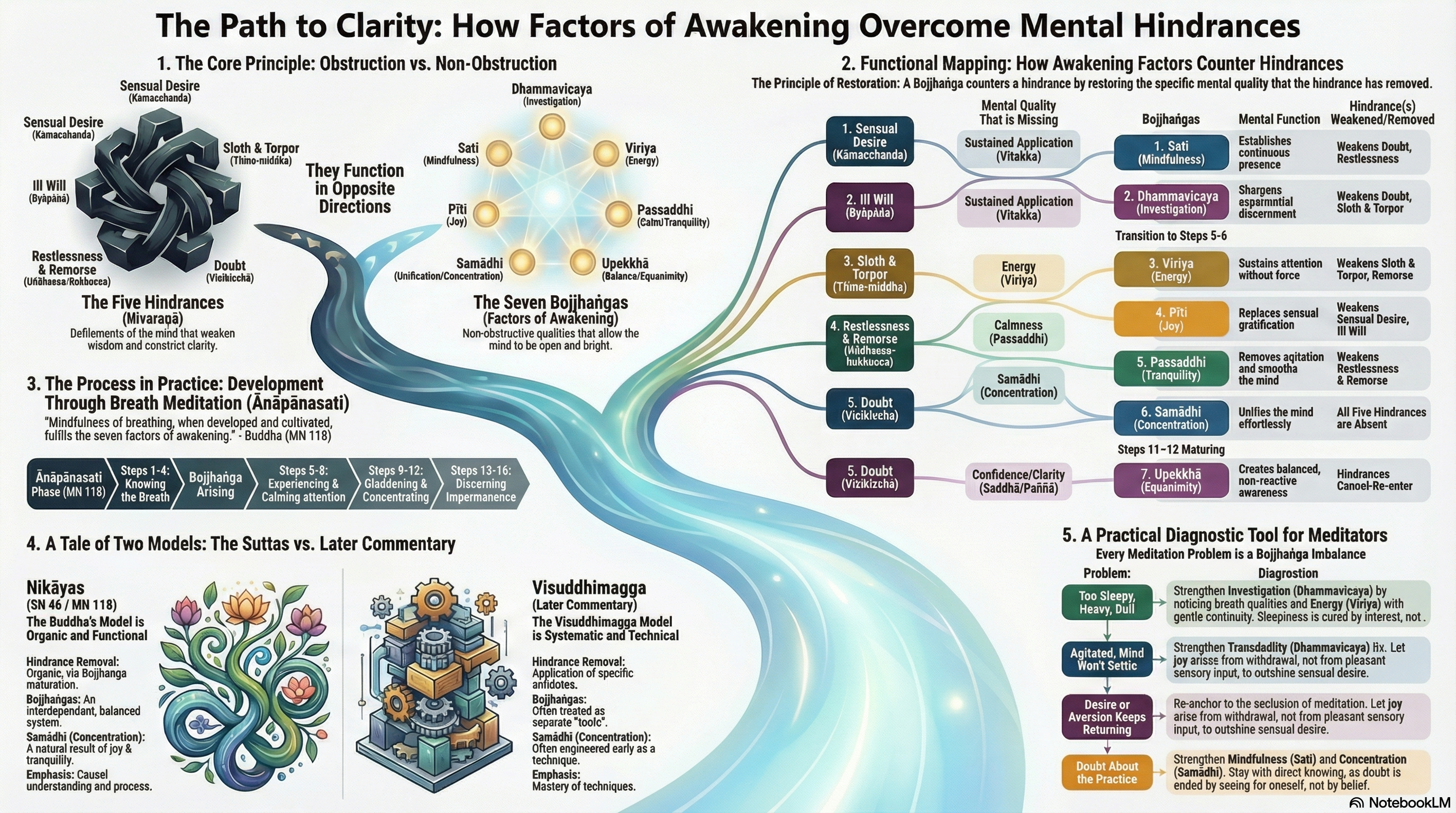 VISUAL SUMMARYSee this sutta in a pictureOpen the complete infographic for a visual overview before or after reading the full study.View infographic →
Practice as a Question of Nourishment
This sutta offers a remarkably practical way to understand mental training: whatever is nourished grows, and whatever is deprived of nourishment weakens. In SN 46.51, the Buddha applies this principle directly to the five hindrances and the seven factors of awakening, showing that the path is not merely about suppressing unwanted states, but about understanding what feeds them and what allows wholesome qualities to mature.
Its special value is that it turns practice into a diagnostic process. When the mind is dull, agitated, attracted, hostile or doubtful, one can ask: What is being fed right now? Which awakening quality is missing? Through yoniso manasikāra, the practitioner learns to stop feeding obstruction and instead cultivate sati, dhammavicaya, viriya, pīti, passaddhi, samādhi and upekkhā.
Seen this way, the sutta gives a powerful principle for practice: do not merely fight the hindrance—change its nourishment. As the bojjhaṅgas are developed, the mind naturally becomes clearer, more balanced, and increasingly unobstructed.
How to use this page: first learn the diagnostic map, then use the complete source essay for deeper study. The summary layer is deliberately practical; the full essay remains available without repeating the whole argument visibly.
What Is Being Fed Right Now?
Wrong / Unwise Feeding — Relevant nimitta or supporting condition is attended to
Hindrance Grows — Āhāra for nīvaraṇa
Yoniso Manasikāra — Changes what is attended to and how
Hindrance Starves — Anāhāra for nīvaraṇa
Bojjhaṅga Is Fed — Āhāra for awakening
The sutta explicitly speaks in terms of what nourishes an arisen/un-arisen hindrance and what serves as non-nourishment for abandoning or preventing it. The essay’s memorable phrase “what starves the hindrances feeds the bojjhaṅgas” is a functional summary, not a literal sutta slogan.
Five Hindrances and What Nourishes Them
Kāmacchanda — Fuel: subhanimitta • Pulls outward • fragments • seeks sensual satisfaction
Byāpāda — Fuel: paṭighanimitta • Constricts • heats • agitates
Thīna-middha — Fuel: arati • tandī • vijambhitā… • Dulls • suppresses inquiry • lowers responsiveness
Uddhacca-kukkucca — Fuel: cetaso avūpasamo • Shakes • scatters • prevents settling
Vicikicchā — Fuel: vicikicchāṭṭhānīyā dhammā • Paralyzes • blocks commitment • obstructs penetration
Seven Bojjhaṅgas as One Coordinated System
Sati — Presence • continuity • non-forgetfulness
Dhammavicaya — Investigation • discrimination • clarity
Viriya — Energy • continuity • non-collapse
Pīti — Non-sensual uplift and gladness
Passaddhi — Tranquillity • smoothing • settling
Samādhi — Collectedness • stability • unification
Upekkhā — Balance • non-reactivity • purified steadiness
The canonical contrast is especially strong at the system level: the hindrances are mental pollutants that weaken wisdom, whereas the seven awakening factors are described as non-obstructive and non-enveloping. The discourse does not provide a fixed “hindrance X = bojjhaṅga Y” table.
Hindrance → Missing Function → Awakening Qualities
Kāmacchanda — Missing: inner joy • collectedness • balance • Pīti • Samādhi • Upekkhā
Byāpāda — Missing: softness • uplift • harmony • Pīti • Passaddhi • Upekkhā
Thīna-middha — Missing: clarity • energy • discrimination • Dhammavicaya • Viriya • Pīti
Uddhacca-kukkucca — Missing: stillness • tranquillity • unification • Passaddhi • Samādhi • Upekkhā
Vicikicchā — Missing: clear seeing • confidence from understanding • Dhammavicaya • Sati • Samādhi
This mapping is the essay’s functional teaching model. It is useful diagnostically, but it should not be presented as an explicit canonical one-to-one antidote list. Several bojjhaṅgas may cooperate to counter the same hindrance, and the whole system matures together.
The Awakening Factors Mature in Sequence
Sati — Establish presence
Dhammavicaya — Clarify & investigate
Viriya — Sustain energy
Pīti — Non-sensual joy
Passaddhi — Tranquillity
Samādhi — Collectedness
Upekkhā — Purified balance
MN 118 explicitly shows ānāpānasati developing the four satipaṭṭhānas, which develop the seven bojjhaṅgas, which culminate in knowledge and liberation. The source’s precise assignment of specific breath steps to specific bojjhaṅgas and individual hindrances is an interpretive teaching map, not an explicit step-by-step pairing stated in MN 118 itself. Likewise, the source phrase “access concentration or First Jhāna” is preserved in the full essay but is not adopted here as a necessary sutta category.
Complete Uploaded Essay
The seven original study sections are retained in full below. They deepen the same framework already made visible above, so the reader can expand only the part that needs closer study.
01 Essay Overview
The Core Principle of Mental Transformation
The fundamental logic of this framework is that the hindrances and the awakening factors function in opposite directions. While the hindrances wrap up or constrict the mind, the bojjhaṅgas open and clarify it. The primary mechanism for this transition is wise attention (yoniso manasikāra), which acts as “non-nutriment” for hindrances and “nutriment” for the factors of awakening. Effectively, what starves the hindrances feeds the awakening factors.
Functional Mapping via Mindfulness of Breathing
Rather than a mechanical one-to-one antidote system, the sources emphasize a functional, organic maturation of the mind. When practicing mindfulness of breathing (ānāpānasati), the seven factors of awakening arise in a progressive sequence:
Mindfulness (Sati): Establishes presence and anchors the mind, weakening doubt and restlessness.
Investigation (Dhammavicaya): Sharpens clarity and awakens interest, countering lethargy and doubt.
Energy (Viriya): Maintains steady continuity, preventing the collapse of effort into sloth.
Joy (Pīti): Replaces sensual desire and hostility with non-sensual, “unworldly” (nirāmisa) gladness.
Tranquillity (Passaddhi): Smooths the mental field, dissolving remorse and agitation.
Concentration (Samādhi): A natural result of joy and stillness where all five hindrances are temporarily suspended.
Equanimity (Upekkhā): A state of purified balance and non-reactivity, rendering the mind “un-enveloped”.
Canonical vs. Later Models
This essay distinguish the original Nikāya model from the later Visuddhimagga approach. The canonical model treats the bojjhaṅgas as an interdependent system where concentration (samādhi) is an outcome of joy and tranquility, rather than a technical achievement or preliminary manipulation. The later Visuddhimagga model is described as more mechanical, applying specific antidotes (like using asubha for desire) and alternating between insight and calm, whereas the suttas suggest insight depends on the collectedness achieved through the bojjhaṅgas.
Practical Application as a Diagnostic Tool
The Bojjhaṅga Framework serves as a diagnostic framework for meditation. Rather than viewing difficulties as personal failures, a practitioner can identify which factor is missing:
Dullness indicates a need for more investigation and energy.
Agitation suggests a lack of tranquility (passaddhi).
Persistent desire suggests the joy (pīti) being experienced is still “sensual-tainted” and needs to be grounded in seclusion.
To understand this framework, imagine a room filled with thick, heavy smoke (the hindrances) that makes it impossible to see or breathe clearly. You do not try to “fight” the smoke by grabbing it; instead, you open a large window and turn on a fan (the factors of awakening). As the fresh air of mindfulness and investigation circulates, the smoke is naturally displaced. The clarity that follows is not something you “built” with the smoke still inside; it is the natural state of the room once the obstructions have been cleared away.
02 SN 46.51 — Āhāra Sutta
In this sutta, Buddha explains that there is this nourishing and factors that will make one thing will grow and another one to shrink – either hindrances to grow or to make them shrink.
What fuels the hindrances of:
1. kāmacchanda – it is subhanimittaṁ
2. byāpāda – it is paṭighanimittaṁ
3. thinamiddha – it is arati tandi vijambhitā bhattasammado cetaso ca līnattaṁ.
4. uddhaccakukkucca – it is cetaso avūpasamo
5. vicikicchā – it is vicikicchāṭṭhānīyā dhammā.
Now, let us look at how Buddha helps in draining out food in hindrances and giving the same food to bojjhaṅgas. This is the clearest and most explicit doctrinal statement for abandoning hindrances and cultivation of bojjhaṅgas
“Atthi, bhikkhave, āhāro uppannassa vā nīvaraṇassa bhiyyobhāvāya, anuppannassa vā nīvaraṇassa uppādāya.
Atthi ca, bhikkhave, anāhāro uppannassa vā nīvaraṇassa pahānāya, anuppannassa vā nīvaraṇassa anuppādāya.”
“Atthi, bhikkhave, āhāro uppannassa vā bojjhaṅgassa bhiyyobhāvāya, anuppannassa vā bojjhaṅgassa uppādāya.”
👉 Then the Buddha explains wise attention (yoniso manasikāra) as:
The anāhāra (non-nutriment) for hindrances
The āhāra (nutriment) for bojjhaṅgas
📌 Crux of it: What starves the hindrances feeds the bojjhaṅgas.
03 SN 46.37 — Āvaraṇa Sutta
Here the Buddha states clearly: “Pañcime, bhikkhave, nīvaraṇā cetaso upakkilesā paññāya dubbalīkaraṇā.”
“Ime kho, bhikkhave, sattime bojjhaṅgā anāvaraṇā anīvaraṇā cetaso apariyonaddhā.”
The five hindrances are defilements of the mind which weaken wisdom and are obstruction (āvaraṇa)
The seven factors of awakening are non-obstructive (an-āvaraṇa) and non-hindering which do not envelop or constrict the mind
📌 What we can observe is that SN 46.37 does not present a list like “this hindrance → that bojjhaṅga”.
Instead, it gives a functional contrast of obstructing states vs non-obstructing state and hence the mapping must be done by function, not by one to one list
04 Āvaraṇa vs Anāvaraṇa
This is the Buddha’s implicit rule:
Whatever obstructs clarity, stability, and penetration = nīvaraṇa
Whatever opens clarity, stability, and penetration = bojjhaṅga
So the mapping is based on what quality is missing when a hindrance is present.
05 Functional Mapping of the Five Hindrances
Let us look closely of each one of these hindrances
🔹 1. Kāmacchanda (Sensual Desire)
What it does?
Pulls attention outward
Fragments the mind
Prevents inner satisfaction
What is missing?
Contentment
Inner joy
Collectedness
Bojjhaṅgas that remove it are:
Pīti – replaces sensual pleasure with nirāmisa joy
Samādhi – unifies the scattered mind
Upekkhā – balances attraction
📌 Principle: Sense desire cannot survive where non-sensual joy and unification are present.
🔹 2. Byāpāda (Ill Will)
What it does?
Constricts the mind
Produces heat, agitation
Destroys gladness
What is missing?
Softness
Uplift
Mental harmony
Bojjhaṅgas that remove it are:
Pīti – uplifts and brightens
Passaddhi – calms bodily & mental irritation
Upekkhā – releases emotional charge
📌 Principle: A mind that is non-obstructed cannot simultaneously be hostile.
🔹 3. Thīna-middha (Sloth & Torpor)
What it does?
Dulls awareness
Suppresses investigation
Removes responsiveness
What is missing?
Clarity
Energy
Discrimination
Bojjhaṅgas that remove it are:
Dhammavicaya – active investigation
Viriya – aroused energy
Pīti – energizing joy
📌 Important: Torpor is not removed by force, but by interest + vitality.
🔹 4. Uddhacca-kukkucca (Restlessness & Remorse)
What it does?
Shakes the mind
Prevents settling
Produces fragmentation
What is missing?
Stillness
Tranquillity
Unification
Bojjhaṅgas that remove it?
Passaddhi – deep calming
Samādhi – collectedness
Upekkhā – non-reactivity
📌 Principle: A mind that is aparayonaddha (not enveloped) is not restless.
🔹 5. Vicikicchā (Doubt)
What it does?
Paralyzes engagement
Prevents commitment
Blocks penetration
What is missing?
Clear seeing
Confidence born of understanding
Bojjhaṅgas that remove it are:
Dhammavicaya – examination of causes
Sati – continuous knowing
Samādhi – experiential verification
📌 Principle: Doubt ends not by belief, but by seeing for oneself.
06 MN 118 — Ānāpānasati → Bojjhaṅgas
Ānāpānasati → Bojjhaṅgas → Hindrance Removal
🔹 1. Sati-sambojjhaṅga
(Ānāpānasati steps 1–4)
What is happening?
Continuous knowing of in-breath & out-breath
Body fully included (sabbakāya)
Primary function
Establishes presence
Prevents drifting
Hindrances weakened
Vicikicchā (doubt) – because experience replaces speculation
Uddhacca (restlessness) – because attention is anchored
📌 SN 46.37 language: Mind is no longer pariyonaddha (wrapped up)
🔹 2. Dhammavicaya-sambojjhaṅga
(Still within steps 1–4, becoming clearer)
What is happening?
Breath qualities are discerned
Long/short, coarse/subtle are known, not analysed
Primary function
Sharpens discernment
Awakens interest
Hindrances weakened
Vicikicchā – causality becomes evident
Thīna-middha – investigation brightens the mind
📌 Important: Dhammavicaya here is experiential discrimination, not thinking.
🔹 3. Viriya-sambojjhaṅga
(Transition toward steps 5–6)
What is happening?
Attention sustains itself
Energy becomes steady, not forced
Primary function
Prevents collapse
Maintains continuity
Hindrances weakened
Thīna-middha – lethargy cannot coexist with aroused energy
Kukkucca – wavering effort due to remorse settles
📌 Buddha’s middle way: Neither slack nor tense
🔹 4. Pīti-sambojjhaṅga
(Ānāpānasati steps 5–6)
What is happening?
Joy and gladness arise because of seclusion
Body and mind feel uplifted
Primary function
Replaces sensual gratification
Energises without agitation
Hindrances removed
Kāmacchanda – sensual pleasure is outshone
Byāpāda – hostility cannot coexist with gladness
📌 This is a major turning point.
🔹 5. Passaddhi-sambojjhaṅga
(Ānāpānasati step 7)
What is happening?
Breath becomes subtle
Body and mind deeply tranquil
Primary function
Removes agitation
Smooths the mental field
Hindrances removed
Uddhacca-kukkucca – restlessness and remorse dissolve
📌 SN 46.37 fits exactly here: Mind is anāvaraṇa — unobstructed
🔹 6. Samādhi-sambojjhaṅga
(Ānāpānasati steps 8–12)
What is happening?
Mind unifies naturally
Attention becomes effortless
Primary function
One-pointedness without force
Stability
Hindrances
❌ All five absent (vikkhambhita)
📌 This is: Access concentration or First Jhāna (depending on depth)
🔹 7. Upekkhā-sambojjhaṅga
(Ānāpānasati steps 11–12 maturing)
What is happening?
Balanced awareness
No push, no pull
Primary function
Non-reactivity
Readiness for insight
Hindrances
Cannot re-enter unless mindfulness collapses
📌 This upekkhā is not indifference, but purified balance.
07 Closing Principle
as they mature, the hindrances lose their capacity to obstruct the mind.
This is the living meaning of SN 46.37.