Strike Once—Listen Until Nothing Remains
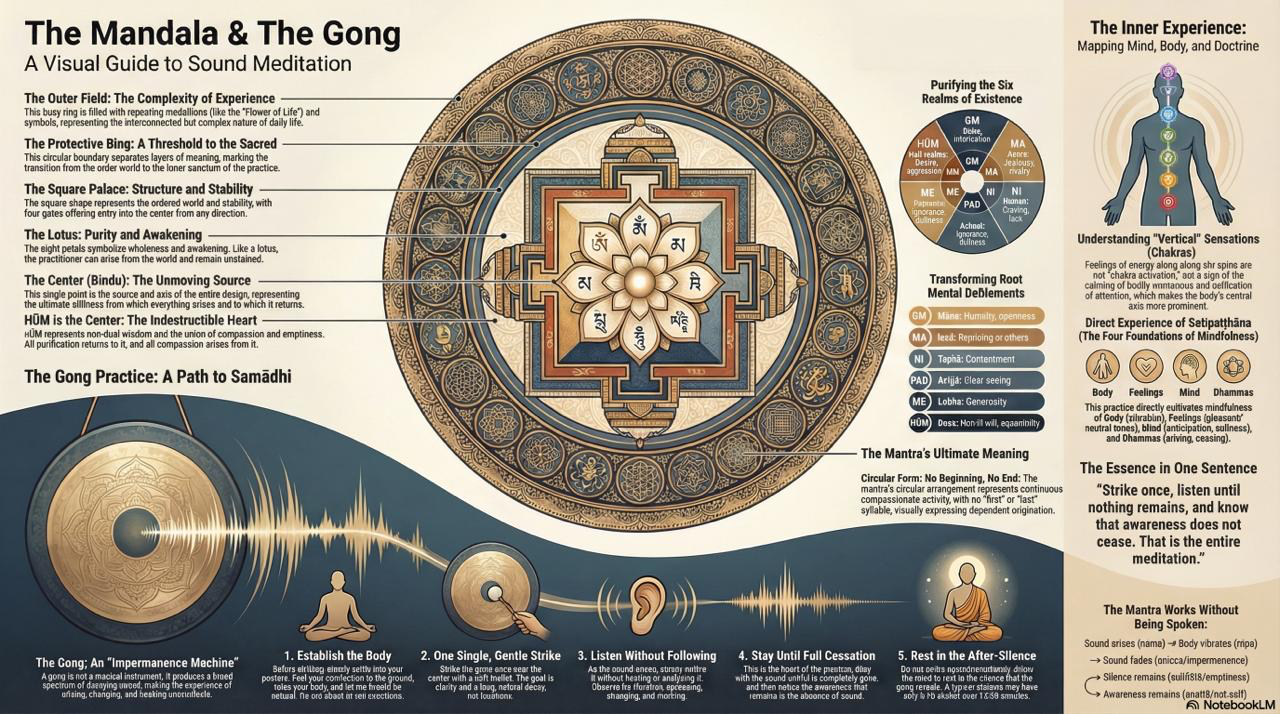 VISUAL SUMMARYSee this study in a pictureOpen the complete infographic for a visual overview before or after reading the full study.View infographic →
Use the Gong for Direct Observation, Not for Metaphysical Conclusions
This practice uses the gong as a direct contemplation of arising, changing and ceasing. A single strike produces a rich field of vibration and overtones that cannot be held still; the sound spreads, transforms, fades and finally disappears into silence. In this way, anicca is not merely understood conceptually—it is heard and experienced directly.
The deeper value of the practice is learning to remain still and non-interfering as sound gives way to silence. Rather than chasing the sound or immediately creating another one, the practitioner observes body, feeling, citta and dhammas through the entire movement of sound → change → cessation → silence, turning a simple gong into a powerful aid for samādhi and insight.
Practice priority: the strongest part of the source is the directly observable movement of sound—arising, changing, thinning and ceasing—together with the practitioner’s non-interference. Symbolic mandala interpretations, physiological explanations and attainment claims are therefore placed later as secondary material.
Strike → Hear → Change → Cease → Silence
Strike — One gentle strike near the center
Hear — Vibration spreads through the field
Change — Overtones thin and reorganize
Cease — The audible sound disappears
Silence — Remain without immediately striking again
01 Form → Sound → Silence
This mandala ultimately points to:
The mantra uses sound to exhaust sound.
The sound arises, changes continuously, becomes fainter and ceases. The practitioner can also know the condition after the sound has ceased. These are directly observable events and do not require adding a metaphysical explanation.
Five Steps — Keep the Practice Simple
Establish the Body — Ground the posture, relax jaw, shoulders and belly; let breathing be natural.
One Single Strike — Gentle, near the center; clarity and decay are more important than volume.
Listen Without Following — Do not name, track, anticipate or manufacture the silence.
Stay Until Sound Ceases — Know vibration, thinning, disappearance and the absence of sound.
Do Nothing — Rest for a few breaths in the after-silence before the next strike.
the source says that noticing the sound has ended while awareness remains “is nirodha samāpatti.” That identification is not established by the passage itself and should be read as the author’s interpretation. In early Buddhist usage, nirodha-samāpatti is a highly specific attainment and should not be equated merely with hearing a sound cease.
Hearing that a sound has ceased is a valid observation of the cessation of that sound. It should not be equated with nirodha-samāpatti. Likewise, “awareness remains” should be read simply as awareness of the post-sound condition, not as proof of a permanent witness or self.
01 How to Use the Gong
Let’s First understand what a gong actually does (important)
A gong is not a bell and not a musical instrument in the usual sense. It produces a broad spectrum of frequencies without any fixed melody, long and decaying resonance wherein the sound that you cannot hold as an object and part of crucial practice
In Vajrayana terms: A gong is an anicca machine — it makes impermanence unavoidable.
You cannot grasp a gong sound – You can only experience arising → changing → ceasing.
How this specific gong is meant to work?
Your gong has: OM MA NI PAD ME HŪṂ mandala
HŪṂ at the center which means:
the visual center = the sonic center
striking near the center emphasizes HŪṂ-like grounding frequencies
the outer areas produce more overtone complexity
So where and how you strike matters.
A. Physical setup
You have already hanged the gong freely and it can vibrate easily
Ensure nothing touches the surface except the striker
B. Position of the meditator
Sit or stand few feets away
If sitting sit upright (chair or cushion) and eyes can be:
softly open (recommended)
or gently closed after some time
C. Striker: Use a soft mallet all the time
Now let us get into the core practice: Gong-based samādhi (step by step)
Step 1: Establish the body
Before striking: feel contact with the ground, relax the jaw, shoulders, belly and let the breath be natural
Do not chant.
Do not set intentions.
Just settle.
Step 2: One single strike
Strike once
Strike near the center, not the rim
Strike gently
It is about clarity and decay.
Step 3: Listen without following
As soon as the sound arises: Do not name it, do not track it, do not expect silence
Just notice: vibration, spreading, changing, thinning, disappearing and SILENCE
This is pure vedanā + saññā observation.
Step 4: Stay until the sound fully ceases
This is the heart of the practice.
Stay with: the sound and then the absence of sound
Notice: when sound is gone, awareness remains
nothing is lost and nothing is added and this is nirodha samāpatti.
Step 5: Do nothing for a few breaths
After the sound ends: do not strike again immediately
allow the mind to rest in the after-silence while this silence is not created by the gong and the gong only reveals it.
✔ Best practice: one strike and wait until all resonance is gone and wait another 10–20 seconds
strike again till you get silence
A session may have:
5–10 strikes total lasting 15–30 minutes
How the mantra works without chanting
You do not need to say OM MA NI PAD ME HŪṂ and the structure works like this:
Sound arises → this is nāma
Sound vibrates the body → this is rūpa
Sound fades → anicca
No sound remains → suññatā
Awareness remains → anattā
The mantra is encoded, not spoken.
Body, Feeling, Citta and Dhammas in One Sound Event
Kāyānupassanā — Vibration in chest, skull, skin and posture
Vedanānupassanā — Pleasant, neutral or subtle uncomfortable feeling without clinging
Cittānupassanā — Anticipation, fading interest, restlessness and stillness
Dhammānupassanā — Arising, changing, ceasing and letting go
01 Satipaṭṭhāna Through Sound
This gong meditation directly supports:
✔ Kāyānupassanā You feel vibration in: chest, skull and skin
✔ Vedanānupassanā – which will be pleasant or neutral leading to subtle discomfort — without clinging
✔ Cittānupassanā – You see: anticipation, fading interest and ultimately stillness
✔ Dhammānupassanā – You directly observe: arising, passing, cessation and letting go
This is Satipaṭṭhāna through sound.
Further more refined practice as an advanced practitioner
Once stable: Strike once and stay with sound
When sound is almost gone, ask silently: “Where did it go?”
Do not answer verbally while attention turn inward which often drops the mind into very deep stillness.
The useful question is not “what permanent awareness remains?” but “what is actually known now?”—vibration, feeling tone, anticipation, fading, quiet, reactivity and release.
Instruction Video and Form • Sound • Silence PDF
I was introduced to this fascinating gong at my dhamma friend home at Brisbane and we started using it for practice of stillness meditation – from sound to silence. Here is a short essay on how to use this wonderful Tibetan tool. The enclosed video provides you with instructions and so also the pdf file.
Mandala, Mantra and Symbolic Interpretation
The visual design can support attention, but it is not necessary for the sound-to-silence practice. This material is therefore placed after the direct practice rather than before it.
From outer complexity toward the center
Outer Complexity — Busy ring, repeating motifs, sensory multiplicity
Thresholds — Boundaries and layers
Square Palace — Order, enclosure, directionality
Lotus — Purity / awakening symbolism
Bindu / HŪṂ — Unmoving center in the source’s reading
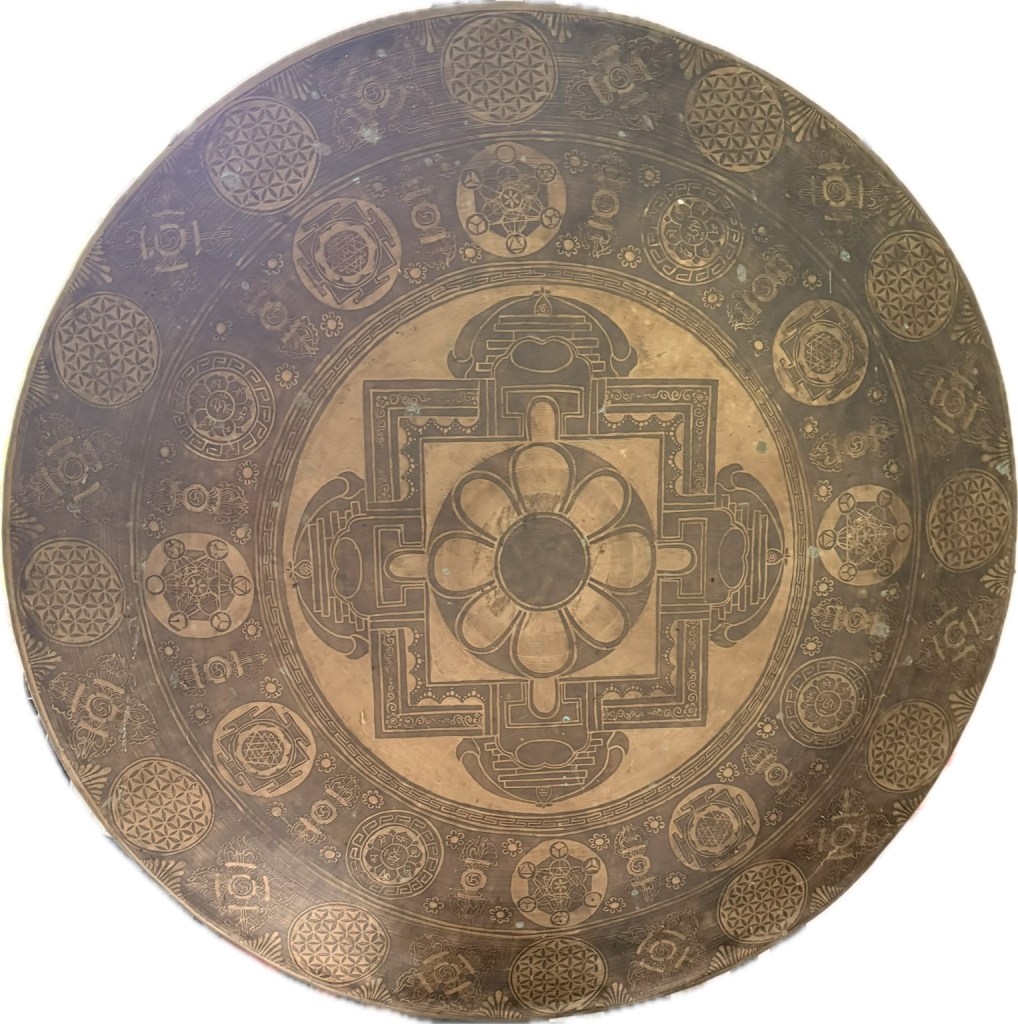
Source gong and mandala
Click infographic to enlarge ↗
meanings assigned in the source to the bindu, lotus, eight petals, square palace, Flower-of-Life-style motifs, Metatron’s-Cube-style geometry, mantra syllables, six realms and six kilesas draw from Vajrayāna symbolism, modern sacred-geometry language, and the author’s Theravāda comparisons. They are preserved here as the source’s interpretation, not presented as universal or canonical meanings of every Tibetan gong or mandala.
The source’s mantra-to-realm and mantra-to-kilesa mappings are tradition-specific interpretive material. In particular, the claim that hatred is the “deepest root” and that its cessation makes “all realms collapse” should not be presented as an early-Buddhist causal statement; the source itself later quotes dependent origination beginning with avijjā.
01 The Gong & Its Mandala
Let us go to the inner square mandala: “palace” structure with four directions
Around the lotus there is a square-within-a-circle form, with four strong directional extensions (up/down/left/right). This is classic mandala geometry having:
Circle → totality / the cosmos / the “field” of experience.
Square palace → structure, stability, the “ordered world” or sacred enclosure which will be explained later in tabular format
Four directional gates/arms → the four directions and the idea of entering the center from any side.
The little architectural details at the ends of the four arms resemble stylized gateways (in traditional mandalas these are “doors” or “toranas”), suggesting:
movement from outer complexity → inner order → center.
Just outside the square mandala is a decorative circular band. In mandala logic, these rings act like thresholds:
they separate layers of meaning,
they mark a transition from “inner sanctum” to “outer world”.
Even when the motifs differ by different vajrayana traditions, the function is similar: layering and containment.
The outer field: repeating medallions + sacred-geometry symbols
The broad outer ring is filled with repeating round medallions, alternating designs, plus small filler motifs (tiny flowers, curls, and ornaments).
A) “Flower of Life” style circles
Several medallions show a dense lattice of overlapping circles—this is widely known today as the Flower of Life family (or close variants like seed/egg-of-life patterns).
Typical meaning in modern sacred-geometry usage: interconnectedness, “blueprint” / harmony of forms, repeating order in nature.
B) “Metatron’s Cube” / network geometry
A few medallions look like a central geometry with connected nodes, reminiscent of Metatron’s Cube-style depictions (a modern esoteric motif derived from circle-lattices).
Common meaning (modern): structure underlying matter, geometry as “organizing intelligence”.
C) Wheel borders
Common meaning across decorative traditions: cyclical time, continuity, “unbroken” flow.
D) Small floral rosettes and scrollwork
These are decorative but also functionally important: they fill negative space and keep the eye moving in a circular rhythm, reinforcing the mandala’s meditative quality.
Overall composition: what the design is “doing” psychologically
This plate is built to create a guided visual journey:
The outer ring is busy and varied → like the complexity of daily experience.
You move inward across boundaries → simplification and focus.
You arrive at the square palace → stability/order.
You settle in the lotus + center point → stillness.
That “outer-to-inner” pull is exactly why mandalas are used as contemplation objects in multiple cultures.
The square mandala palace
| Element | Meaning |
|---|---|
| Square | Stability, completeness |
| Four gates | Four wisdom activities |
| Gates | Entry points for realization |
| Enclosure | Containment of awakened space |
02 OM MA NI PAD ME HŪṂ
Around the central HŪṂ, each lotus petal contains one syllable of the mantra.
| Sanskrit | Tibetan | Meaning |
|---|---|---|
| OM | ཨོཾ | Sacred body, speech, mind |
| MA | མ | Compassion |
| NI | ཎི | Jewel / precious intent |
| PAD | པད | Lotus (purity) |
| ME | མེ | Wisdom |
| HŪṂ | ཧཱུྂ | Indestructible awakened heart |
Why HŪṂ is in the center?
OM purifies body – kayagatasati
MA NI PAD ME purify speech & mind
HŪṂ represents: non-dual wisdom, the union of compassion and emptiness and the heart of Avalokiteśvara
So the mandala means:
All purification returns to HŪṂ
All compassion arises from HŪṂ and that’s why:
the lotus unfolds outward
but the center remains unmoving
Why the mantra is written in a circle (not a line)
Mantras in Tibetan are not meant to be read like sentences.
A circular mantra represents no beginning, no end and no “first” or “last” syllable due to which would be a continuous compassionate activity. This expresses pratītyasamutpāda visually.
The outer ring represents protection and stabilization
Outside the lotus you can see geometric borders, mantra wheels and repetitive symmetry
This functions as a vajra boundary which helps in stabilizes attention, protecting from distraction and keeping the mind from drifting outward.
What this mandala represents in one sentence?
The entire universe of experience purified into compassion, resting in HŪṂ.
Or in Theravada compatible language: Feeling, perception, and intention arise — compassion responds — clinging ceases.
How to relate to it (without ritual or belief)
You don’t need to chant and can simply let the eyes rest on the center (HŪṂ), allowing attention to expand to the petals while everything dissolve back to the center creating inner silence and that’s samādhi supported by form to reach 4 jhānas
03 Six Realms & Six Kilesas
The same six ↔ six root kilesas
Final resolution ↔ anattā & suññatā
OM MA NI PAD ME HŪṂ and the six Realms – In Tibetan Buddhism, this mantra is explicitly taught as a method for purifying the six realms of existence (gati / loka).
| Syllable | Realm (Gati) | Core suffering |
|---|---|---|
| OM | Deva (gods) | Pride, intoxication |
| MA | Asura (titans) | Jealousy, rivalry |
| NI | Human | Desire, attachment |
| PAD | Animal | Ignorance, dullness |
| ME | Preta (hungry ghosts) | Craving, lack |
| HŪṂ | Hell realms | Hatred, aggression |
“Lokaṃ ca loka-samudayaṃ ca loka-nirodhaṃ ca paññapemi.”
“I declare the world, its arising, and its cessation right here.” (SN 12.44)
The same six as six root defilements (kilesas)Now we go deeper with each realm corresponds to a dominant kilesa.. The same mantra does not suppress them — it transforms them.
| Syllable | Kilesa | Transformation |
|---|---|---|
| OM | Māna (conceit, pride) | Humility, openness |
| MA | Issā (envy) | Rejoicing in others |
| NI | Taṇhā (desire) | Contentment |
| PAD | Avijjā (ignorance) | Clear seeing |
| ME | Lobha (grasping) | Generosity |
| HŪṂ | Dosa (hatred) | Non-ill-will, equanimity |
HŪṂ is central while the other syllables are petals – This means:
Hatred and aversion are the deepest root, and when they cease, all realms collapse which aligns perfectly with the Buddha’s teaching:
“Avijjāpaccayā saṅkhārā …
avijjāya tveva asesavirāganirodhā…”
(SN 12.1)
HŪṂ represents cutting of aversion leading to the end of reactive resistance with an effect of non-arising of conflict and we can see that when there is no resistance, there is no becoming.
What Can Be Observed—and What Remains Explanatory
The source also explains vertical or “chakra-like” sensations through calming, attention and body-awareness. Its specific claims about low frequencies producing vagal regulation, high overtones producing cortical alertness, and nervous-system synchronization are scientific interpretations in the article rather than established findings demonstrated by the source itself.
Vertical, spreading or “chakra-like” sensations can be recorded phenomenologically without requiring a chakra model or a specific nervous-system explanation. Claims about vagal regulation, cortical alertness, frequency-specific effects and nervous-system synchronization require independent evidence beyond this article.
01 Body Sensations & Chakra-Like Experience
First, let us acknowledge the experience (without exaggeration)
We often feel activation along the spine
sensations may appear at: pelvic floor, abdomen, chest, throat and head
there can be a sense of vertical openness, sometimes extending “beyond the head”
What is happening?
The nervous system is synchronizing
A gong produces:
low frequencies → vagal / body regulation
high overtones → cortical alertness
long decay → sustained attention without effort
This combination causes: release of habitual muscular holding providing heightened interoceptive awareness and clearer vertical body mapping and so sensations line up along the midline.
The mind interprets this using the nearest available map — for many people, that map is “chakras”.
How would Buddha explain this?
In sutta way, there is no mention of chakras opening due to following reasons:
✔ kāyasaṅkhāra passaddhi – (calming of bodily formations)
✔ cittasaṅkhāra passaddhi – (calming of mental formations)
✔ ekaggatā (unification of attention)
As these deepen: perception becomes more refined, the body feels “transparent” and attention naturally aligns centrally and this is pre-jhānic territory, not energy manipulation.
Why the sensation feels “vertical” and “ascending”
Human body-awareness is organized along: front–back, left–right and up–down. When attention stabilizes: lateral distractions reduce while vertical mapping becomes dominant which creates the sense of: “rising”, “opening upwards” and “beyond the crown”. However, nothing is actually moving upward while distractions are dropping away.
Let the Sound Finish Completely
Gong Practice — Form • Sound • Silence — reorganized from the uploaded source for progressive study and practice.