Meditation Is More Than Sitting Quietly
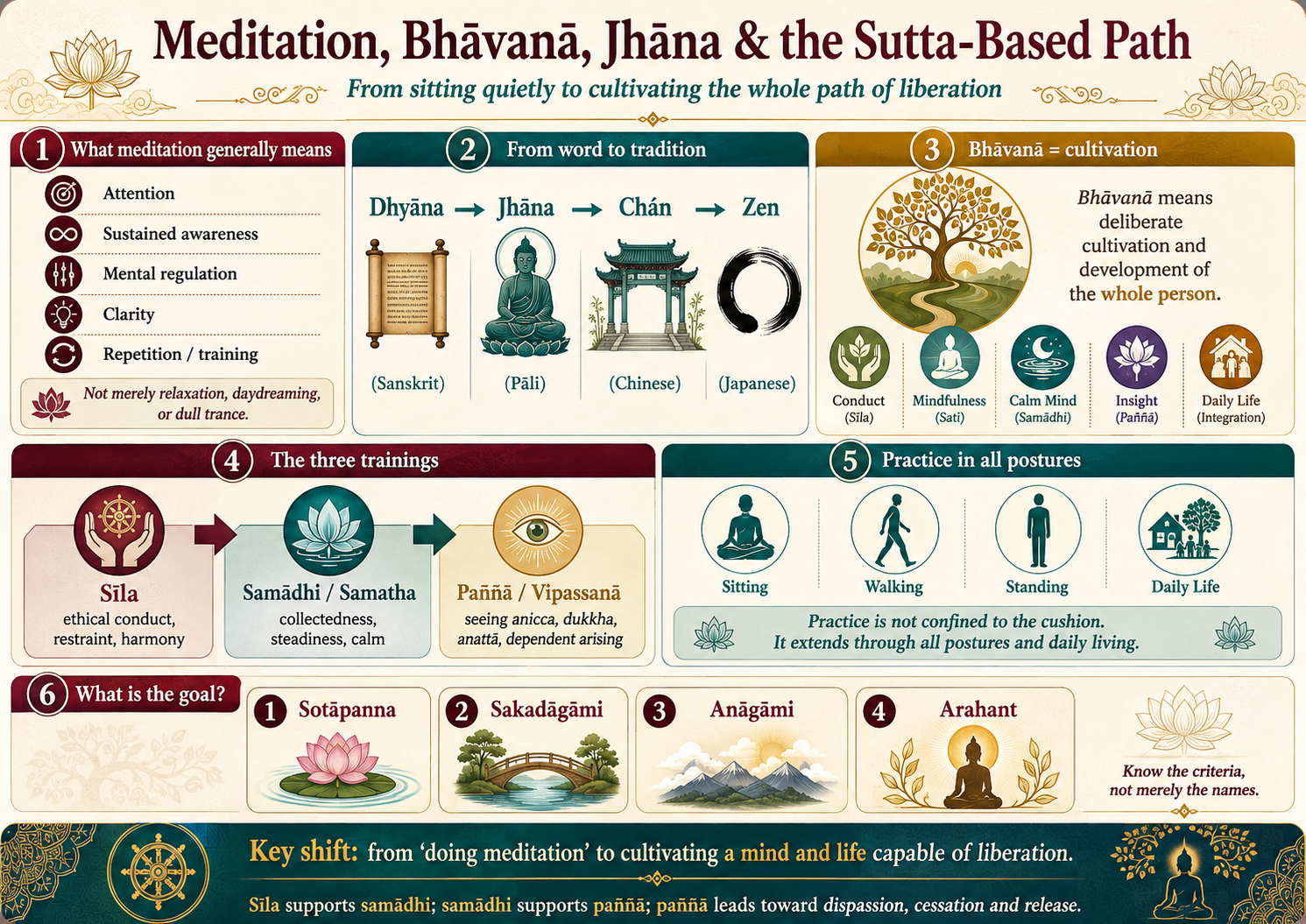 VISUAL SUMMARYSee this study in a pictureOpen the complete infographic for a visual overview before or after reading the full study.View infographic →
Meditation Is an Umbrella Term; Bhāvanā Is Development
Meditation is often understood simply as sitting quietly or concentrating on an object, but the Buddha’s training goes much further. In this framework, bhāvanā is the deliberate cultivation of the whole person—how one lives, speaks, relates to the senses, steadies the mind, and develops wisdom.
The practice therefore unfolds through Sīla → Samādhi → Paññā: ethical conduct provides the foundation, samādhi brings stability and clarity, and paññā investigates experience through anicca, dukkha, anattā and dependent arising. The aim is not merely relaxation or a pleasant meditative state, but a transformation of understanding that progressively leads toward dispassion, cessation and liberation.
Key distinction: “meditation” is an English umbrella term covering many practices. Bhāvanā is better understood as development or cultivation. In the Buddha’s path, cultivation is not confined to a cushion: ethical conduct, sense restraint, mindfulness, collectedness and wisdom all belong to the training.
Sīla → Samādhi / Samatha → Paññā / Vipassanā
Sīla — Ethical purification • Conduct • non-harming • sense restraint • simplicity
Samādhi / Samatha — Mental unification • Sati • avikkhepa • calming • jhāna
Paññā / Vipassanā — Insight and discernment • Anicca • dukkha • anattā • dependent arising
“meditation” is an English umbrella term. The essay prefers to interpret the Buddha’s training through bhāvanā , samatha/samādhi and vipassanā/paññā , rather than reducing the practice to a single sitting technique as indicated in the sutta. There are no sutta’s which mentions sitting only meditation, but it always talk about mental development of removing immoral and establishing moral foundation which then leads to Samādhi by Samathā route. MN6 is clear on this aspect as well as MN53 which provides step by step instruction.
The early Buddhist training is broader than seated meditation, but seated meditation is still explicitly part of the suttas. The safer conclusion is not that the suttas omit sitting meditation, but that they do not reduce the entire path to sitting alone.
01 What Anumodana Sankalpa Teaches
The teachers here do refer to some of the above aspects, but cover entirely towards removing defilements in the mind and to attain complete liberation from birth and death cycle.
Anumodana Sankalpa base their teachings and practices on Buddha’s sutta as primary source and here is what it would mean by term meditation and in pali – bhāvanā
Meditation as per Buddha is a deliberate, sustained cultivation of the mind (bhāvanā) whereby unwholesome mental processes are abandoned, wholesome qualities are developed, and direct experiential understanding of reality as it actually is (yathābhūta) is established, leading progressively to dispassion, cessation, and liberation.
In the Buddha’s teaching, meditation is not merely relaxation or technique, but an integral training of the whole person—ethics, attention, and wisdom—culminating in freedom from suffering.
What meditation includes?
Meditation in its complete sense (bhāvanā) includes three inseparable trainings:
A. Ethical purification (sīla) — what supports meditation
1. Restraint of bodily and verbal misconduct
2.Careful, non-harming speech, bodily and mental actions
3. Sense restraint (indriyasaṁvara)
4. Simplicity of life conducive to seclusion. Seclusion in terms of internal grounded-ness rather than secluded in some remote place
📌 Why this is included
An unrestrained life produces agitation, remorse, and proliferation (papañca). Such a mind cannot settle nor see clearly. Ethics is not “pre-meditation”; it is part of meditation.
“For one who is virtuous, there is no remorse; for one without remorse, gladness arises; from gladness, joy; from joy, tranquillity…” (AN 11.2)
B. Mental unification (samādhi / samatha) — what stabilizes meditation
1. Sustained attention (sati)
2. Non-distraction (avikkhepa)
3. Calming of mental and bodily formations
4. Progressive unification of mind (jhāna)
This is not forceful concentration, but settling of the mind through letting go.
📌 What this accomplishes
1. Weakens the five hindrances and produces inner stillness (passaddhi) making the mind serviceable (kammañña) for insight
C. Insight and discernment (paññā / vipassanā) — what completes meditation
1. Seeing everything in the world as impermanent (anicca) – Example – sunrise to sunset where the person also ends the day
2. Seeing their unreliability (dukkha) eventhough one wants to set things right
3. Seeing their non-ownership (anattā) eventhough one calls as “I’m doing”
4. Understanding dependent arising (paṭiccasamuppāda) in everything and is direct seeing, not philosophical reflection.
📌 What this does?
Cuts identification (sakkāya-diṭṭhi)
Leads to dispassion (nibbidā)
Culminates in cessation (nirodha)
When correctly practiced as per what Buddha says, meditation does:
1. Quieten the mind without suppressing it
2. Reveal how suffering is constructed moment-to-moment
3. Dissolve the illusion of a permanent observer or controller
4. End compulsive craving and resistance
5. Lead to irreversible changes in view (stream-entry and beyond)
6. Meditation is transformative, not merely therapeutic.
From Cushion-Time to Training in Every Posture
Closed eyes → open eyes — Practice should not remain limited to one posture or one setting by closing eyes.
All postures — Sitting, standing, walking and daily activity become fields of training.
Sutta-based development — The essay prioritizes the Nikāyas over school-specific commentarial systems.
Verification — The essay emphasizes examining one’s development rather than relying only on labels or beliefs.
01 What Are We Here to Develop?
This should be the primary question which might be there in your mind and certainly there in my mind too. Here is a brief and short answer to this question.
1. Sitting meditation in closed eyes ONLY to open eyed and meditation in all postures
2. Develop the mind on the sutta based approach and then knowing for oneself on whether they have reached:
1. Sotapanna stage and what qualifies it
2. Sakadagami stage and what qualifies it
3. Anāgami stage and what qualifies it
4. Arahat stage and what qualifies it
There are many questions relating to these and generally it is heard that one cannot get these easily or without being a “monk”. However, the sutta’s do not say that and one can see for oneself rather than relying on different interpretations, commentaries or views presented. It is always as Buddha says, one should investigate without either accepting or rejecting anything.
What “Meditation” Means—and What the Historical Terms Do Not Prove
Common features of meditation in general usage
Intentional Attention — Choose an object, process, or field
Sustained Awareness — Remain and return when distracted
Mental Regulation — Reduce reactivity; cultivate calm and clarity
Meta-Awareness — Know thoughts and feelings as events
Repetition — Training develops through regular practice
Purpose — Clarity, stability and insight
What the source distinguishes from meditation
Not ordinary thinking — Planning and problem-solving are different activities
Not passive relaxation — Relaxation may occur, but practice involves deliberate awareness
Not daydreaming — Imagination is not the same as sustained observation
Not dull trance — Loss of clarity is not the goal
Not dependent on belief — Practice can be examined through experience
Dhyāna, Jhāna, Chán and Zen — language history, not a practice ladder
Dhyāna — Sanskrit • Contemplation / sustained mental engagement
Jhāna — Pāli • Progressive unification and refinement of mind
Chán — Chinese • Historically derived from dhyāna terminology
Zen — Japanese • Japanese pronunciation of Chán
The Theosophical Society was founded in New York in 1875 by Helena P. Blavatsky, Henry S. Olcott, William Q. Judge and others. Annie Besant joined later; she did not found the Society in the early 1800s. The source’s broader claim that the modern word “meditation” spread through Asian countries specifically because of Besant and Blavatsky is not established by the material supplied here and should not be presented as settled history.
Dhyāna and jhāna are Sanskrit and Pāli cognates. Chinese Chán and Japanese Zen are historically related through transmission of the dhyāna term. That linguistic history should not be turned into a simple progression in which Dhyāna “became” Jhāna, then Chán, then Zen as progressively simplified meditation systems.
The essay contains several broad etymological and historical information. Much of what we see is from the Theosophical Society which was founded in 1875 by Helena Blavatsky, Henry Steel Olcott and others, while Besant joined later. There are claims that meditation word spread in Asian countries especially India, Sri Lanka, Burma etc., due to active participation of Anne Besant and Helena Blavatsky in these countries to develop a spiritual model. However, these cannot be taken as 100% accurate as there are many views and claims relating to it and hence have to adhere to caution.
01 What Is Meditation?
From a general and worldly definition context
What is meditation?
Meditation (from meditārī) originally meant a deliberate, measured mental training or exercise, involving sustained attention and thoughtful engagement.
Meditation — a general definition
Meditation is a deliberate mental practice in which a person systematically trains attention, awareness, or mental processes in order to regulate the mind, cultivate specific mental qualities, or gain clarity about inner experience.
It is an intentional practice, done repeatedly over time, aimed at changing how the mind relates to thoughts, sensations, emotions, and perceptions.
What meditation generally includes?
Across cultures, traditions, and modern psychology, meditation typically includes some or all of the following elements:
Intentional attention – Choosing an object, process, or field of awareness
Examples: breath, bodily sensations, a sound, a word, or awareness itself
Sustained awareness – Maintaining attention over time
Noticing distraction and returning without forc
Regulation of mental activity – Reducing excessive mental reactivity
Developing calm, stability, or clarity
Meta-awareness – Awareness of thoughts, feelings, and sensations rather than being absorbed in them
Observing mental events as events
Repetition and training – Meditation is not a one-time experience but a trainable skill
Effects accumulate through regular practice
What meditation can do (general effects)
From a general, secular standpoint, meditation may:
Improve attention and concentration
Increase emotional regulation
Reduce stress and reactivity
Enhance self-awareness
Improve clarity, insight, or creativity
Alter habitual patterns of thinking and feeling
The depth and nature of effects depend on the method and consistency of practice.
What meditation does NOT generally include?
❌ Not ordinary thinking – Planning, analyzing, or problem-solving is not meditation, even if done quietly
❌ Not passive relaxation – While relaxation may occur, meditation requires active engagement of awareness
❌ Not imagination or daydreaming – Fantasizing, visual storytelling, or mental wandering is not meditation
❌ Not trance or unconsciousness – Loss of clarity, dullness, or blankness is not meditation
❌ Not belief-based practice – Meditation does not require belief in any doctrine, philosophy, or metaphysics
In simple terms – Meditation is learning how to pay attention on purpose, in a specific way, to develop clarity, stability, or insight into the mind or its working to keep cool, absorbed and calm state in any day to day situations
02 Etymology of “Meditation”
What we use today as a word is basically of Latin origin and the English word meditation comes from the Latin: meditātiō (noun) meditārī (verb) where in meditārī means: to think over, to ponder, to consider attentively, to rehearse mentally, to practice or train
So originally, meditation meant “mental exercise” or “deep reflection”, not silence or breath awareness.
03 How the Meaning Evolved
Classical Latin (Roman period)
Meditation = thoughtful consideration
Used in philosophy, rhetoric, and moral training
Medieval Christian usage
Meditation = contemplation of scripture
Still largely discursive thinking, not mental silence
Early modern English (16th–18th c.)
Meditation = serious reflective thinking
Example: “Meditations on First Philosophy” (Descartes)
Modern usage (20th c. onward)
Meaning expanded due to influence of Eastern practices and included attention-based and awareness-based practices
Shift from thinking → observing / attending
Meditation ≠ Eastern bhāvanā (originally) The word “meditation” was later used as a translation label for diverse Asian practices after Anne Besant started Theosophical Society in early 1800 and incorporated many of these into meditation.
Dhyāna
Bhāvanā
Zen
Yoga practices
But linguistically speaking, meditation originally meant active mental consideration and NOT non-thought or absorption
04 Dhyāna, Jhāna, Chán and Zen
Dhyāna (Sanskrit)
Root: √dhyai
Meaning: to think, contemplate, reflect, attend mentally
Original sense
Sustained mental attention
Continuous absorption in an object
Neither casual thinking nor trance
Key idea: 👉 A mind that stays with one theme without scattering
Jhāna (Pāli) — experiential refinement
Pāli form of: dhyāna
Associated verb: jhāyati — “to burn,” “to absorb,” “to dwell”
Semantic shift
From “thinking” → deep unification
Thinking becomes progressively quieted
Emphasis on absorption and stability
Key idea: 👉 Attention so unified that discursive thought fades
Chán (禪) — simplification in China
Transmission: Dhyāna → Chánnà → Chán
Cultural shift – Chinese language lacked a precise equivalent
Emphasis moved to:
Directness
Naturalness
Effortless awareness
What changed?
Less analytical structure
Less technical mapping of stages
More emphasis on immediacy
Key idea: 👉 Settling into awareness without contrivance
Zen (禅) — radical minimalism in Japan
Zen = Japanese pronunciation of Chán
Further shift
Almost total rejection of:
Conceptual explanation
Stages
Techniques as goals
Practice emphasis
Sitting (zazen)
Presence
Non-interference
Key idea: 👉 Just sitting — nothing to add, nothing to remove
Know the Criteria, Not Merely the Stage Names
Sotāpanna — What qualifies stream-entry?
Sakadāgāmi — What qualifies once-return?
Anāgāmi — What qualifies non-return?
Arahant — What qualifies completion?
the article encourages practitioners to verify the stages of awakening for themselves and argues that lay status does not by itself preclude attainment. Specific attainment claims should nevertheless be assessed against the relevant sutta criteria rather than inferred from subjective experience alone.
Subjective calm, unusual meditative experience or confidence is not by itself a reliable attainment criterion. Each stage should be assessed against the relevant sutta characteristics, especially the fetters abandoned or weakened and the irreversible changes in view and conduct.
How This Approach Relates to Other Meditation Traditions
The source positions Anumodana Sankalpa as a sutta-first continuation of prior practice rather than a replacement for Burmese, Thai, Sri Lankan, Mahāyāna or Goenka/U Ba Khin training. These comparative judgments are the author’s practice position and should not be presented as neutral descriptions of all those traditions.
The statement that body-scanning alone is insufficient, that particular traditions reach the “same state,” or that one approach must be “transcended” is interpretive rather than a direct sutta quotation. The publishable core is simpler: prior techniques may be useful foundations, while the practitioner continues examining the broader training described in the suttas.
01 What You Will Find Here
If you were to visit UnderstandingBuddhasTeachings YouTube channel or this website or in person, one can note that it is not a formal sitting meditation method, but more to do with incorporating samathā and vipassanā in all aspects and not only about cushion time of sitting meditation.
The practice involves mindfulness of mental, speech and bodily actions that does not harm oneself or others and leads to calm abiding through stabilizing the breath and entering into four Brahma Vihara or heartfulness state which removes agitation from mind and establishes in Brahma realm while being in human body.
There are various traditions like Burmese, Thai, Sri Lankan which are called as “Theravada” and there are many in Mahayana which do provide the same state in different ways. However, we have chosen to go by sutta and not by any traditions with an underlying understanding that many of them have already done one or other retreat from either of these traditions and are aware of sitting meditation practice which is key to understand Buddha’s teachings through “vipassana” of bodily sensations and not reacting to them.
The most popular of them is U Ba Khin and Goenka ji who really helped lay people to attain higher states and their contribution is unbeatable. It would be good to note that as Goenka ji says in his 10 days course that this 10 day format is just a skeleton and one will need to go further which sometimes gets missed and we tend to believe that “body scanning” itself is sufficient enough to reach higher states. This statement is not true and we need to take all traditional approach just as a starting point and then move to sutta and start practicing on top of what we have learned in Goenka ji sessions as in 10, 20, 30, 45 and 60 days.
Thus, the expectations what we have is that those who are attending the course either online or offline are aware of Goenkaji technique and are willing to move or transcend into Buddha dhamma through sutta way. We should note that this is not a replacement to any approaches we have followed, but a supplement or an entire development on the foundations we have either through Burmese, Thai, Sri Lankan or Mahayana approach.
What we need to develop? – Exactly as indicated in this sutta
From “Doing Meditation” to Developing a Life Capable of Liberation
01 Closing Aspiration
Meditation, Bhāvanā and the Sutta-Based Path — reorganized from the uploaded source for progressive study and teaching.