Sotapanna through Anicca, Vipariṇāmi and Aññathābhāvī contemplation
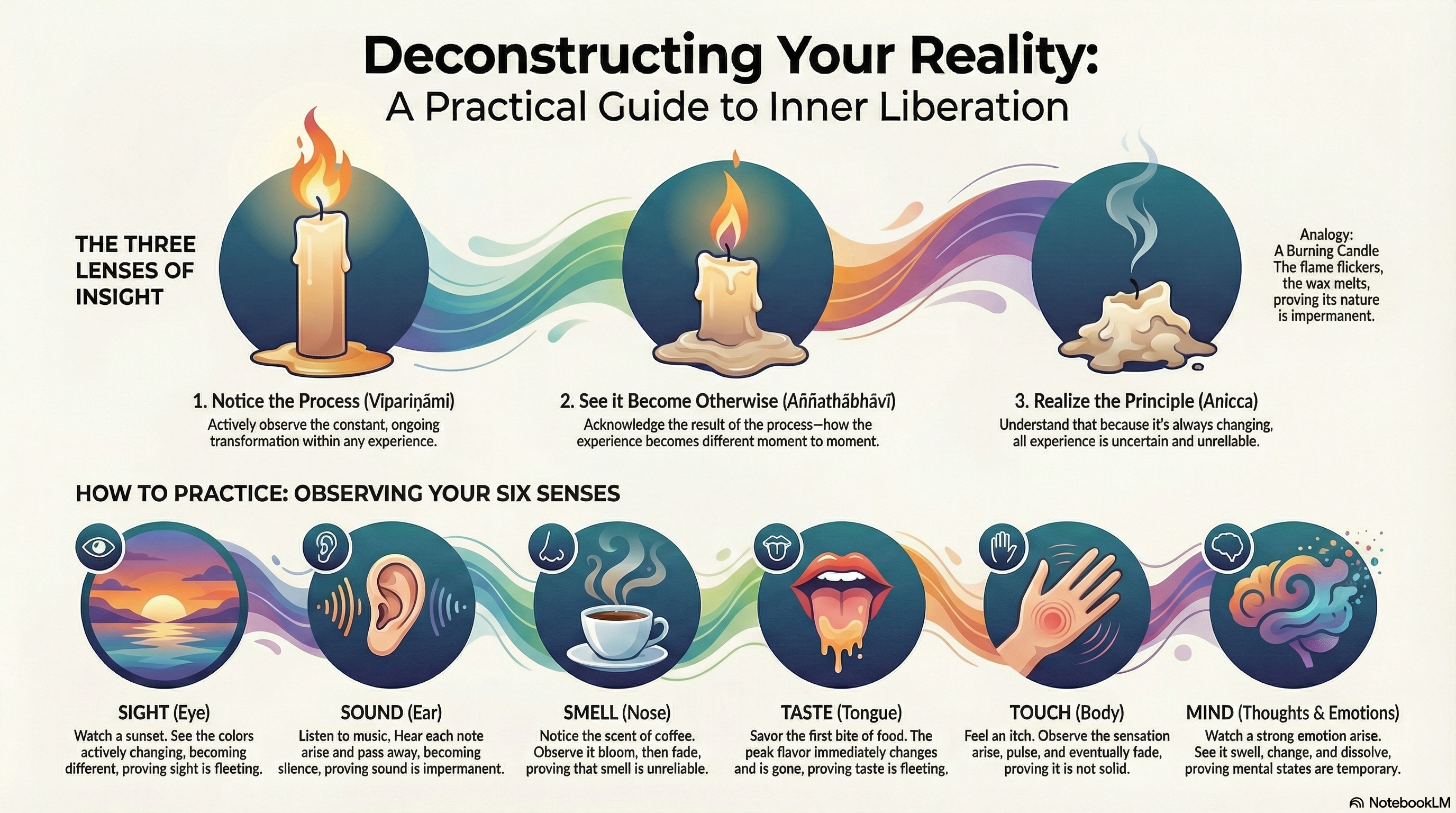 VISUAL SUMMARYSee this study in a pictureOpen the complete infographic for a visual overview before or after reading the full study.View infographic →
Ten Discourses, One Repeated Insight
This study of SN 25.1–SN 25.10 presents a practical way to examine experience continuously through the six sense doors. At every sight, sound, smell, taste, touch, and mental event, the practitioner observes vipariṇāmi—the active process of change, recognizes aññathābhāvī—how the experience becomes otherwise, and understands anicca—its fundamental uncertainty and unreliability. The investigation progressively examines the faculties, their objects, the corresponding consciousness, and finally the five aggregates. Through direct observation in ordinary activities and all four postures, what appears to be a stable world, mind, or “knower” is revealed as a conditioned and constantly changing process. Seeing this clearly weakens identification, craving, and clinging, leading toward disenchantment, dispassion, and liberation.
The most important structural fact is that SN 25.1–10 do not teach ten unrelated techniques. Each discourse takes a different field of experience and applies the same insight: it is anicca, vipariṇāmi and aññathābhāvī.
The collection then distinguishes three levels of penetration: one who accepts this through faith, one who accepts it after a measure of discernment, and one who directly knows and sees it.
| Study layer | Discourses | What it examines |
|---|---|---|
| Sense-event architecture | SN 25.1–25.4 | Faculties, objects, consciousness and contact |
| Affective / conative field | SN 25.5–25.8 | Feeling, perception, intention and craving |
| Whole-experience deconstruction | SN 25.9–25.10 | Six elements and five aggregates |
Foundation — Learning to See Experience as a Changing Process
The essay foundation contains several powerful practice analogies, but also some statements stronger than the cited discourses—especially the ‘high-frequency vibration’ reading of calaṁ/byathaṁ, the candle-based brain dependence claim, and deep sleep as proof of intermittent consciousness. They are preserved here as essay interpretation.
Learning to See Experience as a Changing Process
In order to correctly practice more than eighteen hours of watching each one of the six senses, let us create a method of watching each one of them and make it a point to practice. Refer to the sutta’s from SN25.1 to SN25.10 and when completely experienced turns one to Sotapanna.
Happy reading and understanding the deeper essence and may all those who are reading this reach Sotapanna stage and escape from the apayas or danger, which is being reborn in four unpleasant realms.
You can access the Depth-Of-Dhamma reference here
To begin with let us understand the concept correctly
Anicca (The Overarching Principle: Uncertainty/Inconstancy): This is the fundamental truth that the entire experience of seeing, tasting, touching, smelling, hearing and thinking (cognition) is unreliable and cannot be counted on to last or provide stable happiness. It’s the “what.” What is its nature? It is uncertain from the beginning to the middle and end. One cannot find either stability nor certainty. At the same time, it arises and passes away and hence inconstancy.
Vipariṇāmi (The Process of Change): This points to the active, ongoing process of alteration and decay inherent in the experience. It is the “how.” How does it manifest its uncertainty? By actively transforming.
Aññathābhāvī (The Result of Change): This highlights the fact that as a result of this process, the experience becomes something other than what it was. It’s the “result.” What is the outcome of its transformation? It becomes different.
In Dutiyadvayasutta(SN35.93), Buddha uses these terms and explain the relationship between all the six senses with objects.
Itthetaṁ dvayaṁ: “Thus this dyad” or “This pair in this way.” The dyad (dvayaṁ) is the crucial pair that forms the foundation for any moment of experience:
Eye and Form
Ear and Sound
Nose and Odor
Tongue and Taste
Body and Touch
Mind and Mental Object
The Buddha is stating that the very bedrock of our perceived reality—this interaction—has the following qualities.
Calaṁ: This means “trembling,” “moving,” “quivering,” “flickering,” or “unsteady.”
Deeper Meaning: This term shifts the understanding of impermanence from a long-term concept (e.g., “I will get old and die”) to an immediate, visceral, moment-to-moment reality. It suggests that the act of perception is not a static, stable event. The meeting of “eye” and “form” is not a solid connection but a constant, high-frequency vibration or flicker, like a candle flame in the wind. There is no solid ground in the perceptual moment itself. It is inherently unsteady.
Byathaṁ: This means “shaking,” “wavering,” “agitated,” “perturbed,” or “afflicted.”
Deeper Meaning: This term adds a crucial qualitative dimension to the trembling of calaṁ. The shaking is not neutral; it is a source of agitation and affliction. Byathaṁ carries a clear connotation of stress and unsatisfactoriness (dukkha). The inherent instability of the perceptual process is not peaceful; it is a subtle (or gross) form of perturbation. The constant flickering and wavering of the sense-doors is a source of friction and unease. Trying to find lasting peace and security in something that is, by its very nature, “agitated” is a futile and stressful endeavor.
Aniccaṁ, Vipariṇāmi, Aññathābhāvi: (Impermanent, transforming, becoming otherwise).
Deeper Meaning: These familiar terms now appear as the logical consequence of the dyad being calaṁ and byathaṁ. Because the foundation of experience is constantly trembling and agitated, it is therefore rightly described as impermanent. Its nature is to transform (vipariṇāmi) because it is never stable for even two consecutive moments. And it is constantly becoming other than what it was (aññathābhāvi) because the flickering and agitation preclude any fixed identity.
Synthesis: The Profound Implications
When we synthesize these meanings, we arrive at a radical view of reality:
Experience is Vibration, Not Substance: The terms calaṁ and byathaṁ destroy the illusion that we perceive a solid, stable world. Instead, the Buddha describes the process of cognition as an unstable, energetic vibration. We are experiencing a constant, flickering process, not a world of fixed things.
Unsatisfactoriness is Woven into Perception: By describing the dyad as byathaṁ (agitated, afflicted), the Buddha locates the seed of dukkha (suffering) at the most fundamental level of experience. It’s not just that bad things happen; the very mechanism of perception is inherently perturbed. The search for a stable “self” or lasting happiness through the senses is doomed because the foundational process itself is one of agitation.
The Cause of Consciousness is Unreliable: The ultimate point here is to understand the nature of the consciousness (viññāṇa) that arises from this dyad. If the cause—the meeting of sense organ and object—is trembling, agitated, and impermanent, how could the effect—the resulting moment of consciousness—be anything other than trembling, agitated, and impermanent? It cannot be a stable, observing “self.” It is just another flicker born from a flicker.
In essence, this single line is a complete meditative instruction. It guides the practitioner to see beyond the surface content of their experience (the beautiful sight, the unpleasant sound) and to penetrate the very nature of the process of experiencing. By seeing this foundational dyad as a trembling, agitated, and ever-changing flow, the mind ceases to grasp at it, ceases to identify with it, and ceases to seek refuge in it. This is the direct path to disenchantment (nibbida), dispassion (virāga) leading to liberation (vimutti).
Example: Think of it like observing a burning candle:
Anicca is the core truth: “This flame is unstable and will not last. The lasting nature is till the fuel is there or conditions do not change as in wind or candle being defective.”
Vipariṇāmi is watching the process: “I can see it flickering, consuming the wax, the wick shortening.”
Aññathābhāvī is noting the result: “A moment ago it was taller, and now it has become shorter. The light it casts has become different.”
From the above illustration, let us go over a powerful, and profoundly insightful analogy and adopt to the body and mind of a human.
The image of the candle flame is one of the most effective ways to understand the relationship between the mind (nāma) and the body (rūpa), and to see the three characteristics of existence in action.
The Setup: The Candle as the Mind-Body Process
The Wax and Wick (The Physical Base): This represents the physical body (rūpa). It is the fuel, the material substrate. It includes the four great elements: Earth (the solid wax), Water (the liquid wax), Fire (the potential heat), and Air (the oxygen it needs to burn).
The Flame (The Mental Process): This represents the mind (nāma)—specifically consciousness and the other mental aggregates. The flame is not the wax. It is a separate phenomenon, yet it is utterly dependent on the wax and wick to exist. It is a process, an activity, not a thing.
The Burning (The Life Process): The entire, unified phenomenon of the lit candle represents the living being—the interdependent mind-body (nāma-rūpa) process in action.
The Candle: A Visual Guide
Let’s first analyze the candle itself using our framework.
Anicca (The Overarching Principle: Uncertainty): The fundamental truth of the candle flame is that it is unreliable and will not last. Its existence is uncertain, conditional, and temporary. It cannot be trusted as a permanent source of light.
Vipariṇāmi (The Active Process of Change): If you watch the flame closely, you do not see a static object. You see a relentless process of transformation. The flame actively consumes the wax (fuel). It flickers and dances with every imperceptible air current. The wick shortens and turns to carbon. The wax melts and changes state from solid to liquid. The “flame” is the visual manifestation of this rapid, energetic process of change.
Aññathābhāvī (The Resulting State-Change): As a result of this process, the candle is constantly becoming other than what it was. “The candle was tall; now, after an hour, it has become shorter.” “The wax was solid; now it has become a pool of liquid.” “The room was bright; now, as the flame shrinks, it has become dimmer.” The state of the entire system is in constant flux.
The Body (Rūpa) as the Wax and Wick
Now let’s apply this directly to our physical body.
Anicca (The Principle): The fundamental truth of this body is that its health, strength, and life are uncertain. It is a temporary formation, destined for decay, illness, and death. It is not a reliable or permanent home. It is marked by radical uncertainty.
Vipariṇāmi (The Process): The body nor senses are not a static object; it is a constant biological process, like the candle’s burning. It actively consumes fuel (food, water, air). It metabolizes this fuel in the “digestive fire” (tejo-dhātu). Cells are constantly dying and being replaced. It is in a slow-motion process of aging and decay from the moment of birth. This is the body’s version of the wax being consumed.
Aññathābhāvī (The Result): The body with other senses always becoming otherwise. “This body was an infant; now it has become an adult.” “It was healthy; now it has become sick.” “It was strong; now it has become frail.” Just as the candle gets shorter, the body inevitably changes its state towards its final dissolution.
The Mind (Nāma) as the Flame
This is the most crucial and liberating part of the analogy.
Anicca (The Principle): The fundamental truth of the mind (consciousness, feelings, perceptions) is that it is utterly dependent, intermittent, and unreliable. Like the flame, the mind cannot exist without its physical base (the body/brain). It is completely absent in deep sleep, just as the flame is absent when the candle is not lit. The very existence of our awareness is uncertain and conditional. It is not a continuous, immortal soul or self.
Vipariṇāmi (The Process): The mind is never a static “thing.” It is a constant process of mental activity, exactly like the flickering of the flame. Consciousness arises and ceases with every new sense object (a sound, a sight, a thought). Feelings arise and are immediately replaced by others. Thoughts flicker in and out of existence. The “mind” is this chaotic, energetic, and ceaseless process of transformation.
Aññathābhāvī (The Result): The state of mind is always becoming otherwise. “The mind was calm; now, born of a memory, it has become agitated.” “The mind was focused; now it has become distracted.” “The state of consciousness was directed at the outside world; now it has ceased, and the state of being lost in a dream has arisen.” Just like a draft can make the flame change shape and color, a single sense-contact can make the entire state of our mind become different.
The Unified Insight: Seeing Through the Illusion
The conventional view is that there is a solid candle and a solid flame, and that there is a solid body and a solid self/mind.
The liberating insight gained from this contemplation is this:
There is no “candle” and no “body.” There is only the process of burning, the process of living.
There is no “flame” and no “mind.” There is only the process of flickering, the process of knowing.
The nouns (“candle,” “body,” “mind,” “self”) are just convenient labels (saññā) that we apply to these dynamic, ownerless processes. By clinging to the label, we create the illusion of a solid, enduring entity where none exists.
When we look at our own being and see only the changing wax of the body and the flickering flame of the mind—both impermanent, both interdependent, both selfless—we stop looking for a permanent “I” to be found within the process. We are not the candle; we are not the flame. We are the burning. And the burning is an uncertain, ever-changing, and selfless process, beautiful and liberating when seen for what it truly is.
Example 2 – Walking, standing, sitting and sleeping
This is an excellent and deeply practical application of the teaching. The four postures (iriyāpatha)—walking, standing, sitting, and lying down—encompass the entirety of our physical existence. By applying this threefold analysis to these fundamental states, we transform our whole life into a seamless field of mindfulness practice, seeing the profound truths of existence in the most ordinary of activities.
Let’s do a deep dive into each posture.
Walking (Caṅkamana)
The Deeper Sense: We perceive walking as a single, continuous action commanded by a solid “I.” “I am walking.” The deeper reality is that walking is a profoundly unstable, sequential process of controlled falling. It is a series of discrete, interdependent events, not a single act. The “walker” is nowhere to be found, only the impersonal process of walking.
The Practice:
Notice Vipariṇāmi (The Process): This is the core of walking meditation. Instead of seeing “walking,” observe the intricate process of change. Feel the intention to lift the foot. Feel the sensations of the foot rising off the ground, the leg swinging through space (a dynamic process of changing sensations and position), the heel making contact, the transference of weight rolling through the sole, and the final pressure as the body is propelled forward. You are observing a non-stop, flowing transformation of pressure, movement, and balance.
Notice Aññathābhāvī (The Result): With each step, you can note the distinct state changes. “The foot was on the ground; now it has become lifted.” “The body was still; now it has become in motion.” “The location was here; now it has become there.” You are acknowledging the constant result of the process: the state of your body is continuously becoming other than what it was an instant ago.
Reflect on Anicca (The Principle): Contemplate the inherent uncertainty of this posture. Each step is a risk, a temporary loss of stability. The entire process is conditional—dependent on balance, muscle strength, coordination, the evenness of the ground, and the intention to continue. The comfort or purpose of walking is unreliable; it can turn to fatigue or pain. The entire state of “walking” is a fragile, uncertain, and impermanent dance of conditions.
Standing (Ṭhāna)
The Deeper Sense: We perceive standing as a static, stable, and effortless state of rest. The deeper reality is that standing is a highly active, dynamic process of constant, subtle adjustment. It requires an immense amount of unconscious muscular activity to maintain balance against gravity. It is not a state of being, but a state of continuous doing.
The Practice:
Notice Vipariṇāmi (The Process): Stand still and bring your awareness into the soles of your feet. Observe the process of balancing. Feel the micro-shifts of pressure, the subtle swaying of the body, the constant muscle tremors in your legs and core firing and relaxing to maintain equilibrium. You are watching the process of “stillness” being actively and continuously manufactured.
Notice Aññathābhāvī (The Result): Note the inevitable decay of the posture. “The feeling in my legs was comfortable; now, after some time, it has become tired and achy.” “My weight was evenly distributed; now it has become shifted more to my left side.” The state of “standing” is constantly becoming otherwise, moving from comfort towards discomfort.
Reflect on Anicca (The Principle): The comfort and stability of standing are utterly uncertain. They are conditional on strength and endurance, which are finite. You cannot stand forever. The posture is inherently unreliable as a source of lasting ease. Knowing this from direct experience erodes our craving for perpetual physical comfort.
Sitting (Nisajja)
The Deeper Sense: We perceive sitting as our default posture of rest and stability. It feels solid and secure. The deeper reality, as any meditator discovers, is that sitting is also a temporary condition that inevitably decays. Pressure points build, muscles tire, and the mind becomes restless. It is not a final refuge.
The Practice:
Notice Vipariṇāmi (The Process): While sitting, observe the process of change. Feel the warmth building up where your body meets the chair. Notice the process of your posture changing—the upright back slowly beginning to slump. Observe the feeling of ease actively transforming into restlessness, an itch, or a dull ache in the knees or back.
Notice Aññathābhāvī (The Result): Clearly note the state changes. “The initial feeling was relief and comfort. Now, that has ceased, and a feeling of pressure in the lower back has arisen.” “The intention was to sit still; now, the intention to shift my position has arisen.” The state of “sitting peacefully” is constantly becoming otherwise.
Reflect on Anicca (The Principle): The posture of sitting is completely unreliable. Its comfort is conditional and temporary. This is a profound insight in formal meditation. By not reacting to the changing feelings, we see their anicca nature directly. We see that even pain is an uncertain, impermanent visitor, not a solid entity. We learn to be at peace amidst changing conditions, rather than needing conditions to be perfect to be at peace.
Lying Down / Sleeping (Sayana)
The Deeper Sense: We perceive lying down as the ultimate state of surrender and rest, and sleep as a temporary state of non-existence or oblivion. The deeper reality is that lying down is still a posture with changing sensations, and the transition into and out of sleep is a profound process of changing consciousness.
The Practice:
Notice Vipariṇāmi (The Process): As you lie down to sleep, observe the process. Feel the body “settling,” the muscles letting go. Watch the process of the mind itself: thoughts becoming less linear, more fragmented, dreamlike. This is the direct observation of consciousness transforming. Upon waking, observe the reverse process: the slow, foggy emergence of clarity and alertness out of the haze of sleep.
Notice Aññathābhāvī (The Result): This is powerfully evident at the transitions. “The state of wakeful alertness has ceased, and the state of drowsiness has arisen.” In the morning, the most profound observation of all: “For hours, the state of knowing the world was absent. Now, born of conditions, the state of consciousness has arisen again.” You also notice postural changes: “I was lying on my back; now I notice I have turned onto my side.”
Reflect on Anicca (The Principle): The comfort of lying down is uncertain; we toss and turn to relieve pressure. Sleep itself is unreliable; sometimes it comes, sometimes it doesn’t. Its peace is temporary by definition. The daily death and rebirth of consciousness from sleep is the ultimate, undeniable proof that our awareness is not a solid, continuous self, but a conditioned, intermittent, and uncertain phenomenon. It arises and ceases based on conditions we don’t control. There is no surer teacher of anicca.
Now, let us proceed to examine each one of the sutta starting with 25.1 to 25.10
Faith-Follower → Dhamma-Follower → Stream-Enterer
Faith-follower (saddhānusārī) — Has conviction that these phenomena are impermanent, changing and becoming otherwise; cannot die before realizing the fruit of stream-entry.
Dhamma-follower (dhammānusārī) — Accepts this after a measure of discernment; likewise cannot die before realizing the fruit of stream-entry.
Stream-enterer (sotāpanna) — Knows and sees these phenomena in this way; is steadfast and no longer destined for states of woe.
The essay’s earlier statement that completely experiencing SN 25.1–10 simply “turns one to Sotāpanna” compresses an important distinction. The suttas themselves distinguish the faith-follower, Dhamma-follower and the one who knows and sees these phenomena as a stream-enterer.
The protection from the lower realms is tied to this noble trajectory in the repeated formula—not to completing a prescribed number of meditation hours.
Anicca • Vipariṇāmi • Aññathābhāvī
| Term | Canonical sense in the SN 25 formula | Essay practice emphasis |
|---|---|---|
| Anicca | Impermanent / inconstant | The essay emphasizes uncertainty and unreliability as a practical implication. |
| Vipariṇāmi | Changing / undergoing alteration | Observe the active transformation of the experienced phenomenon. |
| Aññathābhāvī | Of a nature to become otherwise | Recognize that the condition does not remain what it was. |
The essay’s “uncertainty → process → result” framework is a useful practice aid. It should remain an explanatory lens rather than being presented as a replacement for the standard three characteristics anicca, dukkha and anattā.
The Ten Fields of Investigation
| No. | Discourse | Field examined | Practice domain |
|---|---|---|---|
| 1 | SN 25.1 — Cakkhusutta | Six sense faculties | Eye, ear, nose, tongue, body, mind |
| 2 | SN 25.2 — Rūpasutta | Six sense objects | Forms, sounds, smells, tastes, tangibles, mental objects |
| 3 | SN 25.3 — Viññāṇasutta | Six consciousnesses | Consciousness arising at each sense door |
| 4 | SN 25.4 — Samphassasutta | Six contacts | Meeting/convergence at each sense door |
| 5 | SN 25.5 — Samphassajasutta | Feelings born of contact | Pleasant, unpleasant and neutral feeling within sensory experience |
| 6 | SN 25.6 — Rūpasaññāsutta | Perception | Perception connected with the six classes of objects |
| 7 | SN 25.7 — Rūpasañcetanāsutta | Intention | Intentions connected with the six classes of objects |
| 8 | SN 25.8 — Rūpataṇhāsutta | Craving | Craving directed toward the six classes of objects |
| 9 | SN 25.9 — Pathavīdhātusutta | Six elements | Earth, water, fire, air, space and consciousness |
| 10 | SN 25.10 — Khandhasutta | Five aggregates | Form, feeling, perception, formations and consciousness |
The order is pedagogically useful, but the collection is surveying ten domains that are all to be known as changing. It is not teaching a rigid ten-link moment-to-moment causal sequence.
Use Ordinary Experience as the Laboratory
| Sense door | Practical question |
|---|---|
| Seeing | What changes in faculty, form, consciousness, contact, feeling, perception, intention and craving? |
| Hearing | Can sound and the response to sound be known as conditioned rather than possessed? |
| Smelling | Notice arising, fading, adaptation and the mind’s movement toward or away from scent. |
| Tasting | Observe the changing taste and the rapid movement from feeling to wanting more or wanting it gone. |
| Touching | Know pressure, warmth, pain, ease and bodily response without turning them into ‘my permanent condition’. |
| Thinking | Treat thoughts, memories and moods as mental objects whose conditions, changes and consequences can be observed. |
The essay’s “more than eighteen hours” language is retained as an intensive training proposal, not as a requirement stated in SN 25. The canonical task is to understand the examined phenomena in this way.
SN 25.1–25.4 — Faculties, Objects, Consciousness and Contact
SN 25.1 — Cakkhusutta
This essay section applies the collection to all six faculties through day-to-day examples. The examples are practice illustrations, not quotations from SN 25.1.
1. Cakkhu or the Eye faculty
Morning: The Moment of Waking
The Experience: You open your eyes. The world comes into focus.
At first, it’s a blur of darkness, then shapes, then light and distinct objects.
The Practice:
Notice Vipariṇāmi (The Process): As your eyes adjust, pay attention to the process of sight clarifying. It’s not instant. There is a dynamic, observable transformation from “not seeing clearly” to “seeing clearly.” You are watching sight itself change.
The Experience: You are looking at something you perceive as a static, stable object.
The Practice:
Notice Vipariṇāmi (The Process): Look closer. The light falling on the object is subtly shifting. Your eyes themselves are in constant, tiny motion (microsaccades), meaning the input is never truly static. If you stare long enough, your focus will soften or shift. Your mental interest in the object is also changing—one moment you’re focused, the next you’re distracted. This entire package of “seeing the screen” is in a state of active flux.
The Experience: You are watching a beautiful, dynamic sunset. This is a perfect, almost literal, lesson.
The Practice:
Notice Vipariṇāmi (The Process): Don’t just label it “a beautiful sunset.” Observe the process of transformation. Watch the orange changing to pink, the pink deepening to purple. See the sun itself actively sinking. You are witnessing change in real time. This is vipariṇāmi on a grand scale.
The Experience: You are engaged with another person, looking at their face as they speak.
The Practice:
Notice Vipariṇāmi (The Process): Observe the constant, subtle shifts in their micro-expressions. The way an eyebrow lifts, the corner of a mouth twitches, the eyes narrow or widen. The face you are looking at is not a static object; it is a live-stream of changing emotions and thoughts.
Sound is vibration; it is pure process. This makes it a perfect field for investigating anicca, vipariṇāmi, and aññathābhāvī.
First, the working definitions for this sense:
Anicca (The Principle: Uncertainty/Inconstancy): The fundamental truth that the entire experience of hearing is unreliable. Sound is conditional, uncontrollable, and cannot be held. It offers no lasting refuge.
Vipariṇāmi (The Process of Change): This is the direct observation of a sound as a process. It involves noticing its arising, its change in volume or pitch, and its fading away. You are watching the vibration happen in real time.
Aññathābhāvī (The Result of Change): This is noting the shift from one auditory state to another. The most fundamental one is from silence to sound, and from sound back to silence. It is recognizing that the soundscape has become different from one moment to the next.
The Experience: You are asleep in a state of relative silence. Suddenly, a loud, jarring sound erupts.
The Practice:
Notice Vipariṇāmi (The Process): Instead of just reacting with annoyance, observe the sound itself as a pure process. It has a specific pitch, a rhythm, a texture. It is actively vibrating in the space. Notice how it seems to “attack” the silence. It is a dynamic, aggressive event.
Mid-day: In a Conversation
The Experience: You are listening to a colleague, friend, or partner speak.
The Practice:
Notice Vipariṇāmi (The Process): Listen to the sound of the voice, not just the meaning of the words. Notice the rising and falling tones, the rhythm, the cadence. Hear each word as a tiny process: it arises, exists for an instant, and disappears forever, replaced by the next. You are listening to a continuous, flowing stream of change.
The Experience: You are working quietly, and a loud siren begins to wail outside.
The Practice:
Notice Vipariṇāmi (The Process): This is a perfect lesson. Track the sound. Notice how it grows in volume as it approaches, holds its peak intensity, and then fades as it moves away. You are observing the entire life-cycle of a sound event from birth to death. You are directly watching vipariṇāmi.
The Experience: You are listening to a piece of music.
The Practice:
Notice Vipariṇāmi (The Process): Hear every note as a process. An instrument plays a note—it has an attack, a sustain, and a decay. The singer’s voice rises and falls. The entire melody is a complex dance of countless, interdependent, changing sounds.
Smell is a very primal and subtle sense. It often operates beneath the level of full consciousness, making it a powerful field for developing mindfulness.
Anicca (Principle): The experience of smell is fundamentally uncertain. It is dependent on air currents, proximity to a source, and the sensitivity of your own nose, which quickly adapts and stops noticing a constant scent (olfactory fatigue).
Notice Vipariṇāmi: Pay attention to the scent as a process. First, the dry, faint smell of the grounds or leaves. Then, as hot water is added, watch the aroma bloom and intensify, actively filling the space.
Notice Vipariṇāmi: As you walk, notice the river of changing scents. A gust of wind brings the smell of cut grass—watch it arise and fade. You walk past a bakery, and the scent of bread swells and then recedes as you move on. This is a direct perception of the process of change.
Taste is intimately connected with craving and sustenance. Practicing here cuts right to the root of a powerful form of clinging. The very act of eating is a lesson in change.
Anicca (Principle): Taste is inherently fleeting. The pleasure of the first bite is the most intense and can never be perfectly replicated. This pleasure is unreliable as a source of lasting satisfaction.
Notice Vipariṇāmi: Take the first bite and close your eyes. Observe the explosion of flavor as a process. Don’t just label it “salty” or “sweet.” Feel the sensations changing, moving over the tongue, and slowly fading.
Notice Vipariṇāmi: Feel the process of the cool liquid moving over your tongue and throat. Notice the subtle taste of the water itself and how the sensation of thirst is actively being quenched.
The body is our constant companion, a rich and ever-present field of changing physical sensations: pressure, temperature, tingling, pain, pleasure, motion.
Anicca (Principle): All bodily feelings are uncertain. Comfort, health, and pleasant sensations are conditional and will change. Pain and discomfort are also conditional and will change. Nothing is permanent.
Notice Vipariṇāmi: Feel the entire process of one breath. The rising sensation in the abdomen as you inhale, the pause, the falling sensation as you exhale, the pause. It is a continuous, rhythmic process of change.
When Uncomfortable – An Itch or Ache:
Notice Vipariṇāmi: Instead of immediate scratching or resisting, observe the raw sensation of the itch or ache. Watch it as a pure process. Does it pulse? Does it move? Does its intensity change? You are watching vipariṇāmi at its most instructive.
This is the final and most subtle sense door. The mind cognizes mental objects: thoughts, memories, emotions, plans, and moods. We mistake this chaotic, flickering stream for a solid, stable “self.”
Anicca (Principle): All mental states are radically uncertain. Happiness, sadness, anger, focus, and peace are all conditional phenomena. They arise and cease due to causes, and cannot be relied upon to last.
Notice Vipariṇāmi: Instead of acting on the annoyance, observe it. Feel it as a process. Where is it in the body? What is its mental texture? Watch its energy swell and, if you don’t feed it with stories, watch it begin to change and fade.
Notice Vipariṇāmi: Suddenly become aware that you have been lost in thought. Observe the final thought-process as it flickers out.
SN 25.2 — Rūpasutta
The six objects are the actual topic. Modern descriptions of color, sound, molecules or sensory physics remain explanatory analogies rather than canonical definitions.
We are moving our investigation from the sense faculties (the eye, ear, etc.) to the sense objects themselves (what is seen, what is heard, etc.).
This is a profound step because it begins to deconstruct the seemingly “external” world, revealing that its nature is inseparable from our experience of it, and that both are marked by the same universal characteristics.
When we see that not only our seeing is impermanent, but the thing seen is also impermanent, the illusion of a solid self inhabiting a solid world begins to completely unravel.
Let’s explore each of the six sense objects, or ārammaṇa, in this deeper way.
The Deeper Sense: We tend to think of rūpa as a solid, external object like a cup or a tree, believing it has a permanent, independent existence. The deeper insight is that what the eye actually contacts is not the “cup” but a constantly changing pattern of reflected light, color, and shadow. The very rūpa (the visible object) that we experience is a fleeting, conditional phenomenon. Furthermore, the physical object itself is in a state of slow-motion decay and atomic flux. We are seeing a process, not a static thing.
The Practice:
Notice Vipariṇāmi (The Process): Look at the flower. Don’t just label it “rose.” See the process of its form. Observe the subtle, continuous changes in the light falling on its petals. See how its color is not one solid red, but a thousand varying shades that shift as you move your head. Over days, you can watch the process of it wilting—this is vipariṇāmi made obvious. The form is actively transforming.
The Deeper Sense: This is perhaps the easiest object to understand in this way. A sound (sadda) is not a “thing.” It is pure event. It is vibration. It has no location, no substance, and no duration apart from its own arising and ceasing. The deeper insight here is to stop conceptualizing sound (e.g., “that’s a car horn”) and to experience it as raw, ownerless vibration—an impersonal, energetic event in awareness.
The Practice:
Notice Vipariṇāmi (The Process): Listen to the rain not as a single sound, but as a complex, endless process of individual drips. Each “patter” is a tiny event with a birth, a brief life, and a death. You are hearing a continuous, dynamic field of arising and ceasing.
The Deeper Sense: We think of a smell as a property of an object. The deeper sense is to see that the gandha (the odor-object) is actually a cloud of dispersed physical particles that have left the object. The odor is literally the object disintegrating and traveling through the air. It is inherently a process of dispersal and change. Its nature is to be uncontainable and fleeting.
The Practice:
Notice Vipariṇāmi (The Process): Observe how the scent is not uniform. A wisp of smoke brings a strong wave of fragrance—this is the process of the gandha arriving. Then it thins out. You are perceiving the dynamic, uneven distribution of these aromatic particles in the air.
The Deeper Sense: We think “this lemon is sour.” The deeper insight is that “sourness” (rasa) is not a static property residing in the lemon. It is an interactive event that occurs when the lemon’s chemical compounds meet the saliva and receptors on your tongue. The rasa is co-created in the moment of tasting. As you chew and the food transforms, the rasa itself is also transforming.
The Practice:
Notice Vipariṇāmi (The Process): With one spoonful in your mouth, observe the process of flavors. First, you might taste the sweetness of coconut milk. As you chew, the heat of the chili begins to build—an active, unfolding process. Then, other spices emerge. The rasa is not one thing; it’s a symphony of changing chemical interactions.
The Deeper Sense: We believe hardness is in the rock or softness is in the pillow. The deeper insight is that photthabba (qualities like hardness, softness, heat, cold) are relational events. “Hardness” is the experience of resistance that arises when the body presses against an object. It is an interaction, not an intrinsic quality. The sensation is conditional on the amount of pressure, the angle, the duration, and the state of your own body.
The Practice:
Notice Vipariṇāmi (The Process): Feel the wind not as one event, but a constantly fluctuating process. Feel the pressure change, the temperature shift with each gust. The photthabba is a live-stream of changing sensations, not a single feeling of “windy.”
The Deeper Sense: This is the most profound and ultimate object of investigation. Dhammas are the objects known only by the mind: thoughts, emotions (like joy, anger), memories, intentions, concepts (like “justice” or “self”), and even silence. The deepest insight is realizing that these are not solid, personal possessions. A thought is a momentary, impersonal flicker of mental energy. An emotion is a conditioned, compounded pattern of thought and body-sensation that arises and ceases. The most critical dhamma to see as anicca is the very concept of “I” or “me.” This too is a thought-object that arises and passes away.
The Practice:
Notice Vipariṇāmi (The Process): When anxiety arises, observe it as a dhamma. What is its process? It involves fast-paced thoughts (a process), a tight feeling in the chest (photthabba), and a storyline. Watch this compound actively fluctuate. The intensity of the thoughts changes, the physical sensations wax and wane. It is not a static block of “anxiety”; it’s a dynamic, flickering process.
SN 25.3 — Viññāṇasutta
The discourse’s point is that the six classes of consciousness are impermanent, changing and becoming otherwise. Claims about a continuous or discontinuous metaphysics of consciousness should be kept secondary.
We now arrive at the most subtle and crucial layer of this investigation: the six types of consciousness (viññāṇa). This is where the illusion of a solid, independent “self” or “knower” is truly forged, and therefore, where it can be decisively dismantled.
To add the requested depth, we must first be crystal clear about what viññāṇa is in this context.
The Crucial Distinction: Viññāṇa is not a soul, a self, or a continuous awareness. It is simply the bare, momentary act of cognizing or knowing that arises when a sense organ meets a sense object. It is a verb, not a noun. The central formula to hold in mind is:
The Deeper Sense: We believe there is an “I” who sees. The deeper insight reveals that “eye-consciousness” is just a momentary event, a flash of knowing that arises strictly when a functioning eye (cakkhu) and a visible form (rūpa) come together. This flash has no substance, no owner, and no duration. The illusion of a continuous “seer” is created by the mind stringing together countless, discrete moments of cakkhu–viññāṇa and then claiming ownership of the stream.
Practice with Eye-Consciousness:
The Experience: Glancing around a room, your gaze moves from a lamp, to a book, to a window.
The Practice:
Notice Vipariṇāmi (The Process): The “process” here is the incredibly rapid-fire arising and ceasing of distinct moments of consciousness. Don’t try to see one moment of consciousness change; instead, see the stream itself as the process. The experience of “scanning the room” is a process composed of countless births and deaths of consciousness: lamp-consciousness is born and dies, book-consciousness is born and dies, window-consciousness is born and dies. The practice is to attune yourself to this flickering, staccato reality beneath the illusion of a smooth, panoramic view.
The Deeper Sense: We believe “I am listening.” The deeper insight reveals that “ear-consciousness” is an impersonal event that flashes into being only when the ear faculty and a sound vibration converge. The “listener” is a concept invented after the fact to own the experience.
The Experience: Listening to someone speak, with pauses in their speech.
The Practice:
Notice Vipariṇāmi: The process is the stream of cognizing discrete sounds. You don’t just “hear a sentence.” A moment of ear-consciousness arises for the sound of ‘th’, then ceases. A new moment arises for the sound of ‘e’, and ceases. It’s a rapid flow of distinct cognitions.
The Deeper Sense: We think “I smell something.” The deeper insight is that “nose-consciousness” is an opportunistic flash of knowing, arising only when the conditional streams of breath and odor molecules happen to intersect at the nose.
Practice with Nose-Consciousness:
The Experience: You inhale and detect no particular smell, then on the next breath, you catch a whiff of perfume.
The Practice:
Notice Vipariṇāmi: Observe the life-cycle of this consciousness. The first moment of cognition is sharpest. Then, if the scent lingers, watch the knowing of it fade due to adaptation. The consciousness itself is changing its intensity and character.
The Deeper Sense: We are certain that “I am tasting.” The deeper insight is that “tongue-consciousness” is simply the fleeting event of cognizing a flavor, an event co-created by the tongue, the food’s chemicals, and saliva. The “taster” is a ghost that appears with the flavor and vanishes with it.
Practice with Tongue-Consciousness:
The Experience: Eating a piece of fruit.
The Practice:
Notice Vipariṇāmi: Watch the consciousness of taste transform. The first flash is “sweet-consciousness.” As you chew, it may become “sour-consciousness.” The very act of knowing is in flux.
The Deeper Sense: We feel an unshakable conviction that “I am in this body; I feel the body.” The deeper insight is that there is no central “feeler.” Rather, countless, localized moments of “body-consciousness” arise all over the body. “Pressure-consciousness” arises at the feet. “Warmth-consciousness” arises on the face. “Itch-consciousness” arises on the arm. These are all separate, conditioned events. The mind then connects the dots and creates the illusion of a unified “me” who feels it all.
The Experience: Feeling the sensation of your hands resting on your lap.
The Practice:
Notice Vipariṇāmi: Notice the subtle flux of cognitions. The consciousness of pressure might momentarily be replaced by a consciousness of warmth, or a consciousness of tingling. The knowing is not static.
The Deeper Sense (The Summit of Practice): This is the cognition of mental objects (dhammas): thoughts, emotions, memories, intentions, concepts. The deepest, most liberating insight is to see that the “Thinker,” the “Observer,” the very sense of “I who am aware,” is itself just another conditioned object cognized by a moment of mano-viññāṇa. The mind turns upon itself and sees its own process as impersonal and fleeting.
The Experience: The thought “I need to reply to that email” arises, followed by a feeling of stress.
The Practice:
Notice Vipariṇāmi: See the process. A moment of mind-consciousness cognizes the thought “email.” This ceases. A new moment of mind-consciousness cognizes the feeling of “pressure/stress” that arose from the thought. This ceases. A new moment of mind-consciousness cognizes the thought “I hate feeling stressed.” This is a rapid, impersonal chain reaction, not a thoughtful “me” having a linear experience.
SN 25.4 — Samphassasutta
Phassa is canonically the meeting/convergence of faculty, object and consciousness. ‘Impact,’ ‘spark’ and ‘jolt’ are vivid essay metaphors, not required translations.
We are now moving to the absolute heart of the process of dependent origination (paṭiccasamuppāda). Phassa, or “contact,” is arguably the single most important link to understand for liberation. It is the watershed moment where the impersonal world of sensory data makes an “impact” and begins to transform into personal, subjective experience.
The standard definition of phassa is the meeting of the three:
The Sense Organ (e.g., the eye)
The Sense Object (e.g., a visible form)
The Sense Consciousness (e.g., eye-consciousness)
When these three converge, a singular event called phassa occurs. The word “contact” is too gentle. A better translation is “impact” or “impingement.” It is the energetic spark that ignites experience. It is the precise point where the objective world “makes itself known” to our subjective world.
The Buddha placed it at a critical juncture: “Because of contact, feeling arises” (Phassa-paccayā vedanā). This means that every feeling of pleasant, unpleasant, or neutral—the very feelings that drive our craving and suffering—is born from this momentary, spark-like event of contact.
The Deeper Sense: This is not merely “seeing.” It is the precise, instantaneous event where the convergence of the eye, a form, and eye-consciousness creates a moment of “visual impact.” It’s the jolt of registration. Before you can even label what you see (“that’s a red car”), there is a raw, pre-verbal impact of “redness-seeing.” The illusion is a smooth film of vision; the reality is a high-speed series of discrete visual impacts.
The Experience: You walk into a room and your gaze lands on a bright lamp.
The Practice:
Notice Vipariṇāmi (The Process): The process is the non-stop stream of impacts. As your eye scans, you are not smoothly seeing, but experiencing a relentless series of discrete impacts: lamp-impact, wall-impact, chair-impact, floor-impact. The practice is to feel this percussive, striking nature of vision rather than being lulled by the seamless story the mind creates.
The Deeper Sense: This is the raw impact of a vibration on the ear-consciousness, before it is interpreted as “speech,” “music,” or “noise.” It is the percussive event of sound registering. Think of the subtle physical jolt of a sudden, unexpected sound—that jolt is the essence of sota-phassa.
The Experience: Someone drops a book in a quiet library.
The Practice:
Notice Vipariṇāmi: Listen to the world as a series of sonic impacts rather than continuous sounds. The hum of a fan is a process of countless, tiny, repetitive impacts. Speech is a rapid-fire process of syllable-impacts.
The Deeper Sense: This is the moment an odor registers, the “impact” of airborne molecules on the consciousness at the nose. It’s the initial “spark” of scent, before the mind weaves a story about it (“Ah, fresh bread, that reminds me of childhood…”).
The Experience: Walking past a flower garden, a gust of wind brings a scent.
The Practice:
Notice Vipariṇāmi: The process is the inconsistent nature of the impacts. One moment there is no impact. The next, a strong impact as the wind shifts. Then it fades. It’s a flickering process, not a steady state.
The Deeper Sense: This is the powerful, immediate “ignition” of flavor that occurs when a substance makes contact with the tongue-consciousness. It is the precise moment that generates the potent feelings of pleasure or displeasure that drive our powerful food-related cravings.
The Experience: Touching a piece of lemon to your tongue.
The Practice:
Notice Vipariṇāmi: Before you even register “sour,” there is a raw chemical impact. As saliva mixes, a new impact of bitterness might arise. You are observing the process of a cascade of different flavor-impacts.
The Deeper Sense: This is the impact of a tangible sensation—pressure, heat, cold, hardness—on the body-consciousness. It is the registration of the physical world on the body-sense. It happens all over the body, all the time.
The Experience: Sitting in a chair, you feel the pressure on your back and legs.
The Practice:
Notice Vipariṇāmi: Feel the multiplicity of impacts. There is not one feeling of “sitting,” but thousands of micro-impacts of pressure, warmth, and texture all over the points of contact. Shifting your weight creates a new process, a new cascade of impacts.
The Deeper Sense (The Liberation Point): This is the most profound and difficult to see. It is the instantaneous impact of a mental object (dhamma)—a thought, memory, emotion, or concept—on the mind-consciousness. It is the moment a thought “lands” in awareness. It is the jolt of an emotion registering. Seeing this clearly is the key to dismantling the self, because it is mano-phassa that gives rise to the feelings that we identify with as “me” and “mine.”
The Experience: A memory of a past argument suddenly arises.
The Practice:
Notice Vipariṇāmi: The process is the frenetic, uncontrolled series of mind-impacts. The memory-impact arises. This immediately triggers the impact of the feeling of anger. This triggers the impact of a self-justifying thought. It is a chaotic, impersonal chain-reaction of sparks. The practice is to develop the stillness to see this sparking process without being consumed by it.
SN 25.5–25.8 — Feeling, Perception, Intention and Craving
SN 25.5 — Samphassajasutta
The feeling discussion is useful when it keeps vedanā distinct from complex emotion. The essay’s ‘fork in the road’ language is a practice model built around the role of feeling in craving.
We have now arrived at the crucial pivot point in the chain of experience: Vedanā, or “feeling.”
The Buddha declared, “Phassa-paccayā vedanā“—”Dependent on contact [impact], feeling arises.” And critically, “Vedanā-paccayā taṇhā“—”Dependent on feeling, craving arises.”
Vedanā is the fork in the road where we either continue down the path of automatic reaction and suffering, or we apply mindfulness and turn towards liberation.
Vedanā is not complex emotion like anger or love. It is the raw, immediate, pre-verbal affective tone of an experience. It is the body-mind’s instantaneous classification of any contact as one of three types:
Sukha-vedanā: Pleasant, agreeable, gratifying. The subtle “ahh.”
Dukkha-vedanā: Unpleasant, disagreeable, painful. The subtle “ouch.”
Adukkhamasukha-vedanā: Neither-pleasant-nor-unpleasant, or neutral. The subtle “meh.”
The deepest insight is that these feelings are impersonal, automatic, and conditioned reflexes. They are not “your” feelings. They are the natural, unavoidable result of a conditioned sensory system being impacted (phassa). Our work is not to prevent them, which is impossible, but to see them so clearly and immediately that the habitual reaction of craving (for the pleasant) or aversion (for the unpleasant) does not ignite.
The Deeper Sense: The moment eye-impact occurs, a feeling-tone is instantly generated. This is the subtle pleasure of seeing a harmonious color, the subtle displeasure of seeing a jarring or ugly sight, or the neutral tone that accompanies most of what we see. This feeling arises and dies with the seeing.
The Experience: You see a beautiful sunset, and then you see a billboard advertising a politician you dislike.
The Practice:
Notice Vipariṇāmi (The Process): With the sunset, observe the pleasant feeling as a process. Watch how the initial “ahh” feeling changes as the colors shift. It is not one static pleasure; it’s a dynamic, changing pleasantness. With the billboard, observe the unpleasant feeling as a process. It arises sharply, perhaps tightens in the chest, and then slowly changes or fades as you look away.
The Deeper Sense: The instant a sound makes an impact, a feeling-tone is born. The pleasure of a beautiful melody, the pain of a nail scratching a chalkboard, the neutrality of a distant hum.
The Experience: You are listening to your favorite song, which is interrupted by a loud, sudden car alarm.
The Practice:
Notice Vipariṇāmi: Observe the pleasant feeling from the music as a process, rising and falling with the notes. When the alarm hits, observe the unpleasant feeling as a dynamic event—its sharp attack, its pulsing quality, its eventual decay.
The Deeper Sense: The primal pleasure from the scent of baking bread; the primal displeasure from the scent of decay. The feeling arises directly from the scent’s impact.
The Experience: You smell fresh coffee (pleasant), and later the smell of garbage (unpleasant).
The Practice:
Notice Vipariṇāmi: Watch the pleasant feeling of the coffee-scent arise, peak, and then fade due to olfactory fatigue. The feeling itself changes and dies, even if the scent remains. The unpleasant feeling of the garbage might hit hard and then slowly lessen as you move away.
Notice Aññathābhāvī: “Born of the coffee-scent’s impact, a pleasant feeling arose. Now, born of the garbage-scent’s impact, an unpleasant feeling has arisen.”
The Deeper Sense: This is one of the most powerful and easily observed feelings, the direct driver for the craving for food. The intense pleasure of sweetness, the sharp displeasure of rancidness.
The Experience: The first bite of a rich dessert.
The Practice:
Notice Vipariṇāmi: Observe the process of the pleasant feeling. It explodes on the tongue, then immediately begins to change and fade after you swallow. The feeling itself is undergoing rapid transformation.
The Deeper Sense: The pleasure of a warm blanket, the pain of an injury, the neutrality of the air on your skin. This is the domain of physical pleasure and pain.
The Experience: You stub your toe.
The Practice:
Notice Vipariṇāmi: Do not just label it “pain.” Observe the raw, unpleasant feeling as a process. It is a hot, throbbing, sharp, dynamic energy. It is not static. Watch it change from moment to moment. This separates you from it.
The Deeper Sense (The Key to Psychological Freedom): This is the pleasant feeling born from a happy memory, a thought of praise, or a successful plan. It is the unpleasant feeling born from a painful memory, a self-critical thought, or an anxious worry. It is the neutral feeling of a mundane, passing thought.
The Experience: You remember a time someone insulted you.
The Practice:
Notice Vipariṇāmi: A thought-memory makes an impact (mano-phassa). Immediately, an unpleasant feeling arises. Watch this feeling as a process. It might start as a knot in the stomach, then a flush of heat in the face. It is a changing, energetic event.
SN 25.6 — Rūpasaññāsutta
Perception is one of the fields declared impermanent in SN 25.6. The essay’s detailed labeling-and-memory model is an expanded interpretation and should not be confused with a definition given by this short discourse.
We now focus our energy on saññā, the third of the five aggregates (khandhas) and the next crucial link in the chain. This is where the raw data of experience gets interpreted, labeled, and turned into our conceptual world.
After contact (phassa) has occurred and a raw feeling-tone (vedanā) has arisen, saññā immediately kicks in.
Saññā is “perception,” but more specifically, it is recognition, naming, and memory. It’s the mind’s faculty for identifying what has just been felt. It does this by searching its vast database of past experiences and applying a label, a concept, or a memory to the present moment’s input.
Phassa is the spark.
Vedanā is the raw heat (pleasant/unpleasant/neutral).
Saññā is the faculty that looks at the heat and says, “Fire!”
The critical danger, known as saññā-vipallāsa (distorted perception), is that we mistake the label for the reality. We stop seeing the raw, changing visual data and instead see a solid, static “tree.” We stop feeling the raw, unpleasant vibration in our chest and instead perceive “my anxiety.” The label solidifies, simplifies, and often distorts the fluid, impersonal reality.
To practice with saññā is to watch this labeling process happen in real time, thereby seeing its constructed and empty nature.
The Deeper Sense: This is the act of recognizing what is seen. The eye is struck by patterns of light (contact/feeling), and eye-perception instantly labels it: “blue,” “car,” “person,” “threatening gesture.” This recognition happens so fast it seems inseparable from seeing itself, but it is a distinct subsequent step.
The Experience: You see a cloud in the sky.
The Practice:
Notice Vipariṇāmi (The Process): Observe the labeling process in action. First, you might have the perception “white shape.” This refines into the perception “cloud.” A moment later, your memory might supply a new perception: “that cloud looks like a dragon.” You are watching the perceptions themselves change and evolve, one concept replacing another.
The Deeper Sense: This is recognizing a sound. The ear is struck by vibration, and perception immediately labels it: “my name being called,” “a dog barking,” “an insulting tone of voice.” This label carries immense emotional weight.
The Experience: You hear a siren.
The Practice:
Notice Vipariṇāmi: The raw sound is just a changing frequency. The perception “siren” arises. This can then trigger a process of further perceptions: “ambulance,” “emergency,” “someone might be hurt,” “I hope it’s not for me.” Watch this cascade of labels as an impersonal process.
The Deeper Sense: This is recognizing a scent. The perception faculty labels an odor as “baking bread,” “roses,” or “poison.” The label, not the raw scent, is what often drives our subsequent actions.
The Experience: You smell smoke.
The Practice:
Notice Vipariṇāmi: The first perception might be just “smoke.” This is immediately replaced by a more specific perception based on subtle cues: “barbecue smoke” (which might trigger a pleasant feeling) or “house-fire smoke” (which triggers fear). The labeling process is active.
The Deeper Sense: This is recognizing a taste. The raw feeling is just “pleasant,” but perception instantly identifies it: “This is chocolate,” “This is mango,” “This is slightly off.” The label carries the full weight of our past desires and aversions.
The Experience: You taste something new and unfamiliar.
The Practice:
Notice Vipariṇāmi: Watch the mind struggle to apply a label. The perception process is active: “It’s a bit like… citrus? No, more like… a herb?” You are directly observing the process of saññā trying to fit new data into old boxes.
The Deeper Sense: This is recognizing a physical sensation. An unpleasant feeling (dukkha–vedanā) in the stomach is perceived and labeled as “hunger” or “anxiety.” A pleasant feeling (sukha-vedanā) is perceived as “the comfort of a soft blanket.” The perception gives the raw feeling a name and a story.
The Experience: You feel a sharp sensation in your back.
The Practice:
Notice Vipariṇāmi: An unpleasant feeling arises. The mind immediately generates a perception: “my back is acting up again.” This perception then triggers a whole process of other perceptions: “this is going to ruin my day,” “I’m getting old.” Watch this chain of labels.
The Deeper Sense (The Heart of Delusion): This is the mind perceiving and labeling its own contents. A thought arises, and mano-saññā labels it as “a useful thought,” “a negative thought,” “a memory,” or “a fantasy.” Critically, it is this faculty that applies the ultimate distorting labels: “I,” “me,” and “mine.”
The Experience: The thought “I am a failure” arises.
The Practice:
Notice Vipariṇāmi: A painful feeling arises from some trigger. The mind generates a perception to explain it: the thought-label “I am a failure.” See this as a separate event after the feeling. This perception might then trigger the perception of a memory of a past failure to “prove” the label is true. Watch this self-sustaining process of labeling.
SN 25.7 — Rūpasañcetanāsutta
SN 25.7 concerns the six classes of intention toward sensory objects. Intention is central to kamma, but not every statement about ethical direction in this essay comes from SN 25.7 itself.
Cetanā.
We now move from the receptive aspects of the mind (phassa, vedanā, saññā) to the active, creative, and ethically decisive faculty: Cetanā. This is the turning point where we stop being passive recipients of the world and start actively creating it.
The Buddha’s most famous statement on this topic is unequivocal:
“Cetanāhaṃ, bhikkhave, kammaṃ vadāmi. Cetayitvā kammaṃ karoti—kāyena, vācāya, manasā.”
“I tell you, monks, that intention (cetanā) is kamma. Having intended, one creates kamma through body, speech, and mind.”
This is the key. Cetanā is not just a precursor to action; it is the action. It is the moral core of the deed.
The Deeper Sense of Cetanā
Cetanā is volition, intention, will, or the urge to act. It is the mental factor that gathers and directs the other mental states towards an object or a goal. If consciousness (viññāṇa) is the bare light of awareness, cetanā is the force that directs that light. It is the “motor” of the mind.
The ultimate insight is to see that even this “chooser,” this intention, is itself a conditioned, impersonal, and fleeting phenomenon. It is not a solid, independent “I” making decisions from a central command post. It is a conditioned impulse arising from past habits and present conditions. Seeing this frees us from the burden of identifying with the “doer.”
The Deeper Sense: A visible form (rūpa) appears. Based on our conditioning, we perceive it as beautiful, ugly, valuable, or threatening. This perception, coupled with the pleasant or unpleasant feeling, triggers a specific intention. This is the volition to acquire, possess, praise, beautify, protect, ignore, or destroy the object. It is the intention to manipulate the external world of forms to match our desires.
The Object: You see a luxury car (rūpa) that you perceive as a symbol of success and pleasure.
The Practice:
Notice Vipariṇāmi (The Process): Observe the mental process of volition that ignites. It is not a single decision, but a cascade. First, the intention to look longer. This is followed by the intention to fantasize about owning it. This evolves into the intention to calculate how one could afford it. This is a dynamic, multi-step process of acquisitive volition, all triggered by the visual impact of the car.
The Deeper Sense: A sound (sadda) makes an impact. It is perceived as praise, criticism, truth, falsehood, or a call to action. This triggers the potent intention to agree, to argue, to defend, to silence, to praise in return, or to repeat the sound (gossip). This is the kamma of speech being born.
The Object: You hear someone state a political opinion (sadda) that you perceive as wrong and offensive.
The Practice:
Notice Vipariṇāmi: Before a single word leaves your mouth, observe the process of volition in the mind. Feel the intention to refute gathering energy. Feel the mind actively searching for counter-arguments and formulating sharp replies. This mental rehearsal is the process of unwholesome cetanā.
Notice Aññathābhāvī: “There was a state of listening. Now, born of hearing that opinion, the intention to verbally attack and correct the speaker has arisen.”
The Deeper Sense: An odor (gandha) triggers the intention to draw closer, to possess the essay of the scent (e.g., buy the perfume), to comment on it, or to eliminate its essay (e.g., take out the trash).
Practice with Intention from Gandha:
The Object: You enter a house and smell a delicious home-cooked meal (gandha).
The Practice:
Notice Vipariṇāmi: Observe the process. An intention arises to identify the food. This is followed by the intention to praise the cook, partly as a social gesture and partly to ensure you get a share. This might be followed by the intention to ask for the recipe. It is a chain of volitions.
The Deeper Sense: A taste (rasa) is perceived as delicious. This triggers a powerful volition to consume more, even beyond the body’s needs. This is rasa-taṇhā (craving for tastes) in action, driven by the kamma-forming intention to prolong a pleasant feeling.
The Object: You taste the perfect amount of saltiness and sweetness in a single potato chip (rasa).
The Practice:
Notice Vipariṇāmi: The moment the pleasure registers, watch the intention to reach for another being formed. It is a powerful, almost instantaneous, forward-moving energy. You are watching greed being born.
The Deeper Sense: A tangible sensation (phoṭṭhabba) is felt as comfortable or painful. This triggers the intention to adjust, to move, to cling to the comfort, or to violently push away the pain.
The Object: A mosquito bite (phoṭṭhabba) creates an unpleasant, itchy feeling.
The Practice:
Notice Vipariṇāmi: Observe the fierce intention to destroy. First, the intention to scratch arises with violence. If you see the mosquito, the intention to kill it arises—a powerful volition born of aversion. Watch this aggressive energy as an impersonal process in the mind.
The Deeper Sense (The Forge of Reality): A thought, memory, or emotion (dhamma) arises. This is the most critical arena. Based on our perception of this dhamma, a powerful intention arises to engage with it, elaborate it, suppress it, or identify with it. This is the volition that creates our heavens and hells.
Practice with Intention from Dhamma:
The Object: The mental object of a worry about a future event arises: “What if I fail the presentation?”
The Practice:
Notice Vipariṇāmi (The Process of Worrying): The initial thought is just a thought. But then, a subtle but powerful intention arises: the volition to take this thought seriously and explore its negative implications. This is the act of worrying. You can feel the mind intending to spin scenarios, to generate more anxious thoughts. You are watching the kamma of anxiety being actively created.
SN 25.8 — Rūpataṇhāsutta
SN 25.8 concerns craving for the six classes of objects. The essay’s bhava-taṇhā / vibhava-taṇhā applications are useful extensions but wider than the short text itself.
taṇhā (craving)
This is an outstanding and critical area of investigation. By examining taṇhā (craving) itself through the lens of anicca, vipariṇāmi, and aññathābhāvī, we move from simply identifying the cause of suffering to deconstructing its very substance. We see that the enemy we are fighting is, in fact, a ghost.
Let’s do a deep dive into the craving born from each sense object, analyzing the craving itself as a conditioned, impermanent phenomenon.
Craving is the mind’s feverish reaction to feeling (vedanā). It is the thirst for a pleasant feeling to continue (kāma-taṇhā), or for an unpleasant feeling to cease (vibhava-taṇhā). It can also be the thirst for an identity built upon these experiences (bhava-taṇhā).
The liberating insight is this: The craving is just as conditioned, impermanent, and unreliable as the feeling that triggered it and the sense object that triggered the feeling. We suffer because we take a fleeting, conditioned impulse (craving) and treat it as an absolute command from a solid self.
The Object: You see a person you find intensely attractive. A powerfully pleasant feeling arises. Craving ignites.
The Investigation of the Craving Itself:
Notice Vipariṇāmi (The Process of Craving): Don’t just see “desire.” Observe the process of this craving. It begins as a simple intention to keep looking. It transforms into a fantasy, an intention to imagine a future. It might then morph into the intention to possess, to form a relationship. This craving is not a static “want”; it is a dynamic, evolving, and consuming mental fire that changes its form from moment to moment. It is an active process of mental construction.
The Object: You hear harsh criticism directed at you. A painful, unpleasant feeling arises. Craving ignites as aversion.
The Investigation of the Craving Itself:
Notice Vipariṇāmi: Observe the process of the craving for the sound to not-be (vibhava-taṇhā). It starts as a raw flinch. It transforms into the intention to mentally argue, to rehearse defenses. It then morphs into the intention to verbally retaliate, to wound the other person in return. This is the dynamic process of aversion solidifying into ill will.
The Object: The smell of fresh baking from a bakery. A pleasant feeling arises.
The Investigation of the Craving Itself:
Notice Vipariṇāmi: Watch the craving process. The intention to identify the essay transforms into the intention to possess and consume. It fuels fantasies of the taste, creating a chain reaction of desire.
The Object: The intense pleasure of eating a sugary, fatty food.
The Investigation of the Craving Itself:
Notice Vipariṇāmi: This is a powerful process to observe. The craving for the next bite arises before the pleasure of the current bite has even faded. It is a forward-moving, impatient, and relentless energy. It is never satisfied with the present taste, always thirsting for the future one. This is the dynamic process of addiction in microcosm.
The Object: The feeling of physical pain or discomfort.
The Investigation of the Craving Itself:
Notice Vipariṇāmi: Observe the process of aversion (vibhava-taṇhā). It is not just “I want this to stop.” It is a mental process of rejection, of tensing against the feeling, of creating mental stories about how terrible it is and how long it will last. This mental fight is the process of craving, and it adds a huge layer of suffering on top of the raw physical feeling.
The Object: A self-critical thought: “I’m not good enough.” An unpleasant feeling arises.
The Investigation of the Craving Itself (The Ultimate Practice):
Notice Vipariṇāmi: The thought arises. An unpleasant feeling follows. Then watch the craving process: the craving to push the thought away (vibhava-taṇhā). This manifests as a process of distraction (let me check my phone), suppression (I’m not going to think about that), or analysis (why do I always think this way?). Or, conversely, the subtle craving to believe the thought and identify with it (bhava-taṇhā), which manifests as a process of seeking more evidence to prove its truth.
SN 25.9–25.10 — Elements and Aggregates
SN 25.9 — Pathavīdhātusutta
The six elements are directly the field of SN 25.9. Claims that consciousness is absent in deep sleep, depends on the brain, or proves a specific mind-body theory are not established by this discourse.
This is a masterful progression. We are now moving to one of the most profound and powerful practices of deconstruction taught by the Buddha: Dhātu-manasikāra, or attention to the elements.
This practice cuts through all conventional labels (“body,” “me,” “person”) to reveal the raw, impersonal, and fundamental constituents of all experience. By seeing that this “self” is nothing but a temporary, conditioned interplay of these six elements, the idea of an inherent, solid owner is fatally undermined.
Let’s do a deep dive into each element, analyzing it through our established framework.
The Deeper Sense: This is not literal earth. It is the quality of hardness, softness, roughness, heaviness—anything that offers resistance. In the body, this is our bones, teeth, hair, muscles, and sinews. When you feel the solid floor beneath your feet or the tension in your shoulders, you are experiencing the Earth element.
Notice Vipariṇāmi (The Process): Feel the sensation of your teeth touching. This feeling of hardness is not static; it’s a process of changing pressure. Tense a muscle in your arm; feel the process of hardness increasing. Then, relax it and feel the process of that solidity dissolving. The experience of the Earth element is in constant flux.
The Deeper Sense: This is not literal water. It is the quality of liquidity, fluidity, and cohesion that binds the body’s solid parts together. This is the blood, saliva, tears, sweat, mucus, and urine. It is the element that flows and sticks.
Notice Vipariṇāmi: Feel the saliva in your mouth—it is a process of being produced and swallowed. Feel the process of blood pulsing through your veins. When you exercise, you can directly observe the process of sweat being produced and flowing. This element is never static; it is defined by its movement and change.
The Deeper Sense: This is not literal fire. It is the quality of temperature. This includes the body’s heat (“vital warmth”), the heat of a fever, and the “digestive fire” that metabolizes food. It is the element of energy and transformation.
Notice Vipariṇāmi: Feel the process of your body temperature changing. Feel the warmth building as you exercise, or the coolness spreading as you sit still by a window. When you eat, you can sometimes feel the subtle process of the digestive fire working, generating warmth in the abdomen.
The Deeper Sense: This is not literal air. It is the element of motion, pressure, support, and vibration. The most obvious manifestation is the breath moving in and out, but it also includes the movement of limbs, the pulsing of the heart, the internal pressures within the body, and the upward and downward movement of gases.
Notice Vipariṇāmi: The breath is the quintessential meditation object for observing this process. Feel the entire, uninterrupted process of the in-breath changing and becoming the out-breath. Feel the process of the pulse, a rhythmic wave of motion.
The Deeper Sense: This is the element of space, cavity, or emptiness that permeates and defines the other four. It is the space in the nostrils that allows the air element to enter, the space in the mouth and stomach, the space within blood vessels, the gaps between cells. Without space, there could be no movement or existence of the other elements.
Notice Vipariṇāmi: Observe the space in your stomach as a process of being filled with food, and then slowly emptying over time. The space in your lungs is in a constant process of being filled and emptied by the air element.
The Deeper Sense (The Final Deconstruction): This is the element of pure knowing or awareness itself. It is not a self or a soul. It is the transient activity of cognizing the other five elements. Consciousness of solidity arises where the mind and the Earth element meet. Consciousness of temperature arises where the mind and the Fire element meet.
Notice Vipariṇāmi: Observe the non-stop process of consciousness shifting its object. You are conscious of the feeling of solidity in your feet (knowing Paṭhavī). A moment later, that process is replaced by the consciousness of the sound of a bird (knowing an external object). Then it is replaced by the consciousness of a thought (knowing a mental object). The stream of knowing is in constant, rapid transformation.
SN 25.10 — Khandhasutta
SN 25.10 applies the same formula to the five aggregates. The extended family-day example and the Itivuttaka discussion are retained as essay applications beyond the short sutta.
This is the final and most comprehensive investigation. The Five Khandhas, or Aggregates of Clinging, are the Buddha’s ultimate analysis of what a “person” is. He taught that what we mistake for a solid, enduring “self” is nothing more than the dynamic, interdependent, and impersonal functioning of these five processes.
To see the khandhas through the lens of anicca, vipariṇāmi, and aññathābhāvī is to strike at the very root of the “I am” conceit. It is the direct path to insight and liberation, because there is nowhere left for the self to hide.
Let us now do a deep, final dive into each aggregate.
The Deeper Sense: This is not just the body. It is all matter, both internal (our own flesh, bones, breath) and external (a rock, a tree, a computer). We cling to our body as “me” and to external forms as “mine.” We see it as a solid, reliable home. Rūpa–khandha is the aggregate of materiality in all its forms.
Notice Vipariṇāmi (The Process): Observe this body as a relentless process of change. Feel the process of metabolism: food is consumed, transformed into energy and tissue, and expelled as waste. Feel the process of aging: cells are dying and being replaced (imperfectly), hair is graying, skin is wrinkling. This is not a static object; it is a slow-motion fire of transformation.
The Deeper Sense: This is the aggregate of all feeling-tones: pleasant, unpleasant, and neutral. It is the immediate, affective “coloring” of every moment of experience. We cling to it by desperately chasing the pleasant, fleeing the unpleasant, and ignoring the neutral. We believe these feelings are “our” personal truth and a reliable guide to happiness.
Notice Vipariṇāmi: Observe the constant, lightning-fast process of feeling arising and ceasing. A pleasant sight gives rise to pleasant feeling, which is immediately replaced by a neutral feeling, which is then replaced by an unpleasant feeling from a painful memory. The stream of vedanā is a turbulent, ever-changing river.
Reflect on Anicca: Feelings are the most unreliable guides imaginable. Pleasant feeling is uncertain; it depends on fleeting external contacts. Unpleasant feeling is also uncertain; it is not a permanent state. To build our life’s strategy around maximizing one and avoiding the other is to build a house on shifting sand. By seeing the anicca nature of all vedanā, we develop equanimity. We can experience pleasure without clinging, and pain without aversion, knowing that “this too shall pass.”
The Deeper Sense: This is the aggregate of recognition, naming, and memory. It’s the faculty that identifies and creates our conceptual world. We cling to our perceptions as “reality,” believing our labels, views, and memories are objective truth. We build our identity on being “a person who sees the world correctly.”
Notice Vipariṇāmi: Watch the process of perception in action. You see a shape, perceive it as “person,” then as “friend,” then a memory supplies the perception of a past event with them. The conceptual label is constantly being modified and replaced.
The Deeper Sense: This is the most complex aggregate. It includes all our habits, intentions (cetanā), biases, moods, opinions, and all volitional activities of mind. This is the “doer,” the “creator,” the architect of our kamma. We cling to it as our “character” or “personality”—”I am an angry person,” “I am a determined person.”
Notice Vipariṇāmi: Observe the process of a mood being formed. A single thought triggers an unpleasant feeling, which triggers the intention to dwell on it, which fuels more negative thoughts—this is the active process of fabricating a bad mood. Watch the process of a decision being made—the competing intentions and habitual urges pushing and pulling.
The Deeper Sense: This is the aggregate of bare knowing or awareness. It is the momentary “flash” of consciousness that arises at each of the six sense doors. We cling to it as the ultimate “me”—the continuous witness, the stable subject, the soul or self that is “the one who knows.”
Notice Vipariṇāmi: This is the practice of watching the flickering, “staccato” nature of consciousness. Observe the process: eye-consciousness arises and ceases, immediately followed by the arising and ceasing of ear-consciousness, followed by mind-consciousness. It is a rapid-fire sequence of discrete moments of knowing, not a continuous, solid entity.
By investigating the five khandhas in this way, we see with direct insight that what we call a “self” is like a house built on five flowing, unreliable rivers. There is no solid ground anywhere. The form is decaying, the feelings are fleeting, the perceptions are deceptive, the mental habits are changing, and the consciousness is flickering.
When this is seen clearly, the act of clinging—of trying to grasp onto any of these aggregates as “me” or “mine”—is seen as absurd and futile. The hand of clinging naturally lets go. And in that letting go, in that cessation of grasping, is Nibbāna: the end of suffering.
Grounding these profound concepts in the rich, complex, and often chaotic reality of family life is the perfect way to demonstrate their practical power.
Let’s imagine a family in Pune, India: Rajesh, an IT professional; his wife, Priya, who works from home and is our primary practitioner of this investigation; their 15-year-old son, Rohan; and their 8-year-old daughter, Anjali.
The scene is Sunday morning. The plan is to visit the Rajiv Gandhi Zoological Park. This simple plan becomes a crucible for our investigation.
The Situation: Over breakfast, Rajesh says, “Let’s all go to the zoo today! It will be a fun family day.”
Conventional Experience: A simple, happy idea.
Phassa (Contact): The sound waves of Rajesh’s voice (sadda) make contact with her ear organ.
Vedanā (Feeling): An instantly pleasant feeling (sukha-vedanā) arises. It’s a warm, agreeable feeling-tone.
Saññā (Perception): Her mind immediately applies a label based on memory: “Fun family time,” “Good husband,” “Happy day.”
Saṅkhāra (Mental Formation/Intention): Born from this, the volition (cetanā) arises to agree enthusiastically and to start planning.
The Situation: Rohan, looking up from his phone, groans. “The zoo? That’s for little kids. I want to stay home. My friends will be online.”
Conventional Experience: Priya feels a flash of anger and frustration. “Why is he so difficult? He’s spoiling our family day!” A fight is brewing.
Rūpa & Sadda (Form & Sound): She sees Rohan’s sullen expression (rūpa) and hears his dismissive tone (sadda).
Vedanā (Feeling): A sharp, hot, unpleasant feeling (dukkha–vedanā) arises in her chest.
Saññā (Perception): The mind instantly labels this as “disrespect,” “ingratitude,” “teenager problem.”
Saṅkhāra (Mental Formation): A powerful intention (cetanā) arises: the volition to argue, to force him, to say something harsh. This is vibhava-taṇhā (craving for this unpleasant situation to cease) in action.
Her Practice: This is a crucial moment. Instead of being hijacked by the impulse, she turns her attention inward.
Observing Vipariṇāmi: She watches the process of her own anger forming—the tensing of her jaw, the heat rising, the mental rehearsal of sharp words. She sees it’s not a static “anger” but an active, changing process.
The Situation: They decide to go, with Rohan reluctantly in tow. They get stuck in the infamous Pune traffic. Horns are blaring, it’s hot, and the air is thick with fumes.
Conventional Experience: Overwhelming stress. “This is a nightmare! I hate this city! We should have stayed home.”
Priya’s Insightful Investigation: She feels the stress building and realizes this is a perfect opportunity to deconstruct the “terrible traffic” into its impersonal elements (Dhātu-manasikāra).
Paṭhavī-dhātu (Earth Element): She feels the solidity of her seat, the resistance of the brake pedal under Rajesh’s foot.
Āpo-dhātu (Water Element): She feels the stickiness of sweat on her skin.
Tejo-dhātu (Fire Element): She feels the heat from the sun through the window and the warmth of her own body’s irritation.
Vāyo-dhātu (Air Element): She feels the vibration of the car’s engine and the oppressive stillness of the unmoving air.
Ākāsa-dhātu (Space Element): She is aware of the cramped space inside the car.
Viññāṇa-dhātu (Consciousness Element): She notes how her consciousness is just a flickering knowing, jumping from the loud horn (consciousness of sound) to the heat (consciousness of touch) to an anxious thought (consciousness of a mental object).
Final Moment: The Zoo (Deconstruction of the Self – The Five Khandhas)
The Situation: They finally arrive. Anjali is running excitedly, slips, and scrapes her knee. She starts crying loudly. The day feels like it’s reached its peak of failure.
Conventional Experience: Priya feels a wave of despair. The thought “I’ve failed. I can’t even manage one simple family day. I am a bad mother” arises with immense force.
Rūpa-khandha (Form): What is the physical basis? The sight of her daughter’s body, the red scrape, the tears. The sound of crying.
Vedanā-khandha (Feeling): What is the feeling? A powerful, painful, unpleasant feeling (dukkha–vedanā)—a mix of compassion for Anjali and deep personal frustration.
Saññā-khandha (Perception): What is the label? The perception “failure,” “disaster,” “bad day.”
Saṅkhāra-khandha (Formations): What is the reaction? The mental habit of self-blame arises. The intention to feel shame and despair is actively forming.
Viññāṇa-khandha (Consciousness): What is the knowing? Consciousness is flickering between all these: knowing the sight, knowing the sound, knowing the painful feeling, knowing the perception “failure,” knowing the thought “I am a bad mother.”
She notes the aññathābhāvī—”A moment ago, there was just ‘walking in the zoo’; now, this painful ‘failure-self’ has arisen.”
She reflects on the anicca of the whole construction. This “failure-self” is an unreliable, impermanent ghost. It has no core. It arose from conditions, and it will pass.
The “bad day” was not a single entity, but a stream of impermanent, impersonal, and conditioned moments. For Priya, it became a profound field for practice and liberation.
“Taṇhādutiyo puriso,
dīghamaddhāna saṁsaraṁ;
Itthabhāvaññathābhāvaṁ,
saṁsaraṁ nātivattati.”
The Blessed One said this. In connection with this, it was said:
“A person with craving as their companion,
for a long, long time wanders on;
In being-thus and becoming-otherwise,
one does not overcome saṁsāra.”
Deeper Meaning: A Line-by-Line Stanza Analysis
This short, four-line verse is a powerhouse of Dhamma, encapsulating the entire dynamic of suffering.
Taṇhā: This is the pivotal Buddha’s concept of “thirst,” “craving,” or “desire.” It’s not just any desire, but the deep-seated thirst for existence, for sensory pleasure, and for non-existence (when things are painful).
Dutiyo: This means “second” or “companion.” The imagery is incredibly powerful. Craving isn’t just a fleeting mental state; for the unenlightened person (puriso), it is a constant companion. It is like having a second person traveling with you at all times, whispering in your ear, goading you on, telling you what to grasp and what to push away. It is the driving force behind all your actions.
Dīghamaddhāna: This means “a long road” or “a long time.” It emphasizes the vast, almost incomprehensible timescale of saṁsāra, the cycle of birth, death, and rebirth.
Saṁsaraṁ: From the root word meaning “to wander on” or “to flow on.” With craving as one’s companion, one is condemned to this endless journey through countless lives, with all their attendant suffering.
This is the core mechanism, the very engine of the wandering. This single compound word describes the two poles of our entire existence when governed by craving:
Itthabhāva (Being-thus): We experience a pleasant state. Craving latches onto it: “This is good! I want this! Let it be thus!” We cling to this state. Or, we experience a painful state and that is the “itthabhāva” of that moment.
Aññathābhāva (Becoming-otherwise): We then crave for that painful state to “become otherwise.” Or, when the pleasant state naturally changes, we suffer because we crave for it to have remained “as it was.”
This phrase shows that saṁsāra isn’t a physical place; it is this very psychological process. It is the perpetual, exhausting cycle of wanting things to be one way (itthabhāva) and struggling against the reality that they are always in flux (aññathābhāva).
Nātivattati: Na (not) + ativattati (to overcome, to transcend, to go beyond).
This is the stark conclusion. As long as a person is caught in the psychological trap of grasping at “being-thus” and resisting “becoming-otherwise,” there is no escape. One cannot transcend saṁsāra. The exit door remains firmly shut, because one is continually supplying the fuel (craving) that keeps the engine running.
This verse from the Itivuttaka definitively shows that the itthabhāva-aññathābhāva is core teaching of the Buddha himself.
It masterfully links the Second Noble Truth (the origin of suffering is taṇhā) to the lived experience of saṁsāra. It explains how craving perpetuates the cycle: by binding us to the impossible project of making the impermanent permanent. Liberation, therefore, is nothing other than seeing through this process and letting go of the “companion” of craving, thereby stepping out of the cycle of itthabhāva and aññathābhāva altogether.
What Needed Qualification without Losing the Essay
| Essay statement / implication | Assessment | Editorial treatment |
|---|---|---|
| “More than eighteen hours” | Essay training schedule | Not a requirement stated in SN 25.1–10; present it as an intensive practice proposal. |
| “Completely experienced turns one to Sotāpanna” | Too compressed | SN 25 distinguishes faith-follower, Dhamma-follower and one who knows-and-sees as stream-enterer. |
| Ten discourses as one ten-step causal chain | Misleading if implied | The collection surveys ten fields of experience; it is not presented as a ten-link temporal sequence. |
| Calaṁ / byathaṁ = high-frequency vibration | Essay metaphor | SN 35.93 supports moving/tottering or wavering/fluctuating; ‘high-frequency vibration’ is an interpretive physicalizing metaphor. |
| Phassa = impact / energetic spark | Interpretive translation | Useful pedagogically, but the canonical definition is the meeting/convergence of sense faculty, object and consciousness. |
| Mind absent in deep sleep or fainting | Strong explanatory claim | Not established by SN 25 or SN 35.93 and should not carry canonical authority. |
| Consciousness depends on the brain | Modern physicalist claim in the candle analogy | Outside the doctrinal claim made by these suttas; retain only inside the essay. |
| “No one home” / “ultimate proof” language | Rhetorical conclusion | Keep as essay rhetoric, not as a criterion for insight attainment. |
| Perception, intention and feeling as a rigid temporal order | Too linear | SN 35.93 says that contacted, one feels, intends and perceives; do not over-read this as a fixed micro-sequence. |
| The strongest teaching direction | Directly aligned with the collection | See every examined field as impermanent, changing and liable to become otherwise, weakening appropriation. |
Whether the field is eye, form, consciousness, contact, feeling, perception, intention, craving, element or aggregate, the practical movement is away from stability, ownership and refuge toward direct knowledge of conditioned change.
Depth-Of-Dhamma References & Teaching Media
The references and teachings below support the investigation developed in this study.
Use these references to read the relevant suttas and related passages alongside this study.
These selected teachings support the practice explained in this study. Each resource focuses on a specific aspect of the investigation and can be opened for further reflection and practice.