From the Elements to Peace
MN 140 is a profound teaching on how to dismantle the sense of “I” and “mine” by seeing experience in terms of dhātu, contact, feeling, and consciousness rather than as a person or self. The discourse then points to four foundations to be brought to fulfilment: wisdom, truth, relinquishment, and peace.
“Paññaṁ nappamajjeyya, saccamanurakkheyya, cāgamanubrūheyya, santimeva so sikkheyya.”
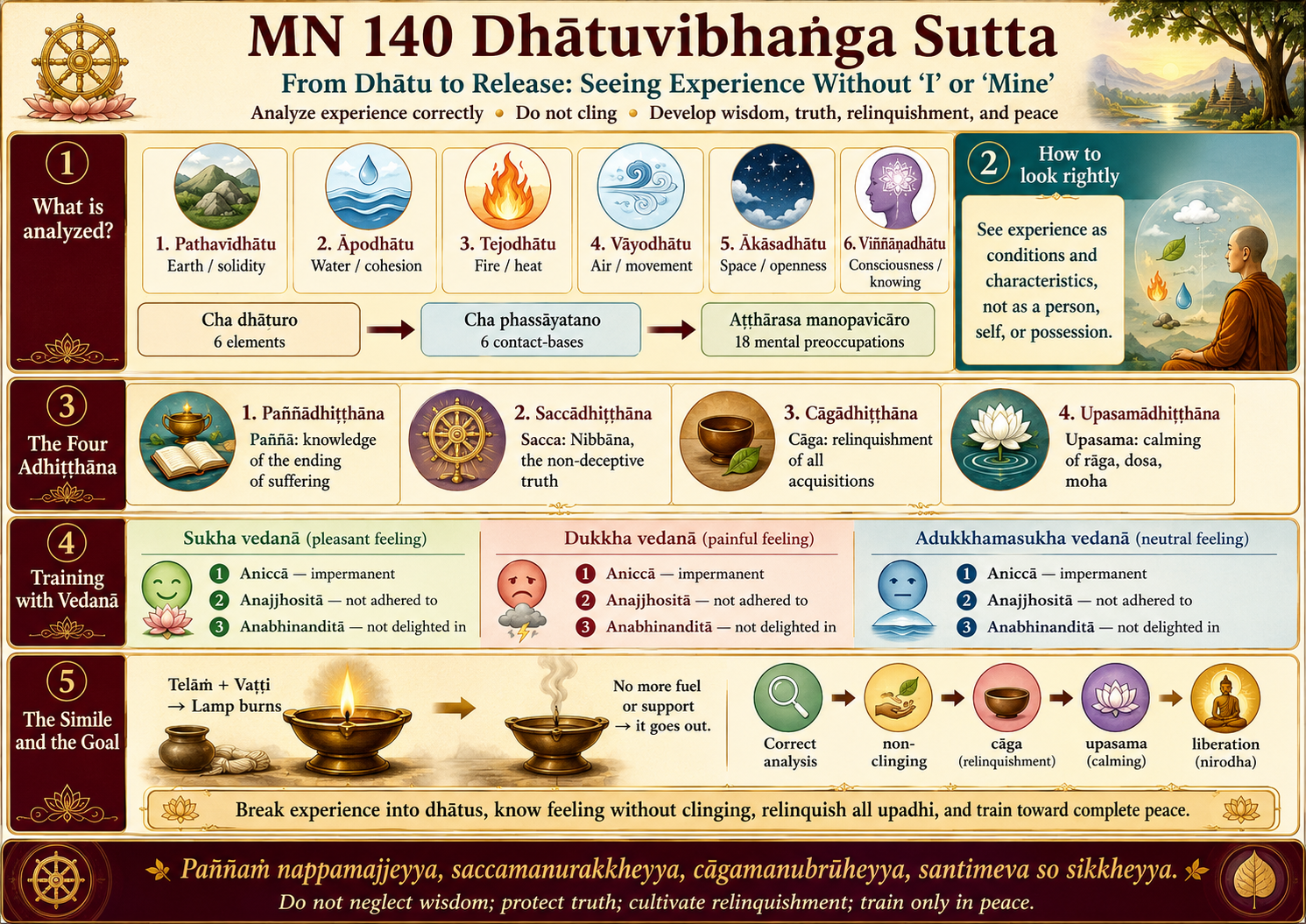 VISUAL SUMMARYSee this sutta in a pictureOpen the complete infographic for a visual overview before or after reading the full study.View infographic →
A Practical Journey from Analysis to Letting Go
This discourse is much more than a study of elements. It shows how a practitioner can move from breaking experience apart correctly to finally letting go of everything that is taken as “me” or “mine.” The person is not affirmed; the person is examined. What seems solid is traced back to elements, contact, feeling, and conditioned knowing.
The teaching then turns from analysis to fulfilment. Wisdom reaches its summit in knowledge of the ending of suffering. Truth reaches its summit in Nibbāna as the non-deceptive. Relinquishment reaches its summit in the giving up of all acquisitions. Peace reaches its summit in the complete stilling of rāga, dosa, and moha.
That is why MN 140 is so important. It does not merely explain experience. It teaches how to stop building a self out of it.
The Six Elements Are Better Seen as Lived Qualities of Experience
The small element-icons are worth preserving because they make the structure immediately memorable. Instead of losing them, this page gives them a cleaner and warmer presentation so each one stands out clearly.
When these six are seen clearly, the illusion of a compact person begins to weaken. The body is no longer read as “I am this.” It is understood as a field of characteristics. Consciousness too is not installed as a permanent self, but known as a conditioned aspect of experience.
The Four Foundations to Be Fully Developed
The discourse does not leave the practitioner with analysis alone. It shows what the training must mature into.
Pleasant, Painful, and Neutral Feeling Must Be Known Without Sticking
The page’s earlier visual treatment of feeling had a strong core insight: feeling is not the problem by itself. The problem is the movement of delighting in it, sinking into it, or building identity from it. The task is to know feeling as impermanent and to leave it unappropriated.
The Oil-Lamp Simile
The Arc of Practice
Carefully Reframed Essay with Clear Reader-Facing Headings
The material has been reorganised so the reader sees the movement of the teaching clearly, without technical migration wording or distracting labels.
What Dhātuvibhaṅga Really Does
Dhātu is best understood here as a mode, characteristic, or aspect of experience. Earth is not merely soil, water not merely liquid, and fire not merely flame. The sutta is directing attention to solidity, cohesion, heat, movement, space, and consciousness as discernible aspects of lived experience.
Vibhaṅga means analysis, breaking apart, or careful discernment. Thus Dhātuvibhaṅga is not a speculative theory of matter. It is a practical dismantling of the sense of “I” and “mine” by seeing body and experience in terms of elements, contact, feeling, and conditioned knowing.
The point is not to replace one philosophy with another. The point is to stop misreading experience as a self. Once the body is seen as earth, water, fire, air, space, and consciousness known dependently, the grip of personality begins to loosen.
| Domain | What MN 140 Draws Attention To | Why It Matters |
|---|---|---|
| Six elements | Earth, water, fire, air, space, and consciousness are examined as conditioned aspects of experience. | The imagined person loses solidity when experience is seen functionally. |
| Six contacts | Contact at eye, ear, nose, tongue, body, and mind conditions the next phase of experience. | Feeling is not a self but a conditioned result. |
| Three feelings | Pleasant, painful, and neutral feeling are to be known without adherence and delight. | This stops appropriation from hardening into identity and craving. |
| Four adhiṭṭhāna | Wisdom, truth, relinquishment, and peace are to be fully developed. | The sutta does not end with analysis; it ends with letting go and cooling. |
The Four Foundations That Must Be Fulfilled
The verse “Paññaṁ nappamajjeyya, saccamanurakkheyya, cāgamanubrūheyya, santimeva so sikkheyya” gives the heart of the training in compact form.
Paññā is not mere intelligence. Here it culminates in direct knowledge of the ending of suffering. Sacca is not just truthfulness in speech; it reaches its highest meaning in Nibbāna as what is not deceptive. Cāga is not only generosity; it becomes the relinquishment of all upadhi, all acquisitions that feed identity and becoming. Upasama is peace in the fullest sense: the stilling of greed, hatred, and delusion.
MN 140 therefore moves from analysis to fulfilment. It does not stop with “this is how experience is built.” It goes further and asks what must now be cultivated so that appropriation ends.
| Foundation | Supreme Noble Fulfilment | Sutta Phrase |
|---|---|---|
| Paññā | Knowledge of the complete ending of suffering | Sabbadukkhakkhaye ñāṇaṁ |
| Sacca | Nibbāna as the non-deceptive truth | Amosadhammaṁ nibbānaṁ |
| Cāga | Relinquishment of all acquisitions | Sabbūpadhipaṭinissaggo |
| Upasama | The stilling of greed, hatred, and delusion | Rāgadosamohānaṁ upasamo |
Feeling Must Be Known Without Adherence or Delight
A crucial turn in the essay is its treatment of vedanā. Pleasant feeling, painful feeling, and neutral feeling are not to be denied, suppressed, or dramatised. They are to be known clearly as they arise.
The language of the page rightly highlights three points: aniccā — impermanent; anajjhositā — not adhered to; and anabhinanditā — not delighted in. This is powerful because it shows how suffering is prolonged not merely by feeling itself, but by the mind’s sticking and delighting.
When feeling is known but not appropriated, a major support for craving weakens. The path then opens naturally toward relinquishment rather than toward more inner argument.
The oil-lamp simile fits here beautifully. A lamp burns only while conditions and fuel remain. In the same way, the round of experience keeps burning where there is fresh feeding. When no further fuel is added, cooling follows.
The Supreme Noble Fulfilment
The final movement of the essay becomes strongest when it stays close to the sutta’s own emphasis. The liberated one is described as having abandoned what had formerly been accumulated and appropriated. Upadhi is given up, not cosmetically reduced. Defilements are uprooted, not merely softened.
This is why the four adhiṭṭhāna are not ornamental ideas. They culminate in four fulfilled realities: wisdom that knows the end of suffering, truth that stands in the non-deceptive, relinquishment that lets go of all acquisitions, and peace that is the stilling of rāga, dosa, and moha.
The entire teaching can therefore be read as a movement from mistaken personhood to unbound peace: first analysis, then right seeing, then non-adherence, then relinquishment, then stilling.
The analysis does not end in complexity. It ends where appropriation ends.
What This Sutta Opens Up for Practice and Understanding
The Six Elements Are Meant to Loosen Identity
The six-element analysis is not there to make a practitioner intellectually busy. It is there to break the conceit that a compact person is sitting behind experience. Solidity is seen as solidity, heat as heat, movement as movement, space as space, and knowing as conditioned knowing. What appears personal begins to reveal itself as dependently arisen structure.
Contact and Feeling Explain Why Experience Becomes Personal
MN 140 is especially useful because it does not stop at the body. Contact gives rise to feeling, and feeling becomes a vulnerable turning point. If the mind clings, the world hardens into “I feel,” “I suffer,” “I want,” and “this is happening to me.” If feeling is known without sticking, the same experience becomes a field of insight rather than a field of bondage.
The Verse on Paññā, Sacca, Cāga, and Upasama Is the Practical Spine of the Sutta
These four are not random virtues placed at the edge of the discourse. They are the completion of the analytical work. Once the person has been dismantled through right discernment, the path must mature into wisdom, truth, relinquishment, and peace. Without this completion, analysis remains dry. With it, analysis becomes liberating.
The Lamp Simile Protects the Teaching from Metaphysical Confusion
The lamp does not go out because a hidden self escapes from it. It goes out because the conditions that sustained its burning no longer continue. In the same way, the sutta’s movement toward peace is best understood through the ending of fuel, appropriation, and continuation. This keeps the teaching practical and free from both eternalism and annihilationism.
The Final Realization Is Simpler Than the Mind Makes It
The essay becomes most powerful when its conclusion is stated plainly: what has been taken as self is only conditioned structure; what sustains bondage is appropriation; what fulfils the training is wisdom, truth, relinquishment, and peace. This simplicity is not superficial. It is the distilled force of the discourse.