Before the Quarrel: Trace the Conditions
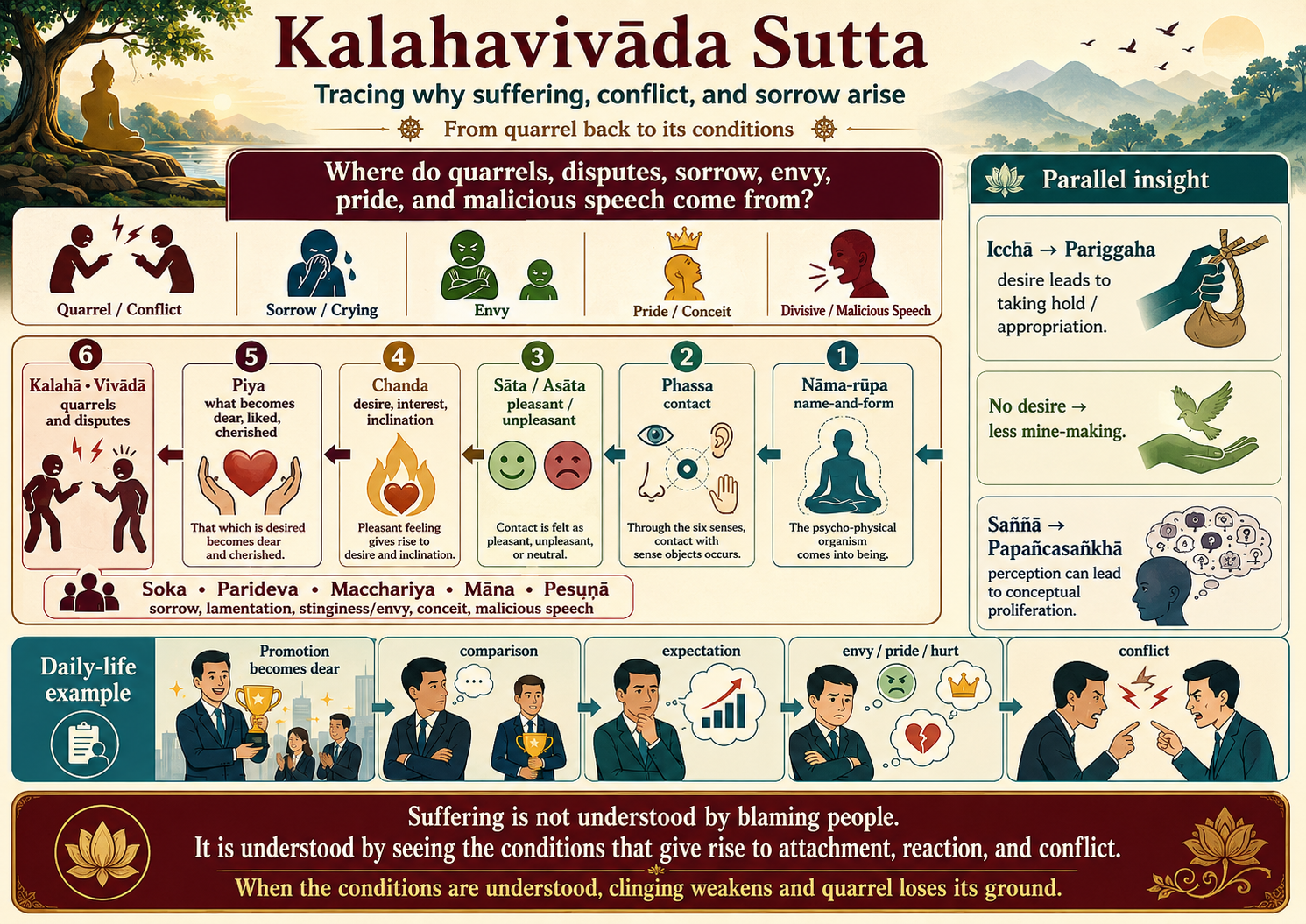 VISUAL SUMMARYSee this study in a pictureOpen the complete infographic for a visual overview before or after reading the full study.View infographic →
Do not ask only “Who started the argument?” Ask “What made the argument possible?”
Kalahavivāda Sutta is one of the most concentrated investigations of conflict in the Aṭṭhakavagga. An unnamed questioner repeatedly asks the Buddha where quarrels, sorrow, stinginess, conceit, divisive speech, desire, judgment, pleasant and unpleasant experience, contact, acquisition and mine-making come from.
The method is relentless. Every answer becomes the next question. Conflict is traced backward through what becomes piyā, then chanda, what is experienced or valued as sāta/asāta, phassa, and nāma-rūpa. A parallel branch follows icchā → pariggaha → mamattā. The discourse then moves into a much more difficult meditation passage involving rūpa, saññā and papañcasaṅkhā, before ending by showing that even competing claims about ultimate purification depend on supports.
This is why the sutta is so useful for teaching. It moves the practitioner from blame to conditionality, from “my position” to “what conditions made this position become mine?”
All sixteen canonical stanzas with direct translation
01Where do quarrels and disputes come from?
Kutopahūtā kalahā vivādā,
Paridevasokā sahamaccharā ca;
Mānātimānā sahapesuṇā ca,
Kutopahūtā te tadiṅgha brūhi.
“From where have quarrels and disputes arisen, together with lamentation and sorrow, stinginess, conceit and excessive conceit, and divisive or malicious speech? From where have these arisen? Please tell me.”
02They arise around what has become dear
Piyappahūtā kalahā vivādā,
Paridevasokā sahamaccharā ca;
Mānātimānā sahapesuṇā ca,
Maccherayuttā kalahā vivādā;
Vivādajātesu ca pesuṇāni.
“Quarrels and disputes arise from what has become dear; so do lamentation and sorrow, together with stinginess, conceit, excessive conceit, and divisive speech. Quarrels and disputes are joined with stinginess, and when disputes have arisen, divisive speech follows.”
03From where do the dear, greed, hope, and expectation arise?
Piyā su lokasmiṁ kutonidānā,
Ye cāpi lobhā vicaranti loke;
Āsā ca niṭṭhā ca kutonidānā,
Ye samparāyāya narassa honti.
“From what source are the things that become dear in the world, and the greeds that roam through the world? From what source are hopes and their expected ends, the things that concern a person’s future?”
04Chanda is the source from which the dear and greed arise
Chandānidānāni piyāni loke,
Ye cāpi lobhā vicaranti loke;
Āsā ca niṭṭhā ca itonidānā,
Ye samparāyāya narassa honti.
“The things that become dear in the world have chanda as their source; so too the greeds that roam through the world. Hopes and their expected ends arise from this, and so do those things that concern a person’s future.”
05From where do chanda, judgments, anger, lying, and uncertainty arise?
Chando nu lokasmiṁ kutonidāno,
Vinicchayā cāpi kutopahūtā;
Kodho mosavajjañca kathaṅkathā ca,
Ye vāpi dhammā samaṇena vuttā.
“From what source does chanda arise in the world? From where do judgments or determinations arise? And anger, false speech, uncertainty, and the other states spoken of by the ascetic—from where do they arise?”
06Pleasant and unpleasant valuation conditions chanda and judgment
Sātaṁ asātanti yamāhu loke,
Tamūpanissāya pahoti chando;
Rūpesu disvā vibhavaṁ bhavañca,
Vinicchayaṁ kubbati jantu loke.
Kodho mosavajjañca kathaṅkathā ca,
Etepi dhammā dvayameva sante;
Kathaṅkathī ñāṇapathāya sikkhe,
Ñatvā pavuttā samaṇena dhammā.
“Depending on what is called pleasant and unpleasant in the world, chanda comes to be. Seeing arising and passing, becoming and non-becoming, with regard to forms, a person makes judgments in the world. Anger, false speech, and uncertainty too are present while this pair is present. One who is uncertain should train in the path of knowledge; having known, the ascetic has spoken of these states.”
07From where do pleasant and unpleasant arise?
Sātaṁ asātañca kutonidānā,
Kismiṁ asante na bhavanti hete;
Vibhavaṁ bhavañcāpi yametamatthaṁ,
Etaṁ me pabrūhi yatonidānaṁ.
“From what source are the pleasant and the unpleasant? When what is absent do these no longer occur? And this matter of becoming and non-becoming—tell me from what source it comes.”
08Pleasant and unpleasant have contact as their source
Phassanidānaṁ sātaṁ asātaṁ,
Phasse asante na bhavanti hete;
Vibhavaṁ bhavañcāpi yametamatthaṁ,
Etaṁ te pabrūmi itonidānaṁ.
“Pleasant and unpleasant have contact as their source. When contact is absent, they do not occur. And this matter of becoming and non-becoming—I tell you that it has its source here.”
09From where do contact, acquisition, and mine-making arise?
Phasso nu lokasmi kutonidāno,
Pariggahā cāpi kutopahūtā;
Kismiṁ asante na mamattamatthi,
Kismiṁ vibhūte na phusanti phassā.
“From what source is contact in the world? From where do acquisitions or acts of taking possession arise? When what is absent is there no mine-making? When what has disappeared do contacts no longer strike?”
10Contact depends on nāma-rūpa; acquisition springs from icchā
Nāmañca rūpañca paṭicca phasso,
Icchānidānāni pariggahāni;
Icchāyasantyā na mamattamatthi,
Rūpe vibhūte na phusanti phassā.
“Contact occurs dependent on nāma and rūpa. Acquisitions have icchā—wishing or desire—as their source. When icchā is absent, there is no mine-making. When rūpa has disappeared, contacts do not strike.”
11How does rūpa disappear, and how do pleasure and pain disappear?
Kathaṁ sametassa vibhoti rūpaṁ,
Sukhaṁ dukhañcāpi kathaṁ vibhoti;
Etaṁ me pabrūhi yathā vibhoti,
Taṁ jāniyāmāti me mano ahu.
“For one proceeding in what way does rūpa disappear? And how do pleasure and pain disappear? Tell me how they disappear; it has occurred to me that we should understand this.”
12The difficult perception verse and papañcasaṅkhā
Na saññasaññī na visaññasaññī,
Nopi asaññī na vibhūtasaññī;
Evaṁ sametassa vibhoti rūpaṁ,
Saññānidānā hi papañcasaṅkhā.
“Not one who perceives ordinary perception, nor one who perceives a distorted perception; not without perception, nor one whose perception is of what has disappeared. For one proceeding in this way, rūpa disappears; for the categories or concepts of proliferation have perception as their source.”
Reading caution: this is one of the most difficult verses in the Aṭṭhakavagga. The canonical words should not be reduced to the old page’s simple scheme of “do not cling to perception, do not reject perception, do not suppress perception.” Modern translators and early interpretive traditions differ on the precise meditative referent.
13Is this the highest purification, or is there something beyond?
Yaṁ taṁ apucchimha akittayī no,
Aññaṁ taṁ pucchāma tadiṅgha brūhi;
Ettāvataggaṁ nu vadanti heke,
Yakkhassa suddhiṁ idha paṇḍitāse;
Udāhu aññampi vadanti etto.
“What we asked, you have explained to us. We ask another question; please tell us this. Do some who are regarded as wise here say that this is the highest extent of purification for a being? Or do they say there is something beyond this?”
14Some claim this as the highest; others posit a condition with no remainder
Ettāvataggampi vadanti heke,
Yakkhassa suddhiṁ idha paṇḍitāse;
Tesaṁ paneke samayaṁ vadanti,
Anupādisese kusalā vadānā.
“Some who are regarded as wise here do indeed say that this is the highest extent of purification for a being. But some among them, claiming expertise, speak of another condition in which nothing remains as a basis or residue.”
Reading caution: the verse reports competing claims by people regarded as wise. It does not simply endorse “anupādisesa” here as the Buddha’s own definition of Nibbāna; the final verse instead exposes the dependence of these positions.
15The sage sees that these positions themselves are dependent
Ete ca ñatvā upanissitāti,
Ñatvā munī nissaye so vimaṁsī;
“Knowing that these are dependent, the sage—having understood their supports—examines those dependencies.”
16Liberated, the sage no longer enters dispute
Ñatvā vimutto na vivādameti,
Bhavābhavāya na sameti dhīro”ti.
“Having known, released, one does not enter dispute. The wise one does not align with becoming or non-becoming.”
From visible dispute to the mind that manufactures a position worth fighting for
17The method is more important than the first answer: keep asking ‘from what condition?’
The genius of Kalahavivāda is its refusal to stop at the visible problem. The questioner does not accept ‘people quarrel because they are angry’ as a sufficient explanation. Each answer becomes the basis for the next question.
This is a training in conditional investigation. Instead of asking only who is wrong, ask what made this reaction possible, what made that condition possible, and where appropriation entered.
Present-day example: Two siblings are arguing over care of an elderly parent. Instead of stopping at ‘they are selfish,’ ask: what has become dear—recognition, control, fairness, inheritance, identity as the ‘good child’? What chanda and judgments are built around that?
18Kalahā and vivādā are downstream symptoms
Quarrel and dispute are late-stage manifestations. By the time voices rise, several prior conditions have already been operating: something has become dear, desire has formed around it, pleasant/unpleasant valuation is active, judgments have hardened, and ‘mine’ may already be involved.
This changes conflict practice. The best time to work is often before the argument, at the point where the mind begins to insist: ‘this must go my way.’
Present-day example: A meeting becomes hostile only after several people have privately attached status and self-worth to their preferred proposal. The quarrel is the visible smoke; the fire began earlier.
19Piyā does not mean that love itself is condemned
The old article repeatedly translates piya as ‘love and attachment.’ The canonical word is broader: dear, cherished, pleasing, desirable. Conflict arises because things become emotionally privileged and are then defended, sought, or withheld.
Care, affection, and mettā need not produce dispute. The danger begins when dearness becomes conditional ownership or the basis of self-measurement.
Present-day example: A parent loves two children. Conflict erupts not because love exists, but because ‘my child must choose the career I approve of’ has become dear and non-negotiable.
20Macchariya is better understood as stinginess or possessiveness than simple envy
The opening list includes maccharā/macchariya. Envy can be part of the lived situation, but the Pāḷi points strongly toward stinginess, possessiveness, and unwillingness to share what one regards as one’s domain.
This is why conflict often produces withholding: information, affection, credit, resources, access, recognition.
Present-day example: After a colleague receives promotion, another employee stops sharing useful information: ‘Why should I help them get further ahead?’ That is closer to the stingy-protective quality of macchariya than simple jealousy.
21Piyā are produced through chanda; desirability is not simply sitting inside the object
The discourse next asks where things that become dear come from and answers: chandānidānāni piyāni. What becomes dear is conditioned by the mind’s interest, wanting, or inclination.
This is a powerful correction to the assumption that an object simply possesses desirability. Different people can encounter the same object and build radically different worlds around it.
Present-day example: A job title is neutral to one person, deeply desired by another, and actively avoided by a third. The title alone does not explain the emotional force; chanda helps make it piyā.
22The same object can generate hope before acquisition and fear after acquisition
The sutta links chanda not only with the dear but also with greed, hope, and expected fulfillment. Desire changes form across time.
Before getting the object: ‘I will be happy when I have it.’ After getting it: ‘How do I keep it?’ Thus acquisition does not automatically end the structure that generated conflict.
Present-day example: Before promotion, Rajesh worries whether he will get it. After promotion, he worries whether he can hold the role and remain admired. The object changed hands; the chanda-system remains.
23Do not call the whole discourse the standard twelve-link paṭiccasamuppāda formula
The old page says the sutta ‘delves into dependent origination’ as though it were simply the familiar twelve-link formula. It certainly teaches conditionality, but its sequence is distinctive.
It moves through piyā, chanda, sāta/asāta, phassa, nāma-rūpa, icchā, pariggaha, mamattā, rūpa, saññā and papañcasaṅkhā. The six sense bases are not explicitly inserted between nāma-rūpa and phassa here.
The correct teaching value is therefore stronger if we call it a special conditional investigation of conflict rather than forcing it into a standard chart.
Present-day example: When teaching, put the actual words of this sutta on the board instead of replacing them with avijjā → saṅkhāra → viññāṇa. Then students can see what this discourse uniquely contributes.
24Sāta and asāta: the mind sorts experience into appealing and unappealing
The answer to ‘from where does chanda arise?’ points to what the world calls sāta and asāta—pleasant/appealing and unpleasant/unappealing.
This valuation is a critical conflict junction. Once a person, idea, outcome, or sensation has been coded as ‘good for me’ or ‘bad for me,’ chanda and judgment gain a platform.
Present-day example: A political post appears. Before any careful analysis, the logo of the opposing group is recognized as ‘unpleasant.’ Judgment is already biased before the argument is read.
25Vinicchaya here is judgment or determination—not automatically liberating discernment
The old material sometimes glosses vinicchaya positively as discernment. In this context it is part of the problem-chain: a person makes determinations or judgments based on the pleasant/unpleasant pair and the arising/passing of forms.
This is the mind fixing a conclusion: ‘this is mine,’ ‘this is right,’ ‘that person is against me,’ ‘this outcome means failure.’
Present-day example: A spouse comes home late. Before asking what happened, the mind concludes: ‘You do not respect me.’ That judgment then organizes the entire conversation.
26Anger and lying can emerge to protect a judgment
Once a judgment becomes important, anger protects it and false speech may be recruited to defend it. We omit facts, exaggerate, misrepresent motives, or selectively remember evidence.
The sutta therefore links emotional conflict with epistemic distortion.
Present-day example: In an argument, a person says ‘you always do this’ even though they know it is not literally true. The lie serves the judgment that the other person is fundamentally inconsiderate.
27Kathaṅkathā — uncertainty can coexist with aggressive certainty
The verse includes kathaṅkathā, uncertainty or doubt. This is psychologically subtle: people often argue most aggressively when they are not secure inside.
Defensiveness can be a strategy to silence one’s own uncertainty.
Present-day example: Someone loudly attacks a colleague’s proposal, but privately fears that their own expertise is becoming outdated. The quarrel protects a threatened certainty.
28Phassa is a decisive pivot: before contact, that particular pleasant/unpleasant reaction is not operating
The sutta next states that sāta and asāta have phassa as their source. This brings conflict back from abstract personality to event-specific contact.
Without the email read, comment heard, face seen, memory contacted, or message received, that specific episode does not unfold.
Present-day example: You were peaceful until you opened a family WhatsApp message. The problem is not that WhatsApp is evil; it is useful to see the exact contact at which the pleasant/unpleasant sorting began.
29Nāma-rūpa → phassa: preserve the unusual wording
The discourse says nāmañca rūpañca paṭicca phasso—contact dependent on name and form. It does not explicitly insert saḷāyatana in this verse.
This compressed relation is one reason Kalahavivāda should be studied on its own terms. The mind-body field and its capacity to designate, recognize, and encounter form are already sufficient to support the conflict process described here.
Present-day example: A facial expression becomes meaningful only within a living body-mind capable of recognizing ‘that look’ and interpreting it. Contact is not an isolated mechanical spark.
30Pariggaha springs from icchā: wanting becomes acquisition and holding
Icchānidānāni pariggahāni: acquisitions, appropriations, or acts of taking hold have desire as their source.
The movement is important: wanting can become an attempt to secure, possess, reserve, control, or define.
Present-day example: You want a parking space. Within seconds the mind shifts to ‘that is my space—I was here first.’ Icchā has moved toward pariggaha.
31No icchā, no mamattā — the sutta explicitly reaches ‘mine-making’
Icchāyasantyā na mamattamatthi: when icchā is absent, there is no mamattā, no ‘mine-ness’ or mine-making.
This is one of the deepest practical lines in the discourse. Conflict intensifies when an object, role, person, view, reputation, or outcome is no longer simply present but becomes mine.
Present-day example: A Dhamma teaching is questioned. If the reaction is ‘this is my method, my teacher, my interpretation,’ the dispute is no longer only about evidence; mamattā is defending territory.
32Mine-making is much broader than property ownership
Mamattā can attach to ideas, relationships, nationality, profession, reputation, religious identity, political position, pain, trauma, and even spiritual attainment.
The more identity is invested, the more disagreement feels like personal attack.
Present-day example: Someone criticizes your city, school, caste, company, country, or meditation lineage. Notice how quickly neutral information becomes ‘they are attacking us.’
33The discourse then changes register: how does rūpa disappear?
After nāma-rūpa, phassa, icchā, pariggaha, and mamattā, the questioner asks something more difficult: under what manner of proceeding does rūpa disappear, and how do pleasure and pain disappear?
The discourse is no longer merely offering conflict-management psychology. It is moving into a refined meditative and phenomenological territory.
Present-day example: This is where a teaching session should slow down. Do not force the office-promotion example into every verse; the canonical inquiry has moved beyond ordinary corporate psychology.
34Verse 12 should not be reduced to ‘observe perception mindfully’
The old page interprets the four negations as a simple middle path: do not cling to perception, do not reject perception, do not suppress perception, and remain mindful. That is attractive pedagogically, but it is not what the Pāḷi transparently says.
The verse is intentionally paradoxical: na saññasaññī, na visaññasaññī, nopi asaññī, na vibhūtasaññī. Modern scholars and early interpretive traditions disagree about the exact states intended.
A source-faithful page should preserve the difficulty rather than replace it with an easy slogan.
Present-day example: When a verse is obscure, a teacher can say: ‘This part is difficult and has competing interpretations.’ That is better Dhamma teaching than creating certainty where the text does not provide it.
35One strong interpretive possibility is deep meditation beyond ordinary form-perception—but label it as interpretation
Bhikkhu Sujato’s introduction to the Sutta Nipāta reads this section in light of deep meditation and the formless attainments: forms or form-perceptions are transcended as the practitioner moves beyond ordinary form experience.
The canonical Mahāniddesa also contains multiple ways of explaining the disappearance of rūpa, including meditative transcendence. But these are interpretive aids, not extra words inside Snp 4.11.
For a sutta-only study, the correct approach is: preserve the verse exactly, present the plausible meditative reading, and clearly mark the interpretive boundary.
36Saññānidānā hi papañcasaṅkhā — perception is the source for the categories of proliferation
This line is one of the most important in the entire Aṭṭhakavagga. Papañcasaṅkhā is notoriously difficult. It can point to conceptual categories, reckonings, designations, or structures of proliferation.
The key fact the verse gives us directly is the conditional relation: saññā is nidāna for papañcasaṅkhā.
Perception marks, recognizes, and names. Once the mark is taken up, the mind can proliferate comparisons, stories, identities, and disputes.
Present-day example: A colleague’s short reply is perceived as ‘dismissive.’ From that mark come stories: ‘she has never respected me,’ ‘people like her always do this,’ ‘I need to put her in her place.’ The contact was one sentence; papañca builds an entire world.
37Papañca converts a single event into a history, identity, and future
A useful practical signature of papañca is expansion. One event becomes many thoughts, many times, many persons, many hypothetical futures.
This is how conflict becomes self-sustaining even after the external trigger has ended.
Present-day example: A one-minute disagreement in the morning becomes an afternoon of imagined conversations, remembered insults from five years ago, and predictions about future betrayal.
38Do not call every thought papañca
Planning a meeting, calculating a budget, remembering instructions, or reasoning carefully is not automatically papañca. The term points to proliferative conceptual structuring that becomes entangled with appropriation and dispute.
The distinction matters because anti-thinking is not wisdom.
Present-day example: Writing a clear response to resolve a contract issue is functional thought. Rehearsing ten imaginary humiliations of the other party is proliferation.
39The question about ‘purification of the yakkha’ is not a simple statement of Buddhist doctrine
The last exchange asks what different people regarded as wise call the highest purification of the yakkha—the being or person. Some say ‘this much’; others speak of something with no remainder.
The discourse reports positions. It is dangerous to convert verse 14 directly into: ‘The Buddha says the higher state is Nibbāna without residue.’ The grammar and final verse show that these claims themselves are being examined as dependent.
Present-day example: In teaching, distinguish: ‘the Buddha reports that some thinkers say X’ from ‘the Buddha endorses X.’ Many doctrinal errors begin by collapsing that distinction.
40The final answer is a critique of dependence on positions
Ete ca ñatvā upanissitāti: knowing these are dependent. The sage investigates the supports on which these claims rest.
This is the perfect ending to a discourse on disputes. Even refined doctrines about ultimate purity can become grounds for conflict when their dependence is unseen.
Present-day example: Two meditation schools debate whether one specific state is ‘the final goal.’ Kalahavivāda asks a prior question: what assumptions, experiences, definitions, authorities, and identity commitments are each position depending on?
41Na vivādameti does not mean the liberated person can never disagree
The sage ‘does not enter dispute’ should not be turned into a rule that a liberated person never corrects error, answers questions, or states that something is false.
Vivāda here belongs to the whole architecture of appropriation, rivalry, conceit, and position-taking. One can clarify Dhamma without making the clarification into self-defense.
Present-day example: A teacher can say ‘that quotation is not in the sutta’ firmly and without hostility. Accuracy is not the same as identity-driven dispute.
42Bhavābhavāya na sameti — do not rush to the slogan ‘beyond existence and non-existence’
The final line is often paraphrased metaphysically. A safer rendering is that the wise one does not align or come together with bhava/abhava—becoming and non-becoming, existence and non-existence.
The Aṭṭhakavagga repeatedly warns against taking positions as identity or refuge. The point is not to invent a third metaphysical theory called ‘beyond duality.’
Present-day example: Someone asks, ‘Does the liberated person exist after death or not exist?’ The training is not to create a new identity around being the person with the cleverest metaphysical answer.
43Workplace promotion — keep it, but use the whole chain more accurately
The old Rajesh promotion story is pedagogically useful. It should be retained, but with better conditional precision.
Promotion becomes piyā because chanda invests it with recognition, income, status, and self-worth. Pleasant/unpleasant valuation appears as approval/rejection. Judgments form: ‘I deserved it.’ Contact occurs through the announcement. Icchā becomes pariggaha—trying to secure the role. Mamattā turns it into ‘my career, my status.’ Papañca then expands the event into comparison and gossip.
Present-day example: The practical intervention is not merely ‘be mindful.’ At each link ask: where did the promotion become mine? What judgment would soften if self-worth were not invested in the title?
44Family inheritance — one object, generations of papañca
Property disputes show the sutta almost line by line. A house becomes dear, desire attaches to it, pleasant/unpleasant valuation divides siblings, judgments about fairness harden, mine-making becomes explicit, and old family memories proliferate.
The physical house may be only one object; the mind turns it into parental love, status, sacrifice, justice, childhood, and identity.
Present-day example: A sibling says, ‘I cared for mother, therefore the house should be mine.’ Another hears, ‘your relationship with mother was less valuable.’ The dispute is no longer about square footage.
45Marriage conflict — the partner becomes mixed with a cherished picture of how marriage must be
Often we do not quarrel only with the person; we quarrel with the gap between the living person and the piyā image of how a spouse should behave.
Chanda feeds the picture, vinicchaya judges deviations, and mamattā says ‘my spouse should not do this.’
Present-day example: One partner forgets an anniversary. The contact is simple. Within seconds perception labels it ‘not caring,’ and papañca supplies: ‘you never value me; this marriage means nothing.’
46Social media and ideological conflict — algorithms accelerate sāta/asāta
Digital platforms train instant pleasant/unpleasant sorting: like/dislike, agree/outrage, follow/block, tribe/enemy.
That rapid valuation gives chanda and vinicchaya almost no friction. The result is a perfect environment for dispute, divisive speech, and mine-making around views.
Present-day example: Before replying to a political post, identify the first moment your body-mind coded it as ‘our side’ or ‘their side.’ That may be more revealing than the hundredth comment.
47Dhamma disputes — the teaching itself can become piyā and ‘mine’
This sutta is especially valuable inside Buddhist communities. A view about jhāna, vipassanā, lineage, translation, attainment, or teacher can become cherished and appropriated.
Once mamattā enters, evidence is no longer processed neutrally; correction feels personal.
Present-day example: Instead of ‘What does the Pāḷi support?’ the inner question becomes ‘How do I defend our tradition?’ Kalahavivāda invites the teacher to detect that shift immediately.
48A practical conflict autopsy
1. Surface: What exactly is the quarrel?
2. Piyā: What outcome, person, identity, or idea became dear?
3. Chanda: What do I want to happen?
4. Sāta/asāta: What am I coding as pleasant/unpleasant?
5. Vinicchaya: What judgment have I already fixed?
6. Phassa: What contact triggered this episode?
7. Icchā/pariggaha: What am I trying to secure, possess, or control?
8. Mamattā: Where has ‘mine’ appeared?
9. Saññā: What label or recognition is organizing the story?
10. Papañca: How far has the mind expanded beyond the original event?
Present-day example: Use this after a real argument. Write one sentence for each step without explaining or defending yourself.
49The practice is not to erase legitimate boundaries or injustice
Tracing conflict inward does not mean pretending that fraud, abuse, discrimination, or harmful conduct did not occur. Conditional investigation is not victim-blaming.
One can take protective action, report wrongdoing, set boundaries, or seek justice while also examining the additional suffering created by appropriation, hatred, and proliferation.
Present-day example: If an employee is harassed, the correct response may include documentation and formal complaint. Kalahavivāda asks whether that necessary action can occur without feeding fantasies of revenge.
50The deepest teaching move: from ‘my view’ to seeing what the view depends on
The discourse ends not by winning the argument but by seeing dependence. That is the exact opposite of ordinary debate culture.
When a view is seen as conditioned by perception, experience, language, identity, fear, desire, and prior assumptions, the urge to make it an absolute self-position weakens.
Present-day example: During a disagreement, try saying internally: ‘This conclusion arose dependent on certain information and values.’ That sentence creates room for investigation without requiring immediate surrender of the conclusion.
51Why this sutta is powerful for teaching
Kalahavivāda offers a repeatable pedagogical method. Start with a real conflict students recognize. Then keep asking ‘from what?’ until the discussion reaches dearness, wanting, valuation, contact, appropriation, mine-making, perception, and proliferation.
The students discover the chain in their own experience rather than memorizing an abstract doctrine.
The final lesson is not conflict avoidance but freedom from the inner supports that make dispute a vehicle for identity.
Do not flatten the sutta into one mechanical arrow-chain
The discourse contains a main line of questioning and important side relations. The table below keeps the relationships visible without pretending that Snp 4.11 is identical to the standard twelve-link formula.
| Layer | Pāḷi | How it functions | Teaching question |
|---|---|---|---|
| Quarrel / dispute | Kalahā • vivādā | Visible conflict, argument, factional speech | Do not stop analysis here. |
| Dear / cherished | Piyā | Outcome, person, status, idea becomes emotionally privileged | What has become non-negotiably important? |
| Desire / interest | Chanda | Wanting shapes what becomes dear | What do I need to happen? |
| Appealing / unappealing | Sāta • asāta | Experience is sorted as for-me / against-me | What was instantly liked or disliked? |
| Judgment | Vinicchaya | Conclusion hardens around the valuation | What have I already decided this means? |
| Contact | Phassa | Concrete encounter activates the episode | What did I see, hear, read, remember, or encounter? |
| Wishing | Icchā | Wanting moves toward securing | What am I trying to get or prevent? |
| Acquisition / possession | Pariggaha | Taking hold, securing, reserving, controlling | What am I trying to make stable? |
| Mine-making | Mamattā | Object/view/person becomes ‘mine’ | Where did self-ownership enter? |
| Perception | Saññā | Marks and labels organize the field | What label made the story possible? |
| Proliferative categories | Papañcasaṅkhā | Stories, comparisons, identities, theories expand | How much of my reaction is now beyond the original contact? |
The same conditional structure appears in office, family, marriage, politics and Dhamma communities
| Situation | What becomes piyā | Judgment | Mine-making | Downstream conflict |
|---|---|---|---|---|
| Work promotion | Recognition / status | “I deserved it.” | Title becomes mine; colleagues become rivals | Gossip, withholding, resentment |
| Family inheritance | House / parental recognition | “I sacrificed more.” | Property becomes proof of love or fairness | Sibling rupture |
| Marriage | Image of how spouse must behave | “If you cared, you would…” | Partner is treated as extension of expectation | Accusation and old-history replay |
| Politics | Group identity / moral certainty | “Our side sees reality.” | View becomes mine/ours | Outrage, contempt, divisive speech |
| Dhamma method | Teacher / technique / attainment view | “Our method is the real one.” | Teaching becomes identity territory | Doctrinal hostility |
| Social media | Approval / visibility | “Why did nobody react?” | Post becomes measure of self-worth | Checking, comparison, envy |
| Parent-child | Control / image of successful child | “My child should choose this.” | Child’s life becomes parental identity | Pressure, disappointment, manipulation |
Use the sutta after a real quarrel
| Question | What it helps locate |
|---|---|
| What exactly happened before my mind began the story? | Locate phassa. |
| What outcome or identity has become dear? | Locate piyā. |
| What am I wanting to happen or not happen? | Locate chanda / icchā. |
| What did I immediately code as pleasant or unpleasant? | Locate sāta / asāta. |
| What judgment have I already formed? | Locate vinicchaya. |
| What am I trying to secure, possess, defend, or control? | Locate pariggaha. |
| Where have I used ‘my’, ‘mine’, ‘our’, or ‘us’ internally? | Locate mamattā. |
| What label did perception assign? | Locate saññā. |
| How far has thought expanded beyond the original facts? | Locate papañca. |
| Can I act responsibly without making the view or outcome into self? | Test whether conflict still needs identity. |
Do not begin with blame. Begin with the condition that made the reaction possible.
Find piyā. What became so dear that its loss or challenge felt threatening?
Find mamattā. Where did “mine” enter the view, person, role, property, or outcome?
Find saññā. What label organized the experience?
Find papañca. How much story exists now that was not in the original contact?
The sutta becomes more difficult precisely where easy modern explanations are most tempting
The verse beginning Na saññasaññī na visaññasaññī should not be converted into a generic instruction to “mindfully observe perception without clinging.” The canonical expression is more technically difficult, and broader early-Buddhist sources as well as modern scholarship read it in relation to refined meditation and the transcendence of form in different ways.
Likewise, the final exchange about yakkhassa suddhi reports competing claims about the highest purification. The decisive Buddhist move comes afterward: the sage sees that these positions are upanissita—dependent on supports—and investigates those supports. Having known and been freed, he no longer enters dispute and does not align himself with becoming or non-becoming.
That ending completes the opening question. The deepest end of dispute is not merely better communication. It is the ending of the dependence that turns perception, judgment, possession and view into a self-position that must be defended.