Nothing Happens for One Reason
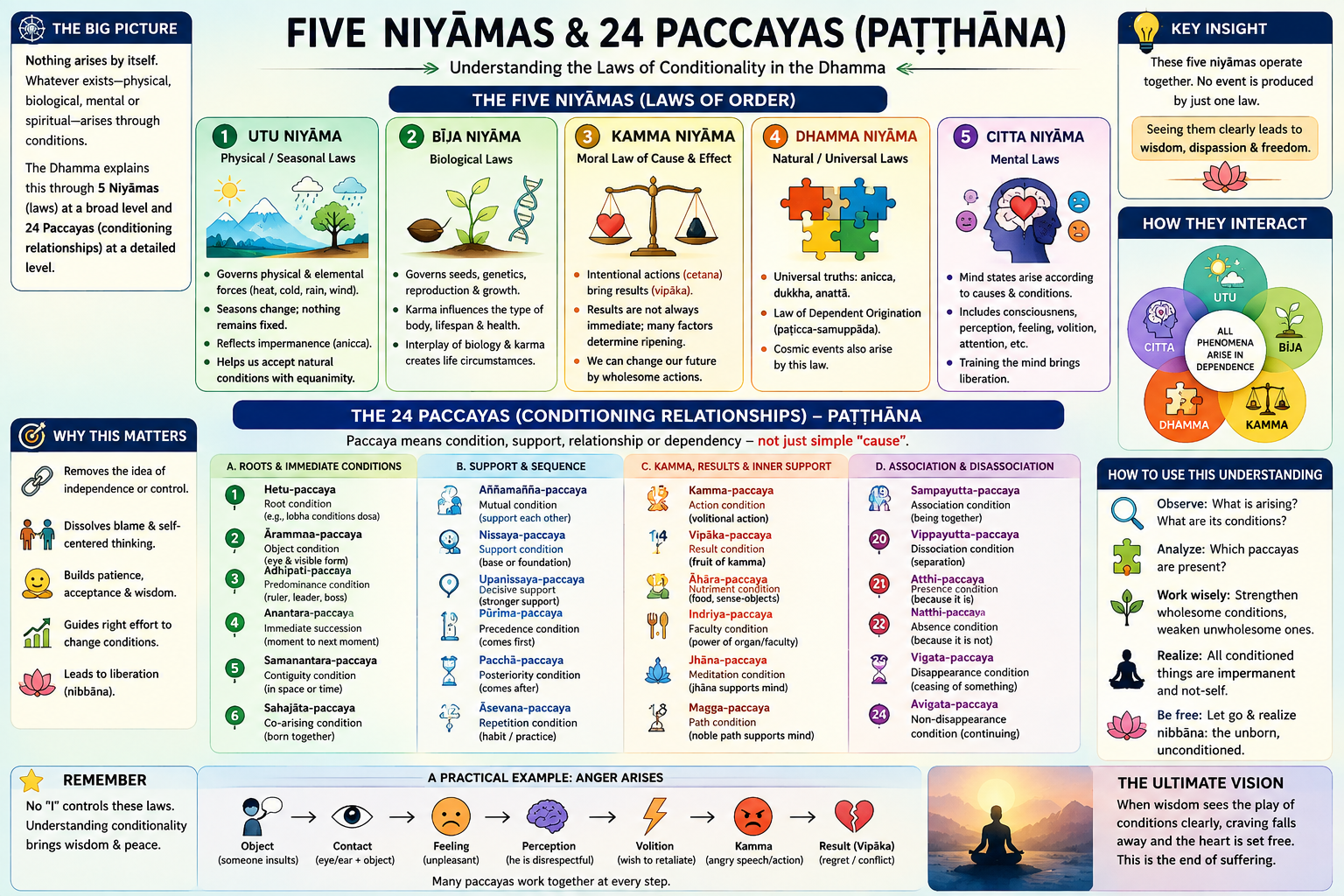 VISUAL SUMMARYSee this study in a pictureOpen the complete infographic for a visual overview before or after reading the full study.View infographic →
The value of the five niyāmas is not taxonomy—it is freedom from one-cause thinking
This essay originally combined two important Theravāda analytical frameworks: the five niyāmas and the Paṭṭhāna’s twenty-four paccayas. Both illuminate conditionality, but they belong to different textual layers and answer different questions.
The strongest revision begins one layer earlier, with the early suttas. The Buddha speaks of dhammaṭṭhitatā, dhammaniyāmatā, and idappaccayatā: things occur according to lawful conditionality whether or not a Buddha appears. The later Theravāda tradition classifies regularities into five broad niyāmas. The Paṭṭhāna, in a different Abhidhamma analysis, enumerates twenty-four kinds of conditioning relation.
The practical gain is enormous: when something happens, we do not rush to “God did it,” “fate did it,” “my past kamma did it,” or “one hidden cause explains everything.” We investigate the relevant conditions.
Textual honesty: the fivefold niyāma list is a later Theravāda commentarial classification, not a standard five-part formula in the early Nikāyas. The Paṭṭhāna’s twenty-four paccayas belong to the Abhidhamma Piṭaka.
Before the fivefold classification: dhammaniyāmatā and idappaccayatā
SNSN 12.20 Paccayasutta — conditionality stands whether Buddhas arise or not
Uppādā vā tathāgatānaṁ anuppādā vā tathāgatānaṁ, ṭhitāva sā dhātu dhammaṭṭhitatā dhammaniyāmatā idappaccayatā.
Whether Tathāgatas arise or do not arise, that principle stands: the stability of Dhamma, the regularity of Dhamma, this specific conditionality.
The Buddha then applies this to dependent arising. The Tathāgata awakens to it and explains it; he does not create the law.
ANAN 3.136 Uppādāsutta — the same language applied to the three characteristics
Uppādā vā, bhikkhave, tathāgatānaṁ anuppādā vā tathāgatānaṁ, ṭhitāva sā dhātu dhammaṭṭhitatā dhammaniyāmatā.
Whether Tathāgatas arise or not, the regularity stands: all conditioned things are impermanent; all conditioned things are dukkha; all dhammas are not-self.
This early usage of dhammaniyāmatā must be distinguished from the later fifth category called Dhamma-niyāma in the fivefold commentarial scheme.
A later Theravāda map—with careful modern equivalents
| Niyāma | Older domain | Traditional emphasis | Useful modern analogy | Do not conclude |
|---|---|---|---|---|
| Utu-niyāma | Seasonal / thermal / material regularity | Weather, heat/cold, material change, seasonal patterns | Modern physics and climate science | Do not moralize storms, heat, or bodily temperature as “bad kamma.” |
| Bīja-niyāma | Seed / generative regularity | Seed produces according to kind; plant reproduction | Biology, heredity, genetics | DNA is a modern analogy, not an ancient Buddhist discovery. |
| Kamma-niyāma | Moral regularity of intentional action | Wholesome/unwholesome intention and corresponding vipāka | Ethics and behavioral consequence | Not everything experienced is past kamma; SN 36.21 rejects that view. |
| Citta-niyāma | Order in mental process | Regular succession and functioning of cittas | Psychology / cognitive science | Not “mind creates the external universe”; traditional usage is more specific. |
| Dhamma-niyāma | Lawful dhamma-order in the fivefold commentarial system | Traditional examples include special lawful dhamma-events | Broad natural-law analogy only with caution | Do not make this a catch-all for all universal or unexplained events. |
What each niyāma contributes—and what it cannot legitimately be made to say
01Begin with the early-sutta foundation: lawful conditionality
The safest starting point is not the later fivefold classification but the Buddha’s early-sutta language of idappaccayatā, dhammaṭṭhitatā, and dhammaniyāmatā: phenomena occur according to conditions whether or not a Tathāgata appears.
In SN 12.20, this regularity is applied to dependent arising. In AN 3.136, the same style of expression is used for the regularity that conditioned things are impermanent and dukkha, and that all dhammas are not-self.
This gives the essay its strongest foundation: reality is not waiting for a creator, judge, or permanent controller to make each event happen.
Present-day example: A seed germinates only when sufficient conditions are present. An angry response likewise depends on contact, perception, feeling, habits, intention, and other supports. Neither event requires an independent controller standing outside the conditions.
02The five niyāmas are a later Theravāda classification, not a numbered early-sutta teaching
The fivefold set—utu, bīja, kamma, citta, dhamma—appears in the Theravāda commentarial and later analytical tradition, including the Sumaṅgalavilāsinī, Aṭṭhasālinī, and Abhidhammāvatāra.
This does not make the framework unimportant. It simply means it should be presented honestly: it is a later attempt to classify different kinds of regularity, not a sutta where the Buddha says, “There are five niyāmas.”
Used carefully, the framework is extremely valuable because it prevents kamma from swallowing every other kind of explanation.
Guardrail: Do not quote the fivefold list as though it were a fixed five-part formula spoken by the Buddha in an early Nikāya discourse.
03Modern labels such as physics, genetics, and psychology are analogies—not ancient definitions
Modern expositions commonly translate utu-niyāma as “physical law,” bīja-niyāma as “biology/genetics,” and citta-niyāma as “psychology.” These are useful bridges for contemporary readers, but they are broader than the older examples.
The commentarial illustrations are more concrete: seasonal and thermal regularities, seeds reproducing according to kind, moral result of kamma, ordered succession in mental process, and particular lawful dhamma-events.
A rigorous essay therefore uses modern science as an analogy of domain, not as a claim that the ancient commentators taught modern physics, DNA, neuroscience, or psychology.
Present-day example: Bīja-niyāma can help us understand why heredity is not morally assigned by a cosmic judge. But saying “the commentators discovered DNA” would be historically false.
04The five are not five competing causes
The niyāmas should not be imagined as five boxes fighting to explain one event. A real event may involve several layers at once.
Nor are they equivalent to the Paṭṭhāna’s 24 paccayas. The fivefold niyāma framework classifies broad orders of regularity; the 24 paccayas analyze specific conditioning relations among dhammas.
The distinction is simple: niyāma asks what kind of regularity is being discussed; paccaya asks in what conditioning relation phenomena stand.
Present-day example: A fever can involve biological processes, temperature and bodily conditions, mental reactions, intentional choices about treatment, and many immediate conditioning relations. Asking for one exclusive “cause” is often the wrong question.
05Utu-niyāma — the regularity of temperature, season, and material change
In the commentarial examples, utu concerns thermal and seasonal order: heat and cold, winds, rainfall, flowering, day/night responses of plants, and other regularities associated with material conditions.
Calling this “physics” is a convenient modern approximation, but the original category is not a textbook of mechanics, chemistry, geology, or meteorology.
The practice insight is that many bodily and environmental events are lawful material processes and need not be interpreted as moral reward or punishment.
Present-day example: A heatwave, monsoon failure, seasonal allergy, or a room becoming hot because ventilation failed can be investigated through physical conditions before anyone asks, “What bad kamma caused this?”
06Utu-niyāma dismantles supernatural and moralized weather explanations
One important use of this framework is to resist the habit of turning weather, earthquakes, storms, or temperature into divine messages or personal moral verdicts.
Early Buddhist conditionality allows natural phenomena to be understood through the conditions appropriate to them.
Present-day example: A cyclone striking a coastline is not evidence that the people there were morally worse than people elsewhere.
Guardrail: The older essay’s suggestion that a person’s or community’s presence in a disaster region may be explained by “collective or personal kamma” should not be presented as established early-sutta doctrine.
07Utu does not mean the body is separate from other conditions
Material conditions interact with biological and mental ones. Heat can affect sleep; poor sleep can affect mood; mood can influence intentional behavior.
This is exactly why conditionality is richer than a one-cause model. Different domains can meet without being collapsed into each other.
Present-day example: A hot night contributes to poor sleep. Poor sleep makes irritation easier. The irritation is not “caused by weather alone,” but weather is a relevant condition.
08Bīja-niyāma — seed regularity and continuity according to kind
Bīja means seed. The old illustrations emphasize that a seed produces according to its kind—barley from barley, characteristic fruit from its seed, and so forth.
Modern heredity and genetics provide a helpful analogy, but we should not retroactively insert chromosomes, DNA, gene expression, or evolutionary theory into ancient Pāḷi texts.
Present-day example: A child resembling parents in eye color or other inherited traits belongs naturally in the biological domain. Moralizing the resemblance as reward or punishment adds a claim the niyāma itself does not require.
09Bīja-niyāma is especially important when discussing disease and disability
The older essay says that susceptibility to illness, health condition, gender, lifespan, and biological circumstances may be shaped by past kamma. Such possibilities are often asserted in later Buddhist culture, but they should not be taught as though every specific biological condition can be traced to a known moral deed.
SN 36.21 is an important corrective: the Buddha explicitly rejects the claim that everything a person experiences is caused by past action and lists bodily disorders, climate, careless behavior, injury, and kamma-result among different sources of feeling.
This makes room for biology to remain biology.
Present-day example: A hereditary blood disorder should first be understood medically and biologically. Compassion and appropriate treatment are more useful than speculation about what someone “must have done in a previous life.”
10Do not use kamma to blame parents, children, or patients for biology
One ethical danger of careless niyāma teaching is retrospective moral judgment: “You were born this way because of your kamma.”
That statement may be impossible to verify, can generate cruelty, and contradicts the practical restraint taught by SN 36.21 against reducing every experience to past kamma.
The five-niyāma framework is most useful when it limits karmic speculation rather than expanding it.
Present-day example: When a child is born with a medical condition, the Dhamma response is care, understanding, and wise action—not constructing an unseen moral biography.
11Kamma-niyāma — moral regularity begins with intention
Kamma is not “anything that happens.” In early Buddhism, kamma is centrally tied to cetanā, intention or volition. Intentional bodily, verbal, and mental actions have moral significance.
The later niyāma framework highlights the regularity by which wholesome and unwholesome kamma bear corresponding kinds of result.
This is moral causality, not cosmic punishment administered by a judge.
Present-day example: Two people can perform outwardly similar acts while the intention differs greatly—for example, cutting tissue during surgery versus cutting a person in hatred. Intention changes the moral nature of the action.
12Kamma is not fate
If everything were fixed by past kamma, present training would be pointless. Buddhism instead gives enormous importance to present intention, restraint, effort, wisdom, and cultivation of wholesome states.
Kamma-niyāma therefore belongs inside conditionality: past kamma can be one condition, present choices another, while other natural processes also operate.
Present-day example: A person raised in an angry household may have strong reactive habits. That history conditions the present, but it does not make a harsh response inevitable. Present sati and intention alter the sequence.
13SN 36.21 should be a central safeguard in every teaching on the five niyāmas
The Sīvakasutta directly rejects the doctrine that every pleasant, painful, or neutral experience is entirely due to past deeds.
The Buddha names several other sources of feeling: bodily disorders, changes of climate, careless behavior, injury, and kamma-result among them.
This single sutta prevents a five-niyāma essay from drifting into karmic determinism.
Present-day example: If someone develops pain after an accident, “injury” is already an intelligible condition in the sutta. There is no need to invent a hidden past-life cause in order to make the event Buddhist.
14Kamma explains ethical consequence; it does not replace medicine, engineering, or evidence
When a bridge collapses, engineering investigation is appropriate. When an infection spreads, epidemiology is appropriate. When fraud occurs, intention and ethics become relevant.
A mature Dhamma view allows each question to be investigated with the conditions actually available.
Present-day example: If a patient has pneumonia, medical treatment addresses biological conditions while Dhamma addresses fear, aversion, speech, intention, and one’s relationship to pain.
15Citta-niyāma — traditionally, order in succession and function of mental process
The older essay calls citta-niyāma “psychological law” and expands it into emotions, positive thinking, and meditation. That is too broad if presented as the original commentarial meaning.
Traditional explanations focus especially on the regular sequence and functioning of cittas in mental process—the ordered way one mental event succeeds and conditions another.
Modern psychology can be compared with this domain, but it should not be equated with it.
Present-day example: An object is noticed, recognized, evaluated, and reacted to through a sequence of mental events. The key niyāma idea is that this is not random and does not require a permanent thinker directing each micro-event.
16Citta-niyāma is not “the mind creates reality”
The phrase “mind precedes phenomena” is often stretched into the claim that mind manufactures external reality. That is not necessary here.
The practical point is that mental experience has lawful patterns: perception, feeling, intention, attention, habit, and memory condition what follows.
The outside world need not be denied in order to see that our lived response is powerfully conditioned by citta.
Present-day example: Two people receive the same criticism. One immediately becomes defensive; another becomes curious. The words are the same; different mental histories and present conditions shape the next process.
17Habit patterns show citta-niyāma and kamma-niyāma intersecting without becoming identical
A repeated angry thought belongs to mental regularity; when intention embraces it and turns it into deliberate speech or action, the ethical dimension of kamma becomes central.
This is why the categories help: not every mental event is itself a karmic result, and not every psychological pattern should be moralized.
Present-day example: An anxious thought arises automatically. That arising is not the same as intentionally lying, insulting, or harming someone because of the anxiety.
18Meditation reveals conditional mind rather than a controller
Watching thoughts, feelings, attention, and intention arise and cease can weaken the intuition of a permanent owner behind them.
The most useful insight is not “I control the mind perfectly,” but “with these conditions, this state tends to arise; when these conditions change, the state changes.”
Present-day example: Repeatedly feeding resentment makes resentment easier. Repeatedly establishing mettā, restraint, and wise attention changes what the mind is prepared to do next.
19Dhamma-niyāma requires the greatest care because two usages are easily confused
The early suttas use dhammaniyāmatā as a phrase for the regularity or fixed order of dhammas—for example, dependent conditionality in SN 12.20 and the three characteristics in AN 3.136.
The later fivefold niyāma classification also contains a fifth category called Dhamma-niyāma. Commentarial examples include particular lawful events associated with Buddhas and other extraordinary regularities.
These usages are related in vocabulary but should not simply be collapsed into one vague heading called “universal law.”
Guardrail: Do not say, without qualification, that the fifth item of the later fivefold list simply means “anicca, dukkha, anattā and every universal law.”
20The early-sutta dhammaniyāmatā is extremely powerful on its own
In SN 12.20, the Buddha states that whether Tathāgatas arise or not, this conditional regularity stands.
In AN 3.136, whether Tathāgatas arise or not, conditioned things remain impermanent and dukkha, and all dhammas remain not-self.
The Buddha discovers and explains the regularity; he does not create it.
Present-day example: In the same pedagogical spirit that a scientist discovers a regularity rather than inventing it, awakening is seeing what already operates.
21Later Dhamma-niyāma should not become a catch-all for anything unexplained
A vague “Dhamma-niyāma did it” can become a Buddhist version of “mystery caused it.” That defeats the purpose of conditional investigation.
When causes are unknown, the honest answer can remain: the relevant conditions are not yet known.
Present-day example: If a rare event occurs, saying “Dhamma-niyāma” is not automatically an explanation. Investigate what can be investigated and leave what is unknown as unknown.
22The five-niyāma framework is best used to de-moralize what is not moral
This may be its greatest teaching value today. Weather is not guilt. Genetics is not guilt. A spontaneous mental event is not automatically guilt. Ethical responsibility becomes especially relevant where intention and action enter.
This prevents unnecessary shame while preserving real accountability for intentional conduct.
Present-day example: A person may have an intrusive angry thought without choosing it. The crucial ethical question is what they intentionally do with that thought next.
23The Paṭṭhāna’s 24 paccayas answer a different question
The Paṭṭhāna, the seventh book of the Theravāda Abhidhamma Piṭaka, enumerates twenty-four conditional relations such as root, object, predominance, proximity, co-arising, support, repetition, kamma, result, nutriment, faculty, jhāna, path, presence, and absence.
These are not five more niyāmas and are not a direct expansion of the fivefold list.
The Paṭṭhāna asks: by what relation does one dhamma condition another? The niyāma framework asks more broadly: what order of regularity are we discussing?
24Paccaya is richer than the English word “cause”
A condition may produce something, support what is already present, provide an object, operate by repetition, function as a faculty, precede or follow, or condition through presence or absence.
Therefore “A caused B” is often too crude for Buddhist conditionality.
The practical question becomes: what is feeding, supporting, triggering, stabilizing, or repeatedly training this state?
Present-day example: Anger may depend on an insulting object, old habit, lack of sleep, repeated attention, social reinforcement, bodily tension, and a judgment of disrespect. Removing one support may weaken the whole pattern.
25Do not map the five niyāmas one-to-one onto the 24 paccayas
Anantara, āsevana, upanissaya, or ārammaṇa can be relevant in mental processes; kamma-paccaya and vipāka-paccaya have obvious ethical relevance; physical and mental dhammas may participate in support, presence, co-arising, and other relations.
But the Paṭṭhāna is a technical Abhidhamma matrix. Forcing each paccaya into exactly one niyāma box creates an artificial taxonomy not supplied by the texts.
26A fever case study — how the framework changes the question
Suppose someone develops fever. A crude karmic reading asks: “What past deed caused this?” A conditional reading separates layers.
Biological: infection, immune response, physiology. Material: temperature, environment, hydration. Mental: fear, interpretation, impatience. Kamma: intentional choices now—truthfulness, care, anger, kindness, negligence. Conditional relations: many immediate supports operate together.
The result is more compassionate and more intellectually honest.
Present-day example: The Dhamma does not become weaker because a doctor explains the infection. It becomes clearer when we stop forcing moral causality into every biological event.
27A traffic accident case study — avoid retroactive moral storytelling
An accident may involve road design, weather, visibility, vehicle condition, driver attention, speed, fatigue, and convergence of conditions.
If negligence or intoxication was intentional, kamma is relevant to that choice. But it still does not follow that every injured passenger was receiving a morally deserved result from the past.
Conditionality gives room for responsibility without cosmic victim-blaming.
28A habit case study — citta, kamma, and paccaya can be seen together
A person repeatedly checks social media. The object provides ārammaṇa; previous repetitions provide āsevana; strong supports such as boredom or loneliness may function as upanissaya; mental processes follow ordered sequences; intentional indulgence has ethical significance depending on what is cultivated.
The five niyāmas and 24 paccayas become practical only when they help us see what to stop feeding.
Present-day example: Instead of saying “this is my personality,” identify the actual supports: notification, expectation, pleasant feeling, repetition, boredom, and intention.
29The deepest lesson is anattā through conditionality
When multiple lawful processes and conditioning relations are seen, the need for a single hidden controller weakens.
The body follows material and biological conditions. Mind follows mental conditions. Kamma operates where intention matters. Dhammas arise in dependence on supporting conditions.
This is not a theory merely to classify the universe. It is a way of seeing experience as conditioned, unstable, and not governed by an independent self.
30How to teach the five niyāmas without turning them into dogma
First: begin with the suttas on idappaccayatā and dhammaniyāmatā.
Second: identify the fivefold niyāma model explicitly as later Theravāda systematization.
Third: explain each category using its older examples before adding modern analogies.
Fourth: use SN 36.21 to prevent kamma-determinism.
Fifth: distinguish the five niyāmas from the Paṭṭhāna’s 24 paccayas.
Sixth: end with practice: what conditions are present, what is being fed, and what ceases when supporting conditions cease?
SN 36.21: the Buddha rejects “everything is caused by past kamma”
Moḷiyasīvaka asks about teachers who claim that everything a person experiences—pleasant, painful, or neutral—is entirely caused by what was done previously. The Buddha rejects that view.
He lists several sources of feeling recognized in the discourse: bodily disorders, a combination of bodily factors, change of climate, careless or improper behavior, assault or injury, and kamma-result. Kamma is one relevant conditioning domain, not the universal explanation for every immediate experience.
This should sit at the center of any teaching on the five niyāmas. It protects practitioners from fatalism and from blaming sick, injured, or disadvantaged people for unseen past deeds.
Not every pain is past kamma. The Buddha explicitly rejects that universal claim.
Biology can remain biology. A medical explanation does not compete with Dhamma.
Weather can remain weather. A storm is not a moral verdict on its victims.
Kamma remains important where intention matters. Present choices still condition what follows.
The twenty-four paccayas classify relations of conditioning, not five cosmic departments
The Paṭṭhāna enumerates twenty-four conditional relations. Paccaya is wider than a single efficient “cause.” Something may condition as root, object, support, predominance, repetition, nutriment, faculty, presence, absence, and in other ways.
| # | Pāḷi | Conditional relation |
|---|---|---|
| 1 | Hetu | Root |
| 2 | Ārammaṇa | Object |
| 3 | Adhipati | Predominance |
| 4 | Anantara | Proximity / contiguity |
| 5 | Samanantara | Immediacy / contiguity |
| 6 | Sahajāta | Co-arising |
| 7 | Aññamañña | Mutuality |
| 8 | Nissaya | Support |
| 9 | Upanissaya | Decisive support |
| 10 | Purejāta | Pre-nascence |
| 11 | Pacchājāta | Post-nascence |
| 12 | Āsevana | Repetition |
| 13 | Kamma | Kamma |
| 14 | Vipāka | Result |
| 15 | Āhāra | Nutriment |
| 16 | Indriya | Faculty |
| 17 | Jhāna | Jhāna |
| 18 | Magga | Path |
| 19 | Sampayutta | Association |
| 20 | Vippayutta | Dissociation |
| 21 | Atthi | Presence |
| 22 | Natthi | Absence |
| 23 | Vigata | Disappearance |
| 24 | Avigata | Non-disappearance |
Important: do not force a one-to-one mapping such as “these paccayas belong to Utu, these to Citta.” The Paṭṭhāna is its own technical matrix.
One event can involve several kinds of regularity without collapsing them into one cause
| Situation | Material / biological layer | Mental layer | Kamma-relevant layer | Teaching guardrail |
|---|---|---|---|---|
| Cyclone | Utu/material conditions | Fear, grief, decisions after contact | Intentional response now | Do not infer collective guilt from geography. |
| Hereditary condition | Bīja/biological conditions | Interpretation, fear, care | Choices in treatment, speech, compassion | Do not convert heredity into moral blame. |
| Workplace insult | Sound/contact + mental process | Perception, feeling, habit, judgment | Whether one retaliates, lies, forgives, or restrains | Not every automatic feeling is chosen kamma. |
| Compulsive scrolling | Mental sequence + repeated conditioning | Object, pleasant feeling, expectation, habit | Intentional feeding or restraint | Āsevana and upanissaya are useful paccaya lenses. |
| Generous act | Material opportunity + mental conditions | Empathy, intention, perception | Cetanā expressed through action | Kamma-niyāma becomes directly relevant. |
Replace “Why did this happen to me?” with better questions
What conditions are directly observable? Physical, biological, mental, social, intentional?
Where does intention enter? That is where kamma becomes especially relevant.
What is merely being assumed? Do not turn invisible past kamma into an explanation when evidence is absent.
Which support can be changed now? Food, environment, attention, habit, speech, intention, companionship, practice?
What ceases when the condition ceases? This is where taxonomy becomes bhāvanā.