The Five Khandhas — How “I” Is Built from Conditioned Experience
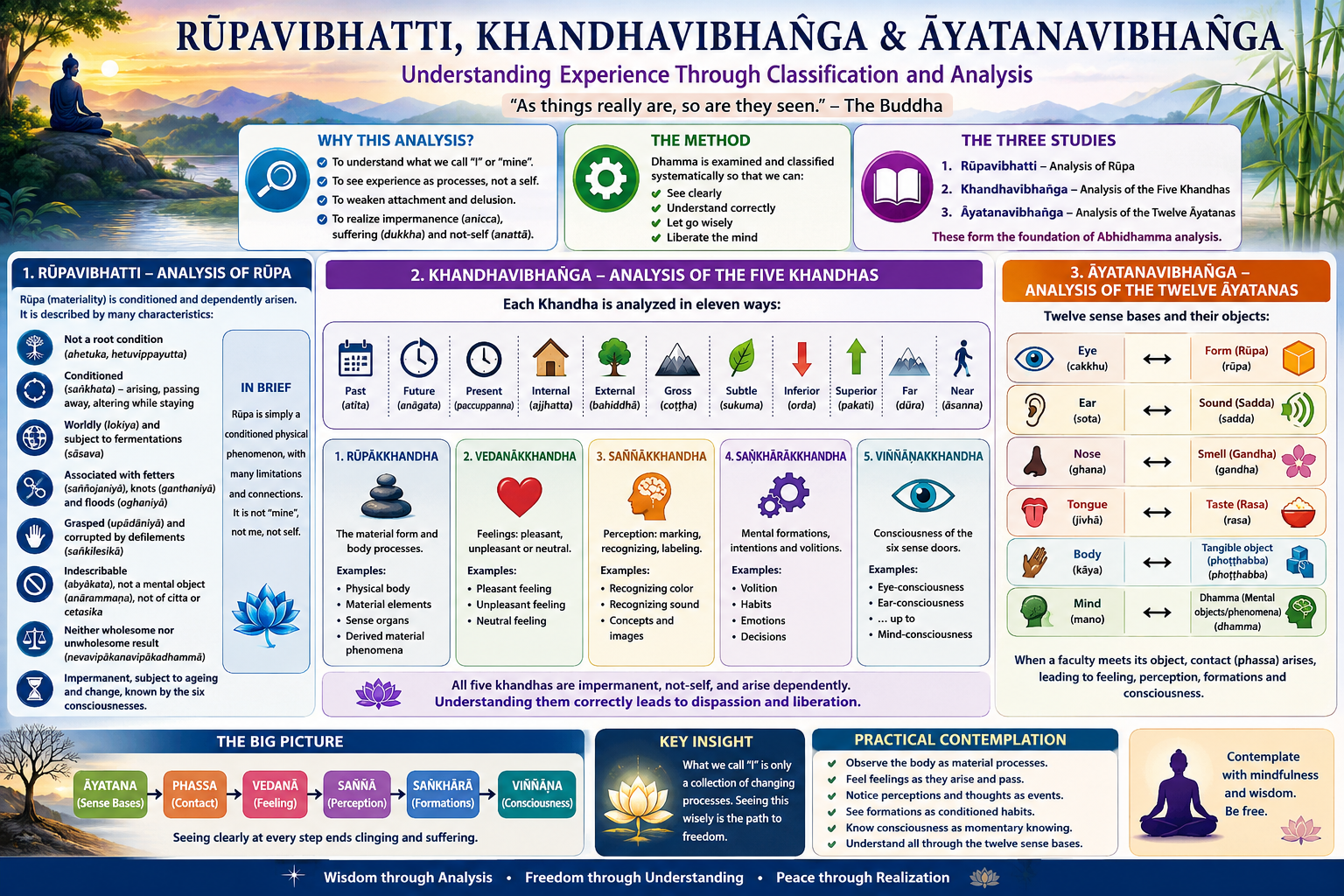 VISUAL SUMMARYSee this study in a pictureOpen the complete infographic for a visual overview before or after reading the full study.View infographic →
Khandhavibhaṅga is an identity-dismantling laboratory
The uploaded study already contains a large amount of Khandhavibhaṅga material, including the five aggregates and the recurring elevenfold classification. What is missing is the bridge from classification to insight.
The five khandhas should not be understood as five components that assemble into a hidden person. They are five enormous classes into which conditioned experience can be analyzed. The Vibhanga then deliberately stretches each class across time, ownership, refinement, valuation and proximity so that the mind cannot preserve one special form, feeling, perception, intention or consciousness as “the real me.”
This page therefore makes Khandhavibhaṅga the centre. Rūpa-analysis and the twelve āyatanas remain important, but they serve the deeper question: How does experience become “I”, “mine” and “myself,” and what happens when the aggregate is known simply as aggregate?
Ten corrections needed before the Deep Dive
01Gross rūpa: remove manāyatana and dhammāyatana
Tattha katamaṁ rūpaṁ oḷārikaṁ? Cakkhāyatanaṁ …pe… phoṭṭhabbāyatanaṁ.
The ellipsis runs through the ten physical sense bases/objects: eye–visible form, ear–sound, nose–odor, tongue–taste, body–tangible. The old expanded line included mind-base and dhamma-base, which are not all rūpa.
02Tadekajjhaṁ abhisaññūhitvā abhisaṅkhipitvā
This means gathering/collecting the whole range together and summarizing it as the aggregate. It should not be translated as “complete perception and wilful intentions of wholeness.”
03Vipariṇata does not mean “unexpected change”
Vipariṇata means changed/transformed. Change need not be unexpected to demonstrate impermanence.
04Abyākata is not “indescribable”
In Abhidhamma ethical classification, abyākata is indeterminate—not classified as kusala or akusala. “Indescribable” creates the wrong impression.
05Vedanā is feeling tone—not emotion as a whole
Keep pleasant, painful and neither-painful-nor-pleasant distinct from composite emotions such as grief, rage, love and jealousy.
06Kusalākusalā does not mean one state that is both wholesome and unwholesome
When the text says kusalākusalā are coarse/inferior relative to abyākata, it is grouping wholesome and unwholesome states together for comparison with indeterminate states—not describing a single perception or formation as simultaneously both.
07Asamāpanna / samāpanna concerns meditative attainment
Do not equate this pair with puthujjana versus stream-enterer/arahant. The immediate contrast is one not in an attainment and one in an attainment.
08Dūre / santike is comparison—not automatic causal succession
Like classes are near and unlike classes far according to the relevant criterion. Do not add “therefore this perception causes more perceptions of the same type” unless a separate conditioning argument is supplied.
09Saṅkhārakkhandha: cetanā is central but not the whole Abhidhamma aggregate
The Suttanta analysis foregrounds six contact-born volitions. In broader Abhidhamma classification, saṅkhārakkhandha contains the mental factors other than feeling and perception. Context must be preserved.
10Rūpa itself does not possess greed, hatred or delusion
Technical labels such as sāsava, saññojaniya and upādāniya in the Abhidhamma matrix describe its relation to the domain of taints, fetters and clinging. Do not word them as though matter itself mentally experiences defilement.
The same comprehensive formula is applied to all five aggregates
01Rūpakkhandha
Yaṁ kiñci rūpaṁ atītānāgatapaccuppannaṁ, ajjhattaṁ vā bahiddhā vā, oḷārikaṁ vā sukhumaṁ vā, hīnaṁ vā paṇītaṁ vā, yaṁ dūre santike vā, tadekajjhaṁ abhisaññūhitvā abhisaṅkhipitvā—ayaṁ vuccati rūpakkhandho.
Whatever materiality there is—past, future or present; internal or external; gross or subtle; inferior or superior; far or near—gathering and summarizing it together, this is called the form aggregate.
02Vedanākkhandha
Yā kāci vedanā atītānāgatapaccuppannā, ajjhattā vā bahiddhā vā, oḷārikā vā sukhumā vā, hīnā vā paṇītā vā, yā dūre santike vā, tadekajjhaṁ abhisaññūhitvā abhisaṅkhipitvā—ayaṁ vuccati vedanākkhandho.
Whatever feeling there is across the same elevenfold range, gathered and summarized together, is the feeling aggregate.
03Saññākkhandha
Yā kāci saññā atītānāgatapaccuppannā, ajjhattā vā bahiddhā vā, oḷārikā vā sukhumā vā, hīnā vā paṇītā vā, yā dūre santike vā, tadekajjhaṁ abhisaññūhitvā abhisaṅkhipitvā—ayaṁ vuccati saññākkhandho.
Whatever perception there is across that range, gathered together, is the perception aggregate.
04Saṅkhārakkhandha
Ye keci saṅkhārā atītānāgatapaccuppannā, ajjhattā vā bahiddhā vā, oḷārikā vā sukhumā vā, hīnā vā paṇītā vā, ye dūre santike vā, tadekajjhaṁ abhisaññūhitvā abhisaṅkhipitvā—ayaṁ vuccati saṅkhārakkhandho.
Whatever formations there are across that range, gathered together, are the formations aggregate.
05Viññāṇakkhandha
Yaṁ kiñci viññāṇaṁ atītānāgatapaccuppannaṁ, ajjhattaṁ vā bahiddhā vā, oḷārikaṁ vā sukhumaṁ vā, hīnaṁ vā paṇītaṁ vā, yaṁ dūre santike vā, tadekajjhaṁ abhisaññūhitvā abhisaṅkhipitvā—ayaṁ vuccati viññāṇakkhandho.
Whatever consciousness there is across that range, gathered together, is the consciousness aggregate.
| Aggregate | Working meaning | Condition highlighted in MN 109 / SN 22.82 | Typical identity move | Analogy |
|---|---|---|---|---|
| Rūpakkhandha | Materiality: four great elements and derived materiality. | Four great elements. | “My body / my looks / my possessions.” | Stage and props—material conditions of the event. |
| Vedanākkhandha | Pleasant, painful, neutral feeling tone. | Phassa. | “I am happy / hurt; I must keep/remove this feeling.” | Three-tone indicator: pleasant, painful, neutral. |
| Saññākkhandha | Perception: marking, recognizing, identifying features. | Phassa. | “This is insulting / beautiful / mine / dangerous.” | Highlighter/label-maker: marks selected features. |
| Saṅkhārakkhandha | Volitional formations; Suttanta Vibhanga foregrounds contact-born cetanā. | Phassa. | “I will attack / acquire / avoid / defend / cultivate.” | Workshop/steering crew: prepares response. |
| Viññāṇakkhandha | Consciousness according to six doors; broader Abhidhamma classifications. | Nāma-rūpa. | “There is an unchanging knower behind all experience.” | Six conditional channels, not one permanent witness. |
The matrix is designed to leave no conditioned refuge for self
| Pāḷi | Dimension | What it covers | Practice example |
|---|---|---|---|
| Atīta | Past | Whatever has ceased and is classed as past. | “My old body”, past pleasure, past humiliation, past intention, past seeing. |
| Anāgata | Future | Not yet arisen; classed as future. | Future health, anticipated pleasure, imagined identity, plans, expected consciousness. |
| Paccuppanna | Present | Currently arisen/manifest. | What is actually occurring now—not the story about it. |
| Ajjhatta | Internal | One’s own aggregate occurrence. | My body, my feeling, my perception etc. as conventionally designated. |
| Bahiddhā | External | Corresponding aggregates of others. | Another person’s body, feeling, perception, formations, consciousness. |
| Oḷārika | Gross | Coarser relative to another class. | Pain vs refined feeling; ordinary vs attainment; physical sense material vs subtle rūpa. |
| Sukhuma | Subtle | Finer relative to another class. | Neutral/refined feeling, attainment states, subtle materiality. |
| Hīna | Inferior | Lower/despised or ethically/refinement-wise inferior according to context. | Unwholesome/tainted states; socially devalued sense objects in rūpa classification. |
| Paṇīta | Superior | Higher/esteemed or more refined according to context. | Wholesome/taintless/refined states; desirable sense objects in rūpa classification. |
| Dūre | Far | Distant physically or dissimilar in classification. | Subtle rūpa may be ‘far’; akusala is far from kusala/abyākata in mental classifications. |
| Santike | Near | Near physically or similar in classification. | Physical sense bases may be near; akusala is near akusala as same class. |
Thirty-six explanations, analogies and practice applications
01Khandha means an aggregate or mass—not one-fifth of a hidden person
The most common misunderstanding is to imagine a person as a machine built from five components: body, feeling, perception, formations, and consciousness. The Khandhavibhaṅga is doing something more radical.
The expression yaṁ kiñci—whatever there is—then ranges across past, future, present, internal, external, gross, subtle, inferior, superior, far, and near. All of that is gathered under one aggregate heading.
So rūpakkhandha is not one solid object called “my body”; it is the entire class of whatever materiality fits the definition. The same applies to the other four.
The analytical purpose is to prevent the mind from preserving a secret remainder called “me” outside the classification.
Daily-life example: Instead of saying “my body is getting old,” the practice asks: what exactly is present? Grey hair, reduced strength, pressure, temperature, visual form, memory of the younger body, unpleasant feeling, comparison, resistance. The apparently single story separates into conditioned categories.
Analogy: Think of five very large filing categories, not five pieces of a person. Every conditioned experience can be filed under these headings; there is no sixth file marked “the owner.”
02Why the elevenfold matrix is so powerful
The recurring formula is not decorative repetition. It deliberately removes every possible place where identity might hide.
Past–future–present removes time as refuge. Internal–external removes “mine versus theirs” as refuge. Gross–subtle removes the idea that refined experience is somehow a true self. Inferior–superior removes status or value as refuge. Far–near removes proximity as refuge.
The point is not to memorize eleven words. It is to make the aggregate category so comprehensive that whatever the mind grasps can be brought under investigation.
Analogy: A customs officer does not inspect only large visible luggage. Everything—small or large, old or new, expensive or cheap—must pass through inspection. The elevenfold matrix is paññā’s customs gate.
03Past, future, present — identity across time is still aggregate
Past aggregates have ceased; future aggregates have not arisen; present aggregates are presently manifested. Yet identity repeatedly reaches into all three.
We say: “I was beautiful,” “I will become successful,” “I am miserable now.” Khandhavibhaṅga asks us to notice that body, feeling, perception, formations, and consciousness are being appropriated across time.
Future anxiety is especially revealing: the mind can cling to an aggregate that has not even arisen.
Daily-life example: You remember an embarrassing meeting from five years ago. The old sound, visual form and consciousness are gone, yet a present mind-object produces present feeling, perception and formations. “My past humiliation” is a new present construction around what is already past.
04Internal and external — ‘mine’ does not change the nature of the dhamma
In the Vibhanga’s analysis, internal commonly means belonging to oneself; external means corresponding phenomena of other beings/persons.
My painful feeling is vedanā. Another person’s painful feeling is also vedanā. My aging body is rūpa. Another person’s aging body is rūpa.
This classification weakens the intuition that the same process becomes metaphysically special merely because it occurs here.
Daily-life example: My toothache feels uniquely urgent because it is internal. A stranger’s toothache may seem abstract. The dhamma analysis says both are conditioned painful feeling associated with conditioned body—ownership changes emotional investment, not the aggregate’s nature.
05Gross and subtle are comparative—not fixed labels engraved on phenomena
The text repeatedly says that gross and subtle should be understood in comparison. The same state can be subtle relative to one thing and gross relative to another.
For mental aggregates, unwholesome may be coarse relative to wholesome/indeterminate; painful feeling may be coarse relative to more refined feeling; experience outside meditative attainment may be coarse relative to experience in attainment; tainted states may be coarse relative to taintless.
This is an important training against absolutizing one meditation state as ‘the subtle ultimate.’
Daily-life example: Ordinary sensual pleasure may feel subtle compared with physical pain. First-jhāna pleasure can make that sensual pleasure appear coarse. Later equanimity can make even pīti seem comparatively coarse.
06Hīna and paṇīta — inferior/superior is contextual, not a ranking of human worth
For rūpa, the Vibhanga describes inferior and superior partly through what beings regard as despised or esteemed, undesirable or desirable. The category itself exposes valuation.
For the mental aggregates the distinction can also be ethical and contemplative: unwholesome versus wholesome, tainted versus taintless, non-attainment versus attainment.
Nothing here licenses the conclusion that a person possessing ‘inferior’ rūpa is an inferior human being.
Daily-life example: A luxury car and an old car are socially ranked very differently. Both remain rūpa: conditioned, aging, breakable, and incapable of providing a permanent self.
07Far and near — a major correction to the old explanation
For rūpa, far and near can be spatial/proximate. For mental aggregates, the text often compares unlike classes as ‘far’ and like classes as ‘near’: unwholesome feeling is distant from wholesome/indeterminate feeling; tainted perception is distant from taintless perception, and so on.
This is primarily a classification of dissimilarity or proximity. The earlier essay sometimes turns it into a causal law—‘unwholesome perceptions are near unwholesome perceptions, therefore they generate more of them.’ Habit reinforcement may be true elsewhere, but it is not what this particular classification by itself states.
Daily-life example: Anger and mettā are ‘far’ in quality even if they occur minutes apart. Two episodes of anger are ‘near’ as members of the same class even if they occurred ten years apart.
08Khandha and upādānakkhandha are not identical
SN 22.48 distinguishes the five aggregates from the five aggregates subject to clinging. This is essential.
Rūpa is not a problem because it is rūpa. Vedanā is not a problem because feeling occurs. Saññā is not intrinsically bondage. The suffering intensifies when these become objects of craving, appropriation, identity, and grasping.
This prevents an anti-experience reading of Buddhism. Liberation does not require destroying ordinary conditioned functioning before death; it requires ending appropriation.
Daily-life example: Pleasant feeling arises while hearing music. The aggregate is vedanā. ‘I need this pleasure again; my evening is ruined without it’ shows the move toward clinging.
Analogy: The five aggregates are luggage on a conveyor belt. Upādāna is grabbing a bag, clutching it to the chest, and insisting: “This is me; this must not change.”
09The twenty forms of sakkāyadiṭṭhi show how self is manufactured
MN 109 / SN 22.82 explains identity view through four patterns applied to each of the five aggregates: seeing the aggregate as self; seeing self as possessing the aggregate; seeing the aggregate as inside self; seeing self as inside the aggregate.
Four identity structures × five aggregates = twenty modes.
This is far more precise than simply saying ‘we think the body is me.’ The self can survive philosophically even after one rejects bodily identity.
Daily-life example: A meditator may say, ‘I know the body is not self—but there is a pure awareness that possesses the body and feelings.’ That is still structurally close to ‘self possessing the aggregate’ or ‘self containing the aggregate.’
10The conditions for the five aggregates — the map is conditional, not substantial
MN 109 / SN 22.82 gives a compact causal teaching: the four great elements are the condition for the manifestation of rūpakkhandha; contact is the condition for vedanākkhandha, saññākkhandha, and saṅkhārakkhandha; nāma-rūpa is the condition for viññāṇakkhandha.
This is a decisive clue to how to practice the Khandhavibhaṅga. Do not ask ‘what is the permanent substance behind the aggregate?’ Ask ‘what conditions make this aggregate manifest?’
When the condition is seen, ownership weakens.
Analogy: A rainbow is easier to understand when you know the optical conditions. Asking ‘where is the permanent rainbow substance?’ becomes unnecessary. The aggregate analysis similarly redirects inquiry from substance to conditions.
11Rūpakkhandha — not simply ‘my physical body’
Rūpa includes the four great elements and materiality dependent on them. It covers internal materiality and external materiality, not merely flesh under one’s skin.
The uploaded page’s detailed source correctly opens rūpakkhandha with the four great elements and derived materiality, but some English glosses collapse derived rūpa into only color, taste, smell and nutriment. The technical category is broader.
Rūpa is conditioned and cannot experience an object by itself. In Abhidhamma classification it is not citta or cetasika.
Daily-life example: Your hand, the phone in it, the light reflected from the screen, temperature, pressure and bodily sensitivity all belong to material conditions. None by itself says ‘I am using my phone.’
12Rūpa as the stage and props — useful analogy, with a limit
A theatre needs a stage, actors’ bodies, props, lighting, and physical sound production. That is a useful analogy for rūpa as the material field in which an episode can occur.
But rūpa is not passive ‘matter owned by mind.’ Body and environment condition what mental events can arise.
Sickness, temperature, hunger, fatigue, age, posture and sensory capacity can all materially condition the mental field without being moral defects.
Daily-life example: A difficult conversation after a sleepless night feels different partly because the body is different. Khandha analysis allows the bodily condition to be seen without immediately calling the whole event ‘my bad personality.’
13A correction: gross rūpa is the ten physical sense bases/objects—not all twelve āyatanas
In the uploaded Rūpakkhandha section, the expansion of rūpaṁ oḷārikaṁ accidentally lists all twelve āyatanas, including manāyatana and dhammāyatana.
The Khandhavibhaṅga text itself gives cakkhāyatanaṁ … pe … phoṭṭhabbāyatanaṁ: eye/visible form, ear/sound, nose/odor, tongue/taste, body/tangible—the ten physical bases and objects.
Manāyatana is not materiality, and dhammāyatana contains mental phenomena as well as subtle materiality and the unconditioned element in the Abhidhamma analysis.
Source correction integrated: the rebuilt page uses the ten physical sense bases/objects for gross rūpa.
14The body changes before the story catches up
Rūpa’s impermanence is not merely a philosophical proposition. Hair greys, skin changes, strength changes, sensory acuity changes, posture changes, cells and tissues change, and objects wear out.
The pain of aging is amplified when present rūpa is compared with remembered past rūpa and an imagined future body.
Khandhavibhaṅga places all three temporal forms inside the same aggregate precisely so that ‘my younger body’ cannot remain a hidden permanent standard.
Daily-life example: Looking at an old photograph, present saññā recognizes past rūpa; present vedanā may be pleasant or painful; present saṅkhārā may compare and resist. The photograph reveals all five aggregates, not merely rūpa.
15Vedanākkhandha — feeling tone, not the whole emotion
Vedanā is the affective tone: pleasant, painful, or neither-painful-nor-pleasant. It can be bodily or mental depending on the classification.
‘Anger’, ‘jealousy’, ‘grief’, and ‘love’ are not single vedanās. They are complex events involving feeling together with perception, formations, consciousness and often bodily change.
This distinction is essential because practice can catch the feeling before the full emotion-story forms.
Daily-life example: A colleague receives the promotion you wanted. The first mental unpleasantness is vedanā. ‘They do not deserve it; management never values me’ involves perception and formations building around that painful tone.
Analogy: Vedanā is like the three-tone indicator on an instrument: pleasant, painful, neutral. It tells you the tone of contact; it does not yet narrate the story.
16Why contact conditions feeling, perception, and formations
The Vibhanga classifies feeling according to the six contacts; likewise perception and volition are classified as born of eye-contact, ear-contact, nose-contact, tongue-contact, body-contact, and mind-contact.
This makes the practice concrete. Rather than asking vaguely ‘why am I emotional?’, identify the door and the contact.
Mind-contact is especially important because remembered and imagined objects can keep producing fresh feeling long after the external event has ended.
Daily-life example: The argument ended yesterday. Today no one is speaking to you, yet memory arises at the mind-door. That present mind-contact conditions present unpleasant feeling and present formations.
17Neutral feeling is not spiritually neutral when ignored
Neither-painful-nor-pleasant feeling is often overlooked because it does not shout.
Yet neutral experience can support boredom, dullness, automatic scrolling, habitual eating, or unconscious seeking of stimulation when not clearly known.
The Vibhanga’s refined comparisons help show why neutral feeling can be subtle relative to pleasure and pain.
Daily-life example: You are waiting five minutes for a lift. Nothing is wrong. Within seconds the hand reaches for the phone. The overlooked neutral vedanā has become a condition for seeking stimulation.
18Pleasant feeling is not the same as craving
One of the most liberating distinctions is that pleasant vedanā can occur without being identical to taṇhā.
The aggregate of feeling can be known simply as pleasant. Craving begins when the mind leans toward continuation, repetition, acquisition or ownership.
This is why an arahant can experience pleasant feeling without creating sensual clinging from it.
Daily-life example: Warm sunlight feels pleasant. The experience becomes bondage only when the mind adds something like ‘this must continue; I cannot be happy unless conditions remain like this.’
19Saññākkhandha — the highlighter and recognizer
Saññā marks, recognizes and identifies features. It makes meaningful functioning possible.
It is not automatically delusion. Without perception you could not recognize a red traffic light, your home, a Pāḷi word, or a meditation instruction.
But perception is selective. It can take one mark and allow the rest of reality to disappear from attention.
Daily-life example: You see a person who once criticized you. Saññā immediately marks ‘the one who insulted me.’ Their entire present complexity disappears behind a stored label.
Analogy: Saññā is like a highlighter pen. It marks certain features so they can be recognized later. The danger is forgetting that the highlighted line is not the whole page.
20Paṭighasamphassajā and adhivacanasamphassajā saññā — coarse and subtle
The Vibhanga contrasts perception born of impingement/contact with perception connected with designation or naming-contact, treating the former as coarser and the latter as subtler.
This should be handled cautiously. It is not simply ‘touch is primitive and concepts are advanced.’ The contrast belongs to an Abhidhamma analytical vocabulary distinguishing direct sensory impingement from subtler designation-associated cognition.
The practical insight is that conceptual perception can be extremely subtle while still being conditioned.
Daily-life example: Seeing red color is one level of perceptual contact. Recognizing ‘the logo of the political group I dislike’ introduces a more elaborated designation field.
21Perception can be accurate conventionally and still support clinging
Anattā practice does not require calling a chair ‘not a chair’ or a spouse ‘not a spouse.’
Saññā can recognize conventional reality accurately while the mind still adds ownership: ‘my wife must…’, ‘my reputation’, ‘my teaching’, ‘my country’.
The target is not ordinary recognition; it is appropriation and distorted permanence.
Daily-life example: Recognizing ‘my son’ is functionally correct. The clinging appears when ‘my’ means his choices must confirm my identity or expectations.
22Near and far perception does not mean one perception mechanically produces another
The old page says ‘unwholesome perceptions are near unwholesome perceptions’ and interprets this as unwholesome perceptions tending to produce more unwholesome perceptions.
That may be a reasonable habit principle in other contexts, but here the Vibhanga is classifying proximity of kinds. Akusala is near akusala; kusala is near kusala; perception associated with painful feeling is near perception associated with painful feeling.
Keep the classification precise, then separately teach conditioning and repetition where the relevant texts support them.
23Saṅkhārakkhandha — not ‘all conditioning’ and not merely random thoughts
In the Suttanta analysis of Khandhavibhaṅga, saṅkhārakkhandha is illustrated through six classes of cetanā born of the six contacts.
This makes volition central. But the broader Abhidhamma saṅkhārakkhandha contains many mental factors apart from vedanā and saññā; it should not be reduced to cetanā in every technical context.
Likewise, the word saṅkhāra has other meanings elsewhere. Context decides.
Daily-life example: After hearing criticism, the urge to interrupt, defend, formulate an excuse, remain silent, ask a question, or retaliate belongs to the active shaping side of the mental event.
Analogy: If saññā is the label-maker, saṅkhārā are like the workshop where tendencies, intentions and responses get assembled into what the mind is about to do.
24Cetanā reveals where ethical training enters the aggregate analysis
Feeling can arise unbidden. Recognition can occur quickly. Consciousness arises dependently. But intention gives the episode an ethical direction.
The same painful feeling can condition harsh speech, patient silence, investigation, truthful correction, or compassion.
Khandha analysis therefore does not produce passivity. Seeing ‘not-self’ makes intention more observable and trainable, not less responsible.
Daily-life example: You receive a rude email. You did not choose the first unpleasant feeling. You can still train whether the next volition is to insult, postpone, clarify, forgive, or set a firm boundary.
25Asamāpanna and samāpanna — not ‘unenlightened versus enlightened’
The uploaded explanations repeatedly suggest that asamāpanna may mean someone without spiritual realization and samāpanna one who has attained stages such as stream-entry or arahantship.
In this classificatory context the straightforward contrast is between one not entered into a meditative attainment and one in an attainment.
That distinction matters because a puthujjana can enter jhāna, while an awakened disciple can of course also be outside an attainment at a given moment.
Correction: do not use these lines as evidence that every ‘samāpanna’ here means an ariya stage.
26Wholesome formations are still formations
One can make another mistake: after learning that saṅkhārā are conditioned, dismissing all intentional cultivation as bondage.
The path itself requires wholesome formations—right effort, restraint, mettā, samādhi, investigation—until their work is completed.
Khandhavibhaṅga helps distinguish coarse/unwholesome from refined/wholesome and taintless without turning the conditioned path into a permanent self.
Daily-life example: The intention to refrain from angry speech is conditioned. That does not make it useless. A raft is conditioned too; its value is in crossing.
27Viññāṇakkhandha — sixfold cognition, not a single witness behind the doors
The Suttanta Khandhavibhaṅga classifies consciousness as eye-, ear-, nose-, tongue-, body-, and mind-consciousness.
This undermines the intuition of one unchanging consciousness watching every experience. The knowing event is specified according to its conditions and door.
A remembered image and a presently visible image therefore involve different conditional configurations even if the mind tells one continuous story.
Daily-life example: You first see a dog, then hear it bark, then remember a childhood dog. Visual consciousness, auditory consciousness, and mind-consciousness have different conditions. The sense of one continuous ‘observer’ is not supplied by the classification.
Analogy: Instead of one eternal camera, imagine six door-specific channels that activate when their relevant conditions are present. The analogy is limited, but it helps remove the idea of one central witness-substance.
28Consciousness does not operate independently of nāma-rūpa
MN 109 / SN 22.82 gives nāma-rūpa as condition for the manifestation of viññāṇakkhandha.
This prevents consciousness from being elevated into an independent metaphysical self after the other four aggregates have been declared not-self.
Consciousness is conditioned too; it is part of the field being investigated.
Daily-life example: Deep meditation may make ordinary body perception quiet and consciousness feel vast or clear. The Khandha teaching still asks: is this consciousness conditioned, changing, and fit to be regarded as ‘mine, I, self’?
29Viññāṇa is not memory storage
A past consciousness has ceased. Remembering it now is a new present mental event conditioned by memory-related processes.
This matters because people often imagine viññāṇakkhandha as a container carrying all previous consciousness moments inside it.
The aggregate is a classification of consciousness across the full matrix, not a warehouse.
Daily-life example: The consciousness that saw your school classroom thirty years ago is not sitting intact somewhere waiting to be replayed. A present mind-consciousness now takes a remembered object.
30One event, five aggregates — the insult example
A person speaks harshly.
Rūpa: body, ear faculty, sound, bodily tension and other material conditions.
Viññāṇa: ear-consciousness cognizes sound; mind-consciousness later takes the meaning/story as object.
Vedanā: unpleasant feeling.
Saññā: recognizes words and marks them ‘insult’, ‘disrespect’, perhaps ‘same as last time’.
Saṅkhārā: intentions, resistance, urge to retaliate, restraint, investigation.
The conventional sentence ‘he insulted me and I got angry’ is not false for ordinary communication, but the analytical view reveals how much construction is hidden inside it.
Analogy: A single headline on a newspaper hides reporters, editors, printing, distribution and interpretation. ‘I am angry’ is similarly a compressed headline for a multi-conditioned event.
31One event, five aggregates — attraction
A person is seen.
Rūpa: eye faculty and visible material form.
Viññāṇa: eye-consciousness.
Vedanā: pleasant tone.
Saññā: marks features as attractive, familiar, desirable.
Saṅkhārā: leaning, fantasy, second look, restraint, recollection of body nature, mettā.
The aggregate analysis makes it possible to distinguish seeing from craving. The person outside is not the same thing as the internally constructed sensual project.
Daily-life example: The first contact lasts moments. Ten minutes of fantasy later is largely mind-door activity sustained by remembered signs and intentional feeding.
32One event, five aggregates — praise
A compliment is heard.
Rūpa: sound and auditory conditions.
Viññāṇa: hearing and later mind-consciousness.
Vedanā: pleasant feeling.
Saññā: ‘they respect me’, ‘I am successful’.
Saṅkhārā: gratitude, conceit, desire for more praise, checking reactions, or wise reflection.
This is where the difference between aggregate and clinging-aggregate becomes visible.
Daily-life example: Enjoying a kind word is not identical with constructing a reputation-self that needs continuous confirmation.
33One event, five aggregates — meditation bliss
Jhānic or other refined meditative experience does not escape the Khandha matrix.
There can be subtle rūpa or a refined material basis depending on the attainment, refined feeling, refined perception, refined formations and consciousness.
The Vibhanga explicitly compares non-attainment with attainment as coarse and subtle. That is a warning against confusing refinement with unconditioned liberation.
Daily-life example: After a powerful peaceful sitting, the thought ‘this bliss is my true self’ is precisely the sort of appropriation the elevenfold formula is designed to challenge.
34Āyatana and khandha are two maps of the same lived event
The twelve āyatanas answer a different analytical question: what are the internal and external bases through which experience occurs?
The five khandhas ask: into what aggregate classes can the conditioned experience be gathered?
Dependent origination asks yet another question: how do conditions build the process of suffering and its cessation?
These maps overlap but should not be fused into one list.
Analogy: A city can be represented by a road map, a population map and a drainage map. None cancels the others; each answers a different question. Khandha, āyatana and paṭiccasamuppāda work similarly.
35Nibbāna is not a sixth aggregate
All five aggregates are conditioned and can be described by past/future/present and the other classifications.
In the Abhidhamma analysis of dhammāyatana, the unconditioned element is included as a dhamma-object category, but it is not made into a khandha.
This protects against replacing the five conditioned aggregates with a new eternal ‘pure consciousness aggregate’ called Nibbāna.
Critical boundary: liberation is not discovering an immortal sixth khandha behind the five.
36The practice culmination — from classification to disenchantment
SN 22.59 applies the same matrix to every aggregate and then gives the practical contemplation: netaṁ mama, nesohamasmi, na meso attā—this is not mine, I am not this, this is not my self.
This is not a mantra to repeat against experience. It is a conclusion supported by seeing impermanence, vulnerability, change and lack of mastery.
Seeing thus leads toward nibbidā, virāga and liberation—not because the aggregates are hated, but because the demand that they provide a permanent self has ended.
Daily-life example: When sadness arises, the practice is not ‘I must get rid of this aggregate.’ It is: this painful feeling is conditioned; the recognition-story is conditioned; the urge to resist is conditioned; consciousness of it is conditioned. None requires ownership.
Analogy: You can watch clouds without signing ownership papers for each cloud. Khandha practice trains the same non-ownership toward every conditioned event.
The aggregates appear because conditions are present—not because a self manufactures them
Cattāro mahābhūtā hetu, cattāro mahābhūtā paccayo rūpakkhandhassa paññāpanāya.
The four great elements are the condition for the manifestation of the form aggregate.
Phasso hetu phasso paccayo vedanākkhandhassa … saññākkhandhassa … saṅkhārakkhandhassa paññāpanāya.
Contact is the condition for the manifestation of feeling, perception and formations.
Nāmarūpaṁ hetu nāmarūpaṁ paccayo viññāṇakkhandhassa paññāpanāya.
Name-and-form is the condition for the manifestation of the consciousness aggregate.
Practice question: instead of “Why am I like this?”, ask “What conditions made this particular rūpa, vedanā, saññā, saṅkhāra or viññāṇa manifest?”
Self can hide in four different relationships with every aggregate
MN 109 / SN 22.82 does not reduce identity-view to “the body is self.” For each aggregate, an uninstructed person can take the aggregate as self, self as possessing the aggregate, the aggregate as contained in self, or self as contained in the aggregate.
| Aggregate | Identity structure | Modern expression |
|---|---|---|
| Rūpa | Rūpa as self | “Rūpa itself is what I truly am.” |
| Rūpa | Self possessing rūpa | “There is an I that owns this rūpa.” |
| Rūpa | Rūpa in self | “This rūpa exists inside a larger true self.” |
| Rūpa | Self in rūpa | “The real self is located within this rūpa.” |
| Vedanā | Vedanā as self | “Vedanā itself is what I truly am.” |
| Vedanā | Self possessing vedanā | “There is an I that owns this vedanā.” |
| Vedanā | Vedanā in self | “This vedanā exists inside a larger true self.” |
| Vedanā | Self in vedanā | “The real self is located within this vedanā.” |
| Saññā | Saññā as self | “Saññā itself is what I truly am.” |
| Saññā | Self possessing saññā | “There is an I that owns this saññā.” |
| Saññā | Saññā in self | “This saññā exists inside a larger true self.” |
| Saññā | Self in saññā | “The real self is located within this saññā.” |
| Saṅkhārā | Saṅkhārā as self | “Saṅkhārā itself is what I truly am.” |
| Saṅkhārā | Self possessing saṅkhārā | “There is an I that owns this saṅkhārā.” |
| Saṅkhārā | Saṅkhārā in self | “This saṅkhārā exists inside a larger true self.” |
| Saṅkhārā | Self in saṅkhārā | “The real self is located within this saṅkhārā.” |
| Viññāṇa | Viññāṇa as self | “Viññāṇa itself is what I truly am.” |
| Viññāṇa | Self possessing viññāṇa | “There is an I that owns this viññāṇa.” |
| Viññāṇa | Viññāṇa in self | “This viññāṇa exists inside a larger true self.” |
| Viññāṇa | Self in viññāṇa | “The real self is located within this viññāṇa.” |
Important: “I am not the body; I am the pure consciousness that owns the body” does not automatically escape sakkāyadiṭṭhi. It may simply relocate the imagined self.
Take one ordinary event and watch all five aggregates participate
| Situation | Rūpa | Vedanā | Saññā | Saṅkhārā | Viññāṇa | Where clinging appears |
|---|---|---|---|---|---|---|
| Someone insults you | Ear/body materiality; sound | Painful | ‘Insult’, ‘disrespect’ | Retaliate, freeze, investigate, restrain | Hearing + mind-consciousness | “He hurt me; I must hurt back.” |
| Attractive person | Visible form, eye | Pleasant | ‘Beautiful’, selected signs | Second look, fantasy, restraint | Eye + mind-consciousness | “I need this person/object.” |
| Promotion denied | Body, visual/email/sound | Painful | ‘Failure’, ‘unfair’ | Compare, complain, learn, resent | Sense + mind-consciousness | “My status has been diminished.” |
| Praise received | Sound | Pleasant | ‘Respected’, ‘successful’ | Gratitude, conceit, seek repetition | Ear + mind-consciousness | “This proves who I am.” |
| Phone notification | Screen/sound/body | Pleasant/neutral | ‘Message’, ‘possible reward’ | Check, postpone, ignore | Eye/ear + mind-consciousness | “I must know now.” |
| Old memory | Present bodily materiality | Pleasant/painful | Past image/name/story | Replay, reframe, abandon | Mind-consciousness | “That past event is still me.” |
| Physical pain | Body materiality | Painful | ‘My knee/back/head’, danger mark | Care, fear, anger, patience | Body + mind-consciousness | “This pain is me / ruins me.” |
| Deep meditation | Refined bodily/material conditions | Pleasant/neutral/refined | ‘Special’, ‘jhāna’, ‘attainment’ | Investigate, cling, compare | Mind-consciousness | “This state is my true self.” |
Two maps, one lived event
Khandha analysis asks what class the conditioned experience belongs to: materiality, feeling, perception, formations or consciousness.
Āyatana analysis asks through which internal/external base the encounter occurs: eye/form, ear/sound, nose/odor, tongue/taste, body/tangible, mind/dhamma.
For example, hearing criticism can be analyzed as ear-base + sound-base from the āyatana perspective, and simultaneously as rūpa + viññāṇa + vedanā + saññā + saṅkhārā from the khandha perspective.
The Abhidhamma analysis of dhammāyatana is also important: it includes vedanākkhandha, saññākkhandha, saṅkhārakkhandha, subtle materiality included in the dhamma-base, and the unconditioned element. Viññāṇakkhandha is classified on the manāyatana side. This is another reason not to insert both manāyatana and dhammāyatana into gross rūpa.
A five-khandha autopsy for any strong experience
Rūpa: What material conditions are actually present—body, posture, sound, light, pressure, temperature, object?
Vedanā: Pleasant, painful, or neutral—before the story?
Saññā: What is being marked, recognized, named, remembered or highlighted?
Saṅkhārā: What intention, resistance, fantasy, plan, restraint or habit is forming?
Viññāṇa: Which consciousness is occurring—seeing, hearing, mind-consciousness, etc.? Is it being imagined as a permanent observer?
Matrix: Is this past/future/present, internal/external, coarse/subtle, inferior/superior, far/near?
Clinging: Where did “mine”, “I am this”, or “this is my self” enter?
Release: Can this be known as conditioned aggregate: netaṁ mama, nesohamasmi, na meso attā?
Khandhavibhaṅga and its essential sutta cross-references
VbKhandhavibhaṅga — complete aggregate analysis
Use the Vibhanga source to verify the detailed Suttanta and Abhidhamma classifications.
Find Khandhavibhaṅga in Depth of Dhamma
SNSN 22.48 — aggregates and clinging-aggregates
This distinction prevents us from treating the mere occurrence of the aggregates as the whole problem.
Find SN 22.48 in Depth of Dhamma
MNMN 109 / SN 22.82 — causes of the aggregates and twenty identity views
Use these for the conditions of each aggregate and the fourfold identity structure applied to all five.
Find MN 109 and SN 22.82 in Depth of Dhamma
SNSN 22.59 — apply the elevenfold matrix to anattā
The same past/future/present, internal/external, gross/subtle, inferior/superior, far/near formula culminates in: netaṁ mama, nesohamasmi, na meso attā.
Find SN 22.59 in Depth of Dhamma