The Five Hindrances — How Citta Becomes Clouded and How It Clears
A bilingual study of kāmacchanda, byāpāda, thīna-middha, uddhacca-kukkucca and vicikicchā: how each hindrance is known, what feeds it, how it is denourished, how it appears in daily life and meditation, and why clearing the five is indispensable for samādhi and paññā.
Know whether the hindrance is present. Know how it arose. Know how it is abandoned. Know how the abandoned hindrance does not arise again.
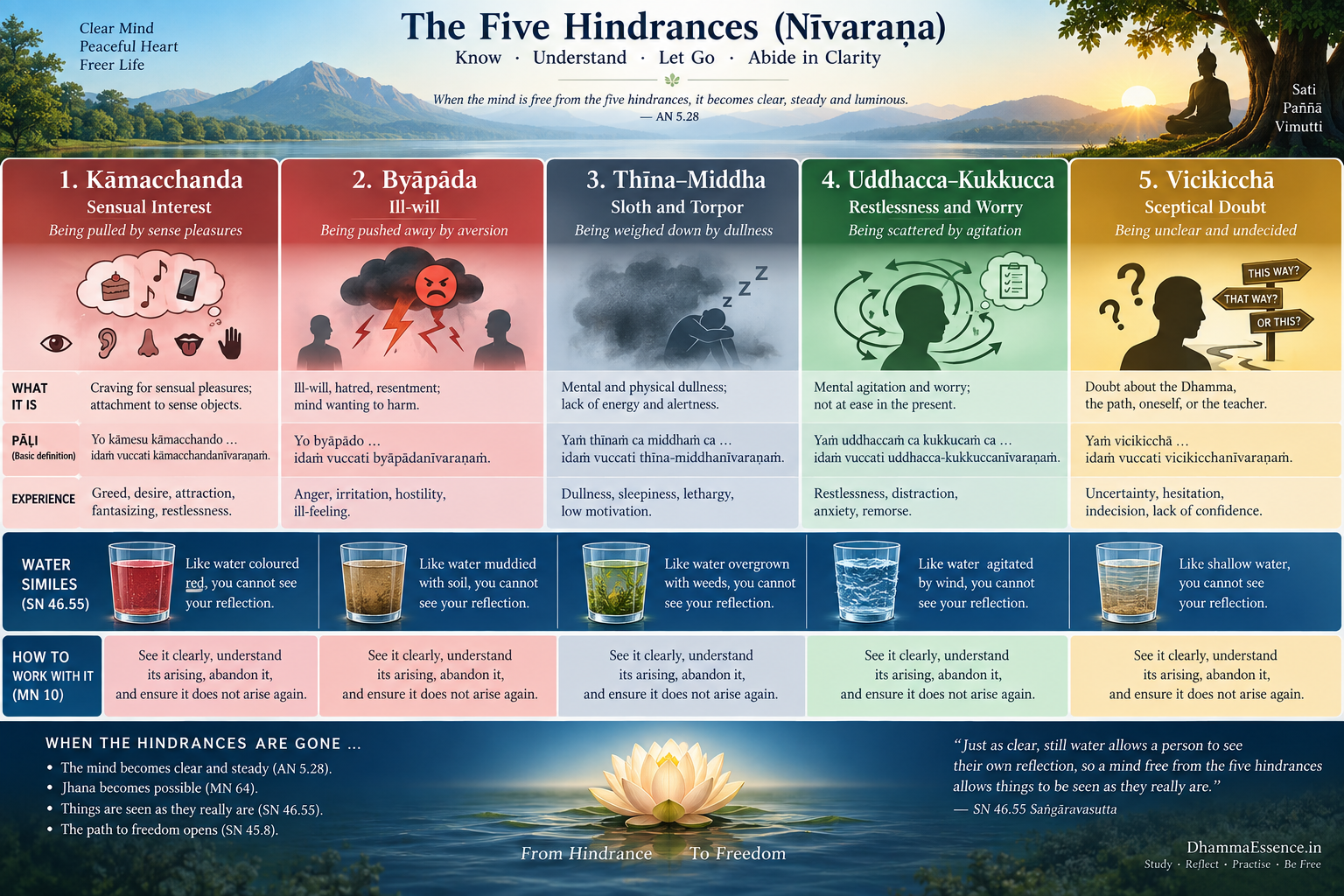 VISUAL SUMMARYSee this study in a pictureOpen the complete infographic for a visual overview before or after reading the full study.View infographic →
The five hindrances are not merely obstacles to a pleasant meditation—they weaken the mind’s capacity to know
When one begins serious Buddha Dhamma practice, and especially when samādhi is to be developed, the five hindrances must be understood in detail. They are repeatedly described as conditions that cover or corrupt citta and weaken paññā. Their importance therefore begins before jhāna and continues throughout the path.
They are:
1. Kāmacchanda — sensual desire and sensual preoccupation.
2. Byāpāda — ill will, resentment and hostility.
3. Thīna–middha — mental sluggishness and torpor/drowsiness.
4. Uddhacca–kukkucca — restlessness and remorse.
5. Vicikicchā — doubt and perplexity concerning the Dhamma and training.
The most useful way to study them is not to ask only “Which one do I have?” but “What is feeding it, what is starving it, and what changes when it is no longer being nourished?”

The Buddha gives a four-question method for every hindrance
| # | Question | What the practitioner learns |
|---|---|---|
| 1 | Is it present? | Know directly: ‘kāmacchanda is present’ / ‘not present’—and likewise for each hindrance. |
| 2 | How did the unarisen hindrance arise? | Find the nutriment, attention pattern, sense-door condition and behavior that fed it. |
| 3 | How is the arisen hindrance abandoned? | Apply the corresponding denourishment rather than merely suppressing the outward symptom. |
| 4 | How does the abandoned hindrance not arise again? | Understand conditions deeply enough that the same feeding pattern is no longer repeatedly reconstructed. |
This fourfold investigation becomes the organizing principle of the whole page. Merely noticing “anger” or “desire” is the beginning—not the end—of mindfulness of the hindrances.
Two sets of similes: bondage and freedom, distortion and clear seeing
The discourses use two complementary sets of similes. DN 2 and MN 39 show what it is like to be bound by a hindrance and then to become free from it. SN 46.55 shows how each hindrance also distorts reflection and clear knowing, like water that cannot accurately reflect a face.
Freedom similes — what changes when the hindrance is abandoned
Scroll horizontally to read all columns when needed →
| Hindrance | Condition while bound | Freedom simile | Meaning for practice |
|---|---|---|---|
| Kāmacchanda Sensual desire |
The mind keeps owing itself another sight, taste, touch, possession or gratifying experience. | Debt → debt repaid | When sensual compulsion is abandoned, citta experiences the relief of no longer being continually obligated to obtain and maintain gratification. |
| Byāpāda Ill will |
Hostility infects the whole field of experience and makes ease difficult. | Serious illness → recovery | When ill will is abandoned, the mind regains ease and strength, like a sick person recovering health. |
| Thīna–middha Sloth and torpor |
Citta becomes confined, heavy and unable to do the work that should be done. | Prison → release | When dullness and torpor lift, the practitioner regains freedom of movement, energy and workability. |
| Uddhacca–kukkucca Restlessness and remorse |
The mind is repeatedly compelled by agitation, unfinished mental movement and regret. | Slavery → emancipation | When agitation and remorse are abandoned, citta is no longer being ordered about by every impulse and replayed concern. |
| Vicikicchā Doubt |
The practitioner does not know which way to proceed and remains uncertain about the path and training. | Dangerous wilderness → safely crossed | When doubt is clarified, one reaches secure ground: the direction of practice is understood well enough to proceed without paralysing uncertainty. |
The important point is the movement to freedom: debt is paid, illness is recovered from, prison is left behind, slavery ends, and the dangerous journey is safely completed. The similes are therefore not merely labels for the five hindrances; they show the felt relief that comes when those hindrances are no longer governing citta.
Water similes — SN 46.55 Saṅgāravasutta: how the hindrances distort seeing
Sutta reference: In SN 46.55 Saṅgāravasutta, the Buddha compares the five hindrances to five conditions of water that prevent a person from seeing their own reflection clearly.
Scroll horizontally to read all columns when needed →
| Hindrance | Water simile | What the simile reveals |
|---|---|---|
| Kāmacchanda | Water dyed with strong color | Desire colors perception so that the attractive sign dominates what is noticed. |
| Byāpāda | Boiling water | Ill will heats and agitates citta so that reflection is distorted. |
| Thīna–middha | Water covered with algae | Dullness and torpor cover clarity, making the mind heavy and obscured. |
| Uddhacca–kukkucca | Water whipped by wind | Restlessness and remorse keep the surface moving, so stable reflection is impossible. |
| Vicikicchā | Muddy water placed in darkness | Doubt leaves the mind unable to discern clearly what should be followed and what should be abandoned. |
Reading both sets together: the freedom similes explain how the hindrances bind; the water similes explain how they distort knowing. Abandonment therefore brings both freedom and clarity.
The hindrances have food—they do not appear without conditions
One of the major corrections to the earlier essay is that the five should not be explained only through “personality view and expectations.” AN 10.61 gives a much broader upstream conditional pattern. The hindrances are fed by misconduct; misconduct is fed by lack of sense restraint; lack of restraint is fed by lack of sati-sampajañña; and the chain continues upstream through unwise attention and poor Dhamma conditions.
| Stage | Chain feeding ignorance — Pāḷi | Meaning | Chain supporting knowledge and release — Pāḷi | Meaning |
|---|---|---|---|---|
| 1 | Asappurisasaṁsevā | Association with people lacking integrity | Sappurisasaṁsevā | Association with people of integrity |
| 2 | Asaddhammasavana | Not hearing true Dhamma / hearing what is not true Dhamma | Saddhammasavana | Hearing true Dhamma |
| 3 | Assaddhiya | Lack of confidence | Saddhā | Confidence |
| 4 | Ayoniso manasikāra | Unwise attention | Yoniso manasikāra | Wise attention |
| 5 | Asati-asampajañña | Lack of sati-sampajañña | Sati-sampajañña | Mindfulness and clear comprehension |
| 6 | Indriya-asaṁvara | Unrestrained sense faculties | Indriya-saṁvara | Restraint of the sense faculties |
| 7 | Tīṇi duccaritāni | Three kinds of misconduct | Tīṇi sucaritāni | Three kinds of good conduct |
| 8 | Pañca nīvaraṇāni | Five hindrances | Cattāro satipaṭṭhānā | Four establishments of mindfulness |
| 9 | Avijjā | Ignorance — the culmination of this nutriment-chain | Satta bojjhaṅgā | Seven awakening factors |
| 10 | — | The ignorance-feeding chain has already culminated in avijjā at stage 9. | Vijjā-vimutti | Knowledge and liberation — the culmination of the wholesome chain |
Why the two sides do not contain an equal number of factors: AN 10.61 is located in the Book of Tens, but the discourse does not present two mechanically symmetrical ten-item lists. In the unwholesome direction, the stated nutriment-chain culminates in avijjā; in the wholesome direction, the sequence continues through the four satipaṭṭhānas and seven bojjhaṅgas to vijjā-vimutti. The table therefore preserves the actual structure rather than inventing an additional unwholesome factor.
Do not only fight the hindrance—stop feeding it
SN 46.51 offers one of the most practical frameworks in the Nikāyas: each hindrance has a nutriment and a denourishment. This changes the tone of practice from self-blame to conditional understanding.
Kāmacchanda grows through repeated unwise attention to the attractive sign; it is denourished through wise attention to the unattractive/asubha sign.
Byāpāda grows through the irritating sign; it is denourished through mettā-cetovimutti.
Thīna-middha grows through boredom, weariness, yawning, post-meal drowsiness and sluggish citta; it is denourished through arousal, endeavor and exertion.
Uddhacca-kukkucca grows through non-tranquillity of citta; it is denourished through tranquillity.
Vicikicchā grows through doubt-provoking themes; it is denourished by wise attention to what is skillful/unskillful, blameworthy/blameless, coarse/refined and dark/bright.
Understand each hindrance in English or Kannada
The original page contained substantial Kannada translations within the five detailed definitions. Those have not been removed or shortened. They are now placed beneath the complete canonical Pāḷi and a clearer English working explanation so that bilingual readers can move between all three layers.
01Kāmacchanda — Sensual Desire
PĀḶI
Tattha katamaṃ kāmacchandanīvaraṇaṃ? Yo kāmesu kāmacchando kāmarāgo kāmanandī kāmataṇhā kāmasineho kāmapariḷāho kāmamucchā kāmajjhosānaṃ—idaṃ vuccati kāmacchandanīvaraṇaṃ.
English — working explanation
Kāmacchanda is the mind’s sensual wanting: desire, delight, craving, infatuation, feverishness and appropriation directed toward sensual pleasure. It is more than simply seeing or hearing something pleasant; the hindrance is the mind leaning into the object, wanting to obtain it, repeat it, prolong it or possess it.
ಕನ್ನಡ — original bilingual explanation preserved
ಯಾವ ಕಾಮವು ಕಾಮದ ಬಯಕೆ, ಕಾಮರಾಗ, ಕಾಮಾನಂದ, ಕಾಮತ್ರಿಷ್ಣ, ಕಾಮವ್ಯಾಮೋಹ, ಕಾಮಜ್ವರ, ಕಾಮಕೊರಗು, ಕಾಮಾಂಟಿಕೆ ಇರುವುದೋ ಅದನ್ನು ಕಾಮಪರದೆ ಎಂದು ಹೇಳಲಾಗುತ್ತದೆ.
The Pāḷi analytical definition is restored in full from the canonical Nīvaraṇagocchaka.
02Byāpāda — Ill Will
PĀḶI
Tattha katamaṃ byāpādanīvaraṇaṃ? “Anatthaṃ me acarī”ti āghāto jāyati, “anatthaṃ me caratī”ti āghāto jāyati, “anatthaṃ me carissatī”ti āghāto jāyati, “piyassa me manāpassa anatthaṃ acarī”ti āghāto jāyati, “piyassa me manāpassa anatthaṃ caratī”ti āghāto jāyati, “piyassa me manāpassa anatthaṃ carissatī”ti āghāto jāyati, “appiyassa me amanāpassa atthaṃ acarī”ti āghāto jāyati, “appiyassa me amanāpassa atthaṃ caratī”ti āghāto jāyati, “appiyassa me amanāpassa atthaṃ carissatī”ti āghāto jāyati, aṭṭhāne vā pana āghāto jāyati. Yo evarūpo cittassa āghāto paṭighāto paṭighaṃ paṭivirodho kopo pakopo sampakopo doso padoso sampadoso cittassa byāpatti manopadoso kodho kujjhanā kujjhitattaṃ doso dussanā dussitattaṃ byāpatti byāpajjanā byāpajjitattaṃ virodho paṭivirodho caṇḍikkaṃ asuropo anattamanatā cittassa—idaṃ vuccati byāpādanīvaraṇaṃ.
English — working explanation
Byāpāda includes resentment, vexation, hostility, anger and the wish to oppose or harm. The analytical definition shows how it can be built around remembered, present or anticipated harm to oneself or to someone dear, and even around benefit given to someone disliked.
ಕನ್ನಡ — original bilingual explanation preserved
ಹಾನಿ ಇದೆ ಅಂತ ನನ್ನಲ್ಲಿ ಆಕಾರವಾದಾಗ ಆಘಾತ ವಾಗುತ್ತದೆ. ಹಾನಿ ಮತ್ತು ಆಘಾತ ಯಾಗಿದೆ, ಹಾನಿ ಮತ್ತು ಆಘಾತ ಮಾಡುತ್ತಿದ್ದಾರೆ, ಹಾನಿ ಮತ್ತು ಆಘಾತ ಮಾಡುತ್ತಾರೆ, ನನ್ನ ಪ್ರಿಯರಾದವರನ್ನು ಹಾನಿ ಮಾಡುತ್ತಾರೆ, ಮಾಡುತಿದ್ದರೆ ಮತ್ತು ಅವರಿಗೆ ಹಾನಿಯಾಗಿದೆ. ನನಗೆ ಪ್ರಿಯ ಇಲ್ಲದವರನ್ನು ಹಿತ ಮಾಡುತ್ತಾರೆ, ಮಾಡಿದ್ದಾರೆ, ಮಾಡಲು ಬಯಸುತ್ತಾರೆ. ಆದ್ದರಿಂದ ನನಗೆ ಆಘಾತ ಆಗುತ್ತದೆ. ಅಥವಾ ಪೀಡೆವೊಳಗಾದಾಗ ಆಘಾತವಾಗುತ್ತದೆ. ಆದ್ದರಿಂದ ಈ ಚಿತ್ತದ ಆಘಾತ, ಮನಸ್ತಾಪ, ಹಗೆ, ಜೊತೆವಿರೋಧ, ಕೋಪ, ಪ್ರಕೋಪ, ಸರ್ಪಕೋಪ, ದ್ವೇಷ, ಪ್ರದ್ವೇಷ, ಸಂಪ್ರದ್ವೇಷ, ಚಿತ್ತದ ವ್ಯಪಾದ, ಮನೋಪ್ರದ್ವೇಷ, ಕ್ರೋಧ,ಸಿಡುಕು, ರೇಗೋದು, ದ್ವೇಷ, ದೂಷಣ, ದೂಷಣೆ ವೊಳಪಡು, ಹಗೆತನ, ಹಗೆವೊಳಪಡು, ಕ್ಷೋಭೆಗೆ ವೊಳಪಡು, ವಿರೋಧಿಸು, ಪ್ರತಿವಿರೋಧಿಸು, ವೈಷಮ್ಯ, ಅಸುರಹಾಗೆ ವರ್ತಿಸು, ಚಿತ್ತ ಜಿಗುಪ್ಸೆ. ಇದನ್ನ ವ್ಯಪಾದ ಪರದೆ ಅಂತ ಕರಿಯುತ್ತಾರೆ.
The Kannada passage is preserved from the original page; the Pāḷi has been restored without omissions.
03Thīna–middha — Sloth and Torpor
PĀḶI
Tattha katamaṃ thīnamiddhanīvaraṇaṃ? Atthi thīnaṃ, atthi middhaṃ. Tattha katamaṃ thīnaṃ? Yā cittassa akallatā akammaññatā olīyanā sallīyanā līnaṃ līyanā līyitattaṃ thīnaṃ thiyanā thiyitattaṃ cittassa—idaṃ vuccati thīnaṃ. Tattha katamaṃ middhaṃ? Yā kāyassa akallatā akammaññatā onāho pariyonāho antosamorodho middhaṃ soppaṃ pacalāyikā soppaṃ supanā supitattaṃ—idaṃ vuccati middhaṃ. Iti idañca thīnaṃ, idañca middhaṃ—idaṃ vuccati thīnamiddhanīvaraṇaṃ.
English — working explanation
Thīna is the sluggish, contracted and unworkable condition of citta; middha is the enveloping heaviness and drowsiness that makes body and mind unfit for the task. They are paired because low mental energy and bodily torpor often reinforce each other.
ಕನ್ನಡ — original bilingual explanation preserved
ಜಡತ್ವ ಅಂದರೆ ಯಾವುದು? ಚಿತ್ತದ ಅಸ್ವಸ್ಥತೆ, ಬುದ್ಧಿಯ ಭಾರತನ, ಅಂಟಿಕೊ, ಒಗ್ಗೂಡಿಸುವಿಕೆ, ಲೀನವಾಗು, ಮಂದವಾದ, ಅಂಟಿಸಿಕೊ, ಜಡತ್ವ, ಹಟಮಾರಿ, ಚಿತ್ತ ಬಿಗಿಯಾಗಿಮಾಡು. ಇದನ್ನು ಜಡತ್ವ ಎಂದು ಹೇಳುತ್ತಾರೆ. ನಿಷ್ಕ್ರಿಯತೆ ಅಂದರೆ ಯಾವುದು? ಇರುಸು ಮುರುಸು, ದೇಹ ಮತ್ತು ಮನಸ್ಸಿನ ಭಾರತನ, ಮುಸುಕು, ಹೊದಿಕೆ, ಅಂತರ ತಡಪು, ನಿದ್ದೆಯ ನಿಷ್ಕ್ರಿಯತೆ, ಜೊಮ್ಪು ನಿದ್ದೆ, ನಿದ್ದೆ ಮಾಡು, ನಿದ್ದೆ ಭಾರ. ಇದನ್ನ ನಿಷ್ಕ್ರಿಯತೆ ಅಂತ ಹೇಳುತ್ತಾರೆ.
The distinction between thīna and middha is retained rather than collapsing them into generic laziness.
04Uddhacca–kukkucca — Restlessness and Remorse
PĀḶI
Tattha katamaṃ uddhaccakukkuccanīvaraṇaṃ? Atthi uddhaccaṃ, atthi kukkuccaṃ. Tattha katamaṃ uddhaccaṃ? Yaṃ cittassa uddhaccaṃ avūpasamo cetaso vikkhepo bhantattaṃ cittassa—idaṃ vuccati uddhaccaṃ. Tattha katamaṃ kukkuccaṃ? Akappiye kappiyasaññitā, kappiye akappiyasaññitā, avajje vajjasaññitā, vajje avajjasaññitā. Yaṃ evarūpaṃ kukkuccaṃ kukkuccāyanā kukkuccāyitattaṃ cetaso vippaṭisāro manovilekho—idaṃ vuccati kukkuccaṃ. Iti idañca uddhaccaṃ, idañca kukkuccaṃ—idaṃ vuccati uddhaccakukkuccanīvaraṇaṃ.
English — working explanation
Uddhacca is agitation, non-calm and scattering of citta. Kukkucca is remorse, regret or scrupulous mental distress—especially the painful reviewing of what should or should not have been done. Restlessness and remorse are related but not identical.
ಕನ್ನಡ — original bilingual explanation preserved
ಚಡಪಡಿಕೆ ಅಂದರೆ ಏನು? ಚಿತ್ತದ ಅಸಮಾಧಾನ, ಅಂತರಾಳದ ಅಶಾಂತಿ, ಚೇತಸ ವಿಕ್ಷೇಪ, ಚಿತ್ತದ ಪ್ರಕ್ಷುಬ್ಧತೆ. ಇದನ್ನ ಚಡಪಡಿಕೆ ಅಂತ ಹೇಳುತ್ತಾರೆ. ಚಿಂತೆ ಮತ್ತು ಆತಂಕ ಅಂದರೆ ಏನು? ಯಾವದನ್ನು ಕಾಪಾಡಬೇಕಾಗಿಲ್ಲವೋ ಅದನ್ನ ಕಾಪಾಡಲು ಶ್ರಮಪಟ್ಟು ಗ್ರಹಿಸುವುದು. ಯಾವದನ್ನ ಕಾಪಾಡಬೇಕೋ ಅದನ್ನ ಬಿಡುವುದನ್ನ ಶ್ರಮಪಟ್ಟು ಗ್ರಹಿಸುವುದು. ಯಾವದು ನೈತಿಕ ಅದನ್ನು ಬಿಡುವುದು, ಯಾವದು ಅನೈತಿಕ ಅದನ್ನು ಗ್ರಹಿಸುವುದು. ಈ ಕೃತ್ಯದಿಂದ ಏನು ಪರಿಣಾಮ ಬೀರುತ್ತದೋ ಅಂತ ಚಿಂತೆ ಮಾಡುವುದು, ತಳಮಳಿಸು, ಮನಸಿನ್ನಲ್ಲಿ ಸೂಕ್ಷ್ಮತೆ ಮತ್ತು ಹೆದರಿಕೆ ತರುವುದು, ಆತ್ಮಸಾಕ್ಷಿ ಪಶ್ಚಾತಾಪ ಪಡುವುದು. ಇದನ್ನ ಚಿಂತೆ ಮತ್ತು ಆತಂಕ ಅಂದು ಕರೆಯುತ್ತಾರೆ.
The Kannada passage is preserved verbatim from the original bilingual content.
05Vicikicchā — Doubt and Perplexity
PĀḶI
Tattha katamaṃ vicikicchānīvaraṇaṃ? Satthari kaṅkhati vicikicchati, dhamme kaṅkhati vicikicchati, saṅghe kaṅkhati vicikicchati, sikkhāya kaṅkhati vicikicchati, pubbante kaṅkhati vicikicchati, aparante kaṅkhati vicikicchati, pubbantāparante kaṅkhati vicikicchati, idappaccayatā paṭiccasamuppannesu dhammesu kaṅkhati vicikicchati. Yā evarūpā kaṅkhā kaṅkhāyanā kaṅkhāyitattaṃ vimati vicikicchā dveḷhakaṃ dvedhāpatho saṃsayo anekaṃsaggāho āsappanā parisappanā apariyogāhanā thambhitattaṃ cittassa manovilekho—idaṃ vuccati vicikicchānīvaraṇaṃ.
English — working explanation
Vicikicchā is doubt and perplexity concerning the Teacher, Dhamma, Saṅgha, training, past and future, and conditionality/dependent arising. It is not every ordinary decision such as ‘Should I take this photograph?’; it is the kind of unresolved uncertainty that prevents the practitioner from committing intelligently to the training.
ಕನ್ನಡ — original bilingual explanation preserved
ಯಾವುದು ಅನುಮಾನವಾಗಿ ಪರದೆ ಆಗಿರುವುದು? ತಥಾಗತ ಬಗ್ಗೆ ಖಚಿತವಿಲ್ಲದೆ ಅನುಮಾನಪಡುವುದು, ಧಮ್ಮ ಬಗ್ಗೆ ಖಚಿತವಿಲ್ಲದೆ ಅನುಮಾನಪಡುವುದು, ಸಂಘದ ಬಗ್ಗೆ ಖಚಿತವಿಲ್ಲದೆ ಅನುಮಾನಪಡುವುದು, ಬೋಧನೆ ಬಗ್ಗೆ ಖಚಿತವಿಲ್ಲದೆ ಅನುಮಾನಪಡುವುದು, ಹಿಂದಿನದ್ದು ಖಚಿತವಿಲ್ಲದೆ ಅನುಮಾನಪಡುವುದು, ಮುಂದಿನದ್ದು ಖಚಿತವಿಲ್ಲದೆ ಅನುಮಾನಪಡುವುದು, ಹಿಂದಿನದ್ದುಮುಂದಿನದ್ದು ಖಚಿತವಿಲ್ಲದೆ ಅನುಮಾನಪಡುವುದು, ಇದಾವಲಂಬಿಸಿರುವುದು ಅವಲಂಬನೆಸಮುತ್ಪನ್ನಾ ವಿದ್ಯಮಾನದ ಬಗ್ಗೆ ಖಚಿತವಿಲ್ಲದೆ ಅನುಮಾನಪಡುವುದು, ಈ ತರಹದ ಖಚಿತವಿಲ್ಲದೆ ಇರುವುದು, ಖಚಿತಕ್ಕೆ ಬಾರದೆ ಇರುವುದು, ಸಂಶಯಪಡುವುದು, ಖಚಿತಮಾಡುವ ಅಭಿಲಾಷೆ ಇಲ್ಲದಿರುವುದು, ಅನಿಶ್ಚಿತ, ಮಸಕು,ಅಡ್ಡರಸ್ತೆ ಹಾಕುವುದು, ಹಲವಾರುಸರ್ಗಗಳು,ಅಪನಿಂಬಿಕೆ, ಸುಮಾರು ತೆವಳುತ್ತಾ, ಹಿಂಜರಿಕೆ, ಖಂಬದ ಹಗೆ ವರ್ತಿಸು, ಚಿತ್ತ ಮತ್ತು ಮನಸ್ಸಿನ ಗೊಂದಲ. ಇವೆಲ್ಲವೂ ಅನುಮಾನಪಡುವುದು ಎಂದು ತಿಳಿಯಬಹುದು.
The definition is kept distinct from ordinary indecision.
Detailed modules on causes, mistakes, remedies and daily-life operation
01Nīvaraṇa: a curtain that blocks seeing and weakens paññā
The five nīvaraṇas are not merely annoying meditation thoughts. The discourses describe them as corruptions of citta that weaken wisdom. When they dominate, what is beneficial for oneself and others is difficult to see clearly.
This is why the water similes are so powerful: the problem is not that the face has changed, but that the medium of reflection is distorted.
Practice: Before trying to force samādhi, first ask whether one of the five conditions is currently coloring, boiling, covering, shaking or muddying the mind.
02They matter before samādhi—and continue to matter throughout training
Knowing hindrances is very crucial whenever samādhi and paññā are being developed.
Abandoning them is explicitly part of the gradual training before first jhāna. Noble development deepens their weakening and eventual eradication according to the path, but they are not a topic that begins only after stream-entry.
Important correction: While reaching Sotapatti phala, hindrances needs to be recognized eventhough they come while reaching Samādhi as the work with hindrances is already foundational.
03A hindrance is a conditioned state, not ‘my personality’
The original essay tried to explain all five mainly through personality-view and expectation. Self-view and appropriation can certainly intensify hindrances, but the suttas give a broader causal picture.
The five are fed by specific signs, modes of attention, lack of restraint, misconduct and wider supporting conditions.
Seeing them as conditioned dhammas makes practice more precise: instead of ‘I am a restless person’, investigate what fed restlessness today.
04The Satipaṭṭhāna method is the ideal master framework
MN 10 and DN 22 give a remarkably complete fourfold way to contemplate each hindrance: know presence/absence, know how the unarisen state arises, know how the arisen state is abandoned, and know how its future non-arising is established.
This is much richer than merely naming a hindrance when it appears.
It converts mindfulness into causal learning.
Practice: Keep a four-column hindrance diary: Present? → Fed by what? → Abandoned how? → What would prevent recurrence?
05AN 10.61 explains why ‘just watch the mind’ is not the whole answer
AN 10.61 places the hindrances in a much longer upstream chain: unwise attention weakens sati-sampajañña; that supports lack of sense restraint; this supports misconduct; misconduct feeds the hindrances; and the hindrances feed ignorance.
The reverse wholesome chain runs through good friendship, true Dhamma, confidence, wise attention, sati-sampajañña, sense restraint, right conduct, satipaṭṭhāna and awakening factors toward knowledge and release.
So the remedy for hindrances often begins hours before the meditation session.
Example: If a day has been spent unrestrainedly feeding social media, gossip, irritation and sensual imagery, the evening’s kāmacchanda and uddhacca are not mysterious.
06Ayoniso manasikāra is repeated feeding, not one accidental contact
SN 46.51 repeatedly uses the idea of frequent unwise attention. A sight or sound may contact the sense door; the hindrance grows when attention repeatedly selects and feeds the attractive or irritating sign.
That distinction prevents us from blaming ordinary sense consciousness itself.
Practice begins at the point of repeated mental nourishment.
Example: Seeing an attractive form is not yet kāmacchanda. Replaying, zooming, fantasizing and seeking another look are ways of feeding it.
07Indriya-saṁvara belongs inside the hindrance teaching
The causal chain in AN 10.61 explicitly links lack of sense restraint to the nourishment of misconduct and hindrances.
Sense restraint does not mean becoming blind or deaf. It means not grasping signs and details in ways that give greed and distress room to take over.
This makes the five hindrances a daily-life training, not only a sitting-meditation topic.
08The five are not a fixed sequence
The original bird illustration unintentionally made the five hindrances look like a chain: liking → ill will → doubt → restlessness → sloth.
That is not a reliable model. Several hindrances can coexist or condition one another, but each has its own definition and nutriment.
Teach the event by identifying which hindrance is actually present rather than forcing all five into one story.
Important correction: Ordinary indecision—such as whether a photograph is close enough—is not automatically vicikicchā.
09Two sets of similes reveal two different aspects
DN 2 and MN 39 compare unabandoned hindrances to debt, sickness, prison, slavery and a dangerous desert journey. These images show the burden and lack of freedom created by the hindrances.
SN 46.55 uses bowls of water—dyed, boiling, algae-covered, wind-rippled and muddy/dark. These show cognitive distortion: one cannot see the reflection clearly.
Together the similes say: hindrances both bind the practitioner and distort knowing.
10Kāmacchanda: pleasant feeling is not the hindrance
Kāmacchanda is not identical with pleasant vedanā. A pleasant feeling can be known without craving.
The hindrance appears as sensual intention, delight, craving, fever and appropriation directed toward agreeable sensory experience.
This distinction matters because trying to eliminate pleasant feeling can create aversion instead of wisdom.
Example: Enjoying birdsong for a moment is not automatically bondage; insisting ‘I must record it, preserve it and hear more’ shows the leaning of craving.
11Kāmacchanda is fed by the attractive sign
SN 46.51 identifies subhanimitta—the attractive/beautiful sign—together with repeated unwise attention as its nutriment.
The mind selects what is desirable and repeatedly returns to it while ignoring impermanence, unattractive aspects, cost and dependency.
In modern life this is amplified by recommendation algorithms designed to keep the attractive sign repeatedly in view.
12Asubha is medicine for rāga, not a reason to despise people
The denourishment is asubhanimitta with wise attention. The safest practice is to correct idealization through anatomy, elements, aging, decay and conditionality—beginning with one’s own body.
The original suggestion to visit hospitals, remand homes or look at ragged and ill people in order to make sensuality disappear risks turning vulnerable human beings into objects of disgust.
The target is rāga, not the person.
Practice: When lust idealizes a body, add what the attractive sign omitted: skin, organs, fluids, aging, illness, elements and mortality—without cultivating contempt.
13Nekkhamma: the relief of no longer needing the sensory object
Renunciation is more than ‘non-sensuousness’. It is the direction of relinquishing dependence on sensual gratification.
Generosity, sīla and sense restraint can support nekkhamma because they repeatedly train the mind not to organize happiness around getting and keeping.
The breath and simple seclusion then become attractive for a different reason: relief from chasing.
14Byāpāda: the mind rehearses the irritating sign
Byāpāda includes remembered harm, anticipated harm, resentment, hostility and groundless irritation.
The paṭighanimitta becomes powerful when attention returns repeatedly to what is offensive: what the person said, should not have done, or deserves in return.
The feeling of moral certainty can hide the fact that the citta is being poisoned by hostility.
Example: After criticism, the conversation may replay for hours with better counterarguments. The external event has ended, but attention is still feeding byāpāda.
15Mettā-cetovimutti directly denourishes ill will
SN 46.51 gives mettā-cetovimutti, repeatedly attended to wisely, as the direct denourishment of byāpāda.
Mettā does not mean pretending harmful behavior is acceptable, removing boundaries, or forcing affection.
It means that the wish to harm, punish or see the other suffer is not allowed to organize citta.
Practice: Separate two questions: ‘What boundary or truthful action is needed?’ and ‘Do I need hatred in order to do it?’
16The traditional mettā phrases can remain—but translate them carefully
Ahaṁ avero homi — may I be free from enmity.
Abyāpajjho homi — may I be free from affliction/ill will.
Anīgho homi — may I be free from distress or trouble.
Sukhī attānaṁ pariharāmi — may I care for myself happily.
These phrases can support the softening of hostility without needing to equate every term directly with Nibbāna.
17Thīna and middha should be distinguished
Thīna concerns the citta becoming unfit, contracted, sinking and sluggish. Middha concerns the enveloping heaviness and drowsiness that makes the psycho-physical system unworkable.
Calling both simply ‘laziness’ misses useful diagnostic information.
A practitioner can have low mental energy without actually falling asleep, or bodily drowsiness due to food and sleep conditions.
18The nutriment of thīna-middha can be very ordinary
SN 46.51 names boredom, weariness, yawning, drowsiness after meals and sluggish awareness, repeatedly attended to unwisely.
This is why food quantity, time of day, posture, sleep, movement and interest in the Dhamma all matter.
Not every sleepy meditation reveals a profound spiritual obstacle; sometimes the body simply needs intelligent regulation.
19Effort has three useful energies here
Ārambhadhātu, nikkamadhātu and parakkamadhātu can be understood as arousal, endeavor and exertion.
Walking meditation, changing posture, opening the eyes, brightening the mind, listening to Dhamma and recollecting urgency may all help.
The remedy is activation—not self-hatred.
20Uddhacca and kukkucca are related but different
Uddhacca is agitation, scattering and non-tranquillity. Kukkucca is remorse or regret—the mind painfully scraping over what was done or not done.
A useful remedy depends on which is dominant. Simple agitation needs calming; valid remorse may also require acknowledgement, apology, restitution or a clear resolution not to repeat the action.
Suppressing legitimate ethical remorse without repair is not tranquillity.
21Second jhāna is not a prerequisite remedy for restlessness-remorse
The original page said one must develop first jhāna and reach second jhāna in order to remove uddhacca-kukkucca.
SN 46.51 gives the direct denourishment as tranquillity of citta with wise attention.
Jhāna develops when hindrances have been sufficiently abandoned; it should not be presented as the only way one can begin abandoning this hindrance.
Important correction: Calm the citta first; do not make a later attainment the only initial antidote.
22Vicikicchā is not everyday uncertainty
The canonical analytical definition directs vicikicchā toward the Teacher, Dhamma, Saṅgha, training, past/future and dependent conditionality.
It is the unresolved perplexity that prevents intelligent commitment and penetrative investigation.
Everyday choices—where to sit, which photo to take, which shirt to wear—may involve indecision but are not automatically this nīvaraṇa.
23The remedy for doubt is investigation guided by wholesome distinctions
SN 46.51 gives wise attention to what is skillful/unskillful, blameworthy/blameless, coarse/refined, dark/bright.
This means doubt is not resolved merely by forcing oneself to believe.
Study, questioning, comparing with Dhamma-Vinaya, trying the practice and observing consequences are part of the cure.
Example: ‘Does sense restraint actually help samādhi?’ can be tested for a week with a clear practice design rather than settled by argument alone.
24The four Brahmavihāras are valuable—but not a one-to-one chart for all five hindrances
Mettā has a direct textual relationship with the denourishment of byāpāda. Karuṇā, muditā and upekkhā also transform important unwholesome tendencies and can support a healthy citta.
But the sutta does not map compassion to one hindrance, appreciative joy to another, and equanimity to a final automatic eradication of rāga-dosa-moha.
Preserve the Brahmavihāras as major practices without making them do textual work they were not assigned.
25Upekkhā is balance, not indifference—and not instant Nibbāna
Upekkhā is not callousness and does not mean treating pleasure/pain, gain/loss or people as though nothing matters.
It is balanced non-reactivity that does not compulsively lean toward one side or push away the other.
Deep upekkhā supports release, but the mere arising of equanimity should not be equated with the complete eradication of rāga, dosa and moha.
26Rebuilding the bird example correctly
Suppose a bird sings in a park. Eye and ear conditions allow seeing/hearing consciousness; contact occurs; feeling may be pleasant; perception recognizes ‘bird/song’. None of that is yet a hindrance by necessity.
If attention repeatedly feeds the attractive sign—‘beautiful, I must record it, I need more’—kāmacchanda may arise.
If someone scares the bird away and the mind repeatedly feeds the irritating sign—‘How dare he!’—byāpāda may arise.
Later, replaying the argument can become uddhacca or kukkucca. But vicikicchā and thīna-middha should only be named if their own defining conditions are actually present.
Practice: Do not force all five hindrances into one incident. Diagnose what is really there.
27Hindrances can reinforce one another without forming a fixed order
Kāmacchanda frustrated can turn into byāpāda. Repeated byāpāda can produce restlessness. Restlessness after a sleepless night can contribute to torpor. Doubt can weaken effort and indirectly support dullness.
These interactions are real, but they are conditional—not a canonical five-step chain.
This is why practice needs both individual antidotes and broader lifestyle conditions.
28The five hindrances feed avijjā
AN 10.61 explicitly states that the five hindrances are nutriment for ignorance.
This gives the topic a much wider importance than ‘meditation obstacles’. A mind dominated by these curtains is less able to see conditionality and what is skillful clearly.
Working with the hindrances is therefore part of the movement from avijjā toward vijjā-vimutti.
29Four satipaṭṭhānas are themselves prescribed for abandoning the five
AN 9.64 states that to abandon the five hindrances one should develop the four establishments of mindfulness.
This prevents the remedy section from becoming five isolated tricks.
Body, feelings, citta and dhammas provide the broad field in which the hindrance is known, its conditions are seen, and clinging to it is released.
30The goal is not to create a permanently blank mind
Freedom from hindrances does not mean there are no sights, sounds, thoughts, feelings or decisions.
It means those experiences no longer automatically become curtains that overwhelm citta and weaken paññā.
The practical test is increasing clarity, non-remorse, steadiness, wise response and the ability to enter samādhi without being dragged away by the five.
Practice: Ask after each day: Which hindrance had the most authority? What fed it? What weakened it? Was recovery quicker than before?
Keep these major practices—but place each one correctly
| Practice | Useful function in this context | Important boundary |
|---|---|---|
| Mettā | Direct denourishment of byāpāda; trains non-hostility and goodwill. | Does not mean approving harmful conduct or removing necessary boundaries. |
| Karuṇā | Weakens cruelty by making suffering intelligible and worthy of care. | Not the canonical one-to-one antidote for a separate hindrance in SN 46.51. |
| Muditā | Trains appreciative joy and works against envy/resentment toward others’ welfare. | Does not require that mettā be “completely mastered” first as a rigid stage. |
| Upekkhā | Develops balance in the face of gain/loss, praise/blame, pleasure/pain and changing conditions. | Equanimity is not indifference and should not be equated automatically with complete Nibbāna. |
| Nekkhamma | Trains the relief and freedom of not organizing happiness around sensual acquisition. | Not hatred of the senses; sense objects can be known without being compulsively pursued. |
Mettā recollection retained:
Ahaṁ avero homi — May I be free from enmity.
Abyāpajjho homi — May I be free from affliction and ill will.
Anīgho homi — May I be free from distress/trouble.
Sukhī attānaṁ pariharāmi — May I care for myself happily.
One practical sheet for all five hindrances
| Question | What to record |
|---|---|
| What is present? | Name the actual hindrance without forcing a theory. |
| Which door/contact preceded it? | Eye, ear, nose, tongue, body or mind; external object or memory. |
| What vedanā? | Pleasant, painful or neutral. |
| Which sign did attention select? | Attractive, irritating, dulling, agitating or doubt-provoking. |
| How was it fed? | Repeated attention, fantasy, argument, inactivity, overthinking, unrestrained media, food, sleep, etc. |
| Which denourishment was applied? | Asubha/renunciation, mettā, energy, tranquillity, investigation/wise attention. |
| What happened afterward? | Did citta become lighter, clearer, steadier and less compelled? |
| What prevents recurrence? | Change the upstream condition—sense restraint, conduct, daily routine, attention pattern or unresolved ethical issue. |